


Although idyllic images of farm life are often perceived as facilitating rural residents’ access to fresh produce, rural populations are actually less likely to consume adequate fruits and vegetables (FV) to maintain physical health in comparison to their non-rural counterparts(Reference Dean and Sharkey1). Only 25 % of rural residents consume five or more daily servings of FV, compared with 40 % of the general population in the USA(Reference Lutfiyya, Chang and Lipsky2). This difference in FV consumption, along with other dietary disparities, may contribute to higher rates of obesity and chronic disease among rural populations(Reference Jackson, Doescher and Jerant3–Reference Matthews, Croft and Liu5).
It is important to understand the factors that contribute to lower intakes of FV. The small but growing literature on rural food environments has found that one such factor may be rural residents’ limited access to affordable, healthy foods(Reference Sharkey, Johnson and Dean6–Reference Dean, Sharkey and Johnson9). There is some evidence that in comparison to urban and suburban areas, rural communities struggle to maintain and attract large food retailers and grocery stores due to their declining customer base, ageing ownership, lack of distribution infrastructure and lack of small-business capital(Reference Pinard, Fricke and Smith10). Therefore, rural residents often rely on a variety of both traditional and non-traditional sources, such as retail food outlets, mobile food vendors, farm stands, dollar stores, pharmacies, convenience stores within a gas station, informal ordering groups, gardening and hunting(Reference Morton and Blanchard11–Reference Yousefian, Leighton and Fox17). The shopping behaviours of rural residents among these sources is unknown, however, as is how shopping at these sources affects their diet quality.
Given that the rural foodscape is unique and complex, information on where rural residents shop for food and how that relates to their diet quality is vital for informing the development of relevant strategies to improve rural healthy food access and for encouraging healthy eating among rural residents. The present study aimed to examine (i) the frequency of shopping at different food sources and (ii) the associations between shopping at different food sources and FV intake among rural residents in upstate New York, USA.
Methods
Context
The present study was conducted within the context of a randomized, community-based intervention trial aimed at CVD risk reduction among rural midlife and older women: Strong Hearts, Healthy Communities (SHHC)(Reference Seguin, Eldridge and Graham18). A total of 179 participants were enrolled in the community-based trial and completed a detailed baseline online survey prior to randomization in 2017. Those participants were asked to identify one to five of their closest family members and/or friends, who were then invited to complete a similar online questionnaire (n 497).
The present study used baseline data gathered from SHHC participants and their family members and friends. We excluded individuals who did not fill out the questionnaire (n 6), were <18 years old (n 14), did not provide a household address (n 8), did not live in a rural area defined by the US Census Bureau (n 122)(Reference Ratcliffe, Burd and Holder19) or did not live in New York State (n 61). In the present study, a rural area is defined as ‘all population, housing, and territory not included within an urbanized area or urban cluster’; urbanized areas are areas with a population of 50 000 or more, and urban clusters are areas with populations of between 2500 and 50 000(Reference Ratcliffe, Burd and Holder19). This definition captures ‘a wide variety of settlements, from densely settled small towns and “large-lot” housing subdivisions on the fringes of urban areas, to more sparsely populated and remote areas’, which better reflects the changing settlement patterns of the USA(Reference Ratcliffe, Burd and Holder19). The US Census Bureau further divides counties into three rurality categories: (i) completely rural, i.e. counties that have a population that is 100 % rural; (ii) mostly rural, i.e. counties that have a population that is 50–99·9 % rural; and (iii) mostly urban, i.e. counties that have a population that is less than 50 % rural(Reference Ratcliffe, Burd and Holder19). Participants who lived in mostly urban counties were excluded from analysis. The final sample for the present study consisted of a total of 465 individuals (from this point onwards referred to as ‘participants’), with 160 SHHC study participants and 305 of their family members and friends.
Measures
Frequency of visiting different types of food sources
To examine participants’ shopping patterns, we adapted a previously used question to ask participants, ‘When you go shopping for food in your community/town, how often do you go to each of the following locations?’(Reference Minaker, Olstad and Thompson20) Options included the following: supermarket, superstore, convenience store, small grocery or local market, farmers’ market or FV store, dollar store, pharmacy, farm stand or community-supported agriculture, food bank or food pantry, food co-op or food hub, community garden, and home food delivery. Response options for each question ranged from 1 to 4, where 1 = ‘never’, 2 = ‘occasionally’, 3 = ‘sometimes’ and 4 = ‘often’, as well as the option ‘This food resource is not present in my community/town’. To ensure reporting consistency, local examples of different food sources and definitions of ‘local community/town’ were provided within the survey. We defined community/town as the community or town that is closest to participants’ home, including where they go to work, school or shop. Participants were also asked to indicate whether they did the majority of their food shopping within their community (yes/no). The survey instrument used in the present study is provided as online supplementary material, Supplemental File 1.
Fruit and vegetable intake
Participants self-reported their FV intake by answering the following questions from the ‘My Life Check – Life’s Simple 7’ developed by the American Heart Association: ‘How much fruit (in cups) do you eat in an average day?’ and ‘How many vegetables (in cups) do you eat in an average day?’(21) Examples of one cup equivalents were provided to assist participants with recall of portion sizes.
Sociodemographic variables
Participants reported their age, sex, education, employment status, marital status, car access, weight, height and home address.
Statistical analyses
Descriptive statistics were used to characterize participants’ demographics, frequency of visiting different food sources and FV intake. We found that the distributions of fruit, vegetable and FV combined intakes were right-skewed; therefore, we applied square root transformations to these variables for analysis. Similarly, since the distributions of shopping frequency at a food bank or food pantry, food co-op or food hub, community garden and home food delivery were skewed to the lower end (see Table 2), these food sources’ shopping frequency variables were dichotomized into ‘ever’ v. ‘never’ by collapsing ‘occasionally’, ‘sometimes’ and ‘often’ into ‘ever’ for analysis.
Linear mixed models were used to examine participants’ FV intake as a function of their frequency of shopping at different food sources. Models controlled for age, sex, BMI, education, employment status, marital status and whether participants did the majority of their food shopping in their community. Participants’ town of residence and SHHC participants’ family and friend referrals were treated as random effects. Results from all models are reported as estimated marginal means of the square root transformations of FV intakes. To reduce the chance of observing false positive findings, type 1 error was set at 0·01 to account for the multiple tests that were conducted, and a Bonferroni correction was also applied to account for multiple between-group comparisons within each model. All analyses were conducted using the statistical software package IBM SPSS Statistics version 25.
Results
Table 1 summarizes participant characteristics. The majority of participants were female (82·3 %), with a mean age of 51·5 (sd 14·4) years and a mean BMI of 31·7 (sd 7·8) kg/m2 (29·0 % overweight and 52·5 % obese). The majority of participants had completed education beyond high school (71·0 %), were employed (73·1 %), were either partnered or married (71·1 %) and had access to a car for food shopping (95·3 %). Two-thirds of participants reported doing the majority of their food shopping in their community (66·7 %). Median daily fruit intake was 1·0 cup (interquartile range = 1·5 cups) and median daily vegetable intake was 1·5 cups (interquartile range = 1·0 cup). Median total daily FV intake was 3·0 cups (interquartile range = 2·0 cups).
Characteristics of Strong Hearts, Healthy Communities (SHHC) trial participants and their family members and friends in rural upstate New York, USA (2017/2018)

IQR, interquartile range.
Frequency of shopping at different food sources among Strong Hearts, Healthy Communities (SHHC) trial participants and their family members and friends in rural upstate New York, USA (2017/2018)
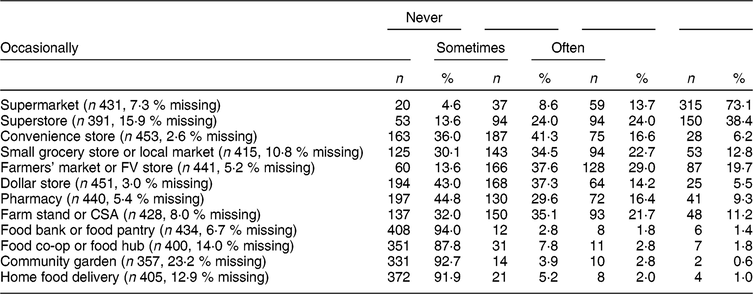
FV, fruit and vegetable; CSA, community-supported agriculture.
Frequency of shopping at different food sources
Table 2 outlines participants’ frequency of shopping at different food sources. When shopping for food within one’s community, the majority of participants reported often going to supermarkets (73·1 %). Many participants sometimes or occasionally shopped at superstores (48·0 %), convenience stores (57·9 %), small grocery stores or local markets (57·2 %), farmers’ markets or FV stores (66·6 %), dollar stores (51·5 %), pharmacies (46·0 %) or farm stands or community-supported agriculture (56·8 %). Almost all participants had never utilized food banks or food pantries (94·0 %), food co-ops or food hubs (87·8 %), community gardens (92·7 %) or home food delivery (91·9 %). None of the participants chose ‘This food resource is not present in my community/town’ as a response to any of the shopping locations. However, this response may not have been visible to viewers online. Therefore, missing values in this question likely reflect that these food sources are not available in participants’ communities.
Associations between frequency of shopping at different food sources and fruit and vegetable intake
While frequent visits to farmers’ markets or farm stands were associated with higher mean squared root fruit intake (P < 0·001), frequent visits to food co-ops or food hubs were associated with lower fruit intake (P = 0·004). On the other hand, frequent visits to convenience stores (P = 0·002) and dollar stores (P = 0·004) were associated with lower mean squared root vegetable intake. Interestingly, people who never visited a community garden consumed more vegetables than those who did (P = 0·008). When FV intakes were analysed together, frequent visits to farmers’ markets or farm stands remained associated with higher mean squared root FV intake (P < 0·001), and frequent visits to convenience stores also remained associated with lower mean squared root FV intake (P = 0·005). All significant pairwise comparisons are indicated in Table 3.
Associations between frequency of shopping at different food sources and fruit and vegetable (FV) intake among Strong Hearts, Healthy Communities (SHHC) trial participants and their family members and friends in rural upstate New York, USA (2017/2018)
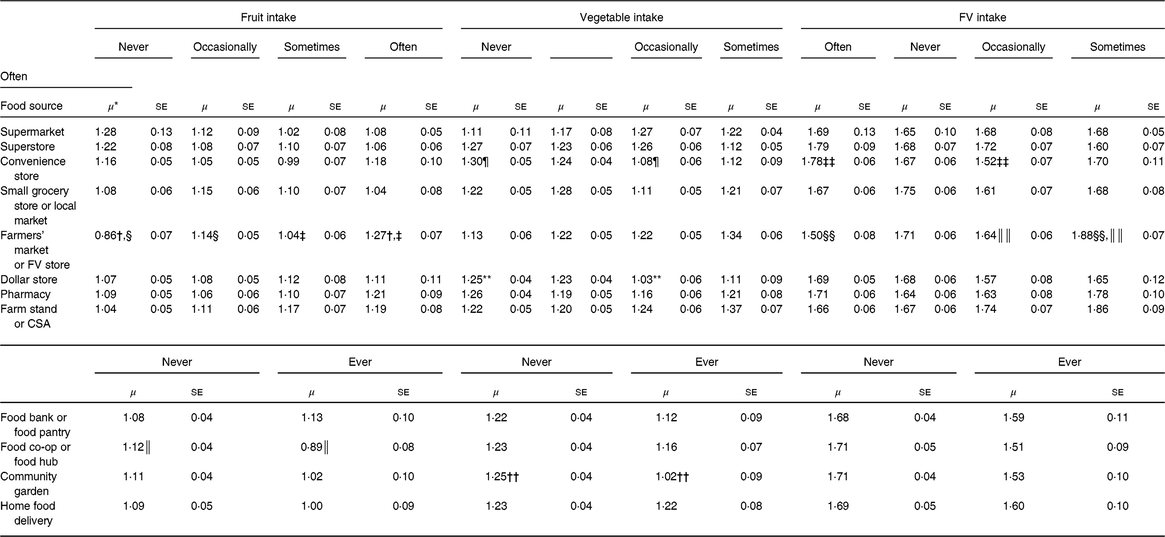
* All μ represent the estimated marginal mean squared root intakes; all models controlled for age, sex, BMI, education, employment status, marital status and whether participants did the majority of their food shopping in their community; participants’ town of residence and SHHC participants’ family and friend referrals were treated as random effects.
† Often v. never: Δ = 0·40, se = 0·09, P < 0·001.
‡ Often v. sometimes: Δ = 0·23, se = 0·07, P = 0·006.
§ Occasionally v. never: Δ = 0·28, se = 0·08, P = 0·002.
║ Ever v. never: Δ = −0·23, se = 0·08, P = 0·004.
¶ Sometimes v. never: Δ = −0·22, se = 0·06, P = 0·002.
** Sometimes v. never: Δ = −0·22, se = 0·06, P = 0·005.
†† Ever v. never: Δ = −0·23, se = 0·08, P = 0·008.
‡‡ Sometimes v. never: Δ = −0·27, se = 0·08, P = 0·003.
§§ Often v. never: Δ = 0·38, se = 0·09, P < 0·001.
║║ Often v. sometimes: Δ = 0·24, se = 0·07, P = 0·006.
Discussion
The present study is among the first to examine rural residents’ shopping behaviours and their associations with FV intake(Reference Pitts, Gustafson and Wu22,Reference Jilcott Pitts, Wu and McGuirt23) . We found that rural residents who shop at farmers’ markets or farm stands more frequently consume more FV. Similar relationships have been supported in other studies(Reference Pitts, Gustafson and Wu22–Reference Freedman, Choi and Hurley24). Previous studies have suggested that increasing visitation to farmers’ markets could be an effective strategy to enhance FV intake because such markets generally carry produce of higher quality, allow consumers to interact with growers, and expose consumers to nutrition information, cooking instructions and recipe ideas(Reference Feagan25–Reference Stewart28). Due to the cross-sectional nature of our data, it could be that people with a high intake of FV simply tend to shop at farmers’ markets or farm stands more often. In contrast, we found that frequent visits to convenience stores are associated with lower FV intake and frequent visits to dollar stores are associated with lower vegetable intake. Such findings are similar those of a study conducted in south-western Ontario, Canada(Reference Minaker, Olstad and Thompson20). Other studies also found that the lower availability of produce at convenience stores and dollar stores was associated with fewer produce purchases(Reference Ruff, Akhund and Adjoian29). However, no association was found between visits to convenience stores and dollar stores, and fruit intake. Unexpectedly, we found that visits to food co-ops or food hubs were associated with lower fruit intake and visits to community gardens were associated with lower vegetable intake. This could be biased by the fact that only 12·2 % of participants reported utilizing food co-ops or food hubs and only 7·3 % of them reported visiting community gardens.
We found no associations between FV intake and shopping frequency at other food sources. The lack of associations between FV intake and utilization of supermarkets, food banks and home food delivery could be due to the lack of variation among participants’ responses (73·1 % reported often going to supermarkets, 94·0 % never going to food banks and 91·9 % never using home food delivery). Our results were in contradiction with three urban studies which found associations between higher frequency of shopping at supermarkets, food co-ops and community gardens, and increased produce intake(Reference Minaker, Olstad and Thompson20,Reference Zenk, Schulz and Hollis-Neely30,Reference Alaimo, Packnett and Miles31) . The discrepancies between our study and others may have been the result of differences in locational and rural/urban characteristics as well as in differences between the methods used in assessing shopping behaviours and FV intake.
Our data on rural residents’ frequency of shopping at different food sources provides insight for informing future interventions. More than half of the participants reported going to convenience stores and dollar stores for food. Given that these food outlets are common in rural communities and our study showed that visits to these stores may be associated with lower vegetable intake, these food retail settings might serve as important venues for public health interventions to improve rural residents’ diet quality. Likewise, home food delivery was rarely used by rural residents and future studies could examine the feasibility of home food delivery services to enhance rural residents’ access to FV, particularly among older adults and the disabled, who may lack the ability to drive or travel independently for food.
The present study has some limitations. First, the cross-sectional nature of the study prevented examination of the causality of participants’ FV intake. Second, FV intake in cups was self-reported by participants and may have been subject to measurement error. Multiple methods of FV intake assessment should be used, such as the National Cancer Institute’s Fruit & Vegetable Intake Screener or the Automated Self-Administered 24-Hour (ASA24) Dietary Assessment Tool, and, ideally, other objective measures of FV intake including dermal carotenoid scans or blood carotenoids(Reference Shim, Oh and Kim32,Reference Subar, Laurence and Janet33) . Third, our study examined participants’ shopping behaviour only within their community and 33·3 % of participants reported doing the majority of their food shopping outside their community. However, our analyses controlled for whether participants shopped for the majority of their foods within their community. Future studies should also examine rural residents’ food shopping behaviours outside their community. Fourth, our results may not be generalized to other rural populations. The majority of the present study participants were midlife to older, employed females who were overweight or obese, and who had received education beyond high school. Fifth, we did not assess participants’ income in the present study. Given the associations found in our study and previous research associating income with food shopping at different sources(Reference Ledoux and Vojnovic34,Reference Stern, Robinson and Ng35) , including income is important for further understanding. Finally, our survey instrument may not have captured all the available rural food resources, particularly those promoted through word-of-mouth. Some of the food sources examined in our study, such as food hubs or co-ops, may not have been familiar or applicable to rural residents. Future studies should better characterize the unique foodscape in rural communities.
Conclusions
We found that visits to different food sources contribute differently to rural residents’ FV intake. Findings from the present study provide important insight for informing future food environment interventions related to helping rural residents to consume adequate FV.
Acknowledgements
Acknowledgements: The authors are grateful to the rural residents who participated in the study and Judy Ward (Cornell University) for her work and contributions to this research. Financial support: This study was supported by the National Institutes of Health and the National Heart, Lung, and Blood Institute (grant number R01 HL120702). The funders/sponsors had no role in the design, analysis or writing of this article. Conflict of interest: None. Authorship: R.A.S., S.C.F. and M.L.G. designed the study and wrote the protocol. M.L.G. and B.K.L. implemented the study. B.K.L. conducted the statistical analysis. B.K.L., S.M. and E.L. wrote the first draft of the manuscript. R.A.S., S.C.F. and M.L.G. provided substantial comments and feedback on preliminary drafts of this paper. All authors contributed to and have approved the final manuscript. Ethics of human subject participation: This study was conducted according to the guidelines laid down in the Declaration of Helsinki and all procedures involving human subjects were approved by the Cornell University Institutional Review Board (protocol number 1402004505). Written informed consent was obtained from all subjects.
Supplementary material
To view supplementary material for this article, please visit https://doi.org/10.1017/S1368980019000843
Author ORCID
Sara C Folta, 0000-0002-4366-5622.



