





Introduction
Waterhemp is a small-seeded, summer annual, dioecious, broadleaf weed with many traits that increase the potential for the evolution of herbicide resistance (Costea et al. Reference Costea, Weaver and Tardif2005). Waterhemp can emerge throughout the entire growing season in Ontario, Canada (Schryver et al. Reference Schryver, Soltani, Hooker, Robinson, Tranel and Sikkema2017; Vyn et al. Reference Vyn, Swanton, Weaver and Sikkema2007) which makes control difficult with either postemergence non-residual herbicides because waterhemp will continue to emerge following application or with soil-applied residual herbicides since the herbicides may degrade before the last waterhemp germinates. Waterhemp is a prolific seed producer; one female waterhemp plant under noncompetitive conditions can produce up to 4.8 million seeds (Hartzler et al. Reference Hartzler, Battles and Nordby2004); these seeds can remain viable in the soil seedbank for up to 17 yr (Burnside et al. Reference Burnside, Wilson, Weisberg and Hubbard1996). Additionally, waterhemp seed has variable dormancy enabling it to emerge in multiple cohorts throughout the growing season, thereby increasing the likelihood of escaping control with some herbicides. Previous studies have shown that waterhemp interference can reduce soybean yield by up to 73% in Ontario (Vyn et al. Reference Vyn, Swanton, Weaver and Sikkema2007) and corn yield by up to 74% (Cordes et al. Reference Cordes, Johnson, Scharf and Smeda2004; Steckel and Sprague Reference Steckel and Sprague2004).
Glyphosate-resistant waterhemp was first confirmed in Ontario from seeds collected from one field on Walpole Island in 2014 (Schryver et al. Reference Schryver, Soltani, Hooker, Robinson, Tranel and Sikkema2017). Multiple herbicide-resistant (MHR) waterhemp has now been confirmed in 18 Ontario counties (Figure 1). Surveys indicate that 61% of seed samples collected had four-way multiple resistance to herbicides in Group 2 (imazethapyr), Group 5 (atrazine), Group 9 (glyphosate), and Group 14 (lactofen; groups are categorized by the Weed Science Society of America; Benoit et al. Reference Benoit, Hedges, Schryver, Soltani, Hooker, Robinson, Laforest, Soufiane, Tranel, Giacomini and Sikkema2019). It has been estimated that uncontrolled MHR waterhemp, without an adjustment in weed management tactics to manage herbicide-resistant biotypes, could cause more than Can$11 million in losses for Ontario farmers; however, this amount can be reduced to Can$2.3 million if appropriate weed management strategies are implemented by growers (Soltani et al. Reference Soltani, Geddes, Laforest, Dille and Sikkema2022).
Multiple-herbicide-resistant waterhemp confirmed in 18 Ontario counties from Essex County adjacent to the Michigan border to Glengarry County adjacent to the Quebec border from surveys completed in 2014 to 2022.

The majority of weed science research for the past 75 yr has focused on the use of herbicides for weed management. Herbicides have provided cost-effective weed control for many years, but the repeated use of herbicides with the same mode of action has resulted in the evolution of herbicide-resistant weed biotypes (Moss Reference Moss2019). A diverse crop/weed management program that incorporates multiple weed management tactics is crucial for long-term sustainable crop production/weed management (Powles Reference Powles2022). Farmers need to proactively introduce more diversity in the crop/weed management programs by implementing diverse crop rotations, using tillage at strategic points in the rotation, planting cover crops where appropriate, planting crops in narrow rows at high seeding rates, purchasing combines that destroy weed seed viability at harvest time, and using multiple herbicide modes of action (Moss Reference Moss2019; Walsh et al. Reference Walsh, Harrington and Powles2012). Earlier studies have shown the potential for cropping systems that use minimum tillage, diverse crop rotations, competitive cultivars, increased seeding rates, proper fertilizer application, competitive cover crops, and efficacious herbicides (Blackshaw et al. Reference Blackshaw, O’Donovan, Harker, Clayton and Stougaard2006, Reference Blackshaw, Harker, O’Donovan, Beckie and Smith2008; Harker Reference Harker2013; Harker et al. Reference Harker, O’Donovan, Irvine, Turkington and Clayton2009). O’Donovan et al. (Reference O’Donovan, Harker, Turkington and Clayton2013) reported that combining cultural practices with strategically applied herbicides resulted in lower wild oat seeds in the soil seedbank and enhanced barley yield. The use of herbicides with multiple modes of action as part of an integrated weed management (IWM) program can be instrumental in reducing selection pressure for herbicide-resistant weed evolution (Gage et al. Reference Gage, Krausz and Walters2019).
This unique study will try to incorporate many of the principles of IWM to manage MHR (Groups 2, 5, 9, 14, and 27) waterhemp on Ontario farms. The development of an IWM strategy, based on a more comprehensive approach that includes crop rotation, cover crops, reduced soybean row width and increased seeding rate, and efficacious herbicides for control of MHR waterhemp can provide field crop producers with a strategy to deplete waterhemp seeds in the soil seedbank on their farms. The aim of this study is to document the decrease in the number of waterhemp seeds in the soil seedbank after each cycle of a three-crop rotation of corn, soybean, and winter wheat (this study is proposed to be 9 yr in length or three cycles of a three-crop rotation). The overall goal of this study is to determine which, if any, IWM practices will deplete the number of waterhemp seeds in the seedbank by 95% or more using weed management practices that can be implemented on most commercial farms in Ontario.
Materials and Methods
Two field experiments were established in 2017 on commercial Ontario farms near Cottam, ON, and on Walpole Island, ON, that had 413 and 40 million waterhemp seeds per hectare in the soil seedbank, respectively, when the study was initiated. The experiment consisted of six fully phased crop rotations (12 treatments) arranged in a randomized complete block with four replications (Table 1). Each treatment had a one-, two-, or three-crop rotation, and each crop had a fixed herbicide program associated with it. The experiment included six crop rotations (and herbicides used): 1) continuous soybean seeded in rows spaced 75 cm apart (glyphosate applied early postemergence [EPOST] 900 g ae ha−1 followed by [fb] glyphosate applied late postemergence [LPOST] 900 g ae ha−1); this is referred to as the “control” treatment; 2) continuous soybean seeded in rows spaced 37.5 cm apart and at a higher seeding rate (pyroxasulfone/flumioxazin applied preemergence [PRE] 240 g ae ha−1 fb glyphosate/dicamba applied postemergence [POST] 1,800 g ae ha−1); 3) soybean/wheat (pyrasulfotole/bromoxynil applied POST 205 g ae ha−1 + AMS 1 L ha−1 fb glufosinate 500 g ae ha−1 applied postharvest); 4) soybean/corn (S-metolachlor/atrazine/mesotrione/bicyclopyrone applied PRE 2,022 g ai ha−1 fb dicamba/atrazine applied POST 1,800 g ae ha−1); 5) corn/soybean/wheat, and 6) corn/soybean/wheat with a cover crop (oat and tillage radish) seeded after wheat harvest (Table 2).

Crop and herbicide information associated with experimental treatments. a

a Abbreviations: EPOST, early postemergence; fb, followed by; LPOST, late postemergence; PH, postharvest; POST, postemergence; PRE, preemergence.
All plots were 9 m wide and 10 m long. Locally adapted ‘DKB 10-01’ (2017), ‘DKB 12-57’ (2018), and ‘DKB 12-16’ (2019) soybean cultivars were seeded at the rate of ∼380,000 seeds ha−1 in rows spaced 75 cm apart or at ∼420,000 in rows spaced 37.5 cm apart. ‘DKC 46-82 RIB’ (2017), ‘DKC 46-82 RIB’ (2018), and ‘DKC 45-65 RIB’ (2019) corn hybrids were seeded at the rate of ∼83,000 seeds ha−1 in rows that were spaced 75 cm apart. ‘C&M Seeds: Easton’ spring wheat was seeded in the spring of 2017 in the year the study was initiated at the rate of ∼123 kg ha−1 in rows that were spaced 18 cm apart. ‘Pioneer 25R40’ (2018) and ‘Pioneer 25R74’ (2019) winter wheat cultivars were seeded at the rate of ∼123 kg ha−1 in rows that were spaced 18 cm apart in the fall (September/October). The cover crop, oat/tillage radish (75%/25% mix) was seeded at the rate of ∼34 kg ha−1 after wheat harvest.
Herbicides were applied PRE (no emerged waterhemp), POST, EPOST (∼7.5 cm waterhemp), LPOST (∼7.5 cm waterhemp), or postharvest following the harvest of winter wheat. All herbicide treatments were applied with a CO2-pressurized backpack sprayer (200 L ha−1 delivery at 240 kPa). The spray boom (1.0 m wide) had 3 ULD 120-02 nozzles (Hypro, New Brighton, MN, USA) spaced 0.5 m apart producing a spray width of 1.5 m.
Viable waterhemp seed density in the soil seedbank was determined before the establishment of the 9-yr study and was/will be determined after Years 3, 6, and 9 of this long-term study. Twenty-five soil cores were taken to a 15-cm depth within each plot in April 2017; the GPS coordinates for each soil core were recorded to ensure soil samples were/will be taken at identical locations in 2020, 2023, and 2026. Samples were taken in the center 25-m2 of the plot, in a grid-pattern 1 m from each other. Cores from each plot were combined in a plastic bag and stored in a freezer (−18 C) for ∼5 mo. Samples were then allowed to thaw and mixed with BM6 All-Purpose HP potting mix (Berger, Saint-Modeste, QC, Canada) at a volume ratio of 1:1. The mixture was placed into shallow germinating trays for 4 wk; emerged waterhemp was counted and removed weekly. At the end of the 4-wk cycle, the sample was placed back into plastic bags and into the freezer for 1 mo. This germinating process was completed four times in the greenhouse during the months of October, December, February, and April. After the April cycle in the greenhouse, the soil samples were discarded and the total number of emerged waterhemp plants was summed. Waterhemp ground cover was assessed around the first of June, July, August, and September of each year (0 = no waterhemp ground cover and 100 = complete waterhemp ground cover).
Data were analyzed for each site individually using SAS software (version 9.4; SAS Institute Inc., Cary, NC, USA) at a significance level of 0.05. The model used for the GLIMMIX procedure comprised the fixed effect of each fully phased treatment, and the random effect of the block within the experimental unit was defined as a block by fully phased treatment. The variable analyzed was the relative waterhemp plant number, calculated by expressing the plant number from soil cores collected after 3 yr as a percent of the plant number from soil cores collected immediately before experiment establishment. Tukey’s adjustment was applied to the comparison of least-square means. The lognormal distribution was used for analysis; least-square means and standard errors were back-transformed for the presentation of results.
Results and Discussion
The waterhemp ground cover in early September 2019 in continuous soybean in rows spaced 75 cm apart (glyphosate [EPOST] 900 g ae ha−1 fb glyphosate [LPOST] 900 g ae ha−1; “control” treatment) was 79%; continuous soybean in rows spaced 37.5 cm apart (pyroxasulfone/flumioxazin [PRE] 240 g ae ha−1 fb glyphosate/dicamba [POST] 1,800 g ae ha−1) was 0%, soybean/wheat (pyrasulfotole/bromoxynil [POST] 205 g ae ha−1 + ammonium sulfate 1 L ha−1 fb glufosinate [postharvest]) was 0%, soybean/corn (S-metolachlor/atrazine/mesotrione/bicyclopyrone [PRE] 2,022 g ai ha−1 fb dicamba/atrazine [POST] 1,800 g ae ha−1) was 0.2%, corn/soybean/wheat was 0.3%, and corn/soybean/wheat with a cover crop (oat and tillage radish) seeded after winter wheat combining was 0.2% (data not presented).
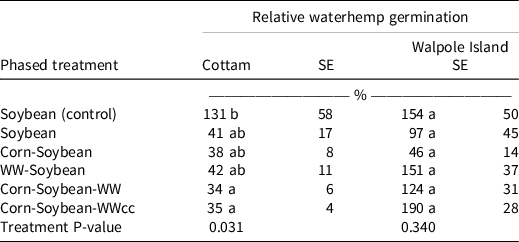
The number of viable waterhemp seeds in the seedbank at the Cottam and Walpole Island sites before establishing the experiments was 413 and 40 million seeds ha−1, respectively. In Cottam, after 3 yr of this study, the number of viable waterhemp seeds in the soil seedbank in the control treatment (continuous soybean in rows spaced 75 cm apart) increased by 31%, relative to when the experiment was initiated (Table 3). The number of viable waterhemp seeds in the soil seedbank decreased by 58% to 66% with the remaining five fully phased crop/weed management treatments. The number of viable waterhemp seeds in the soil seedbank in the three crop rotation treatments was significantly less than in the control treatment (continuous soybean in rows spaced 75 cm apart). Near Cottam, the number of viable waterhemp seeds in the seedbank after 3 yr of this study was reduced from 413 to as low as 107 million seeds/ha with the three-crop corn/soybean/winter wheat rotation. On Walpole Island, after 3 yr of this study, there was no difference in the number of viable waterhemp seeds in the seedbank among the six crop/weed management programs evaluated. The Walpole Island site had significantly lower glyphosate-resistant waterhemp density (40 vs. 413 and million seeds/ha) at the initiation of this study, which may be a factor in the different results between the study locations. Results indicate that implementing a diverse IWM program can potentially decrease the number of viable waterhemp seeds in the soil seedbank, at least in high-density weed seedbank environments.
Waterhemp germination from soil cores collected in 2020, as a percent of waterhemp germination from initial soil cores collected in 2017. a , b , c

a Abbreviations: SE, standard error of treatment means; WW, winter wheat; WWcc, winter wheat followed by oat + radish.
b Means within a column followed by the same lowercase letter do not differ significantly according to Tukey’s honestly significant difference test at P< 0.05.
c Soil cores were collected after the third year of a 1-, 2-, or 3-yr crop rotation cycle in six fully phased treatments. Initial soil cores were collected immediately prior to the experiment establishment at two locations; near Cottam, ON, and on Walpole Island, ON.
Studies conducted in western Canada have shown that implementing proper cultural practices that use diverse crop rotations, optimal crop seeding rates, optimal fertilizer placement, proper fertilizer placement, and targeted low-dose herbicide application can provide higher weed control and reduced weed seed return to the soil than less diverse cropping systems that rely heavily on the use of herbicides (Blackshaw et al. Reference Blackshaw, O’Donovan, Harker, Clayton and Stougaard2006, Reference Blackshaw, Harker, O’Donovan, Beckie and Smith2008; Harker Reference Harker2013; O’Donovan et al. Reference O’Donovan, Harker, Turkington and Clayton2013). Anderson (Reference Anderson2000) observed an 85% reduction in pigweed (Amaranthus spp.) seed production by the implementation of cultural practices that included taller cultivars, no-tillage, varying crop seeding rates and dates, and proper fertilizer placement under tilled and no-till cropping systems. O’Donovan et al. (Reference O’Donovan, Harker, Turkington and Clayton2013) reported up to a 40-fold decrease in wild oat seeds along with improved barley yield when cultural practices were combined with strategically applied herbicides. Harker et al. (Reference Harker, Clayton, Blackshaw, O’Donovan and Stevenson2003) observed that integrating optimal weed management tools can act synergistically for the control of wild oat and provide up to 6-fold greater control than a single weed management tactic. Harker et al. (Reference Harker, O’Donovan, Irvine, Turkington and Clayton2009) also reported that IWM strategies that use tall cultivars, twice-normal seeding rate, and a diverse crop rotation lowered wild oat seed production 97% in barley.
Results of this study indicate that the implementation of diverse crop/weed management strategies provides excellent MHR waterhemp control in corn, soybean, and wheat with reduced viable waterhemp seed in the soil seedbank. Farmers should proactively introduce more diversity in their crop/weed management programs, including implementing diversified crop rotations, increasing crop seeding rates, reducing crop row width, using tillage at strategic points in the rotation, planting a cover crop after winter wheat combining, and incorporating several herbicide modes of action over time. The purchase of a combine with harvest weed seed control should also be considered. This research will be continued until 2026 at both sites (Cottam and Walpole Island) to complete the second and third cycles of a three-crop rotation to determine the long-term effect on the depletion of the number of viable waterhemp seeds in the seedbank using IWM techniques.
Acknowledgments
We are grateful to the Grain Farmers of Ontario for funding this study. No other conflicts of interest have been declared.



 Open access

