




Abrahamic religions such as Islam and Christianity typically characterize God as omniscient: God knows all truths, including truths about people’s intentions and actions. In his discussion of omniscience, Thomas Aquinas (Summa Theologiae I, q. 14) refers to the following passages in the Bible, which are often taken to suggest divine omniscience: ‘With God are wisdom and strength; he has counsel and understanding’ (Job 12:13) and ‘O the depth of the riches of the wisdom and of the knowledge of God!’ (Rom. 11:33) (Aquinas Reference Aquinas2006; cited in Wierenga Reference Wierenga and Zalta2021). In the New Testament, Peter replies to Jesus as follows, ‘Peter … said, “Lord, you know all things; you know that I love you”’ (John 21:17).Footnote 1 In the Qur’an, the word ‘alim’ (which is also one of God’s 100 names) is mentioned thirty-two times to refer to God All-knowing. Muslims believe that God is ‘bikulli sha’in alim’, which means that ‘He is knowledgeable of everything’. God’s foreknowledge in the Qur’an and in the writings of Islamic scholars and theologians is referred to as ‘Ilm al-ghayb’, which translates as ‘the knowledge of the unseen’. Sourat al Jinn of the Qur’an (verses 26 and 27) states: ‘He is the One who knows the unseen (ghayb), and He reveals His unseen (ghayb) to no one, except to the messenger He is pleased with.’ Sourat Al-Naml (verse 65) states: ‘None in the heavens or on earth, except Allah, knows what is hidden: nor can they perceive when they shall be raised up (for Judgment).’ Another verse from Sourat Al-An’aam (verse 59) states:
With Him are the keys of the unseen; none knows them except He. And He knows everything on land and in the sea. Not a leaf falls but He knows it; and there is not a single grain in the darkness of earth, nor is there anything wet or dry, but is in a clear record.
Finally, qada and qadar (divine decree and measurement) is the sixth pillar of faith for Muslims. ‘Qada’ in Arabic means ‘judgment, execution, ordain, decree or decision’ and ‘qadar’ comes from the verb ‘qadr’, which means to assess and to measure, a notion in part related to foreknowledge (Wan Zakaria Reference Wan Zakaria2015).
Philosophers and theologians have usually embraced this characterization of God while debating the precise characterization of omniscience. A few have proposed revisionary accounts of God’s knowledge, assigning to God the amount of knowledge that is consistent with perfection, but falls short of complete omniscience (Nagasawa Reference Nagasawa2017); others have discussed the significance of non-propositional forms of knowledge for God’s omniscience (Zagzebski Reference Zagzebski and Kvanvig2008). In this article, we are only concerned with God’s propositional knowledge.
Both Christian and Muslim philosophers and theologians have recognized that God’s omniscience seems to challenge human free will, a challenge known as ‘theological fatalism’ (e.g. Belo Reference Belo2007; Bhat Reference Bhat2006; Cillis Reference Cillis2013; Pike Reference Pike1965; Timpe Reference Timpe2013; Zagzebski Reference Zagzebski1991). In the Christian tradition, Augustine’s De Libero Arbitrio (Augustine Reference Augustine and Williams1993) and Boethius’s The Consolation of Philosophy (Boethius Reference Boethius and Walsh1999) were among the first to formulate the problem of theological fatalism. If God has foreknowledge that an agent will complete some action, then necessarily that agent will complete some action; but if an agent necessarily completes an action, then that agent does not complete it freely. This formulation of the challenge raised by divine foreknowledge to free will has long been known to be inconclusive (at least since Thomas Aquinas), but alternative, more compelling formulations have been put forward (Hunt and Zagzebski Reference Hunt, Zagzebski and Zalta2022; Pike Reference Pike1965; Zagzebski Reference Zagzebski1991). In particular, the infallibility of divine foreknowledge is crucial to challenging free will: It is because God could not have been wrong that human agents could not act otherwise.
In this article, we only consider one component of the problem of theological fatalism: divine foreknowledge. Our goal is to examine the extent to which in different religious traditions Christians and Muslims endorse divine foreknowledge. If they do, the problem of theological fatalism is not a mere (albeit important) philosophical difficulty, but a problem rooted in lay believers’ intuitive understanding of God.
Here is how we will proceed. We first review the central ideas behind our overall project. We then discuss what we should expect about believers’ agreement with divine foreknowledge in the study reported in this article. The following two sections present the study itself; we then report the results. The last section discusses their significance.
Our overall project: how to solve the psychological problem of theological fatalism?
Folk theories are made of concepts and (implicit) principles that allow people to make sense of their environment (Gelman and Legare Reference Gelman and Legare2011). Folk biology, for instance, includes concepts such as the concepts of birth, growth, inheritance, innate nature (Griffiths et al. Reference Griffiths, Machery and Linquist2009), and disease (Machery Reference Machery, Hens and de Block2023), as well as principles that allow people to make sense of the biological world, for example the existence of species and the similarity between parents and offspring. Theory of mind allows people, among other things, to explain and predict behaviour by deploying concepts such as the concepts of belief and desire (e.g. Nichols and Stich Reference Nichols and Stich2003), and principles, such as those connecting perceptual beliefs and lines of sight (e.g. Povinelli and Eddy Reference Povinelli and Eddy1996).
In addition to folk theories such as folk biology, folk physics, and theory of mind, people seem to have a folk epistemology, viz. a theory of what it means to know something or have justified beliefs (e.g. Gerken Reference Gerken2017; Heintz and Taraborelli Reference Heintz and Taraborelli2010; Kitchener Reference Kitchener2002; Machery et al. Reference Machery2017). This folk epistemology includes the concept of knowledge, and some epistemic principles (e.g. that one cannot know by sheer luck) appear to be surprisingly robust across cultures (Machery et al. Reference Machery2017). Text-analytic evidence also suggests that the concept of knowledge might be infallibilist, at least for English speakers: Nichols and Pinillos (Reference Nichols and Pinillos2018) report that in the CHILDES corpus occurrences of ‘to know that’ are never accompanied by an expression of fallibility such as ‘I am not sure’, in contrast to occurrences of ‘to think that’. That is, in child-directed speech, parents appear to be uttering sentences such as (1), but not sentences such as (2):
1) I think the bread is on the table. I am not sure.
2) I know the bread is on the table. I am not sure.
By appealing to Bayesian ideas about confirmation, Nichols and Pinillos conclude that children are likely to acquire an infallibilist concept of knowledge: Since no expression of fallibility comes with utterances of ‘to know that’, the likelihood that this expression expresses an infallibilist concept of knowledge is higher than the likelihood that it expresses a fallibilist concept of knowledge.
Psychologists have also examined extensively, often in a developmental context, how people detect and understand agency (e.g. Johnson et al. Reference Johnson, Slaughter and Carey1998). When we view others as agents, we view them as having goals and as being in control of their actions, which fulfil their goals in an efficient and rational manner (Csibra et al. Reference Csibra, Gergely, Bíró, Koos and Brockbank1999; Woodward Reference Woodward1998). Recently, Machery and colleagues (Machery Reference Machery, Hens and de Block2023) have shown that merely showing visual cues of agency such as continuous, self-initiated motion is enough to lead people to assign free will and self-control to a marble, exactly as visual cues lead people to assign beliefs and desires to a marble (Heider and Simmel Reference Heider and Simmel1944).
Sometimes the domains of folk theories overlap, and the same events and processes can be conceptualized in different ways. Thus, folk epistemology and the folk theory of agency both apply to human actions. We can reason about the epistemic status of beliefs about past, present, and future actions; we can assign knowledge of past, present, and future actions: You probably know that G.W. Bush decided to invade Iraq; Edouard Machery assigns to his coauthor, Ameni Mehrez, the knowledge that he is right now editing this very sentence; finally, Ameni Mehrez assigns to Edouard Machery the knowledge that many French families will go to the beach during August.
The conceptualizations rooted in folk theories can inhibit one another, and taking one perspective about an event or a process (applying the concepts and principles constitutive of one theory) can prevent one from taking another perspective. For instance, viewing an action as a physical process seems to stand in the way of viewing it as a genuine action. Jack and colleagues (Jack et al. Reference Jack2013) examined the neural correlates of mechanical thinking and of social cognition, and found mutual inhibitions: Solving physical puzzles inhibited the neural correlates of social cognition and vice-versa.
We hypothesize that folk epistemology and the folk theory of agency cannot be easily brought to bear on a future action simultaneously: If one views an event as a human action, one views it as free and one thinks of the agent as responsible for this action (Machery et al. Reference Machery, Kneer, Willemsen, Newen, Murray and Henne2023); if for the folk, freedom requires the capacity to have done otherwise, the agent could thus have done otherwise, and the action didn’t have to occur; but if one views it as known in advance, one is inclined to view it as unavoidable, and thus as not free. Of course, from a philosophical point of view, foreknowledge is arguably consistent with free will if knowledge isn’t infallible:Footnote 2 If so, knowledge that an agent will act in a particular way is consistent with the fact that this agent could act differently (although it is not consistent with them actually acting differently). But first, as noted earlier, the folk concept of knowledge might well be infallibilist, and if it is, foreknowledge, as conceived by lay people, might be incompatible with free will; second, even if the folk concept of knowledge isn’t infallibilist, it might still be psychologically difficult to view a future action as both known and free. To distinguish it from the philosophical problem, we call this difficulty the ‘psychological problem of theological fatalism’.
This hypothesized tension between a folk-epistemological and a folk-agentic perspective on human action might be the source of the philosophical problem of theological fatalism. (In fact, many philosophical problems might be rooted in tensions in lay cognition; Porter et al. Reference Porterin press; Rose et al. Reference Rose2020.) Philosophers and theologians carefully elaborate the commonsensical puzzlement about how an action can be free but infallibly known in advance, as it must be if God has infallible foreknowledge of future actions.
In contrast to philosophers’ sophisticated discussion of the philosophical problem, lay believers can alleviate the tension between divine foreknowledge and free will in lay cognition by denying free will or by curtailing divine foreknowledge. Our overall research about religious traditions (the first part of which is reported in this article) is rooted in the hypothesis that different religious traditions prefer one of these two options. Specifically, we hypothesize that lay believers within Sunni IslamFootnote 3 and Christian denominations influenced by Calvinism deny, or at least deemphasize, free will and assert divine foreknowledge, while other traditions such as Catholicism emphasize free will, and find ways to curtail, or at least deemphasize, divine foreknowledge.Footnote 4 Lay believers, if not philosophers and theologians, might thus alleviate the psychological problem of theological fatalism differently.
Available evidence relevant to the hypothesis guiding our overall research is mixed. Consistent with the hypothesis that Sunni Islam deemphasizes free will, among Turks, religiosity correlates with the subscale of the Free Will and Determinism Scale (‘FAD-plus’) called ‘fatalistic determinism’, which uses items such as ‘I believe that the future has already been determined by fate’ and ‘Fate already has a plan for everyone’ (Yilmaz et al. Reference Yilmaz, Bahçekapili and Harma2018). A third of a sample of 347 Muslim Americans agreed that ‘Everything in life is determined by God’ (Haddad and Lummis Reference Haddad and Lummis1987). According to a PEW study conducted between 2011 and 2012 (Lugo et al. Reference Lugo, Cooperman, Bell, O’Connell and Stencel2012), in nineteen out of the twenty-three countries surveyed, seven out of ten Muslims said they believe in fate. The numbers are the highest for countries like Tunisia (98 per cent), Egypt (93 per cent), and Jordan (91 per cent), and the lowest in Albania (44 per cent) and Kosovo (50 per cent). Muslims are also more fatalist than Christians with respect to poor health (e.g. Baron-Epel et al. Reference Baron-Epel, Friedman and Lernau2009; Hess and McKinney Reference Hess and McKinney2007; Pipes Reference Pipes2015). According to the World Value Survey conducted in 2004 (Acevedo Reference Acevedo2008), Muslims are more fatalistic than Catholics and Protestants.Footnote 5
Turning to Christians, consistent with the hypothesis that Calvinism might deemphasize free will, Weber (Reference Weber1930) famously highlighted the significance of Calvinists’ views about predetermination in their economic success and in their contribution to the birth of capitalism. Van Elk and colleagues (Van Elk et al. Reference Van Elk, Rutjens and van Harreveld2017) found that protestants have weaker beliefs in free will than Catholics. On the other hand, using data from the World Value Survey, Ruiu (Reference Ruiu2013) found little difference in the influence of religious affiliation on fatalism,Footnote 6 although religiosity in general promoted fatalism.
The present study: folk beliefs about divine foreknowledge across religions
It may seem obvious, particularly to believers, that the faithful endorse divine foreknowledge, but do they really, and do they equally across Abrahamic religions and religious traditions?
Psychologists and anthropologists have proposed that a belief in ‘big Gods’ (aka ‘moralizing Gods’) has played an important role in the evolution of cooperation in large groups, a characteristic of human hypersociality (Norenzayan Reference Norenzayan2013; Norenzayan et al. Reference Norenzayan2016). In a large group, it is difficult to distinguish people who are pulling their weight for the common good from free riders, and the former are thus at a disadvantage: In contrast to them, free riders reap the benefit of others’ cooperation without paying any cost. Cooperation is thus threatened. A belief in knowing, powerful, and just Gods (‘big Gods’) is hypothesized to motivate potential cooperation among group members that would otherwise be free riders: Since Gods know how group members behave and can punish them for their actions, potential free riders are incentivized to cooperate (for relevant evidence, see Lang et al. Reference Lang2019). The big-Gods hypothesis about the evolution of human cooperation assumes that believers assign extensive knowledge of human actions to Gods; in this respect, the Abrahamic God, omniscient and omnipotent as it is, is the epitome of big Gods. While the big-Gods hypothesis emphasizes omniscience, it has in fact little to say about whether believers in big Gods, including the Christian and Muslim God, endorse divine foreknowledge. (In fact, ‘foreknowledge’ does not appear in Norenzayan’s influential book, Big Gods: how religion transformed cooperation and conflict.) Rather, the focus is on God’s knowledge of current actions (God is monitoring the decisions group members are taking) and past actions (God knows that group members have done and will reward or punish them accordingly).
Furthermore, it might be attractive to curtail God’s omniscience in some way in order to preserve free will. Indeed, in philosophy, a common, but controversial response to the challenge divine foreknowledge raises for free will is to deny that there are truths about future free actions and thus that God has foreknowledge of those. This might be the case because there are no truths about future contingents in general (Prior Reference Prior1962) or just about future free actions (Swinburne Reference Swinburne2017). Open theists, among others, hold that the future is undetermined because of human free will, and that God knows that it is undetermined (e.g. Pinnock et al. Reference Pinnock, Rice, Sanders, Hasker and Basinger1994). Curtailing foreknowledge partly or fully preserves God’s omniscience since God knows everything there is to know, but omniscience is only preserved because there is less to know than one might have thought.
So, it is not entirely clear whether we should expect lay believers to endorse divine foreknowledge. In the study reported in this article, we hypothesized that the salience of divine foreknowledge varies across religions or religious traditions. While all the religious traditions we consider accept both foreknowledge and free will, they disagree about how to understand their relation, and they emphasize foreknowledge to a greater or smaller extent. Sunni Islam often emphasizes God’s foreknowledge, as we noted earlier (Wan Zakaria Reference Wan Zakaria2015).Footnote 7 We expected Calvinism to be similar to Sunni Islam in this respect because of the connection between providence and predetermination: God predetermines and as a result foresees who will be saved and who will be damned. As Calvin put it (Institutes of the Christian Religion, 1.16.2), ‘nothing happens but what [God] has knowingly and willingly decreed’.Footnote 8 By contrast, Catholicism deemphasizes foreknowledge, while emphasizing free will and the responsibility of individuals. In the Catechism of the Catholic Church, ‘foreknowledge’ appears only once (II, 599, 155), and its significance is presented as follows:
St. Peter explains to the Jews of Jerusalem in his first sermon on Pentecost: “This Jesus [was] delivered up according to the definite plan and foreknowledge of God.” This Biblical language does not mean that those who handed him over were merely passive players in a scenario written in advance by God.Footnote 9
Providence is extensively discussed, but as is the case of foreknowledge, discussions of providence highlight its compatibility with free will (II, 306, 81): ‘God is the sovereign master of his plan. But to carry it out he also makes use of his creatures’ cooperation. … God grants his creatures not only their existence, but also the dignity of acting on their own.’Footnote 10
Further, the Catechism emphasizes the significance of free will throughout (with more than 100 occurrences of ‘freedom’; see, e.g. Article 3 ‘Man’s freedom’, 430).
Finally, Methodists present a difficult case. Providence plays an important role for them since on their view God foresees but does not predetermine which individuals will be saved, freely accepting divine grace, and which individuals will be damned, freely rejecting divine grace.Footnote 11 So, divine foreknowledge plays an important role in Methodist theology, but is always coupled to an emphasis on human free will and responsibility.
Finally, we hypothesized that agreement with divine foreknowledge is partly influenced by motivational factors. Assigning to an omnipotent being the foreknowledge that an agent will do something wrong might feel wrong to lay people: If God knows in advance that an agent will sin, why doesn’t God prevent this sin to happen? The philosophical problem of evil develops this commonsensical idea (Leibniz 1709/Reference Leibniz and Huggard1985; Mackie Reference Mackie1955). Perhaps, to avoid this question, lay believers might be less inclined to agree with divine foreknowledge of morally wrong actions.
In light of the considerations discussed in the previous paragraphs we preregistered the following four hypotheses:
H1: Participants will be more likely to ascribe knowledge to God than to a human being.
H2: Participants will be more likely to ascribe knowledge to God for neutral actions compared to bad and good actions.
H3: The difference between God’s and human knowledge will be larger for neutral actions compared to bad and good.
H4: Muslims, followers of the Church of Nazarene [see endnote 12], and Calvinists will be more likely to assign knowledge to God in comparison to a human being than Catholics and Methodists.
Participants
The study was preregistered on OSF (doi.org/10.17605/OSF.IO/SKJA9), and we report below all the deviations from our preregistration. To determine sample size, we collected pilot data from 152 American participants recruited on Prolific and 43 Muslim participants sampled by snowball sampling on social media (Facebook). In addition to commenting on a pilot version of the final survey (described in the next section), their answers were used to estimate the relevant parameters of our model (for two religious groups only). On the basis of these estimates, we simulated increasingly large datasets (from 200 to 500 participants) using the simr package in R. Setting alpha at .005 as preregistered (Benjamin et al. Reference Benjamin2018), we determined that a sample size of 250 per religious group was sufficient to get a power larger than .8 to identify effects comparable to those estimated based on our pilot data. The pilot data, R code, and power curves are available at OSF (osf.io/ecdrj/).
We collected participants from five different religious groups: Muslims in Tunisia, Muslims in the USA, Calvinists in the USA, Catholics in the USA, Methodists in the USA.Footnote 12 We examined Muslims because of the possibility that divine foreknowledge might be more compelling to them, compared to some Christian traditions. We sampled Muslims in two different countries and cultural contexts for two reasons: (1) If we found differences between Tunisian and American Christians, it wouldn’t be clear that the differences are due to religion rather than differences in their respective cultural contexts; (2) if we failed to find any difference between American Muslims and Christians, it might be because of their shared cultural context and in spite of the religious differences. We examined Calvinists because of their commitment to the doctrine of providence and predetermination and Catholics because of the qualifications attached to the divine providence in the Catholic Catechism, as explained earlier. Finally, we surveyed Methodists because while they emphasize foreknowledge, it is always in the context of defending human free will.
The Tunisian sample was collected in Tunis, Tunisia by the Tunisian polling company One-to-One for Research and Polling. Participants were surveyed at their home, and they were not paid. The four other samples were collected online by CloudResearch and Qualtrics Panels, with the exception of a subset of Calvinist participants. Participants were all born in the USA and all reported being 18 or above. Participants recruited by CloudResearch and Qualtrics Panels were paid a small amount for participation. CloudResearch and Qualtrics Panels were asked to balance gender and age to the extent it was possible. Because online data companies were unable to recruit a large enough sample of Calvinists, we ultimately decided to rely on snowball sampling to increase our sample size. In line with our power analysis, we aimed to collect 300 participants meeting our preregistered exclusion criteria (more on these below), but we were not always able to do this. We aggregate the data collected in the USA (by the two data companies and by snowball sampling).
Table 1 reports the characteristics of the five samples.
Characteristics of the five samples (education: 1 = elementary school, 2 = high school, 3 = some college, 4 = college degree, 5 = MA, 6 = phd)

Our samples were very religious.Footnote 13 On a scale ranging from 1 (‘Definitely not true’) to 5 (‘Definitely true’), the average answer for each group was superior to 4 for the measure of God’s significance in participants’ personal life (‘intrinsic religiosity’), which averages three questions (e.g. ‘My religious beliefs are what really lie behind my whole approach to life’). The Tunisian participants show the lowest average in terms of organizational activities. This is to be expected since half of the sample is composed of women and in Islam women are less likely to engage in organizational practices such as going to the Mosque (Gilliat-Ray Reference Gilliat-Ray2010). Consistent with our data, existing studies show that differences exist even among Muslims, with American Muslim women being more engaged and more likely to attend the Mosque than Muslim women living in Muslim-majority countries (Jamal Reference Jamal2005).Footnote 14 Our American samples were also on average college educated, but our Tunisian sample was on average less educated.
Methods
The study was approved by the Institutional Review Board at the University of Pittsburgh. Participants either took the study in person (Tunisia) or online (American participants). Tunisians took the survey in Arabic, Americans in English. Participants in the USA were asked what their religion was; they were terminated if they did not answer ‘Methodist’, ‘Calvinist’, ‘Catholic’, or ‘Muslim.’ They were also terminated if they answered less than 3 on a 5-point scale in response to the following question: ‘On a scale from 1 to 5 where 1 = not religious at all and 5 = very religious where do you place yourself?’
Participants were then randomly assigned to one of three conditions, which varied the moral valence of the actions described in the vignettes: neutral, good, and bad. In each condition, participants read 12 short vignettes in a random order. Each vignette described a decision made by an agent and the resulting action. It was then followed by four questions in a fixed order. The first question was a trivial comprehension question, which typically merely restated a piece of information in the vignette (Yes/No answer). Correct Yes and No answers were approximately balanced. The second question asked whether God knew that the agent would act this way on a 5-point Likert scale (ranging from 1 ‘Strongly disagree’ to 5 ‘Strongly agree’). The third question asked whether the agent’s neighbor knew that the agent would act this way on a 5-point Likert scale (ranging from 1 ‘Strongly disagree’ to 5 ‘Strongly agree’). Questions 2 and 3 provide us with our main measure: Participants endorse divine foreknowledge if their answers are larger in response to Question 2 than to Question 3.Footnote 15 We chose ‘neighbour’ as a control for divine foreknowledge since a neighbour can have some knowledge about their neighbor’s behavioral dispositions. Finally, we asked participants to assess, ‘How bad or how good was the agent’s action?’ the action was on a 5-point scale (ranging from 1 ‘Extremely bad’ to 5 ‘Extremely good’). The following three vignettes are drawn respectively from the neutral, good, and bad conditions.
Neutral condition
John is hungry. He realizes he has no food. So, he decides to buy some food from the grocery store near his house. John goes to the grocery store.
Do you agree with the following sentence? John was hungry. (Yes/No)
To what extent do you agree with the following sentence? Before John makes his decision, God knows that John will go the grocery store. (5-point Likert scale)
To what extent do you agree with the following sentence? Before John makes his decision, John’s neighbor knows that John will go to the grocery store. (5-point Likert scale)
How bad or how good was John’s action? (5-point scale)
Good condition
Ed is an understanding man. One day, a coworker says something hurtful, but it is an accident. So, Ed decides to forgive him. He forgives him.
Do you agree with the following sentence? Ed has coworkers. (Yes/No)
To what extent do you agree with the following sentence? Before Ed makes his decision, God knows that he will forgive his coworker. (5-point Likert scale)
To what extent do you agree with the following sentence? Before Ed makes his decision, Ed’s neighbor knows that he will forgive his coworker. (5-point Likert scale)
How bad or how good was Ed’s action? (5-point Likert scale)
Bad condition
Isabel is an exploitative person. She is part of a team for a new project at work. She decides to let the other team members do most of the work. Isabel lets the other team members do most of the work.
Do you agree with the following sentence? Isabel has a job. (Yes/No)
To what extent do you agree with the following sentence? Before Isabel makes her decision, God knows that she will let the other team members do most of the work. (5-point Likert scale)
To what extent do you agree with the following sentence? Before Isabel makes her decision, Isabel’s neighbor knows that she will let the other team members do most of the work. (5-point Likert scale)
How bad or how good was Isabel’s action? (5-point scale)
The name of the character was varied from vignette to vignette. In the USA, stereotypically male and female names and names associated with different racial groups were used. In Tunisia, the names of men and women all sounded Tunisian. The full text of the vignettes can be found on OSF.Footnote 16
After the 12 vignettes, participants were asked to complete the DUREL (Koenig and Büssing Reference Koenig and Büssing2010) if they were Christian or a modified version of the DUREL if they were Muslims. Participants then completed a short demographic questionnaire. The DUREL is a brief, five-item questionnaire that measures three dimensions of religiosity: ‘organizational religious activity, non-organizational religious activity, and intrinsic religiosity’ (Koenig and Büssing Reference Koenig and Büssing2010). The DUREL has been extensively validated, including in Muslim contexts (e.g. Esat et al. Reference Esat, Smith, Rizvi and Koenig2021), and it has been used in more than 100 studies. We did not use the exact translation of the DUREL (generously shared with us by Harold Koening), but modified it to take into account the linguistic peculiarities of Tunisian Arabic, and we also changed the measure of non-organizational religiosity (the second factor of DUREL): We asked them how often do participants listen or read the Qur’an. The revised version of the DUREL in Arabic and in English can be found on OSF.
The procedure was similar in Tunisia except for the fact that Tunisians were not asked whether they were Muslim and for the further fact that the names were all replaced by Arab male and female names. The vignettes had been translated in Tunisian Arabic and backtranslated by two native speakers; the translation was then checked by the first author of this article, a native speaker of Tunisian Arabic.
Results
Participants were excluded if they did not complete the survey or if they failed one of the 12 comprehension questions (as preregistered).Footnote 17 The significance level was set at .005 following the recommendations by Benjamin and colleagues (Benjamin et al. Reference Benjamin2018). Results are ‘suggestive’ then their p-value is between .05 and .005, and in need of further confirmation. We did not aggregate the data from Tunisian and American Muslims. Data were analyzed on R using lme4. The complete data set and the code are available on OSF.
We examined whether our classification of vignettes as describing a good, neutral, and bad action was in line with participants’ own judgements. Figure 1 reports participants’ mean answer to the fourth question for the 36 vignettes and the 5 religious groups.
Answers to the question about the moral valence of the action in each vignette.
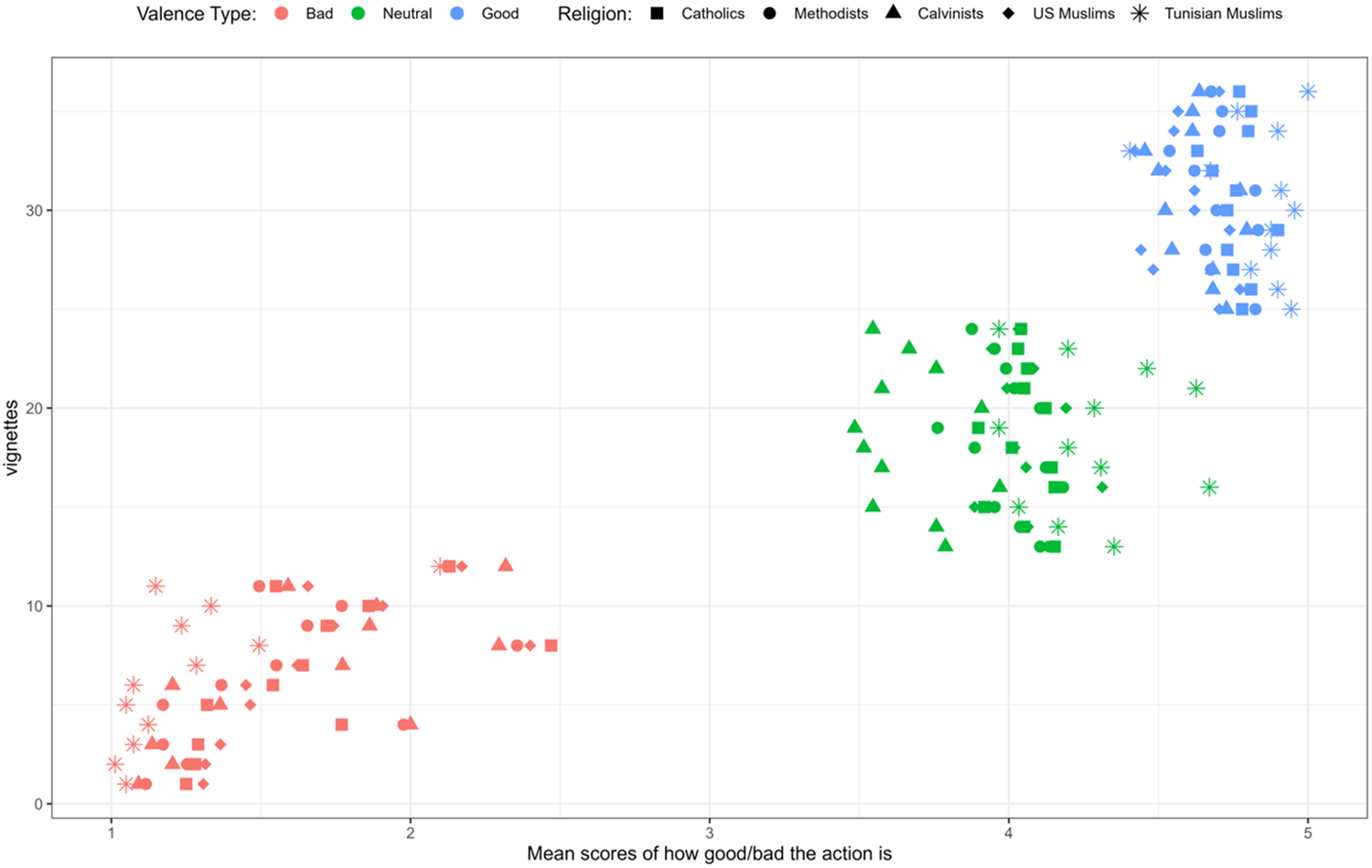
Participants’ judgements were in line with ours, and there was little variation across religious groups and vignettes.
We treated the moral valence of the action (three levels: neutral, good, bad), religious affiliation (five levels), and whether the question asked about human or divine foreknowledge (two levels: human, divine) as fixed factors; we also examined all two-way interactions: whether the effect of valence varied across religions, whether it varied depending on who has foreknowledge, and whether the effect of who has foreknowledge (God versus neighbour) varied across religions; finally, we varied the intercept by participant and vignette.Footnote 18 To summarize our model was as follows:
 \begin{equation*}\begin{gathered}
\text{Answer}_\text{P,V}\sim{\text{ }}{{{\beta }}_0} + {{{\beta }}_{{\text{0P}}}} + {\text{ }}{{{\beta }}_{{\text{0V}}}} + {\text{ }}{{{\beta }}_1}\text{Valence}_\text{P} + {{{\beta }}_2}\text{Religion}_\text{P} + {{{\beta }}_3}\text{Foreknowledge} + \hfill \\
{{{\beta }}_4}\text{Valence}_\text{P}*\text{Religion}_\text{P} + {{{\beta }}_5}\text{Valence}_\text{P}*\text{ Religion}_\text{P} + {{{\beta }}_6}\text{Foreknowledge}*\text{Religion}_\text{P} \hfill \\
+ {\varepsilon _{\text{P}}}; \hfill \\
\end{gathered} \end{equation*}
\begin{equation*}\begin{gathered}
\text{Answer}_\text{P,V}\sim{\text{ }}{{{\beta }}_0} + {{{\beta }}_{{\text{0P}}}} + {\text{ }}{{{\beta }}_{{\text{0V}}}} + {\text{ }}{{{\beta }}_1}\text{Valence}_\text{P} + {{{\beta }}_2}\text{Religion}_\text{P} + {{{\beta }}_3}\text{Foreknowledge} + \hfill \\
{{{\beta }}_4}\text{Valence}_\text{P}*\text{Religion}_\text{P} + {{{\beta }}_5}\text{Valence}_\text{P}*\text{ Religion}_\text{P} + {{{\beta }}_6}\text{Foreknowledge}*\text{Religion}_\text{P} \hfill \\
+ {\varepsilon _{\text{P}}}; \hfill \\
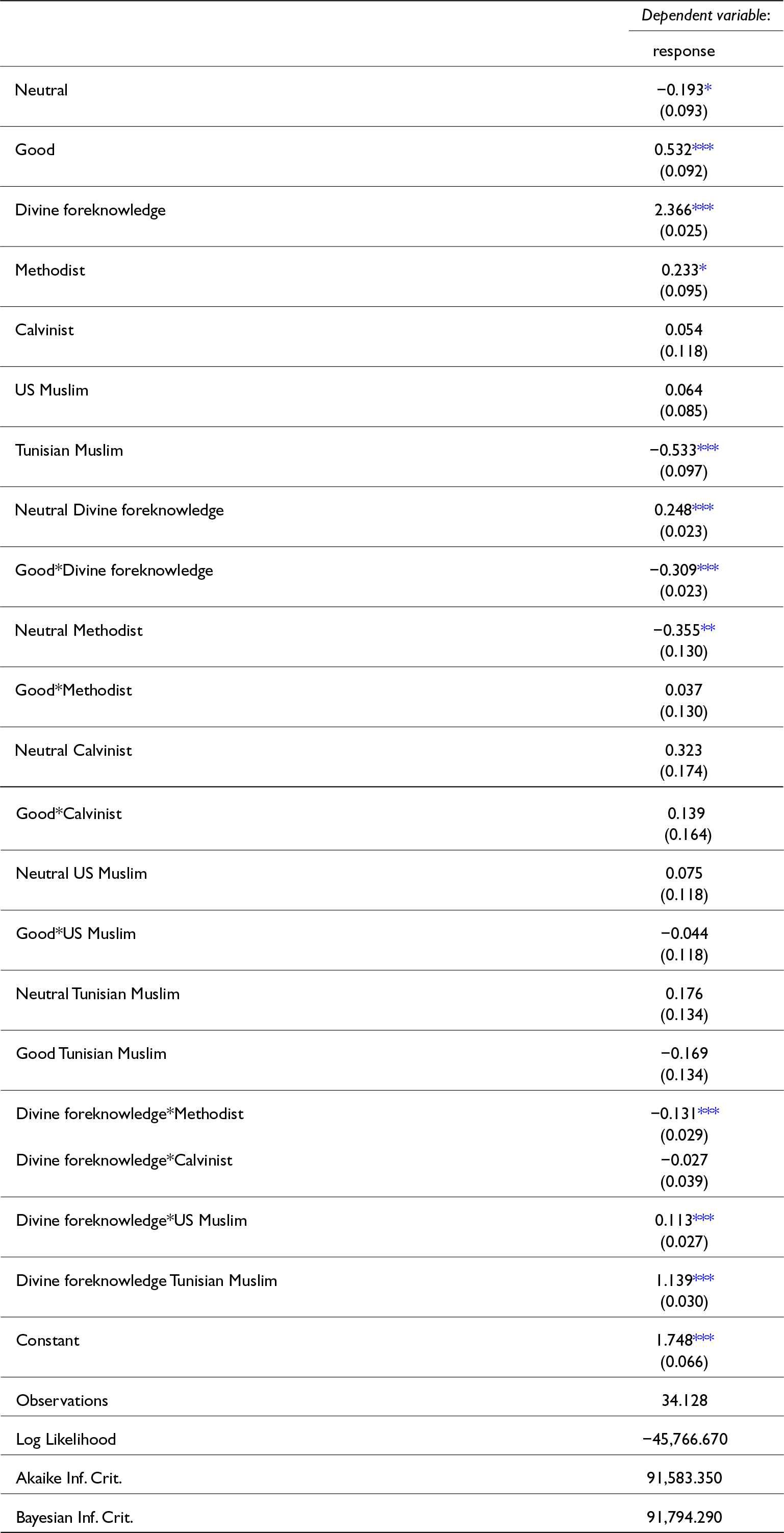
\end{gathered} \end{equation*}Table 2 reports our results.
Regression coefficients for the fixed factors (reference category of valence: bad action; reference category of foreknowledge: human foreknowledge; reference category of religion: catholics)
Note:
* p < 0.05; **p < 0.01; ***p < 0.005.
Figure 2 reports the estimated marginal means for each level of our fixed factors.
Estimated marginal means.
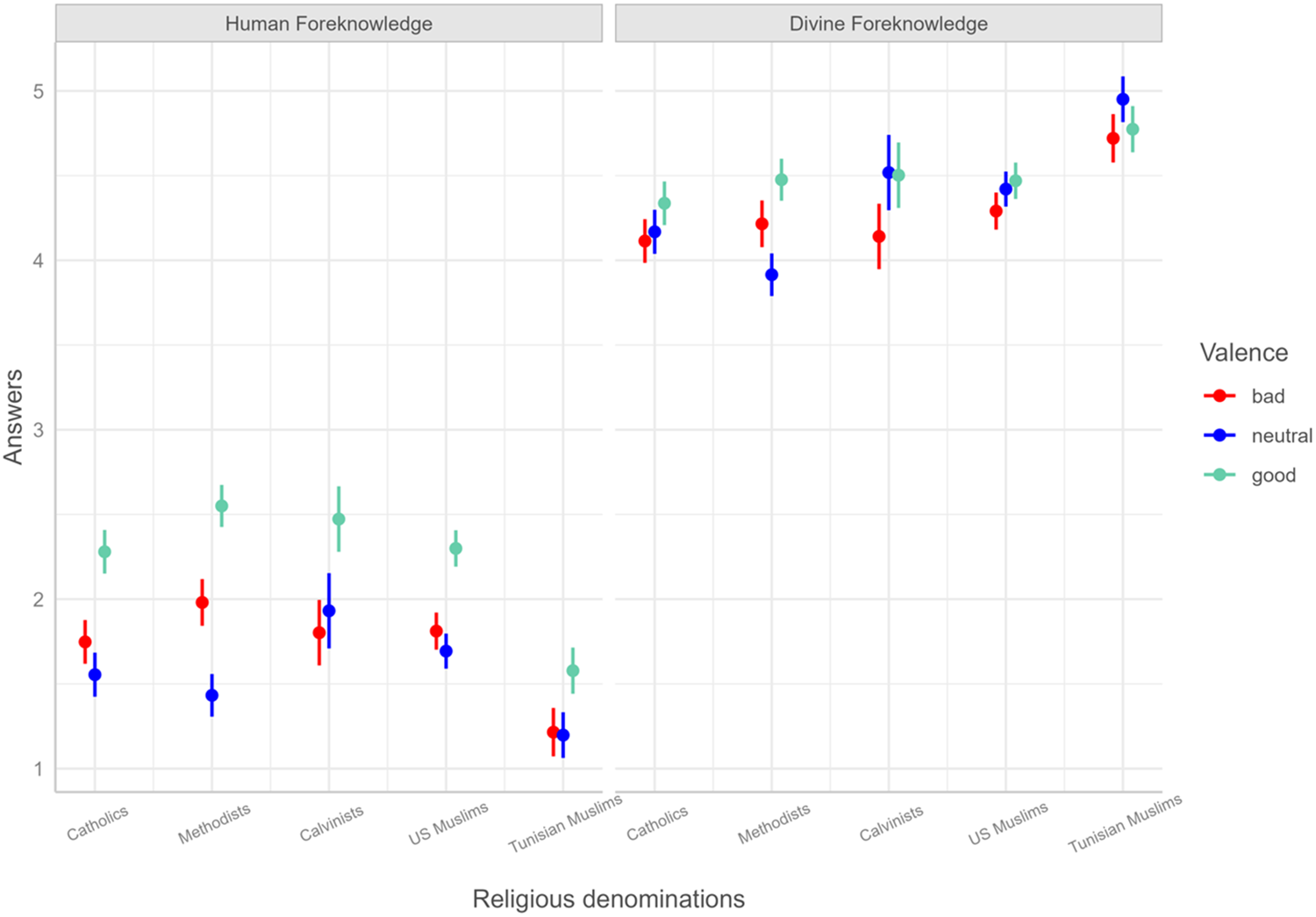
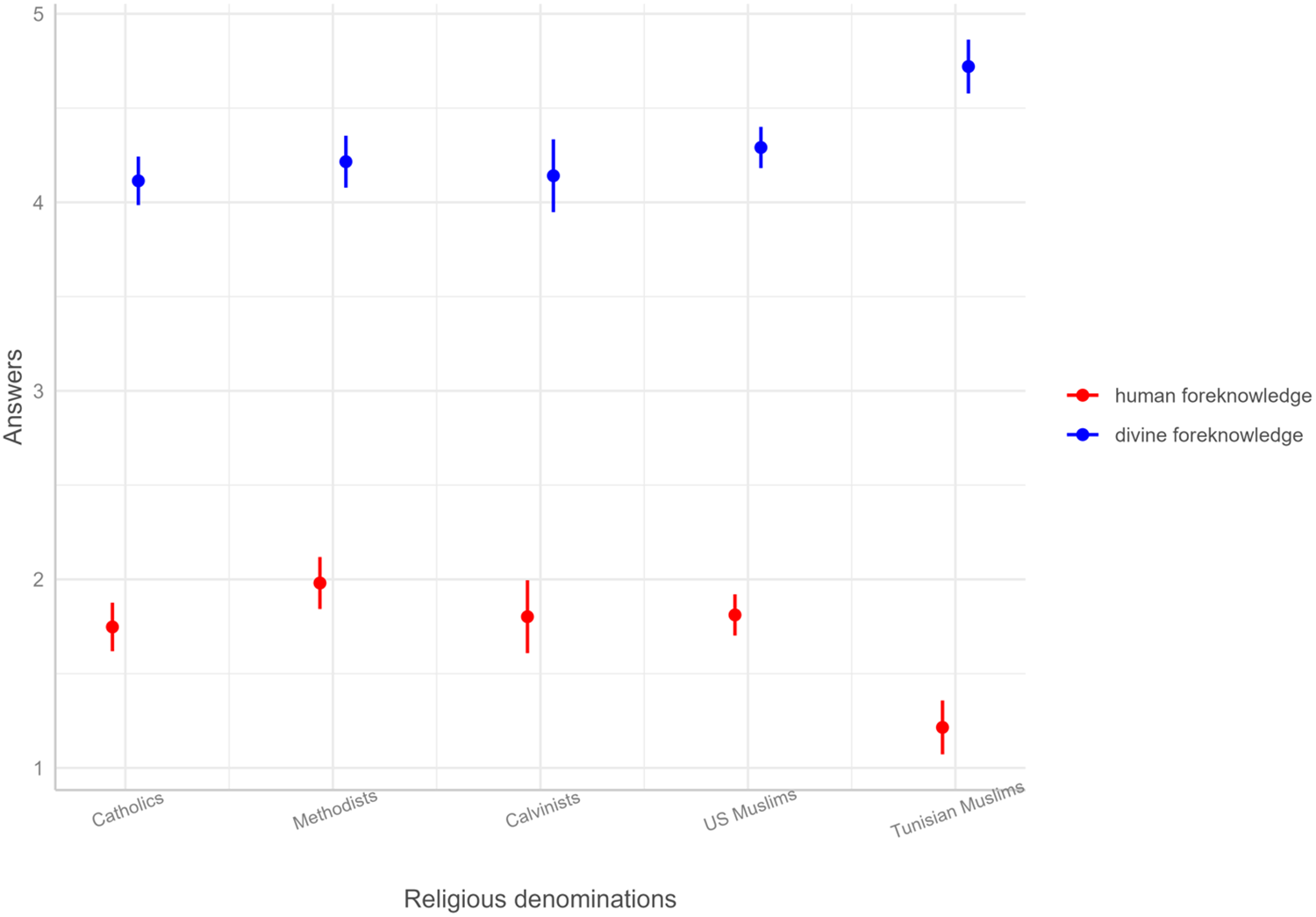
As we had predicted (Hypothesis 1 of the preregistration), we observed, perhaps unsurprisingly, a main effect of who has foreknowledge: Participants were more likely to assign foreknowledge to God than to a human being. In fact, on average, people did not agree that a neighbour would have foreknowledge of her neighbour’s actions, but they were very confident about divine foreknowledge. At least among believers as faithful as those that make up our sample, God is taken to have foreknowledge. This effect varied across religions: While the effect of who has foreknowledge did not significantly differ between Catholics and Calvinists, it was significantly smaller for Methodists compared to Catholics, and significantly larger for both American and Tunisian Muslims compared to Catholics. Figure 3 visualizes this effect, aggregating across the valence of the actions described in the vignettes.
Estimated marginal means aggregating across valence.
We also observed a main effect of valence: As we had partly predicted (Hypothesis 2), whether participants agreed with assigning foreknowledge depended on whether the agent described in the vignette committed a neutral, morally wrong, or morally good action. However, the observed ordering between the foreknowledge of neutral, morally wrong, or morally good actions differed from the one we had predicted.
The main effect of valence was qualified by an interaction with who had foreknowledge, as we had predicted (Hypothesis 3): The difference between human and divine foreknowledge was significantly smaller for positive actions compared to bad actions, and significantly larger for neutral actions compared to bad actions. Figure 4 visualizes this effect, aggregating across religions.
Estimated marginal means aggregating across valence.
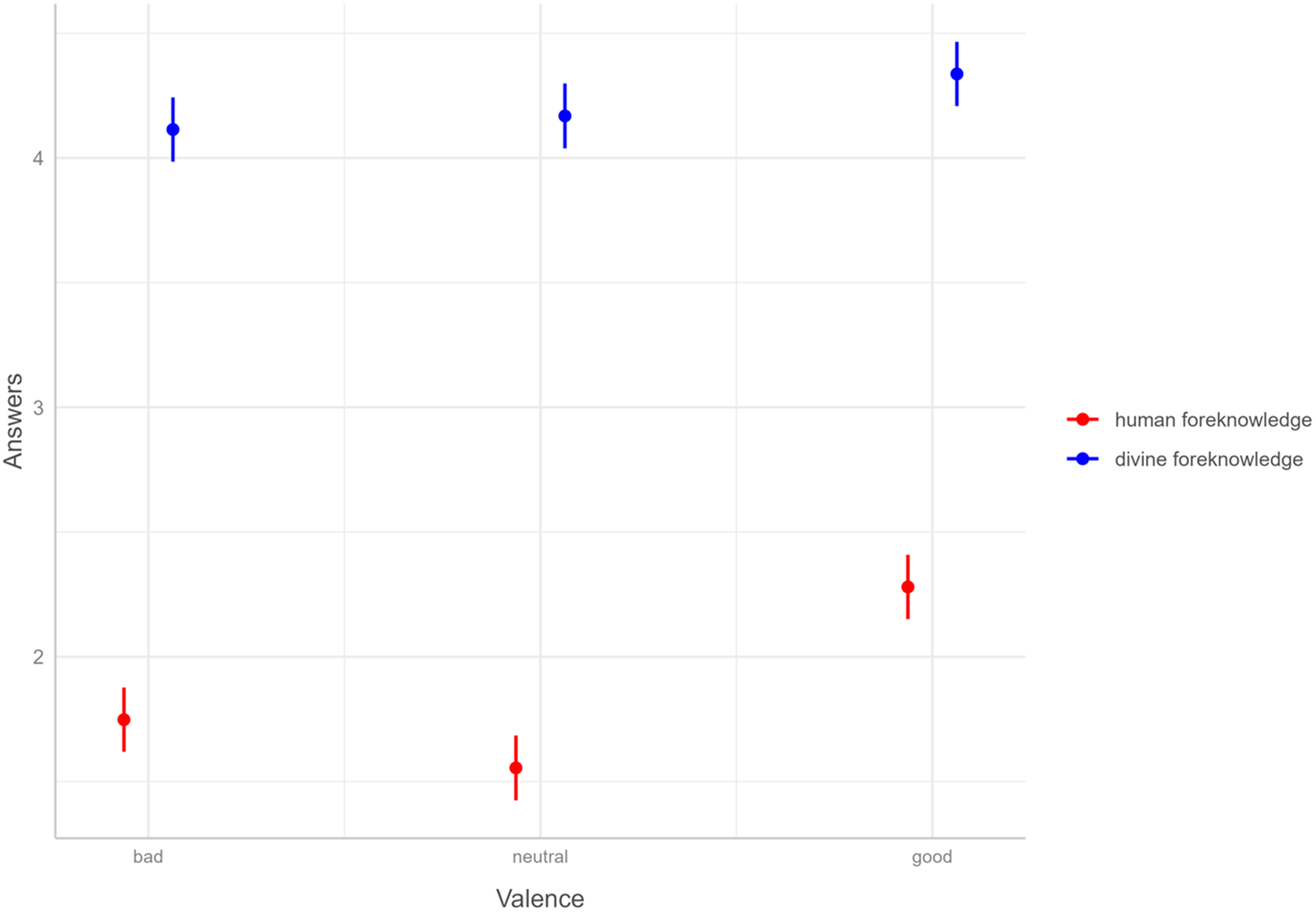
This interaction is due to larger differences across differently valenced actions for human compared to divine foreknowledge. Participants agreed significantly more with human foreknowledge of good actions than of bad and neutral actions, while we observed no significant difference between human foreknowledge of bad and neutral actions (contrary to Hypothesis 2, according to which foreknowledge of neutral actions would elicit more agreement). The pattern for divine foreknowledge was interestingly and unexpectedly different. Participants agreed more with divine foreknowledge of good actions than with divine foreknowledge of neutral or bad actions, but none of these differences reached significance (again contrary to Hypothesis 2): In effect, aggregating across religions, we failed to find evidence that people assign to God more foreknowledge of good actions than bad and neutral actions.
This effect was also qualified by a suggestive, but not significant at the .005 level, interaction with religion (our only preregistered hypothesized interaction). Methodists were less likely than Catholics to assign foreknowledge (aggregating across human and divine foreknowledge) for a neutral action compared to a bad action. None of the other effects reached significance. So, overall, we found little evidence that the effect of valence on divine foreknowledge varies across religions.
We then explored how religiosity, as measured by the DUREL, influences some of the results just reported. We didn’t have any preregistered hypothesis about whether and how religiosity might influence people’s assignment of foreknowledge. We reran our model three times with each of the factors measured by the DUREL and our adaptation of the DUREL to a Muslim context. The results reported above are robust to controlling for different levels of religiosity among religious believers.
Lay conceptions of divine foreknowledge across religions
We have provided evidence that at least very religious Catholics, Reformists, Calvinists, and Muslims are confident that God has foreknowledge of future human actions. As noted in the introduction and in Section 1, viewing God as having foreknowledge of human actions raises the psychological problem of theological fatalism; how lay believers confronts this problem will be a focus of future work. The hypothesis guiding our research is that from a psychological point of view it is difficult to think of the future as both known and open: If God knows the future, then it is not open, and human actions are not free. Whether these two perspectives about future action really inhibit one another will be examined in future research.
We found some differences in the acceptance of divine foreknowledge between religious traditions: American and Tunisian Muslims drew a sharper contrast between human and divine foreknowledge than American Catholics, Reformists, and Calvinists, while Reformists drew a slightly weaker contrast than Catholics. Tunisian Muslims agreed more with divine foreknowledge than any of the other groups. We need to be careful in interpreting these findings since the difference between the Tunisian sample and the American samples could be due to different response styles to surveys (with a greater tendency to use the extreme points of a scale, e.g. Hui and Triandis Reference Hui and Triandis1989). On the other hand, the fact that a similar effect was found among American Muslims and Tunisian Muslims (although to a much smaller degree in the former sample), and the fact that this effect was expected in light of the salience of divine omniscience in general and of divine foreknowledge in Islam suggest that the effect might well be genuine: Foreknowledge might be more salient among Muslims than among Christians. Future work will aim at assessing this result further; in particular, using text-analytic tools, we are currently examining whether themes related to foreknowledge are more common in Islamic religious texts than in Christian ones.
To our surprise, we failed to find any difference between Catholics and Calvinists. Based on Calvinists’ emphasis on foreknowledge and predetermination, we had expected Calvinists to be more likely than Catholics and Reformists to agree with divine foreknowledge. This expectation was not supported by the present study. Future work should aim at assessing further this finding (one of the goals of our ongoing text-analytic work). The greater salience of foreknowledge for Muslims (if our finding is confirmed) raises various questions: Is the psychological problem of theological fatalism more salient to Muslims than to other believers? Supposing that the problem of theological fatalism must somehow be solved, are Muslims more likely to jettison or deemphasize free will than other believers? Future work will examine such questions.
We also examined whether the valence of a future action influences the assignment of foreknowledge because we wondered whether people might be reluctant to assign foreknowledge of bad actions to God: If God foresaw someone’s sins, why didn’t God prevent it? This line of thought might have led people, we speculated, to assign less foreknowledge of bad actions. The moral nature of a future action did influence the assignment of human foreknowledge, with people being more likely to agree with human foreknowledge of morally good actions. While we had not predicted this effect (indeed, we expected people to agree more with human foreknowledge of neutral actions), with the benefit of hindsight, it can perhaps be explained. In contrast to neutral actions such as cleaning the house and going to the beach (two of the twelve examples used in our study), good actions are often viewed as the expression of the agent’s character, a manifestation of the fundamental attribution error (Doris Reference Doris2002; Harman Reference Harman1999), and it is natural to assume that a neighbour would then be in a better position to anticipate them compared to neutral actions. But, if this explanation is correct, why aren’t morally bad actions treated as morally good actions? They too, one might think, might be the expression of people’s character. Perhaps, people are less willing to assign foreknowledge of morally bad actions because these are rarely done openly: Few people sin in public.
In any case, whatever the explanation is, human and divine knowledge differed. The moral nature of a future action had no detectable effect on divine knowledge. In fact, contrary to our expectations, the three types of actions were treated rather similarly (the exception being Reformists, who treated neutral actions somewhat differently from Catholics), and there was little indication that the wrongness of an action led very religious individuals to refrain from assigning foreknowledge to God.
One might speculate that religious believers have already explicitly considered the problem of evil, and that they have already decided that God’s foreknowledge of evil actions is consistent with its perfection. More plausibly perhaps, religious people similar to the ones we sampled might just be committed to divine foreknowledge in general, and they need not decide for each action whether God foreknows it, taking into consideration its particular characteristics. In fact, we suspect that at least for some participants it might be wrong to treat a question about divine foreknowledge as an open question, one that might call for a negative answer: A true believer does not deliberate about whether God foreknows a future action.
Psychologists working on religious cognition have often noted that believers use templates meant for human agents to characterize God’s agency. For instance, Gods are intuitively represented as doing actions in a sequential manner or as moving from one place to another, as a human agent would do (Barrett and Keil Reference Barrett and Keil2016; Barrett Reference Barrett1998; for review, see, Reference Barrett2000). Representations of supernatural agents are often thought to be ‘minimally counterintuitive concepts’ (Barrett Reference Barrett2007; Boyer Reference Boyer2007): Believers tend to think of God or Gods as violating only a few properties represented by their intuitive concepts (e.g. of agents). By contrast, here we see that divine and human foreknowledge are treated differently. This result is consistent with finding that from an early age on, beliefs are assigned differently to humans and to God (Barrett et al. Reference Barrett, Richert and Driesenga2001; Knight et al. Reference Knight, Sousa, Barrett and Atran2004; Richert and Barrett Reference Richert and Barrett2005). How closely representations of supernatural agents follow representations of human agents might depend on the task: Some might elicit more reflective representations, others more intuitive. Or it might vary across domains: Representations of supernatural agents’ locations and motions might be more tightly constrained than representations of their cognitive and epistemic capacities.
Our empirical work is limited in important respects. We first note two methodological problems. First, sampling our target populations was much more difficult than expected, and we were unable to reach our target sample size of 300 Calvinists; we also had to rely on snowball sampling. Experimental philosophy of religion should consider strategies to sample from religious populations, if it is not to limit itself to sampling mainstream religious groups and to rely on samples composed of individuals with low religiosity. Second, we had very strict exclusion criteria (answering twelve comprehension questions), and it turned out to be difficult, both in the online study and in-person study, for participants to get all these questions right. The questions themselves were extremely easy, but participants might not have been highly motivated to be accurate. Turning to more a substantive limitation, we note that our conclusions only generalize to religious individuals. We do not know whether less religious Catholics or Muslims would have also wholeheartedly agreed with divine foreknowledge or would agree equally with divine foreknowledge of good and bad actions.
From a philosophical point of view, the main lesson of this work is that the philosophical problem of theological fatalism echoes how lay believers think about God in Abrahamic religious traditions. This philosophical problem is not an abstruse concern, only of relevance to theologians and philosophers of religions, but a personal issue that believers in the Abrahamic God must address.
Conclusion
In this article, we have provided evidence that religious believers strongly agree with divine foreknowledge, and that, in contrast to what is the case for human foreknowledge, the moral valence of the action does not appear to influence much agreement with divine foreknowledge. Muslims appeared to draw a sharper distinction between human and divine foreknowledge, suggesting perhaps that the problem of theological fatalism is more salient for them or tends to be solved differently. Most important, this research illustrates the deep intuitive roots of the tension between divine foreknowledge and human free will.
Acknowledgements
We are extremely grateful to Kevin Timpe for his comments on a previous version of this article.


 Open access

