Contents
Research Article
Asymptotic convergence to dipole solutions in nonlinear parabolic equations
-
- Published online by Cambridge University Press:
- 14 November 2011, pp. 877-900
-
- Article
- Export citation
A polyconvexity condition in dimension two
-
- Published online by Cambridge University Press:
- 14 November 2011, pp. 901-910
-
- Article
- Export citation
Equidistribution of values of rational functions (mod p)
-
- Published online by Cambridge University Press:
- 14 November 2011, pp. 911-929
-
- Article
- Export citation
-
Let R1(x),…, Rd(x) be rational functions in Iℚ(x), such that 1, R1(x),…, Rd(x) are linearly independent over Iℚ. For almost all primes p, their mod p reductions,
 are well-defined rational functions over Fp and are linearly independent over Fp We show that asymptotically the points
are uniformly distributed in [0, l)d.
 are well-defined rational functions over F
Characterisation of correctness of cardinal interpolation with shifted three-directional box splines
-
- Published online by Cambridge University Press:
- 14 November 2011, pp. 931-937
-
- Article
- Export citation
-
Cardinal interpolation by integer translates of shifted three-directional box splines is studied. It is shown that, for arbitrary orders, k, l, m ∈ N of the directional vectors, this problem is correct if and only if the shift vector is taken from the hexagonal shift region
 (modulo translation with respect to the lattice Z2). This confirms a conjecture of S. D. Riemenschneider [9], and settles the problem studied in [5] for the special case k = l = m in full generality. The method of proof is from homotopy theory.
 (modulo translation with respect to the lattice Z
Equations for biological evolution*
-
- Published online by Cambridge University Press:
- 14 November 2011, pp. 939-958
-
- Article
- Export citation
Complexity in spatio-temporal dynamics
-
- Published online by Cambridge University Press:
- 14 November 2011, pp. 959-974
-
- Article
- Export citation
Gradient estimates and heat kernel estimates
-
- Published online by Cambridge University Press:
- 14 November 2011, pp. 975-990
-
- Article
- Export citation
On the uniform stability for a ‘food-limited’ population model with time delay*
-
- Published online by Cambridge University Press:
- 14 November 2011, pp. 991-1002
-
- Article
- Export citation
High-energy and multi-peaked solutions for a nonlinear Neumann problem with critical exponents*
-
- Published online by Cambridge University Press:
- 14 November 2011, pp. 1003-1029
-
- Article
- Export citation
Positive solutions of certain elliptic systems with density-dependent diffusions
-
- Published online by Cambridge University Press:
- 14 November 2011, pp. 1031-1050
-
- Article
- Export citation
-
Results are obtained on the existence of positive solutions to the following elliptic system:
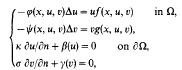
in a bounded region Ω in Rn with a smooth boundary, where the diffusion terms φ ψ are non-negative functions and the system could be degenerate, β γ are strictly increasing functions, k,σ ≧ 0 are constants. We assume also that the growth rates f, g satisfy certain monotonicities. Applications to biological interactions with density-dependent diffusions are given.
Asymptotic behaviour and attractors for a semilinear damped wave equation with supercritical exponent
-
- Published online by Cambridge University Press:
- 14 November 2011, pp. 1051-1062
-
- Article
- Export citation
-
We prove the existence of a global attractor for the problem
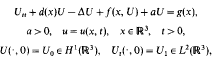
where f is ‘coercive at infinity’ and satisfies the growth condition

while g ϵL2(R3).
On semigroups defined by Coxeter-type presentations
-
- Published online by Cambridge University Press:
- 14 November 2011, pp. 1063-1075
-
- Article
- Export citation
Trace functions on the algebras of certain E-unitary inverse semigroups
-
- Published online by Cambridge University Press:
- 14 November 2011, pp. 1077-1084
-
- Article
- Export citation
Renormalisation of finitely ramified fractals
-
- Published online by Cambridge University Press:
- 14 November 2011, pp. 1085-1104
-
- Article
- Export citation
On the existence of solitary waves in rotating fluids
-
- Published online by Cambridge University Press:
- 14 November 2011, pp. 1105-1129
-
- Article
- Export citation
Front matter
PRM volume 125 issue 5 Cover and Front matter
-
- Published online by Cambridge University Press:
- 14 November 2011, pp. f1-f2
-
- Article
-
- You have access
- Export citation
Back matter
PRM volume 125 issue 5 Cover and Back matter
-
- Published online by Cambridge University Press:
- 14 November 2011, pp. b1-b2
-
- Article
-
- You have access
- Export citation