




Urban authorities have long been providing individuals with official documents. In the late medieval and early modern period, they quite often issued powers of attorney that allowed one person to act on behalf of another. Documents called ‘letters of procuration’ functioned as proof that individuals were allowed to represent the other person. Such documents were employed in various areas of life, for instance if someone wanted to claim an inheritance from a relative who had died in a faraway town, or if they wanted to collect the payment of annuities in another city. Powers of attorney played an important role in many aspects of the life of premodern towns, but their greatest role was arguably in trade. Because the very nature of their profession was to buy commodities in one place and sell them in another, merchants often had to do business in a town other than the one in which they were currently residing.
As merchants became increasingly sedentary during the commercial revolution of the high Middle Ages, they often authorized another person to act on their behalf if they needed to transact business in another city.Footnote 1 As Robert Lopez points out, merchants used procurations on a very regular basis: ‘Procuratio was the bonne à tout faire of medieval business.’Footnote 2 In fact, proxies were such a common feature of commercial life that researchers in economic history have mostly refrained from studying them systematically because urban authorities issued so many procurations that the work needed in order to analyse them seems to be endless.Footnote 3 Very few studies discuss procurations from the perspective of urban economic history.Footnote 4
This article compares procurations from different towns in order to study how the actors dealt with legal pluralism. Legal pluralism means the intersection of different sets of legal norms. Applied to premodern times, this plurality typically comprises not only different law codes issued by towns and rulers, but also contracts between rulers, privileges or the special jurisdiction by kontors.Footnote 5 These different legal norms could all be in force in the same place at the same time, which made navigating them more difficult than when dealing only with different town laws. Procurations were a cornerstone of premodern trade, but it is particularly interesting to analyse how they operated during a time of legal pluralism: letters of procuration were issued by one urban authority and then typically taken to another city where the proxy presented the letter as proof that he was legitimately acting on behalf of another person. Since most towns in premodern times passed their own law codes, procurations were issued under one law and had to be recognized under another. This article analyses how a procuration could fit into different legal spheres; in other words, it discusses what powers of attorney show us about how merchants and urban authorities dealt with legal pluralism.Footnote 6
Since procurations survive in most urban archives and especially in the archives of the commercial cities of Europe, this article can only offer a first glimpse into this vast subject, and put forward a preliminary hypothesis outlining how the actors dealt with legal pluralism. To understand more fully how procuration worked, it would of course be helpful to study the problems that arose in connection with the powers of attorney, such as, for instance, attempts to forge letters of procuration. In the limited context of this article, I opted to conduct only a quick analysis of the rulings of the city councils of Reval (Tallinn) and Lübeck, since these are already edited, and I did not find any evidence of attempts to forge procurations.Footnote 7 Judging by the fact that merchants continued to use procurations on a regular basis throughout the fifteenth and sixteenth centuries, it seems safe to assume that the co-operation between merchants and their proxies was not undermined in any significant way by fraud or other major obstacles.
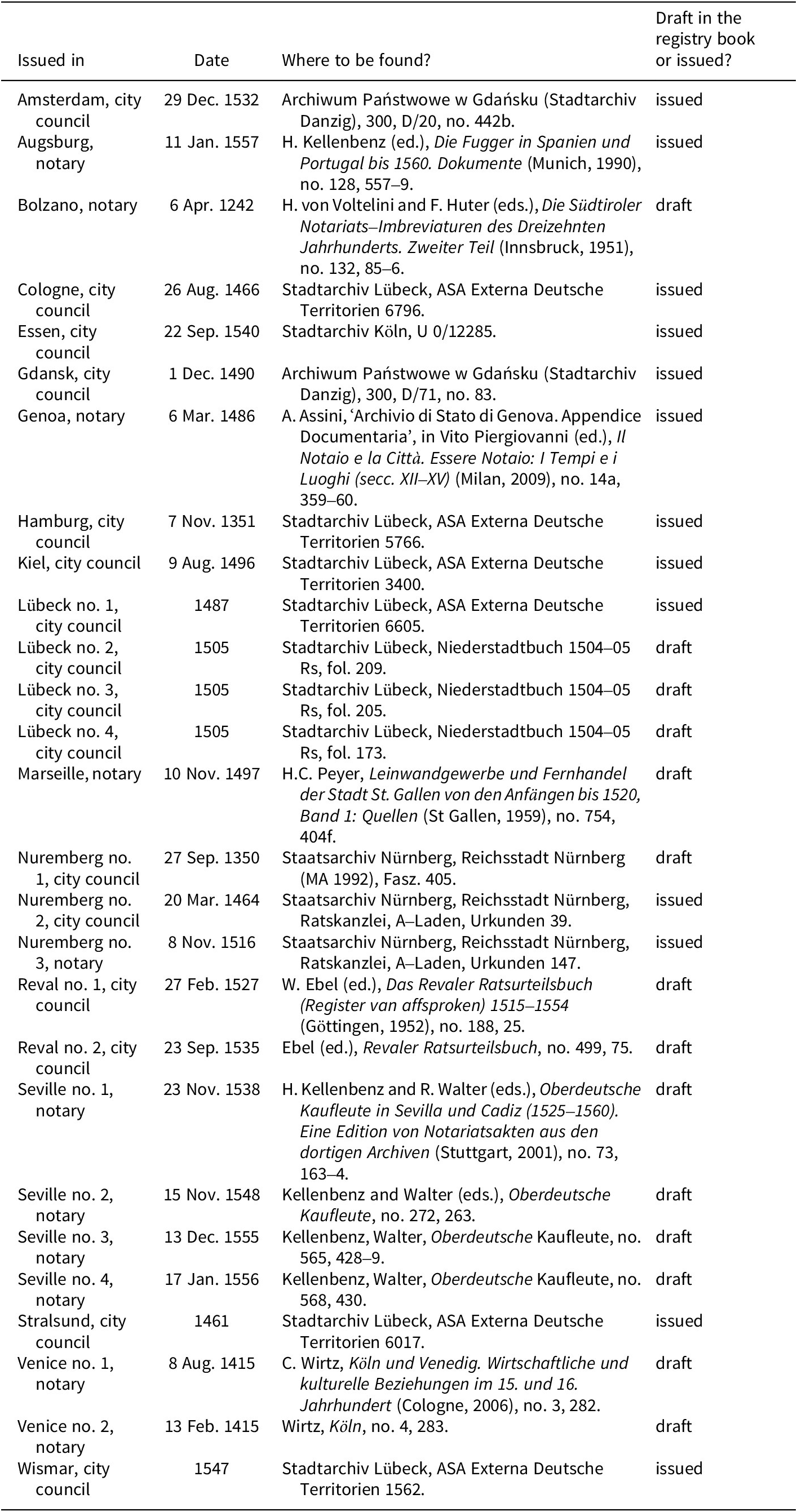
I compared procurations from Antwerp with 27 other procurations from 17 different towns (see Table 1). Across time and space, they showed a remarkably similar set-up, but at the same time there were many variations in how the procurations were worded and phrased. They looked similar enough to be recognizable as the same type of document, but they did not look entirely the same. Even though each town issued its own rules and regulations, they all drew up procurations that appeared quite similar, and they all recognized procurations issued by other town councils as valid proof. Common norms that helped merchants to navigate legal pluralism emerged through the constant exchange between merchants and urban authorities. Procurations were apparently harmonized between different towns, but not unified. This harmonization of basic rules was enough to enable individuals to cross legal boundaries. Complete unification and standardization were not deemed necessary. Harmonization without unification allowed procurations to stay flexible and be changed according to local conditions and new developments. Thus, the legal boundaries between different cities became permeable as merchants used a similar instrument in various European trading towns.
Procurations from places other than Antwerp
This finding fits with the current notion of lex mercatoria which is no longer believed to have formed a codified law for all merchants, but is rather supposed to have consisted of shared habits.Footnote 8 Merchants as well as urban authorities developed a set of shared practices. Oscar Gelderblom in his study on the development of commercial institutions in Bruges, Antwerp and Amsterdam also points out that similar institutions emerged in all three towns, thus fostering exchange and trade.Footnote 9 In Gelderblom’s study, however, it was competition between different cities that led to the development of similar institutions, whereas my analysis suggests that co-operation between merchants and urban authorities played an important role as well.
In the first part of this article, I will outline how merchants worked with proxies, and indicate the role that city councils played in the process. I will use examples from Antwerp where many proxies were installed at the height of its commercial power during the sixteenth century. Letters of procuration, however, survive not only from Antwerp but also from a number of other towns such as Lisbon, Augsburg, Bolzano, Genoa, Marseille, Seville, Venice, Amsterdam, Cologne, Essen, Danzig (Gdansk), Hamburg, Kiel, Lübeck, Nuremberg, Reval, Stralsund and Wismar. In the second and third parts, I will analyse their similarities and differences in order to study how representation by proxy functioned in times of urban legal pluralism. The second part shows that all procurations shared a common framework and general concepts, while the third part analyses how this framework was filled with varying content according to local traditions and trends. The fourth part asks how, on the basis of these findings, we can deduce that a common merchant culture emerged to bridge legal boundaries. Common rules and norms were not instituted from above but developed through the constant exchange between merchants and between the authorities issuing procurations.
Agents crossing legal boundaries between towns
The manner in which merchants organized their trade between different towns in Europe can best be studied by analysing evidence from a city where merchants from different parts of the continent came together to exchange their goods. This was the case in premodern Antwerp. During its golden age from c. 1450 to c. 1570, it served as a ‘centre of international trade’, an ‘urban pole of the European economy’, a ‘commercial gateway to Europe’ and a ‘commercial capital of western Europe’. Situated at the mouth of the river Scheldt, not far away from the North Sea, it had already served as the staple market for English cloth since the fourteenth century.Footnote 10 In 1498, the Portuguese king decided that the first colonial goods such as sugar and spices should be traded via Antwerp.Footnote 11 Merchants from southern Germany thus travelled to Antwerp to provide the Portuguese with silver and copper which they needed for their worldwide journeys, and to buy commodities such as sugar.Footnote 12 Many other merchants followed in their wake, such as Hanseatic merchants selling grain, wax or ash, Tuscan merchants with silk and French merchants bringing salt to Antwerp.Footnote 13
Many merchants were interested in trading in Antwerp, but not all of them could travel to that city. Many worked together with agents who represented them in Antwerp. All in all, merchants had three methods at their disposal with which to conduct business through representatives. They employed servants who were obliged to carry out their masters’ trade wherever they were posted; they formed partnerships or companies and invested part of their capital there; or they installed proxies authorized to act on their behalf.Footnote 14
Merchants often worked together with all three types of representatives at the same time. For example, Joachim Pruner, a merchant from Berlin who had settled in Antwerp to carry out his business in Europe’s trading capital of the time, appointed Marcus Hartmann as a servant and sent him to Lisbon to manage his business there.Footnote 15 Second, he formed a partnership or company with Kilian Rietwieser, a merchant based in Leipzig.Footnote 16 Third, he authorized his brother to buy spices in Lisbon in his name and to send the spices on to Antwerp.Footnote 17 Pruner also traded in gemstones between Lisbon and Venice. When his associate in Venice (Franz von Bombergen) received a number of gemstones, Pruner authorized another colleague in Venice, Michael Imhof, to go to Franz von Bombergen and settle the accounts with him.Footnote 18
The remainder of this article is concerned with the third form of representation. Proxies are of interest for the study of crossing legal borders because they were a very common phenomenon in premodern trade. Nearly every merchant installed proxies, often a number of them at the same time. Furthermore, these proxies were a very flexible instrument. They could be authorized to do a number of different activities: they could sell and buy goods on behalf of a merchant,Footnote 19 they could collect debts for himFootnote 20 or even defend him in court.Footnote 21 Often the ‘procurator’, ‘factor’ or ‘gemechtigter’ was based in the town where he was appointed to carry out business on behalf of his ‘constituent’.Footnote 22 For example, Michael Imhoff had lived in Venice for a while, so he most likely knew where Franz von Bombergen could be found, and he most likely knew how he could induce him to settle the accounts with him.
Proxies as a special type of representative are mostly discussed in legal history.Footnote 23 They also have their place in the study of commercial history, but there they mostly feature as sub-types of other groups. This is not incorrect, but it obscures their important role in the history of inter-urban trade. For instance, proxies are generally regarded as a sub-type of servants.Footnote 24 It is often difficult to distinguish between both forms of representatives, since servants were in fact sometimes allowed also to act as proxies. However, both roles can and should be differentiated. If a servant was going about his everyday activities, mostly buying, selling and shipping goods, he did not have to prove that he was acting on behalf of another person.Footnote 25 But if he wanted to collect a debt, it was not enough to tell the debtor that he was acting in the name of his master. He had to prove that he was allowed to act on behalf of another person. If he wanted to represent his master in court, he had to demonstrate that he was authorized to do so.
Commission agents, on the other hand, were often equipped with powers of attorney. Commission agents hence often acted as proxies. However, if researchers discuss commission agents, they typically focus on their role in buying and selling in the name of their principal.Footnote 26 But studying letters of procuration makes it clear that proxies played an important role in debt collection, as well as in judicial proceedings. If we regard these representatives of merchants as proxies – not servants or commission agents – we are better able to understand their role: they acted in the name of the merchant in trade, debt collection or at court in situations where they had to prove their legitimacy in order to represent the other person. The letters of procuration that such proxies used to identify themselves were very similar to letters of procuration used by diplomatic representatives. The difference is that merchants’ proxies represented one other person and were expected to act just as this specific person would have acted, had he been present, whereas diplomatic envoys had to speak in the name of the whole community they represented. Furthermore, proxies were often appointed to undertake a specific task rather than to provide general representation.
Proxies had to be able to show their letters of procuration to prove their legitimacy.Footnote 27 When a merchant installed a proxy, he went to a notary or to a city council and asked them to issue such a document. City councils and notaries prepared these documents for a fee as part of their service as public authorities. In southern European towns, it was mostly notaries who authorized important acts.Footnote 28 In northern Europe, notaries remained scarce, and urban councils undertook the task of issuing documents that bore the signs of public authority.Footnote 29 In Antwerp, where traditions from the north and the south met, merchants had a choice: the aldermen continued to issue documents, but from the sixteenth century onwards officially appointed notaries also authorized acts and issued the associated documents.Footnote 30 Foreign merchants in Antwerp appear to have preferred to go to the notaries, whereas people from Antwerp and the Netherlands mostly asked the aldermen to provide letters of procuration and other official certificates.
A large number of procurations were issued in Antwerp since several hundreds of merchants frequented the town.Footnote 31 Since the aldermen and notaries not only issued the procurations but also wrote a draft of them in their registry books, we know the names of many proxies working for the merchants during Antwerp’s golden age. Notarial and urban registry books survive not only from Antwerp, though, but also from a number of other towns. This makes it possible to analyse how these procurations could be issued in one town and recognized in another, despite the towns’ different legal systems. Given the current state of research on this topic, it is all but impossible to select a representative sample of procurations, because we lack any overview of the procurations that have survived in European towns. Since procurations served as an important tool in trading and other areas, they were presumably issued in all bigger towns, at least all commercial cities, and in numbers that make it very likely that at least some of them survived from most towns. For this article, I started by scrutinizing the registry books from Antwerp and followed leads found there when they concerned procurations issued in cities which I was already investigating as part of a larger study on representation of German merchants, namely, Lübeck, Gdansk, Cologne and Nuremberg.Footnote 32 More often than not I was unable to trace the specific procuration mentioned in the Antwerp sources, but I did find other procurations written by the same authority. For other European cities, I added the few procurations that had already found their way into edited source collections. All in all, I compared the Antwerp procurations with documents written by notaries in Augsburg, Bolzano, Genoa, Marseille, Seville and Venice and city councils in Amsterdam, Cologne, Danzig, Essen, Hamburg, Kiel, Lübeck, Nuremberg, Reval, Stralsund and Wismar (see Table 1).
Authority, set-up, presence: similarities between procurations from different towns
Letters of procuration were issued in one place and had to be recognized in another. Studying the registry books of the Antwerp aldermen and notaries, it soon becomes clear that merchants brought procurations from various towns in Europe, and that these foreign letters of procuration were accepted as valid proof by the Antwerp authorities. For example, Henrick Proestinck appeared before the Antwerp city council and produced a procuration which was issued by Lübeck city council. The Antwerp aldermen noted that he showed them a procuration issued under the seal of the city of Lübeck on 20 July 1492. This document stated that Henrick Proestinck had been installed as a representative by Hans Vlanwijck. The Antwerp aldermen recognized this document as valid proof, and thus Henrick Proestinck could act in Antwerp on behalf of Hans Vlanwijck.Footnote 33
This process of recognition was a cornerstone of merchants’ abilities to cross legal boundaries. Recognition would only be granted if the authorities could identify a letter of procuration as such. For example, in 1526 Joachim Pruner went to the notary Jacobus de Platea and produced a procuration which was drawn up by a notary in Lisbon. Platea, the Antwerp notary, did not know this particular colleague from Lisbon, but he examined the document and determined that it had the right ‘tenor’ to gain his trust.Footnote 34 The analysis of the various letters show that they shared a sufficient number of similarities to allow for the documents to be recognized as the same type of document, despite all the differences in the various towns’ legal systems.
The first and fundamental characteristic that procurations from different towns shared was that these documents could easily be recognized as authentic since they were all issued by a public authority, either a notary or a city council. The process of authentication functioned slightly differently depending on whether it was notaries or city councils issuing the documents. Notaries stated in their procurations that they were ‘public notaries’ and issued ‘public documents’.Footnote 35 To further prove their official position, they literally drew their seal on the document and put their signature at the end.Footnote 36 Town councils, on the other hand, given their responsibility for equipping their burghers with official documents in northern Europe, used a promulgation formula at the beginning of the letter of procuration, typically stating that ‘the mayors, aldermen and the council of Antwerp/Kiel/Essen make it known hereby that…’. Furthermore, they attached the town’s official seal to the letter. This phrase cannot be found in the registry books, but it was added when the document was issued. For example, a procuration sent from Antwerp to Danzig states: ‘Wy Burgermeesteren Scepen ende Raidt vander Stadt van Antwerpen / doen cond ende kenlick allen den ghenen die dese litteren sullen seen oft hooren lesen / dat…’ (‘We majors aldermen and council of the town of Antwerp make it known to everyone who reads or hears this letter that…’).Footnote 37 These different urban authorities recognized each other, and hence also regarded their documents as official proof.
Second, a procuration had to follow the form and structure that was common for a procuration. The procurations did not look exactly the same, but they were structured in the same way: every procuration was divided into three sections, and most of them also contained a fourth. One section established the legitimacy of the document. It could be placed at the beginning or at the end of the letter. As noted above, notaries and city councils always stated their public position. Both also dated the documents. Documents that were too old would not be accepted, as is shown by a case from 1550, when the Lübeck city council did not accept a procuration because it had been issued five years previously.Footnote 38 If the document was wrongly dated, it would also not be accepted. The city council of Reval, for instance, refused to accept a procuration on the grounds that it was wrongly dated: ‘Den gelesenen volmachts breeff irkennet eyn Radt by unmacht, wente he nicht recht daterth is’ (‘The council doesn’t recognize the procuration as valid because it bears no date’).Footnote 39
The second part of the procuration included the actual appointment of the agent. It stated the name (and often the hometown) of the person who appointed the agent, the associated verb (constituere or a vernacular equivalent)Footnote 40 and the name of the proxy. In the third and often longest part of a procuration, the specific acts that the proxy was allowed to undertake were set out. Especially in cases when the agent was authorized to appear in a court which followed Roman law procedure, the list could become extensive since Roman procedural law was quite detailed. In the later Middle Ages, however, Roman law increasingly became a point of reference in northern Europe also.Footnote 41 Lastly, in most letters of procuration the represented person declared that he would abide by everything the agent did in that appointed capacity.
For example, in 1526 the brothers Joos and Ludwig Steidelin authorized Andreas Imhoff, a merchant from Cologne, to collect debts in their name.Footnote 42 In the first part of the document, the notary promulgated that ‘by this public document it should be known…’, and he gave the date.Footnote 43 He furthermore stressed the legitimacy of the act by listing the names of the witnesses at the end of the document. In the second part, the agent was appointed: Joos and Ludwig Steidelin, brothers and clothiers from Antwerp, empowered (‘made potent’) Andreas Imhoff from Cologne to act in their name.Footnote 44 The third part enumerated all the acts Andreas Imhoff was allowed to undertake on the Steidelins’ behalf. The aim of his job was to get Heinrich Strasenbach, another burgher from Cologne, to pay his debts. Andreas Imhoff was authorized to acquit him accordingly. In order to make him pay the money, Andreas Imhoff could also arrest his goods or take him to court, and at court, he was allowed to proceed according to Roman procedural law, for example to swear an oath or call witnesses. In the fourth part, the Steidelins confirmed that they would adhere to everything Andreas Imhoff would do or agreed upon with Strasenbach, and they pledged their goods as part of this promise. In other procurations, the four parts were filled out slightly differently. But all procurations can be broken down into these sections. Thus, anyone who had been in business for a while knew how a correct procuration should be worded and arranged. If he saw a new procuration, he could assess if it was trustworthy or not.
Precise wording: differences between procurations from different towns
Common norms can be found in the general framework and in the conceptual mindset shaping the procurations. But since they were not written by a centralized bureaucracy with standardized procedures, but rather in a setting characterized by legal pluralism, procurations did not look exactly the same. As already mentioned, the process of authentication worked differently depending on whether it was a notary or an aldermen’s bench issuing the procuration. Notaries used their seals and signatures, while aldermen attached the city’s seal in order to underline their status as public authorities. In addition, a number of differences concern the actual wording of the documents. For example, almost all notaries and aldermen used the verb constituere for installing a proxy, but some notaries in Venice wrote committere instead.Footnote 45 Even when most of the procurations employed the same technical term, it still remained possible to opt for an alternative.
Comparing the wording of the letters of procuration leads to the conclusion that there was no clear pattern of similarities and differences. Procurations from one town shared similarities with documents from some other towns, but we cannot say that procurations from towns A, B and C looked quite similar, but differed from procurations issued in cities D, E and F. For instance, notaries in Venice and town councils from northern Germany often added the phrase ‘the proxy is bestowed with whole and complete power’.Footnote 46 But it is not the case that procurations from Venice and the northern towns were generally equipped with the same standardized phrases. For example, another formula, namely that various proxies were allowed to act together as well as on their own, can be found in Venice, and in Genoa and Seville and also in Reval, Nuremberg and Amsterdam, but not in most northern German towns, with the exception of Stralsund.Footnote 47 Nuremberg, Seville, Cologne, Kiel, Lübeck and Wismar share another similarity: their procurations sometimes state that the proxy was the one ‘presenting’ the letter.Footnote 48
It thus seems impossible to find reasons why procurations from some towns shared certain similarities, since documents from every city featured some similarities, but also some differences with documents from every other city. There is only one distinction that seems to be systematic: individuals who were familiar with Roman law used some Roman law terminology. This explains some of the similarities between procurations issued by notaries, who were trained in Roman law, and documents issued by town councils in northern Germany in the late fifteenth and sixteenth centuries, when members of the city councils began to attend universities.Footnote 49 In earlier times, northern German aldermen did not employ Roman legal terms in the documents.
One example is the promise that a merchant would be held liable for all the actions of his proxy, which featured as the fourth part of many procurations. The idea that a constituent should be liable is derived from Roman law. The Digests (compilations of Roman law from late Antiquity that became a point of reference again with the revival of Roman law in the twelfth century) stated that such a promise had to be made especially if someone wanted to be represented at court.Footnote 50 The notaries and town councils added this clause in the later Middle Ages, and they even used a similar vocabulary to the Digests: to adhere to everything a proxy did was called ratum habere (literally: ‘hold valid’) or its vernacular equivalents.Footnote 51 Roman law can thus be seen as one of the many traditions that influenced how procurations were worded, but it did not offer a template of how they needed to be written. Similarly, it cannot be inferred that the scribes copied procurations out of other formular books. The actual procurations issued in Antwerp did not even follow a guide for notaries printed in Antwerp in 1528, as I have shown elsewhere.Footnote 52
In sum, differences between procurations can mostly be found with regard to the precise wording of the documents. This does not imply that notaries and aldermen chose their words randomly, but rather that there was some room for local conventions and for the implementation of new ideas such as the ones derived from Roman law in sixteenth-century northern Germany.
Bottom-up harmonization
The comparison of letters of procuration from different towns showed that they displayed similarities in the authentication, structure and content of the documents, but differences in the ways scribes chose to phrase the similar processes. This result gives some indication as to how the actors dealt with legal pluralism. Since procurations from various towns were composed using the same structure and shaped by similar ideas of public authority and presence, a merchant or judge or alderman who had been in his trade for a while would have formed a clear expectation of how procurations ought to look. Even if the words differed, he would, for instance, know where to search for the enumeration of acts the proxy was allowed to perform. As such, a procuration from Lübeck could authorize a person to do business in Antwerp, since business partners and authorities in Antwerp would recognize his procuration. At the same time, procurations proved flexible enough to include local traditions, for example the habit of the Venetian notaries of using the verb committere instead of constituere, the latter being a standard phrase across the rest of Europe. And the scribes remained open to new trends, such as employing Roman law terms after studying at a university. In sum, the similarities and differences between various letters of procuration show that procurations provided merchants with a way to cross legal boundaries without forcing them to follow the same exact script.
If it had been the case that the overwhelming majority of procurations looked the same down to almost every detail – if, for example, everyone had used only the verb constituere – it would have been reasonable to suggest that the notaries and aldermen copied the procurations from some form of template. But with all the variations, it is hard to deduce what such a template would have looked like. The comparison between different procurations I have undertaken above revealed enough differences to indicate that the notaries and aldermen did not follow one authoritative model of a procuration. It is therefore not possible to conclude that one way of wording a procuration was seen as more correct than another. No particular institution had authority over others to demand that one model should serve as a template. Procurations looked similar and they worked in a similar fashion even though there was no central authority governing the process.
Rather, a roughly standardized form gradually evolved and constantly changed as procurations were sent all across Europe. We have seen above how an Antwerp notary scrutinized a procuration from Lisbon, and how the Antwerp aldermen cited a procuration from Lübeck in their books. The notary saw the form that a procuration from Lisbon took, and the Antwerp aldermen could not help but notice how procurations were drawn up in Lübeck. Hence, if the Antwerp city councillors had to issue a letter of procuration intended for use in Lübeck, they knew what their counterparts in Lübeck would expect to see. Procurations looked similar, then, because the issuing authorities exchanged their documents all the time.
If the document from Antwerp was not worded exactly like one from Lübeck, however, merchants and councillors in Lübeck were flexible enough to accept them anyway. This tolerance had some limits, but even if a procuration was deemed insufficient, the bearer of the procuration was normally allowed to come back again with a corrected document. This gave them the chance to learn how local procurations were drawn up. For instance, in 1544 in Lübeck Matthias Luchtmaker, in the name of Andreas Berndes, tried to arrest the goods (cloth) of Helmeken Smydt to force him to pay back his debts. But he was not able to produce a procuration that allowed him to do so correctly. The Lübeck city council gave him until midsummer to produce a letter in an acceptable form.Footnote 53 The sources give no indication whether he ended up doing so or not, but it seems likely that if he came back with a revised procuration, this document would have been accepted by the Lübeck city council. In the rulings of the city councils of Lübeck and Reval, no case of a complete rejection of a procuration can be found.
Merchants could also obtain information from their colleagues. Benedetto Cotrugli, a fifteenth-century merchant in Ragusa and Naples, wrote in his handbook on the art of doing business that a good merchant should always aim to live near other merchants because this would allow him to learn from others and gain more professional knowledge.Footnote 54 Merchants met one another at inns and hostels, and they corresponded with family members and business partners.Footnote 55 For example, the Nuremberg merchant Linhart Tucher wrote a letter to his servant in Antwerp and asked him what a procuration in Paris should look like. His servant, Linhart Rotengatter, replied that he had forgotten to inquire about that in Paris, but that he was told (presumably by colleagues in Antwerp) that his current procuration would suffice.Footnote 56
The rules on how to write a procuration thus emerged through the constant exchange between merchants and the different authorities issuing procurations. Rules were harmonized by constant exchange between the parties involved. This process led to harmonization, but not to complete unification. Procurations were similar enough to be recognized across Europe, but flexible enough to include local traditions and trends. Apparently, complete uniformity was not necessary to enable exchange between people from different hometowns. A common merchant culture did not have to even out local differences. Legal pluralism did not have to be negated in order to create common customs of merchants. Rather, common customs emerged when people originating from areas with different legal systems met constantly and repeatedly.Footnote 57
Conclusion
Co-operation between urban authorities enabled merchants and their proxies to deal with legal pluralism. Merchants were able to send their representatives from one town to another, even though most towns did not share the same law code. This article has compared procurations from various European cities in order to find out how exchange between them could work. It turned out that all procurations followed the same general framework. They were structured around the same constituent elements and were based on the same notions of public authorization. The actual wording, however, could vary. The differences between the various procurations did not result in the creation of a discernable pattern. Every procuration shared some characteristics with other procurations but differed in other regards. Thus, procurations did not follow a script that could be found, for example, in Roman law, and they were not aligned to the procurations written by some higher authority. The scribes in Danzig, for example, were inspired by terms from Roman law and by the procurations the city council received from Antwerp, but they did not follow a Roman law formula or treat the Antwerp procuration as a model to be followed slavishly. Rather, a loose and organic common framework emerged since the merchants, notaries and town councils were in constant exchange with one another.
Proxies provide interesting insights into how the constant exchange between merchants and urban authorities created its own common norms that served as a bridge between different legal systems. Legal boundaries could become permeable if everyone shared some common norms, but also displayed some flexibility and tolerance for individual traditions.
Town councils thus not only competed with one another in attracting trade, as Gelderblom pointed out, but also worked together to create a common, but not unified, framework for trade.Footnote 58 Co-operation consisted of recognizing the official documents by other authorities as valid documentation, and of a certain openness to embracing customs of other towns. No one could force the urban authorities to co-operate; rather, it was in their own interests to do so. Every authority depended on others to recognize it, so without mutual recognition, no authority would have been able to issue procurations or other documents that were taken to other cities. In a way, legal pluralism did not hinder trade because authorities took it into account: they accepted different forms of procurations from other authorities and could trust that their documents would also be recognized in other towns.
Competing interests
The author declares none.


 Open access

