





Introduction
Lyme disease (borreliosis) is the most prevalent vector-borne disease in both Europe and the United States, presenting a significant public health concern. The main causative agent in the United States is Borrelia burgdorferi, while the predominant species in Europe are Borrelia afzelii, Borrelia garinii, and B. burgdorferi (Marques et al., Reference Marques, Strle and Wormser2021). Despite its widespread impact, there exist no preventive measures to control Lyme disease. The only FDA-approved Lyme vaccine, LYMErix, targeting outer surface protein A (OspA), was withdrawn from the market in 2002 due to low demand for the vaccine (Nigrovic and Thompson, Reference Nigrovic and Thompson2006). However, the increasing number of cases over the last 20 years and growing public awareness have encouraged researchers that there is a market for Lyme prophylactics. A second generation of OspA-based vaccines is currently in development, with the most advanced candidate, VLA15, entering phase 3 trials (Kamp et al., Reference Kamp, Swanson, Wei, Dhal, Dharanipragada, Kern, Sharma, Sima, Hajdusek, Hu, Wei and Nabel2020; Bézay et al., Reference Bézay, Hochreiter, Kadlecek, Wressnigg, Larcher-Senn, Klingler, Dubischar, Eder-Lingelbach, Leroux-Roels, Leroux-Roels and Bender2023).
In contrast, chemical acaricides have long been proven effective in reducing tick infestation loads on livestock and pets (Obaid et al., Reference Obaid, Islam, Alouffi, Khan, da Silva Vaz, Tanaka and Ali2022), primarily by targeting the tick central nervous system (Waldman et al., Reference Waldman, Klafke, Tirloni, Logullo and da Silva Vaz2023). Fipronil and ivermectin are widely used due to their strong effect against a broad spectrum of pests and parasites. Fipronil belongs to the chemical class of phenylpyrazoles, and its mode of action involves disrupting the arthropod nervous system by blocking gamma-aminobutyric acid chloride channels (Le Corronc et al., Reference Le Corronc, Alix and Hue2002; Zhao et al., Reference Zhao, Salgado, Yeh and Narahashi2003). Ivermectin belongs to the class of macrocyclic lactone and targets the glutamate-gated chloride channels, which also leads to paralysis and death of the parasitic organism (Narahashi et al., Reference Narahashi, Zhao, Ikeda, Salgado and Yeh2010; Campbell, Reference Campbell2012).
In previous studies, passive topical application of fipronil significantly reduced the burden of nymphs and larvae of Ixodes scapularis on small reservoir hosts and decreased the abundance of nymphs in treated areas. In addition, infection rates of B. burgdorferi and Anaplasma phagocytophilum in reservoir animals were significantly reduced after treatment (Dolan et al., Reference Dolan, Maupin, Schneider, Denatale, Hamon, Cole, Zeidner and Stafford2004, Reference Dolan, Schulze, Jordan, Schulze, Ullmann, Hojgaard, Williams and Piesman2016). Recent research has also focused on the systemic control of ticks using oral acaricide baits. Studies have demonstrated that oral fipronil bait effectively controls larval I. scapularis ticks on white-footed mice (Peromyscus leucopus). The efficacy of fipronil has been observed in both laboratory and simulated field conditions, resulting in significant reductions in tick infestations (Poché et al., Reference Poché, Franckowiak, Clarke, Tseveenjav, Polyakova and Poché2020, Reference Poché, Dawson, Tseveenjav and Poché2021, Reference Poché, Smith and Poché2023a). These data indicate that applying acaricides to reservoir animals can represent means to control ticks and interrupt the transmission cycles of tick-borne pathogens. What has remained largely unknown though is whether the currently available acaricides act fast enough to prevent the transmission of tick-borne pathogens. As ticks feed on their host for days, there are inherent waves of pathogen transmission dynamics throughout the course of tick feeding (Eisen, Reference Eisen2018; Pospisilova et al., Reference Pospisilova, Urbanova, Hes, Kopacek, Hajdusek, Sima and Roy2019). In this study, we investigated the acaricidal effects of fipronil and ivermectin on feeding I. ricinus ticks and tested the ability of fipronil-exposed I. ricinus nymphs to transmit B. afzelii spirochetes to laboratory mice.
Materials and methods
Laboratory animals
Ixodes ricinus females were collected by flagging in forests around Ceske Budejovice, Czech Republic. Nymphs and non-infected I. ricinus larvae were obtained from the tick rearing facility of the Institute of Parasitology, Biology Centre, Czech Academy of Sciences. All tick life stages were maintained under controlled conditions (temperature: 24°C, humidity: 95%, day/night period: 15/9 h). Inbred, pathogen-free C3H/HeN mice (The Jackson Laboratory, Bar Harbor, ME, USA) were used for the transmission experiments.
All laboratory animals were treated in accordance with the Animal Protection Law of the Czech Republic No. 246/1992 Sb., ethics approval No. 50-2022-P. The study was approved by the Institute of Parasitology, Biology Centre CAS and Central Committee for Animal Welfare, Czech Republic (Protocol No. 1/2015).
The ex vivo membrane feeding
Membrane feeding of ticks was performed using a 6-well plate format according to Kröber and Guerin (Kröber and Guerin, Reference Kröber and Guerin2007). Whole bovine blood was collected in a local slaughterhouse and manually defibrinated. For feeding of adult I. ricinus females, 13 females were placed, together with identical number of males, in a feeding unit. For feeding of I. ricinus nymphs, 3 I. ricinus females were put in the feeding unit to pre-feed, and on day 1 of feeding, 25 nymphs were put in the feeding unit. All feeding units were lined with a thin silicone membrane of ~80 μm. Blood meals were exchanged every 12 h together with new 6-well plates. All blood meals were supplemented with gentamicin (10 μg mL−1; final concentration). For oral exposure via blood meal spiking, ivermectin (Merck, Sigma-Aldrich I8898, Germany), fipronil (Merck; Supelco 16785, Germany) and fipronil sulfone (Merck; Supelco 32333, Germany) were solubilized in DMSO as 25 mM stocks. These stocks were then diluted in DMSO in a concentration series and used in for blood meal supplementation (0.1% DMSO, final concentration). Supplementation of the blood meals with acaricides started 48 and 24 h after adding I. ricinus adults and nymphs, respectively, into the feeding unit to allow a maximum attachment rate. For topical applications, I. ricinus nymphs were allowed to attach to the silicone membrane and feed for 3 days. The acaricidal compounds were solubilized in ethanol as 15 mM solutions (134 μg fipronil in 20 μL and 263 μg ivermectin in 20 μL) and applied on feeding tick nymphs. Nymphs of I. ricinus were monitored after topical exposure for viability. The type of movement the ticks exhibited in response to exhaled breath determined their categorization into live, moribund or dead. Ticks were observed 24 h post exposure by Leica Z16 APO macroscope and imaged by Leica DMC6200 Digital Camera. The short videos were recorded by a mobile phone and processed by Adobe Express.
LC-MS stability assay of fipronil and ivermectin in blood in vitro
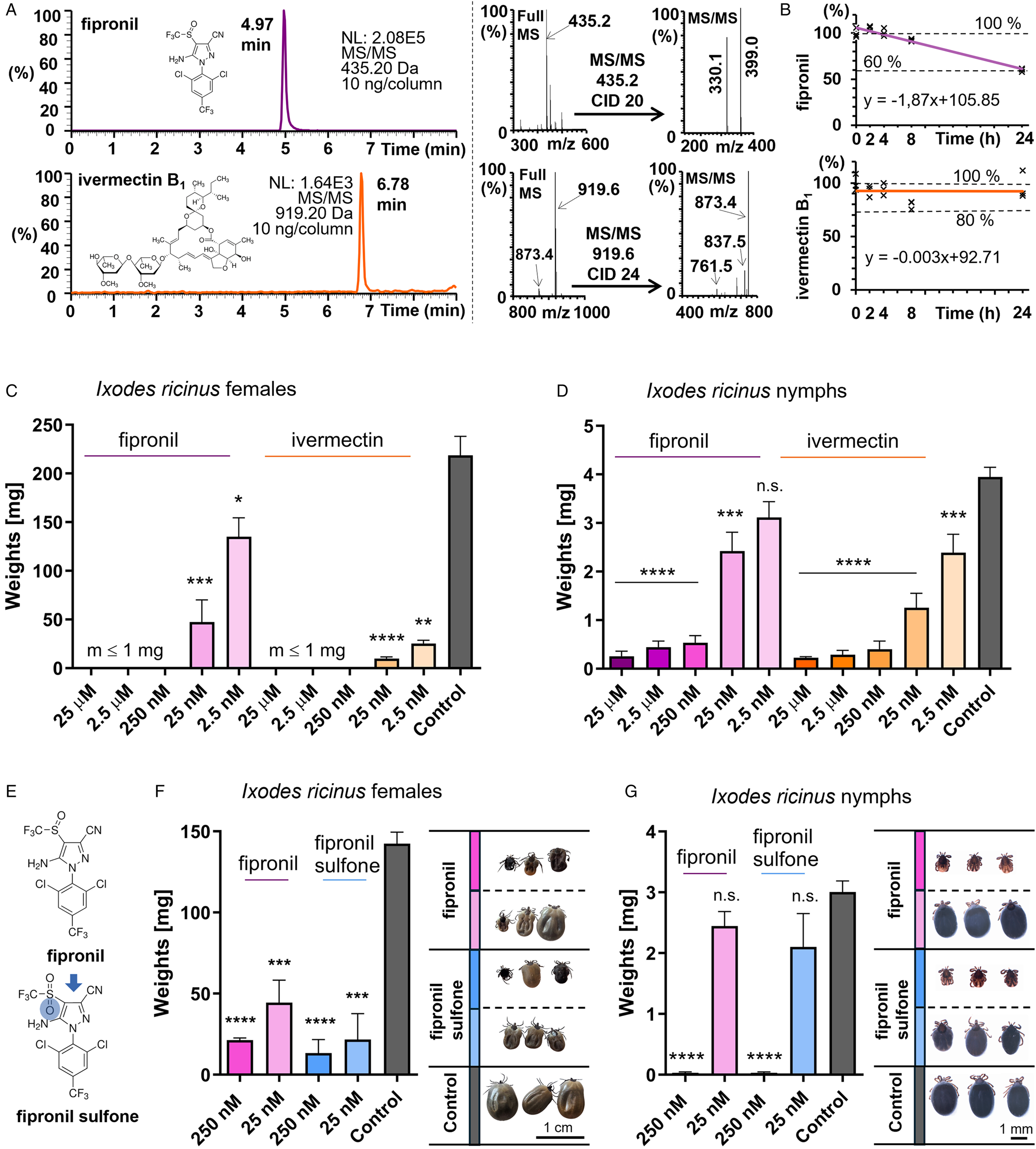
Blood sera were obtained by 2 500 × g centrifugation of manually defibrinated bovine blood (see above). Sera were filter-sterilized (0.22 μm) and supplemented with 1 mg of fipronil and ivermectin per mL of sera in multiple aliquots for given timepoints. Immediately after taking the samples from given thermal incubation time points (0, 2, 4, 8, 24 h; 3 independent incubations per timepoint per compound), they were precipitated with 800 μL methanol. The samples were then gently shaken and put in the ultrasonic bath (0°C, 5 min). The mixture was then centrifuged at 4650 × g at 4°C for 5 min and 200 μL of the supernatant was removed for HPLC-MS/MS analysis. Quantitative analysis of fipronil and ivermectin was performed using liquid chromatography (Accela 600 pump, Accela AS autosampler) in combination with mass spectrometry LTQ-XL (all Thermo Fisher Scientific, San Jose, CA, USA). The chromatographic conditions were as follows: injection volume 5 μL; column Zorbax Eclipse Plus C18-Rapid Resolution HD (50 × 3 mm ID; 1.8 μm Agilent Technologies, Santa Clara, CA, USA) at 35°C; the mobile phase (A) 5 mM ammonium formate in methanol and (B) 5 mM ammonium formate in water; gradient change from A:B as follows: 0 min: 20:80, 4.5 min: 100:0, 8 min: 100:0, 8.1 min: 20:80, 10 min: 20:80 with a flow rate of 400 μL min−1. The conditions for mass spectrometry: negative (−2.5 kV) ion detection mode; capillary temperature 300°C, source heater temperature 300°C, sheath gas flow 35 au, aux gas flow 10 au, sweep gas flow 1 au. Eluted ions were detected in full scan mode from 200 to 1000 Da and in MS/MS mode. For the MS/MS analysis of ivermectin, the ion 919.6 Da [M + Formic-H]- (NCE 24; 4 m/z), or 435.2 Da [M-H]- (NCE 20; 4 m/z) for fipronil, was used (Fig. 1A). The data were acquired and processed using the XCalibur 4.0 software (Thermo Fisher Scientific).
Assessment of stability and acaricidal activity of fipronil and ivermectin in the ex vivo blood-feeding system. (A) Chromatogram of fipronil (RT: 4.97 min), and ivermectin B1 (RT: 6.78 min); top right: full MS spectrum of fipronil, the parent ion [M-H]- (435.2 Da) is highlighted in bold; the MS/MS spectrum of 435.2 [M-H]-, with highlighted diagnostic/daughter ions (399.0 and 330.1 Da); bottom right: full MS spectrum of ivermectin B1, the parent ions (adducts) [M + Formic-H]- (919.2 Da) and [M-H]- (873.4 Da) are highlighted in bold, the MS/MS spectrum [M + Formic-H]- with highlighted diagnostic/daughter ions (873.4, 837.5, 761.5 Da). (B) Stability curves of fipronil and ivermectin in blood sera in vitro incubated at 37°C. (C) Weights of I. ricinus females after full engorgement of controls. Final concentrations in the blood meal are shown. Controls were fed blood supplemented with 0.1% DMSO (solvent control); n ⩾ 5, mean and standard error of means are shown. T-test P values: *⩽0.05, **⩽0.01, ***⩽0.001 and ****⩽0.0001. (D) Weights of I. ricinus nymphs after full engorgement of controls. Final concentrations in the blood meal are shown. Controls were fed blood supplemented with 0.1% DMSO (solvent control); n ⩾ 7, mean and standard error of means are shown. T-test P values: ***⩽0.001, ****⩽0.0001 and n.s.: P = 0.0511. Images from feeding units throughout the feeding of I. ricinus nymphs on acaricide-supplemented blood meals are shown as Supplementary Figs S1 and S2. (E) A scheme of the metabolism of fipronil to fipronil sulfone as it occurs in vertebrates. (F) Left: weights of I. ricinus adults compared to full engorged controls. Final concentrations in the blood meal are shown. Controls were fed blood supplemented with 0.1% DMSO (solvent control). Ticks were collected after 10 days of feeding. Weights in control group are from spontaneously detached ticks. Mean and standard error of means are shown, n ⩾ 5. Right: photographic images of 3 representative I. ricinus females at the end of tick ex vivo blood feeding with fipronil and fipronil sulfone supplementation. (G) Left: weights of I. ricinus nymphs compared to full engorged controls. Final concentrations in the blood meal are shown. Controls were fed blood supplemented with 0.1% DMSO (solvent control). Mean and standard error of means are shown, n ⩾ 6. T-test P values: ****⩽0.0001; n.s. fipronil, P = 0.0684; n.s. fipronil sulfone, P = 0.0561. Right: photographic images of 3 representative I. ricinus nymphs at the end of tick ex vivo blood feeding with fipronil and fipronil sulfone supplementation.
Preparation of B. afzelii-infected nymphs
Low-passage strain of B. afzelii (Pospisilova et al., Reference Pospisilova, Urbanova, Hes, Kopacek, Hajdusek, Sima and Roy2019) was grown in Barbour-Stoenner-Kelly H (BSK-H) medium (Sigma-Aldrich, St. Louis, MO, USA) at 33°C for 5–7 days. Six-week-old female C3H/HeN mice were infected by subcutaneous injections of 105 spirochetes per mouse. The presence of spirochetes in ear biopsies was verified 3 weeks post injection by PCR. Non-infected I. ricinus larvae were fed on B. afzelii-infected mice until repletion, allowed to moult to nymphs, and used for transmission experiments after 4–6 weeks.
Mouse model transmission experiment with B. afzelii-infected I. ricinus nymphs
Borrelia afzelii-infected nymphs (~2 months after moulting) were placed on naive C3H/HeN mice (5 nymphs per mouse) and allowed to attach, which took ~2 h. Fipronil solution (15 mM; 0.7% w/v concentration) was then applied to the attached nymphs. In the control group, 20 μL of ethanol was applied to the attached nymphs. Each experimental group (fipronil and control group) contained 10 mice. Nymphs were allowed to feed; engorgement weights and feeding successes were recorded for each individual nymph. Four weeks after the challenge with tick nymphs, the mice were sacrificed by cervical dislocation, and ear, skin, bladder and heart biopsies were collected using sterile forceps and Metzenbaum scissors. The infection in murine tissues was determined by nested PCR amplification of a 222-bp fragment of a 23S rRNA gene as described previously (Pospisilova et al., Reference Pospisilova, Urbanova, Hes, Kopacek, Hajdusek, Sima and Roy2019).
Viability assay of B. afzelii in vitro, dark-field microscopy and immunodetection
Two hundred microliter of B. afzelii culture was distributed into sterile 1.5 mL tubes (33 tubes in total). Then fipronil or vancomycin (Merck, Sigma-Aldrich: SBR00001), a cell wall synthesis-blocking antibiotic (Wu et al., Reference Wu, Sharma, Niles, O'Connor, Schilling, Matluck, D'Onofrio, Hu and Lewis2018), was added to the tubes at final concentrations of 500, 50, 5, 0.5, and 0.05 μg mL−1. Each concentration was tested in triplicate (30 tubes in total – 15 tubes for fipronil and 15 tubes for vancomycin). The cultures were then checked by immunofluorescence and dark-field microscopy on days 3, 5 and 7 after the addition of fipronil/vancomycin. For immunofluorescence detection, 50 μL of a Borrelia culture (7 days after addition of fipronil/vancomycin) was fixed with 4% paraformaldehyde on a SuperFrost® Plus (Thermo Scientific) slide for 20 min. The slides were then washed 3 times for 5 min each in phosphate-buffered saline (PBS) and permeabilized with 0.1% Triton X-100 (Tx) in PBS with 1% bovine serum albumin (Sigma) for 1 h at room temperature (RT). Borrelia were recognized with primary rabbit anti-B. burgdorferi antibody (1:200; Thermo Fisher Scientific, Invitrogen: PA1-73004) in PBS-Tx (0.1% Tx in PBS) for 90 min at RT. Slides were washed 2 × 10 min in PBS-Tx and stained with a secondary Alexa Fluor 488 goat anti-rabbit antibody (Thermo Fisher Scientific, Invitrogen: a11034), 1:500 in PBS-Tx, for 1 h at RT and washed 2 × 10 min in PBS. Slides were then mounted in DABCO and examined using an Olympus FluoView FV3000 confocal microscope (Olympus, Tokyo, Japan). Viability, motility and spirochete numbers were assessed and compared with control cultures (total of 3 tubes).
Statistics and software
Data were analysed by GraphPad Prism 10, and an unpaired Student's t-test was used for evaluation of statistical significance. A P value of less than 0.05 was considered statistically significant. Error bars in the graphs show the standard errors of the means. Graphic arts were produced in BioRender.
Results
Fipronil and ivermectin are potent acaricides as assessed via oral administration
To evaluate the effects of commercial acaricides on tick feeding progression, fipronil and ivermectin were selected for this study. To qualify the selected compounds for the ex vivo artificial membrane-based blood feeding of ticks, we first evaluated the stability of fipronil and ivermectin in blood serum incubated at 37°C using LC-MS/MS (Fig. 1A). Both acaricides exhibited high thermal stability. Ivermectin retained full thermal resiliency, while fipronil showed a 40% thermal decay during 24 h incubation in blood serum (Fig. 1B). Both acaricides were added to the blood meal for the ex vivo feeding of ticks. The blood was replaced every 12 h to maintain consistent concentrations of acaricides in the blood meal. Both fipronil and ivermectin demonstrated highly potent acaricidal activity against I. ricinus females (Fig. 1C) and nymphs (Fig. 1D, Supplementary Figs S1 and S2). Even at nanomolar concentrations, these acaricides significantly impaired the ticks’ ability to fully engorge, highlighting their high efficacy at low doses. Given that fipronil gets rapidly metabolized to fipronil sulfone (Fig. 1E) in mice as well as other biological systems (Hainzl and Casida, Reference Hainzl and Casida1996), which then lasts long in the body (Chang and Tsai, Reference Chang and Tsai2020), we also tested the toxicity of fipronil sulfone by supplementing it in the tick blood meal. Fipronil sulfone displayed a potent acaricidal activity against I. ricinus females (Fig. 1F, Supplementary Fig. S3 and Videos) and nymphs (Fig. 1G, Supplementary Fig. S3), inducing tick lethality at 250 nM and causing moribundity at 25 nM concentrations. Fipronil sulfone appears to be slightly, yet not significantly, more potent against I. ricinus females and nymphs at 25 nM when compared to pure fipronil (Fig. 1F and G).
Fipronil has fast mode-of-action acaricidal activity upon topical administration
To confirm the acaricidal activity upon topical application, I. ricinus nymphs were allowed to attach and feed on the silicone membrane in the ex vivo feeding system for 3 days before applying the acaricides (Fig. 2A). Shortly after application, both acaricides negatively impacted the status of attached nymphs. Nymphs treated with both acaricides displayed significant moribundity (mostly manifested by uncontrolled movements of legs) 12 h post-application (Fig. 2B, left; Fig. 2C). After 24 h, most fipronil-treated ticks were dead, while most ivermectin-treated ticks were moribund, and all control (ethanol-treated) ticks remained fully viable (Fig. 2B, right; Fig. 2D).
Temporal resolution of acaricidal impact on feeding ticks upon topical application. (A) A scheme of the ex vivo blood feeding experiment with Ixodes ricinus nymphs being exposed to topical treatment of fipronil, ivermectin, or ethanol (solvent control). (B) Impact curves of feeding I. ricinus nymphs in the ex vivo blood feeding system upon topical application of compounds. Ticks were monitored for their substandard moribund appearance (left) or their lethality (right) within the first 24 h upon exposure to the acaricide. Data were obtained from 2 independent blood feeding units per timepoint and compound. (C) Photographic images of representative feeding units before and 12 h after application of studied acaricidal compounds. Green arrows, I. ricinus females; blue arrows, I. ricinus nymphs; red arrows; ticks faeces (indicative of good blood feeding in control groups). (D) Photographic images of 3 representative individuals 24 h upon exposure to the acaricide.
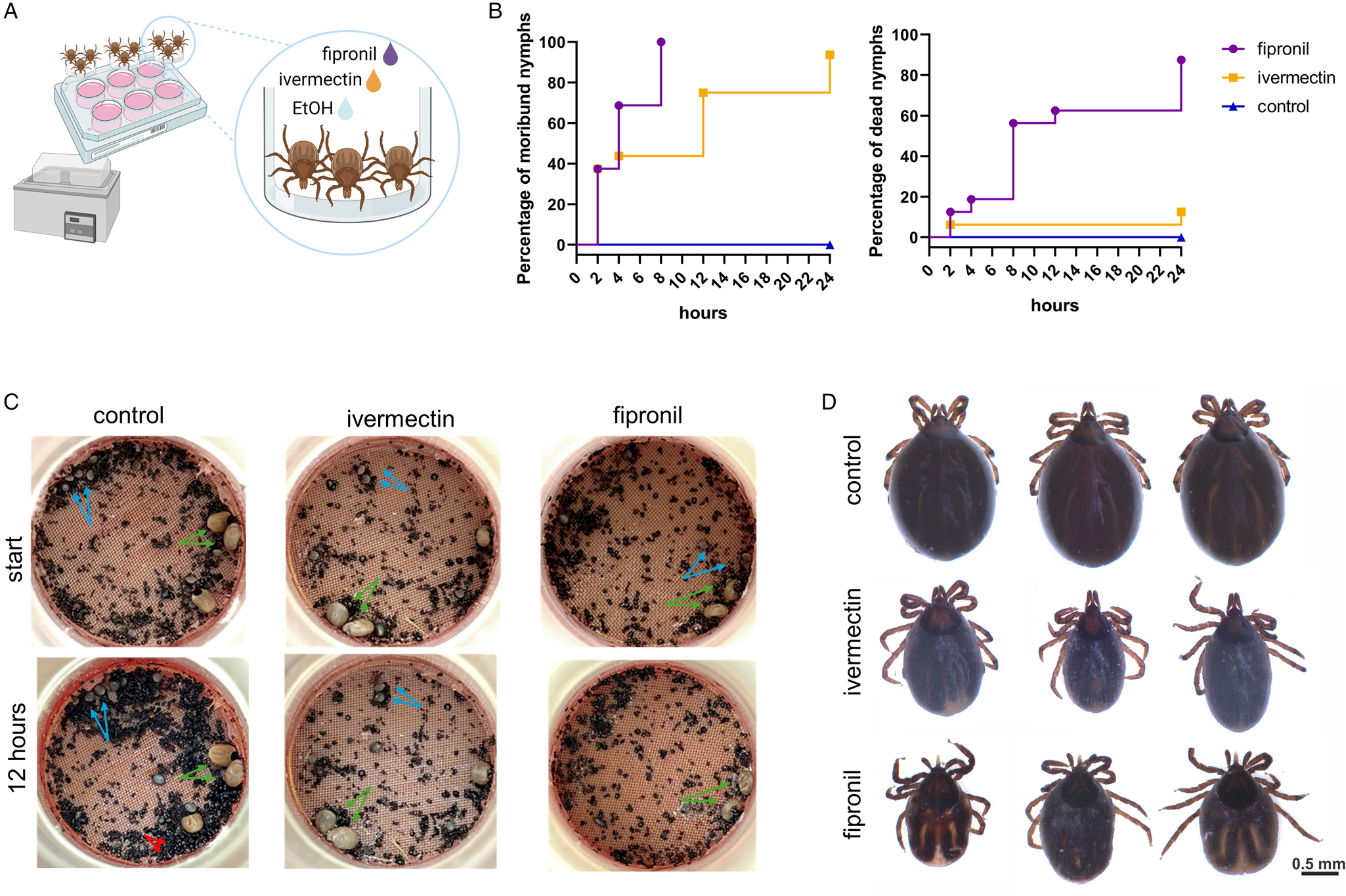
These data on topical toxicity demonstrate a substantially fast acaricidal power of both acaricides, especially fipronil, against I. ricinus nymphs. This raises the question of whether the fast-acting nature of these acaricides is sufficient to prevent the transmission of B. afzelii spirochetes, known to cause permanent infection in mice after ⩾24 h of tick feeding (Pospisilova et al., Reference Pospisilova, Urbanova, Hes, Kopacek, Hajdusek, Sima and Roy2019).
Topical application of fipronil prevents transmission of Lyme disease spirochetes in mice
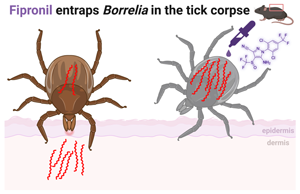
The in vivo experiments explored the ability of fipronil to prevent B. afzelii transmission from infected I. ricinus nymphs to naive mice. Fipronil was applied topically on the ticks shortly after attachment to mice (application of fipronil before tick attachment leads to tick lethality before they can attach; data not shown) and ticks were allowed to fully engorge. The fipronil-treated ticks reached only a weight fraction of fully fed control ticks, yet significantly more than unfed ticks, indicating some extent of active blood feeding (Fig. 3A). Four weeks after tick feeding, biopsies of mouse ear, skin, heart and bladder were examined for the presence of Borrelia. Expectedly, 9 out of 10 mice challenged with solvent-treated control ticks were infected with Borrelia. Conversely, no Borrelia were detected in any organs of 10 mice exposed to fipronil-treated ticks (Fig. 3B). This 100% prevention of transmission in the fipronil group underscores the potential of rapid acaricidal effect of fipronil to eliminate ticks before successful Borrelia transmission can occur.
Fipronil prevents Borrelia transmission into mouse. (A) The graph shows the average weights of 20 individual I. ricinus nymphs. Weights were obtained on day 4 of feeding for fully-fed (FF) control and fipronil-treated nymphs; weights of unfed (UF) nymphs are also shown. Bars indicate standard errors of means. T-test P values: *=0.01, ****<0.0001. (B) PCR detection of spirochetes in mouse organs 4 weeks after exposure to 5 B. afzelii-infected I. ricinus nymphs treated with fipronil or solvent (ethanol) as a control. (C) Microscopic images of Borrelia cultured in vitro with fipronil or vancomycin (positive control) revealing the morphology of representative B. afzelii spirochetes (top panel, immunofluorescent detection) and their abundance (bottom panel, dark field). Scale bars represent 10 μm. (D) The graphs compare the survival of B. afzelii in culture treated with fipronil or vancomycin (500–0.05 μg mL−1) with an untreated control culture. Bars indicate standard errors of means; t-test: *P < 0.05, n.s. = not significant, # dead spirochetes.
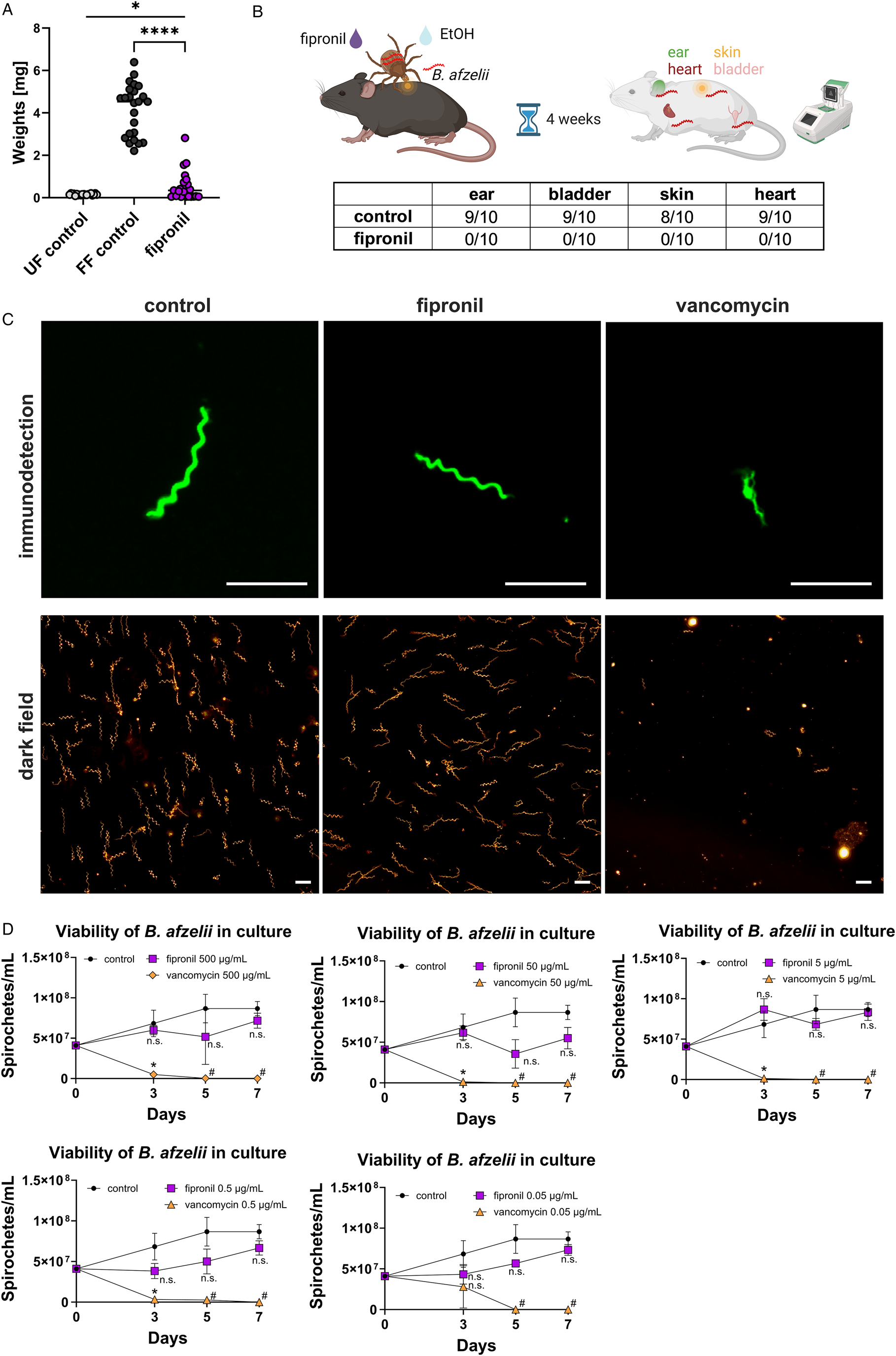
To rule out a direct effect of fipronil on B. afzelii, in vitro viability assays were conducted. Borrelia afzelii cultures supplemented with various concentrations of fipronil showed no effect on bacterial viability, unlike vancomycin, a positive control anti-borrelial antibiotic targeting bacterial cell wall synthesis (Wu et al., Reference Wu, Sharma, Niles, O'Connor, Schilling, Matluck, D'Onofrio, Hu and Lewis2018) (Fig. 3C and D). These results demonstrate that fipronil does not directly affect Borrelia spirochetes and indicates that transmission is prevented through rapid and effective disruption of tick physiology.
Discussion
Drug-based vector control holds great promise for reducing disease burden (Alout and Foy, Reference Alout and Foy2016; Miglianico et al., Reference Miglianico, Eldering, Slater, Ferguson, Ambrose, Lees, Koolen, Pruzinova, Jancarova, Volf, Koenraadt, Duerr, Trevitt, Yang, Chatterjee, Wisler, Sturm, Bousema, Sauerwein, Schultz, Tremblay and Dechering2018). Unlike blood-feeding insects, ticks (Ixodidae) exhibit prolonged association with their hosts, lasting several days. This extended feeding period creates a unique window of opportunity for intervention. The application of acaricides primarily targets the tick vector but also provides an opportunity to prevent pathogen transmission before it happens. The time required to transmit the minimum amount of pathogens capable of infecting the host is defined here as the minimum transmission time (MTT). The MTT values span across the scale from hours to days and are characteristic of individual tick species and pathogens they transmit, as illustrated by a concise overview of pathogens transmitted by Ixodes ticks (Table 1). The concept of exploiting acaricides as agents preventing pathogen transmission holds significant promise for reducing the risk of tick-borne diseases, such as Lyme disease caused by Borrelia.
Overview of minimum transmission times (MTT)
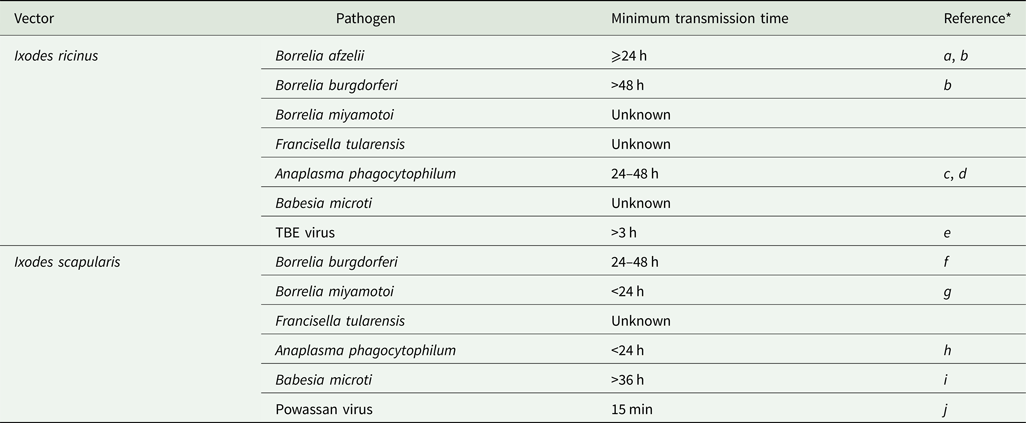
Selected MTTs for tick–pathogen Pairs, as reported in the literature.
* References: a (Pospisilova et al., Reference Pospisilova, Urbanova, Hes, Kopacek, Hajdusek, Sima and Roy2019), b (Crippa et al., Reference Crippa, Rais and Gern2002), c (Hodzic et al., Reference Hodzic, Fish, Maretzki, De Silva, Feng and Barthold1998), d (Fourie et al., Reference Fourie, Evans, Labuschagne, Crafford, Madder, Pollmeier and Schunack2019), e (Thangamani et al., Reference Thangamani, Hermance, Santos, Slovak, Heinze, Widen and Kazimirova2017), f (des Vignes et al., Reference des Vignes, Piesman, Heffernan, Schulze Terry, Stafford Iii Kirby and Fish2001), g (Breuner et al., Reference Breuner, Dolan, Replogle, Sexton, Hojgaard, Boegler, Clark and Eisen2017), h (Levin et al., Reference Levin, Troughton and Loftis2021), i (Piesman and Spielman, Reference Piesman and Spielman1980), j (Ebel and Kramer, Reference Ebel and Kramer2004).
In earlier work, we established an initial framework for tick-targeted interventions to block Borrelia transmission with a series of RNAi experiments (Perner et al., Reference Perner, Kucera, Frantova, Urbanova, Kopacek and Sima2022). While we were able to target essential transcripts by RNAi, which profoundly impeded tick blood-feeding success, the capacity of these RNAi-handicapped ticks to transmit B. afzelii spirochetes remained unchanged to controls (Perner et al., Reference Perner, Kucera, Frantova, Urbanova, Kopacek and Sima2022). We hypothesize that the time needed for RNAi to become fully active exceeds the MTT value for the I. ricinus–B. afzelii couple. While RNAi is valuable for studying functions of tick proteins affecting the biology or life cycle of the pathogens (Hajdusek et al., Reference Hajdusek, Kopacek and Perner2023), it is less suitable for non-specific handicapping of ticks to study pathogen transmission.
In this work, we assessed the impact of commercially available chemical acaricides on tick biology and pathogen transmission capacity, as the interaction with tick molecules is immediate, modulating tick processes without delay. Both acaricides, fipronil or ivermectin, demonstrated high acaricidal potency against several tick species (Hunter et al., Reference Hunter, Baggott, Everett, Fourie, Cramer, Yoon, Collidor, Mallouk, Lee, Blair and Prullage2011; Dumont et al., Reference Dumont, Chester, Gale, Soll, Fourie and Beugnet2015) and blood feeding poultry red mites (Ribeiro et al., Reference Ribeiro, Hartmann, Bartošová-Sojková, Debat, Moos, Šimek, Fara, Palus, Kučera, Hajdušek, Sojka, Kopáček and Perner2023). While fipronil has clear activity against arthropods, Borrelia spirochetes were completely unaffected by fipronil supplementation in vitro (up to 1.14 mM fipronil). It indicates yet unknown resistance mechanism of B. afzelii to fipronil-mediated cytotoxicity, as fipronil reduces the viability of Escherichia coli at 100 μM concentration (Bhatti et al., Reference Bhatti, Satyanarayana, Patel and Satish2019).
Fipronil is primarily formulated for external use, but its extraordinary environmental persistence (Bhatt et al., Reference Bhatt, Gangola, Ramola, Bilal, Bhatt, Huang, Zhou and Chen2023) suggests a need for more directed administration. Subcutaneous or oral administration to heavily infested animals offers such an alternative (Cid et al., Reference Cid, Ferreira, Magalhães, Correia and Scott2016; Poché et al., Reference Poché, Franckowiak, Clarke, Tseveenjav, Polyakova and Poché2020, Reference Poché, Dawson, Tseveenjav and Poché2021, Reference Poché, Smith and Poché2023a). While sulfoxide-containing phenylpyrazoles, such as fipronil, are short-lived in animal blood, their metabolic products, mainly fipronil sulfone, display a days-long half-life in vertebrates, retaining its insecticidal (Hainzl et al., Reference Hainzl, Cole and Casida1998) and acaricidal activity, as demonstrated in this study. For acaricidal compounds to be successful candidates as effective transmission blockers, they must have a long half-life in biological systems and be available in vertebrate blood. Compounds from the isoxazoline class, exhibiting month-long half-lives (Toutain et al., Reference Toutain, Seewald and Jung2017, Reference Toutain, Seewald and Jung2018), are promising in this respect. Lotilaner (TP-05; Tarsus Pharmaceuticals, Inc.), an isoxazoline compound, has recently passed the Phase 2b trials, demonstrating its safety and concentration-dependent tick killing activity after they have attached to human skin (https://clinicaltrials.gov/). Data from this and other studies support the concept of acaricide-mediated protection of individuals from Borrelia transmission.
Other studies also assessed the impact of acaricides aimed at reducing pathogen transmission in smaller populations and restricted areas (Hinckley et al., Reference Hinckley, Meek, Ray, Niesobecki, Connally, Feldman, Jones, Backenson, White, Lukacik, Kay, Miranda and Mead2016; Ostfeld et al., Reference Ostfeld, Mowry, Bremer, Duerr, Evans, Fischhoff, Hinckley, Hook, Keating, Pendleton, Pfister, Teator and Keesing2023). Under laboratory conditions, fipronil baits achieved 100% control of larval ticks on white-footed mice for up to 15 days post-treatment (Poché et al., Reference Poché, Franckowiak, Clarke, Tseveenjav, Polyakova and Poché2020). Similarly, systemic acaricidal treatment with orally delivered fipronil significantly reduced the burden of juvenile I. scapularis on white-footed mice (Williams et al., Reference Williams, Linske and Stafford2023). Success in using ivermectin-treated corn to control ticks on an isolated deer population (Rand et al., Reference Rand, Lacombe, Holman, Lubelczyk and Smith2000) or the high efficacy of fipronil formulations (Poché et al., Reference Poché, Wagner, Green, Smith, Hawthorne, Tseveenjav and Poché2023b, Reference Poché, Wagner, Hawthorne, Tseveenjav and Poché2023c) in controlling ticks on white-tailed deer (Odocoileus virginianus) underscore the potential of systemic acaricides in integrated tick management programmes, particularly for reservoir animals. Conversely, it has been shown that the application of acaricides like bifenthrin (a pyrethroid) around residential properties decreased the number of questing ticks but did not reduce the number of tick exposures or the incidence of tick-borne diseases (Hinckley et al., Reference Hinckley, Meek, Ray, Niesobecki, Connally, Feldman, Jones, Backenson, White, Lukacik, Kay, Miranda and Mead2016). This highlights the importance of targeting tick-pathogen transmission in individual end-hosts.
The practical implementation of tick population control in field settings requires further investigation and should be integrated with other tick management strategies. While acaricides show promise for reducing tick burdens on reservoir hosts, acaricide barriers have demonstrated limited efficacy in reducing household tick exposure and associated disease risk.
In conclusion, the extended feeding period of ticks compared to other blood-feeding insects creates a valuable window of opportunity for acaricidal intervention. This work establishes the proof-of-concept that a targeted approach offers a promising strategy for interrupting pathogen transmission and thus preventing tick-borne diseases such as Lyme borreliosis. We demonstrate the nanomolar efficiency of fipronil against I. ricinus ticks and its rapid speed-of-kill, setting a benchmark for the development of novel acaricides aimed at blocking the transmission of tick-borne pathogens.
Supplementary material
The supplementary material for this article can be found at https://doi.org/10.1017/S0031182024001136.
Data availability statement
All data are available in publication and supplementary material.
Acknowledgements
We acknowledge the excellent technical assistance of Jan Erhart and Zuzana Vavrušková from the animal facility at the Institute of Parasitology (Biology Centre, Czech Academy of Sciences). Dr David Hartmann is thanked for the assistance in processing the videos.
Author contributions
R. Š. and J. P. conceived and designed the study. A. P., T. H., P. B., M. M., L. R. and V. U. conducted data gathering. L. R., P. K., M. M. and V. U. edited the manuscript. R. Š. and J. P. wrote the article. All authors read and proofed the final version of the manuscript.
Financial support
R. S. was supported by the Czech Science Foundation grant no. 22-30920S and by the Ministry of Health of the Czech Republic, grant no. NU20-05-00396. T. H., L. R. and J. P. were supported by the Czech Science Foundation grant no. 22-18424 M (to J. P.).
Competing interests
The authors have no relevant financial or non-financial interests to disclose.
Ethical standards
All procedures were carried out in accordance with the Animal Protection Law of the Czech Republic No. 246/1992 Sb., ethics approval No. 50-2022-P. The study was approved by the Institute of Parasitology, Biology Centre CAS and Central Committee for Animal Welfare, Czech Republic (Protocol No. 1/2015).


 Open access

