

















1 Introduction
1.1 Background
A Sidon sequence in
$[n]$
 is a subset
$A\subseteq \mathbb [n]$
is a subset
$A\subseteq \mathbb [n]$
 such that the pairwise sums
$a+b$
such that the pairwise sums
$a+b$
 with summands taken from A are all different, that is,

This notion was introduced by Sidon [Reference Sidon37] in his work on Fourier analysis. Erdős and Turán [Reference Erdős and Turán19] proved that the maximum size
$\Phi (n)$
 of a Sidon sequence in
$[n]$
of a Sidon sequence in
$[n]$
 satisfies
$(1/\sqrt 2-o(1))\sqrt n<\Phi (n)<(1+o(1))\sqrt n$
satisfies
$(1/\sqrt 2-o(1))\sqrt n<\Phi (n)<(1+o(1))\sqrt n$
 and it was later shown that
$\Phi (n) \sim \sqrt {n}$
and it was later shown that
$\Phi (n) \sim \sqrt {n}$
 [Reference Bose and Chowla8]. Since then, many variants and generalizations of this problem have been studied and there is great interest in bounding the maximum size of a Sidon set in a given group. For further reading, we refer to [Reference Bajnok3, Reference O’Bryant35].
In this article, we are concerned with Sidon sets and their generalizations in arbitrary, possibly nonabelian groups, which were introduced by Babai and Sós [Reference Babai and Sós2].
Definition 1.1 Let
$\Gamma $
 be a group. We say that
$A\subseteq \Gamma $
be a group. We say that
$A\subseteq \Gamma $
 is a Sidon set of the first kind if

with
$\alpha ,\beta ,\gamma ,\delta \in A$
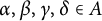 implies that
$|\{\alpha ,\beta ,\gamma ,\delta \}|\le 2$
implies that
$|\{\alpha ,\beta ,\gamma ,\delta \}|\le 2$
 . We say that A is a Sidon set of the second kind if

with
$\alpha ,\beta ,\gamma ,\delta \in A$
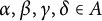 implies
$|\{\alpha ,\beta ,\gamma ,\delta \}|\le 2$
implies
$|\{\alpha ,\beta ,\gamma ,\delta \}|\le 2$
 .
.
Observe that, if
$\Gamma $
 is abelian, then these two conditions are equivalent. The authors of [Reference Babai and Sós2] used probabilistic methods to construct large Sidon sets of both kinds in general groups.
Theorem 1.1 (Babai–Sós [Reference Babai and Sós2])
Let
$\Gamma $
 be a group and
$W\subseteq \Gamma $
be a group and
$W\subseteq \Gamma $
 be finite. Then W contains Sidon sets of both kinds, of size
$(c+o(1))|W|^{1/3}$
be finite. Then W contains Sidon sets of both kinds, of size
$(c+o(1))|W|^{1/3}$
 , where
$c=3\cdot 2^{1/3}/8>0.47247$
, where
$c=3\cdot 2^{1/3}/8>0.47247$
 .
.
Godsil and Imrich [Reference Godsil and Imrich22] improved the constant to
$(2/(7+4\sqrt 3))^{1/3}> 0.52365$
 for Sidon sets of the first kind and
$1/(2+\sqrt 3)^{1/3}>0.64468$
for Sidon sets of the first kind and
$1/(2+\sqrt 3)^{1/3}>0.64468$
 for Sidon sets of the second kind.
If
$\Gamma $
 is abelian, we say that
$A\subseteq \Gamma $
is abelian, we say that
$A\subseteq \Gamma $
 is a
$B_k[g]$
is a
$B_k[g]$
 -set (
$B_k$
-set (
$B_k$
 -set if
$g=1$
-set if
$g=1$
 ) if for any
$\mu \in \Gamma $
) if for any
$\mu \in \Gamma $
 , there are at most g multisets
$\{\alpha _1,\ldots ,\alpha _k\}$
, there are at most g multisets
$\{\alpha _1,\ldots ,\alpha _k\}$
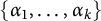 with
$\alpha _i\in A$
with
$\alpha _i\in A$
 such that
$\alpha _1+\cdots +\alpha _k=\mu $
such that
$\alpha _1+\cdots +\alpha _k=\mu $
 . Odlyzko and Smith [Reference Odlyzko and Smith36] introduced the following nonabelian analog of
$B_k$
. Odlyzko and Smith [Reference Odlyzko and Smith36] introduced the following nonabelian analog of
$B_k$
 -sets.
Definition 1.2 Let
$\Gamma $
 be a group. We say that
$A\subseteq \Gamma $
be a group. We say that
$A\subseteq \Gamma $
 is a (nonabelian)
$S_k$
is a (nonabelian)
$S_k$
 -set if whenever

with
$\alpha _i,\beta _i\in A$
 , we have

An
$S_2$
 -set is a Sidon set of the first kind but the converse is not necessarily true. We observe that the elements of an
$S_k$
-set is a Sidon set of the first kind but the converse is not necessarily true. We observe that the elements of an
$S_k$
 -set are pairwise non-commuting; for if
$\alpha \beta =\beta \alpha $
-set are pairwise non-commuting; for if
$\alpha \beta =\beta \alpha $
 , then
$\alpha \beta \alpha ^{k-2}=\beta \alpha \alpha ^{k-2}$
, then
$\alpha \beta \alpha ^{k-2}=\beta \alpha \alpha ^{k-2}$
 , but this equation is forbidden in Definition 1.2. Thus, it is only interesting to search for
$S_k$
, but this equation is forbidden in Definition 1.2. Thus, it is only interesting to search for
$S_k$
 -sets in nonabelian groups. One may generalize
$S_k$
-sets in nonabelian groups. One may generalize
$S_k$
 -sets to a nonabelian analog of
$B_k[g]$
-sets to a nonabelian analog of
$B_k[g]$
 -sets.
Definition 1.3 Let
$\Gamma $
 be a group. We say that
$A\subseteq \Gamma $
be a group. We say that
$A\subseteq \Gamma $
 is an
$S_k[g]$
is an
$S_k[g]$
 -set if for any
$\mu \in \Gamma ,$
-set if for any
$\mu \in \Gamma ,$
 there are at most g tuples
$(\alpha _1,\ldots ,\alpha _k)\in A^k$
there are at most g tuples
$(\alpha _1,\ldots ,\alpha _k)\in A^k$
 such that
$\alpha _1\dots \alpha _k=\mu $
such that
$\alpha _1\dots \alpha _k=\mu $
 .
.
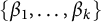
Note that
$\Gamma $
 being nonabelian allows us to impose the stronger condition of the equality of the words
$(\alpha _1,\ldots ,\alpha _k)$
being nonabelian allows us to impose the stronger condition of the equality of the words
$(\alpha _1,\ldots ,\alpha _k)$
 and
$(\beta _1,\ldots ,\beta _k)$
and
$(\beta _1,\ldots ,\beta _k)$
 rather than of the multisets
$\{\alpha _1,\ldots ,\alpha _k\}$
rather than of the multisets
$\{\alpha _1,\ldots ,\alpha _k\}$
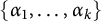 and
$\{\beta _1,\ldots ,\beta _k\}$
and
$\{\beta _1,\ldots ,\beta _k\}$
 . This is important for the applications of Sidon-type sets to extremal graph theory. Given a set
$A\subseteq \Gamma $
. This is important for the applications of Sidon-type sets to extremal graph theory. Given a set
$A\subseteq \Gamma $
 , its Cayley graph
$\mathrm {Cay}(\Gamma ,A)$
, its Cayley graph
$\mathrm {Cay}(\Gamma ,A)$
 is the digraph with vertex set
$\Gamma $
is the digraph with vertex set
$\Gamma $
 where
$\alpha \beta $
where
$\alpha \beta $
 is an edge whenever
$\alpha ^{-1}\beta \in A$
is an edge whenever
$\alpha ^{-1}\beta \in A$
 ; its bipartite Cayley graph
$\mathrm {BCay}(\Gamma ,A)$
; its bipartite Cayley graph
$\mathrm {BCay}(\Gamma ,A)$
 is the undirected graph with vertex set
$\Gamma \times \{0,1\}$
is the undirected graph with vertex set
$\Gamma \times \{0,1\}$
 whose edges are
$\{(\alpha ,0),(\alpha \beta ,1)\}$
whose edges are
$\{(\alpha ,0),(\alpha \beta ,1)\}$
 for
$\alpha \in \Gamma ,\beta \in A$
for
$\alpha \in \Gamma ,\beta \in A$
 . It is well-known that the bipartite Cayley graph of a
$B_2$
. It is well-known that the bipartite Cayley graph of a
$B_2$
 -set is
$C_4$
-set is
$C_4$
 -free: see [Reference Daza, Trujillo and Benavides13, Reference Tait and Timmons39] for applications of this connection to extremal graph theory. Unfortunately, when
$k\ge 3,$
-free: see [Reference Daza, Trujillo and Benavides13, Reference Tait and Timmons39] for applications of this connection to extremal graph theory. Unfortunately, when
$k\ge 3,$
 the bipartite Cayley graph of a
$B_k$
the bipartite Cayley graph of a
$B_k$
 -set contains a
$C_{2k}$
-set contains a
$C_{2k}$
 . However, as described in [Reference Odlyzko and Smith36], there is hope of constructing large
$C_{2k}$
. However, as described in [Reference Odlyzko and Smith36], there is hope of constructing large
$C_{2k}$
 -free graphs using another nonabelian analog of
$B_k$
-free graphs using another nonabelian analog of
$B_k$
 -sets.
Definition 1.4 Let
$\Gamma $
 be a group. We say that
$A\subseteq \Gamma $
be a group. We say that
$A\subseteq \Gamma $
 is an
$S_k'$
is an
$S_k'$
 -set if whenever

with
$\alpha _i,\beta _i\in A$
 , we have for some
$i\, (1\le i\le k-1)$
, we have for some
$i\, (1\le i\le k-1)$
 that
$\alpha _i=\beta _i$
that
$\alpha _i=\beta _i$
 or
$\beta _i=\alpha _{i+1}$
or
$\beta _i=\alpha _{i+1}$
 .
.
An
$S_2'$
 -set is a Sidon set of the second kind but the converse is not true. However, observe that the bipartite Cayley graph of an
$S_k'$
-set is a Sidon set of the second kind but the converse is not true. However, observe that the bipartite Cayley graph of an
$S_k'$
 -set is
$C_{2k}$
-set is
$C_{2k}$
 -free. A partial converse holds: if G is a (bipartite) Cayley graph with girth greater than
$2k$
-free. A partial converse holds: if G is a (bipartite) Cayley graph with girth greater than
$2k$
 , then the generating set is an
$S_k'$
, then the generating set is an
$S_k'$
 -set. This means that constructions of high-girth Cayley graphs can be phrased in terms of
$S_k'$
-set. This means that constructions of high-girth Cayley graphs can be phrased in terms of
$S_k'$
 -sets; for example, the Ramanujan graphs of Lubotzky et al. [Reference Lubotzky, Phillips and Sarnak34] provide a construction of
$S_k'$
-sets; for example, the Ramanujan graphs of Lubotzky et al. [Reference Lubotzky, Phillips and Sarnak34] provide a construction of
$S_k'$
 -sets in
$\mathrm {PSL}(2,q)$
-sets in
$\mathrm {PSL}(2,q)$
 and
$\mathrm {PGL}(2,q)$
and
$\mathrm {PGL}(2,q)$
 .
.
Let
$M_{k,g}(\Gamma )$
 denote the maximum size of an
$S_k[g]$
denote the maximum size of an
$S_k[g]$
 -set in
$\Gamma $
-set in
$\Gamma $
 , and let
$M_k'(\Gamma )$
, and let
$M_k'(\Gamma )$
 denote the maximum size of an
$S_k'$
denote the maximum size of an
$S_k'$
 -set in
$\Gamma $
-set in
$\Gamma $
 . When
$g=1$
. When
$g=1$
 , we just write
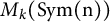
$M_k(\Gamma )$
, we just write
$M_k(\Gamma )$
 . If A is an
$S_k$
. If A is an
$S_k$
 -set, then the tuples in
$A^k$
-set, then the tuples in
$A^k$
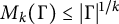
 give distinct products, so we have the trivial upper bound
$M_k(\Gamma )\le |\Gamma |^{1/k}$
give distinct products, so we have the trivial upper bound
$M_k(\Gamma )\le |\Gamma |^{1/k}$
 . More generally,
$M_{k,g}(\Gamma )\le (g|\Gamma |)^{1/k}$
. More generally,
$M_{k,g}(\Gamma )\le (g|\Gamma |)^{1/k}$
 . For
$S_k'$
. For
$S_k'$
 -sets, the general upper bound is not so immediate. Let
$A\subseteq \Gamma $
-sets, the general upper bound is not so immediate. Let
$A\subseteq \Gamma $
 be an
$S_k'$
be an
$S_k'$
 -set. Then
$\mathrm {BCay}(\Gamma ,A)$
-set. Then
$\mathrm {BCay}(\Gamma ,A)$
 is a
$C_{2k}$
is a
$C_{2k}$
 -free graph on
$2|\Gamma |$
-free graph on
$2|\Gamma |$
 vertices with
$|\Gamma ||A|$
vertices with
$|\Gamma ||A|$
 edges. The even cycle theorem [Reference Bondy and Simonovits7] gives
$|\Gamma ||A|=O(|\Gamma |^{1+1/k})$
edges. The even cycle theorem [Reference Bondy and Simonovits7] gives
$|\Gamma ||A|=O(|\Gamma |^{1+1/k})$
 , so
$M_k'(\Gamma )=O(|\Gamma |^{1/k})$
, so
$M_k'(\Gamma )=O(|\Gamma |^{1/k})$
 . The authors of [Reference Odlyzko and Smith36] constructed
$S_k$
. The authors of [Reference Odlyzko and Smith36] constructed
$S_k$
 -sets in certain infinite families of groups whose size is within a constant factor of the upper bound.
Theorem 1.2 (Odlyzko–Smith [Reference Odlyzko and Smith36])
For each integer k at least
$2$
 , and any prime p with
$k|(p-1)$
, and any prime p with
$k|(p-1)$
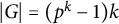
 , a nonabelian group G of order
$|G|=(p^k-1)k$
, a nonabelian group G of order
$|G|=(p^k-1)k$
 exists which contains a nonabelian
$S_k$
exists which contains a nonabelian
$S_k$
 -set S of cardinality
$(p-1)/k$
-set S of cardinality
$(p-1)/k$
 .
.
Our aims in this article are twofold. First, we give lower and upper bounds on
$M_k(\Gamma )$
 and
$M_k'(\Gamma )$
and
$M_k'(\Gamma )$
 in various groups. We list these results in Section 1.2. Second, we establish connections between
$S_k$
in various groups. We list these results in Section 1.2. Second, we establish connections between
$S_k$
 -sets and some problems in extremal graph theory, and we study these problems in their own right. We list these results in Section 1.3.
1.2 Results on Sidon sets
Our lower bounds on
$M_k(\Gamma )$
 will focus on the groups
$\mathrm {Sym}(n),\mathrm {Alt}(n),\mathrm {Sym}(n)\times \mathrm {Sym}(n)$
will focus on the groups
$\mathrm {Sym}(n),\mathrm {Alt}(n),\mathrm {Sym}(n)\times \mathrm {Sym}(n)$
 , and
$\mathrm {Alt}(n)\times \mathrm {Alt}(n)$
, and
$\mathrm {Alt}(n)\times \mathrm {Alt}(n)$
 , where
$\mathrm {Sym}(n)$
, where
$\mathrm {Sym}(n)$
 and
$\mathrm {Alt}(n)$
and
$\mathrm {Alt}(n)$
 are the symmetric and alternating groups on n letters, respectively. There is a large literature on extremal problems for the symmetric group, including properties of its Cayley graphs. For example, Helfgott and Seress [Reference Helfgott and Seress24] showed that if
$\Gamma =\mathrm {Sym}(n)$
are the symmetric and alternating groups on n letters, respectively. There is a large literature on extremal problems for the symmetric group, including properties of its Cayley graphs. For example, Helfgott and Seress [Reference Helfgott and Seress24] showed that if
$\Gamma =\mathrm {Sym}(n)$
 or
$\Gamma =\mathrm {Alt}(n),$
or
$\Gamma =\mathrm {Alt}(n),$
 then for any set
$A\subseteq \Gamma $
then for any set
$A\subseteq \Gamma $
 which generates
$\Gamma $
which generates
$\Gamma $
 , every element of
$\Gamma $
, every element of
$\Gamma $
 can be expressed as a product of
$\mathrm {exp}((\log \log |\Gamma |)^{O(1)})$
can be expressed as a product of
$\mathrm {exp}((\log \log |\Gamma |)^{O(1)})$
 elements of
$A\cup A^{-1}$
elements of
$A\cup A^{-1}$
 . Keevash and Lifshitz [Reference Keevash and Lifshitz30] obtained results on combinatorial properties of the symmetric group, including diameter of the Cayley graph of a dense generating set and the size of subsets avoiding the equation
$\alpha \beta =\gamma ^2$
. Keevash and Lifshitz [Reference Keevash and Lifshitz30] obtained results on combinatorial properties of the symmetric group, including diameter of the Cayley graph of a dense generating set and the size of subsets avoiding the equation
$\alpha \beta =\gamma ^2$
 . Recently, Keevash et al. [Reference Keevash, Lifshitz and Minzer31] determined the maximum product-free subsets of
$\mathrm {Alt}(n)$
. Recently, Keevash et al. [Reference Keevash, Lifshitz and Minzer31] determined the maximum product-free subsets of
$\mathrm {Alt}(n)$
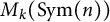
 . Illingworth et al. [Reference Illingworth, Michel and Scott29] studied similar problems in infinite groups. Our first result gives lower bounds on
$M_k(\mathrm {Sym}(n))$
. Illingworth et al. [Reference Illingworth, Michel and Scott29] studied similar problems in infinite groups. Our first result gives lower bounds on
$M_k(\mathrm {Sym}(n))$
 and
$M_k(\mathrm {Alt}(n))$
and
$M_k(\mathrm {Alt}(n))$
 .
.
Theorem 1.3 For all k, we have
-
(a) $M_k(\mathrm {Sym}(n))=(n!)^{1/k+O(1/\log n)}.$

-
(b) $M_k(\mathrm {Alt}(n))=(n!)^{1/k+O(1/\log n)}.$


The idea of Theorem 1.3 is to use the
$S_k$
 -sets of Theorem 1.2 and consider the permutations of G which map each
$\alpha \in G$
-sets of Theorem 1.2 and consider the permutations of G which map each
$\alpha \in G$
 to some
$\alpha \beta $
to some
$\alpha \beta $
 , where
$\beta $
, where
$\beta $
 belongs to the
$S_k$
belongs to the
$S_k$
 -set in G. The Egorychev–Falikman theorem [Reference Egorychev17, Reference Falikman20], which provides a lower bound on the permanent of a doubly stochastic matrix, allows us to estimate the number of such permutations.
Observe that if
$A_1\subseteq \Gamma _1$
 and
$A_2\subseteq \Gamma _2$
and
$A_2\subseteq \Gamma _2$
 are
$S_k$
are
$S_k$
 -sets, then
$A_1\times A_2$
-sets, then
$A_1\times A_2$
 is an
$S_k$
is an
$S_k$
 -set in
$\Gamma _1\times \Gamma _2$
-set in
$\Gamma _1\times \Gamma _2$
 . This is a notable contrast to
$B_k$
. This is a notable contrast to
$B_k$
 -sets. As a consequence, Theorem 1.3 gives that
$M_k(\mathrm {Sym}(n)\times \mathrm {Sym}(n))\ge (n!)^{2/k-O(1/\log n)}.$
-sets. As a consequence, Theorem 1.3 gives that
$M_k(\mathrm {Sym}(n)\times \mathrm {Sym}(n))\ge (n!)^{2/k-O(1/\log n)}.$
 In the case
$k=2$
In the case
$k=2$
 , we provide a better construction whose size can be computed exactly and which is optimal up to a factor of n.
Theorem 1.4 For every
$n,$
 we have
-
(a) $M_2(\mathrm {Sym}(n)\times \mathrm {Sym}(n))\ge (n-1)!$
. -
(b) $M_{2,n}(\mathrm {Sym}(n)\times \mathrm {Sym}(n))\ge n!.$
-
(c) $M_2(\mathrm {Alt}(n)\times \mathrm {Alt}(n))\ge (n-1)!/2.$
-
(d) $M_{2,n}(\mathrm {Alt}(n)\times \mathrm {Alt}(n))\ge n!/2.$




Inspired by the construction of Sidon sets in elementary abelian groups of order
$q^2$
 [Reference Babai and Sós2, Reference Lindström33] (which are themselves based on the original construction of Erdős and Turán [Reference Erdős and Turán19]), our constructions are loosely of the form
$\{(\alpha ,f(\alpha )):\alpha \in \Gamma \},$
[Reference Babai and Sós2, Reference Lindström33] (which are themselves based on the original construction of Erdős and Turán [Reference Erdős and Turán19]), our constructions are loosely of the form
$\{(\alpha ,f(\alpha )):\alpha \in \Gamma \},$
 where
$f:\Gamma \to \Gamma $
where
$f:\Gamma \to \Gamma $
 . However, in nonabelian groups, we cannot use polynomials so we require other tools to find a function f which gives a Sidon set. In the case of
$\mathrm {Sym}(n),$
. However, in nonabelian groups, we cannot use polynomials so we require other tools to find a function f which gives a Sidon set. In the case of
$\mathrm {Sym}(n),$
 we are able to exploit the relationship between cycle structure and conjugacy. Theorems 1.3 and 1.4 give not only an explicit construction of
$S_2$
we are able to exploit the relationship between cycle structure and conjugacy. Theorems 1.3 and 1.4 give not only an explicit construction of
$S_2$
 -sets in these groups but also, to our knowledge, the first improvement over [Reference Godsil and Imrich22] on Sidon sets of the first kind in these groups. In Section 3, we also generalize parts (b) and (d) of Theorem 1.4 to any group with a large conjugacy class.
We also consider Sidon sets of the second kind in
$\mathrm {Sym}(n)$
 . Unfortunately, neither the idea of Theorem 1.3 nor its graph-theoretic generalization work here. That is, taking permutations from a
$C_4$
. Unfortunately, neither the idea of Theorem 1.3 nor its graph-theoretic generalization work here. That is, taking permutations from a
$C_4$
 -free graph does not give rise to a Sidon set of the second kind in any direct way (see Section 7 for details). We make do with a general probabilistic lower bound, extending Theorem 1.1 to
$S_2$
-free graph does not give rise to a Sidon set of the second kind in any direct way (see Section 7 for details). We make do with a general probabilistic lower bound, extending Theorem 1.1 to
$S_2$
 -sets and
$S_2'$
-sets and
$S_2'$
 -sets. We did not attempt to optimize the constants. By an involution in a group, we mean an element of order 2.
Proposition 1 We have the following lower bounds on
$M_2(\Gamma )$
 and
$M_2'(\Gamma )$
and
$M_2'(\Gamma )$
 :
:
-
(a) Suppose that a group $\Gamma $
has a set B of size b where any distinct
$\beta _1,\beta _2\in B$
satisfy
$\beta _1^2\ne \beta _2^2$
and
$\beta _1\beta _2\ne \beta _2\beta _1$
. Then
$M_2(\Gamma )\ge (0.39+o(1))b^{1/3}.$
-
(b) Suppose $\Gamma $
has exactly i involutions. If
$i=o(|\Gamma |^{2/3})$
, then
$M_2'(|\Gamma |)\ge (0.39+o(1))|\Gamma |^{1/3}$
. If
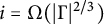
$i=\Omega (|\Gamma |^{2/3})$
, then
$M_2'(\Gamma )=\Omega (|\Gamma |/i)$
.







Note that
$\mathrm {Sym}(n)$
 has
$(n!)^{1/2+o(1)}$
has
$(n!)^{1/2+o(1)}$
 involutions, so Proposition 1(b) gives
$M_2'(\mathrm {Sym}(n))=\Omega (n!^{1/3})$
involutions, so Proposition 1(b) gives
$M_2'(\mathrm {Sym}(n))=\Omega (n!^{1/3})$
 and
$M_2'(\mathrm {Alt}(n))=\Omega (n!^{1/3})$
and
$M_2'(\mathrm {Alt}(n))=\Omega (n!^{1/3})$
 . To our knowledge, both lower bounds are the best known, although we suspect the correct exponent is
$1/2-o(1)$
. To our knowledge, both lower bounds are the best known, although we suspect the correct exponent is
$1/2-o(1)$
 .
.
We note that, in contrast with the situation for Sidon sets, even these basic probabilistic constructions of
$S_2$
 -sets and
$S_2'$
-sets and
$S_2'$
 -sets must be somewhat sensitive to the structure of the group. For example, the assumptions about B in Proposition 1(a) cannot be removed, as shown by considering any abelian group.
Finally, we present upper bounds on the size of
$S_k$
 -sets and
$S_k'$
-sets and
$S_k'$
 -sets. Dimovski [Reference Dimovski16] proved that equality can never hold in the trivial bound on
$S_k$
-sets. Dimovski [Reference Dimovski16] proved that equality can never hold in the trivial bound on
$S_k$
 -sets, that is,
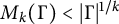
$M_k(\Gamma )<|\Gamma |^{1/k}$
-sets, that is,
$M_k(\Gamma )<|\Gamma |^{1/k}$
 whenever
$|\Gamma |>1$
whenever
$|\Gamma |>1$
 . Our main upper-bound result generalizes the argument of [Reference Dimovski16] to show that a kind of stability sometimes holds.
Theorem 1.5 For any h and any even k, there is
$\varepsilon>0$
 such that any sufficiently large group
$\Gamma $
such that any sufficiently large group
$\Gamma $
 containing a normal abelian subgroup H with
$|\Gamma :H|=h$
containing a normal abelian subgroup H with
$|\Gamma :H|=h$
 satisfies

We observe that, if
$\Gamma $
 is abelian, then
$M_k(\Gamma )=1$
is abelian, then
$M_k(\Gamma )=1$
 . Theorem 1.5 can thus be viewed an extension of this simple obstruction to existence of dense
$S_k$
. Theorem 1.5 can thus be viewed an extension of this simple obstruction to existence of dense
$S_k$
 -sets, to the case where a large subgroup is abelian. With respect to
$S_k'$
-sets, to the case where a large subgroup is abelian. With respect to
$S_k'$
 -sets, rather than
$S_k$
-sets, rather than
$S_k$
 -sets, the hypothesis of Theorem 1.5 implies a much stronger bound.
Proposition 2 If
$\Gamma $
 contains an abelian subgroup of index h, then for any
$k\ge 3,$
contains an abelian subgroup of index h, then for any
$k\ge 3,$
 we have

As a consequence, if one wishes to construct a d-regular Cayley graph with girth greater than
$2k$
 , the ambient group cannot contain an abelian subgraph of index less than
$d/(k-1)$
, the ambient group cannot contain an abelian subgraph of index less than
$d/(k-1)$
 .
.
In Section 5, we prove various other upper bounds on
$M_k(\Gamma )$
 and
$M_k'(\Gamma )$
and
$M_k'(\Gamma )$
 when some information about the structure of
$\Gamma $
when some information about the structure of
$\Gamma $
 is known.
1.3 Results on extremal graph theory
Our first result in this category demonstrates another connection between Sidon sets and extremal graph theory, in the “reverse” direction: given a
$C_{2k}$
 -free graph on n vertices, one can construct an
$S_k$
-free graph on n vertices, one can construct an
$S_k$
 -set in
$\mathrm {Sym}(n)$
-set in
$\mathrm {Sym}(n)$
 . Below, a 2-factor in a graph G is a spanning 2-regular subgraph of G.
Theorem 1.6 Suppose G is a graph on n vertices with girth at least
$2k+1$
 that contains t 2-factors. Then
$M_k(\mathrm {Sym}(n))\ge t/2^{n-1}$
that contains t 2-factors. Then
$M_k(\mathrm {Sym}(n))\ge t/2^{n-1}$
 .
.
As Theorem 1.3 is tight up to the error term, Theorem 1.6 cannot improve Theorem 1.3 (and in fact the lower bounds it yields on
$M_k(\mathrm {Sym(n)})$
 are strictly worse for most values of k). However, we find the result to be interesting for two reasons. First, it demonstrates that the connection between additive combinatorics and
$C_{2k}$
are strictly worse for most values of k). However, we find the result to be interesting for two reasons. First, it demonstrates that the connection between additive combinatorics and
$C_{2k}$
 -free graphs sometimes goes in both directions. Second, it potentially implies the existence of many more distinct maximal
$S_k$
-free graphs sometimes goes in both directions. Second, it potentially implies the existence of many more distinct maximal
$S_k$
 -sets than is guaranteed by Theorem 1.3, owing to the increased flexibility of graphs as compared with Sidon sets.
Next, we consider the relationship between
$S_k$
 -sets and directed graphs. The digraphs considered in this article may have opposite edges but no parallel edges or loops. We define some particular digraphs of special interest. Let
$\mathcal F_k$
-sets and directed graphs. The digraphs considered in this article may have opposite edges but no parallel edges or loops. We define some particular digraphs of special interest. Let
$\mathcal F_k$
 be the set of all digraphs which are the union of two distinct directed walks of length k with the same initial and same terminal vertices, let
$C_{k,k}$
be the set of all digraphs which are the union of two distinct directed walks of length k with the same initial and same terminal vertices, let
$C_{k,k}$
 be the digraph consisting of two vertices
$x,y$
be the digraph consisting of two vertices
$x,y$
 joined by two internally disjoint paths on k edges, each oriented from x to y, and let
$\mathcal C_{k,k}=\{C_{2,2},\ldots ,C_{k,k}\}$
joined by two internally disjoint paths on k edges, each oriented from x to y, and let
$\mathcal C_{k,k}=\{C_{2,2},\ldots ,C_{k,k}\}$
 . If
$\mathcal F$
. If
$\mathcal F$
 is a family of (directed) graphs, then
$\mathrm {ex}(n,\mathcal F)$
is a family of (directed) graphs, then
$\mathrm {ex}(n,\mathcal F)$
 is the maximum number of edges in a (directed) graph with no subgraph isomorphic to
$\mathcal F$
is the maximum number of edges in a (directed) graph with no subgraph isomorphic to
$\mathcal F$
 .
.
Huang and Lyu [Reference Huang and Lyu25] showed that
$\mathrm {ex}(n,C_{2,2})=n^2/4+n+O(1)$
 and determined the extremal digraphs for
$n\ge 13$
and determined the extremal digraphs for
$n\ge 13$
 . Later [Reference Huang and Lyu27], they determined
$\mathrm {ex}(n,P_{t,2})$
. Later [Reference Huang and Lyu27], they determined
$\mathrm {ex}(n,P_{t,2})$
 for large n, where
$P_{t,2}$
for large n, where
$P_{t,2}$
 consists of t internally disjoint 2-edge paths, directed from one common vertex to another common vertex. Wu [Reference Wu42] showed that
$\mathrm {ex}(n,\mathcal F_2)=n^2/4+n+O(1)$
consists of t internally disjoint 2-edge paths, directed from one common vertex to another common vertex. Wu [Reference Wu42] showed that
$\mathrm {ex}(n,\mathcal F_2)=n^2/4+n+O(1)$
 and determined the extremal digraphs. Huang et al. [Reference Huang, Lyu and Qiao28] showed that for
$k\ge 4$
and determined the extremal digraphs. Huang et al. [Reference Huang, Lyu and Qiao28] showed that for
$k\ge 4$
 ,
$\mathrm {ex}(n,\mathcal F_k)=n^2/2-\lfloor n/k\rfloor ^2/2+O(n)$
,
$\mathrm {ex}(n,\mathcal F_k)=n^2/2-\lfloor n/k\rfloor ^2/2+O(n)$
 and determined the extremal digraphs when
$k\ge 5$
and determined the extremal digraphs when
$k\ge 5$
 and
$n\ge k+5$
and
$n\ge k+5$
 . Huang and Lyu [Reference Huang and Lyu26] showed that
$\mathrm {ex}(n,\mathcal F_3)=\lfloor n^2/3\rfloor +1$
. Huang and Lyu [Reference Huang and Lyu26] showed that
$\mathrm {ex}(n,\mathcal F_3)=\lfloor n^2/3\rfloor +1$
 and determined the extremal digraphs for
$n\ge 16$
and determined the extremal digraphs for
$n\ge 16$
 .
.
In all these results, the extremal graphs have a very unbalanced outdegree sequence, for example, in [Reference Huang and Lyu27], they are obtained by some small modification of
$K_{n/2,n/2}$
 with edges oriented consistently from one part to the other. Thus, it is natural to ask how the problem changes when considering a minimum degree rather than size condition. For a vertex u in a digraph G, its outdegree
$d^+(u)$
with edges oriented consistently from one part to the other. Thus, it is natural to ask how the problem changes when considering a minimum degree rather than size condition. For a vertex u in a digraph G, its outdegree
$d^+(u)$
 is
$|\{v\in V(G):(u,v)\in E(G)\}|$
is
$|\{v\in V(G):(u,v)\in E(G)\}|$
 , its indegree
$d^-(u)$
, its indegree
$d^-(u)$
 is
$|\{v\in V(G):(v,u)\in E(G)\}|$
is
$|\{v\in V(G):(v,u)\in E(G)\}|$
 , and its semidegree
$d^0(u)$
, and its semidegree
$d^0(u)$
 is
$\min \{d^+(u),d^-(u)\}$
is
$\min \{d^+(u),d^-(u)\}$
 . Let
$m^+(n,\mathcal F)$
. Let
$m^+(n,\mathcal F)$
 /
$m^-(n,\mathcal F)$
/
$m^-(n,\mathcal F)$
 /
$m^0(n,\mathcal F)$
/
$m^0(n,\mathcal F)$
 be the largest possible minimum outdegree/indegree/semidegree of an n-vertex
$\mathcal F$
be the largest possible minimum outdegree/indegree/semidegree of an n-vertex
$\mathcal F$
 -free digraph.Footnote
1
As we show below, when considering even cycles, these extremal functions resemble the undirected Turán number
$\mathrm {ex}(n,C_{2k})$
-free digraph.Footnote
1
As we show below, when considering even cycles, these extremal functions resemble the undirected Turán number
$\mathrm {ex}(n,C_{2k})$
 more closely than the directed Turán number
$\mathrm {ex}(n,C_{k,k})$
more closely than the directed Turán number
$\mathrm {ex}(n,C_{k,k})$
 . Kelly et al. [Reference Kelly, Kühn and Osthus32] showed that, if C is a cycle oriented so that the number of forwards edges equals the number of backwards edges, then
$m^0(n,C)=o(n)$
. Kelly et al. [Reference Kelly, Kühn and Osthus32] showed that, if C is a cycle oriented so that the number of forwards edges equals the number of backwards edges, then
$m^0(n,C)=o(n)$
 . We determine the order of magnitude of
$m^0(n,\mathcal F)$
. We determine the order of magnitude of
$m^0(n,\mathcal F)$
 for certain families of forbidden cycles. (Note that if C is the antidirected
$C_{2\ell }$
for certain families of forbidden cycles. (Note that if C is the antidirected
$C_{2\ell }$
 with no directed path on three vertices, it is not too difficult to show that
$m^+(n,C),m^-(n,C),m^0(n,C)=\Theta (\mathrm {ex}(n,C_{2\ell })/n)$
with no directed path on three vertices, it is not too difficult to show that
$m^+(n,C),m^-(n,C),m^0(n,C)=\Theta (\mathrm {ex}(n,C_{2\ell })/n)$
 ; see also Conjecture 6.2 in [Reference Zhou and Li43].)
Theorem 1.7 We have

The lower bound on
$m^0(n,\mathcal F_k)$
 is a simple application of the de Bruijn digraphs [Reference De Bruijn14] and is asymptotically tight. Initially, we were interested in
$m^0(n,\mathcal F_k)$
is a simple application of the de Bruijn digraphs [Reference De Bruijn14] and is asymptotically tight. Initially, we were interested in
$m^0(n,\mathcal F_k)$
 because the Cayley graph of an
$S_k$
because the Cayley graph of an
$S_k$
 -set is
$\mathcal F_k$
-set is
$\mathcal F_k$
 -free.
For undirected graphs, the upper bounds
$\mathrm {ex}(n,\{C_3,\ldots ,C_{2k}\}),\mathrm {ex}(n,C_{2k})=O(n^{1+1/k})$
 [Reference Bondy and Simonovits7] are the best known, and for
$k=2,3,5,$
[Reference Bondy and Simonovits7] are the best known, and for
$k=2,3,5,$
 there are matching lower bounds for both functions [Reference Benson5, Reference Füredi21]. Somewhat surprisingly, in the directed case, we find that forbidding only a single
$C_{\ell ,\ell }$
there are matching lower bounds for both functions [Reference Benson5, Reference Füredi21]. Somewhat surprisingly, in the directed case, we find that forbidding only a single
$C_{\ell ,\ell }$
 changes the problem significantly.
Theorem 1.8 For any
$\ell \ge 2,$
 we have

The construction for the case
$\ell =2$
 of Theorem 1.8 can be used to construct large
$S_2$
of Theorem 1.8 can be used to construct large
$S_2$
 -sets in
$\mathrm {Sym}(n)$
-sets in
$\mathrm {Sym}(n)$
 and in fact improves case
$k=2$
and in fact improves case
$k=2$
 of Theorem 1.3 by an exponential factor. Since this improvement would be hidden in the error term
$O(1/\log n)$
of Theorem 1.3 by an exponential factor. Since this improvement would be hidden in the error term
$O(1/\log n)$
 , we skip the details. Another interesting application concerns
$C_{\ell }$
, we skip the details. Another interesting application concerns
$C_{\ell }$
 -creating Hamilton paths. Let
$\widehat {M}(n,\ell )$
-creating Hamilton paths. Let
$\widehat {M}(n,\ell )$
 be the maximum number of Hamilton paths in
$K_n$
be the maximum number of Hamilton paths in
$K_n$
 with the property that given any two of them, there is a nonempty subpath of one and a nonempty subpath of the other such that the union of these subpaths is a copy of
$C_\ell $
with the property that given any two of them, there is a nonempty subpath of one and a nonempty subpath of the other such that the union of these subpaths is a copy of
$C_\ell $
 . Cohen et al. [Reference Cohen, Fachini and Körner12] proved that
$\widehat {M}(n,4)=(n!)^{1/2+O(1/\log n)}$
. Cohen et al. [Reference Cohen, Fachini and Körner12] proved that
$\widehat {M}(n,4)=(n!)^{1/2+O(1/\log n)}$
 . For general even
$\ell $
. For general even
$\ell $
 , the best lower and upper bounds we are aware of are

which follow from [Reference Byrne and Tait10, Reference Soltész38], respectively. Using the construction in Theorem 1.8, we are able to improve the upper bound.
Corollary 1 For even
$\ell \ge 4$
 , we have

Our final application concerns the following conjecture of Erdős and Simonovits. Counterexamples are known to the original form of the conjecture in [Reference Erdős and Simonovits18], so we state the modified version discussed in [Reference Wigderson41].
Conjecture 1 Erdős–Simonovits [Reference Erdős and Simonovits18]
For every finite collection
$\mathcal F$
 of graphs which contains no forest, there exists some
$H\in \mathcal F$
of graphs which contains no forest, there exists some
$H\in \mathcal F$
 and some
$c>0$
and some
$c>0$
 so that

for all n.
Comparing Theorems 1.7 and 1.8, we observe that if
$k\ge 3$
 , then the finite family of graphs
$\mathcal C_{k,k}$
, then the finite family of graphs
$\mathcal C_{k,k}$
 satisfies
$m^0(n,H)/m^0(n,\mathcal C_{k,k})\to \infty $
satisfies
$m^0(n,H)/m^0(n,\mathcal C_{k,k})\to \infty $
 for every
$H\in \mathcal C_{k,k}$
for every
$H\in \mathcal C_{k,k}$
 . Thus, the version of Conjecture 1 obtained by replacing graphs with digraphs and
$\mathrm {ex}$
. Thus, the version of Conjecture 1 obtained by replacing graphs with digraphs and
$\mathrm {ex}$
 with
$m^0$
with
$m^0$
 is false.
2 Constructions using permanents
2.1 Proof of Theorem 1.6
Let G be a graph on n vertices with girth at least
$2k+1$
 , and let G contain t 2-factors. We aim to show that G contains an
$S_k$
, and let G contain t 2-factors. We aim to show that G contains an
$S_k$
 -set of size at least
$t/2^{n-1}$
-set of size at least
$t/2^{n-1}$
 . Orient each edge of G uniformly and independently to obtain a random directed graph
$G'.$
. Orient each edge of G uniformly and independently to obtain a random directed graph
$G'.$
 Say that
$G'$
Say that
$G'$
 respects a 2-factor F if no two edges in F have the same initial vertex or the same terminal vertex in
$G'$
respects a 2-factor F if no two edges in F have the same initial vertex or the same terminal vertex in
$G'$
 . Note that, for each component C of F (which is a cycles), the probability that any two edges in C satisfy this condition is
$2\cdot 2^{-|V(C)|}=2^{1-|V(C)|}.$
. Note that, for each component C of F (which is a cycles), the probability that any two edges in C satisfy this condition is
$2\cdot 2^{-|V(C)|}=2^{1-|V(C)|}.$
 Thus,
Thus,

where
$c(F)$
 is the number of components of F:

Taking some orientation which respects at least as many 2-factors as the expectation, we obtain a family
$\mathcal F$
 of at least
$t/2^{n-1}$
of at least
$t/2^{n-1}$
 directed 2-factors. To each of these, we associate the permutation
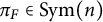
$\pi _{F}\in \mathrm {Sym}(n)$
directed 2-factors. To each of these, we associate the permutation
$\pi _{F}\in \mathrm {Sym}(n)$
 such that
$\pi _{F}(i)=j$
such that
$\pi _{F}(i)=j$
 if
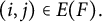
$(i,j)\in E(F).$
if
$(i,j)\in E(F).$
 These permutations are all distinct, so if
$A=\{\pi _{F}:F\in \mathcal F\},$
These permutations are all distinct, so if
$A=\{\pi _{F}:F\in \mathcal F\},$
 then
$|A|\ge t/2^{n-1}$
then
$|A|\ge t/2^{n-1}$
 .
.
Now suppose
$\alpha _1,\ldots ,\alpha _k,\beta _1,\ldots ,\beta _k\in A$
 satisfy

Let
$i\in [n]$
 . For
$\ell \in [0,k]$
. For
$\ell \in [0,k]$
 , let
$x_\ell =(\alpha _\ell \dots \alpha _1)(i)$
, let
$x_\ell =(\alpha _\ell \dots \alpha _1)(i)$
 and
$y_\ell =(\beta _\ell \dots \beta _1)(i)$
and
$y_\ell =(\beta _\ell \dots \beta _1)(i)$
 , so that
$x_0=y_0=i$
, so that
$x_0=y_0=i$
 and
$x_k=y_k=(\alpha _k\dots \alpha _1)(i).$
and
$x_k=y_k=(\alpha _k\dots \alpha _1)(i).$
 Since
$G'$
Since
$G'$
 has no opposite edges and the
$\alpha _\ell ,\beta _\ell $
has no opposite edges and the
$\alpha _\ell ,\beta _\ell $
 have no cycles of length 1 or 2 in their decompositions, there is no pausing or backtracking in the walks
$x_0\dots x_k$
have no cycles of length 1 or 2 in their decompositions, there is no pausing or backtracking in the walks
$x_0\dots x_k$
 and
$y_0\dots y_k$
and
$y_0\dots y_k$
 :
:

This implies that, if for some
$\ell <\ell '$
 , we have
$x_\ell =x_{\ell '}$
, we have
$x_\ell =x_{\ell '}$
 , then
$G[\{x_\ell ,\ldots ,x_{\ell '}\}]$
, then
$G[\{x_\ell ,\ldots ,x_{\ell '}\}]$
 contains a cycle, which contradicts that the girth of G is at least
$2k+1$
contains a cycle, which contradicts that the girth of G is at least
$2k+1$
 . Thus,
$x_0,\ldots ,x_k$
. Thus,
$x_0,\ldots ,x_k$
 are all distinct and similarly so are
$y_0,\ldots ,y_k$
are all distinct and similarly so are
$y_0,\ldots ,y_k$
 . Moreover,
$y_1=x_1$
. Moreover,
$y_1=x_1$
 , for otherwise
$x_k=y_k$
, for otherwise
$x_k=y_k$
 implies that
$G[\{x_0,\ldots ,x_k,y_0,\ldots ,y_k\}]$
implies that
$G[\{x_0,\ldots ,x_k,y_0,\ldots ,y_k\}]$
 contains a cycle, contradicting that the girth of G is at least
$2k+1$
contains a cycle, contradicting that the girth of G is at least
$2k+1$
 . Thus,
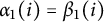
$\alpha _1(i)=\beta _1(i)$
. Thus,
$\alpha _1(i)=\beta _1(i)$
 , and this holds for all i so that
$\alpha _1=\beta _1$
, and this holds for all i so that
$\alpha _1=\beta _1$
 . We obtain

and repeating the argument k times proves that for all
$\ell $
 ,
$\alpha _\ell =\beta _\ell $
,
$\alpha _\ell =\beta _\ell $
 .
.
2.2 Proof of Theorem 1.3
In part (a), we claim that the maximum size of an
$S_k$
 -set in
$\mathrm {Sym}(n)$
-set in
$\mathrm {Sym}(n)$
 is
$(n!)^{1/k+O(1/\log n)}.$
is
$(n!)^{1/k+O(1/\log n)}.$
 The upper bound is immediate from the universal upper bound of
$|\Gamma |^{1/k}$
The upper bound is immediate from the universal upper bound of
$|\Gamma |^{1/k}$
 , valid for any group
$\Gamma $
, valid for any group
$\Gamma $
 . To prove the lower bound, we begin by describing a blow-up construction to obtain from an arbitrary group
$\Gamma $
. To prove the lower bound, we begin by describing a blow-up construction to obtain from an arbitrary group
$\Gamma $
 an
$S_k$
an
$S_k$
 -set in the symmetric group on the elements of
$\Gamma $
-set in the symmetric group on the elements of
$\Gamma $
 .
.
Suppose
$|\Gamma |=n$
 and
$A\subseteq \Gamma $
and
$A\subseteq \Gamma $
 is an
$S_k$
is an
$S_k$
 -set of size a. For
$g\in \Gamma $
-set of size a. For
$g\in \Gamma $
 , we write
$gA:=\{ga:a\in A\}$
, we write
$gA:=\{ga:a\in A\}$
 . For a set X, we will denote by
$\mathrm {Sym}(X)$
. For a set X, we will denote by
$\mathrm {Sym}(X)$
 the group of permutations of X. Let

Let M be the
$\Gamma \times \Gamma $
 matrix where
$M_{xy}=1$
matrix where
$M_{xy}=1$
 if
$x^{-1}y\in A$
if
$x^{-1}y\in A$
 and
$M_{xy}=0$
and
$M_{xy}=0$
 otherwise. Then
$A'$
otherwise. Then
$A'$
 is the set of permutations
$\pi $
is the set of permutations
$\pi $
 satisfying
$M_{x\pi (x)}=1$
satisfying
$M_{x\pi (x)}=1$
 for all
$x\in \Gamma $
for all
$x\in \Gamma $
 , and so
$|A'|=\mathrm {per}(M)$
, and so
$|A'|=\mathrm {per}(M)$
 . The matrix
$M/a$
. The matrix
$M/a$
 is doubly stochastic, so we can estimate
$\mathrm {per}(M/a)$
is doubly stochastic, so we can estimate
$\mathrm {per}(M/a)$
 using the Egorychev–Falikman theorem.
Theorem 2.1 (Egorychev–Falikman [Reference Egorychev17, Reference Falikman20])
If M is an
$n\times n$
 doubly stochastic matrix, then
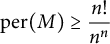
with equality if and only if M is the constant matrix
$n^{-1}J$
 .
.
We obtain

where the last inequality holds as long as
$a\geq n^\epsilon $
 , for some fixed positive constant
$\varepsilon $
, for some fixed positive constant
$\varepsilon $
 and sufficiently large n (which will hold as we will obtain A using Theorem 1.2). Now we claim that
$A'$
and sufficiently large n (which will hold as we will obtain A using Theorem 1.2). Now we claim that
$A'$
 is an
$S_k$
is an
$S_k$
 -set in
$\mathrm {Sym}(n)$
-set in
$\mathrm {Sym}(n)$
 . If
$\alpha _1\dots \alpha _k=\beta _1\dots \beta _k$
. If
$\alpha _1\dots \alpha _k=\beta _1\dots \beta _k$
 with
$\alpha _i,\beta _i\in A'$
with
$\alpha _i,\beta _i\in A'$
 , then for all
$x\in \Gamma $
, then for all
$x\in \Gamma $
 ,
,

By the definition of
$A'$
 , there exist
$a_1,\ldots ,a_k,b_1,\ldots ,b_k\in A$
, there exist
$a_1,\ldots ,a_k,b_1,\ldots ,b_k\in A$
 such that
$\alpha _i(x)=xa_i$
such that
$\alpha _i(x)=xa_i$
 and
$\beta _i(x)=xb_i$
and
$\beta _i(x)=xb_i$
 for all
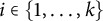
$i\in \{1,\ldots ,k\}$
for all
$i\in \{1,\ldots ,k\}$
 . Thus,

implying

and so

In particular,
$a_k=b_k$
 implies
$\alpha _k(x)=\beta _k(x)$
implies
$\alpha _k(x)=\beta _k(x)$
 . This holds for all
$x\in \Gamma $
. This holds for all
$x\in \Gamma $
 , so
$\alpha _k=\beta _k$
, so
$\alpha _k=\beta _k$
 and thus
$\alpha _1\dots \alpha _{k-1}=\beta _1\dots \beta _{k-1}$
and thus
$\alpha _1\dots \alpha _{k-1}=\beta _1\dots \beta _{k-1}$
 . Repeating this argument k times, using the fact that the
$S_k$
. Repeating this argument k times, using the fact that the
$S_k$
 -set A is also an
$S_{\ell }$
-set A is also an
$S_{\ell }$
 -set for
$\ell <k$
-set for
$\ell <k$
 , we find that
$(\alpha _1,\ldots \alpha _k)=(\beta _1,\ldots ,\beta _k)$
, we find that
$(\alpha _1,\ldots \alpha _k)=(\beta _1,\ldots ,\beta _k)$
 .
.
We have shown that whenever such
$\Gamma ,A$
 exist for given n, we have

To obtain good
$\Gamma ,A$
 , we apply Theorem 1.2. If
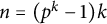
$n=(p^k-1)k$
, we apply Theorem 1.2. If
$n=(p^k-1)k$
 for some prime p with
$k|(p-1)$
for some prime p with
$k|(p-1)$
 , we may take
$a\ge cn^{1/k}$
, we may take
$a\ge cn^{1/k}$
 (where c depends only on k). Thus, for such n,

Now let
$n\in \mathbb N$
 be arbitrary. We refer to the following density-of-primes result which will also be useful later.
Theorem 2.2 (Baker–Harman–Pintz [Reference Baker, Harman and Pintz4])
Let
$\pi (x;q,a)$
 denote the number primes
$p\le x$
denote the number primes
$p\le x$
 with
$p\equiv a\pmod q$
with
$p\equiv a\pmod q$
 . If
$(a,q)=1$
. If
$(a,q)=1$
 ,
$x^{0.55+\varepsilon }\le M\le x/\log x$
,
$x^{0.55+\varepsilon }\le M\le x/\log x$
 ,
$q\le \log ^Ax$
,
$q\le \log ^Ax$
 (for constants
$A,\varepsilon>0$
(for constants
$A,\varepsilon>0$
 ) and x is large enough,

Claim 1 For
$k\ge 2$
 , if n is large enough, then the interval
$(n-n^{1-0.42/k},n]$
, if n is large enough, then the interval
$(n-n^{1-0.42/k},n]$
 contains a number of the form
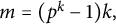
$m=(p^k-1)k,$
contains a number of the form
$m=(p^k-1)k,$
 where p is prime and
$k|(p-1)$
where p is prime and
$k|(p-1)$
 .
.
Proof Applying Theorem 2.2 with
$a=1$
 ,
$q=k$
,
$q=k$
 ,
$x=(n/k+1)^{1/k}$
,
$x=(n/k+1)^{1/k}$
 , and
$M=x^{0.56}$
, and
$M=x^{0.56}$
 gives that for large
$n,$
gives that for large
$n,$
 there is a prime

Then

and so

It is clear that
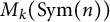
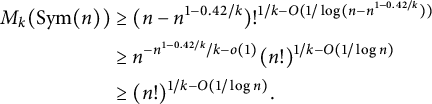
$M_k(\mathrm {Sym}(n))$
 is increasing in n since
$\mathrm {Sym}(n)\subseteq \mathrm {Sym}(n+1)$
is increasing in n since
$\mathrm {Sym}(n)\subseteq \mathrm {Sym}(n+1)$
 . By Claim 1, there exists
$m\in (n-n^{1-0.42/k},n]$
. By Claim 1, there exists
$m\in (n-n^{1-0.42/k},n]$
 of the form
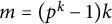
$m=(p^k-1)k$
of the form
$m=(p^k-1)k$
 for prime p and
$k|(p-1)$
for prime p and
$k|(p-1)$
 . Then
In part (b), we claim that the maximum size of an
$S_k$
 -set in the alternating group
$\mathrm {Alt}(n)$
-set in the alternating group
$\mathrm {Alt}(n)$
 is
$(n!)^{1/k+O(1/\log n)}$
is
$(n!)^{1/k+O(1/\log n)}$
 . The upper bound is immediate from
$M_k(\mathrm {Alt}(n))\le |\mathrm {Alt}(n)|^{1/k}$
. The upper bound is immediate from
$M_k(\mathrm {Alt}(n))\le |\mathrm {Alt}(n)|^{1/k}$
 . For the lower bound, note by Theorem 1.3(a) that there exists an
$S_k$
. For the lower bound, note by Theorem 1.3(a) that there exists an
$S_k$
 -set
$A\subseteq \mathrm {Sym}({n-2})$
-set
$A\subseteq \mathrm {Sym}({n-2})$
 with
$|A|=(n!)^{1/k+O(1/\log n)}.$
with
$|A|=(n!)^{1/k+O(1/\log n)}.$
 Consider A as a subset of
$\mathrm {Sym}(n)$
Consider A as a subset of
$\mathrm {Sym}(n)$
 in the natural embedding
$\mathrm {Sym}({n-2})\subseteq \mathrm {Sym}(n)$
in the natural embedding
$\mathrm {Sym}({n-2})\subseteq \mathrm {Sym}(n)$
 , and let
$\tau $
, and let
$\tau $
 be the transposition
$((n-1)\ n)$
be the transposition
$((n-1)\ n)$
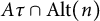
 . If at least half the permutations in A are even, then
$|A\cap \mathrm {Alt}(n)|\ge n/2$
. If at least half the permutations in A are even, then
$|A\cap \mathrm {Alt}(n)|\ge n/2$
 . Otherwise, at least half the permutations in A are odd, implying that
$|A\tau \cap \mathrm {Alt}(n)|\ge |A|/2$
. Otherwise, at least half the permutations in A are odd, implying that
$|A\tau \cap \mathrm {Alt}(n)|\ge |A|/2$
 . Clearly,
$A\cap \mathrm {Alt}(n)$
. Clearly,
$A\cap \mathrm {Alt}(n)$
 is an
$S_k$
is an
$S_k$
 -set. Since every
$\alpha \in A$
-set. Since every
$\alpha \in A$
 fixes both
$n-1$
fixes both
$n-1$
 and n,
$\alpha $
and n,
$\alpha $
 commutes with
$\tau $
commutes with
$\tau $
 . Thus, if
$\alpha _1,\ldots ,\alpha _k,\beta _1,\ldots ,\beta _k\in A$
. Thus, if
$\alpha _1,\ldots ,\alpha _k,\beta _1,\ldots ,\beta _k\in A$
 satisfy
$\alpha _1\tau \dots \alpha _k\tau =\beta _1\tau \dots \beta _k\tau ,$
satisfy
$\alpha _1\tau \dots \alpha _k\tau =\beta _1\tau \dots \beta _k\tau ,$
 we have

so
$\alpha _1\dots \alpha _k=\beta _1\dots \beta _k$
 , implying
$A\tau \cap \mathrm {Alt}(n)$
, implying
$A\tau \cap \mathrm {Alt}(n)$
 is an
$S_k$
is an
$S_k$
 -set. In either case, we have

3 Conjugacy
$S_2$
-sets

Recall that, for a group
$\Gamma $
 ,
$A\subseteq \Gamma $
,
$A\subseteq \Gamma $
 is an
$S_k[g]$
is an
$S_k[g]$
 -set if, for all
$\mu \in \Gamma $
-set if, for all
$\mu \in \Gamma $
 , the number of tuples
$(\alpha _1,\ldots ,\alpha _k)\in A^k$
, the number of tuples
$(\alpha _1,\ldots ,\alpha _k)\in A^k$
 such that
$\alpha _1\dots \alpha _k=\mu $
such that
$\alpha _1\dots \alpha _k=\mu $
 is at most g. To obtain the
$S_2$
is at most g. To obtain the
$S_2$
 -sets in
$\mathrm {Sym}(n)\times \mathrm {Sym}(n)$
-sets in
$\mathrm {Sym}(n)\times \mathrm {Sym}(n)$
 as claimed in Theorem 1.4, we first describe a more general construction. Below, we use the conjugacy structure of
$\Gamma $
as claimed in Theorem 1.4, we first describe a more general construction. Below, we use the conjugacy structure of
$\Gamma $
 to obtain
$S_2[g]$
to obtain
$S_2[g]$
 -sets in the direct product
$\Gamma \times \Gamma $
-sets in the direct product
$\Gamma \times \Gamma $
 .
.
Proposition 3 Let
$\Gamma $
 be a group,
$\pi \in \Gamma $
be a group,
$\pi \in \Gamma $
 , and let
$A\subseteq \Gamma $
, and let
$A\subseteq \Gamma $
 have the property that for any
$\mu \in \Gamma $
have the property that for any
$\mu \in \Gamma $
 ,
,

Then
$\{(\alpha ,\alpha \pi ):\alpha \in A\}$
 is an
$S_2[g]$
is an
$S_2[g]$
 -set in
$\Gamma \times \Gamma $
-set in
$\Gamma \times \Gamma $
 .
.
Proof We let
$(\mu _1,\mu _2)\in \Gamma \times \Gamma $
 and consider the number of pairs
$(\alpha ,\beta )$
and consider the number of pairs
$(\alpha ,\beta )$
 such that
$(\alpha ,\pi \alpha )(\beta ,\pi \beta )=(\mu _1,\mu _2)$
such that
$(\alpha ,\pi \alpha )(\beta ,\pi \beta )=(\mu _1,\mu _2)$
 . These equations give
$\alpha \beta =\mu _1$
. These equations give
$\alpha \beta =\mu _1$
 and
$\pi \alpha \pi \beta =\mu _2$
and
$\pi \alpha \pi \beta =\mu _2$
 . Solving for
$\beta $
. Solving for
$\beta $
 , we obtain

so

By assumption, the number of
$\alpha $
 satisfying this equation is at most g. Since
$\alpha ,\mu _1,\mu _2$
satisfying this equation is at most g. Since
$\alpha ,\mu _1,\mu _2$
 determine
$\beta $
determine
$\beta $
 , it follows that the number of such pairs
$(\alpha ,\beta )$
, it follows that the number of such pairs
$(\alpha ,\beta )$
 is at most g.
Proof of Theorem 1.4
We apply Proposition 3 where
$\Gamma $
 is
$\mathrm {Sym}(n)$
is
$\mathrm {Sym}(n)$
 or
$\mathrm {Alt}(n)$
or
$\mathrm {Alt}(n)$
 . We must further differentiate the cases where n is even or odd to ensure that the construction is contained in
$\mathrm {Alt}(n)\times \mathrm {Alt}(n)$
. We must further differentiate the cases where n is even or odd to ensure that the construction is contained in
$\mathrm {Alt}(n)\times \mathrm {Alt}(n)$
 . In all cases, our goal is to construct an
$S_2$
. In all cases, our goal is to construct an
$S_2$
 -set of size
$|\Gamma |/n$
-set of size
$|\Gamma |/n$
 , or an
$S_2[n]$
, or an
$S_2[n]$
 -set of size
$|\Gamma |$
-set of size
$|\Gamma |$
 .
.
Case 1: n is odd. Let
$\pi $
 be a cyclic permutation and let
$A=\{\alpha \in \mathrm {Sym}(n):\alpha (1)=1\}.$
be a cyclic permutation and let
$A=\{\alpha \in \mathrm {Sym}(n):\alpha (1)=1\}.$
 Now if
$\mu \in \mathrm {Sym}(n)$
Now if
$\mu \in \mathrm {Sym}(n)$
 and
$\alpha \pi \alpha ^{-1}=\mu $
and
$\alpha \pi \alpha ^{-1}=\mu $
 , then
$\mu $
, then
$\mu $
 must be a cyclic permutation
$(m_1\ m_2\ \dots \ m_n)$
must be a cyclic permutation
$(m_1\ m_2\ \dots \ m_n)$
 , where we choose
$m_1=1$
, where we choose
$m_1=1$
 . Write
$\pi =(p_1\ p_2\ \dots \ p_n)$
. Write
$\pi =(p_1\ p_2\ \dots \ p_n)$
 , where
$p_1=1$
, where
$p_1=1$
 . Then

But then
$\alpha (p_i)=m_i$
 for every i, and
$\alpha $
for every i, and
$\alpha $
 is determined. By Proposition 3,
$\{(\alpha ,\alpha \pi ):\alpha \in A\}$
is determined. By Proposition 3,
$\{(\alpha ,\alpha \pi ):\alpha \in A\}$
 is an
$S_2$
is an
$S_2$
 -set and (a) is proved. If we drop the restriction that
$\alpha (1)=1,$
-set and (a) is proved. If we drop the restriction that
$\alpha (1)=1,$
 we are led to the equation

By cycling the
$m_i$
 , we may assume that
$m_1=\alpha (p_1)$
, we may assume that
$m_1=\alpha (p_1)$
 . Then
$\alpha (p_i)=m_i$
. Then
$\alpha (p_i)=m_i$
 for every i. So, the choice of
$\alpha (p_1)$
for every i. So, the choice of
$\alpha (p_1)$
 determines the rest of its values, so there are exactly n such
$\alpha $
determines the rest of its values, so there are exactly n such
$\alpha $
 . By Proposition 3,
$\{(\alpha ,\alpha \pi ):\alpha \in \mathrm {Sym}(n)\}$
. By Proposition 3,
$\{(\alpha ,\alpha \pi ):\alpha \in \mathrm {Sym}(n)\}$
 is an
$S_2[n]$
is an
$S_2[n]$
 -set and (b) is proved. We now extend the construction to
$\mathrm {Alt}(n)$
-set and (b) is proved. We now extend the construction to
$\mathrm {Alt}(n)$
 . Since
$\pi $
. Since
$\pi $
 is an odd cycle,
$\pi \in \mathrm {Alt}(n)$
is an odd cycle,
$\pi \in \mathrm {Alt}(n)$
 . Therefore, if
$B=\{\alpha \in \mathrm {Alt}(n):\alpha (1)=1\}$
. Therefore, if
$B=\{\alpha \in \mathrm {Alt}(n):\alpha (1)=1\}$
 , then
$\{(\alpha ,\alpha \pi ):\alpha \in B\}\subseteq \mathrm {Alt}(n)\times \mathrm {Alt}(n)$
, then
$\{(\alpha ,\alpha \pi ):\alpha \in B\}\subseteq \mathrm {Alt}(n)\times \mathrm {Alt}(n)$
 ,
$\{(\alpha ,\alpha \pi ):\alpha \in \mathrm {Alt}(n)\}\subseteq \mathrm {Alt}(n)\times \mathrm {Alt}(n)$
,
$\{(\alpha ,\alpha \pi ):\alpha \in \mathrm {Alt}(n)\}\subseteq \mathrm {Alt}(n)\times \mathrm {Alt}(n)$
 , and these are clearly an
$S_2$
, and these are clearly an
$S_2$
 -set and an
$S_2[n]$
-set and an
$S_2[n]$
 -set. We count
$|\{(\alpha ,\alpha \pi ):\alpha \in B\}|=(n-1)!/2$
-set. We count
$|\{(\alpha ,\alpha \pi ):\alpha \in B\}|=(n-1)!/2$
 and
$|\{(\alpha ,\alpha \pi ):\alpha \in \mathrm {Alt}(n)\}|=n!/2$
and
$|\{(\alpha ,\alpha \pi ):\alpha \in \mathrm {Alt}(n)\}|=n!/2$
 , proving (c) and (d).
Case 2: n is even. Let
$\pi $
 be an
$(n-1)$
be an
$(n-1)$
 -cycle such that
$\pi (1)\ne 1$
-cycle such that
$\pi (1)\ne 1$
 , and let
$A=\{\pi \in \mathrm {Sym}(n):\pi (1)=1\}$
, and let
$A=\{\pi \in \mathrm {Sym}(n):\pi (1)=1\}$
 . Let
$\mu \in \mathrm {Sym}(n)$
. Let
$\mu \in \mathrm {Sym}(n)$
 and suppose that
$\alpha \pi \alpha ^{-1}=\mu $
and suppose that
$\alpha \pi \alpha ^{-1}=\mu $
 . Let
$\pi =(1\ p_2\ \dots \ p_{n-1})(p_n)$
. Let
$\pi =(1\ p_2\ \dots \ p_{n-1})(p_n)$
 , and observe that
$\mu $
, and observe that
$\mu $
 must be of the form
$\mu =(m_1\ m_2\ \dots \ m_{n-1})(m_n)$
must be of the form
$\mu =(m_1\ m_2\ \dots \ m_{n-1})(m_n)$
 . So
$\alpha \pi \alpha ^{-1}=\mu $
. So
$\alpha \pi \alpha ^{-1}=\mu $
 gives
gives

This implies
$1\in \{m_1,\ldots ,m_{n-1}\}$
 and
$\alpha (p_n)=m_n$
and
$\alpha (p_n)=m_n$
 . By cycling
$m_1,\ldots ,m_{n-1}$
. By cycling
$m_1,\ldots ,m_{n-1}$
 , we may assume that
$m_1=1$
, we may assume that
$m_1=1$
 , and we see that
$\alpha (p_i)=m_i$
, and we see that
$\alpha (p_i)=m_i$
 for
$2\le i\le n-1$
for
$2\le i\le n-1$
 . Therefore,
$\alpha $
. Therefore,
$\alpha $
 is determined, and Proposition 3 implies that
$\{(\alpha ,\alpha \pi ):\alpha \in A\}$
is determined, and Proposition 3 implies that
$\{(\alpha ,\alpha \pi ):\alpha \in A\}$
 is an
$S_2$
is an
$S_2$
 -set, proving (a). If we drop the requirement
$\alpha (1)=1,$
-set, proving (a). If we drop the requirement
$\alpha (1)=1,$
 then we are led to the equation

Thus,
$\alpha (p_n)=m_n$
 , and
$\alpha (p_2),\ldots ,\alpha (p_{n-1})$
, and
$\alpha (p_2),\ldots ,\alpha (p_{n-1})$
 are determined by the choice of
$\alpha (p_1)\in \{m_1,\ldots ,m_{n-1}\}$
are determined by the choice of
$\alpha (p_1)\in \{m_1,\ldots ,m_{n-1}\}$
 . So Proposition 3 gives that
$\{(\alpha ,\alpha \pi ):\alpha \in \mathrm {Sym}(n)\}$
. So Proposition 3 gives that
$\{(\alpha ,\alpha \pi ):\alpha \in \mathrm {Sym}(n)\}$
 is an
$S_2[n-1]$
is an
$S_2[n-1]$
 -set, proving (b). Now since
$\pi $
-set, proving (b). Now since
$\pi $
 is an odd cycle,
$\pi \in \mathrm {Alt}(n)$
is an odd cycle,
$\pi \in \mathrm {Alt}(n)$
 . Let
$B=\{\alpha \in \mathrm {Alt}(n):\alpha (1)=1\}$
. Let
$B=\{\alpha \in \mathrm {Alt}(n):\alpha (1)=1\}$
 . Clearly,
$\{(\alpha ,\alpha \pi ):\alpha \in B\}$
. Clearly,
$\{(\alpha ,\alpha \pi ):\alpha \in B\}$
 is an
$S_2$
is an
$S_2$
 -set which similarly to the case where n is odd proves (c). Finally,
$\{(\alpha ,\alpha \pi ):\alpha \in \mathrm {Alt}(n)\}$
-set which similarly to the case where n is odd proves (c). Finally,
$\{(\alpha ,\alpha \pi ):\alpha \in \mathrm {Alt}(n)\}$
 is an
$S_2[n-1]$
is an
$S_2[n-1]$
 -set which proves (d).
We briefly divert to discuss the question of using Sidon sets in
$\Gamma $
 to find Sidon sets in a subgroup
$H\le \Gamma $
to find Sidon sets in a subgroup
$H\le \Gamma $
 . If
$A\subseteq \Gamma $
. If
$A\subseteq \Gamma $
 is an
$S_k'$
is an
$S_k'$
 -set, then so is
$\gamma A$
-set, then so is
$\gamma A$
 for every
$\gamma \in \Gamma $
for every
$\gamma \in \Gamma $
 , so taking the average value of
$|\gamma A\cap H|$
, so taking the average value of
$|\gamma A\cap H|$
 proves that
$M_k'(H)\ge M_k'(\Gamma )/h$
proves that
$M_k'(H)\ge M_k'(\Gamma )/h$
 , where
$h=|G:H|$
, where
$h=|G:H|$
 . However, if A is an
$S_k$
. However, if A is an
$S_k$
 -set, this translation property does not hold and there are cases where
$|M_k(\Gamma )|/|M_k(H)|$
-set, this translation property does not hold and there are cases where
$|M_k(\Gamma )|/|M_k(H)|$
 can be arbitrarily large even while
$|\Gamma :H|$
can be arbitrarily large even while
$|\Gamma :H|$
 is fixed (e.g., this occurs in Theorem 1.2). Thus, we find it interesting that our construction implies the existence of large
$S_2$
is fixed (e.g., this occurs in Theorem 1.2). Thus, we find it interesting that our construction implies the existence of large
$S_2$
 -sets in certain subgroups
$H\times H\subseteq \mathrm {Sym}(n)\times \mathrm {Sym}(n)$
-sets in certain subgroups
$H\times H\subseteq \mathrm {Sym}(n)\times \mathrm {Sym}(n)$
 . Above we have shown this when
$H=\mathrm {Alt}(n)$
. Above we have shown this when
$H=\mathrm {Alt}(n)$
 , but in fact it holds for an arbitrary H which contains
$\pi $
, but in fact it holds for an arbitrary H which contains
$\pi $
 . Suppose
$H\subseteq \mathrm {Sym}(n)$
. Suppose
$H\subseteq \mathrm {Sym}(n)$
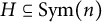 contains the element
$\pi $
contains the element
$\pi $
 . With
$A=\{\alpha \in H:\alpha (1)=1\}$
. With
$A=\{\alpha \in H:\alpha (1)=1\}$
 ,
$B=\{(\alpha ,\alpha \pi ):\alpha \in A\},$
,
$B=\{(\alpha ,\alpha \pi ):\alpha \in A\},$
 and
$B'=\{(\alpha ,\alpha \pi ):\alpha \in H\}$
and
$B'=\{(\alpha ,\alpha \pi ):\alpha \in H\}$
 , we then have
$B,B'\subseteq H\times H$
, we then have
$B,B'\subseteq H\times H$
 . Since these are subsets of the full constructions, it is clear that B (
$B'$
. Since these are subsets of the full constructions, it is clear that B (
$B'$
 ) is an
$S_2$
) is an
$S_2$
 -set (
$S_2[n]$
-set (
$S_2[n]$
 -set) and moreover
$|B'|=|H|.$
-set) and moreover
$|B'|=|H|.$
 To find
$|B|$
To find
$|B|$
 , we note that A is the stabilizer subgroup
$H_1$
, we note that A is the stabilizer subgroup
$H_1$
 , so by the orbit-stabilizer theorem
$|A|=|H|/|H\cdot 1|\ge |H|/n$
, so by the orbit-stabilizer theorem
$|A|=|H|/|H\cdot 1|\ge |H|/n$
 and therefore
$|B|\ge |H|/n$
and therefore
$|B|\ge |H|/n$
 .
.
We conclude this section by generalizing Theorem 1.4(b) and (d) to any group with a large conjugacy class.
Proposition 4 Suppose
$\Gamma $
 is a group with a conjugacy class of size m. Then

where
$g=|\Gamma |/m$
 .
.
Proof Let A be a conjugacy class of size m, and fix
$\pi \in A$
 . For
$\mu \in \Gamma $
. For
$\mu \in \Gamma $
 , let
$B_\mu =\{\alpha \in A:\alpha \pi \alpha ^{-1}=\mu \}$
, let
$B_\mu =\{\alpha \in A:\alpha \pi \alpha ^{-1}=\mu \}$
 . If
$\mu \not \in A,$
. If
$\mu \not \in A,$
 then
$B_\mu =\emptyset $
then
$B_\mu =\emptyset $
 . If
$\mu \in A,$
. If
$\mu \in A,$
 then there exists
$\alpha _0\in A$
then there exists
$\alpha _0\in A$
 such that
$\alpha _0\pi \alpha _0^{-1}=\mu $
such that
$\alpha _0\pi \alpha _0^{-1}=\mu $
 . Now
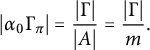
$B_\mu \subseteq \alpha _0\Gamma _\pi $
. Now
$B_\mu \subseteq \alpha _0\Gamma _\pi $
 , where
$\Gamma _\pi $
, where
$\Gamma _\pi $
 is the stabilizer of
$\pi $
is the stabilizer of
$\pi $
 in the conjugacy action of
$\Gamma $
in the conjugacy action of
$\Gamma $
 . The orbit-stabilizer theorem gives
Apply Proposition 3.
4 Probabilistic bounds
Proof of Proposition 1
(a) Assume that
$\Gamma $
 is a group and
$B\subseteq \Gamma $
is a group and
$B\subseteq \Gamma $
 is a set of size b, such that any distinct
$\beta _1,\beta _2\in B$
is a set of size b, such that any distinct
$\beta _1,\beta _2\in B$
 satisfy
$\beta _1^2\ne \beta _2^2$
satisfy
$\beta _1^2\ne \beta _2^2$
 and
$\beta _1\beta _2\ne \beta _2\beta _1$
and
$\beta _1\beta _2\ne \beta _2\beta _1$
 . We claim that there exists an
$S_2$
. We claim that there exists an
$S_2$
 -set in
$\Gamma $
-set in
$\Gamma $
 of size at least
$(0.39+o(1))b^{1/3}$
of size at least
$(0.39+o(1))b^{1/3}$
 . Define a hypergraph H where
$V(H)=B$
. Define a hypergraph H where
$V(H)=B$
 and
$e\subseteq B$
and
$e\subseteq B$
 whenever there exist
$\alpha ,\beta ,\gamma ,\delta \in B$
whenever there exist
$\alpha ,\beta ,\gamma ,\delta \in B$
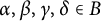 with
$\alpha \beta =\gamma \delta $
with
$\alpha \beta =\gamma \delta $
 and
$\{\alpha ,\beta ,\gamma ,\delta \}=e$
and
$\{\alpha ,\beta ,\gamma ,\delta \}=e$
 . We classify edges by the number and position of the distinct elements in the equation
$\alpha \beta =\gamma \delta $
. We classify edges by the number and position of the distinct elements in the equation
$\alpha \beta =\gamma \delta $
 : with
$\alpha ,\beta ,\gamma ,\delta $
: with
$\alpha ,\beta ,\gamma ,\delta $
 being distinct elements, every edge is of one of the following forms:
-
(1) $\alpha ^2=\beta ^2$
. -
(2) $\alpha \beta =\beta \alpha .$
-
(3) $\alpha \beta =\gamma \alpha .$
-
(4) $\alpha ^2=\beta \gamma .$
-
(5) $\alpha \beta =\gamma \delta $
.


By the assumption on B, there are no edges of the form (1) or (2). In forms (3)–(5), it is possible to solve for
$\gamma $
 in terms of the other elements. Thus, the number of equations of type (3) or (4) is at most
$2b^2$
in terms of the other elements. Thus, the number of equations of type (3) or (4) is at most
$2b^2$
 and the number of equations of type (5) is at most
$b^3$
and the number of equations of type (5) is at most
$b^3$
 . To bound the independence number of
$H,$
. To bound the independence number of
$H,$
 we borrow from [Reference Babai and Sós2] the following non-uniform version of Turán’s theorem.
Proposition 5 (Babai–Sós [Reference Babai and Sós2])
Let
$e_r$
 denote the number of edges of size r in the hypergraph H with n vertices. Let
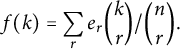
Then

In the setup above, choosing
$k=(0.49b)^{1/3}$
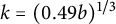 gives, for large enough
$b,$
gives, for large enough
$b,$


Thus,
$M_2(\Gamma )\ge \alpha (H)\ge k-f(k)>k/2>(0.39+o(1))b^{1/3}.$

(b) Let
$\Gamma $
 be a group of order n, and suppose that its set I of involutions has size i. We claim that, if
$i=o(|\Gamma |^{2/3})$
be a group of order n, and suppose that its set I of involutions has size i. We claim that, if
$i=o(|\Gamma |^{2/3})$
 , then
$\Gamma $
, then
$\Gamma $
 contains an
$S_2'$
contains an
$S_2'$
 -set of size at least
$(0.39+o(1))|\Gamma |^{1/3}$
-set of size at least
$(0.39+o(1))|\Gamma |^{1/3}$
 . If
$i=\Omega (|\Gamma |^{2/3})$
. If
$i=\Omega (|\Gamma |^{2/3})$
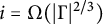 , then we claim that
$\Gamma $
, then we claim that
$\Gamma $
 contains an
$S_2'$
contains an
$S_2'$
 -set of size
$\Omega (|\Gamma |/i)$
-set of size
$\Omega (|\Gamma |/i)$
 . Define a hypergraph H with
$V(H)=\Gamma $
. Define a hypergraph H with
$V(H)=\Gamma $
 and
$e\in E(H)$
and
$e\in E(H)$
 whenever there exist
$\alpha ,\beta ,\gamma ,\delta \in \Gamma $
whenever there exist
$\alpha ,\beta ,\gamma ,\delta \in \Gamma $
 with
$\alpha \ne \beta \ne \gamma \ne \delta $
with
$\alpha \ne \beta \ne \gamma \ne \delta $
 ,
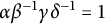
$\alpha \beta ^{-1}\gamma \delta ^{-1}=1$
,
$\alpha \beta ^{-1}\gamma \delta ^{-1}=1$
 , and
$\{\alpha ,\beta ,\gamma ,\delta \}=e$
, and
$\{\alpha ,\beta ,\gamma ,\delta \}=e$
 . For distinct
$\alpha ,\beta ,\gamma ,\delta $
. For distinct
$\alpha ,\beta ,\gamma ,\delta $
 , the edges appear in the following forms:
-
(1) $\alpha \beta ^{-1}\alpha \beta ^{-1}=1$
. -
(2) $\alpha \beta ^{-1}\alpha \delta ^{-1}=1.$
-
(3) $\alpha \beta ^{-1}\gamma \delta ^{-1}=1.$
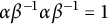
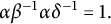
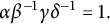
These possibilities are exhaustive up to permuting the symbols, since
$\alpha \beta ^{-1}\gamma \beta ^{-1}=1$
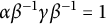 implies
$\beta \gamma ^{-1}\beta \alpha ^{-1}=1$
implies
$\beta \gamma ^{-1}\beta \alpha ^{-1}=1$
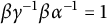 which is a type (2) equation and because
$\alpha \beta ^{-1} \delta \alpha ^{-1} = 1$
which is a type (2) equation and because
$\alpha \beta ^{-1} \delta \alpha ^{-1} = 1$
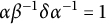 implies
$\beta = \delta $
implies
$\beta = \delta $
 . Now (1) holds if and only if
$\alpha \in I\beta ,$
. Now (1) holds if and only if
$\alpha \in I\beta ,$
 where I is the set of involutions of
$\Gamma $
where I is the set of involutions of
$\Gamma $
 , so the number of equations in form (1) is
$ni$
, so the number of equations in form (1) is
$ni$
 . In forms (2) and (3), one can solve for
$\beta $
. In forms (2) and (3), one can solve for
$\beta $
 in terms of the other elements, so there are at most
$n^2$
in terms of the other elements, so there are at most
$n^2$
 equations in form (2) and
$n^3$
equations in form (2) and
$n^3$
 equations in form (3). We have

If
$i=o(n^{2/3}),$
 then choosing
$k=(0.49n)^{1/3}$
then choosing
$k=(0.49n)^{1/3}$
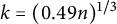 gives
$f(k)/k<1/2$
gives
$f(k)/k<1/2$
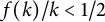 for large n and we have
$M_2'(\Gamma )=\alpha (H)>(0.39+o(1))n^{1/3}$
for large n and we have
$M_2'(\Gamma )=\alpha (H)>(0.39+o(1))n^{1/3}$
 . If
$i\ge Cn^{2/3}$
. If
$i\ge Cn^{2/3}$
 , then choosing
$k=n/((4/C+4)i)$
, then choosing
$k=n/((4/C+4)i)$
 implies
$k\le n^{1/3}/4$
implies
$k\le n^{1/3}/4$
 so for large
$n,$
so for large
$n,$
 we have
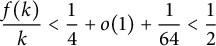
and so
$M_2'(\Gamma )\ge k-f(k)>k/2=\Omega (n/i).$

In the proofs above, we counted five distinct forms of the forbidden equation for an
$S_2$
 -set and three forms for an
$S_2'$
-set and three forms for an
$S_2'$
 -set. As k increases, the number of distinct forms also increases. Thus, we expect that probabilistic bounds for
$k\ge 3$
-set. As k increases, the number of distinct forms also increases. Thus, we expect that probabilistic bounds for
$k\ge 3$
 would be considerably more difficult to apply.
5 Upper bounds
In this section, we prove various upper bounds on
$M_k(\Gamma )$
 , the maximum size of an
$S_k$
, the maximum size of an
$S_k$
 -set in
$\Gamma $
-set in
$\Gamma $
 , and
$M_k'(\Gamma )$
, and
$M_k'(\Gamma )$
 , the maximum size of an
$S_k'$
, the maximum size of an
$S_k'$
 -set in
$\Gamma $
-set in
$\Gamma $
 . We begin with a simple observation.
Proposition 6 Let
$k\ge 2$
 be fixed. If
$\Gamma $
be fixed. If
$\Gamma $
 contains an abelian subgroup of index 2, then

where
$o(1)\to 0$
 as
$|\Gamma |\to \infty $
as
$|\Gamma |\to \infty $
 .
.
Proof Suppose
$\Gamma $
 has an abelian subgroup H of index 2. Let
$A\subseteq \Gamma $
has an abelian subgroup H of index 2. Let
$A\subseteq \Gamma $
 be an
$S_k$
be an
$S_k$
 -set. Since all but 1 of the elements of A must belong to
$\Gamma -H$
-set. Since all but 1 of the elements of A must belong to
$\Gamma -H$
 and all tuples of length k taken from
$\Gamma -H$
and all tuples of length k taken from
$\Gamma -H$
 have a product which belongs to the same coset, we obtain
$(|A|-1)^k\le \frac {|\Gamma |}{2}$
have a product which belongs to the same coset, we obtain
$(|A|-1)^k\le \frac {|\Gamma |}{2}$
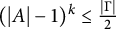 so
so

Next, we consider the situation where
$\Gamma $
 contains a normal abelian subgroup H of fixed index
$h\ge 3$
contains a normal abelian subgroup H of fixed index
$h\ge 3$
 . If
$A\subseteq \Gamma $
. If
$A\subseteq \Gamma $
 is an
$S_k$
is an
$S_k$
 -set, we are interested in a function
$f:\Gamma /H\to \mathbb R,$
-set, we are interested in a function
$f:\Gamma /H\to \mathbb R,$
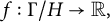 where
$f(g)$
where
$f(g)$
 is proportional to
$|A\cap g|$
is proportional to
$|A\cap g|$
 , with the aim of showing that
$f(1)$
, with the aim of showing that
$f(1)$
 cannot be too small if
$|A|$
cannot be too small if
$|A|$
 is close to
$|\Gamma |^{1/k}$
is close to
$|\Gamma |^{1/k}$
 . To this end, we view f as an element of the group ring
$\mathbb C[G]$
. To this end, we view f as an element of the group ring
$\mathbb C[G]$
 . Our argument closely follows Dimovsky’s proof [Reference Dimovski16] that
$M_k(\Gamma )<|\Gamma |^{1/k}$
. Our argument closely follows Dimovsky’s proof [Reference Dimovski16] that
$M_k(\Gamma )<|\Gamma |^{1/k}$
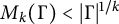 .
.
Lemma 1 Suppose K is a group of order h, and
$x\in \mathbb R^K$
 is a vector with the property that for all
$g\in K$
is a vector with the property that for all
$g\in K$
 ,
,

Then
$x_1=1/h$
 .
.
Proof Consider the group ring
$\mathbb C[K]$
 , so that we may identify x with the element
$\sum _{k\in K}x_kk\in \mathbb C[K]$
, so that we may identify x with the element
$\sum _{k\in K}x_kk\in \mathbb C[K]$
 . According to Maschke’s theorem,
$\mathbb C[K]$
. According to Maschke’s theorem,
$\mathbb C[K]$
 is semisimple. Thus, by the Wedderburn–Artin theorem, we have the direct sum of rings
$\mathbb C[K]=R_1+\cdots +R_m$
is semisimple. Thus, by the Wedderburn–Artin theorem, we have the direct sum of rings
$\mathbb C[K]=R_1+\cdots +R_m$
 , where each
$R_i$
, where each
$R_i$
 is isomorphic to
$M_{n_i}(\mathbb C)$
is isomorphic to
$M_{n_i}(\mathbb C)$
 , the ring of
$n_i\times n_i$
, the ring of
$n_i\times n_i$
 matrices over
$\mathbb C$
matrices over
$\mathbb C$
 . Moreover, each
$R_i$
. Moreover, each
$R_i$
 is the two-sided ideal generated by some idempotent
$e_i$
is the two-sided ideal generated by some idempotent
$e_i$
 , satisfying
$e_ie_j=0$
, satisfying
$e_ie_j=0$
 for
$i\ne j$
for
$i\ne j$
 and
$1=e_1+\cdots +e_m$
and
$1=e_1+\cdots +e_m$
 . Moreover, up to permutation of the
$R_i$
. Moreover, up to permutation of the
$R_i$
 , we may assume that
$e_1=(1/h)\sum _{k\in K}k$
, we may assume that
$e_1=(1/h)\sum _{k\in K}k$
 and
$n_1=1$
and
$n_1=1$
 .
.
Let
$\rho :K\to \mathrm {GL}_h(\mathbb C)$
 be the right regular representation of K:

where
$\mathbb C^h$
 is identified with
$\mathbb C[K]$
is identified with
$\mathbb C[K]$
 above. We extend
$\rho $
above. We extend
$\rho $
 linearly to view it as a function
$\mathbb C[K]\to \mathrm {GL}_h(\mathbb C)$
linearly to view it as a function
$\mathbb C[K]\to \mathrm {GL}_h(\mathbb C)$
 : for
$z\in \mathbb C[K]$
: for
$z\in \mathbb C[K]$
 ,
,

Considering K as a basis of the vector space
$\mathbb C[K]$
 , we obtain a matrix
$[a_{g,h}]_{g,h\in K}$
, we obtain a matrix
$[a_{g,h}]_{g,h\in K}$
 for
$\rho (k)$
for
$\rho (k)$
 , satisfying that for all
$y\in \mathbb C[K]$
, satisfying that for all
$y\in \mathbb C[K]$
 ,
,

The character of
$\rho $
 is the function
$\chi :\mathbb C[K]\to \mathbb C$
is the function
$\chi :\mathbb C[K]\to \mathbb C$
 given by

For
$k,g\in K$
 , we have
$\rho (k)(g)=gk$
, we have
$\rho (k)(g)=gk$
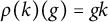 , so
$\rho (k)$
, so
$\rho (k)$
 has matrix
$[a_{g,\ell }],$
has matrix
$[a_{g,\ell }],$
 where
$a_{g,\ell }=\mathbf 1_{\{g=\ell k\}}$
where
$a_{g,\ell }=\mathbf 1_{\{g=\ell k\}}$
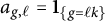 . Hence,
$\chi (1)=h$
. Hence,
$\chi (1)=h$
 and
$\chi (k)=0$
and
$\chi (k)=0$
 for
$k\ne 1$
for
$k\ne 1$
 . On the other hand, we may consider a different basis for
$\mathbb C[K]$
. On the other hand, we may consider a different basis for
$\mathbb C[K]$
 formed from the bases of each ring
$R_i$
formed from the bases of each ring
$R_i$
 : let
$s_{ijk}\in R_i$
: let
$s_{ijk}\in R_i$
 be the element corresponding to the matrix with
$1$
be the element corresponding to the matrix with
$1$
 in position
$(j,k)$
in position
$(j,k)$
 and
$0$
and
$0$
 elsewhere. Then if
$y=\sum _i\sum _j\sum _ky_{ijk}s_{ijk}$
elsewhere. Then if
$y=\sum _i\sum _j\sum _ky_{ijk}s_{ijk}$
 , we have

Observe that the coefficients
$y_{ack}$
 do not depend on c, and that we have
$\rho (y)s_{abc}\in \mathrm {Span}(s_{ab1},\ldots ,s_{abn_a})$
do not depend on c, and that we have
$\rho (y)s_{abc}\in \mathrm {Span}(s_{ab1},\ldots ,s_{abn_a})$
 . Thus,
$\rho (y)$
. Thus,
$\rho (y)$
 is represented by the matrix

and
$\otimes $
 denotes the Kronecker product. Since trace is invariant under change of basis, we have
$\chi (y)=\mathrm {Tr}(\rho (y))=n_1\mathrm {Tr}(A_1)+\cdots +n_m\mathrm {Tr}(A_m).$
denotes the Kronecker product. Since trace is invariant under change of basis, we have
$\chi (y)=\mathrm {Tr}(\rho (y))=n_1\mathrm {Tr}(A_1)+\cdots +n_m\mathrm {Tr}(A_m).$
 Now let
$x=r_1+\cdots +r_m$
Now let
$x=r_1+\cdots +r_m$
 , where
$r_i\in R_i$
, where
$r_i\in R_i$
 ; then

Thus,
$r_1^2=e_1$
 and
$r_i^2=0$
and
$r_i^2=0$
 for
$i>1$
for
$i>1$
 . This implies that, if
$A_1,\ldots , A_m$
. This implies that, if
$A_1,\ldots , A_m$
 are as in Equation (1) corresponding to
$\rho (x)$
are as in Equation (1) corresponding to
$\rho (x)$
 , then
$A_1=[1]$
, then
$A_1=[1]$
 and
$A_i$
and
$A_i$
 is nilpotent for
$i>1$
is nilpotent for
$i>1$
 . Thus,
$\mathrm {Tr}(A_i)=0$
. Thus,
$\mathrm {Tr}(A_i)=0$
 for
$i>1$
for
$i>1$
 , and
$\chi (x)=n_1\mathrm {Tr}(A_1)=1$
, and
$\chi (x)=n_1\mathrm {Tr}(A_1)=1$
 . On the other hand,

Hence,
$x_1=1/h$
 .
.
Lemma 2 Suppose K is a group of order h. For any
$\varepsilon>0$
 , there exists
$\delta>0$
, there exists
$\delta>0$
 such that any
$x\in [0,1]^K$
such that any
$x\in [0,1]^K$
 with the property that for all
$g\in K$
with the property that for all
$g\in K$
 ,
,
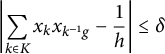
satisfies
$x_1>1/h-\varepsilon $
 .
.
Proof If not, then there is some
$\varepsilon>0$
 and a sequence of vectors
$x^{(n)}$
and a sequence of vectors
$x^{(n)}$
 such that
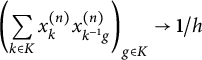
as
$n\to \infty $
 , while
$x^{(n)}_1\le 1/h-\varepsilon $
, while
$x^{(n)}_1\le 1/h-\varepsilon $
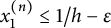 . Since
$[0,1]^K$
. Since
$[0,1]^K$
 is compact, by taking subsequences, we may assume that
$x^{(n)}$
is compact, by taking subsequences, we may assume that
$x^{(n)}$
 converges to some
$x\in [0,1]^K$
converges to some
$x\in [0,1]^K$
 . Since the functions
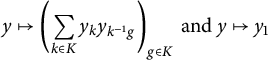
are continuous, we have
$ \sum _{k\in K}x_kx_{k^{-1}g}=1/h$
 for every g and
$x_1\le 1/h-\varepsilon $
for every g and
$x_1\le 1/h-\varepsilon $
 . But by Lemma 1, this is impossible.
We are now ready to prove our upper bound. The proof still closely follows [Reference Dimovski16].
Proof of Theorem 1.5
Let
$k=2r$
 , A be an
$S_k$
, A be an
$S_k$
 -set in
$\Gamma $
-set in
$\Gamma $
 with
$|A|>(1-\varepsilon )|\Gamma |^{1/k}$
with
$|A|>(1-\varepsilon )|\Gamma |^{1/k}$
 , and
$K=\Gamma /H$
, and
$K=\Gamma /H$
 . We must show that H cannot be abelian. Define
$L=\{\alpha _1\dots \alpha _r:\alpha _i\in A\}$
. We must show that H cannot be abelian. Define
$L=\{\alpha _1\dots \alpha _r:\alpha _i\in A\}$
 . Then
$|L|=|A|^r\ge (1-r\varepsilon )|\Gamma |^{1/2}$
. Then
$|L|=|A|^r\ge (1-r\varepsilon )|\Gamma |^{1/2}$
 , and L is an
$S_2$
, and L is an
$S_2$
 -set in
$\Gamma $
-set in
$\Gamma $
 . Let
$x_g=|L\cap g|/\sqrt {|\Gamma |}$
. Let
$x_g=|L\cap g|/\sqrt {|\Gamma |}$
 for cosets
$g\in K$
for cosets
$g\in K$
 . Since L is an
$S_2$
. Since L is an
$S_2$
 -set, the products
$\alpha \beta $
-set, the products
$\alpha \beta $
 for
$\alpha ,\beta \in L$
for
$\alpha ,\beta \in L$
 are all distinct and cover at least
$(1-2r\varepsilon )|\Gamma |$
are all distinct and cover at least
$(1-2r\varepsilon )|\Gamma |$
 elements of
$\Gamma $
elements of
$\Gamma $
 . By counting
$\{\alpha \beta :\alpha \beta \in g,\alpha ,\beta \in L\},$
. By counting
$\{\alpha \beta :\alpha \beta \in g,\alpha ,\beta \in L\},$
 it follows that for all
$g\in K$
it follows that for all
$g\in K$
 ,
,

By Lemma 2, we can choose
$\varepsilon $
 small enough (by minimizing the choice of
$\varepsilon $
small enough (by minimizing the choice of
$\varepsilon $
 over all finite groups of order h) so that this implies
$x_1\ge 1/(2h)$
over all finite groups of order h) so that this implies
$x_1\ge 1/(2h)$
 , that is,
$|L\cap 1|\ge \sqrt {|\Gamma |}/(2h)$
, that is,
$|L\cap 1|\ge \sqrt {|\Gamma |}/(2h)$
 . If
$|\Gamma |$
. If
$|\Gamma |$
 is large enough, then
$\sqrt {|\Gamma |}/(2h)\ge 2$
is large enough, then
$\sqrt {|\Gamma |}/(2h)\ge 2$
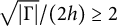 , contradicting that H is abelian.
If more specific information about
$\Gamma /H$
 is known, we can sometimes obtain explicit lower bounds on the value of
$\varepsilon $
is known, we can sometimes obtain explicit lower bounds on the value of
$\varepsilon $
 in Theorem 1.5.
Proposition 7 Suppose
$\Gamma $
 has a normal abelian subgroup H and
$\Gamma /H\simeq \mathbb Z_2^d$
has a normal abelian subgroup H and
$\Gamma /H\simeq \mathbb Z_2^d$
 . Then

Proof Suppose A is an
$S_2$
 -set in
$\Gamma $
-set in
$\Gamma $
 . Let the cosets of H be
$H=\beta _1H,\ldots ,\beta _{2^d}H$
. Let the cosets of H be
$H=\beta _1H,\ldots ,\beta _{2^d}H$
 , where
$\beta _1=1$
, where
$\beta _1=1$
 . Let
$x_i=|A\cap \beta _iH|$
. Let
$x_i=|A\cap \beta _iH|$
 . Since
$(A\cap \beta _iH)^2\subseteq H$
. Since
$(A\cap \beta _iH)^2\subseteq H$
 and
$|A\cap H|\le 1$
and
$|A\cap H|\le 1$
 , we have
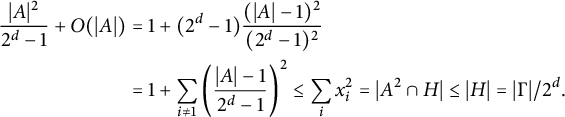
The first inequality follows from the facts that
$|A\cap H|\le 1$
 and that
$\sum _{i\ne 1}x_i^2\ge \sum _{i\ne 1}((\sum _{i\ne 1}x_i)/(2^d-1))^2.$
and that
$\sum _{i\ne 1}x_i^2\ge \sum _{i\ne 1}((\sum _{i\ne 1}x_i)/(2^d-1))^2.$
 The claim follows.
It seems that other bounds could be proven on an ad-hoc basis depending on the structure of
$\Gamma /H$
 . We now turn to
$S_k'$
. We now turn to
$S_k'$
 -sets. Here, if
$k=2,$
-sets. Here, if
$k=2,$
 then the existence of abelian subgroups tells us nothing, since there exist abelian Sidon sets which meet the trivial bound
$|A|(|A|-1)\le |\Gamma |-1$
then the existence of abelian subgroups tells us nothing, since there exist abelian Sidon sets which meet the trivial bound
$|A|(|A|-1)\le |\Gamma |-1$
 . When
$k\ge 3$
. When
$k\ge 3$
 , the situation is different.
Proof of Proposition 2
Let
$A\subseteq \Gamma $
 be an
$S_k'$
be an
$S_k'$
 -set and suppose that
$H\le \Gamma $
-set and suppose that
$H\le \Gamma $
 is an abelian subgroup of index h. Then
$|A\cap H|\le k-1$
is an abelian subgroup of index h. Then
$|A\cap H|\le k-1$
 . For suppose, there existed distinct
$\alpha _1,\ldots ,\alpha _k\in A\cap H$
. For suppose, there existed distinct
$\alpha _1,\ldots ,\alpha _k\in A\cap H$
 . Then we have

while no element appears next to its inverse in the above equation, contradicting the definition. Moreover, for any
$\gamma \in \Gamma ,$
 we have that
$\gamma A$
we have that
$\gamma A$
 is also an
$S_k'$
is also an
$S_k'$
 -set: if
$(\gamma \alpha _1)(\gamma \beta _1)^{-1}\dots (\gamma \alpha _k)(\gamma \beta _k)^{-1}=1,$
-set: if
$(\gamma \alpha _1)(\gamma \beta _1)^{-1}\dots (\gamma \alpha _k)(\gamma \beta _k)^{-1}=1,$
 then
$\gamma \alpha _1\beta _1^{-1}\dots \alpha _k\beta _k^{-1}\gamma ^{-1}=1$
then
$\gamma \alpha _1\beta _1^{-1}\dots \alpha _k\beta _k^{-1}\gamma ^{-1}=1$
 and so
$\alpha _1\beta _1^{-1}\dots \alpha _k\beta _k^{-1}=1$
and so
$\alpha _1\beta _1^{-1}\dots \alpha _k\beta _k^{-1}=1$
 ; also
$\gamma \alpha _i\ne \gamma \beta _i\ne \gamma \alpha _{i+1}$
; also
$\gamma \alpha _i\ne \gamma \beta _i\ne \gamma \alpha _{i+1}$
 implies
$\alpha _i\ne \beta _i\ne \alpha _{i+1}.$
implies
$\alpha _i\ne \beta _i\ne \alpha _{i+1}.$
 Therefore,
$|\gamma A\cap H|\le k-1$
Therefore,
$|\gamma A\cap H|\le k-1$
 for every
$\gamma \in \Gamma $
for every
$\gamma \in \Gamma $
 . Thus:

and so
$|A|\le (k-1)|\Gamma |/|H|=h(k-1).$

This means that for
$k\ge 3$
 , large
$S_k'$
, large
$S_k'$
 -sets can only exist in groups which have no abelian subgroups of bounded index.
6 Extremal problems for directed graphs
In this section, we prove Theorems 1.7 and 1.8 and Corollary 1. We recall that our digraphs may have opposite edges but no parallel edges or loops; and that, for a digraph family
$\mathcal F$
 , the function
$m^+(n,\mathcal F)/m^-(n,\mathcal F)/m^0(n,\mathcal F)$
, the function
$m^+(n,\mathcal F)/m^-(n,\mathcal F)/m^0(n,\mathcal F)$
 is the largest possible minimum outdegree/indegree/semidegree in an
$\mathcal F$
is the largest possible minimum outdegree/indegree/semidegree in an
$\mathcal F$
 -free n-vertex digraph.
We introduce some notation concerning directed graphs. If
$v\in V(G),$
 we write
$N^+(v)=\{u\in V(G):(v,u)\in E(G)\}$
we write
$N^+(v)=\{u\in V(G):(v,u)\in E(G)\}$
 and
$N^-(v)=\{u\in V(G):(u,v)\in E(G)\}$
and
$N^-(v)=\{u\in V(G):(u,v)\in E(G)\}$
 ; we write
$d^+(v)$
; we write
$d^+(v)$
 for its outdegree
$|N^+(v)|$
for its outdegree
$|N^+(v)|$
 and
$d^-(v)$
and
$d^-(v)$
 for its indegree
$|N^-(v)|$
for its indegree
$|N^-(v)|$
 , and we write
$\delta ^+(G)=\min \{d^+(v):v\in V(G)\}$
, and we write
$\delta ^+(G)=\min \{d^+(v):v\in V(G)\}$
 ,
$\Delta ^+(G)=\max \{d^+(v):v\in V(G)\}$
,
$\Delta ^+(G)=\max \{d^+(v):v\in V(G)\}$
 and similarly for the indegree. The minimum semidegree of G is
$\delta ^0(G)=\min \{\delta ^+(G),\delta ^-(G)\}$
and similarly for the indegree. The minimum semidegree of G is
$\delta ^0(G)=\min \{\delta ^+(G),\delta ^-(G)\}$
 . A cycle of length k in G is any cycle of length k in the underlying graph of G. A directed walk of length k in G is a sequence of vertices
$v_0\dots v_k$
. A cycle of length k in G is any cycle of length k in the underlying graph of G. A directed walk of length k in G is a sequence of vertices
$v_0\dots v_k$
 such that
$(v_i,v_{i+1})\in E(G)$
such that
$(v_i,v_{i+1})\in E(G)$
 for every
$0\le i\le k-1$
for every
$0\le i\le k-1$
 . Given subsets
$U_1,\ldots ,U_k\subseteq V(G)$
. Given subsets
$U_1,\ldots ,U_k\subseteq V(G)$
 , we write
$G[U_1,\ldots ,U_k]$
, we write
$G[U_1,\ldots ,U_k]$
 for the graph with vertex set
$U_1\cup \cdots \cup U_k$
for the graph with vertex set
$U_1\cup \cdots \cup U_k$
 containing all edges of G with initial vertex in
$U_i$
containing all edges of G with initial vertex in
$U_i$
 and terminal vertex in
$U_{i+1}$
and terminal vertex in
$U_{i+1}$
 , for some
$1\le i\le k-1$
, for some
$1\le i\le k-1$
 . We define
$E(U,W):=E(G[U,W])$
. We define
$E(U,W):=E(G[U,W])$
 and
$e(U,W)=|E(U,W)|$
and
$e(U,W)=|E(U,W)|$
 .
.
As is common, we may use in our constructions some divisibility or prime factor conditions. However, it is not clear that the functions
$m^+(n, \mathcal {F})$
 ,
$m^-(n, \mathcal {F})$
,
$m^-(n, \mathcal {F})$
 , and
$m^0(n, \mathcal {F})$
, and
$m^0(n, \mathcal {F})$
 are monotone, and hence we cannot simply remove a small number of vertices to obtain lower bounds without additionally checking the degrees. We will therefore need the following lemma.
Lemma 3 Let
$\varepsilon ,a>0$
 and suppose G is a directed graph on n vertices in which
$\delta ^+(G),\delta ^-(G)\ge n^a$
and suppose G is a directed graph on n vertices in which
$\delta ^+(G),\delta ^-(G)\ge n^a$
 . Let
$m\in [n/2,n]$
. Let
$m\in [n/2,n]$
 be an integer, and let
$G'$
be an integer, and let
$G'$
 be the induced subgraph of G obtained by randomly including each vertex independently with probability
$p=m/n$
be the induced subgraph of G obtained by randomly including each vertex independently with probability
$p=m/n$
 . Then with positive probability,
$\delta ^+(G')\ge (1-\varepsilon )p\delta ^+(G)$
. Then with positive probability,
$\delta ^+(G')\ge (1-\varepsilon )p\delta ^+(G)$
 ,
$\delta ^-(G')\ge (1-\varepsilon )p\delta ^-(G)$
,
$\delta ^-(G')\ge (1-\varepsilon )p\delta ^-(G)$
 , and
$|V(G')|=m$
, and
$|V(G')|=m$
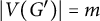 all occur for large enough n.
Proof First, we note that
$|V(G')|\sim \mathrm {Bin}(n,p)$
 and its expected value is m. The mode of
$\mathrm {Bin}(n,p)$
and its expected value is m. The mode of
$\mathrm {Bin}(n,p)$
 is then m, and in particular,
$\mathbb P(|V(G')|=m)\ge 1/(n+1)$
is then m, and in particular,
$\mathbb P(|V(G')|=m)\ge 1/(n+1)$
 . Now, for any vertex
$v\in V(G')$
. Now, for any vertex
$v\in V(G')$
 , we have
$\delta ^+_{G'}(v)\sim \mathrm {Bin}(\delta ^+_G(v),p)$
, we have
$\delta ^+_{G'}(v)\sim \mathrm {Bin}(\delta ^+_G(v),p)$
 . So, the Chernoff bound [Reference Chernoff11] gives

and similarly for
$\delta _{G'}^-(v)$
 . Thus, the probability that there exists
$v\in V(G')$
. Thus, the probability that there exists
$v\in V(G')$
 with either
$\delta _{G'}^+(v)<(1-\varepsilon )p\delta _G^+(v)$
with either
$\delta _{G'}^+(v)<(1-\varepsilon )p\delta _G^+(v)$
 or
$\delta _{G'}^-(v)<(1-\varepsilon )p\delta _{G}^-(v)$
or
$\delta _{G'}^-(v)<(1-\varepsilon )p\delta _{G}^-(v)$
 is at most

and the claim follows by the union bound.
6.1 Proof of Theorem 1.7
We first show that
$(1-o(1))n^{1/k}\le m^0(n,\mathcal F_k)$
 . For the time being suppose that
$n=m^k$
. For the time being suppose that
$n=m^k$
 for some integer m. We consider the following n-vertex digraph, which is a well-known generalization of a construction of de Bruijn [Reference De Bruijn14]: let
$G=(V,E)$
for some integer m. We consider the following n-vertex digraph, which is a well-known generalization of a construction of de Bruijn [Reference De Bruijn14]: let
$G=(V,E)$
 , where
$V=[m]^k$
, where
$V=[m]^k$
 , the set of all k-tuples with coordinates in
$[m]$
, the set of all k-tuples with coordinates in
$[m]$
 , and let
$((x_1,\ldots ,x_k),(y_1,\ldots ,y_k))$
, and let
$((x_1,\ldots ,x_k),(y_1,\ldots ,y_k))$
 be an edge if and only if
$(x_2,\ldots ,x_k)=(y_1,\ldots ,y_{k-1})$
be an edge if and only if
$(x_2,\ldots ,x_k)=(y_1,\ldots ,y_{k-1})$
 . The digraph G is
$\mathcal F_k$
. The digraph G is
$\mathcal F_k$
 -free, implying that
$m^0(n,\mathcal F_k)\ge m=n^{1/k}$
-free, implying that
$m^0(n,\mathcal F_k)\ge m=n^{1/k}$
 . Now let
$n\in \mathbb N$
. Now let
$n\in \mathbb N$
 be arbitrary. Let m be the minimum integer such that
$m^k\ge n$
be arbitrary. Let m be the minimum integer such that
$m^k\ge n$
 , and observe that
$m^k=(1+o(1))n$
, and observe that
$m^k=(1+o(1))n$
 . Let G be the construction described above on
$m^k$
. Let G be the construction described above on
$m^k$
 vertices. By Lemma 3, there is a directed subgraph
$G'\subseteq G$
vertices. By Lemma 3, there is a directed subgraph
$G'\subseteq G$
 on n vertices with
$\delta ^0(G')\ge (1-o(1))\delta ^0(G)=(1-o(1))m\ge (1-o(1))n^{1/k}$
on n vertices with
$\delta ^0(G')\ge (1-o(1))\delta ^0(G)=(1-o(1))m\ge (1-o(1))n^{1/k}$
 . Thus,
$m^0(n,\mathcal F_k)\ge (1-o(1))n^{1/k}.$
. Thus,
$m^0(n,\mathcal F_k)\ge (1-o(1))n^{1/k}.$

We now show that
$m^0(n,\mathcal F_k)\le m^+(n,\mathcal C_{k,k})$
 . If a graph with minimum outdegree
$\delta ^+\ge 1$
. If a graph with minimum outdegree
$\delta ^+\ge 1$
 contains some
$C_{\ell ,\ell }$
contains some
$C_{\ell ,\ell }$
 with
$2\le \ell \le k$
with
$2\le \ell \le k$
 , say formed by the directed paths
$x_0,\ldots , x_{\ell }$
, say formed by the directed paths
$x_0,\ldots , x_{\ell }$
 and
$y_0,\ldots , y_\ell $
and
$y_0,\ldots , y_\ell $
 (where
$x_0=y_0$
(where
$x_0=y_0$
 and
$x_\ell =y_\ell $
and
$x_\ell =y_\ell $
 ), then there exists some directed walk
$z_\ell =x_\ell ,z_{\ell +1},\ldots ,z_k$
), then there exists some directed walk
$z_\ell =x_\ell ,z_{\ell +1},\ldots ,z_k$
 . Then
$x_0,\ldots ,x_{\ell },z_{\ell +1},\ldots ,z_{k}$
. Then
$x_0,\ldots ,x_{\ell },z_{\ell +1},\ldots ,z_{k}$
 and
$y_0,\ldots ,y_\ell ,z_{\ell +1},\ldots ,z_k$
and
$y_0,\ldots ,y_\ell ,z_{\ell +1},\ldots ,z_k$
 form a graph in
$\mathcal F_k$
form a graph in
$\mathcal F_k$
 (we will use this fact of “extending the walks” frequently below). Thus,
$m^+(n,\mathcal F_k)\le m^+(n,C_{\ell ,\ell })$
(we will use this fact of “extending the walks” frequently below). Thus,
$m^+(n,\mathcal F_k)\le m^+(n,C_{\ell ,\ell })$
 .
.
We now show that
$m^+(n,\mathcal C_{k,k})\le (2k+o(1))m^+(n,\mathcal F_k)$
 . Let G be an n-vertex
$\mathcal C_{k,k}$
. Let G be an n-vertex
$\mathcal C_{k,k}$
 -free directed graph with minimum degree
$\delta ^+$
-free directed graph with minimum degree
$\delta ^+$
 . Our first step is to modify the graph G so that only certain orientations of short cycles are allowed. Given a closed walk
$W=v_0e_0v_1e_1\dots v_{k-1}e_{k-1}v_0$
. Our first step is to modify the graph G so that only certain orientations of short cycles are allowed. Given a closed walk
$W=v_0e_0v_1e_1\dots v_{k-1}e_{k-1}v_0$
 in the underlying graph of a directed graph, its type
$t(W)$
in the underlying graph of a directed graph, its type
$t(W)$
 is the absolute value of

with the sum
$i+1$
 taken modulo k; in other words, it is the “net number of forward steps” in the walk.
Lemma 4 Let
$h\in \mathbb N$
 ,
$\varepsilon>0$
,
$\varepsilon>0$
 . Suppose n is large enough and
$\delta ^+>\frac {4h}{\varepsilon ^2}\log n$
. Suppose n is large enough and
$\delta ^+>\frac {4h}{\varepsilon ^2}\log n$
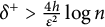 . Let G be an n-vertex digraph with
$\delta ^+(G)\ge \delta ^+$
. Let G be an n-vertex digraph with
$\delta ^+(G)\ge \delta ^+$
 . Then G has a spanning subgraph
$G'$
. Then G has a spanning subgraph
$G'$
 with
$\delta ^+(G')\ge \frac {1-\varepsilon }{2h}\delta ^+$
with
$\delta ^+(G')\ge \frac {1-\varepsilon }{2h}\delta ^+$
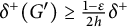 in which every closed walk of length at most
$2h-1$
in which every closed walk of length at most
$2h-1$
 has type
$0$
has type
$0$
 .
.
Proof Randomly partition the vertices of G as
$V(G)=V_0\sqcup \cdots \sqcup V_{2h-1}$
 so that each vertex v is assigned to one part
$P(v)$
so that each vertex v is assigned to one part
$P(v)$
 , uniformly and independently, and let
$G'$
, uniformly and independently, and let
$G'$
 be the graph obtained by keeping only the edges from
$V_i$
be the graph obtained by keeping only the edges from
$V_i$
 to
$V_{i+1}\pmod {2h}$
to
$V_{i+1}\pmod {2h}$
 . For each
$v\in V(G),$
. For each
$v\in V(G),$
 we have that
$d_{G'}^+(v)=\sum _{w:(v,w)\in E(G)}\textbf {1}_{P(w)=P(v)+1}$
we have that
$d_{G'}^+(v)=\sum _{w:(v,w)\in E(G)}\textbf {1}_{P(w)=P(v)+1}$
 , where the
$\textbf {1}_{P(w)=P(v)+1}$
, where the
$\textbf {1}_{P(w)=P(v)+1}$
 are
$d_G^+(v)$
are
$d_G^+(v)$
 independent Bernoulli random variables with parameter
$1/(2h).$
independent Bernoulli random variables with parameter
$1/(2h).$
 The Chernoff bound [Reference Chernoff11] gives

Therefore,

Thus, with positive probability
$d_{G'}^+(v)\ge \frac {1-2\varepsilon }{2h}\delta ^+$
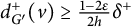 for every v. Now the definition of
$G'$
for every v. Now the definition of
$G'$
 guarantees that every cycle in
$G'$
guarantees that every cycle in
$G'$
 of length at most
$2h-1$
of length at most
$2h-1$
 has type
$0$
has type
$0$
 .
.
Consider the graph
$G'$
 obtained from G by Lemma 4, with
$h=k$
obtained from G by Lemma 4, with
$h=k$
 . We claim that
$G'$
. We claim that
$G'$
 is
$\mathcal F_k$
is
$\mathcal F_k$
 -free. For if
$x_0,\ldots ,x_k$
-free. For if
$x_0,\ldots ,x_k$
 and
$y_0,\ldots ,y_k$
and
$y_0,\ldots ,y_k$
 are two walks with the same initial and same terminal vertices, there exists a minimum i such that
$x_i\ne y_i$
are two walks with the same initial and same terminal vertices, there exists a minimum i such that
$x_i\ne y_i$
 . If
$x_i=y_{i'}$
. If
$x_i=y_{i'}$
 for some
$i'\ne i$
for some
$i'\ne i$
 , then
$x_0,\ldots ,x_i=y_{i'},y_{i'-1},\ldots ,y_0=x_0$
, then
$x_0,\ldots ,x_i=y_{i'},y_{i'-1},\ldots ,y_0=x_0$
 is a closed walk of type
$\ne 0$
is a closed walk of type
$\ne 0$
 and of length at most
$2k-1$
and of length at most
$2k-1$
 , contradicting the definition of
$G'$
, contradicting the definition of
$G'$
 . So,
$x_i\not \in \{y_0,\ldots ,y_k\}$
. So,
$x_i\not \in \{y_0,\ldots ,y_k\}$
 . There exists a minimum
$j>i$
. There exists a minimum
$j>i$
 such that
$x_j\in \{y_0,\ldots ,y_k\}$
such that
$x_j\in \{y_0,\ldots ,y_k\}$
 . Let
$x_j=y_{j'}$
. Let
$x_j=y_{j'}$
 . If
$j=j'$
. If
$j=j'$
 , then
$x_i,\ldots ,x_j,y_{j-1},\ldots ,y_{i-1}$
, then
$x_i,\ldots ,x_j,y_{j-1},\ldots ,y_{i-1}$
 is a
$C_{j-i+1,j-i+1}$
is a
$C_{j-i+1,j-i+1}$
 , where
$2\le j-i+1\le k$
, where
$2\le j-i+1\le k$
 , a contradiction. If
$j\ne j'$
, a contradiction. If
$j\ne j'$
 , then
$j<k$
, then
$j<k$
 or
$j'<k$
or
$j'<k$
 and so
$x_0,\ldots ,x_j,y_{j'-1},\ldots ,y_0$
and so
$x_0,\ldots ,x_j,y_{j'-1},\ldots ,y_0$
 is a closed walk of type
$\ne 0$
is a closed walk of type
$\ne 0$
 and length at most
$2k-1$
and length at most
$2k-1$
 , a contradiction. Thus,
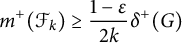
and the inequality follows.
Finally, we show that
$m^+(n,\mathcal F_k)\le n^{1/k}$
 . Let G be an
$\mathcal F_k$
. Let G be an
$\mathcal F_k$
 -free graph with minimum outdegree
$\delta ^+\ge 1$
-free graph with minimum outdegree
$\delta ^+\ge 1$
 . Let
$v\in V$
. Let
$v\in V$
 . Let
$L_i$
. Let
$L_i$
 be the set of vertices x for which there exists a directed walk of length i from v to x. If
$i<k$
be the set of vertices x for which there exists a directed walk of length i from v to x. If
$i<k$
 and there exist distinct directed walks of length i in G with the same initial and same terminal vertices, then the condition
$\delta ^+\ge 1$
and there exist distinct directed walks of length i in G with the same initial and same terminal vertices, then the condition
$\delta ^+\ge 1$
 allows us to extend the walks to length k while still having the same terminal vertices. Thus, G is also
$\mathcal F_i$
allows us to extend the walks to length k while still having the same terminal vertices. Thus, G is also
$\mathcal F_i$
 -free for
$i\le k$
-free for
$i\le k$
 . Hence, for
$x,y\in L_i$
. Hence, for
$x,y\in L_i$
 with
$i\le k-1,$
with
$i\le k-1,$
 we have
$N^+(x)\cap N^+(y)=\emptyset $
we have
$N^+(x)\cap N^+(y)=\emptyset $
 , and so
$|L_{i+1}|\ge \delta ^+|L_i|$
, and so
$|L_{i+1}|\ge \delta ^+|L_i|$
 . It follows that

6.2 Proof of Theorem 1.8
We first prove the lower bound

We begin by defining the digraphs that will prove this inequality.
Definition 6.1 Let
$\ell ,m\in \mathbb N$
 . We define a digraph
$G=G_{\ell ,m}$
. We define a digraph
$G=G_{\ell ,m}$
 on a vertex set
$V=V_0\sqcup \cdots \sqcup V_{\ell -2}\sqcup W_0\sqcup \cdots \sqcup W_{\ell -2}$
on a vertex set
$V=V_0\sqcup \cdots \sqcup V_{\ell -2}\sqcup W_0\sqcup \cdots \sqcup W_{\ell -2}$
 , where for each
$i,$
, where for each
$i,$
 we have
$V_i=\{v_{ijk}:j,k\in [m]\}$
we have
$V_i=\{v_{ijk}:j,k\in [m]\}$
 and
$W_i=\{w_{ijk}:j,k\in [m]\}$
and
$W_i=\{w_{ijk}:j,k\in [m]\}$
 . The edges of G are defined as follows: for
$0\le i\le \ell -3$
. The edges of G are defined as follows: for
$0\le i\le \ell -3$
 and
$j,k\in [m],$
and
$j,k\in [m],$
 let
let
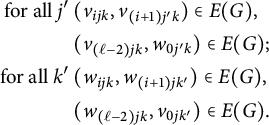
The digraph
$G_{\ell ,m}$
 when
$\ell =4$
when
$\ell =4$
 and
$m=2$
and
$m=2$
 .
.
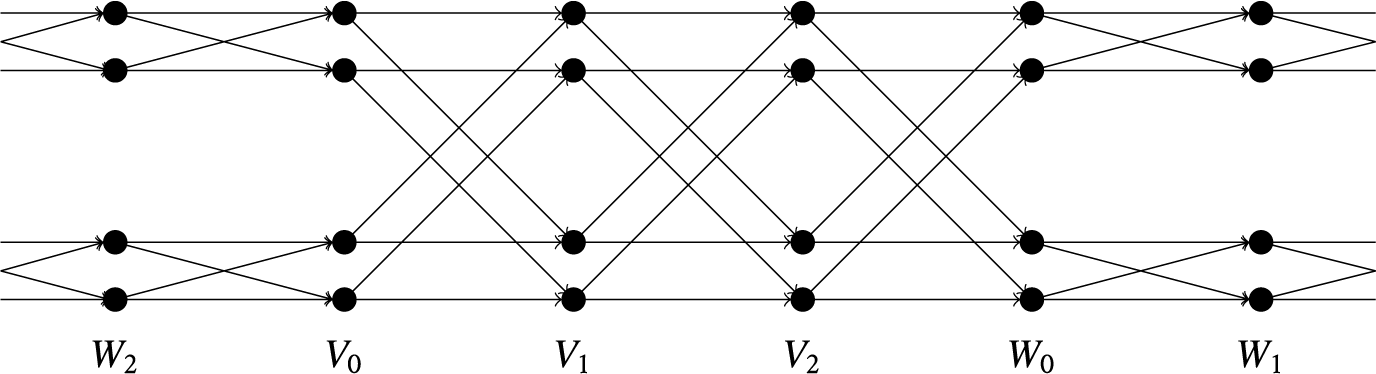
Figure 1 Long description
The diagram consists of five vertical columns of nodes, with each column containing four nodes arranged in two pairs (top pair and bottom pair). Directed arrows connect nodes from left to right.
* Column 1 (labeled W sub 2): Contains four nodes. Horizontal and diagonal arrows connect these to Column 2.
* Column 2 (labeled V sub 0): Contains four nodes. Each node has a horizontal arrow to the next column and a diagonal arrow that crosses to the opposite pair (top to bottom or bottom to top).
* Column 3 (labeled V sub 1): Contains four nodes. Similar to the previous stage, arrows connect horizontally and diagonally to Column 4.
* Column 4 (labeled V sub 2): Contains four nodes. Arrows connect horizontally and diagonally to Column 5.
* Column 5 (labeled W sub 0): Contains four nodes. Arrows connect horizontally and diagonally to a final unlabeled column on the far right.
* Column 6 (labeled W sub 1): The final visible set of four nodes receiving the edges from the previous stage.
The connections create a symmetrical butterfly-like pattern where paths converge and diverge across the horizontal axis.
Assume for a contradiction that G contains a
$C_{\ell ,\ell }$
 composed of the two directed paths
$x_0,\ldots ,x_\ell $
composed of the two directed paths
$x_0,\ldots ,x_\ell $
 and
$y_0,\ldots ,y_{\ell }$
and
$y_0,\ldots ,y_{\ell }$
 where
$x_0=y_0$
where
$x_0=y_0$
 and
$x_\ell =y_\ell $
and
$x_\ell =y_\ell $
 . By the symmetry of the sets
$V_i$
. By the symmetry of the sets
$V_i$
 and
$W_i$
and
$W_i$
 , we may assume that
$x_0\in V_i$
, we may assume that
$x_0\in V_i$
 for some
$0\le i\le \ell -2$
for some
$0\le i\le \ell -2$
 . Then
$V(C_{\ell ,\ell })\cap W_0=\{x_{\ell -1-i},y_{\ell -1-i}\}.$
. Then
$V(C_{\ell ,\ell })\cap W_0=\{x_{\ell -1-i},y_{\ell -1-i}\}.$
 Since
$x_0=y_0$
Since
$x_0=y_0$
 and
$x_{\ell -1-i}\ne y_{\ell -1-i}$
and
$x_{\ell -1-i}\ne y_{\ell -1-i}$
 , the structure of
$G[V_0\cup \dots V_{\ell -2}\cup W_0]$
, the structure of
$G[V_0\cup \dots V_{\ell -2}\cup W_0]$
 guarantees that
$x_{\ell -1-i}=w_{0jk}$
guarantees that
$x_{\ell -1-i}=w_{0jk}$
 and
$y_{\ell -1-i}=w_{0j'k}$
and
$y_{\ell -1-i}=w_{0j'k}$
 for some
$j\ne j'$
for some
$j\ne j'$
 . Now
$x_\ell \in W_{i+1}$
. Now
$x_\ell \in W_{i+1}$
 (with the convention
$W_{\ell -1}=V_0$
(with the convention
$W_{\ell -1}=V_0$
 ). Then the structure of
$G[W_0,\ldots ,W_{\ell -1}]$
). Then the structure of
$G[W_0,\ldots ,W_{\ell -1}]$
 implies that
$x_\ell =w_{(i+1)jk'}$
implies that
$x_\ell =w_{(i+1)jk'}$
 and
$y_\ell =w_{(i+1)j'k"}$
and
$y_\ell =w_{(i+1)j'k"}$
 for some
$k,k"$
for some
$k,k"$
 ; but this contradicts
$x_\ell =y_\ell $
; but this contradicts
$x_\ell =y_\ell $
 (Figure 1).
Thus,
$G_{\ell ,m}$
 is a
$C_{\ell ,\ell }$
is a
$C_{\ell ,\ell }$
 -free digraph on
$(2\ell -2)m^2$
-free digraph on
$(2\ell -2)m^2$
 vertices with minimum indegree and minimum outdegree m. This proves that for every m,
$m^0((2\ell -2)m^2,C_{\ell ,\ell })\ge m$
vertices with minimum indegree and minimum outdegree m. This proves that for every m,
$m^0((2\ell -2)m^2,C_{\ell ,\ell })\ge m$
 . Given any
$n\in \mathbb N$
. Given any
$n\in \mathbb N$
 , there is some
$n'$
, there is some
$n'$
 of the form
$n'=(2\ell -2)m^2$
of the form
$n'=(2\ell -2)m^2$
 with
$n'\in (n,n +o(n))$
with
$n'\in (n,n +o(n))$
 . By applying Lemma 3, we obtain

The second claim in Theorem 1.8, that
$m^0(n,C_{\ell ,\ell })\le m^+(n,C_{\ell ,\ell })$
 , is immediate.
Finally, we show that
$m^+(n,C_{\ell ,\ell })\le (2\ell +o(1))n^{1/2}$
 . Let G be an n-vertex
$C_{\ell ,\ell }$
. Let G be an n-vertex
$C_{\ell ,\ell }$
 -free digraph with minimum outdegree
$\delta ^+$
-free digraph with minimum outdegree
$\delta ^+$
 . Using Lemma 4, we pass to the directed graph
$G'$
. Using Lemma 4, we pass to the directed graph
$G'$
 with
$d:=\delta ^+(G')\ge \frac {1-\varepsilon }{2\ell }\delta ^+$
with
$d:=\delta ^+(G')\ge \frac {1-\varepsilon }{2\ell }\delta ^+$
 in which every closed walk of length at most
$2\ell -1$
in which every closed walk of length at most
$2\ell -1$
 has type 0. Let
$v\in V(G')$
has type 0. Let
$v\in V(G')$
 , and note there is a set
$L_1$
, and note there is a set
$L_1$
 of d vertices in
$N_{G'}^+(v)$
of d vertices in
$N_{G'}^+(v)$
 . Assume we have constructed a set
$L_i$
. Assume we have constructed a set
$L_i$
 (
$i\le \ell -2)$
(
$i\le \ell -2)$
 of d vertices such that for any
$x,y\in L_i$
of d vertices such that for any
$x,y\in L_i$
 , there are paths
$P_1,P_2$
, there are paths
$P_1,P_2$
 on i edges oriented from v to
$x,y,$
on i edges oriented from v to
$x,y,$
 respectively, so that

For
$x\in L_i$
 , we have
$|N^+(x)|\ge d$
, we have
$|N^+(x)|\ge d$
 so we can greedily choose distinct vertices
$L_{i+1}=\{f(x):x\in L_i\}$
so we can greedily choose distinct vertices
$L_{i+1}=\{f(x):x\in L_i\}$
 such that
$(x,f(x))\in E(G')$
such that
$(x,f(x))\in E(G')$
 for all
$x\in L_i$
for all
$x\in L_i$
 . Moreover, we have
$f(x)\not \in \{v\}\cup L_1\cup \cdots \cup L_i$
. Moreover, we have
$f(x)\not \in \{v\}\cup L_1\cup \cdots \cup L_i$
 or else
$G'$
or else
$G'$
 would contain a cycle C of length at most
$2i+1$
would contain a cycle C of length at most
$2i+1$
 with
$t(C)\ne 0$
with
$t(C)\ne 0$
 , a contradiction. Thus, for
$x,y\in L_i$
, a contradiction. Thus, for
$x,y\in L_i$
 , we can extend the paths
$P_1$
, we can extend the paths
$P_1$
 and
$P_2$
and
$P_2$
 by the edges
$(x,f(x)),(y,f(y))$
by the edges
$(x,f(x)),(y,f(y))$
 to satisfy Equation (3). We arrive by induction at the set
$L_{\ell -1}$
to satisfy Equation (3). We arrive by induction at the set
$L_{\ell -1}$
 . If there exist
$x,y\in L_{\ell -1}$
. If there exist
$x,y\in L_{\ell -1}$
 and
$z\in V(G')$
and
$z\in V(G')$
 such that
$(x,z),(y,z)\in E(G')$
such that
$(x,z),(y,z)\in E(G')$
 , then similarly to the above, we have
$z\not \in \{v\}\cup L_1\cup \cdots \cup L_{\ell -1}$
, then similarly to the above, we have
$z\not \in \{v\}\cup L_1\cup \cdots \cup L_{\ell -1}$
 . Thus, applying Equation (3) to the vertices
$x,y$
. Thus, applying Equation (3) to the vertices
$x,y$
 and extending the paths by
$xz,yz$
and extending the paths by
$xz,yz$
 gives a copy of
$C_{\ell ,\ell }$
gives a copy of
$C_{\ell ,\ell }$
 , a contradiction. Hence,
$N^+_{G'}(x)\cap N_{G'}^+(y)=\emptyset $
, a contradiction. Hence,
$N^+_{G'}(x)\cap N_{G'}^+(y)=\emptyset $
 so
so

which gives
$\left (\frac {1-\varepsilon }{2\ell }\delta ^+\right )^2\le n$
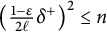 and the result follows.
We observe that, in the digraph
$G_{\ell ,m}$
 , with
$L_i$
, with
$L_i$
 defined as in the previous paragraph, we have
$\left |\bigcup _{x\in L_{\ell -1}}N^+(x)\right |=n/(2\ell -2)$
defined as in the previous paragraph, we have
$\left |\bigcup _{x\in L_{\ell -1}}N^+(x)\right |=n/(2\ell -2)$
 , matching the bound in Equation (4) up to a constant factor.
6.3 Proof of Corollary 1
We say that Hamilton paths
$H_1,H_2$
 in
$K_n$
in
$K_n$
 are said to create a two-part
$C_\ell $
are said to create a two-part
$C_\ell $
 if there exist nonempty paths
$P_1\subseteq H_1$
if there exist nonempty paths
$P_1\subseteq H_1$
 ,
$P_2\subseteq H_2$
,
$P_2\subseteq H_2$
 such that the edge union of
$P_2$
such that the edge union of
$P_2$
 and
$P_2$
and
$P_2$
 is isomorphic to
$C_\ell $
is isomorphic to
$C_\ell $
 . We recall that
$\widehat M(n,\ell )$
. We recall that
$\widehat M(n,\ell )$
 denotes the maximum size of a family of Hamilton paths in
$K_n$
denotes the maximum size of a family of Hamilton paths in
$K_n$
 which pairwise create a two-part
$C_\ell $
which pairwise create a two-part
$C_\ell $
 . Our goal is to show that if
$\ell \ge 4$
. Our goal is to show that if
$\ell \ge 4$
 is even, then
$\widehat M(n,\ell )\le (n!)^{1/2+O(1/\log n)}.$
is even, then
$\widehat M(n,\ell )\le (n!)^{1/2+O(1/\log n)}.$

Let
$\ell =2r$
 . Assume for the time being that
$(2r-2)(2r+1)|n$
. Assume for the time being that
$(2r-2)(2r+1)|n$
 . First, we count Hamilton cycles in the digraph
$G=G_{r,m}$
. First, we count Hamilton cycles in the digraph
$G=G_{r,m}$
 from Definition 6.1 with
$m^2=n/(2r-2)$
from Definition 6.1 with
$m^2=n/(2r-2)$
 . Note that
$G[V_0,\ldots ,V_{\ell -1}]$
. Note that
$G[V_0,\ldots ,V_{\ell -1}]$
 and
$G[W_0,\ldots ,W_{\ell -1}]$
and
$G[W_0,\ldots ,W_{\ell -1}]$
 are each m disjoint copies of a blowup of a directed
$P_{\ell -1}$
are each m disjoint copies of a blowup of a directed
$P_{\ell -1}$
 . Let
$X_1,\ldots ,X_m$
. Let
$X_1,\ldots ,X_m$
 be the components of
$G[V_0,\ldots ,V_{\ell -1}]$
be the components of
$G[V_0,\ldots ,V_{\ell -1}]$
 and let
$Y_1,\ldots ,Y_m$
and let
$Y_1,\ldots ,Y_m$
 be the components of
$G[W_0,\ldots ,W_{\ell -1}]$
be the components of
$G[W_0,\ldots ,W_{\ell -1}]$
 . A transition vector is a word

with properties
-
• $f,g:[m^2]\to [m];$
-
• for each $i,j\in [m]$
, the contiguous subwords
$X_iY_j$
and
$Y_jX_i$
each occur exactly once (we consider the vector cyclically, so that
$Y_{f(m^2)}X_{f(1)}$
is a contiguous subword); -
• $f(1)=g(1)=1$
.




(The importance of the second property comes from the fact that, for any
$X_i$
 and
$Y_j$
and
$Y_j$
 , there are exactly two vertices in
$X_i\cap Y_j$
, there are exactly two vertices in
$X_i\cap Y_j$
 , one in
$V_0$
, one in
$V_0$
 and one in
$W_0$
and one in
$W_0$
 . As we will see below, the second property is used to guarantee that certain walks associated with the transition vector visit each vertex in
$V_0\cup W_0$
. As we will see below, the second property is used to guarantee that certain walks associated with the transition vector visit each vertex in
$V_0\cup W_0$
 exactly once.) A transition vector is equivalent to an Eulerian circuit in the bidirected
$K_{m,m}$
exactly once.) A transition vector is equivalent to an Eulerian circuit in the bidirected
$K_{m,m}$
 . To enumerate Eulerian circuits, we refer to the famous result of de Bruijn, van Aardenne-Ehrenfest, Smith, and Tutte. If G is a digraph and
$v\in V(G)$
. To enumerate Eulerian circuits, we refer to the famous result of de Bruijn, van Aardenne-Ehrenfest, Smith, and Tutte. If G is a digraph and
$v\in V(G)$
 , then an oriented spanning subtree of G with root v is a spanning subdigraph T of G with the following properties: (1) the underlying graph of T is a tree and (2) for any vertex
$u\in V(G)$
, then an oriented spanning subtree of G with root v is a spanning subdigraph T of G with the following properties: (1) the underlying graph of T is a tree and (2) for any vertex
$u\in V(G)$
 , T contains a directed walk from u to v.
Theorem 6.1 (de Bruijn, van Aardenne-Ehrenfest, Smith, and Tutte [Reference de Bruijn and van Aardenne-Ehrenfest15, Reference Tutte and Smith40])
Let H be a strongly connected digraph in which every vertex v has
$d^+(v)=d^-(v)$
 . Let
$t_v(H)$
. Let
$t_v(H)$
 denote the number of oriented spanning subtrees with root v. Then for any
$v\in V(H),$
denote the number of oriented spanning subtrees with root v. Then for any
$v\in V(H),$
 the number of Eulerian circuits of H is

There are
$m^{2(m-1)}$
 spanning trees of
$K_{m,m}$
spanning trees of
$K_{m,m}$
 [Reference Abu-Sbeih1]. For any fixed vertex
$v\in V(K_{m,m})$
[Reference Abu-Sbeih1]. For any fixed vertex
$v\in V(K_{m,m})$
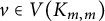 , each such spanning tree has a unique orientation with root v, obtained by orienting every edge so that the head is closer to v than the tail is. By Theorem 6.1, we conclude that there are
$m^{2(m-1)}(m-1)!^{2m}$
, each such spanning tree has a unique orientation with root v, obtained by orienting every edge so that the head is closer to v than the tail is. By Theorem 6.1, we conclude that there are
$m^{2(m-1)}(m-1)!^{2m}$
 transition vectors. We say that a directed Hamilton cycle in G

(making no assumptions on the hidden portions of the vertex sequence) follows the transition vector t if
$v_{0j_sk_s}\in X_{f(s)}$
 and
$w_{0j_{s+1}k_s}\in Y_{g(s)}$
and
$w_{0j_{s+1}k_s}\in Y_{g(s)}$
 for every
$s\in [m^2]$
for every
$s\in [m^2]$
 , that is,
$k_s=f(s)$
, that is,
$k_s=f(s)$
 and
$j_{s+1}=g(s)$
and
$j_{s+1}=g(s)$
 (see Figure 2).
Claim 2 For any transition vector
$t,$
 there are exactly
$(m!)^{2m(r-2)}$
there are exactly
$(m!)^{2m(r-2)}$
 directed Hamilton cycles in G which follow t.
The solid lines describe a directed Hamilton cycle in
$G_{4,2}$
 which follows the transition vector
$X_1Y_1X_2Y_2X_1Y_2X_2Y_1$
which follows the transition vector
$X_1Y_1X_2Y_2X_1Y_2X_2Y_1$
 .
.
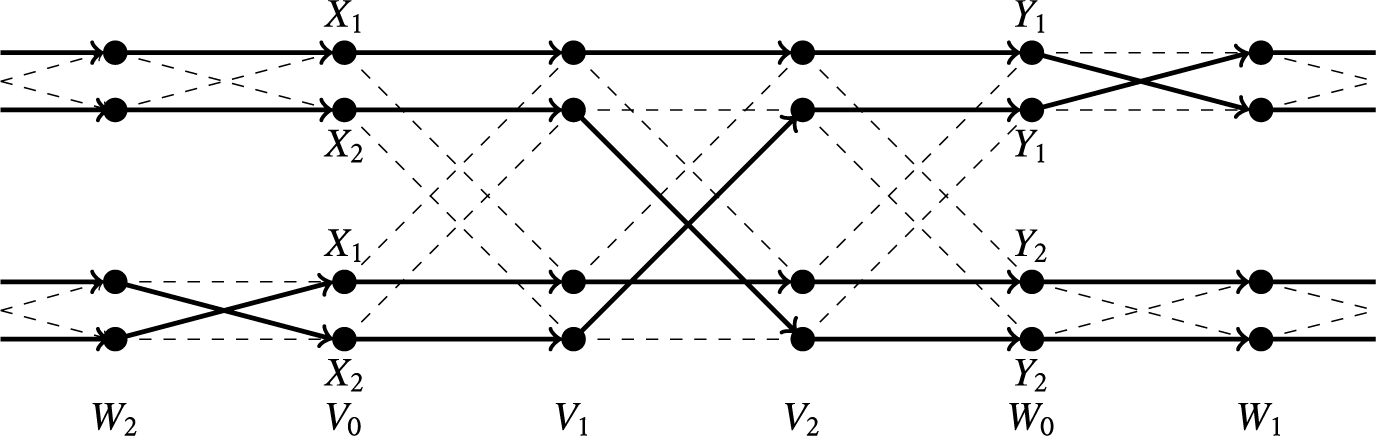
Figure 2 Long description
The diagram consists of nodes represented by black dots connected by solid and dashed directed arrows. The nodes are arranged in four horizontal rows and six vertical columns. The columns are labeled at the bottom from left to right as W sub 2, V sub 0, V sub 1, V sub 2, W sub 0, and W sub 1.
At column V sub 0, the top two nodes are labeled X sub 1 and X sub 2, and the bottom two nodes are also labeled X sub 1 and X sub 2. At column W sub 0, the top two nodes are labeled Y sub 1 and Y sub 1, while the bottom two nodes are labeled Y sub 2 and Y sub 2.
The solid lines indicate the directed Hamilton cycle. Starting from the left at W sub 2, the path enters the top two rows horizontally. Between W sub 2 and V sub 0, the path crosses in the bottom two rows. From V sub 0 to V sub 1, all four rows move horizontally. Between V sub 1 and V sub 2, the path remains horizontal in the top and bottom rows but crosses diagonally between the middle two rows. From V sub 2 to W sub 0, the path moves horizontally. Between W sub 0 and W sub 1, the path crosses diagonally in the top two rows and moves horizontally in the bottom two rows. Dashed lines represent other possible directed edges in the graph that are not part of this specific cycle.
Proof We consider any component
$X_i$
 of
$G[V_0,\ldots ,W_0]$
of
$G[V_0,\ldots ,W_0]$
 . Each time a directed Hamilton path H which follows t visits a vertex
$v\in V_0\cap X_i$
. Each time a directed Hamilton path H which follows t visits a vertex
$v\in V_0\cap X_i$
 , we must choose a path in
$X_i$
, we must choose a path in
$X_i$
 from v to the unique vertex
$w\in W_0\cap Y_j$
from v to the unique vertex
$w\in W_0\cap Y_j$
 , where
$Y_j$
, where
$Y_j$
 is the component indicated by t via the subword
$X_iY_j$
is the component indicated by t via the subword
$X_iY_j$
 . (We know that w is unvisited, since if it was visited previously, then
$X_iY_j$
. (We know that w is unvisited, since if it was visited previously, then
$X_iY_j$
 must have already occurred in t, as
$X_i\cap Y_j\cap W_0=\{w\}$
must have already occurred in t, as
$X_i\cap Y_j\cap W_0=\{w\}$
 .) The first time that
$V_0\cap X_i$
.) The first time that
$V_0\cap X_i$
 is visited there are
$m^{r-2}$
is visited there are
$m^{r-2}$
 choices for such a path (only the last edge is forced), the second time there are
$(m-1)^{r-2}$
choices for such a path (only the last edge is forced), the second time there are
$(m-1)^{r-2}$
 choices, and so on, so that varying the paths taken inside
$X_i$
choices, and so on, so that varying the paths taken inside
$X_i$
 gives
$m^{r-2}\dots 1^{r-2}=(m!)^{r-2}$
gives
$m^{r-2}\dots 1^{r-2}=(m!)^{r-2}$
 total choices. Similarly, there are
$(m!)^{r-2}$
total choices. Similarly, there are
$(m!)^{r-2}$
 total choices for the paths inside each
$Y_j$
total choices for the paths inside each
$Y_j$
 , so considering all components together we arrive at
$((m!)^{r-2})^{2m}$
, so considering all components together we arrive at
$((m!)^{r-2})^{2m}$
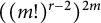 directed Hamilton paths.
Note that every Hamilton cycle follows exactly one transition vector. Therefore, the number of Hamilton cycles in G is

For each Hamilton cycle G, we delete a single edge and take the resulting directed path; thus, there is a family
$\mathcal P$
 of
$n^{n/2+O(n/\log n)}$
of
$n^{n/2+O(n/\log n)}$
 directed Hamilton paths in G. Suppose
$P,Q\in \mathcal P$
directed Hamilton paths in G. Suppose
$P,Q\in \mathcal P$
 and their underlying paths create a 2-part
$\ell $
and their underlying paths create a 2-part
$\ell $
 -cycle C. Since
$G_{r,m}$
-cycle C. Since
$G_{r,m}$
 contains no
$C_{r,r}$
contains no
$C_{r,r}$
 , and
$C_{r,r}$
, and
$C_{r,r}$
 is the unique 2-part cycle of type 0, we have
$t(C)\ne 0$
is the unique 2-part cycle of type 0, we have
$t(C)\ne 0$
 . We will filter out these remaining
$\ell $
. We will filter out these remaining
$\ell $
 -cycles. Partition
$[n]$
-cycles. Partition
$[n]$
 into equal parts
$[n]=N_0\sqcup \cdots \sqcup N_{2r}$
into equal parts
$[n]=N_0\sqcup \cdots \sqcup N_{2r}$
 . Let
$\Sigma $
. Let
$\Sigma $
 be the set of all directed Hamilton paths in
$K_n$
be the set of all directed Hamilton paths in
$K_n$
 starting in
$N_0$
starting in
$N_0$
 and whose
$i^{th}$
and whose
$i^{th}$
 vertex belongs to
$N_{i\pmod {2r+1}}.$
vertex belongs to
$N_{i\pmod {2r+1}}.$
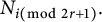 Clearly, no two paths in
$\Sigma $
Clearly, no two paths in
$\Sigma $
 create an
$\ell $
create an
$\ell $
 -cycle of type
$\ne 0$
-cycle of type
$\ne 0$
 , and
, and

Let
$\pi $
 be a random relabeling of
$[n]$
be a random relabeling of
$[n]$
 , then taking an outcome in which
$|\pi \mathcal P\cap \Sigma |$
, then taking an outcome in which
$|\pi \mathcal P\cap \Sigma |$
 is at least average, we obtain a family
$\mathcal P':=\pi \mathcal P\cap \Sigma $
is at least average, we obtain a family
$\mathcal P':=\pi \mathcal P\cap \Sigma $
 of directed Hamilton paths in
$K_n$
of directed Hamilton paths in
$K_n$
 no two of which create any two-part cycle, with
$|\mathcal P'|=n^{n/2+O(n/\log n)}$
no two of which create any two-part cycle, with
$|\mathcal P'|=n^{n/2+O(n/\log n)}$
 . To convert this to an upper bound on
$\widehat M(n,\ell ),$
. To convert this to an upper bound on
$\widehat M(n,\ell ),$
 we refer to a folklore lemma about vertex-transitive graphs (see, e.g., [Reference Godsil and Royle23], Lemma 7.2.2).
Lemma 5 If a graph G is vertex-transitive, then

Consider the auxiliary graph whose vertices are all Hamilton paths in
$K_n$
 where two paths are adjacent if they create a two-part
$\ell $
where two paths are adjacent if they create a two-part
$\ell $
 -cycle. The set of underlying graphs of the elements of
$\mathcal {P}'$
-cycle. The set of underlying graphs of the elements of
$\mathcal {P}'$
 corresponds to an independent set (and, by construction, every element of
$\mathcal P'$
corresponds to an independent set (and, by construction, every element of
$\mathcal P'$
 has a different underlying graph). Applying Lemma 5 to this auxiliary graph, we obtain

Now consider general
$n\in \mathbb N$
 . Note that
$\widehat M(n,\ell )$
. Note that
$\widehat M(n,\ell )$
 is increasing. Thus, taking the smallest
$n'>n$
is increasing. Thus, taking the smallest
$n'>n$
 satisfying
$(2r-2)(2r+1)|n'$
satisfying
$(2r-2)(2r+1)|n'$
 gives
gives

7 Concluding remarks
As noted in Section 1, taking all matchings in a
$C_4$
 -free bipartite graph does not give rise to an
$S_2'$
-free bipartite graph does not give rise to an
$S_2'$
 -set in the symmetric group. Instead, it obtains a family
$\mathcal F$
-set in the symmetric group. Instead, it obtains a family
$\mathcal F$
 of permutations satisfying the following weaker condition: for all
$\alpha ,\beta ,\gamma ,\delta \in \mathcal F$
of permutations satisfying the following weaker condition: for all
$\alpha ,\beta ,\gamma ,\delta \in \mathcal F$
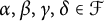 , if
$\alpha \beta ^{-1}=\gamma \delta ^{-1}$
, if
$\alpha \beta ^{-1}=\gamma \delta ^{-1}$
 , then for every
$i\in [n]$
, then for every
$i\in [n]$
 , either
$\alpha (i)=\beta (i)\text { and }\gamma (i)=\delta (i)\text { or }\alpha (i)=\gamma (i)\text { and }\beta (i)=\delta (i).$
, either
$\alpha (i)=\beta (i)\text { and }\gamma (i)=\delta (i)\text { or }\alpha (i)=\gamma (i)\text { and }\beta (i)=\delta (i).$
 We attempted to improve Proposition 1 in the case
$\Gamma =\mathrm {Sym}(n)$
We attempted to improve Proposition 1 in the case
$\Gamma =\mathrm {Sym}(n)$
 by intersecting
$\mathcal F$
by intersecting
$\mathcal F$
 with a family
$\mathcal G\subseteq \mathrm {Sym}(n)$
with a family
$\mathcal G\subseteq \mathrm {Sym}(n)$
 such that for all distinct
$\alpha ,\beta ,\gamma ,\delta \in \mathcal G,$
such that for all distinct
$\alpha ,\beta ,\gamma ,\delta \in \mathcal G,$
 there exists
$i\in [n]$
there exists
$i\in [n]$
 such that
$|\{\alpha (i),\beta (i),\gamma (i),\delta (i)\}|\ge 3$
such that
$|\{\alpha (i),\beta (i),\gamma (i),\delta (i)\}|\ge 3$
 . However, Bukh and Keevash [Reference Bukh and Keevash9] proved the following theorem that generalizes the upper bound of Blackburn and Wild [Reference Blackburn and Wild6] on perfect hash codes. By taking
$S=\mathcal G$
. However, Bukh and Keevash [Reference Bukh and Keevash9] proved the following theorem that generalizes the upper bound of Blackburn and Wild [Reference Blackburn and Wild6] on perfect hash codes. By taking
$S=\mathcal G$
 ,
$q=n$
,
$q=n$
 ,
$t=4$
,
$t=4$
 , and
$v=3$
, and
$v=3$
 in Theorem 7.1, one obtains
$|\mathcal G|\le 6n^{2n/3}$
in Theorem 7.1, one obtains
$|\mathcal G|\le 6n^{2n/3}$
 , implying that the best bound obtainable by this approach is
$M_2'(\mathrm {Sym}(n))\ge (n!)^{1/6+O(1/\log n)}.$
, implying that the best bound obtainable by this approach is
$M_2'(\mathrm {Sym}(n))\ge (n!)^{1/6+O(1/\log n)}.$

Theorem 7.1 (Bukh and Keevash [Reference Bukh and Keevash9])
Suppose that
$(t-1)|n$
 and
$S\subseteq [q]^n$
and
$S\subseteq [q]^n$
 is family of words such that among every t words there is a coordinate with at least v values. Then
$|{S}|\leq \binom {t}{2}q^{(1-\frac {v-2}{t-1})n}$
is family of words such that among every t words there is a coordinate with at least v values. Then
$|{S}|\leq \binom {t}{2}q^{(1-\frac {v-2}{t-1})n}$
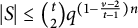 .
.
Before proving the theorem, a lemma is needed. Both Lemma 6 and the proof of Theorem 7.1 which follows are due to Bukh and Keevash.
Lemma 6 There is a family
$\mathcal {F}\subset \binom {[t-1]}{v-2}$
 of size
$|{\mathcal {F}}|=t-1$
of size
$|{\mathcal {F}}|=t-1$
 such that every element of
$[t-1]$
such that every element of
$[t-1]$
 is in exactly
$v-2$
is in exactly
$v-2$
 sets of
$\mathcal {F}$
sets of
$\mathcal {F}$
 .
.
Proof Let
$\mathcal {F}$
 consist of cyclic shifts of
$[v-2]$
consist of cyclic shifts of
$[v-2]$
 modulo
$t-1$
modulo
$t-1$
 .
.
Proof of Theorem 7.1
Let
$\mathcal {F}=\{I_1,\dotsc ,I_{t-1}\}$
 be the family as in Lemma 6. Cut each word
$w\in S$
be the family as in Lemma 6. Cut each word
$w\in S$
 into
$t-1$
into
$t-1$
 consecutive subwords
$w_1,\ldots ,w_{t-1}$
consecutive subwords
$w_1,\ldots ,w_{t-1}$
 of length
$n/(t-1)$
of length
$n/(t-1)$
 each. For a set
$I\in \mathcal {F}$
each. For a set
$I\in \mathcal {F}$
 , define
$w_I$
, define
$w_I$
 to be the concatenation of the words
$(w_i)_{i \in [t-1]\setminus I}$
to be the concatenation of the words
$(w_i)_{i \in [t-1]\setminus I}$
 . So,
$w_I$
. So,
$w_I$
 is a word of length
$(1-\frac {v-2}{t-1})n$
is a word of length
$(1-\frac {v-2}{t-1})n$
 .
.
Do the following for as long as possible: if there is a pair
$(j,u)\in [t-1]\times [q]^{(1-\frac {v-2}{t-1})n}$
 such that the set
$S_{j,u}:= \{w\in S: w_{I_j}=u\}$
such that the set
$S_{j,u}:= \{w\in S: w_{I_j}=u\}$
 has at most j elements, remove all elements of
$S_{j,u}$
has at most j elements, remove all elements of
$S_{j,u}$
 from S. Note that each pair
$(j,u)$
from S. Note that each pair
$(j,u)$
 occurs at most once in this process. So, the total number of words removed from S is at most
$\binom {t}{2}q^{(1-\frac {v-2}{t-1})n}$
occurs at most once in this process. So, the total number of words removed from S is at most
$\binom {t}{2}q^{(1-\frac {v-2}{t-1})n}$
 .
.
We claim that S is now empty. Indeed, suppose that some word w survived to the end of this process. For each
$j=1,2,\dotsc ,t-1$
 in order, find a word
$w^{(j)}\in S$
in order, find a word
$w^{(j)}\in S$
 such that
$w^{(j)}_{I_j}=w_{I_j}$
such that
$w^{(j)}_{I_j}=w_{I_j}$
 and such that
$w^{(j)}$
and such that
$w^{(j)}$
 is distinct from previously selected words
$w,w^{(1)},\dotsc ,w^{(j-1)}$
is distinct from previously selected words
$w,w^{(1)},\dotsc ,w^{(j-1)}$
 . The latter is possible because survival of w implies
$|{S_{j,w_{I_j}}}|>j$
. The latter is possible because survival of w implies
$|{S_{j,w_{I_j}}}|>j$
 .
.
The definition of
$\mathcal {F}$
 implies that in each coordinate the t words
$w,w^{(1)},\dotsc ,w^{(t-1)}$
implies that in each coordinate the t words
$w,w^{(1)},\dotsc ,w^{(t-1)}$
 take at most
$v-1$
take at most
$v-1$
 values. As the words are distinct, we reached a contradiction.
We considered whether the idea in our construction of
$S_2$
 -sets in
$\mathrm {Sym}(n)\times \mathrm {Sym}(n)$
-sets in
$\mathrm {Sym}(n)\times \mathrm {Sym}(n)$
 could be generalized to give
$S_2'$
could be generalized to give
$S_2'$
 -sets or to give
$S_k$
-sets or to give
$S_k$
 -sets for
$k\ge 3$
-sets for
$k\ge 3$
 . For
$S_2'$
. For
$S_2'$
 -sets, we looked for constructions taken from the set
$B=\{(f(\alpha ),g(\alpha )):\alpha \in \mathrm {Sym}(n)\}$
-sets, we looked for constructions taken from the set
$B=\{(f(\alpha ),g(\alpha )):\alpha \in \mathrm {Sym}(n)\}$
 ; here f and g may be words with letters in
$\alpha ,\pi _1,\ldots ,\pi _\ell $
; here f and g may be words with letters in
$\alpha ,\pi _1,\ldots ,\pi _\ell $
 for some fixed elements
$\pi _1,\ldots ,\pi _\ell \in \mathrm {Sym}(n)$
for some fixed elements
$\pi _1,\ldots ,\pi _\ell \in \mathrm {Sym}(n)$
 . Formally, consider the free group
$F=\langle x,y_1,\ldots , y_\ell \rangle $
. Formally, consider the free group
$F=\langle x,y_1,\ldots , y_\ell \rangle $
 and fix two words
$v, w\in F$
and fix two words
$v, w\in F$
 . For each
$\alpha \in G$
. For each
$\alpha \in G$
 , there is a homomorphism
$\phi _\alpha :F\to \mathrm {Sym}(n)$
, there is a homomorphism
$\phi _\alpha :F\to \mathrm {Sym}(n)$
 with
$\phi _\alpha (x)=\alpha $
with
$\phi _\alpha (x)=\alpha $
 and
$\phi _\alpha (y_i)=\pi _i$
and
$\phi _\alpha (y_i)=\pi _i$
 . We set
$f(\alpha )=\phi _\alpha (v)$
. We set
$f(\alpha )=\phi _\alpha (v)$
 and
$g(\alpha )=\phi _\alpha (w)$
and
$g(\alpha )=\phi _\alpha (w)$
 .
.
It seems to us that for any choice of
$f,g$
 , the equations of the form
$x_1y_1^{-1}x_2y_2^{-1}=1$
, the equations of the form
$x_1y_1^{-1}x_2y_2^{-1}=1$
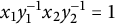 with variables in B either simplify to a single Sidon equation in
$\mathrm {Sym}(n)$
with variables in B either simplify to a single Sidon equation in
$\mathrm {Sym}(n)$
 , or are too complicated to usefully employ the choice of
$f,g$
, or are too complicated to usefully employ the choice of
$f,g$
 . We were also unable to find any similar construction that works for
$S_k$
. We were also unable to find any similar construction that works for
$S_k$
 -sets (
$k\ge 3$
-sets (
$k\ge 3$
 ). It may be interesting to see whether there is a natural construction of
$S_k$
). It may be interesting to see whether there is a natural construction of
$S_k$
 -sets in
$\mathrm {Sym}(n)^k$
-sets in
$\mathrm {Sym}(n)^k$
 , extending our loose analogy with the abelian constructions.
Besides the constructions used in Theorem 1.4, we found other
$S_2$
 -sets of the same size. Let
$\pi ',\sigma '$
-sets of the same size. Let
$\pi ',\sigma '$
 be two permutations of
$[n]$
be two permutations of
$[n]$
 such that
$\pi :=(\pi ')^2,\sigma :=(\sigma ')^2$
such that
$\pi :=(\pi ')^2,\sigma :=(\sigma ')^2$
 are both derangements and involutions, and such that
$\sigma \pi =\rho _1\rho _2$
are both derangements and involutions, and such that
$\sigma \pi =\rho _1\rho _2$
 for two disjoint
$(n/2)$
for two disjoint
$(n/2)$
 -cycles
$\rho _1,\rho _2$
-cycles
$\rho _1,\rho _2$
 . Then one can show that
$\{(\pi '\alpha \pi ',\sigma '\alpha \sigma '):\alpha \in \mathrm {Sym}(n),\alpha (1)=1\}$
. Then one can show that
$\{(\pi '\alpha \pi ',\sigma '\alpha \sigma '):\alpha \in \mathrm {Sym}(n),\alpha (1)=1\}$
 is an
$S_2$
is an
$S_2$
 -set in
$\mathrm {Sym}(n)\times \mathrm {Sym}(n)$
-set in
$\mathrm {Sym}(n)\times \mathrm {Sym}(n)$
 , and in fact, it is also a special case of Proposition 3.
It is interesting that the proof of Theorem 1.5 does not work when k is odd. In fact, if
$k=2r+1,$
 then as in the proof of Theorem 1.5, one can define
$L=\{\alpha _1\dots \alpha _{r+1}:\alpha _i\in A\}$
then as in the proof of Theorem 1.5, one can define
$L=\{\alpha _1\dots \alpha _{r+1}:\alpha _i\in A\}$
 and show that L is a near-optimal
$S_2[|A|]$
and show that L is a near-optimal
$S_2[|A|]$
 -set. However, when
$g\ge 2,$
-set. However, when
$g\ge 2,$
 it is possible for large
$S_2[g]$
it is possible for large
$S_2[g]$
 -sets to exist in abelian groups, so only the final step in the proof fails.
We list some open questions:
-
(1) Does Theorem 1.5 extend to the case that k is odd?
-
(2) Improve the lower or upper bounds in the inequalities
$$ \begin{align*}(n!)^{1/k-O(1/\log n)}\le M_k(\mathrm{Sym}(n))<(n!)^{1/k}\end{align*} $$and
$$ \begin{align*}(n-1)!\le M_2(\mathrm{Sym}(n)\times \mathrm{Sym}(n))<n!.\end{align*} $$


Acknowledgements
The authors would like to thank Boris Bukh and Peter Keevash for the proof of Theorem 7.1. The authors would also like to thank David Conlon for helpful comments. The authors would like to thank an anonymous referee who suggested many improvements to the article and pointed out the known lower bound on
$m^0(n,\mathcal F_k)$
 .
.


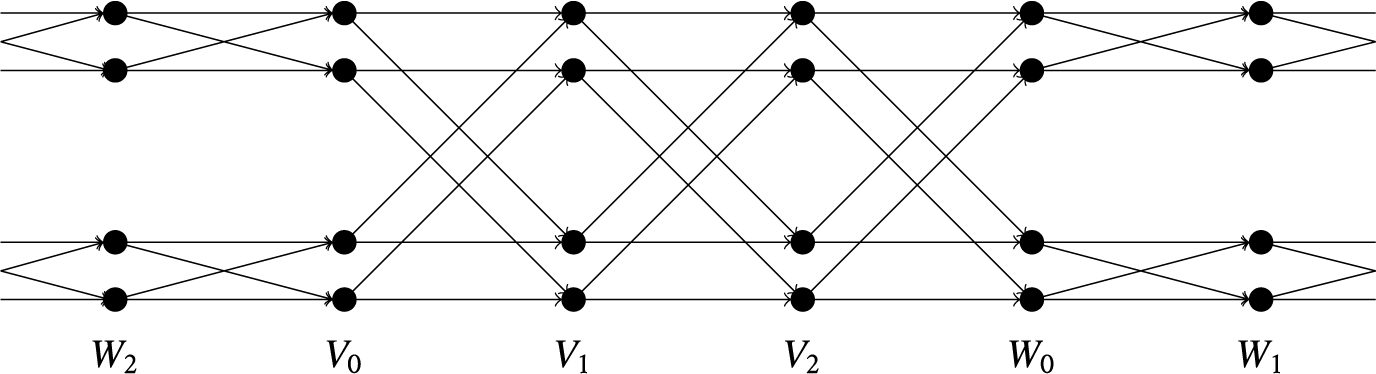


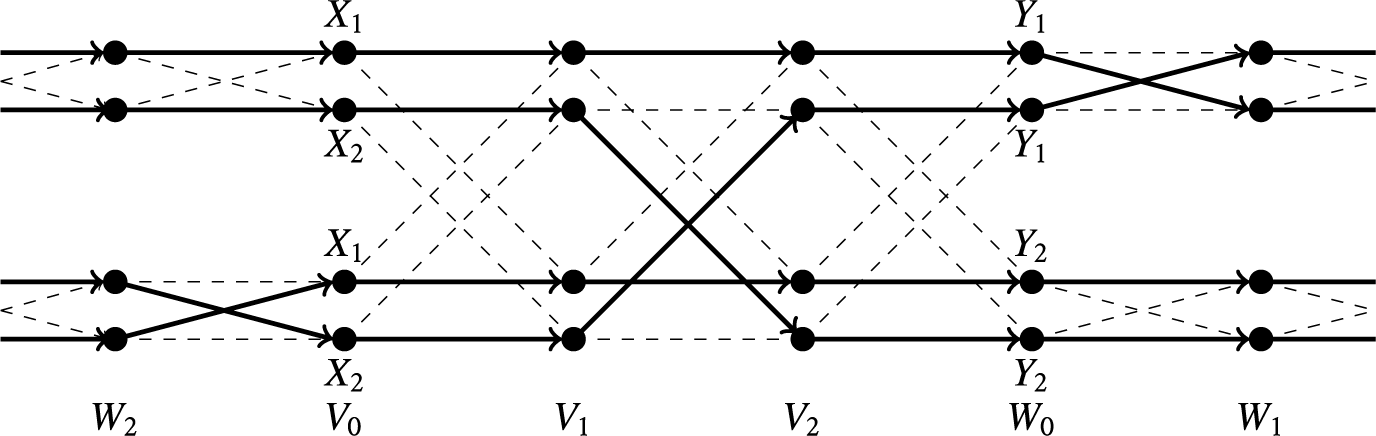


 Open access

