




In mid-September of 1967, George W. Romney, the second-term governor of the US state of Michigan, alighted in St Louis, Missouri, where at least a dozen reporters and TV cameramen prepared to tail him around the city. The stopover was part of a 17-city tour, undertaken with a stated agenda of studying America's deepening urban problems and the unstated aim of heightening press buzz for the GOP moderate's anticipated campaign for the Republican party's 1968 presidential nomination.Footnote 1 At least for the former purpose, St Louis was an obvious destination. The shrinking and beleaguered Midwestern municipality, known nationwide for its deeply entrenched residential racial segregation, contained two government-sponsored, income-restricted housing complexes that observers persistently cited as being, respectively, the nation's most disastrous and perhaps its most promising.
On one hand, the Pruitt–Igoe low-income public housing project, occupied since 1954, had recently earned widespread infamy for its bleak living conditions and the manifest disrepair into which its 33 11-storey tower blocks had sunk. Romney's Pruitt–Igoe visit required him to defy St Louis’ Democratic mayor, Alfonso J. Cervantes, who discouraged a trip there (and to ‘the Negro ghetto’ in general) out of concern over his city's already tattered media image.Footnote 2 On the other hand, in the Midtown area to the west of the central business district stood the gleaming new neighbourhood known as LaClede Town. This low-rise rental complex, privately owned but substantially subsidized by the federal government, had lately been attracting avid applause for its social effervescence and its improbable demographic diversity along lines of race, occupation and income. Like many of his political peers, Romney praised the project as extraordinary. In keeping with the complex's vaguely countercultural image, the main resulting newspaper photo offered the incongruous tableau of the famously buttoned-up Mormon politician and his wife surveying LaClede Town alongside St Louis’ best-known hippie, resident Jerry Faires, adorned with flowing hair, psychedelic-print shirt and dangling medallion.Footnote 3
Today, Pruitt–Igoe's name is familiar to a world-wide audience of urban researchers. Ever since its detonation was begun in 1972, the complex's inception and downfall have inspired a steady stream of books, articles, polemics, documentary films and journalistic retrospectives. By contrast, LaClede Town has garnered almost no scholarly attention in the years since its late 1960s pinnacle. This is despite the fact that the housing initiative was once widely understood, as indicated by Romney's visit, as holding a potential antidote to the dire American inner-city conditions for which Pruitt–Igoe had become such a prominent symbol. The disregard is curious, for in fact, as this article suggests, close scrutiny of LaClede Town's three-decade life can offer a number of valuable insights to students of the US urban past, and especially to those examining America's ‘urban crisis’ period and its long aftermath.
Constructed in stages from the early 1960s to the early 1970s, the LaClede Town complex was a significant anomaly in the city's history: a project held up in the national press as an exemplar of a diverse, racially and economically integrated, forward-looking and tolerant new neighbourhood community in the core of a deeply segregated city. As Newsweek magazine rhapsodized in 1968, ‘The fact that so improbable a concoction works is more than a boost to the spirit of St. Louis. It is refreshing proof that today's urban ecology need not always polarize into high-rise, uniracial enclaves and tenement ghettos.’Footnote 4 In quick order, the development became a national poster child for a particular brand of middle-class racial reformism, one that envisioned a marriage of individual goodwill from below and technocratic expertise from above as the solution to the nation's stubborn racial divide. Perhaps paradoxically, it functioned as an emblem for both the post-war urban renewal aspirations of civic corporate and political leaders and the incrementalist racial progressivism of the Great Society era.
Though a relative rarity, LaClede Town was not the only 1960s US urban neighbourhood to garner regional or national attention for self-conscious efforts at Black/white racial integration, and this article joins a growing body of academic literature focused on such communities. That scholarship generally falls into two categories. On one hand, researchers such as Abigail Perkiss, Phyllis Palmer, Andrew Wiese and Harvey Molotch have explored 1960s–70s integration initiatives in long-standing all-white neighbourhoods where residents, predicting imminent racial turnover and widespread white flight, responded by seeking to ‘manage’ the process of Black in-migration whilst cultivating new reputations for cosmopolitanism and openness.Footnote 5 High-profile examples included neighbourhoods like Philadelphia's West Mount Airy, Shepherd Park in Washington, DC, Chicago's South Shore, and parts of Cleveland's inner-ring suburb of Shaker Heights.Footnote 6 One disconcerting aspect, as the scholars named above explain, is that such neighbourhoods oftentimes saw an increased emphasis on class exclusivity as a necessary counterpart to their integrationist aim to retain and attract white residents once newcomers of colour began their arrival. On the other hand, historians such as Peter Eisenstadt and W. Benjamin Piggott highlight the fairly small handful of post-war US housing developments that, like LaClede Town, were built entirely from scratch by a single developer with racial integration as a primary goal. These ranged from New York City's Rochdale Village, a large high-rise co-operative complex in Queens, to developer Morris Milgram's anomalous tract-home community of Concord Park in suburban Philadelphia.Footnote 7 The construction of both developments was motivated by inter-racialist ideologies inherited from the New Deal and Popular Front years; each remained bi-racial for a time before experiencing wholesale white exodus.
Taken together, such initiatives constitute an under-researched ‘neighborhood diversity movement’, as Wiese labels it, that pinned its hopes on the triumph of a ‘liberalism of attitude’.Footnote 8 Whether individually successful or not, none of these projects was remotely capable of turning the tide against what historian Arnold Hirsch calls ‘the unprecedented application of governmental power’ in support of US urban and suburban racial segregation from the 1930s forward.Footnote 9 Nevertheless, scholarship on such 1960s ‘experiments in integration’ can usefully expand our understanding of the multifarious range of responses and possible futures that various urban communities and inhabitants imagined for themselves in the face of the seemingly inexorable forces segmenting and reordering the post-war metropolis.
While LaClede Town bore certain similarities with the neighbourhood examples listed above, it diverged from them in significant ways. It differed from the first category because of the neighbourhood's diversity by economic class and its tight relationship to the nation's urban renewal saga. And it departed from the second category due to its close associations with 1960s activist and counterculture currents along with its status as an unusual hybrid of public and private development. Precisely because of LaClede Town's atypical nature, its founding in the 1960s and eventual demolition in the 1990s raise significant questions about the evolution of urban racial discourse and development priorities in the mid- and late twentieth-century US city. What role, one might ask, did such intentionally crafted islands of cross-racial interaction play within larger metropolitan matrices of residential racial boundaries and hierarchies? What can the subsequent fate of this so-called ‘model of integrated living’ tell us about the political trajectory of Great Society-style racial liberalism across time?Footnote 10
The narrative offered here approaches those questions by analysing LaClede Town not solely as a physical or social environment but also, and mainly, in its role as a symbolic space – a figure that both racial liberals and growth-coalition elites sought to seize hold of in order to advance their own narratives about race and urban development in the 1960s and beyond. As this article contends, the neighbourhood therefore had a highly complicated and oftentimes contradictory relationship to the city's prevailing racial and cultural politics: at various moments, it alternately defied and ratified the logic undergirding post-war segregation in St Louis. Yet the palimpsest-like nature of the LaClede Town acreage – continually remade by powerful nearby institutions from the 1950s to the 1990s – signals both the limitations of the incrementalist municipal liberalism of the civil rights era and the subsequent rise of a new urban neoliberalism.
The article proceeds by relating three intertwining stories about the neighbourhood, each with its own argument. First, looking at LaClede Town's origins, it suggests some ways in which the construction of this urban village might complicate the dichotomies generally associated with the age of federal urban renewal. Second, examining the uses made of LaClede Town's late 1960s image, it analyses the racial ideologies this image was enlisted to bolster, along with their relationship both to Great Society liberalism and to the imperatives of civic leaders. Third, narrating the project's decline from the mid-1970s to the mid-1990s, it asks what LaClede Town's eventual demise might reveal about the fate of affordable housing in the post-liberal urban era. In different ways, each story indicates the unique and vexed place the housing development occupied, both locally and nationally, in US contests over race, urban space and civic equity.
Fabricating an urban village in the age of urban renewal
The first element of this history deserving examination is LaClede Town's origins, and specifically the complex's emergence as a built environment that seems to contradict much of what typically comes to mind when mid-century US clearance and redevelopment projects are recalled today. In fact, the early history of LaClede Town is an unusual one. For though the project was a direct product of the nation's urban renewal policies of the 1950s, its residents, designers and management often proudly described their community as a rejoinder to the rationalist urban modernism of post-war slum-clearance and superblock housing construction. Still, the development would never have come into existence had it not been for the uprooting and expropriation of thousands of St Louis’ most politically marginalized inhabitants.
Indeed, LaClede Town's antecedents can be found in a great urban trauma: the now-infamous razing of the city's Mill Creek Valley district. An urban renewal project of staggering scale, the demolition was completed by the city's Land Clearance Authority in 1959 as part of a desperate effort to slice the ‘cancer’ of blight out of the urban anatomy. Federal slum-clearance dollars, authorized by the US Housing Act of 1949, provided the bulk of the funding. St Louis voters also lent the initiative heavy support in a May 1955 citywide bond-issue referendum – a choice, as the St. Louis Post-Dispatch exultantly opined, ‘for a moving, growing, advancing future, and against a blighting, killing past’.Footnote 11 Among the nation's biggest undertakings of its type, the initiative wiped away the very heart of St Louis’ Black community. Municipal bulldozers flattened 454 acres of the city's east–west central corridor, running from the downtown's western edge to the Midtown district's North Grand Boulevard, eliminating almost 2,500 residential and commercial buildings including hundreds of businesses, clubs, churches and community social hubs. Along the way, the project displaced nearly 20,000 poor and working-class residents, over 95 per cent of them African American.Footnote 12 The breathtaking extent of the destruction, as historian Walter Johnson asserts, ‘epitomized…the city's leading role in the history of urban planning and racial removal in the United States’.Footnote 13
To the city's land-clearance chief, defending the venture in 1961, the obliteration offered an inspiring ‘symbol of the City's firm new grasp on its own bootstraps’.Footnote 14 Surrounding corporate and educational landholders also cheered the scheme: it was ‘almost providential’, pronounced the president of the adjacent St Louis University, Paul Reinert, SJ, ‘that the expansion…of the University is now coinciding with the civic plans of the city’.Footnote 15 Meanwhile, although one officer for the city's chapter of the National Association for the Advancement of Colored People (NAACP) dubbed the cataclysmic loss of housing stock an unambiguous case of calculated ‘Negro removal’, neighbourhood dwellers had little power to object.Footnote 16 As a long-time area shop owner, Roger Washington, later told an oral historian, ‘Wasn't no protest. When you're helpless and you know it, you have no kind of voice. You know when you're licked.’ Another former inhabitant, high-school educator Jodie Bailey, recalled residents’ clear-eyed understanding of planners’ motivations: ‘[T]hat was a move to get the blacks out and the whites back in. They wanted to build downtown back up; as long as blacks were in the area, they couldn't build it up. That was the thinking we heard.’Footnote 17 Though almost every visible trace of the Mill Creek Valley neighbourhood was expunged from the landscape, this historical background would linger, continually providing the context for how the structures built in its place would be read, represented and described.
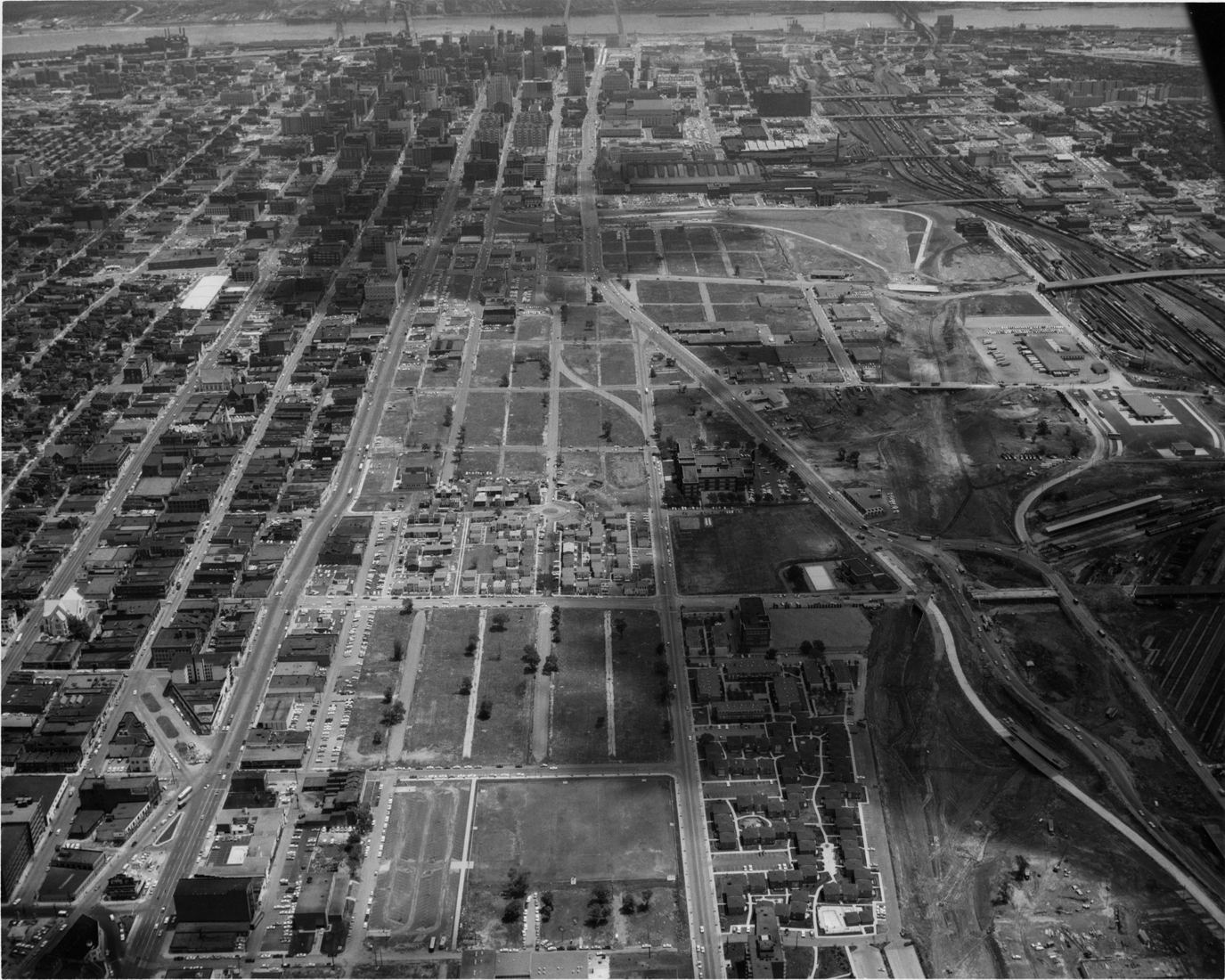
In the wake of demolition, municipal politicians faced mounting public pressure to produce some significant redevelopment. In a sign of the city's lackadaisical pre-renewal planning, most of the cleared land sat vacant for years, earning the vast and empty expanse the derisive nickname of ‘Hiroshima Flats’.Footnote 18 The incumbent mayor, the technocratically inclined Democrat Raymond Tucker, faced biting attacks over the issue during his ultimately successful 1961 re-election bid.Footnote 19 It was with zeal and relief, then, that civic political and business leaders greeted a plan by a New York development firm to partner with locally based Millstone Construction – also the builders of Pruitt–Igoe – on the first residential components of the Mill Creek Valley reconstruction process (Figure 1). First to arrive was the 120-unit LaClede Park complex: a collection of market-rate garden apartments, completed in 1962, just south-west of Laclede and Compton Avenues. Three years later came the complex formally dubbed LaClede Town: a much larger rental subdivision of 279 townhouses, designed by the renowned Washington, DC, architect Chloethiel Woodard Smith. Situated east of Compton Avenue, this development opened in 1965 and was subsequently expanded in stages.
Aerial view of the Mill Creek Valley urban renewal area, looking eastward toward the nearly completed Gateway Arch at the top edge. LaClede Town and LaClede Park, along with several other low-rise developments, are visible in the middle of the expanse. Photo by W.F. Jud, 27 May 1965, from WUSC/Alfonso J. Cervantes papers, box 34.
Because both of the two adjacent communities were owned and managed by Millstone Construction, they would generally be referred to together under the LaClede Town name. But the latter project – LaClede Town proper (plus its late 1960s expansion) – distinguished itself in one significant way. Its construction relied on a little-remembered federal lending programme known as Section 221(d)3, named after the authorizing segment of the Housing Act of 1961. Backed by the Kennedy administration, the programme was aimed at expanding options for urban residents with incomes too high for public housing but too low to secure decent market-rate accommodations.
Under Section 221(d)3, certain qualifying developers could obtain highly subsidised 40-year construction loans, with interest rates between 3 and 4 per cent. In exchange, recipients had to agree to specified ceilings on rent prices (with increases subject to federal approval), a 6 per cent cap on owner profits, a limit of 4 per cent of gross rents to cover overhead and maintenance, and the restriction of all units to low- and moderate-income tenants.Footnote 20 Due to the stringent federal controls in place, LaClede Town would always be an odd hybrid of public and private ventures; to many residents’ chagrin, casual local observers often mistook the privately owned complex as purely a public-housing initiative.Footnote 21 From the start, however, the 221(d)3 restrictions made possible the neighbourhood's well-deserved reputation for affordability and occupational diversity.
With these two early projects, investors and officials hoped not only to begin filling in a colossal scar in the urban fabric, but also to create a fresh, stylish and dynamic image for the district. ‘People do not naturally gravitate back to living in these former slum areas’, argued LaClede Town's New York-based developer, the future US congressman James Scheuer. ‘It must become fun to live downtown again.’Footnote 22 At an August 1965 festival marking the ‘rebirth of Mill Creek Valley’, strolling musicians, professional athletes, tour guides and artists sought to lure sceptical sightseers to the urban renewal area, with one participating minister dubbing the new developments ‘a place for families of all races to live the good life in the heart of the city’.Footnote 23 ‘Once they called it Hiroshima Flats…but look at it now!’, a Millstone Construction newspaper ad boasted (Figure 2). When the rental units nearly instantly reached full capacity, local reporters and politicians disseminated giddy phoenix-from-the-ashes stories about the Mill Creek resurrection. As LaClede Town marketing brochures proclaimed, ‘a new kind of in-town home life at the center of things’ had now arrived.Footnote 24
Millstone Construction ad, running in the St. Louis Post-Dispatch on 8 May 1966. Reprinted courtesy of Millstone Weber LLC.

Early coverage cast as noteworthy the mere fact of the area's redevelopment. But, soon enough, observers also began to marvel at the myriad ways in which LaClede Town differed from the era's typical urban renewal developments. A walkable scale, sidewalk orientation, small blocks, well-traversed public spaces, variation and individuality in the townhouse designs, stores and a coffee shop and pub sprinkled in – the designers, it seemed, must have been thumbing dog-eared copies of Jane Jacobs’ recent manifesto, The Death and Life of Great American Cities, as they conducted their work (Figures 3 and 4). This style of development bore little similarity to contemporaneous US clearance projects rebuilt with saucer-shaped sports arenas, luxury-apartment fortresses, high-rise public housing or hulking garages and convention centres. LaClede Town architect Cloethiel Woodard Smith, a pioneer for women's ascent within the profession, instead prioritized intimate public spaces and gathering spots: somewhere ‘to stroll when you're lonely and want to talk and want to share a human experience in a neutral place instead of someone's home or back yard’, as she put it.Footnote 25 And in contrast to other parts of the Mill Creek Valley redevelopment, which embraced the modernist romance of curvilinear expressway feeders threading past sleek vertical towers, LaClede Town spurred participants to speak of restoring an ‘old’ way of life: ‘urban re-olding’ rather than ‘urban renewal’, as the management archly put it.Footnote 26 Indeed, the project's unconventional design – a forerunner, perhaps, to the New Urbanist planning movement of later decades – might disrupt some of the popular antinomies often used for thinking about mid-century US urban form: modernist planning versus traditional neighbourhood design, the superblock versus the ‘sidewalk ballet’, Robert Moses versus Jane Jacobs.Footnote 27
LaClede Town as featured on the front of the St. Louis Post-Dispatch's Sunday Pictures Magazine, 5 Sep. 1965. Photo by Arthur Witman; reprinted courtesy of the St. Louis Post-Dispatch.

The Coach and Four Pub in LaClede Town, shown in the St. Louis Post-Dispatch on 5 Sep. 1965. Photo by Arthur Witman; reprinted courtesy of the St. Louis Post-Dispatch.

In a further boost to the project's reputation for innovation, the nearby Waring School, a formerly all-Black elementary school that had been shuttered in 1961, was reanimated in 1966 as a public, racially integrated lab school for LaClede Town children.Footnote 28 Add-on development snowballed into the early 1970s, when the community's favourable image earned St Louis two competitively awarded, federally sponsored experimental rental developments meant to test out the utility of prefabricated modular building materials in meeting the country's housing needs.Footnote 29 Dubbed Operation Breakthrough East and West, the two new 8-acre complexes, completed in 1974, bookended the original LaClede Town site with high-rise and garden-apartment expansions. At its peak, the combined development comprised 1,120 units of low-income, moderate-priced and market-rate rental housing spread over 60 acres.
Despite the news-media attention devoted to the project's architectural and design iconoclasm, LaClede Town's eventual public image would be defined most conspicuously by its highly self-conscious emphasis on achieving residential racial ‘balance’. Early on, both builder and management had expressed an over-riding determination to create a robust inter-racial mix. ‘I wanted to keep people in the city and I wanted [my housing projects] to be integrated, frankly, and all the projects we built were either white or they were Black’, Millstone Construction's owner, I.E. Millstone, later reminisced. ‘So that's the reason we decided that we would undertake to build LaClede Town.’Footnote 30 At the outset, this hope seemed particularly unpromising given white St Louisans’ especially fervent commitment to neighbourhood segregation. In 1970, for instance, St Louis would possess the highest residential segregation index out of 18 major northern US cities.Footnote 31 One local housing expert starkly explained in 1966, ‘There isn't a white neighborhood anywhere in St. Louis that you could have a colored family move in without it falling apart at the seams.’Footnote 32
Millstone's company may have been swimming against a formidable tide, but, from the beginning, the venture appeared to constitute an improbable success. Through the mid- and late 1960s, approximately 30 to 35 per cent of LaClede Town's inhabitants were African American, with the remainder white along with a smattering of non-white international residents.Footnote 33 This amalgam substantially exceeded the non-white proportion thought to be sustainable by most of the era's integrated-housing experts, who generally pegged the upper threshold for white tolerance of neighbourhood integration at around 20 per cent African American.Footnote 34 And no one, it seemed, was more committed to achieving this mix than LaClede Town's eccentric, magnetic manager and unofficial ‘mayor’, Jerome Berger.
Characterized by one magazine writer as ‘an unlikely cross between a savvy politician and a beat poet’, Berger was a middle-aged former disc jockey who cultivated an anti-establishment persona while sweeping about town in his signature 1928 Rolls-Royce convertible.Footnote 35 He'd made his start with I.E. Millstone's company in 1960, marketing fashionable luxury units in a new glass-and-concrete high-rise overlooking the city's sprawling Forest Park. Two years later, Millstone anointed him to oversee LaClede Town's day-to-day affairs as head of a new Millstone Construction management subsidiary.Footnote 36 Berger started his new job by using one-on-one cajolery and discretionary rent discounts to lure white and Black artists, jazz musicians, journalists, graduate students and activists as tenants.Footnote 37 Fixated on achieving a specific ambience, Berger imagined his role as a combination of human alchemist, social engineer and exuberant party host. Along the way, he won adoration from inhabitants dissatisfied with predictable suburban homogeneity. As one 1960s tenant, the sociologist Henry Ettman, later recalled: ‘One of the things so grand about LaClede Town is that Jerry Berger had a notion about mix. He'd have Oriental med students on one corner and a welfare family on the other side.’Footnote 38 Similarly, a resident architecture student writing a thesis on the complex effused in 1970 that ‘the policeman, hippy, black militant, Republican, teacher, civil servant, factory worker, student, janitor, and physician happily coexist’ – an assortment that led inhabitants ‘to “loosen up” and see each other as people rather than members of a group or race’.Footnote 39
This approach – combined with Berger's devotion to fostering offbeat opportunities for recreation, community-building activities and colourful ‘happenings’ – soon imbued the complex with a hip and bohemian image.Footnote 40 By embracing and encouraging that reputation, the management nonchalantly departed from the path taken by other high-profile integrated neighbourhoods of the era, where leaders often sought to head off white flight by cultivating an ambience of ‘middle-class propriety’ and ‘economic exclusiveness’, in historian Abigail Perkiss' words.Footnote 41 But while Berger insisted that ‘LaClede Town had to become a groovy place to be’ in order to succeed, outside observers saw something more consequential taking shape.Footnote 42 In 1967, the local B'nai Brith and Anti-Defamation League councils presented Millstone and Berger with their Torch of Liberty Award for contributions to ‘the improvement of democracy’.Footnote 43 And before too long, reporters, commentators and political figures from around the country had begun making pilgrimages to St Louis in order to laud the community's distinctive social medley and the inhabitants’ free-spirited, ostensibly colour-blind lifestyles.
As with parallel residential-integration endeavours of the 1960s–70s – most notably, the one prominently launched by the Chicago inner-ring suburb of Oak Park – the process of image making was understood to be crucial to success. As scholars such as Carole Goodwin and Phyllis Palmer observe of such initiatives, crafting a brand out of diversity meant fostering a specific kind of story about race in America – one that ran counter both to the photos of intractable urban racial confrontation that covered the era's newspaper pages and to the idyllic portrayals of lily-white suburban cul-de-sacs that epitomized hegemonic conceptions of the American dream.Footnote 44 In this, LaClede Town outpaced nearly all of its counterpart neighbourhoods, despite spending only a miniscule amount on marketing. The news media did most of the work. Both locally and nationally, the project came to function as a rhetorical touchstone for an imagined post-racial American society that was presumably just now coming into view.
In this unique environment, it appeared, all the social divisions afflicting US urban life would simply melt away into a warm bath of neighbourly goodwill and progressive-minded tolerance. One local newspaperman, himself an enthusiastic resident, asserted in 1969 that, ‘at a time when racial polarities seem to be becoming more fixed, LaClede Town is a fully integrated neighborhood with virtually no racial tensions’.Footnote 45 Local children, tenants told a visiting journalist, ‘thought nothing of race and the adults rarely think about it’.Footnote 46 The community formed an unparalleled social ‘melting pot’, a United Press International feature story agreed.Footnote 47 ‘Children of no less than six races play together’, marvelled a regional news-syndicate reporter, noting the ‘great metamorphosis from the slum that once stifled the area’.Footnote 48 As City magazine similarly concluded, ‘Even in a stodgy old Midwestern town, where everyone thought segregated, class-conscious suburbs and ghettos took over inexorably, a huge untapped market exists for living in an urbane human stew.’Footnote 49
Such commentary did more than simply trumpet the virtues of one specific housing complex. It also announced a particular theory on how urban racial disparities could or should be surmounted in the late 1960s United States, one saturated with a middle-class racial liberalism that found in the mere existence of inter-racial contact strong evidence for American social advancement. The cultural work that LaClede Town performed in reinforcing this ideological framework made it an indispensable symbol and icon for municipal leaders eager to recast their intensely segregated city as a forward-looking and racially progressive metropolis.
Racial ‘togetherness’ and the limits of Great Society liberalism
The legislation that eased LaClede Town's construction preceded the Lyndon Johnson presidential administration and its Great Society legislative initiatives in the realms of urban development, civil rights and anti-poverty programming. Yet much of the mid- and late 1960s public enthusiasm for the complex reflected a particular worldview and discursive style characteristic of an emergent brand of middle-class Great Society liberalism. This perspective's adherents, explains political historian Douglas Rossinow, envisioned a post-scarcity society that ‘would be transformed through an accretion of reforms bringing greater equity, wealth, and beauty’.Footnote 50 At the same time, the corresponding anti-poverty programmes emanating from the Johnson administration ‘did not seek to alter the basic structures of American society, to create different winners and losers’, as scholar Irwin Unger notes.Footnote 51 These two characteristics – both an earnest optimism for progressive gradualism and a reluctance dramatically to reconfigure existing social and economic frameworks – shaped how many white liberals of the 1960s and early 1970s thought about race in particular, setting them apart from their counterparts further to the left.Footnote 52
When considering how racial divisions could best be overcome, Great Society liberals frequently embraced narratives about the ameliorating potential for person-to-person connections across racial lines and psychological growth among formerly antagonistic groups. These, in turn, were generally imagined to be best engineered through the application of forms of technocratic expertise.Footnote 53 Meanwhile, the liberal emphasis on neighbourly relationship building as an antidote to urban racial hostilities infused numerous 1960s fictional portrayals of a placidly multiracial city life, from television's Sesame Street to children's books by Peggy Mann, Ezra Jack Keats and others. Whether in legislative venues and magazine features or the representational work of writers, illustrators and TV producers, Great Society liberals continually spotlighted and celebrated diverse neighbourhood spaces where race had ostensibly ‘ceased to matter’ due to the tolerant-minded efforts of inhabitants.Footnote 54 Such an outlook, though, oftentimes meant turning away from an intensive scrutiny of power relations and entrenched structural barriers to equality.
As shown in the previous section, this way of thinking about racial division and rapprochement was on full display as commenters and backers laboured to attach specific meanings to the completed LaClede Town neighbourhood. The project offered local observers a nonpareil opportunity for ‘telling stories about race and democracy’, to repurpose a phrase from historian Mary Dudziak.Footnote 55 And yet, as the 1960s progressed, the community's role in the city's turbulent racial and political climate proved contradictory and sometimes paradoxical. To grasp the reasons requires one to distinguish between LaClede Town as a real-life social environment and LaClede Town as a symbolic space in wider metropolitan and national discourses on race and urban development.
On the one hand, as a social environment, LaClede Town came to serve as a vibrant hub and meeting ground for the city's oppositional arts and organizing communities – so much so that the area's US congresswoman, Leonor Sullivan, decried it as a ‘hotbed of radicalism’.Footnote 56 Well-known racial justice activists such as Percy Green and Ivory Perry made their homes there.Footnote 57 The inter-racial leadership group of ACTION, Green's confrontational, headline-making civil rights group, planned and unwound together at the LaClede Town pub.Footnote 58 And the Black Artists’ Group, a collective fostering young performers in the creation of highly political multimedia arts presentations, had significant early roots in the complex.Footnote 59 Anchoring institutions such as the project's Circle Coffee House and the adjacent Berea Presbyterian Church – an African American congregation that survived the Mill Creek Valley demolition before ‘integrating in reverse’ – constantly buzzed with the sounds of avant-garde jazz concerts, folk and acid rock, anti-Vietnam War events, Black Arts poetry and improvisational theatre gatherings.Footnote 60
On the other hand, as a symbolic space LaClede Town often played a role that was equally amenable to the imperatives of civic elites. In the sole existing academic publication analysing LaClede Town, architectural historian Eric Mumford accurately frames the complex as a conspicuous exception: one of the post-war era's ‘relatively few efforts to create racially integrated urban government-sponsored housing’.Footnote 61 Yet a careful look at the discursive uses to which the complex was put during the 1960s and early 1970s suggests how sites of apparent integration can sometimes work as key elements of, rather than simply anomalies within, the larger frameworks of US metropolitan racial segregation. Indeed, the perpetuation of those frameworks is a process that at times requires the presence of sites of exception and exculpation. Such spaces can serve as ex post facto justifications for the forms of dispossession that accompanied their birth, as alibis for injustices elsewhere or as exhibits endorsing individualist rather than structural understandings of how racial disparities are sustained and can effectively be addressed. In various moments, LaClede Town, as an image and figure, was enlisted for all three of these purposes.
In the first instance, as scholar George Lipsitz has pointed out, city officials determinedly enshrined LaClede Town as the ‘favored justification for urban renewal’ – an outcome whose success powerfully vindicated the uprooting of Mill Creek Valley's Black former residents.Footnote 62 Indeed, the clearance project would continue to haunt LaClede Town's existence across its life. In one sense, the Mill Creek community's lingering presence was quite literal: as a cost-cutting measure, building foundations and refuse had been left in place just beneath the cleared ground's surface, causing bemusement and irritation among LaClede Town gardening enthusiasts who continually unearthed reminders of their forcibly removed predecessors.Footnote 63 More generally, the project's very location on a bulldozed African American neighbourhood signalled strong continuities and complicities with the planning ideologies that had evicted and dispossessed thousands of one-time inhabitants. As a writer for Black Enterprise magazine acerbically noted in 1971, ‘Laclede Town's apparent accessibility…does not compensate all the persons displaced by the urban renewal. The overwhelming majority of displaced persons have not been able to move into the lovely little village.’Footnote 64
Nonetheless, growth-coalition leaders needed to demonstrate the value of the Mill Creek clearance to an increasingly sceptical public in order to continue their remaking of the central city. And so, to an institution such as the St. Louis Post-Dispatch – the city's largest daily newspaper and long a major cheerleader for central-city slum clearance – LaClede Town's existence offered a fresh cudgel for pummelling urban renewal's growing collection of critics. ‘It is much too late to try to fool people with a political scare about the Mill Creek redevelopment’, proclaimed the editorial board in 1965; such ‘reckless talk’ was contradicted by the ‘new well-balanced neighborhood’ now rising in place of ‘old, rat-infested slums’.Footnote 65
These sorts of contrasts became a common feature in St Louis’ political and news-media conversations. Yet by the mid- and late 1960s, an energetic urban civil rights movement was stirring and attacks on urban renewal policies were mounting both locally and nationally. African American voters’ anger over the Mill Creek displacements had been one factor in three-term incumbent mayor Raymond Tucker's loss to challenger Alfonso J. Cervantes in the 1965 Democratic primary election, and Black housing activists increasingly would invoke the memory of the neighbourhood's destruction in their campaigns elsewhere in the city.Footnote 66 In this context, civic officials and their allies could no longer rely solely on economic or aesthetic justifications to defend such projects. LaClede Town, then, offered a different way to vindicate displacement and redevelopment. In this retooled account, it was not simply the increased revenue-generating potential of the Mill Creek Valley land, but also now the progress in the realm of race relations that LaClede Town represented, that served to justify the original clearance venture – and, hence, future projects like it. Because municipal and corporate leaders chose to obscure and disregard the human costs of the enormous Mill Creek Valley demolition scheme rather than to reckon with the consequences, these sorts of involuntary displacements in the face of bulldozer-driven redevelopment would continue to be a frequent occurrence in St Louis for many decades to come.Footnote 67
A second and equally important function for the complex was as a leading showpiece for the city's self-proclaimed racial liberalism: an oft-referenced exhibit offering proof not just for the wisdom of central-city slum clearance, but also for the racial progress achieved by enlightened civic leaders. The project as a whole seemed perfectly to ratify what historian Clarence Lang dubs the ‘revised politics of liberal interracial gradualism’ that characterized the 1965–73 administration of Mayor Cervantes.Footnote 68 In fact, a close aide to the mayor grandiosely told the local real-estate appraisers association in 1970, LaClede Town's Operation Breakthrough expansion represented a small step toward ‘show[ing] the peoples of the globe that the American system is the most responsive to human need’.Footnote 69 At the same time, for many boosters and growth-coalition elites, LaClede Town served as a convenient and potent publicity counterweight to obtrusive race-relations embarrassments elsewhere in the city.
Undoubtedly the most prominent of those embarrassments was Pruitt–Igoe, the entirely Black North Side housing project situated a mile north-east of LaClede Town, which was cascading into severe disrepair by the time of LaClede Town's emergence. During the 1960s, Pruitt–Igoe had become a national emblem for the worst failures of federally funded public housing in America. So, in civic discourse of the 1960s and 1970s, LaClede Town and Pruitt–Igoe were constantly paired: each was presented as a reverse-exposure image of the other, with the former always extolled in order to excuse or balance out the latter. As the Regional Commerce and Growth Association, touting the city's dynamism, insisted in one ad campaign (titled ‘An unabashed salute to our own home town’): ‘We should be and are concerned at the failure of Pruitt–Igoe. But why forget the outstanding success of Laclede Town?’Footnote 70 Likewise, in a series of early 1970s proposals for rehabilitating Pruitt–Igoe, city and federal officials envisioned importing several of LaClede Town's unique design elements into a reconstructed version of the troubled low-income project, as an assumed panacea for the glaringly inequitable conditions there.Footnote 71 ‘If LaClede Town is a meritorious exception nationally, it is also an exception in St. Louis itself’, the US Commission on Civil Rights would observe, with significant understatement, in 1971.Footnote 72 And yet, by providing an alibi and diversion, the project's apparent success allowed leaders an avenue for avoiding or deflecting talk about the rigid segregation and fundamental inequalities that prevailed in much of the rest of the metropolis.
Third and finally, LaClede Town stood as an arresting physical embodiment of a strand of 1960s racial liberalism that sought to overcome entrenched structural barriers through face-to-face neighbourly contact – and this may have been its most potent political and symbolic function. More generally speaking, views of this nature on race and integration reflected popularized versions of the ‘inter-group contact hypothesis’, a framework from social psychology most famously outlined in 1954 by Harvard University researcher Gordon Allport.Footnote 73 Post-war experimental psychologists working in this area sought to discover the specific conditions under which interpersonal cross-racial contact might lead to reductions in inter-group prejudice. In the colloquial iterations that circulated in middle-class white lay circles, however, the issue of overcoming racism was oftentimes framed primarily or even solely as a matter of generating opportunities for positive individual encounters across the colour line.Footnote 74 Such perspectives came to constitute a specific vernacular ideology about race. Yet, as cultural-studies trailblazer Stuart Hall and several collaborators have noted, ideologies are not merely free-floating impressions about the world; rather, they ‘are made active and realised in concrete practices and apparatuses’.Footnote 75 In this instance, LaClede Town's tangibility and visibility as a material environment allowed it to activate and lend plausibility to middle-class liberal narratives focused on the ultimately interpersonal origins of racial problems and their potential solutions.
This began with the management's conception of how integration ought to be generated. In a revealing 1968 interview, manager Jerry Berger explained: ‘All around was a Negro neighborhood. We wanted to change that image. However, we didn't want the first group all white either.’ He continued: ‘Because of our location, we had a lot more Negroes coming through than whites but we didn't panic…A lot of those who applied didn't qualify because of income and credit records. If more had qualified we might have had difficulty achieving racial balance. We took a few fatherless families, but we screened pretty thoroughly.’Footnote 76 Across the 1960s and 1970s, meanwhile, the management intermittently faced charges that it discriminated against African American prospective tenants in order to prevent the Black proportion of residents from drifting too high – a circumstance, Berger and Millstone were convinced, that would cause white inhabitants to flee.Footnote 77
During his tenure as manager, Berger denied using anything other than a ‘first-come, first-served’ policy for apartment rentals, though he winkingly told the New York Times of the ‘flexibility’ employed to generate a specific racial and cultural mix.Footnote 78 However, retrospective accounts contain fairly strong evidence of the informal existence of ‘benevolent quotas’, a technical term in legal and housing circles for ceilings on the non-white percentage within a project or neighbourhood when implemented specifically to maintain racial integration.Footnote 79 To their defenders, benevolent quotas offered a community's white residents the security of knowing that their neighbourhood would never reach the ‘tipping point’, where minority residency reaches a proportion high enough to touch off a wholesale white exodus. Despite their integrationist purposes, such quotas increasingly bumped up against various state and local open-housing policies during the 1960s and 1970s, until finally, in 1988, federal courts ruled that most versions violated the Fair Housing Act of 1968.Footnote 80 Their usage by numerous integrated-housing advocates, however, indicates one of the paradoxes inherent to many of the era's efforts to engineer racially mixed neighbourhoods. As political scientist Edward Goetz explains: ‘Integration, it is understood, will not work without white acquiescence, and thus the terms of integration must be those that whites accept. Such a bind requires that the interests of communities of color be subsidiary to those of whites during the process of integrating.’Footnote 81
In Midtown St Louis, those ‘interests of communities of color’ began most basically with simple access to decent affordable housing. Indeed, Berger in 1966 explained to Business Week magazine that ‘he could have filled all [the] spaces with Negroes’ but declined – a remark indicating, if nothing else, the acute demand for central-corridor housing among African Americans in the aftermath of the Mill Creek clearance.Footnote 82 Under this type of approach, then, racial exclusion and racial integration were not opposites; rather, the former was the necessary price for the latter. So, while reporters incessantly depicted the LaClede Town social environment as colour-blind, the management team's selection policies remained extraordinarily colour conscious. Berger's remarks to interviewers exhibit the degree to which notions of a carefully curated ‘balance’, rather than imperatives toward racial justice or redress, were at the heart of the LaClede Town management's mission and ethos.
Nonetheless, to many inhabitants and observers the project offered the best available blueprint for how the city and nation alike might eventually be transformed. ‘Together, those of us who lived there changed the way people thought and felt about integration and public housing’, reporter and one-time resident Ellen Sweets later boasted.Footnote 83 This was a space, claimed former inhabitant and journalist Tom Uhlenbrock, for ‘living and loving together, with no racial hangups’.Footnote 84 Another neighbourhood alumnus retrospectively related the complex's ostensible lesson: ‘Yes, we can all get along. We proved it in LaClede Town.’Footnote 85 With its emphasis on individual tolerance and human ‘togetherness’, LaClede Town helped nudge public conversations on race from questions about systemic inequities to assertions about the primacy of interpersonal relationships.
The commonplace celebrations by racial liberals of the universalist nature of American national identity, critic Nikhil Pal Singh has noted, ‘should be understood as performative – that is, they seek to produce what they purport to describe’.Footnote 86 Here, a single urban neighbourhood is employed as a key element in that larger performative work, operating as a synecdoche for a particular imagining of the nation's merits and possible futures. Yet, as scholar Keeanga-Yamahtta Taylor points out, the rhetoric of colour-blindness often operates to ‘obscure inequality and disparities between African Americans and whites’.Footnote 87 And so, while the existence of positive cross-racial relationships at LaClede Town was by nearly all accounts a social fact, media- and resident-generated accounts of LaClede Town's colour-blind lifestyle also created a social fiction, one that elevated an individualizing analysis of racial divisions in St Louis’ civic ‘hierarchy of discourses’ on race.Footnote 88 By framing interpersonal relationships as the primary arena for addressing metropolitan inequalities, the project's media and municipal cheerleaders showed the limitations of an urban liberalism that was fundamentally un-equipped to confront the structural underpinnings of the region's gross racial disparities in wealth, housing opportunities, employment options, health-care access and other key social and economic resources.
Of the news media's many depictions of LaClede Town, none more powerfully links the three functions described above than an iconic 1968 news photograph, printed several times in the St. Louis Post-Dispatch (Figure 5).Footnote 89 Because of the significant ideological work it performs, the image is worth lingering over for a moment. Pictured here are two young boys at LaClede Town – one Black, the other white – gazing at one another beneath townhouse rooflines. At first, the positioning of the figures might appear implicitly to reference contemporaneous photojournalism of tense inter-racial confrontations at protest marches or demonstrations. But here, that message is reversed. The seeming innocence of the two children, along with the manifest unselfconsciousness of their encounter, instead summons up a prelapsarian world free from the forms of colour prejudice that contaminate adults – a world that the photo's viewers, and perhaps all Americans, are encouraged to aspire to.
Unattributed photo accompanying a 22 Dec. 1968 St. Louis Post-Dispatch story titled ‘Mill Creek Valley: slum to showcase’. Reprinted courtesy of the St. Louis Post-Dispatch.

The photograph, however, appeared not in isolation but rather on a newspaper page that provided its immediate context. For this reason, it may be helpful to recall the distinction made by the semiotician Roland Barthes, in his landmark essay ‘Rhetoric of the image’, between the connoted messages that an image by itself might convey and the surrounding linguistic messages that provide ‘anchorage’, or channel a viewer's interpretations of the image in specific ways.Footnote 90 In the case of this photograph, the connoted message compellingly ratifies the individualizing liberal integrationism emblematized by LaClede Town. However, the accompanying linguistic message firmly anchors that meaning to a pro-urban renewal agenda. ‘Mill Creek Valley: slum to showcase’, reads the article headline emblazoned just above. The photo's caption asserts that ‘the bright, attractive townhouses of LaClede Town now stand on the site of what had been one of the worst slums of St. Louis’, before saluting the ‘massive facelifting program’ still ongoing across the city.Footnote 91
The caption and accompanying article make no mention of the pictured boys, but none is necessary. Like so many other representational artefacts of its moment, the image tightly bundles together discrete arguments about the power of intergroup togetherness, recent racial progress in St Louis and the rightness of the city's urban renewal schemes – with LaClede Town consistently as the focal point.
The fate of affordable housing in the post-liberal city
While the uses made of LaClede Town as symbol may reveal something about the contours of Great Society-era liberal racial ideologies, the story of the complex's eventual dissolution illustrates both the waning of those credos and the endemic erasures of complicated racial histories that are characteristic of the post-liberal urban era. It may be true, as argued above, that LaClede Town served a useful function for civic leaders intent on swivelling attention away from local housing disasters such as Pruitt–Igoe. It is true as well that the rhetoric of inter-racial fraternity adopted by the complex's boosters could never offer an adequate solution to the metropolis' recalcitrant social inequities. Nevertheless, it should not be forgotten that the neighbourhood actually did sustain a robust racial mixture for the first decade and a half of its life, an extreme rarity in the city at the time. Perhaps more significantly, LaClede Town provided inexpensive central-city housing, with convenient access to major institutions, employers and bus lines, for many Black and white St Louisans with tightly limited financial resources.Footnote 92 The latter contribution became especially important during the 1970s and 1980s, when the availability of low-cost and subsidized urban accommodations would drop markedly in St Louis and nationwide.
For this reason, the trajectory of decline that LaClede Town followed during the decades following its 1960s heyday is at least as noteworthy as its role during those heady early years. The complex's origins had come with the top-down urban renewal ideologies of the 1950s; its leap to fame coincided with the progressive yet incrementalist reformism of the Great Society period. The slow and painful end of LaClede Town's life, though, signalled the 1990s triumph of a new urban neoliberalism – an ideological and political framework under which ‘city governments are increasingly expected to serve as market facilitators rather than [as] salves for market failures’, as geographer Jason Hackworth explains.Footnote 93 During this moment in St Louis, powerful private-sector entities would take an increasingly possessive hold over the strategically valuable terrain of the city's central corridor, even as goals such as affordable housing rapidly receded on political priority lists both locally and nationwide.
At LaClede Town itself, the first conspicuous signs of trouble came in the mid-1970s, around the time that the Operation Breakthrough expansions finally opened. Gradually at first, and then more noticeably, maintenance problems began to proliferate. Various management companies were successively pushed out by the US Department of Housing and Urban Development (HUD), guarantor of the project's mortgage, for dereliction of basic duties such as trash removal, weed trimming, painting and repairing burst water pipes.Footnote 94 The new Texas- and New Jersey-based complex owners blamed the Section 221(d)3 affordable-housing provisions built into the project's original mortgage; the federally mandated rent ceilings, they claimed, left nowhere near enough money for maintenance needs. (Years earlier, this had also been a complaint of I.E. Millstone, LaClede Town's builder and original owner, which had prompted Millstone Construction to sell off the entire development in 1972.Footnote 95) In the late 1970s, residents tenaciously pressed for change. They formed an inter-racial tenants’ union in alliance with Missouri's chapter of the Association of Community Organizations for Reform Now (ACORN), a progressive neighbourhood-organizing network, and won some short-term victories on maintenance and security issues through a well-publicized two-month rent strike.Footnote 96 Fearing for the city's reputation, local politicians initially extended sympathetic ears. ‘It is critical that the project succeeds’, declared Richard Gephardt, the area's influential US congressman, in 1978. ‘We have already suffered Pruitt–Igoe, and we don't want anything like that again.’Footnote 97
Yet within just a few years, it could seem to many onlookers that Gephardt's Pruitt–Igoe premonition was drawing ever closer to reality. In the mid-1970s, white LaClede Town parents had begun sending their children to private schools rather than the nearby Waring School, causing the resegregation of the once proudly integrated lab school.Footnote 98 By the early 1980s, increasing numbers of white residents had fled, leaving a dwindling and eventually nearly entirely African American population behind.Footnote 99 Moreover, changing fashions during the 1970s meant that some of the suburb-averse white progressives for whom a place like LaClede Town might once have held cachet were now finding greater allure in rundown but slowly gentrifying historic neighbourhoods of the city's south-east quadrant.Footnote 100 Compounding the white exodus from LaClede Town, then, was a less visible but perhaps more consequential phenomenon of ‘white avoidance’, to use policy scholar Ingrid Gould Ellen's term.Footnote 101 Meanwhile, poverty rates climbed as the ownership group converted an increasing proportion of the apartments (18 per cent by 1985) to subsidized Section 8 units in order to elicit a reliable income stream from the federal government.Footnote 102 One white artist and long-time resident, referencing the late 1970s arrival of ‘dispossessed’ newcomers, later recalled, ‘No longer did anyone go from house to house in the evenings and very few of us felt any real need to get out and meet the new neighbors. They were different.’Footnote 103 LaClede Town vacancy climbed to 60 per cent by the close of the 1980s (Figure 6).Footnote 104 Reflecting a new public sentiment toward the complex, an area sociologist in 1990 characterized the neighbourhood as ‘a deteriorated public housing site and home to one of the city's nastier street gangs’.Footnote 105
Abandoned buildings at LaClede Town, c. early 1990s. SHSM/John C. Danforth papers (unprocessed), box 197.

To many remaining residents, LaClede Town's mounting physical dilapidation across the 1980s demonstrated an egregious neglect, from both public and private sectors, toward African American and low-income central-corridor inhabitants. As Black community leaders pointed out, the once-chic project, so proudly cultivated when economically stable whites made up the majority of tenants, was now permitted to rot.Footnote 106 ACORN and other activist tenant groups went further with their critiques. Through the late 1970s and 1980s, tenant leaders persistently charged that the complex was purposely being allowed to decay as part of concealed HUD and city-hall machinations aimed, essentially, at demolition by neglect. In this recounting, municipal and federal officials, captive to influential private interests, hoped to remove LaClede Town's increasingly low-income population to make way for highly coveted campus expansions for the adjacent global headquarters of A.G. Edwards Inc., the financial services giant, and St Louis University, a wealthy private Catholic institution that already owned a large chunk of the old Mill Creek Valley clearance site.Footnote 107 According to the area's elected representative in the Missouri state legislature, civil rights veteran Louis Ford, a government ‘conspiracy’ was afoot to ‘displace the needy and help the greedy’.Footnote 108
Whether or not a formal ‘conspiracy’ existed, it was clear by the mid-1980s that, to the municipal political leadership and especially to Midtown's powerful surrounding private landholders, LaClede Town stood as a highly visible embarrassment. Importantly, such concerns emerged alongside and in tandem with the intense moral panic over urban lawlessness and disorder that gripped the United States in the Reagan era and beyond – a ‘wave of popular alarm’, as communication scholar Steve Macek has demonstrated, that obsessively ‘constructed the central city as an object of middle-class fear’.Footnote 109 After 1980, outside commentary on LaClede Town increasingly manifested that impulse. The St. Louis Post-Dispatch, for instance, highlighted the area's ‘growing band of restless young people consorting with trouble on the streets’.Footnote 110 ‘Drug-related and other crime is rampant and spills over into the contiguous neighborhoods’, complained US senator Christopher Bond, a Missouri Republican, in a Capitol Hill hearing.Footnote 111 Preoccupied with perceptions of blight and crime in his institution's vicinity, St Louis University's president, Lawrence Biondi, SJ, told reporters that students would be ‘wise to avoid the Laclede Town area’, while privately pressing city officials to develop plans for relocating the tenants.Footnote 112 Making a foray into pop psychology, the Post-Dispatch theorized that LaClede Town's ‘spirit has drooped because the spirits of low-income people…tend to dwell more on survival than on the art of life’.Footnote 113
To claim that much of the 1980s media and elite commentary on LaClede Town reflected a wider urban moral panic is not, of course, to deny entirely the existence of crime, drug sales or gangs at the complex. The point, rather, is that such overviews typically sought no broader causes or webs of complicity for the conditions endured by LaClede Town's low-income African American residents, instead framing the inhabitants themselves both as a source of hazard and infection and as an emblem for a more extensive urban social breakdown. In 1994, a consulting firm, hired by the city to explore options for the area, expressed the same anxieties. Fretting over the proximity between LaClede Town's ‘socio-economic decline’ and the Midtown district's ‘high daytime population of largely well-paid, white-collar workers and college students’, the firm's planners advocated a thoroughgoing transformation – one to be wrought ‘through the free and open functioning of the real estate market’. As one possibility for the land's future, they envisioned the creation of the sort of ‘prestigious corporate atmosphere’, reminiscent of the region's wealthy far-west suburbs, ‘that is so often sought by commercial users’.Footnote 114
It was the spectre of just this kind of sanitized, corporate-friendly redevelopment plan that helped to motivate a renewed wave of tenant activism in the late 1980s. Subsequent popular accounts of LaClede Town's later years have focused nearly entirely on the alleged passivity, familial ‘deviance’, psychological maladjustment or criminality of the 1980s tenants – a recapitulation of the highly racialized social-pathology theories running through the 1965 Moynihan Report and its ideological descendants. But this version of the past unjustly erases the agency and positive social vision demonstrated by many of the complex's 1980s and 1990s African American inhabitants and organizers.
In fact, beginning in the autumn of 1987, a revived tenants’ association engaged in a whirlwind of advocacy activities meant to publicize the residents’ predicament: candlelight vigils, testimony before legislative committees, news-media outreach, public petitions with detailed lists of demands, conferences with city and federal officials and so forth.Footnote 115 Citing their ‘special loyalty’ to the complex, tenant leaders in 1990 insisted that they were owed ‘an opportunity to participate in the future of LaClede Town and their own future’.Footnote 116 Participants won some sympathetic coverage in the city's Black weekly press, which, unlike other news outlets, emphasized the plight inhabitants faced rather than the blight that their presence supposedly embodied.Footnote 117 Of the group's battles, former tenant chairperson Willie Crisp remembers,
As a whole, a lot of people throughout the city really cared about what was going in at LaClede Town…But the people that owned the property, managed the property, and the city leaders didn't really care…It was more important for big companies to have money than for people to have a place to live: a decent place to live and an affordable place to live.Footnote 118
Just as important, activists such as Crisp framed their efforts within a larger political and economic context, aiming not only to secure tolerable living conditions at LaClede Town but also to highlight broader citywide and national issues related to housing access and economic inequality in the face of the Reagan and Bush administrations’ ongoing urban retrenchments.Footnote 119 Surveying the Reagan years, urban historian Roger Biles observes that ‘housing programs suffered deeper cuts after 1981 than any other part of the federal budget’ – including catastrophic reductions in assistance designated for low-income, elderly and disabled city residents.Footnote 120 Keenly aware of such developments, LaClede Town's 1980s activists worked with ACORN and other allies on tenant-organizing drives elsewhere in the city while challenging national-level HUD policies. One such campaign, for instance, involved pushing HUD not to approve early repayments of mortgages obtained under the 221(d)3 programme, since this would free landowners to raise rents and displace tenants unfettered by federal oversight. Several tenant-association members participated avidly on city- and state-level ACORN boards, and a few energetically dived into local campaign work for the Reverend Jesse Jackson's insurgent bid for the Democratic party's 1988 presidential nomination.Footnote 121 Through such efforts, tenant leaders made clear their conviction that something more was at stake than simply the fate of their own individual rental homes.
During the late 1980s, the city government had responded to progressive political pressures by crafting a succession of schemes for retooling rather than completely razing the area. The most commonly mooted plans envisioned a mix of rehabilitation, spot demolition and new residential construction, together aimed at retaining low- and moderate-income housing – an increasingly scarce commodity in the city's gentrifying central corridor – as the primary land use.Footnote 122 St Louis’ top priority for the district, Mayor Vincent Schoemehl told HUD officials in 1988, was to ‘sustain an economically and racially integrated mix of tenants’.Footnote 123 Summoning up the complex's storied past, the mayor pledged the city's commitment ‘to re-establishing [LaClede Town] to its former greatness as a neighborhood’.Footnote 124 The federal government seemed for a time to accept the city administration's logic. In a rebuttal to critics claiming that demand was too low to justify a continued housing usage for the site, HUD's local office insisted that ‘a rental market does in fact exist in the local area’, pointing to high occupancy rates at several of the vicinity's other inexpensive apartment buildings.Footnote 125
These late 1980s redevelopment aspirations continually stalled out due to the inability of city leaders, the federal government and the complex owners to agree on a plan and the necessary funding. Meanwhile, LaClede Town living conditions worsened even further in the absence of ameliorative action. Eventually, the Texas company that owned the complex defaulted on its loan payments, causing HUD (already mortgagee in possession since 1991) to begin foreclosing on the LaClede Town, LaClede Park and Operation Breakthrough properties. Completed in 1994, the foreclosure process placed the federal government in the reluctant position of owner and manager – a role HUD urgently wanted to escape by deeding over the land to the city as soon as municipal leaders could decide on their own plans for the site.Footnote 126 However, amidst the era's racialized moral panic over urban crime, large neighbouring institutions – particularly A.G. Edwards and St Louis University – expressed increasingly adamant opposition to any proposals for the land that focused on the continued provision of low-income or affordable housing.Footnote 127 By the 1990s, entities such as these had increasing sway over municipal land-use priorities. St Louis, after all, was eager to hang onto its corporate office centres after steadily losing white-collar employers since the 1950s. Moreover, civic officials, like their counterparts in peer cities, had recently begun pinning their hopes on major health, education and culture non-profits to assume the role of ‘anchor institutions’ in distressed urban districts – sometimes in the process giving them virtual carte blanche over development policies for their vicinities.Footnote 128
Even as late as 1993, a survey of the remaining LaClede Town residents found 76 per cent of respondents expressing a desire to stay in place, albeit with a management commitment to better maintenance.Footnote 129 Nonetheless, the inhabitants were finally forced to leave in 1995 after the city, under a new mayoral administration, reversed its established preferences regarding the area's future, settling instead on wholesale demolition and the complete elimination of housing usages from the 60-acre site as the most politically viable route forward.Footnote 130 The decision to level LaClede Town marked a disheartening end to the social ambitions that residents and observers had once so eagerly attached to the complex. More broadly speaking, the city's scrapping of long-standing affordable-housing objectives for the area paralleled an ongoing ideological shift in post-1970s US municipal governance, one in which ‘missions of service, equity, and social welfare’ receded in favour of a fixation on attracting ‘investments, innovations, and “creative classes”’, as geographer Helga Leitner and several collaborators summarize it.Footnote 131
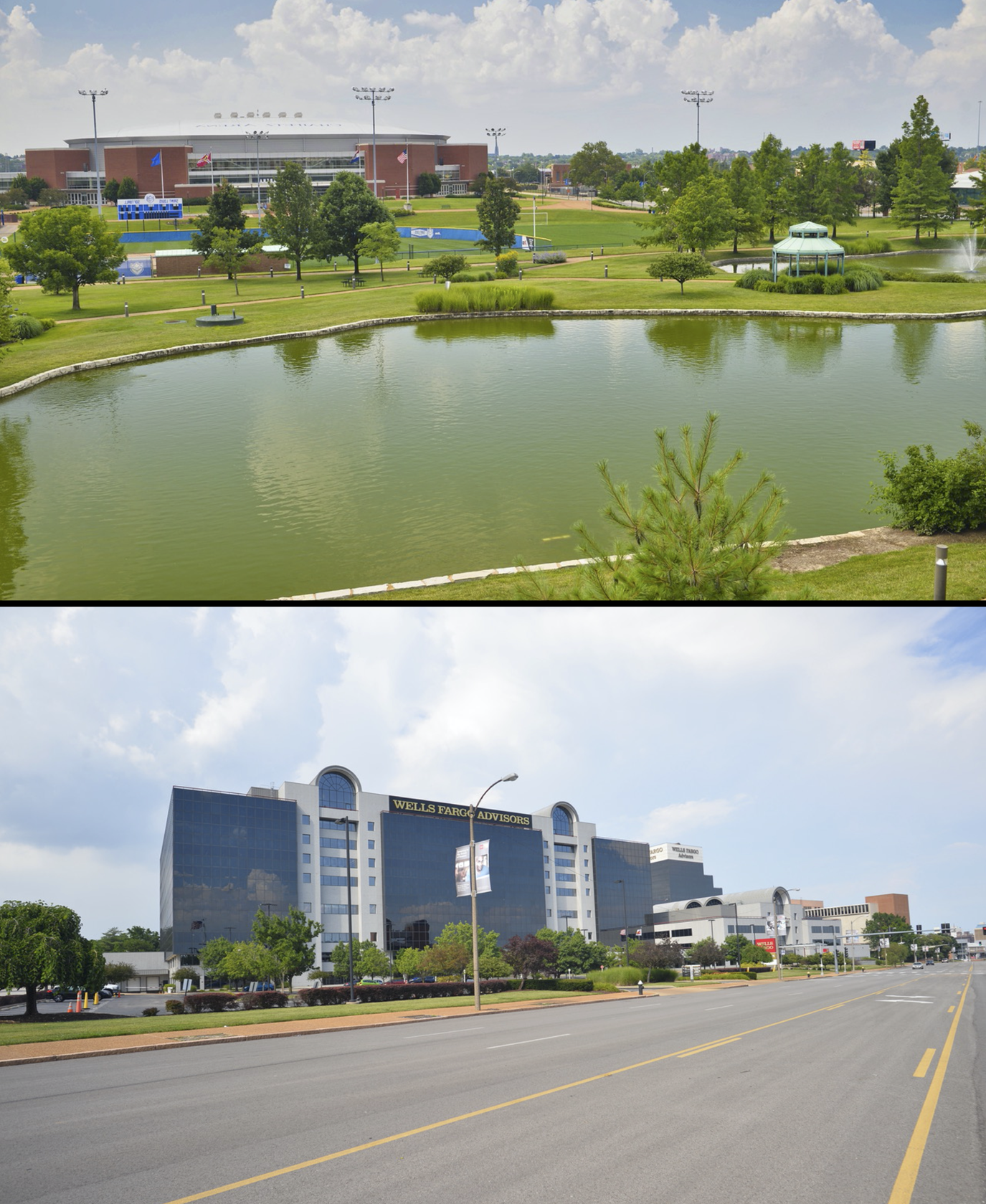
‘They got their way’, Willie Crisp, the former tenant leader, tersely observes of LaClede Town's corporate and university neighbours. ‘But people, they got to live somewhere, those low-income people, and everybody wasn't fortunate enough to get a home.’Footnote 132 Indeed, though it affected only hundreds rather than thousands of low-income Black St Louisans, the mid-1990s razing of LaClede Town eerily echoed the Mill Creek Valley destruction of four decades earlier. Once a vaunted showpiece for the city's ostensible racial progress in the 1960s, the site now was divided up among expanding area universities as well as companies such as A.G. Edwards (now Wells Fargo Advisors) and the Sigma-Aldrich chemicals firm (now MilliporeSigma). While Harris-Stowe State University, a historically Black institution, obtained a slight plurality of the cleared land, taxpayer subsidies helped underwrite St Louis University's acquisition of the LaClede Park and Operation Breakthrough West sites.Footnote 133 The early 2000s saw eight million dollars in Missouri tax-increment financing support the same private university in its erection of a 10,600-seat basketball and concert arena – dubbed ‘the jewel of Midtown’ by school leaders – atop the land where Waring School and LaClede Park once stood.Footnote 134
In the years since LaClede Town's demise, the dramatic metamorphosis in the landscape (Figure 7) readily demonstrates urban historian Lawrence Vale's observation that urban clearance and redevelopment projects are frequently ‘not just about clearing sites, but about clearing sights’ – that is, visually ‘purging the landscape of negative associations, thereby permitting a new moral order to commence’.Footnote 135 Today, two fortress-like corporate complexes, each abutted by sprawling, highly secured parking lots, dominate the site's pedestrian-hostile eastern edge. Meanwhile, on the western side, fenced-off fields of manicured grass and reflecting pools cover much of the St Louis University accession. In an attempted evocation of a rustic pre-urban Eden, a tableau of bronze statues at one pool's edge depicts deer gazing on as a Native American woman washes an unclothed child.Footnote 136 More generally, the physical campus’ aggressively marketed image as an ‘urban oasis’, in tandem with a redevelopment approach that one urban blogger has dubbed ‘SLU-burbanization’, relies on a carefully crafted pastoralism to project an ambience of bucolic racial innocence.Footnote 137 And while the name of the university's expanded Frost Campus commemorates a Confederate Army general who fought in defence of slavery, no physical marker indicates that more than half of that campus’ acreage sits atop the former homes and community institutions of poor and working-class African Americans who were uprooted by the 1950s Mill Creek Valley clearance.Footnote 138
Contemporary views of portions of the western edge (top image) and eastern edge (bottom image) of the site once occupied by LaClede Town and its expansions. Photos by Matthew J. Mancini, 5 Jul. 2020; reprinted by permission.
Epilogue: public memory and public struggle
A half century nearly to the day after Governor George Romney's September 1967 trip to LaClede Town to commend its inter-racial success story, another small chapter in St Louis’ vexed racial history unfolded upon and around the complex's former land. On a cloudy Sunday afternoon, Black Lives Matter demonstrators approached the erstwhile LaClede Town site on a march headed westward from the city's downtown police headquarters. Helmed by clergypersons, the peaceful procession was one element of ongoing citywide protests over the acquittal of a white city police officer charged with murdering an African American motorist, Anthony Lamar Smith. Participants travelled through the now unrecognizable terrain of LaClede Town's old Operation Breakthrough West and LaClede Park components, eventually reaching the western boundary of Mill Creek Valley's former extent at North Grand Boulevard. There, however, their progress was stopped short by an armed private security detachment, hurriedly deployed by the St Louis University administration to block participants’ continued passage through the campus's normally open pedestrian thoroughfare. Meanwhile, the entire student body was warned via text message to ‘shelter in place’ due to the purported threat posed by the non-violent marchers.Footnote 139 Several students of colour, travelling with the procession, reported facing extensive and disproportionate scrutiny by school security personnel before they were permitted to enter their own university's grounds.Footnote 140 ‘I was only allowed to pass’, one later wrote in disbelief, ‘when a white friend of mine vouched for me.’Footnote 141
The juxtaposition of the two incidents, separated by exactly 50 years, is revealing because of the striking contrast between the meanings and aspirations attached to this specific urban landscape in each respective moment. If Romney's September 1967 campaign visit indicated the unique role that LaClede Town had come to play in local and national debates over how to dissolve US inter-racial barriers, then the September 2017 stand-off transpiring just beyond the neighbourhood's former edge hints at the processes of urban hyper-privatization and boundary-erection that had thoroughly transformed this terrain over the preceding two decades.
More broadly, the afterlife of the LaClede Town land suggests multiple forms of erasure at work. It is not only the old Mill Creek Valley ‘slum’ itself, but also the insufficient yet genuine attempt by 1960s–70s LaClede Town residents to acknowledge and counteract the entrenched nature of St Louis metropolitan housing segregation, that is obscured by the present topography. The public subsidies underwriting the land's eventual disbursal and redevelopment, the lack of nearly any remnant revealing earlier uses and inhabitants, and major private institutions’ controlling grip on growing chunks of Midtown perhaps can stand proxy for the supersession of an older urban liberalism by newer neoliberal development imperatives. Civic elites once found it convenient to hitch the former ideology, as exemplified most visibly by LaClede Town, to their broader economic growth strategies; in the most recent era, significant portions of the old Mill Creek Valley renewal area have been remade by institutional landholders who regard urbanism and urban life, in preservation writer Olivia White's words, as chiefly ‘a problem meant to be solved through fortification, landscaping, and policing’.Footnote 142
Sounding notes of nostalgia for a vanished golden age, retrospective media profiles have gauzily presented LaClede Town's early phase as ‘a sixties vision of an urban paradise’, ‘an experiment in ethnic togetherness’, or ‘a small piece of America as it should be’.Footnote 143 This is also the story many former 1960s residents still choose to highlight. As one recent tribute, posted on a Facebook page for LaClede Town alumni, exclaims, ‘Thanks for the diversity and harmony, for making LaClede Town the center of counterculture. A place for civil rights, music, art and sports!…Thanks for Utopia!’Footnote 144
In reality, LaClede Town's role in America's post-war urban landscape remains far more complex and even muddled. Viewed through one lens, the community at its late 1960s height stands as a compelling critique and counter-model to the anti-urban ideologies ratifying the twin demolitions that preceded its construction and marked its end. From a more pessimistic perspective, the complex might instead be cast as simply a bridge between the expropriative strategies of an older modernist urban order and those of the more recent age of privatization and urban neoliberalism. In a moment when social-justice activists are challenging US urban racial hierarchies in newly prominent ways, both of those versions hold useful lessons, for each reminds us of how histories of power and inequality continue to permeate and mould the nation's metropolitan terrain, even when visible traces of the past have all but disappeared.


 Open access

