


High Na intake is strongly associated with high blood pressure( Reference He, Li and MacGregor 1 ) and stroke, being responsible for an estimated 4·0 million deaths worldwide in 2010( Reference Lim, Vos and Flaxman 2 ). The WHO recommends no more than 2 g Na/d (equivalent to 5 g salt (NaCl)/d) in adults, in order to reduce the burden of non-communicable diseases( 3 ). However, in all countries with recent data available the dietary Na intake is much higher than recommended( Reference Elliott and Brown 4 ). To our knowledge, no such data from Mozambique have been published, despite Na intake being of major relevance in this setting given the high prevalence of hypertension (25–64 years: 33·1 % in 2005), the low proportion of hypertensive individuals under pharmacological treatment (39·9 % from the 14·8 % who were aware of their condition)( Reference Damasceno, Azevedo and Silva-Matos 5 , Reference Gama, Damasceno and Silva-Matos 6 ) and the increasing public health impact of CVD. It is estimated that the number of deaths due to CVD almost doubled in Mozambique in the last two decades (from nearly 9000 in 1990 to almost 17 000 in 2010)( 7 ). In 2005–2006, the incidence of stroke hospitalization in Maputo among those aged ≥25 years was estimated to be one of the highest in developing settings (adjusted incidence rate, world standard population: 260·1 per 100 000)( Reference Damasceno, Gomes and Azevedo 8 ) and the early case-fatality rate was also high( Reference Gomes, Damasceno and Carrilho 9 ).
Although the sources of Na differ across high- and low-income countries, bread appears to be one of the most important contributors to overall Na intake worldwide( Reference Joossens, Sasaki and Kesteloot 10 ). In Mozambique, starchy foods are the major staple foods; the consumption of cassava and maize prevails in the north of the country and bread intake is higher in the south( Reference Barslund 11 , Reference Handa and Mlay 12 ), being sold in bakeries and traditional markets (both formal and informal street markets). Data from the last Household Budget Survey showed that, in Maputo city, the daily per capita availability of bread was 106 g( 13 ).
There are no manufacturer Na targets for bread in Mozambique but in neighbouring South Africa, the Government has regulated the Na content of processed foods, including bread, by stipulating a target of 380 mg/100 g for the maximum Na content of bread, which will became mandatory after June 2019( 14 ). For other countries worldwide, the targets range from 360 mg/100 g to 550 mg/100 g( Reference Dunford, Eyles and Mhurchu 15 – Reference Wyness, Butriss and Stanner 19 ).
The present study aimed to estimate the Na content of white bread available in different bakeries and markets in Maputo, Mozambique.
Experimental methods
Selection of the bakeries and markets and collection of samples
All bakeries (n 16) situated in Maputo city that were listed in the Mozambican Yellow Pages( 20 ) were identified, as well as the major traditional markets in the same urban area, including officially organized retail outlets confined to an area fitted for the purpose (formal traditional markets, n 3) and non-organized street markets (informal traditional markets, n 5). Additionally, a well-known bakery chain with four retail stores was identified and their largest bakery was included in the sample of bakeries and markets, increasing the number of bakeries visited to seventeen.
Three loaves of white bread (bread made from wheat flour from which the darker, coarser bran has been removed, retaining the starchy endosperm( Reference Welch 21 )) were bought in June 2012, in each of the twenty-five bakeries/markets, and their prices were noted. Only one type of bread (white bread) was available in the selected bakeries and markets.
Each group of three loaves was then weighed, packed in proper cooler bags (one bag for each bakery/market) and frozen at −18°C until Na content analysis.
Na determination
After defrosting to room temperature, the groups of bread from each bakery/market were weighed and ground mechanically for homogenization of each sample. After homogenization, three aliquots, with approximately 2 g bread each, were collected and prepared for Na determination according to a previously validated method, described in detail elsewhere( Reference Vieira, Soares and Ferreira 22 ). Briefly, the Na existing in the bread was dissolved in doubly deionized water and quantified by flame photometry (flame photometer model PFP7; JenWay®, Dunmow, UK).
Two readings of each of the three aliquots from the same homogenized bread sample were taken. The variation between each group of six results was lower than 5 %, and therefore the mean of the six results obtained was considered for data analysis. The final Na content per 100 g of bread was adjusted for the difference between the weight of the bread on the day of purchase and on the date of analysis, as follows: final Na content=(weight of bread at purchase×Na content)/weight of bread at analysis.
Non-compliance with recommendations for the level of Na in bread
In Mozambique there are no specific guidelines for the maximum Na content of bread, and therefore our results were interpreted according to the maximum levels allowed or recommended in countries where those guidelines exist, including neighbouring South Africa and countries from other regions across the globe, namely Australia, Finland, New Zealand, Portugal, the UK and the USA (see Table 1 footnotes for a more detailed description).
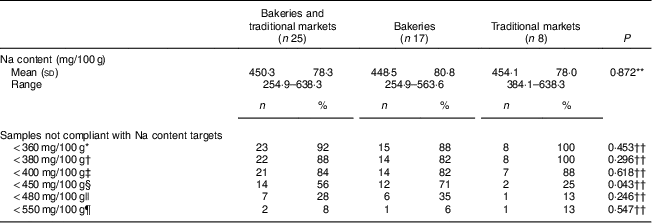
Sodium content of white bread samples from Maputo city, Mozambique
* Defined according to the maximum level of Na allowed by the Finish Government for a ‘reduced salt’ label placed on bread( Reference Pietinen 17 ) and the US target of Na content in bread for 2014( Reference Labarthe 16 ).
† Defined according to the maximum level of Na in bread established by the South African Government (effective June 2019)( 14 ).
‡ Defined according to the maximum level of Na in bread recommended by the Government of Australia( Reference Dunford, Eyles and Mhurchu 15 ) and the Food Standards Agency in the UK( 29 ).
§ Defined according to the maximum level of Na in bread recommended by the National Heart Foundation of New Zealand( Reference Dunford, Eyles and Mhurchu 15 ).
|| Defined according to the level of Na that is required by the Finish Government for the designation of ‘highly salty’ on a label( Reference Pietinen 17 ).
¶ Defined according to the maximum level of Na in bread established by the Portuguese Government( 18 ).
** The t test for independent samples was used for the comparison of bakeries and traditional markets.
†† The χ 2 test was used for the comparison of bakeries and traditional markets.
Statistical analysis
For the samples collected in bakeries and traditional markets, comparisons were made with respect to the distribution of price (Mann–Whitney U test) and Na content (t test for independent samples) of bread and the prevalence of non-compliance with the manufacturer Na targets established by different countries (using the χ 2 test). A significance value of 0·05 was used.
Results
Overall, the price per 100 g of bread varied between 2·2 and 6·2 meticais (between $US 0·08 and $US 0·22), the median price being 3·5 meticais, with no significant differences between the bread available in bakeries and traditional markets (3·2 v. 3·6 meticais, P=0·288). The mean Na content of bread was 450·3 mg/100 g, ranging between 254·9 mg/100 g and 638·3 mg/100 g, with no significant differences between bakeries and traditional markets (Table 1).
A total of 88 % of the samples did not comply with the target defined in South Africa (≤380 mg/100 g) and 84 % were above the maximum level of Na in bread recommended in Australia (400 mg/100 g) and the UK (400 mg/100 g). In just over half (56 %) the Na levels were higher than the threshold recommended in New Zealand (450 mg/100 g), whereas only 8 % exceeded the less restrictive limit imposed by the Portuguese Government (550 mg/100 g). The Na content of nearly all samples (23/25) did not comply with the target recommended in the USA (360 mg/100 g) and did not meet the requirement for a ‘reduced salt’ label (360 mg/100 g) in Finland. Seven (out of twenty-five) bakeries/markets had bread with an Na content that exceeded the threshold at which a ‘highly salty’ label is required, according to the Finish guidelines (480 mg/100 g; Table 1).
There were no statistically significant differences in the price of bread with Na content below and above the targets defined internationally (e.g. South African target, median price/100 g: 3·1 meticais (low Na) v. 3·5 meticais (high Na), P=0·742; Portuguese target, median price/100 g: 3·4 meticais (low Na) v. 4·2 meticais (high Na), P=0·355).
Discussion
The mean Na content of bread available for purchase in the most commonly frequented bakeries and markets in Maputo was 450 mg/100 g. Despite the wide range of values observed (254·9–638·3 mg/100 g), most samples (88 %) were above the maximum levels recommended in neighbouring South Africa.
Taking into account recent reports on this topic, the mean Na content of bread was 544 mg/100 g (range: 204–720 mg/100 g) in a study from Nigeria( Reference Nwanguma and Okorie 23 ) published in 2013, which is approximately 20 % higher than observed in our survey. On the other hand, the mean Na level in bread samples collected in Maputo was similar to that reported in 2010 in Australia (427 mg/100 g) and New Zealand (463 mg/100 g)( Reference Dunford, Eyles and Mhurchu 15 ), and 12 % higher than that described in 2009 in the UK (397 mg/100 g)( Reference Ni Mhurchu, Capelin and Dunford 24 ). These countries have achieved significant reductions in the Na content of bread as a result of important local efforts. In addition to national actions, broader initiatives such as those developed under the European Union Framework for National Salt Initiatives( 25 ) and the World Action on Salt and Health( 26 ) may be contributing to reductions in the Na content of bread. The National Salt Reduction Initiative in the USA is also committed to achieving a progressive reduction in Na intake at a population level; the ambitious target of 360 mg Na/100 g bread was set to be achieved by 2014( Reference Labarthe 16 ).
Bread sold in bakeries was produced on site while that sold in the markets was probably purchased in bakeries, which may help to explain the absence of significant differences in the Na content of bread from bakeries and traditional markets. Nevertheless, we considered that it was important to include traditional markets in our sample of bakeries and markets because they may have a relevant contribution to the sale of bread in Maputo.
The high prevalence of iodine deficiency in Mozambique, which is preventable by the use of iodized salt, could be an argument against the reduction of salt intake. However, salt reduction and salt iodization are compatible( 3 , Reference Vandevijvere 27 ), as long as appropriate monitoring of salt intake at country level is carried out in order to adjust salt iodization over time.
It is expected that the selection of all bakeries registered in the Yellow Pages, as well as all well-known formal and informal traditional markets, resulted in the inclusion of most of the more popular bakeries and markets geographically scattered in Maputo, although some of the smaller bakeries and transient informal markets may have been missed. Also, our findings cannot be extrapolated to the entire country. An additional limitation of our study is the fact that the results are not based on sales data, and therefore do not provide direct evidence of the actual Na ingested from bread in Maputo.
Further research is needed to assess the overall Na intake and the sources of Na in the Mozambican population in order to prioritize the interventions needed to reduce the impact of the expected shift towards a more ‘industrialized’ food pattern. Nevertheless, our results show that, in this setting, the efforts to reduce Na intake may benefit from measures to regulate its content in bread, in addition to consumer education strategies. A partnership between the government, retailers and manufacturers could be a step towards the reformulation of processed foods in order to decrease their Na content. It would be also important to invest in strategies to overcome technical issues that arise when reducing Na in processed foods and to ensure the acceptability of foods with reduced Na content by consumers. The stepwise reduction of the Na content of food is an affordable measure that may attenuate the perception of Na reduction( Reference Buttriss 28 ). Public health policies to reduce the intake of Na include a blend of these measures, together with public campaigns aiming to increase the population’s awareness of healthy eating.
Acknowledgements
Acknowledgements: The authors would like to thank Susana Pasadas for her valuable help during the field work. Financial support: This work was supported by Fundação para a Ciência e Tecnologia (FCT), Projeto Pest OE/SAU/UI0617/2011. FCT had no role in the design, analysis or writing of this article. Conflict of interest: None. Authorship: P.P., A.D., P.M. and N.L. were responsible for the conception and design of the study; C.N., P.P. and A.D. were responsible for the collection of data; V.S. and O.P. were responsible for the laboratory analysis of the samples; V.S., P.P., P.M. and N.L. were responsible for the interpretation of data; V.S. and P.P. drafted the manuscript; and all authors reviewed and approved the final version of the manuscript. Ethics of human subject participation: Ethical approval was not required.



