



1. Introduction
Atomization has numerous applications in industrial processes such as spray combustion (Hoang Reference Hoang2021; Tuan Hoang & Viet Pham Reference Tuan Hoang and Viet Pham2021; Wu, Zhang & Zhang Reference Wu, Zhang and Zhang2021), medical technology (de Oliveira et al. Reference de Oliveira, Mesquita, Gkantonas, Giusti and Mastorakos2021; Sharma et al. Reference Sharma, Pinto, Saha, Chaudhuri and Basu2021) and the production of particles (Beckers et al. Reference Beckers, Ellendt, Fritsching and Uhlenwinkel2020; Wei et al. Reference Wei, Chen, Sun, Liang, Liu and Wang2020). The atomization process is generally divided into two parts: primary atomization and secondary atomization. During the primary atomization process, the jet disintegrates into drops under the instabilities developed on the jet surface (Jiao et al. Reference Jiao, Zhang, Du, Niu and Jiao2017). Secondary atomization is defined as these drops deform and break into tiny drops under the action of the aerodynamic force, viscous resistance and surface tension (Guildenbecher, López-Rivera & Sojka Reference Guildenbecher, López-Rivera and Sojka2009). Increased surface area leads to improved mass and heat transfer rates as drops break up into smaller fragments, which contributes to the acceleration of the reaction. Therefore, secondary atomization is of great importance in industrial processes. Many studies have been done via theoretical deductions, experiments and numerical simulations (Eggers & Villermaux Reference Eggers and Villermaux2008; Kékesi, Amberg & Prahl Wittberg Reference Kékesi, Amberg and Prahl Wittberg2014; Yang et al. Reference Yang, Jia, Sun and Wang2016; Rimbert et al. Reference Rimbert, Castrillon Escobar, Meignen, Hadj-Achour and Gradeck2020).
Conventionally, the secondary breakup of Newtonian fluids is divided into different breakup modes according to their morphologies and mechanisms: bag breakup, bag-stamen breakup, multimode breakup, sheet-thinning breakup and catastrophic breakup (Pilch & Erdman Reference Pilch and Erdman1987; Hsiang & Faeth Reference Hsiang and Faeth1995; Dai & Faeth Reference Dai and Faeth2001; Guildenbecher et al. Reference Guildenbecher, López-Rivera and Sojka2009). These breakup modes are categorized into two regimes: the Rayleigh–Taylor piercing (RTP) and the shear-induced entrainment (SIE), which are mainly governed by the Rayleigh–Taylor instability and the Kelvin–Helmholtz instability, respectively. The RTP is characterized by a flattened drop that deforms into a bag (or bag-stamen structure or bags), through which the air pierces and traverses (Zhao et al. Reference Zhao, Liu, Li and Xu2010; Kulkarni & Sojka Reference Kulkarni and Sojka2014). However, the internal flow mechanism suggests that the flow of the liquid dominates the droplet deformation process, which has been investigated through experiments and simulations. A three-step calculation based on the internal flow mechanism was proposed by Jackiw & Ashgriz (Reference Jackiw and Ashgriz2021) to mathematically describe the realistic process of different breakup morphologies. Kant & Banerjee (Reference Kant and Banerjee2022) studied the deformation process of the droplet and the properties of the air-flow field around the droplet. The simulation results indicated that the recirculation zone in the air-flow field significantly influences the pressure distribution on the surface of the droplet, leading to the interior shift of liquid in the droplet and the deformation of the droplet. In SIE, the unstable waves develop near the equator, causing the formation of ligaments and fragments at the edges while the frontal area remains smooth (Kékesi, Amberg & Prahl Wittberg Reference Kékesi, Amberg and Prahl Wittberg2016; Zhu et al. Reference Zhu, Zhao, Jia, Chen and Zheng2021). The secondary breakup process of non-Newtonian fluids drop has been investigated in many studies. Minakov et al. (Reference Minakov, Shebeleva, Strizhak, Chernetskiy and Volkov2019) performed a series of detailed numerical simulations to explore the influence of the Weber number We on the secondary breakup of Bingham fluids. They obtained the transitional We between different breakup modes and investigated the temporal evolution of the ratio of the cross-steam diameter to the initial diameter. Using numerical simulations, Chu et al. (Reference Chu, Qian, Zhong, Zhu and Chen2020) studied the bag breakup behaviour of polymer solutions considered to be Herschel–Bulkley fluids. Unlike Newtonian fluids, a reticular structure appeared during the bag breakup of the polymer drops. They also established a formula to calculate the transient drag coefficient during bag breakup based on the cross-steam diameter of the drops. In the study of Qian et al. (Reference Qian, Zhong, Zhu and Lin2021), carboxymethyl cellulose (CMC) solution drops were described by the power-law rheological model. They found that the liquid ring remained after bag breakup, which may be related to the enhanced stability of the drops due to the CMC polymer chains.
In recent years, gels have been increasingly applied in the food industry (Cao & Mezzenga Reference Cao and Mezzenga2020), medical technology (Narayanaswamy & Torchilin Reference Narayanaswamy and Torchilin2019; Daly et al. Reference Daly, Riley, Segura and Burdick2020) and fuels and propellants (Glushkov, Pleshko & Yashutina Reference Glushkov, Pleshko and Yashutina2020; Padwal, Natan & Mishra Reference Padwal, Natan and Mishra2021; Glushkov et al. Reference Glushkov, Paushkina, Pleshko and Vysokomorny2022). The commonly used gels are mostly polymers, whose long-chain molecular structures form strong entangled or cross-linked networks through hydrogen bonds when dispersed in water. Therefore, gels have unique properties such as thickening, stabilizing, binding, etc. Gels exhibit shear-thinning behaviour when the shear stress is higher than the yield stress. The yield stress is a critical property of the gel and the reason for its resistance to small perturbations. Inspired by the above references and the complex rheological properties of gels, we conducted an experimental investigation on the secondary breakup process of gel droplets. A high-speed camera was used to obtain the images of gel drop deformation and breakup. The breakup morphology, breakup time and the effect of yield stress on secondary breakup are studied in this article.
2. Experimental set-up
The guar gum gels used in the secondary atomization experiment were water-based gel simulants. We prepared a series of gels of different mass concentrations φ by dissolving guar powder in ultrapure water. The guar gum--water solutions rested until completely dissolved. After that, a blender was used to stir them for at least 30 min. Before the secondary atomization experiments, the guar gum gels were allowed to stand at room temperature for 3 hours to remove air bubbles. We measured the surface tension of guar gum gels by the Wilhelmy plate method and repeated the experiments three times to ensure repeatability. The result was the average of these three experiments. The rheological properties of the guar gum gels were measured by a rotational rheometer (Bohlin CVO Rheometer, Malvern Instruments). The experiments were repeated three times to ensure repeatability. The physical properties of guar gum gels are listed in table 1. Maltose syrup was used for controlled trials, and its physical properties are also listed in table 1.
Physical properties of guar gum gels and maltose syrup.

The schematic of the experimental apparatus was identical to our earlier work (Zhao et al. Reference Zhao, Liu, Li and Xu2010, Reference Zhao, Liu, Xu and Li2011b), as shown in figure 1. The droplet generator was composed of a gel tank and a small diameter tube fixed at the bottom of the tank. At the exit of the tube, a gel droplet formed and fell into a continuous and uniform air-flow field. A circular nozzle combined with a root blower generated the air-flow field measured by a high accuracy rotameter. The internal diameter of the air nozzle was 68 mm, and the horizontal distance between the initial droplets and the air nozzle was 15 mm. The mean air velocity and the root mean square air velocity profile were measured by Dantec hot-wire anemometry in our earlier work (Zhao et al. Reference Zhao, Liu, Li and Xu2010). According to the measurement, the droplets entered the core-flat area of the air jet flow. Therefore, the influence of the boundary layer can be ignored since the boundary layer is thin. A high-speed camera (Fastcam SA2, Photron,) was used to capture the droplet entering the air-flow field and breaking up under the shear of high-speed air. The frame rate was higher than 2000 images per second. The resolution of the pictures was higher than 1024 × 1024 pixels. The physical resolution of images of the gels and the maltose syrup is 206.19 μm pixels−1. We experimented at atmospheric pressure and room temperature. The digital photo images were measured with the NIH IMAGE software. The measurements were repeated three times to ensure repeatability, and the results were the average of the three experiments.
Schematic of the secondary atomization experimental apparatus.

3. Result and discussion
3.1. Dimensionless groups
The secondary breakup of Newtonian fluid drops is resisted by the aerodynamic force, viscous stress and surface tension. Dimensionless numbers are applied to describe the competition between these different forces. The Weber number, We, is defined as the ratio of aerodynamic force to surface tension, representing their relative magnitude:
 \begin{equation}We = \frac{{{\rho _g}u_g^2{D_0}}}{\sigma },\end{equation}
where ρg and ug are the density and the velocity of air, respectively, D 0 is the initial diameter of the drop and σ is the surface tension of the working fluid. For Newtonian fluids, the effect of viscosity on the atomization process is generalized by the Ohnesorge number, Oh:
 \begin{equation}Oh = \frac{{{\mu _l}}}{{{{({\rho _l}{D_0}\sigma )}^{1/2}}}},\end{equation}
where ρl and  $\mu$l are the density and the viscosity of the working fluid, respectively.
The rheological measurements of the guar gum gels are shown in figure 2. Shear-thinning behaviour was observed, where the viscosity decreased with increasing shear rate. Meanwhile, the yield stress was also observed during the rheological measurements. The shear-thinning properties and yield stress of the guar gum gels can be approximated by the Herschel–Bulkley rheological model, and it is
 \begin{equation}\tau (\dot{\gamma }) = {\tau _0} + K{\dot{\gamma }^n},\end{equation}
where the τ 0 is the yield stress,  $\dot{\gamma }$ is the shear rate, K is the consistency and n is the fluid behaviour index. The experimental results were fitted to (3.3) over a range of shear rates from 1 to 400 s−1, and the fitted results are listed in table 2 and plotted in figure 2. As shown in figure 2, the apparent viscosity of maltose syrup at a concentration of φ = 70 % is 0.723 Pa s. We also tested the viscoelasticity of the gels that were used in our experiment with the rotational rheometer, as shown in figure 2(c). In general, the storage modulus G′ characterizes the elastic properties of a material, while the loss modulus G″ characterizes the viscous properties. The elasticity of the gel of φ = 0.5 % is too small and beyond the measurement range of the rotational rheometer, which means it can be considered negligible. Therefore, only G′ and G″ of the gel of φ = 1.0 %–1.5 % are obtained and shown in figure 2(c). For the gel with φ = 1.0 %, G’ is initially smaller than G″; G’ becomes larger than G″ when the frequency is higher. In other words, the gel with φ = 1.0 % behaves as a viscous fluid at low frequencies and an elastic fluid at high frequencies. For the gel with φ = 1.5 %, G’ exceeds G″ at first, which means the gel of φ = 1.5 % behaves as an elastic fluid at most frequencies. The elasticity of the gel increases with increasing concentration.
Rheological property measurements, (a) apparent viscosity μ vs. shear rate  $\dot{\gamma }$; (b) shear stress τ vs. shear rate $\dot{\gamma }$; (c) viscoelastic measurements.

Rheological properties of guar gum gels.

The shear rate  $\dot{\gamma }$ in the secondary atomization is usually defined as
 \begin{equation}{\dot{\gamma }} = \frac{{\phi {u_g}}}{{{D_0}}},\end{equation}
where ϕ is a coefficient. Therefore, Oh can be expressed as
 \begin{equation}Oh = \frac{{{\mu _l}}}{{{{({\rho _l}{D_0}\sigma )}^{1/2}}}}\textrm{ = }\frac{{{\tau _0} + K{{\left( {\phi \frac{{{u_g}}}{{{D_0}}}} \right)}^n}}}{{\phi {u_g}{{\left( {\frac{{{\rho_l}\sigma }}{{{D_0}}}} \right)}^{1/2}}}} = \frac{1}{\phi }\frac{{{\tau _0}{D_0}}}{\sigma }\sqrt {\frac{{{\rho _g}}}{{{\rho _l}We}}} + \frac{{K{{\left( {\phi \frac{{{u_g}}}{{{D_0}}}} \right)}^{n - 1}}}}{{{{({\rho _l}{D_0}\sigma )}^{1/2}}}}.\end{equation}
Based on the form suggested by Zhao et al. (Reference Zhao, Liu, Xu and Li2011b), (3.4) defines the shear rate on the surface of the droplets. The coefficient ϕ is a constant that describes the relationship between the velocity of the air-flow field and the shear rate on the surface of the droplet. As suggested by Zhao et al. (Reference Zhao, Liu, Xu and Li2011b), this coefficient is approximately ϕ = 2.9 × 10⁻³. The value of Oh is obtained by inserting this coefficient.
3.2. Morphological properties and breakup time
Spherical gel drops fall into the air-flow field and deform into various shapes during the secondary atomization process. To quantifiably investigate the morphological properties of a gel drop during the process, Dmax/D 0 was employed to describe the degree of deformation. Here, D 0 is the initial diameter of the gel drop and Dmax is the maximum diameter of the gel drop after it is deformed into an oblate sheet. The Dmax/D 0 values of gel drops are plotted in figure 3 against We, and the average of the Dmax/D 0 values is approximately 1.77, as represented by the dashed line. As reported by previous researchers, the Dmax/D 0 value of Newtonian fluids is approximately 1.75 (Zhao et al. Reference Zhao, Liu, Cao, Li and Xu2011a; Yang et al. Reference Yang, Jia, Che, Sun and Wang2017). In the research of Dai & Faeth (Reference Dai and Faeth2001) the value of Dmax/D 0 of Newtonian fluids is 2.15. Considering that the viscosities of the working fluids they used (range of Oh is 0.0045–0.013) were much smaller than that of the working fluids in our experiment, it is acceptable that the Dmax/D 0 value of our test is smaller. Zhao et al. (Reference Zhao, Hou, Liu, Tian, Xu, Li, Liu, Wu, Zhang and Lin2014) studied the influence of the rheological properties of coal water slurry on the morphological properties during secondary atomization. the Dmax/D 0 value of coal water slurry is approximately 1.47–1.76.
Values of Dmax/D0 of guar gum gel drops.

The breakup time Tb is used to describe the secondary breakup process of gel drops, which can be represented as
 \begin{equation}{T_b} = \frac{{{t_b}}}{{{t^\ast }}} = \frac{{{t_b}{u_g}}}{{{D_0}{{({\rho _l}/{\rho _g})}^{1/2}}}}.\end{equation}
Here, tb is the time from a spherical gel drop breaking into fragments, and t* is the dimensional time of secondary breakup. The breakup times of different gels under different We values are shown in figure 4(a). The increase in We leads to a decrease in the breakup time due to the increase in aerodynamic force. The correlation of breakup time Tb of viscous droplets was given by Gelfand (Reference Gelfand1996), Pilch & Erdman (Reference Pilch and Erdman1987) and Guildenbecher et al. (Reference Guildenbecher, López-Rivera and Sojka2009). Combining these correlations, we fitted the breakup time Tb with dimensionless numbers We and Oh, and the result is
 \begin{align}{T_b} & = 4.5{(We - 12)^{ - 0.25}}(1 + 1.2O{h^{0.74}})\notag\\ & = 4.5{(We - 12)^{ - 0.25}}\left( {1 + 1.2{{\left( {\dfrac{1}{\phi }\dfrac{{{\tau_0}{D_0}}}{\sigma }\sqrt {\dfrac{{{\rho_g}}}{{{\rho_l}We}}} + \dfrac{{K{{\left( {\phi \dfrac{{{u_g}}}{{{D_0}}}} \right)}^{n - 1}}}}{{{{({\rho_l}{D_0}\sigma )}^{1/2}}}}} \right)}^{0.74}}} \right), \end{align}
where the fitting correlation coefficient is 0.95. The calculated Tb values from (3.7) are plotted against the measured Tb in figure 4(b). Yield stress also affects the Tb value of gel drops. Increasing the yield stress leads to an increase in Tb, which is consistent with the experimental results.
(a) Breakup time Tb of gel drop measured in secondary breakup; (b) comparison of measured Tb with calculated Tb.

3.3. The breakup morphology
Numerous studies have been conducted to explore the mechanism of secondary atomization of Newtonian fluid drops. In terms of the different breakup morphologies, the deformation and breakup modes of Newtonian fluid drops are classified into deformation (that means the drops will not break up), bag breakup (Theofanous & Li Reference Theofanous and Li2008; Theofanous et al. Reference Theofanous, Mitkin, Ng, Chang, Deng and Sushchikh2012), multimode breakup (also termed transition breakup) and shear breakup (also termed SIE) (Theofanous & Li Reference Theofanous and Li2008; Theofanous et al. Reference Theofanous, Mitkin, Ng, Chang, Deng and Sushchikh2012).
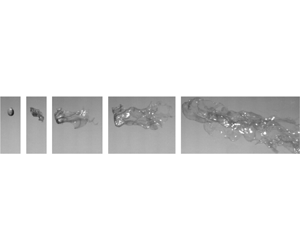
The secondary breakup morphology of guar gum gel shows different breakup modes with the increase of air velocity, as shown in figures 5–9. The deformation regime appears when the air velocity is low. In this regime, the aerodynamic force is too small to take the dominant position, resulting in the absence of a breakup. The gel drop exhibits the bag-type breakup when the air velocity increases slightly, as shown in figure 5. A spherical drop initially flattens, then deforms into a bag-like structure and eventually breaks up during this regime. The stamen structures appear when the air velocity continues to increase. The drop initially deforms into a sheet, then the edges of the drop deform into thin membranes and ligaments. The core of the drop remains stable along the air flow, as shown in figure 6.
Bag breakup of the guar gum gel; the air flows from left to right (φ = 0.5 %, ug = 15.3 m s−1, We = 31.3, Oh = 0.7).

Stamen structure breakup of the guar gum gel; the air flows from left to right: (a) φ = 1.0 %, ug = 45.9 m s−1, We = 357.8, Oh = 2.8; (b) φ = 1.5 %, ug = 61.2 m s−1, We = 736.1, Oh = 6.4.

Hemline breakup of the guar gum gel; the air flows from left to right (φ = 0.5 %, ug = 45.9 m s−1, We = 267.5, Oh = 0.5).

Hemline breakup of the guar gum gel; the air flows from left to right (φ = 1.0 %, ug = 76.5 m s−1, We = 948.2, Oh = 1.9).

Hemline breakup of the guar gum gel; the air flows from left to right (φ = 1.5 %, ug = 91.8 m s−1, We = 1560.6, Oh = 4.6).

The gel drops enter the hemline breakup mode when the aerodynamic force dominates, as shown in figures 7–9. For Newtonian fluids, tiny fragments are continuously peeled off the drop surface in the shear breakup mode (Theofanous & Li Reference Theofanous and Li2008; Theofanous et al. Reference Theofanous, Mitkin, Ng, Chang, Deng and Sushchikh2012). Unlike Newtonian fluids, filaments rather than fragments form on the drop surface when an elastic drop undergoes secondary atomization (Joseph, Beavers & Funada Reference Joseph, Beavers and Funada2002; Theofanous Reference Theofanous2011). In the hemline breakup mode, the high-velocity air skims over the gel drops, and the edges of the drops constantly deform into thin membranes. The drop core also deforms into membranes and, eventually, all these membranes break up into reticular fragments. The hemline breakup of gels and the sheet-thinning breakup of Newtonian fluids are similar in some ways since their deformations all start from the edges of the drops. (Guildenbecher et al. Reference Guildenbecher, López-Rivera and Sojka2009; Jackiw & Ashgriz Reference Jackiw and Ashgriz2021) Therefore, the hemline breakup may be related to the shear instability at the edges of the drops, which is identical to the sheet-thinning breakup of Newtonian fluids.
We performed comparative experiments to verify whether this unique hemline breakup is affected by viscosity. We used maltose syrup as the working fluid instead of pure water because the viscosity of pure water is too low. The secondary breakup process of maltose syrup is shown in figure 10. The drops exhibit multimode breakup and sheet-thinning breakup sequentially as the air-flow velocity increases. It is indicated that the breakup morphologies of maltose syrup are identical to those of Newtonian fluids. Compared with many previous studies, it can be found that there is no hemline breakup in the secondary breakup of viscous fluids. As discussed in § 3.1, the elasticity of the gel with φ = 0.5 % is too small to be measured, which means it can be considered negligible. The elasticity of the gel increases with increasing concentration; however, according to the experimental results, gel drops with φ = 0.5 %–1.5 % all exhibited hemline breakup in the secondary breakup process. In other words, gel drops with φ = 0.5 % still exhibited hemline breakup, even if their elasticity was negligible. Considering the similarity between the hemline breakup of gel drops and the sheet-thinning breakup of Newtonian fluids, it is suggested that the hemline breakup occurs based on the influence of viscosity on the sheet-thinning breakup mode, and the yield stress further affects the breakup morphology, which leads to the appearance of the hemline breakup.
Secondary breakup of the maltose syrup; the air flows from left to right: (a) multimode breakup of φ = 70 %, ug = 45.9 m s−1, We = 256.0, Oh = 1.1; (b) sheet-thinning breakup of φ = 70 %, ug = 61.2 m s−1, We = 460.4, Oh = 1.1.

The breakup mode classification of guar gum gel drops and the relation of the transitional We and Oh are plotted in figure 11. As proposed by Brodkey (Reference Brodkey1967) and Pilch & Erdman (Reference Pilch and Erdman1987), the correlation of the critical Weber number, Wec, and the Ohnesorge number, Oh, is  $W{e_c} = W{e_{cOh \to 0}}(1 + 1.077O{h^{1.6}})$. Here, WecOh →0 is the critical We at low Oh. As they suggested, Wec between the deformation and the bag breakup is approximately $W{e_{cOh \to 0}} = 11$, and Wec of the sheet-thinning breakup is approximately $W{e_{cOh \to 0}} = 80$. On this basis, we fitted the data of our experiments to obtain (3.8) and (3.9). The correlation We 1 represents the transition between the deformation and bag-and-stamen breakup, which is
 \begin{align}W{e_1} & = 11(1 + 2.4O{h^{1.3}})\notag\\ & = 11\left( {1 + 2.4{{\left( {\dfrac{1}{\phi }\dfrac{{{\tau_0}{D_0}}}{\sigma }\sqrt {\dfrac{{{\rho_g}}}{{{\rho_l}We}}} + \dfrac{{K{{\left( {\phi \dfrac{{{u_g}}}{{{D_0}}}} \right)}^{n - 1}}}}{{{{({\rho_l}{D_0}\sigma )}^{1/2}}}}} \right)}^{1.3}}} \right), \end{align}
where the fitting correlation coefficient is 0.98. The correlation We 2 represents the transition between the bag-and-stamen breakup and the hemline breakup, which is
 \begin{align}W{e_2} & = 80(1 + 2.4O{h^{1.3}})\notag\\ & = 80\left( {1 + 2.4{{\left( {\dfrac{1}{\phi }\dfrac{{{\tau_0}{D_0}}}{\sigma }\sqrt {\dfrac{{{\rho_g}}}{{{\rho_l}We}}} + \dfrac{{K{{\left( {\phi \dfrac{{{u_g}}}{{{D_0}}}} \right)}^{n - 1}}}}{{{{({\rho_l}{D_0}\sigma )}^{1/2}}}}} \right)}^{1.3}}} \right), \end{align}
where the fitting correlation coefficient is 0.99. The Oh value indicates the effect of viscosity in classifying the critical conditions for different breakup modes. The velocity of the air-flow field and the shear rate are correspondingly high. The gel shows a shear-thinning behaviour (n < 1) under such a high shear rate; and the viscosity of the gel is small at this time. Therefore, the exponent in the correlation is 1.3, which is lower than that in the correlation proposed by Brodkey (Reference Brodkey1967) Combining equations (3.8) and (3.9) and the experimental results of the breakup morphologies, the hemline breakup is indeed a modified behaviour of the sheet-thinning breakup. As a modification term for Oh, the effect of yield stress on the classification of different breakup modes is also shown in (3.8) and (3.9). Detailed analysis of the yield stress is discussed in § 3.4.
The breakup regime of guar gum gel drops.

(a) The breakup mechanism of hemline breakup; (b) schematic diagram of an antisymmetric disturbance of a liquid sheet.

3.4. Discussion on formation and breakup of gel membranes
As observed in the hemline breakup mode, the edge of the gel drops continuously generated a large number of membranes. Instead of breaking up into filaments or tiny droplets, these gel membranes stabilize and remain intact until the drop core also deforms into membranes. The final breakup of the gel drops is manifested by the fragmentation of the bulk gel membranes. Under the combined effects of aerodynamic, surface tension, inertial and viscous forces, the gel membranes destabilize and eventually break up. Dombrowski & Johns (Reference Dombrowski and Johns1963) investigated the linear stability analysis of a liquid sheet with a constant velocity travelling through a stationary gas. They indicated that the final breakup of the liquid sheet is dominated by the unstable disturbance of maximum growth rate. Inspired by their study, we drew on a similar analytical method to explore the destabilization and breakup of gel membranes, thereby explaining the novel phenomenon in the hemline breakup mode.
The breakup mechanism of hemline breakup is shown in figure 12(a). On this basis, we established a columnar coordinate system and explored the antisymmetric disturbance of a viscous liquid sheet in the air flow with velocity Ug. The schematic diagram is shown in figure 12(b). The thickness of the viscous liquid sheet is 2h. The aerodynamic force dFP caused by the air flow is
 \begin{equation}\textrm{d}{F_P} = 2k{\rho _g}U_g^2{r^2}\theta \,\textrm{d}z,\end{equation}
where the k is the wavenumber. The force dFσ caused by surface tension σ is
 \begin{equation}\textrm{d}{F_\sigma } = \frac{\partial }{{\partial z}}\left( {2\sigma r\theta \frac{{\partial r}}{{\partial z}}} \right)\textrm{d}z = 2\sigma r\theta \frac{{{\partial ^2}r}}{{\partial {z^2}}}\,\textrm{d}z.\end{equation}
The gel membranes fluctuate under the disturbance, and the change of momentum leads to the inertial force dFI, which is
 \begin{equation}\textrm{d}{F_I} =- \frac{\partial }{{\partial t}}\left( {{\rho_l}r\theta h\,\textrm{d}z\frac{{\partial r}}{{\partial t}}} \right) =- {\rho _l}\left( {\frac{{\partial h}}{{\partial t}}\frac{{\partial r}}{{\partial t}} + h\frac{{{\partial^2}r}}{{\partial {t^2}}}} \right)r\theta \,\textrm{d}z =- {\rho _l}r\theta h\frac{{{\partial ^2}r}}{{\partial {t^2}}}\,\textrm{d}z.\end{equation}
We assumed that the thickness of the liquid sheet is changeless with time, which means  $\partial h/\partial t = 0$. For a Herschel–Bulkley liquid as in (3.3), the shear stress τ consists of viscous force τ $_\mu$ and yield stress τ 0. Therefore, the viscous force dF $_\mu$ is
 \begin{align}\textrm{d}{F_\mu } & = \dfrac{\partial }{{\partial z}}({\tau _\mu }r\theta h)\,\textrm{d}z = \left( {h\dfrac{{\partial {\tau_\mu }}}{{\partial z}} + \dfrac{{\partial t}}{{\partial z}}\dfrac{{\partial h}}{{\partial t}}\dfrac{{{\partial^2}r}}{{\partial t\partial z}}} \right)r\theta \,\textrm{d}z\notag\\ & = \left( {h\dfrac{{\partial {\tau_\mu }}}{{\partial z}} + \dfrac{1}{{{U_g}}}\dfrac{{\partial h}}{{\partial t}}\dfrac{{{\partial^2}r}}{{\partial t\partial z}}} \right)r\theta \,\textrm{d}z = h\dfrac{{\partial {\tau _\mu }}}{{\partial z}}r\theta \,\textrm{d}z. \end{align}
In the z-direction, the yield stress is
 \begin{equation}\textrm{d}{F_{{\tau _0}}} =- 2k{\tau _0}{r^2}\theta \,\textrm{d}z.\end{equation}
Therefore, the destabilization and breakup of liquid sheet occurs when the total force is  $\textrm{d}F > 0$, and the critical condition is
 \begin{align} \textrm{d}F & = \textrm{d}{F_P} + \textrm{d}{F_\sigma } + \textrm{d}{F_I} + \textrm{d}{F_\mu } + \textrm{d}{F_{{\tau _0}}} = 2k{\rho _g}U_g^2{r^2}\theta \,\textrm{d}z\notag\\ & \quad + 2\sigma r\theta \dfrac{{{\partial ^2}r}}{{\partial {z^2}}}\,\textrm{d}z - {\rho _l}r\theta h\dfrac{{{\partial ^2}r}}{{\partial {t^2}}}\,\textrm{d}z + h\dfrac{{\partial {\tau _\mu }}}{{\partial z}}r\theta \,\textrm{d}z - 2k{\tau _0}{r^2}\theta \,\textrm{d}z = 0, \end{align}
i.e.
 \begin{equation}2k{\rho _g}U_g^2r + 2\sigma \frac{{{\partial ^2}r}}{{\partial {z^2}}} - {\rho _l}h\frac{{{\partial ^2}r}}{{\partial {t^2}}} + h\frac{{\partial {\tau _\mu }}}{{\partial z}} - 2k{\tau _0}r = 0.\end{equation}
The antisymmetric disturbance is described by a sinusoidal wave as
 \begin{equation}r = \eta \sin (kz + \varepsilon ),\end{equation}
where the η represents the amplitude and is a function of time
 \begin{equation}\eta = {\eta _0}\exp [\textrm{i}(kz - \omega t)],\end{equation}
where η 0 is the initial amplitude;  $\omega = {\omega _r} + \textrm{i}{\omega _i}$ and the ωr and ωi are the frequency and growth rate of the disturbance. By inserting the derivative of (3.17) and (3.18) into (3.16) and plugging ${\varOmega _i} = {\omega _i}h/{U_g}$, the Reynolds number $Re = {\rho _l}{U_g}h/\mu$ and the Weber number $We = {\rho _g}U_g^2h/\sigma $ into it, the equation is transformed to the dimensionless form. The final dispersion relation for a viscous liquid with yield stress is
 \begin{equation}\varOmega _i^2 + \frac{{{{(kh)}^2}}}{{Re}}{\varOmega _i} + 2{(kh)^2}\left( {\frac{{{\tau_0}}}{{{\rho_g}U_g^2}}\frac{Q}{{kh}} + \frac{1}{{We}} - \frac{Q}{{kh}}} \right) = 0,\end{equation}
where  $Q = {\rho _g}/{\rho _l}$. Chojnacki & Feikema (Reference Chojnacki and Feikema1997) studied the breakup of a power-law liquid sheet and established its dispersion relation. When taking the yield stress into consideration, the dispersion relation for a gel is
 \begin{equation}\varOmega _i^2 + n\frac{{{{(kh)}^2}}}{{Re}}\varOmega _i^{2n - 1} + 2{(kh)^2}\left( {\frac{{{\tau_0}}}{{{\rho_g}U_g^2}}\frac{Q}{{kh}} + \frac{1}{{We}} - \frac{Q}{{kh}}} \right) = 0,\end{equation}
where  $Re = {\rho _l}{U_g}h/\mu = {\rho _l}U_g^{2 - n}{h^n}/K$.
In the studies of Chojnacki & Feikema (Reference Chojnacki and Feikema1997) and Yang et al. (Reference Yang, Fu, Qu, Gu and Zhang2012) on the breakup of a power-law liquid sheet, it is indicated via theoretical derivation and exploration that the increase in the consistency coefficient K and the fluid behaviour index n leads to a decrease of the maximum growth rate and dominant wavenumber. In our experiments, the Herschel–Bulkley rheological model as in (3.3) is used to describe the yield stress and shear-thinning behaviour of the gel. The third term in (3.20) represents the effect of yield stress on the breakup of a gel membrane. Compared with a Newtonian fluid or a power-law fluid, the yield stress of a gel leads to a decrease in the maximum growth rate and dominant wavenumber. In other words, the yield stress restrains the growth of disturbance waves. Some of the gel membranes remain intact rather than breaking into filaments in the hemline breakup mode, which may be related to the competition between the yield stress and the aerodynamic force. Zhao et al. (Reference Zhao, Liu, Xu and Li2011b) investigated the secondary breakup of coal water slurry and proposed a dimensionless number to describe this competition. Here, we quote the reciprocal form of this dimensionless number and define it as Cy:
 \begin{equation}{C_y} = \frac{{{\tau _0}}}{{{\rho _g}U_g^2}}.\end{equation}
Then (3.20) will be
 \begin{equation}\varOmega _i^2 + n\frac{{{{(kh)}^2}}}{{Re}}\varOmega _i^{2n - 1} + 2{C_y}khQ + \frac{{2{{(kh)}^2}}}{{We}} - 2khQ = 0.\end{equation}
For a Newtonian fluid or a power-law fluid, the third term in (3.22) equals zero, which means the breakup of the liquid sheet is governed by the other four forces. For a gel whose yield stress has an obvious effect on the breakup of the liquid sheet, the third term leads to the decrease of the maximum growth rate and dominant wavenumber. We solved (3.22) under different initial conditions. The relation between the dimensionless wavenumber k × h and the dimensionless growth rate of disturbance wave  $\varOmega$i is shown in the figure 13. By increasing τ 0 from 0 to 100 Pa, the influence of yield stress τ 0 on the development of a disturbance wave in Newtonian fluids and shear-thinning fluids is studied. According to the results, the yield stress τ 0 inhibits the growth of the disturbance wave. Therefore, the maximum growth rate and the dominant wavenumber decrease with the increase of yield stress τ 0. Therefore, the gel sheet tends to perform the long wave breakup mode because of the decrease in the maximum growth rate and the dominant wavenumber, which explains that fact that the gel membranes formed in the hemline breakup mode remain intact instead of breaking into filaments.
Effect of yield stress on stability of gel membrane: (a) n = 0.35, K = 10.0 Pa sn, 2h = 0.1 mm, ug = 76.5 m s−1, Re = 7298.5; (b) n = 1, K = 10.0 Pa sn, 2h = 0.1 mm, ug = 76.5 m s−1, Re = 7298.5.

Reticular breakup of a gel membrane, the arrows point to the breaking points.

Based on this, Oh in (3.5) can be rewritten by inserting Cy, which is
 \begin{equation}Oh = \frac{{{\mu _l}}}{{{{({\rho _l}{D_0}\sigma )}^{1/2}}}} = \frac{{{\tau _0} + K{{\left( {\phi \frac{{{u_g}}}{{{D_0}}}} \right)}^n}}}{{\phi {u_g}{{\left( {\frac{{{\rho_l}\sigma }}{{{D_0}}}} \right)}^{1/2}}}} = \frac{1}{\phi }{C_y}\sqrt {\frac{{{\rho _g}}}{{{\rho _l}}}We} + \frac{{K{{\left( {\phi \frac{{{u_g}}}{{{D_0}}}} \right)}^{n - 1}}}}{{{{({\rho _l}{D_0}\sigma )}^{1/2}}}}.\end{equation}
Therefore, (3.7)–(3.9) contain the effect of yield stress on breakup time and breakup mode classification, respectively; Oh increases when Cy increases, leading to a longer breakup time and a change in the breakup mode, which means that, as an addition item of viscosity, the yield stress delays the breakup of gel drops.
The intact gel membranes exhibit flexural vibration and exhibit reticular breakup, as shown in figure 14. It can be observed that the breaking points of the membranes occur at high amplitudes where the rest of the membranes remain, leading to the formation of reticular fragments. The flow field around the droplet is studied by Flock et al. (Reference Flock, Guildenbecher, Chen, Sojka and Bauer2012) and Kant & Banerjee (Reference Kant and Banerjee2022) through experiments and simulations. The recirculation zone of air around the droplet generates high negative pressure downstream. As a result, the droplets deform and break up when the vortices shed into the air-flow wake. However, the air-flow-wake structure is unlikely to dominate the breakup morphology of the droplets. In our experiments, the shedding vortices may affect the reticular breakup of the gel membrane. The mechanism of this effect is unknown to us at present and will perhaps be investigated in future work.
4. Conclusion
We measured the rheological properties of guar gum gels by a rotational rheometer. The secondary breakup process of the gel drops was observed by a high-speed camera. It is indicated that the yield stress of gels has a significate effect on the breakup morphology.
The secondary breakup of the gels can be classified into three modes: deformation, bag type and hemline type. The deformation regime appears when the air velocity is low, where the aerodynamic force is too small to dominate, leading to the absence of drop breakup. When the air velocity slightly increases, the gel drops exhibit the bag-type breakup. A spherical drop flattens and deforms into a bag-like structure, such as bag type or stamen type.
Combining breakup morphologies and the regime map, the hemline breakup is indeed a modified behaviour of the sheet-thinning breakup. Gel drops enter the hemline breakup mode with increasing air velocity. As the high-velocity air skims over the gel drops, the edges of the drops constantly deform into thin membranes until the drop core eventually deforms into membranes as well. These membranes vibrate vertically at different positions. Breaking points occur at high amplitudes and form reticular fragments. A linear stability analysis is investigated to explore the phenomenon in hemline breakup mode. The dimensionless number  ${C_y} = {\tau _0}/{\rho _g}U_g^2$ is proposed to describe the relative magnitude of yield stress and aerodynamic force. The results show that the yield stress of the gel drops leads to a decrease in the maximum growth rate and dominant wavenumber at the edges of the drops. The formation of the gel membranes is considered to be related to the effect of yield stress that further modifies the effect of viscosity. Gels with higher yield stress have higher resistance to deformation, resulting in longer breakup times. The breakup regime map of gel drop is also proposed based on We and Oh.
Funding
This research was supported by the National Natural Science Foundation of China (U21B2088).
Declaration of interests
The authors report no conflict of interest.



