




Pray that it is inert.
– Kolvoord, The Expanse S3E7
1 Introduction and main results
On the two-sided full shift with two symbols, that is, $\{0,1\}^{\mathbb {Z}}$
, there is a natural involution
$\{0,1\}^{\mathbb {Z}}$
, there is a natural involution $\tau $
defined by swapping the symbols
$\tau $
defined by swapping the symbols $0$
and
$0$
and $1$
. It is a free involution in the sense that it does not fix any point. We can easily generate more such free involutions in the automorphism group of the full
$1$
. It is a free involution in the sense that it does not fix any point. We can easily generate more such free involutions in the automorphism group of the full $2$
-shift: just conjugate
$2$
-shift: just conjugate $\tau $
by an arbitrary, not necessarily free, automorphism.
$\tau $
by an arbitrary, not necessarily free, automorphism.
However, are there any other free involutions? Or stated more explicitly as the following question.
Question 1.1. Are any two fixed-point-free involutions of the full $2$
-shift conjugate by an automorphism of the full
$2$
-shift conjugate by an automorphism of the full $2$
-shift?
$2$
-shift?
This is an old question in symbolic dynamics that was formulated explicitly for example in [Reference FiebigFie93, p. 492].
Given a finite group G, a construction similar to that above gives a free action (an action of a group is called free if every point has trivial stabilizer) of G on the full shift with $|G|$
symbols. The group G acts on the set G by left multiplication and this induces a free action on
$|G|$
symbols. The group G acts on the set G by left multiplication and this induces a free action on $G^{\mathbb {Z}}$
. Again, we can obtain other free G-actions on
$G^{\mathbb {Z}}$
. Again, we can obtain other free G-actions on $G^{\mathbb {Z}}$
by conjugation with an arbitrary automorphism.
$G^{\mathbb {Z}}$
by conjugation with an arbitrary automorphism.
One hint that the answer to Question 1.1 might be ‘yes’ is the fact that it seems very hard to construct free automorphisms of a given subshift of finite type (SFT) by different means. Marker constructions, see, e.g., [Reference Boyle, Lind and RudolphBLR88, §2] or [Reference KitchensKit98, Ch. 3], are the classical source of the very rich structure of the automorphism group of an SFT. However, this type of construction rarely produces fixed-point-free automorphisms. In addition, we do not know how to decide if there even exists a free action of $\mathbb {Z}/p\mathbb {Z}$
on a given SFT by automorphisms. This question appears explicitly in [Reference BoyleBoy13, §8] as ‘a question for another generation’. We explain in §7 how a partial result in this direction by Kim and Roush from [Reference Kim and RoushKR97] fits together with the results in this paper.
$\mathbb {Z}/p\mathbb {Z}$
on a given SFT by automorphisms. This question appears explicitly in [Reference BoyleBoy13, §8] as ‘a question for another generation’. We explain in §7 how a partial result in this direction by Kim and Roush from [Reference Kim and RoushKR97] fits together with the results in this paper.
While it is hard to construct a free action on a given SFT, there are methods to construct an abundance of SFTs with free G-actions. On one hand, one can construct them as G-extensions of an SFT, see for example [Reference Boyle and SullivanBS05] as well as §4. On the other hand, one can start with a not necessarily free G-action on an SFT X and remove all points x from X for which $(gx)_i=x_i$
for some
$(gx)_i=x_i$
for some $i \in \mathbb {Z}$
and
$i \in \mathbb {Z}$
and $g \in G \setminus \{e\}$
. Up to topological conjugacy of the underlying SFT, every free G-action on an SFT can be produced by both methods, see Propositions 3.4 and 4.2.
$g \in G \setminus \{e\}$
. Up to topological conjugacy of the underlying SFT, every free G-action on an SFT can be produced by both methods, see Propositions 3.4 and 4.2.
There is a simple obstruction for two free G-actions on a subshift to be conjugate as the following example shows.
Example 1.2. (Obstruction to topological conjugacy)
Let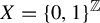 $X=\{0,1\}^{\mathbb {Z}}$
be the full
$X=\{0,1\}^{\mathbb {Z}}$
be the full $2$
-shift and let Y be the subshift of X obtained by forbidding the words
$2$
-shift and let Y be the subshift of X obtained by forbidding the words $000$
and
$000$
and $111$
. Figure 1 shows the
$111$
. Figure 1 shows the $3$
-higher block representation of Y as an edge shift.
$3$
-higher block representation of Y as an edge shift.
The subshift Y from Example 1.2. The automorphism induced by $\tau $
corresponds to a point reflection of this graph across its center.
$\tau $
corresponds to a point reflection of this graph across its center.

Let $\tau : X \to X$
be the map induced by the unique free involution of
$\tau : X \to X$
be the map induced by the unique free involution of $\{0,1\}$
. The subshift Y is invariant under
$\{0,1\}$
. The subshift Y is invariant under $\tau $
. Set
$\tau $
. Set $Z:=X \times Y$
. Consider the two automorphisms of Z given by
$Z:=X \times Y$
. Consider the two automorphisms of Z given by $\varphi =\operatorname {\mathrm {id}}_X \times \tau _{|Y}$
and
$\varphi =\operatorname {\mathrm {id}}_X \times \tau _{|Y}$
and $\psi = \tau \times \operatorname {\mathrm {id}}_Y$
. Both automorphisms have no fixed points, since no point is fixed by
$\psi = \tau \times \operatorname {\mathrm {id}}_Y$
. Both automorphisms have no fixed points, since no point is fixed by $\tau $
. Because automorphisms of subshifts by definition commute with the shift map, we also get a shift action on the orbit spaces
$\tau $
. Because automorphisms of subshifts by definition commute with the shift map, we also get a shift action on the orbit spaces $Z/\varphi \cong X \times Y/\tau _{|Y}$
and
$Z/\varphi \cong X \times Y/\tau _{|Y}$
and $Z/\psi \cong X/\tau \times Y$
. (The orbit space is the topological space obtained by identifying points in every orbit, endowed with the quotient topology.) Since the actions are free, the orbit spaces with the induced shift action are again SFTs, see [Reference Silver and WilliamsSW05, Theorem 4.1]. Note that this would not necessarily be the case if the actions were not free, as the shift on the orbit space in this case need not be expansive. Now, one can easily calculate, see Example 4.1, that
$Z/\psi \cong X/\tau \times Y$
. (The orbit space is the topological space obtained by identifying points in every orbit, endowed with the quotient topology.) Since the actions are free, the orbit spaces with the induced shift action are again SFTs, see [Reference Silver and WilliamsSW05, Theorem 4.1]. Note that this would not necessarily be the case if the actions were not free, as the shift on the orbit space in this case need not be expansive. Now, one can easily calculate, see Example 4.1, that $X/\tau \cong X$
but
$X/\tau \cong X$
but $Y/\tau _{|Y} \cong U \not \cong Y$
, where U is the golden mean shift, that is, the subshift of X with forbidden word
$Y/\tau _{|Y} \cong U \not \cong Y$
, where U is the golden mean shift, that is, the subshift of X with forbidden word $11$
. In particular,
$11$
. In particular, $Z/\varphi $
has two
$Z/\varphi $
has two $\sigma $
-fixed points, while
$\sigma $
-fixed points, while $Z/\psi $
has none. However, if
$Z/\psi $
has none. However, if $\varphi $
and
$\varphi $
and $\psi $
were topologically conjugate automorphisms of Z, their orbit spaces would have to be conjugate shift spaces.
$\psi $
were topologically conjugate automorphisms of Z, their orbit spaces would have to be conjugate shift spaces.
The deeper reason that makes this example work is the fact that $\tau $
is inert, that is, it acts trivially on the dimension group of X, but the restriction
$\tau $
is inert, that is, it acts trivially on the dimension group of X, but the restriction $\tau _{|Y}$
is not inert. To see this, consider the adjacency matrix of the graph depicted in Figure 1 (with the vertices ordered lexicographically):
$\tau _{|Y}$
is not inert. To see this, consider the adjacency matrix of the graph depicted in Figure 1 (with the vertices ordered lexicographically):
 $$ \begin{align*} A=\begin{pmatrix} 0 & 1 & 0 & 0 \\ 0 & 0 & 1 & 1 \\ 1 & 1 & 0 & 0 \\ 0 & 0 & 1 & 0 \end{pmatrix}. \end{align*} $$
Since $|{\det}(A)|=1$
, the dimension group of Y is isomorphic to
$|{\det}(A)|=1$
, the dimension group of Y is isomorphic to $\mathbb {Z}^4$
. As we will see in §3,
$\mathbb {Z}^4$
. As we will see in §3, $\tau $
acts on this dimension group by multiplication from the right with the permutation matrix
$\tau $
acts on this dimension group by multiplication from the right with the permutation matrix
 $$ \begin{align*} \begin{pmatrix} 0 & 0 & 0 & 1 \\ 0 & 0 & 1 & 0 \\ 0 & 1 & 0 & 0 \\ 1 & 0 & 0 & 0 \end{pmatrix}. \end{align*} $$
Hence, $\tau _{|Y}$
is not inert. This carries over to the product maps
$\tau _{|Y}$
is not inert. This carries over to the product maps $\psi $
, which is inert, and
$\psi $
, which is inert, and $\varphi $
, which is not. Hence, the actions of
$\varphi $
, which is not. Hence, the actions of $\psi $
and
$\psi $
and $\varphi $
on the dimension group are not conjugate and, therefore,
$\varphi $
on the dimension group are not conjugate and, therefore, $\psi $
and
$\psi $
and $\varphi $
are themselves not conjugate in
$\varphi $
are themselves not conjugate in $\operatorname {\mathrm {Aut}}(Z,\sigma )$
.
$\operatorname {\mathrm {Aut}}(Z,\sigma )$
.
In light of this example, a natural extension of Question 1.1 is as follows.
Question 1.3. (Topological conjugacy of inert free actions)
Let X be an SFT and G a finite group. Are any two actions of G on X by free inert automorphisms conjugate by an automorphism? What about the case that X is a full shift and $G = \mathbb {Z}/p\mathbb {Z}$
?
$G = \mathbb {Z}/p\mathbb {Z}$
?
It is not totally unreasonable to suspect that this might be true. For example, two actions of a finite group G acting freely on a finite set M are always conjugate. Similarly, any two free actions of G on a Cantor space C by homeomorphisms are automatically conjugate by a self-homeomorphism of C.
While we will not be able to answer Question 1.3, we give a positive answer to a weaker version.
Theorem 6.2. (Main theorem—dynamical version)
Let $(Y_1,\sigma )$
and
$(Y_1,\sigma )$
and $(Y_2,\sigma )$
be SFTs such that
$(Y_2,\sigma )$
be SFTs such that $(Y_1,\sigma ^\ell )$
,
$(Y_1,\sigma ^\ell )$
, $(Y_2,\sigma ^\ell )$
are conjugate for all sufficiently large
$(Y_2,\sigma ^\ell )$
are conjugate for all sufficiently large $\ell $
. Let
$\ell $
. Let $\alpha _1$
and
$\alpha _1$
and $\alpha _2$
be free inert actions of a finite group G on
$\alpha _2$
be free inert actions of a finite group G on $(Y_1,\sigma )$
and
$(Y_1,\sigma )$
and $(Y_2,\sigma )$
, respectively. Then, for every sufficiently large
$(Y_2,\sigma )$
, respectively. Then, for every sufficiently large $\ell $
, there is a conjugacy
$\ell $
, there is a conjugacy $\varphi $
from
$\varphi $
from $(Y_1,\sigma ^\ell )$
to
$(Y_1,\sigma ^\ell )$
to $(Y_2,\sigma ^\ell )$
such that
$(Y_2,\sigma ^\ell )$
such that $\varphi \circ \alpha _1(g) = \alpha _2(g) \circ \varphi $
for all
$\varphi \circ \alpha _1(g) = \alpha _2(g) \circ \varphi $
for all $g \in G$
.
$g \in G$
.
Thus, instead of conjugacy of the actions, we are only able to obtain eventual conjugacy.
Our main tool will be the integral group ring formalism for G-SFTs developed by Parry, see [Reference Boyle and SullivanBS05, Reference ParryPar91] and §4, together with a characterization of inert G-SFTs, see Theorem 5.2.
In this algebraic formulation, our main theorem becomes the following.
Theorem 6.1. (Main theorem—algebraic version)
Every pair of inert square matrices over $\mathbb {Z}_+[G]$
, whose augmentations are shift equivalent (SE) over
$\mathbb {Z}_+[G]$
, whose augmentations are shift equivalent (SE) over $\mathbb {Z}_+$
, is SE over
$\mathbb {Z}_+$
, is SE over $\mathbb {Z}_+[G]$
itself.
$\mathbb {Z}_+[G]$
itself.
Regarding Question 1.1, we obtain the following corollary.
Corollary 6.3. (Eventual conjugacy for free finite-order automorphisms of full shifts)
Let $k,m \in \mathbb {N}$
. Let
$k,m \in \mathbb {N}$
. Let $(X_k,\sigma )$
be the full k-shift and let
$(X_k,\sigma )$
be the full k-shift and let $\varphi _1,\varphi _2$
be two automorphisms of
$\varphi _1,\varphi _2$
be two automorphisms of $(X_k,\sigma )$
for which every orbit has size m. Then, there is a homeomorphism
$(X_k,\sigma )$
for which every orbit has size m. Then, there is a homeomorphism $\psi : X_k \to X_k$
such that
$\psi : X_k \to X_k$
such that $\psi \circ \varphi _1 = \varphi _2 \circ \psi $
and
$\psi \circ \varphi _1 = \varphi _2 \circ \psi $
and $\psi \circ \sigma ^\ell = \sigma ^\ell \circ \psi $
for all sufficiently large
$\psi \circ \sigma ^\ell = \sigma ^\ell \circ \psi $
for all sufficiently large $\ell \in \mathbb {N}$
.
$\ell \in \mathbb {N}$
.
Maybe the most natural setting for this version of eventual conjugacy is the stabilized automorphism group of a subshift introduced by Hartman, Kra, and Schmieding in [Reference Hartman, Kra and SchmiedingHKS22]. In this setting, our main result reads as the following corollary.
Corollary 6.4. (Conjugacy of free finite-order elements in the stabilized automorphism group)
Let $k,m \in \mathbb {N}$
. Let
$k,m \in \mathbb {N}$
. Let $(X_k,\sigma )$
be the full k-shift. Let
$(X_k,\sigma )$
be the full k-shift. Let $\varphi _1, \varphi _2$
be two elements of the stabilized automorphism group of
$\varphi _1, \varphi _2$
be two elements of the stabilized automorphism group of $(X_k,\sigma )$
for which every orbit has size m. Then,
$(X_k,\sigma )$
for which every orbit has size m. Then, $\varphi _1$
and
$\varphi _1$
and $\varphi _2$
are conjugate in
$\varphi _2$
are conjugate in $\operatorname {\mathrm {Aut}}^\infty (X_k,\sigma )$
.
$\operatorname {\mathrm {Aut}}^\infty (X_k,\sigma )$
.
We conclude the introduction with some pointers to related works. The one-sided version of Question 1.3 in the case of $\mathbb {Z}/k \mathbb {Z}$
acting on
$\mathbb {Z}/k \mathbb {Z}$
acting on $(\{1,\ldots ,k\}^{\mathbb {N}},\sigma )$
was answered positively for k prime in [Reference Boyle, Franks and KitchensBFK90, Lemma 3.3(ii)] and very recently for k arbitrary in [Reference Bleak and OlukoyaBO26, Theorem 1.2]. Notice however that the automorphism groups of one-sided SFTs are significantly less rich than their two-sided counterparts.
$(\{1,\ldots ,k\}^{\mathbb {N}},\sigma )$
was answered positively for k prime in [Reference Boyle, Franks and KitchensBFK90, Lemma 3.3(ii)] and very recently for k arbitrary in [Reference Bleak and OlukoyaBO26, Theorem 1.2]. Notice however that the automorphism groups of one-sided SFTs are significantly less rich than their two-sided counterparts.
One can also consider other weakenings of conjugacy besides eventual conjugacy. For a classification of G-SFTs up to finite equivalence, see [Reference Adler, Kitchens and MarcusAKM85].
Boyle, Carlsen, and Eilers [Reference Boyle, Carlsen and EilersBCE20], based on earlier work of Boyle and Sullivan [Reference Boyle and SullivanBS05] in the irreducible case, classified G-SFTs up to G-flow equivalence. As an application, they showed a flow equivalence version of Corollary 6.3. We will show in §8 how a generalization of this result can be recovered as a corollary of our results.
The paper is organized as follows. We recall a few definitions and notation from symbolic dynamics in §2. In §3, we discuss basic results regarding finite groups acting on subshifts. The integral group ring formalism due to Parry used to define G-extensions of SFTs is explained in §4. In §5, we use the results of the previous two sections to give a characterization of inert G-SFTs, which in turn leads to the proofs of our main theorems in Theorem 6.1. In §7, we put a related result of Kim and Roush into our context, and we finish in §8 with an application of our main results to equivariant flow equivalence of G-SFTs.
2 Preliminaries
All necessary material concerning subshifts of finite type can be found in [Reference Lind and MarcusLM21]. This section mainly serves to introduce notation. Our natural numbers $\mathbb {N}$
start at
$\mathbb {N}$
start at $1$
and we denote the non-negative integers by
$1$
and we denote the non-negative integers by $\mathbb {Z}_+$
. In this paper, a topological dynamical system
$\mathbb {Z}_+$
. In this paper, a topological dynamical system $(X,f)$
consists of a compact metrizable state space X and a continuous self map
$(X,f)$
consists of a compact metrizable state space X and a continuous self map $f:X \to X$
. The full shift over the alphabet
$f:X \to X$
. The full shift over the alphabet $\mathcal {S}$
is the topological dynamical system
$\mathcal {S}$
is the topological dynamical system $(\mathcal {S}^{\mathbb {Z}},\sigma )$
, where
$(\mathcal {S}^{\mathbb {Z}},\sigma )$
, where $\sigma : \mathcal {S}^{\mathbb {Z}} \to \mathcal {S}^{\mathbb {Z}}, \sigma (x)_i = x_{i+1}$
is the left shift,
$\sigma : \mathcal {S}^{\mathbb {Z}} \to \mathcal {S}^{\mathbb {Z}}, \sigma (x)_i = x_{i+1}$
is the left shift, $\mathcal {S}$
is endowed with the discrete topology, and
$\mathcal {S}$
is endowed with the discrete topology, and $\mathcal {S}^{\mathbb {Z}}$
with the product topology. The elements of
$\mathcal {S}^{\mathbb {Z}}$
with the product topology. The elements of $\mathcal {S}^{\mathbb {Z}}$
are called configurations. A subshift is a subsystem of a full shift. A subshift X is of finite type if there is a finite set of forbidden words such that X consists of all configurations not containing any of these words. An isomorphism between two topological dynamical systems
$\mathcal {S}^{\mathbb {Z}}$
are called configurations. A subshift is a subsystem of a full shift. A subshift X is of finite type if there is a finite set of forbidden words such that X consists of all configurations not containing any of these words. An isomorphism between two topological dynamical systems $(X,f)$
and
$(X,f)$
and $(Y,g)$
is a homeomorphism
$(Y,g)$
is a homeomorphism $\varphi : X \to Y$
such that
$\varphi : X \to Y$
such that $\varphi \circ f = g \circ \varphi $
. We denote the group of automorphisms of the topological dynamical system
$\varphi \circ f = g \circ \varphi $
. We denote the group of automorphisms of the topological dynamical system $(X,f)$
by
$(X,f)$
by $\operatorname {\mathrm {Aut}}(X,f)$
. Following [Reference Hartman, Kra and SchmiedingHKS22], we call
$\operatorname {\mathrm {Aut}}(X,f)$
. Following [Reference Hartman, Kra and SchmiedingHKS22], we call $\operatorname {\mathrm {Aut}}^{\infty }(X,f) = \bigcup _{k \in \mathbb {N}} \operatorname {\mathrm {Aut}}(X,f^k)$
the stabilized automorphism group of
$\operatorname {\mathrm {Aut}}^{\infty }(X,f) = \bigcup _{k \in \mathbb {N}} \operatorname {\mathrm {Aut}}(X,f^k)$
the stabilized automorphism group of $(X,f)$
.
$(X,f)$
.
If $(X,\sigma )$
is a subshift over the alphabet
$(X,\sigma )$
is a subshift over the alphabet $\mathcal {S}$
, then we can consider
$\mathcal {S}$
, then we can consider $(X,\sigma ^k)$
as a subshift over the alphabet
$(X,\sigma ^k)$
as a subshift over the alphabet $\mathcal {S}^k$
. We say that two subshifts
$\mathcal {S}^k$
. We say that two subshifts $(X,\sigma )$
and
$(X,\sigma )$
and $(Y,\sigma )$
are eventually conjugate if and only if
$(Y,\sigma )$
are eventually conjugate if and only if $(X,\sigma ^k)$
and
$(X,\sigma ^k)$
and $(Y,\sigma ^k)$
are topologically conjugate for sufficiently large k.
$(Y,\sigma ^k)$
are topologically conjugate for sufficiently large k.
Our graphs are tuples $\Gamma =(V,E,\mathrm {i}_\Gamma ,\mathrm {t}_\Gamma )$
consisting of a vertex set
$\Gamma =(V,E,\mathrm {i}_\Gamma ,\mathrm {t}_\Gamma )$
consisting of a vertex set $V=V(\Gamma )$
, an edge set
$V=V(\Gamma )$
, an edge set $E=E(\Gamma )$
, together with two maps
$E=E(\Gamma )$
, together with two maps $\mathrm {i}_\Gamma ,\mathrm {t}_\Gamma : E \to V$
mapping edges to their initial and terminal vertices, respectively. In this context, it will be notationally convenient to consider matrices whose rows and columns are indexed by an arbitrary finite set M not necessarily of the form
$\mathrm {i}_\Gamma ,\mathrm {t}_\Gamma : E \to V$
mapping edges to their initial and terminal vertices, respectively. In this context, it will be notationally convenient to consider matrices whose rows and columns are indexed by an arbitrary finite set M not necessarily of the form $\{1,\ldots ,m\}$
. If
$\{1,\ldots ,m\}$
. If $\Gamma =(V,E,\mathrm {i}_\Gamma ,\mathrm {t}_\Gamma )$
is a graph, its adjacency matrix is the
$\Gamma =(V,E,\mathrm {i}_\Gamma ,\mathrm {t}_\Gamma )$
is a graph, its adjacency matrix is the $V \times V$
matrix A with
$V \times V$
matrix A with
 $$ \begin{align*}A_{i,j}=|\{e \in E \mid \mathrm{i}_\Gamma(e)=i, \mathrm{t}_\Gamma(e)=j\}|.\end{align*} $$
We call a matrix essential if it has no zero rows or columns and we call a graph essential if its adjacency matrix is essential. A non-negative square matrix A is called irreducible if for each pair of indices $i,j$
, there is
$i,j$
, there is $k \in \mathbb {N}$
such that
$k \in \mathbb {N}$
such that $A^k_{i,j}>0$
. If k can be chosen independently of
$A^k_{i,j}>0$
. If k can be chosen independently of $i,j$
, we call A primitive. Every essential graph
$i,j$
, we call A primitive. Every essential graph $\Gamma $
defines an edge shift
$\Gamma $
defines an edge shift $X_\Gamma $
. This SFT over the alphabet
$X_\Gamma $
. This SFT over the alphabet $E(\Gamma )$
consists of all biinfinite sequences of edges
$E(\Gamma )$
consists of all biinfinite sequences of edges $(e_k)_{k \in \mathbb {Z}}$
with
$(e_k)_{k \in \mathbb {Z}}$
with $\mathrm {i}_\Gamma (e_{k+1})=\mathrm {t}_\Gamma (e_{k})$
for all
$\mathrm {i}_\Gamma (e_{k+1})=\mathrm {t}_\Gamma (e_{k})$
for all $k \in \mathbb {Z}$
.
$k \in \mathbb {Z}$
.
Up to renaming the edges, the graph, and hence the edge shift, is uniquely determined by the adjacency matrix. Hence, for a graph $\Gamma $
with adjacency matrix A, we denote by
$\Gamma $
with adjacency matrix A, we denote by $X_A$
the edge shift of
$X_A$
the edge shift of $\Gamma $
. For
$\Gamma $
. For $A \in \mathbb {Z}_+^{V \times V}$
, we can canonically label the edges in the graph defined by A from i to j by
$A \in \mathbb {Z}_+^{V \times V}$
, we can canonically label the edges in the graph defined by A from i to j by $(i,j,1),(i,j,2),\ldots ,(i,j,A_{i,j}) \in V \times V \times \mathbb {N}$
.
$(i,j,1),(i,j,2),\ldots ,(i,j,A_{i,j}) \in V \times V \times \mathbb {N}$
.
An automorphism of a graph is a pair of bijections $\theta _V: V \to V$
and
$\theta _V: V \to V$
and $\theta _E: E \to E$
such that
$\theta _E: E \to E$
such that $\theta _V \circ \mathrm {i}_\Gamma = \mathrm {i}_\Gamma \circ \theta _E$
and
$\theta _V \circ \mathrm {i}_\Gamma = \mathrm {i}_\Gamma \circ \theta _E$
and $\theta _V \circ \mathrm {t}_\Gamma = \mathrm {t}_\Gamma \circ \theta _E$
. For essential graphs, the map on the edges uniquely determines the map on the vertices. Every graph automorphism induces an automorphism of the corresponding edge shift. If a group G is acting by graph automorphisms on a graph
$\theta _V \circ \mathrm {t}_\Gamma = \mathrm {t}_\Gamma \circ \theta _E$
. For essential graphs, the map on the edges uniquely determines the map on the vertices. Every graph automorphism induces an automorphism of the corresponding edge shift. If a group G is acting by graph automorphisms on a graph $\Gamma $
, we sometimes do not write the action explicitly and simply write
$\Gamma $
, we sometimes do not write the action explicitly and simply write $gi$
or
$gi$
or $ge$
for the image of the vertex i or the edge e, respectively, under the action of
$ge$
for the image of the vertex i or the edge e, respectively, under the action of $g \in G$
.
$g \in G$
.
We are interested in various objects associated to a subshift $(X,\sigma )$
. We denote by
$(X,\sigma )$
. We denote by
 $$ \begin{align*} \operatorname{\mathrm{Per}}_k(X,\sigma):= \{x \in X \mid \sigma^k(x)=x\} \end{align*} $$
the set of k-periodic points of X. The cardinalities of these sets can be conveniently encoded in the zeta function
 $$ \begin{align*} \zeta_X(t) := \exp\bigg(\sum_{k=1}^\infty \frac{|\!\operatorname{\mathrm{Per}}_k(X,\sigma)|}{k} t^k\bigg). \end{align*} $$
Now, let $A \in \mathbb {Z}_+^{V \times V}$
be essential. The dimension group
$A \in \mathbb {Z}_+^{V \times V}$
be essential. The dimension group $D_A$
of
$D_A$
of $X_A$
is defined as the direct limit of the diagram
$X_A$
is defined as the direct limit of the diagram
 $$ \begin{align*} \mathbb{Z}^V \xrightarrow{A} \mathbb{Z}^V \xrightarrow{A} \mathbb{Z}^V \xrightarrow{A}\cdots. \end{align*} $$
Formally, we define $D_A$
as
$D_A$
as $\mathbb {Z}^V \times \mathbb {Z} / \sim $
, where
$\mathbb {Z}^V \times \mathbb {Z} / \sim $
, where $\sim $
is the equivalence relation defined by
$\sim $
is the equivalence relation defined by $(x,n) \sim (xA,n+1)$
. One can further endow this group with an order and the automorphism induced by the shift map to obtain the so-called dimension triple, but we do not need this additional structure here.
$(x,n) \sim (xA,n+1)$
. One can further endow this group with an order and the automorphism induced by the shift map to obtain the so-called dimension triple, but we do not need this additional structure here.
If A is an $M \times M$
matrix and B is a
$M \times M$
matrix and B is a $K \times K$
matrix, the Kronecker product
$K \times K$
matrix, the Kronecker product $A \otimes B$
of A and B is the
$A \otimes B$
of A and B is the $(M \times K) \times (M \times K)$
matrix with entries
$(M \times K) \times (M \times K)$
matrix with entries $(A \otimes B)_{(i,k),(j,\ell )} = A_{i,j}B_{k,\ell }$
. If M and K are totally ordered and
$(A \otimes B)_{(i,k),(j,\ell )} = A_{i,j}B_{k,\ell }$
. If M and K are totally ordered and $M \times K$
is endowed with the lexicographic ordering, then this corresponds to the usual Kronecker product. For a set M, we denote by
$M \times K$
is endowed with the lexicographic ordering, then this corresponds to the usual Kronecker product. For a set M, we denote by  the vector in $\mathbb {Z}^M$
whose entries are all equal to
$\mathbb {Z}^M$
whose entries are all equal to $1$
and we denote by
$1$
and we denote by  the
the $M \times M$
matrix which equals
$M \times M$
matrix which equals $1$
in every entry. The
$1$
in every entry. The $M \times M$
identity matrix is denoted by
$M \times M$
identity matrix is denoted by $I_{M \times M}$
.
$I_{M \times M}$
.
3 Finite groups acting freely on SFTs
In the following, let G be a finite group whose identity element we denote by $1_G$
. We start by introducing our central objects of interest.
$1_G$
. We start by introducing our central objects of interest.
Definition 3.1. (G-SFT)
A free G-SFT is a triple $(X,\sigma ,\alpha )$
, where
$(X,\sigma ,\alpha )$
, where $(X,\sigma )$
is an SFT and
$(X,\sigma )$
is an SFT and $\alpha : G \to \operatorname {\mathrm {Aut}}(X,\sigma )$
is a free action of G on
$\alpha : G \to \operatorname {\mathrm {Aut}}(X,\sigma )$
is a free action of G on $(X,\sigma )$
. ‘Free’ here means that
$(X,\sigma )$
. ‘Free’ here means that $\alpha (g)(x) \neq x$
for all
$\alpha (g)(x) \neq x$
for all $x \in X$
and
$x \in X$
and $g \neq 1_G$
.
$g \neq 1_G$
.
Definition 3.2. (G-conjugacy)
Two free G-SFTs $(Y_1,\sigma _1,\alpha _1)$
and
$(Y_1,\sigma _1,\alpha _1)$
and $(Y_2,\sigma _2,\alpha _2)$
are G-conjugate, written as
$(Y_2,\sigma _2,\alpha _2)$
are G-conjugate, written as $(Y_1,\sigma _1,\alpha _1) \cong (Y_2,\sigma _2,\alpha _2)$
, if there is a homeomorphism
$(Y_1,\sigma _1,\alpha _1) \cong (Y_2,\sigma _2,\alpha _2)$
, if there is a homeomorphism $\varphi :Y_1 \to Y_2$
such that
$\varphi :Y_1 \to Y_2$
such that $\varphi \circ \sigma _1 = \sigma _2 \circ \varphi $
and
$\varphi \circ \sigma _1 = \sigma _2 \circ \varphi $
and $\varphi \circ \alpha _1(g) =\alpha _2(g) \circ \varphi $
for all
$\varphi \circ \alpha _1(g) =\alpha _2(g) \circ \varphi $
for all $g \in G$
.
$g \in G$
.
Definition 3.3. (Eventual G-conjugacy)
Two free G-SFTs $(Y_{1},\sigma ,\alpha _1)$
and
$(Y_{1},\sigma ,\alpha _1)$
and $(Y_{2},\sigma ,\alpha _2)$
are eventually G-conjugate if
$(Y_{2},\sigma ,\alpha _2)$
are eventually G-conjugate if $(Y_{1},\sigma ^\ell ,\alpha _1)$
and
$(Y_{1},\sigma ^\ell ,\alpha _1)$
and $(Y_{2},\sigma ^\ell ,\alpha _2)$
are G-conjugate for all sufficiently large
$(Y_{2},\sigma ^\ell ,\alpha _2)$
are G-conjugate for all sufficiently large $\ell $
.
$\ell $
.
The following proposition appears in [Reference Adler, Kitchens and MarcusAKM85, Observation 1-3] and is credited without reference to Franks in [Reference Boyle, Lind and RudolphBLR88], proofs can be found, e.g., in [Reference Boyle, Lind and RudolphBLR88, Proposition 2.9] or [Reference SaloSal19, Proof of Theorem 7.2].
Proposition 3.4. (Representation of free G-SFTs by graph automorphisms)
Let G be a finite group. Every free G-SFT is G-conjugate to a G-SFT of the form $(X_A,\sigma ,\alpha )$
, where A is a square
$(X_A,\sigma ,\alpha )$
, where A is a square $\{0,1\}$
matrix defining an edge shift
$\{0,1\}$
matrix defining an edge shift $(X_A,\sigma )$
and
$(X_A,\sigma )$
and $\alpha $
is induced by an action of G by graph automorphisms of the graph defined by A acting freely on the vertex set.
$\alpha $
is induced by an action of G by graph automorphisms of the graph defined by A acting freely on the vertex set.
Every action of G on an SFT X induces a G-action on the dimension group of this SFT. This is called the dimension group representation of the action of G on X. If $X=X_\Gamma $
is an edge shift and the action on
$X=X_\Gamma $
is an edge shift and the action on $X_\Gamma $
is induced by an action of G on the graph
$X_\Gamma $
is induced by an action of G on the graph $\Gamma $
, the dimension group representation can be constructed as follows. Let V be the vertex set and let A be the adjacency matrix of
$\Gamma $
, the dimension group representation can be constructed as follows. Let V be the vertex set and let A be the adjacency matrix of $\Gamma $
. Since G acts by graph automorphisms, we have
$\Gamma $
. Since G acts by graph automorphisms, we have $A_{gi,gj}=A_{i,j}$
for all
$A_{gi,gj}=A_{i,j}$
for all $g \in G$
and
$g \in G$
and $i,j \in V$
. Our group G acts on
$i,j \in V$
. Our group G acts on $\mathbb {Z}^V$
by
$\mathbb {Z}^V$
by $w \mapsto gw$
with
$w \mapsto gw$
with $(gw)_{i} = w_{g^{-1}i}$
. This action extends to an action of G on
$(gw)_{i} = w_{g^{-1}i}$
. This action extends to an action of G on $D_A$
simply by
$D_A$
simply by
 $$ \begin{align*} [(w,n)] \mapsto [(gw,n)]. \end{align*} $$
This action is well defined since $g(wA)_i = \sum _{j \in V} w_j A_{j,g^{-1}i} = \sum _{j \in V} w_{g^{-1}j}A_{j,i} = ((gw)A)_i$
. Alternatively, one can use the fact that the dimension group construction is functorial in the sense that every isomorphism between SFTs induces a unique isomorphism of the corresponding dimension groups. This isomorphism can be either defined directly using Krieger’s internal construction of the dimension group from [Reference KriegerKri80] using equivalence classes of rays as explained, e.g., in [Reference Boyle, Lind and RudolphBLR88, §6]. Otherwise, one uses the fact that each isomorphism can be decomposed into a series of state splittings and amalgamations. Between edge shifts, these can in turn be represented as strong shift equivalence matrix pairs. To show well-definedness of the resulting isomorphism, that is, independence from the decomposition into splittings and amalgamations, one then uses Wagoner’s complex. This approach can be found in [Reference WagonerWag92, §2] and [Reference Lind and MarcusLM21, Theorem 7.5.7]. More concretely, if
$g(wA)_i = \sum _{j \in V} w_j A_{j,g^{-1}i} = \sum _{j \in V} w_{g^{-1}j}A_{j,i} = ((gw)A)_i$
. Alternatively, one can use the fact that the dimension group construction is functorial in the sense that every isomorphism between SFTs induces a unique isomorphism of the corresponding dimension groups. This isomorphism can be either defined directly using Krieger’s internal construction of the dimension group from [Reference KriegerKri80] using equivalence classes of rays as explained, e.g., in [Reference Boyle, Lind and RudolphBLR88, §6]. Otherwise, one uses the fact that each isomorphism can be decomposed into a series of state splittings and amalgamations. Between edge shifts, these can in turn be represented as strong shift equivalence matrix pairs. To show well-definedness of the resulting isomorphism, that is, independence from the decomposition into splittings and amalgamations, one then uses Wagoner’s complex. This approach can be found in [Reference WagonerWag92, §2] and [Reference Lind and MarcusLM21, Theorem 7.5.7]. More concretely, if $A=RS$
and
$A=RS$
and $B=SR$
is an elementary strong shift equivalence between matrices A and B, then an element
$B=SR$
is an elementary strong shift equivalence between matrices A and B, then an element $[(w,n)]$
in the dimension group of A is simply mapped to
$[(w,n)]$
in the dimension group of A is simply mapped to $[(wR,n)]$
, an element in the dimension group of B. Again, this is well defined since
$[(wR,n)]$
, an element in the dimension group of B. Again, this is well defined since $wAR=wRB$
. In the case of a graph automorphism as above, we simply have
$wAR=wRB$
. In the case of a graph automorphism as above, we simply have $A=R_g R_{g^{-1}}A=R_{g^{-1}}A R_g$
, where
$A=R_g R_{g^{-1}}A=R_{g^{-1}}A R_g$
, where $R_g$
is the
$R_g$
is the $V \times V$
permutation matrix with
$V \times V$
permutation matrix with $(R_g)_{i,j}=1$
if and only if
$(R_g)_{i,j}=1$
if and only if $j=gi$
, so our action is given by
$j=gi$
, so our action is given by $[(w,n)] \mapsto [(wR_g,n)]$
, which agrees with the first definition since
$[(w,n)] \mapsto [(wR_g,n)]$
, which agrees with the first definition since $(wR_g)_{i}=w_{g^{-1}i}=(gw)_i$
.
$(wR_g)_{i}=w_{g^{-1}i}=(gw)_i$
.
Definition 3.5. (Inert free G-SFTs)
We say that the free G-SFT $(X,\sigma ,\alpha )$
is inert if the action on the dimension group induced by
$(X,\sigma ,\alpha )$
is inert if the action on the dimension group induced by $\alpha $
is trivial, that is,
$\alpha $
is trivial, that is, $\alpha (g) \in \operatorname {\mathrm {Aut}}(X,\sigma )$
is inert for all
$\alpha (g) \in \operatorname {\mathrm {Aut}}(X,\sigma )$
is inert for all $g \in G$
.
$g \in G$
.
Applying the explicit construction of the dimension group representation for edge shifts, we obtain the following characterization of inertness, which appeared as a remark in [Reference FiebigFie93, p. 497].
Proposition 3.6. (Inertness of free graph automorphisms)
Let $A \in \mathbb {Z}_+^{V \times V}$
be essential and let
$A \in \mathbb {Z}_+^{V \times V}$
be essential and let $(X_A,\sigma ,\alpha )$
be a free G-SFT induced by an action of G on the graph defined by A. Then,
$(X_A,\sigma ,\alpha )$
be a free G-SFT induced by an action of G on the graph defined by A. Then, $(X_A,\sigma ,\alpha )$
is inert if and only if there is
$(X_A,\sigma ,\alpha )$
is inert if and only if there is $\ell \in \mathbb {N}$
such that for all
$\ell \in \mathbb {N}$
such that for all $g \in G,i,j \in V$
, we have
$g \in G,i,j \in V$
, we have
 $$ \begin{align*} (A^\ell)_{i,j}=(A^{\ell})_{i,gj}. \end{align*} $$
Proof. Let A be a $V \times V$
matrix. Let
$V \times V$
matrix. Let $[(w,n)]$
be an element in the dimension group of
$[(w,n)]$
be an element in the dimension group of $(X_A,\sigma )$
. By the explicit construction of the dimension group representation, a group element g fixes
$(X_A,\sigma )$
. By the explicit construction of the dimension group representation, a group element g fixes $[(w,n)]$
if and only if there is
$[(w,n)]$
if and only if there is $\ell \in \mathbb {N}$
such that
$\ell \in \mathbb {N}$
such that $w A^\ell = (gw) A^\ell =g(w A^\ell )$
. However, this is equivalent to
$w A^\ell = (gw) A^\ell =g(w A^\ell )$
. However, this is equivalent to
 $$\begin{align*}(w A^\ell )_{gj} = (g(wA^\ell))_{gj}=(wA^\ell)_{j} \end{align*}$$
for all $j \in V$
. This holds for all
$j \in V$
. This holds for all $w \in \mathbb {Z}^V$
if it holds for all standard basis vectors, which in turn is equivalent to
$w \in \mathbb {Z}^V$
if it holds for all standard basis vectors, which in turn is equivalent to
 $$\begin{align*}(A^\ell)_{i,j}=(A^\ell)_{i,g j} \end{align*}$$
for every $i,j \in V$
.
$i,j \in V$
.
4 Matrices over the integral group ring and G-extensions of SFTs
In this section, we look at G-SFTs from the opposite direction. Instead of considering an SFT together with a free G-action and obtaining the orbit space as a quotient, we start with an orbit space, which is itself an SFT, and construct an SFT as a G-extension. These extensions can be defined by square matrices over the integer group ring. Our goal is then to show that every free G-SFT can be represented in that way. We use a very concrete definition of G-extensions. For their connection to cocycles and the general theory of extensions of dynamical systems, see [Reference Boyle and SchmiedingBS17].
By $\mathbb {Z}[G]$
, we denote the integer group ring over G consisting of all formal linear combinations of elements in G with integer coefficients. The set
$\mathbb {Z}[G]$
, we denote the integer group ring over G consisting of all formal linear combinations of elements in G with integer coefficients. The set $\mathbb {Z}_+[G]$
consists of all elements in
$\mathbb {Z}_+[G]$
consists of all elements in $\mathbb {Z}[G]$
whose coefficients are non-negative.
$\mathbb {Z}[G]$
whose coefficients are non-negative.
For $h \in G$
, let
$h \in G$
, let $\pi _h$
be the map from
$\pi _h$
be the map from $\mathbb {Z}[G] \to \mathbb {Z}$
defined by
$\mathbb {Z}[G] \to \mathbb {Z}$
defined by $\pi _h(\sum _{g \in G} a_g g):=a_h$
. When we apply this map entry wise, we also get a map
$\pi _h(\sum _{g \in G} a_g g):=a_h$
. When we apply this map entry wise, we also get a map $\pi _h: \mathbb {Z}[G]^{V \times V} \to \mathbb {Z}^{V \times V}$
and we can write every matrix
$\pi _h: \mathbb {Z}[G]^{V \times V} \to \mathbb {Z}^{V \times V}$
and we can write every matrix $B \in \mathbb {Z}[G]^{V \times V}$
as
$B \in \mathbb {Z}[G]^{V \times V}$
as $B = \sum _{h \in G} \pi _h(B) h$
.
$B = \sum _{h \in G} \pi _h(B) h$
.
Let $B \in \mathbb {Z}_+[G]^{V \times V}$
. We define two matrices
$B \in \mathbb {Z}_+[G]^{V \times V}$
. We define two matrices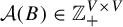 $\mathcal {A}(B) \in \mathbb {Z}_+^{V \times V}$
and
$\mathcal {A}(B) \in \mathbb {Z}_+^{V \times V}$
and $\mathcal {E}(B) \in \mathbb {Z}_+^{(V \times G)\times (V \times G)}$
as follows:
$\mathcal {E}(B) \in \mathbb {Z}_+^{(V \times G)\times (V \times G)}$
as follows:
 $$ \begin{align*} \mathcal{A}(B) &:=\sum_{g \in G} \pi_g(B), \\ \mathcal{E}(B)_{(i,g),(j,h)} &:=\pi_{g^{-1}h}(B)_{i,j}. \end{align*} $$
We call $\mathcal {A}(B)$
the augmentation of B and
$\mathcal {A}(B)$
the augmentation of B and $\mathcal {E}(B)$
the extension defined by B.
$\mathcal {E}(B)$
the extension defined by B.
Using the Kronecker product, we can write this more concisely. Let $P_g$
be the permutation matrix defined by
$P_g$
be the permutation matrix defined by
 $$ \begin{align*} (P_g)_{h,k} = \begin{cases} 1 &\text{ if } k=hg, \\ 0 &\text{ otherwise}. \end{cases} \end{align*} $$
Then,
 $$\begin{align*}\mathcal{E}(B) = \sum_{g \in G} \pi_g(B) \otimes P_g. \end{align*}$$
We get an action $\theta _B$
of G on the graph defined by
$\theta _B$
of G on the graph defined by $\mathcal {E}(B)$
as follows. The automorphism
$\mathcal {E}(B)$
as follows. The automorphism $\theta _B(g)$
acts on the vertex set
$\theta _B(g)$
acts on the vertex set $V \times G$
of this graph simply by
$V \times G$
of this graph simply by $\theta _B(g)(i,h)=(i,gh)$
. We can extend this map to the edges, and thus define a graph automorphism, since
$\theta _B(g)(i,h)=(i,gh)$
. We can extend this map to the edges, and thus define a graph automorphism, since
 $$\begin{align*}\mathcal{E}(B)_{(i,rg),(j,rh)} =\pi_{g^{-1}h}(B)_{i,j}=\mathcal{E}(B)_{(i,g),(j,h)} \quad \text{for every } r \in G. \end{align*}$$
Therefore, we can define that $\theta _B(r)$
maps the kth edge between
$\theta _B(r)$
maps the kth edge between $(i,g)$
and
$(i,g)$
and $(j,h)$
to the kth edge between
$(j,h)$
to the kth edge between $(i,rg)$
and
$(i,rg)$
and $(j,rh)$
. This action by graph automorphisms immediately extends to an action
$(j,rh)$
. This action by graph automorphisms immediately extends to an action $\beta _B$
of G on the edge shift
$\beta _B$
of G on the edge shift $X_{\mathcal {E}(B)}$
.
$X_{\mathcal {E}(B)}$
.
The graphs defined by B, $\mathcal {A}(B)$
, and
$\mathcal {A}(B)$
, and $\mathcal {E}(B)$
are related as follows: B defines a graph
$\mathcal {E}(B)$
are related as follows: B defines a graph $\Gamma $
with edge labels in G; the graph defined by
$\Gamma $
with edge labels in G; the graph defined by $\mathcal {A}(B)$
simply forgets about the edge labels; and
$\mathcal {A}(B)$
simply forgets about the edge labels; and $\mathcal {E}(B)$
defines a covering graph or more specifically a
$\mathcal {E}(B)$
defines a covering graph or more specifically a $|G|$
-lift of
$|G|$
-lift of $\Gamma $
.
$\Gamma $
.
Example 4.1. (Augmentation and extension)
Consider $\mathbb {Z}/2\mathbb {Z}=\{e,g\}$
, where e is the identity element, and
$\mathbb {Z}/2\mathbb {Z}=\{e,g\}$
, where e is the identity element, and
 $$\begin{align*}B=\begin{pmatrix}g & e \\ g &0\end{pmatrix}. \end{align*}$$
The labeled graph corresponding to B is depicted on the left in Figure 2. We have
 $$ \begin{align*} \mathcal{A}(B)&=\begin{pmatrix} 1 & 1 \\ 1 &0 \end{pmatrix},\\ \mathcal{E}(B)&=\begin{pmatrix} 0 & 1 \\ 0 &0 \end{pmatrix} \otimes \begin{pmatrix} 1 & 0 \\ 0 &1 \end{pmatrix} + \begin{pmatrix} 1 & 0 \\ 1 &0 \end{pmatrix} \otimes \begin{pmatrix} 0 & 1 \\ 1 &0 \end{pmatrix} \\ &= \begin{pmatrix}\begin{array}{@{}c|c@{}}\begin{matrix} 0 & 1 \\ 1 &0 \end{matrix} &\begin{matrix} 1 & 0 \\ 0 &1 \end{matrix} \\ \hline \begin{matrix} 0 & 1 \\ 1 &0 \end{matrix} &\begin{matrix} 0 & 0 \\ 0 &0 \end{matrix}\end{array}\end{pmatrix}. \end{align*} $$
A $\mathbb {Z}/2\mathbb {Z}$
extension of the golden mean shift.
$\mathbb {Z}/2\mathbb {Z}$
extension of the golden mean shift.

There is a canonical factor map from $X_{\mathcal {E}(B)}$
to
$X_{\mathcal {E}(B)}$
to $X_{\mathcal {A}(B)}$
induced by the graph homomorphism from
$X_{\mathcal {A}(B)}$
induced by the graph homomorphism from $\Gamma _{\mathcal {E}(B)}$
to
$\Gamma _{\mathcal {E}(B)}$
to $\Gamma _{\mathcal {A}(B)}$
that maps the
$\Gamma _{\mathcal {A}(B)}$
that maps the $\ell $
th edge from
$\ell $
th edge from $(i,g)$
to
$(i,g)$
to $(j,h)$
onto the
$(j,h)$
onto the $\ell $
th edge from i to j labeled by
$\ell $
th edge from i to j labeled by $g^{-1} h$
. We now want to describe the preimages of
$g^{-1} h$
. We now want to describe the preimages of $(e_k)_{k \in \mathbb {Z}} \in X_{\mathcal {A}(B)}$
under this factor map. To do so, we have to introduce slightly more notation. We may relabel the edges from i to j in the graph defined by
$(e_k)_{k \in \mathbb {Z}} \in X_{\mathcal {A}(B)}$
under this factor map. To do so, we have to introduce slightly more notation. We may relabel the edges from i to j in the graph defined by $\mathcal {A}(B)$
by
$\mathcal {A}(B)$
by $(i,j,t,m)$
with
$(i,j,t,m)$
with $t \in G$
and
$t \in G$
and $m \in \{1,\ldots ,\pi _t(B_{i,j})\}$
. The preimages of
$m \in \{1,\ldots ,\pi _t(B_{i,j})\}$
. The preimages of $(i_k,j_k,t_k,m_k)_{k \in \mathbb {Z}}$
under the factor map described above are of the form
$(i_k,j_k,t_k,m_k)_{k \in \mathbb {Z}}$
under the factor map described above are of the form
 $$ \begin{align*}((i_k,g_k),(j_k,h_k),m_k)_{k \in \mathbb{Z}},\end{align*} $$
where $g_0$
is any element in G and where
$g_0$
is any element in G and where $g_{k+1}=h_k=g_k t_k$
. These preimages are precisely the G-orbits in
$g_{k+1}=h_k=g_k t_k$
. These preimages are precisely the G-orbits in $X_{\mathcal {E}(B)}$
of the action
$X_{\mathcal {E}(B)}$
of the action $\beta _B$
. Therefore,
$\beta _B$
. Therefore, $(X_{\mathcal {A}(B)},\sigma )$
is conjugate to the orbit space
$(X_{\mathcal {A}(B)},\sigma )$
is conjugate to the orbit space $(X_{\mathcal {E}(B)}/\beta _B,\sigma )$
.
$(X_{\mathcal {E}(B)}/\beta _B,\sigma )$
.
Parry showed in [Reference ParryPar91, Appendix II] and further unpublished work, see [Reference Boyle and SullivanBS05, §2.7], that every free G-SFT is isomorphic to a G-extension defined by a matrix over $\mathbb {Z}_+[G]$
. This construction is sketched in [Reference Boyle and SullivanBS05, §2]. For completeness, we give a short explicit proof using the notation introduced above in the next proposition.
$\mathbb {Z}_+[G]$
. This construction is sketched in [Reference Boyle and SullivanBS05, §2]. For completeness, we give a short explicit proof using the notation introduced above in the next proposition.
Proposition 4.2. (Representing free G-SFTs by matrices over $\mathbb {Z}_+[G]$
)
$\mathbb {Z}_+[G]$
)

For every free G-SFT $(X,\sigma ,\alpha )$
, we can find
$(X,\sigma ,\alpha )$
, we can find $B \in \mathbb {Z}_+[G]$
such that
$B \in \mathbb {Z}_+[G]$
such that
 $$\begin{align*}(X,\sigma,\alpha) \cong (X_{\mathcal{E}(B)},\sigma,\beta_B). \end{align*}$$
Proof. By Proposition 3.4, we may assume that $X=X_A$
is an edge shift defined by a
$X=X_A$
is an edge shift defined by a $\{0,1\}$
-matrix A and
$\{0,1\}$
-matrix A and $\alpha $
is induced by an action
$\alpha $
is induced by an action $\eta $
of G by graph automorphisms acting freely on the vertex set V of the graph
$\eta $
of G by graph automorphisms acting freely on the vertex set V of the graph $\Gamma $
defined by A.
$\Gamma $
defined by A.
Under these assumptions, we relabel the vertices and edges of $\Gamma $
such that
$\Gamma $
such that $(X_{\mathcal {E}(B)},\sigma ,\beta _B)$
is equal to
$(X_{\mathcal {E}(B)},\sigma ,\beta _B)$
is equal to $(X_A,\sigma ,\alpha )$
as follows. Select vertices
$(X_A,\sigma ,\alpha )$
as follows. Select vertices $v_{1,e},\ldots ,v_{m,e}$
, one from each G-orbit. Since
$v_{1,e},\ldots ,v_{m,e}$
, one from each G-orbit. Since $\eta $
acts freely on the vertices and every vertex is contained in precisely one G-orbit, for each
$\eta $
acts freely on the vertices and every vertex is contained in precisely one G-orbit, for each $v \in V$
, there is now a unique pair
$v \in V$
, there is now a unique pair $(i,g)$
such that
$(i,g)$
such that $v=\eta (g)(v_{i,e})$
. We relabel the vertex v by
$v=\eta (g)(v_{i,e})$
. We relabel the vertex v by $v_{i,g}$
. For
$v_{i,g}$
. For $g \in G$
, define
$g \in G$
, define $B_g \in \{0,1\}^{m \times m}$
by
$B_g \in \{0,1\}^{m \times m}$
by $(B_g)_{i,j}=1$
if and only if there is an edge from
$(B_g)_{i,j}=1$
if and only if there is an edge from $v_{i,h}$
to
$v_{i,h}$
to $v_{j,hg}$
. Set
$v_{j,hg}$
. Set $B=\sum _{g \in G} B_g g$
.
$B=\sum _{g \in G} B_g g$
.
Now, if we label the vertices in V with $(i,g)$
instead of
$(i,g)$
instead of $v_{i,g}$
and thus turn A into an
$v_{i,g}$
and thus turn A into an $(m \times G) \times (m \times G)$
matrix, we really get an equality
$(m \times G) \times (m \times G)$
matrix, we really get an equality $\mathcal {E}(B) = A$
and
$\mathcal {E}(B) = A$
and $\alpha = \beta _B$
.
$\alpha = \beta _B$
.
The operations of forming $\mathcal {A}(B)$
and
$\mathcal {A}(B)$
and $\mathcal {E}(B)$
behave nicely with respect to matrix powers as the following lemma shows.
$\mathcal {E}(B)$
behave nicely with respect to matrix powers as the following lemma shows.
Lemma 4.3. (Compatibility of matrix multiplication with augmentation and extension)
For $B \in \mathbb {Z}_+[G]^{V \times V}$
and
$B \in \mathbb {Z}_+[G]^{V \times V}$
and $k \in \mathbb {N}$
, we have
$k \in \mathbb {N}$
, we have
 $$ \begin{align*} \mathcal{A}(B^k)&=\mathcal{A}(B)^k,\\ \mathcal{E}(B^k)&=\mathcal{E}(B)^k. \end{align*} $$
Proof. This can be shown by induction since
 $$ \begin{align*} \mathcal{A}(B^{k+1})_{i,j} &= \sum_{g \in G} \sum_{\ell \in V} \pi_g( (B^k)_{i,\ell}B_{\ell,j})\\ &= \sum_{\ell\in V} \sum_{g \in G} \sum_{h \in G} \pi_h( (B^k)_{i,\ell}) \pi_{h^{-1}g}(B_{\ell,j}) \\ &= \sum_{\ell \in V} \sum_{h \in G} \pi_h( (B^k)_{i,\ell}) \sum_{g \in G} \pi_{g}(B_{\ell,j})\\ &= \sum_{\ell \in V} \mathcal{A}(B)^k_{i,\ell} \mathcal{A}(B)_{\ell,j}= \mathcal{A}(B)^{k+1}_{i,j}. \end{align*} $$
Similarly,
 $$ \begin{align*} \begin{aligned} \mathcal{E}(B^{k+1})_{(i,s),(j,t)} &= \pi_{s^{-1}t} (B^{k+1}_{i,j}) \\ &=\sum_{\ell \in V} \pi_{s^{-1}t} (B^{k}_{i,\ell} B_{\ell,j})\\ &=\sum_{\ell \in V} \sum_{g \in G} \pi_{s^{-1}g}(B_{i,\ell}^k) \pi_{g^{-1}t}(B_{\ell,j})\\ &=\sum_{\ell \in V} \sum_{g \in G}\mathcal{E}(B)^k_{(i,s),(\ell,g)} \mathcal{E}(B)_{(\ell,g),(j,t)} \\ &= \mathcal{E}(B)^{k+1}_{(i,s),(j,t)}. \end{aligned}\\[-38pt] \end{align*} $$
The usual definition of shift equivalence due to Williams [Reference WilliamsWil73] for integer matrices carries over to the case of matrices over rings or subsets of rings, see [Reference Boyle and SchmiedingBS17].
Definition 4.4. (Shift equivalence and strong shift equivalence)
Let $\mathcal {R}$
be a subset of a ring. We say that two matrices
$\mathcal {R}$
be a subset of a ring. We say that two matrices $A \in \mathcal {R}^{V \times V}$
and
$A \in \mathcal {R}^{V \times V}$
and $B \in \mathcal {R}^{W \times W}$
are SE over
$B \in \mathcal {R}^{W \times W}$
are SE over $\mathcal {R}$
with lag
$\mathcal {R}$
with lag $\ell \in \mathbb {N}$
if there are matrices
$\ell \in \mathbb {N}$
if there are matrices $R \in \mathcal {R}^{V \times W}$
,
$R \in \mathcal {R}^{V \times W}$
, $S \in \mathcal {R}^{W \times V}$
, and
$S \in \mathcal {R}^{W \times V}$
, and $\ell \in \mathbb {N}$
such that
$\ell \in \mathbb {N}$
such that $A^\ell = RS$
,
$A^\ell = RS$
, $B^\ell = SR$
, and
$B^\ell = SR$
, and $AR=RB, SA=BS$
. We say that A and B are elementary strong shift equivalent (SSE) over
$AR=RB, SA=BS$
. We say that A and B are elementary strong shift equivalent (SSE) over $\mathcal {R}$
if they are shift equivalent with lag
$\mathcal {R}$
if they are shift equivalent with lag $1$
. We say that A and B are SSE over
$1$
. We say that A and B are SSE over $\mathcal {R}$
if there is a chain of matrices
$\mathcal {R}$
if there is a chain of matrices $A=C_1,\ldots ,C_n=B$
such that
$A=C_1,\ldots ,C_n=B$
such that $C_k$
is elementary SSE to
$C_k$
is elementary SSE to $C_{k+1}$
for each
$C_{k+1}$
for each $k \in \{1,\ldots ,n-1\}$
.
$k \in \{1,\ldots ,n-1\}$
.
In his seminal paper [Reference WilliamsWil73], Williams showed that strong shift equivalence of non-negative integer matrices is equivalent to conjugacy of the corresponding edge shifts. From this, it immediately follows that shift equivalence implies eventual conjugacy. This converse direction, that eventual conjugacy of edge shifts implies shift equivalence of the defining matrices, was shown by Kim and Roush in [Reference Kim and RoushKR79, Theorem 3.3].
The same theorems hold for matrices over $\mathbb {Z}_+[G]$
and free G-SFTs. This was shown by Boyle and Sullivan [Reference Boyle and SullivanBS05, Proposition 2.7.1], who attribute the result to a personal communication with Parry, and respectively Boyle and Schmieding [Reference Boyle and SchmiedingBS17, Proposition B.11].
$\mathbb {Z}_+[G]$
and free G-SFTs. This was shown by Boyle and Sullivan [Reference Boyle and SullivanBS05, Proposition 2.7.1], who attribute the result to a personal communication with Parry, and respectively Boyle and Schmieding [Reference Boyle and SchmiedingBS17, Proposition B.11].
Theorem 4.5. (Strong shift equivalence and conjugacy)
Let $B \in \mathbb {Z}_+[G]^{V \times V}$
and
$B \in \mathbb {Z}_+[G]^{V \times V}$
and $C \in \mathbb {Z}_+[G]^{W \times W}$
. Then, the following are equivalent:
$C \in \mathbb {Z}_+[G]^{W \times W}$
. Then, the following are equivalent:
-
(i) B and C are SSE over
$\mathbb {Z}_+[G]$
; -
(ii)
$(X_{\mathcal {E}(B)},\sigma ,\beta _B)$
and
$(X_{\mathcal {E}(C)},\sigma ,\beta _C)$
are G-conjugate.



Theorem 4.6. (Shift equivalence and eventual conjugacy)
Let $B \in \mathbb {Z}_+[G]^{V \times V}$
and
$B \in \mathbb {Z}_+[G]^{V \times V}$
and $C \in \mathbb {Z}_+[G]^{W \times W}$
. Then, the following are equivalent:
$C \in \mathbb {Z}_+[G]^{W \times W}$
. Then, the following are equivalent:
-
(i) B and C are SE over
$\mathbb {Z}_+[G]$
; -
(ii)
$(X_{\mathcal {E}(B)},\sigma ,\beta _B)$
and
$(X_{\mathcal {E}(C)},\sigma ,\beta _C)$
are eventually G-conjugate.



5 A characterization of free inert G-SFTs
In this section, we collect the results about inert free G-SFTs which we need in the proof of our main result. An important role is played by the element $u_G : = \sum _{g \in G} g \in \mathbb {Z}_+[G]$
.
$u_G : = \sum _{g \in G} g \in \mathbb {Z}_+[G]$
.
Definition 5.1. (Inert matrices over
$\mathbb {Z}_+[G]$
)

We call a matrix $B \in \mathbb {Z}_+[G]^{V \times V}$
inert if the G-SFT
$B \in \mathbb {Z}_+[G]^{V \times V}$
inert if the G-SFT $(X_{\mathcal {E}(B)},\sigma ,\beta _B)$
is inert.
$(X_{\mathcal {E}(B)},\sigma ,\beta _B)$
is inert.
Theorem 5.2. (Characterization of inert G-SFTs)
Let $B \in \mathbb {Z}_+[G]^{V \times V}$
. Then, the following are equivalent:
$B \in \mathbb {Z}_+[G]^{V \times V}$
. Then, the following are equivalent:
-
(i) B is inert;
-
(ii) for every
$g,s,t \in G$
,
$i,j \in V$
, and every sufficiently large
$\ell \in \mathbb {N}$
, we have (1)
$$ \begin{align} \mathcal{E}(B^\ell)_{(i,s),(j,t)} &= \mathcal{E}(B^\ell)_{(i,s),(j,gt)}; \end{align} $$
-
(iii) for all sufficiently large
$\ell \in \mathbb {N}$
, we have
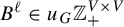
$B^{\ell } \in u_G \mathbb {Z}_+^{V \times V}$
; -
(iv)
$\mathcal {E}(B)$
and
$\mathcal {A}(B)$
are SE; -
(v)
$\zeta _{\mathcal {E}(B)}= \zeta _{\mathcal {A}(B)}$
.





Proof. (i) $\Leftrightarrow $
(ii): this is a direct consequence of Lemma 4.3 and Proposition 3.6.
$\Leftrightarrow $
(ii): this is a direct consequence of Lemma 4.3 and Proposition 3.6.
(ii) $\Leftrightarrow $
(iii): this equivalence follows directly from
$\Leftrightarrow $
(iii): this equivalence follows directly from $\mathcal {E}(B^\ell )_{(i,s),(j,t)} = \pi _{s^{-1}t}(B^\ell )_{i,j}$
as follows. Using this equation, we can reformulate (1) as: for every
$\mathcal {E}(B^\ell )_{(i,s),(j,t)} = \pi _{s^{-1}t}(B^\ell )_{i,j}$
as follows. Using this equation, we can reformulate (1) as: for every $g,h_1,h_2 \in G$
, we have
$g,h_1,h_2 \in G$
, we have $\pi _{h_1^{-1}h_2}(B^\ell )=\pi _{h_1^{-1}gh_2}(B^\ell )$
, which in turn is equivalent to
$\pi _{h_1^{-1}h_2}(B^\ell )=\pi _{h_1^{-1}gh_2}(B^\ell )$
, which in turn is equivalent to $\pi _g(B^\ell )=\pi _{1_G}(B^\ell )$
for all
$\pi _g(B^\ell )=\pi _{1_G}(B^\ell )$
for all $g \in G$
. However, this is nothing else than
$g \in G$
. However, this is nothing else than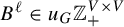 $B^\ell \in u_G \mathbb {Z}_+^{V \times V}$
.
$B^\ell \in u_G \mathbb {Z}_+^{V \times V}$
.
(iii) $\Rightarrow $
(iv): let
$\Rightarrow $
(iv): let $\ell \in \mathbb {N}$
such that
$\ell \in \mathbb {N}$
such that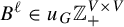 $B^\ell \in u_G \mathbb {Z}_+^{V \times V}$
. Then,
$B^\ell \in u_G \mathbb {Z}_+^{V \times V}$
. Then,

Furthermore,
 $$ \begin{align*} \sum_{g \in G}\pi_{g}(B) \pi_{1_G}(B^{\ell}) &= \sum_{g \in G} \pi_{g}(B)\pi_{g^{-1}}(B^{\ell}) = \pi_{1_G}(B^{\ell+1})\\ &= \sum_{g \in G} \pi_{g^{-1}}(B^{\ell})\pi_{g}(B) \\ &= \pi_{1_G}(B^{\ell})\sum_{g \in G}\pi_{g}(B). \end{align*} $$
Setting  and
and  , we therefore have

Therefore, the pair $(R,S)$
defines a shift equivalence with lag
$(R,S)$
defines a shift equivalence with lag $\ell $
between
$\ell $
between $\mathcal {A}(B)$
and
$\mathcal {A}(B)$
and $\mathcal {E}(B)$
.
$\mathcal {E}(B)$
.
(iv) $\Rightarrow $
(v): the zeta function is an invariant of shift equivalence, see, e.g., [Reference Lind and MarcusLM21, Corollary 7.4.12].
$\Rightarrow $
(v): the zeta function is an invariant of shift equivalence, see, e.g., [Reference Lind and MarcusLM21, Corollary 7.4.12].
(v) $\Rightarrow $
(ii): this result as well as the converse direction are due to Fiebig [Reference FiebigFie93, Theorem B]. We give a simplified proof, since this allows us to also get a quantitative bound on the lag of the shift equivalence in condition (iii). Let
$\Rightarrow $
(ii): this result as well as the converse direction are due to Fiebig [Reference FiebigFie93, Theorem B]. We give a simplified proof, since this allows us to also get a quantitative bound on the lag of the shift equivalence in condition (iii). Let $(w_g)_{g \in G}$
be an orthogonal basis of
$(w_g)_{g \in G}$
be an orthogonal basis of $\mathbb {C}^G$
such that
$\mathbb {C}^G$
such that  . Let F be the $G \times G$
matrix with columns
$G \times G$
matrix with columns $(w_g)_{g \in G}$
. For every
$(w_g)_{g \in G}$
. For every $g \in G$
, we have
$g \in G$
, we have $P_g w_{1_G} = w_{1_G}$
and
$P_g w_{1_G} = w_{1_G}$
and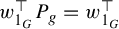 $w_{1_G}^\top P_g = w_{1_G}^\top $
, and hence,
$w_{1_G}^\top P_g = w_{1_G}^\top $
, and hence,
 $$ \begin{align*} F^{-1} P_g F = \begin{pmatrix} \begin{array}{@{}c|c@{}}1 & 0 \\ \hline 0 & Q_g\end{array} \end{pmatrix} \end{align*} $$
for some matrix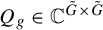 $Q_g \in \mathbb {C}^{\tilde {G} \times \tilde {G}}$
with
$Q_g \in \mathbb {C}^{\tilde {G} \times \tilde {G}}$
with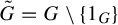 $\tilde {G} = G \setminus \{1_G\}$
. Therefore,
$\tilde {G} = G \setminus \{1_G\}$
. Therefore,
 $$ \begin{align*} (I_{V \times V} \otimes F)^{-1} \mathcal{E}(B) (I_{V \times V} \otimes F) &= \sum_{g \in G} \pi_g(B) \otimes (F^{-1} P_g F) \\ &= \sum_{g \in G} \pi_g(B) \otimes \begin{pmatrix} \begin{array}{@{}c|c@{}}1 & 0 \\ \hline 0 & Q_g\end{array} \end{pmatrix}. \end{align*} $$
Calculating the characteristic polynomial of the resulting block diagonal matrix gives $\chi _{\mathcal {E}(B)}(t) = \chi _{\mathcal {A}(B)}(t) \chi _{Q}(t)$
, where
$\chi _{\mathcal {E}(B)}(t) = \chi _{\mathcal {A}(B)}(t) \chi _{Q}(t)$
, where $Q:= \sum _{g \in G} \pi _g(B) \otimes Q_g$
. Since the characteristic polynomials of
$Q:= \sum _{g \in G} \pi _g(B) \otimes Q_g$
. Since the characteristic polynomials of $\mathcal {E}(B)$
and
$\mathcal {E}(B)$
and $\mathcal {A}(B)$
agree with the inverse of the zeta function up to a power of t, we get
$\mathcal {A}(B)$
agree with the inverse of the zeta function up to a power of t, we get $\chi _{Q}(t)=t^k$
, where k is the size of Q. Hence, Q is nilpotent and we get
$\chi _{Q}(t)=t^k$
, where k is the size of Q. Hence, Q is nilpotent and we get
 $$ \begin{align*} (I_{V \times V} \otimes F)^{-1} \mathcal{E}(B^k) (I \otimes F) &= \mathcal{A}(B^k) \otimes \begin{pmatrix} \begin{array}{@{}c|c@{}}1 & 0 \\ \hline 0 & 0\end{array} \end{pmatrix} \end{align*} $$
and, hence,

In other words, condition (ii) is satisfied.
Remark 5.3.
-
(a) Notice that in condition (iii), we can replace ‘For all sufficiently large
$\ell \in \mathbb {Z}_+$
’ by ‘For some
$\ell \in \mathbb {Z}_+$
’ since
$u_G \mathbb {Z}_+^{V\times V}$
is closed under multiplication with matrices in
$\mathbb {Z}_+[G]^{V \times V}$
. -
(b) The last part of the proof in Theorem 5.1 furthermore tells us how large we have to choose the power
$\ell $
in conditions (ii) and (iii). Namely, we need
$\ell \geq n(|G|-1)$
, since this is the size of Q and hence an upper bound on its nilpotency index.



As a last ingredient, we also need the fact that for square matrices $B,C$
over the integer group ring whose entries eventually lie in
$B,C$
over the integer group ring whose entries eventually lie in $u_G\mathbb {Z}_+$
, we can lift an SE between
$u_G\mathbb {Z}_+$
, we can lift an SE between $\mathcal {A}(B)$
and
$\mathcal {A}(B)$
and $\mathcal {A}(C)$
to an SE between
$\mathcal {A}(C)$
to an SE between $\mathcal {E}(B)$
and
$\mathcal {E}(B)$
and $\mathcal {E}(C)$
. This was shown by Boyle and Schmieding in [Reference Boyle and SchmiedingBS17]. The key observation is that for a matrix B with entries in
$\mathcal {E}(C)$
. This was shown by Boyle and Schmieding in [Reference Boyle and SchmiedingBS17]. The key observation is that for a matrix B with entries in $\mathbb {Z}_+[G]$
, we have
$\mathbb {Z}_+[G]$
, we have $u_G B = u_G \mathcal {A}(B)$
.
$u_G B = u_G \mathcal {A}(B)$
.
Lemma 5.4. [Reference Boyle and SchmiedingBS17, Lemma 4.4]
Consider matrices $B \in \mathbb {Z}_+[G]^{V\times V}$
and
$B \in \mathbb {Z}_+[G]^{V\times V}$
and $C \in \mathbb {Z}_+[G]^{W \times W}$
such that for all sufficiently large k, we have
$C \in \mathbb {Z}_+[G]^{W \times W}$
such that for all sufficiently large k, we have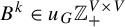 $B^k \in u_G\mathbb {Z}_+^{V \times V}$
,
$B^k \in u_G\mathbb {Z}_+^{V \times V}$
,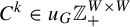 $C^k \in u_G \mathbb {Z}_+^{W \times W}$
. If
$C^k \in u_G \mathbb {Z}_+^{W \times W}$
. If $\mathcal {A}(B)$
and
$\mathcal {A}(B)$
and $\mathcal {A}(C)$
are SE over
$\mathcal {A}(C)$
are SE over $\mathbb {Z}_+$
, then B and C are SE over
$\mathbb {Z}_+$
, then B and C are SE over $\mathbb {Z}_+[G]$
.
$\mathbb {Z}_+[G]$
.
Proof. Assume there is a shift equivalence over $\mathbb {Z}_+$
with lag k given by the matrix pair
$\mathbb {Z}_+$
with lag k given by the matrix pair $R,S$
, and assume that both
$R,S$
, and assume that both $B^k$
and
$B^k$
and $C^k$
have entries in
$C^k$
have entries in $u_G \mathbb {Z}_+$
. Then, both
$u_G \mathbb {Z}_+$
. Then, both $\mathcal {A}(B^k)$
and
$\mathcal {A}(B^k)$
and $\mathcal {A}(C^k)$
have all entries divisible by
$\mathcal {A}(C^k)$
have all entries divisible by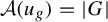 $\mathcal {A}(u_g)=|G|$
. Furthermore,
$\mathcal {A}(u_g)=|G|$
. Furthermore, $B^k=u_G |G|^{-1}\mathcal {A}(B^k) $
and
$B^k=u_G |G|^{-1}\mathcal {A}(B^k) $
and $C^k=u_G |G|^{-1} \mathcal {A}(C^k)$
. Hence,
$C^k=u_G |G|^{-1} \mathcal {A}(C^k)$
. Hence, $(u_G R)$
and
$(u_G R)$
and $(|G|^{-1}\mathcal {A}(C^k) S)$
establish a shift equivalence of lag
$(|G|^{-1}\mathcal {A}(C^k) S)$
establish a shift equivalence of lag $2k$
between B and C.
$2k$
between B and C.
6 Proof of the main theorem
With the preparation from the previous sections, we are now ready to prove our main theorems.
Theorem 6.1. (Main theorem—algebraic version)
Every pair of inert square matrices over $\mathbb {Z}_+[G]$
, whose augmentations are SE over
$\mathbb {Z}_+[G]$
, whose augmentations are SE over $\mathbb {Z}_+$
, is SE over
$\mathbb {Z}_+$
, is SE over $\mathbb {Z}_+[G]$
itself.
$\mathbb {Z}_+[G]$
itself.
Proof. Let $B,C$
be two inert matrices over
$B,C$
be two inert matrices over $\mathbb {Z}_+[G]$
such that
$\mathbb {Z}_+[G]$
such that $\mathcal {A}(B)$
and
$\mathcal {A}(B)$
and $\mathcal {A}(C)$
are SE over
$\mathcal {A}(C)$
are SE over $\mathbb {Z}_+$
. Since B and C are inert, we know by Theorem 5.2 that for sufficiently large
$\mathbb {Z}_+$
. Since B and C are inert, we know by Theorem 5.2 that for sufficiently large $\ell $
,
$\ell $
, $B^\ell $
and
$B^\ell $
and $C^\ell $
have entries in
$C^\ell $
have entries in $u_G \mathbb {Z}_+$
. Therefore, we can apply Lemma 5.4 and conclude that B and C are SE over
$u_G \mathbb {Z}_+$
. Therefore, we can apply Lemma 5.4 and conclude that B and C are SE over $\mathbb {Z}_+[G]$
.
$\mathbb {Z}_+[G]$
.
Theorem 6.2. (Main theorem—dynamical version)
Let $(Y_1,\sigma )$
and
$(Y_1,\sigma )$
and $(Y_2,\sigma )$
be SFTs such that
$(Y_2,\sigma )$
be SFTs such that $(Y_1,\sigma ^\ell )$
,
$(Y_1,\sigma ^\ell )$
, $(Y_2,\sigma ^\ell )$
are conjugate for all sufficiently large
$(Y_2,\sigma ^\ell )$
are conjugate for all sufficiently large $\ell $
. Let
$\ell $
. Let $\alpha _1$
and
$\alpha _1$
and $\alpha _2$
be free inert actions of a finite group G on
$\alpha _2$
be free inert actions of a finite group G on $(Y_1,\sigma )$
and
$(Y_1,\sigma )$
and $(Y_2,\sigma )$
, respectively. Then, for every sufficiently large
$(Y_2,\sigma )$
, respectively. Then, for every sufficiently large $\ell $
, there is a conjugacy
$\ell $
, there is a conjugacy $\varphi $
from
$\varphi $
from $(Y_1,\sigma ^\ell )$
to
$(Y_1,\sigma ^\ell )$
to $(Y_2,\sigma ^\ell )$
such that
$(Y_2,\sigma ^\ell )$
such that $\varphi \circ \alpha _1(g) = \alpha _2(g) \circ \varphi $
for all
$\varphi \circ \alpha _1(g) = \alpha _2(g) \circ \varphi $
for all $g \in G$
.
$g \in G$
.
Proof. By assumption, $(Y_1,\sigma ,\alpha _1)$
and
$(Y_1,\sigma ,\alpha _1)$
and $(Y_2,\sigma ,\alpha _2)$
are free inert G-SFTs for which
$(Y_2,\sigma ,\alpha _2)$
are free inert G-SFTs for which $(Y_1,\sigma )$
and
$(Y_1,\sigma )$
and $(Y_2,\sigma )$
are eventually conjugate. We want to show that
$(Y_2,\sigma )$
are eventually conjugate. We want to show that $(Y_1,\sigma ,\alpha _1)$
and
$(Y_1,\sigma ,\alpha _1)$
and $(Y_2,\sigma ,\alpha _2)$
are eventually G-conjugate.
$(Y_2,\sigma ,\alpha _2)$
are eventually G-conjugate.
By Proposition 4.2, we find matrices $B_i \in \mathbb {Z}_+[G]^{{V_i \times V_i}}, i \in \{1,2\}$
such that
$B_i \in \mathbb {Z}_+[G]^{{V_i \times V_i}}, i \in \{1,2\}$
such that $(Y_i,\sigma ,\alpha _i)$
is G-conjugate to
$(Y_i,\sigma ,\alpha _i)$
is G-conjugate to $(X_{\mathcal {E}(B_i)},\sigma ,\beta _{B_i})$
. In particular,
$(X_{\mathcal {E}(B_i)},\sigma ,\beta _{B_i})$
. In particular, $(Y_i,\sigma )$
and
$(Y_i,\sigma )$
and $(X_{\mathcal {E}(B_i)},\sigma )$
are conjugate, and therefore,
$(X_{\mathcal {E}(B_i)},\sigma )$
are conjugate, and therefore, $(X_{\mathcal {E}(B_1)},\sigma )$
and
$(X_{\mathcal {E}(B_1)},\sigma )$
and $(X_{\mathcal {E}(B_2)},\sigma )$
are eventually conjugate. Algebraically, this means that
$(X_{\mathcal {E}(B_2)},\sigma )$
are eventually conjugate. Algebraically, this means that $\mathcal {E}(B_1)$
and
$\mathcal {E}(B_1)$
and $\mathcal {E}(B_2)$
are SE. Since
$\mathcal {E}(B_2)$
are SE. Since $(Y_i,\sigma ,\alpha _i)$
for
$(Y_i,\sigma ,\alpha _i)$
for $i=1,2$
is inert, so is
$i=1,2$
is inert, so is $(X_{\mathcal {E}(B_i)},\sigma ,\beta _{B_i})$
; in other words,
$(X_{\mathcal {E}(B_i)},\sigma ,\beta _{B_i})$
; in other words, $B_i$
is inert. By Theorem 5.2, this implies that all four matrices
$B_i$
is inert. By Theorem 5.2, this implies that all four matrices $\mathcal {E}(B_1),\mathcal {E}(B_2),\mathcal {A}(B_1)$
, and
$\mathcal {E}(B_1),\mathcal {E}(B_2),\mathcal {A}(B_1)$
, and $\mathcal {A}(B_2)$
are SE over
$\mathcal {A}(B_2)$
are SE over $\mathbb {Z}_+$
. By Lemma 5.4, this implies that
$\mathbb {Z}_+$
. By Lemma 5.4, this implies that $B_1$
and
$B_1$
and $B_2$
are SE over
$B_2$
are SE over $\mathbb {Z}_+[G]$
. Finally, by Theorem 4.6, this is equivalent to
$\mathbb {Z}_+[G]$
. Finally, by Theorem 4.6, this is equivalent to $(X_{\mathcal {E}(B_1)},\sigma ,\beta _{B_1})$
and
$(X_{\mathcal {E}(B_1)},\sigma ,\beta _{B_1})$
and $(X_{\mathcal {E}(B_2)},\sigma ,\beta _{B_2})$
being eventually G-conjugate. Since
$(X_{\mathcal {E}(B_2)},\sigma ,\beta _{B_2})$
being eventually G-conjugate. Since $(X_{\mathcal {E}(B_i)},\sigma ,\beta _{B_i})$
is G-conjugate to
$(X_{\mathcal {E}(B_i)},\sigma ,\beta _{B_i})$
is G-conjugate to $(Y_i,\sigma ,\alpha _i)$
, this finally proves the theorem.
$(Y_i,\sigma ,\alpha _i)$
, this finally proves the theorem.
Corollary 6.3. (Eventual conjugacy for free finite-order automorphisms of full shifts)
Let $k,m \in \mathbb {N}$
. Let
$k,m \in \mathbb {N}$
. Let $(X_k,\sigma )$
be the full k-shift and let
$(X_k,\sigma )$
be the full k-shift and let $\varphi _1,\varphi _2$
be two automorphisms of
$\varphi _1,\varphi _2$
be two automorphisms of $(X_k,\sigma )$
for which every orbit has size m. Then, there is a homeomorphism
$(X_k,\sigma )$
for which every orbit has size m. Then, there is a homeomorphism $\psi : X_k \to X_k$
such that
$\psi : X_k \to X_k$
such that $\psi \circ \varphi _1 = \varphi _2 \circ \psi $
and
$\psi \circ \varphi _1 = \varphi _2 \circ \psi $
and $\psi \circ \sigma ^\ell = \sigma ^\ell \circ \psi $
for all sufficiently large
$\psi \circ \sigma ^\ell = \sigma ^\ell \circ \psi $
for all sufficiently large $\ell \in \mathbb {N}$
.
$\ell \in \mathbb {N}$
.
Proof. The fact that all orbits of $\varphi _i, i \in \{1,2\}$
have the same size m is equivalent to the fact that
$\varphi _i, i \in \{1,2\}$
have the same size m is equivalent to the fact that $\alpha _i(\ell)(x) = \varphi _i^{\ell}(x)$
defines a free
$\alpha _i(\ell)(x) = \varphi _i^{\ell}(x)$
defines a free $\mathbb {Z}/m\mathbb {Z}$
action on
$\mathbb {Z}/m\mathbb {Z}$
action on $(X_k,\sigma )$
. It is well known that every finite-order automorphism of a full shift is inert. This follows from the fact that the automorphism group of the dimension triple is of the form
$(X_k,\sigma )$
. It is well known that every finite-order automorphism of a full shift is inert. This follows from the fact that the automorphism group of the dimension triple is of the form $\mathbb {Z}^n$
and thus torsion-free, see, e.g., [Reference Hartman, Kra and SchmiedingHKS22, Proposition 2.4].
$\mathbb {Z}^n$
and thus torsion-free, see, e.g., [Reference Hartman, Kra and SchmiedingHKS22, Proposition 2.4].
Thus, we can apply the previous theorem to $(X_k,\sigma ,\alpha _1)$
and
$(X_k,\sigma ,\alpha _1)$
and $(X_k,\sigma ,\alpha _2)$
, and obtain our result.
$(X_k,\sigma ,\alpha _2)$
, and obtain our result.
Corollary 6.4. (Conjugacy of free finite-order elements in the stabilized automorphism group)
Let $k,m \in \mathbb {N}$
. Let
$k,m \in \mathbb {N}$
. Let $(X_k,\sigma )$
be the full k-shift. Let
$(X_k,\sigma )$
be the full k-shift. Let $\varphi _1, \varphi _2$
be two elements of the stabilized automorphism group of
$\varphi _1, \varphi _2$
be two elements of the stabilized automorphism group of $(X_k,\sigma )$
for which every orbit has size m. Then,
$(X_k,\sigma )$
for which every orbit has size m. Then, $\varphi _1$
and
$\varphi _1$
and $\varphi _2$
are conjugate in
$\varphi _2$
are conjugate in $\operatorname {\mathrm {Aut}}^\infty (X_k,\sigma )$
.
$\operatorname {\mathrm {Aut}}^\infty (X_k,\sigma )$
.
Proof. This follows directly from the fact that there is $k \in \mathbb {N}$
such that
$k \in \mathbb {N}$
such that $\varphi _1, \varphi _2 \in \operatorname {\mathrm {Aut}}(X_k,\sigma ^k)$
and the previous theorem.
$\varphi _1, \varphi _2 \in \operatorname {\mathrm {Aut}}(X_k,\sigma ^k)$
and the previous theorem.
7 A theorem of Kim and Roush
Theorem 5.2 gives a new way to interpret a theorem by Kim and Roush from [Reference Kim and RoushKR97]. Namely, in our language, their theorem characterizes the existence of an inert $\mathbb {Z}/p\mathbb {Z}$
extension of a given mixing SFT.
$\mathbb {Z}/p\mathbb {Z}$
extension of a given mixing SFT.
Recall that for a subshift X, we denote by $\operatorname {\mathrm {Per}}_k(X,\sigma ) = \{x \in X \mid \sigma ^k(x)=x\}$
the
$\operatorname {\mathrm {Per}}_k(X,\sigma ) = \{x \in X \mid \sigma ^k(x)=x\}$
the $\sigma $
-periodic points in X with period k. Denote by
$\sigma $
-periodic points in X with period k. Denote by $\widetilde {\operatorname {\mathrm {Per}}}_k(X,\sigma )$
the set of
$\widetilde {\operatorname {\mathrm {Per}}}_k(X,\sigma )$
the set of $\sigma $
-periodic points in X with minimal period k, that is,
$\sigma $
-periodic points in X with minimal period k, that is, $\widetilde {\operatorname {\mathrm {Per}}}_k(X,\sigma ) := \operatorname {\mathrm {Per}}_k(X,\sigma ) \setminus \bigcup _{\ell <k} \operatorname {\mathrm {Per}}_\ell (X,\sigma )$
. Endow
$\widetilde {\operatorname {\mathrm {Per}}}_k(X,\sigma ) := \operatorname {\mathrm {Per}}_k(X,\sigma ) \setminus \bigcup _{\ell <k} \operatorname {\mathrm {Per}}_\ell (X,\sigma )$
. Endow $\operatorname {\mathrm {Per}}(X) := \bigcup _{k \in \mathbb {N}} \operatorname {\mathrm {Per}}_k(X,\sigma )$
with the discrete topology.
$\operatorname {\mathrm {Per}}(X) := \bigcup _{k \in \mathbb {N}} \operatorname {\mathrm {Per}}_k(X,\sigma )$
with the discrete topology.
Theorem 7.1. [Reference Kim and RoushKR97, Theorem 7.2 and Lemma 2.2]
Let A be a primitive square matrix over $\mathbb {Z}_+$
and set
$\mathbb {Z}_+$
and set $o_\ell := |\widetilde {\operatorname {\mathrm {Per}}}_\ell (X_A,\sigma )|$
. Let p be prime. Then, the following are equivalent:
$o_\ell := |\widetilde {\operatorname {\mathrm {Per}}}_\ell (X_A,\sigma )|$
. Let p be prime. Then, the following are equivalent:
-
(i)
$X_A$
has an inert
$\mathbb {Z}/p \mathbb {Z}$
extension, that is, there is an inert square matrix B over
$\mathbb {Z}_+[\mathbb {Z}/p \mathbb {Z}]$
whose augmentation
$\mathcal {A}(B)$
is equal to A; -
(ii)
$X_A$
satisfies the so-called ‘Boyle-Handelmann’ condition, that is, there is a free
$\mathbb {Z}/p \mathbb {Z}$
action on
$(\operatorname {\mathrm {Per}}(X_A),\sigma )$
such that the quotient by this action is conjugate to
$(\operatorname {\mathrm {Per}}(X_A),\sigma )$
; -
(iii) for every
$n \in \mathbb {N}$
, the numbers
$(o_\ell )_{\ell \in \mathbb {N}}$
satisfy the following condition: where
$$ \begin{align*} \sum_{k=1}^{m} \frac{p-1}{p^k} o_{n/p^k} \in \{0, \ldots, o_{n}\}, \end{align*} $$
$m = \max \{ k \in \mathbb {N} \mid p^k \mid n\}$
.







The Boyle–Handelmann condition first appeared in a special case in [Reference Boyle and HandelmanBH91, 6.2 ‘Degrees example’]. Its necessity follows directly from the invariance of the zeta function under shift equivalence. In [Reference Kim and RoushKR97, Lemma 2.2], Kim and Roush showed that it can be formulated arithmetically as in condition (iii). The main work in the proof of Kim and Roush goes into (iii) $\Rightarrow $
(i), which is an impressive technical tour de force using the polynomial representation of SFTs.
$\Rightarrow $
(i), which is an impressive technical tour de force using the polynomial representation of SFTs.
Surprisingly, this theorem is basically everything that is known about the existence of inert extensions and actions. A few other results on inert actions can be found in [Reference Boyle and ChuysurichayBC18, Reference LongLon09].
8 Shift equivalence over
$\mathbb {Z}_+[G]$
and equivariant flow equivalence

In [Reference Boyle, Carlsen and EilersBCE20], Boyle, Carlsen, and Eilers showed the following theorem as an application of their characterization of G-equivariant flow equivalence. For the somewhat lengthy definition of G-equivariant flow equivalence, see, e.g., [Reference Boyle and SullivanBS05, §2]. We only need here that it is an equivalence relation between subshifts, which is weaker than topological conjugacy and can algebraically be characterized as in Theorem 8.2.
Theorem 8.1. [Reference Boyle, Carlsen and EilersBCE20]
Let X be the full $2k$
-shift for some
$2k$
-shift for some $k \in \mathbb {N}$
. Let
$k \in \mathbb {N}$
. Let $(X,\sigma ,\alpha )$
and
$(X,\sigma ,\alpha )$
and $(X,\sigma ,\beta )$
be two free
$(X,\sigma ,\beta )$
be two free $\mathbb {Z} / 2\mathbb {Z}$
-SFTs. Then, there is a
$\mathbb {Z} / 2\mathbb {Z}$
-SFTs. Then, there is a $\mathbb {Z} / 2\mathbb {Z}$
-equivariant flow equivalence between
$\mathbb {Z} / 2\mathbb {Z}$
-equivariant flow equivalence between $(X,\sigma ,\alpha )$
and
$(X,\sigma ,\alpha )$
and $(X,\sigma ,\beta )$
.
$(X,\sigma ,\beta )$
.
We will show in Theorem 8.6 that at least for cyclic groups and irreducible free G-SFTs, equivariant shift equivalence already implies equivariant flow equivalence. As a consequence, we obtain Corollary 8.8 as a generalization of Theorem 8.1. This echos the recent result by Boyle [Reference BoyleBoy25] that shift equivalence implies flow equivalence between SFTs in the ordinary non-equivariant setting even without the irreducibility assumption.
A complete set of invariants for G-invariant flow equivalence in the irreducible case was given by Boyle and Sullivan already in [Reference Boyle and SullivanBS05].
Their main result is the following theorem. All relevant notions are briefly defined afterwards. For a slightly simplified version treating the case of irreducible extensions, see [Reference Boyle and ChuysurichayBC18, Theorem 8.5].
Theorem 8.2. [Reference Boyle and SullivanBS05, Theorem 6.4]
Let G be a finite group. Let A and B be irreducible square matrices over $\mathbb {Z}_+[G]$
. Assume that A and B have the same weight class. Let H be a group in the weight class. Let
$\mathbb {Z}_+[G]$
. Assume that A and B have the same weight class. Let H be a group in the weight class. Let $A'$
and
$A'$
and $B'$
be square matrices over
$B'$
be square matrices over $\mathbb {Z}_+[H]$
which are SSE over
$\mathbb {Z}_+[H]$
which are SSE over $\mathbb {Z}_+[G]$
to A and B, respectively. Then, the following are equivalent:
$\mathbb {Z}_+[G]$
to A and B, respectively. Then, the following are equivalent:
-
(i)
$(X_{\mathcal {E}(A)},\sigma ,\beta _A)$
and
$(X_{\mathcal {E}(B)},\sigma ,\beta _B)$
are G-flow equivalent; -
(ii) there exists
$g \in G$
such that
$g H g^{-1} = H$
and there is an
$\operatorname {\mathrm {EL}}_\infty (\mathbb {Z}[H])$
-equivalence from
$(I-A')_\infty $
to
$(I-g B' g^{-1})_\infty $
, that is, there are
$U,V \in \operatorname {\mathrm {EL}}_\infty (\mathbb {Z}[H])$
such that
$$ \begin{align*}U(I-A')_\infty V=(I-g B' g^{-1})_\infty.\end{align*} $$



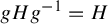





Here are the necessary definitions to make sense of this theorem. For a matrix $A \in \mathbb {Z}[G]^{V \times V}$
and
$A \in \mathbb {Z}[G]^{V \times V}$
and $i \in V$
, define
$i \in V$
, define $W_i(A)$
as the subgroup of G consisting of elements of the form
$W_i(A)$
as the subgroup of G consisting of elements of the form $\{g \in G \mid \text { there exists } n \in \mathbb {N}: \pi _g(A^n_{i,i})>0\}$
. These are all elements of G which appear as products over the labels along a cycle based at i in the graph defined by A. We call such a product the weight of the cycle. The weight class of A is then defined as the conjugacy class of
$\{g \in G \mid \text { there exists } n \in \mathbb {N}: \pi _g(A^n_{i,i})>0\}$
. These are all elements of G which appear as products over the labels along a cycle based at i in the graph defined by A. We call such a product the weight of the cycle. The weight class of A is then defined as the conjugacy class of $W_i(A)$
and this conjugacy class is independent of the choice of i. Recall (see, e.g., [Reference Boyle and SullivanBS05, Definition 3.1]) that a square matrix
$W_i(A)$
and this conjugacy class is independent of the choice of i. Recall (see, e.g., [Reference Boyle and SullivanBS05, Definition 3.1]) that a square matrix $A \in \mathbb {Z}_+[G]^{V \times V}$
is irreducible if for every
$A \in \mathbb {Z}_+[G]^{V \times V}$
is irreducible if for every $i,j \in V$
, there is
$i,j \in V$
, there is $k \in \mathbb {N}$
such that
$k \in \mathbb {N}$
such that $A^k_{i,j} \neq 0$
. For a matrix
$A^k_{i,j} \neq 0$
. For a matrix $A \in \mathbb {Z}[G]^{n \times n}$
, we define
$A \in \mathbb {Z}[G]^{n \times n}$
, we define $A_\infty $
as the
$A_\infty $
as the $\mathbb {N} \times \mathbb {N}$
matrix with
$\mathbb {N} \times \mathbb {N}$
matrix with
 $$ \begin{align*} (A_\infty)_{i,j} =\begin{cases} A_{i,j} &\text{ if } i,j \leq n,\\ 0 &\text{ if } \max(i,j)>n,\; i\neq j, \\ 1 &\text{ if } \max(i,j)>n,\; i=j. \end{cases} \end{align*} $$
In other words, we take the $\mathbb {N} \times \mathbb {N}$
identity matrix and replace the upper left
$\mathbb {N} \times \mathbb {N}$
identity matrix and replace the upper left $n \times n$
block by A. For
$n \times n$
block by A. For $z \in \mathbb {Z}[G], i,j \in \mathbb {N}, i \neq j$
, we denote by
$z \in \mathbb {Z}[G], i,j \in \mathbb {N}, i \neq j$
, we denote by $E_{i,j}(z)$
the
$E_{i,j}(z)$
the $\mathbb {N} \times \mathbb {N}$
matrix which agrees with the identity matrix everywhere besides the entry at position
$\mathbb {N} \times \mathbb {N}$
matrix which agrees with the identity matrix everywhere besides the entry at position $i,j$
, where it equals z. We say that two square matrices A and B over
$i,j$
, where it equals z. We say that two square matrices A and B over $\mathbb {Z}_+[G]$
are elementarily positively equivalent if there are
$\mathbb {Z}_+[G]$
are elementarily positively equivalent if there are $g \in G$
and
$g \in G$
and $i,j \in \mathbb {N}$
with
$i,j \in \mathbb {N}$
with $\pi _g(A_{i,j})>0$
and
$\pi _g(A_{i,j})>0$
and $(I-B)_\infty =E_{i,j}(g)(I-A)_\infty $
or
$(I-B)_\infty =E_{i,j}(g)(I-A)_\infty $
or $(I-B)_\infty =(I-A)_\infty E_{i,j}(g)$
. We call the equivalence relation on square matrices over
$(I-B)_\infty =(I-A)_\infty E_{i,j}(g)$
. We call the equivalence relation on square matrices over $\mathbb {Z}_+[G]$
generated by this notion positive equivalence. The stabilized general linear group over
$\mathbb {Z}_+[G]$
generated by this notion positive equivalence. The stabilized general linear group over $\mathbb {Z}[G]$
is defined as
$\mathbb {Z}[G]$
is defined as $\operatorname {\mathrm {GL}}_\infty (\mathbb {Z}[G]):= \{G_\infty \mid G \in \operatorname {\mathrm {GL}}_n(\mathbb {Z}[G])$
,
$\operatorname {\mathrm {GL}}_\infty (\mathbb {Z}[G]):= \{G_\infty \mid G \in \operatorname {\mathrm {GL}}_n(\mathbb {Z}[G])$
, $n \in \mathbb {N}\}$
. The subgroup generated by the elementary matrices
$n \in \mathbb {N}\}$
. The subgroup generated by the elementary matrices $\{E_{i,j}(z) \mid z \in \mathbb {Z}[G],\; i,j \in \mathbb {N}\}$
is denoted by
$\{E_{i,j}(z) \mid z \in \mathbb {Z}[G],\; i,j \in \mathbb {N}\}$
is denoted by $\operatorname {\mathrm {EL}}_\infty (\mathbb {Z}[G])$
.
$\operatorname {\mathrm {EL}}_\infty (\mathbb {Z}[G])$
.
In addition to the results appearing in [Reference Boyle, Carlsen and EilersBCE20], we also need the following two lemmas concerning the weight class.
Lemma 8.3. (SE matrices have the same weight class)
Let A and B be irreducible square matrices over $\mathbb {Z}_+[G]$
. If A and B are SE over
$\mathbb {Z}_+[G]$
. If A and B are SE over $\mathbb {Z}_+[G]$
, then
$\mathbb {Z}_+[G]$
, then $W(A)=W(B)$
.
$W(A)=W(B)$
.
Proof. If A and B are SE, then there is $k \in \mathbb {N}$
such that
$k \in \mathbb {N}$
such that $A':=A^{k|G|+1}$
and
$A':=A^{k|G|+1}$
and $B':=B^{k|G|+1}$
are irreducible and SSE and, therefore,
$B':=B^{k|G|+1}$
are irreducible and SSE and, therefore, $W(A')=W(B')$
by [Reference Boyle and SullivanBS05, Proposition 2.7.1, Theorem 3.3, and Proposition 4.2]. It remains to show that
$W(A')=W(B')$
by [Reference Boyle and SullivanBS05, Proposition 2.7.1, Theorem 3.3, and Proposition 4.2]. It remains to show that $W(A)=W(A')$
and
$W(A)=W(A')$
and $W(B)=W(B')$
. It follows directly from the definition that every weight of a cycle in
$W(B)=W(B')$
. It follows directly from the definition that every weight of a cycle in $A'$
based at i also appears as a weight of a cycle based at i in A. Therefore,
$A'$
based at i also appears as a weight of a cycle based at i in A. Therefore, $W_i(A') \subseteq W_i(A)$
. Now, let g be an element of G with
$W_i(A') \subseteq W_i(A)$
. Now, let g be an element of G with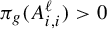 $\pi _g(A^\ell _{i,i})> 0$
for some
$\pi _g(A^\ell _{i,i})> 0$
for some $\ell \in \mathbb {N}$
. Then,
$\ell \in \mathbb {N}$
. Then,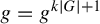 $g = g^{k|G|+1}$
and so
$g = g^{k|G|+1}$
and so $\pi _g(A^{\ell (k|G|+1)})_{ii}\neq 0$
. Therefore,
$\pi _g(A^{\ell (k|G|+1)})_{ii}\neq 0$
. Therefore, $g \in W_i(A')$
and, thus,
$g \in W_i(A')$
and, thus, $W(A)=W(A')$
. The same argument applies to B and
$W(A)=W(A')$
. The same argument applies to B and $B'$
.
$B'$
.
Lemma 8.4. (Shift equivalence over some subring)
Let G be a finite group and let H be a normal subgroup of G. Let A, B be irreducible square matrices over $\mathbb {Z}_+[H]$
. If A and B are SE over
$\mathbb {Z}_+[H]$
. If A and B are SE over $\mathbb {Z}_+[G]$
, there is
$\mathbb {Z}_+[G]$
, there is $g \in G$
such that A and
$g \in G$
such that A and $gBg^{-1}$
are SE over
$gBg^{-1}$
are SE over $\mathbb {Z}_+[H]$
.
$\mathbb {Z}_+[H]$
.
Proof. Let $R,S$
be a shift equivalence of lag
$R,S$
be a shift equivalence of lag $\ell $
between
$\ell $
between $A \in \mathbb {Z}_+[H]^{n \times n}$
and
$A \in \mathbb {Z}_+[H]^{n \times n}$
and $B \in \mathbb {Z}_+[H]^{m \times m}$
over
$B \in \mathbb {Z}_+[H]^{m \times m}$
over $\mathbb {Z}_+[G]$
. In particular,
$\mathbb {Z}_+[G]$
. In particular, $A^\ell =RS$
and
$A^\ell =RS$
and $B^\ell =SR$
. Since A and B are essential, so are R and S. There is an element
$B^\ell =SR$
. Since A and B are essential, so are R and S. There is an element $g \in G$
and indices
$g \in G$
and indices $i,j$
such that
$i,j$
such that $\pi _g(R_{i,j})\neq 0$
.
$\pi _g(R_{i,j})\neq 0$
.
Now, let $s \in \{1,\ldots ,m\}$
and
$s \in \{1,\ldots ,m\}$
and $t \in \{1,\ldots ,n\}$
be arbitrary. There is
$t \in \{1,\ldots ,n\}$
be arbitrary. There is $k \in \mathbb {N}$
such that
$k \in \mathbb {N}$
such that $A^k_{t,i} \neq 0$
. Since
$A^k_{t,i} \neq 0$
. Since $gSA^kRg^{-1}=gB^{k+\ell }g^{-1}$
contains only entries over
$gSA^kRg^{-1}=gB^{k+\ell }g^{-1}$
contains only entries over $\mathbb {Z}_+[gHg^{-1}]=\mathbb {Z}_+[H]$
, the same is true for
$\mathbb {Z}_+[gHg^{-1}]=\mathbb {Z}_+[H]$
, the same is true for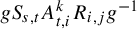 $g S_{s,t} A^k_{t,i} R_{i,j}g^{-1}$
. The factor
$g S_{s,t} A^k_{t,i} R_{i,j}g^{-1}$
. The factor $R_{i,j}g^{-1}$
contains
$R_{i,j}g^{-1}$
contains $1_G$
as a summand, so we have
$1_G$
as a summand, so we have $gS_{s,t} \in \mathbb {Z}_+[H]$
. Now, either
$gS_{s,t} \in \mathbb {Z}_+[H]$
. Now, either $R_{t,s}=0$
or there is
$R_{t,s}=0$
or there is $q\in \{1,\ldots ,m\}$
such that
$q\in \{1,\ldots ,m\}$
such that $g S_{q,t} R_{t,s}g^{-1} \neq 0$
since S is essential. In both cases, we have
$g S_{q,t} R_{t,s}g^{-1} \neq 0$
since S is essential. In both cases, we have $R_{t,s}g^{-1} \in \mathbb {Z}_+[H]$
.
$R_{t,s}g^{-1} \in \mathbb {Z}_+[H]$
.
Therefore, the pair $(Rg^{-1},g S)$
establishes a shift equivalence over
$(Rg^{-1},g S)$
establishes a shift equivalence over $\mathbb {Z}_+[H]$
between A and
$\mathbb {Z}_+[H]$
between A and $g B g^{-1}$
.
$g B g^{-1}$
.
We now show that the conditions of Theorem 8.2 are met when A and B satisfy the conditions of Theorem 8.1, thus showing that in this case, equivariant shift equivalence implies equivariant flow equivalence. To do so, we need another characterization of shift equivalence coming from the ‘positive K-theory’ framework.
Theorem 8.5. [Reference Boyle and SchmiedingBS19, Theorem 6.2]
Let $A,B$
be square matrices over a ring
$A,B$
be square matrices over a ring $\mathcal {R}$
. Then, A and B are SE over
$\mathcal {R}$
. Then, A and B are SE over $\mathcal {R}$
if and only if
$\mathcal {R}$
if and only if $(I-tA)_{\infty }$
and
$(I-tA)_{\infty }$
and $(I-tB)_{\infty }$
are
$(I-tB)_{\infty }$
are $\operatorname {\mathrm {GL}}_\infty (\mathcal {R}[t])$
equivalent, that is, there are
$\operatorname {\mathrm {GL}}_\infty (\mathcal {R}[t])$
equivalent, that is, there are $U,V \in \operatorname {\mathrm {GL}}_\infty (\mathcal {R}[t])$
such that
$U,V \in \operatorname {\mathrm {GL}}_\infty (\mathcal {R}[t])$
such that
 $$ \begin{align*} U(t) (I-tA)_\infty V(t) = (I-tB)_\infty. \end{align*} $$
Theorem 8.6. Let $G=\mathbb {Z}/n\mathbb {Z}$
be a cyclic group. Let
$G=\mathbb {Z}/n\mathbb {Z}$
be a cyclic group. Let $A,B$
be irreducible square matrices over
$A,B$
be irreducible square matrices over $\mathbb {Z}_+[G]$
. If A and B are SE over
$\mathbb {Z}_+[G]$
. If A and B are SE over $\mathbb {Z}_+[G]$
, then
$\mathbb {Z}_+[G]$
, then $(X_A,\sigma ,\beta _A)$
and
$(X_A,\sigma ,\beta _A)$
and $(X_B,\sigma ,\beta _B)$
are G-flow equivalent.
$(X_B,\sigma ,\beta _B)$
are G-flow equivalent.
Proof. Let A and B be SE matrices as above. By Lemma 8.3, they have the same weight class. Let H be a group in this weight class. Since G is Abelian, H is normal. Then, by [Reference Boyle and SullivanBS05, Proposition 4.4], there are diagonal matrices $C,D$
with diagonal entries in G such that
$C,D$
with diagonal entries in G such that $A' := DAD^{-1}$
and
$A' := DAD^{-1}$
and $B' :=CBC^{-1}$
are matrices over
$B' :=CBC^{-1}$
are matrices over $\mathbb {Z}_+[H]$
. Here, A and
$\mathbb {Z}_+[H]$
. Here, A and $A'$
are SSE over
$A'$
are SSE over $\mathbb {Z}_+[G]$
. The same holds for
$\mathbb {Z}_+[G]$
. The same holds for $B'$
and B. Additionally,
$B'$
and B. Additionally, $A, A', B$
, and
$A, A', B$
, and $B'$
are all SE to each other over
$B'$
are all SE to each other over $\mathbb {Z}_+[G]$
.
$\mathbb {Z}_+[G]$
.
Therefore, $A'$
and
$A'$
and $B'$
are also SE over
$B'$
are also SE over $\mathbb {Z}_+[H]$
by Lemma 8.4.
$\mathbb {Z}_+[H]$
by Lemma 8.4.
By Theorem 8.5, we know that there are matrices $U,V \in \operatorname {\mathrm {GL}}_\infty (\mathbb {Z}[H][t])$
such that
$U,V \in \operatorname {\mathrm {GL}}_\infty (\mathbb {Z}[H][t])$
such that
 $$ \begin{align*} U(t) (I-tA')_\infty V(t) = (I-tB')_\infty. \end{align*} $$
We now have to upgrade this $\operatorname {\mathrm {GL}}_\infty (\mathbb {Z}[H][t])$
-equivalence to an
$\operatorname {\mathrm {GL}}_\infty (\mathbb {Z}[H][t])$
-equivalence to an $\operatorname {\mathrm {SL}}_\infty (\mathbb {Z}[H][t])$
-equivalence. Since G and hence also H are Abelian by assumption, both
$\operatorname {\mathrm {SL}}_\infty (\mathbb {Z}[H][t])$
-equivalence. Since G and hence also H are Abelian by assumption, both $\mathbb {Z}[H]$
and
$\mathbb {Z}[H]$
and $\mathbb {Z}[H][t]$
are commutative rings. Therefore, we can take the determinant and, setting
$\mathbb {Z}[H][t]$
are commutative rings. Therefore, we can take the determinant and, setting $u(t) := \det U(t)$
,
$u(t) := \det U(t)$
, $v(t) := \det V(t)$
, we see that
$v(t) := \det V(t)$
, we see that $u(t)$
and
$u(t)$
and $v(t)$
are units in
$v(t)$
are units in $\mathbb {Z}[H][t]$
which satisfy
$\mathbb {Z}[H][t]$
which satisfy
 $$ \begin{align*} u(0)v(0)=1. \end{align*} $$
Now, $\mathbb {Z}[H]$
contains no nilpotent elements, which can be seen, e.g., by applying Wedderburn’s theorem to the commutative group algebra
$\mathbb {Z}[H]$
contains no nilpotent elements, which can be seen, e.g., by applying Wedderburn’s theorem to the commutative group algebra $\mathbb {C}[H]$
. Therefore, the units in
$\mathbb {C}[H]$
. Therefore, the units in $\mathbb {Z}[H][t]$
are precisely the units in
$\mathbb {Z}[H][t]$
are precisely the units in $\mathbb {Z}[H]$
, as the coefficients of order at least one in a unit in a commutative polynomial ring have to be nilpotent, see, e.g., [Reference Dummit and FooteDF04, Exercise 7.3.33]. Hence,
$\mathbb {Z}[H]$
, as the coefficients of order at least one in a unit in a commutative polynomial ring have to be nilpotent, see, e.g., [Reference Dummit and FooteDF04, Exercise 7.3.33]. Hence, $u(t)=u(0)$
,
$u(t)=u(0)$
, $v(t)=v(0)$
, and therefore,
$v(t)=v(0)$
, and therefore, $u(t)v(t)=1$
. Conjugating our equation above by
$u(t)v(t)=1$
. Conjugating our equation above by $u(t)$
and setting
$u(t)$
and setting $t=1$
gives
$t=1$
gives
 $$ \begin{align*} u(1)^{-1} U(1) (I-A')_\infty V(1)v(1)^{-1} = (I-B')_\infty. \end{align*} $$
Both matrices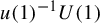 $u(1)^{-1}U(1)$
and
$u(1)^{-1}U(1)$
and $V(1)v(1)^{-1}$
are contained in
$V(1)v(1)^{-1}$
are contained in
 $$ \begin{align*} \operatorname{\mathrm{SL}}_\infty(\mathbb{Z}[H]) = \{W \in \operatorname{\mathrm{GL}}_\infty(\mathbb{Z}[H])\:| \det(W)=1\}. \end{align*} $$
By a K-theoretic result of Oliver, see [Reference OliverOli88, Theorem 14.2(iii)], we have $\operatorname {\mathrm {SL}}_\infty (\mathbb {Z}[H])=\operatorname {\mathrm {EL}}_\infty (\mathbb {Z}[H])$
for the cyclic group H. Hence,
$\operatorname {\mathrm {SL}}_\infty (\mathbb {Z}[H])=\operatorname {\mathrm {EL}}_\infty (\mathbb {Z}[H])$
for the cyclic group H. Hence, $(I-A')_\infty $
and
$(I-A')_\infty $
and $(I-B')_\infty $
are
$(I-B')_\infty $
are $\operatorname {\mathrm {EL}}_\infty (\mathbb {Z}[H])$
equivalent. Therefore, Theorem 8.2(ii) is satisfied, and
$\operatorname {\mathrm {EL}}_\infty (\mathbb {Z}[H])$
equivalent. Therefore, Theorem 8.2(ii) is satisfied, and $(X_{\mathcal {E}(A)},\sigma ,\alpha _A)$
and
$(X_{\mathcal {E}(A)},\sigma ,\alpha _A)$
and $(X_{\mathcal {E}(B)},\sigma ,\alpha _B)$
are G-flow equivalent.
$(X_{\mathcal {E}(B)},\sigma ,\alpha _B)$
are G-flow equivalent.
Remark 8.7. The precise condition in Olivier’s result for $\operatorname {\mathrm {SL}}_\infty (\mathbb {Z}[H])=\operatorname {\mathrm {EL}}_\infty (\mathbb {Z}[H])$
with H Abelian is that either (a) each Sylow subgroup of H has the form
$\operatorname {\mathrm {SL}}_\infty (\mathbb {Z}[H])=\operatorname {\mathrm {EL}}_\infty (\mathbb {Z}[H])$
with H Abelian is that either (a) each Sylow subgroup of H has the form $\mathbb {Z}/p^n \mathbb {Z}$
or
$\mathbb {Z}/p^n \mathbb {Z}$
or $\mathbb {Z}/p \mathbb {Z} \times \mathbb {Z}/p^n \mathbb {Z}$
; or (b)
$\mathbb {Z}/p \mathbb {Z} \times \mathbb {Z}/p^n \mathbb {Z}$
; or (b) $H \cong (\mathbb {Z}/2 \mathbb {Z})^k$
. Thus, instead of cyclicity of G, one can use this condition on H in the assumptions of Theorem 8.6.
$H \cong (\mathbb {Z}/2 \mathbb {Z})^k$
. Thus, instead of cyclicity of G, one can use this condition on H in the assumptions of Theorem 8.6.
Corollary 8.8. Let $G=\mathbb {Z}/n\mathbb {Z}$
be the cyclic group of order
$G=\mathbb {Z}/n\mathbb {Z}$
be the cyclic group of order $n \in \mathbb {N}$
. Let X be the full k-shift for some
$n \in \mathbb {N}$
. Let X be the full k-shift for some $k \in \mathbb {N}$
. Let
$k \in \mathbb {N}$
. Let $(X,\sigma ,\alpha )$
and
$(X,\sigma ,\alpha )$
and $(X,\sigma ,\beta )$
be two free G-SFTs. Then, there is a G-equivariant flow equivalence between
$(X,\sigma ,\beta )$
be two free G-SFTs. Then, there is a G-equivariant flow equivalence between $(X,\sigma ,\alpha )$
and
$(X,\sigma ,\alpha )$
and $(X,\sigma ,\beta )$
.
$(X,\sigma ,\beta )$
.
Acknowledgments
The author thanks Scott Schmieding and Tom Meyerovitch for stimulating discussions about G-SFTs.

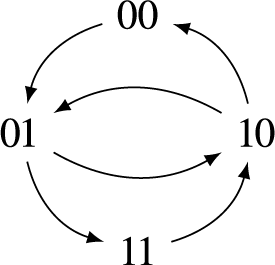

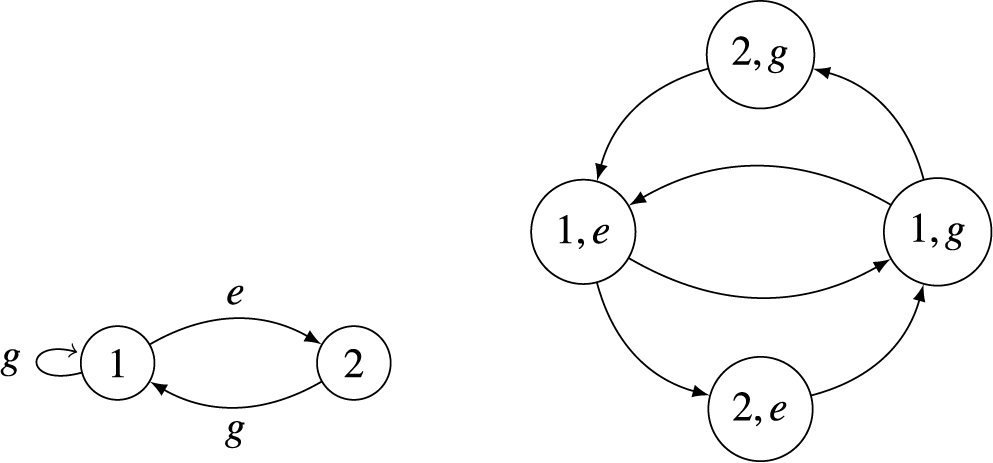


 Open access

