

Introduction
It is estimated that one in three people will care for someone with dementia during their lifetime (NHS England 2023a). The International Alliance of Carer Organizations (IACO) has defined ‘a caregiver, carer or family caregiver [as] an unpaid individual, such as a family member, neighbour, friend or other significant individual, who takes on a caring role to support someone with a diminishing physical ability, a debilitating cognitive condition or a chronic life-limiting illness’ (IACO 2024). Caring for a family member with dementia can be demanding. Higher stress and depressive symptoms are associated with poorer psychological and physical wellbeing in family members caring for people with dementia (Gilhooly et al. Reference Gilhooly, Gilhooly, Sullivan, McIntyre, Wilson, Harding, Woodbridge and Crutch2016; Rippon et al. Reference Rippon, Quinn, Martyr, Morris, Nelis, Jones, Victor and Clare2020), with higher rates of psychological sequelae than among family members caring for those with other chronic conditions (Hopkinson et al. Reference Hopkinson, Reavell, Lane and Mallikarjun2019; Schoenmakers et al. Reference Schoenmakers, Buntinx and Delepeleire2010). Family care-giving in dementia can have positive aspects (Lindeza et al. Reference Lindeza, Rodrigues, Costa, Guerreiro and Rosa2024; Quinn and Toms Reference Quinn and Toms2019), including personal growth (Lloyd et al. Reference Lloyd, Patterson and Muers2016; Quinn et al. Reference Quinn, Toms, Rippon, Nelis, Henderson, Morris, Rusted, Thom, van den Heuvel, Victor and Clare2024) and finding meaning (Quinn et al. Reference Quinn, Clare and Woods2010) which are associated with family carer wellbeing (Quinn and Toms Reference Quinn and Toms2019). However, there may be variation in the care-giving experience across different countries owing to differing cross-cultural norms, national policies and formal support systems (Zarzycki et al. Reference Zarzycki, Vilchinsky, Bei, Ferraris, Seddon and Morrison2024).
Longitudinal quantitative studies indicate that predictors of increasing care-giver burden include decreased carer wellbeing, severity of neuropsychiatric symptoms in the person with dementia, duration of care-giving and the degree of emotional support from other family members (e.g. Lethin et al. Reference Lethin, Leino-Kilpi, Bleijlevens, Stephan, Martin, Nilsson, Nilsson, Zabalegui and Karlsson2020; Lindt et al. Reference Lindt, van Berkel and Mulder2020; Malhotra et al. Reference Malhotra, Chaudhry, Shah, Østbye and Malhotra2024; Ransmayr et al. Reference Ransmayr, Hermann, Sallinger, Benke, Seiler, Dal-Bianco, Marksteiner, Defrancesco, Sanin, Struhal and Guger2018). However, the link between family carer quality of life and neuropsychiatric symptoms is not consistent (Clare et al. Reference Clare, Wu, Quinn, Jones, Victor, Nelis, Martyr, Litherland, Pickett, Hindle, Jones, Knapp, Kopelman, Morris, Rusted, Thom, Lamont, Henderson, Rippon, Hillman and Matthews2019; Farina et al. Reference Farina, Page, Daley, Brown, Bowling, Basset, Livingston, Knapp, Murray and Banerjee2017), perhaps because neuropsychiatric and behavioural symptoms are insufficiently specified across studies (Gilhooly et al. Reference Gilhooly, Gilhooly, Sullivan, McIntyre, Wilson, Harding, Woodbridge and Crutch2016). Moreover, in the IDEAL cohort study, although there was a ‘declining’ class trajectory whose depreciation in ‘living well’ was associated with factors including carer stress and depression (Clare et al. Reference Clare, Gamble, Martyr, Sabatini, Nelis, Quinn, Pentecost, Victor, Jones, Jones and Knapp2022), two-thirds demonstrated relatively stable ‘living well’ scores (quality of life, wellbeing and satisfaction with life) over 24 months.
Qualitative systematic reviews have highlighted how carers may feel a ‘hostage’ to the caring role (Macdonald et al. Reference Macdonald, Martin-Misener, Weeks, Helwig, Moody and MacLean2020) but also how spouses accommodate changes in everyday life owing to dementia and within the marital relationship (Egilstrod et al. Reference Egilstrod, Ravn and Petersen2019; Pozzebon et al. Reference Pozzebon, Douglas and Ames2016; Wadham et al. Reference Wadham, Simpson, Rust and Murray2016). In their review, largely of cross-sectional qualitative studies, Zhu et al. (Reference Zhu, Chen, He, Dong, Fang, Atigu and Sun2024) report how spouses may not adopt a ‘carer identity’ because they regard caring as an integral stage or continuation of the relationship. ‘Carer identity’ itself is defined as ‘a cognitive construction that develops when individuals characterize themselves as a caregiver to a family member or friend, normally for those in need of support due to chronic illness or disability’ (Funk Reference Funk, Gu and Dupre2019, p. 1). Certainly, Milne and Larkin (Reference Milne and Larkin2015, p. 7) argue that, ‘as caring is integral to many relationships, the distinction between caring as a normative activity and an activity beyond the normative is problematic’. Differing cultural narratives are reflected in the shift from ‘carer’ to ‘care partner’ as the preferred term in US dementia care and research, particularly for family and friends of individuals requiring minimal support such as those early into the disease trajectory (Gitlin et al. Reference Gitlin, Jutkowitz and Gaugler2020; Jeste et al. Reference Jeste, Mausbach and Lee2021). In the UK, the term ‘carer’ has remained in common use (e.g. NHS England 2023b), despite the call for its abandonment since it fails to reflect the nuances of the caring relationship (Molyneaux et al. Reference Molyneaux, Butchard, Simpson and Murray2011).
Crucially, identifying as a carer is central to accessing support and financial assessments, but not all family members adopt this label and therefore are less likely to ask for support (Glasby and Thomas Reference Glasby and Thomas2018; McAllum et al. Reference McAllum, Simpson, Unson, Fox and Kilpatrick2021). The label ‘carer’ may also be divisive in family relationships (Hughes et al. Reference Hughes, Locock and Ziebland2013; Molyneaux et al. Reference Molyneaux, Butchard, Simpson and Murray2012). It may signify a new power differential and shift in responsibility within spousal dyads, therein ‘dichotomising the couple’ (Wadham et al. Reference Wadham, Simpson, Rust and Murray2016, p. 471) and threatening couplehood (Hellström et al. Reference Hellström, Nolan and Lundh2007; Molyneaux et al. Reference Molyneaux, Butchard, Simpson and Murray2012). Other reasons for not identifying as a ‘carer’ may be allied to reasons for taking on the role such as family relationships (Greenwood and Smith Reference Greenwood and Smith2019), filial piety (Quinn et al. Reference Quinn, Clare and Woods2010) and role acculturation, particularly related to gender norms (Eifert et al. Reference Eifert, Adams, Dudley and Perko2015; McAllum et al. Reference McAllum, Simpson, Unson, Fox and Kilpatrick2021), for example with older male spouses not identifying as carers (Milligan and Morbey Reference Milligan and Morbey2016). Family members of people with dementia may also link ‘carer identity’ to the intensity of the role – that is, supporting all aspects of daily living – or with being a paid carer (Zhu et al. Reference Zhu, Chen, He, Dong, Fang, Atigu and Sun2024). Conversely, identifying as a ‘carer’ may be linked to cognisance that one’s own needs are now subjugated to those of the person with dementia (Eifert et al. Reference Eifert, Adams, Dudley and Perko2015; O’Connor Reference O’Connor2007) rather than being able to wrap a ‘boundary’ around or separate the caring role and pursue one’s own meaningful activities (Cherry et al. Reference Cherry, Ablett, Dickson, Powell, Sikdar and Salmon2019). Studies of carer online identity construction on carer websites and in blogs have highlighted different carer identities such as ‘prisoner’, where family carers feel trapped by the caring role (Cooper Reference Cooper2021), and ‘guardian of their relative’s selfhood’, where family carers try to preserve their relative’s personhood, with different carer identities remaining stable over months or even years (Prato et al. Reference Prato, Abley and Adamson2022). However, in both these studies, the differing online carer identities adopted were by family members who had already assumed the ‘carer’ label rather than by those who had not.
Evidently, ‘carer identity’ may be more nuanced, fluid and temporally situated than is afforded by carer identity theory (Montgomery and Kosloski Reference Montgomery and Kosloski2009, Reference Montgomery, Kosloski, Talley and Montgomery2012; Montgomery et al. Reference Montgomery, Kwak, Kosloski and O’Connell Valuch2011), which presumes that carer identity develops over time with the demands of the caring role. By contrast, positioning theory has been applied in carer identity research (e.g. Morgan et al. Reference Morgan, Duschinsky, Gott and Barclay2021) to describe situations where individuals use discourses to position themselves, presenting ‘rights’ for themselves and ‘duties’ for others (Harré et al. Reference Harré, Moghaddam, Cairnie, Rothbart and Sabat2009; Knowles et al. Reference Knowles, Combs, Kirk, Griffiths, Patel and Sanders2016; O’Connor Reference O’Connor2007). Morgan et al. (Reference Morgan, Duschinsky, Gott and Barclay2021, p. 1) draw on positioning theory to describe how ‘calling forth the carer identity’ is a co-constructed, discursive practice of ‘carering’ between individuals and policy makers, researchers and broader cultural narratives. For example, family members may be positioned as ‘carers’ by researchers and health-care professionals to ensure care provision (Henwood et al. Reference Henwood, Larkin and Milne2018). Such accounts are suggestive of the tension where ‘living well’ for people with dementia may be at the expense of that of family members, where the more negative accounts of family care-giving are underplayed within the ‘living well’ discourse (Tolhurst et al. Reference Tolhurst, Carey, Weicht and Kingston2019).
Further longitudinal, qualitative research is needed to add to understanding of carer identity in family members of people with dementia. This is particularly important given the shift in emphasis from carer self-identification to proactive identification of carers in order to target support (Carers UK 2022; Glasby and Thomas Reference Glasby and Thomas2018; House of Commons Health and Social Care Committee 2021). Such research is important to understand how family members in a caring role for people with dementia negotiate the role over time, its potential impact on their wellbeing and what influences if or how they adopt a carer identity. Using longitudinal, qualitative interviews on ‘living well’ with dementia from the IDEAL cohort study, we aimed to identify the shifting, embedded narratives of family members of people with dementia as they negotiated the caring role and carer identity over time. Specifically: what impacts ‘living well’ and psychological coping over time for family members of people with dementia; what narratives do family members use to frame the caring role and do these change over time; and is a carer identity evident at each time point?
Methodological approach
Study design and ethics
This longitudinal, qualitative study on ‘living well’ with dementia was conducted with family members as part of a larger cohort study, IDEAL (Improving the experience of Dementia and Enhancing Active Life). The IDEAL study was approved by Wales Research Ethics Committee 5 (reference 13/WA/0405) and IDEAL-2 by Wales Research Ethics Committee 5 (reference 18/WS/0111) and the Scotland A Research Ethics Committee (reference 18/SS/0037). Additionally, IDEAL and IDEAL-2 are registered with the UK Clinical Research Network (UKCRN), numbers 16593 and 37955. Details of both the quantitative and the qualitative IDEAL components are available in the published protocol (Clare et al. Reference Clare, Nelis, Quinn, Martyr, Henderson, Hindle, Jones, Jones, Knapp, Kopelman, Morris, Pickett, Rusted, Savitch, Thom and Victor2014).
Sampling and recruitment
For the quantitative component of the IDEAL cohort study, people with dementia living in the community and their family member study partners were recruited by clinical researchers via UK National Health Service (NHS) Research Networks across 29 sites in England, Scotland and Wales from 2014 to 2016. Recruitment was based on a clinical diagnosis of dementia in the mild-to-moderate stages, in accordance with an MMSE (Mini-Mental State Examination) score of 15 or above (Folstein, Folstein and McHugh, Reference Folstein, Folstein and McHugh1975). Where the person with dementia was willing to take part, with their permission, a key family member was approached to participate.
For the qualitative component of IDEAL, a diverse sample of participants was recruited from the quantitative cohort using maximum variation sampling (Patton Reference Patton2014), based on clinical and socio-demographic characteristics of the person with dementia including a diagnosis of Alzheimer’s, vascular or mixed dementia at age 65 or over; gender; and socio-economic background based on income and previous occupations. (Findings from the qualitative interviews with people with dementia are reported in Stapley et al. [Reference Stapley, Pentecost, Hillman, Jones, Morris, Quinn, Ravi, Thom and Clarein press].) The family members of those with dementia interviewed were also invited to take part in and consented to a qualitative interview. No additional sampling strategy was employed for family members.
Longitudinal semi-structured interviews
Semi-structured interviews were used to cover the same topics across all interviewees, whilst allowing flexibility to follow up on relevant points of interest raised by interviewees themselves. Interview topics across both interviews included coping and adapting, family and relationships, wider networks, services and support, change and ‘living well’. Example questions included: ‘What does “living well” mean to you?’, ‘How are things for (insert name) at the moment?’, ‘What kind of changes have you noticed in them over the past year?’ and ‘Has your relationship changed and, if so, in what ways?’ Interviewees’ first interviews were also used to aid discussion during follow-up interviews, which focused on any possible changes since the first interview. For example: ‘We talked in our last interview about your relationship with (insert name). Do you feel things have changed between you since we last met? In what way?’ ‘Carer identity’ was not asked about specifically, although its presence or absence was evident from the accounts of family members when they discussed the caring role and their relationship with the person with dementia. Also if interview questions on ‘carer identity’ had been asked, these may have triggered performative accounts, where a ‘carer identity’ may have been enacted for the interviewer or conversely resisted, thus perhaps not reflecting interviewees’ everyday experiences. Interviews were conducted in family members’ own homes by an experienced qualitative researcher with a background in medical sociology. All interviews were audio-recorded then professionally transcribed.
Longitudinal thematic and narrative analyses
Longitudinal qualitative analyses were based on 14 sets of Time 1 and Time 2 interview transcripts, with an additional 6 interview transcripts available for analysis at Time 1 only, where interviewees had not completed a follow-up interview owing to participant attrition. Both sets of interviews were summarized in grid format by the analyst, SSt, to aid familiarization and data management (Braun and Clarke Reference Braun and Clarke2006; Clarke and Braun Reference Clarke and Braun2022) and enable first and second interview content to be contrasted. Thematic analyses were completed cross-sectionally and longitudinally (Derrington Reference Derrington2018; Thomson and Holland Reference Thomson and Holland2003) using NVivo (2020) to enable inductive insights into group and individual experiences (Tuthill et al. Reference Tuthill, Maltby, DiClemente and Pellowski2020). Transcripts from the six participants interviewed at T1 only were included in the cross-sectional, thematic analysis, both to add to the corpus of data and hence facilitate data saturation as well as to ensure that these participants’ contributions to the study were included. Longitudinal descriptive themes from the analyses relevant to ‘living well’ and psychological coping with the caring role were finalized by contrasting T1 and T2 thematic analyses to determine which themes remained dominant longitudinally.
Within-case longitudinal, narrative analyses were also employed to explore family members’ experiences of the caring role, how it was negotiated over time and whether a ‘carer identity’ was evident from their accounts. We employed holistic-form structural narrative analyses (Lieblich, Tuval-Masiach, and Zilber Reference Lieblich, Tuval-Masiach and Zilber1998; Smith Reference Smith, Smith and Sparkes2017), which Frank (Reference Frank, Holstein and Gubrium2012) terms ‘dialogical narrative analysis’. This approach enabled us to focus on family members’ embedded or latent narrative types in negotiating the caring role within their discussions of ‘living well’, in which themes from the longitudinal, thematic analyses are interwoven, that is, how family members narrated their caring experiences and if this changed over time. This addresses the criticism of structural narrative analyses being at the intrapersonal level only (Murray Reference Murray and Camic2021) and moves towards understanding how individual narratives are shaped by interpersonal and sociocultural influences.
Through longitudinal, holistic-form structural narrative analyses, focus was on identifying dominant and secondary narrative types and whether these shifted over time. A narrative type was interpreted as ‘dominant’ where an interviewee’s way of speaking about the caring role was evident throughout the interview and dominated particularly relevant sections of talk, for example when discussing the relationship with the person with dementia. A narrative type was classified as ‘secondary’ where this type was also evident in how an interviewee discussed the caring role but was secondary to or less apparent than a dominant narrative type. Varying, even opposing narrative types or genres can coexist (Frank Reference Frank2013); therefore, the narrative types derived are not positioned along a continuum.
A narrative typology to characterize negotiating the caring role was developed from the analyses of both datasets. In narrative analyses of the Time 1 and Time 2 interviews, respectively, analytic attention was paid to identifying a clear narrative line, apparent throughout each participant’s interview, for example by observing repetition, evaluative comments and participants’ own reflections, then building a narrative typology (Smith Reference Smith, Smith and Sparkes2017) that ensured fit within and distinctiveness across narrative types (Kluge Reference Kluge2000). The interview transcripts from the six participants interviewed at Time 1 only were included in the cross-sectional narrative analysis to add further data to aid differentiation between the different narrative types identified. The dominant and secondary narrative types of individual interviewees were also contrasted between Time 1 and Time 2 to determine if these had shifted over time. In addition, the presence or absence of a ‘carer identity’ was an interpretive judgement determined by interviewees’ accounts of the caring role at each time point, for example if an interviewee self-referred using the term ‘carer’ or wanted access to respite care. To facilitate quality within longitudinal, thematic analyses (Nowell et al. Reference Nowell, Norris, White and Moules2017) and narrative research (Andrews Reference Andrews2021), CP reviewed a sample of the interviews and took part in ongoing discussions with SSt regarding the analyses. The analyses were also discussed with IDEAL team members. Because of the time gap between the data collection and the analyses, owing to research team member changes, it was not possible to request participant feedback.
Findings
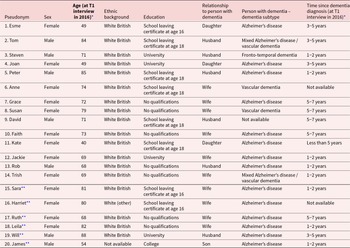
Twenty family members of people with dementia took part in a first qualitative interview in 2017, with 14 taking part in a follow-up interview one year later in 2018. First and follow-up interviews were conducted, with first interviews lasting from 41 to 113 minutes, and follow-up interviews from 19 to 65 minutes. Our 20 interviewees ranged in age from 40 to 88 and were predominantly White British; 10 were male and 10 female, reflecting 16 spousal relationships and 4 filial relationships (see Table 1). Of their relatives, 15 had Alzheimer’s, 2 vascular dementia, 2 mixed (Alzheimer’s and vascular) and 1 frontotemporal dementia. Interviewees are referred to using pseudonyms.
Characteristics of the family members and people with dementia

* ‘Age’ and ‘Time since dementia diagnosis’ have been estimated from IDEAL survey data collected in 2014. No socio-demographic or clinical characteristics data were collected at the time of the T1 qualitative interviews.
** Completed T1 interview only.
Longitudinal, interrelated themes from the analyses relevant to ‘living well’ and psychological coping with the caring role reflect interview accounts at both time points and are interwoven within the family members’ narrative types of negotiating the caring role, for example, within a carer narrative, how a family member discussed coping with dementia decline. To retain focus on carer narrative types, these descriptive themes are not detailed separately but comprise: the health problems of family members (e.g. mobility problems), the care needs of the person with dementia related to dementia decline and other physical health problems (e.g. worsening memory, mobility issues, incontinence), personality change in the person with dementia (e.g. mood changes, loss of inhibition), relationship change (e.g. lack of reciprocal conversation, fewer shared activities), social isolation (e.g. lack of local, family support networks owing to geographical mobility) and variable service support (e.g. absence of post-diagnostic support, pushing for adequate social care).
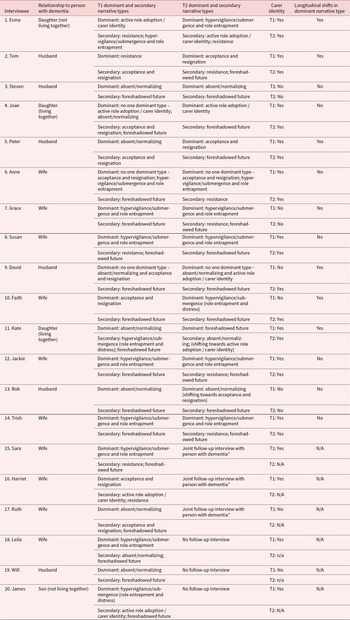
Six narrative types or genres related to negotiating the caring role over time were identified within family members’ accounts of ‘living well’ with dementia: absent/normalizing, active role adoption/carer identity, resistance, acceptance and resignation, hypervigilance/submergence and role entrapment, and foreshadowed future (see Table 2). These are reported as dominant and secondary narrative types, where shifts in narrative types across interview time points are evident (see Table 2). Each narrative type, with one or more illustrative exemplars, is presented. The presence or absence of a ‘carer identity’ was also interpreted from these accounts, for example where interviewees explicitly called themselves a ‘carer’ or from discussions about issues such as wanting respite care. A ‘carer identity’ was apparent within the accounts of all filial but not all spousal interviewees. Notably, for several interviewees the temporal fluidity of the carer identity was apparent, for example where this identity was contextualized to specific caring tasks or at times actively resisted to protect the relationship with the person with dementia. There was also an absence of a carer identity even where some interviewees were finding the caring role demanding.
Longitudinal dominant/secondary narrative types and carer identity

* The caring role was not discussed in the joint follow-up interviews.
Absent/normalizing
Absent/normalizing refers to a narrative type where the impacts of dementia and the caring role are minimal or absent, and where support for the person with dementia is framed by the spousal or filial relationship. Such ‘normalizing’ may be because, in the early stages of the illness, dementia was not greatly impacting the person with dementia and therefore they needed little support. Absent/normalizing was the dominant narrative type for six interviewees at first interview, particularly for male spouses. Our male spousal interviewees emphasized caring within the context of the spousal relationship.
By the time of his first interview, Steven’s wife had had dementia for three years, with little perceived decline, which he attributed to his wife staying active. Both Steven and his wife avoided the dementia ‘label’, instead preferring the term ‘aphasia’. Steven’s caring role was to remember words for his wife whose frontotemporal dementia had worsened by Steven’s second interview but the impacts of which, perhaps owing to this dementia type, were still minimal:
I know what the problem is, because I live with it everyday. Erm, it’s, it’s not that much of a problem as far as I’m concerned because I’m (pause) good with words. Erm … So I remember words, erm, and can supply them for [my wife]. Part of everyday life. (Steven, T1)
So it’s getting worse and it will progress no doubt, err, and I’ll be filling in more gaps. (Steven, T2)
Therefore, by ‘filling in more gaps’, Steven seemed to be employing a cognitive compensatory strategy for his wife that seemed to support their relationship or sense of couplehood. This was also apparent through Steven’s use of the ‘we’ pronoun throughout his interviews to discuss his and his wife’s shared journey with dementia:
I mean, we, we’ve both lived with this for what, three year plus now. And, yes, it’s getting worse … But not to the extent where it’s being … a sort of … noticeable impact on our lifestyle. (Steven, T1)
Notably, Steven rejected a carer identity because he regarded this as a more intense and ‘stereotypical’ role, so that remembering words for his wife was the only time during which being a ‘carer’ was marginally apparent. He also questioned why family members were positioned as ‘carers’ in surveys about dementia:
I keep making the point when I do the tick list of 400 questions or whatever, um, ‘has your role as a carer, carer, this and carer that’ and on one of them I said ‘I’m not a carer as such, you know, all I do is fill in the odd word that [my wife] cannot remember’. But carer to me is, is a much more intense, um hands on. Um almost a sort of physical looking after, and that’s totally unnecessary. Um so I realize that there’s probably not a word that could replace it, but I am careful to point out occasionally that what they might imply by ‘carer’ is not how I see myself. (Steven, T2)
Another interviewee also emphasized maintaining couplehood with his wife – ‘we don’t need other people’ (Rob, T1) – and the shared experience of living with dementia, although, by his second interview, this had become ‘we don’t need other people yet’ (Rob, T2):
You know, it’s er, very … very strange to come to terms with, a bit like Alice in Wonderland, I think, you know. But er, you know, we’re coping pretty well with it. (Rob, T1)
Like several interviewees, Rob also missed ‘proper conversation’ with his wife, with this as a marker of relationship change and potential social isolation. Rob also emphasized the normality of their lives, in spite of his wife’s short-term memory problems and mood swings, the latter of which had been particularly severe prior to his wife knowing her diagnosis. Like Steven, Rob himself equated being a ‘carer’ with needing to offer his wife more support:
In the realm of things, we lead quite a normal everyday life, just a little bit strange. [laughs] … She’s a fully functional person, as she always has been, so … which has taken a lot of pressure off me. If I was having to … er, be more a carer, then that would be a lot different. (Rob, T1)
By his second interview, his wife had declined, including waking up confused in the night, which had been a shock to him: ‘the change is we’ve just taken one more step down the road’ (Rob, T2).
‘Normalizing’ was also evident in other ways within interviewees’ accounts, such as Peter regarding his wife’s memory problems as ‘natural progression’ owing to ageing: ‘I suppose everybody has the same sort of problems’ (Peter, T1). For James, absent/normalizing had been his father’s narrative. James had taken on caring for his mother suddenly after his father’s death, with some resentment that he had not been warned about her needs: ‘the legacy he’s left us’ (James, T1). Absent/normalizing may also be inadvertently reinforced. Our interviewees mostly reported a lack of follow-up after the diagnosis, which may minimize opportunities to discuss the care needs of the person with dementia and hence the caring role of family members. Also, as with Rob’s stepson, visiting family members may not immediately notice the difficulties facing the person with dementia and so also overlook the care being provided: ‘I think he’s noticed now because the longer you spend with her, the more you can see the problems she’s got. Quick chat and then gone, she’s quite normal, no problem’ (Rob, T2). In her interview, Jackie spoke about her husband similarly: ‘I don’t think the children see him as being as much of a problem as I do’ (Jackie, T1). Consequently, family members may not fully recognize their own caring role because it is not recognized by others.
Active role adoption / carer identity
Unlike ‘absent/normalizing’ where the impacts of dementia are largely negated, the ‘active role adoption/carer identity’ narrative type describes family members actively taking on the caring role and adopting a carer identity where the role may be discussed positively. This was a single or shared dominant narrative type for two interviewees at first interview, both daughters of mothers with dementia, and also a secondary narrative type for one other, highlighting how the availability of the carer identity may be not always constant but rather temporal and situation-specific.
This was a secondary narrative type for Harriet, who discussed now running the carers’ group whilst their relatives attended memory group sessions:
It’s rather nice. They have set aside a room for the carers, and we can chat. And now that we’ve been together for over a year, we can really chat … and um, sometimes I … I seem to have taken it over somehow. (Harriet, T1)
Similarly, Esme, whose narrative was dominated by discussion of her caring role, talked about going regularly to a memory group with her mother. Esme described herself as a carer: ‘on a Tuesday I’m the carer, so I do all her meds and what have you’ (Esme, T1). She also spoke of actively engaging with her mother’s paid carers during the rest of the week: ‘I leave them little messages and stuff like that’ (Esme, T1). However, by her second interview, Esme had become overburdened by the caring role because her own chronic health condition had worsened.
Within Joan’s account, two dominant narrative types were evident, both active role adoption / carer identity and absent/normalizing, where a carer identity was evident within the former only. Although having ‘freaked out’ for the first three months after her mother’s dementia diagnosis, Joan had now accepted her mother’s diagnosis, drawing on a carer identity that included advocating for better carer support and researching dementia herself: ‘I’m like Miss Marple, I like to find out’ (Joan, T1). Throughout her interview, Joan also positioned herself as a good carer compared with others whom she felt regarded Alzheimer’s as ‘some sort of curse’, and in both interviews she emphasized the importance of adjusting to the caring role:
You’ve got to adjust your attitude completely. Completely. And I see a lot of people who have got, you know, got relatives with this and they’re almost like operating as normal. You can’t. You’ve got to really just get a total change in your attitudes to how you deal with the eccentricities of it and their repetition which can drive you bananas! And you just have to kind of … and try and distract them if they do get distressed. It’s very much, I mean I’ve been doing it for ten years now. I feel like an old hand. (Joan, T1)
You know, it’s all the attitude, it’s all about the attitude. (Joan, T2)
However, Joan also switched to her other dominant narrative of ‘normalizing’ her caring role within the context of the mother–daughter relationship, including reiterating their similar sense of humour and shared activities such as going to the theatre. Joan saw taking on the caring role as ‘an honour’, wanting to do it and regarding herself as the most patient of her siblings to do so, in spite of having had a difficult relationship with her mother in the past. For Joan, care-giving for her mother, within their renewed mother–daughter relationship, was a positive experience. Therefore, in Joan’s account, both a carer identity and distancing herself from it owing to the filial relationship coexisted, again highlighting the fluidity of the carer identity; although, with her mother’s needs intensifying by the second interview, such distancing was less apparent, with Joan’s carer identity beginning to dominate.
Resistance
By contrast with actively adopting the caring role and largely as a secondary narrative type, ‘resistance’ reflects how the caring role is compartmentalized in order to protect the spousal or filial relationship or to protect the family member’s own interests and wellbeing. Resistance was a dominant narrative type at first interview for one interviewee but was identified predominantly as a secondary narrative type. For Esme, with resistance as a secondary narrative, maintaining the mother–daughter relationship was important to her, such as by going on excursions together, even though Esme’s mother did not always remember what they had done. When asked specifically what ‘living well’ meant to her, preserving their relationship was central: ‘well, I think the main thing is, it’s trying for us to actually keep the sort of relationship we’ve got’ (Esme, T2). For Anne, a former nurse, the caring role had become easier by her second interview, in spite of her husband’s deteriorating mobility, because she was able to adopt a nursing role and therein protect their relationship:
I think erm, in a funny sort of way sometimes it’s easier, erm I’m a retired nurse … so, I do try and go into nursing mode rather than wife mode. Erm, I don’t have any problems with all these things that can go wrong and in some ways it’s, it’s more settled. Erm, it’s awful, isn’t it? As it gets worse it gets more settled. But I can, I can understand and handle that better in a way, yeah. (Anne, T2)
For Susan, resistance manifested in trying to protect her needs and self-identity. Her husband’s dependence on her had become difficult – ‘it’s the clinginess that gets to me’ (Susan, T1) – when pursuing her own separate interests was important for her wellbeing: ‘I think because he doesn’t like to let go of me, I’ve decided I’ve just got to be a bit firmer’ (Susan, T1). Similarly, Tom’s wife had become dependent on him and disliked him going out, particularly to his sports club. For Tom, in his 80s, resistance was his dominant narrative type, wanting to keep himself physically and mentally active in older age:
I am not going to give up my interest because, you know, I don’t want to sit here, day in, day out, and deteriorate. (Tom, T1)
I want to try and keep active in the mind as well as my body like, so I play dominoes twice a week at the club which she doesn’t like me going there. But I can’t sit here and be a cabbage. So I want to keep my brain going and meet people etc. (Tom, T1)
However, by his second interview, Tom had taken on personal care tasks for his wife, her dementia had worsened and he was now unable to go out until his wife was in bed. Even Tom watching sport on television had been stopped because his wife preferred her own programmes. Therefore, with his wife’s needs increasing and Tom’s caring role intensifying, by his second interview, resistance was apparent as Tom’s secondary, not dominant, narrative type.
Acceptance and resignation
Instead of resisting the caring role, ‘acceptance and resignation’ refers to accepting the caring role and becoming resigned to its demands, even when such challenges threaten to become overwhelming. This was a dominant narrative type of four interviewees at first interview, with most but not all also expressing a carer identity. Faith felt that she was coping with her husband’s Alzheimer’s and other health problems, although saying that, because they both had mobility issues and did not go out much, life now was ‘just an existence’ and ‘we just miss, I miss all the nice things we used to do’ (Faith, T1). This shift in pronoun from ‘we’ to ‘I’ is also suggestive of their changed relationship, with Faith saying that she and her husband no longer shared the decision-making and that her husband now remembered more of his marriage with his first wife than with her: ‘I’m not alone but it’s lonely, if you know what I mean’ (Faith, T1). However, Faith seemed resigned to the caring role, with her daughters assuming that she was coping, also not wanting the support of paid carers, even after her husband’s hospital stay, because this would encroach on her spousal role:
So I said, as long as I’m able to do things, I’d want to do it. I wouldn’t really want anybody doing what I saw to be my job. (Faith, T1)
Therefore, Faith discussed the caring role in terms of being a wife rather than drawing on a carer identity, even though she was starting to find the role difficult:
Unless you’re actually living with it, you don’t, you can’t explain what it’s like really. Um, people say, ‘Oh, look at that poor chap, he’s got Alzheimer’s!’ But they don’t say, ‘Look at that poor woman, she’s got to look after him!’ (laughs). (Faith, T1)
By contrast, Harriet did see herself as her husband’s ‘carer’ but had concerns about taking on this role without follow-up support and expertise from his memory clinic:
I felt that was a loss because it meant it was another person, with other expertise, keeping an eye on him. 'Cos sometimes perhaps they think, you know, the carer should know everything. Well, I don’t. (Harriet, T1)
Harriet did not want her husband going into residential care but did want one or two weeks’ respite to catch up with chores around the home and because she was ‘so physically and mentally exhausted sometimes’ (Harriet, T1). Harriet was also losing out on her own relationship with her grandchildren because her husband could tolerate them visiting only for short periods. Therefore, Harriet saw looking after her husband as a full-time job and was resigned to the role, even though this meant that her own needs had become eclipsed in the process:
Knowingly or unknowingly, he has become the centre of which I am spinning around. And I’m doing the best … I’m not a nurse, and I’m not a doctor. But I’ve got a lot of common sense. (Harriet, T1)
With acceptance and resignation, family members may be finding the caring role difficult, but they seem resigned to it and do not ask for or expect support or even know how this can be accessed. Family members with this narrative, which is quieter than the next to be discussed, and because they seem to be coping, may be unheard and overlooked.
Hypervigilance/submergence and role entrapment
This was the dominant narrative type of seven interviewees at first interview, characterizing dimensions of how the demands of the caring role may become difficult to cope with or even untenable. Hypervigilance refers to the family member being in a constant state of watchful awareness to accommodate the care needs of the person with dementia. Similarly, submergence refers to how they may feel overwhelmed by the caring role and meeting the person with dementia’s needs. Coping with the demands of the caring role is sometimes expressed as role entrapment, where the family member feels trapped or imprisoned by the caring role. Family members may also describe the caring role as distressing, which was evident during some of our interviews, including where interviewees became visibly upset.
Hypervigilance was experienced by family members including Jackie, who discussed ‘a continual battle’ (Jackie, T2) to keep her husband drinking enough to stay hydrated. She also faced ‘this continual battle ‘this continual battle to try and keep him stimulated’ (Jackie, T2) rather than asleep all day. For Leila, whose husband could not be left home on his own, shopping trips to the supermarket had become challenging because her husband needed help spotting the items they wanted on the shelves: ‘by the time I’ve had an hour in [the supermarket], I’m really, really at my end, you know. I really, really am. But I can’t leave him here’ (Leila, T1). Susan’s stress was compounded by not knowing when she was going to get a break. Having been told she would get respite care every six weeks, Susan had not had a break in four years, which she contrasted with staff working in residential care:
If I knew for definite I would get [breaks] I’d be able to cope better. I mean for goodness sake, we’re both 81! It’s not as if I’m a young … And it’s like in the homes, they have a break. But when I’m getting up at night and then looking after him all day, he’s 24/7. (Susan, T2)
Similarly, Trish felt that she supported her husband at the expense of her own needs:
He’s got more of a social life than I’ve got because I’m the one doing the running around … So if I want to go anywhere, I can’t now. (Trish, T1)
Like Harriet, also, Susan felt that she had been subjugated to support her husband who was becoming ‘more of a handful’ but was unaware that his dementia was affecting her too: ‘he pushes me in the background really’ (Susan, T2). Susan also said that, although they could afford it, she had been unable to access appropriate care for her husband. The day centre her husband was going to was reluctant to have him back because he had been upsetting other attendees and walked out: ‘so it’s making me a prisoner, isn’t it?’ (Susan, T1). By her second interview, Faith reported feeling more socially isolated, depressed and trapped in the caring role, reflecting a carer identity by this time point, with her narrative shifting from acceptance to submergence:
Well, there’s no end, you can’t see an end to it, can you? This is the thing, and you sort of think, well, this is your life, this is how it’s going to be for the rest of your life sort of thing, you know. (Faith, T2)
There was also discussion of shifts in the spousal relationship, with Trish saying that she thought her husband did not like her anymore. For Susan, her relationship with her husband had also shifted from a marital relationship to more of a friendship: ‘I care about him but I don’t love him anymore’ (Susan, T2).
In her first interview, Grace’s was the strongest hypervigilance/submergence narrative, with pre-existing relationship tensions magnifying her distress and the difficulties in adjusting to her husband’s dementia. She alternated between saying how stressed she got – ‘I do lose my rag with him’ – and repeating ‘we’re alright’ (Grace, T1). Grace missed the person her husband used to be and who would help her around the house:
Well, they’re not the same, are they? I mean I am used to that now. Because I’ll say, where is my [names husband]? He used to help me. (Grace, T1)
Yet, even though Grace seemed overwhelmed by the caring role and the most distressed of those interviewed, she did not draw on a carer identity but rather seemed to reject it, not wanting to be paid Carers Allowance, not wanting her new GP [general practitioner] to discuss her husband’s diagnosis and not regarding her husband as ill and needing care:
It were strange getting money for [names husband], he’s my husband. So he gets the money that’s supposed to be for him but I didn’t want any so please don’t ask me about it because I ain’t doing it. (Grace, T1)
I am not looking after him, sick, yet, am I? (Grace, T1)
Rather, Grace seemed to regard her support for her husband as a continuation of the spousal role: ‘[my son] says he relies on you a lot more … but it’s nothing more than what I’ve probably always done’ (Grace, T2). By her second interview, Grace also seemed to have shifted more towards an acceptance and resignation narrative, although this could have been a performative device for the interviewer: ‘we’re fine, aren’t we? I’m sure you think we are’ (Grace, T2). Grace also continued to distance herself from a carer identity. This may have been reinforced during her husband’s annual review, where she was told they did not need support – ‘like she said, we don’t need carers’ (Grace, T2) – although not needing paid carers did not mean that Grace was not a carer herself.
Foreshadowed future
This narrative was apparent as a secondary narrative type across most interviews at both time points; it refers to family members looking to the future and their potential increased caring role, which may have been foreshadowed by their evolving experiences of the caring role. The dementia care-giving trajectory was salient for many, although distanced by others. During both interviews, most but not all were anticipating the future as the person with dementia declined: ‘I am not even going to think about it. No, I’ll cross that bridge when I come to it’ (Ruth, T1). However, others were aware that ‘there’s nothing easy about it, and it’s only going to get more difficult’ (Anne, T1), with Jackie wanting to know how future support could be accessed: ‘I think I’d probably be happier if I, if I knew specifically where the backup’s going to come as he gets worse’ (Jackie, T1).
Having largely employed an absent/normalizing narrative in her first interview, Kate, by her second, had shifted to foreshadowed future as her dominant narrative. Her mother lived with Kate and her partner, with Kate wanting them to develop a strong bond now before her mother’s dementia progressed: ‘I want them to have a good strong relationship before things get harder’ (Kate, T2). Kate expressed concerns about the future, potentially having to give up work to take on the caring role full-time as well as questioning her ability to cope:
There’s lots of things I think about and worry about but it’s like … it’s more for down the line that I worry, like. (Kate, T2)
To be honest with you, I’m scared stiff. I don’t know, I don’t know if I can look after her but I’m going to give it a go, you know. (Kate, T2)
For Joan, seeing the impact of other health problems on her mother, such as dealing with a cataract operation, had given her ‘a taste of what life’s going to be like’ if her mother became ill with other health problems, ‘and life’s going to be a nightmare’ (Joan, T1). Therefore, for some interviewees, thinking about the future meant fearing intensification of the caring role. For those already subsumed by caring and perhaps a carer identity, the dementia trajectory and future care-giving may have been too difficult to contemplate.
Discussion
This study sought to identify what impacts ‘living well’ and psychological coping over time for family members of people with dementia, the narratives they use to frame the caring role, if these change over time and if a carer identity was evident at each time point. ‘Living well’ themes that remained salient longitudinally were the health problems of family members, the care needs of the person with dementia related to dementia decline and other physical health problems, personality change in the person with dementia, relationship change, social isolation and variable service support. The longitudinal themes interwoven within the narrative types of caring presented suggest how such domains are important longitudinally and cumulatively, even though longitudinal, quantitative scores on living well remain relatively stable (Clare et al. Reference Clare, Gamble, Martyr, Sabatini, Nelis, Quinn, Pentecost, Victor, Jones, Jones and Knapp2022). The six dominant or secondary narrative types of family members caring for a person with dementia reflect a range of discussions of dementia care-giving over time: from this as a minimal role (‘absent/normalizing’) to accepting the caring role and becoming resigned to its demands (‘acceptance and resignation’) to care-giving demands dominating the lives of family members (‘hypervigilance/submergence and role entrapment’) to considerations of future caring (‘foreshadowed future’). In addition, family members actively took on being a ‘carer’ (‘active role adoption / carer identity’) or, conversely, compartmentalized the caring role to protect the spousal or filial relationship or their own interests and wellbeing (‘resistance’).
As well as identifying shifting dominant and secondary narrative types over time, our findings have demonstrated the fluid nature of carer identity; for example, the coexistence of more than one dominant narrative type, such as ‘active role adoption / carer identity’ and ‘absent/normalizing’, and the protective function of the ‘resistance’ narrative. The fluidity of the carer identity has been suggested in previous cross-sectional work (Hughes et al. Reference Hughes, Locock and Ziebland2013; Morgan et al. Reference Morgan, Duschinsky, Gott and Barclay2021), although our longitudinal narrative findings provide additional support. This temporal fluidity of ‘carer identity’ also negates carer identity theory where transition into the carer identity is regarded as uni-directional, fixed and untransmutable (Montgomery and Kosloski Reference Montgomery and Kosloski2009, Reference Montgomery, Kosloski, Talley and Montgomery2012; Montgomery et al. Reference Montgomery, Kwak, Kosloski and O’Connell Valuch2011). However, our work still supports care-giving transitions outlined in ‘caregiving careers’ (Aneshensel et al. Reference Aneshensel, Pearlin, Mullan, Zarit and Whitlatch1995), where focus is on caring roles and stress appraisal rather than carer identity. Such as with some of our interviewees’ ‘hypervigilance/submergence and role entrapment’ narratives, adopting caring roles can be perceived as stressful but may still be distinct from adopting a carer identity, therein countering assumptions that role engulfment leads to carer identity development (Eifert et al. Reference Eifert, Adams, Dudley and Perko2015).
Key insights in relation to assuming a carer identity may be gleaned from focus on the ‘absent/normalizing’ and ‘hypervigilance/submergence and role entrapment’ narratives specifically. First, the ‘absent/normalizing’ narrative adopted by our spousal, particularly male interviewees is commensurate with how a ‘carer identity’ may not dominate because caring is accommodated within or seen as a continuation of the spousal relationship (Egilstrod et al. Reference Egilstrod, Ravn and Petersen2019; Zhu et al. Reference Zhu, Chen, He, Dong, Fang, Atigu and Sun2024), as was also evident across other narrative types within the study. A gendered response to caring was apparent in our interviews, where, as in previous research, older male spouses did not identify as carers (Milligan and Morbey Reference Milligan and Morbey2016), wanting to protect their relationship from the impacts of dementia (Wadham et al. Reference Wadham, Simpson, Rust and Murray2016), from the intrusion of the dementia ‘label’ and from unwanted support and intervention (Arksey and Glendinning Reference Arksey and Glendinning2007; Stephan et al. Reference Stephan, Bieber, Hopper, Joyce, Irving, Zanetti, Portolani, Kerpershoek, Verhey and De Vugt2018). Examples are Steven and his wife’s preference for the term ‘aphasia’, rather than ‘dementia’, and Rob’s reluctance to accept support from others. In addition, our work has highlighted how not adopting a carer identity (e.g. in an ‘absent/normalizing’ narrative) was potentially reinforced by social interactions with other family members, for example adult children not recognizing the difficulties faced by their parents owing to dementia. Certainly, Smith et al. (Reference Smith, Morton and van Rooyen2022) have highlighted how other family members of the person with dementia may not understand the challenges encountered by the family member in the caring role. It is also possible that other family members may downplay the impacts of dementia as a coping strategy, to resist caring roles themselves or to enable continuation of ‘normal’, pre-diagnosis family dynamics. Other research has highlighted how spouses and people with dementia themselves may underplay changes owing to dementia, pre-diagnosis (Esandi et al. Reference Esandi, Nolan, Alfaro and Canga-Armayor2018). However, research into intergenerational family relationships in dementia is largely lacking (La Fontaine et al. Reference La Fontaine, Larkin and Oyebode2024; La Fontaine and Oyebode Reference La Fontaine and Oyebode2014).
The ‘hypervigilance/submergence and role entrapment’ narrative is not unfamiliar, resonating strongly with previous work (e.g. carers as ‘hostage’ to the caring role in Macdonald et al. Reference Macdonald, Martin-Misener, Weeks, Helwig, Moody and MacLean2020). However, in our study, even where family members were overburdened by the caring role, they did not necessarily manifest a carer identity within their interview accounts, again regarding the role as a continuation of the spousal relationship (e.g. Zhu et al. Reference Zhu, Chen, He, Dong, Fang, Atigu and Sun2024): for example, Grace was distressed by the caring role but seemed to reject a ‘carer identity’. Because of the relationship between role captivity and depression in dementia care-giving (e.g. Givens et al. Reference Givens, Mezzacappa, Heeren, Yaffe and Fredman2014), this is a concern. Therefore, even where family members were overburdened by caring, they did not necessarily manifest a carer identity within their interview accounts and so may remain ‘hidden’ to service providers (Knowles et al. Reference Knowles, Combs, Kirk, Griffiths, Patel and Sanders2016). This suggests a caring paradox where those most in need of help do not necessarily identify as ‘carers’ when doing so would trigger access to support. They may not actively seek formal help, particularly older carers (Greenwood et al. Reference Greenwood, Pound, Smith and Brearley2019), or they may refuse this when it is offered. This paradox is further complicated in that family members may recognize themselves as ‘carers’ only through their interactions with health professionals or those in peer support groups (McAllum et al. Reference McAllum, Simpson, Unson, Fox and Kilpatrick2021), perhaps because they are ‘positioned’ as such by them during these interactions (see Henwood et al. Reference Henwood, Larkin and Milne2018; Morgan et al. Reference Morgan, Duschinsky, Gott and Barclay2021). Moreover, Care Alliance Ireland and Hughes (Reference Hughes2022) argue that family members adopting a carer identity, such as the ‘active role adoption / carer identity’ in our study, may be socially valorized as ‘heroes’ or ‘angels’, although this risks family members adopting a subjugating approach to the care recipient and having to maintain exacting standards of care. In our study, for example, Esme could not maintain this narrative type because of her own increasing health needs.
However, an absence of continued post-diagnostic follow-up was largely reported by our interviewees, thus affording them limited opportunity to discuss their ongoing caring role and how they were coping. In England and Wales, service support may be inequitable across different regions and focus on diagnosis and the succeeding first 12 months (Bamford et al. Reference Bamford, Wheatley, Brunskill, Booi, Allan, Banerjee, Harrison Dening, Manthorpe and Robinson2021). In The Dementia Strategy for Scotland (Scottish Government 2023), there is also a commitment to providing support but again for one year, post-diagnosis only, when ongoing support to manage a complex neurodegenerative condition is needed. Optimal, holistic post-diagnostic support also varies globally (Gauthier et al. Reference Gauthier, Webster, Servaes, Morais and Rosa-Neto2022; Morrisby et al. Reference Morrisby, Joosten and Ciccarelli2018), which includes variable access to social care (Stephan et al. Reference Stephan, Bieber, Hopper, Joyce, Irving, Zanetti, Portolani, Kerpershoek, Verhey and De Vugt2018). In the UK, for example, a carer’s assessment by a social worker is the gateway to accessing respite care; however, in our study, one interviewee was still waiting for respite care four years after requesting it. Overt carer burden such as in the ‘hypervigilance/submergence and role entrapment’ narrative may not be easy to ignore. However, the ‘acceptance and resignation’ narrative type, although seemingly positive and suggestive of adaptation to the caring role, may reflect family members accepting the role but only by subjugating themselves and their own needs. In this way, ‘living well’ for people with dementia may be at the expense of that of their family members (Tolhurst et al. Reference Tolhurst, Carey, Weicht and Kingston2019). Therefore, ongoing follow-up – beyond the first year, post-diagnosis – and contact with health and social care professionals is essential to initiate self-reflection regarding ‘carer identity’ by family members and to enable psychological and practical support for those who may be overburdened by continued caring.
Certainly, recognition of the caring role is a gradual process. Carers UK (2022) reports that 51 per cent of carers took more than a year to recognize their caring role, and 36 per cent more than three years, hence its 2024 ‘This Counts As Care’ TV campaign, which aimed to raise awareness of daily caring activities and prompt reflection on whom might be classed as a ‘carer’ (Carers UK 2024). Appropriate communication during the annual review, for example, may also enable family members to recognize their role and discuss their support needs, which should be a separate discussion from the person with dementia (NICE 2020a). This may be particularly important for male spousal carers who, as in our research, are less likely than female spousal carers to use the ‘carer’ term or to engage with peer support (Hughes and O’Sullivan Reference Hughes and O’Sullivan2017). Adoption of the term ‘care partner’, rather than ‘carer’, in such discussions may be valuable, although becoming an active collaborator or ‘care partner’ within the health-care team (Bennett et al. Reference Bennett, Wang, Moore and Nagle2017) risks positioning family members within an ‘active role adoption / carer identity’, where their needs outside the caring role may be unacknowledged and unmet (Holt Clemmensen et al. Reference Holt Clemmensen, Hein Lauridsen, Andersen-Ranberg and Kaae Kristensen2021). Recognizing whether a carer’s dominant narrative has changed over time is also imperative in such interactions as this may be indicative of coping: examples would be a shift from an ‘absent/normalizing’ narrative to ‘acceptance and resignation’ or ‘hypervigilance/submergence and role entrapment’.
With the impetus for ‘carers’ to be identified rather than self-identifying, including by health-care professionals and the NHS (Carers UK 2022; Glasby and Thomas Reference Glasby and Thomas2018; House of Commons Health and Social Care Committee 2021; NICE 2021), in the UK, the important role of GP surgeries in this process has been emphasized because of their central role in community-based care (Cronin et al. Reference Cronin, McLoughlin, Foley and McGilloway2023) and their long-standing relationship with their patients (NICE 2020b). Strategies for carer identification include GP reception staff remaining vigilant to family members booking appointments for the person they care for, clinicians noting who attends an appointment with a patient or searching registered lists of conditions where the person may require care such as dementia or post-stroke (Spencer and Swinglehurst Reference Spencer and Swinglehurst2020). However, effective record-keeping is imperative. Lawton et al. (Reference Lawton, Mallen, Hussain, Bajpai, Muller, Holmstrom, Jinks and Helliwell2024) reported a notable disparity between participants who self-identified as a ‘carer’ (10.1%) compared with those identified on participating GP lists (2.7%). Other examples of good practice include asking all new patients if they identify as carers and using messaging on GP visual display message boards (Carers Trust 2018). In their scoping review, Cronin et al. (Reference Cronin, McLoughlin, Foley and McGilloway2023) have called for development of a universal carer assessment tool. They also highlight key strategies for carer identification including appointing a carer champion or carer lead to maintain a carers register, identifying carers at the point of diagnosis as well as remaining vigilant to signifiers of an undisclosed caring role such as mental health and sleep problems. However, they also note challenges with such approaches, not least the additional demands on their workload, but including where the family member or carer is not registered as a patient with the practice, and that less than 1 per cent of UK family carers are identified via general practice (see also Peters et al. Reference Peters, Rand and Fitzpatrick2020).
Carer passport schemes, which provide a record to identify unpaid or family carers, including in employment settings, may be another useful approach (Carers UK 2023), for example to record use of their one week of unpaid carers leave per year for working carers in England, Wales and Scotland under The Carer’s Leave Act (2023). Publicity campaigns such as in libraries or pharmacies (NICE 2020a) and on television, such as the ‘This Counts As Care’ TV campaign already outlined (Carers UK 2024), may also have impact. However, such approaches may be regarded as still needing carers to self-identify, and, as with our findings, protecting relationships may result in a guarded response to self-identification by family members. Nonetheless, such messaging could address this reticence overtly, emphasizing the benefits of carer self-identification such as access to appropriate support and information, and also targeting family members of people with dementia specifically because of the potential for high care demands within this group. Notably, Cronin et al. (Reference Cronin, McLoughlin, Foley and McGilloway2023, p. 13) report that most of the studies included in their scoping review were conducted by UK researchers, and suggest that there exists ‘a significant policy-practice gap internationally’ in relation to carer identification and support, which future initiatives must aim to address.
Strengths and limitations
Our longitudinal study is one of relatively few that has considered negotiating the caring role and carer identity over time for family members of people with dementia, highlighting the importance of different, sometimes co-occurring, narratives within the caring role and the fluid nature of carer identity. There was little change in adoption of a ‘carer identity’ across interview sets, although one year between interviews may be deemed insufficient for such change to have occurred. Commencing qualitative data collection on recruitment to the cohort study and hence earlier into the care-giving trajectory would have been useful. However, this was not implemented because originally sampling for the qualitative interviews with people with dementia reported elsewhere (Stapley et al. Reference Stapley, Pentecost, Hillman, Jones, Morris, Quinn, Ravi, Thom and Clarein press), and hence for the family member interviews, was to be based on positive or negative change in the quality of life of people with dementia as recorded on the quantitative survey, although in fact changes in such scores were minimal. The sample size itself for this study may be considered relatively small, although 14 longitudinal and an additional 6 cross-sectional interviews is commensurate with achieving 9–17 interviews for saturation within qualitative research (Hennink and Kaiser Reference Hennink and Kaiser2022). A larger sample would also not have been suitable for the in-depth structural narrative analysis (Riessman Reference Riessman2008), particularly as this was implemented longitudinally. Inclusion of the six cross-sectional interviews also aided differentiation between the different narrative types identified, although a second interview would have provided additional data on how or if a ‘carer identity’ had been adopted over time.
In addition, data collection was conducted prior to the Covid-19 pandemic, during which increased carer stress and additional carer burden were reported (e.g. Budnick et al. Reference Budnick, Hering, Eggert, Teubner, Suhr, Kuhlmey and Gellert2021; Pongan et al. Reference Pongan, Dorey, Borg, Getenet, Bachelet, Lourioux, Laurent, Rey and Rouch2021). Therefore, family member discussions of caring and ‘carer identity’ during the pandemic may have been different, although all qualitative research is bounded within a specific temporal and sociocultural context. Hence, transferability (Guba and Lincoln Reference Guba, Lincoln, Denzin and Lincoln1994), if applied, is judged accordingly and with reference to the socio-demographic profile of participants in the study. Certainly, focus on one dementia type rather than across dementias may have reflected the severity of the needs of the person with dementia and consequently the experience of caring. The persons with dementia being cared for were also predominantly older; therefore, the accounts of carers of people with young-onset dementia in relation to carer identity were absent. Finally, although reflective of the IDEAL cohort from which the sample was drawn, we are also aware that all interviewees were White British, so that further work would be needed with a more ethnically diverse sample of participants. Strict protocols were adhered to for informed consent from people with dementia themselves to participate in the cohort study. They were also happy for their family member to be interviewed about ‘living well’ and the caring role. However, although evidenced by family members’ narrative accounts, the presence or absence of a ‘carer identity’ was an interpretive judgement that could be considered an ethical issue of representation (Agarwal et al. Reference Agarwal, Djampour, Farsakoglu, Kolankiewicz, Lundberg, Nordling, Scott, Sixtensson and Söderman2021), as it was not possible to request participants’ feedback on how their accounts of caring have been interpreted and represented.
Nonetheless, this study adds to the corpus of longitudinal, qualitative research on how family members in a caring role for people with dementia negotiate the role over time and which aspects of ‘living well’ impacted by caring remain salient longitudinally. Our work has identified six shifting narratives used by family carers to depict the caring role, which may provide a useful framework to help identify how family carers are coping with the role, if this changes, and when and how family carers require post-diagnostic support for their needs to be met, both inside and outside the caring role. Importantly, our longitudinal study adds to cross-sectional work on ‘carer identity’, suggesting a caring paradox where those most in need of support do not necessarily identify as ‘carers’, thus reiterating the importance of robust, proactive carer identification strategies.
Conclusion
In conclusion, this study is one of relatively few longitudinal qualitative projects where the experiences of family members of people with dementia negotiating the caring role and carer identity have been considered over time, with carer identity regarded as temporally fluid and contextualized. Living well with dementia and psychological coping were manifest within the six longitudinal, shifting narrative types of family members of people with dementia in which presence of a carer identity varied, even where family members were struggling with the demands of the caring role. Although the ‘active role adoption / carer identity’ narrative may be the most socially valorized, others, such as ‘hypervigilance/submergence and role entrapment’, also need to be heard, as well as ‘acceptance and resignation’ narratives where family members seem to be coping but perhaps only by subjugating themselves and their own needs. Timely and continued post-diagnostic support is needed in which shifting narratives of caring over time are recognized. Although the issue is fraught with complexity, development of proactive strategies and guidelines internationally for carer identification is also needed.
Data availability
IDEAL data were deposited with the UK data archive in April 2020. Details of how to access the data can be found at https://reshare.ukdataservice.ac.uk/854317/.
Acknowledgements
We would like to acknowledge the support of the following research networks: National Institute for Health and Car Research (NIHR) Dementias and Neurodegeneration Specialty (DeNDRoN) in England, the Scottish Dementia Clinical Research Network (SDCRN) and Health and Care Research Wales. We gratefully acknowledge the local principal investigators and researchers involved in participant recruitment and assessment within these networks. We thank Alex Hillman for conducting the interviews. We are grateful to the IDEAL study participants for their participation in the study and to members of the ALWAYs group and the Project Advisory Group for their support throughout the study. For the purpose of open access, the authors have applied a Creative Commons Attribution (CC BY) licence to any author accepted manuscript version arising.
Author contributions
The contrbutions were as follows: SSt carried out the analysis, devised and wrote the draft paper; CP took part in ongoing discussions about and agreed the final analysis, provided edits and comments on drafts, and agreed the final version to be published; CQ, CH, CV, IR, JT and SSa provided edits and comments on drafts and agreed the final version to be published; and LC, CQ, CV and JT devised the study, provided edits and comments on drafts, and agreed the final version to be published.
Financial support
‘Improving the experience of Dementia and Enhancing Active Life: living well with dementia. The IDEAL study’ was funded jointly by the Economic and Social Research Council (ESRC) and the NIHR through grant ES/L001853/2. Investigators: L. Clare, I. R. Jones, C. Victor, J. V. Hindle, R. W. Jones, M. Knapp, M. Kopelman, R. Litherland, A. Martyr, F. E. Matthews, R. G. Morris, S. M. Nelis, J. A. Pickett, C. Quinn, J. Rusted and J. Thom. The ESRC is part of UK Research and Innovation (UKRI). ‘Improving the experience of Dementia and Enhancing Active Life: a longitudinal perspective on living well with dementia. The IDEAL-2 study’ is funded by the Alzheimer’s Society, grant number 348, AS-PR2-16-001. Investigators: L. Clare, I. R. Jones, C. Victor, C. Ballard, A. Hillman, J. V. Hindle, J. Hughes, R. W. Jones, M. Knapp, R. Litherland, A. Martyr, F. E. Matthews, R. G. Morris, S. M. Nelis, C. Quinn and J. Rusted. Linda Clare acknowledges support for this independent research report from the NIHR Applied Research Collaboration South-West Peninsula. The views expressed in this publication are those of the authors and not necessarily those of the ESRC, the UKRI, the NIHR, the Department of Health and Social Care, the NHS or the Alzheimer’s Society. The support of ESRC, the NIHR and the Alzheimer’s Society is gratefully acknowledged.
Competing interests
None declared.

 Open access

