



In response to the increasing global demand for proteins, on the one hand, and the depletion of natural resources, on the other, it is necessary to find sustainable alternatives to animal proteins that are of good nutritional quality and are environmentally sound(Reference Millward, Layman and Tomé1). The plant protein market is growing, and the use of legumes in food products has increased. Among them, pea protein is an option due to its substantial protein content, its relatively good AA profile and its cultivation benefits(Reference Davis, Sonesson and Baumgartner2). Evaluation of the nutritional quality of dietary proteins relies on several factors, such as the ability to ensure normal growth, the amino acid (AA) composition of the protein (known as the chemical score), the digestibility and the biological value of absorbed nitrogen and AA(Reference Tome3). Digestibility refers to the ratio between the amount of AA absorbed by the small intestine and the amount ingested. The digestibility of nitrogen can be assessed at the faecal level, although a small part of nitrogen in forms other than AA can be absorbed in the colon(Reference Lee, Weisell and Albert4). However, ileal digestibility is preferred to faecal digestibility in determining AA digestibility because microbial activity modifies the remaining AA fraction in the colon(Reference Davila, Blachier and Gotteland5–Reference Hendriks, van Baal and Bosch7), and colonic absorption of AA has not yet been demonstrated convincingly(Reference van der Wielen, Moughan and Mensink8). Several quality scores allow ranking of a protein on both its digestibility and its AA composition, such as the Digestible Indispensable Amino Acid Score (DIAAS), which has recently been recommended over the Protein Digestible-Corrected Amino Acid Score (PDCAAS) by the FAO(9). It is based on the measurement of the chemical score and the ileal digestibility for each AA, the latter being methodologically challenging. Growing pigs and rats are the recommended animal models for the determination of true ileal digestibility of AA(9).
Pea contains, on average, 24–28 % protein (DM basis)(Reference Hood-Niefer, Warkentin and Chibbar10,Reference Gueguen and Cerletti11) . Its AA composition is characterised by a limiting content of methionine (Met)(Reference Leterme, Monmart and Baudart12), but the total sulphur AA (SAA) content is adequate(Reference Mariotti, Pueyo and Tome13) and meets the recommendation in the reference pattern defined by the FAO(9). It is suggested that plant proteins have impaired digestibility due to the presence of both indigestible fractions in their sequence and anti-nutritional factors(Reference Gilani, Wu Xiao and Cockell14). However, isolates are generally digested well, and it has been reported that pea protein isolate demonstrates good digestibility in humans(Reference Gausserès, Mahé and Benamouzig15). It can be assumed that supplementing pea protein with Met could improve its nutritional quality.
The aim of this study was to evaluate the nutritional quality of pea protein isolate in rats, alone or complemented to increase sulphur AA (SAA) content, through the measurement of various quality indexes: the protein efficiency ratio (PER), which assesses the ability to ensure growth; the nitrogen balance; the true faecal nitrogen digestibility and the true caecal AA digestibility; the PDCAAS and the DIAAS. This study also aimed to compare the nutritional quality of pea protein with two widely consumed protein sources: milk casein and wheat gluten.
Methods
This study was conducted in compliance with the EU directive 2010/63/EU for animal experiments and approved by the Ethics Committee in Animal Experiment of INRA Jouy-en-Josas (Comethea, registration number: 17–20) and the French Ministry of Higher Education and Research (APAFIS no. 11921-2017091818236657). The rats were obtained from Envigo laboratories and were housed under controlled conditions (room temperature 22 (sd 2)°C, photoperiod 12 h light–12 h dark) in individual cages.
Diets and proteins
All the experiments started after a 6-d adaptation period during which the animals were fed a standard chow diet. The rats were randomly split into experimental groups according to diets (Table 1). All diets were isoenergetic (15·5 kJ/g), isonitrogenous and provided the same amount of carbohydrates and fat. They differed from each other in the protein source, only. Pea protein isolate (NUTRALYS® S85F) and hydrolysed wheat gluten (NUTRALYS® W) were provided by Roquette (Lestrem). Micellar casein isolate (PRODIET® 85B) was obtained from Ingredia (Arras, France). The rats had free access to water throughout the duration of the experiment.
Composition of the experimental diets

* Formulated from AIN-93M(Reference Reeves, Nielsen and Fahey44).
The AA composition of tested proteins is presented in Table 2. SAA content of pea protein is lower than casein and gluten but meets requirements according to the older child, adolescent and adult reference pattern defined by the FAO (23 mg/g protein requirement). The amount of test protein was calculated using the nitrogen-to-protein conversion factor of 6·25 (total N content × 6·25).
Indispensable amino acid (IAA) composition of crude proteins and amino acid requirements according to FAO 2013(9) *
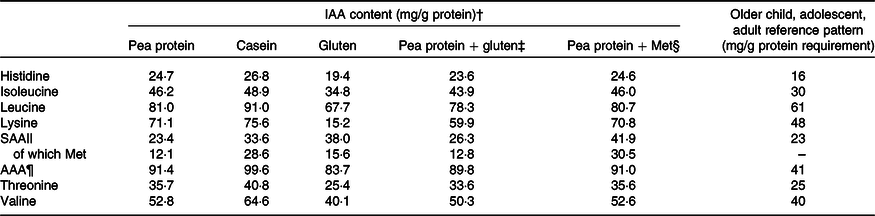
Met, methionine; SAA, sulphur amino acids; AAA, aromatic amino acids.
* The amount of protein in each isolate was 86 % for pea protein and casein, 88 % for gluten, 87 % for pea protein + gluten and pea protein + Met (on DM, total N content × 6·25).
† Values are means of three samples.
‡ The mixture was composed of 80 % pea protein and 20 % gluten.
§ The supplementation reached methionine concentration in casein.
|| Methionine and cysteine.
¶ Phenylalanine and tyrosine.
Study 1: protein efficiency ratio and body composition
Young Wistar male rats weighing 58 (sd 3) g at the beginning of the experiment were fed ad libitum with a diet containing 10 % protein (N × 6·25) for 28 d. They were divided into five groups (n 8/group) according to the protein source: pea protein, casein, wheat gluten, pea–gluten combination (80 % pea protein–20 % gluten, chemical score 100 %) and pea protein supplemented with Met up to the concentration in casein (28 mg/g protein). Fresh food was given each day 1 h before the photoperiod shift from light to dark. Body weight and dietary intake were measured daily. The PER was calculated from the ratio between weight gain (g) and protein intake (g) throughout the experimental period. At day 29, the rats were euthanised by intracardiac puncture under isoflurane anaesthesia for evaluation of body composition and naso-anal length. Abdominal (epididymal, mesenteric, retroperitoneal) and subcutaneous fat pads were excised and weighed to determine fat mass, and the bodies were stripped to assess lean body mass (muscles and bones).
Study 2: protein digestibility and nitrogen balance
Protein and AA digestibility were assessed by two different tests on the same animals. The first evaluated nitrogen faecal digestibility and nitrogen balance in metabolism cages. The second assessed AA caecal digestibility in a postprandial test.
Forty-five Wistar male rats weighing 252 (sd 5) g were fed a diet containing 14 % protein (N × 6·25) for 10 d. They were divided into five groups (n 9/group): pea protein, casein, gluten, pea protein supplemented with Met to meet the concentration in casein (28 mg/g protein) and a protein-free diet. The rats were housed on a reversed light cycle (dark period from 07.00 to 19.00 hours) in cages with wire bottoms to prevent coprophagia. They were trained to eat a calibrated meal containing 4 g (dry weight) of their usual diet in a short time by providing the meal at 09.00 hours for 30 min, only, and before commencing a 2-h fast, as described previously(Reference Tessier, Khodorova and Calvez16). They were subsequently fed ad libitum from 11.00 to 17.00 and fasted until the next calibrated meal. Beginning on day 7, they were housed in metabolism cages for 3 d, and after 1 d of habituation, urine and faeces were collected for 2 d. Dietary intake was measured daily. Nitrogen content of diets, faeces and urine was measured with an elementary N analyser based on the Dumas method (Vario Micro Cube) to calculate nitrogen balance: Ningested (mg) − Nexcreted (mg) and Nexcreted = Nfaeces + Nurine. Faecal nitrogen digestibility was calculated as follows:
 $${\rm{True \ oro}} \!- \!{\rm{faecal \ N \ digestibility }}\,\left( \% \right) = {{{{\rm{N}}_{{\rm{ingested}}}} - ({{\rm{N}}_{{\rm{faeces}}}} - {{\rm{N}}_{{\rm{endogenous}}}})} \over {{{\rm{N}}_{{\rm{ingested}}}}}} \times 100.$$
Endogenous losses of nitrogen in faeces were estimated from rats fed the protein-free diet.
The PDCAAS was calculated as indicated by the FAO/WHO Expert Consultation(17):
 $${\rm{PDCAAS}} = {\rm{lowest\ AA\ ratio }} \times {\rm{ true\ faecal\ protein\ digestibility\ }}\left( \% \right)$$
 $${\rm{A}}{{\rm{A}}_{\rm{i}}}\ {\rm{ratio }} = {{{\rm{mg\ A}}{{\rm{A}}_{\rm{i}}}\ {\rm{in\ 1}}\ {\rm{g\ of\ the\ test\ protein}}} \over {{\rm{mg\ A}}{{\rm{A}}_{\rm{i}}}\ {\rm{in\ 1}}\ {\rm{g\ of\ the\ reference\ protein}}}}$$
The postprandial test started at day 10, when the rats were given a calibrated meal of 4 g and were euthanised 6 h later by intracardiac puncture under isoflurane anaesthesia. Gastro-intestinal segments were identified as stomach, proximal intestine, ileum (defined as the last 10 cm of the small intestine), caecum and colon. The luminal contents of these segments were collected entirely, weighed, stored at −20°C and freeze-dried.
Indispensable amino acids (IAA) in caecum, ileum, stomach contents and tested proteins were assayed on hydrolysed protein by ultra-high performance liquid chromatography to calculate AA digestibility. More specifically, samples were hydrolysed in 6 m HCl at 110°C for 24 h. Norvaline was added as an internal standard. AA in samples were derivatised using the AccQ-Tag Ultra Derivatization kit. The AA analysis was performed on a ultra-high performance liquid chromatography (Acquity UPLC H-Class Plus) with a PDA detector (260 nm) and an AccQTag amino acid C18 column. A specific protocol was carried out for SAA analysis, as they can be partially destroyed during acid hydrolysis. Indeed, Met and cysteine were oxidised to Met sulphone and cysteic acid using performic acid prior to HCl hydrolysis, as described by Rutherfurd et al.(Reference Rutherfurd and Gilani18). Caecal digestibility was calculated for each IAA individually:
 $${\rm{True\ oro}}\!-\!{\rm{caecal\ IAA\ digestibility }} = {{{\rm{IA}}{{\rm{A}}_{{\rm{ingested}}}} - ({\rm{IA}}{{\rm{A}}_{{\rm{ileum}}}} + {\rm{IA}}{{\rm{A}}_{{\rm{caecum}}}} - {\rm{IA}}{{\rm{A}}_{{\rm{endogenous}}}})} \over {{\rm{IA}}{{\rm{A}}_{{\rm{ingested}}}}}} \times 100,$$
where IAAendogenous are the endogenous losses of IAA in ileum and caecum. The endogenous losses of IAA were estimated in the protein-free group. Because some residual amounts of AA were recovered in the stomach and thus did not enter into the digestive process, IAAingested excluded this residual amount.
The DIAAS was calculated as prescribed by the FAO(9): DIAAS = lowest IAA ratio
 $${\rm{IA}}{{\rm{A}}_{\rm{i}}}\ {\rm{ratio }} = {{{\rm{mg\ digestible\ IA}}{{\rm{A}}_{\rm{i}}}\ {\rm{in}}\ {\rm{1}}\ {\rm{g\ of\ the\ test\ protein}}} \over {{\rm{mg\ IA}}{{\rm{A}}_{\rm{i}}}\ {\rm{in}}\ {\rm{1}}\ {\rm{g\ of\ the\ reference\ protein}}}}$$
where digestible IAAi content (g/kg protein) = IAAi content (g/kg protein) × true oro-caecal IAAi digestibility (%).
The reference protein IAA profile used for PDCAAS calculation was the adult AA requirement pattern from the 2007 WHO/FAO/UNU report(19). The reference profile used for DIAAS calculation was the requirement pattern for the older child, adolescent and adult defined by the FAO (2013)(9).
Statistical analysis
A power calculation was performed to determine the sample size required to detect significant differences with a statistical power of 90 % and α level set at 0·05. According to former studies, interindividual variability in protein digestibility measured at ileal or caecal level in rats was around 1·5 %, and the difference in digestibility between animal and plant protein isolates was generally about 2·5 %(Reference Gilani, Peace and Botting20–Reference Rutherfurd, Fanning and Miller23), leading to a sample size of nine animals per group (G*Power 3.1). On the same principle, the difference in PER between pea and casein was estimated to be approximately one point(Reference Bajaj, Mickelson and Lillevik24,Reference Chapman, Castillo and Campbell25) , hence the inclusion of eight rats per group in the study.
The values are expressed as means and standard deviations. Comparisons were made between all protein sources for each nutritional quality parameter (PER, nitrogen balance, faecal and caecal digestibility) using a two-way ANOVA with a random series effect (when the experiment was carried out in several series). For study 1, the influence of the protein source on body weight gain and energy intake was tested using a mixed model with time as a fixed effect and two random effects (animal and series). The casein diet was chosen as the control group for each test. When an overall significant difference was observed (P < 0·05), a side-by-side comparison was made between diets using Bonferroni correction.
Results
Protein efficiency ratio and body composition
An effect of protein source was observed on PER (P < 0·0001). The PER of pea protein was 1·14, greater than gluten (0·47; P = 0·0001) and lower than casein (2·55; P < 0·0001) (Table 3). The combination of pea protein and gluten had a PER of 1·60 and was greater than pea protein and gluten individually (P = 0·01 and P < 0·0001), but lower than casein (P < 0·0001). The PER of pea protein supplemented with Met (2·52) was not different from PER of casein. Weight gain of the rats fed casein and pea protein supplemented with Met were not different and greater (P < 0·0001) than the weight gain in the other groups from the 14th day of study (Fig. 1). Weight gain was also greater in the pea protein group compared with the gluten group, with a difference at day 28 (P = 0·01). All the groups had a dietary intake that met their energy requirements according to the nutritional requirements for a growing rat (kcal/d) = 225 × body weight0·75(Reference Peterson and Baumgardt26), except for the gluten group from the 15th day on (data not shown).
Protein efficiency ratio (PER) of protein sources, alone or in combination*
(Mean values and standard deviations)

Met, methionine.
a,b,c,d Mean values in a column with unlike superscript letters were significantly different (post hoc Bonferroni tests for multiple comparisons, P < 0·05).
* There was an effect of the protein source (P < 0·001), n 8 per group.
† The mixture was composed of 80 % pea protein and 20 % gluten.
‡ The supplementation reached methionine concentration in casein.
Body weight gain relative to initial weight over time. Values are means, n 8 per group. Pea protein + gluten mixture was composed of 80 % pea protein and 20 % gluten. The supplementation of pea protein + methionine (Met) group reached methionine concentration in casein. There was a significant effect of the protein source (P < 0·001), time (P < 0·001) and protein source × time (P < 0·001) on body weight gain. Significant difference from pea protein + Met started at day 7 for pea protein, at day 8 for gluten and at day 11 for pea protein + gluten (P < 0·05). Significant difference from casein started at day 9 for pea protein, at day 10 for gluten and at day 14 for pea protein + gluten (P < 0·05). Significant difference between gluten and pea protein + gluten started at day 17 (P < 0·05). Significant difference between pea protein and gluten started at day 28 (P < 0·05).  , Pea protein;
  , casein;
  , gluten;
  , pea protein + gluten;
  , pea protein + Met.

At day 28, the rats fed casein and pea protein supplemented with Met were larger than rats in other groups (P < 0·001, Table 4). Casein rats had higher fat mass than rats fed gluten (P = 0·01) and the mix of pea protein and gluten (P = 0·03). However, there was no difference in lean mass between groups.
Body composition of rats at the end of the experiment (day 28)*
(Mean values and standard deviations)

Met, methionine.
a,b,c Mean values in a column with unlike superscript letters were significantly different (post hoc Bonferroni tests for multiple comparisons, P < 0·05).
* There was an effect of the protein source for body weight, fat mass and naso-anal length (body weight: P < 0·001, P = fat mass: P = 0·002, naso-anal length: P < 0·001, carcass weight: NS), n 8 per group.
† The mixture was composed of 80 % pea protein and 20 % gluten.
‡ The supplementation reached methionine concentration in casein.
Protein digestibility
In study 2, all rats gained weight throughout the 10 d of the experiment, except for those in the protein-free group. At day 10, the rats fed casein and pea protein supplemented with Met had greater body weights than rats in other groups (P < 0·001, pea protein: 278·6 g; casein: 300·6 g; gluten: 278·3 g; pea + Met: 302·3 g). Overall dietary intake was not different between groups throughout the 10 d of the study, except for protein-free rats, which had lower intakes. Nitrogen balance over 2 d was greater for rats fed casein and pea protein supplemented with Met compared with rats fed pea protein and gluten (casein v. pea: P = 0·01; casein v. gluten: P = 0·03; pea + Met v. pea: P = 0·001 ; pea + Met v. gluten: P = 0·003, Table 5). The protein-free group had a negative nitrogen balance. Rats fed pea protein and gluten had greater nitrogen urinary losses than rats fed casein and pea supplemented with Met (P < 0·001 and P < 0·0001). True faecal nitrogen digestibility of pea protein was 96·0 (sd 1·0), and 95·3 (sd 1·2) when supplemented with Met. Faecal digestibility was greater for pea protein, supplemented or not, and for gluten compared with casein (P < 0·001).
Nitrogen balance over 2 d and true faecal nitrogen digestibility measured for four protein sources after a 1-week adaptation period to the diet and a 1-d adaptation period to the metabolism cage*
(Mean values and standard deviations)

Met, methionine.
a,b,c Mean values in a column with unlike superscript letters were significantly different (post hoc Bonferroni tests for multiple comparisons, P < 0·05).
* There was an effect of the protein source on body weight (P < 0·001), nitrogen balance and faecal digestibility (P < 0·001), n 9 per group. Endogenous losses of nitrogen were estimated using protein-free group.
† The supplementation reached methionine concentration in casein.
In the study dedicated to postprandial AA digestibility, the mean meal size ingested prior to euthanasia was 3·8 (sd 0·4) g DM. The endogenous losses of AA were calculated by measuring the AA content of stomach, ileum and caecum digesta in rats fed the protein-free diet (online Supplementary Table S1). The highest endogenous losses were for glutamic acid and the lowest were for Met and histidine. True caecal AA digestibility values for each protein source were determined (Table 6), except for tryptophan. Mean true caecal digestibility of all AAs was 94·6 (sd 4·1) % for pea protein and 87·5 (sd 3·4) % for pea protein supplemented with Met, 87·0 (sd 5·0) % for casein and 94·4 (sd 3·6) % for gluten. For pea protein, the highest caecal digestibility was for arginine (96·9 (sd 2·7) %). For pea protein and gluten, the lowest digestibility was found for their limiting AAs, Met (84·2 (sd 9·7) %) and lysine (80·2 (sd 16·6) %), respectively.
True caecal amino acid digestibility measured for four protein sources*
(Mean values and standard deviations)

Met, methionine.
a,b,c Mean values in a column with unlike superscript letters were significantly different (post hoc Bonferroni tests for multiple comparisons, P < 0·05).
* There was an effect of the protein source on the average amino acid digestibility (P < 0·001), n 9 per group. Endogenous losses of amino acids were estimated using protein-free group.
† The supplementation reached methionine concentration in casein.
‡ Average digestibility was calculated from the mean amino acid digestibilities weighted by the proportion of each amino acid in the protein.
IAA ratios were calculated using the AA requirement pattern of the older child, adolescent and adult and the true caecal AA digestibility of proteins (Table 7). For casein and pea protein supplemented with Met, the ratios were ≥1 for all IAA. The lowest IAA ratio was SAA for pea protein (0·88) and lysine for gluten (0·25). With Met supplementation, the DIAAS of pea protein increased to 1·10. The DIAAS obtained for casein was 1·29. The untruncated PDCAAS of pea protein was 1·02, whereas it was 1·43 for casein and only 0·32 for gluten.
Digestible indispensable amino acid (IAA) reference ratios calculated using true caecal amino acid digestibility values and lowest untruncated Protein Digestible-Corrected Amino Acid Score (PDCAAS) calculated using true faecal nitrogen digestibility values*

DIAAS, Digestible Indispensable Amino Acid Score; Met, methionine; SAA, sulphur amino acids; AAA, aromatic amino acids.
* The DIAAS ratios were calculated using the amino acid requirement pattern for the older child, adolescent, adult according to the FAO 2013(9) (g/kg protein). The PDCAAS were calculated using the adult amino acid requirement pattern from the 2007 WHO/FAO/UNU report(19).
† The supplementation reached methionine concentration in casein.
‡ Methionine and cysteine.
§ Phenylalanine and tyrosine.
Discussion
The present study enabled a complete evaluation of the nutritional quality of pea protein isolate using various quality indexes and a comparison with other proteins from both animal and plant sources. It also provided thoughts on methodologies regarding the measurement of ileal protein digestibility in rats without use of isotope labelling.
Validated by the FAO, the PER method has been used for decades to evaluate protein quality through the ability to support growth due to its low cost, its effectiveness and the existence of a standardised protocol(Reference Chapman, Castillo and Campbell25). It is still used as the reference method for protein quality evaluation in Canada(27). The present study showed that Met supplementation enabled pea protein to reach a PER that was not different from that of casein and resulted in body weight gain of rats that was not different from that of rats fed the casein diet. Furthermore, the PER obtained for casein was in accordance with the theoretical value of 2·50(Reference Chapman, Castillo and Campbell25), which testifies to the reliability of the study. The lower PER of pea protein can thus be attributed to its low concentration in Met. The present data supported results by Bajaj et al. (Reference Bajaj, Mickelson and Lillevik24), who established a positive correlation between the albumin content of green pea and PER, explained by the greater content in SAA compared with globulin. The PER of pea protein was 2-fold higher than the PER of gluten, indicating a better effectiveness in promoting animal growth. It also appeared that the lysine deficiency of cereals could be more problematic than the Met deficiency of legumes. The combination of pea protein and gluten enabled the significant increase of the PER of both sources when measured individually, but was not sufficient to reach the value for casein and pea protein supplemented with Met. These results are consistent with protein Met content as the value for gluten is not high enough to reach the Met concentration of casein. The combination of legume and cereal proteins would be more effective with a cereal featuring a greater Met content than gluten. However, growing rats have greater SAA requirements than humans; therefore, it is important to point out that none of the diets in the study met the Met requirement set at 6·5 mg/g diet (for a diet containing 4 kcal/g and composed of 10 % water)(Reference Gahl, Finke and Crenshaw28). Casein provides only 70–87 % of the SAA requirements of rats(17). The low PER of gluten is due to its large deficiency in lysine, and the rats were unable to compensate with an increase in dietary intake. Indeed, the food intake of gluten rats was lower than their energy requirements after 2 weeks of experimentation. This disinterest in their diet has been observed in other studies and could be a behavioural response to the IAA deficiency(Reference Gietzen, Hao and Anthony29,Reference McCoy, Meyer and Rose30) . Moreover, gluten given to young rats as a single source of protein leads to reduced growth and lower fat mass. The PER method has been widely used since 1919, but other predictors of nutritional quality are now preferred. PER has indeed major limitations, one of them being that it underestimates the value of some plant proteins for human growth and, on the contrary, overestimates the value of some animal proteins due to higher IAA needs of young rats compared with humans(17).
Nitrogen balance provides information about the protein status of individuals consuming test meals. After ingestion of a protein-free diet for 10 d, the balance was negative due to the absence of nitrogen intake and the maintenance of nitrogen losses. Rats fed pea protein and gluten had greater nitrogen urinary losses and thus lower nitrogen balances than rats fed casein, probably because of a protein synthesis limitation due to the deficiency in Met and lysine, respectively. Supplementing pea protein with Met is sufficient to obtain a comparable nitrogen balance as rats fed casein. Faecal nitrogen digestibility of pea protein without and with Met supplementation was greater than 95 %, leading to a PDCAAS over 1. Those results are comparable with a previous study on the same pea protein isolate, where true nitrogen digestibility was 97·3 % and the PDCAAS was 0·93 for adults(Reference Yang, Guérin-Deremaux and Zhou22). We observed a greater faecal digestibility for pea protein isolate than in other studies addressing protein digestibility of whole pea (89·0(Reference Rutherfurd, Fanning and Miller23), 87·9 %(Reference Nosworthy, Neufeld and Frohlich31)). The purification of protein and the resulting elimination of anti-nutritional factors and fibre can explain this difference(Reference Gilani, Wu Xiao and Cockell14,Reference Le Gall, Warpechowski and Jaguelin-Peyraud32) . Mean caecal AA digestibility of pea protein was greater than digestibility of casein and gluten. Caecal AA digestibility of pea was lowest for SAA, which is consistent with Sarwar et al. (Reference Gilani, Peace and Botting20) where the true digestibility of Met and cysteine was 44 % lower than the digestibility of the protein. Pea protein had lower SAA content than casein and gluten but still met the requirements of the older child, adolescent and adult defined by the FAO(9). The DIAAS of pea protein was 0·88 due to the lower caecal digestibility of SAA. The DIAAS of gluten was low due to the limiting content in lysine. Nevertheless, Met supplementation up to the Met concentration in casein enabled an increase of pea protein DIAAS to 1·10 and thus counteracted the limitation and improved its nutritional quality. The PDCAAS and DIAAS of pea protein in our experimental conditions were greater than figures obtained by Rutherfurd et al. (Reference Rutherfurd, Fanning and Miller23) for a pea protein concentrate (0·89 and 0·82, respectively) using the 1- to 2-year-old child reference pattern defined by the FAO(17). In addition, we found that PDCAAS overestimated the DIAAS for all protein sources, as described by Rutherfurd et al. (Reference Rutherfurd, Fanning and Miller23) in growing rats and by Mathai et al. (Reference Mathai, Liu and Stein33) in pigs. Indeed, protein (N) digestibility is overestimated at the faecal, compared with ileal, level due to microbial activity. Caecal digestibility was used as a proxy for ileal digestibility and this is a limitation of our study. We determined caecal digestibility because of the low amount of ileal content that can be sampled at a unique time point in rats and the difficulty of finding a reliable indigestible marker, which leads to uncertainties(Reference Fuller and Tomé34,Reference Deglaire and Moughan35) . The method we used was developed previously(Reference Tessier, Khodorova and Calvez16) and consists of collecting gastrointestinal contents from all segments of the gastrointestinal tract 6 h after meal intake. It facilitates a compromise between complete digestion and minimal duration of fermentation of digesta in the caecum. However, we cannot exclude the possibility that the values of caecal AA digestibility have been over- or underestimated in comparison with ileal digestibility.
Surprisingly, faecal nitrogen digestibility and mean AA caecal digestibility of casein were lower than for pea and gluten. This low faecal digestibility was due to the faecal nitrogen losses that were significantly greater in the casein group (data not shown). However, casein is known to be highly digestible: comparable studies using rats observed faecal digestibility of 99 % for casein(Reference Gilani and Sepehr21) or 98 % for milk protein concentrate, which is composed mainly of casein(Reference Rutherfurd, Fanning and Miller23). The low digestibility of casein determined in our study might be explained by an underestimation of endogenous losses of nitrogen and AA. The greater digestibility found for pea protein and gluten could also result from rat metabolic adaptation in response to the respective Met and lysine deficiencies in their diets.
The assessment of AA digestibility is highly dependent on an accurate evaluation of intestinal endogenous AA losses(Reference Stein, Pedersen and Wirt36), which we measured through the protein-free diet method. The endogenous losses of nitrogen and AA are affected by animal and dietary factors(Reference Nyachoti, de Lange and McBride37). Among them, specific losses influenced by diet composition contribute to more than 50 % of the total endogenous IAA(38). Different methods can be used to estimate endogenous losses and they have been studied principally in pig models. The protein-free diet method is one of the reference methods to measure endogenous nitrogen and AA losses, but it has some limitations, the main one being its non-physiological nature(Reference Low39). The lack of gut stimulation induced by the absence of protein in the diet may lead to abnormal protein metabolism(Reference Jansman, Smink and van Leeuwen40) and underestimation of the endogenous gut nitrogen losses(Reference Nyachoti, de Lange and McBride37). Indeed, it was found that feeding pigs a protein-free diet causes a quantitative reduction in endogenous nitrogen secretion(Reference Buraczewska41). As casein is known to be a high-quality protein, the low digestibility we found may have come from the calculation of the endogenous losses. An underestimation of the endogenous losses would lead to overestimated exogenous losses and thus to an underestimated digestibility. The same hypothesis can be made concerning the rats fed with pea protein supplemented with Met, as mean caecal AA digestibility was lower for supplemented pea protein compared with pea protein alone. Furthermore, rats fed casein and pea protein supplemented with Met had higher body weights than rats fed pea protein and gluten, a consequence of a better response to the nutritional needs explained by the well-balanced AA profiles of their dietary protein sources. It is thus possible that endogenous losses were greater in these groups. Indeed, pea and gluten groups might have had reduced endogenous nitrogen and AA losses due to the limiting content of Met and lysine in their respective diets. Thus, underestimation of endogenous losses induced by the protein-free diet method may explain the lower AA digestibility obtained for casein and pea protein supplemented with Met. Moreover, the duration of the protein-free diet we used in our study before assessing digestibility could have driven rat metabolisms towards a reduction of endogenous losses. As reviewed by Jansman et al. (Reference Jansman, Smink and van Leeuwen40), the length of the pre-test period, which usually lasts no longer than 7 d, may impact the amount of nitrogen and AA composition of ileal endogenous losses. However, the duration of the feeding period in our study is in accordance with the FAO protocol for determining the true digestibility in rats, which recommends 9 d of diet (4-d preliminary period and 5-d balance period)(17). Besides, a minimum 7-d period was necessary to measure nitrogen balance.
Another method could have been carried out to measure endogenous losses, such as the enzymatically hydrolysed casein method used by Rutherfurd et al.(Reference Rutherfurd, Cui and Goroncy42) to study the impact of protein structure on endogenous ileal AA and true ileal AA digestibility in rats. Each of these methods, however, has limitations and requires making questionable assumptions. According to Stein et al. (Reference Stein, Sève and Fuller43), despite its criticisms, the protein-free diet method is still recommended over the other methods.
In conclusion, pea protein isolate was highly digestible under the experimental conditions carried out in this study, for both nitrogen and AA. The DIAAS obtained for pea protein was 0·88, showing that this protein isolate has a good nutritional quality. Moreover, Met supplementation reaching the concentration in casein increased the DIAAS to 1·10, covering AA requirements. Some differences between the digestibility values of tested proteins might be attributed to the method chosen to measure endogenous losses of nitrogen and AA, even though the protein-free diet method is widely used. This study demonstrated that supplementing pea protein with Met was enough to improve its nutritional quality in terms of capacity to ensure growth and digestibility.
Acknowledgements
The authors thank Morgane Dufay, Catherine Chaumontet and Romain Tessier from UMR PNCA for their contributions to animal testing.
The project was funded by Roquette.
The authors’ responsibilities were as follows: C. G., J. C., L. G. D. and C. L. M. contributed to the conception and design of the study; F. M. G., J. C. and N. K. conducted the research; F. M. G. and J. C. analysed the data; F. M. G. wrote the original draft of the paper; J. C., C. G., L. G. D. and C. L. M. reviewed and edited the manuscript; C. G. and D. A. M. administered the project and all authors read and approved the final manuscript.
C. G., N. K., D. A. M. and J. C. declare that they have no conflict of interest. F. M. G., L. G. D. and C. L. M. are employed by Roquette.
Supplementary material
For supplementary material/s referred to in this article, please visit https://doi.org/10.1017/S0007114520002883



