




Introduction
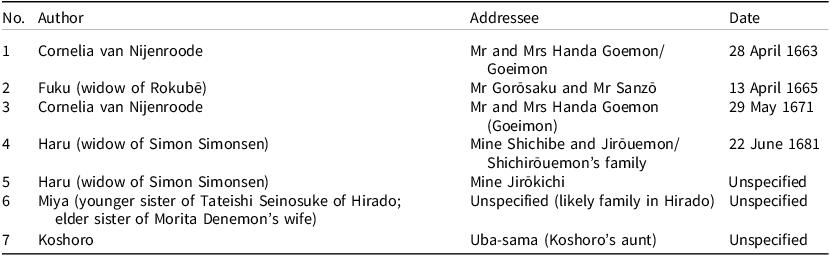
This article examines a small but unusually rich corpus of seven extant letters (also known as Jakarta letters, see Table 1) written by Japanese-born Christian women banished to Batavia in the seventeenth century, including Haru, Cornelia van Nijenroode, Fuku (Catarina Rokube), Miya, and Koshoro.Footnote 1 These letters took shape under Tokugawa Japan’s increasingly restrictive policies towards Christianity and foreign contact, which severed familial and spiritual ties across borders.Footnote 2 Japan’s move towards maritime restriction and Christian suppression culminated in a series of increasingly stringent edicts issued between 1616 and 1639. These measures included confining European trade to the ports of Nagasaki and Hirado (1616), severing relations with Spain and its colonies (1624), restricting the voyages of Red Seal ships (shuinsen, Tokugawa-licensed overseas merchant vessels), prohibiting the return of most Japanese living abroad (1633–34), and, ultimately, the expulsion of the Portuguese in 1639—marking the final act in the effort to eliminate foreign Christian influence.Footnote 3
Corpus of letters: author, addressee, and date

The extant letters are dispersed across several repositories in Japan: Nagasaki Museum of History and Culture (Haru’s 1681 letter); Hirado Dutch Trading Post (Cornelia’s 1663 letter and Koshoro’s letter); and Nagasaki Matsura Historical Museum (Fuku’s 1665 letter). Others are available via online databases or printed collections cited in this article.
Addressed to relatives and kin in Japan, these letters were written after expulsion, displacement, or long-term separation, and circulated through regulated channels linking Batavia and Japan.Footnote 4 Evidence from the surviving letters suggests that communication between Batavia and Japan followed a slow but recognisable rhythm, with a letter sent in one year and a reply received the next. In a 1663 letter written in Batavia, Cornelia acknowledges receipt of a letter from Japan sent in 1662; in another letter from 1671, she apologises for not having written in 1669 and 1670. Such references indicate that the extant letters formed part of an ongoing exchange, much of which has not survived. At the same time, this correspondence was never private in a strict sense. Letters were composed with the expectation that they would pass through multiple layers of oversight, including VOC officials, Dutch ships, Nagasaki magistrates, interpreters, and, at times, Chinese intermediaries. The recurring formulaic opening, ‘Every year, we receive great kindness from the magistrates of Nagasaki’, reflects this awareness of official scrutiny and the regulated conditions under which these letters circulated.
Read together, they offer rare access to how exiled women articulated loss, sustained kinship, and made themselves present across distance in a world shaped by religious persecution, colonial mobility, and bureaucratic surveillance. This article argues that the letters must be read not simply as fragmentary traces of a displaced community but as a coherent repertoire forged under exile. I term this repertoire the ‘grammar of separation’: a historically specific system through which emotional expression, spiritual meaning-making, social obligation, and identity were organised under conditions of rupture.Footnote 5 While this grammar draws on early modern Japanese epistolary conventions, it was reshaped by the specific conditions of Christian exile and displacement in Batavia, and cannot be reduced to either context alone. Across the letters, recurring features—apologies for silence, inventories of gifts, blessings, ritual gestures, statements of longing, and reflections on absence—show that these women did not simply describe separation. They wrote through it using recognisable forms that rendered distance legible and survivable. In this sense, the letters reveal what I call ’epistolary endurance’: the use of writing to sustain relational presence under conditions of uncertainty, delay, and possible permanent loss. Haru’s late reflection captures this dynamic succinctly. Exiled from Japan in 1639 and living in Batavia for nearly sixty years, she wrote: ‘Looking back, it has been over 50 years since I arrived here … Sometimes, I wonder what my life would have been like if I had lived and aged together with you all in Japan’.Footnote 6 Her words condense the conditions that shaped the corpus as a whole: forced rupture, prolonged absence, the passing of companions, and the effort to preserve meaningful ties through writing. Haru’s letter offers one instance of a broader pattern evident across the surviving correspondence.
This article offers a framework for analysing how separation was articulated and managed within a particular historical setting: Japanese-born Christian women in Batavia, shaped by seventeenth-century circuits of mobility, constraint, and disconnection.Footnote 7 At the same time, the grammar of separation observed in the Jakarta letters provides a diagnostic lens for examining how separation might be articulated elsewhere. In other settings, different normative and emotional regimes, for instance, Confucian formulations of filial piety and ritual mourning, may introduce alternative configurations of distance, obligation, and loss. To give one example, in the context of Chosŏn Korea, elite women utilised specific literary forms, kyubang kasa (규방가사, verses from the inner chambers), to navigate the tension between normative expectations and personal suffering. As Cho notes, these texts ‘reiterated the female virtues set by Confucian norms’, while simultaneously expressing ‘grievances about unfair treatment by in-law family members or their loneliness caused by estrangement from their husbands’.Footnote 8 Despite these different normative and emotional regimes, a recognisable grammar of separation is still at work, shaping how estrangement is expressed and managed. As such, the framework developed in this article is not intended for one-to-one transfer, but for extension and adaptation. Its contribution to global history lies in offering a set of analytical coordinates for tracing how historically situated communities gave form to separation within shared, but unevenly distributed, epistolary cultures.
Methodologically, these letters are treated not as spontaneous emotional outpourings but as historically structured texts shaped by intersecting forces: forced separation, social conventions, religious prohibition, communicative constraint, and marginalisation. These forces did not only act upon the writers; they also participated in the production of what may be termed epistolary subjectivity. As Susan Broomhall has shown, emotional expression depends on the genres and social contexts through which it is articulated.Footnote 9 In this corpus, emotional language, textual form, and social performance are inseparable. The letters are therefore read as sites where identity is negotiated and calibrated for specific recipients within constrained conditions. To clarify this approach, it is useful to distinguish between two related concepts developed here: the rupture of separation and the grammar of separation. The rupture of separation refers to the conditions under which these letters were written—geographical exile, religious persecution, loss of kin, emotional dislocation, and delayed or interrupted communication. These were not momentary disruptions but enduring structures of disconnection shaping everyday life. The grammar of separation, by contrast, refers to the patterned and culturally intelligible strategies through which these conditions were articulated and managed. It emerged through rupture rather than outside it, giving emotional, textual, social, and spiritual form to separation. This grammar is traced in this article across four interlocking registers: emotional vocabularies, textual structures, social scripts, and spiritual framings. This framework also clarifies the relationship between mobility and writing: here, mobility took the form not of free travel but of displacement and separation, conditions that made letter-writing a vital means of sustaining relation across fractured space.Footnote 10 While the letters retain elements of Japanese epistolary convention, including formalised politeness and patterned address, exile fundamentally altered their function.Footnote 11 As Christina Laffin reminds us for a different period and milieu, ‘each form of writing, whether a love letter or an offertory prayer, carried with it set conventional expectations’, with writers tailoring their arguments to genre and anticipated readers.Footnote 12 What might once have served ordinary sociability became a means of sustaining existence within the relationship itself. Oceanic distance, uncertain delivery, and the absence of guaranteed reunion reshaped familiar forms into something more urgent.
Moreover, the corpus examined here (see Table 1) was produced by ‘some of the earliest Japanese women who had settled abroad’, living in exile in the Dutch East India Company’s (VOC, 1602–1799) Asian headquarters, Batavia (modern-day Jakarta, Indonesia), with figures such as Haru residing there for nearly six decades.Footnote 13 These letters are read here alongside a narrower range of associated materials, including notarial records, wills, official lists, and visual materials such as Cornelia’s portrait. Together, these sources help situate the letters within the domestic, social, bureaucratic, and transregional worlds in which they were written, circulated, and preserved.
Apart from the domestic sociopolitical context in Japan, Batavia itself formed the wider setting for these exchanges. It was a VOC colonial centre but also a dense, multi-ethnic colonial entrepôt in which Malays, Chinese merchants, Ambonese soldiers, Mardijkers, enslaved people, South Asian labourers, Japanese, and European officials interacted within highly stratified structures.Footnote 14 The Japanese presence there remained small, but it was socially visible and connected to longer-standing VOC interests in Hirado and Nagasaki.Footnote 15 Within this environment, these women formed ties that can be traced across letters, marriage records, wills, and household documents. Those records suggest a community shaped by both internal solidarities and mutually supportive networks, one that was ‘remarkably strong’.Footnote 16
This article, therefore, contributes to several strands of scholarship. It builds on work on Japanese and Batavian Christian communities while shifting attention from incorporation into colonial society to the lived experience of exile. Iwao’s influential reconstruction of ‘Japanese emigrants’ approached the same actors primarily through their visibility in colonial archives—as slave-owners, traders, landowners, and litigants—and emphasised their incorporation into Batavian legal and economic structures as, for example, represented by Michiel Murakami Buzayemon from Nagasaki.Footnote 17 By contrast, this article focuses on how these women presented themselves in letters—as exiles, kin, and spiritual subjects—and how those self-presentations were shaped by rupture, longing, and endurance. It also extends existing work on cross-cultural emotional performance by situating emotion within a broader, multi-register framework that brings together affect, form, obligation, and belief, rather than treating emotion in isolation.Footnote 18 Attending to emotion within its sociocultural and material contexts opens up deeper understandings of the social worlds in which letter-writers were embedded and of their positions within those worlds.Footnote 19
Furthermore, by foregrounding these letters as structured communicative practices, the article recasts these women as emotionally expressive, relationally agentive, and structurally significant actors within early modern colonial worlds.Footnote 20 This intervention also addresses a broader historiographical gap: scholarship on women’s letter-writing under conditions of exile during this period remains limited, particularly for women of mixed descent, although recent work has begun to recover the importance of Japanese-born women as cultural intermediaries, legal agents, and active emotional participants in colonial settings.Footnote 21 Without such attention, letters risk being reduced to mere vehicles of information rather than sites of social practice and historical meaning. More broadly, the article argues that the grammar of separation provides a framework for thinking through global histories of mobility and exile through lived experience and communicative practice. It shows that transregional processes, such as migration, exile, and overseas trade and settlement, did not just produce displacement, but were actively organised and made meaningful through culturally specific practices of writing, care, and endurance, rooted in early modern Japanese epistolary conventions yet reshaped by the conditions of Christian exile in Batavia. While certain registers identified here, such as textual structures and social scripts, have parallels in other forms of early modern correspondence, and experiences such as temporal rupture, emotional longing, or spiritual doubt were not gender-exclusive, their configuration in the Jakarta letters reflects the particular conjunction of exile, marginalisation, and gendered expectations.Footnote 22 Global history, in this sense, is not only constituted through routes, institutions, and empires, but through the patterned communicative practices that sustained relationships across distance.Footnote 23 Finally, the article proceeds in four parts. The first examines emotional vocabularies of longing, grief, and care. The second analyses textual structures, including formulaic openings, narrative organisation, and gift inventories. The third explores social scripts of kinship, reciprocity, and obligation. The fourth considers spiritual framings through which exile and suffering were interpreted.
Emotional vocabularies: Writing longing and grief in exile
Emotions and letter-writing have long been intertwined, with the former often relying on the latter as a means of expression, connection, and the reassertion of identity. In this section, I identify ‘emotional vocabularies’ as one key register within the grammar. The emotional landscape of banishment is vividly articulated through recurring expressions of longing, grief, and temporal dislocation in successive letters by individuals such as Koshoro, Haru, and Cornelia. Comparable emotional patterns recur elsewhere in VOC correspondence: separated women and men ‘exchanged information’ but also voiced ‘their frustrations and sadness about being apart for so long’, turning letters into repositories for the strain of separation as much as for news.Footnote 24 In this respect, the Jakarta letters participate in a wider epistolary world in which emotion itself became a form of labour stretched across distance.
One such letter, written by a woman named Koshoro on a piece of chintz fabric, gives voice to these emotional currents:Footnote 25
How I long for Japan, how I long for it. By a turn of fate, I left Japan, and it has become a homeland to which I can never return. I cannot sit still with this feeling. I have wept until my eyes are swollen, unable to tell whether this is dream or reality. With these feelings of longing for my homeland, I send you a packet of tea.
How I long for Japan, how I long for it.Footnote 26
Emotional expressions in these letters are best understood through William Reddy’s concept of emotives—first-person, present-tense (or past-tense) utterances that do not merely describe feelings but act upon them. Here lies Reddy’s key insight: that emotional states are not fixed or passively waiting to be named—they are being actively shaped, intensified, or negotiated in the very moment of speaking or writing. Following Reddy, I read many first-person emotion claims in these letters as emotives: utterances that do not merely report feeling but help shape it in the act of writing. Emotives, then, are speech acts that not only register emotion but participate in shaping it, navigating it, and sometimes transforming it. In this way, the emotional register constitutes a dynamic affective tool used to survive and interpret disconnection, rather than simply reflect it. These lines function as a poignant instance of emotional communication, one that encapsulates the affective labour of exile. Though the physical traces of Koshoro’s weeping cannot be detected by the naked eye, the emotional intensity is inscribed in the texture of the language itself—its repetition, its embodied phrasing, and its insistent invocation of place and loss. Koshoro’s cry is not just about sorrow; it enacts and transforms her grief through its very articulation. It intensifies, mediates, and gives structure to her separation. As an emotive, her utterance becomes a linguistic tool for navigating emotional rupture—a register through which she negotiates the dislocation of self, home, and kin. Here the letters draw on a longer Japanese tradition in which ‘tears of longing are a convention of love poems’, a trope Abutsu, a notable thirteenth-century Japanese poet and Buddhist nun, ‘use[s]… skilfully within a romantic form of one-upmanship’.Footnote 27 Transposed into the Batavian context, such cultivated conventions are redirected from courtly romance towards the work of enduring exile.
The emotions embedded in letters not only illuminate the personal experiences and inner lives of those who penned them, but also reveal the broader historical conditions under which the letters were written: conditions of colonialism, displacement, or banishment. In another letter, Haru offers a deeply affective reflection that situates personal sorrow within the communicative logic of this exile. Haru, who had left Japan at the age of fifteen, was the younger sister of Nin (Magdalena) and travelled with her and their widowed mother, Maria, from Nagasaki in October 1639. The VOC vessel Breda took them first from Hirado to Casteel Zeelandia (present-day Taiwan), arriving in November 1639, and then on to Batavia, where they arrived on 1 January 1640. VOC records identified her as Jeronima. In a letter sent to Mine Jirōkichi (the grandson of uncle Shichibei), Haru’s expression—‘I feel an overwhelming loneliness, as if my heart has been torn apart’—exemplifies Reddy’s idea of an emotive: a first-person, present-tense utterance that does not merely describe a feeling but works on it in real time.Footnote 28 The visceral imagery is a performative enactment of rupture. Her grief becomes legible through the letter not as an unfiltered emotional discharge, but as a consciously mediated act, an attempt to anchor her epistolary subjectivity within a communicative world destabilised by exile and surveillance. In this sense, the emotive becomes a vehicle for relational mourning and for constructing the self within dislocation, where emotional vulnerability is not just reactive but productive. This structured articulation of grief is a central component of epistolary endurance: by giving form to the overwhelming experience of loss, Haru transforms raw suffering into a communicable and sustainable state. A similar collapsing of affective registers is seen in Abutsu’s corpus, where ‘the sadness of bereavement … is known through the same pain of parting from you’, intertwining grief for the dead with the ache of separation from the living.Footnote 29 The Jakarta letters likewise blur these boundaries, treating exile, distance, and death as part of a shared grammar.
Cornelia’s letter offers another variation on the emotive structure, one centred on affective reception and relational presence. Cornelia van Nijenroode (sometimes spelled Neyenroode, Nijenrode, or Niewenroode) was the younger daughter of Cornelis van Nijenroode, VOC chief merchant in Japan from 1623 to 1632, and a Japanese mother documented in Dutch records as Surisia. In 1671, Cornelia wrote from Batavia to her mother, Surisia, and her stepfather, Handa Goeimon (also rendered as Goemon or Gorōemon), in Nagasaki. It had been more than thirty years since they had last seen each other. She writes,
I have heard that you are both in good health, and I am truly overjoyed. From your letters, I felt as if I had met you in person, and it brought tears to my eyes.Footnote 30
The phrase ‘I felt as if … it brought tears to my eyes’ is a first-person, past-tense, embodied claim that does emotional work through its articulation. While at first glance it may appear to simply describe a previous emotional state, the concept of emotives urges us to read such utterances as more than retrospective narration. In Reddy’s terms, first-person, past-tense emotion claims, such as ‘I was angry at you’ or ‘I used to despise you’, function as interpretations of past states, but they also implicitly assert something about the speaker’s present emotional orientation.Footnote 31 That is, they are not neutral accounts of what once was; they carry transformative force in the moment of utterance, much like present-tense emotives.
Applying this to Cornelia’s statement, ‘I felt as if I had met you in person, and it brought tears to my eyes’, we can see that she is not simply reporting a fleeting emotional reaction. Rather, the structure of the sentence—its embodiment (‘brought tears’), its intimacy (‘met you in person’), and its past-tense framing—suggests a lingering emotional resonance that continues into the present. The statement functions as a relational act: it not only recounts the affective impact of reading her mother’s letter but also reaffirms her emotional connection to an absent maternal figure. This is an emotive in the full sense: it transforms both the speaker’s emotional state and the relationship it references, by making affect legible, shared, and socially meaningful across distance and time. Thus, even though the utterance is framed in the past tense, it performs emotional work in the present. It collapses separation and temporality to reaffirm belonging. As such, it exemplifies how the emotional register operates across tenses—not only conveying affect, but enacting it, revising it, and transmitting it as part of the letter’s broader communicative function.
In each of these cases, whether through written laments or simulated reunions, emotion does not just fill the letters but structures them. These letters were not passive reflections of inner states but active sites of emotional labour, shaped by, and shaping, the historical condition of exile. Such acts of writing emotions participate in performative practices, where expressions of affect carry socially and culturally intelligible meanings across time and space.Footnote 32 The emotional register thus emerges as a mode through which affect is not only communicated but enacted, negotiated, and made culturally legible—as a lived experience of separation—across rupture.
While the emotional dimension is central to how we might read such letters today, scholars like James Daybell have drawn attention to the broader social, political, and material functions of women’s correspondence.Footnote 33 His analysis of Elizabeth Talbot, countess of Shrewsbury (Bess of Hardwick), for example, shows how early modern letter-writing served to sustain kinship ties, manage estates, navigate legal disputes, and engage in patronage networks. Far from being only private or apolitical, such letters reflect the embeddedness of women’s communication in the matrix of power, obligation, and social negotiation. Similar dynamics will be further explored in the following registers of the grammar of separation: textual structures, social scripts, and spiritual framings.
Textual structure: Managing silence and temporal rupture
Different from emotives, which appear within letters as discrete affective utterances but are not themselves structurally determinative, textual structure refers to the abstract narrative and rhetorical architecture of the letters—how silence is acknowledged or deferred, how temporal ruptures are managed, and how relationships are re-anchored across absence. It governs not just what is said, but how something is said: how letters perform the act of relation across time, space, and communicative breakdown. This includes features such as justifications for delayed correspondence, anticipatory apologies, ritualised blessings, and future-oriented closures. Applying this register of textual structure to the Jakarta letters, we can see how their narrative patterns reveal both the fragility and persistence of communication—and the navigation of reconnection—under the rupture of separation. In what follows, instances of delayed explanation, strategic silence, and self-imposed restraint demonstrate that the textual absences in these letters are deliberately managed and densely meaningful.
Two extant letters from Cornelia to her Japanese family provide insight into the textual strategies used to manage rupture and reconnection across temporal and geographic distance. For example, the letter from 1671 suggests Cornelia’s active role in maintaining correspondence networks: she references a letter received from Japan in 1668 and notes her responsibility in distributing accompanying gifts to the intended recipients. Within this second letter, Cornelia reassures her family not only of her own well-being and that of her growing household, but directly addresses the conspicuous absence of communication in the preceding two years:
As for myself, I am in good health, and in the 4th month of the Metal Dog year, I had a daughter. Now, all four of my children are in good health, so please do not worry … Regarding the Earth Rooster and Metal Dog years, I realise you were naturally worried because I did not send letters during these two years. However, please do not worry, as I have been living without any changes.Footnote 34
This passage offers a compelling example of how textual structure functions to manage silence and temporal rupture: ‘I realise you were naturally worried because I did not send letters during these two years.’ As Deborah Tannen observes, silence often carries ‘a negative value in many communicative contexts’, whether in written correspondence or spoken conversation.Footnote 35 Yet in contexts of rupture, such silence can be strategically reworked—managed not as absence, but as a communicative act in itself as shown in the above passage, in the retrospective framing of non-correspondence, where the absence of letters is explicitly acknowledged, explained, and ultimately stabilised as a sign of continuity rather than disruption. As Jay Lemke argues, ‘the structure of a text is the result of the structured social practices that create that text’.Footnote 36 Textual structure, then, should be understood not only as an arrangement of linguistic units, but as a special case of activity structure—a patterned, socially recognisable sequence of actions through which members of a community generate and interpret meaning. Within such structures, even silence and omission carry social weight: ‘each action takes its meaning from a context which it itself helps to create’.Footnote 37
Read in this light, the Jakarta letters employ similar structural formulae to bridge the gaps created by silence and distance, helping to maintain the flow of communication despite interruptions. Thus, Cornelia not only conveys information; she engages in what might be termed ‘narrative repair’—not in the fuller sense originally theorised by Hilde Lindemann Nelson as the construction of counter-stories to repair damaged identities, but in a narrower rhetorical sense: a discursive process through which silence is acknowledged, explained, and reabsorbed into a coherent timeline.Footnote 38 Cornelia’s explicit acknowledgement of silence—‘Regarding the Earth Rooster [1669] and Metal Dog [1670] years … please do not worry …’—pre-empts familial anxiety while acknowledging a rupture in communicative temporality. As Mark Williams has shown in his study of early modern East India Company correspondence, long-distance communication routinely fractured the experience of time itself: letters arrived out of sequence, juxtaposed illness and recovery within the same moment of reading, and produced what Williams terms ‘awkward synchronicities’ that unsettled emotional life.Footnote 39 Temporal knowledge was always belated, uneven, and sometimes cruelly misaligned. Cornelia’s apology participates in these temporalities of distance that structured early modern global communication. She anticipates the emotional turbulence created by asynchronous news and attempts to restore coherence by narrating stability across what would have been, for her family, a temporally disorienting silence. The affective tension produced by the lapse in correspondence is both anticipated and neutralised. ‘I realise you were naturally worried’, she writes, before stabilising the emotional field with a reiteration of continuity: ‘I have been living without any changes.’ In doing so, she transforms a communicative gap into a structured act of reassurance. Her response therefore reflects not only the affective labour of exile but the broader temporal dislocation inherent in early modern mobility, where distance destabilised shared temporal frameworks and required constant renegotiation on the page. This form of textual choreography—acknowledging rupture while smoothing its emotional resonance—is embedded in the communicative labour of exile. As part of the register of textual structure, it reveals how women such as Cornelia sustained familial bonds and relational presence across long periods of silence, turning absence itself into a meaningful act of connection.
Another example of this textual choreography appears in a letter written by Haru, who remained in Batavia until the end of the seventeenth century.Footnote 40 By the time she composed her final known letter, Haru was elderly and physically frail. In a codicil to her 1692 testament—drawn up again in 1697—she not only named four surviving children, but also took steps to emancipate twelve enslaved individuals. Notably, Haru signed the testament using kana, the Japanese syllabary—an act that subtly inscribed linguistic continuity into her legal and emotional legacies. Written horizontally but with characteristic vertically compressed, calligraphic strokes, the signature includes the feminine closing formula kashiko, conventionally used in women’s writing to convey respect, and also points to her financial security and integration into Batavian elite society; her daughter Maria was the widow of a colonial judge.Footnote 41 Around the same period, Haru composed what may have been her final letter to family and community in Japan. She begins with the remark: ‘It has been a long time since I last wrote. Recently, my strength has weakened considerably, and even holding a brush has become quite a burden’.Footnote 42 The delay in communication is not explained through apology, but through reference to physical decline. In this formulation, the act of writing is marked by the body’s frailty—temporal rupture becomes legible through embodied strain. Rather than framing the lapse as communicative failure, Haru presents her weakened condition as part of the message. The letter thus functions as a trace of her continuing presence. Within the grammar of separation, silence is made meaningful through form: lateness and fatigue are rendered as evidence of endurance, sustaining connection under the weight of time.
As such, this form of textual structure should not be read as a failure of communication, but as a modality of perseverance. It affirms relational continuity through embodied vulnerability, rendering silence not as absence, but as a temporally situated and materially expressed interval. Haru’s final letter, written at the limits of physical ability, thus serves both as a record of decline and as evidence of the ongoing labour of connection—a testament to epistolary endurance sustained even when the act of writing itself becomes precarious.
A different inflection of this dynamic appears in the letter of Miya, where the management of rupture takes a more restrained and deliberate form. Although little is known about Miya’s life in Batavia, she is recorded in the Japanese official source Enpō Nagasaki Records. She was the younger sister of Tateishi Seinosuke of Hirado and the elder sister of the wife of Morita Denemon, likewise from the same region.Footnote 43 In Miya’s letter, we encounter a different form of rupture management that might be termed strategic withholding. After informing her correspondent of a relative’s death, she writes:
Regarding your aunt, she suffered from illness for about 14 to 15 days, and although we tried all kinds of treatments, due to her age, she ultimately passed away on 4 April. It is a great loss. I imagine you all must be deeply saddened. I, too, am deeply grieved, and there are no words to express how I feel. There are more details I would like to convey, but I will refrain from doing so.Footnote 44
This statement, deceptively minimal, enacts a deliberate form of rupture management. Rather than signalling forgetfulness or emotional incapacity, Miya’s silence is carefully composed. It exemplifies a communicatively meaningful silence: ‘silence can make up a silent speech act and thus becomes the message itself or part of it’.Footnote 45 Her decision to refrain from elaboration performs a communicative act in its own right—a quiet moral gesture that transforms absence into presence. Such a textual strategy manages the affective weight of rupture not by erasing silence, but by structuring it. Miya’s restraint reflects an ethics of relation: to withhold is to care, to protect the recipients from emotional excess, and to maintain equilibrium in a fragile communicative space.
Collectively, these examples illustrate how these women in Batavia navigated the ruptures of exile not only through what they said, but through how they structured what could be said, withheld, or refused. Textual structure becomes a medium through which absence becomes legible, silence becomes expressive, and rupture is both marked and managed. The act of writing thus served not only to bridge temporal and geographic divides but to choreograph presence across absence—allowing women to maintain a narrative thread that could bind kinship and community despite prolonged gaps and embodied distance.
Social scripts: Duty, kinship, and the gendered gift economy
Social scripts refer to the patterned forms of obligation and gift-giving. These include culturally specific behaviours and expectations embedded in correspondence: gift exchanges, seasonal greetings, affirmations of filial or spousal duty, and gestures of care-giving. In the case of the Jakarta letters, these scripts reflected Confucian, Christian, and early modern Japanese norms. They sustained the relational matrix despite physical and communicative separation, enabling their authors to perform new forms of gendered identity shaped by the cataclysm of the expulsion orders targeting children of Dutch or English mixed descent (ran’eijin-kei konketsuji), displacing these women into radically altered social and familial conditions.Footnote 46 Gender here operates both as a descriptive category and as a mode of historical analysis, shaping how such scripts were performed and understood.Footnote 47 In the letters, obligations of care, exchange, and remembrance were articulated through gendered expectations attached to roles such as daughter, wife, or widow. Their acts of writing and gift-giving thus took shape through this conjunction of gendered obligation and historical conditions, giving form to continuity under conditions of separation.
In this epistolary context, social scripts operated as structured modes of relational performance. Individuals do not navigate social life freely but follow culturally embedded ‘scripts’ shaped by shared values, roles, and expectations.Footnote 48 Among the exiled women, gift-giving emerged as a central ritual practice, despite the rupture of geographical separation. In Japanese society, gift-giving holds cultural significance across both private and public spheres, from household exchanges to broader macro-economic rituals.Footnote 49 Gifts are not only offerings but social instruments that transform and reinforce human relationships. Gift-giving, to use Katherine Rupp’s words, was understood as a material embodiment of a social and cosmic order—one that both influences human beings and is, in turn, shaped by them.Footnote 50 The gift economies in these letters often straddle both models of giri and ninjō, resisting a neat binary. Yet their practice does not neatly conform to the typology articulated by Harumi Befu: giri, the social obligation to fulfil one’s duty to others, and ninjō, a more personal form of affective expression that is voluntary and not bound by reciprocity.Footnote 51
Haru’s letter provides a particularly vivid example of this performative economy of care. Her exhaustive list of goods—including fine textiles, ginseng, camphor, sewing needles, silver, and flowering plants—is a script of familial belonging. Each item is designated for specific recipients:
These six items are for Shirōbei and Jirōemon’s family. Please check them according to the list and receive them.
One hiki of striped cotton fabric.Footnote 52 One tan of chintz, dyed in various colours. One tan of striped cotton cut fabric.Footnote 53 A few needles.
These items are for Kiku, the wife of Jirōuemon/Shichirōuemon in Shimabara. Please be sure to deliver them. There was a report last year that some items I sent were wrong, but I’m sure it was a mistake in my writing. This time, I have marked everything to avoid any errors. As you know, Kiku cared for me when I was a child, and thinking back on the past makes me nostalgic, and I still feel sad thinking of her.Footnote 54
This careful distribution, coupled with her reflection—‘thinking back on the past makes me nostalgic, and I still feel sad thinking of her [Kiku, Haru’s wet nurse, who passed away]’—reveals how material circulation was infused with memory and emotional attachment. In this instance, the logic of giri as reciprocal social obligation seems insufficient to explain the emotional tenor and asymmetrical generosity of the act.Footnote 55 Traditionally, giri entails a moral imperative to give when custom dictates, with the expectation of eventual return—sustaining relationships through a balanced cycle of exchange. In contrast, ninjō arises from the heart, expressing care or emotion without calculation.Footnote 56 Rather, Haru’s gifts align more closely with ninjō—acts arising from affective memory and duty. However, it is important to note that not all instances of gift exchange can be fully explained by the model of ninjō alone. At times, letter-writers did articulate expectations of return, even if subtly. In a 1663 letter (Figure 1) from Cornelia to Mr and Mrs Handa Goeimon, she concludes: ‘I have a small request. Please purchase and send me six pieces of lacquerware incense trays and some boxwood combs. I would be most grateful’.Footnote 57
A letter of Cornelia van Nijenroode, 1663 (Courtesy of Hirado Dutch Trading Post).

Strictly speaking, this request may not fit the formalised logic of giri’s reciprocal exchange as social obligation, yet it still operates within a broader system of relational obligations. As anthropologists such as Marcel Mauss have shown, the gift is never free: it binds people in a web of solidarity.Footnote 58 Cornelia’s request reveals that even in exile, these women remained embedded in transregional networks of care, duty, and exchange, where giving and receiving were inseparable from moral and affective economies. Gendered gift-giving thus entailed benefits for the women themselves, enabling them to build closer relationships, extend their social networks, and increase their chances of receiving attention or assistance when needed.Footnote 59
Other women’s letters reveal equally complex negotiations, enacted through social scripts of relational obligation, emotional care, and gendered duty. A letter attributed to Fuku (later known in Batavia as Catarina) offers a parallel yet distinct approach to the textual management of loss. Archival traces allow Fuku’s life history to be reconstructed with some precision. If the ‘Offke’ listed in VOC passenger records is indeed the same woman, she departed Hirado in October 1639 on the VOC vessel Breda with her five-year-old daughter Magdalena, the child of the Englishman Ziabos Hendrix, and arrived in Batavia on 1 January 1640.Footnote 60 She later married Louwijs Rokube (also known as Louwijs Locqbe or Louwijs de Nangesackje) in 1644.Footnote 61 The marriage register of the Batavia Dutch Reformed Church identifies her explicitly as ‘Catarina de Hirado, free woman’, highlighting her recognised origin within the Japanese Christian diaspora.
Her subsequent archival footprint points to a tightly interwoven community. When the ailing Rokube drafted his will in March 1651, leaving his property to Fuku, one of the witnesses was Simon Simonsen, the husband of Haru, indicating sustained interpersonal ties among first-generation exiles. After Rokube’s death, Fuku appears repeatedly in notarial records as an active economic and social agent: in 1656, as a widow, she leased a stone house on Malacca Street, and in 1659 she served as a baptismal witness alongside Susanna Sukeemon.Footnote 62
These scattered traces of archival presence situate Fuku’s life within the layered dislocations of forced separation, resettlement, and gendered exile. The officially produced Enpō Nagasaki Records (1667) identify Fuku as a former helper of Tanimura Sanzō and Gorōsaku in Hirado, situating her within an established network of service and obligation.Footnote 63 Her 1665 letter exemplifies a gendered script of devotion and duty that is both affective and spiritual:
I have heard that Mr. Gorōsaku’s wife has passed away. I can only imagine how much this must have caused you to feel heartbroken. Although it is said that the elderly pass before others, I hope you can find some comfort. Here is a record of the few items I have sent this time:
One hiki of white cotton to Kōmyōji temple. Two kin and ninety monme of the finest camphor. 100 kin of bodhi tree seeds, to be used for making prayer beads. One container of white sugar.Footnote 64
The sequence of condolence followed immediately by the inventory of gifts suggests that these items formed part of a structured response to bereavement. In particular, the inclusion of bodhi tree seeds points to their intended use in mourning and devotional practice. The inclusion of 100 kin of bodhi tree seeds ‘to be used for making prayer beads’ alongside a long inventory of household goods and clothing signals how gift-giving could function as both a relational and transcendent practice.Footnote 65 Despite her identity as a Christian widow, the act of sending Buddhist devotional materials highlight the flexibility of the social script to navigate the rupture of permanent separation: she performs kin-based offerings irrespective of theological alignment. Under Tokugawa rule, where Buddhist affiliation was socially and politically necessary and Christianity regarded as ‘pernicious creeds’ (jadō) corrupting the population, such a gift could sustain mourning, kinship, and ritual obligation in a form acceptable to those who received, inspected, or circulated the letter.Footnote 66 Her additional gifts are meticulously allocated—‘One yukata, two small knives, and one ryōzume obi for Mr. Gorōsaku … one purple crêpe obi for Mr Gorōsaku’s son, Heikichi’—demonstrating a script of care calibrated to age, gender, and familial role.Footnote 67 These gifts perform a complex script of enduring loyalty and retrospective care across the ocean.
These gendered, socio-emotional practices of gift-giving forged affiliations and obligations across the dispersed communities of Japan and Batavia.Footnote 68 The closing phrase of Fuku’s letter, ‘I await the confirmation of everyone’s safety’, functions as a ritualised gesture of concern, rendering emotional presence intelligible across geographical absence.Footnote 69 Such expressions align with the ‘intersubjective’ function of formulaic language, where formulae play a key role in maintaining the relationship between the writer and addressee.Footnote 70 Rutten and Van der Wal observe that ‘intersubjective health formulae … consist of health statement and health wishes’, emphasising the importance placed on mutual well-being as a central component of the epistolary bond.Footnote 71 Similarly, the repetitive inquiries about health and safety in the Jakarta letters serve not only as polite conventions, but as important mechanisms for sustaining kinship and connection across vast distances.
Cornelia’s letters from 1663 and 1671 further elaborate the social scripts of gift-giving within exile. In her 1663 letter addressed to her mother Surisia and Handa Goeimon (sometimes rendered Goemon or Gorōemon), she sends ‘one piece of cloth with Chinese pattern for grandmother … one gingham for Hester’s mother’, and even allocates a gift for her wet nurse.Footnote 72 The selection of specific commodities such as textiles that visually represented the global trade currents of the VOC was unlikely to have been incidental. As Margot Finn observes in the context of colonial family politics, such objects served as a ‘material mechanism for the circulation of family memories and identities’ that allowed exiles to bridge the ‘powerful centrifugal forces’ of separation.Footnote 73 By transmitting ‘Dutch cloth’ (see below) and ‘Chinese patterns’ to a closed Japan, Cornelia was engaging in a ‘chain of transactions at once economic and emotive’, capable of ‘collapsing space, time and alterity’ to render her presence tangible in Nagasaki.Footnote 74 This position was closely tied to her marriage to Pieter Cnoll, a senior VOC official who rose to the rank of opperkoopman (first head merchant), a status visually captured in the family portrait of Pieter Cnoll (1665) (Figure 2), the only known portrait associated with one of the principal figures discussed here. The painting depicts Cornelia at the centre of a large household that included children and enslaved attendants, signalling both her elevated social position and the domestic structures that underpinned her capacity to give.
Jacob Coeman, ‘Pieter Cnoll, Cornelia van Nijenrode, their daughters and two enslaved servants’, 1665 (Collection of Rijksmuseum, Amsterdam).

A second letter from 1671 indicates that the Japanese community in Batavia had received a letter from Japan in 1668, and Cornelia seems to have played an important role in redistributing the gifts to their intended recipients. In that 1671 letter, she writes, ‘I am sending two tans of Dutch cloth to grandparents … a gift from both the eldest son and his sister’, reaffirming familial hierarchy and multi-generational ties.Footnote 75 Social hierarchy is one of the key factors influencing patterns of gift-giving, where individuals of higher status are generally expected to give more to those of lower status.Footnote 76 However, in Cornelia’s case, her elevated economic status, as the wife of Pieter Cnoll, the First Senior Merchant at the Castle in Batavia, placed her in a position to provide generously for her family in Japan.Footnote 77 This asymmetrical pattern of gift-giving—what Aafke Komter terms ‘asymmetrical reciprocity’—suggests that women in Batavia, by gifting more, leveraged their relative social and economic advantage.Footnote 78
In doing so, they reinforced transnational solidarity and sustained the social networks from which they, in turn, derived benefits. The letters show that these exchanges mattered in ways that went beyond the goods themselves. Receipt was consistently noted and acknowledged across letters. Cornelia writes that a letter and entrusted items ‘were happily received and brought much joy to those concerned’, while Fuku remarks that the requested items arrived ‘exactly as I had ordered’.Footnote 79 What is being affirmed here is the reliability of the connection itself. Haru’s letters make this even clearer. She confirms receipt across Dutch and Chinese shipping routes, writing, ‘Last year, I received letters and various items sent on both the Dutch and Chinese ships, and I am satisfied’.Footnote 80 These details show how exchange was managed and how maintaining these ties provided a degree of predictability, control, and recognition across distance. The benefits of these relationships, then, lay not simply in the acquisition of commodities, but in sustaining dependable channels of communication and a shared sense of being acknowledged and remembered, even under conditions of inspection and official discretion.Footnote 81 These exchanges functioned as ‘constitutive—rather than as purely commemorative—social acts’, creating a family unit that existed simultaneously in the realm of sentiment and the material world.Footnote 82 These actions are not only gestures of courtesy, but perform belonging, manage separation, and conform to the norms of sociocultural ‘intelligibility’.Footnote 83 By enacting the roles of granddaughter, daughter, and mother, Cornelia sustains the normative architecture of kinship, duty, and gendered gift-giving through the register of social scripts.
While these women typically acknowledged the arrival of requested goods in their letters, at times they also received items that do not appear to have been explicitly solicited. This is particularly striking given that only one side of the correspondence from Batavia to Japan survives, making it difficult to reconstruct the intentions behind such exchanges. Miya, for instance, writes in gratitude: ‘I received your letter dated 17 September along with a bundle of large sugihara paper’, where the value lies as much in the contact as in the object itself. From the phrasing, the ‘bundle of large sugihara paper’ does not seem to correspond to a specific request, unlike other items explicitly acknowledged as such across the corpus. Its inclusion is therefore suggestive. Sugihara paper, a high-grade form of washi (traditional Japanese paper) associated with durability and formal use, was widely circulated in early modern Japan as a valued gift item.Footnote 84 Its transmission need not have served a specific practical purpose; rather, it can be understood as part of a broader repertoire of exchange between Batavia and Japan. Although the written voices of the recipients in Japan do not survive, their actions of selecting, sending, and circulating goods nonetheless formed a part of these exchanges. In this sense, the maintenance of long-distance relationships did not depend on the letters produced in Batavia alone, but also on material gestures initiated from the Japanese side. The sugihara paper points to an ongoing relationship: a way of signalling continued inclusion within a shared social world.
What emerges from these letters is that gendered and kinship-based obligations were maintained across distance through a repertoire of social scripts. Through the structured practices of gift-giving, role enactment, and ritualised address, Japanese Christian women writing from Batavia reconstituted familial ties in the face of forced separation. Rather than erasing social roles, exile refracted them—intensifying the need to perform care, obligation, and continuity. These relational practices, however, were not only social in nature but also deeply embedded in spiritual world views. These women’s efforts to sustain connection across rupture were often accompanied by religious meaning-making, as they turned to faith, ritual, and transcendent frameworks to make sense of loss, endurance, and moral duty.
Spiritual framings: Making separation intelligible
Within the grammar of separation that this article constructs, spiritual framings comprise the last of four interrelated registers—alongside emotional vocabularies, textual structures, and social scripts—through which these women gave form to the dislocations of exile. At the heart of their letters lies a fundamental rupture: the forced separation from homeland and kin. The spiritual register reveals how such separation was not only narrated but interpreted, often through appeals to divine will, fate, or metaphysical understandings of suffering and endurance. These women drew upon Christian teachings, inherited cosmologies, and cross-religious ritual practices to make sense of loss and to sustain a sense of self amid displacement. Their Christian identity was shaped by the escalating repression of the early Tokugawa state. By the 1630s, Tokugawa Iemitsu had required all commoners to affiliate with a Buddhist temple, a policy reinforced in 1665 when temples were tasked with certifying each individual’s religious conformity.Footnote 85 Restrictions on travel and residence further embedded this system in everyday life. In effect, it functioned both as a mechanism of political governance and as a means of enforcing the ban on Christianity, which had been unevenly applied since the late sixteenth century.
What began as a loose connection between temples and households was soon formalised and imposed as a compulsory system by the Tokugawa authorities, who used it to surveil and regulate religious life, most notably by requiring Christians to register as Buddhist parishioners.Footnote 86 In particular, this regulatory framework took concrete institutional form in the danka system (also known as the temple-parishioner system), through which Buddhist temples operated as agents of state control—a structure of affiliation between households and funerary temples through which families selected temples to oversee their ritual and memorial obligations.Footnote 87 Maintaining affiliation with a registered temple was legally necessary for survival and identity verification, especially as Christianity was officially banned.Footnote 88 Within this environment, the Dutch East India Company became an unexpected conduit: a 1640 letter from the governor-general in Batavia explicitly described the relocation of Japanese Christian wives and children aboard the VOC vessel Breda, adding that Company officials would ‘endeavour to raise the children in fear of God and heartfelt Christian religion’.Footnote 89 This moment exemplifies how deportation, spiritual care, and Dutch commercial structures became entangled, creating a small but enduring Christian community of exiles in Batavia. In doing so, they rendered separation spiritually legible, articulating their experience within a framework that endowed suffering with meaning rather than leaving it as mute rupture.
The most introspective articulation of this register appears in Haru’s final letter to Mine Jirōkichi, written towards the end of a life that spanned more than seven decades.Footnote 90 The letter expands into the terrain of speculative mourning and spiritual duty. Addressed to Mine Jirōkichi, the letter reflects on over fifty years of life in exile: ‘Sometimes, I wonder what my life would have been like if I had lived and aged together with you all in Japan.’ This is a form of kinship—a speculative reinsertion into a family script from which she was forcibly severed. Yet even here, she performs her role as elder: she passes down moral instruction (‘Please take this as advice from an old woman’) and offers a life report to be ‘placed before the grave of my uncle’. The act of offering her personal narrative in place of a bodily return reaffirms kin-based duty even in the face of permanent separation. Reflecting on her advanced age, she writes: ‘Why have I been made to live such a fate? What does God desire of me, allowing me to live to this age? This is all I think about now.’ Her question emerges from a half-century of displacement, the loss of family, and the lingering sense of unbelonging as someone ‘born to a foreign parent’ and exiled as a young woman.Footnote 91 And yet, she resolves this uncertainty not with despair but with affirmation: ‘Still, I believe that God will recognise the satisfaction I feel for having lived the life I was given as best I could’.Footnote 92 Through this appeal to divine recognition, Haru interprets her survival as spiritually legible—even purposeful—despite its emotional costs. The letter offers not doctrine, but spiritual reflection as a means to reframe life’s apparent arbitrariness. Her affirmation that she has ‘always taken pride in living as a Japanese person’ adds another layer: a religiously inflected patriotism that anchors her displaced identity in cultural continuity as much as divine observation.
Elsewhere in the same letter, grief is rendered through metaphysical imagery: ‘Lately, I feel as though the wind carries its presence when it blows around me, and I find myself speaking to it’.Footnote 93 Here, Haru reframes separation through the language of spiritual continuity. Death, in this formulation, does not sever connection entirely; it transforms it into an ambient presence. The poetic evocation of wind as a medium of spirit resonates with Japanese cosmologies in which natural forces are animated and imbued with spiritual presence.Footnote 94 What matters is not doctrinal precision but the emotional logic of consolation: grief becomes manageable when relocated to a cosmically ordered world where spirits linger and can be addressed. Spiritual framing here allows the boundary between life and death to blur, enabling communication—however imagined—to persist.
Fuku’s 1665 letter also invokes religious meaning, though more obliquely. The inclusion of 100 kin of bodhi tree seeds ‘to be used for making prayer beads’ does not solely fulfil a ritual obligation.Footnote 95 Sent by a Christian widow to her kin in Japan, the gift expresses a transcultural devotion that exceeds religious categorisation. Rather than a contradiction, this gesture may reflect a moral ecology in which Buddhist and Christian practices are not mutually exclusive but drawn upon to sustain kin relations and collective mourning after the passing of Mr Gorōsaku’s wife. The political stakes of such offerings were real: under the Tokugawa system, Buddhist temples were also instruments of anti-Christian surveillance, and maintaining ritual propriety could shield families from suspicion.Footnote 96 It also reflects the broader socioreligious pressures under Tokugawa rule: by sending materials associated with Buddhist practice to a temple such as Kōmyōji, a prominent Pure Land institution in Kyoto, Fuku may have been ensuring her family’s ability to perform appropriate rituals and remain in good standing with temple authorities—a necessity for social survival under the danka system, which tied Buddhist temple affiliation to household registration, burial rights, and proof of non-Christian status. This need was sharpened by the Tokugawa authorities’ continued efforts to monitor those exiled abroad and their kin networks. In 1667, for example, the authorities compiled a list of twenty-nine individuals still living overseas, including eight in Batavia such as Haru, Fuku, Hester, Cornelia van Nijenroode, and Murakami Buzaemon, and explicitly linked them to their surviving families in Japan.Footnote 97 As a spiritual gesture, it translates grief into action and remembrance into form. The bodhi seed—symbol of Buddhist enlightenment—operates here as a devotional emotive: materialising longing, care, and mourning in a form that can be received and ritualised. In this sense, spiritual framing is not only verbal but enacted, shaping emotional responses through religiously meaningful action.
Meanwhile, affect in Fuku’s account is embedded not in first-person emotional expression but in a devotional-material gesture. She writes of sending ‘bodhi tree seeds’ to her family in Japan. Though not articulated through a vocabulary of inner feeling, this act—communicated through the letter—functions as a ritualised emotive. The bodhi seed acquires layered resonance when gifted by a Christian convert: it becomes both a gesture of remembrance and a cross-religious offering of mourning. Fuku’s words give emotional form to the act, making the gift a communicative extension of affective care. As William Reddy suggests, emotives are performative expressions that shape what they refer to and can alter emotional conditions through their articulation.Footnote 98 While Reddy’s focus is primarily on speech, Fuku’s gift functions as a ritualised, material emotive—a devotional act that performs care, remembrance, and grief in ways that exceed verbal expression. In this context, grief is structured not through lament, but through a transcultural spiritual gesture that binds emotional expression to devotional intent.
Spiritual language surfaces more subtly in Cornelia’s 1671 letter. In describing the death of her aunt, she writes: ‘She was truly fortunate to have lived such a long life, and her peaceful passing was inevitable in due course’.Footnote 99 The absence of overt religious language is telling. The phrase neither invokes God nor salvation directly, but it reflects a familiar ethical sensibility: a belief in the dignity of long life and the inevitability—perhaps even blessing—of a peaceful death. It recalls a hybrid ars moriendi, shaped as much by filial ethics as by Christian ideals of the ‘good death’.Footnote 100 As Klestinec and Manning have noted, the concept of the good death was a predominantly Christian ideal across much of the early modern period, though never static; it was continually reshaped by religious divisions, changes in family structures, and the expansion of print culture and literacy.Footnote 101 Here, Cornelia’s formulation suggests a syncretic vision of death as part of a morally ordered life, interpreted not through grief alone but through a culturally inflected acceptance shaped by spiritual values.
As the final register within the grammar of separation, spiritual framings do not resolve the condition of exile but offer interpretive resources through which it could be endured and understood. They offer no unambiguous consolation, yet mark an effort to locate separation within a broader moral and cosmological order—through appeals to divine will, ritual acts of remembrance, or poetic invocations of ancestral presence. They unfolded in the shadow of a state that had narrowed Christian practice to Deshima alone by 1641, turning spiritual expression into an act shaped by surveillance as much as devotion. They also reflect the specific conditions of religious governance in Tokugawa Japan, where spiritual expression was not only a matter of belief but of survival, and where Fuku’s gesture functioned as a form of spiritual support—fostering both ritual solidarity and the well-being of her kin in a politically regulated religious landscape.Footnote 102 In navigating these conditions, exiled women such as Fuku mobilised spiritual language and devotional objects as tools of protection as well as care, operating within a system in which funerary Buddhism was not only spiritually meaningful but also entangled with the Tokugawa state’s delegated ‘public duty’ of anti-Christian inspection and religious surveillance.Footnote 103
In the absence of stable kinship networks, national belonging, or doctrinal certainty, these women turned to spiritual language and gesture to affirm identity, imagine continuity, and interpret loss. Their letters, collectively, demonstrate how the grammar of separation functioned not only as a record of rupture, but as a set of patterned responses to it. Spiritual framings thus complete the analytical arc: from the articulation of emotion and the management of temporal rupture, through the performance of duty and reciprocity, to the interpretive work of making suffering intelligible—both to others, and to the self. In this way, faith became the guarantor of epistolary endurance, promising a reunion beyond the temporal bounds of exile.
Conclusion
This article has argued that Japanese-born Christian women exiled to seventeenth-century Batavia developed what can be understood as a grammar of separation—a historically and culturally intelligible system of emotional, rhetorical, and material expression—through which they endured rupture. The surviving letters are few, but they are unusually rich, and they allow us to see how these writers responded to the pressures of exile, religious persecution, and familial severance. Rather than treating these texts as simple personal communications, I have read them as affective artefacts of survival: shaped by constraint, yet capable of sustaining memory, obligation, and presence. In this sense, the corpus offers insight into what I term ‘epistolary endurance’: the use of letter-writing as a practice through which these women sustained relationships, narrated loss, and held themselves together across distance and time. In doing so, this article has contributed to a substantial body of scholarship on early modern epistolarity that has emphasised convention, circulation, and information exchange by demonstrating that letters not only followed established conventions but also operated as affective practices organised into a coherent system of emotional expression, obligation, and identity formation under conditions of religious and political banishment. This corpus thus extends existing approaches by situating epistolary writing within a global and gendered context of exile and separation.Footnote 104
Although this study is based primarily on letters sent from Batavia, and did not have access to the replies from Japan, the corpus itself indicates that correspondence was ongoing and reciprocal in practice, even if only one side survives. The effectiveness of these letters depended on shared expectations about how they would be read, recognised, and responded to. In this sense, the grammar of separation was not solely authored by the writers in exile but rested on a broader epistolary community that sustained these conventions across distance. What distinguishes the Batavia case is not the existence of such a grammar, but its particular inflection through Japanese epistolary conventions, Christian ethics, and gendered expectations of care and obligation.
Rather than seeing separation as a singular state, the readings presented here suggest a set of overlapping ruptures—geographical, emotional, temporal, social, marital, spiritual, and linguistic. These were not resolved, but they were actively negotiated. The four analytical registers introduced in this article trace how this negotiation worked in practice. Emotional vocabularies gave shape to longing, grief, and apology through what William Reddy terms emotives—speech acts that helped constitute emotional life. Textual structures reorganised silence, delay, and narrative gaps into recognisable assurances. Social scripts of gift-giving, filial duty, and reciprocity held distant networks together. Spiritual framings—Christian, and occasionally Buddhist—offered moral and interpretive scaffolding for understanding loss. Each register forms part of epistolary endurance: a repertoire of practices through which writing became a means not only of communication but of holding emotional and social worlds intact.
By foregrounding these women as epistemic and affective actors, this study contributes to the historiography of emotion, exile, and early modern gendered mobility. It complements recent efforts to centre women in Dutch maritime and colonial scholarship by tracing how family networks, strategies of survival, and emotional labour operated within VOC structures.Footnote 105 It further re-opens dialogue with Seiichi Iwao’s classic account of ‘Japanese emigrants’ in Batavia: rather than discarding his reconstruction of the community, I have treated his notarial and legal findings as a starting point while interrogating the expansionist, male-centred, and nation-focused framing that underpins them.
Most importantly, this study adds nuance to global histories of communication by showing how letter-writing negotiated displacement, performed care, and preserved identity under conditions of surveillance and constraint. The corpus of surviving letters does not allow us to generalise outward without caution, but it does reveal how mobility and subjecthood were navigated by these women whose experiences fall outside dominant narratives centred on men, merchants, and officials. Epistolary endurance provides a conceptual language for understanding how they transformed sparse opportunities for communication into durable forms of presence and care.
While the grammar of separation identified here is grounded in a specific linguistic, religious, and social context, its underlying features—reliance on shared conventions, the management of delay and uncertainty, and the use of writing to sustain relational worlds—suggest points of comparison with other early modern contexts shaped by distance and risk. Merchant households and maritime communities, for instance, likewise developed patterned ways of writing through uncertainty and crisis, as recent work on seventeenth-century Dutch seafarers’ correspondence demonstrates.Footnote 106 Such findings suggest that the grammar discussed here was not unique but formed part of a broader repertoire of epistolary responses to mobility, uncertainty, and rupture. In these contexts, as in Batavia, formulaic language and emotional expression operated together as practices that rendered absence manageable and relationships intelligible across distance.
More broadly, this framework offers a way to think about historically contingent forms of emotional expression under duress. It invites further work on how early modern women used writing to negotiate identity, obligation, and loss across wide distances. In the case of the Japanese-born Christian women examined here, the act of writing became a means of preserving presence, inscribing grief, and asserting continuity across rupture. To view these letters through the lens of epistolary endurance is to recognise that writing itself became a mode of survival: a practice through which memory, obligation, and hope could be carried across distance, delay, and loss. Their words endure because separation demanded a language capacious enough to hold fracture and connection together. Through this grammar of separation—and through their epistolary endurance—these women made themselves visible in histories that might otherwise have overlooked them.
Acknowledgements
I would like to thank the four anonymous reviewers for their detailed and constructive feedback, which significantly improved the manuscript. I am especially grateful to the journal’s co-editor, Dr Guido van Meersbergen, for his meticulous editorial guidance and incisive feedback. I am deeply appreciative of the time and care he invested. I also thank the editorial team, including Dr Kirsten James, for her patience in responding to my queries, and Dr Julia Lindenlaub for her adept editing. Earlier versions of this article were presented in several settings: at an internal workshop of the ‘Moved Apart’ project on 9 April 2025; at a hybrid Global History Seminar on 2 June 2025; and at the Early Modern Global Separation Conference held at Lund University on 20–21 August 2025. I am grateful to all participants for their comments and engagement. I also thank Professors Lisa Hellman, Svante Norrhem, James Daybell, and Susan Broomhall, for their support and trust throughout this research, especially Lisa for her continued encouragement. I am likewise indebted to the LUX Library for its invaluable assistance in securing essential research materials from across the world, and to my friend Dr Asanuma Chie for her generous help. I also thank Professor Beatrice Trefalt of Japanese Studies at Monash University, Australia, for facilitating access to its extensive resources and collections. Finally, I dedicate this article to Sue, without whom it would not have been possible to begin. Any errors remain my own.
Financial support
This research was produced with support from the Swedish Research Council grant ‘Moved Apart’ (nr. 2022-01864).
Competing interests
The author declares none.
Ming Gao PhD is a multilingual historian of Japan and East Asia at the Department of History, Lund University. His research focuses on epistolary practices in East Asia, the medical humanities, gendered violence, emotions, and women’s history.


 Open access

