

Terms to describe the behavioral and psychological symptoms commonly seen in dementia, including “Behavioral and Psychological Symptoms of Dementia” (BPSD), “non-cognitive symptoms,” and “neuropsychiatric symptoms,” were introduced in the 1980s and 1990s to draw attention to the heterogeneous group of symptoms that, distinct from cognitive deficits, are commonly seen in dementia and cause significant distress to patients and carers (Reisberg et al., Reference Reisberg, Borenstein, Salob, Ferris, Franssen and Georgotas1987; Cummings et al., Reference Cummings, Mega, Gray, Rosenberg-Thompson, Carusi and Gornbein1994; Allen and Burns, Reference Allen and Burns1995; Finkel et al., Reference Finkel, Costa e Silva, Cohen, Miller and Sartorius1996). BPSD include a wide range of affective, psychotic, and hyperactivity symptoms, and studies include different combinations of symptoms. These symptoms are also often studied individually outside the context of BPSD in the older population with or without cognitive impairment. Depression is most frequently studied, particularly in the older population without dementia. The relationship between dementia and depression in older people and the courses of the two disorders have been an important research topic for around 70 years (Roth, Reference Roth1955).
Traditionally, depression in the population without dementia is considered as a phenomenon distinct from BPSD, and thus BPSD research and depression research in older people have been largely separate endeavors. BPSD research typically studies sub-threshold depression as well as other behavioral and psychological symptoms in dementia and those with more severe depression are often excluded, along with people without dementia. Depression research typically includes major or minor depression in all older adults but often excludes people with cognitive impairment or other psychiatric problems.
However, there are several areas where these two research fields may overlap. Depression in a cognitively healthy older person may indicate early dementia, and depression may be a risk factor for dementia (Ownby et al., Reference Ownby, Crocco, Acevedo, John and Loewenstein2006). Continuities in depression are seen “pre” and “post” dementia diagnosis, and common biological and psychosocial risk factors for depression may exist among the cognitively intact and cognitively impaired older populations.
Some sense of the many permutations in the literature is essential to understanding the meaning of research findings reported by different studies and how they may be compared. Here we explore how depression and/or other BPSD have been studied using different inclusion and exclusion criteria and on populations with different levels of cognitive impairment.
We have previously published a review of systematic reviews on behavioral and psychological symptoms in the older population (van der Linde et al., Reference van der Linde, Stephan, Savva, Dening and Brayne2012), and we identified three high-quality reviews investigating the prevalence of depression and/or BPSD in different populations (Verkaik et al., Reference Verkaik, Nuyen, Schellevis and Francke2007; Monastero et al., Reference Monastero, Mangialasche, Camarda, Ercolani and Camarda2009; Luppa et al., Reference Luppa2010) as well as two additional reviews on the associations of depression (Jorm et al., Reference Jorm1991; Christensen et al., Reference Christensen, Griffiths, Mackinnon and Jacomb1997).
Populations included or excluded when studying BPSD or depression
Figure 1 shows the different populations that can be included when studying depression or BPSD with several example references. Many studies recruited all older adults without specifying any exclusion criteria. In these populations a proportion of participants will have dementia. How many participants with dementia are included depends on the setting; for example, Margallo-Lana et al. (Reference Margallo-Lana2001) recruited participants from six care homes and report a dementia prevalence of 91%, while this may be as low as 6.5% in population-based studies of those aged 65 years and over (MRC CFAS, 1998). The proportion of participants with dementia was often not reported. Other studies of the older population excluded those with cognitive impairment or dementia, for example Anstey et al. (Reference Anstey, von, Sargent-Cox and Luszcz2007) exclude those with a Mini-Mental State Examination (MMSE) score below 24. Studies that focus on a dementia population mostly recruited participants from a dementia specialized care home or memory clinic (Selbaek et al., Reference Selbaek, Kirkevold and Engedal2008). A minority of studies recruited a healthy population without current psychiatric symptoms such as dementia or depression (Geda et al., Reference Geda2006)), or compared those with cognitive impairment or depression to those without psychiatric illness (Silberman et al., Reference Silberman, Weingartner, Laraia, Byrnes and Post1983; Geda et al., Reference Geda2004). We did not find any studies that excluded those with a history of depression. History of depression was measured as a covariate by a few (Brodaty and Luscombe, Reference Brodaty and Luscombe1996), while, for example, Baker et al. (Reference Baker, Launer, Breteler and Hofman1999) measured depression history only, by asking participants if they had ever had a psychiatric diagnosis.
Populations that can be included when studying depression and/or dementia in the older population and examples of studies, including different populations. This figure shows the different populations that can be included when studying depression or BPSD and the populations that were included in several example references.

Different definitions and measurement of depression
The variable conception and measurement of depression is well recognized as for many other conditions, posing difficulties in terms of interpreting and comparing studies. Three types of approaches to assessing depression are (1) psychiatrist-assessed depression, which includes clinical judgment of depression symptoms, and is typically used in clinic- or hospital-based studies and usually uses clinical research criteria; (2) rating scale-assessed depression, using depression instruments such as the Geriatric Depression Scale (Yesavage et al., Reference Yesavage1982) and the CES-D Scale (Radloff and Teri, Reference Radloff and Teri1986), with little judgment about the clinical importance of symptoms and dichotomized around a cut-off score that can be predetermined or defined post hoc, which are typically used in community and primary care studies; and (3) non-psychiatrist assessments using structured instruments such as World Mental Health Composite International Diagnostic Interview (WMH-CIDI; World Health Organization, 1990) or AGECAT (Copeland et al., Reference Copeland, Dewey and Griffiths-Jones1986) benefiting from structure and some interpretation but lacking the quality of psychiatrist assessment. These different approaches produce different prevalence rates and are treated differently (Beekman et al., Reference Beekman, Copeland and Prince1999; Anderson et al., Reference Anderson2008; National Institute for Health and Clinical Excellence, 2009; Luppa et al., Reference Luppa2010). BPSD are typically measured by rating scales (van der Linde et al., in press).
Permutations and study results
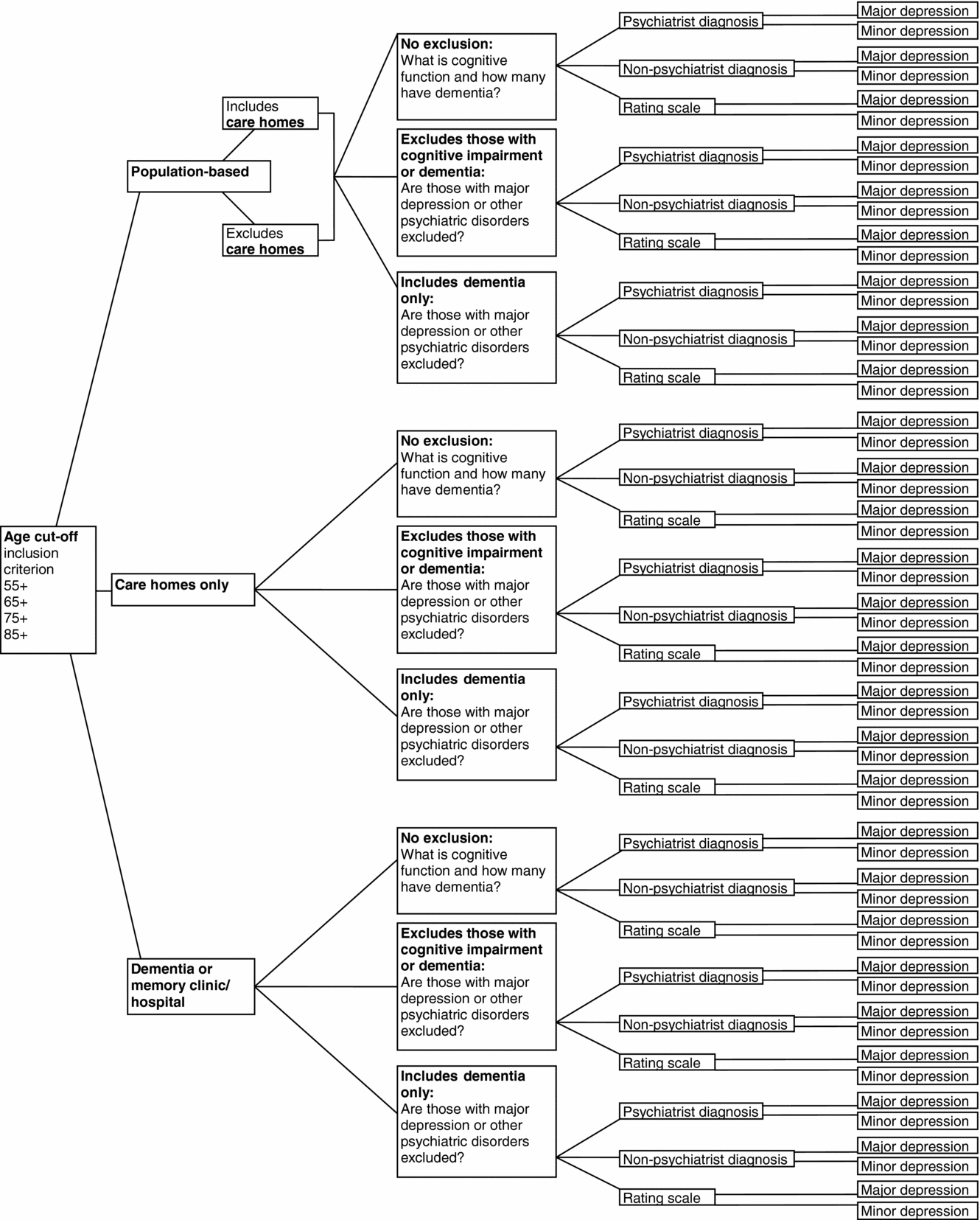
Depression prevalence has been reported to vary widely among studies (Beekman et al., Reference Beekman, Copeland and Prince1999; Luppa et al., Reference Luppa2010). Less variation is seen when the prevalence of major and minor depression is reported separately, although the depression definitions used in the literature often include both major and minor depression (Beekman et al., Reference Beekman, Copeland and Prince1999). Studies using symptom-rating scales report higher prevalence rates than studies using diagnostic systems (Luppa et al., Reference Luppa2010). In a review by Luppa et al. (Reference Luppa2010) on the prevalence of depression in the older population, it was found that of the 24 included studies, 16 excluded nursing home residents, and in one study this was not reported. In addition, four studies excluded those with cognitive impairment, and 11 did not report if cognitively impaired individuals were included or excluded. They conclude that “adequate sampling strategies (e.g. inclusion of nursing home residents and severe cognitively impaired individuals) will reduce methodical disparities and will decrease variability in prevalence rates.” While depression is less frequent in late life than in mid-life, it is more frequent in the oldest old than in the younger old, possibly because of the higher proportion of women, disability, and cognitive impairment in this group (Blazer, Reference Blazer2003; Luppa et al., Reference Luppa2010). The age distribution of a study population differs by setting (Brayne and Davis, Reference Brayne and Davis2012) and often an age cut-off is used as an inclusion criterion (e.g. recruitment of those aged 55+, 65+, or 75+ years).
Figure 2 shows the many permutations when taking these factors into account. For example, compare a study (study A) of the prevalence of BPSD (Selbaek et al., Reference Selbaek, Kirkevold and Engedal2008), a study (study B) of depression in those without cognitive impairment (Anstey et al., Reference Anstey, von, Sargent-Cox and Luszcz2007), and a study (study C) of major depression in all older adults (Streiner et al., Reference Streiner, Cairney and Veldhuizen2006). Study A recruited residents with dementia from a care home, and measured depressive symptoms and other BPSD using the Neuropsychiatric Inventory (Cummings et al., Reference Cummings, Mega, Gray, Rosenberg-Thompson, Carusi and Gornbein1994). Study B recruited people aged 65 years and over from the population-based Australian Longitudinal Study of Ageing. It excluded those with an MMSE score below 24, and measured depressive symptoms with the CES-D Scale (Radloff and Teri, Reference Radloff and Teri1986), for some analyses using a cut-off of 16 or higher. In study C, people aged 55 years and over were recruited from a population-based survey in Canada. They did not exclude those with dementia, and measured major depression based on the WMH-CIDI following the DSM-IV-TR criteria (World Health Organization, 1990).
Permutations in population characteristics, inclusion and exclusion criteria, and depression measurement of studies of depression in older adults. This figure shows many permutations when taking into account population age, setting, exclusion criteria, and depression definition and measurement.
These differences in methodology would have influenced which participants were included in each study and who was counted as a depression patient. For example, Person 1, a 74-year-old woman who has been experiencing mild depressive symptoms since the onset of dementia, would be included as a depression patient in study A, excluded because of her dementia in study B, and while she would not be excluded in study C, her symptoms would not meet the criteria of major depression. Person 2, a 67-year-old male without memory problems with a recent episode of major depressive disorder would be excluded from study A and defined as a depression patient in both study B and study C. Person 3, who has had fluctuating episodes of major depression throughout his life, and has been recently diagnosed with dementia would be included as a depression patient in study A and study C and excluded in study B.
Summary and proposals for future research
From our own work on BPSD, we have recognized that depression is one of the most frequently seen symptoms and we have experienced difficulty in deciding how depression is best handled in preparing our review of reviews of BPSD (van der Linde et al., Reference van der Linde, Stephan, Savva, Dening and Brayne2012). In this study, therefore, we aimed to explore how depression and/or other BPSD have been studied using different inclusion and exclusion criteria, and on populations with different levels of cognitive impairment. We have aimed to depict how using different criteria can generate very different groups of patients in different studies, and how this may be a source of potential confusion.
We have shown that in research on depression, either as part of BPSD or outside the context of BPSD, a range of different populations can be included. Many studies have recruited all older adults without specifying any exclusion criteria and in these studies it is often unclear how many people have dementia or cognitive impairment. Others have excluded those with cognitive impairment, or included those with dementia only. In addition, definitions and measurement of depression as well as the characteristics of the populations (e.g. population age and if the study included or excluded those living in a care home) differed widely among studies and were often not reported clearly.
The findings of studies of BPSD and/or depression are influenced by their design, especially the population groups selected for study, as well as by the research question that they seek to address. Therefore, a clear report of the inclusion and exclusion criteria and population characteristics is essential to understanding the meaning of the findings and to compare results among studies. Our figures provide a useful framework for researchers to use when describing their work to say exactly how people are included and excluded.
By definition, BPSD research focuses on dementia. Depression is probably the most commonly studied individual feature among these non-cognitive manifestations of dementia. However, we do not currently know to what extent depression within dementia is similar to or different from depression in non-cognitively impaired people, and thus it is difficult to know where to set inclusion and exclusion criteria. It is only a partial solution to concentrate solely on people with dementia and exclude those without cognitive impairment, as there are certain research questions that would benefit from inclusion of those without dementia. Several risk factors for depression in dementia may occur earlier in the life course. For example, those with previous depression or certain personality types may be more likely to show symptoms of depression in dementia (Jorm et al., Reference Jorm1991; Robins Wahlin and Byrne, Reference Robins Wahlin and Byrne2011). In addition, some risk factors for depression may be similar in dementia and cognitively intact. For example, the interaction between an individual person and his environment is thought to play a role in the expression of depression and other behavioral and psychological symptoms. This might include a wide range of factors such as over stimulation, change in environment, physical surroundings and sounds, pain, dehydration, comorbidity, problems with hearing or vision, boredom, and social interactions (Lawlor, Reference Lawlor1996; Eriksson, Reference Eriksson2000; Purandare et al., Reference Purandare, Allen and Burns2000; Ballard et al., Reference Ballard2009; Husebo et al., Reference Husebo, Ballard and Aarsland2011). These factors are often difficult to capture and much of the evidence is based on studying the effect of interventions. To further enhance the field, these complex research questions require careful study that goes beyond the traditional division between depression and BPSD-orientated research.
Conclusions
The main practical implications are that there exist a large number of studies of not quite comparable populations, and so researchers probably need to give more thought to the implications of this in design, analysis, and reporting of future studies. In applying research findings, critical readers need to consider these permutations and areas of overlap between depression and BPSD, as the results of differing studies cannot readily be extrapolated or useful inferences drawn.
This study is the clearest exposition so far of the varied populations used in studies of depression and BPSD in older people. Our figures enable clinicians and researchers to locate clearly where an individual study lies.
Conflict of interest
None.
Acknowledgments
We thank Professor Alan Thomas for his comments and suggestions in preparing an earlier draft of this guest editorial.
Rianne M van der Linde receives a studentship from the National Institute for Health Research (NIHR) Collaborations for Leadership in Applied Health Research and Care (CLAHRC) for Cambridgeshire and Peterborough.