

Introduction
In a time of resurging geopolitical rivalry and large-scale military conflict, looming climate disaster, technological disruptions, and pandemics, the future of global politics is routinely painted as radically uncertain in both academic discussions and global policy discourse (for recent examples, seeFootnote 1). Amidst this heightened sense of flux and polycrisis, political organizations on the world stage are re-evaluating how they think and act in relation to the future. Beyond well-researched forms of anticipatory expertise that seeks to render future uncertainties manageable through probability and approximation, speculative foresight that posits the future as radically unknowable and enables organizations to imagine multiple possible futuresFootnote 2 is gaining traction across regional and multilateral international organizationsFootnote 3 (IOs). For instance, as the COVID-19 pandemic swept the globe in 2020, the World Health Organization (WHO) established a brand new unit dedicated to global health foresight.Footnote 4 Two years later, the organizations’ first ever foresight report used scenario planning to explore ‘what the future of infectious threats might look like’, inviting its readers to ‘imagine the different directions that the current and future pandemics might take and to expand the range of plausible futures’.Footnote 5 With this recent investment in futures thinking, the WHO is not alone: across global policy domains such as international peace and security,Footnote 6 sustainable development,Footnote 7 and economicFootnote 8 and regional cooperation,Footnote 9 foresight is perceived as an essential toolkit for IOs as they seek to navigate contemporary uncertainties, preparing for unknown future threats and possibilities.
This article addresses a significant research gap on the politics of foresight as a pervasive,Footnote 10 but scarcely researched and undertheorized form of expertise in contemporary international institutions. Existing scholarship on foresight is sparse in IR, political science, and the broader study of global politics. Much of it focuses on the supposed promises of foresight as a potential methodology to be employed in academic research.Footnote 11 This article, by contrast, approaches foresight from a sociology of knowledge perspective; it explores foresight as a specific form of future-oriented expertise in IOs and aims to throw light on i) its contemporary operation as a bundle of epistemic practices and ii) its contingent historical emergence. Theoretically, I mobilize Karin Knorr Cetina’s notions of epistemic practices,Footnote 12 and I build on performative accounts of the future in social theoryFootnote 13 and science and technology studiesFootnote 14 (STS). Empirically, my account is based on a transversal analysis of IO policy documents, digital platforms and historical archives, futurist writings, and secondary literature on the history of futurisms.
I proceed in two main steps. First, I examine foresight expertise as a bundle of epistemic practices in contemporary IOs. Specifically, I attend to how foresight is created and validated as expertise across organizations, and I analyze how it constitutes the future as a temporal register that IOs and other political actors can relate to and seek to manipulate. Based on this account, I argue that foresight differs from other future-oriented practices that are better understood and more well-researched, such as risk technologies, forecasting, and predictive and anticipatory modeling. While the latter seek to control and mitigate future uncertainties through probability and predictive approximation, foresight constitutes the future as plural, radically indeterminate, and beyond the grasp of present knowledge – thus allowing for organizations to relate to future threats and possibilities amidst contingency and flux. Moreover, I find that foresight is authorized through claims to innovation and imagination, transdisciplinary eclecticism, pluralism, and methodological correctness in ways that challenge established notions of IO expertise as based on bureaucratic rationalities, scientific objectivity, and political neutrality.
In a second move, I illustrate how the specific rendering of the future as plural and contingent that undergirds IO foresight in the present emerged in the second half of the 20th century. Through a genealogical exploration of historical archives and scholarly writings, I find that foresight has a complex history that includes both genres, people, and places that are not usually associated with either IOs or with authoritative expertise more broadly speaking – such as science fiction literature and the fine arts, management philosophy, geopolitical strategy, utopianism, and spiritual traditions. More specifically, I show that the onto-epistemic commitments that permeate IO foresight practices in the present were made possible through the establishment of ‘futures studies’ as an activist, utopian, and aesthetic counter-project to how mainstream Cold War futurology that had been envisioned as a science of forecasting and prediction and a vital toolbox in strategic competition. While foresight is presently promoted as a new and innovative set of tools for IOs and other global governance actors to cultivate, my historical account throws a critical light on such claims to novelty by illustrating that scholars of world politics and IOs themselves were, in fact, deeply involved in the historical emergence of foresight during the Cold War.
In the next two sections of this article, I situate my account in the literature before elaborating on my theoretical points of departure and conceptual contribution. In the following section, I examine foresight as a bundle of epistemic practices in contemporary IOs. Thereafter, I explore the genealogy of foresight in the second half of the 20th century. Finally, I conclude by offering some reflections on the article’s main findings and by sketching paths for further research.
Knowledge and future(s) in international organizations
Across IR, political science, and neighbouring disciplines, the usage of speculative foresight in international institutions is poorly studied as an empirical phenomenon and present political practice. In fact, most existing studies on foresight have reacted to the recent popularity of these techniques in policy circles by suggesting how they may enrich political science and IR as a research methodology.Footnote 15 Some of these contributions provide valuable snapshots of the growing interest in foresight outside of academia.Footnote 16 However, in-depth empirical studies and critical analyses of how IOs and other political organizations engage in foresight as a form of expertise are lacking. This article therefore addresses a significant empirical research gap. Conceptually, the article situates itself at the crossroads of two broader literatures: the study of how imagined futures affect political practices and scholarship on IO expertise. I will address both of these research strands below.
Historically, research on international politics has engaged with the future in long-standing debates on the dangers and virtues of utopianism in world affairs;Footnote 17 theorized the effects of expectations and psychological perceptions of the future in strategic interactions amongst policymakers;Footnote 18 and pondered the question of whether IR can be predictive in a natural science-sense of the term.Footnote 19 More recent literature has drawn on existentialist philosophy and psychoanalysis (amongst other sources of inspiration) in theorizing the future as a source of existential anxiety that operates as a productive force in identity constructionFootnote 20 and inspires ontological security narratives, routines, and actions aimed at stabilizing a state’s sense of self.Footnote 21 Finally, the concept of the future has, naturally, featured prominently in IR’s ‘temporal turn’,Footnote 22 be it in the context of timing practicesFootnote 23 or appraisals of the role of prophecies and predictions in philosophical accounts of time that underpin world politics.Footnote 24 In this article, my analytical focus is not so much on the future as such, but on foresight as a form of future-oriented expertise; that is as a way of knowing and constituting the future as a temporal register, amongst political organizations. My contribution therefore speaks most directly to epistemologically constructivist scholarship in and beyond IR that conceptualizes future-oriented practices as productive forms of knowledge and seeks to critically scrutinize how they matter here and now, in the present.
For this strand of scholarship, Ulrich Beck’s writings constitute an important reference point. From the late 1980s onwards, Beck cautioned against the proliferation of ‘risk’ as a way to control the future, infringe on civil liberties, and securitize the present through anticipation.Footnote 25 Since then, scholars in critical security studies have illustrated how risk technologies and pre-emption reshape security practices and legitimate their expansion onto new societal domains.Footnote 26 While Beck’s original account of the risk society emphasized the uninsurability and incalculability of risk, critical research on the proliferation of precautionary risk technologies in the post-9/11 era instead emphasized how they attempt to ‘“tame” and govern what appears to be ungovernable’ through sovereign decisionism and mundane routinized management of ‘unease’.Footnote 27 Across STS, climate governance, and the sociology of economic expertise, others have studied anticipation through forecasting and prediction that derive from quantitative computational modeling and simulations. This literature emphasizes how anticipatory expertise ‘locks in’ and naturalizes political assumptions.Footnote 28 More recently, a burgeoning IR literature on anticipatory governance has sought to address how assumptions about the future mark processes of global governance and the work of IOs. This strand of research emphasizes that ‘IOs routinely craft visions about which transnational developments are likely to materialise and matter’.Footnote 29 Through anticipatory assumptions and expectations, IOs exercise epistemic authority, limiting the realm of possible futures according to their political preferences.Footnote 30 In a similar vein, Ariel Colonomos’ work on the ethics of prediction and forecasting argues that future experts in world politics produce overly ‘conservative’, linear forecasts that prioritize stability over the potential for abrupt change, thus reinforcing the status quo and limiting political imagination.Footnote 31
Taken together, these literatures on future-oriented expertise span knowledge practices that implicate assumptions about the future, and such that either seek to render the future less uncertain, or uncertainty more manageable, through notions of risk, probability, forecasting, and predictive approximation. Much ink, thus, has been spilled on critiquing forms of expertise that naturalize specific visions of the future as probable and possible, demanding and justifying anticipatory actions in the present. This article, by contrast, turns attention to foresight as an umbrella term for speculative forms of future expertise that embrace deep contingency as a given and make productive use of uncertainty by replacing the notion of ‘the future’ with visions of multiple futures (in the plural). This ‘rediscovery’ of the future as ‘unknowable’ – a realm of radical contingency rather than something to be tamed, anticipated, and controlled – in political institutions has been addressed in some recent contributions to social theory.Footnote 32, Footnote 33 In IR, Peter Katzenstein’s recent work has instead echoed this shifting understanding on the future in urging us to abandon the assumption that the world is constituted through controllable risks, and inviting us to accept radical ‘uncertainty and an open future’ as a ‘self-evident’ and ‘ineluctabl(e)’ condition in contemporary world politics.Footnote 34 However, despite this burgeoning interest in the future as radically contingent and unknowable, there is a lack of empirically grounded, reflexive, and critical diagnostics of the (onto)politics that such visions of the future unfold, in IOs and elsewhere.
Next to the study of future-oriented practices, my article shares in the overall ambition of this special issue to advance the study of expertise in IR by attending to plural forms of expert knowledge. In existing research, there is a broad consensus that IOs advance claims to expertise as they navigate competitive environments and seek to bolster their own authority and legitimacy.Footnote 35 Sociologically inclined scholars have also shown how authoritative expertise comes about in practices of professionals and bureaucrats, NGOs, IOs, states, and (natural) scientists.Footnote 36 A closer look at foresight as a form of IO expertise extends this well-known picture; it challenges received understanding of IOs as international bureaucracies that exercise rational-legal authorityFootnote 37 and claims expertise based on notions of scientific objectivityFootnote 38 and political neutrality.Footnote 39 This is only part of the story. As my analysis illustrates, IO expertise, both past and present, extends to much more eclectic and unexpected sources of knowledge and a wider variety of claims that authorize expertise.Footnote 40 Attending to IOs’ foresight practices and their genealogical emergence reveals how expertise is also fashioned as such through claims to innovation and imagination, transdisciplinary eclecticism, pluralism, and methodological correctness. It suggests an alternative vision of IOs as consumers and co-producers of eclectic forms of knowledge that transverse the worlds of art and literature, management philosophy, geopolitical strategy, esotericism, and utopianism.
The performativity of the future and foresight as epistemic practice
To think through what is at stake with IOs’ embrace of foresight, this article takes performative accounts of the future in social theory and STS as its starting point. Following theorizing in this vein, knowledge that social actors generate about possible futures can be thought of as ‘truth candidates’: as social imaginaries that become true and real if successfully enacted. As Jeroen Oomen and Martin Hajer argue, the future becomes real ‘only to the extent that it is performed’.Footnote 41 Future-oriented social practices are consequential since they:
bring[…] together actors around one or more imagined futures […] through which actors come to share particular orientations for action.Footnote 42
This line of thinking echoes Sheila Jasanoff’s work on sociotechnical imaginaries, where she emphasizes how ‘collectively held, institutionally stabilized and publicly performed visions of desirable futures’ motivate and underwrite social and technological developments.Footnote 43 Visions of the future thus become performative to the extent that they establish a common understanding of events that may occur and appropriate ways of acting in response among relevant actors in a global policy domain.Footnote 44 As a consequence, interrogating future-oriented practices gains importance for understanding questions of power and political responsibility. More fundamentally, performative theorizing rests on a commitment to constructivist and historical epistemology that does not understand new systems of thought as part of a ‘continuous accumulation of knowledge’ but as constitutive of the very entities they describe.Footnote 45 This suggests that the future itself has a history and can be constituted in different ways depending on the specific place and time.Footnote 46 In the analysis below, I therefore pay attention to onto-epistemic commitments in foresight – that is, assumptions about the nature of the future (its assumed properties, its assumed relation to past and present, and its epistemological status) – in order to grasp how the future is imagined and enacted in epistemic practices and hence brought to bear on the present. Moreover, I take an interest in how these commitments emerged historically.
In choosing to study foresight in IOs, I also build on more applied work on expertise and anticipation in international institutions. While IOs were traditionally viewed as ‘weak’ actors in international politics due to their lack of coercive power and material resources, the fact that their status as ‘expert’ makes them central actors in global governance is now widely recognized. They also inhabit a particularly salient position when it comes to imagining and enacting future worlds: their acknowledged role as knowledge producersFootnote 47 and orchestratorsFootnote 48 render them uniquely positioned to establish common horizons for what events and developments, conflicts, and collaborations the future may or may not hold. As Mattias Kranke and John Berten put it, IOs are ‘prognostic experts engaged in imagining and establishing visions of the future’.Footnote 49 IOs, thus, inhabit a particularity salient role as futures are crafted and enacted in international politics and hence seem to be particularly worthwhile studying.
To do so, I conceptualize foresight as a bundle of ‘epistemic practices’ that enable IOs and other actors to construct futures as distinct objects of (non-)knowledge and to carve out ways of manipulating and relating to such futures. This understanding works with Karin Knorr Cetina’s concept of epistemic practices, while developing and tailoring it to the phenomenon at hand.Footnote 50 For Knorr Cetina, epistemic practices are both knowledge creating and knowledge validating. Footnote 51 They bring forth objects of knowledge that, unlike our colloquial understanding of material ‘things’, are characterized by ‘a lack in completeness of being’: they can never be fully known and objective, but keep unfolding.Footnote 52 This approach lends itself to an exploration of practices that are directed towards and constitute the future as a quintessentially liminal and elusive object of knowledge and human experience. While I speak of foresight as a way of knowing to denote its nature as expertise, I also characterize it as a way of unknowing the future since the speculative nature of foresight expertise makes it possible for organizations to relate to plural visions of the future despite their inherent unknowability.
Based on this understanding, in the next section of this article, I trace how foresight is circulated and cultivated across organizations, how it enables IOs to relate to the future (knowledge creation) and how it is authorized as expertise (knowledge validation). As I will illustrate empirically, foresight expertise constitutes the future as plural, radically indeterminate, and beyond the grasp of present knowledge. Visions of the future that foresight brings forth can thus be characterized as speculative since they operate outside of probability considerations and are not seen as deducible from either past or present. Foresight can also be categorized as ‘creative’ to the extent that such visions are deemed relevant and useful by virtue of sparking imagination and novel ‘out of the box’ thinking – rather than by virtue of producing ‘robust’ or reliable forecasts, quantified models, or probability assessments (see below, pp. 15–17, for a discussion of ‘creative’ and ‘robust’ future visionsFootnote 53).
As I will illustrate later on, this specific way of relating to the future as plural, contingent, and unknowable has a complex history that helps throw light on its politics. In contemporary policy discourse, foresight is often praised as a new and exciting set of tools for IOs and other global governance actors to cultivate. However, I throw critical light on such claim by drawing on the genealogical notion of historical conditions of possibility. This theoretical idiom gives expression to a historical understanding of knowledge and ontology: practices of knowing emerge in historically specific contexts that enable them to circulate and be articulated in relation to other practices. Just like the objects they bring forth, practices of knowing themselves are characterized by an emergent ontology.Footnote 54 Drawing on this notion and, more broadly, following a genealogical interest in uncovering unexpected, forgotten, and impure beginningsFootnote 55 of present practices,Footnote 56 my historical account relocates the emergence of onto-epistemic commitments that permeate IO foresight today in competing strands of futurism during the Cold War period.
Next to the analytical toolbox I lay out above, my exploration of foresight expertise in the rest of this article is based on a deliberately heterogenous compilation of empirical materials (‘data’), including contemporary IO policy documents and reports, digital platforms, and online events, historical IO archives, futurist writings, and secondary literature on the history of futurisms. These materials were compiled by tracing foresight expertise transversally,Footnote 57 that is, across institutional sites and substantive policy fields, and diachronically, that is, across time. There was thus no predefined ‘sample’ of IOs underpinning my analysis, but instead an interest in reconstructing foresight in IOs as a field of historically contingent epistemic practices. That said, I did not enter this field from ‘nowhere’Footnote 58: my entry point was inspired by my previous research and personal expertise on the institutional ecology of the UN, and from there I traced foresight practices across historical and contemporary sites and contexts. Thereby, the delineation of materials to be considered was guided by a methodological concern with qualitative variation and my interpretative reading of the latter was informed by the analytical tools I discuss above along with the methodological principle of qualitative saturation. The empirical examples I use below are situated and illustrative, allowing me to unfold a series of analytical points and explore selected aspects of foresight as expertise in IOs.
Foresight in international organizations: Imagining the future as contingent, plural, and unknowable
‘Foresight is no longer optional.’ Footnote 59
In the late summer of 2021, at the height of the Covid-19 pandemic, the WHO was under heavy pressure. As a state-centered IO that is closely associated with biomedical expertise and claims to scientific objectivity,Footnote 60 WHO was struggling to retain its authority amidst critiques from different camps in global politics. To the vaccine-justice movement, the organization was failing to protect populations in the Global South from death and disease through its inability to halt the financialization of vaccine distribution and Western vaccine nationalism.Footnote 61 To many Western states, the organization’s beholdenness to China in the fatal first weeks of the previous year had enabled the pandemic to reach its disastrous global proportions.Footnote 62 To critics of lockdowns and other pandemic response policies, the verdict was even harsher: WHO was in the midst of advancing to an authoritarian global emergency government.Footnote 63
In this tense atmosphere, epidemiologists and other highly skilled specialists from the WHO Science Department launched a brand-new initiative. Noting that ‘accelerated COVID-19 transmission has been reported from many parts of the world’, they described the purpose of the new webinar series as a:
journey of imagining the future of infectious threats (…) to mitigate the ongoing and anticipated risks of COVID-19 and other infectious threats.Footnote 64
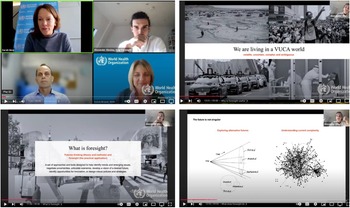
The methodology that the initiative would adopt was not epidemiological. Instead, the experts assembled for four consecutive workshops would use ‘scenarios’ and ‘horizon scanning’.Footnote 65 As the first seminar took place in late October, a professional with the title ‘senior foresight strategist’ gave a presentation on ‘the usefulness of foresight for improved pandemic preparedness’. The group of senior WHO scientists who were present throughout the Zoom session listened carefully, asked follow-up questions, and jointly pondered issues such as ‘What is foresight?’, ‘What are the methodologies?’, ‘Why is foresight useful?’, and ‘What are the practical uses?’Footnote 66
As this example illustrates, contemporary IOs view foresight as a relevant toolkit as they seek to tackle urgent policy problems, navigate uncertainties, and retain credibility amidst flux and contingency. Why had the world been so ill-prepared to face the Covid-19 pandemic? Could approaching the future in a way that took into account its non-singular nature make the world and WHO fit for the next crisis? Perhaps, these were some of the questions going through the minds of WHO officials.
Foresight as epistemic practices in IOs: Creating expertise
With its embrace of future thinking, the WHO is no exception among contemporary international institutions. The UN is another case in point. In September 2024, the organization held a star-studded conference entitled ‘Summit for the Future’ at the New York headquarters. This major global summit had been announced in the Secretary General’s report ‘Our Common Agenda’ with the declared purpose of ‘turbocharging action on the Sustainable Development Goals’.Footnote 68 Steeped in foresight vocabulary, the report sketched two alternative futures for the world: ‘a breakthrough scenario’ which would lead to ‘a green, safer and prosperous future’ and ‘a scenario of breakdown and perpetual crisis’.Footnote 69 While global public debate around the Summit of the Future focused on the political declarations it produced in Pact for the Future, Global Digital Compact, and the Declaration on Future Generations,Footnote 70 work on developing the appropriate methods and skills to create ‘a culture of foresight’Footnote 71 was already well under way in the organization.
In 2023, the UN ‘Futures Lab Network’ had been established to ‘help the UN System and beyond embrace futures thinking and strategic foresight’.Footnote 72 In the same year, the Secretary General launched ‘UN 2.0’, an initiative dedicated to ‘rejuvenating’ the UN through ‘cutting-edge skills for the twenty-first century’.Footnote 73 Next to skills in data science, digital technology, innovation, and behavioral science, UN 2.0 aims to promote the development of foresight expertise:
instilling a culture of foresight means equipping ourselves with the capacities to discern emerging trends, anticipate potential shifts, and respond proactively.Footnote 74
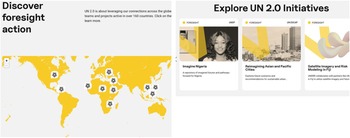
These practices on the part of WHO and the UN are indicative of a broader phenomenon, where IOs across policy fields, such as international peace and securityFootnote 75, sustainable developmentFootnote 76, environmental governance,Footnote 77 economicFootnote 78 and regional cooperationFootnote 79, engage in the creation of foresight expertise as a way to relate to the future. They exemplify, how, in the worlds of contemporary IOs, we encounter a range of practices and artifacts geared towards cultivating and circulating expertise across institutions and policy fields that constructs plural futures as objects of (non-)knowledge. For instance, the UN Futures Lab lists foresights initiatives across UN programs, funds, and agencies,Footnote 80 while UN 2.0 includes an interactive world map that allows users to browse foresight initiatives around the globe, whilst featuring articles on best practice projects – hence facilitating the movement and proliferation of knowledge across institutional scales and boundaries,Footnote 81 see Figure 2.
Collage of stills from WHO foresight project series, ‘Webinar 1: ‘The Usefulness of Foresight for Improved Pandemic Preparedness’.Footnote 67

UN 2.0 Interactive map ‘Discover foresight action’ and preview of articles ‘Explore UN 2.0 initiatives’.Footnote 82

Efforts at ordering also pervade the creation of foresight expertise in contemporary IOs and their surrounding organizational fields. For instance, last year, the International Science Council published a report it had prepared in cooperation with the UN Environment Programme.Footnote 83 As ‘foresight is receiving growing attention on the international stage as a set of tools to support proactive sustainable development’, the report addresses what is described as ‘a need to reflect on the field of foresight and horizon scanning itself (…) through reviewing the landscape of available tools and methods’.Footnote 84 Similarly, the UN recently released a ‘UN Strategic Foresight Guide’ that describes foresight methods and orders them by dividing them into three different ‘areas of application’: namely, ‘make sense of change’, ‘imagine possible futures’, and ‘take action’.Footnote 85 To summarize, the world of contemporary IOs is marked by practices that cultivate, circulate, and order foresight, hence creating it a specific form of future-oriented expertise and enabling it to travel and proliferate across individual organizations and substantive policy fields.
Foresight as epistemic practices in IOs: Validating expertise
How, in the midst of this proliferation and velocity, is foresight validated and authorized as expertise? Compared to more well-studied modes of IO knowledge production, foresight is thoroughly eclectic. It is authorized through claims to innovation, imagination, pluralism, and ‘out of the box’-thinking, rather than claims to objective or universal truths. Indeed, futures research has long been marked by a certain disdain for formal academic training and dull disciplinary discussions, instead valuing knowledge that is fashioned as novel, creative, and unexcepted.Footnote 86
Let us explore this point by returning to the WHO foresight webinar that I mentioned above. At the beginning of the seminar, Director of the WHO Epidemic and Pandemic Preparedness and Prevention Department, Sylvie Briand, offered a few opening remarks. She recounted how pandemic preparedness had tended to move from crisis to crisis and sought to explain the relevance of foresight for moving from a ‘reactive’ to a ‘proactive’ approach:
Every time we face a major event like that, we often do an action review, and we draw the lessons from the response, and we fix what has not worked in this outbreak. From my experience I have noticed that usually the next epidemic or pandemic is completely new, it is a new animal and then we are not necessarily ready, prepared for it. So, I think this is why we wanted really to add (…) this new and exciting innovative foresight initiative which is about imagining the future of infectious threat for the next 3 to 5 years, so that we can think ‘out of the box’. And the ‘out of the box’ is really difficult because we all have our own cognitive biases and tend to do more of the same (…) and remain in our comfort zone (…). But sometimes the solution lies somewhere else. And to find this new solution, innovative solution, we need really also to think about different scenarios for the future. So this is what foresight is about.Footnote 87, 4 min 45 sec – 6 min 20 sec
As Briand’s line of reasoning illustrates, foresight is validated as expertise through claims to novelty, creativity, and innovation. It is fashioned as a way of ridding ourselves of biases and the frustrating task of seeking to learn from the past, instead opting to engage in new, ‘fresh’ ways of knowing that engage our capacity to imagine and to speculate.
Related features of how foresight is validated as expertise are allusions to methodological correctness. Formalized and explicit procedures that guide and structure foresight practices are numerous. They tend to be elaborate and specific, carrying a distinct and recognizable name, such as ‘horizon scanning’, ‘delphi exercise’, ‘scenario thinking’, ‘science fictioning’, ‘backcasting’, or ‘policy gaming’.Footnote 88 This clearly delineated methodological nature of foresight (the fact that is possible to refer to ‘the horizon scanning technique’) means that foresight travels lightly: it is packaged, objectified, and commodified in ways that make it transverse organizational boundaries and policy fields, as an attractive procedural toolbox for IOs and other actors to cultivate.
Moreover, successfully embodying the role as a ‘foresight expert’ involves illustrating the eclectic and boundary-transversing nature of one’s knowing. This is noteworthy since it contrasts with the established notion that expertise is constituted as such through exclusivity and specialization.Footnote 89 As an illustration, let us consider the list of authors in the UNESCO foresight report ‘Transforming the future: Anticipation in the 21st century’.Footnote 90 Besides IO professionals, diplomats, and bureaucrats, the report was authored by academics of various disciplines, professional futurists, and consultants, along with designers, poets, and artists. For example, one of the contributors, Shermon Cruz, is described as ‘a professional futurist, a climate reality leader, a certified business continuity professional’.Footnote 91 Another contributor, Kewulay Kamara, is described as ‘a poet/storyteller, multi-media artist and lecturer’, who had ‘featured in The New York Times’, directed an ‘epic poetry documentary’, and given ‘a Ted TEDxUNC Talk on the uses of storytelling and foresight’.Footnote 92 In these depictions, eclecticism and transgressions between realms of expertise are emphasized and valued. In fact, these short author bios show how people travel across professional fields and categories throughout their careers. Riel Miller, the editor of the publication, offers an apt illustration here. Miller’s professional biography includes research and teaching positions with academic institutions in Canada, Norway, France, and other countries, board memberships and roles in professional futurist associations, such as World Futures Studies Federation and Association of Professional Futurists, work as an independent consultant, and various positions as a policy advisor with OECD and UNESCO, including as ‘Head of Futures Literacy at UNESCO’.Footnote 93
How IO foresight constitutes the future: On onto-epistemic commitments
Despite its eclectic and boundary-transversing nature, foresight comes with distinct onto-epistemic commitments that also set it apart from more well-researched future-oriented forms of expertise. Pertinent research on forecasting, modeling, and risk technologies has illustrated how such practices seek to render the future calculable and manageable through probability, approximation, and naturalization (see above, pp. 5–6). However, in foresight, the future is posited and acted upon as plural, contingent, and ultimately unknowable. To delve deeper into the question of how foresight allows for IOs to relate to the future and how it constitutes the future as a temporal register, let us consider some of the tropes and underpinning assumptions that recur across foresight practices in contemporary IOs.
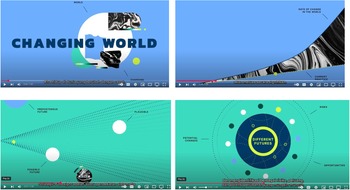
A good place to start is the rejection of prediction. There is a firm sense across IOs’ engagements with foresight that the future cannot be deduced from past experience in a ‘linear’ manner. No matter how much data or how sophisticated the methods, the future remains elusive: ‘the future is not an extrapolation of the past’.Footnote 95 Foresight embarks from a view of both present and future as ontologically contingent. This becomes visible in diagnoses of polycrisis, uncertainty, and accelerating change that often mark the metaphorical place where foresight is seen as useful and needed. Consider, by way of illustration, the notion that ‘we are living in a VUCA world’, where ‘VUCA’ stands for ‘volatile, uncertain, complex and ambiguous’Footnote 96 (see Figure 1 above). Another vivid illustration of this commitment to uncertainty, flux, and complexity can be found in a 2024 video published by UN Global Pulse, an innovation lab created by the Secretary General as part of UN 2.0.Footnote 97 In the video, moving graphic illustrations and keywords light the screen (for a still, see Figure 3 below) and ambient music plays in the background, as a narrator tells us:
as the rate of change grows exponentially, and multiple crises compile on a global scale, we struggle to keep up. Soon, the gap between what is happening, what’s to come and what we can do about it significantly widens. Bridging that gap in today’s increasingly complex landscape can feel like an impossible task, especially for policy makers. But there is a way forward. Strategic foresight is a systematic approach to dealing with uncertainty.Footnote 98
Stills from the video ‘What is Strategic Foresight?’.Footnote 94

Foresight therefore grapples with uncertainty and unknowability as inherent features of the (future) world that need to be cultivated and understood. This sets foresight apart from existing scholarly diagnoses of risk technologies and forecasting techniques that seek to tame uncertainty by approximating and anticipating more or less likely futures.Footnote 99 In a pertinent study of more speculative forms of risk technologies that transverse security and economic governance, Louise Amoore diagnoses a subtle shift from the management of risks based on their relative probability, towards a concern with low-probability high-risk events.Footnote 100 This shift from ‘prevent[ing]’ to ‘preempt[ing]’ dangerous eventsFootnote 101 loosens the grip of probability calculations and emphasizes possibility as a relevant horizon for future-oriented governance.
Foresight takes this logic further by concerning itself with multiple unlikely, but principally plausible, futures. This is closely connected to the idea that the future is at once plural and created. While it is impossible to predict which, out of many possible, futures will be realized, futures are nonetheless products of human efforts and imagination:
Every ‘what if’ sparks new ideas and drives us to create a better tomorrow. What if we embraced uncertainty and complexity with imagination? By exploring multiple futures, we gain fresh perspectives on present challenges and opportunities.Footnote 102
In fact, futurist professionals understand foresight methods not only as tools for imagining futures or relating to its plural possibilities, but as devices that shape and create the future. Jim Dator, a prominent futurist who is associated with the Manoa school of futures studies, gives expression to this sentiment:
Futures visioning is not just about imagining a preferred future. It is about using that vision to decide what to do now in the present in order to move towards the preferred future.Footnote 103
Finally, futures thinking goes along with a commitment to viewing – and ethically valuing – current practices in relation to long-term futures, rather than a responsiveness to immediate risks, dangers, needs, or opportunities. As a recent EU foresight report put it:
integrating long-term goals into short to medium-term decision-making can boost our chances of leaving a world that is in better shape to the next generation.Footnote 104
There is thus a sentiment that possible long-term futures ought to be central to current decisions and that they are ontologically decisive in the sense that ‘we’ (humanity, as a species) need to relate to the long-term to survive, be prosperous, and flourish. There is value in ‘provok(ing) long-term thinking’.Footnote 105
Against this backdrop, foresight can be understood as a bundle of epistemic practices that constitute the future as plural, contingent, and unknowable. In a time where diagnoses of a deepening polycrisis aboundFootnote 106 and IOs face a variety of pressures,Footnote 107 it seems attractive for IOs to equip themselves with expertise designed to approach the uncertainty of the world and the elusive, unknowable nature of the future with ease and competence: ‘We may not control uncertainty, but we can shape how we face it’.Footnote 108 How did this specific way of (un)knowing and relating to the future emerge historically and take on its current form?
In the next section, I venture into IOs’ historical archives and scholarly writings on the history of futurisms to examine how some of the onto-epistemic commitments that mark IO foresight practices today crystallized during the second half of the 20th century. Based on the theoretical premise that practices of knowing are constitutive and historically contingent, I engage in a history of the present that seeks to destabilize taken-for-granted assumptions about cherished contemporary practices through ‘counter-memory and re-serialization’.Footnote 109 Rather than accepting claims about the ‘fresh’, innovative, and novel nature of IO foresight in the present, I place it in different historical series by tracing out some of its ‘numberless beginnings’.Footnote 110
The unexpected origins of IO futures
In contrast to other powerful repertoires of knowledge that mark the work of IOs, such as climate science or epidemiology, foresight did not emerge in the world of the natural sciences and scientific advisory bodies. Instead, a walk to the historical archive shows that foresight has a complex history of emergence, with heterogenous beginning dispersed across science fiction and Cold War strategic competition, business philosophy, and spiritual teachings.Footnote 111 For instance, a modern classic in foresight is the 1962 speculative monograph Profiles of the Future: An Inquiry into the Limits of the Possible. It was written by Arthur C. Clarke – a prolific science fiction author to whom we also owe the screenplay for the well-known 1968 Kubrick movie 2001: A Space Odyssey – and it features imaginative narratives about distant futures of space travel, technology, and human civilization.Footnote 112 Other works in the foresight canon include French oil executive Pierre Wack’s writings from the late 1970s onwards. They tell a corporate ‘success story’ of how the Shell company had been surprisingly well equipped to deal with the 1973 oil crisis that severely impacted vast parts of the industry. In contrast to the ‘linear’ planning activities of its competitors, so the story goes, Shell had embraced creative thinking on the uncertainty and plurality of futures.Footnote 113 The broader genealogy of 20th century futurisms from which foresight emerged also extended to geopolitical theorizing on nuclear warfare and Cold War strategy,Footnote 114 while connections to esotericism and spiritual traditions included early ecologism, Quakers, scientology, and the European and North American hippie movement.Footnote 115
Cold war futurology and the birth of futures studies
Even a brief consideration of some the heterogenous historical beginnings of foresight, therefore, lends further support to a vision of IO expertise as extending beyond forms of knowledge that are sustained and authorized through notions of scientific objectivity and bureaucratic rationality. It renders understandable how foresight came to be authorized through claims to eclecticism, creativity, and innovation, and how it is that it travels so lightly across organizations and policy fields. Yet, to understand the historical conditions of possibility for foresight to emerge as a specific way of (un)knowing to the future, it is useful to revisit a particular point in its genealogy: the establishment of ‘futures studies’ in the early 1970s as an activist, utopian, and aesthetic counter-project to ‘scientific’ Cold War futurology.
In the preceding decades, futurology had been invented as a science of forecasting and prediction, and as such it had become a vital toolbox in Cold War power struggles. US scientists at the RAND corporation and the Hudson Institute had developed scenario methods, war games, and simulations as strategic thinking tools that would allow the West to stay ‘ahead’ in the event of a hot Cold War.Footnote 116 In France, Gaston Berger invented la prospective as a ‘science of forecasting’.Footnote 117 With the political upheavals of 1968, the rise of the New Left, peace protests, and the hippie movement, block politics fatigue and new kinds of utopianism swept the West. Against this backdrop, the very first ‘International Futures Studies Conference’ was held in Oslo in 1967 under the aegis of the French futurist society ‘Humanité 2000’ and a group of European peace activists, researchers, and intellectuals.Footnote 118 By 1973, the World Futures Studies Federation (WFSF) was founded as a forum for futurists of a more activist inclination who sought to pluralize and democratize futurology. These more radical futurists sought to open the field to utopian, normative forms of speculation and creativity, as opposed to the ‘planning’ activities of ‘technocratic elites’.Footnote 119 As historian Jenny Andersson puts it, futures studies were ‘a counter reaction to futurology and protest against the Cold War world order’.Footnote 120
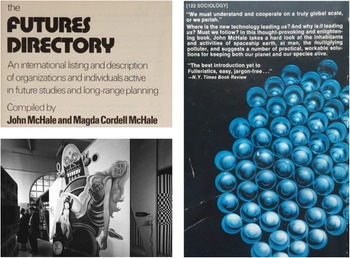
To explore this historical lineage, let us consider an instructive document from the archive. A few years after the conference in Oslo, UNITAR commisioned a report that charted the budding field of futures studies.Footnote 121 The authors were artist John McHale, who the art critic Reyner Banham would later call ‘the father of pop’,Footnote 122 and his wife Magda Cordell McHale, herself an artist who would move on to a career as a futurist academic in the subsequent decades.Footnote 123 The UNITAR report and other works in the same genre by the McHales are noteworthy for several reasons. First, they show how the fine arts constituted another piece in the mosaic of foresight’s eclectic field of emergence. To illustrate the porous borders between artistic practice, social analysis, and the emerging field of futures studies during the Cold War period, Figure 4 presents a collage of selected writings and artworks by the McHales.
Collage of publications and artworks by Magda Cordell McHale and John McHale. Upper left: detail of the first page of the publication “The Futures Directory”Footnote 124; bottom left: group exhibition “This is Tomorrow”, installation view, Whitechapel Art Gallery, London 1956Footnote 125; and to the right: back cover of the monograph “The Future of the Future”.Footnote 126

Second, the 1976 report by the McHales also provides an apt illustration of how the onto-epistemic commitments that continue to mark IO foresight today crystalized historically. Noting an expansion of future-oriented activitivies and organizations, they differentiated between ‘forecasting’, ‘long-range planning’, and ‘futures studies’ as fieldsof inquiry that were ‘woven together but […] have certain independent aspects’.Footnote 127 While forecasting assumed ‘definable causal relations between events through which one can predict their future states – with varying levels of probability of occurrence’, long-range planning was concerned ‘with the organization of events within the next five to ten years’, its ‘horizons’ being limited ‘by its functional relationship to some specific sector of the society (and) implied value assumptions’.Footnote 128
In contrast to such mainstream futurological approaches, the report described futures studies as a more ‘open ended and less definable process’ that was ‘open to speculation’, oriented toward the long termFootnote 129, and worked with ‘explicit sets of value considerations’Footnote 130. The purpose of such an alternative approach to the future, they explained, was:
not to prophesy what a specific future will be, but rather more to explore the plurality of future(s) states which may be contingent upon our actions or accessible to our choice.Footnote 131
Such a vision of plural and contingent futures, they continued, was better suited to the modern world. In fact, ‘unilinear and short-term approaches [were] no longer appropriate’, since:
(w)e live in a highly interdependent world system whose complex interrelationships must now be viewed in terms of their longer term consequences and implications. The common awareness and sense of urgency have generated much debate regarding the alternative kinds of futures which we may face.Footnote 132
As this example illustrates and renders tangible, the emerging field of futures studies thus sought to set itself apart from what they saw as the futurological mainstream’s preoccupation with prediction and strategy. Thereby, it emphasized the unknowability of the future (in the singular), the impossibility of prediction, the plurality of possible futures, and the role of imagination and creativity in envisioning paths for long-term peaceful coexistence and flourishing of mankind.Footnote 133 It was thus in this historical moment that some of the onto-epistemic commitments that permeate IO foresight today took form. This was premised on a rift between different camps of futurists who sought to know and relate to the future in contrasting ways: utopian and aesthetically inclined ‘activists’ and elitist professionals who viewed futurology as a science of prediction and forecasting. Indeed, the McHales wrote about a ‘dichotomy between various futures workers’.Footnote 134 On the one hand, they explained, the field was characterized by a ‘drive towards increased specialization and professionalism’.Footnote 135 But on the other hand, there was also an opposing tendency among futurists who wanted to:
engage the broadest and most diverse array of persons, both professionals and non-professionals, with futures-oriented thinking and action.Footnote 136
In short, there was a ‘polarization between scholar and activist’.Footnote 137 Seen in this light, the cultivation of the contingent and plural, creative, and unexpected in futures thinking that contemporary foresight experts embrace and the taming of uncertainty through prediction, risk, and probability that they tend to reject, must be viewed as reflective of two competing strands in futurist discourse as it developed in the late 20th century. Early futures studies thus foreshadowed the ontopolitics of foresight in the present and pioneered ways of validating expertise through allusions to creativity and pluralism, rather than science or objectivity.
Now, where do IOs fit into the story? What was their position within the historical ‘stage of forces’ in Cold War futurism that allowed for speculative foresight, as a new way of (un)knowing the future, to be articulated in relation to other practices? The next section addresses the place of world politics and IOs in early futures studies.
The place of IOs and world politics in the history of foresight
Another characteristic of early futures studies that is noteworthy when viewed from the present is the emphasis that was placed on problems of world politics and peaceful human coexistence. To explore this point, let us dwell on the historical event of the first International Futures Studies Conference of 1967 and consider the social identities and shared problematizations motivating its participants. Set in beautiful scenery over the fjord of Oslo and dedicated to the theme Mankind 2000, this gathering brought together a heterodox group of planners, futurists, peace researchers, activists, artists, and journalists. One of the organizers was Johan Galtung, whom most readers of this journal might recognize as the ‘founding father’ of peace research.Footnote 138 As a political scientist and peace researcher, he was not alone at the conference. In fact, several chapters of the Mankind 2000 report that Galtung edited together with German journalist and peace activist Robert Jungk following the conference read a lot like an IR journal of the day. Galtung’s own contribution was entitled ‘On the Future of the International System’.Footnote 139 In the rest of the report, chapters with similarly pertinent titles, such as ‘International Planning of Peaceful Economic Development’Footnote 140 or ‘A Proposal for Curtailing Small Wars’,Footnote 141 featured next elaborations on themes that must have sounded less familiar to an IR audience, such as ‘Future Applications of Cybernetics’Footnote 142 or ‘Communication in the Year 2000’.Footnote 143 Problems of international cooperation, war, and peace were thus all but absent in the early days of futures studies.
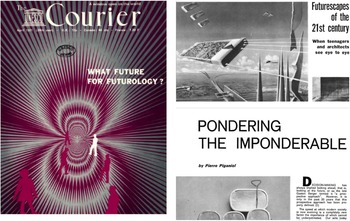
What is more, a closer inspection of further documents and artifacts from the historical archive reveals that IOs themselves were closely entangled with different strands of futurist discourse. In practical terms, this intermingling took on various forms, from conferences and workshops to research programs, grants, and consultancies. As I mentioned in passing above, the McHales both took on the role as foresight consultants for UNITAR.Footnote 144 In the early 1970s, the organization hosted regular seminars with other activist, experimental futurists, such as Jim Dator and Robert Jungk.Footnote 145 UNESCO’s engagement with the field provides another illustrative example. In the UN context, the organization stands out as perhaps the most significant long-term space for the cultivation of speculative foresight and alternative futures. For instance, Dutch futurist Fred Polak, whose 1955 monograph The Image of the Future popularized the notion of multiple possible future worlds and was later to be canonized as a futures studies ‘classic’,Footnote 146 was a recipient of multiple fellowships from the organization.Footnote 147 From the late 1960s onwards, UNESCO also published regular reports on futures and futurology, such as a highly aestheticized publication ‘What future for futurology?’Footnote 148that featured works by Jungk, Helmer, Galtung, Polak and (John) McHale; and other avid futurists of the day such as Bertrand de Jouvenel, Ossip K. Flechtheim and Kenneth E. Boulding (see, Figure 5). Surveying recent trends in the field, the report quoted Helmer declaring that:
the fatalistic concept of an unforeseeable and unavoidable future (…) is being progressively abandoned. We are beginning to realize that there are a great number of possible futures, and that appropriate action can influence these possibilities in different ways.Footnote 149
Collage of images from The UNESCO Courier with the theme ‘What Future of Futurology?’Footnote 153

In the course of the 1980s and 1990s, as futures studies shifted emphasis from questions of technology, space, war, and world peace towards indigenous cultures, ecologism, feminism, and design, UNESCO continued to partake in the field’s development.Footnote 150 On the opposite side of the divide, IOs such as the OECD, NATO, and the Council of Europe remained more closely wedded to the idea of scientific futurology, and thus to notions of probability, causality, and prediction.Footnote 151
Taken together, these historical fragements, dispersed ‘bits and pieces’Footnote 152 from the historical archive illustrate that the study of world politics and international institutions themselves were deeply intertwined in the complex historical emergence of foresight. Considering this, genealogy is relevant today, since it destabilizes contemporary notions of foresight as a novel, fresh, and innovative species of knowledge that can be applied to world affairs, instead uncovering forgotten lines of descent. It illustrates that historically, IOs as political institutions and IR as a discipline were much more closely intertwined with futures studies and foresight than is commonly assumed or remembered. Against this backdrop, the current circulation and cultivation of foresight in IOs can be reassessed and problematized as a rediscovery and rearticulation, rather than a sudden eruption of new truths and insights. Moreover, the claims to novelty and innovation that accompany and authorize foresight as relevant expertise in IOs and elsewhere can be reassessed as closely related to its objectified, and commodified character. Novelty fashions expertise as relevant, useful, and urgent. It convinces IOs and other organizations to invest in foresight, privileging this strand of future-oriented expertise and the professionals who provide it, over others.
Concluding discussion
In this article, I have explored speculative foresight as a popular but sparsely researched form of future-oriented expertise in IOs that allows it to complexify received assumptions about the politics of knowledge in international institutions and the nature of future-oriented expertise. In times when diagnoses of deep uncertainty and polycrisis abound, foresight is perceived as a relevant toolkit for political organizations on the world stage as they seek to approach uncertainty, flux, and the unknowability of the future with confidence and competence. Attending to IO’s use of foresight and its history, I explored the surprisingly eclectic nature of IO expertise and called attention to the plural ways in which it is authorized. Venturing into the historical archive, I found that – contrary to conventional wisdom – the genealogies of IR, IOs, and foresight were in fact closely entangled in the second half of the 20th century. Moreover, I discussed how core onto-epistemic commitments that mark IO foresight today differ from more well-researched forms of future-oriented expertise and I showed how these commitments emerged historically through the establishment of ‘futures studies’ as an activist, utopian, and aesthetic counter-project to scientific Cold War futurology. Mobilizing performative accounts of future-oriented practices and Knorr Cetina’s work, I proposed to conceptualize foresight as a bundle of epistemic practices that constitute the future as plural and contingent, and allows for IOs to relate to this temporal register despite its assumed radical unknowability. As a scholarly intervention, my aim in this article has thus been to push the literatures on IO expertise and future-oriented practices by exploring how foresight expertise operates in the present and by illuminating selected strands of its complex genealogical web of emergence in 20th century futurisms.
Before I conclude, I would like to offer some brief reflections on promising directions for future research that would go beyond the immediate focus of this short article. First, the performative potential of foresight practices that I discussed above calls for a more thorough ethico-political assessment of the constitutive effects of speculative and creative ways of futuring, its import for political accountability, and its intertwinement with global power asymmetries. How can, or must, we (re)imagine political response-ability if the future is acted upon as something radically unknowable? What experiences, hopes, and fears are made present in foresight practices by IOs and other actors in global politics? Such inquiries could mobilize theorizing on political representation, agency, and voice to interrogate who is (not) positioned to speak, act, and thus to craft futures in, and of, international politics. In a similar vein, future research could study how contemporary IOs and other political actors (re)interpret contingency and pluralism as sources of danger and anxiety in the context of uncertainty and policycrisis, rather than sources of political possibility and renewal. Second, and related, this article has focused on the current renaissance of speculative foresight in policy circles and specifically its take-up in IOs, and it has traced some of its historical beginnings back to activist and aesthetic strands of futurism in the late 1960s and early 1970s. Yet, the broader genealogy of contemporary futurism also includes other lines of descent that deserve further scholarly attention in order to problematize how the future is (re)imagined and brought to bear on the present. For instance, this applies to future-oriented political ideologies that flourish across big technology companies, philanthrocapitalist ventures, and speculative strands of contemporary philosophy that recent research has linked to 20th century eugenics and sought to summarize in the concept of the ‘TESCREAL bundle’ – an acronym for ‘transhumanism, extropianism, singularitarianism, (modern) cosmism, rationalism, effective altruism, and longtermism’.Footnote 154 As another example, more research is needed on the present political legacies of futurisms beyond Euromodernity and the West, such as Afrofuturisms, Sinofuturisms, and Indofuturisms, including the strong presence of artistic forms of envisioning in these lineages, the (co)evolution of multiple socio-technical futurist imaginaries, and a historical reappraisal of decolonization as a futurist enterprise from the (global) South.
Acknowledgements
I would like to thank the editors of this Special Issue, Annabelle Littoz-Monnet, Juanita Uribe, and Leandro Montes Ruiz, as well as the Special Issue workshop participants for insightful comments on my work and inspiring conversations on the politics of expertise. I am also grateful to the three anonymous reviewers and the RIS editors for providing helpful feedback during the revision process.
Funding
This research was supported by the Swedish Research Council (grant number 2024-01635).

 Open access

