


Introduction
International wildlife trade, whether legal or illegal, is a global business, with a value of traded and smuggled goods of USD billions per year (Harfoot et al., Reference Harfoot, Glaser, Tittensor, Britten, McLardy and Malsch2018; ‘t Sas-Rolfes et al., Reference ‘t Sas-Rolfes, Challender, Hinsley, Veríssimo and Milner-Gulland2019). Wildlife trade to and from China is a major component of this global commerce. China is a major supply source (Nijman, Reference Nijman2010; Petrossian et al., Reference Petrossian, Pires and van Uhm2016), but since the 1990s has become one of the world's largest consumers of wildlife and wildlife products (Zhou & Jiang, Reference Zhou and Jiang2004; UNODC, 2013), as a result of economic development and increasing consumer affluence. China's demand for wildlife appears to continue to expand as its affluent, urban population increases, and the culture of wildlife consumption spreads from the south to other parts of the country (Zhang et al., Reference Zhang, Hua and Sun2008; Zhang & Yin, Reference Zhang and Yin2014).
This demand drives unsustainable and often illegal harvest and trade, threatening biological diversity within and beyond China's borders. The Red List of China's Biodiversity (MEE & CAS, 2015) shows that 21% of the 4,357 Chinese vertebrate species that have been assessed using the IUCN Red List categories and criteria are categorized as threatened. Overexploitation for food and use in traditional Chinese medicine is the most pervasive threat to Chinese vertebrates (MEE & CAS, 2015). As wildlife populations are depleted within China, sourcing of commercially valuable species has shifted to neighbouring countries in Asia, and to Africa (UNODC, 2010). As a result, the wild populations of highly coveted species, including pangolins (Challender et al., Reference Challender, Wu, Kaspal, Khatiwada, Ghose and Ching-Min2019), Asian large felids (Lynam, Reference Lynam2010; Maheshwari & Niraj, Reference Maheshwari and Niraj2018), bears (Garshelis & Steinmetz, Reference Garshelis and Steinmetz2016), rhinoceroses and elephants (UNEP et al., 2013; Milliken, Reference Milliken2014), and tortoises and freshwater turtles (Nijman & Shepherd, Reference Nijman and Shepherd2015) have experienced severe declines in China's main source countries. As highlighted by the global outbreak of COVID-19 (WHO, 2020), this legal and illegal wildlife trade threatens not only biodiversity but also human health, by facilitating the transmission of zoonotic diseases from wild animals to people.
Prior analyses of legal and illegal wildlife trade in China focused primarily on high-value species or wildlife products such as tigers (Wong, Reference Wong2015), elephant ivory (Gao & Clark, Reference Gao and Clark2014) or bear bile (Foley et al., Reference Foley, Stengel and Shepherd2011), or on trade hotspots of these species and products such as Yunnan (Yi et al., Reference Yi, Meng, Jing, Xu and Liu2015), Guangxi (Jiang et al., Reference Jiang, Yu, Yang, Li and Luo2017) or Guangdong (Chow et al., Reference Chow, Cheung and Yip2014). There is a paucity of empirical studies that consider both the legal and illegal wildlife trade in the country as a whole.
Here, we aim to provide an evidence-based overview of China's role in transnational wildlife trade through an examination of empirical data on legal wildlife trade and enforcement seizures of illegally traded wildlife during 1997–2016. Specifically, we examined: (1) the scale and scope of China's legal and illegal trade, (2) the number and diversity of species involved, (3) the major trading partners and (4) the hotspots and routes associated with China's illegal trade. This information can aid wildlife management authorities in China and source countries in improving their regulation of legal trade, and help cross-border wildlife law enforcement agencies formulate more tailored interception and prevention strategies to disrupt illegal trade.
Methods
We gathered data from two sources. For legal trade, we queried the CITES trade database (CITES, 2016) for all records of China's imports of five vertebrate classes (mammals, reptiles, amphibians, birds and fish) during 1997–2016 (data downloaded on 20 December 2018). This database has been used in previous studies to examine trade of a selected range of taxonomic groups or species at different geographical scales (e.g. Jiang et al., Reference Jiang, Zhou, Meng, Meng, Li and Ping2013; Li & Jiang, Reference Li and Jiang2014; Foster et al., Reference Foster, Wiswedel and Vincent2016), but ours is the first to use it to quantify China's global imports of all CITES-listed vertebrate species.
For data on illegal trade, we collated information reported by TRAFFIC (2017) on seizures of illegally traded wildlife for the same time period, including cases that involved China as the source, transit point or final destination of the seized wildlife, and seizure incidents occurring within and outside China (see Supplementary Material 1 for details).
Results
Legal trade
Scale of China's legal trade
Our analysis of 9,446 CITES trade records showed that during 1997–2016, an estimated > 11.5 million whole-organism equivalents of wildlife (including 7.3 million live animals) and 5 million kg of wildlife derivatives were legally imported into China. The mean annual import volume in whole-organism equivalents was 0.6 million, accounting for c. 10% of the legitimate global wildlife imports, which were estimated at 6 million per year (Harfoot et al., Reference Harfoot, Glaser, Tittensor, Britten, McLardy and Malsch2018). The vast majority (93%) of the trade was for commercial purposes, followed by trade of animals for breeding in captivity (4%).
Imports by taxonomic group and type of goods
Whole-organism equivalents were mostly reptiles (n = 7 million), followed by fish (n = 3.8 million) and mammals (n = 0.6 million). China's imports of birds (n = 0.1 million) and amphibians (n = 19,233) were comparatively low, together accounting for only 1% of the total imports. There was considerable variability in the annual import volume of all taxonomic classes (Supplementary Fig. 1, Supplementary Material 2). With respect to the type of traded goods, China's imports were dominated by live animals and skins, accounting for 64 and 33% of the total imports, respectively.
Most imported species
A total of 879 vertebrate species were imported into China during 1997–2016. Of those, 158 species were listed on CITES Appendix I, 672 on Appendix II and 61 on Appendix III. Overall, a relatively small number of species accounted for the majority of imported wildlife (e.g. the brown caiman Caiman crocodilus fuscus and the oriental ratsnake Ptyas mucosus; Supplementary Material 2). Within the taxonomic groups, the 10 most traded species constituted 94% of the imports of mammals, 80% of reptile imports, 55% of bird imports and nearly all fish imports. Ten species belonging to multiple taxonomic groups accounted for 79% of all imports of live animals, and five reptilian species together accounted for 76% of all imports of skins.
Purpose of imported wildlife
The intended purpose of legally imported wildlife varied between taxonomic groups (Supplementary Table 1, Supplementary Material 1). Mammals were imported primarily for the fur trade, and reptiles for their skin, and for human consumption, traditional Chinese medicine and the pet trade. Birds were imported primarily for the pet trade. Parrots (Psittaciformes), particularly members of the Psittacidae family, which are often traded as caged birds in China (Li & Jiang, Reference Li and Jiang2014), were the most imported taxon. Fish trade was dominanted by the Siberian sturgeon Acipenser baerii and the Asian arowana Scleropages formosus, which were introduced into China mainly for commercial captive breeding for human consumption (Chen et al., Reference Chen, Li, Yang, Zhang and Wu2017) and ornamental use (Tian et al., Reference Tian, Mu, Wang, Gu, Hu and Luo2013), respectively.
Wild-caught vs captive-bred imports
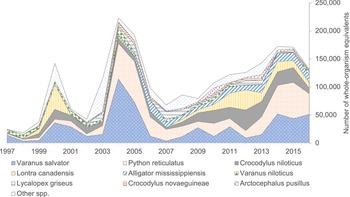
Captive-bred animals comprised on average over half (56%) of China's annual imports for most of the study period (Supplementary Fig. 2a, Supplementary Material 2). At the level of taxonomic groups, mammals were mostly wild-caught (79% of annual mammal imports during 1997–2016; Supplementary Fig. 2b), whereas birds and fish were predominantly captive-sourced (61% of annual bird imports and 93% of annual fish imports; Supplementary Figs 2d,e). Imported reptiles were wild and captive-sourced at approximately equal rates during this period (Supplementary Fig. 2c). When looking specifically at the trade of skins, however, we found a transition towards a higher proportion of wild-sourced products over the study period: from 17% in 1997 to 66% in 2016 (Fig. 1; Supplementary Material 2). This was mainly driven by increased imports of wild-sourced reptile skins: the import volume in whole-organism equivalents rose by 384% from 24,826 to 120,149 and the proportion of wild-caught reptile skins in annual imports increased from 19 to 64% during 1997–2016 (Fig. 2). In contrast, imports of mammal furs were consistently dominated by wild-sourced supplies.
China's skin imports during 1997–2016, broken down by wild-caught (CITES source codes W, R), captive-bred (source codes C, D, F) and other sources (source codes I, O, U or blank; see Supplementary Material 1 for details about the CITES source codes).

Most traded species in China's wild-sourced skin imports in whole-organism equivalent terms during 1997–2016 (see also Supplementary Material 2).

Major trading partners
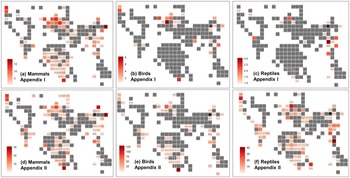
A total of 140 countries and territories, from all continents except Antarctica, were reported as the source of China's legally imported vertebrate animals and products during 1997–2016 (Fig. 3). At the regional level, Asia-Pacific was the biggest supplier, providing 46% of China's imports; followed by Europe (18%), Central and South America (17%) and North America (12%). Contrary to its role as a major source in China's illegal trade (UNODC, 2010), Africa provided only a small share (6%) of China's legal wildlife imports. At the national level, 10 source countries supplied 85% of China's total imports, with Colombia, Indonesia, Malaysia, Thailand, USA and Viet Nam consistently supplying large volumes of wildlife throughout the period studied. Of the species listed in CITES Appendix I, European countries exported the highest number of mammals and birds, and South-east Asian nations exported the highest number of reptiles (Figs 2a–c; Supplementary Material 2). For species listed in Appendix II, the number of vertebrate species exported was more evenly distributed across the continents. South Africa and Japan exported the highest number of mammal species, South Africa the highest number of bird species and Indonesia the highest number of reptile species (Figs 2d–f).
Countries that legally traded vertebrate species to China during 1997–2016 (also see Supplementary Material 2). Countries and territories are represented by their ISO code in the tile grid, in their approximate geographical location. China is marked by the black star. The colour of each tile represents the number of species imported to China. Countries and territories for which no data were available are shaded grey. The top panels show the number of CITES Appendix I-listed (a) mammal, (b) bird and (c) reptile species imported. The bottom panels show the number of Appendix II-listed (d) mammal, (e) bird and (f) reptile species imported.

Illegal trade
Scale of China's illegal trade
Our analysis of 496 wildlife seizures showed that a large diversity and volume of wildlife was illegally traded to, from or via China during the study period. The reported illegal trade involved 121 animal species, with 37 species in 340 seizures listed on CITES Appendix I, 61 species in 128 seizures on Appendix II and three species in five seizures on Appendix III. In addition, 54 species recorded in illicit trade were also legally imported (Supplementary Material 3). Amongst the species listed on CITES Appendix I or II that were traded both legally and illegally, those that were imported legally from one country were often trafficked illegally from another country in the same region, particularly in East and South-east Asia (Supplementary Fig. 3). Only eight species were sourced legally and illegally from the same country (e.g. in Malaysia: the Amboina box turtle Cuora amboinensis and the Sunda pangolin Manis javanica; in Indonesia: the Asian leaf turtle Cyclemys dentata and the black marsh turtle Siebenrockiella crassicollis). Overall, the seizures resulted in the confiscation of > 130,181 animals, including live (n = 82,738) and dead specimens (n = 47,443). Reptiles were the taxonomic group with the largest total number of specimens seized (n = 109,866). The number of seized mammals was much smaller (n = 18,424), but mammals and their derivatives comprised 75% of all seizure incidents.
Commonly trafficked species and derivatives
The species and derivatives most commonly trafficked to China (Table 1) were bears (paws, gall bladders), elephant ivory (tusks, carvings, jewellery), leopards and tigers (pelts, bones), pangolins (live, meat, scales), rhinoceroses (horns), and lizards, snakes, turtles and tortoises (live, shells). Elephant ivory, lizards, pangolins, snakes, turtles and tortoises in particular were traded on a substantial scale. For example, during 1997–2016, 146 seizures involved the forfeiture of 118,689 kg of elephant tusks and ivory products by enforcement agencies within and outside China. This is c. 23% of the 518,143 kg of elephant ivory seized by CITES parties globally (including China) during the same period and reported to the Elephant Trade Information System (Milliken et al., Reference Milliken, Underwood, Burn and Sangalakula2013, Reference Milliken, Underwood, Burn and Sangalakula2019). Using an estimated mean tusk weight of 3.95 kg (Rosen & Smith, Reference Rosen and Smith2010), the impounded ivory represents c. 15,000 elephants.
High-profile species and derivatives seizures of illegally traded wildlife destined for the Chinese market during 1997–2016 (data from TRAFFIC, 2017).

1 TCM, traditional Chinese medicine.
Smuggling routes and hotspots
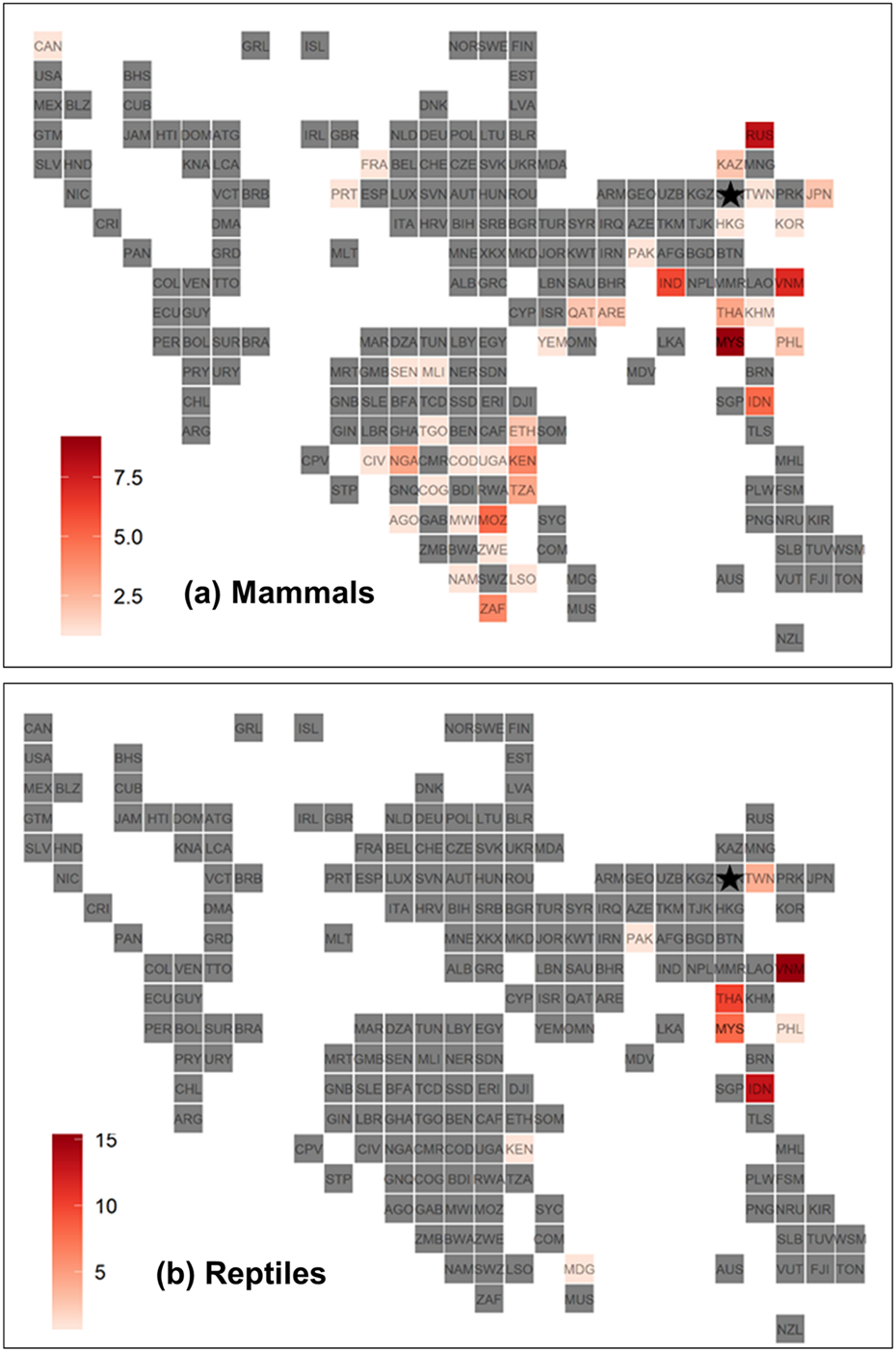
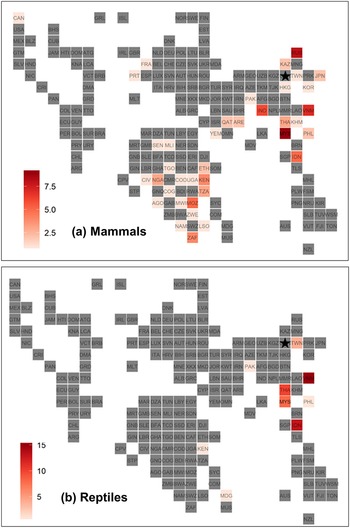
Seizure data suggest that countries and areas predominantly in Africa (e.g. the Democratic Republic of the Congo, Kenya, Nigeria) and Asia (e.g. Indonesia, Myanmar, Russia) are involved in the illegal trade of mammals and reptiles to China (Fig. 4). The majority of the trafficked mammal species originates from African, East and South-east Asian countries (Fig. 4a), whereas South-east Asia is the centre of the illegal trade for reptilian species (Fig. 4b). Multiple routes exist for trafficking wildlife into China. Hong Kong is the most important entrance point for wildlife smuggled by sea from South-east Asia and Africa into mainland China, but China's terrestrial borders are also commonly used in transnational wildlife trafficking. Authorities in all of China's border areas, from the north-east (Heilongjiang, Jilin) and north (Inner Mongolia), to the west (Xinjiang), upper south-west (Tibet) and south-west (Yunnan, Guangxi), have reported seizures involving large volumes of illegally traded wildlife (TRAFFIC, 2007; Supplementary Material 3).
Countries and territories that illegally traded CITES Appendix I or II-listed (a) mammal and (b) reptile species to China during 1997–2016 (see also Supplementary Material 3). Countries and territories are represented by their ISO code in the tile grid, in their approximate geographical location. China is marked by the black star. The colour of each tile represents the number of species seized with China as the final destination. Countries and territories for which no data were available are shaded grey.
Discussion
Limitations of data sources
Although the CITES trade database and the TRAFFIC Bulletin are amongst the few publicly available data sources on legal and illegal wildlife trade (Lopes et al., Reference Lopes, Ferreira and Moraes-Barros2017), both have limitations, and an analysis based on these two sources alone would lead to an underestimation of trade volumes. CITES is limited to regulating international trade for c. 36,000 species listed in its three appendices. However, there are numerous non-CITES listed species, trade in which is generally poorly documented and thus remains largely unknown (Janssen & Leupen, Reference Janssen and Leupen2019). For example, only c. 8% of currently recognized reptile species are covered by CITES (Auliya et al., Reference Auliya, Altherr, Ariano-Sanchez, Baard, Brown and Brown2016). In addition, local use and domestic trade, which may account for the majority of global wildlife trade (Broad et al., Reference Broad, Mulliken, Roe and Oldfield2003), are outside the regulatory scope of CITES. Data on illegal trade are limited by the fact that not all illegal transactions are intercepted and not all seizures are reported by media (Underwood et al., Reference Underwood, Burn and Milliken2013). As such, seizure data are indicative not only of the presence and scope of illegal trade, but also of the effectiveness of law enforcement efforts to tackle it (UNODC, 2016). In addition, the TRAFFIC Bulletin compiles only the more significant wildlife seizures and prosecutions (e.g. cases involving interception of large-volume shipments or charismatic species such as elephants or tigers) that have taken place worldwide since 1997 (TRAFFIC, 2017).
Overview of legal and illegal trade
Our analysis showed that China's global wildlife trade, both legal and illegal, is substantial in scale and scope (UNODC, 2016; Harfoot et al., Reference Harfoot, Glaser, Tittensor, Britten, McLardy and Malsch2018). China's legal imports of CITES-listed species are primarily destined for commercial markets in four areas: the fashion industry, trade of pets and ornaments, traditional Chinese medicine, and human food. Trade in non-CITES listed species can generally only be analysed through examining country-level records of such trade, or via market surveys (Janssen & Shepherd, Reference Janssen and Shepherd2018). The China Forestry and Grassland Statistical Yearbook (NFGA, 2008–2017a) indicates that during 2007–2016, China's import value of non-CITES-listed species was USD 1.7 billion, which is much less than that of CITES-listed species (USD 9.6 billion). However, market surveys suggest that domestic trade in amphibians (Wang et al., Reference Wang, Qi, Guo, Lin, Xiao and Wang2018), birds (Li et al., Reference Li, Xiang, Liu, Liu and Xing2019), turtles and snakes (Chow et al., Reference Chow, Cheung and Yip2014; Ling, Reference Ling2014) was dominated by non-CITES-listed species in terms of trade volume and species diversity.
Although the reported scale of China's illegal wildlife trade is only 1% of its legal imports, this is probably a gross underestimate because of the clandestine nature of illicit trade and the low rate of detection. In addition, the reported volume of seized wildlife probably only covers a fraction of all global wildlife seizures related to China because many seizures are not reported in the media. For example, data from the China Forestry Yearbook (NFGA, 2008–2017b) indicated that during 2007–2016, Chinese forestry police countrywide handled a total of 246,000 forest and wildlife-related criminal cases and 2 million administrative cases, leading to apprehension of 3.9 million offenders and confiscation of 57.6 million animal individuals.
The parallel existence of sizeable legal and illegal markets challenges the ability of China's wildlife authorities to prevent illegally traded wildlife from entering the legal commerce, and to differentiate between legal and illegal products, particularly as nearly half of the species recorded in illegal trade were also traded legally. In addition, Chinese legislation supports the development of a farming industry for protected species and permits the commercial trade and utilization of farmed specimens and related products (Li, Reference Li2007). This has created an additional source of legal supply and another route for laundering illegally traded and wild-sourced specimens. There is evidence that legally registered farms have been used as storage and transfer facilities for laundering wild-caught animals (Ma & Zong, Reference Ma and Zong2008; Wang, Reference Wang2011), and that some local markets have become channels for illegal wildlife trade (EIA, 2009; Jiang et al., Reference Jiang, Yu, Yang, Li and Luo2017). As part of the efforts to control the coronavirus pandemic and prevent future outbreaks of zoonotic diseases, in February 2020 China passed a total ban on consumption of all terrestrial wildlife as food, regardless of protection status and whether it is wild or captive-sourced (NPC-SC, 2020).
Increasing trade in wild-sourced skins
There are studies suggesting a shift from wild to captive sources in the legal wildlife trade globally (Harfoot et al., Reference Harfoot, Glaser, Tittensor, Britten, McLardy and Malsch2018), in the live reptile and amphibian trade in the USA (Herrel & van der Meijden, Reference Herrel and van der Meijden2014) and in the consumption of wildlife as food in China (CWCA & WildAid, 2005). Our analysis did not confirm this trend towards more captive-sourced wildlife in China's imports of vertebrates and their derivatives, including meat (Supplementary Fig. 2f). On the contrary, both the import volume of wild-sourced skins and their proportion in China's annual skin imports have increased markedly since 1998. In 2016, two-thirds of China's skin imports were supplied by wild and ranching sources (Fig. 1). This shift was largely driven by the increase in imports of wild-sourced skins of a few reptilian species, including the Asian water monitor Varanus salvator, the reticulated python Python reticulatus and the Nile crocodile Crocodylus niloticus (Fig. 2). The import volume of wild-sourced skins from these three species combined increased five-fold over the study period, and the majority were sourced in South-east Asia (especially Indonesia and Malaysia).
One reason for this is that the demand for reptile skins for China's leather industry exceeds the supply capacity of its domestic captive breeding programmes. Within China, attempts to breed V. salvator in captivity have failed (Xu et al., Reference Xu, Luo, Li and Shen2006). Only one python farming company exists in the country, with an annual output of c. 40,000 skins from captive-bred Burmese pythons Python bivittatus, all traded in domestic markets for leather products and Chinese musical instruments (mainly Erhu; Natusch & Lyons, Reference Natusch and Lyons2014). There are c. 100,000 individuals of alien crocodilian species (mostly the Nile crocodile, the Saltwater crocodile Crocodylus porosus and the Siamese crocodile Crocodylus siamensis) being kept in captivity across China (Gao & Zhang, Reference Gao and Zhang2005). Given this limited domestic supply, China relies on supplies from abroad to meet the increased demand for reptile skins, and imports more than doubled in value since 2008. In 2017 the country imported 78.4 t of reptile skins, with a total value of USD 12.5 million (UN Comtrade Database, 2017). Considering a mean weight of 0.07 kg for skins of smaller lizards and 1.5 kg for crocodile skins (UNODC, 2016), this implies an import of 52,000–1.1 million reptile individuals into China that year.
This trend applies not only to China: over half of legal exports of CITES-listed reptile skins globally are from wild sources (UNODC, 2016), and most of the legal python exports from South-east Asia are reportedly collected from the wild (Nijman & Shepherd, Reference Nijman and Shepherd2009). In addition, illegally traded, wild-caught reptiles may be laundered into the legal supply chain prior to export (Lyons & Natusch, Reference Lyons and Natusch2011), and thus recorded as legal wild-sourced trade. Indonesia, China's major exporter of reptile skins, has a quota system in place for monitoring and regulating the harvest of wild reptiles, but its legal exports may also include illegally harvested reptiles because collection activities are highly decentralized and informal, and discerning between legal and illegal reptile skins is difficult (UNODC, 2016).
Conclusion
Although the long-term solution to unsustainable and illegal wildlife trade must include measures to reduce demand and alleviate poverty, based on this first assessment we propose that disrupting the supply chains from source to market is an important and urgent short-term step. For international supply chains, this relies primarily on source countries enacting enforceable schemes to verify the legality of traded goods (e.g. allowing only tagged crocodilian skins to be exported; CITES Secretariat, 2010), or imposing stricter domestic measures (e.g. requiring import as well as export permits for export, or requiring reptilian egg shells as the proof of provenance for each farmed reptile individual exported; Lyons & Natusch, Reference Lyons and Natusch2011). However, China should be proactive in promoting the sustainability and legality of its wildlife trade. Close collaboration is needed with its major source countries, especially those featuring prominently in both legal and illegal trade (e.g. Indonesia, Malaysia), with information on wildlife farming and management practices shared promptly between parties. Source countries need to properly implement certification schemes, licensing and registration, and improve their data reporting to CITES. China should also take advantage of its role as the architect of the ongoing Belt and Road Initiative and work collaboratively with its trading partners to develop rigorous guidelines and standards for responsible sourcing and sustainable trade of wildlife products (Hinsley et al., Reference Hinsley, Milner-Gulland, Cooney, Timoshyna, Ruan and Lee2019).
For domestic supply chains, China's wildlife authorities, particularly the forestry administration, police and market regulation departments at local levels, need to improve their work in two areas to effectively regulate harvesting, farming and trading of wild animals. Firstly, increased efforts are needed to ensure rigorous implementation of China's licensing controls (e.g. hunting permits, captive-breeding permits). In particular, the existing special marking scheme, which was introduced in 2003 to track the sale and purchase of wildlife products from protected species and attest their legality (NFGA, 2003), is a promising instrument for impeding and disrupting the laundering of illicit wildlife and facilitating the detection of illegal trade. In addition, we propose investing and leveraging advanced forensic techniques such as high-resolution X-ray fluorescence (Brandis et al., Reference Brandis, Meagher, Tong, Shaw, Mazumder and Gadd2018) and DNA metabarcoding (Luczon et al., Reference Luczon, Ong, Quiland and Fontanilla2016) to help determine specimen identity, provenance or legal status. Secondly, we recommend that local wildlife authorities carry out regular inspections of wildlife trading sites and farming facilities, to detect and punish illegal purchase and resale of poached and trafficked animals under the guise of captive breeding or special marking.
Acknowledgements
This work was supported by research grants from Sun Yat-sen University (20wkpy08) to YJ and from the National Natural Science Foundation of China (41180944) and Sun Yat-sen University (18841200) to TML. We thank A. Kar Yan Wan and S. Fiennes for their help with improving the manuscript, and two anonymous reviewers and J. Hochbach for their constructive feedback.
Author contributions
Study design, data analysis and manuscript revisions: all authors; data collection and writing: YJ; revisions: all authors.
Conflicts of interest
None.
Ethical standards
This study did not involve any animal or human subjects, and otherwise abided by the Oryx guidelines on ethical standards.




 Open access

