

Introduction
Older adults aged 65 years and over constitute 17.1 per cent of the Australian population (Australian Bureau of Statistics 2022). Among the 65+ population, over 37 per cent were born overseas and more than 18 per cent speak a language other than English at home (Australian Institute of Health and Welfare 2024). Older migrants in this scoping review are operationally defined as those who were born overseas, immigrated to Australia, aged 65 years and over, and speak a language other than English at home (Australian Bureau of Statistics 2022). While English-speaking migrants may also encounter cultural differences upon settling in Australia, our focus on non-English-speaking migrant populations is grounded in the evidence that language barriers and cultural mismatches with mainstream services present challenges in accessing and navigating aged care (Georgeou et al. Reference Georgeou, Schismenos, Wali, Mackay and Moraitakis2023; Iwuagwu et al. Reference Iwuagwu, Poon and Fernandez2024). These challenges tend to be experienced to a lesser extent by English-speaking migrants, who are generally better positioned to communicate with service providers and engage with existing care systems in Australia.
Research shows that older migrants from non-English-speaking countries tend to rely on their family members to look after them in Australia (Low et al. Reference Low, Anstey, Lackersteen and Camit2011; Wilson et al. Reference Wilson, Temple, Brijnath, Utomo and McDonald2022). One contributor to this phenomenon is the difficulty they encounter in accessing care services outside family due to English language barriers, a lack of knowledge of aged care systems in Australia and limited culturally appropriate aged care services (Department of Health and Aged Care 2019; Iwuagwu et al. Reference Iwuagwu, Poon and Fernandez2024). Another key contributor to the heavy reliance on family care is their ethnic and cultural tradition. For example, caring for older family members is regarded as a filial obligation of adult children and is often taken for granted in Asian, Middle Eastern and African cultures (Shrestha et al. Reference Shrestha, Arora, Hunter and Debesay2023; Xu et al. Reference Xu, Stjernswärd, Glasdam, Gulestø and Fu2025). However, cultural traditions in family care are changing due to acculturation where self-reliance is valued, resulting in discrepancies in care expectations between the older and younger generations in migrant families, including those in Australia (Tezcan Reference Tezcan2018; Wali and Renzaho Reference Wali and Renzaho2018; Xu et al. Reference Xu, Stjernswärd, Glasdam, Gulestø and Fu2025). In addition, some family carers may not be equipped with the necessary skills to provide the needed care, which could result in unmet needs and exacerbate their feelings of burnout and stress (Alves et al. Reference Alves, Monteiro, Bento, Hayashi, Pelegrini and Vale2019; Stenberg and Hjelm Reference Stenberg and Hjelm2023).
Despite the heavy reliance on informal family care-giving among older migrants in Australia, research on the lived experiences and support needs of their family carers remains limited. Studies in other countries have shown that family carers in migrant communities often face distinct challenges, including navigating language barriers, which differ from those faced by carers in the general population, managing cultural expectations and accessing culturally appropriate services (Baghirathan et al. Reference Baghirathan, Cheston, Hui, Chacon, Shears and Currie2020; Stenberg and Hjelm Reference Stenberg and Hjelm2023). Yet, their voices remain under-represented in aged care research and policy.
Although nearly 96 per cent of older people live in the community in Australia (Australian Bureau of Statistics 2022), there are no scoping reviews on the experiences of family carers of older migrants living at home. A recent review of research in European migrant families by Shrestha et al. (Reference Shrestha, Arora, Hunter and Debesay2023) highlighted the heavy reliance on family carers and the barriers they face in accessing formal support. Given the increasing proportion of culturally and linguistically diverse (CALD) adults within Australia’s ageing population, there is a pressing need to synthesise existing evidence to guide future research and practice. A scoping review is well-suited to mapping existing evidence and identifying potential avenues for improving the aged care experiences of both older migrants and their family carers. The aim of this scoping review was to highlight the major findings from studies in Australia in the last ten years with respect to the caring experience of families and older immigrants living in the community. We hope that findings from this scoping review can advance understanding of how family aged care is experienced in migrant families, factoring in cultural expectations and generational differences in defining family aged care.
Method
This scoping review followed Arksey and O’Malley’s (Reference Arksey and O’Malley2005) five-stage framework comprising: (1) identifying research questions; (2) identifying relevant publications; (3) selecting publications; (4) charting the data; and (5) analysing and reporting results.
Stage 1: identifying research questions
The overarching research question is: What are the experiences of individuals in providing care to their older migrant family members in Australia?
Stage 2: identifying relevant publications
Four search concepts were identified and agreed on by the first two authors after extensive discussion and initial review of relevant literature. They are (a) informal aged care; (b) family carers; (c) CALD background; and (d) Australia. These search concepts were used to refine specific keywords for each of the seven selected databases: Scopus, Social Sciences Database (ProQuest), APA PsycInfo (Ebsco), PubMed (NCBI), Embase (Elsevier), CINAHL (Cumulative Index of Nursing and Allied Health Literature) and Web of Science. Table 1 presents the keywords associated with each of the four search concepts. A systematic literature search was conducted across these electronic databases using a combination of keywords and subject headings. Specific limiters (e.g. publication date, language and peer-reviewed articles) and expanders (e.g. applying equivalent subject or proximity searching mode) were applied to ensure comprehensive search results.
Search concepts and associated keywords

* Notes: stands for broadening a search to include various word endings; ‘’stands for sources containing a specific phrase.
Stage 3: selecting publications
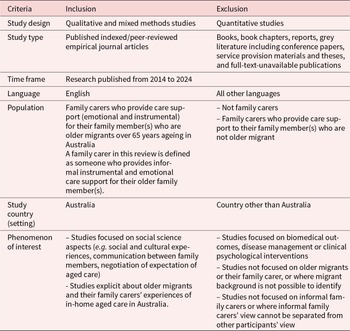
The first two authors collaboratively conducted the selection process and identified eligible publications involving empirical research conducted in Australia from 2014 to 2024 for the final review based on the inclusion and exclusion criteria (see Table 2). The literature search was restricted to studies published within the past ten years to ensure the synthesis of recent evidence, as earlier literature has been reviewed in existing literature reviews (e.g. Georgeou et al. Reference Georgeou, Schismenos, Wali, Mackay and Moraitakis2023). Only peer-reviewed empirical journal articles were included in this review. Books, book chapters, reports and other forms of grey literature were excluded, as they often lack consistent peer-review processes and may not provide sufficient methodological detail for quality appraisal. The methodological quality of the identified publications was assessed using the Critical Appraisal Skills Programme (2018) checklist for qualitative studies before they were included for further analysis. Given that this review specifically focuses on the sociocultural experiences of family carers providing informal care to older family members, studies primarily focused on biomedical outcomes, disease management or clinical psychological interventions were excluded. While we acknowledge that some clinical studies may also explore social dimensions, we defined clinical studies as those situated within medical field which prioritise diagnosis, treatment and symptom management, rather than relational, cultural or emotional care-giving experiences. This distinction was necessary to maintain the sociocultural focus of the review.
Inclusion and exclusion criteria for publication selection

To capture the complexity and contextual nuances of family carers’ experiences, we prioritised studies that employed qualitative or mixed methods approaches. Purely quantitative studies were excluded because they typically include measurable variables (e.g. care-giver burden scales or service use) and are less likely to provide rich, interpretive insights into carers’ lived experiences, cultural values and relational dynamics. Mixed methods studies were included only when they contained a qualitative component that offered relevant sociocultural insights, which aligned with the review’s aims. Publications were excluded if they were not in English, if the full text was unavailable or if they did not primarily focus on older migrants or their family carers.
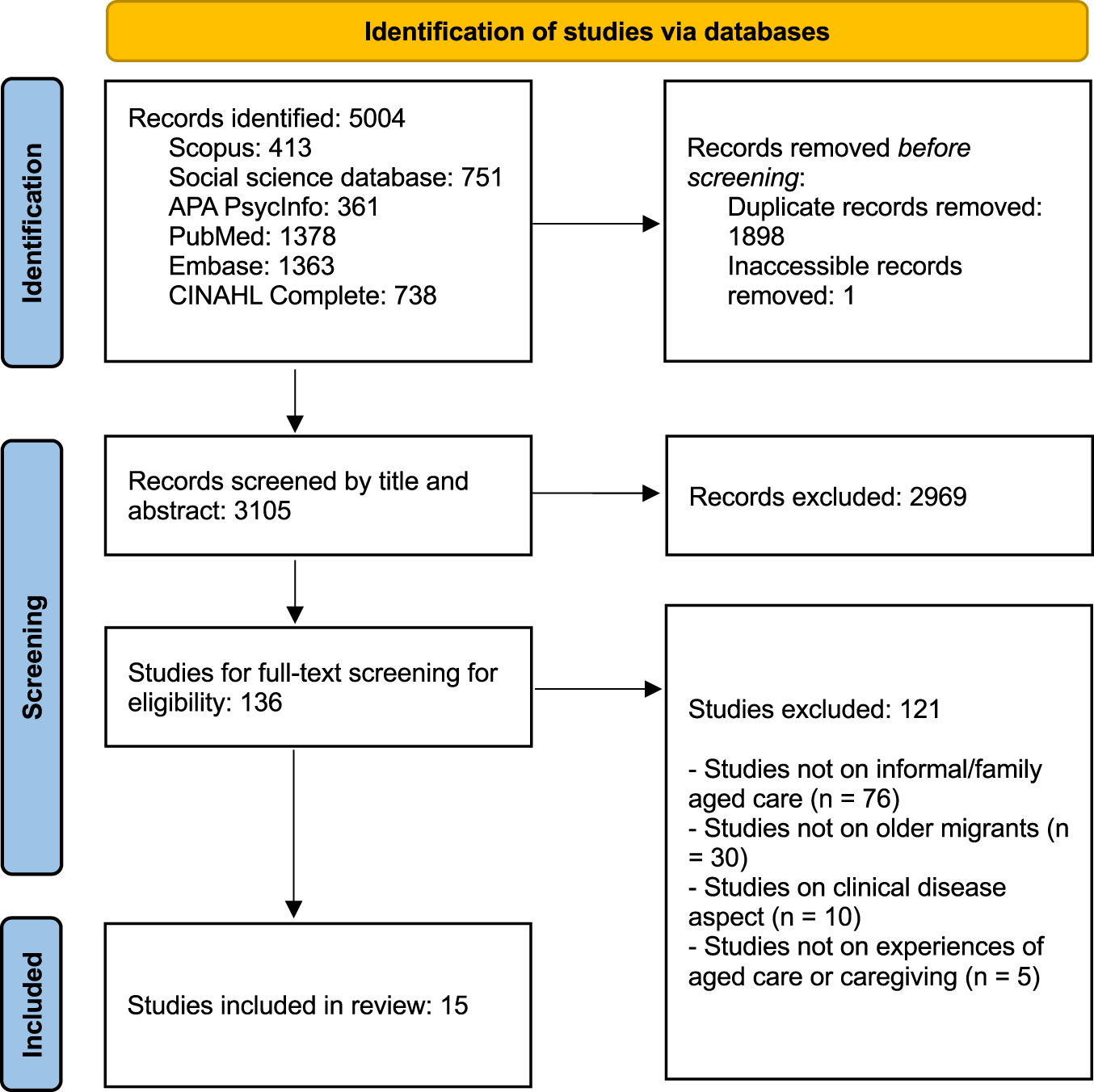
The initial database search had 5,004 hits. A PRISMA (Preferred Reporting Items for Systematic Reviews and Meta-Analyses) flow diagram was used to document the process of identifying, screening and selecting publications for the final review (Page et al. Reference Page, McKenzie J, Bossuyt, Boutron, Hoffmann, Mulrow, Shamseer, Tetzlaff, Akl, Brennan and Chou2021). Figure 1 provides a visual illustration of the number of records identified, screened and excluded at various stages. The selection of records was conducted on Covidence. First, duplicates (n = 1,898) and one inaccessible record were removed from the pool of records. Second, titles and abstracts of the remaining records were screened, and 2,969 publications were ineligible. The full text of remaining records was reviewed, and 121 records were ineligible. Fifteen records were included in the review sample.
PRISMA flow diagram of study selection.

Stage 4: data extraction
Data extracted were authors and year, title, aim of study, aged care type (dementia or general), study design, sample size, participants’ cultural and linguistic background and age, data analysis, findings, discussion and implications, and how aged care is interpreted or negotiated or experienced by older people and their family carers.
Stage 5: analysing and reporting results
Data analysis began with a descriptive summary by year of publication, participants, study focus and research design. This was followed by a thematic analysis guided by Braun and Clarke’s (Reference Braun and Clarke2006, Reference Braun and Clarke2019) six-phase framework. This framework was adopted in previous scoping reviews on aged care – for example, in studies by Georgeou et al. (Reference Georgeou, Schismenos, Wali, Mackay and Moraitakis2023) and Grosse and Kokorelias (Reference Grosse and Kokorelias2025). The first two authors were involved in the data analysis process. First, we familiarised ourselves with the data by thoroughly reading each of the included studies and reviewing the charted information to gain an overall understanding of the content. Second, we generated initial codes by conducting a manual inductive coding of the findings and discussions from the included studies. The first author led the data extraction and coding, the preliminary results of which were subsequently reviewed by the second author. Any discrepancies were discussed and resolved through discussion until reaching consensus, ensuring reliability of the coding process. For instance, language barriers to accessing care services and challenges of communicating with health professionals were coded as barriers faced by family carers. Third, initial themes were identified by reviewing and categorising codes. For example, codes related to cultural expectation of caring practice, family obligations and traditional care-giving roles were grouped together under a broader thematic label of cultural expectation of family care. Fourth, we refined the themes by comparing similarities and differences between codes and themes and by identifying relationships between initial themes. Fifth, at the defining and naming themes phase, for example, the initial themes of collective values of familism, norms towards family-oriented care and traditional expectations of filial piety were combined as they shared the core concept of the role of culture in family care-giving practice. We therefore defined this combined theme as cultural expectations of family care. Finally, at Phase 6, we interpreted the finalised set of themes. The analysis was an iterative process of reviewing and refining themes to ensure consistency and coherence.
In reporting the findings of the thematic analysis, we drew on both participants’ lived experiences and the interpretations provided by the authors of the primary studies. While the synthesis was primarily descriptive, we sought to reflect carers’ lived experiences by highlighting themes grounded in participants’ narratives. Meanwhile, we incorporated the authors’ analytical interpretations to capture how these experiences were contextualised and understood within each study. This approach enabled us to present a balanced account that acknowledges both the voices of family carers and the interpretive framing offered by the authors of the studies, which recognises the multi-layered nature of qualitative evidence.
Results
A descriptive overview of identified studies
Table 3 provides a summary of the included studies with the authors, the aim of the study, the type of aged care, the participants and the participants’ cultural and linguistic background. All included studies employed a qualitative research design. All studies collected data through interviews and three also used focus groups.
Descriptive summary of the included studies (n = 15)

As shown in Table 3, of the 15 records, five (33 per cent) were published between 2014 and 2019 and ten (67 per cent) between 2020 and 2024. Eight (53 per cent) focused on providing aged care to older migrants with dementia, and seven (47 per cent) investigated general care-giving experiences. Notably, four of the dementia-focused papers were from the same studies (Brijnath et al. Reference Brijnath, Gilbert, Kent, Ellis, Browning, Goeman, Adams and Antoniades2021; Gilbert et al. Reference Gilbert, Antoniades, Croy and Brijnath2021, Reference Gilbert, Antoniades, Croy, Thodis, Adams, Goeman, Browning, Kent, Ellis and Brijnath2022; Antoniades et al. Reference Antoniades, Croy, Gilbert, Thodis, Medel, Do, Dang, Kent and Brijnath2022). Further, about two-thirds of the studies (n = 9, 60 per cent) investigated family carers’ experiences of providing aged care for older migrants, four (27 per cent) explored older migrants’ experiences and two (13 per cent) examined both family carers and older migrants in the same study. Regarding cultural backgrounds, participants were from Arabic, Chinese, Hindi, Tamil, Vietnamese, Spanish, Greek, Ethiopian, Italian, Croatian, Dutch, El Salvadorian, German, Polish and Romanian cultural groups.
Thematic analysis of the selected publications
Thematic analysis of the 15 selected articles generated four themes: cultural expectations of family care, emotional and instrumental burdens of family care, generational gaps in understanding family care and barriers to accessing services beyond family care. These themes are discussed in detail next.
Cultural expectations of family care
Nine studies (60 per cent) reported family-oriented care influenced by cultural expectations of filial obligations in different cultural groups including Arab (Allam et al. Reference Allam, Gresham, Phillipson, Brodaty and Low2023), Chinese (Caldwell et al. Reference Caldwell, Low and Brodaty2014; Jetten et al. Reference Jetten, Dane, Williams, Liu, Haslam, Gallois and McDonald2018; Teh et al. Reference Teh JHC, Brown L and Bryant2020; Antoniades et al. Reference Antoniades, Croy, Gilbert, Thodis, Medel, Do, Dang, Kent and Brijnath2022; Baldassar et al. Reference Baldassar, Stevens and Wilding2022), Vietnamese (Antoniades et al. Reference Antoniades, Croy, Gilbert, Thodis, Medel, Do, Dang, Kent and Brijnath2022), Spanish (Cordella and Rojas-Lizana Reference Cordella and Rojas-Lizana2020), Romanian (Knight et al. Reference Knight, Keane, Benea and Stone2024) and Ethiopian groups (Fernandez and Athukorala Reference Fernandez and Athukorala2024). Across these studies, carers consistently framed informal aged care for older family members as either a moral obligation (Teh et al. Reference Teh JHC, Brown L and Bryant2020; Baldassar et al. Reference Baldassar, Stevens and Wilding2022) or a religious duty (Knight et al. Reference Knight, Keane, Benea and Stone2024), with a particular emphasis on the expectation that adult children should care for their ageing parents. Care for their parents was considered a duty or a form of ‘payback’ from adult children to their older parents (Antoniades et al. Reference Antoniades, Croy, Gilbert, Thodis, Medel, Do, Dang, Kent and Brijnath2022; Allam et al. Reference Allam, Gresham, Phillipson, Brodaty and Low2023). For example, older Chinese migrants viewed receiving family care from their adult children as a form of repayment for raising their children (Teh et al. Reference Teh JHC, Brown L and Bryant2020). Similarly, in a study of dementia care for older parents of migrant family in Australia, Antoniades et al. (Reference Antoniades, Croy, Gilbert, Thodis, Medel, Do, Dang, Kent and Brijnath2022) reported that
often carers described the way their parent had looked after them in childhood as a kind of debt. While it was distressing for carers to see a parent’s functional abilities and cognitive faculties decline due to dementia, carers’ remarks often suggested that repaying this debt gave them a sense of moral purpose. (p. 7)
In half of the studies (n = 7, 47 per cent), participants equated family care with values of familism that are integral to their cultural identity. For example, family care obligations were perceived by family carers as characteristic of their Ethiopian cultural identity (Fernandez and Athukorala Reference Fernandez and Athukorala2024) and inherent in their Romanian culture (Knight et al. Reference Knight, Keane, Benea and Stone2024).
Many participants considered placing older adults in a residential care facility or a nursing home disrespectful to older family members and a failure to fulfil filial responsibilities (Caldwell et al. Reference Caldwell, Low and Brodaty2014; Antoniades et al. Reference Antoniades, Croy, Gilbert, Thodis, Medel, Do, Dang, Kent and Brijnath2022; Allam et al. Reference Allam, Gresham, Phillipson, Brodaty and Low2023). For Arab carers, seeking external aged care services was culturally stigmatised and that such services were ‘sub-standard’ (Allam et al. Reference Allam, Gresham, Phillipson, Brodaty and Low2023). Such views were shared by Chinese family carers in a study that examined the decision-making process of placing an older family member with dementia into a nursing home (Caldwell et al. Reference Caldwell, Low and Brodaty2014). This study found that Chinese carers are reluctant to send their parent to a nursing home because such a decision is perceived in their culture as children failing their moral duty, parents being abandoned or presence of family conflict (Caldwell et al. Reference Caldwell, Low and Brodaty2014).
Older migrants expressed fear of being abandoned and mistreated in nursing homes (Cordella and Rojas-Lizana Reference Cordella and Rojas-Lizana2020; Teh et al. Reference Teh JHC, Brown L and Bryant2020). Older Chinese migrants preferred to be cared for by their adult children due to stigma and negative perceptions of residential care facilities (Caldwell et al. Reference Caldwell, Low and Brodaty2014). Such views were also noted among older Spanish migrants in Australia, who perceived nursing homes as the last resort and who emphasised that family care-giving responsibilities are unquestionable for their generation, implying that such practices should be passed on from generation to generation in the family (Cordella and Rojas-Lizana Reference Cordella and Rojas-Lizana2020).
Emotional and instrumental burdens of family care
The studies showed that adult children were often primary carers providing instrumental support such as assisting with household tasks (Horsfall et al. Reference Horsfall, Blignault, Perry and Antonopoulos2016), managing medication (Gillespie et al. Reference Gillespie, Harrison and Mullan2015), facilitating access to health professionals and services (Caldwell et al. Reference Caldwell, Low and Brodaty2014; Xiao et al. Reference Xiao, Habel and Bellis2015) as well as emotional support (Gilbert et al. Reference Gilbert, Antoniades, Croy and Brijnath2021). Many carers struggled to manage work commitments and their caring responsibilities. They described caring for older family members as a source of burnout but accepted that they had limited choices due to cultural expectations (Caldwell et al. Reference Caldwell, Low and Brodaty2014).
Six studies (40 per cent) highlighted care burdens of family carers who were migrants themselves. They faced challenges in navigating the aged care system in Australia, which was designed with limited cultural sensitivity (Gilbert et al. Reference Gilbert, Antoniades, Croy, Thodis, Adams, Goeman, Browning, Kent, Ellis and Brijnath2022). For example, Gilbert et al. (Reference Gilbert, Antoniades, Croy, Thodis, Adams, Goeman, Browning, Kent, Ellis and Brijnath2022) reported that aged care assessments lacked cultural relevance and stated:
Rules around gaining the person with dementia’s consent to undertake an assessment created other cultural tensions between carers and aged care assessment services. Some carers said that in their culture, it did not make sense to require formal consent for an assessment by an older person if their dementia was advanced. (e4496)
In Brijnath et al.’s (Reference Brijnath, Gilbert, Kent, Ellis, Browning, Goeman, Adams and Antoniades2021) study, one Tamil carer reported difficulties in interpreting conflicting advice from health professionals and paying for the high expenses of full-time carers in Australia. He eventually relocated his father to India for dementia care.
Different care-giving roles were ascribed to female adult children in the included studies. Adult daughters were expected to carry the burden of care when an older parent was unwell (Fernandez and Athukorala Reference Fernandez and Athukorala2024). Antoniades et al. (Reference Antoniades, Croy, Gilbert, Thodis, Medel, Do, Dang, Kent and Brijnath2022) noted that ‘a primary carer, usually a daughter of the person with dementia, is expected to be a full-time carer by the other family members because the alternative – residential aged care – conflicts with their cultural values’ (p. 6).
Some studies showed that carers viewed providing dementia care for their family members as a process of achieving personal growth despite the associated emotional stress. They felt that the care contributed to building bonds with family members, strengthening family cohesion and fulfilling moral obligations (Antoniades et al. Reference Antoniades, Croy, Gilbert, Thodis, Medel, Do, Dang, Kent and Brijnath2022). Similarly, a study of Greek family carers who cared for their spouses found that family carers reported a sense of love, purpose and belonging through care-giving to their spouse. Horsfall et al. (Reference Horsfall, Blignault, Perry and Antonopoulos2016) explained how ‘they strove to avoid a forced separation and the loss of the one they loved and cared for. They placed great value on their caring role which, while at times was a struggle, gave them a sense of meaning, purpose and belonging’ (p. 200). Similarly, some participants saw providing care for older family members with dementia as a self-transformative process, in which they navigated the relationship with the older family member and managed their care needs (Brijnath et al. Reference Brijnath, Gilbert, Kent, Ellis, Browning, Goeman, Adams and Antoniades2021).
Generational gaps in understanding family care
Despite recognising cultural expectations of filial responsibility, both older migrants and their adult children were aware of a change in the traditional interpretation of what defined family care. Older migrants noted a growing generational gap with their adult children who were educated and acculturated into the host country faster than the older generation. For example, while older Chinese migrants expected to be cared for by their adult children, they were aware that their adult children, who often worked full-time, could hold different views on what family care entailed and might not be able or willing to perform the role of a personal carer (Baldassar et al. Reference Baldassar, Stevens and Wilding2022). This generational gap could result in tensions between traditional cultural expectations of filial responsibility held by older migrants and the value of self-reliance held by younger generations in the same family (Cordella and Rojas-Lizana Reference Cordella and Rojas-Lizana2020; Teh et al. Reference Teh JHC, Brown L and Bryant2020).
In a study on Spanish older migrants, some older migrants and their spouses relied on caring for each other rather than depending on their children for care. However, this study also found that such a self-reliance approach resulted in a feeling of uncertainty about the future and stress among older Spanish migrants (Cordella and Rojas-Lizana Reference Cordella and Rojas-Lizana2020). Similar tensions between cultural expectations of family care and the value placed on self-sufficiency were also found in families of older Chinese migrants, Teh et al. (Reference Teh JHC, Brown L and Bryant2020) noted that, ‘on the one hand, these older adults appeared to retain the traditional expectation for their children to provide financial and physical caregiving when such needs arise. On the other hand, half of the participants described a strong disinclination to rely on their children when their health deteriorated’ (p. 28). Even when the preference for family care was shared between older and younger generations, the reason underlying the preference could be less strongly influenced by cultural traditions among adult children, who tended to be more open to care services outside the family.
Barriers to accessing services beyond family care
Although the changing views of family care were recognised by both older migrants and their adult children, the heavy reliance on family care among older migrants remained. One main reason was barriers to accessing care services outside the family. Family carers who were migrants themselves faced many challenges in accessing information about aged care support due to unfamiliarity with aged care systems in Australia (Xiao et al. Reference Xiao, Habel and Bellis2015; Gilbert et al. Reference Gilbert, Antoniades, Croy, Thodis, Adams, Goeman, Browning, Kent, Ellis and Brijnath2022). Those who were relatively older and cared for their spouse, and adult children who cared for their parents and recently immigrated to Australia themselves, usually found it difficult to navigate the aged care system in Australia due to unfamiliarity and lack of information (Gillespie et al. Reference Gillespie, Harrison and Mullan2015; Xiao et al. Reference Xiao, Habel and Bellis2015; Gilbert et al. Reference Gilbert, Antoniades, Croy, Thodis, Adams, Goeman, Browning, Kent, Ellis and Brijnath2022). Older migrants who were care recipients experienced the same challenges (Fernandez and Athukorala Reference Fernandez and Athukorala2024).
Carers across cultural groups expressed their need for, but also their difficulty in obtaining, culturally appropriate aged care services or bilingual care workers from community service providers. Older migrants and their family carers expected health information to be communicated and services to be delivered to them in culturally responsive ways. For example, Arab carers linked quality aged care with having service providers and health-care professionals who understood their language and culture and who could provide cultural food (Allam et al. Reference Allam, Gresham, Phillipson, Brodaty and Low2023). Studies highlighted the potential of utilising ethnic community associations to facilitate aged care support for older migrants, given the bond and trust among people belonging to the same ethnic communities (Allam et al. Reference Allam, Gresham, Phillipson, Brodaty and Low2023; Fernandez and Athukorala Reference Fernandez and Athukorala2024). However, a common finding across studies was that such aged care services were not readily available.
Discussion
This systematic scoping review of research published between 2014 and 2024 on family aged care for older migrants in Australia highlighted that within immigrant families, both family carers and recipients held cultural expectations regarding the obligation of adult children to care for older parents. The findings showed that younger family carers often preferred greater self-reliance compared with their ageing parents, partly due to their work commitments and time constraints, which reduced their ability to fulfil a direct carer’s role. We discuss these themes next and suggest recommendations for future research, practice and policies.
Cultural expectations of family care and mental health support for carers
Our findings showed that strong cultural expectations of filial responsibility underpinned family care across cultural groups. Family care-giving was also regarded by adult children as repayment to their older parents for raising them. This finding aligns with systematic reviews conducted in Europe, which identified cultural and moral obligations as a key reason for family care-giving (Shrestha et al. Reference Shrestha, Arora, Hunter and Debesay2023; Stenberg and Hjelm Reference Stenberg and Hjelm2023). Consistent with prior studies on the moral and relational aspects of care-giving (Broom et al. Reference Broom, Kirby, Kenny, MacArtney and Good2016), the included studies indicate that family carers were often motivated by deeply held cultural values and moral responsibilities. These findings suggest that care-giving norms can be resistant to change in migrant families. For example, a study on ethnic minority family care-givers in the United States found that providing care for family members was perceived as natural and unquestioned among many Asian American, Hispanic American and African American participants (Pharr et al. Reference Pharr, Francis, Terry and Clark2014).
Despite the challenges associated with a heavy reliance on family care, existing research noted the importance of understanding and respecting cultural values of ageing and care (Torres Reference Torres1999, Reference Torres2006; Chejor et al. Reference Chejor, Cain, Laging and Porock2023). As our findings show, cultural expectations of family care-giving and reluctance to use residential aged care services for older migrants raise an important question: how can service providers effectively support family care-giving practices in migrant families while reducing barriers to accessing services (Department of Health and Aged Care 2019)? For example, a recent review of ageing-in-place strategies in Japan, Singapore and Thailand found that policies in these countries reflect values of filial piety and support family care-giving practices, such as offering tax subsidies to family carers in Japan and Singapore (Satchanawakul et al. Reference Satchanawakul, Liangruenrom, Thang and Satchanawakul2025). In Australia, scholars have called for a culturally responsive home support programme following recent aged care reforms. They recommended reframing the message of independent living in the Support at Home Program towards connection-based themes, to better align with the reliance on family and social networks among culturally diverse groups, and providing culturally adapted aged care assessment (Dakey et al. Reference Dakey, Maxwell and Siette2025). We argue that the absence of culturally appropriate services makes it difficult for older migrants to access the care and support they need beyond their families. Integrating community and family care that leverages existing service capacity and family support can facilitate the delivery of culturally appropriate services to meet the needs of older adults from diverse cultural backgrounds.
Additionally, our findings show that the perceived cultural stigma associated with sending older parents to a nursing home and the fear of inadequate care as well as lack of culturally appropriate services in a residential care facility also contributed to preference for family care, even though sometimes the care demand could be beyond the capability of a family carer. To address these challenges, we recommend providing community educational programmes that help reduce stigma and normalise the use of formal aged care services. These programmes need to emphasise the benefits of accessing formal care, which can complement rather than replace family care-giving. Moreover, aged care providers can collaborate with bicultural staff to co-design services that align with cultural expectations and promote trust (Boughtwood et al. Reference Boughtwood, Shanley, Adams, Santalucia, Kyriazopoulos, Rowland and Pond2013).
Our scoping review found that family carers, often adult children of older migrants, struggled to juggle fulfilling filial obligations and work commitments, resulting in burnout. They experienced a mixture of feelings of duty, fear, stress and shame (Caldwell et al. Reference Caldwell, Low and Brodaty2014; Gilbert et al. Reference Gilbert, Antoniades, Croy and Brijnath2021). The emotional and instrumental strain was especially worse for those who provided care for a family member with dementia (Gilbert et al. Reference Gilbert, Antoniades, Croy and Brijnath2021, Reference Gilbert, Antoniades, Croy, Thodis, Adams, Goeman, Browning, Kent, Ellis and Brijnath2022). Family carer burnout was also reported in a systematic review that included publications in Spanish and Portuguese (Alves et al. Reference Alves, Monteiro, Bento, Hayashi, Pelegrini and Vale2019) as well as research on informal family carers of older migrants in the United States (Moon et al. Reference Moon, Haley W, Rote and Sears J2020). While a small number of included studies highlighted some positive aspects of care-giving such as enhancing family bond (Horsfall et al. Reference Horsfall, Blignault, Perry and Antonopoulos2016; Gilbert et al. Reference Gilbert, Antoniades, Croy, Thodis, Adams, Goeman, Browning, Kent, Ellis and Brijnath2022; Knight et al. Reference Knight, Keane, Benea and Stone2024), it was worth noting a general feeling of burnout experienced by family carers in the reviewed studies.
Future research is needed to explore avenues for enhancing mental health support for family carers, particularly those who may be at a higher risk of burnout, health problems or emotional stress. Our findings indicate that these carers are often older migrants themselves who provide care for their spouse and those who care for their older family members with dementia. It is crucial for government policies to enhance mental health support for family carers to protect their wellbeing. In terms of practice, while some community service providers run social activities for family carers to share experiences and reduce social isolation, more could be done to enhance support programmes for mental health and wellbeing through ethnic community associations. In addition, ethnic associations could serve as a bridge between service providers and relevant government departments to identify the needs of family carers and their older family members, to inform policy decisions.
Changing views of family care and barriers to accessing services
The included studies revealed shifting perceptions of family care-giving. For example, children of older migrants valued independence and autonomy in how they support their ageing parents rather than assuming the role of a personal carer due to acculturation in Australia (Cordella and Rojas-Lizana Reference Cordella and Rojas-Lizana2020). This shift can lead to intergenerational tensions, as older migrants may hold more traditional expectations that care-giving should be provided within the family, as shown in several included studies (e.g. Cordella and Rojas-Lizana Reference Cordella and Rojas-Lizana2020; Teh et al. Reference Teh JHC, Brown L and Bryant2020; Baldassar et al. Reference Baldassar, Stevens and Wilding2022). In such cases, care-giving involves navigating and reconciling these differing expectations between generations. Limited research in the reviewed studies explored the negotiation process. On the other hand, the realisation of cultural change by older migrants as they lived and aged in Australia led to their willingness to accept external care services. However, the heavy reliance on family care and reluctance to access needed external care services continue to dominate care practices in migrant families. A key factor contributing to limited service use is the mismatch between migrant families’ cultural expectations and the design of mainstream aged care services, alongside challenges such as unfamiliarity with aged care systems in Australia, English language barrier and inadequate access to information on eligible services.
Carers in the included studies identified a lack of information about aged care systems as a barrier to seeking support outside the family (Xiao et al. Reference Xiao, Habel and Bellis2015; Gilbert et al. Reference Gilbert, Antoniades, Croy, Thodis, Adams, Goeman, Browning, Kent, Ellis and Brijnath2022; Fernandez and Athukorala Reference Fernandez and Athukorala2024). Such information access can be facilitated by community service providers who specialise in aged care for clients from diverse cultural backgrounds. For example, bilingual care workers from the same cultural background as an older migrant’s family could help with disseminating information about aged care systems and resources to the family (Boughtwood et al. Reference Boughtwood, Shanley, Adams, Santalucia, Kyriazopoulos, Rowland and Pond2013). Effective and timely provision of information on support resources for both family carers and their older family members can better prepare family members for meeting the needs of their family members whose circumstances could change as they age.
Future research may explore how best to facilitate collaborations between family carers and community aged care services. Carers in the included studies identified a lack of culturally appropriate services as a barrier to obtaining support outside the family (Xiao et al. Reference Xiao, Habel and Bellis2015; Gilbert et al. Reference Gilbert, Antoniades, Croy, Thodis, Adams, Goeman, Browning, Kent, Ellis and Brijnath2022; Fernandez and Athukorala Reference Fernandez and Athukorala2024). This finding is supported by previous research that identified difficulties in finding facilities that provided cultural activities and food of their ethnic culture, which would help older migrants to stay culturally connected (Jetten et al. Reference Jetten, Dane, Williams, Liu, Haslam, Gallois and McDonald2018). Similarly, studies conducted in the United Kingdom reported that fears of loss of culture and identity contributed to the reluctance among family carers of older migrants to use formal care services (Baghirathan et al. Reference Baghirathan, Cheston, Hui, Chacon, Shears and Currie2020; Hossain Reference Hossain2021). Effective collaboration between family carers and aged care service providers in the context of individual, social, community and policy influences promotes culturally responsive care. Integrating community and family care that leverages existing service capacity and family support can make ageing at home fulfilling for older people from diverse cultural backgrounds and make aged care more sustainable for society.
Although this review focuses on the Australian context, the findings are directly relevant to the global context as ageing is a global phenomenon; so is the increase of older adults from culturally and linguistically diverse backgrounds in the ageing population. Many countries face similar challenges in providing culturally responsive aged care, especially as family care-giving roles evolve across generations in migrant communities (Shrestha et al. Reference Shrestha, Arora, Hunter and Debesay2023). Themes such as changing expectations on family care-giving, emotional and instrumental burdens on family carers and barriers to accessing formal care resonate across global contexts. For example, a study exploring female Pakistani carers’ views on future care for their older family members in Norway found strong traditional expectations of filial piety and increased family care burden (Arora et al. Reference Arora, Rechel, Bergland, Straiton and Debesay2020). As such, the findings can inform aged care policy and practice internationally, particularly in contexts grappling with demographic change and increasing cultural diversity. This scoping review makes a unique contribution to the literature by systematically synthesising research on family carers of older migrants in Australia across diverse cultural groups. It highlights how cultural expectations, systemic barriers and generational gaps intersect to shape current family care for older migrants.
Limitations
The included studies were limited to peer-reviewed published qualitative studies. Books, book chapters and grey literature were not reviewed. Additionally, the limitation to English publications excluded studies reported in non-English languages. Further, this scoping review focused on studies involving multicultural groups but all conducted in Australia. Future research could broaden the scope to include studies in other countries.
Conclusion
Increasing cultural diversity in the ageing population has created many challenges for individuals, families, communities and societies. With the majority of older adults in Australia living in their own homes or with family (Australian Bureau of Statistics 2022), research on how family care is defined and delivered in migrant families can contribute to the design of strategies to improve the lives of both older migrants and their family carers. While families continue to play a pivotal role in providing aged care support for older migrants, cultural change is reflected in interpreting and adhering to traditional cultural practices of family care. More research that advances understanding of how cultural expectations of aged care are negotiated, interpreted and communicated in migrants’ families can facilitate integration of community and family care to improve the aged care experiences of both older migrants and their families.
Supplementary material
The supplementary material for this article can be found at https://doi.org/10.1017/S0144686X26100579.
Acknowledgements
This research project was supported by the Australian Research Council Linkage Grant Scheme (LP210200703; 2022-2025).
Competing interests
The authors have no competing interests to declare.
Ethical standards
This scoping review made use of published data so ethical approval was not required.



 Open access

