

1 Introduction
Manufacturing companies are increasingly offering product/service systems (PSSs) to their customers (Tukker Reference Tukker2015). While many definitions of PSSs exist in the literature, two of the most highly cited (Beuren, Ferreira & Miguel Reference Beuren, Ferreira and Miguel2013) are ‘a marketable set of products and services capable of jointly fulfilling a user’s needs’ (Goedkoop et al. Reference Goedkoop, Van Halen, Te Riele and Rommens1999, p. 3), and ‘a system of products, services, supporting networks and infrastructure that is designed to be: competitive, satisfy customer needs and have a lower environmental impact than traditional business models’ (Mont Reference Mont2002a , p. 239). Examples of PSSs in industry are numerous. For instance, Ricoh, a multinational imaging and electronics company, provides a package deal called Pay per Page Green which installs, maintains and collects printers and photocopiers at the end of their life, while the customer only pays for pages and copies delivered (Vezzoli et al. Reference Vezzoli, Kohtala, Srinivasan, Xin, Fusakul, Sateesh and Diehl2014). Another example is Toyota Industries, a leading supplier of material handling equipment. Toyota Industries offer trouble-free material handling operations. An example of their offerings is the rental of forklift trucks, where the customer pays for their use while Toyota Industries look after maintenance, upgrade or remanufacturing, and eventual disposal (Kowalkowski & Ulaga Reference Kowalkowski and Ulaga2017).
The rationale for such PSS business models can be economic (e.g., revenue and profit growth), competitive (e.g., differentiation and closer customer relations), and environmental (e.g., resource efficiency and reduced carbon footprint) (Baines & Lightfoot Reference Baines and Lightfoot2014). In addition, drivers of PSS business models can be both proactive and reactive. Whereas some manufacturers lead change by proactively designing new PSSs, others act in a reactive manner and change due to pressure from legislators and competitors as well as resource scarcity and environmental concerns (Mont Reference Mont2002b ; Kowalkowski & Ulaga Reference Kowalkowski and Ulaga2017).
Despite the well-justifiable rationale, several scientific reports confirm that manufacturing companies face various challenges when designing PSSs (e.g., Annarelli, Battistella & Nonino Reference Annarelli, Battistella and Nonino2016). In particular, Durugbo (Reference Durugbo2013) and Matschewsky, Kambanou & Sakao (Reference Matschewsky, Kambanou and Sakao2017) reported problematic separation between product and service departments in PSS providers in industry, and several studies have focused on how to address these challenges in an efficient and effective manner (Andreasen Reference Andreasen2011; Vasantha et al. Reference Vasantha, Roy, Lelah and Brissaud2012). A main root cause for this issue may be that designing a PSS is more complex than designing only its physical product part and the need to jointly manage the integration between product and service elements (Kimita, Sakao & Shimomura Reference Kimita, Sakao and Shimomura2017). PSSs can benefit from interactions across departments in industrial companies (Lightfoot, Baines & Smart Reference Lightfoot, Baines and Smart2013; Eisenbart, Gericke & Blessing Reference Eisenbart, Gericke and Blessing2017), since the bundle of products and services needs to be designed in unison as a system of products, services, networks and infrastructures (Morelli Reference Morelli2003).
Scientific knowledge across disciplines is lacking to realize such improved integration between departments in a company (Lightfoot et al. Reference Lightfoot, Baines and Smart2013; Eisenbart et al. Reference Eisenbart, Gericke and Blessing2017). In particular, while the PSS is a research issue in both engineering design (e.g., Goh, Giess & McMahon Reference Goh, Giess and McMahon2009; Ki Moon et al. Reference Ki Moon, Simpson, Shu and Kumara2009) and marketing (e.g., Tuli, Kohli & Bharadwaj Reference Tuli, Kohli and Bharadwaj2007; Ulaga & Reinartz Reference Ulaga and Reinartz2011), there is limited knowledge transfer between the two. Many of the challenges that manufacturers face when designing a PSS derive from the goods-centric engineering design models prevailing in these firms (Isaksson, Larsson & Rönnbäck Reference Isaksson, Larsson and Rönnbäck2009; Matschewsky et al. Reference Matschewsky, Kambanou and Sakao2017) (see conventional theories for mechanical design, e.g., Pahl & Beitz Reference Pahl and Beitz1988). Prior research has also shown that many manufacturers, including world-leading ones, fail to commercialize their PSS offerings because marketing aspects, such as sales and pricing, are insufficiently addressed during the design phase (Kindström & Kowalkowski Reference Kindström and Kowalkowski2014). Hence, from both a scientific and practical view, we lack sufficient knowledge about how marketing can inform engineering design to provide PSSs that are desired by customers, financially viable, and technologically and environmentally feasible.
Motivated by these observations, this paper aims to reveal the current insights related to PSS design in quantitative and qualitative terms by focusing on interdisciplinary insights in engineering design and marketing. Based on the results obtained, implications and a research agenda for PSS design are provided. In order to arrive at this goal, this research postulates the following research questions:
-
(1) To what extent have insights coming from the marketing discipline been used in the engineering design discipline, and vice versa?
-
(2) What are the implications of insights in marketing for engineering design in order to more effectively and efficiently design PSSs?
The significance of this research resides in its methodology and its findings. The methodology takes an original approach that could be replicated in the future, while the findings contribute to building the necessary bridges across the two disciplines for further discussion within the design community and practical applications in industry.
The remainder of this paper is structured as follows: Section 2 describes the importance of interdisciplinary research in general, and for PSSs in particular; Section 3 describes the research method used; Section 4 explains the results and research agenda and finally, Section 5 presents the conclusions.
2 Interdisciplinary research
2.1 Motivation for interdisciplinary research
Interdisciplinary research can be understood as one of the answers to an increasingly complex world, one in need of integrating several disciplines to tackle complex problems or phenomena (Ledford Reference Ledford2015). Indeed, wicked problems in the current sustainability paradigm are unique, complex and need to be continuously managed through collaboration (Rittel & Webber Reference Rittel and Webber1974; Brown, Deletic & Wong Reference Brown, Deletic and Wong2015). Interdisciplinary research, therefore, integrates information, data, techniques, tools, perspectives, concepts, and/or theories from two or more disciplines to further understand or solve problems beyond the scope of a single discipline (Wagner et al. Reference Wagner, Roessner, Bobb, Klein, Boyack, Keyton and Börner2011).
2.2 Engineering design and marketing
The lack of interaction between engineering design and marketing in general is not a new issue. Krishnan & Ulrich (Reference Krishnan and Ulrich2001) review the literature in engineering design, marketing and operations management to look at product development and fundamental decisions made by intention or default. Of special interest are Krishnan & Ulrich’s (Reference Krishnan and Ulrich2001) differences between the engineering and marketing academic fields with respect to products. Marketing tends to see a product as a bundle of attributes, while engineering sees it as a complex assembly of interacting components. Furthermore, in engineering design, Chen, Hoyle & Wassenaar (Reference Chen, Hoyle and Wassenaar2012) have noted that different functions in a firm tend to optimize their own objectives with limited input from other functions. They highlight the limited communication between the engineering design and marketing domains, and suggest that there is a need to consider customer behavior and demand (the marketing domain) along with the costs and performance of an engineering system (the engineering design domain), while Andreasen & Hein (Reference Andreasen and Hein2000, p. 14) recognize in integrated product development the poor interplay between marketing and design and the ‘ignorance of, and lack of mutual respect between, the departments concerned’. Even earlier, Kahn (Reference Kahn1996) found that interdepartmental collaboration makes the difference between product development success and failure, while Souder & Song (Reference Souder and Song1997) showed in their research of companies in the electronics sector that one of the keys to success in new product development resides in finding the right combination of product design and market choice decisions.
To further clarify the domain of engineering design and marketing, the following definitions are used throughout this paper.
Engineering design is ‘The process of devising a system, component, or process to meet desired needs. It is a decision-making process (often iterative), in which the basic sciences, mathematics, and the engineering sciences are applied to convert resources optimally to meet these stated needs’ according to US Accreditation Board for Engineering and Technology (ABET 2016).
Marketing is ‘The activity, set of institutions, and processes for creating, communicating, delivering, and exchanging offerings that have value for customers, clients, partners, and society at large’ according to American Marketing Association (AMA 2016).
2.3 Need for interdisciplinary research in PSSs
Regarding PSS practice, the literature has shown that PSS providers have struggled to fully capture the benefits of PSS offerings. One reason could be that PSS providers are failing to capture the value from various customers’ perspectives effectively (Kuijken, Gemser & Wijnberg Reference Kuijken, Gemser and Wijnberg2016), which is a central issue in marketing based on the definition above. Morelli (Reference Morelli2003) argued that designing a PSS is a multidimensional activity that requires interaction between the designer, social actors (including those involved in marketing) and technological artifacts. Such necessary interactions in PSS design are, however, insufficiently achieved in industrial practice (see Matschewsky et al. Reference Matschewsky, Kambanou and Sakao2017).
There have been several calls by researchers to look for more interdisciplinary work among academia for PSS design and even design in general (Papalambros Reference Papalambros2015). In PSS research, a number of articles support the need for interdisciplinary research between engineering design and marketing, although their scopes in terms of disciplines do not match exactly. Isaksson et al. (Reference Isaksson, Larsson and Rönnbäck2009) argued it fruitful to combine the engineering and marketing fields to deepen the understanding of the PSS design process. Tukker & Tischner (Reference Tukker and Tischner2006, p. 1554) reported that ‘the PSS community (has) paid only limited attention to business management literature, where well-founded theories about the business sense of servicing had been developed’. Sakao & Shimomura (Reference Sakao and Shimomura2007) have another example calling for more interaction across disciplines; the authors call for a much bigger framework in PSS design to tackle design in the sustainability paradigm. Moreover, there have also been calls from the marketing literature to develop the necessary capabilities in companies interested in implementing PSSs (see, for example, Ulaga & Reinartz Reference Ulaga and Reinartz2011). Furthermore, in their analysis of PSS definitions in business management, engineering design and information systems, Boehm & Thomas (Reference Boehm and Thomas2013) concluded that exchange between these disciplines could be beneficial for the PSS discipline as a whole, calling for more interdisciplinary work since PSSs can gain from looking at the discipline from different perspectives. Additionally, in A Research Manifesto for Services Science, Chesbrough & Spohrer (Reference Chesbrough and Spohrer2006) highlight the importance of integration across academic silos in order to understand modern services. Lightfoot et al. (Reference Lightfoot, Baines and Smart2013) identified five major research areas in servitization (i.e., service marketing, service management, operations management, PSSs and service science) while also suggesting the opportunity for knowledge production by increasing interactions across these disciplines, as well as suggesting a deeper analysis of this cross-fertilization. Qu et al. (Reference Qu, Yu, Chen, Chu and Tian2016) suggest that methodologies from other disciplines, namely, environmental, engineering and business management could support PSS design. Finally, Baines et al. (Reference Baines, Ziaee Bigdeli, Bustinza, Shi, Baldwin and Ridgway2017) call for more ambitious research, suggesting to engage in multidisciplinary, interdisciplinary and transdisciplinary future research.
3 Method
3.1 Overview
The research method followed in this paper is new to our knowledge in that it proposes levels of utilization of insights across disciplines. The method involves three stages. Stage I consists of a systematic literature review, which is a quantitative-oriented method (Jesson, Matheson & Lacey Reference Jesson, Matheson and Lacey2011), and later the identification of insights and their level of utilization. Stage II involves a qualitative thematic analysis (Robson Reference Robson2011) in order to find possible discrepancies between concepts or terms and examine how marketing can inform engineering design. Finally, Stage III identifies a future research agenda for PSS design.
The first two stages correspond to the two research questions. The major benefit of how Stage I is conducted lies in its objective and quantitative manner, determining as accurately as feasible the current extent to which knowledge was used across the disciplines in the literature; for Stage II, that exists in its concise representation of issues for future research in this vast area based on in-depth discussion. The method with its steps is depicted in Figure 1.
Steps followed for the method.

3.2 Systematic literature review with level of insights (Stage I)
Step 1. Identify keywords. This step identifies keywords related to the subject, which include other terms commonly used in each discipline (see appendix A). The ISI Web of Science was the scientific database chosen, since it provides journals with impact factors. This database has been used in a similar way in other publications (see, for instance, Dahlander & Gann Reference Dahlander and Gann2010). The scope for the search focuses on publications in the Web of Science Core Collection, where only the databases SCI-Expanded and SSCI were selected, as these are considered relevant to engineering design and marketing, the topics of interest. The years selected were between the earliest possible year in the database, 1975, and the most recent, 2017 (see appendix B for the list of the journals for each discipline). The chosen journals were selected according to the best knowledge of the authors about PSS-related topics and common outlets. Moreover, the selection was supported by the Web of Science’s categorization of journals as either engineering or marketing. Those journals falling into multiple categories were therefore not selected in Step 1. An example is the International Journal of Production Economics, which although relevant is categorized in the Web of Science as Engineering Industrial, Manufacturing and Operations Research and Management Science. This limitation was compensated by looking again into relevant literature in Step 8. Indeed, widening the scope of the search to include journals in multiple disciplines. Papers that fall into more gray literature are not covered here.
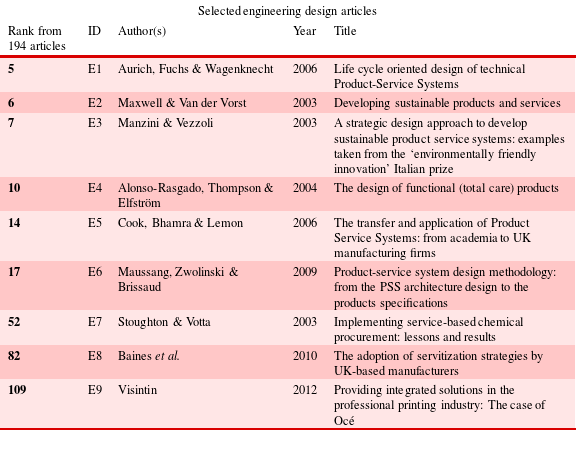
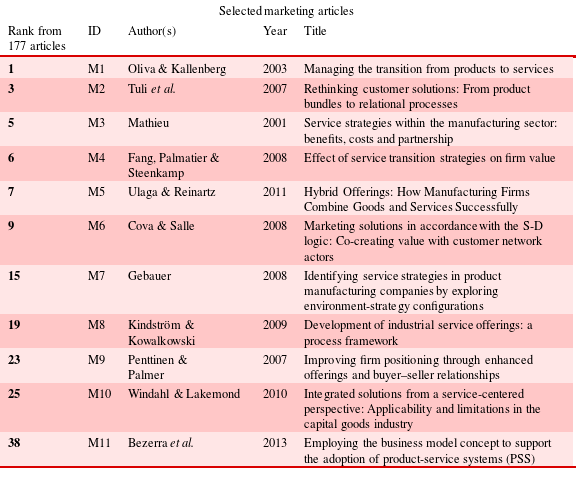
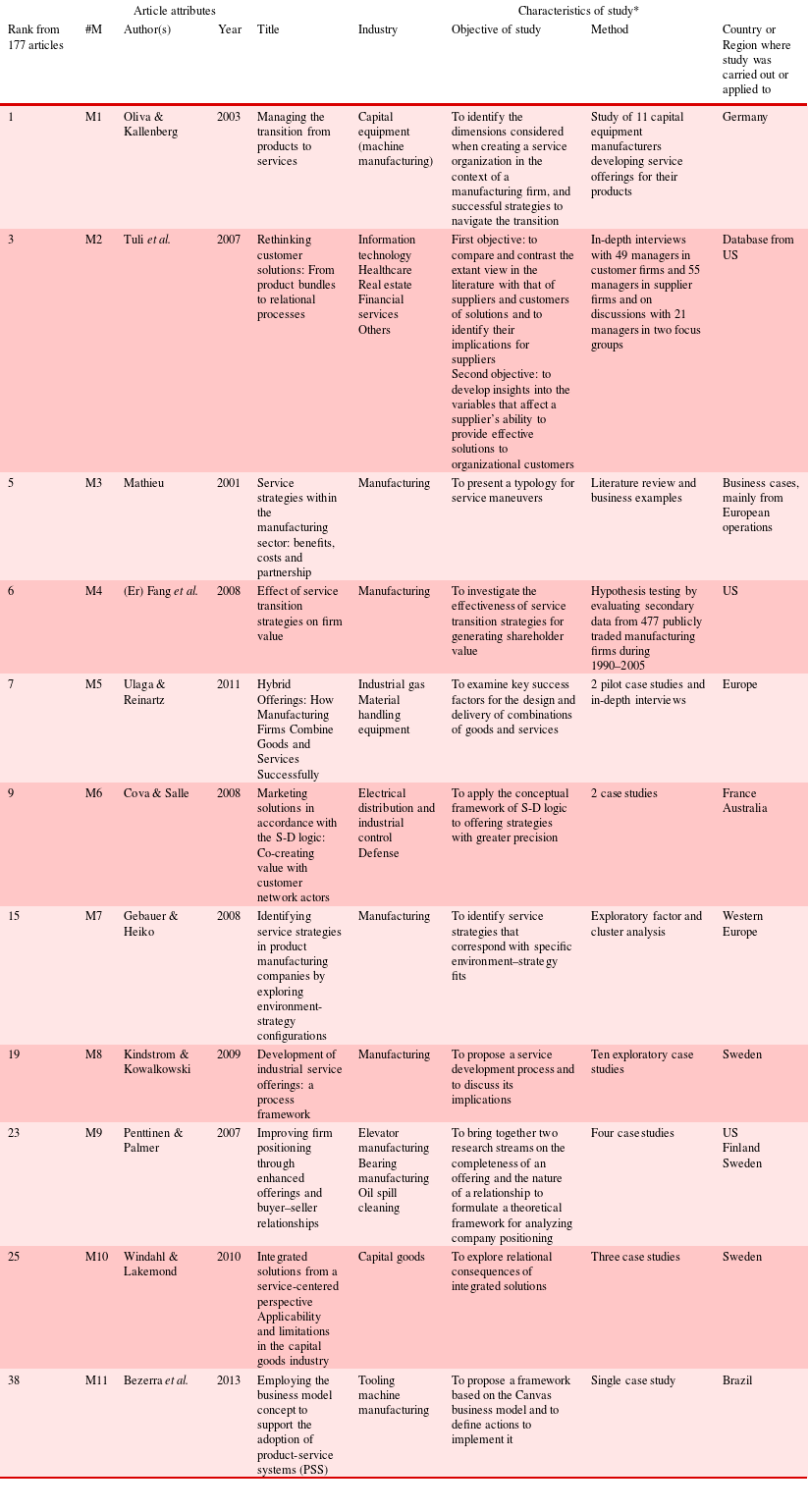
Step 2. Select relevant articles. Databases were created to make the selection of relevant articles. After the keyword search articles were arranged more highest to least cited to have a ranking measure. A criterion for their selection was that the articles had to be cited at least two times from the opposite discipline. In ED, 194 articles were first identified from the keyword search; those which were reviews, not relevant or with only one or no citations were removed. Nine articles that had been cited more than once were selected. The same process was followed in the selection of relevant articles in marketing. A database was also created with 177 articles, from which 11 were finally selected.
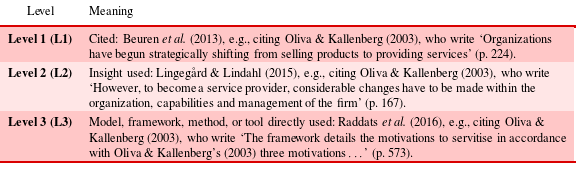
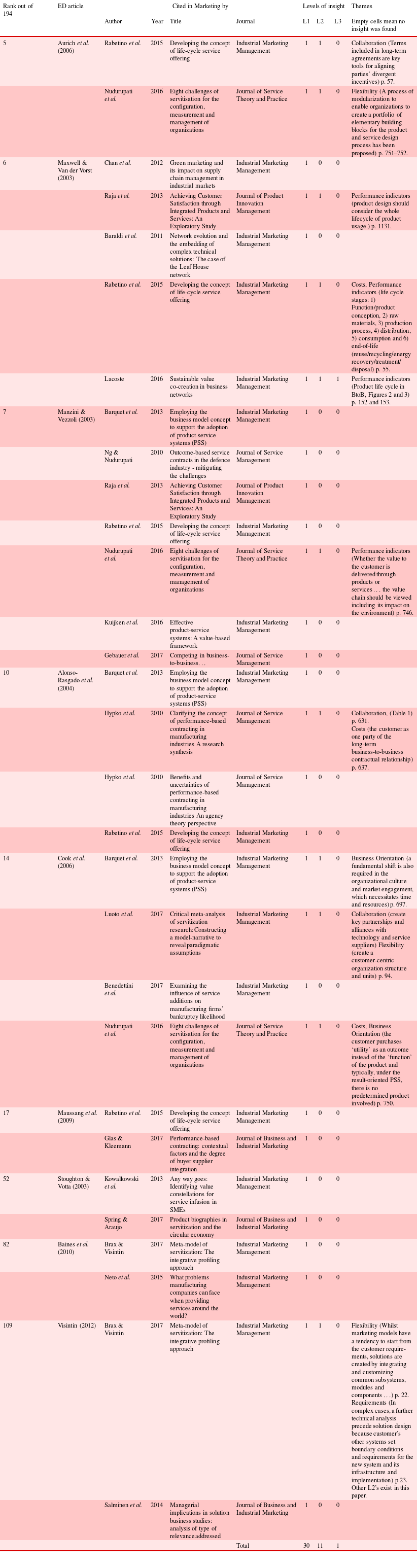
Step 3. Analyze levels of insight usage. After the selection of articles, 9 in ED and 11 in M, Table 1 was applied to identify how insights are being used from authors in the opposite discipline. In the selected 9 articles in ED, 19 articles (30 Level 1 citations) citing them in industrial marketing journals were reviewed. (Some articles like Rabetino et al. (Reference Rabetino, Kohtamäki, Lehtonen and Kostama2015) cite multiple times the opposite discipline.) From the 11 articles in M, 33 articles (50 Level 1 citations) citing them in engineering design journals were also reviewed. (Some articles like Visintin (Reference Visintin2012) cite multiple times the opposite discipline.) Table 1 is explained as follows: Level 1 is assigned one count if a citation from the opposite discipline is used in the publication. Level 2 is assigned one count if there is an insight used, that is, using the understanding or observation from an author in the opposite discipline. Level 3 is assigned one count only if there is enough evidence to suggest that the author(s) had made use of an insight for creating a model, framework, method or tool from the opposite discipline.
Levels of insight usage
3.3 Thematic analysis (Stage II)
Stage II consisted of carrying out qualitative thematic analysis. Braun & Clarke (Reference Braun and Clarke2006) suggest that thematic analysis is usually used when identifying, analyzing and reporting patterns or themes in qualitative data. Guidelines for this type of research usually follow several steps (Robson Reference Robson2011; Vaismoradi, Turunen & Bondas Reference Vaismoradi, Turunen and Bondas2013; Elo et al. Reference Elo, Kääriäinen, Kanste, Pölkki, Utriainen and Kyngäs2014). The steps in this research are as follows:
Step 4. Familiarization with the data. This is carried out in order to understand the overall topics of each of the selected relevant articles (from Step 2) and highlight possible themes. The selected articles address related contents, and, therefore, this step entailed re-reading the selected articles.
Step 5. Generation of themes. The objective for Stage II is to find possible mismatches across disciplines, and an initial guide was found in the well-established criteria in engineering in general (quality, cost, delivery and flexibility). In this step, judgment and interpretation are needed in order to identify themes in each article.
Step 6. Analysis of themes. This step is iterative with Step 5, as some themes were regarded as repetitive across the articles. Each theme is then compared across the disciplines.
Step 7. Final selection of themes. The themes generated in Step 6 are compiled in a spreadsheet in such a way that meaningful comparisons across the disciplines are possible. Based on the themes, insights are provided as implications for engineering design and marketing.
3.4 Identifying a research agenda (Stage III)
Based on the outcomes of Stages I and II, a future research agenda for PSS design is suggested. This will be structured using the themes of relevance selected in Step 7.
Step 8. Identifying a research agenda for PSS design. The insights provided in Step 7 support the formulation of future research questions that so far have not been addressed, or only partially addressed, in the literature. The databases created in Step 2 were used to categorize the insights found into the themes from Step 7 (see appendix D). The research agenda is created after the insights are identified and a literature search for papers addressing these issues is conducted. This includes relevant journals falling into an already interdisciplinary field: Examples are journals in operations management, in particular the International Journal of Operations and Production Management and Journal of Operations Management. The same applies to the International Journal of Production Economics. (See Figure 1, the database flows into Step 8.)
4 Results
4.1 Keyword search and selection of relevant articles (Stage I, Steps 1 and 2)
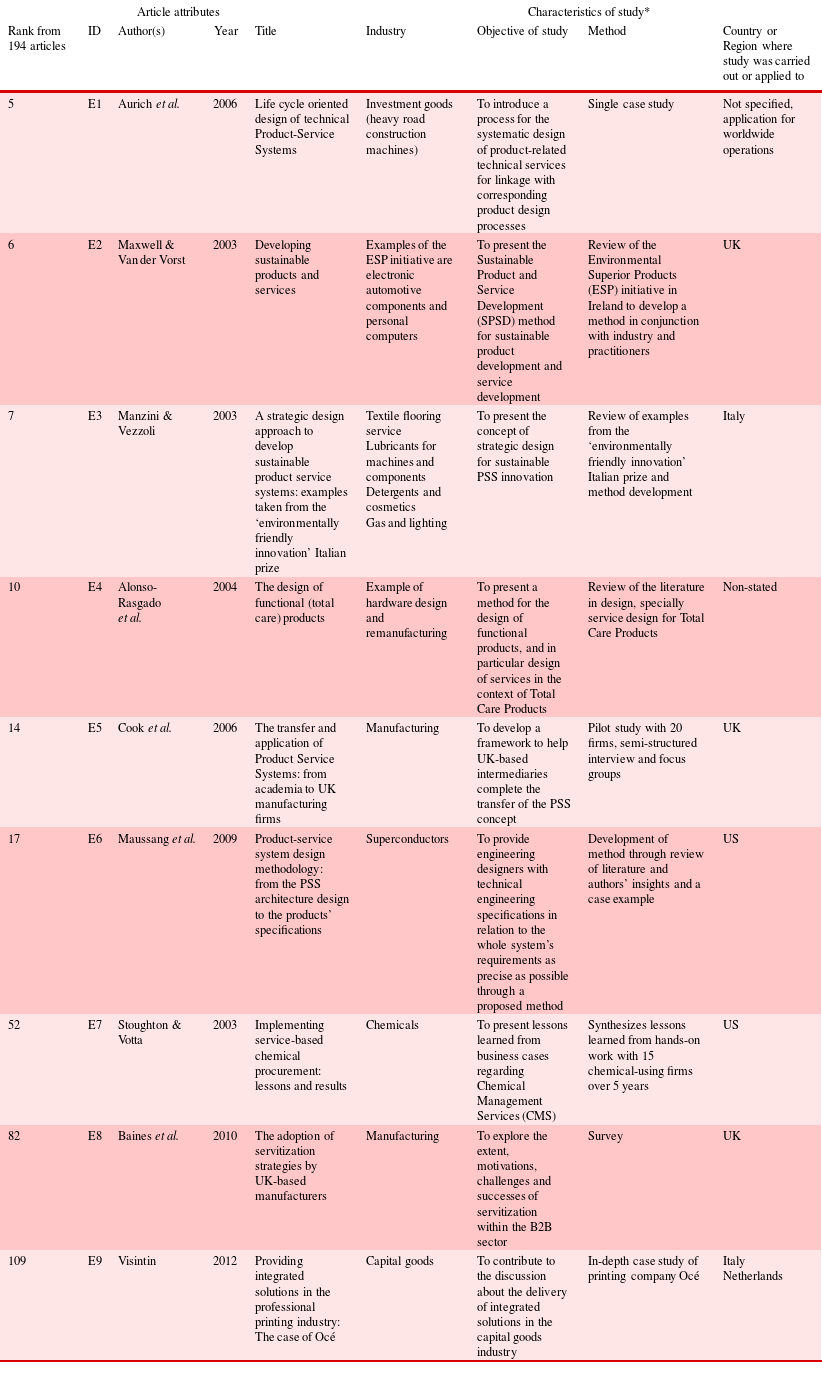
Results for Stage I are time-specific, i.e., results obtained in December 2017. Keywords include other terms commonly used in each discipline. For instance, in engineering design it is common to see related terms such as industrial service, hybrid offering, functional product and servitization. With regard to marketing, terms often used are service infusion and service transition, among others (see appendix A for the keywords adopted). The databases for ED and M included 194 and 177 articles, respectively, ordered from the most to least cited (see Tables 2 and 3) The selected articles come from industries in capital goods, personal computers, and automotive and financial services, to mention a few, as well as different objectives of study, methods and world regions (see appendix C for further details).
The selected articles in engineering design (Outcome of Step 2)
The selected articles in marketing (Outcome of Step 2)
4.2 Analysis of levels of insights (Stage I, Step 3)
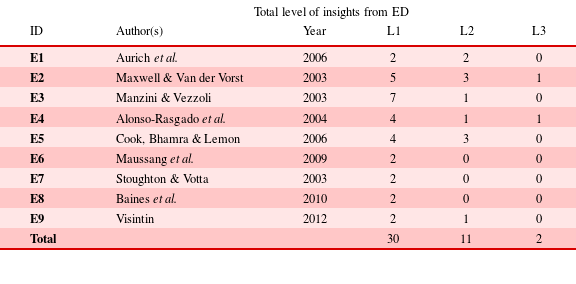
Results of Step 3, namely, cross citations in engineering design and marketing, are shown in Tables 4 and 5, respectively.
Levels of insight of marketing citing ED (Outcome of Step 3)
Levels of insight in engineering design citing M (Outcome of Step 3)
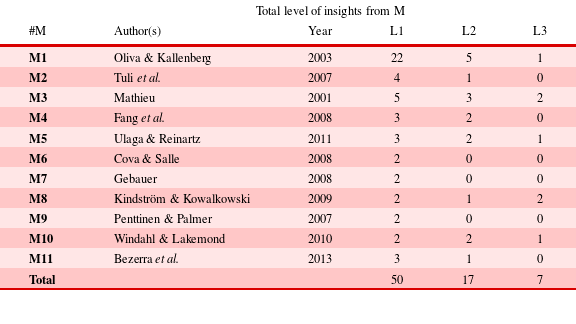
Table 4 shows that only Maxwell & Van der Vorst’s (Reference Maxwell and Van der Vorst2003) work has been cited at three levels. Their insights in the marketing literature refer to their sustainable product and service development method to meet business and industry requirements from a lifelong perspective: Level 2 citations point out that sustainable or green design (reuse/recycling/energy recovery/treatment/disposal) is usually driven by regulation (Baraldi, Gregori & Perna Reference Baraldi, Gregori and Perna2011; Chan, He & Wang Reference Chan, He and Wang2012; Raja et al. Reference Raja, Bourne, Goffin, Çakkol and Martinez2013), while Lacoste (Reference Lacoste2016) considers Maxwell & Van der Vorst’s (Reference Maxwell and Van der Vorst2003) work at Level 3 in order to depict the product lifecycle for business-to-business operations, and to show how suppliers can support the redesign or improvement of products through value co-creation with customers.
Of special attention concerning Table 5 is the number of articles that cite the work of Oliva & Kallenberg (Reference Oliva and Kallenberg2003). Oliva & Kallenberg’s (Reference Oliva and Kallenberg2003) work is frequently used at Level 1 as a source to indicate how several manufacturing companies have moved from providing products to PSSs, as well as the reasons for this shift, namely economic benefits, competitive pressure, customer demand and sustainability (Cavalieri & Pezzotta Reference Cavalieri and Pezzotta2012; Beuren et al. Reference Beuren, Ferreira and Miguel2013). Level 2 insights are used to point out how successful delivery of PSSs needs new organizational principles, structures and processes (Bastl et al. Reference Bastl, Johnson, Lightfoot and Evans2012). These new considerations will imply the creation of a separate organization to handle service offerings, relational rather than transitional relations and a dedicated sales force (Biege, Lay & Buschak Reference Biege, Lay and Buschak2012). Raddats et al. (Reference Raddats, Baines, Burton, Story and Zolkiewski2016) make use of insights at Level 3 based on Oliva & Kallenberg (Reference Oliva and Kallenberg2003) as well as other authors in order to create framework matching drivers, product complexity, systems and motivations for servitization to examine their research questions.
Given its large number of citations and impact on PSS research, Kowalkowski et al. (Reference Kowalkowski, Windahl, Kindström and Gebauer2015) refer to it as the path-defining study, and this may not come as a surprise. However, these citations are mostly at Levels 1 and 2, which means that Oliva & Kallenberg’s insights on the evaluation of service potential (installed base), necessary models for its quantification and when to enter the market have been only partially addressed in engineering design.
4.3 Thematic analysis (Stage II, Steps 4, 5, 6, and 7)
The results show that there are several themes that are looked at from different points of view, and that vary depending on the context used across disciplines (see appendix D). Overall, seven themes were finally selected from Stage II: business orientation, collaboration, cost aspects, flexibility, performance indicators, requirements, and services. For each theme, there are implications for engineering design and insights hopefully useful for academics and practitioners researching, providing, or planning to provide PSSs. How each theme was addressed in the selected articles from the two disciplines and the insights derived from that are presented in the following sections.
4.3.1 Business orientation
One could argue that engineering design can be regarded as having an operational business orientation. It typically focuses on the optimal use of resources and the use of systematic methods for the design of products and services, even when referring to strategy. For instance, Alonso-Rasgado et al. (Reference Alonso-Rasgado, Thompson and Elfström2004) propose a systematic process for designing a service and refer to the term optimization when working with services, and Aurich et al. (Reference Aurich, Fuchs and Wagenknecht2006) mention the need for systematic design of services and processes. These studies refer to topics such as design tasks, service components, and the standardization of information. Maxwell & Van der Vorst (Reference Maxwell and Van der Vorst2003) propose the sustainable product and service development method, while acknowledging that most methods focus on the operational rather than the strategic levels. Marketing, in turn, could be considered as having a more strategic business orientation. While marketing strategy can be regarded as one subdiscipline within marketing (others include consumer behavior, etc.), marketing research on PSSs has a strategic, business-to-business orientation. In this respect, Mathieu (Reference Mathieu2001) suggests that service strategies are a source of competitive advantage, and looks at an integrated approach to strategy formation when facing uncertainty in complex markets. The well-cited study by Oliva & Kallenberg (Reference Oliva and Kallenberg2003) also concerns strategic aspects and benefits. They point at the opportunities as well as challenges of increasing the service business orientation of a manufacturing firm. What is more, Cook et al. (Reference Cook, Bhamra and Lemon2006) suggest that manufacturing companies are more receptive when concepts describing PSSs refer to achieving a company’s strategic goals. Barquet et al. (Reference Barquet, de Oliveira, Amigo, Cunha and Rozenfeld2013) provide insights into how to combine the Business Model Canvas tool (Osterwalder & Pigneur Reference Osterwalder and Pigneur2010) with PSS offerings and implement a business strategy; similarly, Gebauer (Reference Gebauer2008) identifies service strategies to fit with a specific business environment. Manzini & Vezzoli (Reference Manzini and Vezzoli2003) in ED seem to have recognized this gap with their strategic design as a design activity linking products, services, communication, clients and stakeholders. Therefore, to a greater extent than in a classic manner, engineering design research becomes more effective by recognizing that PSS design is not only an activity at the operational level, it can also be strategic and a source of competitive advantage.
Insight 1: Strategic thinking when designing a PSS can contribute to the competitive advantage of the firm by expanding business opportunities in uncertain business environments.
4.3.2 Collaboration
Collaboration in engineering design has a more structured approach to optimize and facilitate communication. The provider is at the center of that collaborative effort. For example, Aurich et al. (Reference Aurich, Fuchs and Wagenknecht2006) propose technical service design, where service can learn from product design in order to standardize, systematize and document the design of the service. Moreover, Manzini & Vezzoli (Reference Manzini and Vezzoli2003) suggest strategic design for sustainability, aiming at creating new stakeholder configurations which are medium and long-term sustainable, economically feasible and socially appreciable. The authors present a model for how different stakeholders can be configured and optimized around the designer. By contrast, in marketing, the customer is typically at the center of the collaborative effort. For example, Cova & Salle (Reference Cova and Salle2008) emphasize the co-creation of value in PSSs through collaboration with the supplier and its network, as well as the customer and its network. This then provides what they call services supporting the customer network (SSCN) to define the degree of integration with a customer and its network. Mathieu (Reference Mathieu2001) also suggests that when implementing a service strategy the provider should, in some instances, consider partnerships with potential competitors (i.e., coopetition) in order to better serve the customer. Windahl & Lakemond (Reference Windahl and Lakemond2010) also suggest that performance offerings need to go beyond dyadic relationships to consider a network that can provide this type of offering. They further highlight that the more the offering is linked to the customer’s core process, the more dependent it becomes on the supplier, and that performance offerings might be more suitable for non-core processes. The implications for ED would be that of placing the customer at the center of the collaboration, which may result in collaborating with unusual partners such as the customers’ suppliers or even competitors.
Insight 2: Organizational configurations for a PSS can range from collaboration with individual customers and their suppliers to entire networks that can include competitors as part of providing solutions to the customer.
4.3.3 Cost aspects
The analysis reveals that studies in engineering design of PSSs usually attempt to optimize and reduce costs over the whole product lifecycle. For example, Aurich et al. (Reference Aurich, Fuchs and Wagenknecht2006) suggest a feasibility analysis as part of their technical service design process, where it is suggested to carry out a cost–benefit analysis and technical feasibility analysis. For their part, Alonso-Rasgado et al. (Reference Alonso-Rasgado, Thompson and Elfström2004) focus on cost reduction strategies like reducing functionality and deploying maintenance staff only when necessary, as well as sensitivity and cost–benefit analysis.
Marketing, on the other hand, tends to address the hidden aspects of costs and highlight the value of an offering. Regarding the hidden costs, Mathieu (Reference Mathieu2001) suggests that manufacturers moving into service provision can face competitive and political costs. Competitive costs relate to the unexpected competitors that may appear once a company moves into providing services; competitors may be other service providers, distributors or even customers. Political costs refer to the internal resistance that some organizational subunits might incur when transitioning into services. Fang et al. (Reference Fang, Palmatier and Steenkamp2008) point out the opportunity cost when transitioning from products to services, which suggests that larger firms might incur larger costs due to the necessary realignment to support service initiatives. Additionally, Tuli et al. (Reference Tuli, Kohli and Bharadwaj2007) highlight the value perspective of services. A quote from a customer reads ‘A solution to me is when a supplier proposes bringing in value beyond the widgets. Rather than saying that here is a widget for $10, it’s more about finding what I really need …’ (p. 4). The study emphasizes the need for providers to focus on long-term value-creating relationships rather than only establishing relationships to sell products or systems. Finally, an important contribution from the marketing literature can be seen in the deeper knowledge in legal and contractual obligations when entering relational rather than transactional transactions. In ED, only Stoughton & Votta (Reference Stoughton and Votta2003) provide insights into contractual agreements. In this respect, Penttinen & Palmer (Reference Penttinen and Palmer2007) suggest that enhanced offerings will often involve advanced information sharing and more fully articulated legal and contractual obligations. They refer to full-service contracts, ensuring a year-to-year steady stream of revenue from which both supplier and customer benefit, the former through customer retention and higher profitability and the latter through reduction of number of suppliers and more dedication to their core business. Drawbacks, however, can be higher relationship and coordination costs (hidden costs) and higher reliance on the customer.
Although several authors in engineering design take customer value into account (for example, Manzini & Vezzoli (Reference Manzini and Vezzoli2003) and Baines et al. (Reference Baines, Lightfoot, Benedettini, Whitney and Kay2010)), Cook et al. (Reference Cook, Bhamra and Lemon2006) provide evidence of the poor transfer of such knowledge from academia into UK manufacturing companies, suggesting that some companies focus too much on cost reduction strategies instead of adding value. Similarly, from a marketing perspective, Ulaga & Reinartz (Reference Ulaga and Reinartz2011) suggest that companies should switch from selling product features to selling value. The implications for engineering design are, on the one hand, not to underestimate hidden costs such as internal resistance and new learning and, on the other hand, to focus more on what customers really value.
Insight 3: When offering a PSS, hidden costs may arise in the form of resistance to change, re-training and other investment when creating relational rather than transactional relationships with customers.
4.3.4 Flexibility
The term flexibility in engineering design is usually implemented with the modularity and customization of products/services with a lifecycle perspective. For instance, Aurich et al. (Reference Aurich, Fuchs and Wagenknecht2006) suggest the design of lifecycle-oriented products and services by components in order to support flexible adaptation according to customers’ needs. Maussang et al. (Reference Maussang, Zwolinski and Brissaud2009) suggest the integration of a supervision module, a physical object capable of identifying and diagnosing failure of a refrigeration cable, and reflect on the importance of process architecture when designing services. That is, flexibility in engineering design focuses on increasing internal efficiency and is implemented by the standardization of components or modules when designing products, services or processes.
In marketing, flexibility is then more related to the organizational capabilities of the firm and how these can be adjusted according to customers’ needs. Tuli et al. (Reference Tuli, Kohli and Bharadwaj2007) suggest multiple and flexible hierarchical structures called contingent to better respond to customer demands and find appropriate solutions. In ED, Visintin (Reference Visintin2012) refers to the literature in business, management and marketing that provides different views on modularity. Visintin (Reference Visintin2012) cites the work of Bask et al. (Reference Bask, Lipponen, Rajahonka and Tinnilä2011), who suggest that modularity has been traditionally researched from the perspective of products and product design. However, the Océ case study described by Visintin (Reference Visintin2012) makes use of service modularity. The case company offers different services depending on customer needs; depending on the solution provided, which is either a product, a product/service bundle, or an integrated system, different employees will be involved in its design and delivery. Additionally, the pricing will depend on the service provided. Visintin (Reference Visintin2012) acknowledges that the case study of Océ is an example of a vertically integrated firm, and that the literature suggests that in other cases, the identification of other suppliers may be needed in order to deliver a solution.
The implication for engineering design is to understand that flexibility includes not only modular designs to increase internal efficiency, but also the perspective of internal organizational capabilities and forming temporary projects or cooperation with other suppliers according to customers’ varying needs. Flexibility in a general sense is partly practiced in industry: for instance, concurrent engineering involves flexibility, because each subgroup works in part simultaneously for an identical design project. However, the scope of cooperation concerned here is, as stated by Tuli et al. (Reference Tuli, Kohli and Bharadwaj2007), larger than the major internal focus of design practice.
Insight 4: In order to offer a PSS, the provider could adopt temporary teams during different stages of design and improve flexibility as required by customers.
4.3.5 Performance indicators
Engineering design usually refers to the indicator of efficiency as a measure of performance. It takes into account materials and energy resources, and attempts to make use of them in an efficient manner or to an optimal degree. Terms like productivity, efficiency, optimization and dematerialization along the lifecycle of products and services are common in PSS literature (see, for example, Maxwell & Van der Vorst Reference Maxwell and Van der Vorst2003). In contrast, the indicators usually employed in marketing seem to be more related to the effectiveness that products/services have on the firm and the market. For example, Fang et al. (Reference Fang, Palmatier and Steenkamp2008) analyze the effect that services have on a firm’s market value. The authors find that the effect of services (service intensity) can be seen in the threshold of 20% to 30% of total firm sales. They also argue that when a firm provides services related to their core product business (service relatedness), services become substantially more effective. Moreover, this effect is usually related to the success of the product/service offering. In addition, several authors (e.g., Ulaga & Reinartz Reference Ulaga and Reinartz2011) report their findings of how the introduction of PSSs can be successful in the market by identifying critical capabilities and matching those with customers’ needs.
Insight 5: Performance Indicators for a PSS offering should cover both the efficiency and effectiveness to reflect the impact of the offering on firm value and customer value.
4.3.6 Requirements
In engineering design, the terms used for requirements are usually based on technical or functional artifacts and tend to focus on the provider’s side. For instance, Alonso-Rasgado et al. (Reference Alonso-Rasgado, Thompson and Elfström2004) emphasize the importance of functionality and describe functional products as a combination of hard and soft elements, namely hardware combined with a service support system. They focus on the design of the service system and make suggestions on hardware design and its remanufacturing. Furthermore, engineering design tends to concentrate on tangible resources such as finances, material, and energy. Studies such as Manzini & Vezzoli (Reference Manzini and Vezzoli2003), Maxwell & Van der Vorst (Reference Maxwell and Van der Vorst2003) and Aurich et al. (Reference Aurich, Fuchs and Wagenknecht2006) refer to optimal use of natural resources as one of the main priorities.
However, in marketing, requirements often go beyond functional needs. Tuli et al. (Reference Tuli, Kohli and Bharadwaj2007) suggest that requirements go beyond asking the customer for functional specifications, but understanding the customers’ current business needs including internal operating processes, labor situation and business model: requirements are also about knowing the customers’ current and future needs, since these needs may change over time. They suggest that a provider should then identify its customers’ recognized, unrecognized and even future needs. Furthermore, marketing often places more emphasis on intangible resources, such as the personnel in a company and their skills or capabilities that can support the marketing of products/services, rather than tangible ones. Capabilities of the company are a recurring theme in marketing, typically building on dynamic capabilities theory or the resource-based view of the firm. For instance, Fang et al. (Reference Fang, Palmatier and Steenkamp2008) divide resources into tangible (e.g., office space and call centers) and intangible (e.g., customer relationships and brand image) and provide the term resource slack, referring to excess resources that a firm may possess. Both Cova & Salle (Reference Cova and Salle2008) and Tuli et al. (Reference Tuli, Kohli and Bharadwaj2007) emphasize the interactive nature of PSS development and provision by suggesting that customers and suppliers co-create value through resource integration. The implications for engineering design would be to consider personnel capabilities when designing PSSs, since these can limit the type of offering provided.
Insight 6: For a successful PSS offering, both customer and provider may need to make necessary adjustments to their tangible and intangible capabilities in order to specify, communicate and capture value.
4.3.7 Services
The literature in engineering design regarding services has a shorter history than in marketing. The inception of PSSs in the late 1990s, as well as the emerging service engineering proposed by Sakao & Shimomura (Reference Sakao and Shimomura2007), attempt to integrate the design of products and services in unison. However, marketing can be regarded as having a longer history in services and being more advanced and sophisticated (see, for instance, Grönroos Reference Grönroos1978 & Lovelock Reference Lovelock1983). This has been reflected already in the six themes above, but here particular issues on services as such are raised. In marketing, Mathieu (Reference Mathieu2001) provides a typology of service maneuvers that could be useful in developing a service strategy. This typology shows what type of service a provider may offer (customer service, product service and service as a product) and the internal impact that service could have at the provider (tactical, strategic and cultural). Moreover, Oliva & Kallenberg (Reference Oliva and Kallenberg2003) provide what they call the installed based (IB) of products with a long lifecycle currently under use and how that IB should be serviced. According to the authors, IB services are the necessary services to run a product effectively during its entire useful life. The authors divide services into a matrix providing a wide range of possible services that a provider can offer. Other studies provide similar classification schemes for services and PSSs (see, for example, Zeithaml & Brown Reference Zeithaml and Brown2014). Similarly, Kindström & Kowalkowski (Reference Kindström and Kowalkowski2009) provide a framework for new service development, which has not been extensively addressed in ED.
Moreover, as mentioned above, the effect of services is a highly recurring topic in marketing, in contrast to its limited attention in engineering design. As an example, Tuli et al. (Reference Tuli, Kohli and Bharadwaj2007) address effective solutions and how to successfully achieve them. They suggest that effective solutions are the extent to which relational processes (what they call supplier variables) provide what the customer needs. Both supplier and customer variables need to be addressed properly for successful solutions. The implication for engineering design is to look at the expertise developed in marketing regarding services and solutions.
Insight 7: Engineering design can adopt, from the marketing discipline, classifications, guidelines, frameworks and tools on how to successfully provide services and solutions.
4.4 Research agenda for PSS design (Stage III, Step 8)
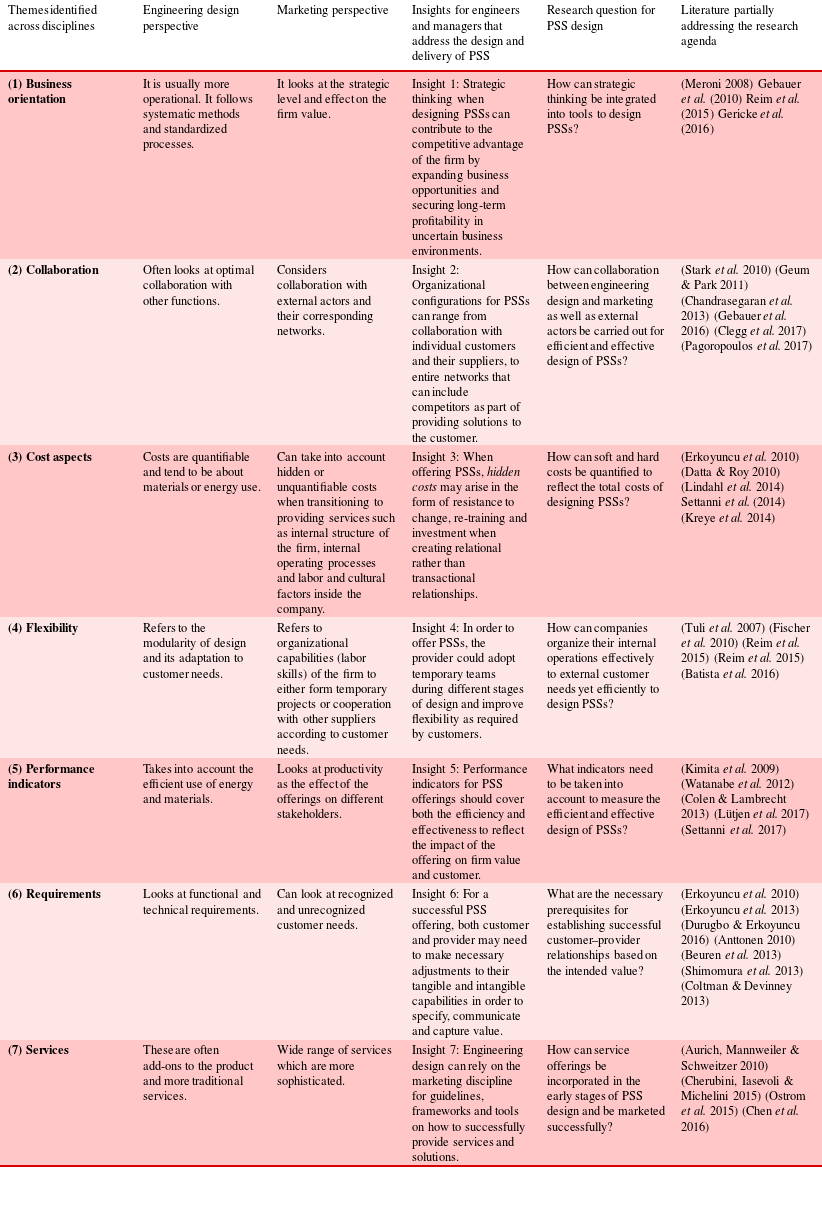
As implied from the derived insights, there are a number of research opportunities for designing PSSs in industry. This section proposes further research agenda for PSS design per each theme and insight (detailed in appendix D). Deriving the research agenda has been enabled by the in-depth analysis with the two disciplines up to Step 7. This type of interdisciplinary or transdisciplinary research (see a definition for this in Sakao & Brambila-Macias Reference Sakao and Brambila-Macias2018) is still recognized as an interesting opportunity as a result of several recent thorough reviews: concerning PSS design, evaluation, and operation (see Qu et al. Reference Qu, Yu, Chen, Chu and Tian2016) as well as in operation management concerning servitization (see: Baines et al. Reference Baines, Ziaee Bigdeli, Bustinza, Shi, Baldwin and Ridgway2017) which is a process of organizational change involving PSS. Table 6, summarizes the identified themes and insights (from Section 4.2) as well as the proposed research questions for PSS design. The research questions are intended to be in a high level to stimulate further research but still described with tight connection to the insights and other existing research about PSS. This future research agenda not only is based on the selected relevant articles but also takes into account literature published in engineering design and marketing (as shown in Figure 1).
(1) Business orientation – Insight 1: Strategic thinking when designing PSSs can contribute to the competitive advantage of the firm by expanding business opportunities and securing long-term profitability in uncertain business environments. The thematic analysis shed light on the contrast in business orientation between engineering design’s operational focus and marketing’s strategic focus as explained in Section 4.3.1. The knowledge gap in engineering design has been addressed as follows. In engineering design, Meroni (Reference Meroni2008) suggests eight main pillars in strategic design for PSSs. These range from co-designing and scenario building to social innovation and strategic dialog. Reim, Parida & Örtqvist (Reference Reim, Parida and Örtqvist2015) carry out a literature review and suggest that PSS strategy can be adopted at a strategic level by considering business models (i.e., product, use and result-oriented models) and at operational level by understanding tactics that can create value. In marketing, Gebauer et al. (Reference Gebauer, Edvardsson, Gustafsson and Witell2010) explore service strategies, which success will depend on the right alignment with corporate structures in terms of culture, human resource management, and the organizational structure itself. However, knowledge on how these aspects can be integrated into useful tools remains unsolved. Supporting designers with a tool or a method is highly effective (Gericke, Kramer & Roschuni Reference Gericke, Kramer and Roschuni2016). Based on this, the following research question is proposed: How can strategic thinking be integrated into tools to design PSSs?
(2) Collaboration – Insight 2: Organizational configurations for a PSS can range from collaboration with individual customers and their suppliers to entire networks that can include competitors as part of providing solutions to the customer. According to Stark et al. (Reference Stark, Krause, Kind, Rothenburg, Müller, Hayka and Stöckert2010) customers are increasingly asking for complete solutions instead of single products. The authors suggest using virtual production creation which may offer engineering designers capabilities to collaborate and compete successfully. Pagoropoulos, Maier & McAloone (Reference Pagoropoulos, Maier and McAloone2017) investigate transformation of relationships between the customer and the supplier concerning PSS and digital capabilities using a case from the maritime sector. Geum & Park (Reference Geum and Park2011) review tools for sustainable PSS design and propose the product–service blueprint, while Chandrasegaran et al. (Reference Chandrasegaran, Ramani, Sriram, Horváth, Bernard, Harik and Gao2013) carry out research mainly in trends of computer tools for capturing knowledge and its representation in product design. Clegg et al. (Reference Clegg, Little, Govette and Logue2017) documented a transformation process to a PSS provider involving, for instance, closer collaboration with suppliers accessing to a common information system. Gebauer et al. (Reference Gebauer, Saul, Haldimann and Gustafsson2016) identify organizational capabilities necessary for pay-per-use services concerning collaboration with customers based on studies with small and medium-sized companies: e.g., insight into customer behavior and comprehensive customer support. However, little research shows how non-engineering experts can also be part of these trends. Specially, as implied by the results of Stage I, little knowledge for effective collaboration between engineering design and marketing is available since engineering design tends to see the designer at the center of the collaborative effort instead of the customer as in marketing. This lack of knowledge is valid with the other actors, too. Therefore, a proposed research question in the future is: How can collaboration between engineering design and marketing as well as external actors be carried out for efficient and effective design of PSSs?
(3) Cost aspects – Insight 3: When offering PSSs, hidden costs may arise in the form of resistance to change, re-training and investment when creating relational rather than transactional relationships. In the current literature on PSS design, research on lifecycle cost (Lindahl, Sundin & Sakao Reference Lindahl, Sundin and Sakao2014), uncertainty associated with cost (Erkoyuncu et al. Reference Erkoyuncu, Roy, Shehab and Cheruvu2010) and cost of service contracts (Datta & Roy Reference Datta and Roy2010) has been reported. Further, in industrial engineering, limitations of the current techniques for through-life costing of PSS in terms of the object, scope, and computation have been pointed out (Settanni et al. Reference Settanni, Newnes, Thenent, Parry and Goh2014). For instance, the scope is argued to be extended so that functioning of the system in question is understood systematically (ibid). For their part, Kreye, Newnes & Goh (Reference Kreye, Newnes and Goh2014) look at competitive bidding from manufacturing companies and propose a framework depicting the influence of various uncertainties in the bidding strategy. However, scarce research has been reported in the engineering discipline on the costs addressing organizational changes that have been frequently addressed in the marketing discipline as explained in Section 4.3.3 (Mathieu Reference Mathieu2001; Tuli et al. Reference Tuli, Kohli and Bharadwaj2007; Fang et al. Reference Fang, Palmatier and Steenkamp2008). Therefore, little knowledge in engineering design is available to calculate the cost, for instance, for a provider focusing on sales of a product at present to provide a result-oriented service based on the product. This calculation needs to consider not only the cost for a transition to PSS but also the cost of PSS provision after the transition. In more general, an interesting research question is proposed as: How can soft and hard costs be quantified to reflect the total costs of designing PSSs?
(4) Flexibility – Insight 4: In order to offer PSSs, the provider could adopt temporary teams during different stages of design and delivery and improve flexibility as needed by an external customer. In Section 4.3.4, the focus of engineering design research on internal efficiency was contrasted with that of marketing on organizational capabilities. In particular, Tuli et al. (Reference Tuli, Kohli and Bharadwaj2007) in marketing describe contingent hierarchies as a way in which providers can adopt flexible hierarchical structures to provide solutions depending on varying customer need. Fischer et al. (Reference Fischer, Gebauer, Gregory, Ren and Fleisch2010) suggest that service literature has usually focused on operational capabilities regarding services, namely, service orientation in corporate culture, human resource management, organizational structure, service development, IT infrastructure and measurement and reward systems. The authors suggest however a framework to address the necessary dynamic capabilities to change operational routines. Reim et al. (Reference Reim, Parida and Örtqvist2015) suggest that result-oriented business models for PSSs are highly flexible and with high degree of customization. The current literature in engineering design seldom exploits these insights from marketing. Applying these insights has therefore potential to provide a new perspective to solving problems with PSS design identified in Engineering Design literature (e.g., Matschewsky et al. Reference Matschewsky, Kambanou and Sakao2017). Interestingly, the research by Tuli et al. (Reference Tuli, Kohli and Bharadwaj2007) is followed by Batista et al. (Reference Batista, Davis-Poynter, Ng and Maull2016) in industrial engineering, who point out, in outcome-based contracts, that an issue originating from varying customer need lies mainly in an internal variety implying the need of flexibility. Therefore, the need for more research is supported regarding the following research question: How can companies organize their internal operations effectively to external customer needs yet efficiently to design PSSs?
(5) Performance Indicators – Insight 5: Performance indicators for PSS offerings should cover both the efficiency and effectiveness to reflect the impact of the offering on firm value and customer value. Indicators to evaluate PSS customer satisfaction (Kimita, Shimomura & Arai Reference Kimita, Shimomura and Arai2009), a framework criterion to describe the influence of a service to multiple stakeholders (Watanabe et al. Reference Watanabe, Mikoshiba, Tateyama and Shimomura2012) and guidelines to measure costs (Colen & Lambrecht Reference Colen and Lambrecht2013) have been described in the literature. More recently, however, Lütjen, Tietze & Schultz (Reference Lütjen, Tietze and Schultz2017) have reported that performance effects of servitization are mixed, with some companies withdrawing from such efforts. Among their case companies studied Lütjen et al. (Reference Lütjen, Tietze and Schultz2017) found that firms do not seem to have specific key performances indicators for measuring service innovation at the organizational level or project level. Settanni et al. (Reference Settanni, Thenent, Newnes, Parry and Goh2017) present a case study from the defense industry showing the use of indicators for technical activities to ensure availability suggesting that manufacturers should also include more qualitative measures, a broader criterion. Among these many criteria or factors to consider, clarity is needed to further develop useful indicators when designing PSSs. This is in contrast to the marketing discipline, where an offering’s matching customer need has been researched for a longer time as exemplified by Ulaga & Reinartz (Reference Ulaga and Reinartz2011) in Section 4.3.6. Therefore: What indicators need to be taken into account to measure the efficient and effective design of PSSs?
(6) Requirements – Insight 6: For a successful PSS offering, both customer and provider may need to make necessary adjustments to their tangible and intangible capabilities in order to specify, communicate and capture value. Literature in engineering design seems to be richer in this area of research. Several contributions point at different aspects of requirements for successful PSSs. From identifying, understanding and mitigating uncertainties when offering PSSs (Erkoyuncu et al. Reference Erkoyuncu, Roy, Shehab and Cheruvu2010; Erkoyuncu, Durugbo & Roy Reference Erkoyuncu, Durugbo and Roy2013; Durugbo & Erkoyuncu Reference Durugbo and Erkoyuncu2016) to the need of scenario analysis that addresses the needs of different stakeholders (Beuren et al. Reference Beuren, Ferreira and Miguel2013) and the organization of human resources to provide high quality PSSs (Shimomura et al. Reference Shimomura, Kimita, Tateyama, Akasaka and Nemoto2013). Coltman & Devinney (Reference Coltman and Devinney2013) provide operational capabilities (customer engagement, cross-functional coordination, creative solutions, operations improvement, IT infrastructure and professional delivery) and show how managers can allocate these capabilities to new or existing business opportunities. A more comprehensive list or guidelines for companies planning or already offering PSSs seem necessary. Hence: What are the necessary prerequisites for establishing successful customer–provider relationships based on the intended value?
Themes, perspectives, insights, research agenda and additional literature
(7) Services – Insight 7: Engineering design can rely on the marketing discipline for guidelines, frameworks and tools on how to offer services successfully. Research in ED suggests that systematizing the design of services contributes to their successful offering (Aurich et al. Reference Aurich, Mannweiler and Schweitzer2010). Moreover, Cherubini et al. (Reference Cherubini, Iasevoli and Michelini2015) identify critical success factors in marketing when designing PSSs in the electric car industry while Ostrom et al. (Reference Ostrom, Parasuraman, Bowen, Patricio, Voss and Lemon2015) identify research priorities for service research through an extensive study. Moreover, Chen et al. (Reference Chen, Wang, Huang and Shen2016) address successful service commercialization and service innovation as an intangible resource. As it has been proposed before, service research seems a more developed area of research in marketing than in engineering design and many lessons can be learned. In this regard, the following question is proposed: How can service offerings be incorporated in the early stages of PSS design and be marketed successfully?
5 Concluding remarks
This research shows quantitative evidence that there are few insights in terms of the number of citations and their level of utilization across engineering design and marketing. This means that so far, there has been little impact across the two selected domains. The results are in line with those found in previous research, which show that the interaction between disciplines is generally low. This means that there can be many potentially fruitful linkages which have not yet been fully explored and exploited. Scientific value of the paper also exists in the new method of applying levels of utilization that enables a more quantified and deeper analysis of interdependencies than in earlier research. The method is generic and therefore applicable to analysis of other interdisciplinary endeavors. The practical value can be seen in the implications for engineering design and the insights for practitioners planning or currently involved in offering PSSs.
With regard to the first research question, namely to what extent insights coming from the marketing discipline have been used in the engineering design discipline and vice versa, the results show that the levels of utilization for engineering design citing marketing insights are mainly concentrated at Level 1, only citing, and to a lesser degree make use of Level 2, taking into account insight from the opposite discipline. This means that most citations do not integrate insights into models, frameworks or theories; the number of Level 3 citations found in few instances reflects this. With regard to marketing making use of engineering design, the analysis shows that this is difficult to find too, as most citations remain at Levels 1 and 2. These results are found useful to differentiate the extents of utilizing insights from published literature. Semi-quantifying these extents has not been carried out in an existing review article to the authors’ knowledge. Thus, a different process for the quantification may be tested in the future and compared with the method adopted in this article for further development.
The importance of engineering design and marketing when designing PSSs suggests that there is a need for bridging the gap between these two disciplines. While each discipline would certainly continue disciplinary work to advance and provide further insights, the design of PSSs does require interdisciplinary work, as noted by experts in the field and reviewed in this article.
The results for the second research question addressed this. The implications are provided in the form of themes for more effective and efficient design of PSSs: business orientation, collaboration, cost aspects, flexibility, indicators, requirements and services. These themes provide insights for academics and practitioners aimed at providing clearer guidance into PSS implementation in industry. The value of the insights derived in this article originates in the novel approach adopted for the literature review (depicted in Figure 1) for this article. The themes can also provide opportunities to further advance the understanding of how to effectively and efficiently design PSSs.
Future research could involve the corroboration and expansion of the themes found in this research. It can also expand the findings into what marketing can learn from engineering design. Interdisciplinary research into other relevant disciplines such as operations management and information systems could enhance the overall understanding of different views, theories, tools and methods.
Acknowledgments
This research was supported by the Mistra REES (Resource Efficient and Effective Solutions) program (No. 2014/16), funded by Mistra (The Swedish Foundation for Strategic Environmental Research). An earlier and shorter version of this paper was presented at the International Design Conference in Dubrovnik, Croatia in 2016 with the title ‘Interdisciplinary Insights Found for Product/Service System Design’.
Appendix A
Key search for engineering design:
(TS $=$
(“product service system”) OR TS
$=$
(“product service system”) OR TS $=$
(product-service system) OR TS
$=$
(product-service system) OR TS $=$
(product/service system) OR TS
$=$
(product/service system) OR TS $=$
(“product service systems”) OR TS
$=$
(“product service systems”) OR TS $=$
(product-service systems) OR TS
$=$
(product-service systems) OR TS $=$
(product/service systems) OR TS
$=$
(product/service systems) OR TS $=$
(“functional *product*”) OR TS
$=$
(“functional *product*”) OR TS $=$
(“integrated *solution*”) OR TS
$=$
(“integrated *solution*”) OR TS $=$
(“hybrid *offering*” AND “manufacturing”) OR TS
$=$
(“hybrid *offering*” AND “manufacturing”) OR TS $=$
(“industrial *service*”) OR TS
$=$
(“industrial *service*”) OR TS $=$
(“system *solution*” AND “manufacturing”) OR TS
$=$
(“system *solution*” AND “manufacturing”) OR TS $=$
(“customer *solution*”) OR TS
$=$
(“customer *solution*”) OR TS $=$
(“marketing *solution*”) OR TS
$=$
(“marketing *solution*”) OR TS $=$
(“after-sales service” AND “manufacturing”) OR TS
$=$
(“after-sales service” AND “manufacturing”) OR TS $=$
(“servitization”) OR TS
$=$
(“servitization”) OR TS $=$
(“service infusion”) OR TS
$=$
(“service infusion”) OR TS $=$
(“service engineering”) OR TS
$=$
(“service engineering”) OR TS $=$
(“service transition” AND “manufacturing”) OR TS
$=$
(“service transition” AND “manufacturing”) OR TS $=$
(“service *strateg*” AND “manufacturing”) OR TS
$=$
(“service *strateg*” AND “manufacturing”) OR TS $=$
(solution? provider?)) AND (((SO
$=$
(solution? provider?)) AND (((SO $=$
(cirp annals manufacturing technology) OR SO
$=$
(cirp annals manufacturing technology) OR SO $=$
(computer-aided design) OR SO
$=$
(computer-aided design) OR SO $=$
(computers in industry) OR SO
$=$
(computers in industry) OR SO $=$
(design studies) OR SO
$=$
(design studies) OR SO $=$
(AI-EDAM) OR SO
$=$
(AI-EDAM) OR SO $=$
(journal of cleaner production) OR SO
$=$
(journal of cleaner production) OR SO $=$
(journal of engineering design) OR SO
$=$
(journal of engineering design) OR SO $=$
(advanced engineering informatics) OR SO
$=$
(advanced engineering informatics) OR SO $=$
(research in engineering design) OR SO
$=$
(research in engineering design) OR SO $=$
(proceedings of the Institution of Mechanical Engineers part b-journal of engineering manufacture)))).
$=$
(proceedings of the Institution of Mechanical Engineers part b-journal of engineering manufacture)))).
Key search for marketing:
(TS $=$
(“product service system”) OR TS
$=$
(“product service system”) OR TS $=$
(product-service system) OR TS
$=$
(product-service system) OR TS $=$
(product/service system) OR TS
$=$
(product/service system) OR TS $=$
(“product service systems”) OR TS
$=$
(“product service systems”) OR TS $=$
(product-service systems) OR TS
$=$
(product-service systems) OR TS $=$
(product/service systems) OR TS
$=$
(product/service systems) OR TS $=$
(“functional *product*”) OR TS
$=$
(“functional *product*”) OR TS $=$
(“integrated *solution*”) OR TS
$=$
(“integrated *solution*”) OR TS $=$
(“hybrid *offering*” AND “manufacturing”) OR TS
$=$
(“hybrid *offering*” AND “manufacturing”) OR TS $=$
(“industrial *service*”) OR TS
$=$
(“industrial *service*”) OR TS $=$
(“system *solution*” AND “manufacturing”) OR TS
$=$
(“system *solution*” AND “manufacturing”) OR TS $=$
(“customer *solution*”) OR TS
$=$
(“customer *solution*”) OR TS $=$
(“marketing *solution*”) OR TS
$=$
(“marketing *solution*”) OR TS $=$
(“after-sales service” AND “manufacturing”) OR TS
$=$
(“after-sales service” AND “manufacturing”) OR TS $=$
(“servitization”) OR TS
$=$
(“servitization”) OR TS $=$
(“service infusion”) OR TS
$=$
(“service infusion”) OR TS $=$
(“service engineering”) OR TS
$=$
(“service engineering”) OR TS $=$
(“service transition” AND “manufacturing”) OR TS
$=$
(“service transition” AND “manufacturing”) OR TS $=$
(“service *strateg*” AND “manufacturing”) OR TS
$=$
(“service *strateg*” AND “manufacturing”) OR TS $=$
(solution? provider?)) AND ((SO
$=$
(solution? provider?)) AND ((SO $=$
(european journal of marketing) OR SO
$=$
(european journal of marketing) OR SO $=$
(industrial marketing management) OR SO
$=$
(industrial marketing management) OR SO $=$
(international journal of research in marketing) OR SO
$=$
(international journal of research in marketing) OR SO $=$
(journal of business research) OR SO
$=$
(journal of business research) OR SO $=$
(journal of business-to-business marketing) OR SO
$=$
(journal of business-to-business marketing) OR SO $=$
(journal of marketing) OR SO
$=$
(journal of marketing) OR SO $=$
(journal of marketing research) OR SO
$=$
(journal of marketing research) OR SO $=$
(journal of service management) OR SO
$=$
(journal of service management) OR SO $=$
(international journal of service industry management) OR SO
$=$
(international journal of service industry management) OR SO $=$
(journal of service research) OR SO
$=$
(journal of service research) OR SO $=$
(journal of the academy of marketing science) OR SO
$=$
(journal of the academy of marketing science) OR SO $=$
(journal of service theory and practice) OR SO
$=$
(journal of service theory and practice) OR SO $=$
(managing service quality))).
$=$
(managing service quality))).
Appendix B
Selected journals in engineering design (ED): CIRP Annals – Manufacturing Technology, Computer-Aided Design, Computers in Industry, Design Studies, International Journal of Advanced Manufacturing Technology, International Journal of Computer Integrated Manufacturing, International Journal of Operations and Production Management, International Journal of Production Research, Journal of Cleaner Production, Journal of Engineering Design, Journal of Operations Management, and Research in Engineering Design, Proceedings of the Institution of Mechanical Engineers Part B-journal of Engineering Manufacture.
Selected journals in marketing (M): European Journal of Marketing, Industrial Marketing Management, International Journal of Research in Marketing, Journal of Business and Industrial Marketing, Journal of Business Research, Journal of Business-to-Business Marketing, Journal of International Marketing, Journal of Marketing, Journal of Marketing Research, Journal of Product Innovation Management, Journal of Service Management (formerly International Journal of Service Industry Management), Journal of Service Research, Journal of Services Marketing, Journal of the Academy of Marketing Science, Journal of Service Theory and Practice (formerly Managing Service Quality: An International Journal), Marketing Letters, Marketing Science and Marketing Theory)
Appendix C
Selected articles in engineering design
Selected articles in marketing



 Open access

