


Introduction
Cold glaciers are a unique archive for climate and environmental studies. Near-absence of melt guarantees a continuous record of the climate and environmental history in the firn and ice. In contrast to the polar regions of Greenland and Antarctica, relatively little is known about the spatial distribution of negative firn temperatures in the European Alps and many other mountain ranges. Knowledge of the relevant atmospheric and englacial processes leading to the formation of cold firn is crucial for finding representative Alpine core-drilling sites and for assessing possible thermal consequences for these sites in view of a potential climate change.
In order to quantify firn and ice temperatures a mean annual firn temperature (MAFT) can be defined. Seasonal surface temperature fluctuations are normally reflected within the uppermost 10–20 m of the firn. the MAFT is found at a depth where seasonal temperature fluctuations vanish or, in practice, where they are within the accuracy range of the measurement. In the recrystallization zone (Reference ShumskiiShumskii, 1964), the MAFT is very close to the observed surface or air temperature. In the recrystallization-infiltration and cold-firn zones (Reference ShumskiiShumskii, 1964), the MAFT is normally higher than observed surface and air temperatures due to release of latent heat within the upper snow and firn layers from penetrating and refreezing surface meltwater.
The MAFT is mainly a result of the energy and mass balance at the glacier surface. Important parameters affecting the MAFT are mean annual air temperature (MAAT), radiation flux, volume and seasonality of accumulation/ ablation, volume of penetrating and refreezing meltwater, topographic location (hollow or ridge) and wind effects (Reference Alean, Haeberli and SchädlerAlean and others, 1984; Reference Suter, Laternser, Haeberli, Frauenfelder and HoelzleSuter and others, 2001). Some of these parameters are closely linked to each other (e.g. topography, wind effects and volume of snow deposition). Other parameters that may influence the near-surface thermal regime are glacier flow velocity, extension and characteristics of the catchment basin (e.g. snow avalanches), firn and ice deformation, ground heat flux and occurrence of crevassed zones (Reference Suter, Laternser, Haeberli, Frauenfelder and HoelzleSuter and others, 2001).
For a long time it was assumed that glaciers in the Alps were generally temperate, although Reference VallotVallot (1893, Reference Vallot1913) reported cold firn in the Mont Blanc massif as early as the turn of the 20th century. Discussion of cold firn and ice in the Alps was reanimated by investigations in the Monte Rosa area (Reference FisherFisher, 1953, Reference Fisher1954, Reference Fisher1955, Reference Fisher1963) and in the Jungfrau area (Haeberli and Brentani, 1955). Reference HaeberliHaeberli (1976) and Reference Lliboutry, Briat, Creseveur and PourchetLliboutry and others (1976) were among the first to systematically assess the distribution of cold firn and ice in the Alps. In the past, extensive firn- and ice-temperature measurements were predominantly carried out at locations of specific practical or scientific interest in connection with construction work (e.g. Reference Haefeli and BrentaniHaefeli and Brentani, 1955; Reference Haeberli, Iken and SiegenthalerHaeberli and others, 1979), glacier risk prevention (Reference Lüthi and FunkLüthi and Funk, 1997) and high-alpine core drillings (e.g. Reference Oeschger, Schotterer, Stauffer, Haeberli and RöthlisbergerOeschger and others, 1978; Reference Alean, Haeberli and SchädlerAlean and others, 1984; Reference Haeberli and FunkHaeberli and Funk, 1991; Reference Vincent, Vallon, Pinglot, Funk and ReynaudVincent and others, 1997). A scheme for the spatial distribution of cold firn and ice was outlined by Reference Hooke, Gould and BrzozowskiHooke and others (1983) including near-surface temperatures of alpine and polar regions, and by Reference Haeberli and AleanHaeberli and Alean (1985) focusing on firn and ice temperatures from the Alps. Reference Alean, Haeberli and SchädlerAlean and others (1984) investigated interactions between snow deposition, firn temperature and solar radiation in the Colle Gnifetti (Monte Rosa) area. An altitude-and aspect-dependent statistical model of the distribution of cold firn and ice in accumulation areas of the Alps was developed by Reference Suter, Laternser, Haeberli, Frauenfelder and HoelzleSuter and others (2001).
The goal of the present study was to systematically investigate the present-day spatial distribution of cold firn and its dependence on climatic and topographic variables in the Mont Blanc area, Western Alps (France and Italy), and in the Monte Rosa area, Southern Alps (Italy and Switzerland). Englacial temperature measurements were therefore made so as to
-
1. measure a mean annual firn temperature;
-
2. cover an altitude band as large as possible;
-
3. choose sites with varying climatic and topographic conditions;
-
4. detect an altitude-dependent boundary between cold and temperate firn, and
-
5. compare the present-day firn temperatures and cold-firn occurrence with earlier observations and models.
Field Observations
Study areas
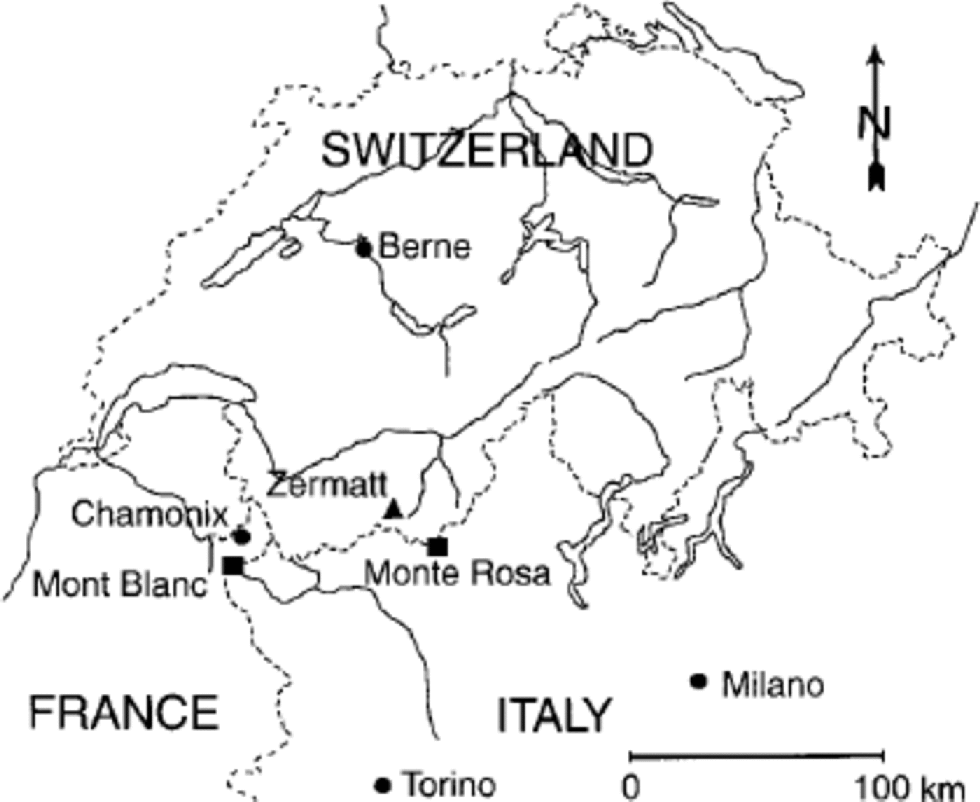
The Mont Blanc study area (45˚50’30’’N, 6˚51’00’’ E; Fig. 1 and 2) covers about 3 km2 and is located to the north of the Mont Blanc summit. It extends from about 3800 to 4800m a.s.l. and comprises the accumulation areas of Glaciers de Bionnassay, de Taconnaz and des Bossons, as well as the summits of Mont Blanc (4807ma.s.l.) and Dôme du Goûter (4304m a.s.l.). the climate of the investigated area is characterized by almost constantly negative air temperatures and very high wind speeds since the massif is fully exposed to the (north)westerlies and, therefore, high precipitation rates. Due to generally high wind speeds, accumulation shows a large spatial variability from 0.2ma–w.e. at very wind-exposed sites (personal communication from S. Preunkert, 2001) to 4ma–1w.e. at wind-protected sites (Reference Vincent, Vallon, Pinglot, Funk and ReynaudVincent and others, 1997). Observed firn and ice depths range from a few metres to about 40 m at exposed crests and domes, and from 120 to >200m at saddles and basins (Reference Vincent, Vallon, Pinglot, Funk and ReynaudVincent and others, 1997; unpublished data).
Location of the Mont Blanc and Monte Rosa study areas.
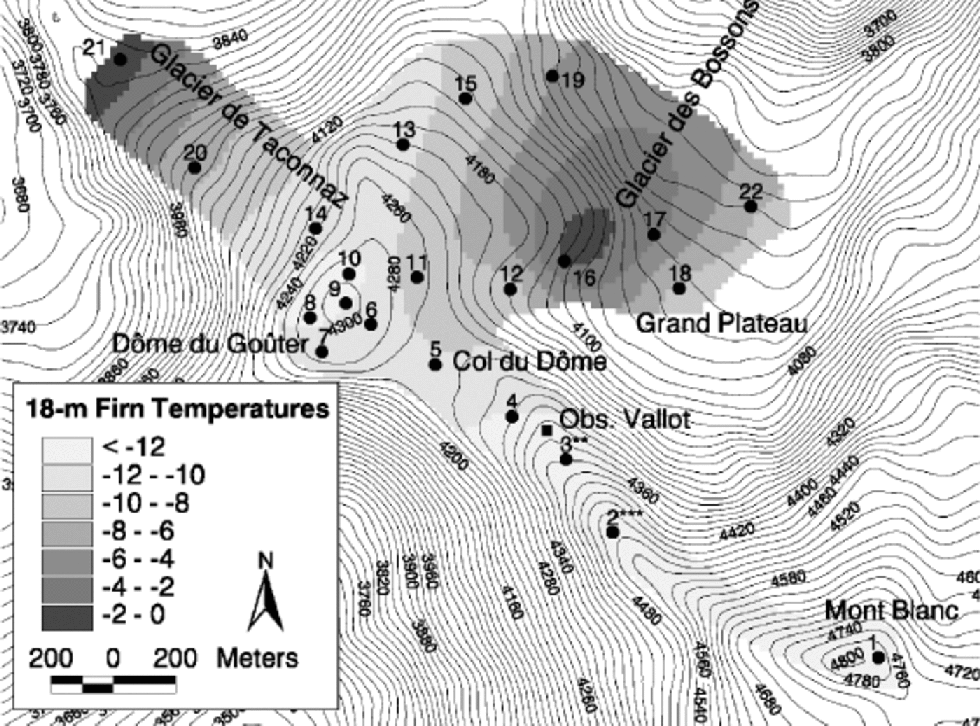
Borehole locations and observed 18 m temperatures (˚C) in the Mont Blanc area, 1998, showing grid-interpolated values using a spline interpolation algorithm. ** denotes a location with a value measured at 8 m, and *** with a value measured at 12 m depth.
The Monte Rosa study area (45˚55’20’’ N, 7˚52’00’’ E; Fig. 1 and 3) is about 4 km2 and covers the accumulation areas of the eastern part of Ghiacciaio del Lys and of Grenzgletscher above approximately 3900ma.s.l. the climate in the study area is characterized by high-altitude conditions, i.e. practically persistent sub-zero air temperatures throughout the year, relatively high precipitation rates and high wind speeds. Snow accumulation is strongly variable, ranging from 0.3 ma–1w.e. at wind-exposed saddles and ridges to 2–3ma–1w.e. at wind-protected sites (Reference Gäggeler, von Gunten, Rössler, Oeschger and SchottererGäggeler and others, 1983; Reference Haeberli, Schotterer, Wagenbach, Schwitter and BortenschlagerHaeberli and others, 1983; Reference Alean, Haeberli and SchädlerAlean and others, 1984; Reference EichlerEichler and others, 2000). Observed ice depths in the study area range from 40 to 120m at wind-exposed crests and saddles and from 80 to 4200 min the central part of the firn basins (Reference Haeberli, Schmid and WagenbachHaeberli and others, 1988; personal communication from D. S.Vonder Mühll, 1995; personal communication from G. C. Rossi, 2001).
Borehole locations and observed 18 m temperatures (˚C) in the Monte Rosa area, 1996 and 1999, showing grid-interpolated values using a spline interpolation algorithm. the two values from 1996 (boreholes 95-1 and 95-2) are taken from Reference LüthiLüthi (1999). *denotes a location with a value measured at 16 m depth.

Methodology
Firn temperatures were measured in steam-drilled and air-filled boreholes to a maximum depth of 22 m to ensure the detection of a MAFT. At borehole 0 (Fig. 3), firn temperatures were recorded at a permanently installed thermistor chain to 30 m depth. In all other boreholes, thermistor chains were removed after each measurement.
NTC thermistors incorporated in three different 30m long thermistor chains with a 2 m sensor interval were used to measure a complete temperature profile. Data were recorded on three external data-logging systems applying a four-wire full bridge measurement on the thermistors. Each thermistor chain together with the logging unit was carefully calibrated at several temperatures between 0˚ and –18˚C using a cold bath and a temperature-measuring device calibrated at the Swiss Federal Office of Metrology. the accuracy of the calibration is given by the stability of the cold bath, the resolution and accuracy of the data-logging unit, the characteristics of the thermistors and the cable and the absolute accuracy of the temperature-measuring device. the absolute accuracy of a thermistor measurement is ±0.03˚C at 0˚ to –10˚C and ±0.04˚C at –12.5˚ to –20˚C. the relative accuracy between the thermistors or of one and the same thermistor using the same measuring bridge is even better, ±0.02˚ and ±0.01˚C, respectively.
After the steam-drilling operation, which lasted typically 60–90min to a depth of 22 m, the thermistor chain was installed from 12 hours to several days after drilling. Normally, no liquid water was found in the boreholes, and if it occurred, no measurements were made within the water column. After the thermistor chain was installed, the borehole was carefully sealed with isolating material at the surface to protect against snowdrift or immediate near-surface air movement in the borehole due to air-pressure fluctuations at high wind speeds. This procedure could not completely prevent rare in-borehole temperature fluctuations due to wind pumping. A convection effect in the air-filled boreholes with a maximum diameter of 6 cm can be excluded (Reference ZotikovZotikov, 1986). Measurements were made for 12–24hours at a 10–15 min sampling rate.
Measured resistances were converted into temperatures using the Steinhart–Hart equation

where T is the temperature (K), RT is the resistance (Ω) and a, b and c are calibration coefficients. During the calibration procedure, resistances were measured at three or more reference temperatures, and coefficients determined for each thermistor, individually.
Steam drilling into cold firn or ice disturbs the temperature distribution around the borehole. Therefore, a certain amount of time must elapse until temperatures have adjusted to the previously undisturbed conditions. the time for complete adjustment within a measuring accuracy of 0.1 ˚C is on the order of a few days up to about 2 weeks (Reference LaternserLaternser,1992). Thus, extrapolation of continuous readings right after drilling is an easier and quicker way to obtain final (undisturbed) temperatures. This procedure was applied to all temperature measurements in steam-drilled boreholes with no permanent installation of a thermistor chain. Temperature T, at time t after drilling, is

(Reference Lachenbruch and BrewerLachenbruch and Brewer, 1959), where Q is the energy input per unit length, K is the thermal conductivity of firn and Tf is the undisturbed temperature or final temperature. Thus, T(t) is proportional to 1/t and Tf is the shift on the temperature axis found at 1/t =0 for t → ∞. No differences within the accuracy of the measurements could be found for the extrapolated final temperatures when using more sophisticated extrapolation formulae (Reference Lachenbruch and BrewerLachenbruch and Brewer, 1959) including the duration of the thermal disturbance (cf. Reference LaternserLaternser, 1992; Reference SuterSuter, 1995). After insertion of the thermistor chain into the borehole, two effects of adjustment can be observed:
-
1. thermal inertia of the thermistor when adjusting to the ambient temperature, and
-
2. recording of the decrease in thermal perturbation caused by steam drilling.
At the beginning of the measurement these two effects cannot be separated. Thermal inertia of the thermistor when adjusting to the ambient temperature can be expressed by the following exponential relation:

where T (t) is the temperature at time t, Tf is the final temperature, Tb is the starting temperature and τ is the time constant. the time constant τ is a measure for the thermal inertia of a sensor and defined as the time until the sensor has adjusted to the final temperature to within 1/e of the total temperature change. In the case of thermistors, τ is mainly a function of the thermal insulation of the thermistor from surrounding conditions and the medium in which temperature is measured. τ was determined experimentally in the field by measuring in thermally undisturbed boreholes and typically found to be 11–31min. Measurements under nearly ideal conditions (practically no wind) showed that thermal adjustment to the ambient conditions was reached after 4–5 hours at the latest after inserting the thermistor chain. the relatively large thermal inertia of the sensors is due to their wrapping in thermally isolating material and the low thermal conductivity (0.025Wm–1K–1) of the surrounding (still) air. Thus, for the linear extrapolation procedure, the first 5 hours of data after inserting the thermistor chain into the borehole were generally omitted to avoid any effect of thermal sensor inertia. Since in extreme cases a perfect thermal adjustment of the thermistors was only reached after 9 hours, extrapolation was made using five datasets where the first 5, 6,7, 8 or 9 hours were omitted, respectively. the final temperature was taken from the best linear relation (highest correlation coefficient) of these five sets. Below 10m depth, differences between the five sets were generally small and typically 50.01 ˚C. When temperatures were measured in thermally undisturbed boreholes, the first 3–5 hours of data were omitted and a mean value obtained from stable conditions. Repeated measurements in the same borehole under disturbed and undisturbed conditions were made for one borehole in the Mont Blanc area (borehole 6; Fig. 2) and for two in the Monte Rosa area (boreholes 21 and 24; Fig. 3). Measurements were repeated after 1.5 and 6 weeks, respectively. Below 10 m depth (where a short-term variation due to seasonal temperature changes can be excluded for the period under consideration), maximum differences found between extrapolated and undisturbed values were 0.12˚ (Monte Rosa) to 0.15˚C (Mont Blanc). Since quite a strong wind pumping occurred during the ``undisturbed’’ measurement in the Mont Blanc region, extrapolated temperatures may represent the undisturbed conditions with an accuracy better than ±0.1˚C.
In this study, firn temperatures measured at 18 m depth (18 m temperature) were taken as MAFTs. Numerical calculations showed that under high accumulation rates a seasonal signal can penetrate down to ~18m depth. the time horizon which is resolved at 18m depth is on the order of 2–3 years, practically independent of the accumulation rate (unpublished data).
Firn temperatures
The result of the observed 18m temperatures in the 22 steam-drilled boreholes of the Mont Blanc area from June 1998 is shown in Figure 2. Temperatures were obtained using the linear extrapolation (boreholes 4–22; Equation (2)), an exponential extrapolation by plotting exp(T) vs 1/t for measurements which could only be made for a few hours right after drilling (boreholes 1 and 2) or no extrapolation at all in thermally undisturbed conditions (borehole 3). the temperature measurements from boreholes 2 and 3 represent temperatures at 12 and 8 m depth, respectively. Due to refrozen meltwater in the boreholes after drilling into more or less massive ice, no temperature measurement was possible below these depths. Although temperatures were not measured at 18 m depth in these two boreholes, they were considered for further analysis as the observed temperature profiles in June were generally very close to a uniform temperature below 8m depth. the 18m temperature from borehole 6 is the mean between an extrapolated and a thermally undisturbed value. the measurements show a general trend to higher values with decreasing altitude. the ``hot’’ spot found at 4100 ma.s.l. on Glacier des Bossons is the result of the high value (–1.35˚C) observed at borehole 16. No errors were detected during the measurement and data analysis, so the value is considered robust. the influence of a crevasse cannot be completely excluded, however. the relatively high value at the Mont Blanc summit is remarkable as compared to the observed firn temperatures at lower elevations and to earlier observations of –16.5˚C by Reference VallotVallot (1893) and of –20.2˚C by Reference Lliboutry, Briat, Creseveur and PourchetLliboutry and others (1976), although the latter measurement is very likely to be influenced by a crevasse. Compared to earlier measurements, a warming could be observed at Col du Dôme (–12.8˚C in 1911 (Reference VallotVallot (1913); –10.3˚C in 1998), whereas the value measured at Grand Plateau (–8.6˚C in 1998) was similar to that in 1974 (–7.3˚C; Reference Lliboutry, Briat, Creseveur and PourchetLliboutry and others (1976)). the deep values at the foot of the Mont Blanc north face could be the result of cold-snow deposition due to avalanche activity. Temperate firn was found below about 3800ma.s.l. on Glacier de Taconnaz, whereas the firn was still cold on the upper reaches of Glacier des Bossons at 3920 ma.s.l.
The 18 m temperatures measured in the 31 steam-drilled boreholes of the Monte Rosa area in May–July 1999 were generally obtained using the linear extrapolation procedure (Equation (2)). No extrapolation was made for boreholes where re-logging was done in July 1999 due to absent or erroneous measurements (boreholes 13, 16 and 18–24). At borehole 8, a value could only be measured at 16 m depth due to refrozen meltwater in the borehole. the value from the permanently installed thermistor chain at borehole 0 is a daily mean value from 31 May 1999 and accumulation-corrected. the observed firn temperatures are shown in Figure 3. the 18m temperatures follow a strong topographic pattern on Grenzgletscher, with deep values on shaded slopes, exposed firn saddles and crests. Surprisingly high values were found on the steep south slope beneath Colle Gnifetti, reaching almost –1˚C and leading to extreme firn-temperature gradients within a short distance. A more altitude-dependent firn-temperature distribution occurs on the gentle south slope of Ghiacciaio del Lys. the transition between cold and temperate firn occurred between approximately 3950 (Grenzgletscher) and 4050ma.s.l. (Ghiacciaio del Lys). Compared to observations in the early 1990s (Reference Suter, Laternser, Haeberli, Frauenfelder and HoelzleSuter and others, 2001), strongly increased MAFTs were observed on the steep south slope below Colle Gnifetti at 4250ma.s.l. (+1.7˚C) and at 4300ma.s.l. (+4.9˚C), whereas similar MAFTs were detected on Grenzgletscher below 4250ma.s.l. in 1999.
Accumulation
Very bad weather conditions during the remainder of 1998 prevented the stakes set in the Mont Blanc area in June from being revisited, so no direct accumulation measurements were made. An accumulation index was used for the following statistical analysis distinguishing between weak (1), medium (2), heavy (3) and very heavy (4) accumulation as estimated from topography and (estimated) mean wind velocities.
In the Monte Rosa area, accumulation at borehole sites 1–24 was estimated using stake observations from May–July 1999 and snow-height measurements from an energy-balance station at the Seserjoch (Fig. 3). for the extrapolation to an annual accumulation rate, we assumed that accumulation follows a regular spatial pattern over the year. Thus, the values observed from May to July 1999 at the above-mentioned sites were extrapolated taking a conversion factor derived as the ratio of the Seserjoch accumulations between 1 June 1999 and 31 May 2000 (2.1m total accumulation) and between 1June and 15 July 1999. No stake observations could be made for boreholes 11 and 19. the values for boreholes 4 and 95-2 were taken from Reference LüthiLüthi (1999) and for borehole 17 from a meteorological station at Colle del Lys (personal communication from G. C. Rossi, 2000; Fig. 3). No stake observations could be made for boreholes 25–31 on Ghiacciaio del Lys in 1999. Instead, annual accumulation rates from nearest stake points based on observations from September 1997 to August 1998 were considered (personal communication from G. C. Rossi, 2001) assuming precipitation conditions during this period similar to those during June 1999–May 2000. As in the Mont Blanc area, an accumulation index was derived for each borehole site.
Statistical Analysis and Models
Methodology
The following simple and multiple linear regression calculations are based on the assumption that observations are independent and normally distributed and that residuals have uniform variances. Several statistical methods and tests were used to quantify the quality of the statistical validity: correlation coefficient r, coefficient of determination r2, F test and p value.
A causal relation between the dependent variable MAFT and the independent variables elevation (ELEV), aspect (ASP), slope (SL), potential direct solar radiation (RAD), accumulation index (ACCI) and accumulation (ACC) was presumed. the statistical models are considered to be valid in the parameter space of the observations. Theyhave a restricted validity for aspects in the range west-southwest–south–east-southeast (WSW-S-ESE) and potential direct solar radiation exceeding 350Wm–2 in the Mont Blanc study area, due to a limited number of measurements in these aspects.
Further input data
The regression analysis requires additional input data:
Digital elevation models (DEMs)
The DEM of the Mont Blanc study area is based on digitally analyzed aerial photographs of the Mont Blanc region from 1993 obtained from the Institut Géographique National in France and on manual correction based on the Swiss topographic map 1:50 000.
The DEM of the Monte Rosa study area was compiled using digitized contour lines from the 1977 land registry plan 1:10 000 for the Swiss part and merged with a DEM of the Italian Ghiacciaio del Lys based on aerial photographs from 1994 (personal communication from G. C. Rossi, 1999).
Aspect and slope
The topographic aspect and slope can be considered a good proxy parameter for incoming solar radiation in a mountain area, as can be seen below. Aspect and slope information were derived from the corresponding DEMs for each borehole or estimated from the map (aspect). A coding system was used for the aspect where north receives the smallest (1) and south the highest value (9). the aspects northwest and northeast (value 3), west and east (value 5) and southwest and southeast (value 7) were considered symmetrical. No aspect was attributed to sites with a slope ≤4˚.
Potential direct solar radiation
Potential direct solar radiation is a good approximation of the shortwave incoming radiation, making an important contribution to the surface energy balance and its spatial and temporal variation (e.g. Reference FunkFunk, 1985). Using potential direct solar radiation as a proxy parameter for shortwave incoming radiation neglects the effect of spatial and temporal variations of cloud cover on the MAFTs. Due to a lack of observations, no statement can be made on the impact of cloud cover. It can, however, be assumed that its spatial variation is small within the study areas given their small extent. Potential direct solar radiation was calculated for each borehole site using the grid-based computer program SRAD (Reference Moore, Norton and WilliamsMoore and others, 1993a, Reference Moore, Gallant and Guerrab) and the DEM data. the program calculates the radiation total on a daily basis and considers, besides aspect and slope angle, topographic shading. Additionally, atmospheric scattering, reflection and absorption are taken into account. for the regression calculations a daily mean value averaged over 1year was calculated. Values ranged between 175 and 405W m–2 at the drill sites.
Simple linear regression
The regression of the observed 18m temperatures or MAFTs against elevation (ELEV) can be written as

where a is the intercept, b is the slope and ϵ is the residual. Statistical results are given in Table 1. Figure 4 shows the observed MAFTs plotted against elevation. for the Mont Blanc area, 64% of the variation of the MAFTs can be explained by the elevation alone; 60% in the case of the Monte Rosa area. An altitude-dependent firn-temperature gradient of –1.48˚C(100m)–1 and of –2.36˚C(100m)–1 was calculated for the Mont Blanc and Monte Rosa areas, respectively. the calculated boundary between cold and temperate firn lies at 3570 ma.s.l. in the Mont Blanc and at 3920 ma.s.l. in the Monte Rosa area. the large discrepancy in gradients and lower boundary of cold-firn occurrence is due to the under-representation of southerly aspects in the Mont Blanc sample and the relatively high MAFTat the Mont Blanc summit and should not be interpreted climatologically. If the high MAFT at the Mont Blanc summit is omitted and only values in ``cold’’ aspects (WNW-N-ENE) are regressed in both samples, gradients are –1.90˚C(100m)–1 for the Mont Blanc and –2.14˚C(100m)–1 for the Monte Rosa area. Compared to an earlier investigation (Reference Suter, Laternser, Haeberli, Frauenfelder and HoelzleSuter and others, 2001), altitude-dependent firn-temperature gradients are higher in the current datasets.
Observed MAFTs from the Mont Blanc (a) and the Monte Rosa (b) areas as a function of elevation and calculated regression lines.

Statistical results of the simple linear regression of the MAFTs vs elevation ( ELEV ) for the Mont Blanc (MB) and Monte Rosa (MR) areas

Multiple linear regression
The relation between the dependent variable MAFTand the independent variables elevation (ELEV), aspect (ASP), slope (SL), potential direct solar radiation (RAD), accumulation index (ACCI) and accumulation (ACC) is given as

where a is the intercept, b, c, d, e, f and g are coefficients and ϵ is the residual. the statistical results for several combinations of parameters are summarized in Table 2. All multiple linear regression models show high correlation coefficients, coefficients of determination and F-test values. All models are very strongly significant. Care must be taken for the Mont Blanc area, as southerly aspects are under-represented, which is critical when looking at aspect and radiation. This fact leads to generally better statistical results for the Monte Rosa area.
Statistical results of the multiple linear regression of the MAFTs vs elevation ( ELEV ), aspect ( ASP ), slope (SL), potential direct solar radiation (RAD), accumulation index (ACCI) and accumulation (ACC) for the Mont Blanc (MB) and Monte Rosa (MR) areas
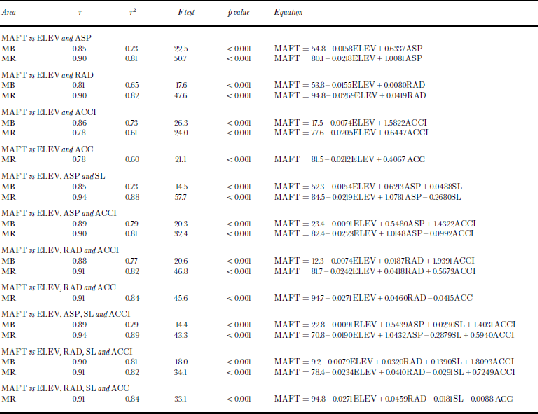
The easily determined parameters elevation and aspect are able to explain 73% and 81% of the MAFT variation in the Mont Blanc and Monte Rosa areas, respectively. for the Monte Rosa area an even better result is achieved when aspect is replaced by potential direct solar radiation  0.82). This is not the case for the Mont Blanc area due to the radiation-exposed location of some very cold sites (Fig. 2). An equal (Mont Blanc) or improved (Monte Rosa) result is found when the regression is made with elevation, aspect and slope. the combination of aspect and slope gives a better proxy for radiation. In addition, slope can be considered a proxy for turbulent heat exchange which is generally more effective in flatter terrain than on steep slopes. Elevation and accumulation alone do not sufficiently explain the 18 m temperature variation except for the Mont Blanc region where deep MAFTs coincide with a low accumulation index (r2 = 0.73). However, satisfying results are obtained when combining radiation or radiation proxy-parameters aspect and slope with accumulation. for the Mont Blanc area, the parameters elevation, aspect and accumulation index, or elevation, aspect, slope and accumulation index, are able to explain 79% of the MAFT variation. for the Monte Rosa area, the parameters elevation, aspect, slope and accumulation index explain 89%. When combining altitude, radiative, heat-exchange (slope) and accumulation information, coefficients of determination of 0.81 (Mont Blanc) and 0.82–0.84 (Monte Rosa) are found.
Lower boundaries of cold-firn occurrence
Using the above statistical relationships, it is possible to derive spatial distribution models for cold firn based on the topographic and climatic parameters ELEV, ASP, SL, RAD and ACCI which are relatively easy to measure, estimate or calculate. the lower boundary of cold-firn occurrence is found where the MAFT becomes 0˚C and can then be written as (cf. Equation (5))

where ELEVbound is the lower boundary of the cold-firn distribution, a is the intercept, c, d, e and f are coefficients and b is the slope of the parameter elevation.
ELEVbound vs ASP
The aspect-dependent lower boundaries of the two areas (Table 3) are quite similar and differ on the order of 230 m. the discrepancy increases towards southerly aspects, perhaps due to a lack of observations in the Mont Blanc area.
Lower boundary (m a.s.l.) of cold-firn occurrence as a function of aspect ( ASP ) for the Mont Blanc and Monte Rosa areas

ELEVbound vs RAD
The radiation-dependent lower boundaries of the two areas show a slightly narrower range than the aspect-dependent values (Table 4). However, ranges are very similar.
Lower boundary (m a.s.l.) of cold-firn occurrence as a function of potential direct solar radiation ( RAD ) for the Mont Blanc and Monte Rosa areas

ELEVbound vs ASP and SL
When aspect and slope information are combined, lower boundaries rise for steeper terrain in Mont Blanc, whereas the opposite is observed for Monte Rosa (Table 5).This can be explained by some relatively deep values on steep and shady slopes in Monte Rosa. the ranges obtained are similar to the aspect-dependent lower boundaries, showing that the influence of slope alone is weak. the scatter is some what larger in the Monte Rosa than in the Mont Blanc area.
Lower boundary (m a.s.l.) of cold-firn occurrence as a function of aspect ( ASP ) and slope ( SL ) for the Mont Blanc and Monte Rosa areas

ELEVbound vs ASP and ACCI
Incorporation of an accumulation index leads to a strong decrease in elevation of the 0˚C firn-temperature line for the Mont Blanc area, whereas practically no influence can be seen for the Monte Rosa area (Table 6).
Lower boundary (m a.s.l.) of cold-firn occurrence as a function of aspect ( ASP ) and accumulation index ( ACCI ) for the Mont Blanc and Monte Rosa areas

ELEVbound vs RAD and ACCI
When aspect is replaced by calculated potential direct solar radiation, an even larger lowering of the lower boundary can be observed for the Mont Blanc area. A range of lower boundaries similar to that in Table 6 is found for Monte Rosa, showing elevated lower boundaries with increasing radiation and accumulation index (Table 7).
Lower boundary (m a.s.l.) of cold-firn occurrence as a function of potential direct solar radiation ( RAD ) and accumulation index ( ACCI ) for the Mont Blanc and Monte Rosa areas

Cold-firn distribution in the Zermatt region
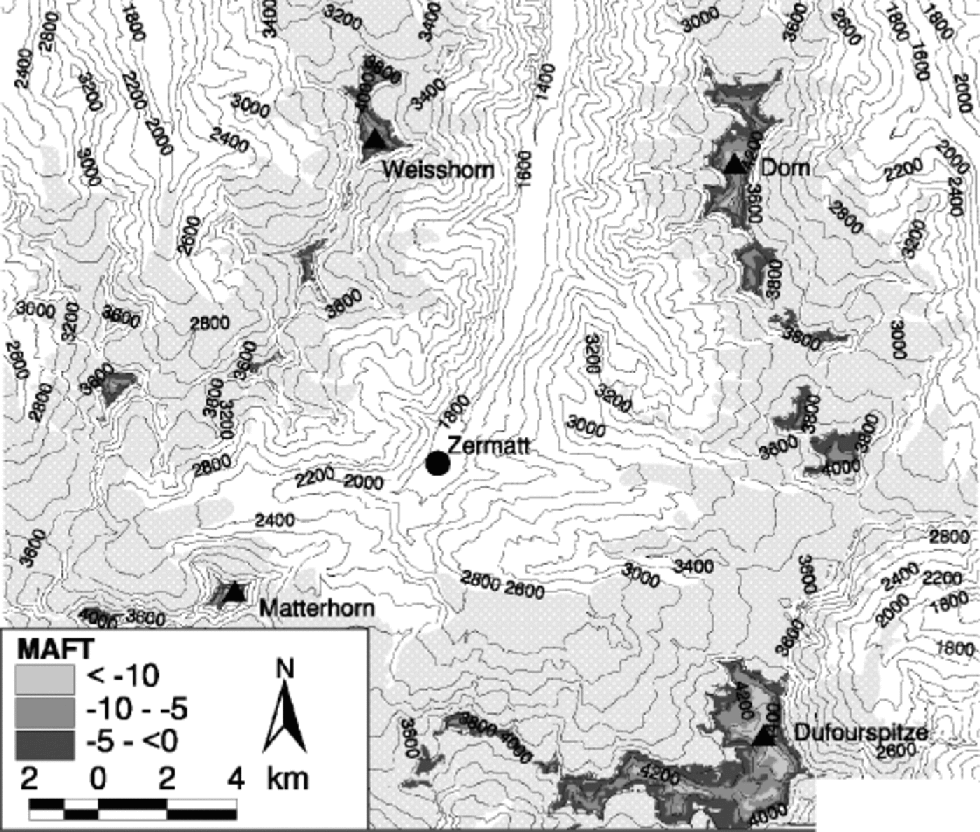
Based on the relation between the observed MAFTs in the Monte Rosa study area and the parameters elevation and aspect, a firn-temperature distribution for a larger area in the Zermatt regionwas computed (Figs1 and 5). Such a distribution model should be able to explain 81% of the firn-temperature variation (Table 2). the calculation was performed within ARC/INFO and ArcView based on a digital elevation model with a 25 m resolution (DHM25 © Swiss Federal Office of Topography). As compared to an earlier distribution model for the region (Reference Suter, Laternser, Haeberli, Frauenfelder and HoelzleSuter and others, 2001), the present occurrence of cold firn is restricted to high-elevation sites above approximately 3700 ma.s.l.
Statistically simulated distribution of cold firn in the Zermatt region based on the parameters elevation and aspect. MAFTs are given in ˚C. Light grey, white dotted areas represent glacier extent. (Topographic data: DHM25 © Swiss Federal Office of Topography.)
Conclusions
In the Mont Blanc aswell as in the Monte Rosa area, MAFTs generally decrease with elevation. Wind-exposed saddles and crests show low temperatures, whereas relatively steep slopes with southerly aspects often have near-temperate conditions, which results in high to extreme firn-temperature variations within very short distances. Observations in the Monte Rosa area show a clearer dependence on aspect and potential direct solar radiation than those in the Mont Blanc area. the distribution pattern suggests a strong influence of shortwave radiation and turbulent heat exchange (being generally more efficient at wind-exposed sites). During the surface-melt period in summer, these two energy fluxes mainly determine the melt-energy input into the snow and firn, and thereby the near-surface temperatures found.
The parameter elevation explains 64% and 60% of the variation of the MAFTs in the Mont Blanc and Monte Rosa areas, respectively. Resulting high firn-temperature gradients (changes of MAFT with elevation) cannot be explained by the air-temperature lapse rate alone, but rather show a strong influence of latent-heat release for the near-surface thermal regime, and thereby a high spatial variation in microclimatic conditions. the climatic and topographic parameters elevation, aspect, slope, potential direct solar radiation, accumulation index and accumulation explain up to 81% and 89% of the MAFT variation in the Mont Blanc and Monte Rosa study areas, respectively. Lower boundaries of cold-firn occurrence were calculated for the two study areas based on aspect, slope, potential direct solar radiation and accumulation index. A plausible range of lower boundaries results for the Monte Rosa area and a more unrealistic pattern for the Mont Blanc area, especially if potential direct solar radiation is combined with accumulation. the representativity of the Mont Blanc dataset is questionable for southerly aspects, since measurements in these aspects are sparse. the effect of slope was unclear since steeper slopes showed a cooling effect in the Monte Rosa and a warming effect in the Mont Blanc area. the distribution of cold firn was modelled for the Zermatt region based on the statistical relationship between 18 mtemperature from the Monte Rosa study area, elevation and aspect. Compared to an earlier distribution model based on elevation and aspect using a dataset of the Alps from 1950 to 1994 (Reference Suter, Laternser, Haeberli, Frauenfelder and HoelzleSuter and others, 2001), cold firn now occurs at lower elevations on slopes with southerly aspects in Mont Blanc and at higher elevations on slopes with northerly aspects in the Monte Rosa area. the aspect-dependent range of the lower boundaries is less pronounced in the present study and is found at 300–400m compared to 750 m in the earlier investigation. Some single sites in the Mont Blanc and Monte Rosa areas show a significant increase in MAFT since earlier investigations. the present-day distribution pattern of cold firn lies well within the boundaries of the previous distribution model based on elevation and aspect (Reference Suter, Laternser, Haeberli, Frauenfelder and HoelzleSuter and others, 2001). Although lower boundaries of cold-firn occurrence are higher in northerly aspects and lower in southerly aspects than in the previous model, a major change in cold-firn occurrence cannot be inferred for the Alps over the last 50 years.
Acknowledgements
This research was supported by the European Union Environment and Climate Programme under contract No. ENV4-CT97-0639 and the Swiss Government under BBW Nr. 97.0349-1. We gratefully acknowledge many students and colleagues at the Section of Glaciology of the Laboratory of Hydraulics, Hydrology and Glaciology (VAW) at ETH Zürich, the Laboratoire de Glaciologie et Géophysique de l’Environnement, Grenoble, France, and the Institute of Geography at the University of Zürich for their help with the strenuous fieldwork at high altitude. We are especially indebted to G. C. Rossi for providing many useful data and to P. Jansson and an anonymous reviewer for carefully reviewing the present paper.



