




Early one morning during the wet season in the late 1970s, Mama Henriette Mafuika joined thousands of other men, women, and children from the Zairian city of Boma in the local stadium. The crowd had gathered, many against their wishes, to welcome the provincial governor to the city. The crowded atmosphere felt at turns festive, restless, and oppressive. Loud, infectious propaganda music played in Lingala over amplifiers powered by inconsistent electricity. Local Mouvement Populaire de la Révolution (MPR) officials went around to party informants asking in Lingala, “nani adefiler te?” (Who hasn’t shown up for the rally?) As Mafuika explained, “If you did not show up, they would arrest you and throw you in jail.”Footnote 1 These forced assemblies were partially predictable. Everyone knew that they would gather, chant slogans, dance to festive political music, watch performances by party dance troupes, and greet their single-party leaders.Footnote 2 However, they did not know how long they would need to wait for their governor to show up and what their leaders would require of them once they did.Footnote 3
On this occasion, the governor showed no signs of coming. The hazy morning in the riverside city turned to a humid afternoon, and still the crowd waited. One song followed another: “Oh, Mobutu, our father of love, we cry out for you. Live long, live long!”Footnote 4 As Mafuika explained, “Regardless of the wait, you couldn’t go back to your home. If you tried, they would say that you were against Mobutu, and they would arrest you.”Footnote 5 The crowd marched, they danced, they sang in Lingala until they were tired, and still the governor did not show up. When he finally arrived around 4pm, Mafuika recalled: “We were all exhausted. All the young children in the crowd were hungry.”Footnote 6 With the governor’s arrival, the crowd’s coerced praise took on new enthusiasm. The local young people launched into their musical and dance performance, and finally, the governor took the stage in the overheated stadium.
Although Boma was a Kikongo-speaking city, the governor addressed the crowd in Lingala, as all the other governors did when they rotated through town every few years.Footnote 7 If asked why these rallies were in Lingala, each official would give the same answer, “The speeches were in Lingala so that everyone could understand. Whether you had studied [in school] or you had not, you could understand.”Footnote 8 Where MPR officials saw Lingala as a unifying force to facilitate communication, Mafuika’s recollection illustrates how the Mobutu regime’s authoritarian imposition of Lingala fostered resentment and critique among some Zairians.
I argue in this article that Zairians’ experiences navigating Lingala during Mobutu’s regime had three important effects: contributing to linguistic change, shaping people’s relationships to state power, and influencing their experiences of the regime’s everyday authoritarianism.Footnote 9 First, Lingala’s informal yet central role in Mobutu’s regime caused linguistic change, contributing to Lingala’s nationwide expansion, especially in cities and towns. This occurred at first with the regime’s informal imposition of the language, and later, due to the crisis of Zaire’s formal economy that the regime’s disastrous economic policies precipitated.Footnote 10 Second, navigating Lingala strongly influenced Zairians’ relationships to political power, and their ability to negotiate, evade, or contest the regime’s authority. Third, navigating Lingala became a central part of Zairians’ experiences of the everyday authoritarianism of Mobutu’s regime, from MPR rallies and regime slogans to Mobutu’s speeches.Footnote 11
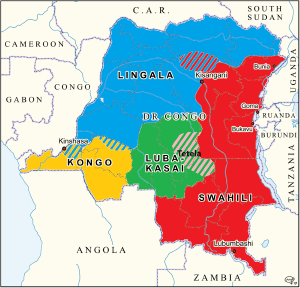
This article draws from some of the roughly 350 oral history interviews that I conducted across eight Congolese provinces — in Congo’s four national languages of Lingala, Kikongo, Ciluba, and Kiswahili, and also in French — primarily between 2019 and 2021.Footnote 12 I used a relational approach to interviewing pioneered by the late Lee Ann Fujii in which the interviewer gains insights through conversational co-creation with their interviewees rather than through one-way questioning.Footnote 13 I centered oral histories within my research to capture people’s primarily oral practice of Lingala in Congo, and in response to Congolese historian Donatien Dibwe Dia Mwembu, who has made convincing arguments for their centrality to understanding Congolese history across decades.Footnote 14 I corroborated my oral histories by combining a close reading of Congolese sociolinguistic publications, with extensive interviews with Congolese sociolinguists from across the four national language zones (see Fig. 1, below), and archival research in Congo, Belgium, and the US.Footnote 15 Across my interviews, I noticed a striking generational impact where people in regions like Kwilu and Katanga who experienced brutal violence by the Lingala-speaking Congolese army during the Congo Crisis (1960–65) retained more negative perspectives toward the language over time, even as younger people without these experiences expressed more openness to the language and its possibilities.Footnote 16
Map of Congo’s four national languages: situating Lingala under Mobutu in the Democratic Republic of the Congo’s linguistic ecology
The collective experience of how Mobutu’s regime used Lingala brought Congolese together and strengthened Congolese national identity, both through linguistic community, and through the suffering that Congolese shared under Mobutu’s increasingly violent authoritarian rule.Footnote 17 Lingala thus became a central part of Zairian experiences of everyday authoritarianism, of what Marie-Eve Desrosiers has described as the “the regular engaging, vying, and navigating that forms the day-to-day life of authoritarianism.”Footnote 18 Desrosiers encouraged scholars to reconsider the mundane limitations of authoritarian regimes, moving beyond the spectacular and horrible staging of authoritarian excess to recognize and analyze everyday governance. Lingala’s informal and oral status made it difficult to capture through archives or government documents.Footnote 19 In their extensive study of Mobutu’s regime, Turner and Young noted: “the central role accorded to Lingala by the regime entrenched regionalized perceptions of power,” and yet they only dedicated one paragraph to discussing Lingala under Mobutu.Footnote 20 In the Congolese case, the lack of focus on the relationship between Lingala and political power also stemmed from the language’s overwhelmingly oral practice, which Mobutu’s regime furthered by shutting down important Lingala and other African-language journals.Footnote 21 Lingala’s informality and orality under Mobutu made oral history interviews central to understanding how Zairians navigated Lingala’s pervasive presence in Mobutu’s regime.Footnote 22
This article contributes to African history by rethinking the relationship between language and postcolonial power, underscoring the rupture that independence represented in terms of how African publics could engage with and influence their political leaders. In recent years, postcolonial historians have nuanced prior chronologies and persuasively portrayed decolonization as a contested, gradual, and contingent process.Footnote 23 Accounts of Mobutu’s regime have often emphasized continuities in his style of governance from Belgian colonial rule. Turner and Young portrayed Mobutu’s Zairian state as a successor to Belgian colonial bula matari in its reliance on authoritarian violence.Footnote 24 Historians like Sarah Van Beurden and Bogumil Jewsiewicki have noted continuities with Mobutu’s regime in his practicing of cultural guardianship, and in his political logic of rule.Footnote 25 More recently, Pedro Monaville and Emery Kalema have shown, respectively, the uncertain political shifts of Mobutu’s early years and how Mobutu’s violent politics of forgetting reshaped Congolese society.Footnote 26 My research does not dispute the authoritarian character of Mobutu’s regime but reveals how the use of Lingala under Mobutu created a new interface through which Congolese citizens interacted with state agents and navigated authoritarian governance differently than under Belgian colonial rule.
Navigating Lingala
I enlist the concept of “social navigation” to describe how Zairians deployed their linguistic, cultural, political, and social capital to navigate Mobutu’s predatory regime. Within African Studies, Henrik Vigh first formulated the concept of social navigation to capture how young people in urban Guinea-Bissau managed conflict and soldiering during the nation’s civil war.Footnote 27 Judith Verweijen built on Vigh’s analysis in discussing civilian resistance against military force in contemporary eastern DRC.Footnote 28 Verweijen’s emphasis on movement, dynamism, and shifting social formations is particularly relevant for Mobutu’s Zaire, as the leader changed state structures to maintain power and kept state officials constantly shifting posts to maintain discipline and control. Where social navigation literature has provided us with new insights into social experiences of (civil) war, I add linguistic dimensions to this discussion, which has especially high stakes in DRC, as one of the most linguistically diverse countries in the world.Footnote 29
By analyzing the role that language played mediating between Zairian state actors and citizens, we find striking instances of civilian (particularly feminine) agency, power, and resilience in the face of state violence and oppression. Historians across geographies have historicized ideas of agency to highlight and appreciate the ways in which women and other marginalized folks have negotiated their relationships with state and capitalist power.Footnote 30 In a recent issue of this journal, Elijah Doro and Sandra Swart acknowledged creative peasant agency in Southern Africa, but urged historians to move beyond agency to “engage power asymmetries and disparities” that have in their context, contributed to the “pervasive and enduring constraints of White settler power.”Footnote 31 In Africanist scholarship, resilience has recently been invoked to explain the persistence and popular legitimacy of customary authorities, and of African adaptations when facing insufficient state support.Footnote 32 My research engages with discourses of both resilience and agency as it considers how Zairians used their knowledge of Lingala to subvert predatory interactions, opening space for negotiation, either to blunt persistent state power or bend it in their favor.Footnote 33
The Lingala language originated in the early 1880s when newly arrived European officials and African (non-Congolese) soldiers formed a new pidgin, based on Bobangi, the main lingua franca on the upper Congo River.Footnote 34 Lingala’s major expansion into what became the Lingala zone occurred following the Batetela mutiny of colonial auxiliaries against the Congo Free State in 1893–94. Authorities subsequently restructured the Force Publique, ending their reliance on foreign missionaries, and adopting Lingala as the military’s new language of command to nationalize the force and reduce the potential for mutiny.Footnote 35 Thus military recruits, soldiers, veterans, and their families used Lingala — as the language became known after the 1890s — to construct new colonial identities.Footnote 36
Beyond Lingala, Congo’s complex linguistic ecology in the late nineteenth century — with an estimated 350 ethnic groups and around 250 languages — influenced the policy choices of Congo Free State (CFS) and Belgian colonial authorities.Footnote 37 Where CFS authorities made a failed attempt to spread French among state auxiliaries, Belgian colonial authorities after 1908 moved away from expanding French due to a combination of pragmatism and racism.Footnote 38 They instead leaned on the four regional lingua francas which became Congo’s de facto national languages: Lingala, Kiswahili, Kikongo (ya Leta), and Ciluba.Footnote 39 These languages expanded through their use by colonial agents and auxiliaries, and their adoption by Congolese seeking social mobility in Congo’s oppressive colonial economy.Footnote 40 Lingala came to be spoken across what became the Lingala zone through its adoption by colonial agents, some mission schools, and Congolese town-dwellers, the other three national languages followed similar patterns — with a partial exception in Ciluba.Footnote 41
Belgian colonial authorities maintained French as official language, but only trained small numbers of Congolese (men) in French until a slight expansion of secondary education in the 1940s.Footnote 42 These Congolese, the évolués, constituted a small percentage of the population — and a significant focus of the historiography — and were almost exclusively men, who gained outsized power at independence, as educational attainment and mastery of French became essential criteria for entering government.Footnote 43 Linguist Marcel Kalunga Mwela Ubi’s explanation to me is worth quoting at length:
Immediately after independence, education truly was the key to enabling someone in Congo to live a prosperous life. All that people had to do was look at the évolués, who had converted their years in school, their mastery of French, and their technical knowledge into a dominant position in post-independence Congo … education, and with this, the mastery of French, was the key to attaining prosperity and influence in life.Footnote 44
Benefitting from UN and other external support, Congolese authorities during the First Republic (1960–65) expanded Congo’s small secondary education system but faced massive challenges in implementation due to the concurrent Congo Crisis.Footnote 45 Mobutu’s regime continued this educational expansion in his first decade (1965–75), but shifted criteria for political advancement away from educational attainment and toward loyalty or militantisme, as Mobutu publicly embraced Lingala, and cemented his power.Footnote 46
Mobutu’s use of Lingala differed substantially from Belgian colonial language policies and from the French-favored policy of the First Republic in that his de facto Lingala policy enabled a much closer, yet still authoritarian relationship between Mobutu and the Congolese population.Footnote 47 Where the MPR party-state bureaucracy had French as its language of work, Mobutu’s personalized state engaged with Zaire’s broader population primarily through Lingala, giving the language a central position in Congolese politics. Mobutu’s regime thus provided Zairians with greater proximity to power through language, shifting from the distant superiority of French under Belgian colonial rule and the First Republic.Footnote 48 French retained its position as Zaire’s official language, but Mobutu’s patrimonial politics and the devastating economic decline that his regime presided over undermined the ability of mastering French to provide socioeconomic advancement.Footnote 49
Mama Anasthesie Kasese’s recollections reveal how Zairians navigated the Zairian state linguistically. Kasese, a Katangese farmer and mother, improved her relationships with soldiers and other state agents by speaking Lingala. As she explained: “it helped me a lot knowing Lingala. When I came across a military roadblock, I would just say in Lingala mbote, sango nini (hi, how are you)? And they would let me pass every time without any issue.”Footnote 50 This reaction presented a striking contrast with soldiers’ normal, predatory treatment of women at roadblocks, especially in Kiswahili-speaking Katanga province, which came under military rule following the Shaba Wars of 1977–78.Footnote 51 Kasese’s testimony, along with those of my other interviewees, illustrates how Zairians deployed their linguistic and cultural resources under Mobutu, to navigate state power, survive its predation, and manage their daily lives.
Lingala and the state: from regional expansion toward national practice
We can understand the central role that Mobutu’s regime played in Lingala’s cross-country expansion by exploring Lingala’s position at the start of his rule, and how it changed throughout. Before Mobutu seized power in November 1965, Lingala was growing rapidly within its linguistic region, and in parts of western Congo, but not elsewhere. In western Congo, Lingala was, as Margot Luyckfasseel has argued, a “killer language,” winning out in competition over different local languages, especially among young people.Footnote 52 Lingala’s expansion in this phase came largely at the expense of local languages as people migrated to cities to escape insecurity and find new economic opportunities.Footnote 53
East of Kinshasa in the Kikongo zone, Lingala was already established along the Congo River in 1965. Some people had learned Lingala as the language made inroads westward, especially in the city of Bandundu.Footnote 54 Lingala also gained speakers in western Bas-Kongo from the 1950s onward, as people expanded commercial contacts with Kinshasa, and some preferred not to speak Kikongo ya Leta due to its connections with the Belgian colonial state.Footnote 55 While Lingala served as the language of the army, this did not always lead to its diffusion amongst the civilian populace. Moreover, multiple regional rebellions during the era of the Congo Crisis (1960–65) meant that these soldiers were not deployed nationwide.Footnote 56 The decentralized federalist government of President Joseph Kasa-Vubu during the First Republic further limited linguistic expansion: Kinshasa, the Lingala-speaking Congolese capital, was not the center of political and cultural power that it would become during Mobutu’s reign.Footnote 57 Lingala-language rumba music — another major factor in its eventual expansion — was then limited by the limitations on broadcasting and distribution into Congo’s vast hinterland.Footnote 58
In Ciluba-speaking Kasai, Lingala’s presence in 1965 was limited to soldiers, their families and a small number of traders travelling to Kinshasa.Footnote 59 In the western regional center of Kananga (known as Luluabourg until 1966), Lingala was present with the city’s military, and especially with the military’s officer school (Ecole de formation d’officiers) where Congolese military and national police officers trained, and yet Lingala’s use did not extend beyond the areas around military barracks.Footnote 60 As linguist Adrien Munyoka explained, regarding the southeastern Kasaien town of Mwene-Ditu: “People perceived Lingala as the language of hard power, the language of law enforcement.”Footnote 61 Still this presence was limited, as local police forces mainly used Ciluba and Kinshasa’s cultural and political influence remained weak. Lingala was absent from fast-growing Mbuji-Mayi, which had emerged from the small town of Bakwanga following ethnic cleansing practiced by Balulua against ethnic Baluba in western Kasai in 1959–1960. Felicien Mbala, recalled that in Mbuji-Mayi in 1965, “we did not hear Lingala spoken here. A few very rare traders who travelled to Kinshasa spoke it but for the vast majority, Lingala did not mean anything to us. City residents did not speak Lingala at all.”Footnote 62 According to Munyoka, Lingala music from Kinshasa became noticeable in Kasai’s cities in “1964 or 1965 with the arrival of portable radios” from Kinshasa.Footnote 63 In Kasai’s rural areas, home to close to 80 percent of the region’s population at the time, Lingala remained nearly non-existent, as customary authorities and local law enforcement continued to use Ciluba and other local languages.Footnote 64
In Congo’s Kiswahili zone, Lingala’s presence remained even more limited than in Kasai. Little trade connected the East with Kinshasa, and multiple rebellions against the central government in the 1960s reduced Lingala’s practice further. Before Mobutu, Kiswahili had an unopposed status as the main lingua franca in urban, periurban, and multiethnic parts of eastern Congo. Kiswahili was taught in primary schools, spoken by local authorities, and used as the language of work in Katanga’s critical mining industry, and by some religious denominations across eastern Congo.Footnote 65 During Belgian colonial rule, Kiswahili also became the language of urban life in Elizabethville (Lubumbashi) and other major towns. Learning Kiswahili for Katangese became synonymous with socioeconomic success and aspirations of modernity.Footnote 66 Lingala’s absence from Katanga was reinforced during the Katanga secession (1960–63), when Katangese authorities banned music in Lingala, and on at least a few occasions, mobs targeted Lingala speakers due to the language’s association with the national army and central government.Footnote 67 Elsewhere in the Kiswahili zone in rural Kivu, Lingala was practically non-existent.Footnote 68 As with Kwilu, central government soldiers sent to quell Congo’s numerous rebellions only deepened popular antipathy toward Lingala as these soldiers and their European mercenary allies practiced brutal scorched earth tactics against civilians as well as soldiers. If civilians’ increased interactions with soldiers necessitated at least limited knowledge of Lingala, the soldiers’ numerous war crimes caused many Kiswahili-speakers to reject Lingala and refuse to speak the language when possible.Footnote 69
Imposing Lingala: language and Mobutu’s regime
In my interviews, Congolese used the French verb imposer (in French as well as Congolese languages) to characterize how Mobutu and his regime used Lingala to rule Congo-Zaire throughout his rule.Footnote 70 Unlike other cases in Africa such as Tanzania or Malawi, the Mobutu regime did not impose Lingala through formal language policies or the education system.Footnote 71 Under Mobutu, Lingala did not displace the official language — in this case French — but rather existed alongside it, as a prestigious and powerful language associated with the state, in a language regime partially inherited from the colonial period, but augmented under Mobutu’s rule.Footnote 72
Many Zairians associated the leader himself with the informal imposition of the tongue due to Mobutu’s exclusive use of Lingala during his popular rallies across the country, forcing people from all social classes to attend these rallies where they would be subject to the language.Footnote 73 Politicians, the MPR and its youth league (the Jeunesse de la Mouvement Populaire de la Révolution, or JMPR), as well as, soldiers, and gendarmes joined these regime efforts but imposed Lingala through language practices and ideologies rather than formal language policy.Footnote 74 Where many interviewees described Mobutu’s regime as imposing Lingala through their rule, informants from within the regime often saw their use of Lingala as a pragmatic tool facilitating communication with the public.
The Mobutu regime’s imposition of Lingala represented a language policy by effect, rather than by law or decree. Lingala expanded due to Mobutu’s personalized dictatorship, regime officials’ need to demonstrate loyalty and proximity to Mobutu, and the regime’s policy of stationing officials outside their home region and rotating them periodically. The regime’s informal imposition of Lingala produced ambiguous, sometimes contradictory effects. Imposing Lingala created resentment among some Zairians, particularly in Shaba province, who viewed the regime’s use of Lingala as a form of oppression, providing one more grievance for people who experienced Mobutu’s regime as predatory, exploitative, and corrupt. The regime’s use of Lingala also enabled political leaders to communicate with much of Zaire’s population, and on rare occasions, it enabled ordinary Zairians to critique their leaders directly.Footnote 75 Learning Lingala allowed Zairians to negotiate with a predatory regime, and navigate the uncertainties of daily life in Zaire, especially after 1970s once the formal economy imploded, and people needed to fend for themselves (se débrouiller) to survive and feed their families.Footnote 76
Idi Amin’s imposition of Kiswahili in Uganda represents a particularly apt comparative case study for Lingala under Mobutu as a formerly colonial language, used by the military and enlisted by an authoritarian postcolonial government to strengthen its rule. Amin decreed Kiswahili to be Uganda’s sole “national language” following his 1971 military coup. As with Lingala in Congo-Zaire, Kiswahili in Uganda had a longer history connected most to its use in the British King’s African Rifles (KAR), who imposed a simplified version of Kiswahili (Ki-KAR) across Kenya, Tanzania, and Uganda under Britain’s colonial control.Footnote 77 Idi Amin, like Mobutu, had a limited formal education and rose through the ranks of the colonial army before taking power in a military coup.Footnote 78 Before Amin’s dictatorship, Kiswahili had served as a lingua franca in northern and western Uganda but had been largely rejected by Baganda elites and commoners dating back to the late nineteenth century.Footnote 79 Amin’s imposition of Kiswahili through Radio Uganda and Uganda Television — and its continued use by security forces — caused Kiswahili to become associated with his regime’s extensive political violence, particularly in Buganda.Footnote 80 Unlike Mobutu with Lingala, which had become established as the language of Leopoldville (Kinshasa) and rumba music prior to independence, Kampala urbanites preferred Luganda and largely rejected Kiswahili in Amin’s Uganda, meaning that the language did not gain the positive cultural associations of urban modernity from which Lingala in Zaire benefited under Mobutu’s rule.Footnote 81
Navigating Lingala in the Kiswahili zone
After Mobutu seized power in 1965, Kiswahili maintained its position from a language policy perspective, however Mobutu’s nationalization of the territorial administration and his restructuring of Congolese political culture brought Lingala increasingly into Kiswahili’s area of influence from the early 1970s onward.Footnote 82 After Zaire’s commodity-dependent economy began to worsen in the late 1970s, Kiswahili speakers and other Zairians needed to make increasing use of Lingala to navigate predatory state agents in Zaire’s grassroots economy, and to build longer distance social, economic, and commercial networks.
We can differentiate a spectrum of reception across Zaire’s Kiswahili zone ranging from more significant rejection in Katanga, to more ambivalent reactions in Kivu and elsewhere. While some Kiswahili speakers learned Lingala to adapt to their new reality, other Kiswahili-speaking Zairians, especially in Katanga, viewed the regime’s informal imposition of Lingala as arrogant and oppressive. This was particularly true for older generations of Katangese. As Daniel Kyungu recalled “I was proud (nilikuwa na kiburi) of speaking Kiswahili and so I refused to speak Lingala at all.”Footnote 83 Kyungu was far from alone. Some Kiswahili-phone interviewees used ideological critiques of Lingala to blunt its power, arguing that Lingala was the language of theft (luga ya bwiji in Katanga Kiswahili) or that it was impolite and lacking respect (aina eshima).Footnote 84 Many Katangese came to despise Lingala and to refuse to speak it (kubouder Lingala) as the regime went on. Contemporaneous sources corroborated my interviewees’ perspectives regarding the prevalence of negative language attitudes toward Lingala during Mobutu’s rule in Katanga (Shaba).Footnote 85
Where negative attitudes toward Lingala appeared most drastic in Katanga, people elsewhere in eastern Zaire shared largely negative views, even if Lingala gained comparatively more adoption in these areas. Regarding South Kivu, Joseph Lunjwire explained that: “For us in Bukavu, Lingala was the language of musicians, soldiers, and Mobutists. But if someone from Bukavu spoke Lingala, they were either considered to be a thug, or a boastful person.”Footnote 86 Lunjwire’s perspective is complicated by the analyses of sociolinguist Didier Goyvaerts, who observed the significant adoption of Lingala in the city of Bukavu during the late 1980s and early 1990s.Footnote 87 Bringing together the recollections of Lunjwire and others who lived in Bukavu with Goyvaerts’s analysis, we can see that Lingala in Kivu was both widely disliked due to associations with regime violence and a necessary evil that people needed to adapt to and, in some cases, to learn.Footnote 88 As the broader Kivu region spiraled into increasing insecurity and violence during and after the early 1990s, learning Lingala became even more important to both navigate encounters with security forces and secure scarce employment.Footnote 89 Amos Bagambe, for example, learned Lingala as a youngster in rural North Kivu during the early 1990s by speaking with soldiers in his area, and later writing down the words that he learned in school notebooks. Bagambe’s learning Lingala as a youngster facilitated his later finding employment as a response driver for a private security company.Footnote 90
Where some Zairians rejected Lingala as being a language of oppression or violence, others embraced Lingala as a language of economic opportunity, political influence, and national unity. “Moustique” recalled to me that growing up in Shaba during the 1970s, he and his age-mates found Lingala to be a gateway to possibilities and employment through the JMPR.Footnote 91 Other Zairians across the country learned or improved on their Lingala under the Mobutu regime for its benefits in terms of business and trade. Giles Acevedo, who lived in South Kivu for most of Mobutu’s rule, used Lingala to build relationships with government officials and thus expand his agricultural business. Acevedo explained that many Zairians where he lived learned Lingala either to deal with soldiers, follow Mobutu’s speeches, or enjoy Zaire’s continent-topping rumba music.Footnote 92 In South Kivu where Acevedo lived, Kiswahili had been established as the regional language since the early twentieth century and Lingala only arrived after Mobutu’s seizure of power.Footnote 93 Lingala never threatened the position of Kiswahili in the east or Ciluba in Kasai, but rather grafted onto existing language ecologies, taking on some characteristics which had previously been associated with French in facilitating networking, business, and relationships with political leaders.
Where some Zairian traders and businesspeople embraced Lingala, many Zairian parents — especially in the Kiswahili zone — grew concerned when their children began to speak Lingala at home. For these Zairian parents, attacking Lingala became a way to criticize the immoral behavior that they saw Mobutu’s regime as sanctioning if not producing. Parents in Katanga who heard their teenagers speaking Lingala at home would ask: je unafunda bwizi (are you learning how to steal)?Footnote 94 With the implication that speaking Lingala was only a short jump from becoming a criminal. This type of discourse from parents became so prevalent that young people learning Lingala needed to avoid carefully speaking the language at home, as Laurent Itela and others recalled.Footnote 95
“Moustique”’s experience and those of other interviewees also point to the significance of generation in understanding and explaining responses to Lingala. The Zairian parents who rejected Lingala and sought to prevent their children from learning the language had lived before Mobutu’s lengthy rule. Zairians who came of age after the mid-1970s, particularly those in cities and towns, grew up with Lingala and with the extensive propaganda of Mobutu’s MPR party-state, but also the increasing insecurity and economic crisis that Mobutu’s regime contributed to. Both factors, the politicization of employment and the increasing insecurity that Zairians faced contributed toward Lingala’s expansion. Where many of my interviewees discussed Lingala as having been easy to learn, it was particularly those of and after this “independence generation” (born from 1956–65) who gained early exposure to Lingala during the critical period of linguistic development and could thus internalize their knowledge of the language more effectively.Footnote 96 Still, we must recognize that popular responses to Lingala in the Kiswahili zone tended toward the most negative, particularly in Katanga, which experienced a military state of emergency and its accompanying violence through much of Mobutu’s regime.Footnote 97
Navigating Lingala in the Kikongo zone
Where Lingala expanded across the Kikongo zone under Mobutu’s rule, people had contrasting reactions to Lingala in Kongo Central as opposed to Kikongo-speaking parts of Bandundu. For Kongo Central, Lingala had already begun to make inroads before independence through the region’s close economic integration with Léopoldville, and due to extensive migration toward the capital. Kwilu and Kwango in Bandundu by contrast, had more peripheral economic relationships with Léopoldville at independence, as transportation proved a major challenge. The primary force behind Lingala’s penetration of Bandundu was the region’s military occupation by central government troops in response to the Mulele rebellion. The army’s extremely violent campaign to suppress this rebellion and collectively punish civilians in the region for their alleged support of the rebels, poisoned a whole generation against Lingala through popular perceptions of it as a language of violence and oppression.Footnote 98 The Kikongo zone contrasted with the other national languages in terms of its proximity to Kinshasa. The region thus encountered Lingala as much through cultural and economic integration as through politicization, along a regional spectrum based on proximity and relative experiences of Congo Crisis violence.Footnote 99 In all regions, rumba music in Lingala provided a more positive motivator to learn the language than Lingala’s accompanying political position.Footnote 100
For Bandundu, a crucial shift toward people’s gradual acceptance of Lingala came with a major bridge and road construction project along national highway number one — connecting Kinshasa and Bandundu’s capital, Kikwit — in 1971. While Kikwit was only 500 kilometers from Kinshasa, Western Congo’s geography complicated this journey via the dirt roads due to the nine rivers that needed to be forded. Once highway number one had been modernized, Bandundu became far more integrated into Kinshasa’s economic and cultural orbit, bringing Lingala deeper into the region. Popular responses to Lingala in Kwilu began to improve in the 1970s, especially among young people with limited experiences of military occupation during the Mulele rebellion, however Kikongo (ya Leta) retained its status as both regional lingua franca, and an important symbol of regional identity.Footnote 101
Among Kikongo speakers in Bandundu, an earlier generation who survived the horrific collective punishment that Lingala-speaking soldiers inflicted across Kwilu in the 1960s retained their intense opposition to Lingala throughout their lives.Footnote 102 Younger folks growing up in the 1970s and 1980s began to see Lingala in a new and more positive light, particularly in relation to popular music but also due to Zaire’s declining and changing formal economy after 1975.Footnote 103 As Bandundu became more connected to Kinshasa by economic and social connections, the pressure for young people to learn and speak Lingala increased, contributing to a gradual expansion in the use of Lingala, particularly in the region’s cities and towns. Adding to these social and cultural pressures, Zaire’s economic collapse in the 1980s and 1990s pushed increasing numbers of young people into Zaire’s vibrant grass-roots economy through activities like artisanal mining, street vending, or smuggling.Footnote 104
Popular responses to the city of Kikwit’s 1995 Ebola outbreak revealed continued perceptions of Lingala as a symbol of regime oppression. By the mid-1990s, the state’s impact on Zairian society had become deeply negative, providing almost no social services but exporting political violence and starvation-level poverty across the country. During the panic and fear that came with the world’s first Ebola outbreak in a major city, Kikwit residents responded by scapegoating Lingala. In some instances, people attacked anyone heard speaking Lingala, and chased known regime members or supporters from the town. People saw Ebola as the regime’s latest measure to punish and damage the city and region, which had given rise to military opposition in the 1960s and added political opposition through the Parti Lumumbiste Unifié (PALU) in the 1990s.Footnote 105
Navigating Lingala in the Ciluba zone
Popular responses to Lingala’s expansion under Mobutu in Ciluba-speaking Kasai skewed less negative than in the Kiswahili-phone east despite similar associations with theft, violence, and impoliteness.Footnote 106 Mobutu began his regime by following the advice of Kasaien political leaders and maintaining the provincial division between eastern and western Kasai, which the First Republic central government had enacted in 1964 to reduce tensions between Kasai’s two largest ethnic groups, the Luba and Lulua.Footnote 107 One major factor that influenced Kasaien experiences of Mobutu’s regime was the provincial quota system that Mobutu enacted for higher education. Kasaiens (especially members of the Luba ethnic group) had predominated in secondary education and urban areas across Congo during the colonial period as clerks, teachers, and other white-collar professions.Footnote 108 Mobutu’s quota system, combined with the later collapse of the formal economy, reoriented many Kasaiens more towards trade, business, and artisanal mining. Diamond mining, which expanded significantly during the secession of Eastern Kasai in 1961–62, remained a critical part of Kasai’s economy throughout the Mobutu years, providing jobs, wealth, and opportunities for social advancement through both artisanal and industrial mining.Footnote 109
As historian T. K. Biaya has discussed, both mining and commerce pushed many Kasaiens away from education, and with that, mastering French, giving rise to the popular Ciluba expression Cifalansa ki falanga tò (French is not money), meaning that learning French would not necessarily make one wealthy. Biaya noted that among Mbuji-Mayi’s wealthiest and most powerful traders in the 1980s, many had either a primary education or no formal education at all; they rather gained their wealth through diamond trading or importing goods from Kinshasa. In both cases, these nouveau riche needed to speak Lingala to facilitate relationships with the regime but did not need to speak French to succeed.Footnote 110 Kasai’s relative sociolinguistic homogeneity supported Ciluba’s important role, as unlike Congo’s other three national language zones, Ciluba served as a first language for a majority of Kasaiens, including those from both the Lulua and Luba ethnic groups.Footnote 111 Many members of Kasai’s ethnolinguistic minority groups learned Ciluba in primary schools, and spoke the language as needed. Negative language attitudes toward Ciluba among some members of these groups — like with Kanyok people in southeastern Kasai, furthered Lingala’s establishment in the region.Footnote 112
Two groups in Kasai which became most associated with Lingala under Mobutu, aside from the military, were politicians and traders. These categories often overlapped, as Zairians connected to the regime leveraged their political capital to diversify income streams.Footnote 113 Kasaien politicians — as elsewhere in Zaire — needed to speak Lingala, from local up to provincial levels, to demonstrate their adherence to the regime and loyalty to Mobutu. This became especially true after the 1980s, when Kasai became the home base of Mobutu’s main political opposition, the Union pour la Démocratie et le Progrès Social (UDPS), and its leader Mobutu’s former collaborator, Ettienne Tshisekedi.Footnote 114 Aspiring politicians would learn Lingala in order to build their connections with the regime, and also to understand Mobutu himself, who spoke only Lingala when he led his frequent political rallies in either Kananga, Mbuji-Mayi, or smaller towns in the region. Many Kasaiens involved in business, even simple traders, also learned Lingala during Mobutu’s rule to improve their contacts in Kinshasa, facilitate their travel to western Zaire, and manage the demands of predatory regime officials.
One important vector of Lingala’s expansion into Kasai beyond state actors and businesspeople occurred through Kasai’s extensive artisanal diamond mining. Artisanal diamond mining in Kasai first became a major industry during the South Kasai secession following independence in 1960. Under Mobutu’s rule, artisanal diamond mining was completely illegal until 1979, and later partially legalized following outrage at a military massacre of artisanal miners which also precipitated the formation of UDPS.Footnote 115 This work’s quasi-legal status meant that miners needed to navigate and evade state agents to maintain their livelihoods and survive encounters with soldiers or police.
For artisanal miners in Mbuji-Mayi’s diamond fields along the Kasai River during the 1970s and 1980s, knowing Lingala made the difference between life and death. Beyond the outskirts of Mbuji-Mayi’s Societé minière de Bakwanga (MIBA) parastatal compounds, artisanal miners worked in small groups sifting through silty dirt to find diamonds. Upon finding diamonds, they needed to reenter town, being sure to evade unpaid soldiers, who extorted the diggers for their living. Ditunga recalled multiple stories of miners, caught with diamonds, and summarily executed by soldiers. After each incident, stories spread among the miners that they were killed because they could not negotiate with their captors in Lingala. On two occasions, soldiers caught Ditunga, and although they beat him, he had spent time learning to speak rudimentary Lingala, and successfully placated the soldiers. While he needed to give them a small portion of his findings, they let him go each time.Footnote 116 Thus state violence pushed Lingala’s expansion among artisanal miners and other workers in the informal economy in Kasai and beyond.
Further up Kasai’s diamond mining supply chain, diamond traders known as diamentaires also needed to speak Lingala to navigate regime authorities and sell their diamonds to international brokers in Kinshasa. For Andre Malengela, who entered the industry in Mbuji-Mayi in the 1980s and became an important diamond trader later in the 1990s, learning to speak Lingala was a critical skill for aspiring diamond traders hoping to succeed. As Malengela explained, Lingala helped diamond traders to deal with state agents in Kasai but was absolutely necessary for negotiating with state authorities and customs officials in Kinshasa.Footnote 117 Kasai’s cities — Mbuji-Mayi and, especially, Tshikapa — played important roles in the cross-border diamond exchange between UNITA rebels and Zairian authorities, for which Lingala also served as the main lingua franca for the trade on both sides of the Angolan border into the 1990s.Footnote 118
Deploying knowledge of Lingala especially improved Zairian civilians’ interactions with state agents in places like Katanga or Kasai, where knowledge of Lingala remained limited. Conversely, Lingala’s ability to improve outcomes of negotiations with state agents decreased in spaces like Kinshasa, where virtually everyone spoke Lingala prior to Mobutu. If Lingala represented a source of alienation and opposition to the Mobutu regime in areas like Katanga or Kivu, the regime’s extensive use of Lingala provided some measure of connectivity and popular support across the Lingala zone. We must recognize. However, that differing linguistic relationships did not change the regime’s authoritarian and exploitative nature.Footnote 119
Zairians in Kinshasa and across the Lingala zone dealt with the same roadblocks, extortion, and violence of the regime as did folks elsewhere. In places where knowledge of Lingala proved relatively rare, people could speak Lingala to improve their proximity and relationship to both security forces and the regime, as Jonathan Kitenge explained regarding Katanga: “Lingala was the president’s language (luga ya president in Kiswahili), and as such it carried powerful authority (authority moya ya nguvu).”Footnote 120 Lingala’s scarcity in these places made speaking it more valuable as a way to differentiate oneself from others in relations with the state.Footnote 121 Yet in places like Mbandaka, where virtually everyone spoke Lingala prior to Mobutu’s rule, speaking the language provided less benefit.Footnote 122 Still, in reflecting on the decades since Mobutu lost power, people’s memories of Mobutu’s regime within the Lingala zone proved much more positive during my interviews than those of folks elsewhere, pointing to the role of linguistic affinity in influencing collective memory.Footnote 123
Conclusion
This article represents an early foray into the sociolinguistic history of postcolonial Africa. For Africanist historians, there is significant work to be done in Congo, across Central Africa, and around the continent in studying divergent histories of language and power.Footnote 124 Angola is another case where research is needed into both linguistic affiliations and linguistic changes during civil war.Footnote 125 Further analysis of historical relationships between language, political power, and authoritarian violence is also particularly needed in the cases of Zimbabwe and Uganda. In both countries, postcolonial governments under Robert Mugabe and Idi Amin respectively imposed languages associated with colonial militaries (Chishona in Zimbabwe and Kiswahili in Uganda) through militarized collective violence directed at regions and people that these governments constructed as oppositional.Footnote 126
This article has argued that Zairian experiences navigating Lingala under the Mobutu regime in Congo-Zaire had three significant effects: contributing to linguistic change in Lingala’s expansion, shaping Zairians’ ability to negotiate with state power, and becoming central to Congolese memories of the everyday authoritarianism of Mobutu’s regime. Beyond Congo, this article shows that for historians, studying sociolinguistic processes provides us with new insights into a crucial but underemphasized difference from colonial to postcolonial regimes in Africa. We gain insight into the way in which African languages provided Africans with differentiated access to their postcolonial rulers. We also see how new postcolonial subjects needed to adapt and deploy their linguistic resources as they navigated new postcolonial states. By recentering the linguistic navigation of non-elite Congolese in our understanding of Mobutu’s regime, we gain deeper appreciation for the (constrained) agency and creativity that people exert in even the most predatory and challenging political contexts.
Acknowledgements
I first thank the editors and anonymous reviewers of The Journal of African History for their thoughtful suggestions and generous readings of my article. I would also like to thank those who read and commented upon earlier versions of this work, especially David Glovsky, Linda Heywood, Timothy Longman, Michael Meeuwis, and Didier Gondola. Above all, I would like to thank my dear friends and interlocutors across Congo without whom my scholarship would not be possible.


 Open access

