


Introduction
Introduced species can degrade island ecosystems and lead to endangerment and extinction of native island species (Reaser et al., Reference Reaser, Meyerson, Cronk, De Poorter, Eldrege and Green2007), and therefore it is often necessary to remove non-native species to conserve island biota. An increasing body of scientific literature documents the importance and scale of efforts to eradicate invasive species from islands (Veitch et al., Reference Veitch, Clout and Towns2011). However, the literature contains few examples of bird eradications (Feare, Reference Feare2010). Here, we discuss conservation concerns pertaining to an introduced population of wild turkeys Meleagris gallopavo on Santa Cruz Island, California, USA, and describe the methods used to eradicate the population.
Santa Cruz Island (250 km2), located c. 40 km off the coast of Santa Barbara, California, is characterized by two mountain ranges flanking a central valley (Fig. 1). It has a Mediterranean climate, with cool wet winters and warm dry summers. The Nature Conservancy owns 76% of the island; the U.S. National Park Service owns the remainder. Before the island was acquired for conservation numerous animal taxa were introduced for livestock or hunting, which subsequently caused extensive damage to the island ecosystem. For example, feral pigs Sus scrofa and sheep Ovis aries, both introduced in the 1850s, destroyed native vegetation, with cascading ecological consequences (Morrison, Reference Morrison, Witmer, Pitt and Fagerstone2007). Sheep were eradicated from the island by the late 1990s and the recovery of native vegetation has been dramatic: in 1985 c. 75% of the island was covered by bare ground or grassland; in 2005 approximately the same percentage was covered by native shrub and woodlands (Fig. 1). Feral pigs were eradicated in 2006. Pigs degraded soils and native vegetation and also provided a prey subsidy for golden eagles Aquila chrysaetos, which became resident on the island. Incidental predation by eagles drove the three subspecies of island fox Urocyon littoralis endemic to Santa Cruz and two neighbouring islands to near extinction (Roemer et al., Reference Roemer, Donlan and Courchamp2002).
Vegetation change on Santa Cruz Island, California, USA, from 1985 to 2005. Maps depict vegetation coverage, pooled into general categories: bare ground and herbaceous vegetation; scrub and low stature vegetation; chaparral and medium canopy communities; and forest and woodland. (a) Vegetation prior to/during the eradication of feral sheep Ovis aries. (b) Vegetation in 2005. Double circles show the locations of winter aggregations of turkeys Meleagris gallopavo; area approximates relative population size at the time of the introduction (a) and when management intervened (b). The inset shows the location of Santa Cruz Island off the coast of California (CA).

Wild turkeys were first introduced in California, on Santa Cruz Island, in 1877 (Caton, Reference Caton1887; CDFG, 2004). That introduction failed, as did others in the 1950s and 1960s (P.W. Collins, Santa Barbara Museum of Natural History, pers. comm.). In 1975 California Department of Fish and Game introduced two toms and five hens to the portion of the island that became the property of The Nature Conservancy in 1987. During the subsequent 2 decades the turkey population was c. 40–50 individuals, localized around the initial introduction site, near the main ranch compound in the central valley (LL, pers. obs.). During November–February turkeys tended to aggregate in open areas for courtship. At other times they were generally dispersed and cryptic.
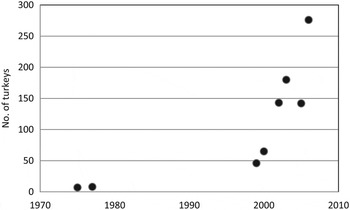
In the early 2000s the turkey population irrupted (Fig. 2). The reason for the sudden increase is unknown but may have involved both top-down (predator mediated) and bottom-up (food resource mediated) mechanisms. When turkeys were introduced, non-native ungulates had suppressed native scrub. Following the removal of sheep from the island, the increase in scrub, oak (Quercus spp.) and other native vegetation may have improved turkey habitat (Fig. 1) by increasing the availability of food resources (e.g. acorns, invertebrates, small vertebrates; Eaton, Reference Eaton, Poole, Stettenheim and Gill1992) and reducing nest predation (Lehman et al., Reference Lehman, Rumble, Flake and Thompson2008). The decline in the fox population during the 1990s may have resulted in reduced predation of eggs and poults (Palmer et al., Reference Palmer, Priest, Seiss, Phalen and Hurst1993). Pigs were probably competitors for food resources as well as predators of turkey nests (Wilcox & Van Vuren, Reference Wilcox and Van Vuren2009). Because the increase in the turkey population began before pigs were removed we assumed the population would continue to increase. Winter 2005–2006 was the first in which lekking aggregations formed away from the main ranch. Small flocks organized around strutting males were observed on the island's western end as well as to the east, on and around a mowed airstrip (Fig. 1).
Observed abundance of wild turkeys on Santa Cruz Island (Fig. 1). Seven birds were introduced to the island in 1975. During 1999–2006 LL conducted counts annually in January–February, when turkeys were aggregated in overwintering flocks. During the 2 decades between the introduction and the start of the annual surveys the overwintering flock comprised c. 40–50 individuals (LL, pers. obs.). In 2006 the recorded population was 276 individuals, distributed in three flocks, and in late 2006–early 2007, based on results of the eradication programme, it was 310 individuals.
Managers had numerous concerns about the growing turkey population. Potential effects included depredation of and competition with native taxa, and dispersal of non-native plants. Of greatest concern, however, was the potential effect on island foxes if turkeys became a prey subsidy for golden eagles (Fig. 3). The eradication of pigs was intended in part to reduce the island's attractiveness to golden eagles (NPS, 2002). If turkeys replaced pigs as a food subsidy for golden eagles they could perpetuate the risk of fox predation by the eagles (Fig. 3). Although turkeys may not be a primary food resource for golden eagles where they co-occur on the mainland, golden eagles are known to predate turkeys (Eaton, Reference Eaton, Poole, Stettenheim and Gill1992) and they have more limited prey options on Santa Cruz Island, with its depauperate fauna (i.e. four native terrestrial, non-volant mammal species: a fox, a skunk, and two rodents). Population viability analyses suggested the presence of only a few golden eagles could result in the extirpation of island fox populations (Bakker et al., Reference Bakker, Doak, Roemer, Garcelon, Coonan and Morrison2009). During 1999–2006 managers captured 32 free-flying golden eagles on the island and translocated them to mainland California (IWS, 2006). However, in 2006 golden eagles still occurred on the northern Channel Islands and the turkey population trajectory (Fig. 2) suggested the opportunity for efficient management was diminishing.
Hypothesized trophic relationships among native and non-native biota (sheep, native vegetation, pigs Sus scrofa, turkeys, golden eagles Aquila chrysaetos and island foxes Urocyon littoralis) on Santa Cruz Island (Fig. 1) prior to the eradication of wild turkeys. Circled species were introduced or, in the case of the golden eagle, probably not resident on the island historically.

The Nature Conservancy sought a management strategy for turkeys that was compatible with its mission to conserve native biodiversity. Given the similarities between threats posed by turkeys and feral pigs, managers reviewed alternatives that were evaluated during the environmental impact assessment for abating the threat posed by pigs (NPS, 2002). Such a formal process was not required for the turkeys because they were considered an unmanaged domestic flock and not part of California's managed game population. The Nature Conservancy determined that eradication of turkeys from the island was necessary because the alternative, sustained population control, would perpetuate risk to native species, require monitoring and management indefinitely, obligate funds to turkey management instead of other conservation needs and result in more individual bird mortalities over time.
Vertebrate-pest management specialists evaluated the site and the population, concluded that eradication was feasible and developed an eradication plan based on a succession of culling operations. Live capture and translocation off the island was rejected because of the difficulty of trapping every individual safely and concerns about potential transmission of disease to the mainland (which was a factor precluding translocation of pigs; NPS, 2002). Population control via orally administered contraception was also rejected because of uncertainties regarding its efficacy (Avery et al., Reference Avery, Yoder and Tillman2008), risk of exposure of non-target species and the need to reduce turkey numbers immediately to reduce the risk of prey switching by golden eagles (Fig. 3). Wild turkeys can live for >10 years (Eaton, Reference Eaton, Poole, Stettenheim and Gill1992). Public hunting was not pursued as an option because this approach was unlikely to achieve eradication (Van Deelen & Etter, Reference Van Deelen and Etter2003).
Methods
Before any turkeys were dispatched we planned the entire project, including how the last turkey would probably be detected and dispatched. Our eradication plan was built on general principles for eradication projects and involved four phases: initial reconnaissance of the population; netting and precision shooting; monitoring of turkeys fitted with radio-telemetry transmitters to locate remaining birds; and long-term monitoring for survivors.
Strategic principles
Eradication projects need to be implemented intensively, often using a variety of techniques to ensure that all target animals are put at risk, and in a manner that prevents individuals from gaining an awareness of the culling effort lest they become wary and more difficult to engage (Parkes, Reference Parkes1990; Morrison et al., Reference Morrison, Macdonald, Walker, Lozier and Shaw2007). For example, when a shooter encountered a group of turkeys he would not attempt to dispatch any of the birds unless he was confident that all in the group could be dispatched, because a bird that escaped an engagement could become more difficult to encounter later and could potentially avoid detection and restore the population. By only engaging turkeys when dispatch was virtually ensured we were also able to reduce the risk of injury and escape, which helped reduce the stress and suffering of the birds and meet the standards for euthanasia of wildlife (AVMA, 2001).
We identified two traits of the population that provided us with a tactical advantage. Firstly, the turkeys had not been hunted previously. Prior hunting can frustrate eradication efforts because it can alter the behaviour of the target species (Morrison et al., Reference Morrison, Macdonald, Walker, Lozier and Shaw2007). Our eradication plan was therefore designed to maintain naivety to hunting throughout the project. Secondly, turkeys aggregated in open habitats during winter, and we could leverage that behaviour to increase the effectiveness of our netting, shooting, and monitoring efforts. Efficiency was further improved by using a Schweizer 269C helicopter to transport personnel and equipment, support monitoring and provide an aerial-based shooting platform (Parkes et al., Reference Parkes, Ramsey, Macdonald, Walker, McKnight, Cohen and Morrison2010).
Phase I: reconnaissance and conditioning
In autumn 2006, as winter aggregations of turkeys formed, we ascertained group compositions, activity patterns and locations of roost sites. We used this information to tailor engagement strategies for the different groups and sites. We planned to trap most birds by using large drop nets, and therefore we needed to locate flat, grassy foraging areas that would be amenable to trapping. Netting sites needed to be free of objects or contours that would interfere with the net making contact with the ground, and to offer a long-distance vantage for observers to monitor activity and possibly shoot. We also needed the birds to be in compact, geographically segregated groups because the likelihood of birds escaping a trapping bout would be higher in large, loosely aggregated flocks. We reinforced the desired temporal and spatial habitat-use patterns by distributing food (cracked corn) at specific times and places.
Phase II: netting and precision shooting
We used drop nets to reduce the population quickly. Custom-made nylon nets (18.3 m or 24.4 m square, with a 7.6 cm mesh; Memphis Net and Twine Co, Inc., Memphis, USA) were suspended from four galvanized corner posts and elevated c. 4 m by a centre pole (Plate 1). An observer controlled a remote trigger that caused the net to drop to the ground. Nets were positioned where >10 turkeys were conditioned by prebaiting to assemble. We set up nets >3 days ahead of their intended deployment to allow turkeys to become accustomed to their presence. Prebaiting occurred at fixed times and in a conspicuous manner so turkeys would associate the team with food.
A drop net near the main ranch on Santa Cruz Island (Fig. 1). Cracked corn bait would be placed near the centre post to lure turkeys under the net.

Nets were dropped only when the group of turkeys underneath was sufficiently large and there were no birds close to the edge that might escape or witness (and so learn from) the event. Turkeys were most aggregated and predictable in their movement patterns when they emerged from their roost trees in the morning, or just prior to roosting in the evening, so we focused trapping effort in those periods. The team was positioned in concealed locations at least an hour before turkeys were expected to arrive and all team members were within radio communication. Some had a wide vantage of the net site, to observe and communicate the behaviour of the flock so that the net could be released when appropriate. Others were located close to the net (usually with little visibility of it) so when the net dropped they could arrive quickly and ensure the net maintained contact with the ground while shooters dispatched the immobilized birds with a small-caliber firearm. This process, between drop of the net and dispatch of the last captured bird, could be completed in a few minutes. Carcasses were removed and the net was dismantled or reset; if reset, a leaf blower was used to remove feathers from the area to avoid making other turkeys wary of the site.
Smaller groups and individuals not captured by nets were dispatched using ground- and helicopter-based shooting. We positioned shooters near baited areas, water holes, roost sites and locations where turkeys were detected by ground and aerial-based monitoring. When birds were encountered in small groups, a shooter would first observe the group to elucidate the dominance hierarchy and then dispatch the birds in their pecking order, from top to bottom. As relatively dominant individuals were dispatched the remaining turkeys were disoriented momentarily, which provided a slight time advantage for the shooter to dispatch the remainder and ensure none escaped.
We buried the majority of carcasses to prevent scavenging by eagles, foxes and other wildlife. Prior to disposal we collected meat and biometric data from most of the birds.
Phase III: radio-telemetry
Populations at low abundance can be difficult to detect. The ‘Judas animal’ technique is often employed when this situation arises in vertebrate eradication (e.g. Parkes et al., Reference Parkes, Ramsey, Macdonald, Walker, McKnight, Cohen and Morrison2010). This technique exploits the sociability of the target species, assuming that the Judas animal will be more efficient at finding others of its kind than humans. Judas individuals are reproductively sterilized, fitted with telemetry transmitters, released and then relocated periodically to observe whether they are associating with others.
We placed some of the turkeys captured with drop nets into 56-m2 kennels maintained on the island for fox management. Toms were penned separately from hens and poults. We converted an outbuilding into a surgical facility where each turkey was placed under general anaesthesia by veterinarians, sterilized by vasectomy or tubal ligation, given antibiotic injections and fitted with a backpack-harnessed radio transmitter (Advanced Telemetry Systems, Isanti, USA) and a white plastic neck band to aid identification in the field. Judas turkeys were deployed following a post-operative recovery period.
In mid December 2006 we released Judas turkeys approximately every 2 km along the central valley and in places where we suspected turkeys were present based on earlier sightings. We assumed most would move from their release site to the overwintering site where they were captured, grouping with other birds, telemetered and not, along the way. Ground- and helicopter-based observers monitored the birds every 2–3 days until early January and again in March. When it was determined that birds were stationary or unlikely to locate non-telemetered turkeys they were dispatched. Some, however, were retained to serve as sentinels for longer-term monitoring.
Phase IV: long-term monitoring
We implemented phases I–III in winter 2006–2007 and then reduced monitoring effort until autumn 2007. Turkeys were cryptic during spring and summer so monitoring would have been inefficient. Moreover, we wanted the birds to settle back into routine activity patterns. In October 2007 we resumed monitoring of remaining telemetered birds. Although the transmitter batteries only functioned until that autumn, Judas turkeys still served a monitoring purpose because they could be identified by their neck bands. We assumed these sentinel turkeys would continue to act as attractants for remaining turkeys, drawing them to sites where overwintering flocks had gathered previously. Fortuitously, those sites were locations frequented by on-island staff and conducive to incidental monitoring. We also posted notices in all island facilities requesting that island users report any turkey sightings, tracks, feathers or calls detected outside those sites. Over the following years we considered a lack of observations of new turkeys, especially poults, an indicator of eradication success.
Results
During November–December 2006 222 turkeys were captured using drop nets, 24 of which were later deployed as Judas turkeys. Captures were the result of five net drops across three locations; 24–54 birds were captured per drop. Nets were set and monitored more often than they were actually deployed, as the team would forego dropping the net if flock characteristics were not suitable. Shooters dispatched an additional 87 turkeys: 58 from the ground and 29 from the helicopter.
During 12–19 December 2006 we released nine male (M) and 15 female (F) Judas turkeys, and until 7 January 2007 recorded 103 individual resightings. Although each bird was released alone (Fig. 4), during this period nine individuals (3 male, 6 female) were observed in Judas–Judas interactions, in seven groups of the following compositions: MM, FF, MF (×3), MMF and FFFM. Eighteen non-telemetered associates were detected with Judas individuals in nine resighting events. The final 10 non-telemetered turkeys were detected in association with Judas birds and dispatched by a helicopter-based shooter.
Movement and re-grouping of Judas turkeys on Santa Cruz Island. Circles (black = male; white = female) indicate the release sites of 24 Judas turkeys deployed during the week of 10 December 2006. Locations where birds died or were dispatched by shooters during 17 December 2006–7 January 2007 are indicated by X. Arrows point to the locations of remaining birds on 7 January 2007. The main ranch was the approximate site of the original introduction and the location of the main overwintering aggregation thereafter. The inset shows the location of Santa Cruz Island off the coast of California (CA).

By the end of March 2007 five female and six male telemetered turkeys remained. When the birds were resurveyed in October 2007 five males remained; they were observed together, with an unbanded hen with a distinctive limp. The transmitters of all other Judas turkeys were recovered, in some cases near carcasses. The batteries in the transmitters failed the following winter. In February 2008 the five remaining sentinel birds and the limping female were seen regularly at the main ranch. Because the hen was distinguishable, and the sentinels were sterilized, we opted not to dispatch her. By March 2008 one of the banded males had disappeared. That year the birds were wide-ranging. In March 2008 a sentinel tom was seen near the main airstrip; three turkeys were also observed near the Navy Site on the property of the National Park Service (the observer was uncertain whether the birds had neckbands). In April 2008 one banded bird was seen in Coches Prietos canyon (Fig. 4). In July and September 2008 the four banded males and the limping female were observed at the main ranch. The female died in November 2008, which was probably helpful because it may have motivated the males to search more actively for females. We note that the presumably reproductively viable limping female did not produce offspring in the two prior breeding seasons. In January 2009 another male died. In March 2009 the three banded males were observed together near a former roost. In January 2010 two sentinel toms remained at the main ranch. In April 2012 the carcass of one of those toms was found. The last tom disappeared in December 2012. No new birds have been confirmed since October 2007.
Discussion
Introduced bird populations can threaten native biota on islands, yet few eradications of alien birds have been documented (Feare, Reference Feare2010; Canning, Reference Canning2011; Suliman et al., Reference Suliman, Meier, Haverson, Veitch, Clout and Towns2011; Phillips et al., Reference Phillips, Cooke, Carrión and Snell2012). Thus, this project makes a number of key contributions towards a methodological foundation for future conservation work, including the use of a systematic, intensive approach and the application of the Judas technique to birds.
This work is also a case study in conservation decision-making, in that the decision to eradicate turkeys was based on the precautionary principle (Simberloff, Reference Simberloff2003) rather than direct evidence that turkeys harmed the island's conservation values. Instead of waiting to assess effects, managers considered (1) the well-documented effects of introduced species on islands worldwide (Reaser et al., Reference Reaser, Meyerson, Cronk, De Poorter, Eldrege and Green2007), (2) the potential ecological effects of turkeys on Santa Cruz Island (Fig. 3) and (3) the trajectory of expansion of the turkey population (Fig. 2), which is not uncommon for introduced species (Crooks & Soulé, Reference Crooks, Soulé, Sandlund, Schei and Viken1999; Aagaard & Lockwood, Reference Aagaard and Lockwood2014), and took action before potential adverse effects could manifest themselves. The precautionary merits of the project have borne out: occasional depredation of island foxes in 2007 and subsequent years indicated presence of transient golden eagles on the northern Channel Islands (Coonan, Reference Coonan2011); a large turkey population could have encouraged those eagles to reside longer and so subjected foxes to greater predation risk.
We cannot be certain of eradication until an adequate period of time has passed without additional sightings of turkeys. However, we are confident that turkeys have been eradicated, because (1) the project adhered to strategic principles of eradication, namely that individuals did not become aware of the eradication effort as the population was being reduced, (2) only one turkey appears to have escaped detection during phases I–III and (3) no additional turkeys have been detected since October 2007. Nevertheless, the island is large and rugged, and therefore continued vigilance is warranted.
Soon after the project began, animal rights interests took legal action to halt it (United States District Court, 2007), despite the project's conservation objectives and explicit aim to meet standards for euthanasia of wildlife (AVMA, 2001). The case was dismissed with prejudice 2 months later. Such litigation serves as a reminder of the sensitivity of this type of project, the importance of incorporating, to the extent practicable, animal welfare considerations into the methods used, and the need for managers to anticipate issues that could interfere with implementation, because even minor delays can jeopardize eradication projects (Morrison et al., Reference Morrison, Faulkner, Vermeer, Lozier, Shaw, Veitch, Clout and Towns2011).
As a result of this project, in 2007 Santa Cruz was free of unmanaged mainland vertebrates for the first time in 150 years. Today, the only unmanaged introduced vertebrate on the island is the Catalina California quail Callipepla californica catalinensis, sourced from Santa Catalina Island in 1946 (P.W. Collins, pers. comm.); the ecological impact of this population has not been assessed. The removal of turkeys represents the culmination of a quarter century of vertebrate-pest management efforts on Santa Cruz Island, and managers can now shift limited resources to other conservation priorities.
Acknowledgements
We thank our many colleagues in The Nature Conservancy and Prohunt, Inc. who helped make this project successful; Drs W. Vickers, S. Weldy, K. Krause and W. Boyce for veterinary assistance; P. Collins, M. Daily and P. Schuyler for helpful historical information; and B. Cohen for the map figures. We are also grateful for the many partners in restoration of this island, especially K. Faulkner and R. Galipeau of Channel Islands National Park.
Biographical sketches
Scott Morrison directs the science programme for The Nature Conservancy in California; his research interests include conservation of island ecosystems in an era of global change. Anthony DeNicola focuses on developing and implementing approaches for wildlife management in non-traditional environments. Kelvin Walker and Norman Macdonald focus on development and application of best practices in vertebrate-pest eradication programmes. David Dewey’s interests include the natural history and management of the California Islands. Lyndal Laughrin directs the University of California Santa Cruz Island Reserve and field station, with research interests in avian and small mammal ecology and behaviour. Rachel Wolstenholme focuses on management and recovery of endangered species, including island fox and California condor.



