

Introduction
A prominent explanation for variation in public support for government assistance programs centers on path dependence and the feedback effects of government programs (Korpi and Palme, Reference Korpi and Palme1998; Pierson, Reference Pierson2001). Once put in place, goes the argument, policies influence public support through two channels: they shape the resources people possess as well as their interpretative schema, including who is deserving of assistance (Béland et al., Reference Béland, Andrea Louise and R. Kent2022).
In line with the resource-based account, research shows that higher-income individuals tend to be less supportive of public spending on assistance programs to the needy than lower-income people. This is consistent with the fact that better-off individuals are less likely to benefit from or rely on such programs in the future. Explanations related to the second channel hold that when policies are instituted, they also affect people’s interpretive and informational environment. Through the implementation of the policy, people are exposed to pertinent information—about how the government operates, the efficiency or impact of the programs (or lack thereof), and empathetic understanding of social risk—that subsequently feeds their assessment of the policy and of related matters.
Evaluating the feedback effects of a policy is difficult because exposure to it is typically endogenous: those who utilize the program are often a self-selected group that differs from others, making it hard to tease out the attitudinal effects of the policy from other factors related to the characteristics of the group exposed to the policy. Given this problem, this study leverages a unique setting in which people who typically do not rely on direct government assistance were in need of substantial help due to exogenous factors (i.e., a global pandemic). Specifically, we examine the effect of the Paycheck Protection Program (hereafter PPP)—one highly salient policy—on a constituency of small business owners in the aftermath of a major economic shock (the COVID-19 pandemic). Hence, our study focuses on the second channel described above: whether and how government assistance affects the interpretive schema of well-off individuals. We use an experimental design to mimic a heightening of the salience of government assistance to a population not traditionally used to government support and assess the downstream effects of this experience on policy preferences.Footnote 1
Substantively, small business owners are an important, yet understudied, population in American politics. In the U.S., there are over 33 million small businesses, defined as independent businesses that have fewer than 500 employees. These small businesses employ almost half (46%) of all American workers and are the source of about two-thirds of the growth in employment over the past quarter century.Footnote 2 Moreover, they tend to be better off economically than the average American, making them an excellent case study for examining the effects of social assistance on a group that is typically not dependent on the welfare state (Malhotra et al., Reference Malhotra, Margalit and Shi2025).
Leveraging a bespoke sampling frame of PPP recipients, we conduct a survey in which we embed an experimental manipulation where half of respondents were randomly assigned to receive a salience prime. They were reminded of their participation in the PPP program and that the government had bailed out small business owners whose livelihoods were in jeopardy during the pandemic, when many forms of economic activity ground to a halt. Unlike other forms of financial assistance that come in the form of subsidies or tax breaks, the PPP provided direct transfers of money as forgivable loans to small business owners that helped them make payroll and keep their businesses afloat during a stressful time. On the margin, this manipulation made the program salient to PPP recipients for whom it may not have been top of mind. As such, from respondents who were affected by the treatment, we can learn about the way the program as a whole changed attitudes by exposing people to a visible case of them benefiting from social spending on a government assistance program.
This study adds to prior efforts to document the feedback effects of government assistance. Gilens (Reference Gilens1999), for example, shows that means-tested welfare in the U.S. depresses political support among both recipients and non-recipients by reinforcing racialized deservingness beliefs. Demonstrating positive feedback effects, Campbell (Reference Campbell2012) exploits individual-level survey data and program eligibility rules to show that Social Security and Medicare beneficiaries are highly supportive of both programs and are accordingly more likely to vote and contact public officials than are demographically similar non-beneficiaries. Mettler (Reference Mettler2011) finds that recipients of visible programs (e.g., Social Security) are substantially more likely to express pro-government attitudes than recipients of “submerged” tax expenditures, even at similar income levels. Our study adds to this work by showing that similar patterns hold also in the context of economically better-off individuals who, for exogenous reasons, happen to need government assistance. Further, whereas extant research has shown policy feedback effects on support for politicians who implemented the program, participation, trust, and beliefs of deservingness, we uniquely show that government support policies can have spillover effects on attitudes toward anti-poverty programs that do not directly benefit well-off recipients.
Specifically, we find that making PPP benefits salient caused small business owners to increase their support for various government programs designed to assist those in need: nutritional assistance, healthcare, and income assistance for the unemployed. Overall, we find that the experimental prime increased support for antipoverty programs by about 6.9 percentage points, which represents about 16% of the partisan divide in support.
Taken together, this paper provides novel evidence of the policy feedback process and advances the literature in several ways. First, the unique features of our case—a group not typically reliant on social assistance programs needing help for exogenous reasons—make it particularly useful for evaluating the feedback effects of public aid. Second, our sampling strategy and survey design allow us to focus on an important population for which we have proof from administrative records that they actually received government support. Finally, our experimental evidence on the influence of program salience is causal in nature, supplementing observational research on the topic that correlates people’s awareness of and experience with government programs and their attitudes toward the welfare state.
Empirical design
Bespoke survey
As there is no national repository of small business owners, we constructed our survey sampling frame based on the list of individuals who applied for the Paycheck Protection Program (PPP) as of September 30, 2023.Footnote 3 According to the US Small Business Administration (SBA), PPP was part of a COVID-19 relief program that aimed to help qualifying business entities keep their workforce employed through uncollateralized, low-interest, and forgivable loans. PPP loans were available to any US-based small business, sole proprietor, independent contractor, self-employed person, 501(c)(3) nonprofit organization, 501(c)(19) veterans organization, or tribal business that was in operation on February 15, 2020, and satisfied at least one of the following conditions: (1) had 500 or fewer employees; (2) met the industry size standards set by the SBA (i.e., had a tangible net worth not exceeding $15 million on March 27, 2020, and an average net income not exceeding $5 million for the two full fiscal years prior).
By the time of its conclusion in 2021, PPP provided $793 billion in loans to close to 1 million organizations. We use PPP as the foundation of our survey sample for two reasons. First, instead of relying on respondents’ self-reporting of benefit receipt, using a government-verified list of small business owners helps us more accurately target the population of interest. Second, unlike many other government grants for small business entities, PPP is not set up to target any specific subsample of businesses. In order to avoid double counting the same entity applying for multiple rounds of loans, we rely on the first-draw loan list, which contains in total 557,859 entities who applied for PPP.
In order to make sure our sample is balanced and representative of the distribution of PPP loans, we took the following steps: (1) a random sample of entities is selected from the foundational PPP pool; (2) business owners of these entities as well as their contact information are identified through various sources, including utilizing the PPP application records, Internet searches, and LinkedIn data; (3) among the matched list, a stratified recruitment sample that is balanced on entity characteristics is invited to take the survey through a link. Each of these business owners received at least one text and one email.
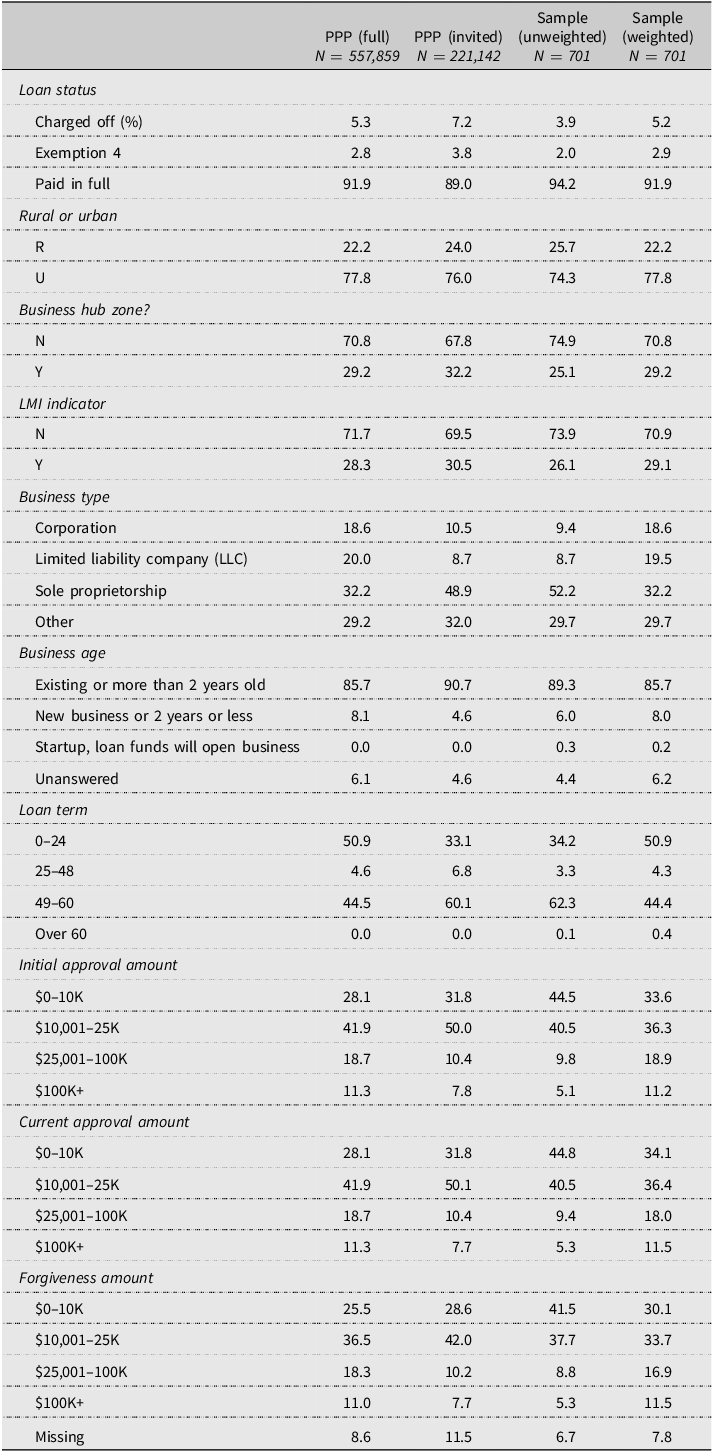
Respondents were first screened and disqualified from the survey if they self-identified as non-small business owners or said that they never owned a small business in the past. We also excluded responses based on various data quality checks (see Online Appendix A for additional details). To reach our target sample size while still keeping the final sample balanced, we launched the survey in four waves, repeating the steps as detailed above. Respondents were provided an incentive of $20 for participating. Overall, our matched business owner sample containing personal contact information consists of 262,347 individuals. Of these, 221,142 individuals were invited to our survey. The final sample size is 701, which makes the final qualified response rate to be 0.32%.Footnote 4 Although this seems low, it is comparable to survey efforts using probability samples that attempt to reach individuals using digital methods. For example, the SMS portion of the Cornell Midterm Election Survey has a final response rate of 0.8%. Recent phone surveys conducted by the New York Times have response rates of 0.4%. Table 1 presents characteristics of the sample as compared to the sampling frame. As shown in the table, despite the low response rate, the sample is fairly representative of the PPP recipients who were invited to take the survey as well as the larger PPP dataset.
Descriptive statistics of paycheck protection program (PPP) recipients

Notes: PPP data as of September 30, 2023. Data was obtained through FOIA request.
Nonetheless, to address potential issues with non-response, we apply post-stratification weights to the data. Because we employ methods of probability sampling, we can reweight the data to make it representative based on the plethora of sampling frame characteristics to which we have access. The final sample is weighted based on mostly business entity characteristics along with some business owner characteristicsFootnote 5 to match the PPP distribution list. The specific list of variables that are used to construct the weights is reported in Online Appendix A. The survey process, including the construction of the sampling frame, was administered by Verasight.
Table OA2 shows descriptive statistics of our sample of PPP recipients. We compare this group against a national sample of the U.S. adult population conducted by Prolific.Footnote 6 Overall, we observe that the small business owner population is older, less white, and wealthier than the U.S. population at large.
Experimental manipulation
For a randomly selected half of our sample, we ask respondents the following question: “During the COVID-19 crisis, the US Government’s PPP provided government-backed loans to businesses to help them keep their workforce employed. Which of the following best describes your engagement with the Paycheck Protection Program?” The response options were “I have been a recipient of the program’s loans,” “I have applied for the program but did not receive a loan,” “I have heard about the program but did not apply,” and “I have not heard about the program.”
Importantly, the purpose of this question is not to elicit individual program participation information—we know from administrative data that all respondents have applied and received loans from PPP—but to remind respondents of a government program from which they have gotten financial support. The “Prime” variable is an indicator for whether this question is asked before the measurement of the outcome variables.Footnote 7 Randomization was successful; balance tables are presented in Online Appendix C.
Although the experimental manipulation presented in this paper was part of a larger study on this sample, all respondents received the PPP experiment in the same position in the survey.Footnote 8
Outcome measures
We employ three measures to assess support for government redistributive policies.Footnote 9 While asking these questions, we remind the respondents that higher government spending would come from higher taxes, consistent with best practices to remind respondents of tradeoffs inherent in public policies (Margalit and Raviv, Reference Margalit and Raviv2024). For ease of interpretation, we recode all survey measures to lie between 0 and 1.
Healthcare. We ask whether the respondent would like to see more or less government spending on healthcare for the poor: “Would you like to see more or less government spending on health care for the poor? Remember that increasing such spending might require higher taxes to pay for it.” The response options were “spend much less,” “spend less,” “keep at current level,” “spend more,” and “spend much more.”
Nutritional Assistance. We ask whether the respondent would like to see more or less government spending on nutritional assistance (such as food stamps) for the poor: “Would you like to see more or less government spending on nutritional assistance for the poor (food stamps)? Remember that increasing such spending might require higher taxes to pay for it.” The response options are the same as Healthcare.
Unemployment Assistance. We ask whether the respondent would like to see more or less government spending on income assistance for workers who lose their jobs: “Would you like to see more or less government spending to provide income assistance for workers who lose their jobs? Remember that increasing such spending might require higher taxes to pay for it.” The response options are the same as Healthcare.
Index. We build a combined scale based on the three aforementioned measures via a simple average.
Results
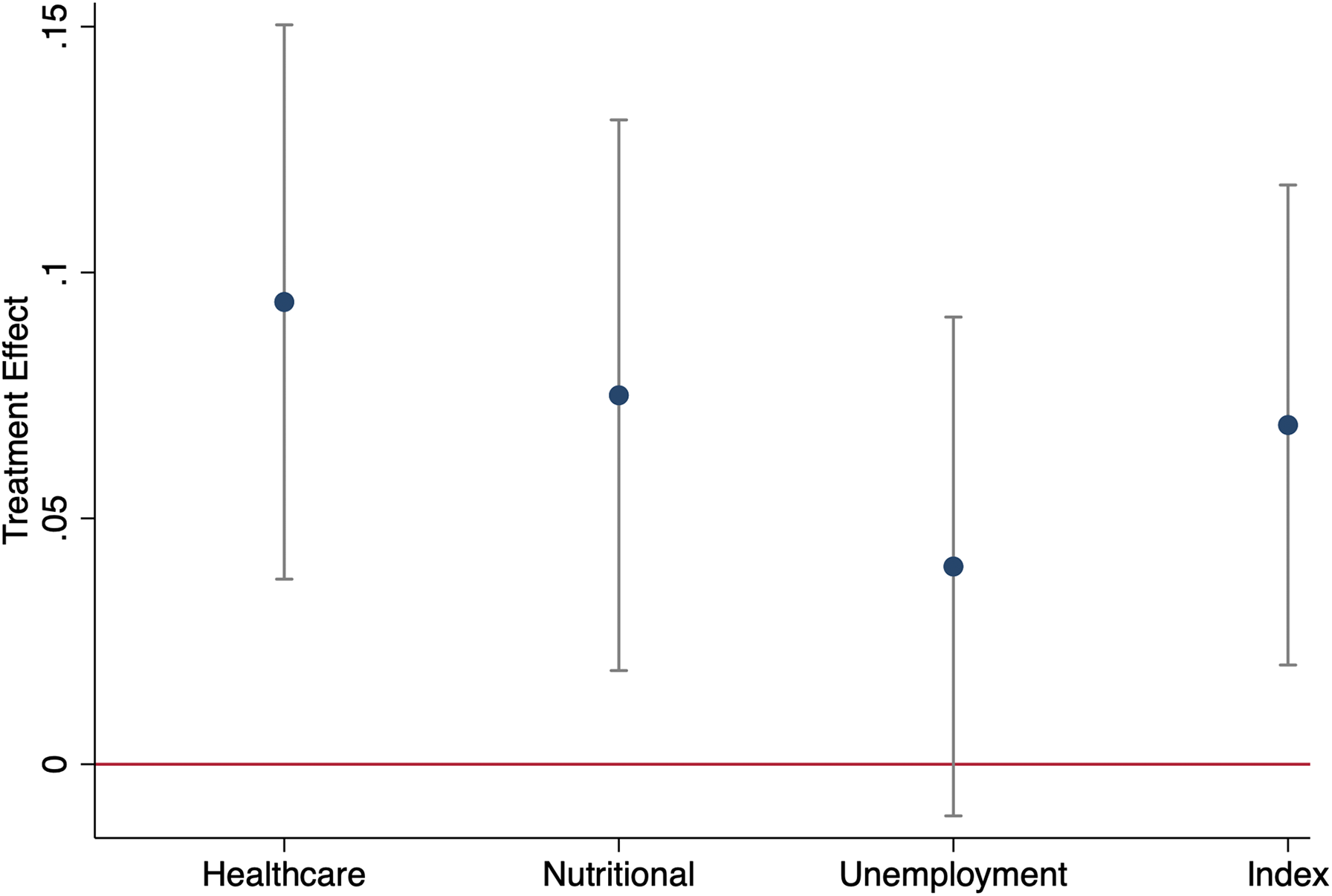
As shown in Figure 1, the experimental prime increased support for all three antipoverty programs. For the table version of this figure, see Online Appendix C Table OA5. The figure presents estimates from simple OLS regression models regressing the outcome variables against a dummy variable representing the experimental prime.Footnote 10 The strongest effect was for healthcare for the poor—making PPP salient increased recipients’ support by 9.4 percentage points (p = .001). This effect size is substantively large, representing about 22% of the association between partisanship and the outcome variable. The prime increased support for nutritional assistance by 7.5 percentage points (p = .009) and unemployment assistance by 4.0 percentage points (p = .120). Averaging across the three outcome variables, the treatment shifted support for antipoverty programs by 6.9 percentage points overall (p = .006). In other words, the treatment shifted respondents from being slightly against the programs to somewhat in favor (the constant terms representing the control group in Table OA5 are below 0.5). Although we can only speculate as to why the unemployment outcome exhibited the weakest treatment effects, one possibility is that the PPP was intended to reduce the need for unemployment benefits by keeping workers on payroll. Alternatively, programs such as Medicaid and SNAP are means-tested and targeted toward the poor, whereas unemployment insurance is paid into by all workers and therefore might be perceived differently by respondents.
SBOs exhibit stronger support for antipoverty programs when primed about PPP. Notes: 95% confidence intervals. Outcome is a 5-point scale on [0,1].

Conclusion
The role and size of the state have become a central topic of public discussion following President Trump’s decision to form a new Department of Government Efficiency (DOGE). Led by Elon Musk, this department had set its sights on radically transforming the operation of government by shrinking the public sector, eliminating prominent functions, and cutting an array of public programs. An open question is what impact these changes will have on citizens’ views of the state as some of its key operations come to the fore.
This paper offers insight on this question by investigating a case where a government assistance program is made salient to its beneficiaries. Leveraging a unique sample of small business owners, we take advantage of a historic bailout program that made the government’s role in mitigating social risk salient to a typically higher income and disproportionately right-leaning constituency (Malhotra et al., Reference Malhotra, Margalit and Shi2025). Our experimental approach allows us to study this research question causally. Our findings reveal support for the idea that welfare policies have feedback effects that extend beyond the policy itself. When the government implements a social assistance program, it influences the way beneficiaries evaluate government intervention on a broader set of causes and needs. Making salient government assistance does appear to be effective in building support for the welfare state.
Supplementary material
The supplementary material for this article can be found at https://doi.org/10.1017/XPS.2026.10031.
Data availability
The data, code, and any additional materials required to replicate all analyses in this article are available at the Journal of Experimental Political Science Dataverse within the Harvard Dataverse Network, at: https://doi.org/10.7910/DVN/WUQ8B5 (Malhotra and Shi Reference Malhotra and Shi2026).
Competing interests
The authors report no conflicts of interest.
Ethics statement
This research was approved by the Stanford University Institutional Review Board (IRB Protocol 71035). The authors affirm that the research adheres to APSA’s Principles and Guidance for Human Subjects Research. Participants were shown an information screen with study information prior to beginning the survey.


 Open access

