

Over the past decade, there have been massive developments in web-based and internet technologies, along with the introduction of smartphones. Smartphones are a new generation of mobile technology that has fundamentally changed telecommunications (Reference Abboudi and AminAbboudi 2011). They are equipped with immense computing capabilities that allow constant access to the internet and they enable more than just voice-and text-based communication. Smartphones are generally regarded as handheld computers rather than merely mobile telephones (Reference Abboudi and AminAbboudi 2011). The release of Apple’s iPhone in 2007 most likely sparked a revolution in the telecommunications and information technology arena. The launch of the Apple App Store in July 2008 is also regarded as a pivotal moment in the advancement of smartphone technologies (Reference Payne, Wharrad and WattsPayne 2012). The store enables users to download smartphone-based applications (apps) – computer programs that give smartphones capabilities and functions beyond accessing the internet.
A literature review that we conducted in July 2014 revealed no rigorous studies of the use of web-based e-learning technologies and smartphone-based technologies in the education of medical students and junior doctors (residents). Hence, there is a paucity of research looking into the application of the latest web-based and, in particular, smartphone technologies in psychiatry education. The purpose of this article is to highlight what other medical specialties have done in terms of research into educational smartphone apps and what psychiatry could potentially do for its trainees to make the most of smartphone and web-based technologies for education.
Medical students’ and trainees’ perspectives on smartphones
Recent studies have examined medical students’ and trainees’ ownership, usage and perspectives on smartphones. In 2012, a questionnaire-based survey was distributed among interns in the Republic of Ireland (Reference O'Connor, Byrne and ButtO’Connor 2014). This study demonstrated that smartphones were widely adopted and that they were being used daily by interns to help them perform their regular duties. The British National Formulary was the most commonly used app. Another study in the same year (Reference Payne, Wharrad and WattsPayne 2012) found a high level of smartphone ownership among the 257 UK medical students and 131 junior doctors surveyed. The majority of the participants owned between 1 and 5 medically related apps. Compared with other platforms, iPhone users were more likely to own apps. App use was similar for both the students and the trainee doctors, the majority using them for 20–30 min a day. The most frequently used apps were those for disease diagnosis and management and drug reference.
In 2013, Robinson et al carried out a questionnaire-based study looking into smartphone usage and acceptability among clinical medical students at the University of Birmingham, UK. In all, 361 students took part; 59% of them owned a smartphone and 37% of these reported using the device to help them in their learning. Importantly, the students had generally positive attitudes towards the concept of using smartphones as future educational aids, with at least 84% of them believing the devices to be useful. However, it is also important to note that about 64% of these students felt that smartphones might be too costly to introduce in clinical education.
The studies described above were largely limited to examination of smartphone and app ownership and usage rates, and the general views of medical students and trainees on smartphones and apps. There has been a paucity of research looking at apps themselves, for example, students’ evaluation and views of a particular educational app that their tutors have asked them to use. This gap in terms of research evidence has recently been addressed by Reference Payne, Weeks and DunningPayne et al (2014). This research group conducted a pilot study to investigate the effect of a hospital-specific smartphone app on the work of a cohort of British junior doctors. The investigators created an iPhone app that contained mainly disease management and antibiotic dosing guidelines specific to the hospital and tested it with 39 foundation year doctors for 4 months. Their results showed that participants felt generally positive towards the availability of such an app, with 68% reporting that it helped them save time when performing clinical activities.
In a study among orthopaedic trainees, Reference Al-Hadithy, Gikas and Al-NammariAl-Hadithy et al (2012) noted that smartphones allowed them to complete their work-based assessments without the need for computer access, which might increase completion rates and reliability. More journals now provide podcasts and video tutorials that can be accessed on smartphones, which is particularly useful for higher examinations.
Smartphone use for education in medical specialties
Reference Franko and TirrellFranko & Tirrell (2012) conducted an email survey of smartphone and smartphone app use by medical providers in the US Accreditation Council for Graduate Medical Education (ACGME) training programmes. Of the 3306 respondents, 1397 were residents, 524 fellows and 1385 attending physicians. More than 85% of the respondents used a smartphone. Importantly, the study highlighted that the app types most frequently requested by the respondents were associated with textbook/reference materials, classifications, treatment algorithms and general medical knowledge. Out of the 134 psychiatry respondents, 84% used a smartphone and 63% of them used apps. The study found no association between level of training and use of apps.
Given the generally positive attitudes and perspectives that trainees and medical students have towards smartphones and smartphone apps, more specialties are actively embracing the smartphone as an educational tool (Box 1).
How other medical specialties are using smartphone apps
Nephrology
In their review paper, Reference Bhasin, Estrella and ChoiBhasin et al (2013) identified several online learning resources that improve medical students’ and residents’ knowledge about the complications of chronic kidney disease. Despite the existence of several nephrology apps, such as calculators for nephrology-based equations and drug information for kidney dosing, there is still a lack of nephrology education tools for clinicians and medical trainees.
Ophthalmology
Reference Hassani, Sanharawi and Dupont-MonodHassani et al (2013) searched through the Apple App Store and the Android Play Store and identified 342 apps relevant to ophthalmology, some intended for patients, some for ophthalmologists. It might be inferred that some of these apps might be helpful in education and in enhancing ophthalmologists’ clinical skills.
Orthopaedics
Reference Al-Hadithy, Gikas and Al-NammariAl-Hadithy et al (2012) noted the potential of the smartphone not only in education but also as an invaluable tool in clinical care. Commonly used educational apps include AO Surgery Reference and Zollinger’s Atlas of Surgical Operations, which provide immediate access to information pertaining to surgical procedures, and iSpineOperations, which provides 3D animations of cervical and lumbar spine procedures.
Paediatrics
Reference Hawkes, Walsh and RyanHawkes et al (2013) identified a lack of current studies demonstrating the usefulness of smartphones and smartphone apps in teaching of core clinical skills. Twenty paediatric trainees evaluated NeoTube, a smartphone neonatal intubation instructional app. Use of the app resulted in an increase in the trainees’ overall skills score and a reduction in the duration of each intubation attempt.
Pharmacology
Reference Haffey, Brady and MaxwellHaffey et al (2014) noted that many pharmacology-themed apps offer the potential to improve the ease and accuracy of oral dose calculations and intravenous dose calculation and delivery, and that the current wealth of apps also allows users greater ease of access to popular pharmacological textbooks, guides and journals. However, textbook-based educational apps tend to be very expensive and are not affordable for all users.
Plastic surgery
Reference Al-Hadithy and GhoshAl-Hadithy & Ghosh (2013) give a comprehensive guide to mobile-based educational websites, podcasts, videos and electronic books for plastic surgeons. There are at least 16 apps of educational value for plastic surgeons, including Mersey Burns, a free app for calculating burn area percentages and the amount of fluids that should be prescribed.
Urology
Reference Abboudi and AminAbboudi & Amin (2011) highlight apps that can help urologists in their daily clinical practice and several apps (such as Urology Flashcards) developed specifically for educational purposes. They describe how an app based on the widely used Oxford Handbook series has potential educational benefits, offering quick access to relevant information for residents and trainees.
Current use of technology in psychiatric training and education
For over a decade, journals such as Academic Psychiatry have noted that knowledge and skills in medical informatics are essential for lifelong learning and modern psychiatric practice (Reference Hilty, Hales and BriscoeHilty 2006) (Box 2). A needs-based assessment was conducted, and it was previously proposed that the existing psychiatry curriculum needs to integrate with the advancement in technologies. A 2006 pilot study of users’ perceptions of technology in medicine demonstrated that residents and medical students believed technology skills to be integral to their medical training (Reference Briscoe, Fore Arcand and LinBriscoe 2006). Participants indicated a preference for the use of personal digital assistants (PDAs) as these provide immediate access to critical information pertinent to the clinical care of patients. More recent research has looked into the use of e-learning in the teaching of psychiatry to medical students (Reference Weninger, Keller and FegertWeninger 2009). This particular feasibility trial, at the University of Ulm, Germany, showed that child and adolescent psychiatry case studies could successfully be added to an e-learning system primarily oriented towards somatic disease. In another German study, psychiatric educators at the Hamburg Medical School used ‘cinemeducation’ to help students gain a deeper understanding of psychiatric illnesses (Reference Kuhnigk, Schreiner and ReimerKuhnigk 2012).
Current use of technology in psychiatry education
-
Personal digital assistants (PDAs) to check for evidence-based information
-
Online e-learning modules and learning resources such as the Royal College of Psychiatrists’ CPD Online (www.psychiatrycpd.co.uk) and Trainees Online (tron.rcpsych.ac.uk)
-
Videos to enable students to gain insight into psychiatric disorders
-
Tele-technologies in the supervision of junior doctors during psychodynamic psychotherapy training
The latest advancement in technology is the application of unique tele technologies to help augment resident training in psychodynamic psychotherapy (Reference Katzman, Abbass and CoughlinKatzman 2015).
A framework for psychiatry to adopt
Although our literature search for this article revealed no recent reviews of apps specific to psychiatric training, there are many apps for academic purposes in the commercial app stores. A quick search using the key words ‘psychiatry education’ reveals 266 apps in the Apple App Store and 240 in the Android Play Store.
A scoping review was recently conducted by Reference Boydell, Hodgins and PignatielloBoydell et al (2014) to assess the use of technology (such as videoconferencing, mobile phone apps and websites) in delivering mental health services to children in Canada. They carried out a descriptive numeric summary and thematic analysis of the reviewed literature. They concluded that technology did indeed play a major role in the service and support provided to children; it also played a role in the prevention, assessment, diagnosis and treatment of psychiatric disorders.
It might be worth carrying out more scoping reviews in psychiatry. One might analyse peer-reviewed studies on education in psychiatry, to summarise the key findings of current research and to identify knowledge gaps. Another might assess the application of technology in the specialty, which would be essential for understanding the breadth and impact of current research. A scoping review could also consider commercial psychiatry-related educational apps that are currently available in app stores and highlight their common themes.
Reference Haffey, Brady and MaxwellHaffey et al (2014) have suggested two ways of overcoming the lack of evidence-based educational apps in pharmacology that would serve well in psychiatry (Box 3). The first involves encouraging universities and healthcare organisations to create their own ‘in-house’ apps. They suggest that in-house apps have inherent advantages, including the fact that they could focus on current shortfalls in clinical education or deficiencies in the competencies of medical students or junior doctors. The second is for universities and healthcare organisations to compile lists of apps that have been peer-reviewed and deemed suitable for use by medical students or junior doctors.
A framework that psychiatry could adopt for educational needs
Conduct a scoping review to identify the current gaps in psychiatry education and commercially available educational apps in psychiatry
Enable clinicians and educators to develop their own ‘in-house’ educational apps
Enable clinicians and educators to identify suitable educational apps through a systematic peer-review process
Developing in-house educational apps
As regards Haffey et al’s first suggestion, clinicians in universities could play a greater role by using existing easy-to-follow software to develop simple web-based apps. This strategy has been described by Reference Subhi, Todsen and RingstedSubhi et al (2014), who show how to create a simple web-based mobile app using just an internet browser and a text editor. The jQuery Mobile builder (jquerymobile.com) leads the clinician through a step-by-step process of creating a custom app. The builder automatically generates codes based on the content that the clinician has included and the clinician pastes these into a text-editor file, thereby creating a simple smartphone-based web app. They can thus create their own apps for the dissemination of information they feel is pertinent for the educational needs of medical students and junior doctors. Elsewhere (Reference Zhang, Cheow and HoZhang 2014a, Reference Zhang, Tsang and Cheowb) we describe in greater detail how psychiatrists could be app developers and introduce two other cost-effective methods for app development. Here, we outline two educational portals and apps for undergraduate and postgraduate education with which we have been involved.
The Mastering Psychiatry portal
In collaboration with colleagues around the world, we used the method described above to develop the Mastering Psychiatry online portal and smart phone app (masteringpsychiatry.wordpress.com). The portal, which went online in 2013, was originally conceived to help Singapore’s medical undergraduates, giving them access to a free online textbook and simulated patient videos (Fig. 1). By August 2014 there had been 15 803 views and 2109 downloads of the online textbook (Reference Zhang, Ho and ShankarZhang 2014c).
The Mastering Psychiatry textbook and online portal (www.masteringpsychiatry.com).

The app, which was developed between August and December 2013, was supported by an educational grant and subjected to a user survey to evaluate students’ perceptions of it. A total of 185 students participated in the survey. Results showed that a high proportion of the students would like an educational psychiatry smartphone app to have the following features: textbook-based content, clinical videos of objective structured clinical examinations (OSCEs) and an event notification service. A high proportion of the students concurred with the perception that a smartphone app would be helpful in psychiatry education and that smartphones can be a viable and good alternative to a book.
The CASC Feedback portal and the Deja Vu CASC app
Another international collaboration, this between the Singapore MRCPsych CASC Consortium and the Cornwall Partnership NHS Foundation Trust in the UK, resulted in the CASC Feedback portal (cascfeedback.org) and the Deja Vu CASC smartphone app (dejavucascsg.com/deja-vu-casc-app) (Fig. 2). The latter is now available from the Google Play app store. These were developed between January and April 2014 using methods similar to that outlined above for the creation of web-based apps. Their purpose is to help trainees master the MRCPsych Clinical Assessment of Skills and Competencies (CASC), which is the final examination towards obtaining Membership of the Royal College of Psychiatrists.
The Deja Vu CASC smartphone app (dejavucascsg.com/deja-vu-casc-app).
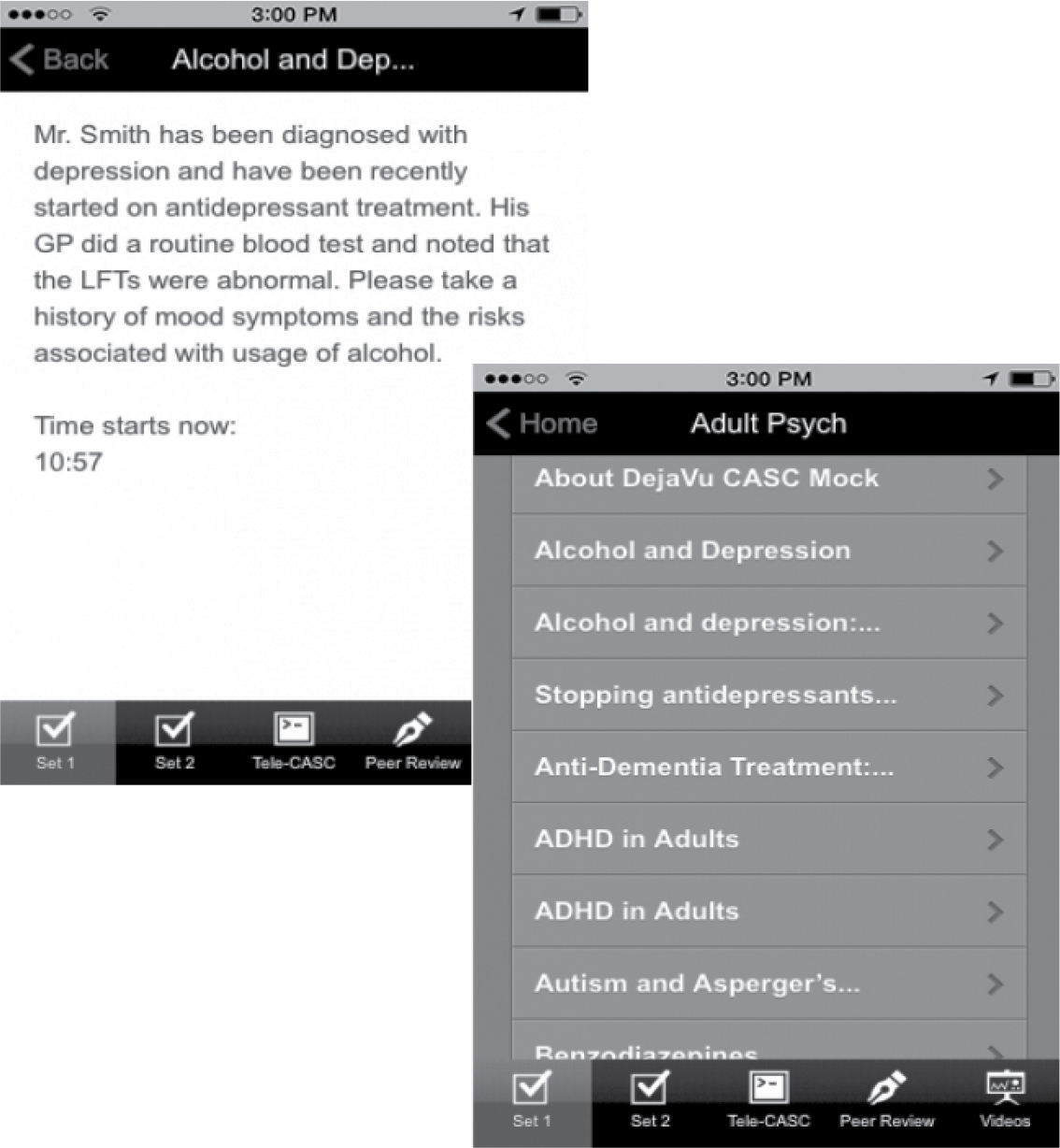
By August 2014 there had been 57 downloads of the app from the web-link made available to trainees via the PsychClub website (www.psychclub.com). In addition, there have been 225 views of the videos deployed within the app. Since the launch of the CASC Feedback portal, there have been 65 visitors to the site, the majority of whom are from the UK (n = 36) and Singapore (n =18). These early data, in particular the number of downloads of the app, show that trainees are willing to consider using such a system.
Identifying suitable educational apps through systematic peer review
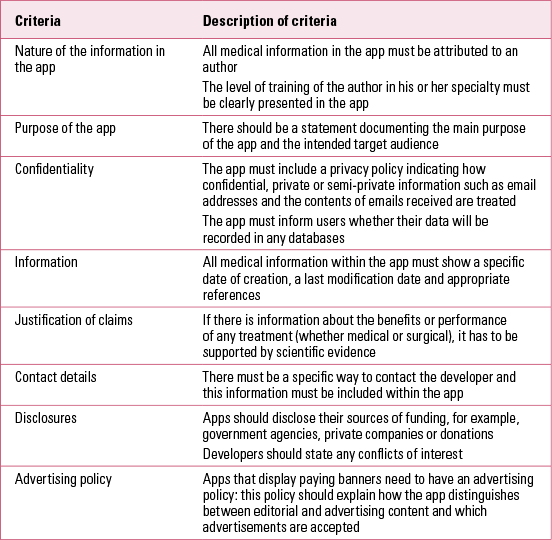
The second suggestion made by Haffey et al is for universities and healthcare organisations to compile lists of peer-reviewed apps that educators and clinicians deemed to be suitable for use. Reference LewisLewis (2013) has suggested criteria for conducting such peer review of smartphone medical apps using a self-certification model. The model (Table 1) builds on what has been developed by the Health on the Net Foundation (HON) to assess the reliability and credibility of the information presented on medical and health websites. Note that the self-certification model provides criteria for evaluating the reliability of the information contained in an app – more work is needed to further a set of criteria to determine the educational value of the app.
A self-certification model for the review of smartphone apps
Before developing new apps, psychiatrists need to assess the increasing numbers of psychiatry-related apps in the app stores to identify those (whether educational or clinical) that are safe and might be of value in their specialty and to reveal current needs and knowledge gaps. The self-certification model can help in such assessments. The literature review on apps that we conducted for this article showed that most papers are limited merely to the identification of apps and have not begun to use models for their peer review and evaluation. If more psychiatrists become involved in the review of psychiatry-related apps and more related publications appear in informatics journals psychiatry as a specialty will further advance.
Advantages and disadvantages of the proposed framework
Advantages
Adoption of the proposed framework for app development and review in psychiatry education has a number of potential advantages:
-
there would be more clinician involvement in app building, which would help ensure the quality of content within the apps
-
clinicians and educators could take charge and develop apps that fulfil specific educational needs in their organisations
-
clinicians and educators would be able to systematically review apps and would also have a collection of apps deemed suitable for their universities or organisations
-
clinicians and educators could help to ensure that their collection of apps is evidence-based and safe for use in education
-
use of smartphone technology would enhance students’ perceptions of psychiatry as a modern specialty
-
these technologies could facilitate students’ mastery of core concepts in psychiatry
-
these technologies would augment current teaching methods
-
use of smartphone technology would facilitate student’s mastery of knowledge on the go.
Disadvantages
The most obvious disadvantages are:
-
additional commitments (in terms of time) required to create new educational apps
-
potential duplication of content.
Conclusions
There have been massive developments and advancements in the use of smartphones and their related apps for education in other medical specialties. Psychiatry should also consider their utilisation, given their inherent benefits in education. Two core approaches have been reviewed in this article: equipping psychiatrists with the necessary skills to develop apps themselves; and equipping them with a framework for reviewing existing apps to enable them to create lists of apps that are evidence-based and can be used in their educational setting. Implementation of these two approaches would do much to advance psychiatry as a specialty.
MCQs
Select the single best option for each question stem
-
1 Which one of the following technologies have been used in psychiatry education?
-
a portable digital assistants to check for evidence-based information
-
b an online e-learning portal on child psychiatry
-
c video technologies to share more insights into psychiatric disorders
-
d video technologies in the supervision of residents for psychodynamic psychotherapy
-
e all of the above.
-
-
2 To identify the current gaps in education, which one of the following would be a recommended approach?
-
a scoping review
-
b focus groups
-
c randomised controlled trials
-
d observational study
-
e naturalistic study.
-
-
3 Which one of the following is not included in the proposed self-certification model for the evaluation of psychiatry-based apps?
-
a disclosures
-
b information
-
c privacy and confidentiality
-
d justification of claims
-
e app ratings.
-
-
4 Which of the following has not been used in undergraduate and postgraduate psychiatric education?
-
a video technologies
-
b smartphone technologies
-
c online portals for web-based learning
-
d augmented reality
-
e tele-technologies.
-
-
5 Research has shown that most junior doctors in the UK own on average how many medically related smartphone apps?
-
a 1–5
-
b 6–10
-
c 11–15
-
d 20–25
-
e more than 30.
-
MCQ answers

| 1 | e | 2 | a | 3 | e | 4 | d | 5 | a |




eLetters
No eLetters have been published for this article.