




1. Background
Many linguistic theories assume, and much psycho- and sociolinguistic work predicts, that different functions of a word are distinct in the speaker’s mind. The weakest version of this position is uncontroversial – if polysemous and homophonous words exist, then competent speakers must be distinguishing them in some way – but the nature of this distinction is debated: are the different functions stored as one lemma, or separately? Much of the research in this debate has focused on the useful theoretical distinction between polysemy (one lemma with different but related senses, e.g. film ‘thin sheet of material’ and film ‘motion picture, originally recorded on thin strips of material’) and homonymy (two lemmas with different and unrelated meanings, e.g. bank ‘monetary institution’ and bank ‘side of a river’). Results are ambiguous as to whether this theoretical distinction is relevant for psycholinguistic descriptions of the mental lexicon (see Gries Reference Gries, Dąbrowska and Divjak2019: 32–5 for a summary).
One interesting strand in this research investigates language production. If different senses/meanings of a polysemous/homonymous word are stored distinctly, this would allow for (though not guarantee) systematic differences in speech production. Such systematic variation could also aid the listener, of course, as the systematic differences could be mapped to the different senses/meanings and thus allow faster retrieval without the need for processing contextual information. It could even be argued that the existence of such systematic variation explains why polysemy and homonymy persist despite evident cognitive and communicative pressures against them: if a polysemous/homonymous word is not ambiguous to the listener due to systematic acoustic differences between senses/meanings, then there is less pressure to remove this supposed source of ambiguity (cf. Ferreira Reference Ferreira2008; though see Trott & Bergen’s (Reference Trott and Bergen2022) argument that languages do in fact reduce this source of ambiguity).
These systematic differences could of course exist in any aspect of the linguistic form; for the purposes of this article, we focus on acoustic (arguably subphonemic) differences, as (following Jurafsky et al. Reference Jurafsky, Bell, Girand, Gussenhoven and Warner2002) several studies revealed interesting acoustic differences between supposedly homophonous words. For instance, Gahl (Reference Gahl2008) and Lohmann (Reference Lohmann2018) showed that word duration, as a function of word/lemma frequency, can reliably distinguish supposedly homophonous English words: in spontaneous speech, the high-frequency word time is often shorter than its supposed homophone thyme, which is less frequent. Similarly, supposedly homophonous pairs that are distinguished by inflection are also distinguished acoustically, possibly due to stem frequency (Engemann & Plag Reference Engemann and Plag2021), relative frequencies of different word forms (Luef & Sun Reference Luef and Sun2021), or inheritance of acoustic targets from the stem (Seyfarth et al. Reference Seyfarth, Garellek, Gillingham, Ackerman and Malouf2018).
The English word like is so frequent across contexts, registers and varieties in present-day usage that its frequency is often commented on by non-linguists, mostly negatively (see D’Arcy Reference D’Arcy2017). Unlike many other frequent or strongly socially indexed words, it is highly polysemous (we propose seventeen different senses/functions in this article; see section 2). For these reasons, it is the ideal subject for investigating the question of function-specific storage and production.
Prior evidence for separate storage of different like functions includes the work of Corrigan & Diskin (Reference Corrigan and Diskin2019), Diskin-Holdaway (Reference Diskin-Holdaway2021) and Pan & Aroonmanakun (Reference Pan and Aroonmanakun2022), who found that second-language learners from various L1s and in various countries use the discourse marker like, but not some other functions of like, with the same frequency as comparable first-language speakers. As Zaykovskaya (Reference Zaykovskaya, Yin and Vine2022) suggests, this may be conceptualised as over-use of discourse like (relative to the use of other functions of like) as a conspicuous sociolinguistic marker (similar to Davydova’s (Reference Davydova2021) analysis of L2 quotative like). Regardless of this intriguing possibility for future research, these findings all imply that different functions of like are stored and accessed separately.
Further evidence comes from acoustic differences between like functions. Drager (Reference Drager2009) found systematic differences in like tokens (realisation/quality and relative durations of the three segments making up a prototypical like token) produced by young female speakers of New Zealand English, arguing that these differences index the function of like as well as the speaker’s social identity. Likewise, Podlubny et al. (Reference Podlubny, Geeraert and Tucker2015) showed that duration and vowel quality differ between (some) functions of like in the speech of Canadian English speakers to such a degree that they may serve as cues to like function.
On the other hand, Schleef & Turton’s (Reference Schleef and Turton2018) study of like in London and Edinburgh, while documenting similar acoustic differences between functions, argued that these differences are due to the syntactic and prosodic context. That context is of course not the same for every token with the same function, but Schleef & Turton show that certain contexts are associated with certain functions quite reliably – for example, quotative like is rarely in a clitic group (Beckman & Hirschberg’s (Reference Beckman and Hirschberg1993) ToBI boundary strength 0), and it is this clitic group environment that is most clearly associated with diphthongal vowels in like. Thus, they argue, the monophthongal vowels found in many quotative likes are not an acoustic cue to that function of like, but rather evidence of the fact that quotative like tends to be used in a context that happens to favour monophthongal realisations of vowels.
We must furthermore respect the fact that most of the functions of like are also distinguished by word class, because Hollmann (Reference Hollmann2020) showed that different word classes (even subclasses) systematically differ in some phonological dimensions. For instance, prototypically attributive adjectives (like recent) on average contain more syllables and are more likely to contain nasal consonants than prototypically predicative adjectives (like better). By the same token, it is possible that acoustic differences between functions of like are cues to word class, not a specific like function – the verb like may be produced with the acoustic information for the single lemma like plus the systematic/typical acoustic information for verbs, rather than there being a consistent but non-systematic set of acoustic information for the verb like or a reliable realisation effect from its typical context.
The present study further investigates acoustic differences between different functions of like, using rich data from another regional accent of England. Our primary aim, though, is to scrutinise Schleef & Turton’s (Reference Schleef and Turton2018) argument that apparently systematic acoustic differences in like may in fact stem from the most common positions and contexts of each function (and not to describe regional patterns in like). Parsimoniously, we expect any strong acoustic differences we find to be explained by context.
2. Functions of like
Different typologies of the different functions of like have been proposed (e.g. nine functions in D’Arcy Reference D’Arcy2007 and Drager Reference Drager2009, eleven in Podlubny et al. Reference Podlubny, Geeraert and Tucker2015, and at least eleven in Dinkin Reference Dinkin2016). We argue that there are seventeen functions in present-day British use, differentiated by word class, function, alternants and position. These are listed below, with examples from our data and explanations of their occurrence and function. It is impossible to reconcile this list of functions and terms with all prior research, because of inconsistent terms and at times less than perfectly precise definitions, but we use the same labels (or similar ones) as prior work wherever possible. We do not intend this typology to be the final word on like; its purpose is merely clear description and exploration of the present data.
-
1. the verb, as in I don’t really like the fantasy one
-
2. the noun, as in discrimination and the like
-
3. the adverb, as in your boss seems like a bit of an idiot. This usually introduces a noun phrase complement and is usually obligatory, which may be why a few researchers (e.g. Dinkin Reference Dinkin2016: 227) call it a preposition. We adopt the more widely used label ‘adverb’ here simply for ease of comparison.
-
4. the comparative adverb/connector, as in this isn’t anything like the last good one. This type of like occurs between two noun phrases that are being compared (without a conjunction or copula).
-
5. the adjectival suffix, as in sitting Buddha-like. This type of like straightforwardly derives adjectives from nouns and other adjectives.
-
6. the conjunction introducing a non-obligatory clause of similarity, as in [she’s] flapping, like she always does. As Blondeau & Nagy (Reference Blondeau, Nagy, Meyerhoff and Nagy2008) note, this like can usually be replaced by as, and is used for describing similarity to an existing entity/event.
-
7. the conjunction introducing a non-obligatory clause of comparison, as in and then he’ll look at you like you’re crazy. As López-Couso & Méndez-Naya (Reference López-Couso and Méndez-Naya2012) note, this like can usually be replaced by as if or as though, but not by as alone, and is used for comparison to a hypothetical alternative.
-
8. the complementiser that, for expediency, we will call type 1 here, which introduces an obligatory clause (often following feel or seem), as in you feel like you’re making progress. This like can be replaced by as if, as though and that, and can also be omitted.
-
9. the complementiser of type 2, which introduces an obligatory clause (often following look or sound), as in that just sounds like they needed to add something on to the label. This like can be replaced by as if or as though, but not by that, and can also not be omitted.
-
10. the quotative, as in I’m like ‘I couldn’t tell you’. This introduces complements, these being quotes or approximations of what was said/thought. Quotative like is often preceded by forms of be or go.
-
11. the approximator, as in they’re like 30, 35 quid. This introduces a measure phrase with approximative meaning.
-
12. the exemplifier, as in commute to get to like jobs and stuff
-
13. the clause-/utterance-external discourse marker, as in Like, he can do that. This often alternates with phrases such as you know, I guess or I mean.
-
14. the clause-final discourse marker, as in trashy taste in music like. This does not have common alternants; it expresses hedging or softening, and has been described as a stereotypical feature of some regional varieties (Welsh English by McArthur Reference McArthur2003: 110; Irish English by Diskin Reference Diskin2017; and Newcastle English by Simpson Reference Simpson2022).
-
15. the clause- and utterance-internal discourse particle, as in while I was like waiting for the train. This is by far the most common in our data, and appears to be the function of like that has attracted lay attention to the supposed over-use of like. This like can be distinguished from many other functions by the fact that it clearly does not express similarity, comparison, equivalence or approximation. As D’Arcy (Reference D’Arcy2007) notes, it does not have a common alternant.
-
16. the ‘trailing off’ discourse marker, as in well like…. It may be argued that this occurs only in cases where speakers are interrupted (or interrupt themselves) and does thus not have a distinct and coherent function. Introspection and anecdotal evidence (of usage and intonation) suggest that it is used deliberately, with a distinct function of signalling that the utterance is incomplete but the speaker is ready to end their turn; therefore, we count it as a separate function here to allow any possible function-wise differences to surface in our analysis.
-
17. the ‘social media’ noun, as in every like on this photo counts. This may simply be one sense of the noun function above; due to its relative novelty, we counted it separately to allow any possible differences to surface in our analysis. Note that verbal use with the specific ‘social media’ meaning has also been attested (e.g. Please like my page on Facebook).
3. Data
Through paper notices on community noticeboards at the University of Central Lancashire and in the surrounding city of Preston, we recruited 11 volunteers (all speakers of North-West English by self-identification and experimenter judgment; aged 18–25; 5 self-identified females, 6 self-identified males) and recorded them in a phone conversation with a close friend or family member. By using a head-mounted microphone (Countryman E6 connected to a Zoom H4n battery-powered recorder) and placing this microphone on the side of the head where the speaker did not hold the telephone, it was possible to record speech from the participants only, but not the speech of their friends/family members. These conversations were held in a sound-dampened recording studio; participants were encouraged to place the call to their friend or family member using the landline telephone in this studio, but some preferred to use their mobile phones (thus it would not have been possible to use an acoustically and electromagnetically isolated recording room). Participants were asked to speak to their friend/family member for about 20 to 30 minutes on any topics they chose; the conversations as recorded ranged from 21 to 38 minutes. Following this conversation, participants were asked to read a list of 36 sentences including likes of 12 different functions (see section A of the online supplementary material for the sentence list annotated with like functions; this sentence list did not contain distractors). Importantly, speakers were not aware of the content of the sentence list until the start of the sentence list recording; thus, while like was most likely salient to speakers once they saw it occur at least once in every sentence in the sentence list, like was not highlighted to speakers during the conversation recording.Footnote 1 After this sentence-list reading was complete, the recorder was stopped, and the session ended. Participants received GBP 10 as recompense for their time and travel costs. This procedure was approved by the ethics committee at the University of Central Lancashire (reference number BAHSS421).
The conversations were transcribed orthographically by hand. We used the Montreal Forced Aligner (MFA; McAuliffe et al. Reference McAuliffe, Socolof, Mihuc, Wagner and Sonderegger2017) toolset to train a custom acoustic model for mapping transcribed words to pronunciation, as the existing models for the English language (apparently General American and Southern British) were not appropriate to our (North-West England) data. With this acoustic model, the MFA then aligned these transcripts to the recordings at word- and phone-level, producing Praat (Boersma & Weenink Reference Boersma and Weenink2015) TextGrids.
The training process for the acoustic model was automatic (i.e. unsupervised); to check that the acoustic model was sound, we compared the MFA alignment against manual alignment for a continuous section of 30 seconds each (including pauses) from three speakers’ conversation recordings. For each vowel in this alignment check sample, we compared the values obtained from automatic and manual alignment for six data points: the starting point (time-stamp), duration, and the first and second formants at 25 per cent and 75 per cent of that duration.
The starting points of what ought to be the same phone/segment in these two datasets are correlated very strongly (r = 0.985, p < 0.001). The mean difference between starting points is 12.4ms. This difference is less than 25 ms for 87.3 per cent of segments, and less than 100 ms for 98.2 per cent of segments. This compares favourably to McAuliffe et al.’s (Reference McAuliffe, Socolof, Mihuc, Wagner and Sonderegger2017: 500–1) differences (mean of 17.3 ms using Buckeye corpus data, 16.6 ms using Phonsay) and percentages under threshold (77 per cent less than 25 ms in Buckeye and 76 per cent less than 25ms in Phonsay; 98/95 per cent less than 100 ms; note that McAuliffe et al. used MFA ‘out of the box’, with the pre-existing acoustic model trained on the LibriSpeech corpus, while we used MFA with a custom acoustic model generated by unsupervised training on our dataset).
In line with previous research, we normalised the vowel formant measurements using Lobanov’s method as implemented in the R package phonTools (version 0.2-2.1; Barreda Reference Barreda2015). Then, we calculated the Pillai score for each unique combination of speaker and vowel phoneme, as a measure of distance/difference between these two datasets for that speaker and vowel in five dimensions (F1 at 25%, F1 at 75%, F2 at 25%, F2 at 75%, and vowel duration). For details of the Pillai score, see Hay et al. (Reference Hay, Warren and Drager2006), Hall-Lew (Reference Hall-Lew2010) and Kelley & Tucker (Reference Kelley and Tucker2020); for present purposes, it is enough to know that the Pillai score ranges from 0 to 1, with lower scores indicating more overlap. In the present sample of vowel segment data, the Pillai scores for each speaker–vowel combination range from 0.006 to 0.897, with a mean of 0.236. Interpreting this dimensionless statistic is not straightforward, but by comparison with previous research, we interpret this as indicating strong overlap: For instance, Hay et al. (Reference Hay, Warren and Drager2006) report a Pillai score of 0.24 for the famously merged beer/bare pair in their two-dimensional New Zealand English data, and Kelly & Tucker’s (Reference Kelley and Tucker2020: 143) target Pillai score for their three-dimensional simulation of partially overlapping vowel categories is 0.66 (note that Kelly & Tucker report inverted Pillai scores, so their reported score of 0.34 is equivalent to 1 – 0.34 = 0.66 in the values/terms we use in this article).Footnote 2
Thus, we conclude (similarly to MacKenzie & Turton Reference MacKenzie and Turton2020 and Gnevsheva et al. Reference Gnevsheva, Gonzalez and Fromont2020) that the alignment produced by the self-trained MFA is not identical to manual alignment, but similar enough for the purposes of our analysis. Therefore, we accepted the TextGrids produced by this model for the conversation data, and also used the same model to produce aligned TextGrids for the sentence list data.
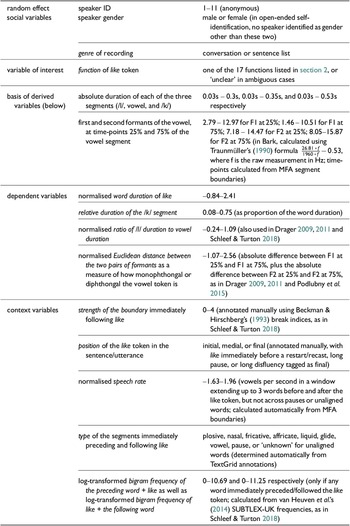
For all 614 tokens of like in the conversation dataset and all 416 tokens of like in the sentence list dataset, we recorded the information listed in table 1. All duration and timing information uses MFA segment or word boundaries; ‘normalised’ indicates that this information was normalised using Gelman’s (Reference Gelman2007) method of subtracting the mean and dividing the result by two standard deviations, to make easier the comparison of these numerical variables to each other as well as to the binary variable of gender. In line with prior research (e.g. Podlubny et al. Reference Podlubny, Geeraert and Tucker2015), we use the perceptual Bark scale (rather than raw frequency measurements in Hz) for formants to represent the perceptual prominence of any differences more accurately.
Information calculated/extracted for each like token

A higher break index on Beckman & Hirschberg’s (Reference Beckman and Hirschberg1993) scale means a perceptually stronger break – break index 0 indicates a clearly cliticised transition between words, break index 1 the more typical juncture between words, and break index 4 the end of an intonation phrase. While this is perceptual, it measures an important aspect of the phonological environment: clause-initial and clause-final likes are more likely to be followed by stronger breaks than quotatives, for instance, and the difference in break strength makes for different phonological environments with well-known effects (Schleef & Turton Reference Schleef and Turton2018: 47 and 52–8).
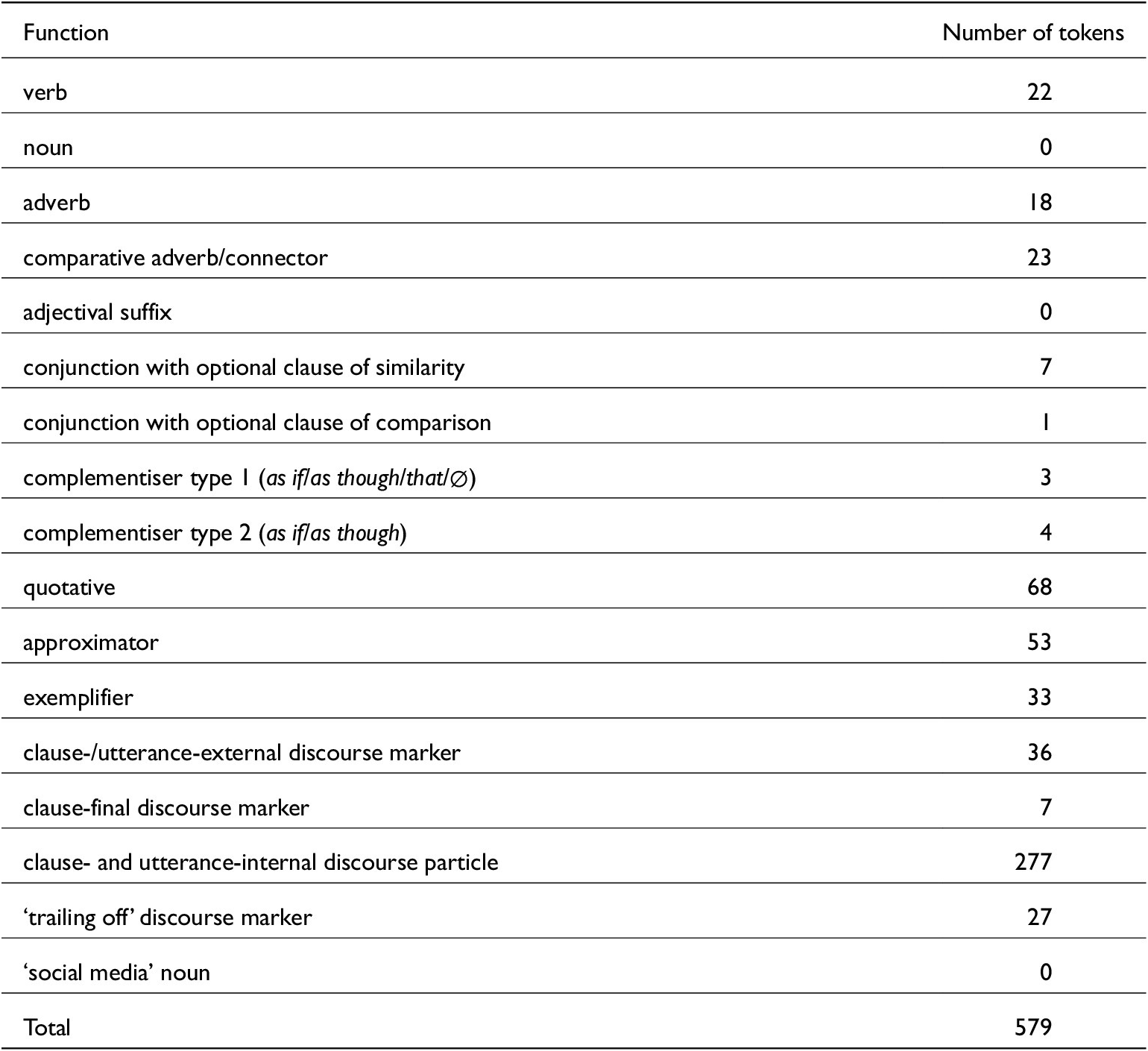
Table 2 shows the number of tokens from each function in this conversation data, using the function labels in section 2. For 35 tokens, it was not clear which function they had; these unclear tokens were excluded from all analysis in this article
Tokens by function (conversation data only)

It is evident from table 2 that some functions are much more common than others (in our data, but most likely this would also hold true for a larger-scale study of function frequency). For the present analyses, we combined the two conjunction functions with the two complementiser functions into one ‘conjunction/complementiser’ category, as these functions are syntactically rather similar.
Of the 36 sentences in the sentence list, 34 contained one like each; the other two sentences each contained two likes. Thus, the whole list of 36 sentences contained 38 likes (see supplementary material). Two sentence tokens with one like each (namely sentences number 6 and 7 in speaker number 5’s recording) were not recorded due to a technical fault and are thus not included in any analyses, leaving (38 × 11 – 2 =) 416 tokens in the sentence list dataset, for a total of (579 + 416 =) 995 like tokens used in the analyses reported below.
To reduce the dimensionality of this data and eliminate multicollinearity between acoustic variables, which can cause problems in regression modelling, we conducted factor analysis for mixed data (FAMD) before fitting explanatory regression models (see section 4). FAMD calculates a lower-dimensionality representation of mixed (quantitative and categorical) data, just as principal components analysis does for quantitative-only data and multiple correspondence analysis does for categorical-only data (Pagès Reference Pagès2014). In fields ranging from grapevine diseases (Bertrand et al. Reference Bertrand, Maumy, Fussler, Kobes, Savary and Grosman2007) to global conflicts (Vazquez et al. Reference Vazquez, Johnson, Griffith and Muneepeerakul2024), FAMD has been used as an analysis method revealing correlations or as a dimension-reduction method prior to further analysis (as we use it here). The only prior use in linguistics that we are aware of is Onosson & Stewart’s (Reference Onosson and Stewart2021) description of Media Lengua vowels, though a paper that used FAMD in clustering the vocalisations of three Atlantic seals (Stansbury et al. Reference Stansbury, de Freitas, Wu and Janik2015) may also be of interest.
For FAMD dimensionality-reduction on the present data, we used R version 4.0.5 (R Core Team 2021) and the FactoMineR package (version 2.10; Lê et al. Reference Lê, Josse and Husson2008). This was done separately for each of the four intended dependent variables listed in table 1, using all of the context variables (to use the term from table 1) as well as the genre of recording and the three other variables that were not destined to be the dependent variable for the respective model (out of the word duration, /k/ duration, ratio of /l/ to vowel durations and Euclidean diphtongisation measure). This FAMD resulted in five dimensions of data, with each like token’s acoustic information being expressed by five coordinates within this space.
As we conducted FAMD separately for each of the four regression models, the FAMD dimensions are not comparable across models and do not represent the same variables across models, as they are composed of different variables for each model. This is unavoidable, but the alternative with comparable models (that is, a consistent single FAMD of context variables only, with the other variables added to each model individually) would reintroduce problems of multicollinearity.
4. Mixed-effects regression modelling
We used the lme4 package for R (version 1.1-27.1; Bates et al. Reference Bates, Mächler, Bolker and Walker2015) to apply four separate linear mixed-effects regression models to this set of like tokens – one each for the four acoustic measures as dependent variable in prior research (diphthongisation of the vowel, ratio of /l/ segment duration to vowel segment duration, the duration of the /k/ segment expressed as a proportion of the word token duration, and the word token duration itself). We used restricted maximum-likelihood estimation (REML) and bound optimisation by quadratic approximation (BOBYQA) limited to a maximum of 100,000 function evaluations. The fixed independent variables in each model were the speaker’s gender, the function of like, and the five dimensions calculated by FAMD; the models also included a random speaker-wise slope for each of these variables except the speaker’s gender (as this does not vary within each speaker). For the purposes of analysis, we set the discourse particle like as the reference level for the variable of like function. The resulting models are discussed separately below. Note that all figures reported below are rounded to three decimal places. Due to this rounding, the t values reported here are not always identical to the fraction of reported coefficient estimate over reported standard error.
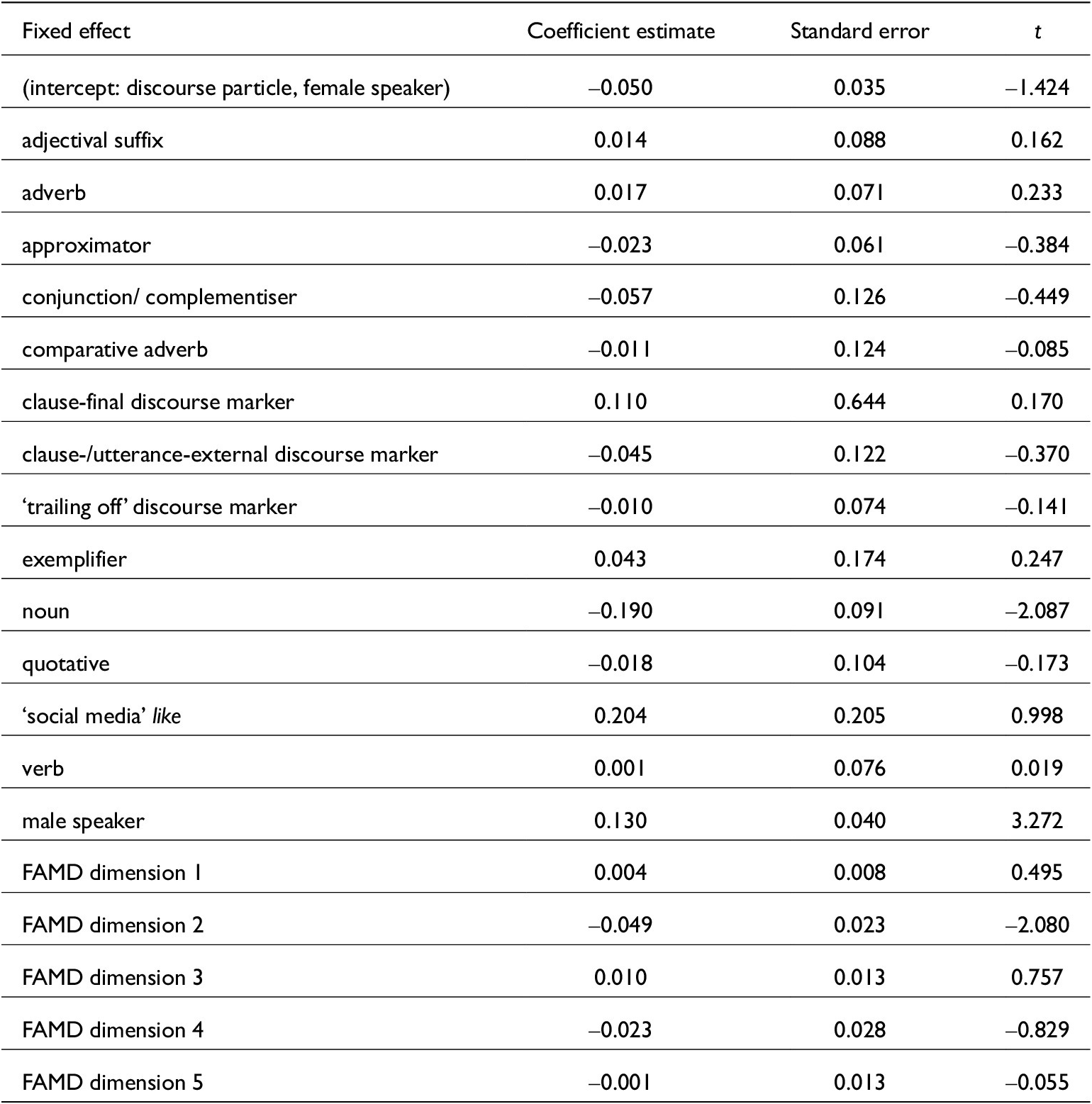
4.1. Model A: Diphthongisation measure
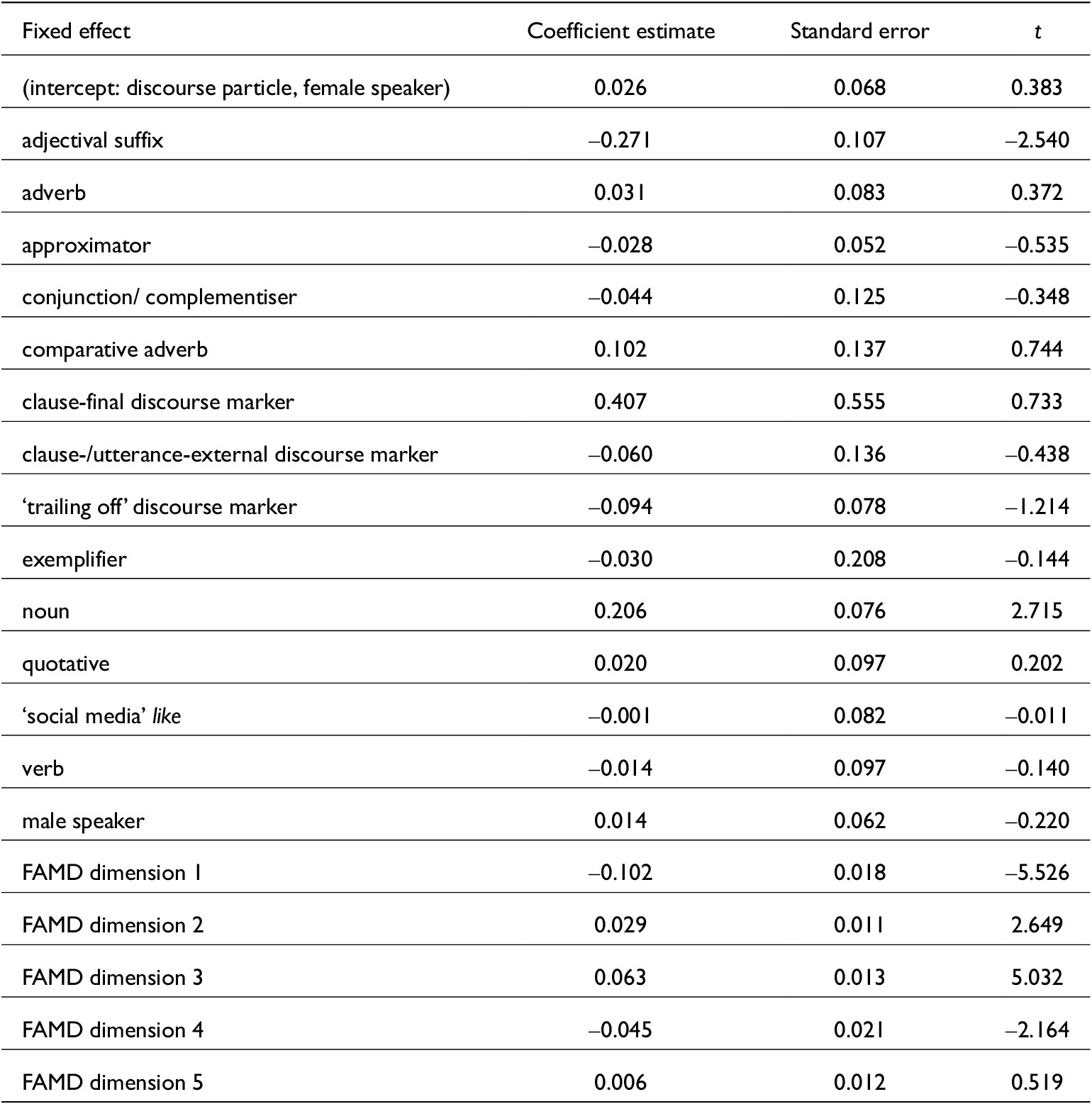
The model for the normalised diphthongisation measure (see table 3 for fixed-effect coefficients) shows that this measure of vowel quality is affected by four of the five FAMD dimensions calculated from acoustic variables and by two functions of like: the adjectival suffix tends to have a more monophthongal vowel than the discourse particle (and most other functions), and the noun like a more diphthongal vowel. Effects of other like functions are not strong enough to be distinguished from zero.
Fixed-effect coefficients of model for vowel diphthongisation

As table 2 shows, these two functions of like only occurred in our sentence-list data, not in conversation. Thus, it is not surprising that they show more consistent and extreme articulations (very diphthongal nouns, very monophthongal suffixes) than other categories: all the data for these two functions comes from the same syntactic and phonological environment.
The first FAMD dimension in this model largely incorporates the speech rate and information about what follows the like token. This connection is not surprising, given well-known effects like final lengthening, and neither is the fact that this dimension has a significant effect on the diphthongisation measure: shorter vowels are less likely to be diphthongal, after all. The second FAMD dimension represents the position of like. The third and fourth FAMD dimensions mostly represent the preceding and following segments and the genre of recording. Section B of the online supplementary material shows correlation circles and tables of variable contributions to these FAMD dimensions.
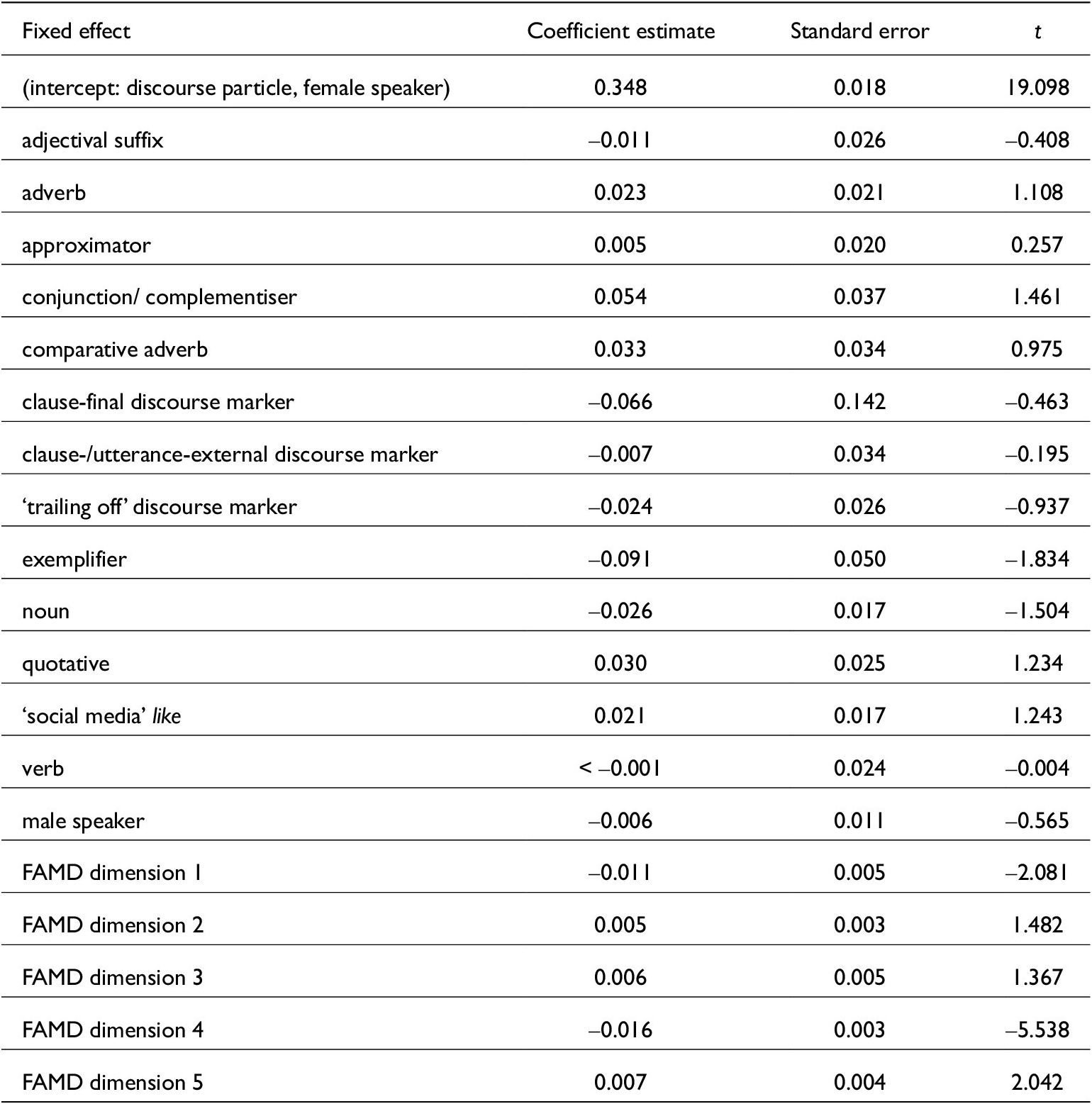
4.2. Model B: /l/-to-vowel duration ratio
The dependent variable for this model was calculated by dividing the absolute duration of a token’s /l/ segment by the absolute duration of that token’s vowel, thus expressing how long the /l/ is compared to the vowel. We have two reasons to use this ratio rather than the absolute duration of /l/ as a measure of /l/ reduction. Firstly, this reduces the impact of speech rate differences: the absolute /l/ duration is moderately correlated with speech rate (Spearman’s ρ = –0.35, p < 0.001 in our data), but the /l/-to-vowel duration ratio is not (Spearman’s ρ = 0.07, p > 0.05). Secondly, it makes our findings more easily comparable to prior work which also used this ratio (for instance Drager Reference Drager2009, Reference Drager2011 and Schleef & Turton Reference Schleef and Turton2018).Footnote 3 This duration ratio variable was normalised before modelling, as stated above.Footnote 4
The mixed-effects model for this dependent variable (see table 4) shows that the /l/ segment is relatively short in the noun like and relatively long when produced by male speakers. Some of the acoustic and contextual information incorporated into the FAMD dimensions is also predictive (dimension 2, which largely comprises positional information in this model).
Fixed-effect coefficients of model for /l/-to-vowel duration ratio

Following from the vowel quality effect described by model A above, this length ratio effect of the noun function is not surprising: the noun like in our data tended to have a diphthongal, long vowel, and as this vowel length is the denominator of the ratio used in model B, it naturally makes for a negative effect in model B just as it made for a positive effect in model A. The gender effect is unexpected, but robust even in descriptive statistics: In our data, male speakers produce longer /l/s and shorter vowels (mean /l/ duration 86.7 ms, mean vowel duration 75.7 ms) than female speakers do (mean /l/ duration 67.0 ms, mean vowel duration 102 ms).
4.3. Model C: /k/-to-word duration ratio
The dependent variable for this model was calculated by dividing the absolute duration of a token’s /k/ segment by the absolute duration of the whole token (in other words, it expresses the length of the /k/ as a proportion of the length of the whole token). Previous work has studied /k/ by using variables that record expert judgments of /k/ realisation/quality; as this work by and large found /k/ reduction, we chose to use this duration ratio as a more straightforward quantity that measures /k/ reduction here.
The mixed-effects model for this dependent variable (shown in table 5) shows that it is affected by acoustic and contextual information (in FAMD dimensions) – there is no meaningful effect of like function.
Fixed-effect coefficients of model for /k/-to-word duration ratio

The first FAMD dimension in this model can be interpreted as speech rate and related factors. The fourth dimension here is largely made up of information regarding the preceding and following segments, while the fifth dimension adds the /l/-to-vowel duration ratio. As with similar FAMD dimensions in model A above, it is not surprising that these positional and durational variables have effects on the /k/-to-vowel duration ratio in this model.
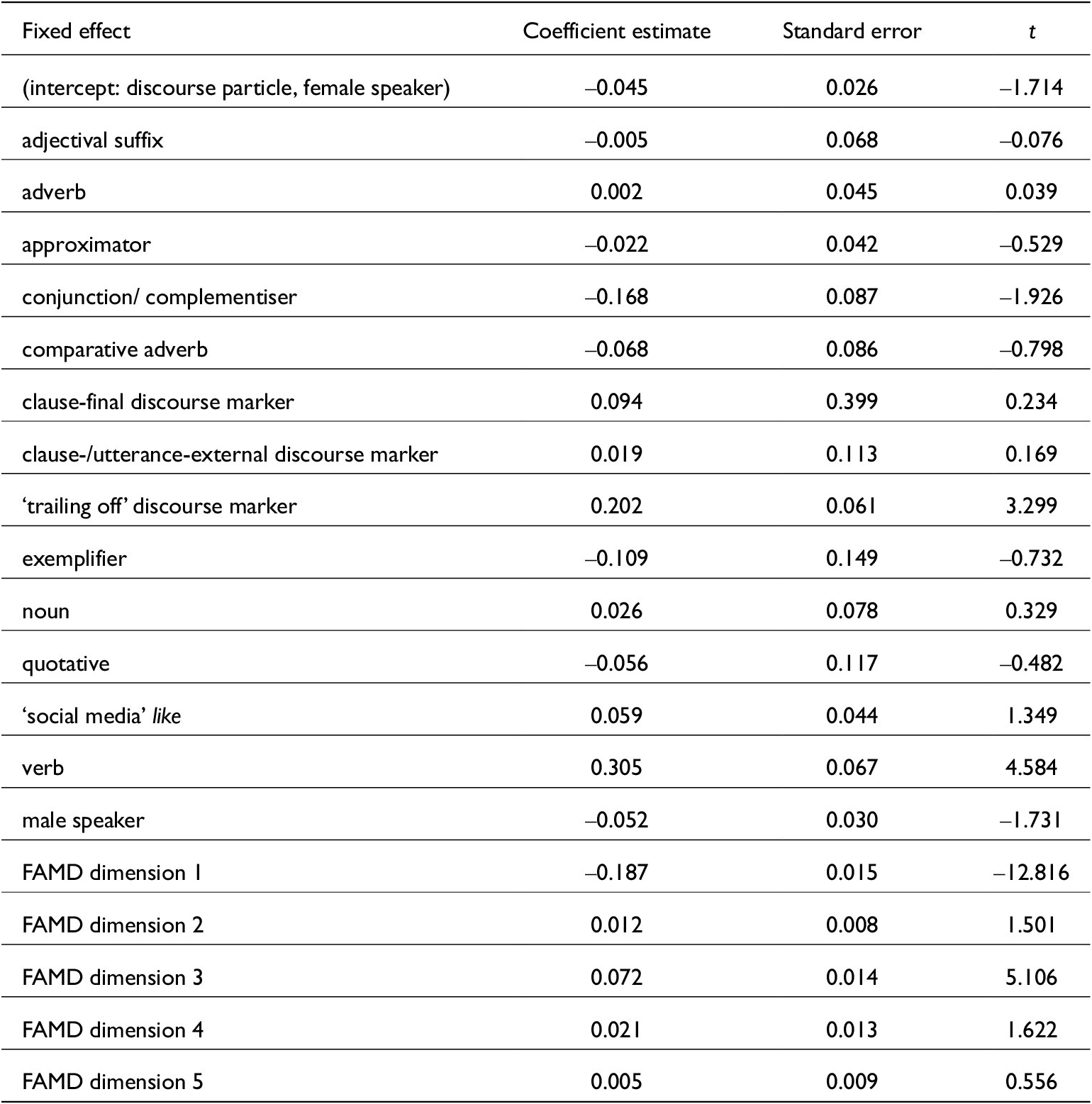
4.4. Model D: Word duration
Table 6 shows the fixed-effect coefficients of the model for the (normalised) duration of each like token. This direct phonological measure is strongly connected to the FAMD dimensions, which is unsurprising: it is widely known that word duration and other segmental and suprasegmental features can affect one another (as noted in other models above), and positional lengthening/shortening effects are also well-established. Moreover, one of the variables incorporated in these FAMD dimensions is speech rate, which naturally affects word duration; as speech rate contributed mostly to the first dimension in this model, it is again unsurprising to see a strong negative effect of that dimension on word duration (higher speech rate going together with lower word duration). The largest contributions to the third FAMD dimension here come from the vowel diphthongisation measure, genre of recording and positional information.
Fixed-effect coefficients of model for word duration

The model does show some effects of like functions: verbs and ‘trailing off’ marker likes are longer than other likes, and conjunctions/complementisers are shorter than other likes. These effects appear scattershot at first glance, but taking them in turn suggests that they are incidental to the usual positions of different like functions rather than inherent distinctions/cues to function directly: The verb like occurs 22 times in our conversation data and 33 times in the sentence-list data. As the sentence list data has a slower speech rate overall, it is not surprising that we see longer word durations for this function of like, with relatively more of its data coming from that slower part of the dataset. Verbs are also more likely to be stress-bearing (though this was not measured/included in the models formally) and thus longer.
The ‘trailing off’ discourse marker occurs at the end of utterances or turns by definition and, due to its apparent function (see section 2), is naturally likely to be lengthened. Conversely, conjunctions and complementisers are usually utterance-internal and not followed by pauses (only 6 of 33 sentence-list and 1 of 15 conversation tokens with these functions are followed by pauses); thus, most of these conjunction and complementiser tokens were not subject to final or pre-pausal lengthening, which explains why they tend to be shorter. In other words, all effects of like function in model D can be explained by (typical) position and context: final, stressed and/or pre-pausal like tends to be longer.
5. Hierarchical cluster analysis
Linear mixed-effects regression modelling is widely used in linguistics, but has been criticised as it can lead to unsubstantiated conclusions (see e.g. Eager & Roy’s (Reference Eager and Roy2017) demonstration that mixed-effects regression models often fall short of their aim of accounting for random effects properly, especially with unbalanced and binary data). To alleviate this concern, we chose a second approach to answering our research question (are there acoustic differences between like functions that cannot be explained by token position/context?): hierarchical clustering.
After removing like tokens in the rare and phonologically particular functions of clause-final discourse marker (‘Irish like’) and ‘trailing off’ like as well as tokens whose function was unclear, we mean-centred the speech rate, word duration, relative /k/ duration, /l/-to-vowel duration ratio and diphthongisation measure, and scaled these to standard deviations within each variable. The genre of recording, boundary strength immediately following like, position of like in the sentence/utterance, speech rate, type of segments (if any) immediately preceding and following like, and the two bigram frequencies for each like token (all as described above) were also available to the clustering algorithm. Importantly, though, speaker ID and like token function were held out of this dataset when we used Ward’s (Reference Ward1963) minimum-variance method (as implemented in R) to calculate a best-fit clustering solution. Using the R package dendextend (version 1.15.1; Galili Reference Galili2015), this clustering solution was plotted as a dendrogram.
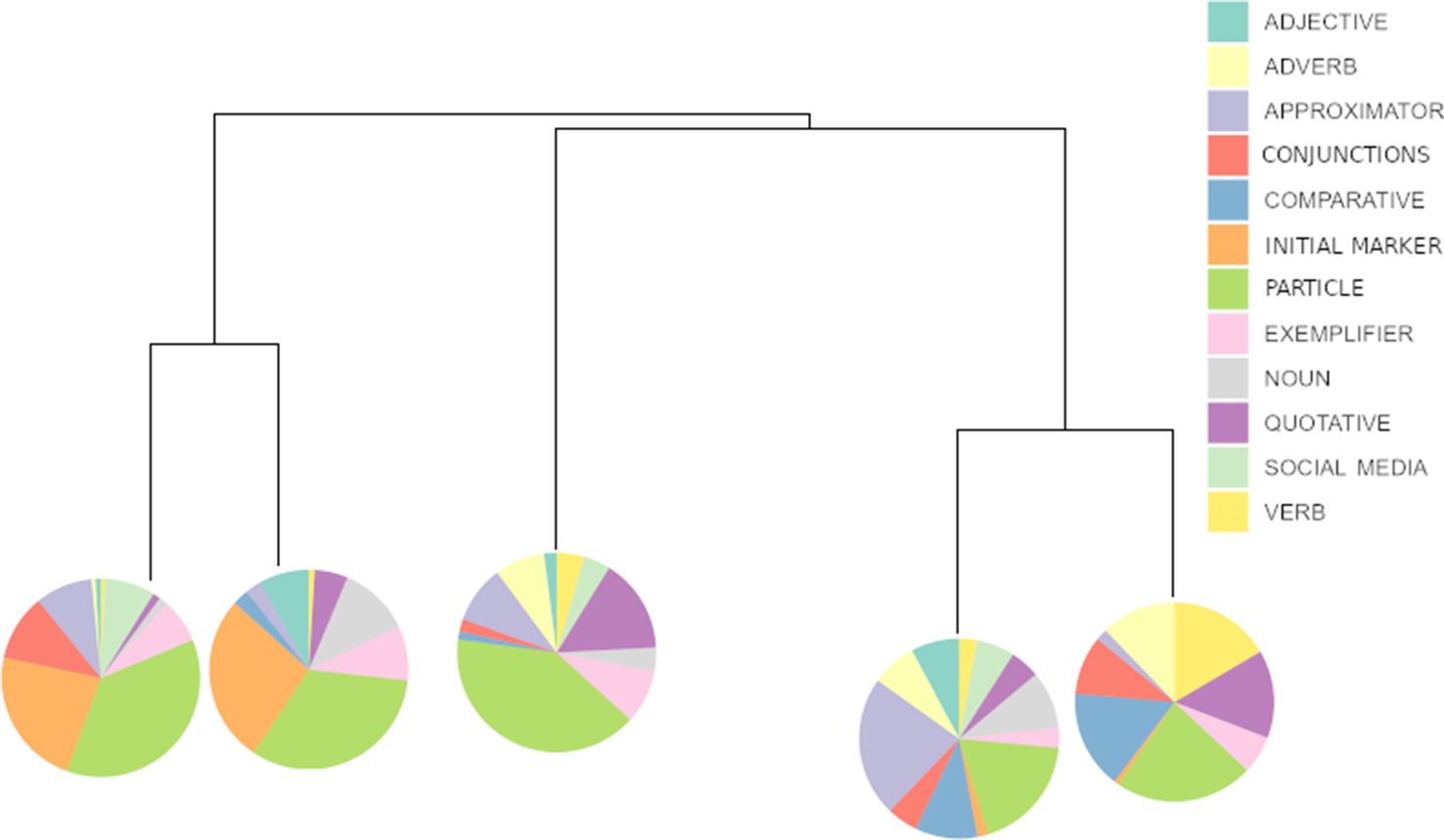
This dendrogram contains a few small function-wise clusters for rare functions, but no larger speaker- or function-wise clusters. The truncated version shown in figure 1 demonstrates that most functions occur across all clusters – each pie chart shows the proportion of functions within that branch of the dendrogram. Most noticeably, there are no sizeable clusters that do not contain some discourse particle likes. While this is not unexpected given the frequency of this type of like, and the fact that it can occur in different contexts, it is possible that the clustering algorithm was unable to find speaker- or function-wise clusters due to the existence of discourse particle likes across the variable space. Thus, the procedure was repeated without the discourse particle tokens (and a few other outliers, defined by being at least two standard deviations from the mean value of a variable) to investigate whether the unbalanced full dataset obscured interesting function-wise differences. However, the dendrogram for this reduced dataset does not show sizeable clusters for any single like function either (and is thus not shown here). Thus, we conclude that such similarities that do exist between different like tokens in our data are due to features other than the function of like, as the regression modelling suggested.
Dendrogram of clustering solution including discourse particle

6. General discussion
Three of the four linear mixed-effects regression models fitted to our data contain effects of like function. However, in all three models, these effects can be explained by context:
-
• nominal like tokens in our data have more diphthongal vowels (and, concurrently, a lower ratio between the durations of /l/ and that vowel) due to occurring in more consistent and extreme environments in our elicitation;
-
• likewise, the adjectival suffix likes tend to monophthongs in our data because of sentence-list intonation;
-
• verbs and ‘trailing off’ likes are longer because of stress and/or a following pause; and
-
• likewise, like tokens that function as conjunctions or complementisers are shorter than others because they rarely occur in a pre-pausal position and thus are more likely to be reduced.
In summary, these apparent effects of like function in models of acoustic measures can all be explained by lengthening or reduction due to context (or, in the case of the noun and adjectival suffix, type of recording/data).
It is interesting that these apparent function effects (which we argue are proxies of context effects) emerge in the models despite the presence of other variables that measure the context directly. We suggest two reasons why these apparent function effects do emerge (though the present study cannot support either of these suggestions strongly): the first possible explanation is that the context effects are so strong that they cover all other effects, but emerge even in imperfect proxy variables. This possible explanation is supported by the observation that most effects, and strongest effects, in models A, B, C and D are effects of the utterance context (incorporated in FAMD dimensions). The second possible explanation is that our model fitting and selection procedure was deliberately biased to include the variable that records the function of like tokens, by not incorporating it in dimension-reducing FAMD.
Hierarchical clustering also shows no sizeable clusters by like function when contextual information is available to the clustering algorithm alongside acoustic information. There are many acoustic differences between individual tokens of like in our data, but none that we can confidently ascribe to the function of like – in other words, different functions of like are not produced with systematic differences in our data. Thus, we see no reason to assume that these different functions are stored separately.
The present findings are further evidence for Schleef & Turton’s (Reference Schleef and Turton2018) argument that subphonemic differences in like can be explained by context. This argument appears to counter the earlier findings of Drager (Reference Drager2009, Reference Drager2011) and Podlubny et al. (Reference Podlubny, Geeraert and Tucker2015), who saw function-specific differences when some, but not all of the features of a like token’s context were taken into account. For instance, Drager (Reference Drager2011) considers the type of the segments preceding and following each like token with great care, but not the fact that different functions of like are likely to occur in different prosodic settings – and it is this latter difference in typical setting that causes differences in like realisations, we argue. That said, there are two possible other explanations discussed in those earlier papers: frequency and social group membership/identity. We will address these possibilities in turn.
Word frequency has been shown to affect word duration. Gahl’s seminal paper found a length difference between frequent and infrequent homophones of 28 ms (368 vs 396 ms in all data; Gahl Reference Gahl2008: 481) or 22 ms (374 vs 396 ms for just the first use in each text; Gahl Reference Gahl2008: 487). Of course, these figures are for many homophone pairs of different lengths and thus cannot be applied to like directly, but they serve as a point of comparison: in our conversation data, the longest reliableFootnote 5 function-wise average word duration is 266 ms for verbs and utterance-/sentence-initial discourse markers, and the shortest is 182 ms for comparative adverbs/connectors. The most frequent function in our data, the clause- and utterance-internal discourse particle like, has a high average word duration when considered in this range, at 231 ms. The scale of the difference between averages in our data is larger than in Gahl (Reference Gahl2008), and thus it is conceivable that frequency (of the different like functions, in this case) explains at least part of the difference. Of course, this frequency is likely connected to typical position – for instance, complementisers are surely rarer than discourse markers and particles not because speakers often choose to omit complementisers, but rather because speakers choose to use fewer constructions that require or allow complementisers in the first place. Frequency may well have an additional effect, and future studies would be well-advised to investigate it (with function-wise frequency data). That said, our length differences are clearly not due to frequency in the way Gahl’s were: the most frequent like (the discourse particle) is not usually the shortest here; moreover, the shortest and longest likes have functions that, intuitively, do not differ in frequency. This discussion of frequency effects does of course not call into question Gahl (Reference Gahl2008) or other frequency effect findings (for example, Lohmann’s Reference Lohmann2018 confirmation of Gahl’s work, which found frequency effects while controlling for some features of position/context). However, it illustrates that our findings for like are unlikely to be frequency effects, as they do not match what would be predicted for frequency effects.
In addition to lemma frequency generally, there is speaker-specific frequency (or likelihood of use) for each function. As Drager (Reference Drager2011) argues convincingly, one speaker’s production may be determined by how often they themselves use the lemma (for instance, forms that a particular speaker uses often are more likely to be reduced by that speaker). We were unable to include speaker-specific frequency in our analyses, as it would require much more data per speaker.
Likewise, a speaker’s identity (or social group membership) may well affect their production of like. Drager’s (Reference Drager2009, Reference Drager2011) detailed study of like in one high school year group found differences in like between pupils according to where they tended to eat lunch (which indexed further social dimensions). This is intriguing, but unlikely to be the source of any systematic effect in our data, as our participants are arguably drawn from the ‘general population’ rather than one restricted setting. In such a setting, it is of course possible for acoustic differences to arise and serve as sociolinguistic markers; however, we see no reason to assume that like realisation (out of all the features of North-West England English) is indeed a sociolinguistic marker within that larger variety. Thus, while we do not rule out the possibility of function-wise differences as sociolinguistic markers, we believe it is much less likely to explain the present findings than the well-documented context effects are. Of course, function-specific subphonemic markers would be an indication of function-specific storage, as Drager argues; absent a study like Drager’s that also accounts for the context effects we argue for, we see no convincing evidence to assume different functions of like are stored with subphonemic detail.
Thus, we assume that there is no psychologically real representation of different functions of like, at least not in this respect. Some of the information that distinguishes different functions of like (e.g. the quite systematic usage pattern, meaning and social evaluation of quotative like) is most likely psychologically real in some way, of course, as speakers could otherwise not use the different likes as consistently as they evidently do. However, we see no convincing evidence for subphonemic acoustic distinctions in the present study. In other words, we agree with Ferreira (Reference Ferreira2008): readily accessible information in an utterance (word frequency and semantics in Ferreira’s data, syntax and prosody in ours) is often enough to disambiguate phonemically identical utterances in practice, and therefore speakers and listeners do not use other information (such as subphonemic distinctions) to further disambiguate them.
Our typology of seventeen functions of like is of course subject to further argument. Due to low numbers of tokens, we are unable to state conclusively that the ‘social media’ function or the ‘trailing off’ function are distinct from other functions. Similarly, the four like conjunction and complementiser functions appear to be distinct syntactically, but had to be combined in our analysis due to low numbers; there may be interesting distinctions between these functions or further argument on their similarity.
7. Conclusion
Having studied the subphonemic detail of like in use by young adult speakers of English from the North-West of England, we find no systematic differences between functions of like that cannot be accounted for by context (in line with Schleef & Turton Reference Schleef and Turton2018). This means we find no evidence for separate storage of different functions of like.
Future work could extend this analysis to data from prior studies (if available), to investigate whether the present argument also holds in these cases. It is, after all, conceivable that some regional varieties of English do differentiate like functions subphonemically while others do not, and reliable findings of such differentiation would show conclusively that these function-specific representations do indeed exist.
Another intriguing possibility for future research is to examine this phenomenon from the perspective of the listener, as done previously in Drager (Reference Drager2009) and Lohmann & Tucker (Reference Lohmann and Tucker2021). If a listener cannot perceive or use supposed subphonemic differences, the discussion of their psychological reality is of course not moot, but the listener-oriented argument for this reality would be falsified. It may not be fruitful to study discrimination of like tokens in isolation, if relative differences (to the context) are the cues listeners use.
Future research could also investigate the frequency of different functions of like in more detail, which would allow the use of relative per-function frequency in statistical analyses and thus the investigation of frequency effects as per Gahl (Reference Gahl2008). That said, finding such frequency effects would not necessarily contradict the present findings, as these frequency effects have usually been described in the domain of duration (even for different word forms, as in Engemann & Plag Reference Engemann and Plag2021). Duration can, of course, affect other measures we used as dependent variables, but crucially this would be a frequency effect, which does not necessarily require function-specific mental representation (for example, in exemplar-theoretic models). Moreover, even these effects may be affected by context features: Lohmann & Conwell (Reference Lohmann and Erin Conwell2020) show that nouns tend to be followed by stronger boundaries than verbs (a function of English syntax), and that this (rather than separate storage) leads to nouns being longer than verbs in homophonous noun–verb pairs like chat. Future research investigating frequency effects would thus also be useful in further investigating whether these word-class effects are in fact contextual, just like the supposed like function effect we discussed here.
Acknowlegements
This article has benefitted greatly from the insight of Ryan Podlubny, Benjamin V. Tucker, Nick Palfreyman, the attendees of the 29th Manchester Phonology Meeting in 2022, a colleague who wishes to remain anonymous, and the reviewers and editors. The anonymous research participants who contributed speech samples are also acknowledged gratefully.

 Open access

