Contents
Research Article
Unbounded solution components for nonlinear Hill's equations
-
- Published online by Cambridge University Press:
- 14 November 2011, pp. 1131-1167
-
- Article
- Export citation
Poincaré–Birkhoff results for Lagrangian systems with subquadratic potential
-
- Published online by Cambridge University Press:
- 14 November 2011, pp. 1169-1177
-
- Article
- Export citation
The quasiconvex envelope of the Saint Venant–Kirchhoff stored energy function
-
- Published online by Cambridge University Press:
- 14 November 2011, pp. 1179-1192
-
- Article
- Export citation
Sturmian comparison theorem for half-linear second-order differential equations
-
- Published online by Cambridge University Press:
- 14 November 2011, pp. 1193-1204
-
- Article
- Export citation
-
Let φ:ℝ→ℝ be defined by φ(s) = |s|p−2s, with p > 1 a fixed number. We extend Sturm Comparison Theorem of the linear differential equation
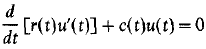
to the nonlinear differential equation

by using the Wirtinger inequality. A Lyapunov inequality and some oscillation criteria of (E) are also given.
Application of two parameter eigencurves to Sturm–Liouville problems with eigenparameter-dependent boundary conditions
-
- Published online by Cambridge University Press:
- 14 November 2011, pp. 1205-1218
-
- Article
- Export citation
-
Oscillation, comparison and asymptotic theory for the Sturm-Liouville problem

with 1/p, q, r ε L1 ([0, 1]), p, r > 0, are studied subject to eigenvalue-dependent boundary conditions

This continues previous work on cases with (− 1)j δj ≦ 0 where δj = ajdj − bjcj. We now consider the remaining sign conditions for δj, exploiting the interplay between the graph of cot θ− (λ, 1), for a modified Prüfer angle θ−, and the eigencurves of a related two-parameter problem.
Bounds on the effective conductivity of two-dimensional composites made of n ≧ 3 isotropic phases in prescribed volume fraction: the weighted translation method
-
- Published online by Cambridge University Press:
- 14 November 2011, pp. 1219-1239
-
- Article
- Export citation
On the stability of the saddle solution of Allen–Cahn's equation
-
- Published online by Cambridge University Press:
- 14 November 2011, pp. 1241-1275
-
- Article
- Export citation
-
Let f be an odd, C2 function on [− 1, 1], which vanishes at ± 1, and such that f′(O) < 0, f′ (±1) > 0 and u ↦ f(u)/u is increasing. Dang, Fife and Peletier [5] showed that there is a unique solution u with values in [−1, 1] of

which has the same sign as xy. The linearised operator around u is B defined by

It is proved here that the spectrum of B contains at least one negative eigenvalue, that all eigenfunctions corresponding to negative eigenvalues have the symmetries of the square, and that for Allen–Cahn's nonlinearity (f(u) = 2u3 − 2u), there is exactly one negative eigenvalue.
Global resolvability for a viscoelastic model with relaxation*
-
- Published online by Cambridge University Press:
- 14 November 2011, pp. 1277-1285
-
- Article
- Export citation
Colour algebras and Cayley–Dickson algebras
-
- Published online by Cambridge University Press:
- 14 November 2011, pp. 1287-1303
-
- Article
- Export citation
Contracting sets and dissipation
-
- Published online by Cambridge University Press:
- 14 November 2011, pp. 1305-1329
-
- Article
- Export citation
The spectra of well-posed operators
-
- Published online by Cambridge University Press:
- 14 November 2011, pp. 1331-1348
-
- Article
- Export citation
-
In this paper, the general ordinary quasidifferential expression M of nth order, with complex coefficients, and its formal adjoint M− are considered. It is shown in the case of two singular endpomts and when all solutions of the equation and the adjoint equation are in
 (the limit-circle case) that all well-posed extensions of the minimal operator T0(M) have resolvents which are Hilbert Schmidt integral operators and consequently have a wholly discrete spectrum. This implies that all the regularly solvable operators have all of the standard essential spectra to be empty. These results extend those for the formally symmetric expression M studied in [1] and [14], and also extend those proved in [8] for one singular endpoint.
 (the limit-circle case) that all well-posed extensions of the minimal operator T
Index
Index to Volume 125
-
- Published online by Cambridge University Press:
- 14 November 2011, pp. 1351-1354
-
- Article
- Export citation
Front matter
PRM volume 125 issue 6 Cover and Front matter
-
- Published online by Cambridge University Press:
- 14 November 2011, pp. f1-f2
-
- Article
-
- You have access
- Export citation
Back matter
PRM volume 125 issue 6 Cover and Back matter
-
- Published online by Cambridge University Press:
- 14 November 2011, pp. b1-b2
-
- Article
-
- You have access
- Export citation