

The folk play from present-day Nicaragua known as El Güegüense (alternatively spelled Güegüence) or Macho ratón was designated by UNESCO in 2008 as a representative of the area’s “intangible cultural heritage,” along with another performance from Central America, the K’iche’-language play Rabinal achí (Reference Arellano, Arellano, Mántica, Plaza and PregoArellano 2008, 13). As of this writing it is one of six such designations from Central America. El Güegüense features the protagonist Güegüense (with his sons Don Forsico and Don Ambrosio) and the Spanish colonial authorities, led by Governor Tastuanes. In the story, Güegüense is summoned to speak with the governor about paying his taxes. Through veiled mockery, the use of layered language, and by feigning ignorance or deafness, Güegüense tricks the governor into agreeing to the marriage of his daughter Suche-Malinche to Don Forsico and evades punishment. The play’s state-supported listing on UNESCO’s website describes it: “A forceful expression of protest against colonial rule, El Güegüense is a satirical drama well known throughout Nicaragua. It is performed during the feast of San Sebastián, patron saint of the city of Diriamba in Nicaragua’s Carazo province. El Güegüense, a synthesis of Spanish and indigenous cultures … is considered one of Latin America’s most distinctive colonial-era expressions” (UNESCO 2021).
The CIA World Factbook (2019) estimates Nicaragua’s population at 6.1 million, of which 69 percent are mestizo, 17 percent white, 9 percent Black, and 5 percent Indigenous. Most of the Indigenous category are counted from the eastern half of the country in its two autonomous regions. The continued presence of Indigenous peoples in the western portion has been muddied. Estimates of the prehispanicFootnote 1 population of the region vary widely, with Newson (Reference Newson1987, 85–87, 335) proposing a population between six hundred thousand and eight hundred thousand prior to the Spanish invasion. Within a quarter century, by 1550 CE, 92.5 percent of that population had been annihilated, with a depopulation ratio “higher than that recorded for central Mexico and the central Andean area … [and] higher than the depopulation ratios … for other chiefdoms, such as the Chibcha” (Reference NewsonNewson 1987, 337). Through disease, warfare, murder, and enslavement, the Indigenous population of Pacific Nicaragua suffered tremendously. Historians, social commenters, and orchestrators of nation building in Nicaragua spoke of the “complete disappearance” of Indigenous peoples in the Pacific regions, whether by disease or becoming mestizo (Reference PeraltaPeralta 1893, xvi–ii; Reference CuadraCuadra 1981, 209). Despite the presence of twenty-three pueblos indígenas (Indigenous peoples or communities) outside the autonomous regions, Indigeneity is often muted, as its markers (such as language) are removed. Researchers have noted that the Indigenous peoples of Masaya “in most ways act just like other mestizos” (Reference AdamsAdams 1957, 238). This narrative has rendered Indigenous cultures and lives invisible while in plain sight. It has also “legitimized the annexation of cultural performances such as of El Güegüence to the truth of mestizaje” (Reference FieldField 1999, 186–187).
This essay places an Indigenous focus on El Güegüense in new ways by examining the underlying origins of the performance. By drawing out Indigenous symbolism and veiled meanings that are woven within the play in both its dialogue and its performance, it argues that El Güegüense is a decolonizing work of Indigenous “restorying” and survivance. This understanding should initiate dialogues on issues of cultural appropriation in the process of nation building of Nicaragua.
Method
I approach El Güegüense as an act of decoloniality, as voiced by Aníbal Quijano (Reference Quijano2001) and Walter Mignolo (Reference Mignolo2012). This lens draws away and delinks from Eurocentric interpretations and considers the agency of Indigenous peoples in response to colonizing powers (Spanish and others). While some authors have considered decolonial (e.g., Reference GonzálezGonzález 2018) and Indigenous characteristics of El Güegüense, I also examine the work from an Indigenous perspective of survivance. This term has been popularized in Indigenous studies and can be defined as “an active sense of presence, the continuance of native stories, not a mere reaction, or a survivable name. Native survivance stories are renunciations of dominance, tragedy and victimry” (Reference VizenorVizenor 1999, vii). Indigenous concepts like survivance, while not directly rooted in the literature of decoloniality, should be understood as a decolonial praxis. Survivance can also be considered an act of Indigenous “restorying,” which involves questioning colonial histories of Indigenous communities and telling Indigenous people’s counternarratives to dominant cultural versions of history (Reference CorntasselCorntassel 2009, 138–139). My reading of El Güegüense draws out spiritual natures within it. Indigenous research is innately spiritual and ceremonial (Reference WilsonWilson 2015), and I have embraced this as both a way of interpreting the work and a manner of approaching the research itself, much like Marissa Muñoz’s (Reference Muñoz, Smith, Tuck and Yang2019, 64) use of Irene Lara’s (Reference Lara, Lara and Facio2014) “serpentine conocimiento”: “Indigenous teachings that all life is connected to both earthly and spiritual realms, emphasizing duality, intuition, and fluidity.”
Through decolonial and Indigenous perspectives, this article undertakes a critical analysis of literature on El Güegüense and ties it to other works of Indigenous heritages. In addition, the article is informed by Indigenous autoethnography (see Reference HoustonHouston 2007) and by my existence as an Indigenous person from Masaya. As Kovach (Reference Kovach2010, 7) writes, “we know what we know from where we stand.” My periods of time in Masaya inform my perspective, as do the stories I grew up with and conversations with friends and relatives who participate in the traditional dances in the area. I examine themes within El Güegüense alongside contemporary Indigenous traditions to consider it as a work of Indigenous ceremonial survivance.
Origins of the Play
When and by whom El Güegüense was first created and performed has been a point of contention among poets, scholars, and political thinkers. Alvarez Lejarza (Reference Alvarez Lejarza1977, 54–60) details a historical survey of scholarship regarding El Güegüense. Often authors use interpretations of a work’s origins to advance their own social and political ideals.
The UNESCO-approved statement considers that the work was likely first written down during the early eighteenth century (UNESCO 2021). Scripts from that period are not known to exist. One of the best-known examples of the written play comes from Daniel Brinton’s 1883 publication The Güegüence: A Comedy Ballet in the Nahuatl-Spanish Dialect of Nicaragua. It is commonly accepted that the play existed for a length of time in a form passed along entirely orally, as is still commonly done today.
The performance is testified to on numerous occasions, with foreign visitors noting its significant role in the festival of San Jerónimo in Masaya in the 1860s (Reference ArellanoArellano 2002, 166). Earlier, in 1810, colonial authorities suspended the performance and people caught performing it were imprisoned. Still, El Güegüense carried on with performances by community elders, who considered the performances more important than the threat of prison (Reference FieldField 1999, 177). The stances of the colonial authorities and the elders suggest that it was an important and long-lived traditional expression.
Firmly dating the work brings no small amount of difficulty. Jorge Eduardo Arellano (Reference Arellano, Arellano, Mántica, Plaza and Prego2008, 14) considered the work to be written in the tradition of Nahuatl theater, likely as a response to missionaries. He claimed that from these roots, the play was first performed in the decades following the Spanish invasion in the 1520s (Reference WhisnantWhisnant 1995, 223). Placing the material and style of the play in contrast to developments in Spanish theater, others have suggested alternatively that the work may be from the seventeenth century. Determining this “when” impacts debates over the identity of the play’s creator(s) and how that identity may affect what El Güegüense is meant to represent.
Other authors heavily counter the view that the work is a Spanish creation. There is, however, a related theme of hispanism (a perceived cultural indebtedness to Spain) and indebtedness to mestizaje (a concept of racial and cultural mixing of Indigenous and European people to create a new, largely Western-facing society as part of nation-building projects) that colors interpretations. Plaza (Reference Plaza, Arellano, Mántica, Plaza and Prego2008, 59) suggested that the author must have admired Mesoamerican civilization and been an expert in Greek and Roman mythology, with in-depth knowledge of Spanish bullfighting.
While not dismissing certain Indigenous elements, Cuadra (Reference Cuadra1966) proposed that the play’s appearance marked the emergence of a perfect mestizaje in Nicaragua. It is frequently noted that the play has a “conclusive hispanified, mestizo nature” (Reference FieldField 1999, 56). As Suárez Radillo (Reference Suárez Radillo1981, cited in Reference ArellanoArellano 2014, 115) stated, “the work as well as the players are proof of the now evident racial and cultural mixing, not only in terms of language, but also in … the Latin American attitude toward the imposition of ways of life that started out as foreign, but which is now starting to be assimilated and transformed.”Footnote 2 This interpretation of the play as a work of mestizaje supports that social-political agenda. Guevara (Reference Guevara2010, 64) correctly identifies that it is this perceived mestizo character of the play that has permitted it to achieve its status to Nicaraguan identity.
These readings of the play’s authorship and origin reflect the view of the triumph of the mestizo. Here, the play—with its wedding of Suche-Malinche to Don Forsico—is emblematic of “progress” and mestizaje. Indeed, the rebelliousness of Güegüense himself has been attributed to an innately Nicaraguan quality, particularly framed in Nicaraguan resistance against the imperialism of Spain and later the United States. A proponent of hispanism and former self-described fascist, Pablo Antonio Cuadra (Reference Cuadra1966) considered the character to be indivisible from the Nicaraguan. The revolutionary thinker Alejandro Dávila Bolaños (Reference Dávila Bolaños1973) advanced the notion of El Güegüense as a work of likely Indigenous authorship but innately woven into the political fabric of Marxism and the struggle of the Sandinistas against the US-supported Somoza dictatorship. To him, the play was “an anticolonial guerrilla theatre that proclaimed Nicaraguan identity in opposition to the domination of Spanish culture, the Catholic religion, and white skin” (Reference FieldField 1999, 170). Even here, the suggestion of Indigeneity reflects on Nicaraguans rather than on Indigenous peoples; Indigenous spirit and rebelliousness are tapped as characteristics of the Nicaraguan people.
Dismissing an Indigenous creator, Arellano (Reference Arellano1991, 283) suggested the author of the work was either a priest or one “of superior mentality familiar with the life and beliefs” of Indigenous peoples of Nicaragua. Zepeda Henríquez (Reference Zepeda Henríquez2003, 148) considered that while performances like El Güegüense, along with those dances named after animals such as zopilote (buzzard) and zompopo (leafcutter ant), may contain a “primal element” of Indigenous culture; they are simply evolved “mestizo expressions in mimicry” of those cultures.
Still, many authors have recognized that the work follows a tradition of performances within Mesoamerica. The play’s use of masks, similar to those in Guatemala, has been noted as being a marker of Indigeneity (Reference Cid Pérez and de CidCid Pérez and Martí de Cid 1964, 159). The styles of repetition used and the open-air venue have similarly been considered signs of Indigenous heritage (Reference ArellanoArellano 2002, 162). Cuadra (Reference Cuadra1966, 3) understood Güegüense himself as a carryover from “extinct aboriginal theatre.” Güegüense has been identified as a trickster figure, his language, mannerisms, mockery, and gestures placing him as part of the genre of play called cuecuechcuicatl (roughly “mocking song”) (Reference MánticaMántica 2001, 10–12). Similar figures have appeared in other local trickster tales that feature Indigenous characters outsmarting highborn Spanish colonists. One, “El indio docto que fue un doctor” (The wise Indian who was a doctor) showed the Indigenous protagonist’s being awarded a doctorate in philosophy and canonical law—and thus granted a station of esteem in colonial society—despite the chapéton (a European settler in Latin America) examiner grading him with an R (rejection). He proudly turned this adversity around by saying, “I know I am docto [wise], and with this ‘R’ I am a doctor” (Reference Peña HernándezPeña Hernández 1968, 227). Erick Blandón Guevara (Reference Blandón Guevara2003) explored El Güegüense through a decolonial lens whereby he considered the themes of gender, sexuality, and race stemming from Indigenous traditions.
Even when an insider origin is considered, it is often still through a colonial perspective. Dávila Bolaños’s advocacy of Indigenous authorship is not done with Indigenous people in mind but to conjure the Indigenous spirit of resistance and attribute it to the Nicaraguan people. While appreciating Indigenous roots, decolonial authors have considered “whether Güegüense is ultimately indigenous or mestizo seems less important … than the narrative of resistance to unreasoned and unjustified authority” (Reference GonzálezGonzález 2018, 75). Using outdated population estimates, Westlake (Reference Westlake, Haedicke, Heddon, Avraham and Westlake2009, 270) states that Indigenous culture has been “obliterated” and incorrectly asserts the Nahua displacement of Chorotega people in the area where El Güegüense originates. Some decolonial interpretations of El Güegüense have used the language of colonization.
These interpretations, while giving credit to nebulous Indigenous roots, are at their core anti-Indigenous. Academic ladino views of Indigenous heritages have tended to focus on the pastness of Indigenous peoples; considerations of El Güegüense’s heritage commonly draw distance between the play, its creator(s), and modern Indigenous people. I will highlight and examine the evidence of Indigenous heritages.
The Layered Words of Güegüense
The dialogue of the play, as it was recorded in the 1800s, has been widely understood as being a work of not only the Spanish language but also the local Pipil-Nicarao language (related to Nahuatl). Arellano (Reference Arellano2002, 190) wrote that there are some seventy-seven different Pipil-Nicarao words used in the work. The presence of more than one language in the dialogue allows for the play and its main character to layer meanings of their words. Multiple authors have argued that it also contains lines in a third language, Mangue (Reference Cid Pérez and de CidCid Pérez and Martí de Cid 1964, 159; Reference ArellanoArellano 2002, 188; Reference Solano Lacié, Quesada and TosattiSolano Lacié, Quesada, and Tosatti 2005, 195). Mangue was the primary language of the region in Nicaragua where El Güegüense originates, among Chorotega (or Mangue) people. A full lexicon of the language does not exist, and it is considered dormant, though some communities maintain that it is still spoken ceremonially. The potential existence of this language in the play adds a further dimension. As a tonal language, Mangue, when it was commonly understood, could have placed even more nuanced layers of meaning onto the dialogue.
Because it was present and likely widely understood in the region prior to Spanish invasion, Pipil-Nicarao held a privileged position over Mangue dialects under colonial administration as a pan-Indigenous language. Even in the second half of the 1800s, Indigenous languages were the primary languages of the non-ladino population (Reference WhisnantWhisnant 1995, 82). Throughout the work, Güegüense uses Indigenous languages to produce misunderstandings that either allow him to mock the Spanish officials with earthy remarks or trick them into mismeasuring his goods. As mentioned above, wordplay, ridicule, and trickery are features of Indigenous storytelling, both prehispanic and into the colonial period. Layered language and wordplay are also used to convey meaning to the audience.
Several characters in the play have names worth examination. To begin, Güegüense is not a name so much as a title. Oviedo (cited in Reference BrintonBrinton [1883] 1969, xlv) wrote that Huehue was a title used among Indigenous people for an old man responsible for seeing to the defense and well-being of the community. Among Indigenous peoples in what is currently Mexico, Huehuetzin was the reverential title for an old man in charge of directing religious dances (Reference Solano Lacié, Quesada and TosattiSolano Lacié, Quesada, and Tosatti 2005, 195). These are the commonly associated roots to the name Güegüense, though Mántica (Reference Mántica2001, 10) considers Cuecuetzin (great scoundrel) as more appropriate. León-Portilla and Shorris (Reference León-Portilla and Shorris2004, 275) considered that Huehue-tzin may have a connection to the Nahuatl Huehuetlatolli (Sayings of the elders), a genre of literature that passed down traditional rules of conduct, morality, and religious beliefs. Huehuetzin is a prominent figure in Indigenous Mesoamerican stories (Reference Cid Pérez and de CidCid Pérez and Matrí de Cid 1964, 157) and has survived in numerous fashions as tricksters and El Viejo characters, common figures in Indigenous stories who wield Indigenous knowledge and, in some cases, magical powers. Güegüense should be understood as a trickster figure from Indigenous traditions, like Coyote or Raven, complete with the paradox and ambiguity that such a figure entails. He is a holder of tradition, a being charged to conduct ritual and to protect his community. Such a multilayered character is only to be expected in a work where nothing is as it immediately appears.
The name of the antagonist of the play, Governor Tastuanes, etymologically originates in the Nahuatl language (Reference Cid Pérez and de CidCid Pérez and Martí de Cid 1964, 158). Tlatoani, “one who speaks,” is the title for the ruler of an altepetl (typically translated as “city-state”). His daughter Doña Suche-Malinche shares a name with the controversial figure La Malinche (known alternatively as Malinalli or Malintzin), who aided Hernán Cortés during the Spanish-Mexica War. To some, she is a founding mother of Mexico and the mestizo. To others, she is the personification of betrayal against one’s own people (as with the concept of malinchismo, whereby people favor foreignness over their own society). To yet others, she is a tragic figure required to make difficult decisions in order to survive. More directly related to the name of the character, Suche in Nahuatl means “flower” (Cíd Perez and Martí de Reference Cid Pérez and de CidCid 1964, 158). Malintzin could roughly translate to “revered prisoner” (Malli-tzin). Suche Malinche and La Malinche may not be directly connected but are a part of the play’s layered meanings. Without saying a word, as a prisoner Doña Suche-Malinche may tell us a lot about the play.
The meaning of one of the final lines of El Güegüense has come under significant analysis by scholars: “¡Ah, mis tiempos! Cuando era muchacho. El tiempo del hilo azul, cuando me veía en aquellos campos de los Diriomos alzando aquellos fardos de guayaba, ¿No muchachos?” (Ah, my times! When I was a boy. The time of the blue thread, when I saw myself in the fields of Diriomos hefting baskets of guavas. No boys?) (line 297).
What “el tiempo del hilo azul” means has attracted conjecture. Maritza Corriols (Reference Corriols2015, 63) considered it a nostalgic statement, of a time when “the socio-cultural structure of the Indigenous community had not been disassembled.” She supported this with Carlos Mántica’s explanation of the phrase as a possibly intentional corruption of the fusion of two Nahuatl (presumably Pipil-Nicarao) words, yolo (heart/soul/identity) and xouxxouhqui (blue) into yoloxouxxouhqui, meaning not enslaved (Reference CorriolsCorriols 2015, 63). From this position, Güegüense speaks of a time prior to the invasion of the Spaniards, when he lived in an undisrupted Chorotega community near the volcano, Mombacho.
Others have taken a more literal approach to the hilo azul. To them, it evokes a prehispanic past and directly relates to Indigenous textile traditions (Reference Cid Pérez and de CidCid Pérez and Martí de Cid 1964, 154). The “blue thread” may be exactly that: Indigenous fabrics dyed blue or purple by using the shells of the sea snail murex purpureus or the plant añil (Reference ArellanoArellano 2002, 239). The physicality of the hilo azul has drawn the Monimboseño historian Flavio Gamboa to consider it a parable about the future survival of Indigenous people: “if continuity and community are to be found they will be found in the practices of daily work and the materials out of which life is made” (in Reference FieldField 1999, 172). This reflection pointing toward Indigenous futures rather than pastness matches concepts of time and stories of Indigenous survivance. It may also speak to other survivals.
Plaza (Reference Plaza, Arellano, Mántica, Plaza and Prego2008, 47–50) associates the color blue with sacrifice and Indigenous Mesoamerican religious practice. Among Postclassic Maya peoples, sacrificial subjects were frequently decorated in blue paint (Reference Sharer and TraxlerSharer and Traxler 2006, 752). Indigo (añil) and attapulgite clay, an uncommon compound present in the Yucatán Peninsula, make this paint, which is also found in Indigenous artwork (Reference ArnoldArnold 2005). For its uniqueness and affiliation, it is known as Maya blue. And while indigo is present in prehispanic Nicaragua (Reference NewsonNewson 1987, 140), Maya blue is unknown in Nicaraguan contexts, prehispanic or colonial.
Hidden ritual language may form a portion of the dialogue. Güegüense describes treasures to the governor such as a feathered huipil (an item used in ceremonies) and golden shoes, using the Mangue phrase Asaneganeme, “Allow me to offer you.” However, Plaza (Reference Plaza, Arellano, Mántica, Plaza and Prego2008, 53–54) suggests that it could also contain another meaning that entreats the Morning Star (Venus) to join him from across the sea. Venus held great significance in prehispanic Mesoamerica, representing numerous beings and phenomena, such as the Feathered Serpent (see Reference Milbrath, Aldana, Villalobos and BarnhartMilbrath 2014), a being appearing in prehispanic Nicaraguan rock art. This invocation from a “huehue”—if that is what Güegüense is—may suggest an act of sanctification.
Plaza is right to note the theme of ritualized sacrifice in El Güegüense but perhaps followed the wrong lead. The imagery and significance of the sacrifice in the play extends beyond the religious meanings of colors in Mesoamerican cultures. The hilo azul appears to be considering a prehispanic time, whether blue is a ritual color or a dye that Spaniards associated with Indigenous people. I agree with Gamboa (in Reference FieldField 1999, 171) that “the blue thread is a symbol of indigenous survival rather than of defeat, a manifestation of the historical thread of continuity.” It speaks to the past but also to the vitality of Indigenous societies and their heritages, their crafts and work, and their rituals and performances that continued in defiance of coloniality, the epistemic hegemony of Eurocentrism and modernity.
The Sacrifice of the Machos
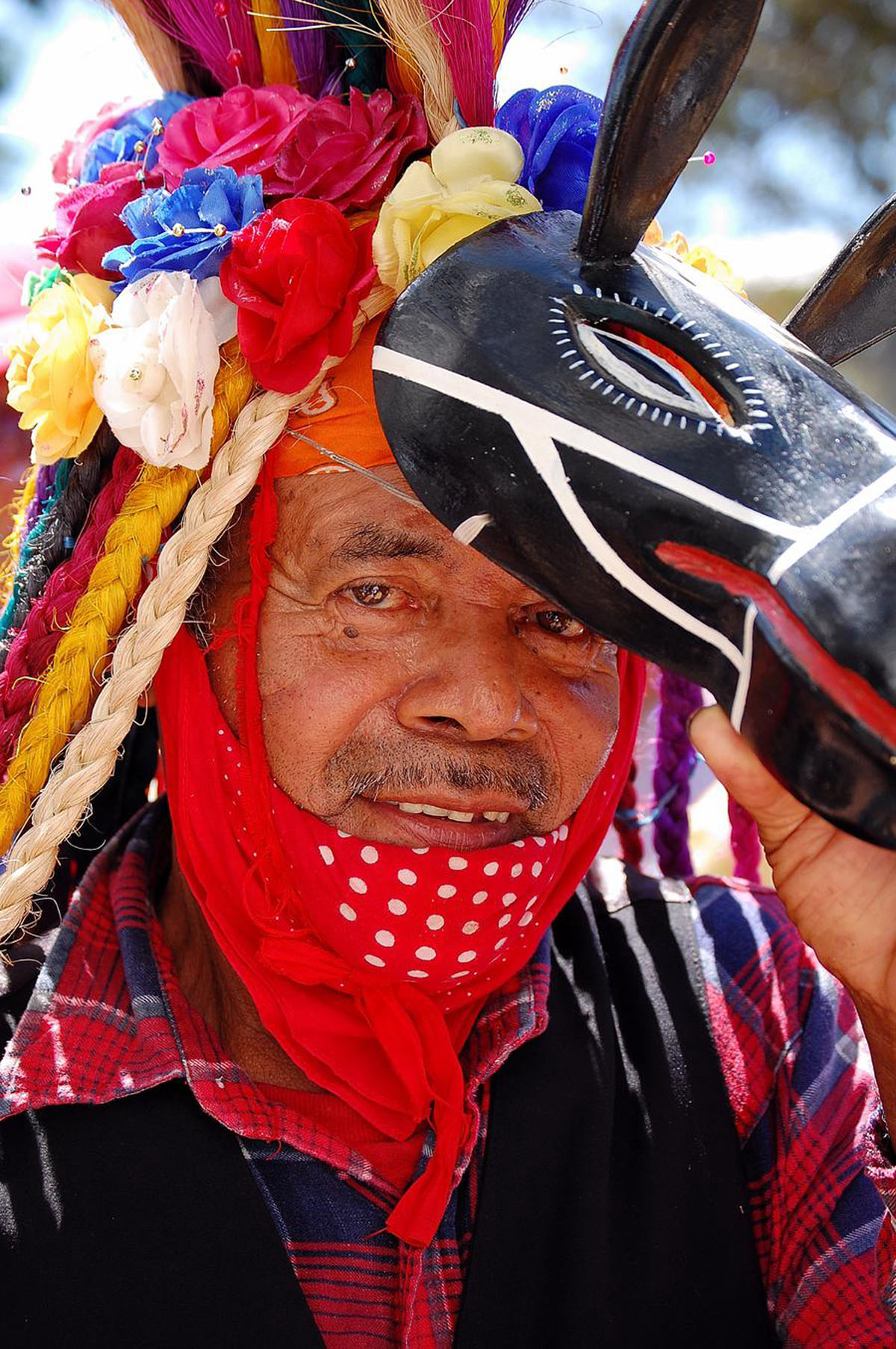
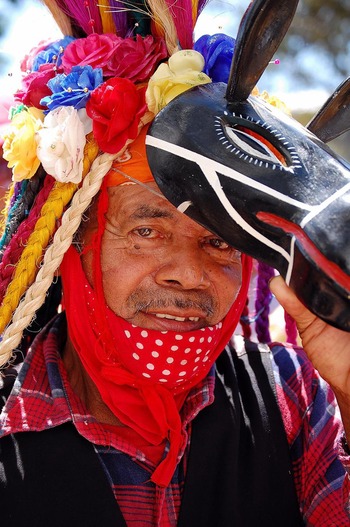
Among the most recognizable figures in El Güegüense are the four machos (donkeys) (Figure 1). Their presence on the stage is marked by a dance by which the play itself is also at times known: Macho ratón (or Baile de los machos). Their first dance occurs by the command of Governor Tastuanes, before a procession of women arrives and the deal is struck to marry Güegüense’s son Forsico to Doña Suche-Malinche. The machos’ dances are marked by their departure from those previously performed in the play, particularly the transformation of the music and dancer’s movements to mimic the sounds and actions of animals (Reference Cid Pérez and de CidCid Pérez and Martí de Cid 1964, 156–157). Mántica (Reference Mántica1989, 128) considered the machos and their dance to be an element added to the play. I certainly agree. Their appearance with the arrival of Suche-Malinche’s (voiceless) procession significantly alters the tone of the play.
Macho dancer from El Güegüense. Photo: Claudia Tijerino.
After their final dance, the machos are examined by Güegüense, who questions his sons about the animals’ health. His first question, “Has this donkey’s cinchera healed already, boy?” (line 281) is met with an affirmative reply, as is the second that immediately follows: “And this other donkey, is the riñonada healthy yet?” (line 283). Both words hold significance. The first, cinchera, is the part of an animal’s body where the cinch of a saddle goes (around the chest, below the forelegs). Riñonada also signifies a part of an animal’s body in relation to a saddle. However, it also has a secondary meaning of the kidneys, or often more directly the fat of the kidneys. The double meaning of these questions following the dance stands out.
If we consider la riñonada first, this secondary meaning regarding the kidneys is of interest. As with the other body parts mentioned, the surface level is likely questioning some affliction that the machos received from their saddles. It is worthwhile to note ailments concerning kidneys and donkeys. When under stress and in situations where food access becomes uneven, donkeys (underweight and otherwise) are at risk of hyperlipemia, a metabolic disorder marked by abnormally high levels of triglycerides (fats) in the bloodstream (Reference Harrison and RickardsHarrison and Rickards 2018). It is an often fatal affliction. Recovery from this affliction is unlikely, as audience members would probably know. I would like to address a deeper understanding.
Of all organs mentioned in the Bible, kidneys are mentioned thirty times, including eleven times in direct reference to their use in animal sacrifices among Jewish people (Reference EknoyanEknoyan 2005, 3467). As objects of sacrifice, it is the fat of the kidney that is valued the most, which riñonada can denote. This use of the word lends a substantially different meaning to the dialogue that happens following the Macho ratón. Kidneys are powerful sacrificial elements in the biblical world, with significance beyond the merely organic. Their sacrificial importance and their position as being a seat of ethics and mortality are noteworthy (Reference KoppelKoppel 1994).
The cinchera is analogous to the horse’s girth or heart girth. It is where the saddle strap cinches around an animal. Injury of the kidneys at this point is plausible. Health issues would be attributed to improper saddle placement. However, considering the surrounding context, this question also falls into an interrogation of deeper meaning. The English translation of cinchera (heart girth) draws the point straightforwardly. While it is not directly associated with the heart in Spanish in the same way that riñonada is to a kidney, this is the external part of anatomy that is perhaps closest to the heart. The heart has a strong connection to the act of sacrifice. Heart sacrifice imagery is attested in prehispanic art, with iconography showing methods of its removal (Reference Robicsek, Hales and BooneRobicsek and Hales 1984). In the Postclassic Period (ca. 900–1521 CE), heart extraction was the most commonly practiced form of human sacrifice among Maya peoples (Reference Sharer and TraxlerSharer and Traxler 2006, 751). Among Indigenous peoples of what is currently Pacific Nicaragua, human sacrifice, including of the heart, was reported by Spanish chroniclers. In the early colonial period, stories of human sacrifice persisted.
Following the questions about the cinchera and riñonada, Güegüense continues his inquiry into the health of the machos. He remarks that one of the machos is unwell on account of it having an erection (line 285), and ascribes the animal’s swollen genitals to the affliction fluxión (an accumulation of fluid, often pus, in a part of the body, leading to swelling; alternatively, a hyperaemia). To cure the ailment, Güegüense directs his son Don Forsico to burst the macho’s genitals (line 289). The young man refuses, and the two argue over who should perform this procedure. The word fluxión is clearly being used as a vulgarity (Reference Cid Pérez and de CidCid Pérez and Martí de Cid 1964, 154), along with the command to relieve the macho’s condition. And while the interaction between the characters is in keeping with the sexual and earthy humor of the play, this stands out within this context.
Rather than viewing the health examinations following the Macho ratón as an opportunity to move characters across the stage and as a setup to the sexual humor involved in Don Forsico being commanded to relieve the macho of its “fluxión,” I offer a reading that depicts greater significance. In a play of layered meanings, the reading of the fluxión dialogue can be viewed as containing meaning beyond just humor. The surface interpretation of this exchange is of a carnal nature and has fit into interpretations of sexuality (Reference Blandón GuevaraBlandón Guevara 2003). My conocimiento considers a deeper, ceremonial, foundation to the imagery of the fluxión.
The imagery of the fluxión dialogue evokes not only sexual humor but also prehispanic ritual practices. Güegüense’s command not only points towards sexual action but to lancing a wound, specifically the genitals. Bloodletting from the penis is mentioned in Mesoamerican contexts, such as prehispanic carved monuments and the K’iche’ Popol wuj (Reference StrossStross 2007, 389–391). In Pacific Nicaragua, Oviedo recorded three major festivals among Indigenous peoples at which the ritual bloodletting of participants’ penises occurred to sanctify maize for ritual consumption (Reference NewsonNewson 1987, 63). The exchange between Güegüense and Don Forsico, then, can be interpreted as one last act of sacrifice the machos must undertake, having already recovered from their previous sacrifices.
Interpreting the machos as sacrificial animals ties into the origins of El Güegüense and raises questions of the imagery’s purpose and the presence of the machos in the first place. The sacrificial traditions that I have drawn on to interpret the health inspection of the machos are from Mesoamerican and biblical worlds. To consider this understanding of sacrificial imagery, one must assume that the authors of El Güegüense intimately understood Indigenous spirituality and were aware of biblical sacrificial imagery. In fact, authors such as Richard Haly (Reference Haly1996, 541) have noted the use and adaptation of Christian ritual and prayer to hide Indigenous Mesoamerican cosmologies; this is survivance, not mestizaje. To understand the nature of the sacrifice of the machos, it is important to comprehend what the machos are, and the significance of their deaths (and seeming resurrection). If the play is based in prehispanic tradition, then the root of the machos cannot be a donkey; as Spanish imports, they simply did not exist in the prehispanic world. If the author was Chorotega, then what does the macho represent as a sacrificial creature, if not a donkey?
The Chorotega Horse
Within El Güegüense, the only nonhuman characters are the four machos, portrayed as black donkeys. In different cultural expressions, particularly those in the Masaya Department, horses and donkeys—or creatures with the qualities of either—also appear, specifically, in two separate street performances associated with religious holidays and saints. What is particularly interesting about these festival dances is that they are more readily understood than El Güegüense as cultural works connected to contemporary Indigenous peoples. These heritages, while read and accepted as Chorotega creations, have been appropriated by wider populations. In this way, regardless of the direction of perceived ownership and origins, both these Indigenous performances and El Güegüense share the distinction of being appropriated by mestizo Nicaraguan culture.
Baile de la Yegüita
The performance of pueblos indigénas in Masaya (Nindirí, San Juan de Oriente, and Monimbó) called El baile de la Yegüita (Dance of the Little Mare) features six characters called GüeGües who fight over a mare or filly (Reference Solano Lacié, Quesada and TosattiSolano Lacié, Quesada, and Tosatti 2005, 124). These dancers are painted in black and carry out a ritual struggle with one another until the Yegüita herself intervenes, whereupon the dance begins again. La Yegüita is carried out in honor of San Juan Bautista on June 24.
Among Chorotega communities in Guanacaste, Costa Rica, the Yegüita appears as a folkloric being and in performances. According to Chorotega tradition, two Indigenous brothers come into conflict with one another over a woman, eventually coming to blows and threatening to kill one another. Their struggle is only stopped by the appearance of a small brown horse that attacks and separates them for their foolhardy quarrel, before disappearing. In some retellings, the woman in question (who clearly is not simply a woman) turns into the horse to stop their confrontation. Among Guanacaste Chorotega communities, the performance featuring the Yegüita, held in honor of the Virgen de Guadalupe, originally included La chilillada (The whip) until it was banned by priests in the early 1900s (Reference Solano Lacié, Quesada and TosattiSolano Lacié, Quesada, and Tosatti 2005, 124). This aspect of the dance featured groups of men beating each other with whips made of tapir leather only to be separated by the Yegüita after they had drawn blood from one another (Reference Solano Lacié, Quesada and TosattiSolano Lacié, Quesada, and Tosatti 2005, 124).
The presence of this figure among Chorotega communities separated by hundreds of kilometers (including the Rivas Isthmus, which Nahoa people came to occupy in prehispanic times) and colonial administrative boundaries is worth considering. Despite being divided and somewhat isolated from one another, this story, its meanings, and expressions appear to be an enduring part of Chorotega heritage. While it may be possible that these expressions occurred in the colonial period with Chorotega people remaining in communication with one another, it is far more likely that the Yegüita and the woman central to the conflict represent a much older spirit. For Cárdenas Argüello and Cuadra (Reference Cárdenas Argüello, Cuadra and Vargas2003, 321), the mare is not a horse at all but a native animal that had been made into a horse as a result of colonial forces.
A Horse, A Deer
Mary Pohl (Reference Pohl1981) drew connections between prehispanic Maya ritual practice and modern festivals involving bullfights. In this, she argued that the presence of bulls in these festivals concealed another animal that was known to prehispanic worlds: the deer. She noted the Spanish accounts of Itza people’s veneration of Hernán Cortés’s horse, both in life and its statue in the early 1600s (Reference PohlPohl 1981, 521). She also highlighted evidence of horse and cattle bones in Lowland Maya caves used since prehispanic times, stating that the “cave remains provide archaeological documentation for the addition of the horse to the native pantheon and confirm its relation to the aboriginal deer deity” (Reference PohlPohl 1981, 521). In Mexica accounts, horses are even described as being deer: “The ‘stags’ came forward, carrying the soldiers on their backs. … The ‘stags’ these ‘horses’ snort and bellow… They make a loud noise when they run; they make a great din, as if stones were raining on the earth. Then the ground is pitted and scarred where they set down their hooves. It opens wherever their hooves touch it” (Reference León-PortillaLeón-Portilla 1962, ix).
The spiritual significance of the deer among many Mesoamerican peoples is documented. In what is currently Guatemala in 1525 CE, Spanish invaders came upon a large group of seemingly tame deer. When they later asked about them, “the Indians explained that the animals were gods. The main Maya idol took the form of a deer. The Indians observed a taboo on hunting so the animals were not used to being pursued” (Reference PohlPohl 1981, 521). Chinanteco and other Oto-Manguean language speakers’ stories feature sibling heroes performing a heart sacrifice of a deer before they defeat a primeval man-eating serpent (Reference Chinchilla MazariegosChinchilla Mazariegos 2017, 139). According to La leyenda de los soles (The legend of the suns), the patron deity of the Chichimecas, Ītzpāpālōtl, briefly appeared as a deer in events that led to her consuming the heart of a man and later becoming the force that demanded (and, in physical form, carried out) the xōchiyāōyōtl (flower war): ritualized combat to acquire captives for sacrifice (Reference Carr, Gingerich and SwannCarr and Gingerich 1983, 189–192).
At prehispanic sites in Pacific Nicaragua, deer bones are the most frequently found mammal remains (Reference McCaffertyMcCafferty 2008, 70). Their skins were worn by Indigenous peoples during festivals and were also used by the Nicarao to cover their books, some of which contain records of land claims (Reference NewsonNewson 1987, 53). Oviedo recounted that the Nicarao also placed the heads of deer at the doors of hunters and used the blood of the animals dried as offerings to the deer spirit, Macat (Reference NewsonNewson 1987, 61).
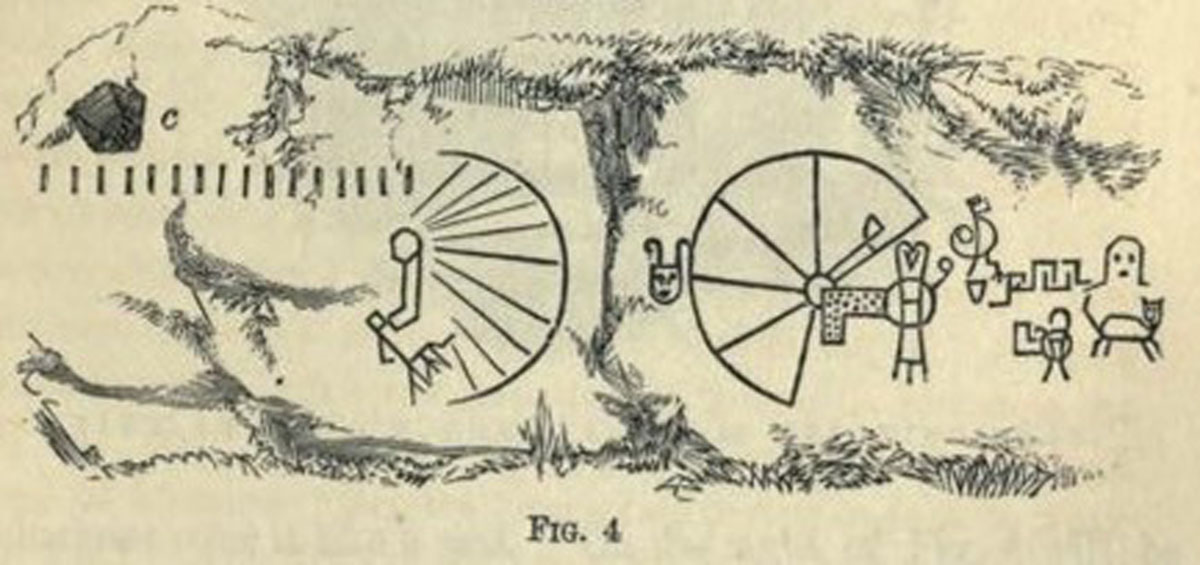
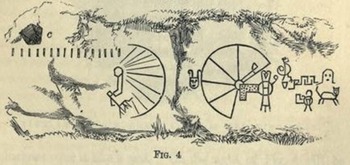
Interestingly, images of deer are not readily apparent in the cultural material of prehispanic Pacific Nicaragua, such as petroglyphs or zoomorphic pottery. There are, however, some depictions of horned or antlered human figures, such as the petroglyphs at Cailagua in Monimbó (Figure 2). Still, important facets of ceremonial life need not be evident in the physical record of artifacts to be culturally significant. While physical evidence in the archaeological record suggesting the cultural position of deer among Indigenous peoples of western Nicaragua might be scarce, records of their importance exist. Indeed, the name Masaya comes from Pipil-Nicarao and means roughly “the place where the deer are.”
Sketch of Cailagua Petroglyphs in Monimbó; horned head in center. Sketch from Ephraim Squier’s 1860 book Nicaragua: Its People, Scenery, Monuments, Resources, Condition, and Proposed Canal.
Overt depictions of a spiritually significant creature would have been noticed by Spanish priests and officials. The colonizing forces actively suppressed Indigenous religious expressions. The treatment of Indigenous people in colonial Nicaragua was particularly harsh, with Bartolomé de las Casas reporting that some five hundred thousand were enslaved and tens of thousands murdered in the first quarter century of colonial rule (Reference NewsonNewson 1987, 85–87). For Indigenous religious and cultural practices to survive such catastrophic conditions they needed to adapt and adopt a veneer of Catholicism, with imagery taking a less openly pagan guise.
As Borland (Reference Borland2006, 22–24) argued, for example, the figure and celebration of San Jerónimo in Masaya likely has roots in the Indigenous veneration of the spirit of the volcano, Popogatepe, depicted as an ancient woman with black skin living in the cave called Xinancanostoc or Cueva del Murciélago (Cave of the Bat). The saint himself is venerated in his form as an ancient cave-dwelling hermit with white skin. Reverence of the spirit of the volcano as an ancient and dark-skinned woman would be viewed as idolatrous and, therefore, unsafe for marginal people to continue. However, inverting the image would have provided the safety to carry out Indigenous ritual life, masked as something more palatable to the colonial powers. By this same logic, the significance of a deer could be inserted into something the colonists brought along with their saints. A deer becoming a horse or a donkey would allow the same form of safety while resisting colonial powers and performing acts of survivance in plain sight.
El torovenado
The Monimboseño dance called El torovenado (The bull deer) is celebrated in honor of the patron saint, San Jerónimo. The current celebration, which takes place on the last Sunday of October, features costumed processions and performances that address social issues, often ridiculing political figures. According to oral histories, in the early colonial period the dance was performed by people in both bull and deer masks (Reference Padilla FloresPadilla Flores 2000). To the performers, the deer symbolized the sun deity, the female moon spirit of the forest, and Indigenous people and traditions more broadly; the bull symbolized the Spanish colonizers.
Some origin stories of the performance maintain that it was organized near the end of the colonial period by a priest in honor of a bull that killed a dangerous jaguar. This, however, appears unlikely considering earlier attestations of El torovenado. It should be said that elements of this story may have a connection, with the tigre (jaguar) featuring centrally in the dance, in which it attacks a woman, either an elder or in some renderings the daughter of a cacique (Reference Padilla FloresPadilla Flores 2000). The story of the bull slaying the jaguar is perhaps more in line with other Chorotega stories where the savior-animal is a disguised deer. Borland (Reference Borland2006, 52) went so far as to suggest that “the torovenados may be connected to a group of deer dances, or baile/danza del venado, found throughout North and Central America.” It is a point that I entirely agree with, but to me El torovenado is not the only deer dance in Nicaragua.
Danza del venado and El macho ratón
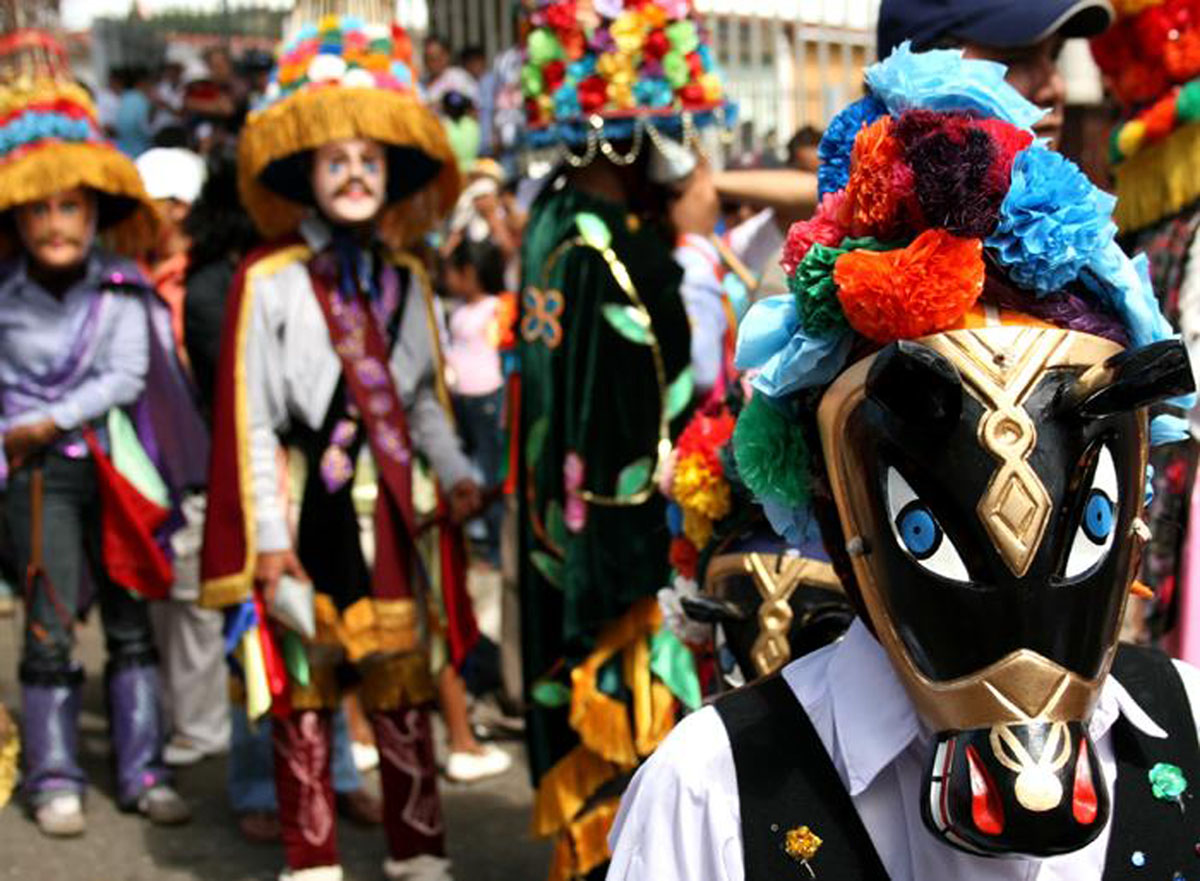
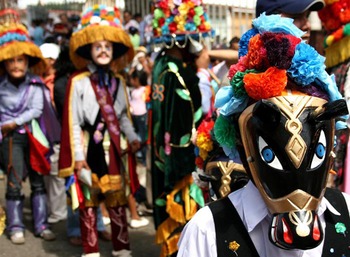
Indigenous Chorotega performances have several aspects in common with the Danza del venado found among other peoples within the so-called Mesoamerican world. As noted above, El torovenado has been suggested as having a connection with deer dances, while I (among others) understand the Yegüita as a deer. Within that scope, these two cultural performances appear to be Indigenous survivals of Chorotega deer ritual. The same can be said of El Güegüense (Figure 3).
Characters from El Güegüense in procession. Photo: Laura G. Díaz.
In their work, José Cid Pérez and Dolores Martí de Cid (Reference Cid Pérez and de Cid1964, 157) recognized that the final musical portion of the play “is a dance that comes from Guatemala and seems to have its origins in indigenous rituals.” These rituals are most likely the deer dances found among several groups of Maya peoples. Sacrifice is a central theme in both El Güegüense and the Danza del venado. Drawing on understandings from these performances across the Mesoamerican world and diverse cultures may help inform the deeper meaning of El Güegüense and Macho ratón but is beyond the scope of this article.
Discussion
The story of Güegüense and his triumph over colonial forces is significant to the people of Nicaragua as a symbol of Nicaraguan identity (and mestizaje). The work’s privileged position within the country contributes to why it was put forward for the prestigious UNESCO heritage listing. It has been branded as a great work but one that is in danger and in need of revival. In Alberto Guevara’s (Reference Guevara2010) interviews with performers and wealthy sponsors, a very clear difference of opinion was evident. Among the more affluent mestizo and white population, the play is regarded as a great masterpiece of Nicaraguan culture, which according to “Doctor” Gallardo, “ordinary people do not appreciate. … [They] are absent-minded. I invite them to participate in the revival of their own history, their own past. What do they do? They ignore the call. They come drunk. They question my intentions” (Reference GuevaraGuevara 2010, 68). This is the patronizing attitude that ladino society has of the play—which they often label as a ballet—and the performance of it. Appropriations of the play have frequently removed it from its proper location as a festival dance, in the streets and around church squares, and into theaters, where proper theater is supposed to exist.
For El Güegüense performers, the privileged mestizo interpretations of a homogenous Nicaraguan society hold little weight and even less reality. The act of carrying out the dance is sacred and sacrificial. Performers often undertake their role in the dance as part of carrying out a vow to a saint (Jerónimo in Monimbó and Sebastián in Diriamba). It is an active expression of spiritual devotion, community maintenance, and sharing of social and cultural memory. It is held as a part of their spirits, their being. One practitioner, Doña María, told Guevara (Reference Guevara2010, 69), “We don’t need to read about the Güegüense in books, everything is in our heads.” For this reason, my writing is not particularly for the benefit of practitioners, who do not need to be told the meaning of their practice.
This article has argued for an Indigenous reading of El Güegüense as a work of Chorotega—not mestizo, ladino, or Nicaraguan—heritage and survivance. Such a reading positions the work toward an understanding that has been largely ignored, and foregrounds its ritual meanings. To approach the work as one of Indigenous heritage, one must be willing to consider that it was created by Indigenous minds and is carried out by Indigenous bodies today. Scholars and poets from affluent spheres have often failed to consider that as a likely option. Except by some revolutionary and recent thinkers (Reference Dávila BolañosDávila Bolaños 1973; Reference Blandón GuevaraBlandón Guevara 2003), El Güegüense is not readily considered a work of Indigenous heritage, let alone one of still-living Indigenous heritages. Even to some authors, such as Arellano, who propose an early date for the work, the identity of its creator is evidently a powerful member of dominant colonial society, an educated person such as a priest or a wealthy merchant. It is illogical to these thinkers that an Indigenous person, an indio, could possibly be capable of such a creation. Failure to conceive of Indigenous people as thoughtful and creative and as having cultures not locked into and resigned to the past shows coloniality and mestizaje at work. This works to enable the institutionalized and normalized racism against modern Indigenous peoples.
In modern Nicaragua expressions that disparage Indigenous people and normalize white supremacy are still common. These expressions depict them as being violent (“The Indian in him came out,” said about a person who has lost their temper), unable to act properly or in a civilized way (such a person being called a “pure Indian”), and ignorant (jincho, coming from a slang term for “Indian”). Other expressions present them as vermin to be exterminated (“The Indian, the snake and the blackbird; the law says kill them”) and as undeserving of respect or treatment as equals (“There is nothing worse than an Indian eating from a china plate”).
The normalized understanding of Indigenous people as poor, backward, and uneducated has marked readings of heritage and empowered the coloniality of mestizaje. A perceived indebtedness to the Spanish also emboldens the colonization of Indigenous heritages and forces their cultures into marginal positions. Augusto Sandino, the revolutionary leader who staged an anti-imperial rebellion in the second quarter of the twentieth century and inspired the Sandinista National Liberation Front, lionized mestizaje by saying, “I used to look with resentment on the colonizing work of Spain, but today I have profound admiration for it. … Spain gave us its language, its civilization, and its blood” (cited in Reference FieldField 1998, 437).
The belief in the colonial as a “civilizing force” is a troubling sentiment that continues nearly one hundred years after Sandino voiced his admiration. Indeed, mestizaje is not a mixing of cultures but an acculturating force leading into Western modernity. It marginalizes those who do not succumb to it, and it renders those invisible whose presence denies its reality and whose continued existence rejects its perceived inevitability.
Even critics who have acknowledged modern Indigenous heritages have often been duplicitous. Donald Ortega’s interpretation of El torovenado is one of conflict and difference, wherein “the bull and the deer are not united; they are contrasted as tamed and untamable” (Reference BorlandBorland 2006, 60). And while he spoke of the “Indian, who remains free from foreign influence” (Reference BorlandBorland 2006, 60), contemporary Indigenous peoples and heritages were not what he was speaking about. I have argued that Dávila Bolaños was correct to identify the author of El Güegüense as an Indigenous person, and equally right to consider the work one of Indigenous resistance. His assertion of it as a primarily Marxist and pan-Nicaraguan resistance is, ironically, itself colonial. Even scholars with decolonial perspectives replicate colonial, anti-Indigenous conceptions in their evaluations, placing Indigenous heritages (and by proxy, people) in the past and Nicaraguan heritages as their sole inheritors.
Central to the character of Güegüense and the play is the idea of resistance. It is a theme that resonates with the understood history of Nicaragua as a land often imposed on by colonial forces. Like Ortega, Dávila Bolaños’s words regarding Indigenous roots feed directly into the myth of mestizaje, making Indigenous struggle a part of the Nicaraguan experience. Blandón Guevara (Reference Blandón Guevara2003, 172) also smoothed over the ethnic origins of the work to stress resistance. This resonance and association of struggle with that of Nicaragua and the Nicaraguan fails to understand that the mestizo, the ladino, and mestizaje are just as much colonial forces to an Indigenous person as is the United States. Güegüense resists them just as much as he resists the Spaniard. To say that El Güegüense, with its spiritual significance and position as a work of Indigenous survivance, is an expression of Nicaraguan identity is like claiming that Ghost Dances among Paiute, Lakota, Caddo, and other Native American peoples are a part of “American culture.”
If one approaches El Güegüense from a truly decolonial perspective, it becomes difficult to conceive of it as a work of the elite mestizo or the Spaniard. Reconciling the themes and imagery that it raises as being the product of anti-Indigenous, colonial forces is difficult. It takes an amount of willful obtuseness to consider a socially powerful mestizo, ladino, or chapéton—even one who admired Indigenous cultures—as its creator. Instead, it seems likely that the creator(s) is a Huehue: the Indigenous spiritual and communal leaders charged with the survival of their people and practices in the face of colonial powers. In this pursuit, such a person would also have been aware of the religious language of the colonizer.
As a work of Indigenous heritage, El Güegüense is a story of resistance against coloniality using the tools that the marginalized have available to them. It is the continuation and flourishing of Indigenous culture. The work is multifaceted. It is a trickster—a wise man—resisting oppression; it is a comedy to berate the powerful; and it is a survival of Indigenous spiritual practice: a Chorotega Danza del venado. It is an act of survivance.
In this context Doña Suche-Malinche is not the mother of the mestizo, as interpretations have suggested. Rather, she has more in common with the woman/deer in the Yegüita legend, being a focus of Güegüense after the dance of the machos. She may represent a divine spirit held as a revered prisoner by Tastuanes, rather than a Spanish bride. To ensure the future of his community (through Forsico), the trickster Güegüense must liberate her from colonial hands. At the end of the play, before mounting the machos, Güegüense says: “Let me remember my time, with that I am comforted. Ah, boys, where are we going, backward or forward?” (line 301). Forsico replies, “Forward.” While this has been considered from a perspective of progress and mestizaje, it can just as readily be viewed as survivance. Under colonial law, it was illegal for Indigenous people except community leaders to ride horses (Reference NewsonNewson 1987, 180). Their riding would either have been an act of defiance or assertion of their position within Indigenous society. Forsico’s words would then declare that Indigenous people will remain; they will not be consigned to the past.
Given that this article has supported El Güegüense as a work of Indigenous heritage, the issue becomes one of ownership. Santos Román Mercado Méndez (in Reference Falla SánchezFalla Sánchez 2013, 453), secretary to the Alcalde de Vara (the traditional leader of the Indigenous community of Monimbó), asserted that while Masaya is considered the capital of Nicaraguan folklore, that folklore and El Güegüense were all born in Monimbó. (Of course, I would not wish to diminish the work’s importance to the community of Diriamba). Chorotega heritage has been appropriated and marketed as the “typical” culture by the Nicaraguan and Costa Rican states (Reference Stocker and ForteStocker 2013, 160).
Article 11.1 of the United Nations Declaration on the Rights of Indigenous Peoples (UN 2007) states: “Indigenous peoples have the right to practice and revitalize their cultural traditions and customs. This includes the right to maintain, protect and develop the past, present and future manifestations of their cultures, such as … designs, ceremonies, technologies and visual and performing arts and literature.” However, “to present Chorotega Indigenous imagery today, it must be done through artefacts left over from a past when Indigenous existence was undeniable, or it must follow stereotypes plain enough to be recognized as Indian in a nation whose appropriation of Indigenous traditions has rendered them ineffective at evoking recognition of their Chorotega origins” (Reference Stocker and ForteStocker 2013, 152). Understood as an expression of Indigenous heritage, El Güegüense shows itself to be a masterfully interwoven act of resistance and survivance. Accordingly, it is necessary that this heritage and restorying be supported. It is ceremony, it is performance, it is literature—all of which belong to Chorotega people. While it may not be possible to disengage El Güegüense from “the Nicaraguan,” Indigenous people should be in control of its destiny. This would be a step toward decolonizing a state that has prided itself on its spirit of resistance against would-be colonizers.

 Open access

