




Nomenclature
- AI
-
artificial intelligence
- ADS-B
-
automatic dependent surveillance – broadcast
- AEI
-
aggregated-embodied emissions intensity
- CNN
-
convolutional neural networks
- DL
-
deep learning
- EASA
-
European Union Aviation Safety Agency
- EGT
-
exhaust gas temperature
- ELM
-
extreme learning machines
- FAA
-
Federal Aviation Administration
- GAM
-
generalised additive model
- GAN
-
generative adversarial networks
- GCN
-
graph convolutional network
- GDPR
-
general data protection regulation
- IATA
-
international air transport association
- ICAO
-
International Civil Aviation Organisation
- IoT
-
Internet of Things
- LLM
-
large language models
- LOF
-
local outlier factor
- LSTM
-
long short-term memory
- MAE
-
mean absolute error
- ML
-
machine learning
- MPC
-
model predictive control
- PCA
-
principal component analysis
- PdM
-
predictive maintenance
- PRISMA
-
preferred reporting items for systematic reviews and meta-analyses
- P2MPC
-
power prediction-based model predictive control
- RF
-
random forest
- RUL
-
remaining useful life
- SAF
-
sustainable aviation fuel
- SOC
-
state of charge
- TCN
-
temporal convolutional network
- UAV
-
unmanned aerial vehicles
- QAR
-
quick access recorder
- VAE
-
variational autoencoder
- WoS
-
web of science
- XGB
-
XGBoost
1.0 Introduction
In 2025, the aviation sector stands at a critical crossroads in the global climate action agenda. At the Third ICAO Conference on Aviation and Alternative Fuels (CAAF/3), member states collectively adopted an aspirational global goal of a 5% reduction in CO2 emissions from aviation fuel by 2030 through the expanded use of sustainable aviation fuels (SAFs), complementing the International Civil Aviation Organisation (ICAO) long-term aspirational goal (LTAG) objective of net-zero by 2050 [1, 2]. Despite the momentum, the sector continues to face major challenges, particularly concerning the availability and cost of SAF, which remains a top barrier to decarbonisation [1]. In this context, artificial intelligence (AI) is increasingly recognised for its transformative potential in achieving sustainability goals across multiple aviation domains.
The aviation sector accounts for approximately 2%–3% of global greenhouse gas emissions, positioning it as a critical domain in the fight against climate change [3]. Increasing air traffic demand, tightening environmental regulations and growing consumer awareness have necessitated a transformation of the industry in line with both operational efficiency and sustainability goals. In this transformation process, technologies such as AI, machine learning (ML) and deep learning (DL) have drawn attention for their multifaceted contributions. AI-powered systems not only support environmental objectives such as reducing emissions and optimising fuel consumption but also drive transformation across a wide range of functions from safety and flight planning to maintenance processes and strategic decision-making [Reference Demir, Moslem and Duleba4, Reference Manchanda5].
AI-supported systems are technological constructs that perform functions such as data analysis, prediction, learning and automation through algorithms that approximate human reasoning and decision-making processes [Reference Russell and Norvig6]. Powered by subfields such as ML, DL and natural language processing (NLP), these systems enable the transformation of large-scale and complex data into meaningful information. In the aviation industry specifically, the use of AI-supported systems initially emerged in the early 2000s in limited areas such as flight planning and fault prediction. However, in recent years, their application has expanded into multidimensional domains including air traffic management, maintenance, fuel optimisation, emissions monitoring and strategic decision support [Reference Alreshidi, Moulitsas and Jenkins7, Reference Fang8]. According to the European Union Aviation Safety Agency (EASA) [9], AI applications not only enhance operational safety but also enable environmental improvements that directly contribute to sustainability goals.
Over the past decade, AI has gained increasing influence in the aviation sector, offering transformative contributions in key areas such as safety, operational efficiency and sustainability. In this context, empirical and theoretical studies on the use of AI in aviation have also diversified. For instance, in the systematic review study presented by Fang [Reference Fang8], while emphasising the potential of AI to optimise decision-making processes in the aviation sector, it is stated that the implementation of these technologies in line with sustainable development goals should be evaluated in ethical, legal and cybersecurity contexts. Demir et al. [Reference Demir, Moslem and Duleba4] examined 224 articles and highlight China’s AI-based contributions and international collaborations in the field of aviation safety. The authors state that AI plays an important role in flight safety, accident prevention, pilot behaviour and the development of preventive strategies. In addition, the systematic review conducted by Tafur et al. [Reference Tafur, Camero, Rodríguez, Rincón and Saenz10] details the effects of AI on air operations, such as air traffic management, flight route prediction and performance improvement. Despite the difficulties encountered in data diversity and the integration of multiple information sources, the study highlights the potential of AI to increase operational safety and efficiency. Similarly, Calvet [Reference Calvet11], in a review focused on the optimisation of ground and air operations, draws attention to the contributions of AI-supported solutions in terms of airport capacity, flight duration and environmental impact reduction. A literature review conducted by Pik [Reference Pik12] discusses the potential of AI in airport security, particularly in areas such as biometric verification and threat detection, emphasising its ability to balance speed, accuracy and passenger experience.
In this context, the contributions of AI to sustainability in aviation stand out through its more flexible, predictive and real-time solutions compared to traditional methods. However, the vast majority of the literature focuses on a specific technology or application area, and comprehensive reviews reflecting sectoral integrity and thematic diversity are rarely included [Reference Fang8, 9]. Unlike prior reviews that focus on isolated domains such as air traffic management or airport operations, this study provides an integrative thematic classification encompassing the environmental, operational and policy-related dimensions of sustainable aviation. Accordingly, this study aims to address this gap by systematically evaluating the role of AI in advancing sustainable aviation goals.
The review was conducted in line with the following research objectives:
-
RQ1. How has AI been addressed in academic publications on sustainable aviation between January 2008 and May 2025?
-
RQ2. What are the most frequently used AI methods and thematic patterns in the sustainable aviation literature?
-
RQ3. In what dimensions are the technical and strategic contributions of AI to sustainable aviation classified across the reviewed studies?
2.0 Materials and methods
This study adopts a mixed-methods approach, using a systematic literature review, bibliometric analysis and content analysis to examine the contributions of AI to sustainable aviation. The methodological structure is designed to provide a holistic view of the literature and objectively reveal its trends.
2.1 Data source and search strategy
The literature review was conducted using the Web of Science (WoS) database, which was selected due to its comprehensive indexing system, interdisciplinary coverage and advanced bibliometric analysis capabilities. WoS was selected due to its multidisciplinary coverage and inclusion of most journals simultaneously indexed in Scopus and IEEE Xplore. Comparative pilot searches confirmed that additional databases yielded predominantly duplicate or non-aviation-specific results.
The review process was structured based on the Preferred Reporting Items for Systematic Reviews and Meta-Analyses (PRISMA) 2020 guidelines [Reference Page, McKenzie, Bossuyt, Boutron, Hoffmann, Mulrow and Moher13], which are widely recommended for systematic reviews and meta-analyses. Accordingly, the search was conducted in May 2025, and keyword combinations were designed to encompass the core concepts of sustainability, aviation and AI. The search string employed was as follows:
(‘artificial intelligence’ OR ‘AI’) AND (aviation OR ‘air transport’) AND (sustainability OR ‘sustainable aviation’ OR ‘green aviation’)
This string made it possible to evaluate both the technical applications and the impact of AI on sustainable aviation in policy, management and strategic contexts.
Overview of included studies on AI applications in sustainable aviation

2.2 Selection criteria
The studies included in this review cover literature published between January 2008 and May 31, 2025. The main reason for choosing 2008 as the starting year is that studies intersecting AI applications and sustainable aviation themes have started to increase significantly in the academic literature since this date. The findings obtained during the literature review show that academic interest in the applications of AI in the field of environmental sustainability has gained momentum, especially after 2008. This date also indicates a period when the concept of ‘Green AI’ began to take shape, and studies on the development of environmentally focused algorithms intensified [Reference Pachot and Patissier14]. Sustainability-focused AI interventions, especially emission modeling, fuel optimisation and predictive maintenance, began to appear more frequently in the literature after 2008. Therefore, the year 2008 was considered a significant threshold in terms of both the increase in the number of qualified publications and the conceptual development of the field and was included in the review in this context. Although the literature search covered the 2008–2025 period, only studies published from 2020 onward were included in Table 1 due to the emergence of applied AI methods in sustainable aviation during this period.
To ensure relevance and quality, publications were included in the review if they satisfied all of the following criteria:
-
• Published between 2008 and May 31, 2025.
-
• Addressed the application of AI or ML.
-
• Focused on the aviation sector (civil or commercial aviation).
-
• Contained sustainability-related goals, results or implications.
-
• Peer-reviewed full-text journal articles.
-
• Written in English.
The following studies were excluded from the review:
-
• Publications not directly related to aviation.
-
• Studies that were not associated with AI or aviation.
-
• Articles that excluded sustainability-related objectives or outcomes.
-
• Publications for which full-text access was unavailable.
-
• Articles published in languages other than English.
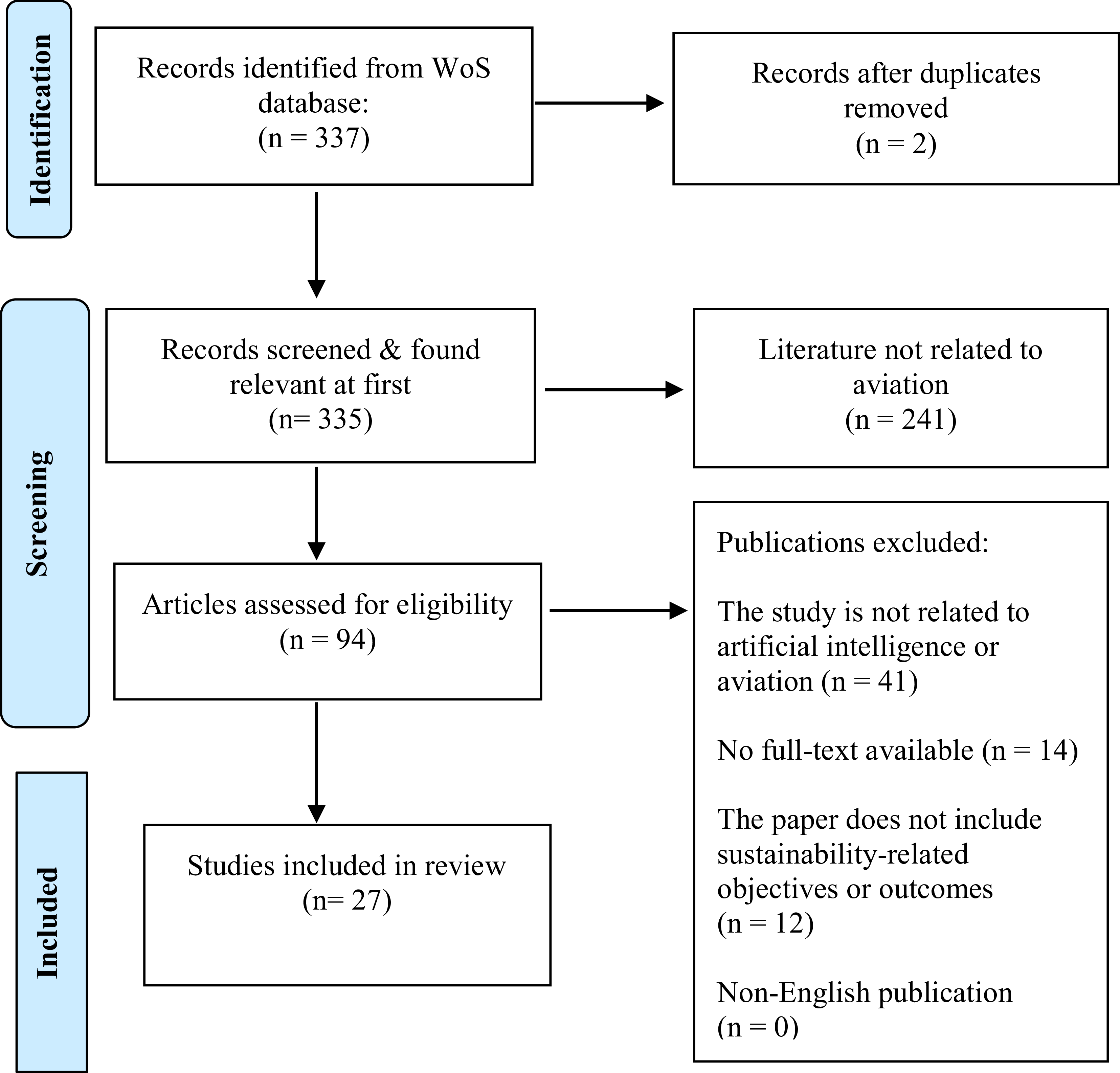
The PRISMA flow diagram illustrates the screening process in Fig. 1. The screening process was conducted in three main stages: identification, screening and inclusion. Initially, 337 records were identified through the WoS database. After applying the predefined inclusion and exclusion criteria, 310 records were excluded. Consequently, 27 peer-reviewed articles that met all eligibility requirements were included in the final analysis.
2.3 Conducting phase
Prior to analysis, a total of 337 articles initially identified through the WoS database were systematically imported into the EndNote20 reference management software. This step ensures accurate tracking of the bibliographic information and facilitates the export of the data required for the analysis process. The screening process was conducted within EndNote to facilitate systematic filtering and categorisation. As a result of this process, 27 articles that met all the eligibility criteria were retained for in-depth analysis. To increase the validity and reliability of the analysis process, EndNote20 reference management software, which is preferred in systematic reviews, was used. User guides and literature indicate that EndNote accelerates the work process and provides a systematic structure by supporting operations such as adding, removing, tagging and full-text association centrally and consistently [15]. EndNote 20 was used to manage and de-duplicate references and to facilitate systematic screening [Reference Bramer16]. In addition, the features of this software, such as multi-user support, version tracking and annotation, have strengthened the traceability and reportability of the study.
PRISMA 2020 flow diagram for article selection.

Figure 1 Long description
The flowchart begins with the identification phase, where 337 records are identified from the WoS database. After removing 2 duplicates, 335 records are screened for relevance. 241 records are excluded as they are not related to aviation. 94 articles are assessed for eligibility, with 41 excluded for not being related to artificial intelligence or aviation, 14 for having no full-text available, 12 for not including sustainability-related objectives or outcomes, and 0 for being non-English publications. Finally, 27 studies are included in the review.
Following this, a comprehensive review of the full texts was conducted. The articles were then subjected to a combination of qualitative content analysis and descriptive mapping, following established methodological recommendations [Reference Elo and Kyngäs17, Reference Tranfield, Denyer and Smart18]. Manual coding was performed based on a structured coding scheme developed in line with the research objectives. The coding focused on key dimensions such as:
-
• AI technique used (e.g. ML, DL, hybrid models)
-
• Aviation domain (e.g. aircraft maintenance, flight operations, airport systems)
-
• Sustainability focus (e.g. emissions reduction, resource efficiency, noise mitigation)
-
• Data type and source (e.g. ADS-B data, simulation outputs, maintenance logs)
To ensure the validity and reliability of the analysis, several strategies were implemented. Initially, the coding scheme was pilot-tested on a sample of articles to refine the category definitions and ensure alignment with the research objectives. To assess the inter-coder reliability, an independent aviation researcher was invited to code a subset of the data. Any discrepancies were discussed collaboratively until a full consensus was reached, thereby minimising subjective bias and enhancing consistency. Additionally, expert opinion was sought regarding the relevance and clarity of the coding framework and analytical procedures. Feedback from the domain experts contributed to the refinement of both the coding categories and the overall research design. Methodological triangulation was also applied by combining qualitative content analysis with descriptive mapping, supporting the credibility and depth of the interpretation.
MAXQDA 2024 software was used for the management and analysis of the coded data, thus ensuring systematic categorisation and traceability. Biblioshiny (an R-based interface) and VOSviewer 1.6.20 were employed to create visual representations such as the frequency distributions of the AI methods.
3.0 Results
3.1 Systematic review
Based on the findings of this systematic review, it has been identified that AI applications in the sustainable aviation sector assume multidimensional roles in the context of sustainability. The 27 analysed studies stand out with solutions developed especially in line with the sustainability goals. The findings obtained from the studies were classified thematically and gathered under four main themes in Table 1. This thematic framework was structured to more clearly reveal the application areas where AI contributes to sustainable aviation.
The findings of the 27 studies analysed were gathered under four main themes. The main themes in question are: AI-driven emission reduction and fuel efficiency; aircraft maintenance and reliability with AI support; airport and infrastructure sustainability; and AI applications in aviation education, decision support and policy making.
3.1.1 AI-driven emission reduction and fuel efficiency
This theme covers studies where AI and ML methods are used to reduce carbon emissions, optimise fuel consumption and improve environmental performance in aviation. A total of 18 studies were included in the review under this theme. These studies cover various applications such as the optimisation of SAF, hybrid engine modeling, fuel load planning, engine emission prediction and preventing unnecessary fuel consumption caused by air traffic operations. AI applications have demonstrated a significant effect on enhancing sustainability by improving operational efficiency and supporting the ICAO’s long-term CO2 reduction goals. ML-supported predictive analytics play a critical role in reducing carbon emissions in production processes and offer decision-support systems that enhance energy efficiency through real-time monitoring and anomaly detection [Reference Ojadi, Onukwulu, Odionu and Owulade19]. This approach sheds light on similar processes used in aviation and highlights the general potential of AI-based sustainability strategies. The artificial neural network-based model developed by Kosir et al. [Reference Kosir, Heyne and Graham20] predicts the material compatibility of SAF blends within aircraft fuel systems and enables the development of fuel types optimised for both safety and environmental performance. Similarly, Oh et al. [Reference Oh, Oldani, Solecki and Lee21] developed deep learning models that included uncertainty calculations to predict flash points of sustainable fuels. These studies suggest that AI can be used as a reliable tool, especially in SAF certification processes. Additionally, Wang et al. [Reference Wang, Xue, Wu and Yan22] demonstrated that fuel consumption predictions and optimisation based on the QARQAR data provided an average fuel saving of 3.67%. These models consider ICAO-recommended reserve fuel policies and contribute to strategies that reduce the environmental impact while maintaining operational safety. The power prediction-based model predictive control (P2MPC) system developed by Wei et al. [Reference Wei, Ma, Xiang and Liu23] provided fuel efficiency and emission reduction by controlling the battery status and EGT in hybrid land-air vehicles. This represents a critical AI application in the context of the anticipated proliferation of electric and hybrid aircraft. Sun et al. [Reference Sun, Zhang and Su24] analysed the final demand-based emission intensity of the transportation sector on a more macroscale and showed that air transportation increases the indirect climate burden in developed countries. AI-supported data analysis techniques provide significant advantages in such analyses. Similarly, Miller et al. [Reference Miller, Durlik, Kostecka, Łobodzińska and Matuszak25] emphasised the transformative potential of AI technologies in increasing energy efficiency and reducing greenhouse gas emissions in the transportation sector. The study states that AI-supported solutions in flight route optimisation, management of alternative fuel systems and fleet planning contribute to reducing the carbon footprint in aviation. AI facilitates production, distribution and performance optimisation in hydrogen and biofuel-based systems by enabling process modeling, yield prediction and energy-flow optimisation functions that accelerate SAF integration into existing aviation fuel infrastructures [Reference Miller, Durlik, Kostecka, Łobodzińska and Matuszak25]. In the literature, it is emphasised in many sources that such AI applications play a critical role in achieving sustainability goals. Likewise, the ICAO’s Environmental Report [2] emphasised AI as a technology that should be integrated into carbon reduction strategies. In this context, it is seen that AI technologies in the aviation sector offer multidimensional contributions to achieving sustainability goals not only at the operational level but also at the strategic, environmental and infrastructural levels. The studies examined reveal the potential of AI to increase environmental performance, especially fuel efficiency and emission reduction, with concrete applications.
3.1.2 Aircraft maintenance and reliability with AI support
In the aviation industry, maintenance operations play a critical role in ensuring flight safety and operational continuity. Particularly for airline operators functioning under high safety requirements and cost pressures, optimising aircraft maintenance processes is important [Reference Ahmadi, Söderholm and Kumar26]. While traditional maintenance approaches are mostly based on time-based or reactive strategies, in recent years, AI-based solutions have transformed the sector by making these processes data-driven, predictive and predictive [Reference Pınar27]. AI technologies such as ML, robotics, Internet of Things (IoT), computer vision and natural language processing have been integrated into maintenance processes, enhancing both operational efficiency and technical reliability [Reference Amit28]. For instance, Rolls Royce’s Intelligent Borescope system reduces engine inspection time by 75%, while Lufthansa Technik’s Condition Analytics solution analyses sensor data to predict maintenance needs in advance [Reference Lu29]. These systems not only detect current faults but also contribute to the optimisation of maintenance planning by making future-oriented predictions based on historical usage data and failure trends. These thematic findings are consistent with the studies analysed in this review. For instance, Kabashkin et al. [Reference Kabashkin, Perekrestov, Tyncherov, Shoshin and Susanin30] demonstrated that AI-supported maintenance optimisation in unmanned aerial vehicles (UAVs) led to a 20% cost reduction. In addition, other studies on this theme emphasise various technical dimensions regarding the applications of AI in maintenance processes. For example, Apostolidis et al. [Reference Apostolidis, Bouriquet and Stamoulis31] developed a solution for the damage detection of engine components using neural network-assisted image processing algorithms. Plastropoulos et al. [Reference Plastropoulos, Bardis, Yazigi, Avdelidis and Droznika32] emphasised the role of AI-driven data collection and predictive analytics within the context of ‘smart hangars’, highlighting how technologies such as digital twins, robotics and IoT can optimise aircraft maintenance processes, enhance safety and contribute to sustainability in line with Industry 5.0 principles. In studies conducted within the Turkish context, Kilic et al. [Reference Kilic, Villareal-Valderrama, Ayar, Ekici, Amezquita-Brooks and Karakoc33] demonstrated the applicability of deep learning-based models, particularly LSTM networks, for forecasting micro turbojet engine performance, highlighting their potential to improve maintenance efficiency and support environmental sustainability in local aviation practices. Furthermore, Mohammadi et al. [Reference Mohammadi, Rahmanian, Sattarpanah Karganroudi and Adda34] highlighted the effectiveness of transformer-based deep learning models, particularly DeiT, for early aero-engine defect detection under limited data conditions, demonstrating their potential to enhance predictive maintenance strategies and support sustainability in aircraft operations. By reducing unscheduled maintenance events, extending component lifespans and minimising resource waste, AI-driven predictive maintenance contributes directly to the environmental and economic dimensions of sustainability in aviation.
3.1.3 Airport and infrastructure sustainability
Consistent with the UN’s 2030 Sustainable Development Goals, AI-supported airport operations have increasingly focused on optimising energy consumption, waste management and traffic flow efficiency to reduce environmental impact [Reference Schulte-Sasse35]. Integrating AI into airport operations enables the optimisation of numerous processes, ranging from apron management and passenger flow to baggage logistics and terminal energy management. In the literature, the gains obtained through the integration of AI into airport infrastructure are gathered under the following headings: operational efficiency, environmental sustainability, energy savings, improvement of passenger experience and strengthening of cybersecurity [36, 37]. For example, passenger flows within the terminal are analysed with camera and sensor data, reducing congestion at security, passport control and boarding gates, thus increasing passenger satisfaction. AI-based biometric systems and facial recognition technologies accelerate identity verification processes and increase the accuracy of security protocols. Moreover, AI-supported systems in terminal energy management optimise lighting, HVAC (heating, ventilation, and air conditioning) and overall energy consumption; AI algorithms predict peak usage hours and dynamically adjust operations accordingly [37]. These applications contribute to environmentally friendly air transportation by reducing airports’ carbon emissions. The studies analysed within this theme also confirm the developments observed in the literature. For instance, Ramakrishnan et al. [Reference Ramakrishnan, Seshadri, Liu, Zhang, Yu and Gou38] evaluated the green performance of airports worldwide using explainable semi-supervised learning models. Their model offers sustainability-enhancing strategies to airport operators based on environmental parameters such as S1/S3-type greenhouse gas emissions and energy usage. Similarly, a systematic review by Selvam and Al-Humairi [Reference Selvam and Al-Humairi39] emphasised the contribution of IoT- and AI-based weather monitoring systems to sustainable airport operations. The use of these systems as decision-support tools in air traffic management helps reduce weather-related operational risks and enhances energy efficiency. The integration of AI into airport and infrastructure sustainability is driving a multi-dimensional transformation that not only increases operational efficiency but also increases environmental awareness. In light of the increasing air traffic, energy costs and environmental regulations, the comprehensive adoption of these technologies has become a critical strategic priority to both meet climate goals and improve passenger satisfaction.
3.1.4 AI applications in aviation education, decision support and policy making
As part of the digital transformation process, the aviation sector has begun to effectively use AI technologies not only in operational processes but also in education, decision support and policy making. In the context of education, large language models (LLM) and AI-supported assistants facilitate students’ access to information, improve programming skills and personalise learning processes [Reference Wandelt, Sun and Zhang40]. The study by Wandelt and colleagues [Reference Wandelt, Sun and Zhang40] empirically demonstrated the potential of ChatGPT to enhance student performance in aviation management education, while also highlighting the need for critical evaluation in terms of accuracy, reliability and contextual alignment. Within the scope of decision support systems, Klophaus [Reference Klophaus41] conducted a study utilising AI to perform SWOT analyses on five emerging aviation technologies (Urban Air Mobility, UAVs, electric aircraft, supersonic flights and SAFs). The study emphasises that AI’s capacity to produce analytical outputs can provide meaningful contributions to decision-making processes when complemented by expert opinions. This indicates that AI systems can play a supporting role in aviation strategies. AI-supported education and decision-making tools also foster sustainability by promoting safety culture, energy awareness and data-driven policymaking aligned with sustainable operational standards. When evaluated in this context, it is seen that AI-supported systems have significant potential in aviation education, decision support mechanisms and policy production. Nevertheless, the reliability, ethical implementation and human-centred design of such technologies must be carefully addressed. The principles of human oversight, transparency, and accountability should be upheld [Reference Schulte-Sasse35]. Thus, AI will continue to contribute to the digitalisation and sustainability goals of the aviation sector not only at the operational level but also in the areas of governance and education.
Collectively, these four themes demonstrate that AI technologies are being increasingly integrated into aviation operations to enhance sustainability, safety, and efficiency. While the corpus of 27 studies provides a structured overview of emerging trends, its limited size constrains the generalisation of sector-wide conclusions and should be interpreted as exploratory rather than exhaustive.
3.2 Search results
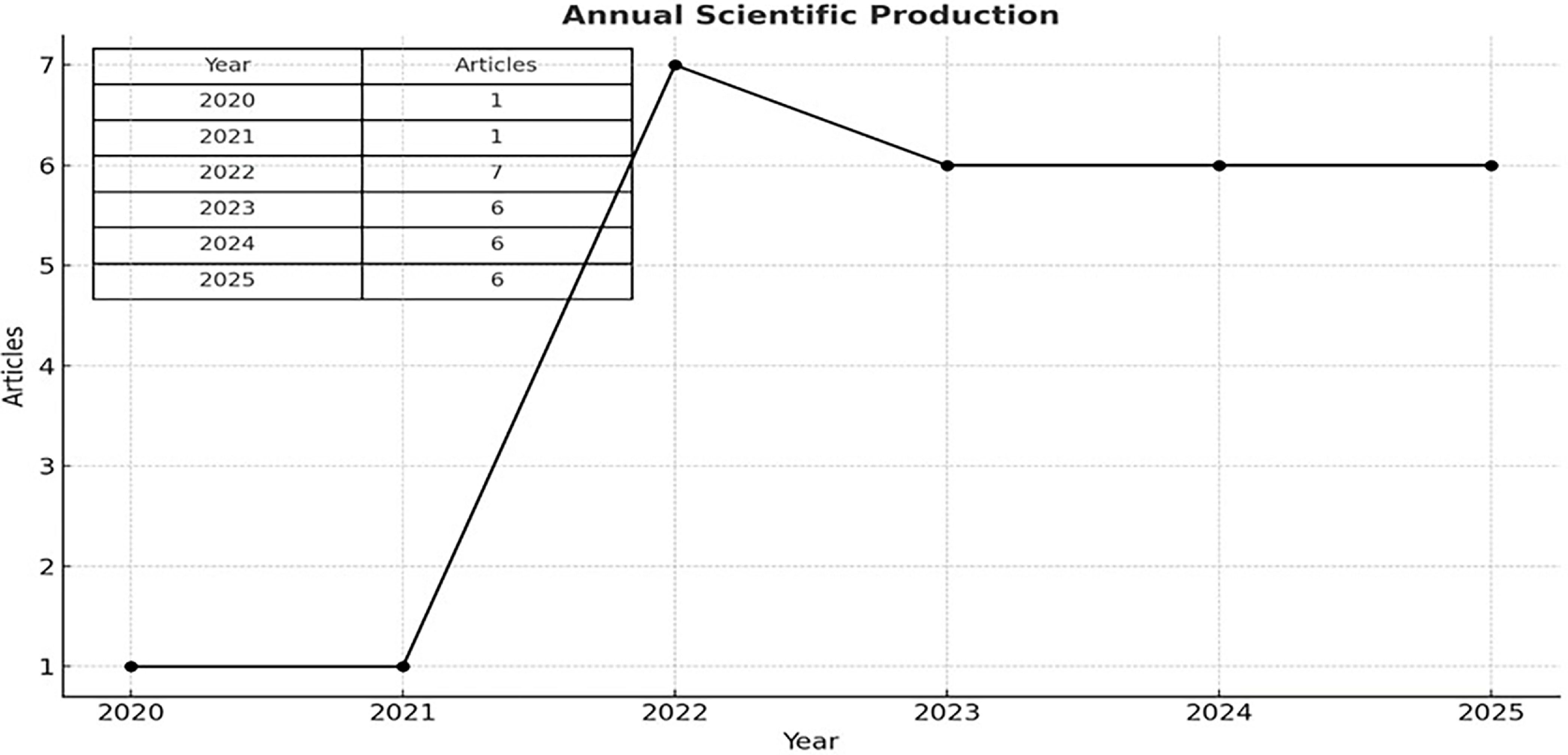
The distribution of the 27 academic publications analysed in years is shown in Fig. 2. This figure is a descriptive bibliometric visualisation illustrating publication trends, not a statistical analysis. It reflects the development trends of AI applications in the aviation field. According to the data, there was only one publication in 2020, and it is seen that the subject was represented by a limited number of studies in this period. Similarly, there was only one publication in 2021. However, there was a remarkable increase in the number of publications in 2022, and a total of seven publications were identified. This increase shows that academic interest in the relevant field has started to increase significantly.
Distribution of the studies used in the research according to years.

Figure 2 Long description
A line graph titled 'Annual Scientific Production' shows the number of articles published each year from 2020 to 2025. The x-axis represents the years, ranging from 2020 to 2025, and the y-axis represents the number of articles, ranging from 0 to 7. In 2020 and 2021, one article is published each year. In 2022, there is a significant increase to 7 articles. From 2023 to 2025, the number of articles stabilizes at 6 each year. The graph includes a table summarizing the data, with columns for 'Year' and 'Articles'. All values are approximated.
In the years 2023, 2024 and 2025, six studies were encountered in each year, suggesting a steady continuation of research production in the field. This distribution shows that AI technologies have increasingly become a focal point in the aviation sector, especially over the last five years, and are being academically discussed in multidimensional application areas such as sustainability, maintenance processes, educational systems and decision support mechanisms.
The annual distribution data obtained show that AI is gaining more and more importance in aviation, both theoretically and practically, and inter-disciplinary research is intensifying. In particular, the peak in 2022 can be associated with the acceleration of digitalisation and automation trends following the pandemic. It is anticipated that this trend will deepen further in the coming years.
3.3 Findings of AI in sustainable aviation operations
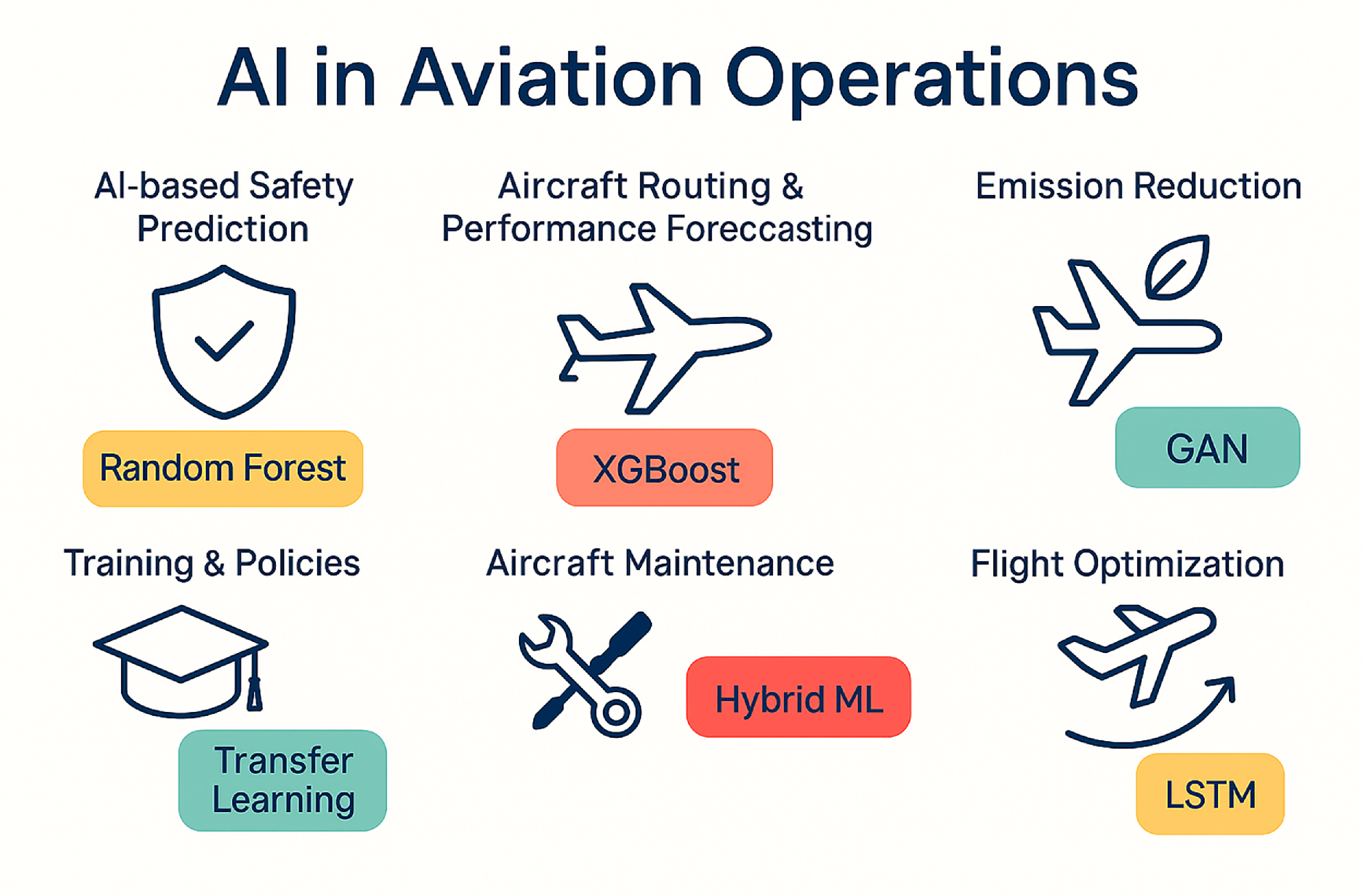
The infographic in Fig. 3 summarises the aviation operations in which AI methods were applied in 27 studies analysed within the scope of the systematic review. The most frequently used AI algorithms under each operational domain are indicated in the visual.
AI in sustainable aviation operations.

Figure 3 Long description
The image titled AI in Aviation Operations features six icons, each representing different applications of artificial intelligence in the aviation industry. The first icon, a shield with a checkmark, signifies AI-based safety prediction using Random Forest. The second icon, an airplane, represents aircraft routing and performance forecasting with XGBoost. The third icon, an airplane with a leaf, indicates emission reduction through Generative Adversarial Networks (GAN). The fourth icon, a graduation cap, symbolizes training and policies enhanced by Transfer Learning. The fifth icon, a wrench and screwdriver, denotes aircraft maintenance improved by Hybrid Machine Learning (ML). The sixth icon, an airplane with an upward arrow, illustrates flight optimization using Long Short-Term Memory (LSTM). Each icon is accompanied by a label describing the specific AI application and its associated technology.
Figure 3 presents the key dimensions of AI applications in sustainable aviation operations, each of which is briefly explained to illustrate their specific contributions to environmental, operational and strategic goals.
3.3.1 AI-based safety prediction: random forest (RF)
AI offers significant contributions to enhancing operational safety in aviation. In particular, RF, a supervised learning algorithm, is widely used to predict safety-critical events by analysing flight data. This method enables the identification of patterns that are difficult to detect using traditional inspection techniques, thus allowing risky situations to be anticipated in advance [Reference Breiman42, Reference Li, Wen and Su43]. In this context, AI-powered predictive maintenance (PdM) applications are rapidly gaining importance in the aviation industry. With systems based on historical maintenance records, IoT-based sensor data and visual inspections, it is possible to predict mechanical failures with high accuracy before they occur. This not only reduces maintenance costs but also increases system reliability [Reference Rubinstein44]. An example of this innovative approach is the camera-based PdM system developed by the Israel-based company OdysightAI. This system was developed following the 2017 crash of an Apache helicopter caused by a failure in a flight control rod that was not monitored by existing maintenance systems. Using micro-cameras and specialised AI models, the system continuously monitors critical components and provides early warnings. This development adds a visual layer to traditional prognostics and health monitoring (PHM) systems for components that are otherwise not covered [Reference Rubinstein44]. The system is currently deployed in IDF Apache helicopters and is being tested for broader integration in other rotorcraft platforms and under extreme environmental conditions in collaboration with NASA. Analyses show that such systems provide a 40% cost saving compared to reactive maintenance methods and 8%–12% compared to preventive maintenance systems. AI’s contribution to aviation safety is not limited to individual aircraft systems. Ricci [Reference Ricci45] states that commercial aviation is still the safest form of transportation and that according to International Air Transport Association (IATA) data, only 0.16 accidents occur per million flight segments. However, increasing air traffic density and inadequacies in critical workforce areas such as pilots, air traffic controllers and maintenance technicians constitute the main safety challenges facing the aviation sector. At this point, ML techniques such as RF play an important role in operational decision support systems by increasing situational awareness and reducing the cognitive load of maintenance or flight crews. Moreover, in systems developed by Airbus, such as Wayfinder and Optimate, RF-based models are actively employed in advanced functions, including autonomous flight control and 4D trajectory management. These systems aim to conduct operations both safely and efficiently by analysing multivariate inputs such as weather, traffic density, fuel consumption and even pilot attention distributions in real-time [Reference Ricci45]. In this context, it can be said that AI-based modeling and prediction tools offer a safety architecture that covers not only maintenance processes but also holistic flight systems.
3.3.2 Aircraft routing and performance forecasting: XGBoost
Flight routing and performance prediction hold strategic importance for airline operations in terms of both operational efficiency and energy management. Traditional route planning approaches typically rely on fixed rules and historical data, failing to adequately account for dynamic variables such as weather conditions, traffic density and real-time system behaviours. In this regard, powerful ML algorithms like extreme gradient boosting (XGBoost) offer significant advantages in predicting flight performance and routing decisions with high accuracy [Reference Chen and Guestrin46, Reference Rajendran and Sundararajan47]. XGBoost is particularly prominent in predicting microturbine engine performance and modeling parameters such as fuel consumption and aerodynamic drag during flight [Reference Paraschos, Trimble, Bhargava, Klingler and Nicolai48]. This algorithm predicts the behaviour of aircraft systems under certain operational conditions by learning from historical flight data. It enables the development of more efficient, environmentally sustainable and time-optimised flight plans in line with these predictions [Reference Li, Wen and Su43]. Moreover, XGBoost has demonstrated strong predictive capabilities in airport ground operations. In a study by Wang [Reference Wang, Xue, Wu and Yan22], the taxi-in time of arriving aircraft was predicted at an airport located in central-southern China. In the study, 15 affecting factors were determined, the importance of these factors was ranked by the RF method, and then the XGBoost-based prediction model was applied. The model, which was evaluated with criteria such as mean absolute error (MAE), mean square error (MSE) and root mean square error (RMSE), showed 92.78% accurate prediction success within ±5 minutes when compared to linear regression, support vector machines, and artificial neural networks. Paraschos [Reference Paraschos, Trimble, Bhargava, Klingler and Nicolai48] supported the success of XGBoost in flight time estimation with visual analysis. In the study, the relationship between the actual flight times and the times estimated by the XGBoost model was examined with a scatter plot, and the model’s predictive ability was revealed with high accuracy. Each data point corresponds to a specific flight, with the actual values on the horizontal axis and the predicted values on the vertical axis. This graphical approach provides important clues in terms of the model’s stability and predictive success. In addition, another study by Shengyuan et al. [Reference Shengyuan, Xinghua, Guangdong, Wu and Zhao49] showed that XGBoost is also used innovatively in the context of air-rail integrated transportation networks. In this study, a heuristic path planning algorithm (XGB-HPPA) based on XGBoost is proposed for the prediction of transfer stations in time-expanded graphs (TEG) with high data density. The model first reduces the complexity of the network by eliminating inefficient transfer nodes and greatly speeds up the processing time of path-planning algorithms. Comparative analyses show that XGB-HPPA both increase the number of valid solutions and obtains results that converge to the optimal solution. Such applications reveal that XGBoost can be effectively used not only in in-flight system predictions but also in macro-level multimodal transportation planning.
3.3.3 Emission reduction: generative adversarial networks (GAN)
Given that aviation accounts for approximately 2.5% of global greenhouse gas emissions [50], accurate emission modeling has become a priority area for sustainability-focused innovation. In this context, AI algorithms have become a critical tool, especially in scenario simulations aimed at modeling, estimating and reducing carbon emissions [Reference Adewale, Ene, Ogunbayo and Aigbavboa51]. In particular, GAN algorithms provide significant benefits in synthesising low-quality or incomplete environmental data, determining emission sources and testing operational scenarios. Zhang et al. [Reference Zhang, Rong, Liu and Yang52] stated that these algorithms can be used to estimate carbon emissions, especially at seaports and airports; GAN-based data enhancement methods provide more effective results than traditional sensor data in accurately modeling port-based emissions. The same study emphasises that software development processes should be systematically structured from the conceptual design to the final prototype to increase the accuracy of emission analyses. Similarly, a study developed by Zhou [Reference Zhou53] demonstrated significant improvements in accuracy, F1-score and strategy adaptation capabilities in carbon emission prediction through optimisations made on the convolutional neural networks (CNN) architecture. This model was equipped with multi-scale feature extraction, attention mechanisms and advanced optimisation algorithms and was tested on datasets related to fuel use and the carbon footprint of airline companies. The findings showed that the proposed model has much higher accuracy and response time than other traditional AI architectures, and its performance is further improved, especially in environments with large data volumes [Reference Zhou53]. On the other hand, a study conducted by Kosir et al. [Reference Kosir, Heyne and Graham20] revealed that GAN algorithms successfully predicted the volumetric swelling effects on aircraft fuel systems in contact with SAF. In this way, the environmental performance was increased by preserving material compatibility and optimum fuel mixtures could be created in terms of energy efficiency. The ability of GANs to model such physical interactions enables a much more comprehensive and dynamic structure compared to traditional statistical modeling. All these examples demonstrate the multifaceted contributions of AI in emission reduction. The use of models such as GAN, CNN, temporal convolutional network (TCN) and graph convolutional network (GCN) in both direct carbon estimations and operational improvement processes enables the design of environmental sustainability strategies based on scientific foundations. Thus, airlines are empowered to make more proactive and data-driven decisions, not only to comply with regulations but also to reduce operational costs and fulfill their environmental responsibilities.
3.3.4 Training and policies: transfer learning
The integration of AI technologies into aviation training processes and policy development increases the quality of learning in the sector and strengthens strategic decision-making processes. In particular, transfer learning allows models developed for use in different training scenarios to be adapted to other training environments, shortening learning times and increasing performance. For instance, transfer learning models developed for simulator environments in aviation training accelerate pilots’ adaptation to emergency scenarios and significantly improve the effectiveness of such training processes [Reference Savaş, Özdemir and Esen54, Reference Cao, Zhang and Feng55]. Transfer learning enables the adaptation of pre-trained models to specific aviation datasets, reducing the computational demand and training costs, which enhances energy efficiency and resource sustainability in AI model development. In addition, the integration of large language models (LLMs) such as ChatGPT into educational processes supports the faster acquisition of theoretical knowledge and facilitates the comprehension of complex aviation terminology for students [Reference Liu56]. These systems promote interactive and dynamic learning in training environments, thereby enhancing the retention and effectiveness of conceptual understanding. In terms of policy development processes, AI-supported decision-making mechanisms are of critical importance. In particular, AI-based data analytics methods help to better plan and manage operational and strategic decisions in aviation management. The detailed data analysis and predictive capabilities provided by the AI models make it possible to comprehensively evaluate the basic dimensions of air transportation policies, such as sustainability, economic efficiency and safety [Reference Kabashkin, Perekrestov, Tyncherov, Shoshin and Susanin30, Reference Yıldız and Çulha57]. For example, ML algorithms used in decision support systems play an active role in the planning of airspace management and air traffic policies, reducing the cognitive load of air traffic controllers and increasing the level of safety [Reference Milićević58]. As a result, the integration of AI methods into education and policy development processes accelerates the future transformation of the aviation sector and contributes to the creation of a more efficient, safe and sustainable aviation ecosystem.
3.3.5 Aircraft maintenance: hybrid ML
Aircraft maintenance processes are one of the key components of ensuring safety and continuity in aviation operations. Hybrid ML approaches have recently come to the forefront to increase the effectiveness of maintenance activities and prevent operational disruptions. Hybrid models combine different types of algorithms to increase accuracy, early fault detection and predictability compared to the models used alone. Kaynak and Ervural [Reference Kaynak and Ervural59] emphasised that the hybrid ARIMA-ANN model outperformed the classical linear and nonlinear methods in predicting machinery failures. These hybrid models can effectively identify both linear and nonlinear patterns in real-world data, significantly reducing unplanned downtimes. This approach is noted to improve operational efficiency and lower maintenance costs, thereby supporting the competitive advantage of airlines. Jasra et al. [Reference Jasra, Valentino, Muscat and Camilleri60] recommended the use of the local outlier factor (LOF) algorithm together with hybrid statistical methods for anomaly detection in-flight data. This method not only detects anomalies occurring during the flight process but also increases flight safety by quantifying the degree of anomalies. Thus, detailed analysis is provided even during short periods when the flight exhibits abnormal behaviour. This method significantly supports maintenance and safety management processes by reducing human intervention in flight data analysis. Paredes et al. [Reference Paredes, Chávez, Isa-Jara and Vargas61] developed a hybrid approach combining supervised learning (MLP) and reinforcement learning (Q-learning) algorithms to estimate the remaining useful life (RUL) of aircraft engines. The method was found to offer 15% higher accuracy compared to approaches using only supervised learning algorithms and 4% more accuracy than other hybrid methods. It provided an early warning approximately 17 cycles before failure, effectively preventing unexpected machinery downtimes and reducing maintenance costs. In addition to these studies, hybrid models effectively integrate data from different sources such as sensor data, historical maintenance records, and real-time aircraft component status data to predict potential failures more accurately [Reference Kabashkin, Perekrestov, Tyncherov, Shoshin and Susanin30–Reference Plastropoulos, Bardis, Yazigi, Avdelidis and Droznika32, Reference Mohammadi, Rahmanian, Sattarpanah Karganroudi and Adda34]. Furthermore, the integration of computer vision, transfer learning and digital twin technologies into hybrid methods significantly enhances both operational and financial outcomes in maintenance processes [Reference Kabashkin, Perekrestov, Tyncherov, Shoshin and Susanin30, Reference Rubinstein44]. As a result, hybrid ML approaches increase the accuracy of failure predictions in aircraft maintenance processes and provide significant advantages in terms of operational continuity and safety by reducing maintenance costs.
3.3.6 Flight optimisation: long short-term memory (LTSM)
Optimisation of flight operations is a critical goal in the aviation industry in terms of both reducing operational costs and increasing sustainability. In this context, long short-term memory (LSTM) models, which can capture long-term dependencies in time series data, are frequently preferred in-flight optimisation processes. The effectiveness of LSTM models has been confirmed by academic studies conducted at various stages of flight operations. For instance, Qu et al. [Reference Qu, Xiao, Yang and Xie62] developed an Att-Conv-LSTM model that integrates temporal and spatial data to predict flight delays and found that it reduced prediction errors by 11.41% compared to conventional LSTM models. Similarly, Yousefzadeh Aghdam et al. [Reference Yousefzadeh Aghdam, Kamel Tabbakh, Mahdavi Chabok and Kheyrabadi63] stated that bidirectional LSTM models (Bi-LSTM) in air traffic management optimisation, when used together with extreme learning machines (ELM), allow the development of more accurate and faster decision support systems. Xiong et al. [Reference Xiong, Zou, Wan, Sun and Yu64] emphasised the importance of the DMPSO-LSTM model, which they developed based on QAR data, for the accurate prediction of fuel consumption at different stages of flight (climb, cruise and descent). This study increased the quality of data preprocessing by using the adaptive noise ensemble empirical mode decomposition (CEEMDAN) method, and then significantly improved the prediction performance of the LSTM model by using dynamic multi-dimensional particle swarm optimisation (DMPSO). The model results showed a decrease of more than 40% in the MAE value, more than 38% in the RMSE value, and more than 6% in R² value in the climb segment. Similar performance increases were obtained in the cruise and descent segments. The integration of such advanced models into flight operations offers three main advantages to airlines: (1) it provides the most appropriate balance between payload and fuel costs by quantitatively determining the load-fuel relationship; (2) it helps determine the most suitable flight profiles with more accurate predictions at different phases of flight (climb, cruise and descent); and (3) high-accuracy fuel consumption estimates support optimal fuel loading decisions by minimising safety margins [Reference Xiong, Zou, Wan, Sun and Yu64].
4.0 Discussion
In this study, a systematic review of AI applications in the aviation sector from a sustainability perspective was conducted and analysed through 27 studies in the literature. The analyses undertaken in this scope focused on four main themes: AI-driven emission reduction and fuel efficiency; aircraft maintenance and reliability with AI support; airport and infrastructure sustainability; and AI applications in aviation education, decision support and policy making. Within the education-related studies, large-language-model tools were identified as emerging instruments to support simulation-based and personalised training processes. Despite their pedagogical value, these tools are constrained by issues of factual accuracy, bias and compliance with aviation-training regulations, necessitating human oversight.
A year-by-year analysis of publication frequencies reveals a notable increase in studies starting from 2020, with a consistent growth trend, especially after 2022. This situation can be explained by the increasing interest in sustainability applications in the sector and the acceptance of AI as an effective tool in this context [Reference Fang8, Reference Konar, Cam and Aktaş65]. These findings align with and contribute to ongoing global sustainability initiatives in aviation. In particular, the emerging AI-driven approaches correspond with the objectives of the ICAO long-term global aspirational goal (LTAG) toward achieving net-zero carbon emissions by 2050, as well as IATA’s Net Zero 2050 Roadmap. Moreover, the European Union’s Fit for 55 package highlights the importance of digitalisation and operational optimisation both of which are areas where AI technologies demonstrate tangible impact. By linking the identified AI applications to these international frameworks, this review underscores their strategic relevance for policy alignment and sustainable transformation in the sector.
While AI applications demonstrate growing potential in enhancing operational sustainability, the methodological robustness of the reviewed studies varies considerably. Most research relied on simulated data and relatively small sample sizes, which may limit the generalisability and reproducibility of the reported outcomes. Future investigations should therefore prioritise larger empirical datasets and standardised evaluation protocols to strengthen the evidence base.
When the distribution of AI applications in the aviation field was analysed, it was found that aircraft maintenance processes were the most frequently addressed area, followed by emission reduction and flight optimisation. This distribution is due to the direct association of maintenance activities with operational safety and economic sustainability. It was identified that methods such as hybrid ML and RF stand out in predictive maintenance and safety management applications [Reference Kaynak and Ervural59–Reference Paredes, Chávez, Isa-Jara and Vargas61].
Assessment of specific AI algorithms used in different aviation operations highlights the effectiveness of the RF algorithm in early risk prediction and enhancing operational safety [Reference Ricci45]. Similarly, the XGBoost algorithm has shown superior success in aircraft route optimisation and performance predictions [Reference Wang, Xue, Wu and Yan22, Reference Paraschos, Trimble, Bhargava, Klingler and Nicolai48, Reference Qu, Xiao, Yang and Xie62]. GAN algorithms are an effective tool in synthetic data production and emission predictions in aviation in terms of sustainability and emission management [Reference Zhang, Rong, Liu and Yang52, Reference Zhou53].
It has been revealed that the transfer learning method provides significant advantages in education policies and training processes, especially in cases where there is a lack of data. This method offers efficiency and productivity by optimising resource usage in aviation training [Reference Wandelt, Sun and Zhang40].
Under the theme of Aircraft Maintenance, hybrid ML models have shown superior performance in error prediction and predictive maintenance applications in maintenance operations. These models increase the operational reliability of aircraft and reduce costs by providing higher accuracy results than traditional methods [Reference Kaynak and Ervural59–Reference Paredes, Chávez, Isa-Jara and Vargas61].
In terms of flight optimisation, it has been observed that LSTM algorithms provide high accuracy, especially in time series predictions, and are successful in predicting critical performance indicators such as flight delays and fuel consumption [Reference Qu, Xiao, Yang and Xie62–Reference Xiong, Zou, Wan, Sun and Yu64]. It has been determined that flight processes can be planned more effectively, and operational efficiency is increased with the integration of LSTM.
The analysis of the frequency of AI methods revealed that while general ML methods are widely used, deep learning, neural networks (Artificial Neural Network – ANN, Bayesian Neural Network – BNN), LSTM, and RF algorithms are also frequently preferred. This indicates that data analytics-based approaches are increasingly embraced in the aviation sector and have a broad potential for application in this field [Reference Chen and Guestrin46].
The integration of AI into aviation systems requires not only technical advancement but also regulatory adaptation. Compliance with ethical and legal frameworks, such as the European Union’s General Data Protection Regulation (GDPR) and the European Union Aviation Safety Agency’s (EASA) AI Roadmap, is essential for the certification of AI applications in safety-critical domains. These frameworks emphasise explainability, data governance, accountability and human oversight as prerequisites for trustworthy and certifiable AI in aviation. Addressing these regulatory and certification challenges is therefore vital to ensure that AI deployment aligns with safety, transparency and ethical standards within the aviation ecosystem.
5.0 Conclusion
This systematic review comprehensively analysed the recent developments in the use of AI technologies in sustainable aviation operations. Four main thematic categories were identified by examining 27 academic studies published between 2020 and May 2025. The prominent AI methods in the studies include RF, LSTM, hybrid ML, GAN, and transfer learning; these methods are applied in various operational areas such as safety prediction, aircraft maintenance, emission management and flight optimisation. The findings clearly demonstrate the increasing importance of AI in the aviation sector and its critical role in achieving sustainability goals. Rather than proposing a definitive framework, this review provides an integrative thematic mapping that organises AI applications in sustainable aviation and outlines emerging research priorities.
5.1 Future research directions
In today’s rapidly advancing technological landscape, the following areas are expected to guide future studies aimed at ensuring that AI applications in aviation become sustainable, reliable, and compliant with regulatory requirements.
5.1.1 Explainable and certifiable AI models
Explainability and certification are of critical importance for AI applications used in safety-critical systems. While models such as the generalised additive model (GAM) developed by Apostolidis et al. [Reference Apostolidis, Bouriquet and Stamoulis31] are preferred in maintenance and safety applications due to their transparent structures, the dissemination of such explanatory approaches will increase the industry’s trust and facilitate regulatory processes. In addition, studies showing that there are deficiencies in the literature on the certification of ML-based safety-critical systems emphasise the importance of considering elements such as verification, uncertainty and robustness together with explainability.
5.1.2 Expansion of hybrid and ensemble AI methods
As emphasised by Kaynak and Ervural [Reference Kaynak and Ervural59], ARIMA–ANN combined conventional hybrid models have the potential to provide better accuracy in applied maintenance predictions than single methods. The hybrid SI-LOF model developed by Jasra et al. [Reference Jasra, Valentino, Muscat and Camilleri60] demonstrates that hybrid methods can open new doors in aviation by offering a unique score-based approach to identify extreme anomalies in flight data. These studies show that the integration of different algorithms can be advanced both conceptually and practically, as demonstrated by Konar et al. [Reference Konar, Cam and Aktaş65], who combined artificial neural networks and the backtracking search optimisation (BSO) algorithm to reduce gas turbine engine emissions through a fast and effective modeling approach.
5.1.3 Real-time decision support systems:
The DMPSO–LSTM model proposed by Xiong et al. [Reference Xiong, Zou, Wan, Sun and Yu64] has provided usability for decision support systems in both heavy traffic management and fuel optimisation by providing real-time fuel estimation over QAR. Increasing the accuracy and speed of such models can create significant performance gains in operational decision processes.
5.1.4 Generative AI in data-scarce environments
Generative AI-supported predictive maintenance models (e.g. GANs, VAEs) examined by Khan et al. [Reference Khan, Nasim and Rasheed66] enhance model accuracy through synthetic data generation, particularly in contexts lacking ‘run-to-failure’ data. When used alongside digital twins, these methods are expected to further improve the quality of maintenance forecasting.
5.1.5 Integration of AI and behavioural sciences
Studies by Es-haghi et al. [Reference Es-haghi, Anitescu and Rabczuk67] and Mello and Macario [Reference Mello and Macario68] emphasise the potential of AI-supported personalised services in shaping passenger behaviour, enabling sustainability strategies and supporting circular economy approaches. This integration facilitates environmental management and systems optimisation in aviation through AI-based resource management, waste reduction and behavioural interventions.
5.1.6 Digital twin-based AI models
AI applications supported by digital twins have the potential to eliminate critical error sources in real-time monitoring and autonomous system management. Digital twin technology stands out as one of the building blocks of digital transformation in the aviation sector and plays an active role in real-time monitoring, decision support systems and predictive maintenance processes. Unlike traditional digital models, digital twins do not only provide static representations; they also function as dynamic, data-fed virtual copies that are constantly synchronised with physical systems. In this way, they can simultaneously reflect both system behaviours and environmental interactions [Reference Charles69]. Applications such as Airbus’s [70] Skywise platform enable digital twins to be continuously updated with data from sensors integrated into aircraft, allowing more than 50,000 users worldwide to benefit from this infrastructure for maintenance planning, failure prediction and operational optimisation. This approach is not only applicable in aircraft design and production stages; it also increases efficiency in operational processes, reduces environmental impact and makes maintenance processes more proactive. For example, Airbus uses digital twins in industrial facilities such as the A321 production line to simulate production flows before the assembly process and thus reduce error rates [70]. One of the greatest contributions of digital twins in terms of engineering is the realisation of multi-disciplinary simulations of complex systems and the updating of these simulations with real-time data. This makes it possible to predict how systems will behave in ‘off-design’ situations and supports early-stage intervention [Reference Charles69]. Especially in high-risk areas such as the defense industry, this technology offers strategic advantages in areas such as mission planning, asset management and operational readiness. The integration of AI and digital twins further increases these benefits. AI algorithms perform predictive analyses on large data sets from digital twins, optimising system performance and enabling scenario modeling. Thanks to this integration, flexibility increases in many processes from production lines to fleet management, error sources decrease and operational decisions become data-based. In addition, AI-supported digital twins have begun to be used in sustainable cabin services, smart resource management and carbon emission reduction by analysing user behaviour [3]. However, structural challenges such as data security, platform compatibility and qualified human resources also come to the fore in the implementation of these technologies. Especially when systems are shared between different suppliers, issues such as data integrity and ownership stand out as important areas of research [Reference Charles69].
5.1.7 Data security and regulatory compliance
The rapid adoption of AI systems in the aviation sector brings with it multifaceted responsibilities, including data security, ethical compliance and adherence to regulations. AI solutions integrated into critical areas such as autonomous flight systems, predictive maintenance and air traffic control enable digital systems to guide operational decisions. However, this also raises concerns about the transparency, reliability and suitability of such systems [Reference Kaplan71]. While examining the adoption of AI in predictive maintenance systems, Azyus et al. [Reference Azyus, Wijaya and Kurniawan72] found that algorithmic accuracy alone is insufficient. Explainability and user comprehensibility of the systems are critical for building trust in the technology. A lack of transparency in how decisions are made may lead to resistance among technicians and maintenance teams, potentially threatening the sustainability of established operational routines. Furthermore, certification processes for predictive systems may face inconsistencies between the probabilistic nature of algorithms and traditional deterministic safety standards [Reference Azyus, Wijaya and Kurniawan72]. The development of regulatory frameworks plays a key role in integrating AI-based applications into operational systems. International organisations such as the International Civil Aviation Organisation (ICAO), the European Union Aviation Safety Agency (EASA) and the Federal Aviation Administration (FAA) have been developing regulations for AI and autonomous systems based on core principles such as transparency, traceability, human oversight and ethical decision-making [Reference Kaplan71]. However, regulatory differences between countries can lead to both technical incompatibilities and policy fragmentation, thus becoming an obstacle to innovation. Data security and resilience to cyber-attacks are critical for the sustainable use of these technologies. Considering that AI systems are fed with large data sets, affect operational decisions and are constantly updated over inter-system network connections, it is essential to protect these systems against malicious access. While legal frameworks such as the European Union’s General Data Protection Regulation (GDPR) have introduced strong provisions for the protection of passenger data, a more holistic approach is required to reduce cyber risks that may threaten flight safety [Reference Kaplan71]. Ethical considerations, including privacy and the militarisation of low-altitude AI-powered flight technologies, also present emerging challenges for regulatory bodies, as highlighted by Li et al. [Reference Li, Liu, Huang and Yan73]. In this context, holistic approaches that take into account both technical and socio-legal components will support the safe, ethical and sustainable integration of AI applications in aviation. Future research should focus not only on algorithmic efficiency but also on user behaviour, decision-making dynamics and interactions with legal frameworks. In doing so, AI’s transformative role in aviation will be grounded in trust and regulatory alignment, not just technological advancement.
5.2 Limitations
This study has several methodological limitations that should be acknowledged. First, the analysis relied on a single bibliographic database (WoS), which, despite its multidisciplinary coverage, may not include all relevant publications available in other databases such as Scopus or IEEE Xplore. Second, the number of included studies (n = 27) is relatively limited, which constrains the generalisability of the findings to the entire aviation sector. Third, as with most systematic reviews, a potential publication bias favouring studies with positive outcomes of AI applications cannot be completely ruled out. Nevertheless, the use of a transparent PRISMA-based selection process and a clearly defined inclusion–exclusion protocol contributes to the reliability and replicability of the result in these.


 Open access

