





Prenatal depression is a significant public health concern with implications for parent and child well-being (Field, Reference Field2011). Depression during the prenatal period is a uniquely strong predictor of postnatal depression (Hutchens & Kearney, Reference Hutchens and Kearney2020) and also associated with heightened martial conflict (Fisher et al., Reference Fisher, Brock, O’Hara, Kopelman and Stuart2015), poor parenting practices (Lovejoy et al., Reference Lovejoy, Graczyk, O’Hare and Neuman2000), and deficits in child socio-emotional, regulatory, and physical health development (Field, Reference Field2011). Due to the potential impact of parental depression on the entire family, in the current work we adopt a family process approach in considering the longitudinal effect of prenatal parental depression by taking into account both individuals within the family and relationships between familial members. Specifically, we investigate to what extent father and mother prenatal depression and the nature of the partner relationship predicts parental postnatal depression, parenting styles, and the child effortful control (a key regulatory capacity). We use the emerging construct of partner reflective functioning (RF) – an index of RF within the romantic partnership that captures one’s ability to understand a partner’s thoughts, feelings, and beliefs, and how these mental states may motivate behavior (Borelli et al., Reference Borelli, Slade, Pettit and Shai2020) – as an indicator of the supportive capacity of the romantic couple relationship, and as a potential protective factor for the entire family in the face of prenatal depression. In applying RF to romantic partnerships, this study is one of the first to investigate the potential mitigating effects of partner RF on individual, couple, parental, and child functioning. Specifically, the current study examines the longitudinal role of this couple-level construct in protecting the family against the effects of prenatal parental depression on postnatal parental mental health, parenting style, and child effortful control.
Parental depression during the prenatal period: Functional impairment and risk for postnatal depression
Adults suffering from depression experience impairment across a wide range of functioning including unemployment, heightened need for medical services, physical health impairment, and greater morbidity (McLaughlin, Reference McLaughlin2011). Furthermore, the risk for mental health problems increases during the transition to parenthood as the stress and uncertainty regarding the upcoming challenge of becoming parents renders partners vulnerable to negative outcomes including risk for depression (Saxbe et al., Reference Saxbe, Rossin-Slater and Goldenberg2018). In other words, the transition to parenthood poses a significant stressor for parents, which can be further exacerbated by the risks associated with prenatal depression. Attention to prenatal depression is of upmost importance in both mothers and fathers as depression during pregnancy is one of the strongest predictors of postnatal parental depression and, in turn, significant functional impairment (Bruno et al., Reference Bruno, Celebre, Mento, Rizzo, Silvestri, De Stefano, Zoccali and Muscatello2020; Field, Reference Field2011; Hutchens & Kearney, Reference Hutchens and Kearney2020). Furthermore, both the stress associated with the changes in a couple’s relationship and the experience of depression can negatively impact the quality of the couple’s relationship resulting in heightened partner conflict (Figueiredo et al., Reference Figueiredo, Field, Diego, Hernandez-Reif, Deeds and Ascencio2008; Fisher et al., Reference Fisher, Brock, O’Hara, Kopelman and Stuart2015; Ramchandani et al., Reference Ramchandani, Stein, Evans and O’Connor2005). Ultimately, depression during the prenatal period is a critical risk factor for postnatal depression with implications for individual impairment, couple functioning, parenting, and child outcomes.
Parental depression and parenting behavior: A focus on permissive parenting
Parental depression is a robust predictor of parenting behaviors. Indeed, parents with depression often demonstrate low responsiveness to children’s cues, low emotional involvement, and disengagement from their children (Beebe et al., Reference Beebe, Lachmann, Jaffe, Markese, Buck, Chen, Cohen, Feldstein and Andrews2012; Field, Reference Field2010). Parental depression is also associated with deficits in parenting self-efficacy or a lack of a sense of competency in the parenting role (Gross & Marcussen, Reference Gross and Marcussen2017), a key component of negative parenting practices including permissive parenting (Mowbray et al., Reference Mowbray, Oyserman and Bybee2000). Permissive parenting is a parenting style characterized by leniency regarding rules (Baumrind, Reference Baumrind1967, Reference Baumrind1971) and is strongly related to poor academic, health and well-being outcomes among children of permissive parents (Dornbusch et al., Reference Dornbusch, Ritter, Leiderman, Roberts and Fraleigh2016; Lengua & Kovacs, Reference Lengua and Kovacs2005; Oyserman et al., Reference Oyserman, Bybee and Mowbray2002). Similarities between symptoms of depression (e.g., flat affect, low energy, anhedonia, and hopelessness) and characteristics of permissive parenting (low parenting self-efficacy and capitulation) further support the relevance of parental depression in the use of permissive parenting strategies and subsequently, the child’s developmental trajectory (Elgar et al., Reference Elgar, McGrath, Waschbusch, Stewart and Curtis2004). Ultimately, the effects of pre- and postnatal depression on parents have implications for parenting behavior and child outcomes.
Parental depression and child outcomes: A focus on child effortful control
The impact of parental depression on parenting behaviors and the partner relationship quality also has significant implications for later child adjustment. Children of depressed mothers and fathers demonstrate psychological distress (Shelton & Harold, Reference Shelton and Harold2008), negative mood and temperament (Hanington et al., Reference Hanington, Ramchandani and Stein2010), internalizing and externalizing problems (Fisher et al., Reference Fisher, Brock, O’Hara, Kopelman and Stuart2015; Ramchandani et al., Reference Ramchandani, Stein, Evans and O’Connor2005), and general psychopathology (Goodman et al., Reference Goodman, Rouse, Connell, Broth, Hall and Heyward2011). Such developmental outcomes are thought to be a result of early deficits in child regulation, namely effortful control (Gartstein & Fagot, Reference Gartstein and Fagot2003). Effortful control is a self-regulatory ability involving attentional control (voluntarily altering or shifting attention), behavioral regulation (the inhibition of behavior), and motor regulation or the modulation of speed (Kochanska et al., Reference Kochanska, Murray and Harlan2000). In other words, effortful control is the process of inhibiting behavior or stopping oneself from engaging in a preferred behavior and instead initiating a subdominant, but perhaps more adaptive, behavior (Kochanska et al., Reference Kochanska, Murray and Harlan2000). This self-regulatory construct is a robust indicator of school readiness with associations found between heightened effortful control and academic achievement as early as kindergarten years (Blair & Razza, Reference Blair and Razza2007) and into middle childhood (Valiente et al., Reference Valiente, Lemery-Chalfant, Swanson and Reiser2008). Effortful control also has implications for socio-emotional development (Kochanska et al., Reference Kochanska, Murray and Harlan2000), with some findings demonstrating an association between effortful control and social competence resulting in later heightened cognitive and academic performance (Valiente et al., Reference Valiente, Lemery-Chalfant and Reiser2007).
Healthy child self-regulation, namely effortful control, develops in part within a warm and supportive parent–child relationship through coregulation and modeling of regulatory behaviors (Eisenberg et al., Reference Eisenberg, Zhou, Spinrad, Valiente, Fabes and Liew2005; Karreman et al., Reference Karreman, Van Tuijl, Van Aken and Deković2006). Parenting that is harsh and characterized by negative emotionality is associated with parental depression as well as deficits in effortful control and self-regulatory behaviors among children (Gartstein & Fagot, Reference Gartstein and Fagot2003; Karreman et al., Reference Karreman, van Tuijl, van Aken and Deković2008). Further findings suggest that parental depression can lead to deficits in child self-regulation through the mechanism of low parenting efficacy (Bates et al., Reference Bates, Salsberry, Justice, Dynia, Logan, Gugiu and Purtell2020). In other words, parents experiencing depression are at a heightened risk for low parenting efficacy and the lack of confidence in the parenting role can lead to deficits in child regulation. As a result, parental depression can impact both parenting efficacy and parenting behavior, resulting in parent–child interactions characterized by negative affect and low warmth and exacerbated by low confidence in parenting efficacy. Such negative parent–child interactions impact the child’s ability to self-regulate resulting in deficits in effortful control.
The impact of prenatal parental depression on the family
The aforementioned findings demonstrate how parental depression has significant implications at the individual level (risk for postnatal depression), at the parenting level (risk for poor parenting style), and at the child developmental level (risk for regulatory deficits). Considering that, we adopt in this current investigation, a family processes approach to understanding the impact of prenatal depression at both the individual and relational levels within a family (Cummings et al., Reference Cummings, Keller and Davies2005). A family process or family systems approach emphasizes that an individual functions within and is shaped by the larger family unit and therefore factors that affect this individual – whether positively or negatively – also indirectly impact the other members of the family and the interpersonal dynamics across the family (Cummings et al., Reference Cummings, Keller and Davies2005). For instance, intraindividual challenges (prenatal depression) may negatively affect the individual (resulting in postnatal depression) with negative implications for the quality of key familial relationships, such as parenting behavior in the parent–child relationship, and in turn negative effects for the child’s development via deficits in effortful control. Yet it is also possible that other relational dynamics within the family can play a significant protective rule when faced with the challenge of prenatal depression. In particular, support between romantic partners can be critical in mitigating the effects of prenatal depression (Milgrom et al., Reference Milgrom, Gemmill, Bilszta, Hayes, Barnett, Brooks, Ericksen, Ellwood and Buist2008) and reducing the prevalence of postnatal depression (Feinberg, Reference Feinberg2002; Solmeyer & Feinberg, Reference Solmeyer and Feinberg2011). Therefore, in the current study we focus on the romantic partner relationship, employing the construct of partner RF as a key relational factor in promoting adjustment and well-being across the family.
Partner reflective functioning: Potential protective factor for families in the face of parental depression
RF describes a general capacity to consider the significance of mental states motivating behavior (Fonagy et al., Reference Fonagy, Steele, Steele, Moran and Higgitt1991). Initially, RF develops as a personal skill that is important in self-awareness and subsequent self-regulation and socioemotional development (Fonagy et al., Reference Fonagy, Steele, Steele, Moran and Higgitt1991). As RF matures, this personal capacity develops beyond self-awareness of thoughts and emotions and how these impact behavior to enable the individual to understand the interplay of another’s mental states and behavior with one’s own mental states, and ultimately affect one’s own behavioral response (Katznelson, Reference Katznelson2014). A person with a strong reflective capacity recognizes the impact of one’s prior relational experiences and current relational dynamics (Fonagy et al., Reference Fonagy, Steele, Steele, Moran and Higgitt1991). As our understanding of mental states and behavior expands beyond the self, RF grows into a relational construct with implications for relationship quality.
RF was initially conceptualized and assessed as a general capacity (Fonagy et al., Reference Fonagy, Steele, Steele, Moran and Higgitt1991), examining the extent to which adults were able to reflect on their prior experiences (mainly with their parents), the mental states relevant to such experiences, and how the cognitions and emotions surrounding these experience affect current functioning and current relationships (Fonagy et al., Reference Fonagy, Steele, Steele, Moran and Higgitt1991). Given that RF was argued to evolve within the primary attachment relationship (Gergely et al., Reference Gergely, Fonagy, Jurist and Target2002), scholarly attention was directed also to the reflective capacity within the specific domain of parenting. Parental RF regards parents’ capacity to reflect on their child’s mind, their experiences as a parent, and the subsequent relationship with their child (Slade et al., Reference Slade, Bernbach, Grienenberger, Levy and Locker2005). Thus, RF is a general skill that when applied to specific relationships may demonstrate a unique reflective process (Luyten et al., Reference Luyten, Campbell, Allison and Fonagy2020; Slade, Reference Slade2005).
Indeed, recently, researchers applied the important construct of RF to the romantic partnership – partner RF (Borelli et al., Reference Borelli, Slade, Pettit and Shai2020). The capacity to interpret the impact of mental states on behavior is essential in understanding the motivations behind a partner’s behavior and responding accordingly. Indeed, Borelli and colleagues found that maternal and paternal partner RF were associated with each other, with parental RF, with attachment security, and with coparenting behavior (Borelli et al., Reference Borelli, Slade, Pettit and Shai2020). These initial findings suggest that partner RF has implications for both the couple relationship and overall family functioning and may be particularly relevant as romantic partners transition to parenthood and face relational challenges.
A strong reflective capacity may also serve the couple when a partner is suffering from prenatal depression. The ability to consider the mental states of the depressed parent can allow the partner to anticipate potential stressors and take on additional parenting responsibilities to reduce the load for the depressed partner, supporting – rather than undermining – the partner’s parenting decisions. This supportive partnership may bolster a partner’s parenting capacity in the face of added stressors and is essential in reducing doubts surrounding parenting efficacy for the depressed partner (Merrifield & Gamble, Reference Merrifield and Gamble2013). Therefore, a partner with a strong reflective capacity may promote family resilience in the face of parental depression across the transition to parenthood preventing negative parenting practices and promoting partner support.
The current study
The current study uses a family process approach to examine partner RF as an indicator of the capacity for a partner to provide relational support for the depressed parent that may attenuate associations between prenatal parental depression and outcomes at the individual, parental, and child levels. Specifically, we investigate the buffering role of partner RF against the association between prenatal parental depression and postnatal parental depression, permissive parenting, and child effortful control. We test our hypotheses among couples immersed in a stressful time in a couple’s life cycle – the transition from partners to parents (Saxbe et al., Reference Saxbe, Rossin-Slater and Goldenberg2018). It is important to note that we focus on the role of RF within a specific relationship (that between romantic partners) rather than a more general approach to reflective capacity. To understand the unique role of RF within the partner relationship, we attempt to distinguish partner RF from parental RF. Specifically, we hypothesize that partner RF will uniquely attenuate family-level negative outcomes and that parental RF will not play the same role. Therefore, in each of our main hypotheses below, we argue that partner RF, but not parental RF, plays a significant moderating role.
Our main hypotheses focus on the effects of prenatal parental depression on individual functioning (postnatal depression), the parent–child relationship (permissive parenting), and child development (effortful control). We also hypothesize that the relational construct of partner RF will act as a significant moderator in buffering the negative effects of prenatal parental depression. Prenatal depression is prevalent in both mothers and fathers (Field, Reference Field2011) and we include both mothers and fathers in our analyses. As maternal and paternal prenatal depression and maternal and paternal partner RF measured 6 months postnatally are included as main predictors in our hypotheses, each hypothesis is divided into part “A” with maternal prenatal depression as the main predictor and paternal partner RF as a moderator and part “B” with paternal prenatal depression as the main predictor maternal partner RF as a moderator.
In our first hypotheses we focus on the effects of prenatal depression on the individual via 24-month postnatal depression. Specifically, in Hypothesis 1A we expect maternal prenatal depression to be associated with heightened levels of maternal postnatal depression, but paternal partner RF will moderate this link such that high paternal partner RF will mitigate the effects of maternal prenatal depression on maternal postnatal depression. In Hypothesis 1B we expect paternal prenatal depression to be associated with heightened levels of paternal postnatal depression, but maternal partner RF will moderate this link such that high maternal partner RF will mitigate the effects of paternal prenatal depression on paternal postnatal depression.
Our second set of hypotheses addresses the effects of prenatal depression on the parent–child relationship via parenting behavior measured 24 months postnatally. In Hypothesis 2A we expect that maternal prenatal depression will be associated with heightened levels of maternal permissive parenting, but paternal RF will moderate this link such that high paternal partner RF will mitigate the effects of maternal prenatal depression on maternal permissive parenting. In Hypothesis 2B we expect paternal prenatal depression to be associated with heightened levels of paternal permissive parenting, but maternal partner RF will moderate this link such that high maternal partner RF will mitigate the effects of paternal prenatal depression on paternal permissive parenting.
Our final set of hypotheses address the effects of prenatal depression on child development via effortful control measured 24 months postnatally. In Hypothesis 3A we expect maternal prenatal depression to be associated with poor child effortful control, but paternal partner will moderate this link such that high paternal partner RF will mitigate the effects of maternal prenatal depression on child effortful control. In Hypothesis 3B we expect paternal prenatal depression to be associated with poor child effortful control, but maternal partner RF will moderate this link such that high maternal partner RF will mitigate the effects of paternal prenatal depression on child effortful control.
Method
Participants
The current study included 91 mother–father dyads (mothers: M age = 30.69 years, SD = 3.45; fathers: M age = 32.28 years, SD = 3.88) from a larger sample of 105 dyads recruited during pregnancy for their first child and residing in Israel. The original study was conducted to examine couples across the transition to parenthood. Participants were recruited via flyers or advertisements posted in medical centers or on the Internet. Included participants were heterosexual and cohabitating couples. To limit attrition and encourage participation, families received both vouchers and child developmental reports. Fourteen mother–father dyads were not included in the current analyses due to missing data and attrition. Independent sample t-tests demonstrated no significant difference between families who did not complete and families who remained in the study on key variables. The results of these t-tests can be found in Table 6 of the Supplementary Materials. Therefore, the remaining participant information and analyses refer to the current sample of 91 dyads.
At the beginning of the study, mothers were on average 29.39 weeks pregnant, SD = 2.62. After birth, 45 infants were reported as male and 46 as female. On average, mothers reported 15.92 years of education, SD = 2.97 and fathers 15.23 years of education, SD = 3.02. Mothers and fathers were provided with the average national individual income at the time of the first lab visit and instructed to report separately if the individual income of each parent fell below this average, at average, and above average at that time. Most mothers reported an income below average (n = 44), followed by above average income (n = 34), and a minority of mothers reported average income (n = 13). In contrast, most fathers reported above average income (n = 54), followed by below average income (n = 23) and a minority reported average income (n = 13) with one missing case.
Procedure
Participants were originally recruited when mothers were in their third trimester. Mother–father dyads completed consent during their first visit and completed study measures at three timepoints including, prenatally (T1), 6-months postnatally (T2), and 24 months (T3). Parental depression was measured at all three timepoints. Partner and parental RF were measured at T2. Lastly, permissive parenting and child effortful control were measured at T3.
Measures
Depressive symptoms
Expectant parents completed the six item depression component of the Brief Symptom Inventory (Derogatis, Reference Derogatis1983). This subscale demonstrated strong internal consistency for both expectant mothers (α = 0.77) and fathers (α = 0.79). Parents also completed the Edinburgh Postnatal Depression Scale (Cox et al., Reference Cox, Holden and Sagovsky1987) postnatally, with strong internal consistency for both mothers (α = 0.86) and fathers (α = 0.81) at 6 months, and for mothers (α = 0.77) and fathers (α = 0.79) at 24 months.
Reflective functioning
The Partner Development Interview (PartnerDI; Borelli et al., Reference Borelli, Slade, Pettit and Shai2020) and the Parental Development Interview (PDI-R; Slade et al., Reference Slade, Aber, Berger, Bresgi and Kaplan2003) are validated measures used in this study to assess RF within the romantic partner relationship and the parent–child relationship, respectively. Both semistructured interviews were conducted at 6 months postnatally to assess RF. The PartnerDI was adapted from the PDI-R (Slade et al., Reference Slade, Aber, Berger, Bresgi and Kaplan2003) and validated in a recent investigation (Borelli et al., Reference Borelli, Slade, Pettit and Shai2020). In the current study, parents completed both the PartnerDI and PDI-R in person to determine the unique role of RF within a parenting relationship versus within a partner relationship. The PDI involves a researcher asking parents questions about their experience in a parenting role to facilitate their reflection upon their emotions during such parenting experiences. Similarly, the PartnerDI includes two warm-up questions followed by five questions asking about emotions felt when the parent was with their partner. For example, participants are instructed to tell the interviewer about a time when the participant and his/her partner were really clicking or getting along. Participants are also asked to answer what gives the participant the most pain or difficulty with his/her partner. Parents completed both interviews independently and the narratives were transcribed verbatim and coded. Two trained postgraduate coders rated the transcripts for RF by focusing on when the speaker made connections from one mental state to another mental state, from a mental state(s) to a behavior(s), and on additional complex emotion-related interactions (Fonagy et al., Reference Fonagy, Steele, Steele, Leigh, Kennedy, Mattoon and Target2020; Slade et al., Reference Slade, Bernbach, Grienenberger, Levy and Locker2005). Partner RF was coded on a 9-point rating scale ranging from denial of, or no, RF (−1) to high levels of RF (7). Coders underwent an intensive training and a subset (15%) of interviews were double coded to demonstrate strong interrater agreement, ICC = 0.90, p < .0001.
Permissive parenting
Parenting style was measured at 24 months postnatally using the Parenting Practices Questionnaire (Robinson et al., Reference Robinson, Mandleco, Olsen and Hart1995). This 62-item questionnaire was validated to identify parenting style based on Baumrind’s model (Baumrind, Reference Baumrind1971). Parents reported how often they exhibited a certain behavior (1 [never] to 5 [always]). Permissive parenting was made up of three factors: lack of follow through (six items), ignoring misbehavior (four items), and self-confidence (five items). Internal consistency was acceptable – fathers (α = 0.67) and mothers (α = 0.62).
Effortful control
At 24 months of age, toddlers underwent a battery of four behavioral tasks to measure effortful control (Kochanska et al., Reference Kochanska, Murray and Coy1997). These tasks assess three components of effortful control including delaying gratification (Snack Delay and Gift-in-Bag), inhibiting or initiating activity (Tower), and decreases in motor activity (Walk-A-Line-Slowly). These specific tasks have been referred to as the gold-standard of self-regulatory measures for children 2 years in age (Kochanska et al., Reference Kochanska, Coy and Murray2001; Rueda et al., Reference Rueda, Posner and Rothbart2005). Tasks were coded by two individual coders who demonstrated excellent internal consistency in double coding 20 observations of each of the four tasks (all ICC’s > 0.98).
In Snack Delay, researchers asked children to delay retrieving an exciting snack from under a glass cup until the researcher rang a bell. There were four trials with delays ranging from 10 to 30 s. Partway through the delay the researcher lifts her hand and holds it above the bell without actually ringing the bell. Children were coded on a scale of 1 to 5, with 1 indicating that the child retrieved and ate the snack before the experimenter lifted her hand over the bell, a score of 2 indicating the child ate the snack after the experimenter lifted her hand over the bell but before the experimenter rang the bell, a score of 3 indicates the child touched the bell and/or the glass before the experimenter lifted her hand over the bell, a score of 4 indicated the child touched the glass and/or bell after the experimenter lifted her hand over the bell, and a score of 5 indicated the child delayed retrieval until the bell was rung. A total score was calculated using the mean of the four trials with higher scores indicating better delay of gratification.
In Gift-in-Bag, the researcher asked the child to delay touching a colorful bag with a wrapped gift until the researcher retrieved a bow. The researcher then left the room for 3 min. Coders scored children on the ability to delay gratification. Children received lower scores for taking the gift from the bag (score of 1) or placing a hand or hands into the bag (score of 2). Opening the bag to look into it resulted in a score of 3. Touching the bag but not peeking into it was coded with a score of 4. A score of 5 was awarded to children who did not touch the bag. In addition, length of time children remained in the seat or near the gift box contributed to a higher score (e.g., a child who remained in the seat for less than 30 s received a score of 1 for seat length of time and a child who remained in the seat for more than 2 min received a score of 4 for seat length of time). Lastly, latency until touching or opening the bag, putting hands in the bag, or retrieving the gift from the bag was coded in seconds. Higher scores reflected better effortful control.
In Tower, the experimenter and child took turns building a tower from blocks. The experimenter initially explained what “taking turns” means. Scoring is based on the proportion of blocks placed by the child out of total blocks placed by both the experimenter and the child to reflect the ability of the child to take turns with the experimenter. The total number of blocks are multiplied by 10 and then divided by the number of blocks placed by the child. For example, if a total of six blocks were placed and half of those (3) were placed by the child the final score would be calculated by multiplying 6 (total blocks) by 10 for a product of 60 and then dividing 60 by 3 (blocks placed by child) resulting in a score of 20. In contrast if the child placed 5 of the total 6 blocks the final score would be calculated by multiplying 6 (total blocks) by 10 for a product of 60 and then dividing 60 by 5 (blocks placed by child) resulting in a score of 12. Therefore, higher scores reflect an equal number, or closer to an equal number, of turns by the experimenter and child and therefore a better capacity of the child to take turns. Furthermore, additional credit (five points) was given if the child removed a block from the top of the tower when the tower was tall. In contrast, five points were deducted from the final score if the child intentionally knocked the tower down during the task.
The Walk-A-Line-Slowly task asked the child to walk on a marked line of 1.8 m at varying speeds. Children were asked to walk the line once at regular speed and two additional times as slowly as possible. Both of the slow trials were timed in seconds and a final score was calculated using an average of the two trials where the child was asked to walk slowly. Final scores of longer mean duration indicate higher effortful control.
For the purpose of the current study, z-scores from these four tasks were combined to create an average effortful control score.Footnote 1 Bivariate correlations between the task scores can be found in Table 1.
Bivariate correlations of scores on individual effortful control tasks

Note.
* p < .05,
** p < .01.
Data analytic plan
Of the 91 families, 30 were missing some, but not all, data points across all variables included in the present study. A series of independent sample t-tests (see Table 6 of the Supplementary Materials) indicates that those with missing data did not differ significantly from those with complete data on key study variables suggesting data were missing at random. As a result, multiple imputation was used to account for missing data. This method uses existing data to predict the missing timepoints. We conducted 40 iterations of multiple imputation using the predictors and covariates in our models (including partner and parental RF) as constraints in our multiple imputation and aggregated across these iterations to create a final pooled score used to conduct analyses. The multiple imputation was able to predict values where there were sufficient predictor variables resulting in 91 families with sufficient data to be included in some, but not all models. Each model is limited by the number of families with key predictors, in particular, maternal and paternal partner and parental RF. As a result, our final sample size collapsed across all models is 91, but our sample size for each model ranged from 78 to 85 families per model as limited by partner and parental RF and are reported in Tables 3–5 with our results from each of our main models.
We evaluated our specific hypotheses and exploratory analyses through the use of the PROCESS macro for SPSS (Hayes, Reference Hayes2017). Specifically, we used Model 1 to investigate our hypotheses. Further, to better understand results, PROCESS computes and provides estimates of the simple slopes at average, high (1 SD above the mean), and low (1 SD below the mean) levels of the continuous moderator variable (partner RF). Additionally, we determined whether parental RF was a significant moderator of maternal and paternal prenatal depression in predicting maternal and paternal postnatal depression, maternal and paternal permissive parenting, and child effortful control in order to identify whether any effects are unique to partner RF or an indicator of general mentalization abilities. In models where parental RF was found to a be a significant moderator, we ran moderation analyses including parental RF as an additional covariate with partner RF as a moderator in order to determine whether partner RF remained a significant moderator above and beyond the effects of parental RF.
Results
Descriptive statistics and bivariate correlations for all variables can be found in Table 2. Paired sample t-test revealed that mothers and fathers did not differ on most key study variables (see Table 7 in the Supplementary Materials). Mothers and fathers did differ significantly on report of 6-month postnatal depression, t(90) = 2.46, p = .02 and parental RF, t(73) = 2.63, p = .01. Mothers reported higher depressive symptoms at 6 months (M = 5.90, SD = 4.28) than fathers (M = 4.52, SD = 3.47). Similarly, mothers scored higher on parental RF (M = 4.39, SD = 1.17) than fathers (M = 3.91, SD = 1.14). Independent sample t-tests revealed no significant differences in families of male versus female infants on almost all of our measures of interest (see Table 6 of the Supplementary Materials). A significant difference in father permissive parenting between male and female children emerged (t(89) = 2.22, p = .03) with fathers engaging in more permissive parenting with male children (M = 2.33, SD = 0.29) than female children (M = 2.17, SD = 0.37). Therefore, child sex was accounted for as a covariate in analyses of father permissive parenting. Bivariate correlations revealed a significant association between maternal partner RF and paternal education, r(85) = −.28, p = .01. Therefore, we include paternal education as a covariate in analyses including maternal partner RF (part “B” of our main hypotheses using partner RF as a moderator). Bivariate correlations revealed no additional significant associations between relevant demographic variables and key study variables (see Table 2). One-way ANOVAs were conducted to determine any differences on key study variables between the three income groups as reported separately by mothers and fathers. No significant differences emerged between income groups (see Table 6 of the Supplementary Materials). Lastly, analyses revealed no significant differences between full- and pre-term families (see Table 6 of the Supplementary Materials).
Descriptive statistics and bivariate correlations
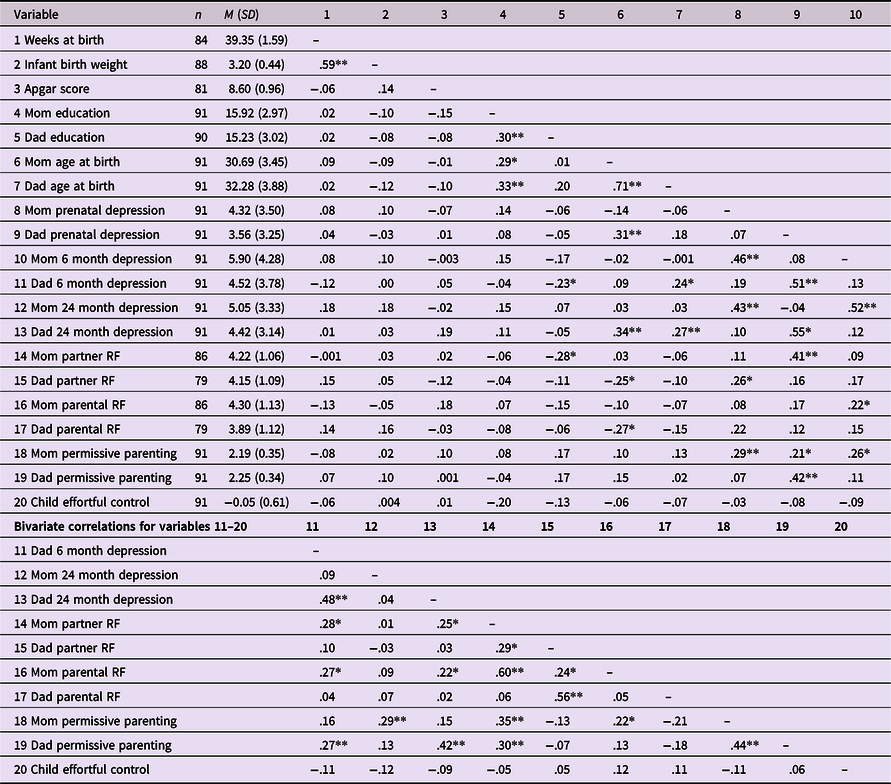
Note.
* p < .05,
** p < .01, Age of assessment is provided in months and refers to the number of months postnatally.
Hypothesis testing
Hypothesis 1A: Maternal prenatal depression moderated by 6-month postnatal paternal partner RF to predict 24-month postnatal maternal depression
After accounting for the covariate of 6-month postnatal maternal depression and the main effects of maternal prenatal depression and paternal partner RF, R 2 = .38, SE = 6.43, F(4, 74) = 11.31, p < .001, we found a significant interaction of maternal prenatal depression and paternal partner RF, ΔR 2 = .11, b = −0.28, 95% CI (−0.44, −0.12), F(1, 74) = 12.86, p = .001 (see Table 3). Probing of the interaction revealed that maternal prenatal depression was positively associated with maternal depression at 24 months of infant age when fathers’ partner RF was at low, b = 0.62, 95% CI (0.33, 0.92), t(74) = 4.18, p = .0001, and at average levels, b = 0.32, 95% CI (0.12, 0.52), t(74) = 3.22, p = .002, but not at high levels, b = 0.01, 95% CI (−0.20, 0.23), t(74) = 0.11, p = .92. Therefore, as maternal prenatal depression increased, so did maternal 24-month postnatal depression, but only when partner RF was low or average among fathers.
Hypothesis 1B: Paternal prenatal depression moderated by 6-month postnatal maternal partner RF to predict 24-month postnatal paternal depression
After accounting for the covariates of paternal education and 6 month postnatal paternal depression and the main effects of paternal prenatal depression and maternal partner RF, R 2 = .34, SE = 6.60, F(5, 79) = 7.97, p < .001, we found the interaction of paternal prenatal depression and maternal partner RF to be not significant, ΔR 2 = .005, b = 0.06, 95% CI (−0.09, 0.20), F(1, 79) = 0.58, p = .45 (see Table 3). Furthermore, the main effects of paternal prenatal depression on paternal postnatal depression and maternal partner RF on paternal postnatal depression were not significant, b = 0.09, SE = 0.37, p = .81 and b = −0.20, SE = 0.44, p = .65, respectively.
Hypotheses 1A and 1B: Predicting postnatal depression

Note. Hypothesis 1A: maternal prenatal depression moderated by 6-month paternal partner RF to predict 24-month postnatal maternal depression, accounting for the covariate of 6-month postnatal maternal depression. Hypothesis 1B: paternal prenatal depression moderated by 6-month maternal partner RF to predict 24-month postnatal paternal depression, accounting for covariates of paternal education and 6-month postnatal paternal depression.
Hypothesis 2A: Maternal prenatal depression moderated by 6-month postnatal paternal partner RF to predict 24-month postnatal maternal permissive parenting
After accounting for the covariate of 6 month postnatal maternal depression and the main effects of maternal prenatal depression and paternal partner RF, R 2 = .24, SE = 0.10, F(4, 74) = 5.82, p = .0004, we found a significant interaction of maternal prenatal depression and paternal partner RF in predicting 24-month maternal permissive parenting, ΔR 2 = 0.06, b = −0.02, 95% CI (−0.04, −0.004), F(1,74) = 5.53, p = .02 (see Table 4). Probing of the interaction revealed that maternal prenatal depression was positively associated with maternal permissive parenting when fathers’ partner RF was at low, b = 0.07, 95% CI (0.03, 0.11), t(74) = 3.61, p = .001, and at average levels, b = 0.04, 95% CI (0.02, 0.07), t(74) = 3.42, p = .001, but not at high levels, b = 0.02, 95% CI (−0.01, 0.04), t(74) = 1.26, p = 0.21. Therefore, as maternal prenatal depression increased, so did maternal permissive parenting at 24 months, but only when partner RF was low or average among fathers.
Hypothesis 2B: Paternal prenatal depression moderated by 6-month postnatal maternal partner RF to predict 24-month postnatal paternal permissive parenting
After accounting for the covariates of paternal education, child sex, and paternal 6-month postnatal depression and the main effects of paternal prenatal depression and maternal partner RF, R 2 = .29, SE = 0.09, F(6, 78) = 5.43, p = .0001, we found a nonsignificant interaction of paternal prenatal depression and maternal partner RF in predicting paternal permissive parenting, ΔR 2 = .002, b = 0.004, 95% CI (−0.01, 0.02), F(1,78) = 0.18, p = .67 (see Table 4). Furthermore, the main effects of paternal prenatal depression and maternal partner RF on paternal permissive parenting were not significant, b = 0.01, SE = 0.04 p = 0.77 and b = 0.06, SE = 0.05, p = .23, respectively.
Hypotheses 2A and 2B: Predicting permissive parenting

Note. Hypothesis 2A: maternal prenatal depression moderated by 6-month paternal partner RF to predict 24-month maternal permissive parenting, accounting for the covariate of 6-month postnatal maternal depression. Hypothesis 2B: paternal prenatal depression moderated by 6-month maternal partner RF to predict 24-month paternal permissive parenting, accounting for covariates of paternal education, child sex, and 6-month paternal depression.
Hypothesis 3A: Maternal prenatal depression moderated by 6-month postnatal paternal partner RF to predict 24-month postnatal child effortful control
After accounting for the covariate of maternal 6-month postnatal depression the main effects of prenatal maternal depression and paternal partner RF, R 2 = .09, SE = 0.36, F(4, 74) = 1.76, p = .15, we found a significant interaction of maternal prenatal depression and paternal partner RF in predicting 24-month child effortful control, ΔR 2 = .07, b = 0.04, 95% CI (0.01, 0.08), F(1, 74) = 5.72, p = .02 (see Table 5). Initial probing of the interaction revealed no significant simple slopes at conditional values of paternal partner RF (1 SD below the mean, average, and 1 SD above the mean). In order to further investigate the interaction, Johnson-Neyman analyses were conducted to determine any potential significant regions of values of paternal partner RF in moderating the association between maternal prenatal depression and child effortful control. These probing analyses revealed that maternal prenatal depression predicted child effortful control at low (lowest 5.06% or 1.86 SD below the mean), b = −0.10, 95% CI (−0.20, 0.00), t(74) = −1.99, p = .05, and high (highest 10.13% or 1.86 SD above the mean), b = 0.07, 95% CI (0.00, 0.13), t(74) = 1.99, p = .05, but not at average, b = −0.02, 95% CI (−0.07, 0.03), t(74) = −0.68, p = 0.50, levels of paternal partner RF. Therefore, when fathers demonstrated very low levels (1.86 SD below the mean) of partner RF, as maternal prenatal depression increased, child effortful control decreased. In contrast, when fathers demonstrated very high levels (1.86 SD above the mean) of partner RF, as maternal prenatal depression increased so did child effortful control.
Hypotheses 3B: Paternal prenatal depression moderated by 6 month postnatal maternal partner RF to predict 24-month postnatal child effortful control
After accounting for the covariates of paternal education and 6-month postnatal paternal depression and the main effects of paternal prenatal depression and maternal partner RF, R 2 = .04, SE = 0.39, F(5, 79) = 0.74, p = .60, we found a nonsignificant interaction of paternal prenatal depression and maternal partner RF, ΔR 2 = .01, b = 0.01, 95% CI (−0.02, 0.05), F(1, 79) = 0.64, p = .43 (see Table 5). Furthermore, the main effects of paternal prenatal depression and maternal partner RF on child effortful control were not significant, b = −0.07, SE = 0.09, p = 0.46 and b = −0.10, SE = 0.11, p = .36, respectively.
Hypotheses 3A and 3B: Predicting child effortful control

Note. Hypothesis 3A: maternal prenatal depression moderated by 6-month paternal partner RF to predict 24-month child effortful control, accounting for the covariate of 6-month postnatal maternal depression. Hypothesis 3B: paternal prenatal depression moderated by 6-month maternal partner RF to predict 24-month postnatal child effortful control accounting for covariates of paternal education and 6-month postnatal paternal depression.
Assessing the unique effects of partner RF versus parental RF
We conducted analyses testing each of our hypotheses but replacing partner RF with parental RF to investigate whether partner RF played a distinct moderating role compared to parental RF.
Parental RF (Hypothesis 1A): Maternal prenatal depression moderated by 6-month postnatal paternal parental RF to predict 24-month postnatal maternal depression
After accounting for the covariate of 6-month postnatal maternal depression and the main effects of maternal prenatal depression and paternal parental RF, R 2 = .29, SE = 7.33, F(4, 74) = 7.64, p < .001, we found a significant interaction of maternal prenatal depression and paternal parental RF, ΔR 2 = .04, b = −0.19, 95% CI (−0.37, −0.01), F(1, 74) = −4.64, p = .03 (see Table 8 in the Supplementary Materials). Probing of the interaction revealed that maternal prenatal depression was positively associated with maternal depression at 24 months of infant age when fathers’ parental RF was at low, b = 0.44, 95% CI (0.13, 0.76), t(74) = 2.81, p = .01, and at average levels, b = 0.23, 95% CI (0.02, 0.43), t(74) = 2.23, p = .03, but not at high levels, b = 0.01, 95% CI (−0.24, 0.26), t(74) = 0.10, p = .92. Therefore, as maternal prenatal depression increased, so did maternal 24-month postnatal depression, but only when paternal RF was low or average among fathers.
As a result, of the significant interaction between maternal prenatal depression and paternal parental RF predicting postnatal maternal depression, we conducted further analyses to determine whether paternal partner RF remained a significant moderator of the association between maternal prenatal depression and maternal 24-month postnatal depression while accounting for paternal parental depression. After accounting for the covariates of maternal 6-month postnatal depression and paternal parental RF, and the main effects of paternal prenatal depression and maternal partner RF, R 2 = .39, SE = 6.43, F(5, 73) = 9.23, p < .001, our analyses revealed that paternal parental RF was a significant moderator of the association between maternal prenatal depression and maternal postnatal depression ΔR 2 = .11, b = −0.29, 95% CI (−0.44, −0.13), F(1, 73) = 13.32, p = .001 (see Table 9 in the Supplementary Materials). The interaction of maternal prenatal depression and paternal partner RF remained significant even after accounting for the effects of paternal parental RF, suggesting that partner RF predicts a unique portion of the variance in the outcome of maternal postnatal depression that is not explained by paternal parental RF.
Parental RF (Hypothesis 1B): Paternal prenatal depression moderated by 6-month postnatal maternal parental RF to predict 24-month postnatal paternal depression
After accounting for the covariate of 6-month postnatal paternal depression and the main effects of paternal prenatal depression and maternal parental RF, R 2 = .34, SE = 6.44, F(4, 80) = 10.46, p < .001, we found the interaction of paternal prenatal depression and maternal parental RF to be not significant, ΔR 2 = .01, b = 0.09, 95% CI (−0.07, 0.25), F(1, 80) = 1.31, p = .26 (see Table 8 in the Supplementary Materials).
Parental RF (Hypothesis 2A): Maternal prenatal depression moderated by 6-month postnatal paternal parental RF to predict 24-month postnatal maternal permissive parenting
After accounting for the covariate of 6 month postnatal maternal depression and the main effects of maternal prenatal depression and paternal parental RF, R 2 = .23, SE = 0.11, F(4, 74) = 5.46, p = .001, we found a nonsignificant interaction of maternal prenatal depression and paternal parental RF in predicting 24-month maternal permissive parenting, ΔR 2 = 0.01, b = −0.01, 95% CI (−0.03, 0.01), F(1,74) = 1.27, p = .26 (see Table 10 in the Supplementary Materials).
Parental RF (Hypothesis 2B): Paternal prenatal depression moderated by 6-month postnatal maternal parental RF to predict 24-month postnatal paternal permissive parenting
After accounting for the covariates of child sex and paternal 6-month postnatal depression and the main effects of paternal prenatal depression and maternal parental RF, R 2 = .22, SE = 0.10, F(5, 79) = 4.56, p = .001, we found a nonsignificant interaction of paternal prenatal depression and maternal parental RF in predicting paternal permissive parenting, ΔR 2 = .001, b = 0.004, 95% CI (−0.02, 0.02), F(1,79) = 0.12, p = .73 (see Table 10 in the Supplementary Materials).
Parental RF (Hypothesis 3A): Maternal prenatal depression moderated by 6-month postnatal paternal parental RF to predict 24-month postnatal child effortful control
After accounting for the covariates of maternal 6-month postnatal depression the main effects of prenatal maternal depression and paternal parental RF, R 2 = .05, SE = 0.37, F(4, 74) = 1.27, p = .29, we found a nonsignificant interaction of maternal prenatal depression and paternal parental RF in predicting 24-month child effortful control, ΔR 2 = .04, b = 0.03, 95% CI (−0.01, 0.07), F(1, 74) = 2.96, p = .09 (see Table 11 of the Supplementary Materials).
Parental RF (Hypothesis 3B): Paternal prenatal depression moderated by 6-month postnatal maternal parental RF to predict 24-month postnatal child effortful control
After accounting for the covariate of 6-month postnatal paternal depression and the main effects of paternal prenatal depression and maternal parental RF, R 2 = .05, SE = 0.38, F(4, 80) = 1.08, p = .37, we found a nonsignificant interaction of paternal prenatal depression and maternal parental RF, ΔR 2 = .01, b = 0.02, 95% CI (−0.02, 0.06), F(1, 80) = 1.25, p = .27 (see Table 11 of the Supplementary Materials).
Discussion
This study significantly expands the literature on the protective role of the partner relationship in the longitudinal negative effects of parental prenatal depression on parental postnatal mental health, parenting styles, and child effortful control. This study supports the larger literature emphasizing partner relationship quality and support in promoting familial resiliency in the face of prenatal depression (Merrifield & Gamble, Reference Merrifield and Gamble2013; Solmeyer & Feinberg, Reference Solmeyer and Feinberg2011). As only the second study to explore the novel concept of partner RF, these results also considerably advance our understanding of the importance of the construct. Our findings generally suggest that fathers’ partner RF protects the family against the negative outcomes associated with prenatal maternal depression. In order to fully understand the implications of our findings, it is important to note that high levels of RF in our sample were equivalent to a score of 5, which according to Fonagy constitutes ordinary (and not extraordinary) mentalization (Fonagy et al., Reference Fonagy, Steele, Steele, Leigh, Kennedy, Mattoon and Target2020), suggesting that ordinary levels of RF are sufficient to exert a protective influence on the family in the face of parental depression
Firstly, we found that fathers’ partner RF mitigated the persistence of maternal depressive symptoms from prenatally to 24 months postnatally. When fathers were high in partner RF, the link between maternal prenatal depression and maternal 24 month postnatal depression was no longer significant. These findings underscore the importance of couple- and family-level approaches to the treatment of depression. Maternal depression is often associated with significant consequences for parental postnatal mental health, romantic relationship quality, parenting behavior, and child regulation (Burke, Reference Burke2003). Our findings suggest that couple-level support plays a significant role in ameliorating these effects during a challenging transition and when the consequence of postnatal depression can be especially harmful for the family.
It is possible that fathers who can reflect on their partner’s mental states are able to help mothers learn how to identify negative cognitions and emotions that may contribute to depressive symptoms. As a result, these mothers are better able to manage their depressive symptoms and be better equipped to respond to stressful parenting situations (Lovejoy et al., Reference Lovejoy, Graczyk, O’Hare and Neuman2000). Indeed, prevention programs emphasizing mutual support among partners undergoing the transition to parenthood (Feinberg & Kan, Reference Feinberg and Kan2008) and programs intended to supplement depression treatment by training families to identify and aid the depressed individual with negative cognitions (Dobkin et al., Reference Dobkin, Allen, Alloy, Menza, Gara and Panzarella2007) are effective in reducing rates of depression. Such findings underscore the significance for a supportive partnership in tackling both couple- and parenting-specific challenges.
Our second hypothesis explored the association between parental depression and permissive parenting and the potential buffering effects of partner RF. Our results supported the hypothesis that paternal partner RF acted as a significant moderator in alleviating the link between maternal prenatal depression and permissive parenting. As mothers’ depressive symptoms increased, so did their permissive parenting behavior, but this association was only significant when fathers’ partner RF was average or low. To our knowledge, this study is the first to identify an association between prenatal maternal depression and permissive parenting. The primary characteristics of this parenting style are similar to depression, namely low self-efficacy and learned helplessness wherein depressed individuals lose hope as to whether their actions will be effective in achieving goals resulting in ineffective parenting behaviors (cf. River et al., Reference River, Borelli, Vazquez and Smiley2018).
These results may have implications for understanding the dyadic nature of partner romantic relationships within a parenting context. Although the precise processes underlying partner RF’s protective role remains unknown, it is possible that fathers who are better able to reflect on their partner’s mental states may be better equipped to provide them support when necessary (e.g., Fonagy & Target, Reference Fonagy and Target1997). Partner support may be particularly helpful for mothers suffering from depression due to their increased need for support during a vulnerable time (Misri et al., Reference Misri, Kostaras, Fox and Kostaras2000; Xie et al., Reference Xie, He, Koszycki, Walker and Wen2009). This type of assistance can be essential in trying to help one’s partner to regulate in the face of overwhelming stressors, to support the depressed partner’s parenting decisions, and to engage in additional parenting responsibilities to reduce the load on one’s partner (Merrifield & Gamble, Reference Merrifield and Gamble2013). This support may be critical in minimizing the negative consequences of maternal pre- and postnatal depression. Furthermore, permissive parenting may be particularly problematic when the nondepressed partner’s attempts to enforce rules among children directly contrasts with the strategies of the depressed parent. This inconsistency in parenting behavior provides the child with mixed messages as to the collective parents’ behavioral expectations for the child, resulting in heightened risk for internalizing and externalizing problems (Benson et al., Reference Benson, Buehler and Gerard2008). The child may realize and seek out the more lenient parent over the nondepressed and less permissive parent, resulting in maladaptive familial dynamics (e.g., triangulation; Franck & Buehler, Reference Franck and Buehler2007) further reinforcing low parenting self-efficacy (Choe et al., Reference Choe, Olson and Sameroff2013). Thus, permissive parenting may be detrimental for the child and may have cyclical effects on the depressed parent.
Our findings suggest mixed support for our final hypothesis that paternal partner RF was a significant moderator in the association between prenatal maternal depression and child effortful control. Specifically, our analyses demonstrate that as maternal prenatal depression increases, child effortful control worsens, but only for the lowest levels of paternal partner RF in our sample. Furthermore, for the families in our sample with the highest levels of paternal partner RF, a positive association was found between maternal prenatal depression and child effortful control. Ultimately, whereas some families demonstrated an association between maternal prenatal depression and child effortful control when considering paternal partner RF, this was not the case for most families in our sample. We take this into consideration as we interpret the findings below.
One potential conclusion is that moderate levels of paternal partner RF are sufficient to buffer against child regulatory deficits in the face of maternal depression. When the mother is struggling with self-regulation during stressful parenting-related events, the father may come to the aid of the mother by taking on some of the parenting burden. This, in turn, may allow both parents to be cognitively and emotionally available to detect and accurately interpret and respond to the child’s internal needs. Recent findings suggest that father-child synchrony and paternal involvement in childrearing may be related to parental RF and can act as buffers against the negative consequences of maternal depression (Feldman, Reference Feldman2015). Furthermore, postnatal depression interventions targeting both parenting and the quality of the romantic partnership demonstrate decreases in negative child outcomes (Tomfohr-Madsen et al., Reference Tomfohr-Madsen, Giesbrecht, Madsen, Mackinnon, Le and Doss2020).
Our findings also suggest that at the highest levels of paternal partner RF, we see a positive association between maternal prenatal depression and child effortful control. This unexpected result is partially consistent with prior literature indicating a buffering effect of father positive parenting in the face of maternal depression and child outcomes (Vakrat et al., Reference Vakrat, Apter-Levy and Feldman2018). Our results may demonstrate compensatory behavior on the part of the father. Perhaps, in the face of maternal prenatal depression, fathers with the highest level of partner RF are able to reflect on the limitations of the mother and step in to provide additional support for the child. It is also possible that fathers with such a strong capacity to reflect on their partner’s mental states were able to help alleviate symptoms of depression and continued to go above-and-beyond in supporting both their partner and the child after such symptoms decreased and reduced the impact on the mother’s parenting. In this case, children may benefit from positive parenting behaviors and downstream effects of heightened romantic partner support in the face of depression. We attempted to account for concurrent depression by controlling for maternal depression while partner RF was measured. Yet it is possible that depressive symptoms changed further after this timepoint, resulting in a significant positive association between prenatal maternal depression and effortful control when paternal partner RF was particularly strong. This possible mechanism is supported by findings indicating that the presence of two parents with heightened insightfulness (or reflective capacity) can result in heightened family cooperation than that of one insightful or no insightful parents (Marcu et al., Reference Marcu, Oppenheim and Koren-Karie2016). Therefore, the experience of fathers to grow in reflective capacity may provide long-lasting benefits for overall family functioning.
The potential benefits of partner support for parenting behavior also highlight the importance of distinguishing between partner and parental RF and whether these individual constructs play a unique role in affecting familial functioning. In order to address this question we analyzed the potential moderating effects of parental RF measured at the same timepoint as partner RF. These analyses revealed only one significant finding – paternal parental RF moderated the association between maternal prenatal and maternal postnatal depression when fathers demonstrated high levels of paternal RF. This finding is consistent with previous results demonstrating strong positive associations between partner RF and parental RF (Borelli et al., Reference Borelli, Slade, Pettit and Shai2020) and suggest that a father with a strong capacity for RF for his partner may also be able reflect on the child’s mental states and take on additional caregiving responsibilities in a sensitive manner that benefits both child and mother.
To determine whether paternal partner RF would play a unique protective role above and beyond that of paternal parental RF, we also conducted a moderation analysis while accounting for paternal parental RF. This analysis revealed that paternal partner RF remained a significant buffer in association between maternal prenatal depression and maternal postnatal depression even when considering the potential effects of paternal parental RF. These findings further our understanding of RF as a capacity that is specific and unique to each individual relationship. In other words, a father’s capacity to reflect on the mental states of his partner is distinct from his capacity to reflect on the mental states of his child.
In general, our results have implications for intervention development. Firstly, these findings suggest that ordinary (or moderate) levels of RF are beneficial for familial resilience and a sufficient goal for intervention development. This provides a reason for optimism – intervention programs designed to enhance parental RF can achieve increases of two or three points in RF, suggesting that it might be possible to improve fathers’ partner RF to a “protective level” (e.g., Suchman et al., Reference Suchman, DeCoste, Borelli and McMahon2018). Although some interventions demonstrate increases of one point or less (Sadler et al., Reference Sadler, Slade, Close, Webb, Simpson, Fennie and Mayes2013; e.g., Suchman et al., Reference Suchman, Decoste, McMahon, Dalton, Mayes and Borelli2017), these findings open the door for a wider range of eligible partners to gain the necessary increases in reflective capacity for the benefit family functioning. In other words, fathers need only engage in ordinary levels of RF for families to receive benefits. As a result, interventions that promote relatively small increases in RF may still play a protective role for the family. Secondly, these findings suggest an important direction for intervention research and identifying targets for intervention. Specifically, further study into not only the behaviors that occur during dyadic partner interactions, but also what elicits paternal support (i.e., context, prediction regarding specific events, and so forth) is essential to better understand the mechanism through which partner RF reduces depression risk.
In addition, our results are consistent with previous findings suggesting that a strong general capacity for RF can promote heightened partner interactions with relevance for parenting behavior (Jessee et al., Reference Jessee, Mangelsdorf, Wong, Schoppe-Sullivan, Shigeto and Brown2018). Therefore, it is likely that brief interventions focusing on RF can provide long-term benefits particularly for families demonstrating risk for maternal prenatal depression. For example, a brief intervention can train fathers of families to identify negative partner cognitions and support the partner in cognitively challenging such cognitions (e.g., the use of Adaptive Inferential Feedback; Dobkin et al., Reference Dobkin, Allen, Alloy, Menza, Gara and Panzarella2007). Similarly, RF based interventions training family members to support and provide intervention skills to family members of those with borderline personality disorder (characterized by symptoms consistent with depression) demonstrate significant improvements in family functioning in addition to reducing depressive symptoms for the family member with BPD (Bateman & Fonagy, Reference Bateman and Fonagy2019). Therefore, screening partners expecting their first child for depression and applying such interventions to families identified as at-risk may have significant longstanding benefits.
We pause here to reflect on the pattern of findings which revealed that paternal partner RF is uniquely beneficial for mothers and children, when compared to maternal partner. Mothers demonstrated increased benefits from a reflective partner than fathers suggesting that paternal partner RF is protective for mothers but the effects of maternal partner RF may be limited for fathers. We contend that the unique roles of mothers and fathers may explain this direction of results. As mothers are typically responsible for a larger share of the caretaking responsibilities than fathers (Milkie et al., Reference Milkie, Kendig, Nomaguchi and Denny2010; Schieman et al., Reference Schieman, Ruppanner and Milkie2018), the parenting behavior of mothers may play a more significant role than father parenting behavior in both the child’s and family’s adjustment. It would be interesting to explore these associations within families in which fathers serve as primary caregivers, allowing researchers to isolate whether partner RF is protective only with respect to mothers because of sex differences in the impacts of parenting on children or because of the degree of involvement of the parent. Alternatively, mothers’ partner RF may be protective against risk factors that are more common among men, such as alcohol or substance use disorders (Lev-Ran et al., Reference Lev-Ran, Le Strat, Imtiaz, Rehm and Le Foll2013).
Strengths and limitations
There are several significant strengths associated with this study. First, the study is longitudinal in nature strengthening the argument that maternal prenatal depression constitutes a critical risk factor. Next, unlike many studies of the correlates of maternal depression, we also included fathers in our study, which allowed us to determine the individual and relational roles of mothers and father in exploring the trajectory of maternal depression from pre- to postnatal periods and the development of parenting styles and child self-regulation. We also included postnatal maternal depression as a covariate in our models, and therefore accounted for the relevance of repeated child exposure to maternal depression. Additionally, adopting a mixed-method approach, whereby we used self-reports, coded behavioral measures (to assess child self-regulation) and coded semistructured interviews (rather than self-report measures) strengthens the conclusions we can draw from this study. Finally, we incorporated an innovative measure of partner RF – a construct that few have studied. As shown in the current study, partner RF can mitigate some of the negative long-term effects of maternal depression.
Despite these strengths, there are several limitations that should be considered and may have implications for future directions. For instance, some constructs (e.g., permissive parenting, children’s effortful control) were only measured at a single timepoint due to the fact that assessing them earlier was not developmentally indicated. Although this makes sense from a measurement point of view, it reduces the strength of our conclusions. Whereas we used a robust and well-established behavioral measure of effortful control, this construct was not assessed within the parent–child relationship. Given the significance of the parent–child relationship in the development of child regulation (Eisenberg et al., Reference Eisenberg, Zhou, Spinrad, Valiente, Fabes and Liew2005), future studies should incorporate a measure of effortful control that takes into account parent–child interactions. Considering effortful control within the parent–child relationship may also enable future studies to disentangle maternal-child coregulation from paternal-child coregulation and child self-regulation. Such distinctions may be significant given the unique effects of paternal partner RF and maternal parenting behavior in the current study. Additionally, we were unable to use naturalistic observations of parenting behavior to determine actual parenting practices. Similarly, it may be useful to measure not only partner RF, but supportive behaviors that could correspond with increased RF and determine how these behaviors may relate to improved parenting behavior, and in turn child outcomes.
Lastly, it is important to note that this was a community sample. Therefore, mothers in this study varied in extent of depressive symptoms, but by design, most of them were not within the clinical limits. Thus, the generalizability of these results is limited to community samples rather than clinically homogenous samples of depressed mothers. Our findings suggest that paternal partner RF may play a significant protective role in a clinically depressed sample of mothers. Partner support is an essential intervention component in treating depression (Dobkin et al., Reference Dobkin, Allen, Alloy, Menza, Gara and Panzarella2007; Figueiredo et al., Reference Figueiredo, Field, Diego, Hernandez-Reif, Deeds and Ascencio2008). Therefore, a partner’s ability to reflect on the mental states of the depressed partner may be uniquely suited to support clinically depressed partners particularly during the prenatal period. Future studies can investigate whether partner RF is a unique component of partner support with implications for interventions within clinical samples.
Conclusions
This study furthers the body of research linking maternal pre- and postnatal depression, parenting styles, and child outcomes by suggesting one factor that may attenuate the risk associated with prenatal maternal depression – partner RF. In so doing, the study recognizes how support within the partner relationship can compensate for other vulnerabilities, underscoring the need for more global assessment of children’s context in determining children’s risk and adjustment. The study also emphasizes fathers’ partner RF as a protective factor and potential target of intervention and prevention efforts. By improving fathers’ ability to consider the mental states of the partner, we may be able to improve depressive outcomes, parenting practices, and children’s self-regulation. The potential for promoting familial resiliency in the face of prenatal depression has significant public health implications and suggest the potential promise of family-level programs to target the new construct of partner RF.
Supplementary material
The supplementary material for this article can be found at https://doi.org/10.1017/S0954579422000189.
Acknowledgments
We would like to thank the couples transitioning to parents who participated in this study during this pivotal transition. We would also like to thank the research assistants who helped us with data collection and coding of the respective data.
Funding statement
This research received no specific grant from any funding agency, commercial or not-for-profit sectors.
Conflicts of interest
None.


 Open access

