


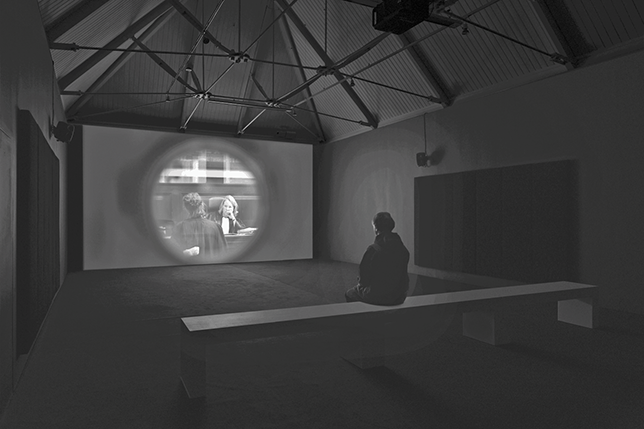
Carey Young, Palais de Justice (still), 2017. Single-channel HD video (from 4K); 16:9 format, quadraphonic sound. Installation view from Carey Young: Appearance, Modern Art Oxford, 2023.
2.1 Law as Theatre
The trope of law-as-theatre, writes Julie Stone Peters, is older than the figure of Justice as blind, but just as devastatingly ambivalent. Instead of insisting that Justice, to be impartial, should not see, it insists that Justice, to be effective, should be seen. But the trope of law as theatre is not just an analogy; it is also an antithesis. Justice defines itself against the theatre. Theatre is compromised by its desire to please, its repertoire of tricks and sleights, its masks, wigs and bags of blood. The ‘dispassionate reason, objectivity, discipline, and the sovereignty of the truth’ that is law, argues Peters, should have no truck with such arts, for obvious reasons.Footnote 1 But this pristine, dispassionate, abstract Law cannot avoid meddling with showmanship. It must condescend to embody itself, to make itself visible, ‘to showcase justice, visibly represent its own force and dignity … deploy the passions of the crowd, produce a theatre for vengeance’ (8–9). So the analogy and the antithesis coexist simultaneously, registering two opposing attitudes. On the one hand, there is ‘legal theatricality (law needs theatre); and legal antitheatricality (law must avoid theatre at all costs)’. The trope, Peters writes, ‘marked these out as antinomies, but also revealed them as, often, perilously proximate. Recognising law as a performance practice, it identified theatre as both a source of law’s power and an embarrassment’ (9). Peters’ latest book, Law as Performance, argues that these antinomies are not just anecdote material, but lie at the definitional heart of legal theory in the West. ‘“What is law?”’ Peters asks, ventriloquising legal philosophers since law began. ‘“Not theatre!”’ she choruses back, still in their voices. But then she adds, mischievously, in her own: ‘Except when it is’ (9, my italics).
In this strikingly original and erudite study, Peters uses the terms ‘theatre’ and ‘performance’ more or less interchangeably, which is not to say that she is not conscious of and discriminating about these words’ different etymologies and semantic range. Early cultures, as she notes, did not have a single word for what we call ‘performance’. Indeed, as Luke Wilson has pointed out, the terms ‘perform’ and ‘performance’ in sixteenth-century legal English are primarily set in conceptual opposition to the ‘promise’ of which they signify the fulfilment.Footnote 2 Peters scrutinises a range of other words: ‘hypokrisis’, ‘actio’, ‘pronunciatio’ and ‘delivery’, along with a range of words for audiences and spectators (17). We could say, broadly, then, that Peters is interested in theatre in its performative aspect. As soon as we come on to the history of law as ‘theatre’, however, another term becomes important: rhetoric. Chapter 1, vividly describing the theatricality of the Athenian law courts, identifies hypokrisis as the art of acting, but also as that of legal oratory. So we have two terms, ‘theatre’ and ‘rhetoric’, both of which are associated with, indeed largely defined by, a third term: live ‘performance’ before an audience. And yet neither ‘theatre’ nor ‘rhetoric’ coincides completely with ‘performance’. If performance is an aspect of theatre, so is dramatic composition. And if, as pronunciatio, performance is an aspect of rhetoric, then so is the discovery of persuasive arguments, known as inventio. It is to these compositional or inventive aspects of early modern theatre and rhetoric – which are also in various ways held to compromise the rational and dispassionate workings of the law – that this chapter will in due course turn.
My aim, in this response to Peters’ timely, powerful work, is both to acknowledge its transformative force for legal studies and at the same time to introduce some distinctions that may be of some value in distinguishing discussions of the ‘theatricality’ of law (in the sense of reconstructing law as live performance) from the emergence of a modern understanding of ‘theatre’ as the production of coherent and powerful fictions enacted by characters. The early modern period (1500–1650) is described, in chapter 5 of Peters’ study, as ‘the age of theatre’. If Peters shows how judicial proceedings draw on the performative aspects of rhetoric and theatre, I hope, conversely, to show how, in the ‘age of theatre’, theatre’s distinctive fictionality – every bit as important as the fictionality of ‘the rise of the novel’ – drew on the fiction-generating power of probable argument and inferential reasoning, as taught in legal rhetoric.Footnote 3 First, however, to attend to the argument of Law as Performance.
2.2 Law as Performance
Julie Stone Peters is well known as an academic crosser of literary and legal disciplinary boundaries, combining the writing of prize-winning books on early modern book history with being at the cutting edge of contemporary debates on women’s rights and law as a media spectacle.Footnote 4 Yet her work is characterised not so much by boundary crossing as by the investigation of boundaries as generators of antitheses which in turn give rise to definitional desire and disavowal. Peters’ work bracingly confronts all that is disavowed in the definitional boundaries that sustain and produce institutional knowledge. When I used to teach early modern literature and law, I would start my students off with Peters’ 2005 PMLA article, ‘Law, Literature and the Vanishing Real: The Future of an Interdisciplinary Illusion’. This article opened with a bold satire on professional critical desire, an imagined scenario in which literature professors demanded of their legal counterparts real-world effectiveness against injustice, while law professors craved from their literary peers some amalgamation of a razor-sharp deconstruction of truth as metaphor with a warmly empathetic response to human ‘story telling’ and ‘narrative’. The implication was that the illusions of interdisciplinarity that went by the name of ‘law and literature’ were fantasies shaped by what professionals in each discipline felt their own discipline lacked, each distorting the other into the desired antithesis and complement.Footnote 5
Law as Performance is similarly bracing in that it confronts and dismantles what is argued to be a defining distinction between law and theatre from the legal point of view. Law has a theatrical dimension, but theatre must know its ancillary place. Law cannot, must not, be reduced to mere theatre. So the official story goes – but Peters shows that, in the end, in the publicity of the court, in those moments in which two advocates argue and present evidence (using every technique of rhythmic speech, appropriate gestures, timely revelations, emotively human props or mocking rituals) mere theatre is exactly what law is. Quintilian, contrasting the listener’s experience with that of the reader, writes that, for the former, ‘everything is alive and stirring, we welcome every fresh thought as it is born with joy and anxiety, and are moved not only by the fortunes of the trial, but the risks of the speakers … In reading, on the other hand, judgement is surer, because a listener’s reactions are frequently distorted by personal inclination or by the noisy cries of the applauding audience’.Footnote 6 Peters foregrounds the extent to which law has depended, across the centuries and across different jurisdictions, on these live, collective audience responses rather than on solitary readerly judgement. Auditory and sensory reactions and distractions (whether anticipated by forensic technique or unexpectedly emerging in the trial) shape legal decisions that, once codified or assimilated to the body of knowledge called law, are promptly abstracted and insulated from the crowd-pleasing compromises of their origins.
This analogy-as-antithesis (law as performance, but also everything but) energises Peters’ wide and erudite sweep across Western legal history, 2,000 years of trials, ranging, geographically, from Athens to Rome through Bologna, Toulouse, Innsbruck, Lisieux and Bamberg as well as Paris and London. She begins with ancient confrontations and codependencies, some quite familiar (Plato versus Aristotle; Quintilian’s textbook Cicero), and, moving through legal treatises and trial records of the high and late Middle Ages, reaches sixteenth-century France and the Netherlands and, finally, London with its much-investigated Inns of Court. What distinguishes Peters’ treatment from earlier studies of these confrontations between law and theatre is her methodology. She highlights those aspects of forensic theory and practice that most explicitly acknowledge theatrical uses of bodily movement, signs of emotion, physical props. She is sceptical of legal-historical narratives that accept at face value reforming accounts of a law which has wrested control of trial procedure from the contingency of the publicly accessible live event. She looks, in the official record, for what it does not want to tell us: indications of what the space felt like; the sensory sway of the crowd; the jostling, the cacophony, the emotionally heightened, embodied experience of witnessing the trial’s unfolding in a public space. Legal historians, she notes, have looked to literary texts for this kind of colour, but complex poetic artefacts do not tell us much about real people in real situations. She reads between the lines of ancient, medieval and early modern theoretical texts as well as medieval texts of legal reform and archival records of trials.
Theoretical treatises of forensic oratory, from the Greeks to the Romans, provide explicit instructions in hypokrisis, actio and pronunciatio – how to speak, how to move the body, how to deploy clients and props to most pathetic effect. The early modern period sees the fullest pedagogical revival and development of these techniques, but Peters persuasively insists that medieval legal-rhetorical theory from the eighth to the fourteenth centuries was far from underestimating the importance of actio and pronunciatio, far from uninterested in the body, the visceral, the embarrassing, the emotive. As she comes on to the high and late Middle Ages, Peters confronts and challenges the methodological assumptions of histories that have treated official legal ideology as empirical and experiential. Scholars have identified two moments in early European legal history in which power shifts away from the contingency of communal and public arenas of justice and towards a more authoritatively controlled, scripted and regulated process. The first of these ostensibly occurred when the church and jurists took over in the twelfth century and law ‘became a privileged tool in the hands of experts’ (146). The second, taking place in the late fifteenth and early sixteenth centuries, was influentially characterised by John H. Langbein as the transition, across several European jurisdictions, from public, accusatory criminal procedures to one based on the law of the Roman canon inquisition, an ‘Inquisitionsprozess’.Footnote 7 In both cases, Peters argues, the success of attempts to script judicial procedures and to control public access to them has been assumed from the aspirational texts of the reformers, the motivations and aims of which tell a very different story. In 1455, Thomas Basin, Bishop of Lisieux, proposed a scheme for a perfectly functioning trial procedure involving the silent exchange of written documents to replace the noisy, disorderly and temporally distended public trials of the Norman customary courts. Yet his proposals themselves alert us to the inescapable presence of the crowd in places of trial, before and after he wrote. This, Peters shows, is true across Europe in this period, whether those places of trial be outdoor or indoor. And with the presence of this public audience comes the contingency and reversibility of live theatre.
One of the three propositions with which Peters opens her book is that performance, though essential to law, cannot be completely controlled by a script. It ‘has a tendency to take on a life of its own’ (5). In challenging these narratives of procedural shifts from public accusation to private Inquisitionsprozess, Peters reads between the lines of trial records for those moments of the autonomous life of performance, moments in which the official theatrical script fails to deliver its desired effects. The trial and defrocking of Jan Hus in 1415, for example, degenerates into a Noises Off-like farce of revealed backstage business as the ecclesiastical judges engage in a decidedly unslick, not to say cumbersome, series of costume changes. In order to perform the judicial ritual of defrocking Hus, the bishops had first to get him into his frocks, which meant several senior clergy wrestling the heretic into the elaborate vestments of ecclesiastical high office – alb, amice, stole, cincture, maniple and chasuble – only in order to wrestle them all back off again. And while they were about it, Hus took the opportunity to subvert the iconography of the event by elevating his arms and addressing the crowd in full sacerdotal regalia, possibly appearing to be performing the Mass in the person of Christ himself.
This is a powerful reading, brilliantly illustrative of the book’s central thesis. Peters’ wide-ranging exploration of the antinomies of law-as-theatre (the analogy that sparks antitheses) seems to pay off again and again. Peters’ book will undoubtedly be generative for legal, social and cultural historians as well as literary scholars of early modern England. To take two recent examples of work on English law and literature by younger scholars: Clare Egan’s study of provincial libels emphasises how carefully the court of Star Chamber framed libellous words in order to make ‘sure the material contained was not laughed at in the court itself’, testifying to the unruly power of performance to disrupt legal proceedings.Footnote 8 Lucy Clarke’s work on the role of performance in constituting magisterial authority at a local level is similarly supported and enriched by Peters’ central trope of law as performance.Footnote 9
Yet this ingenious central rhetorical trope, illuminating as it is, may nevertheless be a little too neat for its own good. In equating theatre first with performance and second with rhetoric, Peters’ book may be eliding complex and incommensurable differences that matter. I do not think these elisions detract in any serious way from the book’s central argument about the theatricality of law in ancient, medieval and early modern Europe. But I do think that noticing them helps explain why what Peters has to say about law ‘in the age of theatre’ (the early modern period) seems largely unilluminating about what was distinctive and new in that period’s achievements in theatre itself, as opposed to in the theatricality of law. And the period’s achievements in theatre – that is, in dramatic writing – would have, in the long run, a more significant legacy for poetic and legal meaning-making in the West.
2.3 Not Just Performance: Rhetorical Invention and Theatrical Fictionality
It is, then, worth unpacking the differences between early modern theatre, rhetoric and performance, not because these are ever entirely separable practices but because, on the contrary, their necessary interaction and interdependence cannot be properly appreciated unless we consider their separate qualities and see how they work together. I will sketch out how we might supplement Peters’ account of law’s theatricality in terms of rhetorical pronunciatio and courtroom performance with another account of how theatre, borrowing and adapting legal rhetoric’s techniques of inventio, became imbued with powerful qualities of fictionality and credibility, acquiring a new capacity to elicit an audience’s imaginative participation in the bringing alive of invented stories and fictional characters.Footnote 10
The Renaissance of theatre in early modern Europe was the effect of a revival of forensic rhetoric as well as topics-logic or dialectic. We could, to borrow Katrin Ettenhuber’s term, say it was the effect of a revival of ‘the rhetorico-logical art of language’ adapted to the practice of composing and enacting powerfully enduring theatrical fictions.Footnote 11 On the rhetoric side, then, we’re not talking solely about those aspects of rhetoric that Peters identifies most closely with theatre and performance (hypokrisis, actio, pronunciatio). Rather more significant for the composition of dramatic plots was rhetoric as inventio and dispositio, the invention and emplotment of arguments. The dramatic masterpieces composed in the sixteenth century are less vehicles for improvisatory performance than invitations to an audience to infer a whole fictional world, incorporating back story and offstage. These plays aim, through ingenious plot composition, to elicit a profound and complex emotional response to a whole enacted, invented narrative. This was a truly new achievement in the European vernaculars: nothing like it had existed since the drama of the ancient world. I have already mentioned Peters’ third opening proposition – that ‘performance can take on a life of its own’. This proposition pinpoints precisely how ‘law-as-performance’ is unlike the theatre of the European Renaissance. For in the ‘age of theatre’ dramatists desired performance less to take of an improvised life of its own (as it had traditionally done) than to bring into being the more complex poetic life of the play in the audience’s imaginations.Footnote 12 When Hamlet tells the players to ‘let those that play the clowns speak no more than is set down for them’ because talented improvisers can obscure ‘some necessary question of the play then to be considered’, he expresses theatre’s new concern that the precise poetic under-specification that invites audience to conjecture and imagine (‘some necessary question of the play’) should not be drowned out by unscripted performance practice.Footnote 13
2.4 Renaissance Theatre’s New Fictionality: from Italy to England, 1500–1650
So what, precisely, was new about theatre in sixteenth-century Europe? Most of what we take for granted about much theatre today – the fact of theatre’s fictionality, the fact that plays and TV and movie dramas enact stories about invented characters whose motives and feelings interest us, the fact that we imagine a ‘world of the play’ beyond the stage or fictional spaces beyond what the camera shows us and that we infer or project a coherent order of events on to the mix of representational effects that we see – all these ordinary assumptions of theatrical, cinematic and televisual drama, are the legacies of sixteenth-century innovations in theatre. And it all started in Italy. ‘Italy’, as Louise Clubb has written, ‘was unique in producing the technology of modern theatre’. And she goes on:
From the Cinquecento (the 1500s) into the Seicento (the 1600s) it developed a new system of play-making, comprising generic structures, methods of acting, and innovations in scene design, as well as theoretical principles and vocabulary … that would appear in theatrical structures throughout Europe and would be carried from commedia erudita and commedia dell’arte to Molière and Shakespeare and beyond.Footnote 14
Adapting the plot structures of Latin comedy, Ludovico Ariosto and his imitators and followers produced comedies that were modern, recognisable fictions of contemporary Italian urban life, ‘presenting fiction on-stage so as to capture and embody in the vernacular the causality and illusion of quotidian reality’.Footnote 15
Prior to the Italian avant-garde experimentalism of the early sixteenth century, European vernacular theatre – the sacre rappresentazioni of fifteenth century Italy, say, or Corpus Christi or penitential drama of fifteenth-century England – was of course already doing profound and significant things with performance. The Corpus Christi plays, as Sarah Beckwith has persuasively demonstrated, performatively enacted the body of Christ as a divine jurisdiction exercised through community reconciliation.Footnote 16 Yet these culturally powerful forms of theatrical performance lacked fictionality – they lacked any capacity to invite the audience to infer or imagine an implied world offstage, or action happening between scenes. Late fifteenth-century English drama displays few techniques for ‘conveying offstage action and extramimetic locations’.Footnote 17 When actors go offstage, they do not enter an imagined elsewhere that is part of the play; they simply cease to be until their next performative appearance. Peter Womack, referring to the late fifteenth-century play Mankind, puts it thus:
The performers come on, do their performance and leave, and nobody pretends that they are going anywhere except to their dressing rooms. The performance may generate a ‘character’ (a singer adopts the voice of a lover, a wrestler cultivates an artificially aggressive stage personality); but if so, the character does not acquire enough imaginative solidity for us to attribute continuing life to it. Rather, it is a trope, or a colour, within the always dominant discourse of the performance itself.Footnote 18
This is not a criticism of fifteenth-century sacred drama, but a recognition of its distinctive kind of theatricality. As sacramental drama, there is no imaginative dimension to the offstage, writes Womack, because ‘the on-stage space is complete’ as an allegory of human salvation in which the audience is already implicated.Footnote 19 Womack’s analysis enables us to distinguish a late medieval theatrical culture, with its ‘always dominant discourse of the performance itself’, from the radically innovative fictionality of the early modern theatre that succeeded it. Early modern or Renaissance theatre offers us fictions and characters (Hamlet, Falstaff) to whom later generations have attributed a ‘continuing life’. Early modern theatre also produces fictional worlds, imagined theatrical space. One of the assumptions of modern theatregoers, as Womack says, is that of the metonymic relation of onstage and off. We assume that ‘if the stage is a drawing-room, the characters are entering it from the dining-room; if it is a street, the upstage door leads into somebody’s house’ and so forth.Footnote 20 But this assumption – which Womack names ‘fictional adjacency’ – is predicated precisely on the further assumption that what a play presents is a coherent fictional world. And that, in turn, is an assumption inherited from the achievement of European theatre in the sixteenth century.
Peters shows compellingly how public pleading in legal trials inevitably has qualities of live theatre which open it to the contingencies of performance. Conversely, however, I want to show how sixteenth-century theatre became more powerful as fiction. The story I will tell is partial; it is focussed on what Italian comedy conveyed to England by way of a mastery of vivid techniques for engaging the audience’s imagination in the plot. Although this is just one strand of how European theatre developed in the sixteenth century, it is significant and pertinent partly because it drew on forms of argumentative proof originally formulated for the law courts, codified in Roman forensic rhetoric and adapted in the ‘forensic disposition’ of Roman New Comedy. Ludovico Ariosto, the great innovator of early modern theatre, made dazzling use of the ‘forensic disposition’ of Terence and Plautus’s comedies: that is, in actions that seem always to anticipate litigious consequences, in ‘argumentation that borrows the strategies of forensic discourse: above all, in a readiness to formulate attacks and defenses … to rehearse evidence and to supply proofs’.Footnote 21 Ariosto’s plots involved young men’s attempts to get access to courtesans or citizens’ daughters by various forms of entrapment, impersonation and credit fraud, deploying the kinds of proofs that Quintilian, after Aristotle, called ‘artificial’ or ‘technic’ – that is, the rhetorico-logical strategies subsumed under the general term of ‘arguments’.Footnote 22 We need to see these strategies not just as ‘let’s pretend’ versions of real legal strategies of proof, but as the resources of a new theatrical fictionality predicated on the audience’s readiness to infer, from characters’ uses of probable arguments, all the backstories, motives and hidden truths of the play’s story.
For example, Ariosto’s first comedy, La Cassaria (1508) involves a plot of legal entrapment adapted from Plautus’s Poenulus.Footnote 23 To help a young man extract the courtesan he loves from the hands of her pimp, the young man’s servant, Volpino, plots to plant a coffer full of valuable merchandise in the pimp’s house so they can accuse him of stealing it. But by Act 4, the scheme has gone wrong: the young man’s father and owner of the coffer has come home early, so Volpino starts to improvise, accusing the pimp of stealing the old man’s coffer. The old man is deeply sceptical, reluctant to go to the authorities without more proof, but Volpino confidently lies. ‘If I come along with you, I’ll present the governor with so many indications and conjectures, so much proof (tali indizii e conietture et prove) that even if he didn’t want, he couldn’t help but believe you’.Footnote 24 Volpino’s conjectures and indicia (a term Sir Thomas Smith was later to gloss in the English legal context as ‘tokens’ or ‘evidence’) turn out to be ingeniously detailed and vividly visualised narratives designed to elicit the false inferences which drive the engine of the comic plot.Footnote 25 Important to grasp, however, is the homology between these comic uses of artificial proof to devise plausible but false narratives and the newly illusionistic power of theatre to make audiences think they have seen things they have not seen, and to infer and imagine the fictional world of the play. The poet does not lie, but the lies of his characters produce the knot of confusion and false surmise to which the audience must attend and in making sense of which it becomes imaginatively involved.
Audience attention, inferring causes and motives, thus begins, with Ariosto and his imitators, to contribute to a new imaginative participation in making theatrical fictions feel realistic or verisimile. Writing to an actor friend, the dramatist Giovanni Battista Giraldi Cinthio proposed, controversially, that a newly invented or fictive (finta) tragedy might even be more moving than one based on history, since the spectator of a fictive tragedy will be aware that the only way he can know the story is through this theatrical representation, and so will pay very close attention: ‘Aware that the action about to be represented can be known only through the representation’, Cinthio speculates, ‘the spectator no sooner tastes the plot and thinks that it might be ingeniously constructed (ingegnosamente composta) than he concentrates his attention and tries not to lose one word’.Footnote 26 It is thus auditors’ own imaginative participation in following the intricate situations enacted before them – inferring connections, imagining motives, causes and emotions – that gives the fiction credibility and life. That a fiction should seem verisimile, like truth or like life, is not an effect of its ‘copying’ some concept of everyday ‘reality’, but rather of what Terence Cave calls ‘bold and highly precise forms of underspecification’ which afford ‘limited but suggestive indications about a character and his or her behaviour that would allow us, in the case of a real person, to infer their cognitive profile and anticipate their likely utterances or actions’.Footnote 27 Or, as Benedict Robinson puts it, fictionality demands probability, because ‘every inference from actions to passions or from passions to actions depends on a socially constituted sense of what is probable’.Footnote 28 In early Italian commedia erudita the complication of the intrigue invites auditors to be proactive in inferring and anticipating, so that although this theatre can seem to us to be mere plot and no psychology, its particular precise forms of under-specification were paving the way for the greater characterological interiority we associate with Shakespearean theatre. Cinthio accordingly derives effects of verisimilitude from the poet’s care in tying the ‘knot’ of the play, by which he says he means ‘the weaving together or composition of the story’ (la testura, ò la compositione della fauola) and then untying or resolving it so that, the story being brought to its end, the mind of the auditor or reader (l’animo di chi ascolta, ò di chi legge) is fully satisfied; false inferences will be naturally explicated and resolved without any deus ex machina other than the artifice of its unfolding. This does not always happen in ancient drama, says Cinthio, but Ariosto’s Cassaria, in that ‘it almost naturally unties itself, surpasses in artifice all his other comedies’.Footnote 29 Note too that the kind of attentiveness Cinthio describes is that of audience and reader indiscriminately (chi ascolta, ò … chi legge), overriding Quintilian’s previously cited distinction between the groupthink of listening and the independent judgement of reading.
Moreover, this newly discovered theatrical power of inferential plotting and artificial proof intersected with a new way of producing imaginative or fictional space. In the Italians’ avant-garde comedy of the sixteenth century, when an actor goes offstage, he is not (as in Mankind) simply absenting himself as actor; for, as an invented character he is engaged in vividly producing the ‘elsewhere’ within the fiction – perhaps an interior space such as a young virgin’s bedroom or a convent full of excitable nuns, or another part of town, where there are pubs and market stalls, pigeon sellers and officers of the law. Of Ariosto in this respect, Louise Clubb writes, ‘what really electrified audiences in 1508 and 1509 were his settings, namely contemporary Italian cities: his second comedy, I Suppositi, brought onstage the bourgeois Ferrara of merchants, customs officers, and travelers, with the offstage court invoked as a guarantor of order’.Footnote 30 The brilliant, illusionistic realism of Ariosto’s theatrical depiction of Ferrara had been remarked by the poet’s contemporaries too. In 1519 Tomà Lippomano wrote of Ariosto’s I Suppositi, ‘The comedy was such, that it feigned a Ferrara’ (che’l fu fento un Ferrara).Footnote 31 Critics have discussed the innovative sets, involving houses and doors, that contributed to the ‘citta ferrarese’.Footnote 32 But the city was also feigned or fictionalised in language, in speeches made by characters about their actions and whereabouts in between their appearances onstage. The mistaken impression often given by anglophone criticism of Italian Renaissance comedy is that its adherence to neo-Aristotelian ‘unities’ of time and place was a mechanical, rule-bound restriction of imaginative vitality. ‘Fixed-locale staging restricts the action in certain ways,’ writes Alan Nelson. ‘All conversations, including the most private must occur outdoors.’Footnote 33 But if we reverse Nelson’s thinking we can see how the fixed locale staging makes the audience’s imagination work overtime. It contributes to the electrifying effect of seeing on stage ‘a Ferrara as precise as the real one’, producing a vivid sense of the city’s streets and shops and of the unseen the interiors of houses.
In Ariosto’s La Lena (1528) we have such an effect in Act 2, scene 3, when a servant, Corbolo, who has been dispatched by his young master to buy some nice fat quails or pigeons for a feast at Lena’s, describes his travails seeking vainly among the delicatessen shops (pizzicagnoli) in front of the Palazzo Ducale. The pigeons were all so scrawny, he says, they looked as though they had had the quartan fever, but then, at the porta del Cortile, the archway now known as the Volta del Cavallo, some of the Duke’s gamekeepers (uccellatori) were waiting to go into the Gorgadello – the local pub. One of these sold Corbolo a pair of decently plump pheasants on the condition that he would keep the transaction secret. ‘The statue of Duke Borso will not be quieter than me,’ promises Corbolo (‘Non è la statua / Del duca Borso là di me più tacita’), referring to the statue of the Este Duke towering above the very Volta del Cavallo beneath which we imagine this conversation to take place.Footnote 34 This is an audacious joke: for it is the silence of the ruling Este family – in the form of the complicity of the ducal decrees which prohibit the sale and consumption of game – that creates the dearth of edible fowl in the shops by the Palazzo and fuels the lucrative black market exploited by the Duke’s gamekeepers. Corbolo’s narration of his voyage in search of the ingredients for the feast therefore presents to the Este family seated before the stage in the Sale Grande of the Palazzo Ducale not ‘an opulent, well-regulated Ferrara’, but a city ‘inferior to all others’, corrupt and full of secrets.Footnote 35
Even more electrifying, however, were the implications of this inferential plotting for the imagining of what characters might be getting up to when not even present or embodied by actors onstage. La Lena offers a wonderful example of the libidinal possibilities of the inferential plot on the fixed locale stage in the little episode of a dispute over a barrel. In Act 4 of the comedy, all sorts of people – creditors, law officers, surveyors, tenants, relatives and friends – seem to have converged just inside and outside of the stage exit signifying the house of the eponymous Lena and her slothful, penurious husband, Pacifico. It seems that the house’s owner, their neighbour, Fazio, has decided to put it on the market (hence the surveyor) and the rumour of this has made Pacifico’s many creditors rush to the house to reclaim what is owed to them before sale. Among the disputed objects is a barrel which a relative of Pacifico’s claims he lent Pacifico last wine harvest to get rid of a bad smell, but now he’s worried it will be seized by debt collectors and wants it back. An altercation ensues, temporarily settled by Fazio, who says he’ll adjudicate the case later and orders the barrel to be rolled into his house. But the barrel is not – at least in the audience’s imagination – empty. For the audience must (if they have been paying any attention) infer that it contains the nearly naked body of a lustful young merchant’s son called Flavio who has, since the play’s opening, been trying to gain access to Fazio’s closely guarded daughter, Licina. Following the usual contours of Roman comedy, La Lena opens with Flavio on the doorstep of Lena’s house, promising Lena money if she could get him access to Licina. Annoyed that he does not have the cash, Lena makes Flavio undress so his clothes can be sent to the pawnbrokers. At this point, Flavio undresses and goes offstage – that is, into the imagined interior of Lena’s house. But when news comes in Act 3 of Fazio arriving with a surveyor to check out Lena’s house, a panicked discussion ensues about where to stow the naked Flavio so Fazio will not see him. It concludes with a plan to stuff him into an empty wine barrel that someone left in the house. The audience never sees this action; however, when they later see Fazio loftily ordering this same wine barrel to be trundled into his house, what the audience ‘knows’, or imagines they know, is that Flavio will soon be making love to Licina – though of course the actor playing Flavio has been unseen since Act 1 and will never reappear until the final applause at the end of the play. The whole momentous sexual encounter announced by servants in the last scene is created by the audience’s imagination, activated by their attentive following of the plot.
This unprecedented new potential for activating audiences’ imaginations – including their libidinal imaginations – was certainly not lost on English poets and playwrights later in the sixteenth century. Nor could they have failed to notice the logico-rhetorical basis of Italian theatrical fictionality and its affinity with forensic strategies of proof. Writing to lawyer William Fleetwood, to whom he dedicated his translation of Cinthio’s Epitia, George Whetstone condemned English playwrights for neglecting plot probability. The English playwright ‘groundes his worke, on impossibilities … not waying, so the people laugh, though they laugh them (for theyr follyes) to scorne’.Footnote 36 Yet while Whetstone implicitly lauded the probability of Italian plots, he lamented their lewdness: ‘at this daye, the Italian is so lasciuious in his cōmedies, that honest hearers are greeued’. Whetstone wrote these words a decade or so after Fleetwood had likely been in the audience of one such comedy, George Gascoigne’s translation of Ariosto’s I Suppositi (1509) performed at Gray’s Inn in 1566.
Gascoigne’s choice of I Suppositi was a daring one: even now, his play seems surprisingly sexually permissive for the period, far less concerned with female chastity than any of Shakespeare’s plays. I Suppositi involves an amorous intrigue, announced in the opening words, when a Ferrarese citizen’s daughter comes onstage and confides to her nurse ‘in the street’ (because, the nurse says, indoor walls have ears!) that a household servant, Dulippo, who has been her lover for the past two years, is really a merchant’s son called Erostrato who wants to marry her. This shocking revelation is at once a joke about this avant-garde theatre’s not being able to show an interior scene and an announcement to the listening audience that in this new style of theatre their presence is going to be ignored. The nurse’s first words, as the two step out onstage before the listening audience, are ‘Here is no body, come foorth, Polynesta, let us looke about lest any man heare our talke.’Footnote 37
The lawyers in the audience would surely have burst out laughing at this risqué opening. Nor, as they attended to the plot, could they have failed to notice the way that the play’s ingenious ‘untying of the knot’ of supposes, or false inferences, was itself dependent on proofs that were equally suppositious, conjectural and possibly false, even in their supposed legal denouement. The young Sicilian student Erostrato has, on arriving in Ferrara, changed identities with his servant Dulippo so that he can enjoy Polynesta while Dulippo keeps house in his place and courts her officially, fending off a rival suitor, a rich lawyer, Cleander. But when Cleander ups his offer of a dower, the boys need to fake a counter-offer, so they con a passing Sienese merchant into assuming the identity of Erostrato’s father, Philogano, and signing a bond. Naturally it all goes horribly wrong in Act 4, when the real Philogano arrives in Ferrara only to be denied admittance and confronted with a his Sienese doppelganger and his old servant claiming his son’s identity. He assumes the worst: his son must have been murdered by this gang of imposters.
The question then turns on problems of proof: how, when witnesses in Ferrara support the claims of the imposters, is Philogano to prove his own identity? Philogano’s servant Litio spends a lot of Act 4 slandering Ferrara for its falsehood and lack of judicial safeguards: ‘have you not often heard tell of the falsehood of Ferrara’, he asks, berating a native of the city: ‘in deed your officers are most to blame, that suffer such faultes to escape unpunished’. The Ferrarese citizen defends the judicial system: ‘we have potestates, we have Judges, and above all, we have a most juste prince, doubt you not, but you shall have justice if your cause be just’; but Litio is again sceptical, for how will the matter be proved? ‘If there be many such witnesses in this country, men may go aboute to prove what they will in controversies here.’Footnote 38
Litio’s scepticism has the last word, for the lawyer summoned to help Philogano is none other than the rival for Polynesta’s hand, Cleander. Cleander is as perplexed by the problems of proof as everyone else: ‘Yea, but how will ye prove that he is not Erostrato, having suche presumptions to the contrarie?’, he asks, ‘or how shal it be thought that you are Philogano, when an other taketh upon him this same name, and for proofe bringeth him for a witnesse, which hath bene ever reputed here for Erostrato?’Footnote 39 The question seems irresolvable, certainly within the scope of the play, when it conveniently dawns on Cleander that Philogano’s servant Dulippo must be none other than the son, Carino, whom he lost at the battle of Otranto. Recognitions of this kind, as Terence Cave has shown, always have a strong whiff of scandal in their facile reliance on easily falsified signs and tokens.Footnote 40 So it is no surprise that when Cleander exclaims, ‘What nedeth me more evident tokens? this is my sonne out of doubt whom I lost eighteen yeares since, and a thousand thousand times have I lamented for him: he shuld have also a mould on his left shoulder,’ Litio sceptically and obscenely replies, ‘He hath a moulde there in deede: and an hole in an other place too, I woulde your nose were in it.’Footnote 41 Ariosto’s prologue explicitly links the ‘evident tokens’ of this resolution to the deceptions made possible by suppozioni, or merely probable and possibly false inferences. The play, his prologue announces, is called Suppositi because it is full of ‘suppozioni’. The nuances of the Italian word suppositi range from supposition to substitution and further to ‘placed under, after or behind’. As the prologue slyly announces that children have been ‘per l’adrieto … suppositi’ (‘substituted in the past’, or ‘exposed from behind’) so sodomitical innuendos accumulate alongside disparaging references to logical sophistry. Supposes are evidently deeply scandalous, not to be trusted and neither is the brilliantly vivid fiction of the play.Footnote 42
Gascoigne’s Supposes thus marked the arrival in English of a new kind of theatrical fictionality. When Shakespeare adapts the Supposes plot as the subplot of his The Taming of the Shrew, he acknowledges its illusionistic realism by having its powerful fictionality dispel the embryonic fiction of the induction, which dramatises the common anti-theatrical complaint that boys playing women’s parts incited men to lust. As Christopher Sly beckons the cross-dressed page Bartholomew to come to bed with him, the players intervene with a comedy – The Taming of the Shrew – which forever defers Sly’s lust for the boy player; Sly and the boy player simply disappear and with them the anti-theatrical prejudice. But in splicing the Supposes plot of clandestine courtship with a plot of successful wife-taming, Shakespeare defeats the anti-theatricalists by containing, disciplining and even ‘beshrewing’ the sexually permissive implications of the Ariosto–Gascoigne plot of erotic subterfuges.
The dazzling intelligence of Shakespeare’s solution to the scandal of Supposes should not prevent us from seeing its connection with the bumpy ride Gascoigne’s play had on first publication in 1573, when it was called in by the High Commission (who included William Fleetwood).Footnote 43 Gascoigne published a ‘reformed’ version of the text in 1575 and in the same year reformed the plot of Supposes itself by rewriting it as a play called The Glasse of Government in which the amorous adventures and impostures of students in the city of Antwerp are detected and severely punished by a diligent magistrate. A whole scene is devoted to the magistrate’s forensic examination of the parasite Eccho, whom he suspects but cannot prove to have ensnared the students and made them customers of the prostitute – ‘I haue examined them’, he later worries, ‘but truly I can not finde hitherto any proofe against them, whereby they ought to be punished’. It is only by going over events in the first two acts with the boys’ tutor that the magistrate uncovers the lies – or ‘supposes’ – that give him ‘good cause to punish Master Eccho’ while the boys themselves meet ignominious ends, one hanged and the other whipped and left for dead in a village outside Geneva. The audience is finally invited not to applaud, but to wring its hands. Gascoigne dedicated this extremely grim play to William Fleetwood’s friend and fellow High Commissioner Sir Owen Hopton.Footnote 44
The story I have been tracing is, as I have said, only one strand in the history of how the balance between the performative and the fictional in European theatre changed in the sixteenth century and how the rhetorico-logical strategies of argument, drawn from Cicero and Quintilian and from Roman New Comedy, informed new inferential plot structures which made audiences proactive in anticipating and imagining (or supposing) likely outcomes. The strand I have emphasised is that of commedia erudita, but there are, of course, many others. There is not scope here for more than a sketch of how Shakespeare’s playwriting built on the foundations I have described. Briefly, Shakespeare worked out an ingenious way of dissociating the inferential techniques of the Italian intrigue structure – so effective for engaging the audience’s imagination in producing the fiction – from unavoidably libidinal conclusions. Where in Italian comedy the emplotment can lead the audience to imagine sexual activity just offstage, Shakespeare’s circumstantial dramaturgy allows for such possibilities, but in place of sexual explicitness offers figurative proofs that require construal or that are irresolvably ambiguous along a fault-line between speculation and fact. Things may or may not have happened; there are doubts, suspicions, hallucinations – but it may all be just in someone’s head. A good example is Shakespeare’s Comedy of Errors, probably performed at Gray’s Inn in 1594, which features a husband locked out of his house, but ensures that while he nearly goes mad thinking his wife is playing him false, an interior scene shows the audience that she is chaste and innocent.
Shakespeare thus also dissociated the inferential technique of the Italian comic plot from its dependence on Italian innovation in scene design, on the fixed-locale stage and temporal unity. This is not to say that Shakespeare simply abandoned, because he did not need, the ‘rules’ of the neoclassical unities. As I have argued elsewhere, constraints of time and space on the Italian stage were not so much rules as prompts to new forms of inferential and imaginative activity recognisable as a new dramaturgical resource. Shakespeare and other dramatists of the 1590s and 1600s did not ignore or reject these. What Shakespeare did was to adapt the inferential value of temporal and spatial specificity by developing a drama in which time and place are ‘circumstances’, that is, topic questions structuring our experience of the play. Circumstantial questions of time, place, motive and manner are also constantly deployed by characters in ways which deliberately invite audiences to imagine their inner lives, and which give specificity and reality to the world of the play.Footnote 45 This is rhetoric as inventio contributing to theatre’s fictionality.
2.5 Rhetoric as Invention: The Work of Similitude in Law as Performance
In her interpretation of the Dutch engraver Crispijn de Passe’s image of Rhetorica (c. 1599) Peters perhaps comes closest to an elision of the contribution of rhetoric as inventio with its contribution as performative technique. De Passe’s engraving shows a female figure holding a scroll, her head turned towards the viewer while her body is turned the other way, to the left of the image. The background is an urban scene, divided in two. On the right, two men earnestly argue a legal case, while on the left, a scene is being played at the theatre. Rhetorica’s striding out to the theatre on the left, stepping across what Peters identifies as Rome’s Cloaca Maxima, illustrates the image’s caption, which reads, ‘If I say what is to be said well, coloring the words, any cause is to be made good through my eloquence’ (223). In the scene’s division between law and theatrical performance, the latter – identified with Rome’s sewer – has won. In Peters’ interpretation, de Passe is identifying theatrical performance with law’s power to make the worse seem the better cause. But if the moral is that law-as-truth is being subverted by law-as-rhetoric, then surely subversion takes place as much at the level of rhetorical invention and theatrical fictionality as it does at the level of performance. It is by the skilful invention of arguments, by the rhetorico-logical art of language, that the worse may be made to seem the better cause. This art of rhetorico-logical argument is, as I have shown, also fundamental to the rise of a theatrical fictionality – a theatre of supposes and surmises. This is a theatre which, though it exploits the uses of deception and false inference to engage the audience’s imagination, is capable of dramatising and exposing law’s venality and is true in its depiction of human passions.
Julie Stone Peters’ colleague at Columbia Kathy Eden published a book in the same year as Peters’ Law as Performance, called Rhetorical Renaissance, and the cover of this book is adorned by another female figure of ‘Rhetorica’. This Lady Rhetorica, an image by Mantegna (1431–1506), is not stepping over a sewer to head to the theatre. She is a warrior queen brandishing an unsheathed sword. Among Renaissance humanists Lady Rhetorica could also, as Eden acknowledges, be portrayed less flatteringly as a courtesan, a meretrix. But even in that guise she was a mistress of debate, overthrowing powerful statesmen with her arguments, her skilful deployment of such forensic techniques of proof as status theory, refutation and similitude.Footnote 46 Julie Stone Peters’ book is overpoweringly persuasive partly because of the way its central figure of similitude – ‘law as theatre’ – generates its own antithesis. She uses it to challenge older legal histories by a technique not unlike that used to such great effect in ‘Law, Literature and the Vanishing Real’. In the claims of philosophers of law, the texts of legal reformers, the efforts of officials to control the trial script and excluded the disorderly crowd, ‘performance’ emerges as something like the repressed in psychoanalysis. Law disavows its inevitable dependence on performance practice. This is a brilliant, powerful argument. We could, without discrediting it, however, also appreciate it as the effect of Peters’ rhetorical artistry, her exploitation of the affinity that similitude has, as a mode of proof, with techniques of refutation, sharpening, as it does, our perceptions of difference and dissimilitude. It is in Kathy Eden’s book that we learn of the development of similitude in Roman forensic rhetoric and in humanist preaching, law and poetry, from Socratic techniques of refutation.Footnote 47 ‘“What is law? … Not theatre!” Except when it is.’ Julie Peters’ brilliant central antithesis, derived from the similitude of law as theatre shows that the power of rhetoric – and therefore its threat to law as pure, abstract truth – lies not just in theatrical performance, but in the invention of figures and tropes that shape arguments, form thoughts and produce imaginatively compelling fictions. I am entirely persuaded by what Peters says about law’s relation to theatrical performance from ancient, through medieval to early modern times. My act of desynonymy – insisting that rhetoric, theatre and performance are not substitutable for one another – while subtracting nothing from Peters’ dazzling argument, makes a bit of room for thinking about its implications for the history of literature, including theatre, and for the longer-term implications for trial by social media in the present day.
In a dramatic moment in her closing remarks in the Depp v. Heard defamation trial on 27 May 2022, Johnny Depp’s advocate Camille Vasquez offered an arresting evocation: ‘She [Amber Heard] came into this courtroom prepared to give the performance of her life. And she gave it. Miss Heard’s acting coach … testified that Miss Heard has difficulty crying when she is acting. You saw it. Miss Heard sobbing without tears.’Footnote 1 This took me right back to the economy of bodily self-evidence and affect in the early modern English courtroom – the context I have engaged with most closely – and its mediation through drama, to the rhetoric of distinction between authenticity and performance that Renaissance plays both stage and trouble. It was a moment that reached back almost seamlessly to a context that opens into the prehistory of the legal focus on tears as an ultimate proof of essence against show, manifestation against mask. It also signalled the abiding embeddedness of ideas from classical forensic rhetoric in the popular evidential imaginary, not just in early modern England where rhetorical texts had been freshly revived and widely read, but all the way down to our own times. It vivified the way in which, as the editors write in Chapter 1, the digitisation of law in our times has brought the agon and the bodily performance of law back into view, in the public sphere, against what they see as the accretive masking of law’s theatre in the Western tradition. But that masking itself turns out to be less of a stable or continuous history if we know where to look for the dramaturgy of law, at what historical moments, and the epistemic and ontological stakes shared by judicial drama and the theatre of legal process. The emplotment of the affective body and its semiotics in the contemporary courtroom functioned as a window on how historically determined traditions reshape themselves at different junctures to animate something essential about the way we want the law to make our inward, inaccessible truths visible, whether ‘in camera’ or on camera, whether in a formal court of law or in human ‘scenes’ of adjudication or ascertainment.
But the moment sincerity is coded, it becomes performable. The freighting of signs with meaning comes with a risk. The authentication procedure undercuts authenticity. Lear, in Shakespeare’s The Tragedy of King Lear, asks incredulously at the moment of reunion with his daughter Cordelia: ‘Be your tears wet?’ He has seen too much hypocrisy – or indeed hypokrisis in the original classical forensic sense of judicial delivery – to believe that he has not only regained his long-lost child but also her forgiveness when he has only deserved judgement at her hands. ‘No cause, no cause’, Cordelia remonstrates – meaning that there is no cause for her to judge him for his wrongs or to deny him loveFootnote 2 – while the audience hear a pun on legal cause or causa – and an echo of Othello’s ‘It is the cause, it is the cause my soul: […] It is the cause’, repeated with fervour three times (5.2.1–3) in Shakespeare’s Othello; or indeed Brabantio’s insistence in the same play that his allegation against Othello is ‘not an idle cause’ (1.2.95).Footnote 3 Lear’s question, however, does not just come out of a longing to ascertain that Cordelia is weeping, but, more specifically, to know that her tears are moist, and thus, genuine – intimating an awareness that even tears can be faked and performed as a persuasive device. Or perhaps that one can sob without tears. This induces a more radical sense of being adrift in a sea of semiotic incertitude.
Tears are, of course, a part and punctum of face and body, opening into the legal fixation with natural self-evidence – which focuses on a human need to bank on the irrepressible manifestation of the inward in the physical form. The textual hunger as well as frustration inscribed in legal performance is translated into literature’s depictions of the judicial imagination in moments of epistemic crisis. The narrator in Shakespeare’s Lucrece comments on Lucrece’s inability to read and thus judge the treacherous book that her rapist Tarquin’s face is – with ‘subtle shining secrets’ written in its ‘glassy margents’ (Lucrece, 99–102). Cicero’s Crassus says, ‘All delivery is an expression of the soul, and the face is the image of the soul, and the eyes are the pointers to it [Nam ut imago est animi voltus sic indices oculi].’Footnote 4 Quintilian, so familiar to the English Renaissance through the humanist curriculum, turns to tears as the most unmediated sign of feelings, when the face looks too much like a mask. Through early modern literature, not least drama, tears are the touchstone of authenticity, and their faking is cited as the worst kind of desecration: witness the distraught Imogen’s lament, in Shakespeare’s Cymbeline, at discovering Posthumus’ intemperate, murderous misjudgement which she compares to the false Sinon’s performance of grief: a blemish on the truest of men and on the sanctity of tears:
But ‘weeping’, as Cornelius informs him, was one of the ‘shows’ of the wicked queen to convince King Cymbeline of her love while plotting to poison him; a ‘craft’ to secure her unworthy son’s royal adoption (5.5.52–6). Not even tears, any more than face and body, are free from inference. In Lucrece, ‘those round, clear pearls of [Sinon’s] move [Priam’s] pity’: how could they not (1553)? And ‘So Priam’s trust false Sinon’s tears doth flatter/That he finds means to burn his Troy with water’ (1560–1). It is the perjured Sinon’s face – graced with ‘outward honesty, but yet defiled/With inward vice’ (1545–6) – that Lucrece rips apart in the tapestry of the siege of Troy, having identified so much with Hecuba’s sorrow as to fail to distinguish between its immediate instrument, Sinon, and the agent of her own destruction, Tarquin.
In a comic key, the performability of tears is foreshadowed in Shakespeare by the Lord’s instruction on acting to his page Bartholomew in The Taming of the Shrew, to keep an onion in a napkin to ‘enforce a watery eye’, ‘if the boy have not a woman’s gift/To rain a shower of commanded tears’ (1.1.120–4). But the theatre is acutely alive to the generic scope and range of this recognition of radical performability. It can provide inventive delight at what Ben Jonson calls ‘quick comedy’ in Volpone (Prologue, 30), such as the feigned decrepitude of his own ceaselessly performative Volpone, for feigning is inseparable here from protean acting.Footnote 5 Volpone plays so long and so unstoppably that he sabotages his own legal victory over his virtuous and woefully wronged accusers across two trial scenes in Act IV. But as the ‘fox’ (vulpes) is caught in his own snare and led in shackles to prison, Volpone the dramatic character – mimetic creature and master of ingenious plot reversals – breaks free of his confinement, steps out of the reductive tool of the beast-fable and re-emerges to speak the Epilogue. And in doing so, he destabilises the judgment of the law court at the end of a final act that need not even have existed, if only he had been content to stop playing after the favourable legal outcome of the previous act.Footnote 6 Effecting the final peripeteia, he at once constructs and appeals to an alternative jurisdiction, enlisting the verdict of the jury of the audience as delight exceeds and floods the judicial ‘cause’ internal to the dramatic plot in the wider courtroom of the theatre, driving a provocative wedge between legal and aesthetic judgment:
Julie Stone Peters admires the orator in the equally admirable early fourth-century invective Against Alcibiades (attributed unreliably to Andocides) for demanding the judicial expulsion of the Athenian statesman Alcibiades who, bolstered by sycophantic judges and aspirant Athenian youths, has abused the law in mistreating and throwing offstage the non-Athenian Taureas in the midst of a theatrical competition. The orator sides instead with the theatre audiences who cheer the wronged Taureas and condemn the tyrannical act of Alcibiades (LP, 51–2). The radical provocation of Volpone is to blur the distinction between legally culpable ‘deed’ and courtroom actio, and to challenge the ‘democratic power of applause’ that Peters identifies as a motor of righteous judgement from the example of pre-Platonic speech (52). The role of performance is less feel-good than we would like: the collaborative participation it elicits does not safeguard accountability but complicates it. The innocuousness of the ‘salt’ that the Prologue promises to rub the audience’s cheeks with, leaving them ‘red, with laughter’ (Prologue, 33–6), proves deceptive; unlike the ‘entertainment’ that Peters sees as ‘spectacular diversion’ inseparable from the law (LP, 21, 25, 4, 6), it proves unassimilably subversive. This is a play where comedy is the medium of the anarchic potential of the performative that nestles at the heart of legal training and procedure. Volpone wins the first trial through consummate role-playing – the charismatic impersonations and dissimulations that Peters shows to be the substance of ‘Legal Performance Education in Early Modern England’ (LP, chapter 6); but because that is what turns him on – he ‘[glories]/More in the cunning purchase of [his] wealth/Than in the glad possession’ (I.i.30–2) – it overflows the institutional ends of legal performance, shaping an unsettling chiasmus between conscience and craft, punishment and pleasure, justice and jouissance.
But the opposite affective markers of laughter and tears are equally productive – though distinct in their probative purchase – for a medium that finds in law not so much a model for judgment as a ground-plot for the relation between reality and representation, subjectivity and semiotics. For the theatre also knows how not only hypokrisis itself, but an awareness of it, can tragically undo us as it does Shakespeare’s over-integrated Othello when it faces us with the essential unknowability of the other as well as the impossibility of representing oneself to the world. For, as early modern drama, not least Shakespeare, repeatedly shows us, law shapes the imagination at moments of crisis because we feel that it meets a human need for justice and knowledge, vindication and certainty. But does it? And if not, what work does it do? And what do its failures speak to? This chapter shows how dramatists, at once inheritors of the rhetorical tradition – at the very least through the humanist curriculum of grammar schools, and familiar with the law – whether through Inns-of-Court education, or their own brushes with the legal system, mine law as an imaginative resource, both in its discernment and its obscurities, its hermeneutic success and its cognitive limits, its evocations and its obfuscations, its rigours and its risks. Un-anxious to find resolution or arrive at verdict, plays can, instead, probe the uses of the ludic content in law as well as use the ludic as their own method to question and complicate the veridical assumptions of judicial process. My use of a contemporary legal moment as an entry point into early modern drama’s mining of the complexities of hypokrisis at once draws on Peters’ excavation of theatrocracy and offers a provocation against her assumption of a fundamental difference between the fiction of the theatre and the truth and reality of the law court. When Lear, faced with the flagrant lack of justice in his world and its institutions, stages his own mock trial on the bare heath in the 1608 Quarto of Shakespeare’s King Lear, is the play merely presenting a fib, or is it tuning in to the fiction, construction and the affective realties underpinning ‘real’ trials?
As Lear choreographs his meagre company into a law court to try Goneril and Regan, the daughters who have kicked him out of doors and blinded his loyal retainer, Gloucester, the fantastic nature of the trial lays bare the performative insides of the legal machine, its fictive ontology: the ways in which any place could be shaped into a trial by the structure of the action, the ecology of relations, the blocking of characters in space and the psychic impulses and epistemic fantasy that call for ‘trial’ in human affairs, or for a mock trial in a Godless world where one must anatomise hearts on a heath because no court, human or divine, will do it. The theatre can mine this dimension of the ontology of law the more freely because it does not share institutional law’s investment in factual truth or its veridical telos. Remember Adorno: ‘Art is magic delivered from the lie of having to be truth.’Footnote 7 What might be the yield of replacing a hierarchy between ‘what real people did in real legal arenas’ and the ‘fiction’ of ‘literary texts’ that needs to be sifted from ‘fact’ (LP, 22) with a horizontal placement of legal and theatrical engagements in counterpoint with the role of the performative imagination in expressing, accessing and shaping truth?Footnote 8 Their dynamic tells us more about legal performance than either discipline can in isolation: it reveals it to be both an extractive agent of moral understanding and a tool of persuasive artifice, with all the representational and moral implications of that duality.
If Vasquez and her historical predecessors in Elizabethan or Jacobean London or the Athenian or Roman law court are unerring at unmasking the supposed performance of defendants and accusers, the plays that stage the composite drama of the legal scene are canny at piercing the performativity of advocacy itself. Peters uncovers the legal terrain in granular detail through the sixteenth-century French lawyer Etienne Pasquier’s masterly translation of the rhetorical precepts of advocacy (LP, 244–50). Pasquier is shown to recast the tears of Bobie – his client Jean d’Arconville’s opponent – as a manipulative mask, and Arconville’s own dry eyes as a sign of masculine, stoic integrity, while also, at the same time, emplotting Arconville’s wife’s tears as an unmediated sign of distress and a trigger for judicial pathos. It is as if the self-reflexive impersonations written into legal practice (not to speak of the mise-en-abyme of legal training so brilliantly reconstructed by Peters) unmoor the very touchstones of sincerity. Is Cicero weeping the tears that his client Milo cannot – a suggestive moment for Peters (LP, 19) – an example of a lawyer manipulating emotion by performing its coded proof? After all, Cicero emplots Milo’s tearlessness as manly stoicism, much as Pasquier emplots Arconville’s. Or is this rather an instance of what Quintilian presents as suasorial empathy, becoming one with the subject he speaks for, embracing mimesis as an act that stirs the self itself:
… let us assimilate ourselves to the emotions of those who really suffer […] […] Will [the hearer] weep when the speaker’s eyes are dry? […] Will we be moved before we try to move others.
… let us not plead the case as though it were someone else’s, but take the pain of it on ourselves for the moment.
Curiously, the idea of temporary identification is similar to the passionate plain style of affective preaching that seventeenth-century Protestant preachers such as William Perkins advocated – the paradox of the preacher being a mere vehicle for the Holy Spirit but needing to be transformed by it in order to be an effective medium and move his congregation.Footnote 9 Quintilian’s reassuring distinction between an orator and an actor is as unsustainable in the courtroom practice of arousing emotion as the paradoxical precepts of English Reformed preaching style, whose demand of dispassionate passion is complicated by its own tripartite interpersonal economy between ‘1. God, 2. the Preacher, and the Hearer’.Footnote 10 One remembers Herbert too, a priest and poet who feels a wrench every time he renounces artifice in his poetry, but who makes a firm distinction between holiness and eloquence in characterising sermons.Footnote 11 The inter-discursive location of the fractured facts of legal performance is nowhere so clear as in the syncretic fictions of imaginative literature. But that is another chapter of the story.
Early modern plays reflect on both sides of the equation. They are sharply aware of how lawyers can play to – and indeed play – the affective needs of the audience. But they also understand what performance and being, artifice and nature, can do for each other, and how sometimes one slides into the other in a juridical context. In the mock trial of Q Lear – the theatre staging the theatricality of law – legal roles shift and coalesce like aspects of the judicial impulse. As Lear slides from judge to accuser to plaintiff, Edgar says in an aside: ‘My tears begin to take his part so much/They mar my counterfeiting’ (Q55/F18–19). In an extraordinary semantic glide, Edgar’s tears are at once the irrepressible sign of authenticity piercing his theatrical ‘part’ as ‘poor Tom’, and Lear’s advocate, defending him through affective representation, in a trial where Lear has none to take his ‘part’. After all, Quintilian argued that the parts of a forensic speech – or partitio – was a vital part of an individual question and an aspect of proof.Footnote 12 The transference of emotion that Peters locates in Quintilian’s idea of effective legal representation haunts the moment: the sense that legal role-play is an extractive form of art, not just histrionics is almost inextricable from genuine empathy as a disruptor of performance. Tears in this play are nothing if not fluid.
The stakes of self-representation in court are of course different from those of advocacy – or people speaking for others, staging others’ bodies for ethos and pathos. In a necessarily indicative rather than exhaustive discussion, I will glance at a selection of early modern texts, either dramatic or folding drama into the narrative, to show how literature gets into the ethical and affective crevices of the forms of representation that law demands as well as makes available. I also intuit and suggest that literature uses the structure of interpersonal encounter to address these implications. Lucrece laments her rape copiously for some 2,000 lines, but when it comes to writing to her husband, Collatinus, about it, she ends up tearing all her drafts and writing a one-liner, choosing instead to ‘hoard’ ‘the life and feeling of her passion’ (1317)
She has mentally constructed the scene of disclosure as a trial where she has to clear herself from the world’s ‘suspicion’ by choosing the theatrical over the textual, relying on embodied presence. Her resolve taps into the intersection of a physiognomic idea with a legal one. A fragment from De Pace Regis et Regni (1609) by Ferdinand Pulton of Lincoln’s Inn throws light on the thinking behind this: in a criminal trial, ‘the defendant must answer [the indictment] in proper person, and not by Atturney’ – because then ‘his countenance, or gesture will shew some tokens therof, or by his simple speeches somewhat may be drawne from him to bolt out the veritie of the cause’.Footnote 13 Raleigh famously was denied benefit of counsel in his treason trial. Yet when he demanded to meet the witness against him ‘face to face’, the crown prosecutors denied his request – a landmark in the historical development of the right of confrontation in criminal cases which became the norm in English common law courts by the later seventeenth century. The model of encounter as a sifter of truth was a gift of the law, yet its place in the ecology of law itself was uneasy to start with.
In Arden of Faversham (1592), an obviously judicial play, two men travel together with ‘a pretty tale’ told by Franklin to Arden to ‘[beguile] the weary way’.Footnote 14 It is an account of the trial of a woman taken in adultery, now repentant, being interrogated by her husband – whether in a formal or domestic court. ‘I wonder how she looked,’ Arden interjects. Franklin replies:
The gendered fantasy of the expressive body becomes here a prettifying aesthetic code for authentic demonstration. The mise-en-abyme of this moment encases encounter within response. The woman is speaking for herself, but Franklin is offering a commentary. That interface marks a space where access is lost even as it is scripted in reception. By contrast, the trial of the guilty but compelling Vittoria Corombona in Webster’s The White Devil stages an attempt at scripting so that the audience witness both the defendant’s self-representation and the prosecutor Monticelso’s attempt at reading and reducing her. Peters dwells on how the classical tradition placed attention to ‘character’ at the heart of oratorical prosopopoeia (78). In their courtroom collision, M vents his frustration with her wayward body which, in its very fairness, fashions a false semiotic, and calls her a whore. She retorts, ‘Whore? Ha – what’s that?’ Here’s Monticelso’s reply.
And he proceeds to present a twenty-four-line exercise in the aphoristic Inns-of-Court genre of character-writing which sketched deeds to make intent quickly legible. It falls flat against Vittoria’s protean performance and her shrewd counter-images. Quick to recognise Monticelso’s formal strategy, Vittoria retaliates: ‘This character ’scapes me’ (l. 101). Webster himself had written thirty-two character sketches. But here, he flamboyantly sets apart the deep play of dramatic characterisation from the naïve fantasy of indexical demonstration. Associating the latter with both physiognomy and providentialism, he shows how law co-opts both through the factually correct but representationally naïve lawyer Monticelso whose attempt to demonstrate Vittoria’s corruption falls on its face in this densely rhetorical play. ‘I will but touch her and/Straight you will see she will fall too soot and ashes,’ he says (ll. 66–7), almost quoting from his own ‘character’ of the ‘Ordinary Widow’ – but she does not.Footnote 16 The theatrical conditions – the boy in a frock impersonating the complex woman flaunting her femininity on the dock – only align the playhouse ‘auditory’ (whom she co-opts as the common man’s jury) with the superior aesthetics of her action (l. 15). Ironically, while striking at legal procedure, she is a creature formed out of the ethically insouciant logic and craft of impersonation in moots: thus almost embodying the ancient and paradoxical combination of affinity and rivalry between law and drama that Peter Goodrich has unearthed.Footnote 17 The white devil of the play ‘characterises’ the inscrutable face, and the illegible defendant haunting the legal imagination, but she also signals that aspect of the play-texts which is defiantly pensive, like Roland Barthes’s classic text, holding back ‘some ultimate meaning … whose place it keeps free and signifying’ (S/Z).Footnote 18 An example of how law’s subjects turn subjection around into irreducible subjecthood, ‘acutest at its vanishing’.Footnote 19
A similar inwardness is forged in a 1590s play with an almost opposite evidentiary semiotic – the anonymous A Warning for Fair Women which, like Arden, was based on a real-life adultery and murder story. The guilty wife, Mistress Sanders, comes into court with a white rose ‘in token of her spotless innocence’, but the rose changes colour (presumably as she turns and squeezes a sheep’s heart or some such). Her attempt to fashion her own semiotic is hijacked by the theatre of God’s judgement in this providentialist play, where insides are already always visible because God is the ultimate spectator as well as dramaturge. But when she is in prison and actively repentant, the generic shift to pathos, almost tragedy, is an effect of the very rhetoricity built into theatrical presence:
The lack of devices to make the inward visible becomes a mimetic index of the invisible theatre of the heart. Law becomes a seam at which tears, faces, bodies, selves and texts are shown to play and play out their games of knowledges, intimating a live, intractable, inexpressible core.
In a secular context, this takes a slightly different form – one that can be peculiarly poignant in cultural encounters. Once the performability of sincerity is understood, can genuineness make itself legible? Consider Othello the ‘hypocrite’. Summoned to answer Brabantio’s ‘cause’ (1.2.95) ‘in [his] own part’ (1.3.74), alleging Othello’s use of witchcraft to seduce Desdemona, he begins by protesting his lack of eloquence – ‘Rude am I in speech’ – only to proceed to a vivid re-enactment of his persuasion of her through recountings of the ‘moving accidents’ that brought him from Africa to Venice, slavery to military decoration. ‘This only is the witchcraft I have used,’ he rests his case. So magnificent is his oratory that the critical reception has been cynical of his ‘round unvarnished tale’ – the ‘credibility problem’ Peters refers to when one is too good an orator. The Duke responds, ‘This tale would win my daughter too’ (1.3.170). Is this conviction to be uttered admiringly, ruefully or cynically? ‘Tale’ evokes a story that might be invented and incredible. Yet perhaps Othello’s ‘story’ is also his ‘history’ (words he uses interchangeably, as did the period); when Desdemona responds to its ‘[strangeness]’, perhaps she registers the source of its force in a radically other, unified and simpler world, though liable to be swiftly reconstructed in hyper-civic Venice where performance is sharply distinct from being. Where the semblance of racial tolerance proves a dissemblance, the black but un-obscure Othello becomes judicially opaque, and over-read. The poetics of hypokrisis that Peters says Plato left incomplete is drawn out by playwrights in this legally obsessed culture into a poetics – and a politics – of relation. The theatre also challenges legal theory’s tendency to essentialise ‘performance’, and Peters’ implicit corroboration of it: ‘“performance” … may diagnose a universal ontological condition: the fact that what appears as natural is in fact produced and reproduced through performance on the stage of life’ (LP, 18). But the stages of life are plural, and the hermeneutics of performance as well as reception are culturally specific, often inflected not only by gender but also race, class or place.
But does prosopopoeia – as opposed to self-presentation – guarantee the ethics of emotion in the law court, as Peters suggests? If we take on trust Quintilian’s idea that when we speak for another we take on their pain, perhaps so. But if we look at what Renaissance plays do with Plato’s worry about theatrocracy’s ‘contamination’ of justice with pleasure and pain, how they disaggregate and counterpoint the two, and locate pleasure at the heart of law’s own performativity, we will see how an affective challenge of the ethics of representation is enabled by the twinning of law and performance. In Shakespeare’s Titus Andronicus, the immediate aftermath of an offstage crime is mediated to us by Marcus, who runs into his niece, the raped and mutilated Lavinia, arrests her mid-flight, and turns her into a still image as he makes her turn to face him and describes her in a vivid forty-seven-line testimonial address (2.4.11–57). ‘Shall I speak for thee? Shall I say ’tis so?’ he asks (l. 33), and then we see prosopopoeia going horribly wrong as it is infected by the pleasure of rhetorical ornamentation and the temptation of poetic decorum. The rhetorical coupling of enargeia as poetic resource and as forensic tool is ruptured as ravishing description converts the ravished Lavinia into a series of elegant tropes as we face her onstage, bleeding. Framing the scene as a chance meeting – one that inscribes Lavinia’s mute recoils – courts a deeper indecorum, to question the ethics of response and representation. The elocutionary asymmetry grants semiotic power to Lavinia and evokes the dialogue that can never happen. And finally, ekphrasis sharpens the judicial stakes of shaping enargeia into encounter. Lavinia’s onstage presence in the face of Marcus’ ekphrastic vividness brings the audience face to face with a perversely redundant mediation. Quintilian talks of (good) enargeia as a function that conjures up presence in absence. But Marcus’ enargeia, while we look at Lavinia, collapses presence into hideous absence – after its conversions of art, language perversely bodies forth the non-existent:
Not all instances of enargeia in Shakespeare make the objects of representation, or their scenes ‘present’. In Erasmus’ mimetic hierarchy, the richest kind of enargeic descriptions are messenger speeches in tragedies, ‘because they are presented instead of the spectacle and … report the things … impossible or inappropriate to present on the stage’.Footnote 21 Think of death by drowning – like sex and murder, impossible to stage. Gertrude, in Hamlet, is witness and messenger of Ophelia’s suicide. But listen to her enargeia:
In Aristotelian rhetoric, enargeia is the tool for both poet and orator to reimagine and then present absent things with ‘the vividness of an eye-witness’.Footnote 22 The later, Latin rhetorical tradition, immediately proximate to the English Renaissance, translates enargeia as evidentia.Footnote 23 What kind of evidence does Gertrude’s aestheticising speech provide of Ophelia’s motive, agency or physical reality as she drowned? The phonetic gap between melodious and muddy is entirely elided in the poetic images – eikons? – it spawned, from the pre-Raphaelite necrophilia of John Everett Millais’ iconic painting Ophelia, to Hitchcock’s cinematic adoption in the scene in Vertigo where Kim Novak’s Madeleine drowns ‘mermaid-like’ with ‘her clothes spread wide’ in a pool of water strewn with flowers from her bouquet. But that gap is also the space of what Erasmus calls the ‘exercise or display of genius’ – when the whole evidentiary business ‘looks to pleasure’.Footnote 24 Erasmus distinguishes between two kinds of objects of vivification that, together, contribute to enargeic copia: ‘living things’ and ‘woven things’.Footnote 25 Gertrude’s account knits the living thing (which, here, is also the dying thing) into a woven thing with a liveliness that complicates both ethical insouciance and aesthetic enjoyment.
Different in specifics but comparable in kind is the displacement of erotic frisson into narrative jouissance in Iachimo’s evidential narratives in Shakespeare’s Cymbeline. Though Iachimo is not speaking for anyone but himself, his judicial reports take me back to the layering of performativity in the contemporary trial I started with, one that early modern culture was dense with, not just in the theatre of the courtroom, as Peters brilliantly unpacks, but in the courtroom of the theatre. Vasquez’s vivid conjuration and framing of a moment already watched by the court audience could have come straight out of Cymbeline, where the original scene of criminal action – Imogen’s bedroom – is first staged; then vividly reported in another space and time by the villain Iachimo as he tries to persuade her husband Posthumus of her supposed infidelity through false proofs consisting of a heady mix of material tokens and enargeic narrative; and then reported again in the final trial scene in Iachimo’s supposed confession speech which becomes a self-delighting bravura performance. The compositional aspect of rhetoric and the performance of law that Lorna Hutson distinguishes in Chapter 2 in this volume come together in Iachimo’s repeated efforts at persuasion. Ontologically, they are a variation on the crafted whimsy of Vittoria’s report of her ‘foolish, idle dream’ (White Devil, 1.2.232) to her lover Bracciano, insinuating her wish that he should get rid of her husband and his wife, which Bracciano rightly interprets as the first stage of a mutual composition, swearing to give her thoughts ‘the invention of delight/And the fruition’ (265–6). But the dramatic context of purported confession and revelation in the finale of Cymbeline embeds the rhetorical in the performative. As Iachimo launches into his evidential aria, ‘Once upon a time, unhappy was the clock … ’ (5.5.153), the dilations and delays of his narrative, his melodramatic ‘faint’, his leisurely, relishing embellishments, his self-congratulatory asides – ‘O cunning, how I got it!’ (205) – elicit anguished impatience from this onstage audience; witness Cymbeline’s outburst: ‘I stand on fire./Come to the matter’ (168–9). Rhetorical temptation overtakes legal necessity, as in Volpone. And like Volpone, Iachimo is not interested in the supposed legal purpose – or ‘profit’ – of this confession: disclosure, testimony and repentance. He is absorbed, instead, by the pleasure of his bravura performance, his Italianate aria evoking his earlier ingenuity of deception. Like his false, testimonial narrative to Posthumus, but unlike the fictional world of Volpone, the focus here is on affect and ethics, as narrative retardation sharpens anticipation and causes avoidable pain, in a context of interpersonal ecology. The painful and the comic, the poignant and the perverse, jostle in this tragicomic disclosure to uncover the generic components that make up the insides of the legal machine, which need the extractive work of the theatre to be realised in their fully affective dimensions.
But Gertrude’s speech, or Marcus’, can be played to draw on the affective scope of absence; their strange, dislocated pathos can be made to speak out of a longing that reaches across the gap between res and its representation. Interestingly, the context in which Erasmus conceives of enargeia as a vehicle of longing is a meditation on real presence – and indeed on mediation – in Convivium Religiosum (The Godly Feast) (1522). This is a dialogue structured around Eusebius’ guided tour of his house for his guests. His commentary preserves the opacity and enigma of certain forms in the garden, whether natural, artificial or textual: these becomes the loci of plenitude, precisely because they generate epistemic desire. Erasmus’ reflection on the deceptiveness of appearance, and on the elusiveness of the reality beyond it, is immediately followed by this comment: ‘the very appearance of the place invites one to pray’.Footnote 26 The proto-Pauline figure of the transenna or lattice-window – ‘veluti per transennam vidisse’ – stands in at once for seeing through a glass, dimly, and the pursuit of seeing and knowing face to face.Footnote 27 This throws light in turn on the slippage between energeia – the Aristotelian sense of motion, and enargeia – the evidential idea, in De Copia. Could we see the intrinsic elusiveness of Vittoria’s ‘character’ as theatre’s way of translating into a secular idiom the untranslatable copia of the self’s presence in the face of exegesis?
I end, then, with these intimations of how law’s disknowledge becomes the poetic condition for theatrical knowledge – an ironic variance that maps on to the chiasmus shaping the relation between Aristotle’s preference of probable proof and the English law courts’ privileging of direct and inartificial proofs for creating conviction.Footnote 28 The vivid invisibilities in the performance of evidentiary practice, and the knowingness of drama’s deep play with the affordances and limits of energeia, underline the slippage between the two in legal thinking and action that allows playwrights to push as well as test the limits of empathy, and, paradoxically, forges personhood precisely as its invisibility is inscribed. Theatrical performance acknowledges and looks beyond the invisible object of representation – the truths of intention and emotion – at how their very elusiveness intensified the need for these signs, the desperation to map what is visible on to what is not, to make presence figure absence. The epistemic yearning structuring judicial encounters, the proficiency of legal representation at playing to it, the semiotic remit of subject-positions, and the pain and pleasure of the scaenius of law need the scaenius of the theatre to be fully explored: for the theatre is at home in hypokrisis.
Staging Law Outdoors
The study of law suggests that its performances, largely through the format of trials, take place behind the closed doors of its offices and courtrooms. Little of the exterior would seem to intrude upon its routines and, vice versa, little of what might constitute law’s performativity occurs outside of its bounded architectural habitat. Yet this has not always been the case. Numerous examples of outdoor performances provide a rich study into the siting of legal performance. They direct our attention away from the familiar environments in which law’s monumental and bureaucratic presence is most directly felt. Hitherto, no study has taken place of those institutional performances that historically took place in the outdoors. The argument presented in this chapter is that it was the outside that provided the initial stage and staging of law. Asserting the presence of law across the various and remote parts of the realm required performances of its majesty on the very surface of the earth. It required acts heralding, inscribing and publicising common law as the law of the land and so it was the land that had to become the physical platform and the scene of its delivery. The evolution of common law depended upon the rudiments of landscape, on the plotting of the countryside, and on the elemental matter of the earth. Such features formed a stage on which the emergence of common law not only took place but was very much performed.
It is as well to note that from the perspective of a pre-common law history, customs that were eventually assimilated into early common law were already, and in the main, matters of the land. The materiality of the earth established customs as regional, local, agrarian, riparian, of the forest and of the soil. Feudal relations revolved around land usage. For early common lawyers, the spirit and antiquity of customary laws initially festered in and were inherited with the territory. For Coke, it was earth that held the memory of the law. Interred in England’s soil were the bones of common law sages that had survived ‘the worm of oblivion’.Footnote 1 Rights and customs not only subsisted in the soil. They were also activated and reactivated through heavily symbolic performances that took place upon the land. Consider, as an initial example, the ritual practices around livery of seisin in which land was passed from one title-holder to another in ‘solemn ceremony’.Footnote 2 Completion of conveyance could not be perfected until both parties met on the land and ‘a carve of land be delivered to the other party’. The symbolic transfer of a carve or clod of land (sometimes substituted by a twig) is what entitled the new owner to be ‘seized of the land’. It was, however, the grounds of the property itself that mattered and that became both stage and medium for the transmission and transfer of all the rights and appurtenances that inhered therein.
In shifting the legal stage from inside to out, the claim is that a new perspective on law emerges. It is a perspective that has links to an observation made by Julie Stone Peters that often, and in spite of the law’s control of its own performances, a more earthly and insurgent drama manages to break through the legal artifice. This is given exemplary expression in her account of a judicial trial by battle held in 1571.Footnote 3 The duel is performed on Tothill fields, where scaffolds were erected for onlookers and a dais raised for the judges and the Chief Justice of Common Pleas, who had decamped and reconstituted their court in open air. The outdoors is, quite obviously, a highly practical venue for men of steel to take ten paces back and ‘fight until the stars appear in the evening’. It is, nevertheless, symbolic of law’s return to outdoor locations. It ought to be remembered that the Court of Common Pleas ordinarily sat in its fixed location at Westminster Hall. However, prior to the constitution of the Curia Regis by Henry II, and, certainly, prior to Conquest, the court sat al fresco. Other descriptions of Naylor’s flamboyant character and the theatricality of his retinue are well attended to by Peters.
One point, however, deserves further attention. On his way to Tothill fields, Nayler (along with his retinue) pauses outside Westminster Hall. None of the accounts give any reason for the pause, and, perhaps, it was simply a matter of respect for the institution. Nevertheless, a pose was adopted, one that constituted a rhetorical caesura in theatrical form and allowed the retinue to view the court of law from the outside. There was, in other words, a symbolic reorganisation of legal resources, reducing the law to a mere phenomenon of architecture. So that what might appear as performative obeisance could also be regarded as an audacious and impudent objectifying of law, as if by adopting an external position, and marching past the building, there is an assertion (or an attempt at an assertion) of an exteriority to law. The outside – the earthy and the quotidian – may threaten and challenge legal authority. It also threatens the presumption that law is an immobile and intransitive institution that fails to move either in time or in tune with the earth. An appreciation of outdoor legal performances might be read, or unearthed, not simply as a corrective counter memory to institutional stagecraft but as a part of its repertoire that, while forgotten, subsists deeply rooted within the genealogy and ontology.
The duel at Tothill fields is not the only mention of outdoor events in Peters’ book. Elsewhere she emphasises the embedded and public nature of outdoor trials held ‘at hills, at columns, crosses, statues, or bridges; in tents … or in the open market square’.Footnote 4 Reference is made to ‘Law Days’ – days set apart from the quotidian – held outside the city of Hereford and on Cutthorne Mound outside Southampton.Footnote 5 These outdoor courts join a vast typology of other legal events, whose provenance lies in caliginous ages, and that were held outdoors. Common law, in part, owes its institutional character to customary formalities of open-air moot hills, ‘thing’ assemblies, wapentakes and burghemots. Even those institutions that were eventually harboured within architecturally safe environments, such as piepowder, manorial and hundred courts and halimots, were initially held as outdoor public events. In these theatrical environments, the use of the earth becomes loaded with significance in order to construct a sense of make-believe.
In more general terms, we might note that as platform and as ground, the stage is more than a merely terranean under-structure, and provides the legal drama with more than the boards upon which actors tread.Footnote 6 In any performance, it is the stage that allows for the allocation of props, bodies and action during performance and becomes as significant as dialogue, character or plot. More essentially, it provides a medium for foundation. This sense of the stage as a medium for foundation emerges in Martin Puchner’s analysis of theatre’s existential problem with locality and place.Footnote 7 Puchner draws links between theatre’s concern for ground and the philosophical project of foundations for metaphysical norms. The rostrum, raised above the level of the floor, situated in indoor theatre venues, as Puchner notes, had the effect of uprooting theatre from its initial open-air environments (as, for example, the flat floor of amphitheatres in ancient Greece), on which performances were held. In the process of lifting performances onto an indoor raised platform, the dynamic and foundational relationship between the earth and theatre had become lost.
The legal equivalent of Puchner’s analysis would be to draw a link between the stages on which legal performances were housed, and Hans Kelsen’s formulation, in his Pure Theory of Law, of the Grundnorm (as the most basic and ultimate foundation of law) thereby linking performative action to a foundational principle.Footnote 8 The Grundnorm is more often than not translated as basic norm. A literal translation, however, from the German might render Grund as ground. In its earliest forms to which this essay refers, the Grundnorm was taken up as the most material of grounds, namely that of the platform of earth itself. It was the earth – humus and loam – that provided the common law with the most basic foundational norm. It was its Grund and source, and the stage from which all other norms arose. It is less a ‘pure theory of law’ than a soiled theory. In both legal and non-legal senses of the word, performance relies upon a foundational platform, and it is the choice of venue and stage that becomes key. The concern here is to retrieve the ground as an alternative sense of law’s foundation and stage. In doing so, there is the further claim that any analysis of legal performance loses its sense of the material ecology (the relationship between law and the natural environment) that is locked into the emergence of common law unless it takes into account the notion of the outdoor stage and the peculiarity of al fresco rituals.
Theatre of the Assizes
The ecology of common law emerges most notably through those outside performances that marked the transition from disparate religious and sovereign practices to a sense of a common law. In particular, it is the itinerant assize courts and eyres of medieval England that provide the historical background. The assize courts were the primary mechanism for assimilating local customary rules and observances practised in the various shires of medieval England into common law. As Paul Raffield neatly summarises: ‘As well as exercising the functions of a court of law (in civil and criminal matters), the eyre served as an itinerant form of central government, exercising a supervisory and regulatory role over local government and local customs.’Footnote 9 Both were comprised of a corps of justice-errants periodically sent out from Westminster to ride the preset routes of provincial circuits, collect taxes and hear pleas. Initially, twenty-one judges toured the country divided into the four inaugural circuits. These four circuits were later increased to eight in order to ‘facilitate perambulation by Royal agents’.Footnote 10 Such judicial visitations and incursions into areas remote from London, the centre of judicial and legislative power, established what Frederic Maitland called ‘the great council of the nation’.Footnote 11 The circuit courts of assizes and eyres were launched during the twelfth century as a means of replacing the seigniorial courts (the private franchise jurisdiction of manor lords determined by the collective of arcane rights of sake and soke, toll and team, and ingfangthief).Footnote 12 In replacing these baronial and private manor courts (courts that largely relied on local customary laws), circuit courts instituted a machine for colonising boroughs and shires, bringing them structurally closer to the Curia Regis, the King’s Court. They took over adversarial causes between warring barons, as well as other similar private duels. The assizes, in particular, became the first resort for cases that had hitherto fallen under the jurisdiction of manor lords, or sheriffs. In more conceptual terms, the assizes provided a key institution in the state monopolisation of hitherto private feuds, and in the more general pacification of social relations.
It was by sending the judges on circuit that the assizes more deeply settled common law upon a geographical and sublunary terrain. To cite Maitland and Pollock’s felicitous phrasing, ‘the English circuit system struck its roots deep into the soil’.Footnote 13 Or, as William Dugdale put it: their task was to distribute justice jura per pagos, in each town throughout the country.Footnote 14 In its turn away from the centre of power, the institution of the assizes created a minor revolution in legal technique. It may have been untelevised, but this itinerant spectacle of the assizes reoriented law’s theatrical performance towards a drama of social action defined by topography and the surface of the land rather than the grand architectonic structure of court buildings. Of course, the elementary attributes of the body politic remained. The central conceit of Crown authority remained intact, and the King acted deus ex machina. Circuit judges, representing regal authority, were deployed ‘front of stage’ to perform in character. The act, of course, depended on the suspension of disbelief that judges carried the memory of the law in their breasts. In this fashion, according to Francis Bacon in his Speech for the Summer Circuits 1617, they ‘preserve[d] laws pure’.Footnote 15
What is important to note, however, is that the performance of law took place on a wider stage than those provided by the assize courts themselves. In striking its roots deep into the soil, assize performances were not restricted to those that took place in courts located in towns. Indeed, assize trials and the court buildings in which they were held were no more than nodal points in an organised network of communication that extended over the entire social and geographic terrain. And, while it cannot be denied that assize trials were theatrical and even melodramatic events, while they performed the ultimate function of decision-making, it was the itinerancy of the regional circuits themselves that provided a larger, more significant stage for the presentation of law.
For Bacon, this outdoor stage of the circuits was first and foremost conditioned by cosmic forces. If the earth provided the law with a stage, then planetary and horoscopic energies ensured its integrity. Astronomy conspired to pattern the circuits in its own image according to which the Crown took on the characteristics of an all-seeing mechanism, a primum mobile in a Pythagorean/heliocentric system that set the whole mechanism of the circuits in motion. As Bacon puts it; ‘You that are Judges of the Circuits are as it were the planets of the Kingdom … Do therefore as they do; move always and be carried with the motion of your first mover, which is your sovereign.’Footnote 16 Bacon’s sentiments are not simply metaphorical and are to be taken as symptomatic of the Pythagorean ethos of the Elizabethan and Jacobean era.Footnote 17 In their circuits and revolutions, microcosm resembled macrocosm and revealed the greater order of the universe.
Put differently, the assize court trial was no more than a play set within a much grander play that communicated a more grandiloquent message. Each individual assize trial was no more than the equivalent of Hamlet’s Mouse Trap mirroring the larger plot. With its own interchangeable cast of stock characters (malevolent defendants, mischievous troublemakers, inept solicitors, hapless officials), the trial merely confirmed the words of the main script that was acted out on the move and on the paths and routes between shires and assize towns.
These were paths already wired into the landscape. In one, admittedly eccentric reading these routes were ley lines that followed the flows and currents of druidic energies.Footnote 18 Ancient trackways made good through customary usage and the assertion of customary rights and which already gave rise to many various usages that would be assimilated into common law were ready-made for the transition from customary to common law and provided a geographical platform for the most visible and outward appearance of law as it moved cross-country. Since the court travelled with the judges, the journey along the circuits was the journey and performance of the law. Crime committed on the road and in the presence of a judge ‘was done as in the presence of the Prince … As that if a justice of assize shall happen by any of his circuit to be slain, the Law adjudgeth it to bee Lese Crimen Majestasis’.Footnote 19
Accordingly, if the Lord Chancellor might be regarded as having provided directions, instructing the errant judges from the centre of legal power, and if the countryside provided the stage, then the paths might be regarded as replete with its own set of stage furniture. Positional and ‘on-set markers’ were provided by stone crosses, oak trees, tumps and megaliths that sat at significant junctions and presented itinerant judges with locations for ad hoc roadside hearings along the way. The itinerancy of law officiated on these once pagan sites of significance. It colonised, for the purposes of its own staging, sites of geological, lithic and arboreal weight.
The journey itself was designed as a spectacle performed and accounts of assize judges on the move are worth considering in detail. Setting off from Holborn, a retinue (or a posse comitatus) of valets, clerks and guards travelled with the judge, riding pack horses from assize town to assize town: ‘When they moved, crimson and gold, burnished steel and floating ancient [pennants] gladdened the eye: at the same time the ear was addressed by the blare of trumpets.’Footnote 20 Barristers followed in their own coaches, or on horseback, or even on foot: ‘Royal justices with attendant trains of clerks and officers … passed from shire to shire drawing after them as they went a great crowd of recogniters, parties, essoiners and others.’Footnote 21 Even on route and in between court sessions, judges were on show. According to the ‘Historical Memorials’ of William Dugdale: ‘When riding judges and serjeants are to wear a coat of good broad cloth with sleeves, and faced with velvet. They have used of late to lace the Sleeves of the Serjeant Coat, thick with lace. And they are to have a Sumpter, and ought to ride with six men at the least.’Footnote 22
With the country providing its stage, the scenography to common law’s performance was provided by the English landscape. Take the description of his journey by John Alderson Foote, a late nineteenth-century circuit judge: ‘It was a goodly land and fair through which His Majesty’s judges followed those well worn ways.’Footnote 23 His approach into Salisbury for assizes is marked by the sudden rise of its cathedral spire over the southern uplands, by wild roses and ‘everlasting hills’. Mounted on the English stage, the setting provided an idyllic geography. This landscape becomes an illusion, a matter of stagecraft and part of the designated proscenium. There is even lighting and sound design where the circuit is described as ‘bathed in sunshine’ and Devizes silently sleeps. What emerged, as the backdrop to this theatre, is the make-believe scenery of ‘merrie’ England as a rural idyll, ‘time worn’ and ‘everlasting’, against which the myth of common law appeared. Foote’s account mirrors the more doctrinally nuanced observations made by Coke on his way to the Norwich Assizes:
Mee thinkes, that oftentimes when I ryde by the way, I see the Effects of Justice rightlie resembled, when I behold a River with a silver currant, bounded in her equall course, with what just proportion shee doth disperse her streames, without bewraying any little rage of intemperate violence.Footnote 24
Not only did the scenography represent a bucolic idyll, the English countryside – with its furniture and props of rivers and streams – gently reflecting the decorum of justice. Merrie England was justice because it was equal, proportionate and temperate. Distance and lighting hid the defects of quotidian life, mob unhappiness. Space, as it is with any element of scenography, was synthesised into an illusion of place. Where the usual elements of stagecraft employ perspectival technique, painted backcloths or Piranesian trompe l’oeil, these judicious descriptions of landscape served to create the sense of a place situated in time immemorial in order to stage the romance of common law.
The entry of the itinerant circuit into the assize towns deserves further attention since it is here that law’s dramatic realisation on the territorial stage reached its climax and was expressed with full pageantry. Any stage requires attention to design and layout. Proscenium arches, trapdoors, fly-towers and bridges are typical and indeed essential to the delivery of performance. So too are exit and entry points in determining the positioning and movement of actors. The outdoors, as any other stage, was similarly laid out for devising performance and the directions for exiting/entering geographical territory required ritual and ceremony. Crossing county borders, arriving in a town, were essentially acts of becoming visible. It was a play of transferring from one jurisdiction to another, from one atmosphere into another, but also an act of transferring from invisibility to the point of visibility. Most accounts of the entry of processions into assize towns tend to assume that the ceremony provided a prelude to the main business of hearing assizes at court.Footnote 25 In this sense, they were no more than an insertion into an overall chain of events leading up to proper matters to be decided in court. It might be supposed that these outdoor civic performances established what Butler describes as: ‘the temporal conditions for making the speech act [that] precede[s] … the momentary occasion of its enunciation’.Footnote 26 Nevertheless, such analyses miss the point that territorial borders and the geography of entry points were configured on the outdoor set as specifically dedicated liminal points. The minor geography was in fact the major stage, the point of entry and exit, as also the source of the customs that constituted the law of the land, the leges terrae, and the audience for, as well as recipient of the proto-liturgical pronouncements of the assize court itself.
The pageantry of these entrances mixed and enjoined judicial and civic performances as an essential part of staging the machinery of state-sponsored justice. From the twelfth century until as recently as 1972 (when the assize circuits were abolished), the county sheriff would meet the travelling justices at the county border with elaborate ceremony. ‘The sheriff with his posse comitatus used to receive the judges at their entrance into the city, and attend them till they were received by the sheriff and posse comitatus of the next county.’Footnote 27 In his description of the assizes to Charles Villiers (the courtier and favourite of Charles II), Bacon stipulated the ‘attendance of the sheriffs of the counties, accompanied with the principal gentlemen, in a comely equipage, upon the judges of assize at their coming into the place of their sitting’.Footnote 28 Whether Villiers was directly concerned with the ‘comely equipage’ of anyone other than the king is moot, but Bacon’s advice emphasises the theatrics of law’s arrival into town. Descriptions of assize processions are legion, and we need only summarise the large retinue of significant gentry, trumpeters and javelin men on horseback, followed by aldermen, tradesmen, magistrates and the sheriff, travelling in ceremonial carriages (the latter of which is used to collect and transport the visiting judge). The earliest use of the accompanying retinue may well have been to act as bodyguards for the justices. Local tenants and cottagers armed with halberds/javelins were employed for the task. Sheriffs were instructed to ‘have in readiness a strong and decent guard for receiving [the judges], which guard must consist of the potents, knights, esquires, and gentlemen of the county with their men arrayed in liveries, with a trumpet for their convoy’.Footnote 29 They evolved, however, from a performance of protection to one of symbolic ritual. Under shrieval and mayoral arms and with the continued use of javelin men, trumpeters rode and blew on and announced the iconic presence of law. A description taken from John Wesley’s sermon before the assizes at Bedford concentrates on the minute solemnities necessary for civic values. ‘For these also, by means of the eye or ear, may more deeply affect the heart: and when viewed in this light, trumpets, staves, apparel, are no longer trifling or insignificant, but subservient, in their kind and degree, to the most valuable ends of society.’Footnote 30
In terms of the development of common law, the border marked the point at which local, rural, franchises ceded rights, authority and jurisdiction to the royal judges. As Hale noted, the assizes brought the law ‘Home to the Parties in the Countries … near where they live’.Footnote 31 These ceremonies staged the occupation and colonising of the land, a patterning of authority in accordance with what ought to be held in general across all England. The pageants reversed the flow of law’s energy from sources of local customs (rooted in local soil) to a more centrally located hierarchical organisation of authority that took over the whole terrain. Thus, even in the localised and custom-driven context of civic authority, daily life and quotidian existence in assize towns had to surrender to the extraordinary appearance and arrival of law. A long-standing statute from the thirteenth century, for example, forbade the continuation of markets during the time of visiting assizes and eyres.Footnote 32 The country had to be awoken for the show and individual locales had to make way for ‘the place of law’s appearance’.Footnote 33
A Brief Digression on the Courts of Piepowder
The business of moving across the country required from the wandering judges a particular appreciation of other courts that would eventually be assimilated into the institutional repertoire of common law. In particular, the courts of piepowder (alternatively, the courts of pied poudres, pipoudler or pye poudre) deserve brief mention. These courts were held during market fairs and matters that fell within its jurisdiction were only those that were incidental to specific markets. Essentially, in the terms of the day, they were curia parvi ponderis summarli. Claims invariably were small and the presence of foreign traders at market fairs, meant justice needed to be speedy and simple. The courts (much to Blackstone’s appreciation) ministered justice with model efficiency and speed.Footnote 34 They were, it is important to note, located at the gateways of urban or larger rural settlements. Two points on the materiality of the stage might here be made. First, it is the geographical positioning of the piepowder courts that brought them into contact with itinerant justices as the latter rode into and sat at the gates of the city. The particularities of the aforementioned spectacles are not worth repeating except to stress that it is the liminal point of gateways and boundaries that here provide a stage for the meeting of laws as well as the meeting of jurisdictions. The second point adds a footnote as it were. What is interesting about piepowder courts is that the discourse of elevation that attaches to the assizes surrenders to its opposite and retains, in a more material sense, the importance of earthly matter as material foundation for the staging of law. Courts of piepowder were, Blackstone says, ‘the lowest … court of justice’. Indeed, it is only once he provides an account of these courts that he then continue to write about other courts of the legal system by ‘ascending gradually to those of the most extensive and transcendent power’. Blackstone claims that the name (pluralised from piepowder and translated from pye-poudre, or cura pedis pulverizati) derives from the dusty feet (the pied poudre) of the suitors to the court. These travelling merchants, itinerant chapmen, shepherds, vagabonds and drovers were those who not only traversed geographical space but ‘by their motion raise pulvererm vel lutum (dust and mud)’. An alternative explanation for the name is given by Cowell and refers to the feet of the whole court; ‘it hath the name of dustie feet which we commonly get by sitting neere the ground’.
The staging of the assizes depended upon a cosmologically determined ecosystem of itinerant circuits. The earthly stage provided the landscape of ‘merrie’ England. Paths and natural furniture provide on-set markers. To this we ought to add that it was the very material quality of dust that determined jurisdiction. That is to say, the dust in question had a forensic value. The dusty foot, if we are to believe Blackstone’s etymology, belonged to those travellers from other urban areas plying their trades at the relevant marketplaces. It was the very material of the stage, namely the dust specific to a region, that marked the stranger as coming from another region. It might, however, be speculated that what applied to the traveller also applied to the wandering justices, who might equally have brought their own dusty boots into town. If dust on the traveller’s foot provided a marker of regional differences, it also provided, on the part of those judges who rode through the gateways of market towns, an erasure of those differences and a mixing of regional soils to provide a unified stage.
Feigning the Death of Performance
In one restricted and administrative sense, the functional performance of common law across the geographical stage of the country continued well into the twentieth century. Its continued existence, however, was more often than not considered a matter of nostalgia and anachronism. Towards the end of the nineteenth century, and perhaps under the spirit of utilitarian reform, assize processions had become enfeebled and assumed a mantle of mere pageantry. Many of the insignia of shrievalty that marked these quarterly street performances of the assizes were priced by Parliament, and had succumbed to money-saving reforms. It might be assumed that such reforms were purely driven by economic motivation. Hansard records, however, show that such reforms were ideological. In a House of Commons debate, Mr Edwin Jones is reported as declaring that there is ‘no pageantry in having twenty four decrepit old men moving before the judge, and preceded by an asthmatic trumpeter’.Footnote 35 In the same debate and vein, Sir John Shelley derided the ‘idle paraphernalia of the number of men in red-coats, accompanied by trumpeters discoursing very ineloquent music’.Footnote 36 Faced with the alternative proposition that aesthetics becomes and empowers the law, Shelley continued:
[that he] could not see what honour was given to the judges by putting in a gilt coach at the station the man with whom they travelled cheek by jowl in the railway carriage, and who perhaps made his appearance on the platform in a wide-awake [hat] and a shooting jacket.Footnote 37
Arguments against the overt pageantry of conducting law, as Julie Stone Peters reminds us in her analysis of the Tothill duel, are not anti-performance. They merely posit a licit form of performance as being more a propos to the proper function of law. The alternative to the use of javelin men and asthmatic trumpeters would remain performative. The arguments presented in Parliament, however, typify the old split between the body politic (or body judicial) and the body natural. Masks are let slip and judges are believed to be as much a maladroit body as any other. The stage, from the perspective of reformers, was no longer considered necessary and judges on the road were no longer considered to be providing a performance. Visiting brethren were mere flesh and blood, separated from us only by cheek and jowl. Once out of their judicial robes, their fashions – an un-feathered, wide-awake hat and gentleman’s shooting jacket – are, or were, no different to the rest of fare-paying passengers on the railways. Even as an anachronism, the theatre of assizes continued to function in the historical imagination. The argument that pageantry is ersatz, comically out of touch and out of time, is a key part of the theatre of law. Indeed, what seems to substitute for the fetish of judicial dignity is a performance in which it is the physical body of the judge that becomes the object of obsession. Often, this reverse fetish is expressed through the comic. Anecdotes that relate incidents of mishaps during the assizes take the theatre of law into the realms of the absurd.Footnote 38 Take the instance where Justice Rokeby had to be carried out of his digs at Trinity College (Cambridge) on a chair because the entrance to the college was too narrow for the ceremonial coach and horses.Footnote 39 Or the same judge having to cope with a coach horse falling down dead during the procession: ‘just as the high sheriff met us, one of the horses in my coach fell down dead’.Footnote 40 Another author derides the scene of assize judges smoking cigars while in procession and belching beer during sermons.55 A peep backstage, or a comic interlude, allowed the mask of judicial authority to slip, but this slippage only served to enhance and reify what happened on the front stage. Laughter became the new medium of faith and kept the mystical theatre afloat. If pageantry highlights anachronism, it is because anachronism is key to the timelessness of ceremony and to the exceptional and non-ordinary spectacle of law.
The transhistorical transposition of circuit theatre (from the twelfth to the twentieth centuries) proceeded along the lines of all legal performances, reinforcing the conditions of faith and collective behaviour. It reasserted the common law myth of time immemorial. What disappears, however, during this relatively long history is the direct confrontation between law and the natural environment. It would seem as if the play had been performed and the stage had served its purpose. Common law had long since settled its purchase on the land. There is, in other words, a denial of the proper extent of law’s ecology. With the few exceptions of judicial memoirs from circuit judges in the late nineteenth and early twentieth centuries, the idea of common law’s dependency on nature is increasingly excluded. Land is externalised and subject largely to the topics of private law. Earth no longer exists as a stage, or a functional and active agent in law’s performance. What is lost is not simply a connection to the material ecology of law but a relationship between law and a sense of location with all the social, political and cultural memories that therein subsist.
The Persistence of the Outside
The outdoor stage, read somewhat historically and with only the barest of attention to the present, determined the performance of law. The question that arises is: what is lost to legal performance once the outside moves indoors and into the relative comfort of purpose-built architecture? Since 1972 the assize circuits have been discontinued along with their attendant performances. Law seems no longer to mobilise the natural environment, nor does it need to perform directly on it. Any analysis of current legal performances would have to attend to action taking place in a dust free, airless environment sequestered from the planetary impulses, cosmic energies and matters of the earth. That the third rock from the sun once provided the ground for legal stagecraft might seem to turn a purposeless and perverse study into a moribund topic. Nevertheless, given that the stage, in itself, is an actant, always performing and always staging its drama, there is no reason to suppose that its effect has disappeared.
Consider the symbolic elements of the relatively new building for the UK Supreme Court that deliberately redraws the curtains to reveal an ecology embedded in the legal imaginary. The court replaced the former House of Lords, was housed in the refurbished Middlesex Guildhall and opened in 2010. The building is state-of-the-art and, in its interior design, far removed from the ecological conditions and earthly stage of the assize circuits. The props, stage layout and scenography seemingly reflect an interior designed for businesslike functionality. Yet, in both the foyer and in Court number one at the Middlesex Guildhall, carpets have been laid depicting the natural sigils of the four nations of the United Kingdom; the rose of England, the leek of Wales, the thistle of Scotland and the flax of Northern Ireland. The carpet is a matter of pride, described in the various press releases and brochures as a ‘pop art carpet designed by Sir Peter Blake of Sergeant Pepper fame [that] brightens up the room with symbols representing the four nations of the United Kingdom’.Footnote 41 Nature has been brought inside as a synthetic representation of the Supreme Court’s territorial and conceptual jurisdiction. The carpet provides a stage for the highest appeal cases and remains an efficient and postmodern simulacrum of the stage that provided common law with its initial platform. The material ecology of the archaic and historic stage has been emblematised and distorted. Despite being simulated, the symbolic mobilisation of law’s ecological provenance remains visible. Judges, lawyers and a host of attendants continue to perform upon an extension of territory.
Other tropes that attach to the legal stage speak to the insistence of the earth in legal performance. In her analysis of the Supreme Court of India, Rahela Khorakiwala comments on its circular architecture.Footnote 42 She notes that while resembling a mamelon, the rotunda of the court building, seen from above, has been interpreted by some as a phallic architectural image.Footnote 43 The rotunda connects architecture to the invisibility of women in the Indian judicial system. It is an expression of the unsatisfactory civic ordering of life. We can add to this. The dome – whether on the Indian Supreme Court or the Old Bailey – speaks to law’s love for discourses of elevation. The hemispherical idiom locks into a persistent tradition that begins with the hill upon which early lawyers would moot or, the mountain from which laws are received. Alternatively, and from the perspective of the inside, the dome is a hemispherical vault that makes manifest the heavens. In this sense, the dome is a proscenium arch that recalls an observation made by Francis Bacon that the assize circuits were patterned and choreographed according to laws of planetary movement.Footnote 44 Lawyers that once circulated around the assizes now do so, ‘in motion all day’, beneath curvilinear vaults that bring the heavens inside.
More generally, Khorakiwala intimates, circularity organises the pathways of lawyers and ushers us towards an aspect of their performance that is as visible – perhaps more so – as those that occur in the courtroom. Little-analysed features of court architecture such as the corridor, function equally as much as the courtroom as places of legal theatre. As Mark Jarzombeck reminds us, the architectural history of the corridor is linked to the organisation and appearances of social interaction.Footnote 45 Rules of etiquette required country houses to be built with separate corridors for masters and servants. Charles Barry’s design for the Houses of Parliament used corridors to segregate the Lords from the Commons. The Lord Chancellor had his own corridor just as judges in modern court buildings have theirs. As Jarzombeck notes of the Royal Courts of Justice on the Strand, the judges were able to access their corridor directly from their carriage via a magnificent stairway panelled with wainscot.Footnote 46 Circulation as a medium of legal performance takes its cue from the bringing of the outside into the courthouse. Corridors are the modern pathways, or, as Le Corbusier calls them, ‘internal streets’ (rue interieure). Where assize judges once heard cases on the move, en route and on the roadside, lawyers, with their own retinue, now perform in corridors. More than utilitarian spaces, corridors are places of argument, of deals and bargains between competing parties. They have become the extension of the territorial pathways and rural circuits where the acting and the action take place.
Conclusion
Attending to the history of the legal stage, to its earthbound platform, its former material ecology and its fractured persistence, reveals a different performative history of law. Such a history cannot be inattentive to the deep nationalism at stake in the mythologising of the English country stage. A history of blood and soil is woven into the ecology of law. Equally, however, a sense of the stage on which law performs and has performed its drama reminds us that law is a specifically located institution and built upon local and geological fault-lines. The theatrical is often invoked as a matter of providing a scene of make-believe, a founding reference or the underside of legal rationality that masks the credo/fides quia absurdum.Footnote 47 As a modest contribution and addendum to studies of legal performance, it can only be proposed that this underside be examined as that platform which exists beneath the sandal. As Freud discovered, ‘stones speak’.Footnote 48 The materiality of the stage, its land, soil and scenery opens up the chance to consider the stage on which law performs as matter through which a richer ecology of law might be activated, other voices heard and its current forms mocked.
Two propositions about the law: (1) Law is an endless flow of paperwork, a relentlessly, overwhelmingly textual practice. From contracts to briefs to opinions to treatises, law lives in its texts. There is no law without text. (2) Law produces authenticity and authority through performances. Witness testimonies, pleadings, and trials all enact law through the bodies of participants. There is no law without performance.
Legal texts; legal performances: These practices exist in a kind of opposition – the fixed finality of text; the fleeting ephemerality of performance – but also produce and reproduce each other. Legal texts record or script legal performances (transcripts, oaths); legal performances inspire or enact legal texts (testimonies, opinions read from the bench).
To understand law as dependent on both text and performance, we must study how law moves between these two domains. This chapter examines law’s textuality and its theatricality in tandem by probing legal performances as they move between texts and acts. By drawing on theater studies and the history of dramatic texts, I offer methods for reading legal texts as scripts that precede or follow legal performances. Examples from Anglo-American law reveal that legal documents’ typographical and formatting conventions encode law’s anxious reliance on performance. Paying close attention to the relationship between the law’s texts and its performances would better serve the law and, most importantly, justice.
To begin locating performance in legal texts, we must first know what we are looking for: What does performance look like in a text? There are many ways to encode performances in writing, but perhaps the best known and most widely disseminated is the set of conventions surrounding dramatic texts (also called playscripts or scripts). The modern playscript consists of five main elements. Figure 5.1, from The Dramatic Publishing Company’s edition of Elizabeth Robins’s Votes for Women, shows us the five elements now common in printed drama.
Elizabeth Robins, Votes for Women (The Dramatic Publishing Company, 1907).
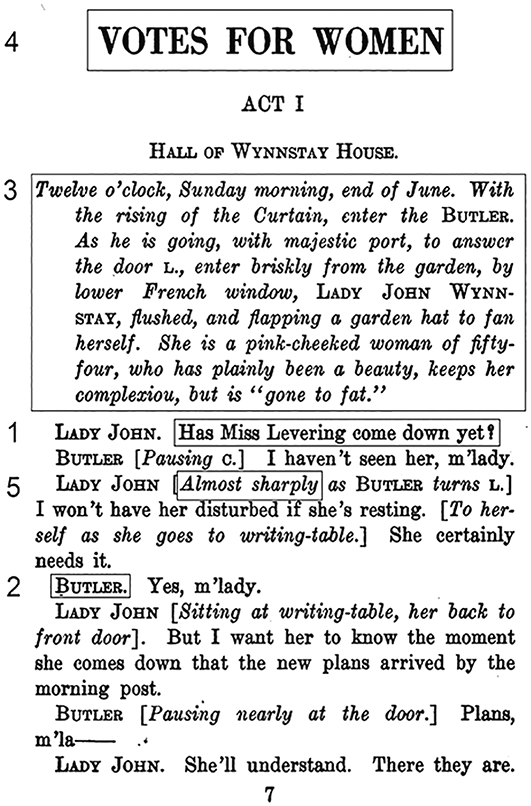
Most plays distinguish these elements through typographical variation: A combination of text size, font, capitalization, indentation, and spacing indicates the different functions of each element.Footnote 1 (Numbers refer to boxed elements in the figure.)
1. Dialogue furnishes the words spoken by performers, printed here in a regular font, fully justified.
2. Speech prefixes indicate who speaks each line of dialogue (and, sometimes, who performs specific actions on stage). These appear in this text indented at the start of each line of dialogue, in small caps and followed by a period.
3. Stage directions both describe the scene and direct the movement of actors. This edition prints them in italic font, with a hanging indent when they occupy a full paragraph.
4. Paratext, such as the play title (in a large, bold type, all capitals, center-aligned) or the page number (a center-aligned regular font at the bottom of the page), control the structure of the play and the text as a material artifact.
5. Didascalia are stage directions that indicate not action (“Pausing nearly at the door.”) but a character’s emotion or manner, such as “Almost sharply.” Didascalia often look like regular stage directions, but they are less concrete than a practical stage direction and sometimes far more discursive, as in the plays of Bernard Shaw.Footnote 2
The history of printed drama traces two developments in the playscript’s form: (1) the elements’ individuation, and (2) the changing print conventions that distinguish them from each other.Footnote 3 Even in any given era (including the present day), one can find huge variety among plays: the presence or absence of any given element, the use of different typographical indicators for the common elements. Each element is a convention with a history. How texts differentiate among them changes depending on shifting methods, tastes, and needs in the theater and in the printing and publishing industries.Footnote 4
An example from this history of theater’s evolution in print, discussed alongside a similar change in some legal print practices, demonstrates the potential of this analytic method. Prior to the consolidation of the conventions for printed drama just enumerated, dialogue-based genres did not reliably distinguish dramatic from narrative forms, instead intermingling them. As Julie Stone Peters explains in her history of printed European drama, “medieval verbal arts foregrounded their use of direct speech and indirect speech in combination, their conjoined use of both characters speaking in their own voices and an author’s or narrator’s voice describing the action.”Footnote 5 The Renaissance consolidation of theater’s artistic identity went hand in hand with a new style in printed drama. The emergent style for dramatic texts minimized “the voice of the poet” and maximized characters’ direct speech, in part by distinguishing typographically between dialogue and other aspects of the script (stage directions, arguments, etc.). Those nondialogic elements retained traces of an authorial, narrative function, but without corrupting the dialogue, the essence of printed drama.Footnote 6 The dramatic action (primarily spoken by characters) and the narrative circumstances (inscribed by stage directions and other textual materials) thus adopted distinct typographical forms.
Compare the history of reporting speeches in Britain’s Parliament. Not until 1909, when Hansard became an official report commissioned by each House of Parliament, were all members’ speeches printed fully in the first person. (Or, at least “substantially” verbatim.)Footnote 7 Previously, printed parliamentary debates appeared as indirect speech, a form of narration that suggests, but is not true dialogue:
Mr. H. Berkeley believed that if this Bill became law it would have the effect of turning every pothouse into a theatre, and every theatre into a pothouse.
Mr. Brady also thought the passing of the Bill would reduce the drama to the lowest pitch it had ever stood at in the country.
Mr. Locke said, he was not disposed to accept mere assertions as an answer to his arguments.Footnote 8
Here we find a combination of direct and indirect speech. We can imagine the named members speaking, but only through an act of implicit translation from this printed form. The use of “believed” and “thought,” as well as “said” without quotation marks, all either interiorize or simply narrativize what was actually a set of speech acts, that is, a dialogue. One could imagine a naive reader thinking that Berkeley did not speak at all, but that the debate’s author omnisciently reports Berkeley’s “beliefs.” Why did parliamentary reports appear this way? In part because, until the 1890s, the reports were produced by cobbling together articles from multiple newspapers. The narrative style disguised the fact that the debates were summaries of summaries.
Modern Hansard transcribes Parliament’s debates more clearly, treating speech like speech. In other words, it looks more like a dramatic text – complete with speech prefixes in bold followed by a colon. Hansard today purports to represent directly what was said by MPs, and thus to increase the transparency of parliamentary actions and to improve citizens’ knowledge of government by making their representatives accountable for their speech. Parliamentary reports’ old narrative–dramatic style, with its indirect discourse, could only gesture at such accountability. It never adopted – as a standard or as a format – the direct connection between speech and the speaking subject upon which dramatic texts insist. Thus we see in the evolution of printed parliamentary debates the belated adoption of a process that theatrical texts underwent in the Renaissance. These changes in legislative reporting, defined in part by adopting drama’s print conventions, improved democratic transparency and accountability.
Changing how parliamentary reports transcribe spoken words and actions changes the legal character of those reports themselves. Such change is only possible after we have recognized the gap between the legal form and its (often disregarded) dramatic cousin. When we see what legal forms elide in their failure to be fully dramatic, we can identify the shortcomings of the former and the possibilities inherent in the latter. In this particular case, once one recognizes that parliamentary debates might be written as dramatic texts, the apparatus of a dramatic text becomes available to bring Parliament to book in a new, newly legible form. Many other legal texts may benefit from a similar analysis – but first we must locate the dramatic potential that their current form suppresses.
Let us explore legal writing by seeking in legal documents – primarily legal transcripts – the elements of printed dramatic texts. By searching for dialogue, speech prefixes, stage directions, paratext, and didascalia, we will find some of law’s essential performances – sometimes concealed, sometimes hiding in plain sight. Because law really is, sometimes, a type of performance, how law does and does not engage with drama’s textual elements may help us learn what legal texts prioritize and exclude from the legal performances they encode or anticipate. Seeking the elements of printed drama, we will discover the slippages between legal texts and legal performances, and identify places where more care for that dynamic may create a better form – literally and figuratively – of law.
Dialogue
Unlike dramatic texts, most legal texts are not scripts for performance. Ex post facto scripts of legal performances – that is, transcripts, such as parliamentary reports – are far more common. A deposition transcript, for instance, is something designed not to be performed by others but to document what was already said. And yet legal material does encode dialogue. For instance, the Constitution of the United States includes a kind of dialogue: the oath to be administered when swearing in the president. Here is how the Constitution introduces the oath:
Before he enter on the Execution of his Office, he shall take the following Oath or Affirmation: – “I do solemnly swear (or affirm) that I will faithfully execute the Office of President of the United States, and will to the best of my Ability, preserve, protect and defend the Constitution of the United States.”
This differs from stage dialogue’s formatting in two important ways. First, there is no speech prefix, but simply an order that the president-elect “shall take” the oath. Second, the oath’s text appears in quotation marks – not, of course, the way dramatic texts indicate speech. Should we, then, regard the oath of office as dialogue at all?
The Constitution’s text suggests we should not. And yet inaugural ceremonies have adopted traditional practices that transform the Constitution’s pseudo-script into a real script for legal performance. In practice, the presidential oath truly is a dialogue. The dialogic nature of the oath begins with the addition of an oath administrator (traditionally, the Chief Justice of the Supreme Court) as the second speaker in the ceremony. Until the 1930s, the oath’s administrator would read the oath as a question, to which the president-elect merely replied in the affirmative. In playscript form, that might look something like this:
Administrator: Do you, George Washington, solemnly swear that you will faithfully execute the Office of President of the United States, and will to the best of your Ability, preserve, protect and defend the Constitution of the United States?
President-Elect: I do.
This form of dialogue gives all the words of the oath to a new, supporting actor, transforming the president-elect’s “line” into a question delivered by the administrator. In this version, the president-elect, surprisingly, never speaks the constitutionally assigned dialogue at all, but instead speaks an entirely different line (“I do.”), inherited from the normal form of oath-taking (e.g., weddings, sworn testimony). In other words, pre-1930s inaugurations relied on the implicit script of oaths and affirmations to transform the Constitution’s unclear dialogue into a recognizable performance of oath-taking.
With Franklin Delano Roosevelt, the inaugural oath transformed into a new performance script. In a letter from February 1933, Roosevelt asked the clerk of the Supreme Court “whether it would be better for me to repeat the oath after the Chief Justice.”Footnote 9 Chief Justice Charles Evans Hughes affirmed this suggestion as “the more dignified and appropriate course” than the “I do” of previous generations.Footnote 10 Thus, since the 1933 inauguration, the oath’s administrator has read each clause of the Constitution’s oath to the president-elect, who replies piecemeal, thereby cumulatively saying all of the oath’s language. Oath takers have also begun appending “so help me God.” The script – and the hands of inaugural participants may well hold a printed script – might look like this:
Administrator: Please raise your right hand and repeat after me: I, Joseph Robinette Biden, Junior, do solemnly swear –
President-Elect: I, Joseph Robinette Biden, Junior, do solemnly swear –
Administrator: – that I will faithfully execute –
President-Elect: – that I will faithfully execute –
Administrator: – the Office of President of the United States,
President-Elect: – the Office of President of the United States [etc.]
However formatted on the page, both the old and the modern forms of the oath differ significantly, in their text, from the Constitution’s script for the oath. Each version transforms the Constitution’s implicit text for performance into a proper script.
This may seem a rather overwrought, quibbling history of presidential oath-taking.Footnote 11 Yet to execute the Constitution’s mandate, we must answer questions that document leaves unresolved: What does it mean to “take” an oath? What is the proper script for oath-taking? What words must be said, by whom, at what time? By understanding presidential oath-taking as a scripted performance, we notice how American law has left the assumption of executive power somewhat mysterious. The plain constitutional text requires rewriting and reformatting to be performed.
Theater scholars are accustomed to plumbing this magical space between print and performance, and to demystifying how the forms of dramatic texts enable particular performances. Less common to theater studies is the examination of scripts derived from performances. Law, however, inverts theater’s literal priority of the written word (i.e., the dramatic text that precedes the performance), depending less on performing implicit scripts than on producing ex post facto transcripts of legal performances. The legal system has not ignored the challenges posed by translating speech to writing; many conventions have developed to control some of the messiness inherent in that act of transformation. The Federal Guide to Judiciary Policies for producing court transcripts, for instance, features sixteen pages of guidelines.Footnote 12 These rules range from the material (paper sizes) to the visual (margins, lines per page, indentations) to the organizational (headings) and more. Such conventions help stabilize legal performances into reliable, purportedly neutral texts. (Intriguingly, the Judicial Conference seems to have established these rules initially only to regularize transcript fees charged by court stenographers.Footnote 13) By standardizing transcripts, the rules predetermine what can and cannot be meaningfully recorded about a legal performance.
One rule stands out as particularly relevant when considering the relationship between legal and dramatic texts, a rule that determines what counts as “verbal content” in a transcript. The rule posits that, while the proceedings “must be transcribed as spoken,” nevertheless,
In the interest of readability, false starts, stutters, uhms and ahs, and other verbal tics are not normally included in transcripts; but such verbalizations must be transcribed whenever their exclusion could change a statement’s meaning.Footnote 14
Transcripts necessarily smooth out the messiness of speech: translate run-on thoughts into neat sentences and paragraphs; remove ambiguities; make what we hear with comprehension into something we read with understanding. But speech is not writing, and some of the information that speech carries is in precisely those things that writing seeks to suppress.Footnote 15 (As any good playwright knows, making meaning from “false starts, stutters, uhms and ahs” is a task at which actors excel.) Forensic linguist Anne Graffam Walker observed this problem in a 1986 essay that surveyed appellate justices about their use of transcripts. Appellate judges, she found, use transcripts “not just to get the facts, but to get at the meaning of the original proceeding which produced the facts by forming impressions of the setting and the participants in an effort to reach intelligent and fair decisions.”Footnote 16 Significantly, judges rely on “contextual features” and “disfluencies” of language to get at that meaning.Footnote 17 In other words: Judges read transcripts like theater artists read scripts, mining them for clues about character and intent. Court proceedings are just as likely to carry meaning in those easily missed, suppressible aspects of speech as any line of Chekhovian dialogue.
A recent play that dealt with the relationship between American law and women presented a magnificent example of unexpected meaning in precisely such verbal clutter from a court proceeding. Heidi Schreck’s What the Constitution Means to Me plays some of the recorded oral argument in Griswold v. Connecticut, the case that established a right to privacy, specifically a right to access birth control. To fully appreciate the effect of this scene, one must listen to the oral argument itself, which, in this written chapter, I cannot offer readers. But Schreck’s script reproduces the necessary portion of it, with her own – rather than the court’s – formatting and details. Her transcript reads:
Justice Potter Stewart: Now that I’ve interrupted you, you’ve told us that in Connecticut the sale of uh … these devices is uh … not molested because they’re sold for the prevention of disease. Is this uh … true about all of these devices that are covered uh … that each of them has the potential dual function of acting in a contraceptive capacity and as a prevention of disease, or only with respect to some of them?
William I. Emerson: It’s probably only true with respect to some, but some get by under the term “feminine hygiene,” and uh … others uh … (Cough) uh … (Cough) uh … I – I – I just don’t know about, but uh (Cough) uh … (Cough) They are, they are all sold in Connecticut drug stores on one theory or another.
Justice Earl Warren: Is there anything in the record to (Cough) to indicate uh … (Cough) the uh, stem of the birth rate in Connecticut vis-à-vis the States that don’t have such laws?Footnote 18
Schreck is wholly uninterested in the substance of this dialogue. She plays the recording so the audience can hear these men’s evident discomfort when talking about birth control. The audio recording and Schreck’s transcription feature persistent, loud throat-clearing first from lawyer Thomas I. Emerson (Schreck mistakenly names him William) and then Chief Justice Earl Warren.
By contrast, here is what that passage looks like in the court’s official transcript:
The Court: Now that I’ve interrupted you – you’ve told us that in Connecticut the sale of these devices is not molested because they’re sold for the prevention of disease. Is this true about all of these devices that are covered, that each of them has the potential dual function of acting in a contraceptive capacity and as a prevention of disease, or only with respect to some of them?
Mr. Emerson: It’s probably only true with respect to some, but some get by under the term “feminine hygiene,” and others I just don’t know about. But they are all sold in Connecticut drugstores on one theory or another.
The Court: Is there anything in the record to indicate the extent of the birth rate in Connecticut vis-a-vis the states that don’t have such laws?Footnote 19
No coughs; no throat clearing; just words. Yet as Schreck and her audience recognized – laughter was plentiful at both performances I attended, and can be heard in the film made of the stage production – the throat-clearing recharacterizes the entire argument, permeating the meaning of the men’s purportedly substantive statements with a stark awareness that their speaking on this issue at all is injust.Footnote 20 The court’s transcript, of course, records only what legal transcribers considered essential dialogue: the words.Footnote 21
Speech Prefixes
Speech prefixes in the law appear in striking forms. Some legal documents include a paratextual relative of speech prefixes, a list of dramatis personae. In case names, the central players in the dramatic conflict called litigation constitute the title itself: plaintiff v. defendant.Footnote 22 The printed US Reports go further, opening each volume with a list of the justices, along with the officers of the court. Opinions name the attorneys arguing and supporting each case, along with the filers of amicus curiae briefs.
Speech prefixes proper appear in transcript of arguments or depositions. The transcript from Griswold, for instance, refers to the lawyers by name, but to the justices – who do not, sad to say, speak simultaneously, like a Greek chorus – simply as “The Court.” At some point since 1965, that practice changed, and modern Supreme Court transcripts do indicate which justice asked which question. The Guide to Judiciary Policy, however, still indicates that transcripts must refer to judges as “THE COURT.” Lawyers maintain their identity – though the policy, in superannuated detail, insists on identifying female lawyers by their marital status (“MRS., MS., OR MISS”). Criminal defendants, after an initial identification by name, lose theirs: a defendant becomes simply THE DEFENDANT, like a character in a medieval morality play.
Yet all of these titles fall by the wayside during witness examinations. Witness examination transcripts record dialogue in a format that almost eliminates speakers as speaking persons. The proper prefixes are simply “Q” and “A” for “question” and “answer” (Figure 5.2).
Deposition of Lawrence Paterson, Ohio Supreme Court, Case No. 2010-2029, 33.
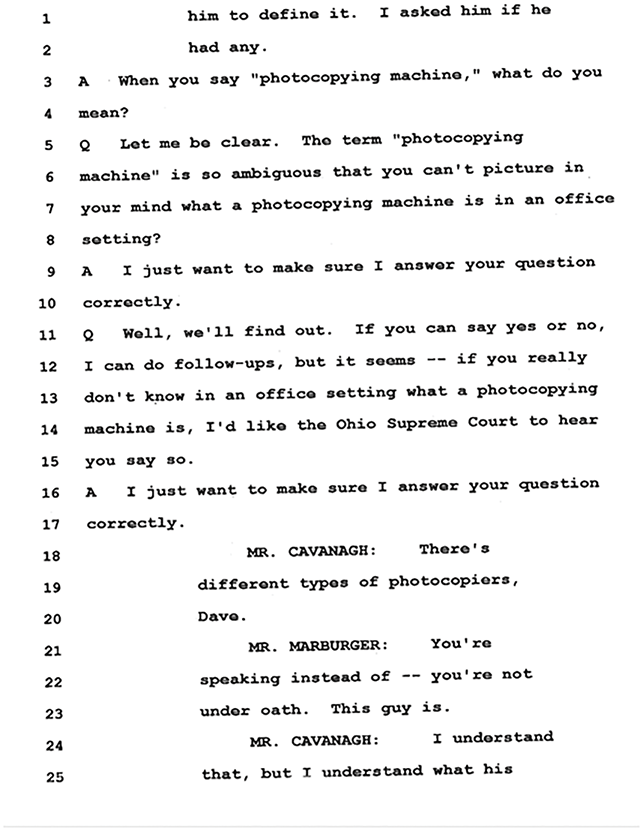
The transcript is a pure dialogue, denuded of persons speaking, recording only the linguistic pursuit of truth.Footnote 23 Most examinations, however, also include some haggling about procedure, a “colloquy.” And colloquies, unlike the questioning proper, revert to named speakers, but with different indentation, with each new speaker identified beginning “on the tenth space from the left margin.” The convention results in an effect like a play within a play.
But which is the metatheatrical frame and which the staged performance? Colloquies control the flow of the question and answer, stepping out of the performance of the Q&A to negotiate the rules of engagement. Law’s procedure, rules about what may be asked, what counts as badgering a witness, etcetera, all direct the play of Q&A. And yet the transcription format suggest that the question and answer is the main event. Q and A’s dialogue is left-justified without indentation, while colloquies begin inside, as it were, the Q&A. And the abstraction of “Q” and “A,” a kind of Beckettian scholasticism, implies large questions of major import, compared to the piddling asides of squabbling, named lawyers. Indeed, even in the formidably absurd deposition in Figure 5.2, Mr. Cavanaugh’s casual, dismissive “There’s different types of photocopiers, Dave” seems petty and insignificant next to A’s profound semantic query – yes, A asks a question! – “When you say ‘photocopying machine,’ what do you mean?”
Stage Directions
Legal scripts thus follow their own, somewhat strange practices for speech prefixes. The rules for stage directions are far less clearly defined. Legal texts do not deal significantly with a legal proceeding’s setting. Legal documents usually provide only vague indications of place-as-jurisdiction: the Southern District of New York, for instance. Dockets, perhaps, add some sense of geographic movement, with their indication of a case’s journey through different jurisdictions. In legal texts, legal scenery is sparse.
This does not mean, however, that legal scenery does not exist or is unimportant. Linda Mulcahy argues that “the environment in which the trial takes place can be seen as a physical expression of our relationship with the ideals of justice.”Footnote 24 Federal courts recognize this in their Design Guide, which combines Levitical detail about the sizes of clerks’ desks with observations such as “Courtroom ceiling heights should reflect the solemnity of court proceedings. The raised judge’s bench and ceiling height contribute to the order and decorum of the proceedings.”Footnote 25 The Design Guide attends to both the practical and the affective registers of architecture, recognizing that courts are environments loaded with symbolic and emotional meaning.
But on the page, law loses attention to space. The Guide to Judiciary Policy does not require transcripts to reveal in which physical venue proceedings took place. Without such information, we cannot grasp how each trial participant’s relationship to the courtroom space may affect their behavior. Many actor training paradigms urge actors to familiarize themselves with the play’s set, so as to make the actor comfortable enough to act truthfully.Footnote 26 Little wonder that the strange courtroom environment creates tension for so many people, or that law enforcement officers and expert witnesses perform so well on the stand: They may be familiar not only with court procedures, but with the very rooms in which they find themselves. (Even a seasoned witness may feel uncomfortable in a new courtroom.) As the Design Guide’s existence demonstrates, legal spaces matter. The absence of information about legal scenery in most legal texts does not imply neutral settings, but merely inattention to the physical environment’s effects on legal performances.
Although scenery is usually absent from legal texts, information about the actions of bodies is not uncommon. The Guide to Judiciary Policy indicates that “It is the responsibility of the attorneys, as well as the judge in some instances, to note for the record any significant nonverbal behavior (i.e., physical gestures, and lengthy pauses on the part of a witness).” A court transcript will also indicate recesses, the commencement and conclusion of a proceeding, and even the jury’s entrances and exits. In tracing the movement of bodies, as well as the discrete “scenes” of legal action, transcripts can look very much like plays. Yet law remains ambivalent about the import of legal actors’ bodies. On the one hand, law often insists on presence in the courtroom. Debates about televising trials still bring up fierce resistance from many in the judiciary.Footnote 27 On the other hand, the appellate process, for instance, turns the human beings in the case into merely dramatis personae.
Does the law script movement, as well as record its having occurred? The blank signature line on a contract is a kind of stage direction: The line instructs you to “sign here,” your printed name beneath it like a speech prefix, interpellating you into your role as a legal person whose speech act–signature entails you to perform your contractual obligations. The signing body is absent in the signature, but also was present.Footnote 28 Or what of court orders, which initiate a whole set of reactions in other courts, other branches of government, and society generally? The hard, flat, ritual locution “It is so ordered,” which punctuates most Supreme Court opinions, may set in motion very specific actions by affected parties. Like a good director, those parties must, as readers of the script, fill in the scenes necessary to enact the drama those words imply.
Paratext
Paratexts, a concept developed by Gérard Genette, are perhaps the least fruitful area in which knowledge of dramatic conventions might shed new light on the forms of legal texts.Footnote 29 This is true for two contradictory reasons: first, because paratexts – page numbers, introductory essays, footnotes, epigraphs – function so precisely in any given form, and, second, because the analytic possibilities of paratexts are generalizable across all types of texts. Legal citations exemplify the former, a legal practice so idiosyncratic that it may learn nothing from drama. Byzantium would blush at the modern prescriptive Uniform System of Citation propagated by The Bluebook, a system the intricacies of which have become, in the words of one critic, “an unhelpfully over-prescriptive approach to citation that has resulted in needless complexity.”Footnote 30 Drama has no comparable standards for citations, and no internal models that might rescue law from its current citational morass. Headnotes exemplify the second type of paratext, familiar across genres, merely the law’s version of introductions. The headnotes produced by Westlaw and Lexis, which summarize legal opinions, are simply a branded form of summary, subject to the same critique as the summarizing introduction for a dramatic (or any other) text.Footnote 31
Might we still have something to learn from drama’s paratextual elements? Act and scene divisions, for instance, are essential paratextual forms in drama, with a history that traces changes in dramatic production practices and the logic of dramatic plots. So-called French scenes, as one example, begin and end with the entrance or exit of a character; each configuration of people on stage creates a new scene.Footnote 32 Trial transcripts follow a slightly different logic, mandated to indicate such moments as “DIRECT EXAMINATION,” “CROSS EXAMINATION,” “PLAINTIFF RESTS,” etcetera.Footnote 33 On the one hand, the transcript records the trial’s formal process, its phases and movements, merely indicating the orderliness of the proceedings. Yet the trial, as lived by its participants, may not be quite so orderly. The transcript’s headings reassert the proper dramatic script of the trial.Footnote 34 Its paratexts insist that the trial was a set of discrete, sequenced events, from opening statements to presentations of evidence and examination of witnesses, to closing statements, and, eventually, to judgment.
Didascalia
Nowhere does the booking of the law’s performance matter more than in the realm of didascalia. Didascalia are the dramatist’s expressive tool for encoding and directing emotion – from which we interpret meaning, motive, character, and so much else that we must understand to reach just outcomes. Without didascalia, with only dialogue, we risk misunderstanding legal performances entirely.
Two examples from comedy’s interaction with law demonstrate the point. One is the famous story from one of Lenny Bruce’s obscenity trials.Footnote 35 As Nat Hentoff reported during the trial,
Lenny had to endure hearing his act performed before a three-judge panel by a nonperformer who had more or less memorized it. Nobody, certainly not the judges – who had refused to let Lenny do his own act – thought any of [the witness]’s surrogate act was funny. How could they? It not only wasn’t funny. It was awful. …
“This guy is bumbling,” Lenny kept saying, “and I’m going to jail. He’s not only got it all wrong, but now he thinks he’s a comic. I’m going to be judged on his bad timing, his ego, his garbled language.”Footnote 36
As any comic will tell you, and as the officers of Bruce’s court refused to acknowledge: it’s all in the delivery.
The second example comes from one of the greatest courtroom films ever made, My Cousin Vinny.Footnote 37 (Once again, the written form of the chapter somewhat stymies the effect of my argument; I recommend a screening.) Early in the film, Ralph Macchio, playing the role of Bill, is interrogated for a crime the audience knows he did not commit. In a classic moment of dramatic misunderstanding, Bill believes he has been arrested for shoplifting a can of tuna. Having confessed his crime, Sheriff Farley (Bruce McGill) – seeking a confession to homicide – asks Bill, “At what point did you shoot the clerk?” Bill replies with what an audience member might describe as incredulity: “I shot the clerk,” he says, looking stunned, and then repeats the statement with increased confusion and alarm.
Later in the film, the sheriff testifies in court about his interrogation of Bill, reading directly from a transcript. In his reperformance of this legal script, the sheriff uses an entirely different intonation, as though Bill had stated twice, plainly and factually, “I shot the clerk.” The sheriff’s testimony turns a suspect’s statement of disbelief into a declaration of guilt, not by transforming any words, but by altering his delivery of those words. Intonation, like coughing, does not get recorded in a transcript. Sheriff Farley reasonably read Bill’s testimony neutrally because, after all, the transcript itself is neutral, recording words, but not tone.
And yet there exists a clear tradition of indicating emotion in a dramatic text. Indeed, this very scene offers an example of that tradition. The screenplay for My Cousin Vinny notes, through its didascalia, Bill’s attitude during the interrogation. The first “I shot the clerk” is to be delivered, “completely confused, rolling the words over.” During the second statement, Bill “gives [a] questioning look to [Sheriff] Farley.”Footnote 38 The screenplay does precisely what the interrogation’s transcript would not: indicates attitude, emotion, tone, delivery.
Why does the law not attempt to put pathos into writing? How many Bills have had their fates sealed by such refusal?Footnote 39 It is a commonplace of modern dramatic texts to make clear – in parenthetical description, by using different fonts, or by other means – how a text ought to be acted. Yet legal transcripts do not take up these conventions from drama, reverting instead to an (illusory) pure textuality.
Though I have reached the end of my discourse, this chapter, I hope, can serve as a beginning. It offers some methods for thinking about legal texts as scripts that either precede or follow legal performances, and suggests how we might employ traditions from dramatic texts for that analysis. My brief examples indicate the deep, unresolved questions about how law textualizes its performances and performs its texts.
In some sense, this study arrives too early. Law does not yet have a proper book history (for instance, of trial transcripts), nor a proper performance history, though both have emerged in recent scholarship.Footnote 40 Perhaps, though, to explore either of those areas properly, law must first recognize that each involves the other. Any book history of law must take seriously the legacy and meaning of performance’s textual conventions. And understanding law as performance remains challenging in no small part because legal writing seems designed to leave performance out.
Yet performance persists in the conventions of legal writing, printing, and publishing; we just have to look for it. If law is performance, legal texts are performance texts, and we should – at least sometimes – read them that way.
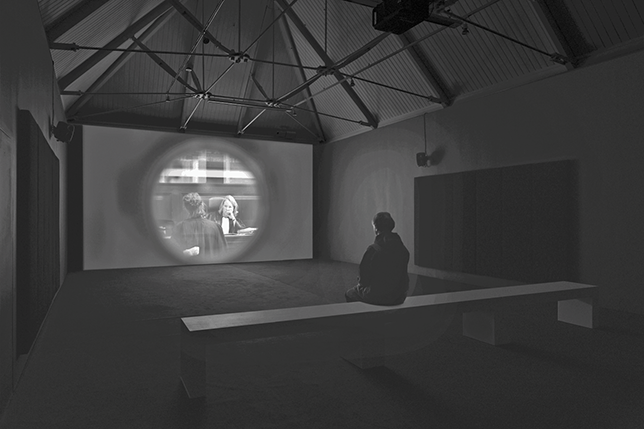

 Open access