




INTRODUCTION
Anthropogenic climate change has begun to create immediate problems for human populations, ranging from increased wildfire frequency to reduced growing seasons for staple crops (Skarbø and VanderMolen, Reference Skarbø and VanderMolen2016; Allen et al., Reference Allen, de Coninck, Dube, Hoegh-Guldberg, Jacob, Jiang, Revi, Masson-Delmotte, Zhai, Pörtner, Roberts, Skea, Shukla and Pirani2019). Many scholars and agencies predict that one of the primary consequences of rising global temperatures will be an increase in the prevalence of interpersonal violence (Anderson and DeLisi, Reference Anderson, DeLisi, Forgas, Kruglanski and Williams2011; Caruso et al., Reference Caruso, Petrarca and Ricciuti2016; Mares and Moffett, Reference Mares and Moffett2016; Levy et al., Reference Levy, Sidel and Patz2017; Robbins Schug, Reference Robbins Schug and Robbins Schug2020). Recent sociological studies observed upticks in direct interpersonal violence associated with rising global temperatures in modern contexts (Anderson and DeLisi, Reference Anderson, DeLisi, Forgas, Kruglanski and Williams2011; Mares and Moffett, Reference Mares and Moffett2016; Levy et al., Reference Levy, Sidel and Patz2017). For example, Mares and Moffett (Reference Mares and Moffett2016) note that global homicide rates increased by an average of 6% for each degree of increase in average annual temperature (Celsius).
The extent to which such relationships apply across variable ecological and cultural contexts remains poorly understood. Sociological studies and the human securities literature operate at limited timescales and within cultural contexts shaped principally by European colonialism and global markets (Robbins Schug et al., Reference Robbins Schug, Parnell, Harrod and Buikstra2019; Robbins Schug, Reference Robbins Schug and Robbins Schug2020; Rockman and Hritz, Reference Rockman and Hritz2020). The cultural breadth and temporal depth of archaeology provide a means of investigating the diverse ways that humans respond to climatological changes more broadly (Douglass and Cooper, Reference Douglass and Cooper2020; Burke et al., Reference Burke, Peros, Wren, Pausata, Riel-Salvatore, Moine, de Vernal, Kageyama and Boisard2021). Bioarchaeological research is uniquely situated to evaluate questions about the effects of climatological fluctuations on human behaviors. Life experiences manifest themselves in the skeleton through a process of embodiment, potentially reflecting disease, violence, and malnutrition, or lack thereof. Through various biological and cultural processes, the social and physical environments are transcribed on the skeleton (Walker, Reference Walker2001; Armelagos, Reference Armelagos2003; Sofaer, Reference Sofaer2006; Larsen and Walker, Reference Larsen, Walker and Larsen2010; Agarwal and Glencross, Reference Agarwal, Glencross, Agarwal and Glencross2011; Tung, Reference Tung2021).
Violence is a complicated topic and often difficult to define. The World Health Organization (WHO) broadly defines violence as “The intentional use of physical force or power, threatened or actual, against oneself, another person, or against a group or community, that either results in or has a high likelihood of resulting in injury, death, psychological harm, maldevelopment or deprivation” (Krug et al., Reference Krug, Mercy, Dahlberg and Zwi2002, p. 1084). Alternatively, Francis Galtung (Reference Galtung1969) conceived of violence as tripartite, consisting of direct violence, structural violence, and cultural violence. While structural and cultural violence can be subtle and invisible (Farmer, Reference Farmer2004), only direct violence takes the form of readily visible interpersonal assault (Galtung, Reference Galtung1969).
Within the archaeological record, evidence for the different types of violence can take numerous forms, including cranial fractures, paleopathological lesions indicative of metabolic stress, and stable isotope signatures indicative differential access to important foodstuffs (Walker, Reference Walker2001; Tung, Reference Tung2021). These forms of evidence often point to events of direct and structural violence among past populations (Klaus and Tam, Reference Klaus and Tam2009). Additionally, violence is not necessarily limited to events that affect living persons directly. One example of post-mortem structural violence includes the dissection of deceased individuals interred in cemeteries belonging to subaltern communities by medical schools in the nineteenth century (Nystrom, Reference Nystrom2014; Nystrom et al., Reference Nystrom, Sirianni, Higgins, Perrelli, Liber Raines and Nystrom2017). Within Andean contexts, another form of violence includes the sacrifice of human individuals by slitting the throat or strangulation—as is seen in Moche, Chimú, and Inka contexts (Verano, Reference Verano, Bourget and Jones2008; Faulbaum, Reference Faulbaum2011; Prieto et al., Reference Prieto, Verano, Goepfert, Kennett, Quilter, LeBlanc and Fehren-Schmitz2019).
As one of the most environmentally variable landscapes in the world, the South American Andes, presents an ideal opportunity to investigate how people respond and adapt to rapid climatological change and environmental variation. People have inhabited the extreme environments of the Andes for at least 13,000 years (Lindo et al., Reference Lindo, Haas, Hofman, Apata, Moraga, Verdugo and Watson2018; Contreras, Reference Contreras2022; Fiedel, Reference Fiedel2022). They rapidly developed an impressive suite of cultural and biological adaptations leading to a number of diverse archaeological cultures and traditions (Dillehay and Kolata, Reference Dillehay and Kolata2004; Silverman and Isbell, Reference Silverman and Isbell2008; Malpass, Reference Malpass2016; Lindo and DeGiorgio, Reference Lindo and DeGiorgio2021). To facilitate discussion of the diversity of archaeological cultures in the Andes, archaeologists have divided time periods into ‘horizons’ of widespread sociopolitical organization and relative cultural homogeneity, and culturally differentiated ‘intermediate periods’ between horizons (Rowe, Reference Rowe1962). This analysis is specifically concerned with the Andean middle horizon and late intermediate period.
The Andean middle horizon (MH), ca. 1.5–1.0 ka (AD 500–1000), saw the rise of the first states in the Andes—Wari and Tiwanaku (Isbell and Schreiber, Reference Isbell and Schreiber1978; Janusek, Reference Janusek2004, Reference Janusek2008; Isbell, Reference Isbell, Silverman and Isbell2008; Nash, Reference Nash2019; Williams and Nash, Reference Williams and Nash2021). Previous research showed clear evidence for interpersonal violence during this period (Tung, Reference Tung2012; Arkush and Tung, Reference Arkush and Tung2013). The Wari Empire is thought to have engaged in numerous episodes of violent conquest, an aspect of their culture mirrored in the bioarchaeological and archaeological records through the prevalence of skeletal trauma during periods of expansion and militaristic iconography on Wari ceramics (Williams, Reference Williams2002; Schreiber, Reference Schreiber2004; Tung, Reference Tung2007; Arkush and Tung, Reference Arkush and Tung2013). Trophy heads are frequently found at sites in the Wari heartland, and isotopic evidence compellingly suggests that these trophy heads were the victims of conquered communities (Williams, Reference Williams2002; Tung, Reference Tung2008a; Tung and Knudson, Reference Tung and Knudson2008). Conversely, Tiwanaku traditionally has been thought to have exerted its sphere of influence more subtly, taking a “Zen road to statecraft” (Janusek, Reference Janusek2008, p. 287) with cultural hegemony diffusing via multi-regional exchange networks. However, recent bioarchaeological studies have begun to complicate the image of Tiwanaku's peaceful hegemony, with some middle horizon archaeological sites within Tiwanaku's sphere of influence revealing evidence of direct interpersonal violence (Torres-Rouff et al., Reference Torres-Rouff, Knudson, Pestle and Stovel2015; Becker and Alconini, Reference Becker, Alconini, Tiesler and Lozada2018; Blom and Couture, Reference Blom, Couture, Tiesler and Lozada2018).
The abandonment of Wari and Tiwanaku sites at the end of the middle horizon has been the subject of debate. Despite impressive monumental architecture and the wide-scale regional influence wielded by these states, their influence receded and vanished almost entirely by ca. 1.0 ka (AD 1000). Interestingly, this sociopolitical unravelling occurred slightly after the onset of the Medieval Climate Anomaly (MCA), a centuries-long global climate perturbation that occurred from ca. 1.05–0.70 ka (AD 950–1300) (Lüning et al., Reference Lüning, Gałka, Bamonte, García Rodríguez and Vahrenholt2019). Previous research demonstrated that the MCA broadly affected human behavior around the world. For example, bioarchaeological meta-analyses indicate that there was a sharp increase in violence among foragers throughout what is now the state of California during this period (Schwitalla et al., Reference Schwitalla, Jones, Pilloud, Codding and Wiberg2014; Allen et al., Reference Allen, Bettinger, Codding, Jones and Schwitalla2016). Closer to the study region, the MCA likely had consequences for Indigenous populations within the Amazon Basin, as indicated by increased rates of interpersonal violence (Neves, Reference Neves, Nielsen and Walker2009; Moraes and Neves, Reference Moraes and Neves2012) and site abandonment during this time frame (Riris, Reference Riris2019; Bush et al., Reference Bush, Nascimento, Åkesson, Cárdenes-Sandí, Maezumi, Behling and Correa-Metrio2021).
Within the Andes, some scholars argue that enduring drought caused by the MCA may have played a causal role in the decline of Wari and Tiwanaku (Binford et al., Reference Binford, Kolata, Brenner, Janusek, Seddon, Abbott and Curtis1997; Kolata et al., Reference Kolata, Binford, Brenner, Janusek and Ortloff2000). According to the model, this drought undermined Tiwanaku's agricultural economy, which is adapted to relatively wet conditions adjacent to Lake Wiñaymarka on the Andean Altiplano. Drought-induced resource scarcity appears to have further jeopardized critical cycles of reciprocity and exchange between Tiwanaku elites and commoners (Janusek, Reference Janusek, Alt and Pauketat2019). The undermining of this inter-class trust destabilized the Tiwanaku sociopolitical and cultural system (Ortloff and Kolata, Reference Ortloff and Kolata1993; Binford et al., Reference Binford, Kolata, Brenner, Janusek, Seddon, Abbott and Curtis1997; Moseley, Reference Moseley, Oliver-Smith and Hoffman1999; Kolata et al., Reference Kolata, Binford, Brenner, Janusek and Ortloff2000; Janusek, Reference Janusek2008). Other scholars suggest that drought was unlikely to have affected agricultural productivity (Erickson, Reference Erickson1999), or that the temporal resolution of paleoclimatological reconstructions and radiocarbon do not permit strong claims regarding the effect of climate change on Tiwanaku's sociopolitical stability (Marsh et al., Reference Marsh, Contreras, Bruno, Vranich and Roddick2021).
Although the potential drivers of Wari sociopolitical collapse have not been systematically investigated, bioarchaeological evidence demonstrates that the immediate aftermath of collapse was a violent time within the Wari heartland of the Ayacucho Basin, perhaps indicating a backlash against elite groups perceived as being responsible for the difficult times (Williams, Reference Williams2002; Finucane et al., Reference Finucane, Valdez, Calderon, Pomacanchari, Valdez and O'Connell2007; Tung, Reference Tung2012). The period after the collapse of Wari and Tiwanaku, and before the rise of the Inka Empire, is termed the late intermediate period (LIP), ca. 1.0–0.6 ka (AD 1000–1400), and is frequently characterized as a period of unrest and violence suggesting something of a cultural “collapse” across the MH–LIP transition (Covey, Reference Covey2008; Arkush and Tung, Reference Arkush and Tung2013).
Sociopolitical ‘collapse’ is not a simple process. Nor is ‘collapse’ a particularly fitting word to describe the destabilization of the Wari and Tiwanaku as sociopolitical hegemonies during the Andean Middle Horizon when one considers that these cultural traditions persisted, albeit in different forms. Resilience theory presents a more apt framework for thinking about the nature of societal reorganization (van der Leeuw and Redman, Reference van der Leeuw and Redman2002). Borrowed from ecology, resilience theory posits that human societies function similarly to natural systems—moving through adaptive cycles over time (Redman, Reference Redman2005). These cycles include exploitation, in which rapid expansion is emphasized; conservation, characterized by the slow storage of energy and material in increasingly organized structures; release, what archaeologists broadly understand as collapse; and finally, reorganization in which human societies develop new social systems and methods of adaptation (Holling and Gunderson, Reference Holling, Gunderson, Gunderson and Holling2002). Importantly, although the process is cyclical, reorganization entails movement to new socioeconomic forms that retain some characteristics of earlier ones. Within this framework, the people living towards the end of the Middle Horizon within the Wari and Tiwanaku hegemony likely separated themselves from their spheres of influence in something of a release phase. This is exemplified in the Moquegua Valley where a new cultural style of settlement, known as Tumilaca, emerged during the end of the Middle Horizon. Associated with Tiwanaku style architecture but lacking Tiwanaku iconography, these individuals were descendants—cultural, biological, or both—of those who abandoned Tiwanaku colonies (Sutter and Sharratt, Reference Sutter and Sharratt2010).
The hypothesis that environmental conditions may have affected the frequency of interpersonal violence in the Andes is supported by recent quantitative research by McCool et al. (Reference McCool, Wilson and Vernon2022a), who identified a positive relationship among interpersonal violence, altitude, and altitudinal variation. They argued that the increased marginality of high-altitude environments, caused by hypoxic conditions and extremely low temperatures, reduced the carrying capacity of the environment and motivated violent competition over scarce resources.
In a more region-specific study, McCool et al. (Reference McCool, Codding, Vernon, Wilson, Yaworsky, Marwan and Kennett2022b) found that violence rates in the Nazca highlands were, counter to expectation, greatest during periods of elevated precipitation. The authors hypothesized that the increased precipitation may have acted as a pull factor—drawing more people to the area than the environment could support (McCool et al., Reference McCool, Codding, Vernon, Wilson, Yaworsky, Marwan and Kennett2022b). These findings conflict with findings from other world regions indicating increased violence associated with increasingly dry conditions (Allen et al., Reference Allen, Bettinger, Codding, Jones and Schwitalla2016; Schwindt et al., Reference Schwindt, Bocinsky, Ortman, Glowacki, Varien and Kohler2016). The Nazca case shows that human responses to climate change can be highly variable with micro-ecologies and socio-political contexts influencing outcomes within macro-ecological conditions.
The study presented here offers a systematic evaluation of the hypothesis that drought and climatological instability drove interpersonal violence throughout the south-central Andes. Thus, the study presents a meso-scale analysis that spans multiple cultural regions within the south-central sub-region of the Andes. Following on these previous findings, we hypothesize that the highest incidences of cranial trauma in the south-central Andes occurred during periods of drought and climatological instability, particularly during the LIP. We therefore expect to observe that, on average, increased rates of violent trauma in the highlands corresponded to decreased and more variable ice accumulation rates. Additionally, we evaluate the relationship between climate and violence proxies across an elevational gradient in order to assess the extent to which these dynamics apply in different ecological contexts.
METHODS
To evaluate the relationship between climate and violence in the south-central Andes, we compile published bioarchaeological data on cranial trauma from the region (Fig. 1) and compare these observations to ice-accumulation data, which serve as a paleoclimatological proxy for precipitation. Here, we describe our proxy data for inter-personal violence and precipitation and our statistical methods for evaluating their relationship.
The south-central Andes and sites included in this study. Contour lines present at 500 m asl and 3000 m asl, defining the coastal, mid-elevation, and highland samples (U.S. Geological Survey, 2010).

Trauma data
In this analysis, we limit the scope of our investigation to patterns of direct interpersonal forms of violence in which an individual is physically harmed by another. Such violent encounters can—but do not always—manifest as perimortem or antemortem fractures in the crania. Violence also can manifest in post-cranial regions, but we limit our analysis because cranial traumas are frequently well preserved and are the most consistently documented indicators of violence in the Andes (Arkush and Tung, Reference Arkush and Tung2013; Tung, Reference Tung2021; McCool et al., Reference McCool, Codding, Vernon, Wilson, Yaworsky, Marwan and Kennett2022b), which allows for relatively reliable comparison of many samples examined by different analysts.
For each burial assemblage, we record archaeological age and elevation. Archaeological age is expressed as the range of dates for a given skeletal assemblage as determined by the original authors of the respective publications. Although AMS radiocarbon dates for each individual would be preferable, such specificity is unavailable for most samples. When possible, we separate archaeological sites by dated skeletal assemblage. We classify burials into one of three elevation categories defined as follows: coastal as 0–500 m asl, mid-elevation as 501–3500 m as., and highland as >3500 m asl. For each burial or burial assemblage, we compile published geolocations for elevation zone assignment.
The trauma variable for a given cranium is coded as ‘1’ for the presence of one or more lesions indicative of antemortem trauma or fractures indicative of perimortem trauma, or ‘0’ for the lack of such evidence for cranial trauma. Information regarding estimated age at death, injury recidivism, type of trauma (perimortem versus antemortem), and fracture location is not a component of this study. Bioarchaeological studies investigating the extent and effect of these aspects of interpersonal violence are important for our understanding of the varied forms of violence in the archaeological past of the Andes. However, while these and other variables certainly can affect the probability that an individual has experienced violent trauma, for the purpose of this study we assume that our sample reflects a random demographic cross-section of the overall population. As a general approach, we exclude any assemblages that are clearly biased toward a particular demographic group, such as child sacrifice or male warrior cemeteries, which are known from the Andes.
Climate data
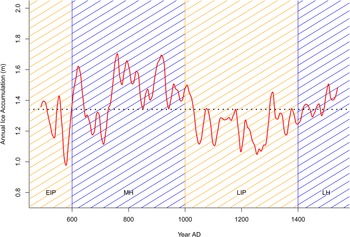
Climatological data for the period of interest comes from the Quelccaya glacial ice cores (Fig. 2; Thompson et al., Reference Thompson, Mosley-Thompson, Bolzan and Koci1985). Seasonal cycles of aridity and moisture during the austral summer and moisture during the austral winter influence the amount of dust in the local atmosphere (Thompson et al., Reference Thompson, Mosley-Thompson, Bolzan and Koci1985; Bird et al., Reference Bird, Abbott, Vuille, Rodbell, Stansell and Rosenmeier2011). This seasonal flux of dust is preserved in glacial sediments, creating rings analogous to those found in the tree samples. Each cycle represents a single year, preserving a record of hydrological cycles in the Andes. By measuring the thickness of each cycle, paleoclimatologists can infer net annual snow accumulation, which is a direct measure of annual precipitation (Thompson et al., Reference Thompson, Mosley-Thompson, Bolzan and Koci1985).
Quelccaya snow accumulation rates over time (Thompson et al., Reference Thompson, Mosley-Thompson, Bolzan and Koci1985). Dashed black line indicates average yearly ice accumulation. EIP = early intermediate period, MH = middle horizon, LIP = late intermediate period, and LH = late horizon/Inka imperial period.

Mean annual ice accumulation for each skeletal assemblages is assigned by taking the average annual ice accumulation for the temporal range of any given site assemblage. Variance in annual ice accumulation for each skeletal assemblages is assigned by taking the standard deviation in annual ice accumulation for the temporal range of any given site assemblage.
Statistical analysis
To evaluate the relationship between the frequency of cranial trauma among skeletal populations and changes in environmental conditions we construct two generalized linear mixed models (GLMM) using the logit function with cranial trauma as a binary response variable and ice accumulation as a continuous predictor variable. In our first GLMM, we model the interaction of mean annual ice accumulation and elevational zone as the predictor variables, the frequency of cranial trauma as our response variable, and archaeological site as a random effect. Mean annual ice accumulation is specified for the date range of each assemblage examined. In our second GLMM, we model standard deviation in annual ice accumulation as the predictor variable, the interaction between the frequency of cranial trauma and elevational zone as our response variable, and archaeological site as a random effect.
The examination of site assemblages runs a risk of finding spurious results due to site-based autocorrelation. GLMM allows us to control for this confound by identifying unique intercepts for each archaeological site, controlling for the effects of idiosyncratic cultural practices and contexts that generate additional sources of variability (Bates et al., 2003). Holding archaeological site as a random effect thus buffers against any specific archaeological site with an abnormally high or low frequency of samples from skewing the results. We use a GLMM to adjust and correct for the over-dispersion that would occur without inclusion of a random effects variable in the model. All statistical analyses were conducted in the R statistical computing environment using the lme4 and lmerTest packages (Bates et al., 2003; Kunzetsova et al., Reference Kunzetsova, Brockhoff and Christensen2017; R Core Team, 2019). The code used for statistical analysis is available in supplemental material 1, and all data used in the project are available in supplemental material 2.
RESULTS
Our data compilation resulted in bioarchaeological data from 29 publications for a sample of 4045 individuals from 58 sites spanning 1070 years in the south-central Andes (see Fig. 1; (Fouant, Reference Fouant1984; Blom and Bandy, Reference Blom, Bandy and Hastorf1999; Kellner, Reference Kellner2002; de la Vega et al., Reference de la Vega, Frye, Tung, Stanish, Cohen and Aldenderfer2005; Torres-Rouff et al., Reference Torres-Rouff, Costa-Junqueira and Llagostera2005, Reference Torres-Rouff, Knudson, Pestle and Stovel2015, Reference Torres-Rouff, Hubbe and Pestle2018; Lessa and de Souza, Reference Lessa and de Souza2006; Tung, Reference Tung2007, Reference Tung2008c, Reference Tung2012, Reference Tung, Scherer and Verano2014a; Andrushko et al., Reference Andrushko, Buzon, Simonetti and Creaser2009; Cagigao, Reference Cagigao, Reindel and Wagner2009; Andrushko and Torres, Reference Andrushko and Torres2011; Kurin, Reference Kurin2012; Arkush and Tung, Reference Arkush and Tung2013; Whalen, Reference Whalen2014; Juengst and Skidmore, Reference Juengst and Skidmore2016; Kurin et al., Reference Kurin, Lofaro, Gómez Choque and Krigbaum2016; Juengst et al., Reference Juengst, Chávez, Hutchinson and Mohr Chávez2017; Lowman et al., Reference Lowman, Sharratt and Turner2019; Juengst, Reference Juengst and Robbins Schug2020; McCool, Reference McCool2020; Scaffidi and Tung, Reference Scaffidi and Tung2020; Torres-Rouff, Reference Torres-Rouff and Robbins Schug2020; Bey et al., Reference Bey, Andrushko and Bélisle2021). Unfortunately, disturbances to the dust cycles limit the temporal range of the paleoclimate record to ca. 1.5 ka (AD 470) to present (see Fig. 2), reducing the sample to 2753 crania from 49 sites (Table 1).
Cranial trauma and precipitation by archaeological period. EIP = early intermediate period, MH = middle horizon, LIP = late intermediate period, LH = late horizon/Inka Imperial period.

Our first model reveals a strong negative relationship between annual ice accumulation and the frequency of cranial trauma, which is driven entirely by the highland sub-population (Fig. 3). In the highlands, the odds of observing evidence of inter-personal violence increase on average by a multiplicative factor of 2.4 (1.8–3.2; 95% C.I.) for every 10-centimeter decrease in annual ice accumulation at the Quelccaya Glacier. In contrast, the model fails to find a relationship between average annual ice accumulation and interpersonal violence within the coastal or middle elevation sub-populations in the sample. The sum of squared Pearson residuals is considerably less than the number of records, and a scatterplot of the Pearson residuals and predicted values produces non-anomalous values, indicating high goodness of fit between the model and data (see supplemental materials 2).
Generalized linear mixed model results, predicting cranial trauma as a function of mean annual precipitation by altitudinal zone. We observe an inverse relationship between interpersonal violence and precipitation within highland contexts, but not mid-elevation or coastal contexts. The frequency of violence ranges from 0–1, where 0 = total lack of violence and 1 = evidence of violence throughout the entirety of the skeletal assemblage. Dots indicate archaeological sites, with dot size indicating sample size, which ranges from 5–277. Lines represent relationship between annual ice accumulation the frequency of cranial trauma, with gray ribbons represent standard error ranges, and dot sizes represent sample size per archaeological site.

Our second GLMM fails to detect a relationship between Quelccaya ice accumulation variance and the frequency of interpersonal violence, leading us to reject our hypothesis for a relationship between climatic variance and violence.
DISCUSSION
This study examined the relationship between precipitation and interpersonal violence within the south-central Andes from ca. 1.5–0.5 ka (AD 470–1540). Comparing bioarchaeological data on crania trauma from 2753 individuals to paleoclimatological data from the Quelccaya Glacier, we found that decreased precipitation predicts increased rates of cranial trauma. This observation suggests that climate change exerted a significant effect on rates of interpersonal violence in the region. This effect was restricted to the highland mortuary populations where the odds of archaeologically detectable inter-personal violence increased on average by a multiplicative factor of 2.4 (1.8–3.2; 95% C.I.) for every 10-centimeter decrease in annual ice accumulation at the Quelccaya Glacier. Surprisingly, we did not find support for the hypothesis that climatic variance affected rates of violence. Rather, these results indicate a relationship in which precipitation influenced violence within the highland contexts, and that individuals in coastal and mid-elevation regions were either unaffected by environmental changes or opted for non-violent solutions to the challenges posed by the MCA.
Perhaps the most likely explanation for the relationship between violence and precipitation in the highlands is conspecific competition over limited resources during times of resource scarcity. Other archaeological studies have reported a similar correlation between climatological conditions and interpersonal violence in the Andean highlands (Torres-Rouff, Reference Torres-Rouff and Robbins Schug2020; McCool et al., Reference McCool, Wilson and Vernon2022a, Reference McCool, Vernon, Yaworsky and Coddingc). The ostensible mechanism behind this relationship is that the MCA drought undercut agricultural production in high elevation environments (Binford et al., Reference Binford, Kolata, Brenner, Janusek, Seddon, Abbott and Curtis1997; Kolata et al., Reference Kolata, Binford, Brenner, Janusek and Ortloff2000; Flores et al., Reference Flores, Bologna and Urzagasti2011; Arnold et al., Reference Arnold, Hillman, Abbott, Werne, McGrath and Arkush2021). This resource depletion would have stranded high elevation populations above carrying capacity. As resources grew scarce, violent competition would have served as a potential response. This Malthusian explanation does not, of course, explain all of the variability within the data, but instead offers a potential causal mechanism by which decreased precipitation may have led to increased interpersonal violence rates, on average, within high elevation environments in the south-central Andes. It is thus possible to recognize these broader trends in drought response while simultaneously recognizing response variation around the mean. One such example is the Molino-Chilacachi skeletal assemblage, which despite being located at a high elevation during a period low precipitation, only exhibits a trauma rate of 14.6%, which is 24% below the predicted mean of 38.6% (de la Vega et al., Reference de la Vega, Frye, Tung, Stanish, Cohen and Aldenderfer2005).
It is possible that at least some populations within the high elevation environments did not view mobility as a viable option for coping with climate change-induced resource stress, whether due to circumscription or cultural ties to landscapes. Within many ethnographic accounts from the Andes, the landscape is not ontologically framed as an inanimate background, but rather an active social participant in the world (Sillar, Reference Sillar2009; De la Cadena, Reference De la Cadena2010; Allen, Reference Allen2012). Similarly, in many Andean cosmologies, ancestors and the deceased are considered active participants in the world and important members of the community (Tung, Reference Tung2014b). If archaeological populations held cosmological beliefs about the physical landscape and buried ancestors in ways that are comparable to those observed in the ethnographic record, leaving the drought-stricken altiplano may have been an unacceptable solution for many. In short, the economic benefits of abandoning their landscape and ancestors may not have exceeded the cultural costs.
For those people who did perceive mobility as an acceptable solution to drought-induced resource scarcity, migration towards wetter regions may not have completely alleviated metabolic stress or conspecific competition over agricultural resources. McCool et al. (McCool et al., Reference McCool, Codding, Vernon, Wilson, Yaworsky, Marwan and Kennett2022b) argued that the increased precipitation in the Nazca highlands may have acted as a pull factor, drawing more people to the area than the environment could support, leading to conflict over scarce resources. That these findings contradict each other requires explanation. One possibility is that the relationship between increased precipitation and violence within the Nazca region only occurred due to broader regional drought. If not for the unusually dry conditions experienced throughout the Andes during this time, highly populated areas may not have appealed to mobile populations. Alternatively, it is possible that internal social factors created variable responses in different regions of the Andes.
The differential outcomes between the lowlands and highlands also require explanation and additional research. We hypothesize a few possible explanations here, the first of which is migration. Mobility has been documented frequently within the ethnographic and archaeological record as a response to environmental and social stressors (Kelly, Reference Kelly1992). Although migration is an easier strategy for foragers to employ in response to food shortages and drought, sedentary agriculturalists may find such solutions less tractable, though not impossible, given elevated territoriality (Kelly, Reference Kelly1983, Reference Kelly1992; Pestle et al., Reference Pestle, Torres-Rouff, Gallardo, Ballester and Clarot2015). The long history of inter-altitude mobility studies and numerous stable isotope analyses may demonstrate that inter-regional mobility among sedentary Andean populations was indeed feasible (Murra, Reference Murra and Ortiz de Zúñiga1972; Blom et al., Reference Blom, Hallgrimsson, Keng, Lozada C and Buikstra1998; Tung, Reference Tung, Silverman and Isbell2008b; Chala-Aldana et al., Reference Chala-Aldana, Bocherens, Miller, Moore, Hodgins and Rademaker2018). For example, genetic evidence indicates population movement from the Altiplano towards the Nazca Highlands, coinciding with highland drought and comparative moisture in the Nazca region (Mächtle and Eitel, Reference Mächtle and Eitel2013; Fehren-Schmitz et al., Reference Fehren-Schmitz, Haak, Mächtle, Masch, Llamas, Tomasto Cagigao and Sossna2014). Furthermore, this influx of migrants may have resulted in increased interpersonal violence (McCool et al., Reference McCool, Codding, Vernon, Wilson, Yaworsky, Marwan and Kennett2022b). However, this seems unlikely for the majority of the south-central Andes given the apparent lack of increase in violence in the lower elevations during periods of drought.
Alternatively, it is possible that the MCA posed little real economic threat for coastal and middle elevation populations. The cold waters of the Perú Current foster some of the richest fisheries in the world, and lomas fogs are capable of supporting a high volume of plant life sufficient for agricultural productivity and camelid pastoralism (Tomczak, Reference Tomczak2003; Lozada et al., Reference Lozada, Buikstra, Reycraft and Reycraft2005; Reitz et al., Reference Reitz, Andrus, Sandweiss, Rick and Erlandson2008; Beresford-Jones et al., Reference Beresford-Jones, Pullen, Whaley, Moat, Chauca, Cadwallader and Arce2015; Baitzel and Rivera Infante, Reference Baitzel and Rivera Infante2019). Moreover, hydrologic flows of the mid- and low-elevation zones may be less sensitive to highland drought at short time scales given that they are partially charged by groundwater, which smooths temporal variation in hydrologic systems, thus allowing for greater continuity in agricultural production. Mid-elevation communities may have been ideally positioned to engage in interregional trade and benefited from ease of access to multiple altitudinal zones. Finally, populations may have opted to absorb climate stress through other means—opting to weather the challenges of drought-induced resource scarcity rather than resort to violent competition. These combined effects may have been sufficient to buffer against drought-induced resource scarcity, limiting conspecific competition. Supporting this model, during the MCA we see the development and flourishing of coastal polities throughout the Andes such as Chimú in the north coast and Chiribaya in the south. In contrast, highland communities faced considerable balkanization and high levels of interpersonal violence (Buikstra and Lozada, Reference Buikstra and Lozada2002; Zaro and Alvarez, Reference Zaro and Alvarez2005; Covey, Reference Covey2008; Tung, Reference Tung2012; Cutright, Reference Cutright2015).
Cross-cultural studies of modern populations observe numerous behavioral changes accompanying elevated resource stress. In particular, scholars observe tighter maintenance of social norms, an increase in the belief of supernatural agents manipulating weather, and increased sharing practices (Ember et al., Reference Ember, Skoggard, Ringen and Farrer2018; Skoggard et al., Reference Skoggard, Ember, Pitek, Jackson and Carolus2020). However, these studies are necessarily limited to comparatively small windows of time, with 25 years serving as the longest time interval examined. Future research should address which, if any, of these responses to environmentally induced resource stress were employed within the south-central Andes during the LIP.
It is important to note that while violence is most often associated with aggression, harm, and broadly negative connotations in modern contexts, the anthropological literature informs of broader connotations within other cultural contexts. For example, violence is often an important aspect of the formation of masculinity and male identities (Martin, Reference Martin2021; Tung, Reference Tung2021), attaining social status (Scaffidi and Tung, Reference Scaffidi and Tung2020), an important aspect of social cohesion and enforcing social norms in the forms of witch-hunts (Martin and Harrod, Reference Martin, Harrod and Robbins Schug2020), and a factor in releasing inter-community tensions in the form of tinku fights in the Andes (Alarcón, Reference Alarcón, Tauli-Corpuz and Cariño2004; Tung, Reference Tung2007). Nonetheless, such forms of violence having a specific ritual, spiritual, or social function does not preclude them from influence from external or ecological factors (Arkush and Stanish, Reference Arkush and Stanish2005; McCool et al., Reference McCool, Tung, Coltrain, Accinelli Obando and Douglas J. Kennett2021).
Overall, it seems likely that the initial shock of the drought characteristic of the MCA stranded Wari and Tiwanaku above environmental carrying capacities, undermining the complex networks of social and political connections holding together the first Andean states (Williams, Reference Williams2002; Flores et al., Reference Flores, Bologna and Urzagasti2011; Tung, Reference Tung2012; Arnold et al., Reference Arnold, Hillman, Abbott, Werne, McGrath and Arkush2021). The scarcity of water within highland contexts during this time also may have threatened the ritual practices employed by Wari and Tiwanaku elites to reify and naturalize the sociopolitical organization of the Middle Horizon (Glowacki and Malpass, Reference Glowacki and Malpass2003; Tung, Reference Tung, Scherer and Verano2014a; Janusek, Reference Janusek, Alt and Pauketat2019). The causes of sociopolitical collapse are rarely, if ever, monolithic and are always driven by some interaction between environmental and socio-cultural factors (Tainter, Reference Tainter1990, Reference Tainter2006). The agricultural consequences of the MCA may have dissolved the sociopolitical ties and cultural norms tying together Wari and Tiwanaku, potentially instigating confusion and violence in the immediate aftermath of collapse in the highland regions where Wari and Tiwanaku held the greatest influence. It stands to reason that the periphery of these polities in middle-elevation and coastal environments felt the shock of collapse less intensely, evinced by the flourishing of coastal polities such as the Chiribaya along the south coast during this time frame (Buikstra and Lozada, Reference Buikstra and Lozada2002; Zaro et al., Reference Zaro, Nystrom, Bar, Alvarez and Miranda2010).
CONCLUSION
The long history of Andean archaeology and bioarchaeology allows for highly detailed investigations into the relationship between climate change and violence over time. While human behavior is not fully determined by environmental conditions, these conditions certainly influence the suite of cultural milieu that are adopted by a given community to manage life in changing and competitive environments (Faulseit, Reference Faulseit2015). Our results support the hypothesis that drought predictably elevates interpersonal violence rates under certain ecological and sociological conditions, but there is considerable response variation around the mean. This supports previous research demonstrating a relationship between climatological factors and human behavior in the Andes (McCool et al., Reference McCool, Wilson and Vernon2022a, Reference McCool, Codding, Vernon, Wilson, Yaworsky, Marwan and Kennettb; Wilson et al., Reference Wilson, McCool, Brewer, Zamora-Wilson, Schryver, Lamson, Huggard, Brenner Coltrain, Contreras and Codding2022), California (Allen et al., Reference Allen, Bettinger, Codding, Jones and Schwitalla2016), Mesa Verde (Schwindt et al., Reference Schwindt, Bocinsky, Ortman, Glowacki, Varien and Kohler2016), and Amazonia (Neves, Reference Neves, Nielsen and Walker2009; Bush et al., Reference Bush, Nascimento, Åkesson, Cárdenes-Sandí, Maezumi, Behling and Correa-Metrio2021).
Violence is a pervasive and immensely complicated component of all human societies (Galtung, Reference Galtung1969; Tung, Reference Tung2012; Schwitalla et al., Reference Schwitalla, Jones, Pilloud, Codding and Wiberg2014; McCool et al., Reference McCool, Vernon, Yaworsky and Codding2022c). Teasing apart the causal factors of interpersonal violence in both modern and archaeological contexts poses numerous challenges. Despite the daunting challenge, understanding the extent to which climate and environmental changes can drive human behavior, especially in regard to interpersonal violence, is important as modern anthropogenic climate change continues to intensify (Allen et al., Reference Allen, de Coninck, Dube, Hoegh-Guldberg, Jacob, Jiang, Revi, Masson-Delmotte, Zhai, Pörtner, Roberts, Skea, Shukla and Pirani2019; Kohler and Rockman, Reference Kohler and Rockman2020). This study demonstrates that climate change exerts predictable effects on interpersonal violence rates. The analysis also shows that specific violence rates are nonetheless not inherent outcomes of climate change but are in large part culturally contingent, and thus manageable or altogether avoidable.
Supplementary material
The supplementary material for this article can be found at https://doi.org/10.1017/qua.2023.23
Acknowledgments
We thank the Forager Complexity Lab members and the Davis Archaeology Working Group for their feedback. We also thank Mark Grote for assistance with statistical analysis. Any faults or errors are the authors’ sole responsibility.
Competing Interests
The authors declare no competing interests.



 Open access

