


Historical accounts of business enterprise in the early modern period tend to be triumphalist, while studies of commercial, manufacturing, and banking endeavours that failed to take off, crashed with a bang, or fell short of succeeding are somewhat rare in scholarly literature. But, as any work tackling the fundamental problems of exchange (and the solutions devised to resolve them) will acknowledge, failed expectations and debacle are part of any trade, regardless of the economic sector.Footnote 2 Business success is the tip of a deeper iceberg, with every endeavour meeting or exceeding expectations being matched by many more instances of the contrary. But little is usually said about the fallout when examining the factors leading to business collapse.
What happened, for instance, when foreseeable risks materialized or a business was unexpectedly struck by a string of bad luck? How did parties react when insolvency became a reality rather than merely a possibility?Footnote 3
A perfect example of unfavourable business outcomes occurred in the Portuguese Atlantic during the truly annus horribilis of 1624,Footnote 4 when a series of military setbacks plunged an already struggling economy further into the abyss, inflicting a major blow on government finances and private business alike. In May 1624, the Dutch West India Company (WIC) attacked São Salvador da Bahia, briefly capturing the capital of the colony of Brazil. Although a swift Luso-Castilian counteroffensive the following year (the “Voyage of the Vassals”) meant the Dutch did not hold Salvador for long, the shockwaves endured.Footnote 5 One group hit particularly hard by this military setback were the private entrepreneurs who had aligned their interests with the Portuguese state by contracting royal monopolies, supplying credit and provisions, or handling logistics for the armed forces and government bureaucracy. And these entrepreneurs are at the heart of this article.
Shortly after securing the government contract for the Portuguese Crown's commercial monopolies and taxation rights in Angola and adjacent trading districts in West Central Africa, Loango, and Benguela, Henrique Gomes da Costa experienced difficulties in fulfilling his contract, with losses in the very first year of the concession. Around the same time, the proceedings from the tax-farming contracts managed by Gil Fernandes de Aires were far below even the most pessimistic projections, resulting in several successive payment deadlines being missed and an arrears to the exchequer accumulating. It soon became apparent that these inauspicious starts were no temporary setback as both Gomes da Costa and Fernandes de Aires were ultimately stripped of their contracts, imprisoned, and deprived of assets pledged as collateral, with neither ever able to join another public-private partnership with the Crown.Footnote 6
These men's downward trajectories showcase the difficulties of pursuing a government contract in the early seventeenth-century Portuguese Atlantic, as well as the consequences of not achieving the intended outcomes. This article discusses how the state and businessmen handled foreseeable risks and unfavourable turns of events, how both responded to growing strife in the contracting ventures that brought them together, and the action taken once their contracts were terminated.
Although a longer chronology or quantitative assessment of contractual breakdownFootnote 7 would undoubtedly be productive, the primary evidence available is simply too inconsistent for such treatment. While there are many references to contractual ruptures for some periods, others periods make little or no mention of such phenomena. However, and despite some aspects and outcomes remaining obscure, the issue has been addressed sufficiently often in correspondence between government institutions to justify investigating these case studies.
A micro-historical analysis shows that what may be lost in chronological reach can be compensated by analytical coherence, colour, and nuance.Footnote 8 Inspired by recent micro-historical forays into business encumbrance in the past, this article is structured around two case studies during a fairly brief period. It emphasizes human agency, chance, and also less economically deterministic factors (political culture, for instance), which are more clearly observable through smaller analytical vignettes such as case studies, while also raising awareness of cultural and political values underpinning business failure.Footnote 9
The meaning attached here to contractual failure firstly requires clarification. A distinction can be made between parties explicitly requesting release from government contracts they could no longer fulfil and contract terminations resulting from decisions by the Crown. As neither contractor in this study acknowledged his insolvency by requesting release from the contracts, failure in this article should be understood to mean the second scenario.
Given the current state of Lisbon's notarial archivesFootnote 10 and particularly the scarcity of merchant accounts and correspondence providing insight into enterprises’ inner workings, the article is based primarily on institutional documentation. The ways the state and businesses tried to protect themselves against setbacks and contain any ensuing damage will be demonstrated through the paper trail left by the high courts able to adjudicate on and oversee contracts, such as the Council of the Treasury (Conselho da Fazenda), the Council of Portugal in Madrid (Conselho de Portugal), and the correspondence of the viceroyalty or governors running Portugal's day-to-day affairs during the Union of the Crowns.Footnote 11
The article first introduces the debates on government contracts and public-private partnerships in Western Europe prevailing during the early modern period, and contrasts these with the Portuguese experience. It then explains what a “contract” entailed in early modern Portugal and why these ventures comprised compelling, albeit potentially risky, investments. This is followed by the core of the article, which examines reactions to the contractors’ impending failure by the state, by the concessionaires themselves, and by their supporting networks. The reasons for the Crown's differing treatment of struggling contracts take centre stage, with the complexities of managing and monitoring public-private partnerships in seventeenth-century Portugal being fleshed out.
Government Contracts in Early Modern Europe and Seventeenth-Century Portugal
Historians have long frowned on the exclusivist contracts awarded by Western European states in the sixteenth to eighteenth centuries.Footnote 12 Recently, however, more balanced and ultimately more favourable perspectives have gained momentum, thanks to a new banner (the “contractor state”) and a fresh research agenda, with closer attention now being paid to governments’ efforts to co-opt merchants, financiers, and industrialists to bear administrative burdens and promote a more efficient allocation of resources to the military and executive apparatus. Rather than focusing on the central power's coercive “sticks,” or obsessing about “nationalization” of taxation and administrative operations, scholars have now started raising awareness of the “carrots” of economic mutual gain, portraying public-private partnerships not as symptoms of devolved authority, but instead as pragmatic, logical solutions for overcoming the state's executive shortcomings. By partnering with certain economic groups on terms considered mutually beneficial, central powers could further their own interests while also strengthening their operational capacity in the military and administrative arenas.Footnote 13
In Portugal, as elsewhere, the government contract was the prime means for aligning the state and private enterprise in pursuit of symbiotic goals. Despite various invaluable studies on specific partnerships over the years, and the widespread acknowledgement that contracts were at the core of its merchant elite's business portfolios, Portugal remains largely absent from many scholarly reflections on the contractor state,Footnote 14 even though this administrative solution was extensively used in the Lusitanian world from the early days of overseas expansion in the fifteenth century until well into the modern period.Footnote 15 Having been neglected by mainstream international scholarship, Portugal's role as a contractor state, let alone a contractor empire (given the great incidence of colonial public-private partnerships), has yet, therefore, to be acknowledged.
Contracts can be grouped by geographical scope, colonial economic sector or, for example, financial importance. This article makes a broad distinction between contracts of revenue and contracts of expenditure and provisioning. The first type of contracts entailed the temporary, and therefore reversible, transfer by the state of the right to collect specific taxes or to operate and exploit the king's patrimonial monopolies. Those awarded these contracts were granted exclusive prerogatives to barter and sell colonial commodities and to access coveted markets and routes overseas. The second type involved executive operations otherwise performed by the exchequer and the Crown's administrative apparatus, including the provision of credit, victuals, equipment, labour, and logistics.
Although the reciprocal rights and obligations differed, the divide was never so clear-cut in practice: firstly because merchant bankers pursued both types of contracts indiscriminately and often in tandem, and secondly because the two types of partnerships could not help but be linked, given that supplying assentistas were paid from the lump sums generated by other contracts and not from the tax receipts collected by the state. Links between the two could be even stronger as sometimes the Crown used the prospects of a tax or monopoly farm to persuade merchant-monopolists to provide certain services, credit, or commodities. A royal farm then served both as collateral for the contract and for repayment. Instead of receiving funds from tax receipts levied by a fellow tax-farmer, a supplying-expenditure contractor was allowed to collect the means of repayment himself, without any third party being involved. Other contracts were in reality a means to redeem the state's outstanding debts to a contractor. Unable to offset the indebtedness directly, the government granted the contractor the opportunity to obtain payment through potentially lucrative revenue-farming.
Demise of Contracting Enterprises
The reality of contracting does not always reflect the conventional wisdom that exclusivist concessions bestowed by a government guaranteed high, long-term returns, with little or no risk for custodians. Despite the prospective advantages, these contracts offered no guarantee of private entrepreneurs’ success. As Richard Bonney asked in respect of tax-farming in Colbert's France, “Is it any wonder, given the extent of the difficulties and the broad range of talents required, that relatively few tax-farmers were successful in the long-term, that profits were uncertain, and bankruptcies frequent?”Footnote 16
While all forms of tax-farming and government supplies involved risks and uncertainty, those involving indirect fiscal receipts, particularly from long-distance trade within territorially (and juridically) scattered empires, were particularly exposed to potential negative outcomes and imponderables and were relatively costly for the state.Footnote 17
One obvious way for businesses to limit these risks was to diversify across different investments and assets. According to scholarship on mercantile and financial elites in early modern Portugal, no trend of specializing in specific contracts or monopolized economic sectors is discernible. Instead, the upper business echelons diversified their state-private investments by bidding for contracts across a wide spectrum.Footnote 18
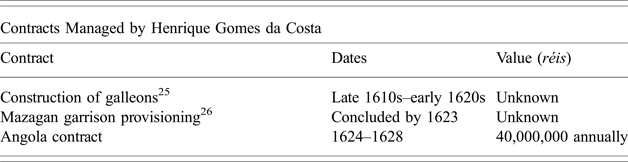
This was definitely the case for Gil Fernandes de AiresFootnote 19 and Henrique Gomes da Costa,Footnote 20 both of whom contracted for revenue-raising contratos and expenditure-allocating assentos. As the following tables show, their range was extremely varied, also geographically.Footnote 21

After some assentos supplying the Crown's naval stores and a brief spell as a shipbuilder under contract, Fernandes de Aires won a six-year contract for the consulado duty-farm, starting on 31 December 1623 and ending on the same day in 1629. The consulado was a 3 percent ad valorem tariff on cargoes coming through or leaving Portugal's littoral customs houses. The proceeds (one of the main fiscal innovations introduced under the Habsburgs) were used to equip a squadron that would patrol the Portuguese coast and defend it against pirates and enemy states’ navies.Footnote 27 The maritime customs house, where the consulado and other duties were levied, constituted one of the Portuguese state's main sources of revenue. The customs houses in Lisbon in particular (the staple port for trading with the kingdom's prized overseas possessions and the port most visited by other European nations’ merchant marines) were the golden goose of the royal treasury's metropolitan receipts.Footnote 28
The prospect of operating the consulado farm had sparked avid interest among the business elite since 1591,Footnote 29 while the annual flat sums paid by contractors for the privilege of collecting the tariff increased steadily in the years leading to 1623. The auction preceding Fernandes de Aires’ contract was exemplary in being fairly competitive, while the negotiation of the previous consulado contract in 1617 had also involved five candidates.Footnote 30 But by the time this latter concession ended and the Crown started looking for new leaseholders, a deflationist crisis of colonial goods was in full swingFootnote 31 and the Eighty Years’ War had recommenced after the Twelve Years’ Truce. The resumption of hostilities between the Spanish monarchy and the Dutch Republic in April 1621 and the reinstating of trade embargoes could have been expected to cool investors’ optimism, thus causing the value of the revenue farm to stagnate or even shrink. Instead, the public auction preceding the awarding of the contract saw its value rise by almost 11 percent to the highest level since the tariff was introduced in 1591 and the highest value (seventy million réis) ever reached by the consulado contract during the Union of the Crowns.Footnote 32
The reasons for this uninterrupted and seemingly unlikely growth are not entirely clear. Competition between bidders is likely to have inflated the contract's value, even if the economic climate would normally have suggested caution. The possibility that the economic climate was not properly assessed cannot be excluded. Could businesses have viewed this contract as immune from the worsening economic climate, and hence a safe investment? While an individual merchant banker's judgment may be queried, it is hard to imagine the same miscalculation being made by all the other businesses negotiating and accepting government contracts around that time. Yet this was precisely what happened with Henrique Gomes da Costa.
Gomes da Costa's final contract, and arguably the highlight of his involvement with the royal apparatus, was the Angola contract. This started in May 1624, the month that the WIC seized Bahia. Of the Angola contracts negotiated during the 1600s, Gomes da Costa's 1624 contrast had by far the highest value. Never before or since in that century was this fiscal monopoly contracted for as much as forty million réis. Previously, the contract was awarded for around twenty to twenty-five million réis, and it was not until the 1740s that the price set in the Gomes da Costa contract was surpassed (excluding the effects of inflation, and with new taxes collectable in Angola added to the royal farm).Footnote 33 The timing of events meant that when Gomes da Costa and the Crown formally concluded negotiations, the former was still unware of events in Brazil, with the news not reaching Lisbon until late July, a month after the usual starting date for contractual leases.
The Angola contract revolved around the Portuguese Crown's monopolies in its outposts in West Central Africa, including the right to collect slaving duties in Luanda, the administrative capital and seat of the colony's trading factory and fiscal agencies. It also allowed the leaseholder to operate the licensing system used to grant private enterprises access to the bartering districts on the African coast. By purchasing a permit (avença) from the contractor, traders could sail to and barter in areas within the contract's scope. Other than the few licences set aside by the king for individuals he wanted to grace with royal favour, the contractor enjoyed exclusive rights to sell these licences.Footnote 34 A combination of indirect tax-farming and the outsourcing of trading licences therefore constituted the two pillars of the Angola contract.Footnote 35
In exchange for the right to operate the royal monopoly on export trade, along with the farm of the trade tariffs levied on the settlement, Gomes da Costa was required to pay the Crown an annual lump sum in instalments. These payments were due both in the metropolis and in Angola, and were instrumental to the colony's administrative and economic livelihood. The wages of officials and clerics, the military apparatus, and the public infrastructure all depended on the receipts paid by the contractor to the local exchequer.
For any merchant-monopolist, the biggest catch in these public-private partnerships was the opportunity to levy duties and tolls and thus to stage manage flows of the Angolan slave trade and Portuguese trading incursions in Loango to the north and Benguela to the south. By the second decade of the seventeenth century, these regions had become the leading supplier of slaves to Brazil and Spanish America, accounting for two-thirds of all African slaves shipped across the Atlantic.Footnote 36 To reap these rewards, however, the leaseholder had to make sizeable investments and run operations ranging from Lisbon and other Iberian ports to coastal West Central Africa, Brazil, and the Indies of Castile. And as a vital commercial and fiscal player who was simultaneously a licence seller and duty collector, the contractor was also exposed to economic fluctuations and political turmoil on both sides of the South Atlantic, including in slaving “production” outlets (where Portugal had some influence, but certainly not control, despite its best military efforts) and in consumer markets in the New World.Footnote 37
In response to the mounting difficulties, the two contractors asked the royal authorities for an understanding of their situation. The contractors presented similar arguments, with both referring to the deteriorating political and economic climate in the Iberian Atlantic that had made it virtually impossible for them to fulfil their contractual obligations.
Both separately argued that they were prevented from enjoying “free use” (uso livre) of their government concessions. Given the Portuguese-Dutch war in the South Atlantic and the resultant commercial embargoes, the contractors claimed they stood no chance of fulfilling their obligations to the Crown, let alone generating profits. They considered that, for the sake of fairness, their contractual burden should be proportionally relieved to reflect the losses attributable to anomalous circumstances and that the exchequer was morally obliged to safeguard contractors’ interests in times of unforeseen duress, even if these problems had not been directly caused by the Crown and its officials.
In support of these claims, both contractors referred to contractual clauses contemplating the possibility of renegotiating their financial obligations in the event of unforeseen turmoil.Footnote 38 Addressing tax-farming in mid-seventeenth-century France, Noel Johnson claims that adjusting lease prices to changing political and climatic circumstances (such as the outbreak of war, epidemics, or bad harvests) made income inflows from revenue farms less “stable” and predictable than one might assume.Footnote 39 Making such an inference for the Portuguese case is problematic, as it is unclear how often periodic tranches were changed during the tenure. What can be ascertained, however, is that, by the 1630s, contractual provisions started including adjustment provisions in case war was declared, trade embargoes were imposed, or, after Pernambuco was captured by the WIC and the colony of Dutch Brazil was founded in 1630, if the Portuguese regained control of northeastern Brazil. If any of these scenarios materialized, the financial obligations would either increase or decrease at a predetermined rate.Footnote 40 However, this innovation in the terms of public concessions was not introduced until after the farms of Fernandes de Aires and Gomes da Costa failed, which explains why the value of their contracts was not automatically downgraded after the loss of Salvador da Bahia, and why they had to fiercely argue for this at the Council of the Treasury.
How then were the contractors’ pleas and justifications received by the government institutions? Before deciding whether to accept a write-down, the government first had to ascertain whether the losses were caused by events beyond the contractor's control or by negligence and miscalculation. Not surprisingly, assessments were always subjective as no predefined criteria existed for determining where human error started and the context ended. The problems in gathering information on transaction volumes carried out by distant fiscal agencies also meant assessments were based on unreliable empirical date. Consequently, it was by no means certain that the contractor could enforce such a clause.
Triggering Rescission or Cushioning a Faltering Contract
Despite legislation stating that the royal administration had to be expedient in rescinding government contracts if their terms were breached, the government's stance changed depending on the circumstances surrounding each contract.Footnote 41 The Crown could opt to be more lenient and flexible and accept changes to contractual provisions. It could also choose to strictly enforce financial clauses, while leaving timings, locations, and amounts unchanged. When addressing Fernandes de Aires’ pleas for less stringent financial obligations, the Council of the Treasury believed a struggling contractor should continue to be liable for his commitments, but in a way palatable to both sides. While the Crown should abandon the “anticipations” it had promised on signing the contract, at least for a while, it should remain steadfast in demanding additional collateral for the accumulating liabilities.Footnote 42
Alternatively the Crown could opt to stick scrupulously to the public-contracting procedures and not grant any leeway. The choice between these two approaches was generally determined by the availability of contractors and the political links between the Crown and the merchant. If the Crown considered a certain public-private partnership worthwhile, despite a contractor's current difficulties, the timing or amounts of lump sums would be renegotiated, and the merchant banker allowed to remain in business until his full contractual dues were settled. If, however, the royal administration no longer wished to remain associated with an underperforming contractor on the verge of defaulting, it could use this opportunity to replace him with a new, financially well-endowed and well-connected partner.
The Crown often preferred to continue doing business with an otherwise reliable contractor with whom it had been in partnership for some time. This reliability often related more to the contractor's general ability to fulfil obligations without incident and the willingness to do whatever it took to remain in the king's favour and in business with the sovereign. From the Crown's perspective, it was better to favour dependable bidders than those promising financially attractive terms, but whose ability to maintain them was untested and could potentially be questioned.
These relationships should not therefore be seen along impersonal and technocratic lines, based on the narrow criterion of economic-efficiency demonstrated by the auctions. This feature of the political economy of contracting is particularly evident in the language and rhetoric used by contractors when applying for government concessions and who claimed they were bidding for the sake of the king and the well-being of the monarchy.Footnote 43 If contractors were granted concessions other than for financial reasons, it is hardly surprising that these other reasons also came into play when the authorities had to deal with contractors in peril and close to default.
While the logic of service-reward and personal bonds between the king, his closest entourage, and merchant bankers certainly permeated the negotiating and monitoring of contracts,Footnote 44 it would be wrong, given the numerous examples of the contrary, to claim that public tendering was not used to select contract recipients during this period, and that all legal dispositions regarding the negotiation of government concessions were a dead letter.
Neither, however, should these political calculations and contracting ideology suggest that the monarchy pulled the rug from under contractors’ feet at the earliest sign of difficulty or as soon as they proved expendable. Quite the opposite. The royal administration normally disowned a disgraced financier or supplier only if someone else was ready to step into the outsourcing on terms at least as advantageous as those offered by the individual facing bankruptcy. If no obvious replacement was in sight, the decision-makers might reconsider pulling the plug on their fraught assentistas and contratadores, and grant them another chance on easier terms.Footnote 45
In some cases, however, and despite the Crown's best efforts, little could be done to salvage a contractor in dire financial or operational straits because of not complying with contractual requirements or offering a below-par service, failing to provide the quality stipulated in a provisioning arrangement, or repeatedly reneging on instalments, while the contract continued to lose money. However stellar the leaseholder's track record may have been or however close his links with the Crown, their relationship outside the sphere of the contract was ultimately one of convenience. Regardless of past accomplishments, if a contractor proved to be a liability and a factor of uncertainty, the Crown would seize the opportunity to discard him and use the full bearing of the law to extract as much satisfaction from the inconvenience as possible.
However, the Crown's input in the fallout of a public-private partnership extended beyond monitoring concessionaires’ performance and granting them more or less leeway to meet requirements. Indeed, the Crown itself could become a disruptive force and act in ways detrimental to the contractor, whether intentionally or otherwise. This is evidenced by the fact that although tax-farmers and monopoly leaseholders sometimes struggled to pay their lump sums promptly, the state, too, could find it difficult to muster the revenues needed to service its supplying and logistics-handling assentos. The state's incapacity to punctually honour its financial commitments to providers of services, commodities, or credit caused financial problems that not infrequently threatened the completion of contracts.
Fernandes de Aires witnessed first-hand the nefarious side effects of the state's treasury problems. These did not even relate to the tariff farm he was managing, but instead to previous contractors whose accounts had not yet been settled. In autumn 1624, when the finances of his consulado contract were worsening by the day, he requested payment for having supplied barrels and caskets for the India carracks a couple of years earlier.Footnote 46 For that service, he had been promised 1,151,000 réis payable from revenues of the Sete Casas de Lisboa fiscal agency.Footnote 47 In 1625, however, he owed the barrel-makers 500,000 réis, and blamed this unpaid sum on the Crown's cash-flow problems that prevented him from being paid for previous supplies. Unimpressed, the barrel-makers increased the pressure on Fernandes de Aires by taking him to court. After the latter was imprisoned in the Limoeiro penitentiary, he wrote to the Council of the Treasury requesting immediate payment of what was owed him, so that he could settle his accounts with his suppliers and be released from prison.Footnote 48
Apart from payment delays, the state could be also be detrimental to public outsourcing in other ways. In the case of revenue farms linked to maritime trade (such as the consulado and the Angola contract), the government also meddled by requisitioning merchant vessels in the event of military emergencies. According to Fernandes de Aires, the enlisting of merchant vessels for the relief fleets equipped for military purposes was one of the most damaging effects of the outbreak of war with the Dutch in the South Atlantic. Indeed this was a recurring complaint among contractors involved in collecting trade tariffs throughout the Union of the Crowns.Footnote 49
Henrique Gomes da Costa's case was no different as when he pleaded his case before the Crown, he, too, protested against the requisitioning of private trading ships for the Voyage of the Vassals. Contractors regarded the requisitioning of their vessels, or those of avençadores, as a blatant infringement of contractual stipulations, and urged the Crown to include clauses in contracts to prevent this. Unfortunately for them, one emergency situation was all it took to turn such clauses into a dead letter, and thus expose the contractors to problems that should have been prevented.Footnote 50
A third problem was the intransigence of the royal officials who monitored all commercial transactions at the ports and the taxes collected on contractors’ behalf. Ever since the end of the Twelve Years’ Truce, the enforcing of the embargoes decreed by the Habsburg monarchs on all ships and cargoes from the Dutch Republic had caused tensions between the local Portuguese authorities and tax inspectors appointed directly by authorities at the Spanish court. Sceptical of the Portuguese officials’ effectiveness and zeal in fighting contraband, the cabinet of the Count-Duke of Olivares, Phillip IV's privado, decided to place officials trusted by Madrid in Lisbon and other Lusitanian ports.Footnote 51 In pursuing the goals for which they were appointed, these much vilified civil servants were bound to interfere in contractors’ operations, be they imports of equipment and raw materials from the North Sea and the Baltic, or the collection of custom duties on maritime traffic. In early 1624, Fernandes de Aires complained about being harassed by Spanish embargo inspectors regarding a cargo-laden German ship prevented from docking in Lisbon after being suspected of being a Dutch vessel in disguise. Whether these officials were overzealous or simply committed to their task, their work prevented consulado farmers from reaping the substantial proceeds of taxing the ship's valuable cargo.Footnote 52
The Council of the Treasury's response to the pleas of Fernandes de Aires was largely identical to its response to Gomes da Costa. The merchants’ requests for respite in the payment schedule and a partial easing of arrears were not accepted, on the grounds that the contracts had started only a few years earlier and there was still time to remedy the financial predicament before the lease expired. The Council saw no reason why losses in one year could not be offset by gains in subsequent years.
Although the Crown tried to mediate the dispute between Fernandes de Aires and his creditors and suppliers, it eventually simply shrugged its shoulders. The exchequer's priority was to ensure the financial contributions due from the contractor continued flowing into the royal coffers, and that the logistic services required of the contractor were provided. These objectives could not be achieved with the contractor imprisoned and his creditors in hot pursuit. Providing there were signs that a contractor could turn things around, the state could show a modicum of flexibility, particularly if the Crown was partially to blame for the payment arrears. It was better, in other words, to lose some money in the short term by enforcing a contract's financial clauses leniently rather than risk its premature end through being overzealous. However, money could not be conjured up from thin air and, with no revenues available, the exchequer was powerless to rescue Fernandes de Aires, however solicitous a contractor he was.
While this was not what struggling contractors wanted to hear, the Crown's verdict is hardly surprising, considering contractors went into these negotiations and stood against the exchequer alone. Although the two contractors faced largely identical problems and requested the same, there is no evidence that they presented their cases together or attempted to garner other contractors’ support for the changes. Lacking strength of numbers or the coordinated power of a financiers’ cartel, they had less chance of obtaining their desired outcome than if they had acted collectively.Footnote 53
Despite the two contractors’ difficulties, the Crown did not abandon the tax-farms and the two merchant- bankers immediately. Although refusing to ease their financial obligations, the authorities did not terminate the contracts or accuse the contractors of mismanagement, but instead reiterated their confidence in a successful outcome. It is easy to understand why the two were not discharged from their contracts or relieved of their commitments. The unfavourable political and economic climate meant that replacing them would not be easy, and even if a replacement were found, the financial returns from the subsequent farms were bound to fall short of those under the existing contracts.
However, despite the Crown's best intentions, or wishful thinking, it soon became clear that the consulado and Angola contratos could not be saved, and that the state would have to end the two contractors’ operations. This marked a tactical shift in the Crown's relations with its contractors as, from then onwards, interactions centred on the collateral provided and the Crown's attempts to seize this.
Risk and Collateral
While government -outsourcing was not a risk-free affair for contractors, the state, too, had something to lose if a contract failed to produce the desired revenues. Governments were not particularly fond of the unpredictability surrounding the highly complex licensing and taxation of overseas trade, while they also found long-distance remittances of funds off-putting.Footnote 54 This volatility of receipts and the costs of collecting taxes ranked among governments’ most cumbersome operational problems, and this was why contract-farming was such a palatable and frequently used option.
Having shown how contracts were no guarantee of success, I will now discuss the serious toll that defaulting on their obligations took on contractors, as well as examining how the Crown sought to insulate itself against unfavourable outcomes in public-private partnerships by holding contractors accountable for their shortcomings.
Given the sizeable sums involved and the political costs of farming contracts out (i.e., the devolving of sovereign powers and loss of authority in the eyes of subjects), the Crown needed warranties. A comprehensive set of regulations, including strict provisions on collateral,Footnote 55 was therefore devised to minimize the state's losses and to compensate the royal treasury if a contractor defaulted or grossly breached obligations.
By law, contractors had to pledge assets representing between one-tenth and one-quarter of the contract's annual worth to the treasury, although some warranties were for up to half the contract's value. Contractors were expected to pledge their own possessions and also to appoint warrantors to vouch, personally and with their own assets, for the contractor's competence and integrity. This meant that those interested in pursuing a contract needed to have not only capital of their own, quick access to credit, and sufficient personal assets to pledge, but also people willing to pledge their own assets as collateral. The assets most frequently pledged were real estate, moveable assets, and government bonds.Footnote 56
But while attempting to protect itself against defaults and ensure that only wealthier merchants became tax-farmers, the Crown sometimes ended up burdening its contratadores by requiring them to command more resources than they could reasonably muster. Collateral thus became a further pressurizing variable that could itself contribute to contract failure.
The challenge of assembling sufficient collateral can be seen from the assets pledged by Fernandes de Aires and Gomes da Costa and their attempts to satisfy the exchequer's requirements.Footnote 57


The collateral deployed by contractors and their warrantors was often troublesome and not infrequently plagued by irregularities, as the above tables show. By law, all assets pledged had to be fully owned by those submitting them. This was so the state would not become involved in ownership disputes with third parties if it decided to seize assets. The collateral was also not permitted to be used other than for vouching for the contractor as it would otherwise be impossible for the Crown to sell the collateral to recoup losses inflicted by the contractors on the royal purse.Footnote 58
The need to pledge assets could easily create problems as even if contractors had sufficient capital to start and sufficient liquidity to sustain their contract when business was bad, they did not necessarily have assets to spare. Sometimes, therefore, even the most affluent businessmen had already mortgaged assets for other purposes, or had assets tied up in inheritance disputes with relatives or other ownership quarrels with former business partners. Delays in enlisting mortgaged estates were also fairly common as assets suitable as collateral were hard to come by at short notice, not to mention the time needed to persuade potential warrantors to back a bid.
Other times, assets were presented with a degree of wishful thinking, such as when warrantors presented an asset they did not yet own, but hoped to do so soon. In the early seventeenth century, Cristovão de Moura, three times viceroy of Portugal and Marquis of Castelo Rodrigo, warned about the common practice of bidders promising assets they did not own when the contract was being auctioned and later using the contract proceeds to purchase those very same assets.Footnote 59
Assembling assets of sufficient value and finding people willing to provide backing with their own possessions was no straightforward undertaking. Several of Fernandes de Aires’ warrantors ultimately decided to withdraw the collateral they had promised to provide. Fearing this would prompt the authorities to select another bidder, Fernandes de Aires concealed these last-minute withdrawals from treasury officials and simply listed these names in his bid.Footnote 60
Gomes da Costa, in turn, illustrates the efforts that went into submitting and ultimately getting collateral approved by the authorities. After lengthy negotiations, the Crown agreed to cap the collateral at twenty million réis (half the value of the annual concession). It was also agreed that arrears from a previous and unrelated public-private partnership and involving a Crown debt of 9,536,200 réis for provisioning the Mazagan garrison town (present day El Jadida) in North AfricaFootnote 61 should be converted into collateral for a new public-private partnership. Both parties welcomed the decision to include an unpaid sum from a previous contract in a new partnership. It meant that Gomes da Costa had to muster ten million réis less in collateralized assets (half of what would otherwise have been needed), while the exchequer was relieved from its duty to repay that amount to the merchant banker in the short term. While the state effectively turned a liability into an asset, for the contractor it meant turning what was likely to be a long wait for financial compensation into a potentially rewarding business opportunity and entering into the next chapter in a career at the king's service. With half of the estimated value covered, Gomes da Costa proceeded to provide collateral bonds worth 9,805,000 réis, while his warrantors were able to raise assets worth 10,463,800 réis.Footnote 62
While some of the problems in compiling collateral could be resolved, matters were no more straightforward when the Crown decided to seize pledged assets. This could easily turn into an extremely thorny and lengthy procedure, often worsened by protracted litigation, because, as these two contractors’ examples show, the pledging of assets was plagued by all sorts of irregularities and swindles that often made it impossible for the Crown to achieve timely financial satisfaction.
The collateral bond irregularities that were only discovered afterwards included the case of the warrantor Pedro Pinheiro da Costa. None of the assets he pledged on behalf of Henrique Gomes da Costa proved to be in order. Neither the contractor nor the warrantor were able to provide ownership certificates for the houses in Lisbon that Pinheiro claimed to own, and it was only after being imprisoned that he was able to muster some kind of document attesting to his ownership of these houses. According to a document sent by his father-in-law to the Crown, several of the vineyards he had pledged did not actually exist. And, lastly, the houses he owed in Benavente were subject to a legal dispute with a third party who claimed to own them.Footnote 63
Given the intricacies of providing collateral for these partnerships, the pledged assets should perhaps be seen less as pecuniary compensation for the state, and more as a pressure mechanism for maximizing a contractor's commitment, or rather as a testament to his liquidity and his ability to command additional resources in the event of downturns. Whether extra capital was needed for managing the contract or for enduring periods of dwindling revenues, such merchants indicated they had reserves they could draw on.
As well as burdening the contractors, however, the perils of contract-leasing often spilled over to the warrantors, as the contractual ordeals in Gomes da Costa's Angola contract show. In summer 1631, for example, several years after that colonial contract ended, one of Gomes da Costas's warrantors, António Travassos, was sent to the Limoeiro (Lisbon's civil prison) and the exchequer seized all his assets because of irregularities detected. Despite fears that his collateralized bonds might be irretrievable, the Crown was able to seize two houses in the Rua das Arcas in Lisbon and place them on the rental market.Footnote 64 Pero Pinheiro da Costa, mentioned above, who had allegedly committed assets he either did not fully own or that did not actually exist, was also sent to jail.Footnote 65
Rather than asking why warrantors resorted to such practices, it is worth considering why they were willing to risk their possessions to vouch for a contractor in the first place. My assumption is that this was primarily in exchange for a share of the returns, or the right to manage part of the public-private partnership themselves through subcontracting arrangements. Fernandes de Aires, for example, sublet the right to collect duties at specific customs houses, which he then drafted as collateral for his own concession.Footnote 66 By passing on shares in a tax-farming enterprise to others, the principal recipient was able to pool resources from a series of associates. Unfortunately, the primary evidence on the subcontracting of revenue farms is too flimsy to permit a more in-depth study of this practice, or to use as a proxy for assessing private-capital markets in Portugal during the first half of the seventeenth century.
Regrettably, our knowledge of government collateral and the appointment of warrantors is similarly patchy. Only a few inventories of pledged assets and lists of warrantors that shed light on patterns for assembling collateral during the period have surfaced (including the two examined in this article). Consequently other relevant questions, such as the types of assets most commonly used or the social profile of warrantors, cannot yet be answered conclusively.
Conclusion
As this article explains, colonial and maritime tax-farming could provide attractive returns on investment. However, they were not instantly profitable and required quite some effort and organizational skill to succeed. Meanwhile, business failures could have extremely destructive implications for contractors and warrantors. While the staple problems of exchange permeating these contracts, combined with sheer misfortune, played a significant role in leaseholders’ inability to achieve the desired outcomes from their tax-farms, these were not the sole causes. The state also has to accept its share of blame as, owing to administrative and financial shortcomings, the Crown did not always keep its side of the bargain and could end up wearing down a contractor, and thus involuntarily precipitating the venture's collapse.
It would be a gross oversimplification, however, to portray contractors’ relationship with the state as being characterized by powerlessness. Although some contractors could do little but wait long and hard (sometimes in vain) for payment from the Crown, other entrepreneurs demonstrated a more proactive approach. Contractors could exploit the Crown's payment arrears, for example, by turning liquidity shortages into opportunities to secure a new contract, as in the case of Henrique Gomes da Costa, who was awarded the Angola contract partially to compensate him for arrears under a previous contract for provisioning a Portuguese stronghold in Barbary. But entrepreneurs’ causes were not helped by their entering into these renegotiations alone, without the support of other contractors in similarly dire straits.
Lastly it was argued that contracting as whole, and the way defaults were handled in particular, should be seen in the context of a system of exchange of political and social capital between the monarch and the merchant bankers.

 Open access

