




1. Introduction
Japanese is known to exhibit a phonemic contrast between geminate and single consonants, as, for example, in [katːa] ‘bought’ vs. [kata] ‘mold’ and [kanːa] ‘plane’ vs. [kana] ‘syllabary’. This contrast has received considerable attention in phonetic literature, with most studies focusing on its durational properties (Kawahara Reference Kawahara and Kubozono2015a). A handful of available articulatory studies (as reviewed below in section 1.2) have uncovered some non-durational differences, and primarily the relative tightness/strength of the constriction for geminates. Comparisons across different manners of articulation, on the other hand, have produced conflicting results, suggesting that non-durational differences may be suspended in some consonant types, namely fricatives. To better understand the details of the phonetic implementation of the Japanese length contrast, this study seeks to investigate place- and manner-specific differences in gemination more systematically, by considering stops/affricates, fricatives and nasals produced at the alveolar, alveolopalatal, and velar places of articulation. Differences between geminate and singleton consonants of these types, produced by five speakers in a variety of materials, are examined for the amount of linguopalatal contact and constriction duration using electropalatography (EPG).
1.1 Non-durational articulatory correlates of geminates: A cross-linguistic perspective
While constriction duration is the primary and uncontroversial correlate of geminate-singleton contrasts, articulatory studies of geminates in several languages have also revealed some systematic non-durational differences. In particular, electropalatographic (EPG) investigations of coronal geminates in Cypriot Greek (Armosti Reference Armosti2009), Italian (Farnetani Reference Farnetani, Hardcastle and Marchal1990; Payne Reference Payne2006), Swiss German (Kraehenmann & Lahiri Reference Astrid and Lahiri2008), Tarifit Berber (Bouarourou et al. Reference Bouarourou, Vaxelaire, Ridouane, Hirsch, Sock, Fuchs and Laprie2008), and Tashlhiyt Berber (Ridouane Reference Ridouane2007; Ridouane & Hallé Reference Ridouane, Hallé and Kubozono2017) found that geminates were produced with a greater amount of tongue–palate contact than the corresponding singletons. Similarly tighter constrictions for geminates (coronals and/or labials) were observed using electromagnetic articulography (EMA) in Italian (Maspong, Burroni & Kirby Reference Maspong, Burroni and Kirby2024) and real-time MRI in Ikema Miyako Ryukyuan (Fujimoto, Shinohara & Mochihashi Reference Fujimoto, Shinohara and Mochihashi2023). Tighter constrictions for geminate consonants can be attributed to a greater articulatory force required to sustain longer constrictions (Ridouane Reference Ridouane2007; Kochetov & Kang Reference Kochetov and Kang2017). It should be noted that the relation between length and the tightness of constrictions is more general, not limited to geminates. That is, single consonants produced with relatively forceful constrictions (e.g., a voiceless stop in a stressed syllable) tend to exhibit longer closures as well (Vaxelaire Reference Vaxelaire1995 on French, X-ray; Byrd Reference Byrd1995 on English, EPG).
Studies that examined temporal articulatory characteristics of geminate consonants, however, have produced mixed results. Some studies reported length-related kinematic differences, such as greater temporal anticipation or faster gesture velocity (Lehiste, Morton & Tatham Reference Ilse, Morton and Tatham1973 on Estonian, EMG of bilabial consonants; Smith Reference Smith1995 on Japanese and Italian, EMA of bilabial and alveolar stops and nasals; Šimko, O’Dell & Vainio Reference Šimko, O’Dell and Vainio2014 on Finnish, EMA of labial stops; Türk, Lippus & Šimko Reference Türk, Lippus and Šimko2017 on Estonian, EMA of coronal and labial stops; Celata, Meluzzi & Bertini Reference Celata, Meluzzi and Bertini2022 on Italian, EMA of dental stops, nasals, and laterals). Other studies observed no clear movement kinematic differences between geminates and singletons (e.g., Dunn Reference Dunn1993 on Italian and Finnish, EMA of bilabial consonants) or noted those for some of the examined consonant pairs, languages, or speakers (Löfqvist Reference Löfqvist2005: Japanese but not Swedish, EMA of labial stops, nasals, and fricatives; Gili-Fivela et al. Reference Gili-Fivela, Claudio Zmarich, Savariaux and Tisato2007 on Italian, EMA of bilabial nasals, dental and velar stops, and alveolar laterals).
The lack of consistency in the kinematic results can be in part explained by differences among the studies in the methods employed (EPG, EMA, or MRI) and the articulatory gestures (the lips, the tongue tip, etc.) studied; but it may also be due to inherent differences among languages in how they implement geminate-singleton contrasts. For example, in some languages (e.g., Bengali, Berber, Hindi, and Italian) geminates shorten preceding vowels, while in others (e.g., Japanese) pre-geminate vowels get lengthened (see Kubozono Reference Kubozono and Kubozono2017 for a review). In contrast, the more consistent results of studies that examined constriction amount differences suggest that this parameter is likely a more robust articulatory correlate of the geminate-singleton contrast, regardless of the language.
1.2 The Japanese geminate-singleton contrast and articulatory investigations
The geminate-singleton contrast in Japanese is of particular interest, as it is highly frequent across the lexicon and involves consonants of most places and manners of articulation (Vance Reference Vance1987, Reference Vance2008; Kawagoe Reference Kawagoe and Kubozono2015; Kawahara Reference Kawahara and Kubozono2015a, among others). Segmental minimal pairs shown in Table 1 (adapted from Morimoto Reference Morimoto2020) illustrate the contrast across multiple consonant types.
Examples of words illustrating the geminate-singleton contrast in Japanese (see footnote 1 on the phonemic status of alveolopalatals)
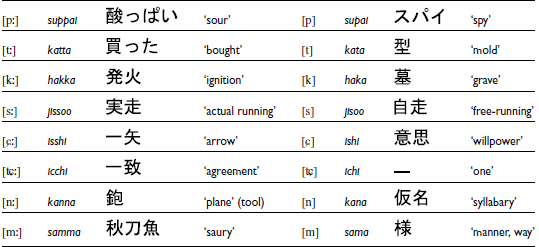
Table 1 Long description
A table comparing geminate and singleton consonant contrasts in Japanese words, showing examples across different consonant types. The table has six rows and five columns. The columns are labeled with symbols representing different consonant types: [p], [t], [k], [s], [c], [n], and [m]. Each row provides Japanese words with geminate and singleton consonants, along with their English translations. For example, the first row under [p] shows the words 'supal' meaning 'sour' and 'supai' meaning 'spy'. The table illustrates how geminate and singleton consonants create distinct meanings in Japanese words across various consonant types.
In phonological accounts, Japanese obstruent geminates are typically analyzed as a sequence of a syllable-final moraic phoneme /Q/ (called sokuon and considered to be underspecified for place) followed by a syllable-initial obstruent (stop, affricate, or fricative of a particular place; e.g., /kaQta/ [katːa]; Vance Reference Vance1987, Reference Vance2008, and citations therein). Japanese nasal geminates, on the other hand, are treated as a sequence of a syllable-final moraic nasal phoneme /N/ (called hatsuon and also considered to be underspecified for place) followed by a syllable-initial labial or coronal nasal (e.g., /kaNna/ [kanːa]). This analysis is also reflected in Japanese orthography: the initial portion of the geminate is rendered by the lowercase kana っ or ッ for obstruents and by the kana or ン for nasals.
An overwhelming majority of phonetic studies on the Japanese geminate-singleton contrasts have focused exclusively on duration differences. In these (mostly acoustic) investigations, geminates were found to be about twice as long (or even more) as single stops, confirming their phonological patterning as having extra prosodic length, a mora (Homma Reference Homma1981, Beckman Reference Beckman1982, Han Reference Han1994, Hirata & Whiton Reference Hirata and Whiton2005; Kawahara Reference Kawahara2006; Idemaru & Guion Reference Idemaru and Guion2008, among others; see Kawahara Reference Kawahara and Kubozono2015a for a review). Several studies also examined non-durational acoustic differences between geminates and singletons and found that geminate stops were produced with creakiness on the adjacent vowels (a shallower spectral tilt; Kawahara Reference Kawahara2006, Idemaru & Guion Reference Idemaru and Guion2008), which was attributed to the vocal folds being pressed tightly together for the geminates.
There is only a small number of articulatory investigations of Japanese geminates and singletons; these, however, do provide some evidence for durational differences being accompanied by certain non-durational differences, and particularly in terms of how tight the consonant constrictions are. Linguopalatal contact differences, for example, can be observed in EPG palatograms from the National Language Research Institute corpus (NLRI 1990) illustrated in Figure 1. These images represent the roof of the mouth of a Japanese speaker producing the geminate /tː, sː, ʨː, kː/ and their singleton counterparts in nonsense words of the type [aCːa] and [CaːCa] (second consonant), respectively. The dots indicate electrodes embedded in the artificial EPG palate that the speaker wore during the experiment. Dark lines show the extent of the contact between the tongue and the artificial palate at the maximum constriction during the consonant. We can see that the alveolar stops /tː/ and /t/ were produced with complete closure at the alveolar ridge and a side contact further back on the palate. The pattern for the alveolopalatal affricates /ʨː/ and /ʨ/ is similar to the stops, but with the closure extending further back and showing more side contact. Alveolar fricatives /sː/ and /s/ were produced with a central channel at the alveolar ridge and some posterior side contact, while velar stops /kː/ and /k/ showed some side contact at the back of the artificial palate (which reflects only a partial capture of the velar closure). Crucial for our purposes is the comparison between geminates and singletons of the same consonant type (place and manner). Note that the extent of the linguopalatal contact was slightly higher, covering a larger area, for /tː/ than /t/. Similar differences can be observed for the affricates. The two fricatives differ mainly in the width of the central channel, which is narrower for the geminate. No clear differences can be noted for the velars, which is possibly due to the limited extent of the artificial palate (as the accompanying X-ray tracings on p. 326 of NLRI 1990 do show a more extensive sagittal contact between the tongue dorsum and the velum). NLRI (1990), the goal of which was to provide articulatory and acoustic illustrations of various Japanese sounds, did not explicitly discuss these geminate-singleton differences, nor provided any quantitative analyses of the data. Based on the images in Figure 1, however, it is possible that geminate consonants in Japanese can be produced with greater linguopalatal contact compared to singletons. This generalization, nevertheless, is tentative at best, as the data presented in NLRI (1990) was obtained from a single speaker, and thus may in principle reflect individual, rather than language-general differences in the production of the contrast.
EPG frames overlaid over a palate cast for geminate and singleton consonants produced by a Japanese speaker; dots represent electrodes embedded into the artificial palate; the lines demarcate the areas where linguopalatal contact was present (dotted for geminates and plain black for singletons) (adapted from figures on pp. 135, 147, 169, 227, 321, 323, 325, 327 in NLRI 1990). For example, the contact for [tː] in atta was produced in the front (upper) region of the palate below the incisors, which corresponds to the alveolar ridge; additionally, the contact was at the sides of the palate, but not in its central region.

Figure 1 Long description
The image shows EPG frames overlaid on a palate cast, illustrating the production of geminate and singleton consonants by a Japanese speaker. Dots represent electrodes embedded in the artificial palate. Lines demarcate areas of linguopalatal contact, with dotted lines for geminates and plain black lines for singletons. The contact for [t] in 'atta' is shown in the front region of the palate below the incisors, corresponding to the alveolar ridge, and at the sides but not in the central region.
Following up on these observations, Kochetov & Kang (Reference Kochetov and Kang2017) examined the production of the length contrast in Japanese alveolar stops /tː, t/ and alveolopalatal affricates /ʨː, ʨ/ (comparing those to Korean fortis stops and affricates). Five Japanese speakers wearing EPG palates produced these sounds in nonsense words of the type [ma_a] (matta vs. mata, matcha vs. macha). The results showed that geminates were consistently produced with a greater amount of linguopalatal contact in the anterior portion of the palate (the alveolar and postalveolar regions). In addition, geminate stops (but not geminate affricates) showed greater contact in the posterior (palatal) portion of the palate. That is, geminates were produced with a tighter constriction and (for stops) with an overall higher position of the tongue. The geminate-singleton differences in linguopalatal contact, however, were relatively small compared to the extensive durational differences (the duration of the articulatory closure). Specifically, the geminate-to-singleton ratios in terms of the amount of contact across the palate were 1.13 for stops and 1.06 for affricates, compared to the durational ratios of 2.03 and 2.57, respectively.
In another recent EPG study, Matsui, Kawahara & Shaw (Reference Matsui, Kawahara and Shaw2016) studied Japanese geminates of several manners of articulation – stops /t, d/ (including their affricate allophones), fricatives /s, z/, and the rhotic /ɾ/. (It should be noted that the occurrence of geminate voiced obstruents and /ɾː/ in Japanese is limited to recent loanwords and onomatopoeia; Kawahara Reference Kawahara and Kubozono2015a; Morimoto Reference Morimoto2020.) Four speakers produced geminate and singleton variants of these sounds in reduplicated onomatopoeic words of the type CV_V-CVCV (e.g., katta-kata vs. kata-kata). The results showed significantly more contact in geminates than singletons for all consonant pairs, except those involving the voiceless alveolar fricatives (/sː/ vs. /s/). In a related report on data from two of the speakers Kawahara & Matsui (Reference Kawahara and Matsui2017: 16) concluded that ‘articulatory strengthening does not occur for voiceless fricatives in Japanese geminates’, noting the parallel results reported by Ridouane & Hallé (Reference Ridouane, Hallé and Kubozono2017) for Tashlhiyt Berber.
Beyond the EPG research, some evidence for stronger geminate constrictions comes from EMA studies by Löfqvist. Specifically, in his (2025) investigation, Löfqvist found that geminate bilabials (voiceless and voiced stops, nasal, and fricative) were produced in real words (e.g., samma vs. sama) by his four speakers with a higher lower lip than their singleton counterparts. Löfqvist’s (Reference Löfqvist2007) study examining five speakers producing alveolar stops, alveolar and alveolopalatal fricatives, and velar stops (e.g., hossa vs. hosa) showed a greater magnitude of tongue movement during the consonant constriction (as well as slower peak velocity) for geminates compared to singletons. While not interpreted as such by the author (given a different focus of the study), the higher lower lip position and a greater tongue movement magnitude observed here can be regarded as evidence for tighter constrictions for the geminates. Finally, while primarily focusing on the Japanese rhotic geminate /ɾː/, Morimoto (Reference Morimoto2020) used EMA to examine other coronal geminates and singletons: the stops /tː, t, dː, d/, the fricative /sː, s/, and the nasal /nː, n/ (including their vowel-conditioned allophones). The data were obtained from eight speakers producing these sounds in onomatopoeic words of the type CVCV-CVCV, (e.g., gatta-gata vs. gata-gata; cf. Matsui et al. Reference Matsui, Kawahara and Shaw2016). The results revealed a significantly higher position of the tongue tip and tongue body for geminates compared to singletons, however, only for some of the consonant types. Specifically, tongue tip height differences involved the voiceless stops /tː, t/ and the rhotic /ɾː, ɾ/, while the tongue body height differences involved the alveolar stops, the rhotics, and, to a lesser extent, the alveolar nasals. No significant differences were observed for alveolar fricatives (/sː, s/), echoing the results of Matsui et al. (Reference Matsui, Kawahara and Shaw2016), but seemingly contradicting those of Löfqvist (Reference Löfqvist2007) (who did find significant differences between /sː/ and /s/).
Finally, the most recent EMA investigation of Japanese length contrasts, conducted by Burroni, Kawahara & Shaw (Reference Burroni, Kawahara and Shaw2025), examined a large set of coronal geminates and their singleton counterparts ([t], [d], [ts], [ʨ], [s], [z]-[ʝ], [ɾ]). These consonants were produced in onomatopoeic words by seven speakers. The results, combined for all consonant pairs, revealed multiple differences in kinematic properties: geminates exhibited higher tongue tip positions indicative of tighter constrictions, overall longer gesture durations (both the movements towards the target and the constriction plateaus), greater movements, and lower stiffness (movement speed). They also showed longer times to constriction targets, resulting in longer preceding vowels. This study thus confirmed some previous findings (namely Löfqvist Reference Löfqvist2007), while also providing new insights into the mechanisms of the Japanese geminate production. It did not, however, examine possible differences in the realization of length across different manners and places of articulation, which is the focus of the current study.
1.3 This study
As reviewed above, the available articulatory research on the Japanese length contrasts has provided some evidence for non-durational differences between geminates and singletons, and primarily in terms of the strength of the constriction. This is consistent with findings for similar contrasts in other languages, as reviewed in section 1.1. At the same time the studies on Japanese geminates have produced somewhat contradictory results with respect to articulatory differences in certain manners of articulation, namely voiceless fricatives. The lack of significance in some cases may stem from the fact that constriction amount differences are in general relatively small (compared to the extensive durational differences) and difficult to capture based on small numbers of tokens or items. Some of the differences may also have arisen due to the use of different methods. While EMA can provide high resolution kinematic data for various articulators, comparing consonants in terms of their extent of lingual constrictions is more difficult, as observations are based on positions of a single flesh point for a given articulator (e.g., a single sensor on the tongue tip for /t/ or a single sensor for the tongue dorsum for /k/; see Kochetov Reference Kochetov2020 for an overview of EMA and EPG methods). In contrast, EPG provides considerably more information about the contact of the tongue with the palate (given multiple electrodes embedded in the artificial palate), and thus is more likely to detect small-scale differences. Finally, some differences in the results may also come from the types of materials used – nonsense words (NLRI 1990; Kochetov & Kang Reference Kochetov and Kang2017), onomatopoeia (Matsui et al. Reference Matsui, Kawahara and Shaw2016; Morimoto Reference Morimoto2020), or words of the core lexicon (Löfqvist Reference Löfqvist2007). It seems plausible to assume that the use of the less standard vocabulary may lead to greater variability in the data and either hyper- or hypo-articulation, depending on the speaker. Relatively frequent words with geminates and singletons, on the other hand, are likely to show more homogeneity, while at the same time showing propensity to lenition (see e.g., Gahl Reference Gahl2008; Tomaschek et al. Reference Tomaschek, Tucker, Fasiolo and Harald Baayen2018 on the role of word frequency in speech production). This may lead to reduced articulatory differences between geminates and singletons in real words compared to nonsense words.
The goal of this study is to employ EPG to more systematically examine Japanese length contrast by considering a range of consonant types (places and manners) and a variety of reading materials (nonsense words and real words in different prosodic contexts). With respect to consonant types, the study examines voiceless obstruents of three places – alveolar stops /tː/ vs. /t/ and fricatives /sː/ vs. /s/, alveolopalatal affricate /ʨː/ vs. /ʨ/, and fricatives /ɕː/ vs. /ɕ/, and velar stops /kː/ vs. /k/, as well as alveolar and alveolopalatal nasals /nː/ vs. /n/ and /ɲː/ vs. /ɲ/.Footnote 1 Note that some of these consonants, namely geminate alveolopalatals, velar stops, and nasals (regardless of their place) have received limited (if any) attention in previous articulatory studies, and thus the study expands the coverage of consonants involved in gemination. On the other hand, we chose not to include voiced obstruents and /ɾ/, as these exhibit gemination only in recent loanwords or expressive vocabulary (Kawahara Reference Kawahara and Kubozono2015a; Morimoto Reference Morimoto2020).
In general, while we expect geminates to show more linguopalatal contact than their singleton counterparts, this effect may be weaker or absent altogether for alveolar fricatives, given earlier, albeit contradictory results (cf. Löfqvist Reference Löfqvist2007; Matsui et al. Reference Matsui, Kawahara and Shaw2016; Morimoto Reference Morimoto2020). The effect may also be limited in alveolopalatal affricates (given the partial results in Kochetov & Kang Reference Kochetov and Kang2017: more geminate contact only in the anterior portion of the palate). If this is the case, it would confirm the characterization of alveolar fricatives and alveolopalatal affricates as highly resistant to positional effects or coarticulation. This is the conclusion reached by Recasens & Espinosa Reference Recasens and Espinosa2006 (cf. Recasens & Espinosa Reference Recasens and Espinosa2009): strengthening or weakening of consonants depends to a great degree on their specification for high-demand manner or place requirements such as frication, trilling, and tongue body involvement. Given this, alveolopalatal affricates and fricatives are the prime candidates to show resistance to gemination, and thus minimal (if any) geminate-singleton differences. Nasals, on the other hand, may be affected to a greater degree by length manipulations, given the generally weaker constrictions compared to obstruents (Gibbon et al. Reference Gibbon, Yuen, Lee and Adams2007; but see Morimoto Reference Morimoto2020 on rather limited differences for /nː/ vs. /n/). We may also expect smaller differences or their absence for velars, as the EPG provides only a partial view of their constrictions (Gibbon & Nicolaidis Reference Gibbon, Nicolaidis, Hardcastle and Hewlett1999; see also Figure 1).
In terms of the materials (as discussed further below), the study uses a variety of stimuli (nonsense words and real words in different prosodic contexts) with the goal to determine whether lexical status and position in the utterance affect gemination. In general, we may expect larger length differences in real words and especially in minimal pairs occurring in the same sentence or an utterance-initial prosodic context (e.g., Armosti Reference Armosti2009 on the greater linguopalatal contact in Cypriot Greek geminates utterance-finally vs. utterance-medially.).
2. Method
2.1 Speakers
The participants were five female native speakers of Japanese with the average age of 36.4 years (range 28–43 years) at the onset of the study. They were from several locations along the eastern/southern coast of the island Honshu: Shizuoka (JF1), Shiga (JF2), Ibaraki (JF3), Kyoto (JF4), and Hyogo (JF5). Dialectally, Shiga, Kyoto, and Hyogo are considered to be part of the Western Japanese dialect; Shizuoka and Ibaraki, on the other hand, belong to the Eastern dialect. We are not aware of any differences between the two dialects in terms of gemination and the examined consonants (while differences in pitch accent patterns are commonly noted; Onishi, Reference Onishi, Boberg, Nerbonne and Watt2018).
The speakers were residing in Toronto at the time of the experiment, living abroad for an average of 8.8 years (range 2–14 years). They reported using Japanese on a regular basis, on average 52% of their daily communication (range 40% to 60%), while using English (and Serbian for JF3) in the other cases. While relatively small for a phonetic study, the number of speakers involved here is comparable to or even higher than is typical for EPG research (e.g., the median of four participants across 54 EPG-based journal publications between 2000 and 2019; Kochetov Reference Kochetov2020).
2.2 Materials
The materials included three sets, all containing words with intervocalic geminates and singletons of seven types: alveolar stops /tː, t/, alveolopalatal affricates /ʨː, ʨ/, velar stops /kː, k/, alveolar nasals /nː, n/, alveolopalatal nasals /ɲː, ɲ/, alveolar fricatives /sː, s/, and alveolopalatal fricatives /ɕː, ɕ/.
Set 1 consisted of a combination of phonetically balanced nonsense and real words of the type [maCa], as shown in Table 2. The items were randomized and presented in Japanese orthography (katakana) to the participants in a carrier sentence sorede ___ mo dekiru (それで ___ も、出来る) ‘You can make ___ out of it’.Footnote 2 The participants were instructed to produce pitch accent (high tone) on the first syllable (see Kawahara Reference Kawahara and Kubozono2015b on Japanese pitch accent).Footnote 3
Items used in Set 1, shown in Roman transliteration and the katakana syllabary; some of these are real words or personal names; others are nonsense words (indicated with ‘—’)
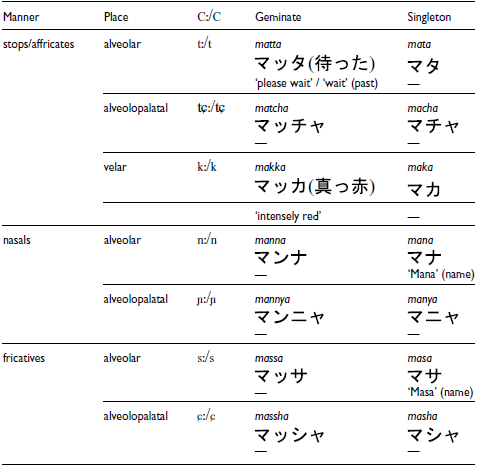
Table 2 Long description
A table comparing phonetically balanced nonsense and real words in Japanese orthography, showing Roman transliteration and katakana syllabary. The table is divided into three main columns: Manner, Place, C/J/C, Geminate, and Singleton. It contains rows for stops/affricates, nasals, and fricatives, each with specific subcategories such as alveolar, alveolopalatal, and velar. Each cell contains Japanese words or nonsense words indicated with special characters. The table provides examples of words like 'matta', 'mochi', 'manna', and 'massa' in both Roman transliteration and katakana syllabary. Some words are real words or personal names, while others are nonsense words.
Sets 2 and 3 consisted of 13 segmental minimal pairs (the same for both sets), two per consonant type, except for /ɲː/ vs. /ɲ/ (which had only one pair). These 26 words are shown in Table 3.Footnote 4 Note that combinations of back and front vowels, in different orders, were used in all words except with velars. For the latter, words with two front vowels were selected to ensure that closures could be captured by EPG. While words within pairs were chosen to be segmentally the same, it was not always possible to control for the pitch accent placement. We are not, however, aware of any research on possible effects of pitch accent on lingual constrictions (cf. Kawahara Reference Kawahara and Kubozono2015b) and would therefore assume that these differences will be unlikely to play a role.
Real words used in the study (Set 2 and Set 3), shown in Roman transliteration and Japanese orthography
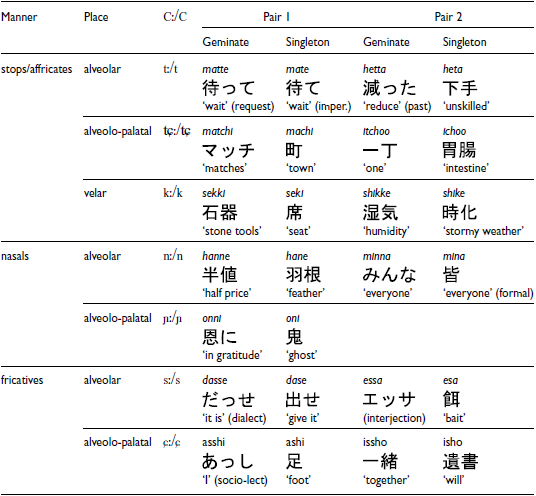
Table 3 Long description
A table comparing Japanese words in Roman transliteration and Japanese orthography by manner and place of articulation. The table has 8 rows and 6 columns. The columns are labeled Manner, Place, C/C, Pair 1, and Pair 2. The rows are labeled with different manners of articulation: stops/affricates, nasals, and fricatives. Each row lists specific places of articulation and corresponding words in both geminate and singleton forms. The table includes words for alveolar, alveolo-palatal, and velar articulations, with examples for each type.
In Set 2, words from Table 3 were randomized and presented in a carrier phrase kabe ni wa ___ mo kaite aru (壁には_______ も書いてある) ‘___ is also written on the wall’. In Set 3, each minimal pair was placed in the same sentence, creating contrastive focus – ___ dewa naku ___ to itta (___ ではなく___ と言った) ‘This is not ___; this is ___’, and presented in two different orders: with a singleton word first and the corresponding geminate word second (e.g., mate – matte) and with a geminate word first and the corresponding singleton word second (e.g., matte – mate). To take into consideration the position of the word within the sentence, we will refer to cases when the word is utterance-initial as Set 3a (e.g., [t] in mate – matte), and when it is utterance-medial as Set 3b (e.g., [tː] in mate – matte). These two sets with the manipulations in the order for Set 3 were selected to elicit potential differences in the realization of the geminate-singleton contrast given the contrastive focus. Thus, one may expect greater length differences when minimal pairs are juxtaposed, so that the target consonants are explicitly contrasted with each other (contrastive focus, Set 3). In the same vein, one may expect to find stronger realizations of contrast utterance-initially than utterance-medially (Set 3a vs. Set 3b). Somewhat clearer differences may be expected between Set 1 and the other two sets, given the more controlled phonetic contexts, as well as possible articulatory weakening in more frequent vocabulary items in Sets 2 and 3 (cf. Gahl Reference Gahl2008).
On average, 22 repetitions per word per speaker were elicited for Set 1 and 18 repetitions were elicited for Sets 2 and 3.Footnote 5 With a handful omissions due to recording errors, this gave us 1,511 tokens for Set 1 (14 items × 22 repetitions × 5 speakers), 2,340 tokens for Set 2 (26 items × 18 repetitions × 5 speakers), and 4,528 tokens for Set 3 (26 items × 2 orders × 22 repetitions × 5 speakers), giving in total 8,379 tokens. The data were recorded over multiple recording sessions together with stimuli for other experiments.
2.3 Instrumentation
A WinEPG system by Articulate Instruments (Wrench et al. Reference Wrench, Gibbon, McNeill, Wood, Hansen and Pellom2002) was used to collect articulatory data at a sampling rate of 100 Hz and audio data at 22,050 Hz. The system uses acrylic palates with 62 electrodes, custom-made for each participant. The traditional (University of Reading-style) EPG palates were used for participants JF1, JF2, and JF3, while newer ‘Articulate’ palates (Wrench Reference Wrench2007) were used for JF4 and JF5. As can be seen in Figure 2, Articulate palates extend further back, thus providing a better coverage for the velar region; otherwise, however, they are similar in capturing contact at the front and central portions of the palate (alveolar, postalveolar, and palatal regions) (see Tabain Reference Tabain2011; Kochetov, Colantoni & Steele Reference Kochetov, Colantoni and Steele2017 for a comparison of the two models).
Artificial palates and the accompanying palate casts of the speakers.
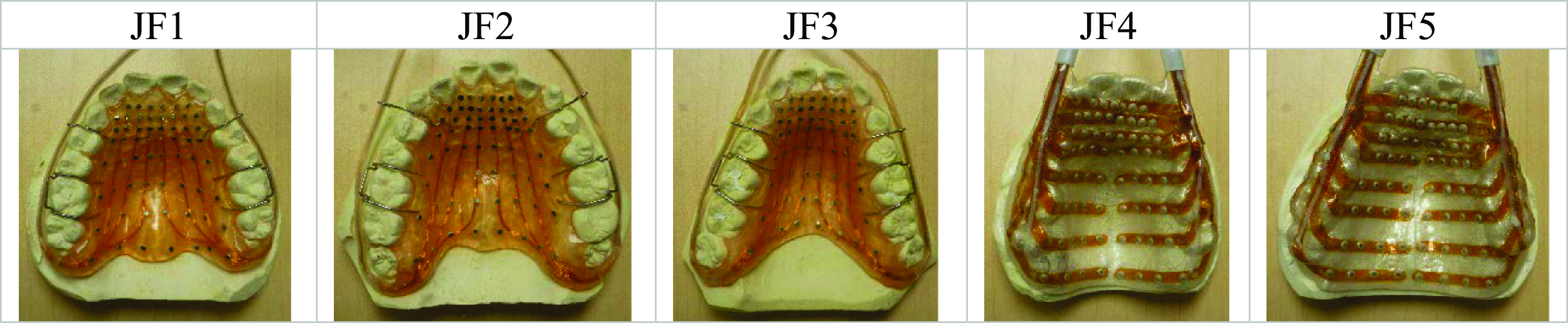
Figure 2 Long description
The image displays five artificial palates labeled JF1 through JF5, each showing distinct electropalatography (EPG) patterns. These patterns illustrate the distribution and intensity of tongue-palate contact during speech production. The palates are arranged horizontally, with each one demonstrating variations in the contact points and areas, likely corresponding to different phonetic articulations. The EPG patterns are marked by orange and white regions, indicating areas of contact and non-contact respectively. The labels JF1 to JF5 help identify and differentiate the specific EPG patterns for each palate.
2.4 Annotation and analysis
Consonant closures/constrictions were annotated based on the waveform and spectrogram using the Articulate Assistant software (version 1.18; Wrench et al. Reference Wrench, Gibbon, McNeill, Wood, Hansen and Pellom2002). Closures of stops and affricates were taken to be intervals between the onset and offset of relative silence (thus excluding the stop release or affricate frication); constrictions of fricatives were taken to be intervals between the onset and offset of fricative noise; closures of nasals were taken to be intervals between the points of abrupt amplitude decrease and increase, also corresponding to the nasal murmur interval during the oral constriction. These acoustic events typically corresponded well to articulatory closures and constrictions of the consonants, as evidenced by EPG frames. Figure 3a presents a sample annotation – a waveform, a spectrogram, and a set of corresponding palate frames taken every 10 ms – for a token of sekki. The interval of the velar closure is indicated with a label “kk”, and the cursor is placed on the first frame of maximum contact during the closure (which in this case is also the midpoint of the consonant constriction). The image in (b) shows an enlarged view of the selected frame, with palate regions indicated to the left corresponding to rows 1–8 of the artificial palate. Note that the closure is produced in the velar region (row 8), with considerable side contact in the palatal region (rows 5–7) and extends into the alveolar region (to row 2). The image in (c) shows an average of all frames with the closure for the same token, while the image in (d) shows an average of nine tokens of this word produced by the speaker within a session. The close similarity between the (c) and (d) indicates that the velar stop closure was produced consistently across the sample.
(a) A sample annotated token: /kː/ in sekki by speaker JF3; (b) the frame taken at the point of maximum contact; (c) an average of all frames within the closure interval with numbers and shading indicating percentages of each electrode activation across frames; (d) an average of nine tokens of /kː/ (the entire closure intervals) in sekki by this speaker.
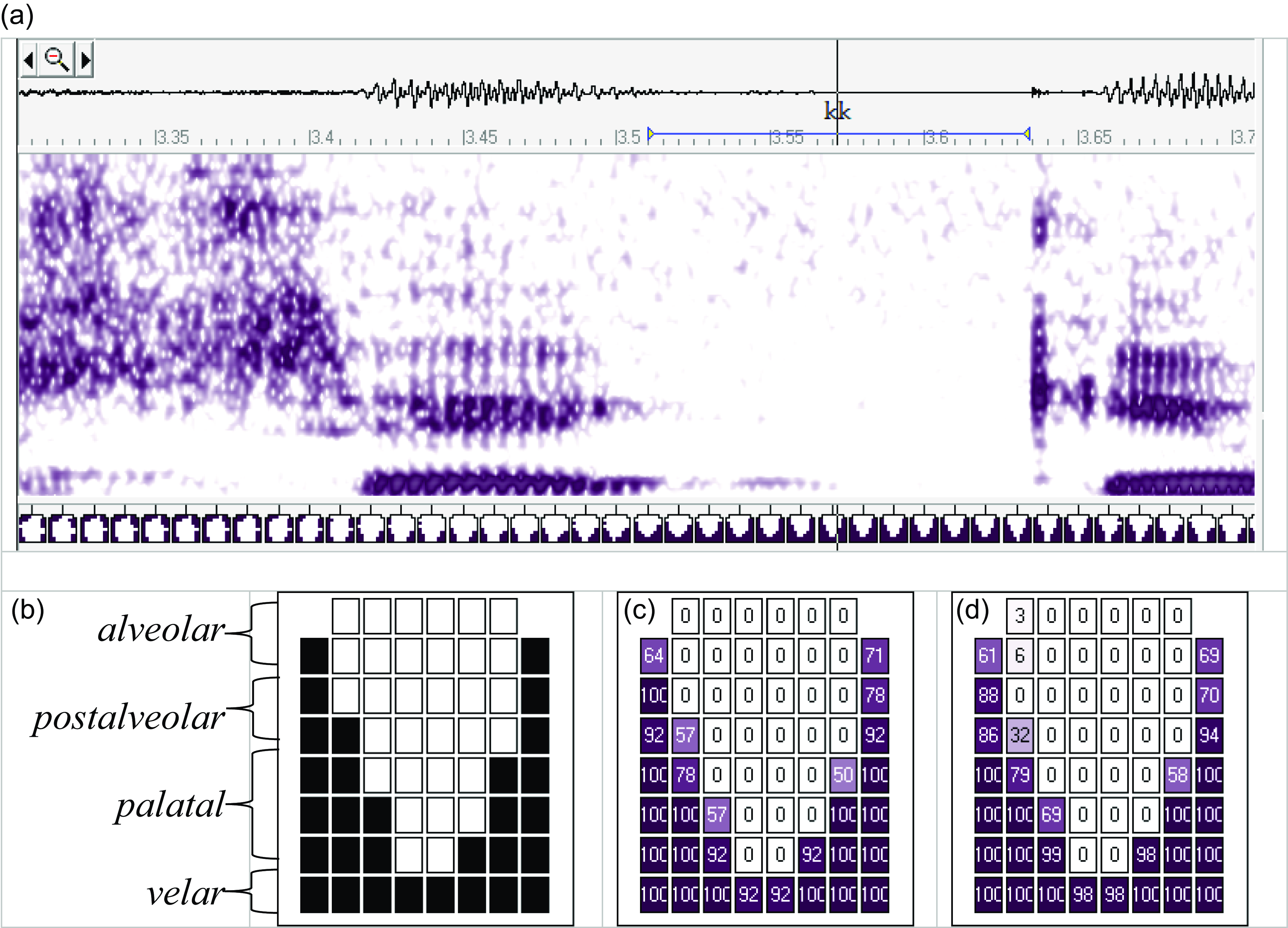
Figure 3 Long description
The image contains multiple graphs and charts analyzing articulatory differences in geminate and singleton consonants. The top section (a) shows a waveform and spectrogram of a speech sample, highlighting the /k/ sound in the word 'sekki' spoken by a speaker identified as JF3. The waveform displays variations in amplitude over time, while the spectrogram shows frequency components. Below the spectrogram, a series of frames indicate the points of maximum contact during the articulation of the /k/ sound. The bottom section includes three subfigures: (b) shows a frame taken at the point of maximum tongue-palate contact, (c) presents an average of all frames within the closure interval with percentages and shading indicating electrode activation across frames, and (d) displays an average of nine tokens of /k/ in 'sekki' by the same speaker, showing the entire closure intervals. The charts and graphs collectively illustrate that geminates are produced with a greater amount of tongue-palate contact compared to singletons, supporting the finding that tighter constrictions are associated with geminate consonants.
For each token, linguopalatal contact values (‘1’ or ‘0’ for each electrode) were automatically extracted from the first point of maximum contact frame as well as – for Set 1 – from five equally spaced points within the annotated interval. The choice to limit the temporal analysis to Set 1 was based on the more uniform phonetic context there (a_a), compared to the more variable environments in real words.
Two variables were used in the analysis. The first one was the amount of contact across the palate, Q (Quotient of maximum activation). It was calculated by dividing the number of contacts activated by the total number of contacts (62). For example, the frame shown in Figure 3b has the Q value of 0.484 (30 activated electrodes out of 62). (Note that we did not use Q at particular regions of the palate, e.g., in the first five rows as in Kochetov & Kang Reference Kochetov and Kang2017, since the consonants examined here differed in place.) The other variable was Duration of the annotated interval (in seconds), which was also automatically extracted for each token by the software.
The data were analyzed using linear mixed effects regression (LMER) models implemented with the lme4 package (Bates et al. Reference Bates, Martin Maechler, Steve Walker, Singmann and Grothendieck2017) using R (R Core Team 2014) separately for Q and Duration. Fixed factors were Length (two levels: geminate (CC), singleton (C)), Consonant Type (C_type, seven levels: alveolar stops, alveolopalatal stops (affricates), velar stops, alveolar nasals, alveolopalatal nasals, alveolar fricatives, alveolopalatal fricatives), and Set (four levels: Set 1, Set 2, Set 3a, Set 3b), with the first two factors included as an interaction; random factors were Speaker, Word, and Recording session, with random intercepts only.Footnote 6 Treatment-contrast coding was used for categorical variables, with the baseline condition being the geminate alveolar stop in Set 1. For each analysis, likelihood ratio tests were used to compare the full model to a nested model excluding the factor of interest, employing the Anova() function of the lmerTest package (Kuznetsova et al. Reference Kuznetsova, Brockhoff and Christensen2017). Pairwise comparisons and posthoc tests (with a Bonferroni correction) were performed using the phia package (De Rosario-Martinez Reference De Rosario-Martinez2015). Pearson correlations were further performed to examine the relation between Q and Duration, separately for geminates and singletons.
3. Results
We begin the presentation of the results by a qualitative overview of sample linguopalatal contact profiles in section 3.1. This is followed by the presentation of quantitative results for the amount of contact Q at the point of maximum contact in section 3.2 and an examination of temporal differences in Q in section 3.3. Further, quantitative durational results are presented in section 3.4, followed by an examination of correlations between amount of contact and duration in section 3.5.
Average palate profiles for geminate and singleton consonants from Set 2 produced by JF3 (based on nine repetitions within a single recording session).
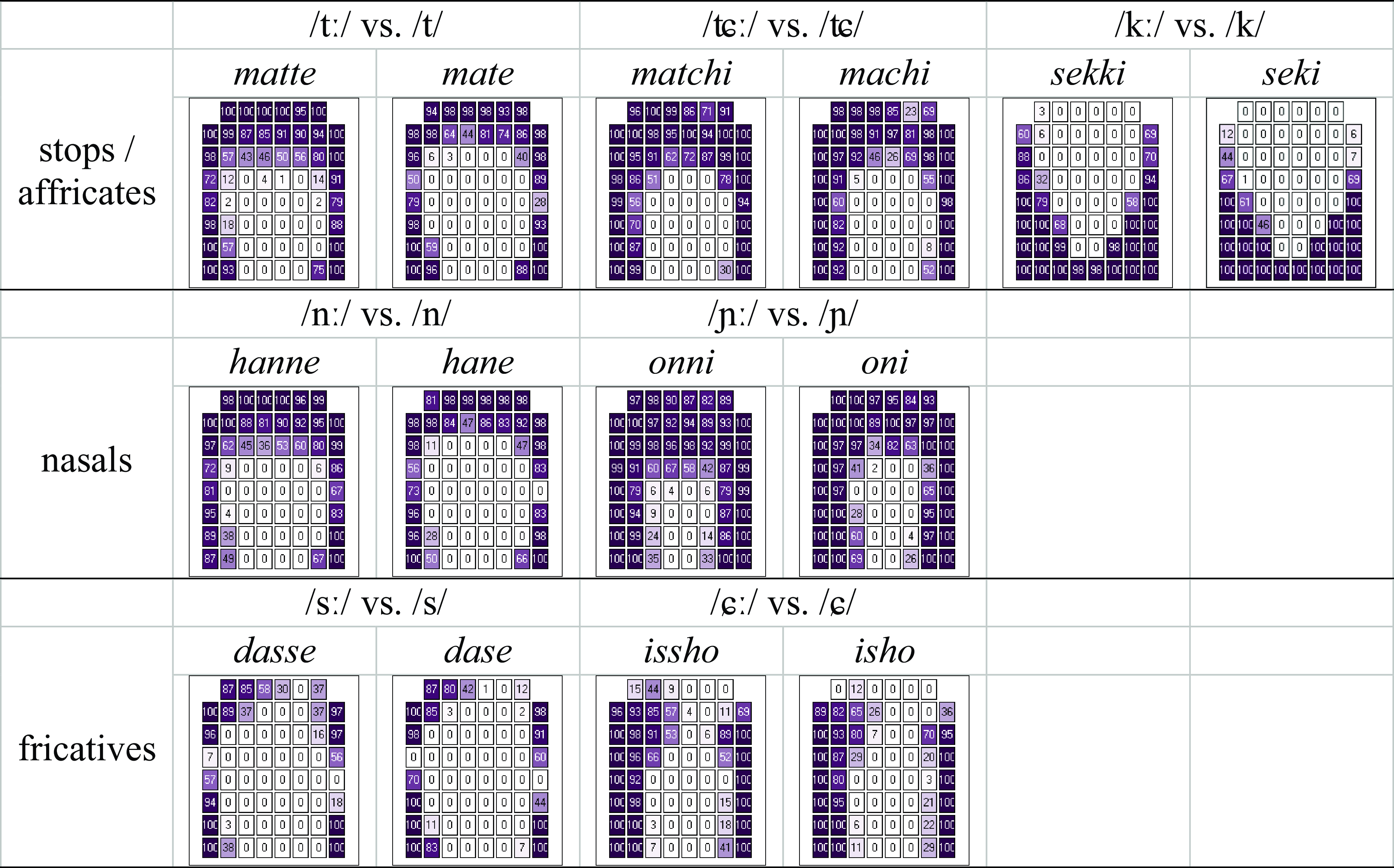
Figure 4 Long description
The matrix displays average palate profiles for geminate and singleton consonants from Set 2 produced by JF3. It is based on nine repetitions within a single recording session. The matrix is divided into three main categories: stops/affricates, nasals, and fricatives. Each category compares different consonant sounds, such as matte versus mate, matchi versus machi, hanne versus hane, onni versus oni, dasse versus dase, issho versus isho. Each comparison is represented by a grid of cells with numerical values indicating the degree of tongue-palate contact. The grids show variations in the amount of contact, with darker shades indicating higher contact levels. The matrix highlights systematic non-durational differences in tongue-palate contact between geminate and singleton consonants.
3.1 Overview
Figure 4 presents sample average linguopalatal profiles for all consonant pairs produced by one of the speakers, JF3 (a subset of Set 2; see Figure A1 for examples of all words produced by five speakers with original-size images available in the Supplementary Materials). Considering the first two images, /tː/ in matte vs. /t/ in mate, we can see that both consonants were produced with a closure in the anterior portion and side contact throughout the artificial palate. The closure for the geminate, however, was more extensive, occupying three instead of two rows (the alveolar and partly postalveolar regions); the side contact for the geminate /tː/ was also slightly greater than for /t/. This indicates that the geminate was produced with a higher tongue position and stronger contact. Similar differences can be observed for the rest of the consonants, albeit not as robust in the cases of affricates and velar stops. In the case of fricatives, the central channel (alveolar or postalveolar) was narrower for geminates compared to singletons. (It should be kept in mind that EPG measures the extent of the contact but not the distance between the tongue and the palate, which can be also crucial for acoustic consequences of these articulations.)
3.2 Amount of contact (Q)
Results of a linear mixed effect model for Q produced significant effects of Length ( $\chi$
2(1) = 1035.23, p <.0001), Consonant Type (
$\chi$
2(1) = 1035.23, p <.0001), Consonant Type ( $\chi$
2(6) = 135.28, p <.0001), and Set (
$\chi$
2(6) = 135.28, p <.0001), and Set ( $\chi$
2(3) = 24.79, p <.0001), as well as a significant interaction of Length and Consonant Type (
$\chi$
2(3) = 24.79, p <.0001), as well as a significant interaction of Length and Consonant Type ( $\chi$
2(6) = 332.05, p <.0001). Full model comparisons are presented in Table 4 and the model estimates in Table 5. The reason for the interaction can be observed in Figure 5a: geminates of all consonant types had on average higher Q values than their singleton counterparts, but the magnitude of these differences varied by type. Posthoc tests run on Consonant Type pairs (see Table 6) revealed that pairwise comparisons for Length were significant at the p <.0001 level for alveolar stops, alveolar nasals, alveolar fricatives, and alveolopalatal nasals; they were significant at the p <.05 level for alveolopalatal affricates and velar stops; the comparison for alveolopalatal fricatives was not significant (p >.05), albeit showing on average slightly more contact for the geminate (by 0.02). Differences for the other pairs were larger: 0.04 for alveolopalatal affricates and velar stops, 0.05 for alveolar fricatives, 0.09 for alveolar stops and alveolopalatal nasals, and 0.14 for alveolar nasals. The average difference across consonant types was 0.07, which means that geminates were on average produced with the contact with four to five extra electrodes on the artificial palate than singletons. Based on these differences, the overall geminate-singleton ratio was 1.13. Ratios for Consonant Types were (in increasing order) 1.05 for alveolopalatal fricatives, 1.07 for alveolopalatal affricates, 1.08 for velar stops, 1.14 for alveolar fricatives and alveolar stops, 1.16 for alveolopalatal nasals, and 1.26 for alveolar nasals.
$\chi$
2(6) = 332.05, p <.0001). Full model comparisons are presented in Table 4 and the model estimates in Table 5. The reason for the interaction can be observed in Figure 5a: geminates of all consonant types had on average higher Q values than their singleton counterparts, but the magnitude of these differences varied by type. Posthoc tests run on Consonant Type pairs (see Table 6) revealed that pairwise comparisons for Length were significant at the p <.0001 level for alveolar stops, alveolar nasals, alveolar fricatives, and alveolopalatal nasals; they were significant at the p <.05 level for alveolopalatal affricates and velar stops; the comparison for alveolopalatal fricatives was not significant (p >.05), albeit showing on average slightly more contact for the geminate (by 0.02). Differences for the other pairs were larger: 0.04 for alveolopalatal affricates and velar stops, 0.05 for alveolar fricatives, 0.09 for alveolar stops and alveolopalatal nasals, and 0.14 for alveolar nasals. The average difference across consonant types was 0.07, which means that geminates were on average produced with the contact with four to five extra electrodes on the artificial palate than singletons. Based on these differences, the overall geminate-singleton ratio was 1.13. Ratios for Consonant Types were (in increasing order) 1.05 for alveolopalatal fricatives, 1.07 for alveolopalatal affricates, 1.08 for velar stops, 1.14 for alveolar fricatives and alveolar stops, 1.16 for alveolopalatal nasals, and 1.26 for alveolar nasals.
Boxplots of the amount of linguopalatal contact (Q) (a) by Length and Consonant Type and (b) by Length and Set; CC = geminate, C = singleton, t = alveolar stops, ch = alveolopalatal affricates, k = velar stops, n = alveolar nasals, ny = alveolopalatal nasals, s = fricative alveolars, sh = alveolopalatal fricatives.
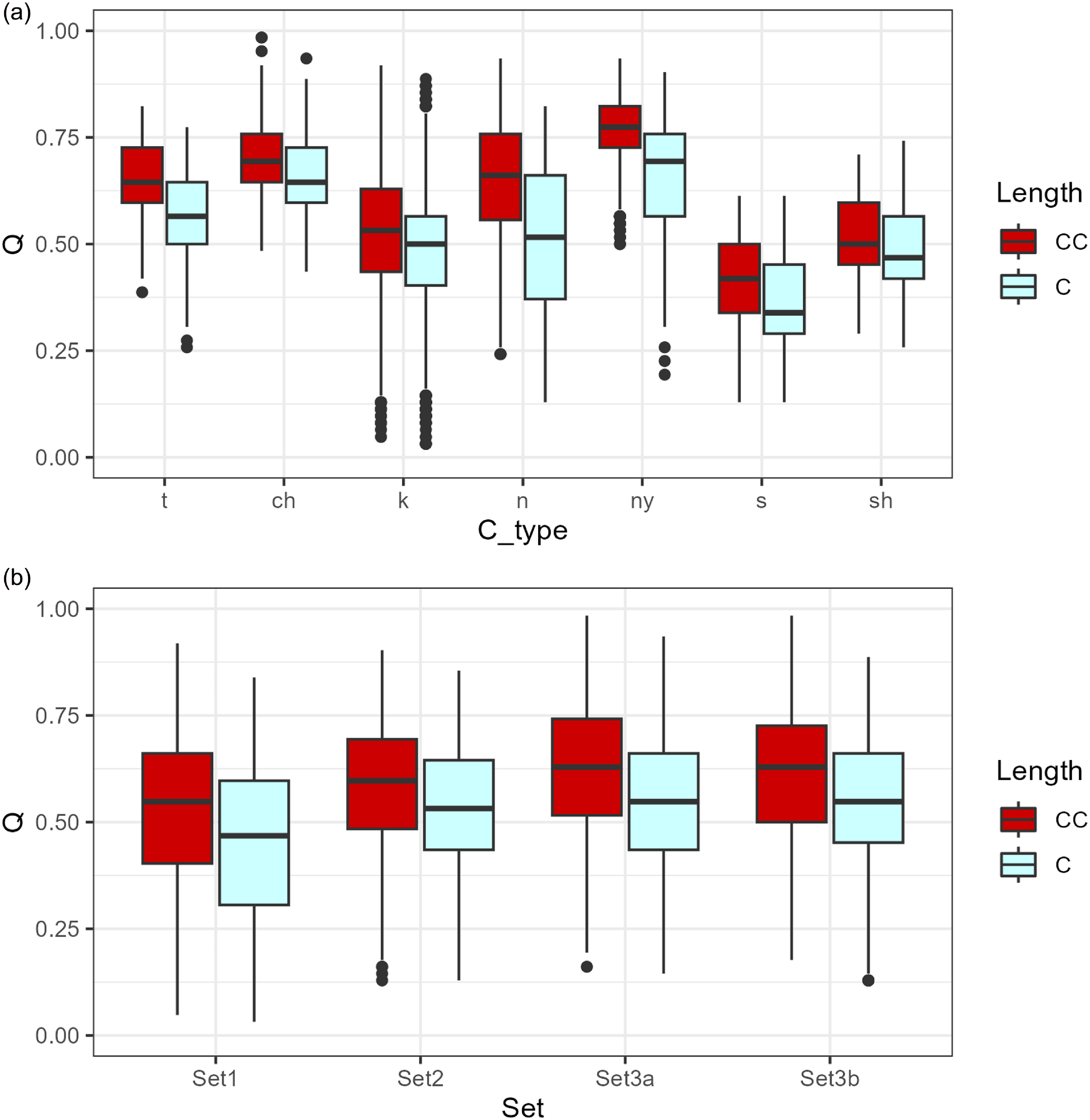
Figure 5 Long description
The image presents two box-and-whisker plots. The first plot (a) shows the amount of linguopalatal contact (Q) by Length and Consonant Type. The x-axis represents different consonant types: t (alveolar stops), ch (alveolopalatal affricates), k (velar stops), n (alveolar nasals), ny (alveolopalatal nasals), s (fricative alveolars), and sh (alveolopalatal fricatives). The y-axis represents the amount of linguopalatal contact (Q), ranging from 0.00 to 1.00. The plot compares two lengths: CC (geminate) in red and C (singleton) in blue. Each box plot shows the median, lower quartile, upper quartile, and whiskers indicating the range of data, with outliers marked as individual points. The second plot (b) shows the amount of linguopalatal contact (Q) by Length and Set. The x-axis represents different sets: Set1, Set2, Set3a, and Set3b. The y-axis again represents the amount of linguopalatal contact (Q), ranging from 0.00 to 1.00. Similar to the first plot, it compares two lengths: CC (geminate) in red and C (singleton) in blue. The box plots show the median, lower quartile, upper quartile, and whiskers indicating the range of data, with outliers marked as individual points. The legend indicates that red represents geminate (CC) and blue represents singleton (C). All values are approximated.
The significant Length and Consonant Type interaction was also due to considerable differences in Q among different manners and place of articulation (as seen in Figure 5a). Generally, the amount of contact was higher for coronal (alveolar and alveolopalatal) stops than velar stops and coronal fricatives, as well as higher for alveolopalatals than alveolars. Most of these differences were significant; this was fully expected given the inherent place and manner differences and their linguopalatal realizations. For example, less contact was in general expected for velars given the partial coverage of their constrictions and for fricatives given the absence of closures. The results of pairwise comparisons of different Consonant Types by length are not shown here.
The above-mentioned significant effect of Set was largely due to differences between Set 1 and the other sets, as revealed by posthoc tests shown in Table 7. As also seen in Figure 5b, the amount of contact was lower in Set 1 than in Sets 2 and 3(a,b). This was likely due to the target consonants being placed in the context of the low vowel /a/, compared to the other sets having more varied phonetic contexts (see also Figure A2 in the Appendix). Unexpectedly, no significant differences were found among Sets 2, 3a, and 3b. There was also no significant interaction of Length and Set. On average, geminates had slightly more contact in Sets 3a,b (the contrastive condition) compared to Set 2 (the no-contrast condition): 0.62 and 0.61 vs. 0.59, but singletons showed a similar increase in Sets 3a and 3b compared to Set 2: 0.55 and 0.55 vs. 0.53.
Model comparisons for Q (Analysis of Deviance Table, Type II Wald $\chi$
2 tests); significance codes: ‘***’ <0.001, ‘**’ <0.01, ‘*’ < 0.05, ‘.’ <0.1
$\chi$
2 tests); significance codes: ‘***’ <0.001, ‘**’ <0.01, ‘*’ < 0.05, ‘.’ <0.1
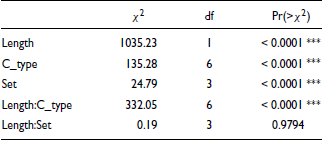
Table 4 Long description
The table presents a comparison of model effects on Q values using Type II Wald chi-square tests. It includes four rows and four columns. The columns are labeled as chi-square, degrees of freedom, and Pr(>chi-square). The rows are labeled as Length, Consonant Type, Set, Length:Consonant Type, and Length:Set. The Length row shows a chi-square value of 1035.23 with 1 degree of freedom and a significance level of less than 0.0001. The Consonant Type row shows a chi-square value of 135.28 with 6 degrees of freedom and a significance level of less than 0.0001. The Set row shows a chi-square value of 24.79 with 3 degrees of freedom and a significance level of less than 0.0001. The Length:Consonant Type row shows a chi-square value of 332.05 with 6 degrees of freedom and a significance level of less than 0.0001. The Length:Set row shows a chi-square value of 0.19 with 3 degrees of freedom and a significance level of 0.9794. The table highlights significant effects of Length, Consonant Type, and Set, as well as a significant interaction between Length and Consonant Type.
Summary of a linear mixed model for Q; formula: lmer(Q ∼ Length * C_type + Length * Set + (1|Speaker) + (1|Word) + (1|Recording_session), data); significance codes: ‘***’ <0.001, ‘**’ <0.01, ‘*’ < 0.05, ‘.’ <0.1; the intercept is the geminate alveolar stop in Set 1
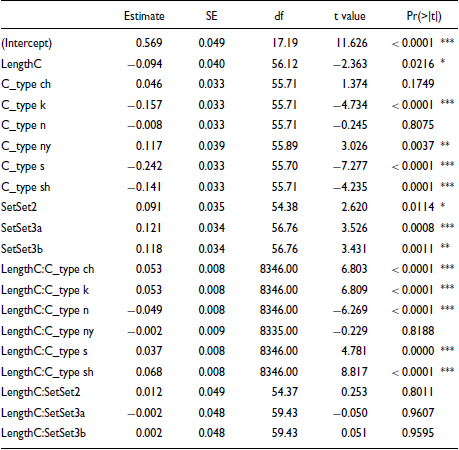
Table 5 Long description
The table presents the results of a linear mixed effect model for Q, detailing the estimates, standard errors, degrees of freedom, t values, and p-values for different factors and their interactions. The factors include Length, Consonant Type, and Set, as well as their interactions. The table has 17 rows and 6 columns. The columns are labeled Estimate, SE, df, t value, and Pr(-|t|). Each row corresponds to a different factor level or interaction term. Notable trends include significant effects of Length, Consonant Type, and Set, as well as a significant interaction between Length and Consonant Type. The p-values indicate the significance levels of these effects, with some being highly significant (p < 0.0001) and others less so. The intercept represents the geminate alveolar stop in Set 1. The table provides detailed statistical insights into the factors influencing Q values.
Q results of posthoc tests for Length by C_type; ‘***’ <0.001, ‘**’ <0.01, ‘*’ < 0.05, ‘.’ <0.1
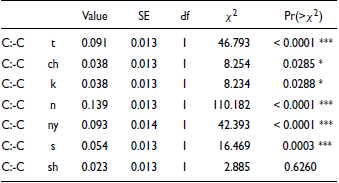
Table 6 Long description
The table presents posthoc test results for Length by Consonant Type. It contains six rows and six columns. The columns are labeled Value, SE, df, chi-square, and Pr(>chi-square). The rows are labeled with different Consonant Types: alveolar stops (t), alveolopalatal affricates (ch), velar stops (k), alveolar nasals (n), alveolopalatal nasals (ny), alveolar fricatives (s), and alveolopalatal fricatives (sh). Each row displays the Value, Standard Error (SE), degrees of freedom (df), chi-square statistic, and p-value for the respective Consonant Type. Notable trends include significant p-values for alveolar stops, alveolar nasals, alveolar fricatives, and alveolopalatal nasals at the <0.0001 level, and significant p-values for alveolopalatal affricates and velar stops at the <0.05 level. The comparison for alveolopalatal fricatives was not significant.
Q results of posthoc tests for Set; ‘***’ <0.001, ‘**’ <0.01, ‘*’ < 0.05, ‘.’ <0.1

Table 7 Long description
The table presents the Q results of posthoc tests for Set, with seven rows and five columns. The columns are labeled Value, SE, df, χ2, and Pr(>χ2). The rows compare different sets: Set1-Set2, Set1-Set3a, Set1-Set3b, Set2-Set3a, Set2-Set3b, and Set3a-Set3b. Each row provides the value, standard error, degrees of freedom, chi-square value, and p-value for the comparison. Notable findings include significant differences between Set1 and Sets 2, 3a, and 3b, with p-values less than 0.0001. No significant differences are found among Sets 2, 3a, and 3b, with p-values equal to 1.0000. The table uses significance codes: *** for <0.001, ** for <0.01, * for <0.05, and . for <0.1.
Considering individual differences, all speakers showed on average greater Q values for geminates than singletons (see Figure A3a), but to a different degree. JF1 and JF2 exhibited relatively low geminate-to-singleton ratios (1.04 and 1.08), while the other three speakers showed considerably higher ratios (1.15 for JF3, 1.18 for JF4, and 1.19 for JF5). Some of these differences can be attributed to the use of different artificial palate models, as the speakers showing the greatest contrast, JF4 and JF5, used the newer model with a better coverage of the velar region (see section 2.3). The speakers’ anatomical differences, however, could also be a factor: JF1 and JF2 had relatively flat hard palates, while the other speakers’ palates were more domed (see Figure 2). This may also explain the overall greater tongue–palate contact for JF1 and JF2, in particular for alveolars (see Figure A1). Another notable inter-speaker difference was in the realization of alveolar fricatives. These sounds were produced by JF1 with a very narrow channel, which given insufficient spatial resolution of the artificial palate was often rendered as a complete closure. In contrast, JF4’s alveolar fricatives appeared to be dental and thus showed very limited anterior contact (especially for the singleton /s/; see the displays for dase and esa in Figure A1).
In summary, our analysis of the amount of linguopalatal contact taken at the constriction maximum showed relatively small but consistently significant differences between geminates and singletons, with the exception of alveolopalatal fricatives. A closer examination of the data for the latter consonants showed considerable variation across the items. Specifically, length differences were near-absent in the pairs involving the words asshi and ashi (Sets 2 and 3). A series of follow-up t-tests by word pair, summarized in Table 8, confirmed the lack of significance for comparisons involving these two items. The geminate-singleton differences for the other pairs (massha vs. masha and issho vs. isho), however, were significant.
Results of t-tests for Q for word pairs involving alveolopalatal fricatives; ‘***’ <0.001, ‘**’ <0.01, ‘*’ < 0.05, ‘.’ <0.1
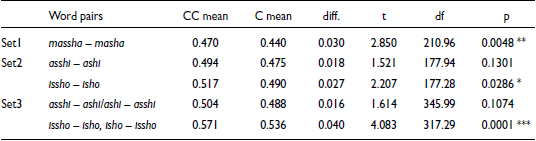
Table 8 Long description
A table with three rows and six columns presents the results of t-tests for Q values of word pairs involving alveolopalatal fricatives. The columns are labeled Word pairs, CC mean, C mean, diff., t, df, and p. The table is divided into three sets. Set 1 includes the word pair massha masha with a CC mean of 0.470, C mean of 0.440, a difference of 0.030, t value of 2.850, df of 210.96, and a p value of 0.0048, marked with two asterisks indicating significance at the 0.01 level. Set 2 includes two word pairs: asshi ashi with a CC mean of 0.494, C mean of 0.475, a difference of 0.018, t value of 1.521, df of 177.94, and a p value of 0.1301, and issho isho with a CC mean of 0.517, C mean of 0.490, a difference of 0.027, t value of 2.207, df of 177.28, and a p value of 0.0286, marked with one asterisk indicating significance at the 0.05 level. Set 3 includes two word pairs: asshi ashi/ashi asshi with a CC mean of 0.504, C mean of 0.488, a difference of 0.016, t value of 1.614, df of 345.99, and a p value of 0.1074, and issho isho, isho issho with a CC mean of 0.571, C mean of 0.536, a difference of 0.040, t value of 4.083, df of 317.29, and a p value of 0.0001, marked with three asterisks indicating significance at the 0.001 level.
The lack of significance in the asshi – ashi pair can be attributed to the marginal status of the first word (see Footnote 4; cf. Shigeto Kawahara p.c.). A likely additional factor was the devoicing/deletion of the following vowel /i/ in Set 3. This segment was flanked there by voiceless obstruents, as in [aɕːi dewa naku aɕi̥ to itːa], and therefore subject to devoicing (see Fujimoto Reference Fujimoto and Kubozono2015 on Japanese high vowel devoicing). This, in turn, often resulted in the fricative being strongly coarticulated with /t/ (notably for JF1, JF4, and JF5). Taking into consideration these lexical and contextual factors, it can be concluded that the lack of significant length differences for the full set of alveolopalatal fricatives is partly due to the choice of the stimuli and carrier sentences. Finally, it should be noted that vowel devoicing/deletion also affected the item shike: it was consistently produced as [ɕ(i̥)ke] by all the speakers, with the /k/ often showing carryover coarticulation from the alveolopalatal /ɕ/ (see e.g., JF1’s shike – shikke in Figure A1) and thus reducing the length difference.Footnote 7
Trajectories of amount of contact (Q) based on five equally distant time points (normalized) during the closure for geminates (CC) and singletons (C), separately by Consonant Type; t = alveolar stops, ch = alveolopalatal affricates, k = velar stops, n = alveolar nasals, ny = alveolopalatal nasals, s = fricative alveolars, sh = alveolopalatal fricatives; the function geom_smooth() using method = ‘loess’ and formula ‘y ∼ x’; confidence intervals are indicated in grey.

Figure 6 Long description
The image contains eight line graphs, each representing the trajectories of amount of contact (Q) during the closure for geminates (CC) and singletons (C) across different consonant types. The consonant types include alveolar stops (t), alveolopalatal affricates (ch), velar stops (k), alveolar nasals (n), alveolopalatal nasals (ny), fricative alveolars (s), and alveolopalatal fricatives (sh). Each graph shows the data for geminates (CC) in red and singletons (C) in blue, with confidence intervals indicated in grey. The x-axis represents five equally distant time points normalized during the closure, while the y-axis represents the amount of contact (Q). The graphs illustrate that geminates generally exhibit a greater amount of tongue-palate contact than singletons across all consonant types. The function geom_smooth() using method = loess and formula y x is applied to smooth the data points. All values are approximated.
3.3 Temporal differences in the amount of contact (Set 1)
The analysis presented above was based on a single point within the consonant constrictions – the point of maximum contact. It is of interest to know, however, how the amount of contact differences were manifested throughout the consonant constriction. Figure 6 presents Q trajectories across five points during the annotated consonant interval (time-normalized). We can see that with the exception of fricatives and velar stops, Q values for geminates were clearly higher than those for singletons at least at points 2, 3, and 4 (i.e., at 25%, 50%, and 75% of their constriction). Differences for the fricatives were found more towards the end: points 4 and 5 (alveolar) or 3 and 4 (alveolopalatal). Note that the magnitude of the length difference for the alveolopalatal fricative was slightly higher than that for its alveolar counterpart (and much higher than for the velar stop), despite our finding of non-significant differences in the single-point analysis (over the entire data) in section 3.2. The overall low Q values for velars were due to the artificial palate capturing only a part of the closure in the low vowel context.
Altogether, these results show that contact differences between geminates and singletons in Japanese, as produced by our speakers, were not limited to a single point but spanned a large part of the consonant constriction for coronal stops/affricates and nasals, while being more temporally limited for fricatives and velar stops.
Model comparisons for Duration (Analysis of Deviance Table, Type II Wald $\chi$
2 tests); significance codes: ‘***’ <0.001, ‘**’ <0.01, ‘*’ < 0.05, ‘.’ <0.1
$\chi$
2 tests); significance codes: ‘***’ <0.001, ‘**’ <0.01, ‘*’ < 0.05, ‘.’ <0.1
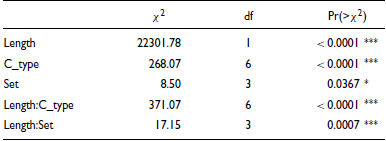
Table 9 Long description
The table presents model comparisons for Duration using Analysis of Deviance Table and Type II Wald chi-square tests. It includes four rows and three columns. The columns are labeled as chi-square, degrees of freedom (df), and Pr(>chi-square). The rows are labeled as Length, C_type, Set, Length:C_type, and Length:Set. The chi-square values are 22301.78, 268.07, 8.50, 371.07, and 17.15 respectively. The degrees of freedom are 1, 6, 3, 6, and 3 respectively. The Pr(>chi-square) values are all less than 0.0001 except for Set and Length:Set, which are 0.0367 and 0.0007 respectively. Significance codes are provided: *** for less than 0.001, ** for less than 0.01, * for less than 0.05, and . for less than 0.1.
3.4 Consonant duration
Results of a linear mixed effect model for duration produced significant effects of Length ( $\chi$
2(1) = 22301.78, p <.0001), Consonant Type (
$\chi$
2(1) = 22301.78, p <.0001), Consonant Type ( $\chi$
2(6) = 268.07, p <.0001), and Set (
$\chi$
2(6) = 268.07, p <.0001), and Set ( $\chi$
2(3) = 8.50, p = .0367), as well as a significant interactions of Length and Consonant Type (
$\chi$
2(3) = 8.50, p = .0367), as well as a significant interactions of Length and Consonant Type ( $\chi$
2(2) = 371.07, p <.0001) and Length and Set (
$\chi$
2(2) = 371.07, p <.0001) and Length and Set ( $\chi$
2(3) = 17.15, p =.0007). Full model comparisons are presented in Table 9, while model estimates are shown in Table 10.
$\chi$
2(3) = 17.15, p =.0007). Full model comparisons are presented in Table 9, while model estimates are shown in Table 10.
As seen in Figure 7a, the Length and Consonant Type interaction was likely due to Consonant Type differences in the magnitude of the durational Length contrast, as well as in the Consonant Type-specific differences by Length. Overall, geminates of all consonant types had much higher duration values than their singleton counterparts, which is not surprising. Posthoc tests run on consonant type pairs revealed that all pairwise comparisons were significant (p <.0001; see Table 11). Highest differences were observed for velar stops (100 ms), alveolar stops (87 ms), and alveolopalatal fricatives (81 ms), while lower differences were found for alveolopalatal nasals (76 ms), alveolar fricatives (72 ms), and alveolar nasals (66 ms). The overall geminate-singleton ratio was 2.20, ranging from 1.73 for alveolopalatal fricatives to 2.65 for alveolopalatal nasals. In other words, geminate consonants were on average more than twice as long as singletons. In terms of Consonant Type, nasals had shorter duration than stops and fricatives; fricatives tended to be longer than stops, although not consistently across the length categories (see Figure 7a).
Summary of a linear mixed model for duration; formula: lmer(Duration ∼ Length * C_type + Length * Set + (1|Speaker) + (1|Word) + (1|Recording_session), data); significance codes: ‘***’ <0.001, ‘**’ <0.01, ‘*’ < 0.05, ‘.’ <0.1; the intercept is the geminate alveolar stop in Set 1

Table 10 Long description
The table presents the results of a linear mixed effect model for duration, showing significant effects of Length, Consonant Type, and Set, as well as interactions between Length and Consonant Type and between Length and Set. The table includes columns for Estimate, Standard Error (SE), degrees of freedom (df), t value, and the probability of the absolute t-statistic being greater than the observed value (Pr(>|t|)). Key factors include Length, Consonant Type (C_type), and Set, with interactions between Length and Consonant Type and between Length and Set. Notable significant effects include Length with a chi-square value of 22301.78 and p-value less than 0.0001, Consonant Type with a chi-square value of 268.07 and p-value less than 0.0001, and Set with a chi-square value of 8.50 and p-value of 0.0367. Significant interactions include Length and Consonant Type with a chi-square value of 371.07 and p-value less than 0.0001, and Length and Set with a chi-square value of 17.15 and p-value of 0.0007. The table provides detailed estimates and statistical significance for each factor and interaction, highlighting the impact of these variables on duration.
Duration results of posthoc tests for Length by C_type; ‘***’ <0.001, ‘**’ <0.01, ‘*’ < 0.05, ‘.’ <0.1
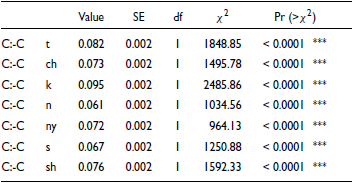
Table 11 Long description
A table with eight rows and six columns presenting the duration results of posthoc tests for Length by Consonant Type. The columns are labeled Value, SE, df, chi squared, and Pr greater than chi squared. Each row represents a different Consonant Type: t, ch, k, n, ny, s, and sh. The table includes values for each Consonant Type, their standard errors, degrees of freedom, chi squared values, and p-values, all indicating significant differences with p-values less than 0.0001.
The significant Length and Set interaction was due to Set 3a being significantly different from Set 1, however, only for geminates (p = 0.0348; see Table 12 and Figure 7b). A similar (but non-significant) tendency was also observed for the Set 3b vs. Set 1 pair. This can possibly reflect the greater effect of gemination in the contrastive context: geminates were produced stronger when they occurred in the same sentence with singletons. However, the difference between Sets 3a and 3b vs. Set 2 (where the same words appeared in the no contrast condition) was not significant, and thus the observed differences may reflect the different lexical status of words (nonsense words vs. real words).
Duration results of posthoc tests for Set by Length categories; ‘***’ <0.001, ‘**’ <0.01, ‘*’ < 0.05, ‘.’ <0.1
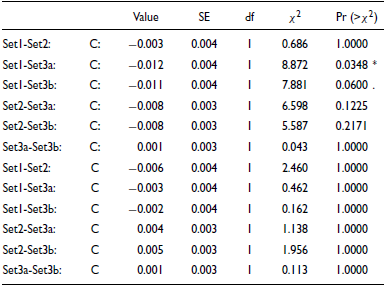
Table 12 Long description
The table presents duration results of posthoc tests for Set by Length categories. It includes seven rows and five columns. The columns are labeled Value, SE, df, χ2, and Pr (> χ2). The rows compare different sets: Set1-Set2, Set1-Set3a, Set1-Set3b, Set2-Set3a, Set2-Set3b, Set3a-Set3b, and repeats of Set1-Set2, Set1-Set3a, Set1-Set3b, Set2-Set3a, Set2-Set3b, Set3a-Set3b. Each row provides values for C, SE, df, χ2, and Pr (> χ2). Notable comparisons include Set1-Set3a with a significant p-value of 0.0348, indicating a significant difference, and other comparisons with non-significant p-values. The table highlights the interaction between different sets and lengths, particularly noting the effect of gemination in contrastive contexts.
With respect to individual results, all speakers showed robust durational differences (see Figure A3b). On average, geminates were more than twice as long as singletons for four out of five speakers (with the ratios being 2.02 for JF1, 2.04 for JF2, 2.67 for JF4, and 2.09 for JF5); one speaker showed a lesser durational difference (JF3, the ratio of 1.91). Interestingly, the length differences did not seem to be affected by the participants’ speech rate. An examination of utterance durations showed that a slower rate was exhibited by JF1 and JF2 (on average 172 and 190 ms per mora), while JF3, JF4, and especially JF5 showed much faster rates (144, 156, and 134 ms per mora respectively).Footnote 8
3.5 Relation between the amount of contact and consonant duration
Plotting all tokens by amount of contact and duration separately by Consonant Type in Figure 8 Footnote 9 shows that the length categories were almost fully separated by duration, while indicating considerable overlap in Q. Interestingly, both geminates and singletons tended to show a positive correlation of the two variables. As seen in Table 13, significant positive correlations were obtained for four out of seven geminate consonants; these included all the alveolopalatals (/ʨː/, /ɕː/, and /ɲː/) and the velar stop /kː/, but not the alveolars. Somewhat unexpectedly, the nasal /nː/ showed a significant negative correlation. Among singletons, significant positive correlations were observed for five out of seven consonants, with only the alveolars /n/ and /s/ showing the lack of it. It should be noted that most of the significant correlations were either moderate (between 0.30 and 0.50) or weak (below 0.30), with only the affricates /ʨː/ and /ʨ/ showing strong correlations (above 0.50). Overall, this means that there was mainly weak-to-moderate association between consonant duration and its amount of linguopalatal contact, largely regardless of the geminate or singleton status. In other words, for most consonants, tokens with longer duration had a somewhat greater amount of contact. While these correlations do not show causation, it is reasonable to interpret greater linguopalatal contact as at least in part resulting from longer constriction durations: to produce a longer consonant duration, one has to apply greater strength to the active articulator, and this results in more contact with the passive articulator. It is important to note, however, that linear regression curves for geminate consonants in Figure 8 were not just a continuation of singleton regression curves; in fact, they were often parallel to each other (notably for the alveolopalatals and the velar stops). This shows that geminates were not simply longer versions of the corresponding singletons; rather, the production mechanisms of the two length categories are inherently distinct (cf. Löfqvist Reference Löfqvist2005, Reference Löfqvist2007; Burroni et al. Reference Burroni, Kawahara and Shaw2025).
Boxplots of consonant Duration in seconds (a) by Length and Consonant Type and (b) by Length and Set; CC = geminate, C = singleton; t = alveolar stops, ch = alveolopalatal affricates, k = velar stops, n = alveolar nasals, ny = alveolopalatal nasals, s = fricative alveolars, sh = alveolopalatal fricatives.

Figure 7 Long description
A box-and-whisker plot showing consonant duration in seconds by length and consonant type. The plot consists of two panels: (a) and (b). Panel (a) displays the duration by length and consonant type, with categories including alveolar stops, alveolopalatal affricates, velar stops, alveolar nasals, alveolopalatal nasals, fricative alveolars, and alveolopalatal fricatives. Panel (b) shows the duration by length and set, with sets labeled as Set1, Set2, Set3a, and Set3b. Each box plot represents the distribution of durations, with the median, lower quartile, upper quartile, and outliers indicated. The red boxes represent geminate consonants, while the light blue boxes represent singleton consonants. The x-axis in panel (a) is labeled with consonant types, and the y-axis represents duration in seconds. The x-axis in panel (b) is labeled with sets, and the y-axis represents duration in seconds. The plot shows variations in consonant duration across different types and sets, with geminates generally having longer durations than singletons. All values are approximated.
Scatterplot of individual tokens by amount of contact (Q, normalized) and Duration (normalized) by Length and Consonant Type; CC = geminate, C = singleton; t = alveolar stops, ch = alveolopalatal affricates, k = velar stops, n = alveolar nasals, ny = alveolopalatal nasals, s = fricative alveolars, sh = alveolopalatal fricatives; black lines represent linear regression curves for each consonant.

Figure 8 Long description
The image contains a series of scatterplots that depict the relationship between the amount of contact (Q, normalized) and duration (normalized) for different consonant types. Each scatterplot is labeled with a specific consonant type: t for alveolar stops, ch for alveolopalatal affricates, k for velar stops, n for alveolar nasals, ny for alveolopalatal nasals, s for fricative alveolars, and sh for alveolopalatal fricatives. The data points are color-coded with red circles representing geminate consonants (CC) and blue triangles representing singleton consonants (C). Black lines represent linear regression curves for each consonant type, indicating the trend in the data. The scatterplots show varying degrees of correlation between the amount of contact and duration for different consonant types and lengths. All values are approximated.
Outputs of Pearson’s product-moment correlation analyses by consonant; ‘***’ <0.001, ‘**’ <0.01, ‘*’ < 0.05, ‘.’ <0.1

Table 13 Long description
The table presents the results of Pearson's product-moment correlation analyses for various consonant types, divided into geminate (CC) and singleton (C) categories. The table includes seven consonant types: alveolar stops (t), alveolopalatal affricates (ch), velar stops (k), alveolar nasals (n), alveolopalatal nasals (ny), fricative alveolars (s), and alveolopalatal fricatives (sh). Each consonant type is analyzed for its correlation coefficient (r), degrees of freedom (df), and p-value (p). Significant correlations are marked with asterisks, where *** indicates p < 0.001, ** indicates p < 0.01, * indicates p < 0.05, and . indicates p < 0.1. For geminates, significant positive correlations are observed for alveolopalatal affricates (ch) and velar stops (k), while a significant negative correlation is noted for alveolar nasals (n). Among singletons, significant positive correlations are found for alveolopalatal affricates (ch), velar stops (k), alveolopalatal nasals (ny), and alveolopalatal fricatives (sh). The table highlights that most correlations are moderate or weak, with only affricates showing strong correlations.
4. Discussion and conclusion
The goal of this study was to provide a systematic investigation of linguopalatal contact differences in the production of the Japanese length contrast across various lingual places and manners of articulation. These consonants were produced by five native speakers in a variety of phonetic and prosodic contexts, as well as in words of different lexical status. Our analysis of the amount of contact across the palate, taken at the point of maximum contact during the constriction, showed consistently higher values for geminates of all places and manners of articulation, with the exception of alveolopalatal fricatives. On average, geminates were produced with an extra contact of four to five electrodes (out of 62) over the artificial palate, resulting in a geminate-to-singleton ratio of 1.13. For comparison, place differences between alveolopalatal and alveolar singletons of the same manner were indicated by on average seven to eight electrodes (ratio 1.27), while manner differences between stop/affricate and fricative singletons of the same place were produced with on average 12 extra electrodes (ratio 1.46). Thus, the length differences were smaller than place and manner differences, but nevertheless substantial. There was also considerable variation with respect to the realization of the length contrast depending on manner and place. The largest differences were exhibited by nasals and the smallest differences were exhibited by fricatives. Furthermore, in terms of place, overall smaller differences were exhibited by alveolopalatal and velar obstruents, compared to alveolar obstruents and nasals regardless of the place. The noted lack of significant difference for alveolopalatal fricatives can be in part attributable to the choice of stimuli and carrier sentences, as differences were found to be significant for some of the items or conditions. It also likely reflects a stronger resistance of these sounds to contact changes (as discussed further below).
The expected length differences in amount of contact were also observed across all three datasets (nonsense words, real words in contrast and without contrast), prosodic contexts, and across the five speakers. Our temporal analysis of consonant constrictions in Set 1 showed that Q differences between geminates and singletons extended through much of the consonant duration, albeit being skewed towards the consonant offset for fricatives. Duration differences in length were very large, showing an average ratio of 2.2 (i.e., with geminates being more than twice as long as singletons). Correlation analyses showed weak-to-moderate positive association between constriction duration and amount of contact, and this was the case for the majority of geminate and singleton consonants. That is, longer durations tended to imply greater linguopalatal contact for most consonant types. Of note, this was in particular the case for alveolopalatals rather than alveolars, possibly due to the overall greater contact involved in the production of the former. While both geminates and singletons showed duration-contact correlations, the two categories had different patterns, pointing to somewhat distinct sources of this relation. Presumably, the greater contact for geminates is at least partly due to their phonological specification for stronger constrictions or more distant ‘virtual targets’ (cf. Ridouane Reference Ridouane, D’Imperio and Vallée2010; Kochetov & Kang Reference Kochetov and Kang2017, as further discussed below), or perhaps is a consequence of their other kinematic and timing properties (cf. Burroni et al. Reference Burroni, Kawahara and Shaw2025).
It is of interest to note that our speakers produced clear length distinctions in both contact and duration despite being (late) bilinguals in English (the language that does not have a comparable contrast). This further indicates that the Japanese distinction between geminates and singletons is very robust and appears to be resistant to L2 influences (see Kartushina, Frauenfelder & Golestani Reference Kartushina, Frauenfelder and Golestani2016 on L2-to-L1 transfer). To further confirm this, however, it would be important to examine the production of geminates by Japanese speakers of different levels of proficiency in English.
Overall, these results confirm our observations of the first articulatory comparison of linguopalatal contact for Japanese consonants in NLRI (1990), and namely for the obstruents /tː, t, ʨː, ʨ, sː, s/ produced in that study by a single speaker. The results also confirm the findings of two other EPG studies of Japanese – Kochetov & Kang (Reference Kochetov and Kang2017; on /tː, t, ʨː, ʨ/ in the ma_a context in nonsense words) and Matsui et al. (Reference Matsui, Kawahara and Shaw2016; on /tː, t, sː, s/ in onomatopoeic words) – and extend our observations to other consonants, prosodic conditions, and kinds of lexical items. It is important to note that alveolopalatal affricates in Kochetov & Kang (Reference Kochetov and Kang2017) were not as clearly distinguished in amount of contact as alveolar stops (showing differences in the anterior part of the palate only). The same holds in the current study for alveolopalatal obstruents in general: while affricates showed significant contact differences between geminates and singletons, differences in alveolopalatal fricatives were not significant (at least for the entire dataset). This is consistent with the general characterization of alveolopalatals as highly resistant to positional variation and coarticulation and in fact already exhibiting an extensive linguopalatal contact (Recasens & Espinosa Reference Recasens and Espinosa2006, Reference Recasens and Espinosa2009; see also Payne Reference Payne2006 on a comparison of alveolopalatals and geminate dentals in Italian).
Another important finding of the current study is that alveolar fricatives showed relatively small, nevertheless significant length differences in Q. This is in agreement with Löfqvist’s (2007) finding based on EMA (and broadly with Burroni et al. Reference Burroni, Kawahara and Shaw2025, who had these consonants as part of a larger dataset) but contrary to the lack of observed differences for /sː, s/ in Matsui et al. (Reference Matsui, Kawahara and Shaw2016) based on EPG and in Morimoto (Reference Morimoto2020) based on EMA. It is possible that the between-study differences reflect individual variability among Japanese speakers in the presence/absence or the degree of the non-durational realization of the contrast. Alternatively, given the small magnitude of length differences in alveolar fricatives, previous studies could have lacked the required statistical power or adequate spatial resolution for the tongue–palate contact (in the case of EMA). Note also that despite a significant amount of contact differences, alveolar fricatives in the current study behaved differently from other manners in the lack of Q-Duration correlations. Further research is therefore needed into manner- and place-specific differences in the realization of Japanese geminates making use of larger participant samples, more thoroughly controlled materials, and ideally a combination of different methods.
Another manner-specific finding of the current study is that nasals showed the most robust length difference (the ratios of 1.16 and 1.26, compared to 1.05 to 1.14 for the other consonant types). This is a novel result, as none of the previous EPG studies of the Japanese length have examined lingual nasals. While alveolar nasals were examined in Morimoto’s (Reference Morimoto2020) EMA study, they were found to show intermediate tongue-tip position differences between stops and fricatives. It is also of interest to note that nasals in our data showed the shortest duration both for geminates and singletons, and that one of the nasal consonant types (alveolar nasal) did not show the expected correlation between Q and duration. Some of these manner-specific differences can be attributed to the motor control requirements for nasals: unlike stops, nasals do not require a fully sealed-off oral cavity, leading to weaker constrictions and partial lack of side contact with the palate (Gibbon et al. Reference Gibbon, Yuen, Lee and Adams2007). A related factor is the susceptibility of single nasals to intervocalic lenition (also observed in our data), which must have contributed to the greater contrast with geminates. Finally, it is worth noting that geminate nasals in Japanese are traditionally analyzed differently from geminate obstruents (see section 1.2). These phonological representational differences, if meaningful, may have also contributed to manner-specific phonetic differences.
As mentioned above, consistent non-durational differences were observed in our data largely regardless of the dataset and prosodic context. While we predicted this to be the case, we also expected to find some differences among the datasets – namely between nonsense words and real words and between real words in isolation and in a contrastive focus context. Additionally, we expected the contrast to be more prominent in utterance-initial position than in utterance-medial position. These predictions were confirmed for neither amount of contact nor duration, with the exception of differences involving Set 1 (nonsense words) and some of the other sets, which could be more plausibly explained by segmental context differences. It therefore seems that the geminate-singleton contrast in Japanese is relatively stable, hardly sensitive to prosodic differences and shows relatively minimal differences in their realization across the lexicon.
The results for non-durational differences for Japanese consonants fit into the growing body of findings for typology of gemination across world languages. Recall that similar effects, in terms of the tightness of constriction, were obtained in EPG studies of languages as diverse as Italian, Swiss German, and Tashlhiyt Berber (Farnetani Reference Farnetani, Hardcastle and Marchal1990; Kraehenmann & Lahiri Reference Astrid and Lahiri2008; Payne Reference Payne2006; Ridouane Reference Ridouane2007; Ridouane & Hallé Reference Ridouane, Hallé and Kubozono2017; see section 1.1). Studies that used other methods, such as EMA and MRI have produced similar results (cf. Maspong et al. Reference Maspong, Burroni and Kirby2024 on Italian; Fujimoto et al. Reference Fujimoto, Shinohara and Mochihashi2023 on Ikema Miyako Ryukyuan), while pointing to some language-particular differences in kinematic properties (cf. Löfqvist Reference Löfqvist2005 on Japanese vs. Swedish; see Kubozono Reference Kubozono and Kubozono2017). The reason for tighter constrictions for geminate consonants is presumably due to the need to apply greater articulatory force in order to sustain longer contact between lower and upper articulators.
The fact that the resulting articulatory differences are systematic and largely independent of pure constriction duration differences (which are also observed in singletons; see section 3.5) suggests that these effects are grammatical in nature, being part of phonetic implementation of geminate consonants. This was in fact proposed by Ridouane (Reference Ridouane, D’Imperio and Vallée2010) to explain non-durational differences in Berber initial and medial geminates. According to his analysis, the phonologically long consonants, associated with two timing slots, are enhanced at the phonetic level of representation by the feature [tense]. The implementation of this feature-filling rule results in geminates being different from singletons not only in duration, but also in the tightness of the oral constrictions (see also Kochetov & Kang Reference Kochetov and Kang2017). Taking this further, the implementation of [tense] can have somewhat different realization depending on the manner and place of target consonants, as related to articulatory constraints on their production (coarticulatory resistance; Recasens, Pallarès & Fontdevila Reference Recasens, Dolors Pallarès and Fontdevila1997). Specifically, these effects are expected to be stronger for the less resistant constrictions of nasals and weaker for the more resistant constrictions of fricatives; similar differences are expected of place differences, namely between alveolars and alveolopatals (Recasens & Espinosa Reference Recasens and Espinosa2006, Reference Recasens and Espinosa2009). How exactly length contrasts are enhanced by articulatory tensing across various consonant types and prosodic positions in various languages is a fruitful direction to pursue in the future.
Acknowledgements
The author would like to thank Shigeto Kawahara and three anonymous reviewers for multiple helpful suggestions and corrections. He is also grateful to Maho Kobayashi for assistance with the design of the materials and to Jacqueline Wong for help with data annotation. The work was supported by the Social Sciences and Humanities Research Council of Canada Standard Grant #416-2010-0959. A subset of the data presented here were originally analyzed and presented in Kochetov (Reference Kochetov2012; four word pairs with /tː, t, kː, k/ from Set 2, three speakers, first recording session) and Kochetov and Kang (Reference Kochetov and Kang2017; two word pairs with /tː, t, ʨː, ʨ/ from Set 1, five speakers).
Appendix
Average palate profiles (taken over entire constriction intervals) for geminate and singleton consonants from Set 2 produced by all speakers (based on nine repetitions within a single recording session for JF1, JF2, and JF3; based on 18 repetitions for JF4 and JF5). All original-size images are available in the Supplementary Materials.

Figure A1 Long description
The matrix presents average palate profiles for geminate and singleton consonants from Set 2 produced by five speakers (JF1, JF2, JF3, JF4, and JF5) across different recording sessions. The matrix consists of five columns labeled JF1, JF2, JF3, JF4, and JF5, and twelve rows labeled with different consonant types: ma(ngte), he(nDa), ma(t)c hi, t(cho)o, shi(k)e, se(k)i, mi(n)a, ha(n)e, o(n)ni, e(s)ga, da(s)ge, a(s)shi, and i(s)ho. Each cell within the matrix contains a visual representation of the palate profile for the corresponding consonant type and speaker. The profiles are depicted using a grid pattern with varying shades of purple, indicating different levels of constriction. The data is based on nine repetitions within a single recording session for JF1, JF2, and JF3, and eighteen repetitions for JF4 and JF5. The matrix provides a comparative analysis of the palate profiles for geminate and singleton consonants across different speakers and recording sessions.
Boxplots of Q by Length, Consonant Type, and Set; CC= geminate, C = singleton, t = alveolar stops, ch = alveolopalatal affricates, k = velar stops, n = alveolar nasals, ny = alveolopalatal nasals, s = fricative alveolars, sh = alveolopalatal fricatives.

Figure A2 Long description
The image presents a series of box-and-whisker plots arranged in a grid format. Each plot compares the distribution of Q values across different sets for various consonant types. The x-axis represents different sets labeled as Set1, Set2, Set3a, and Set3b, while the y-axis represents the Q values ranging from 0 to 1. The plots are grouped by consonant types: t, ch, k, n, ny, s, and sh. Each box plot within a group is color-coded to represent different lengths: red for geminate consonants (CC) and light blue for singleton consonants (C). The box plots show the median (Q2), lower quartile (Q1), and upper quartile (Q3) values, with whiskers indicating the range of the data and dots representing outliers. The plots reveal variations in Q values across different consonant types, sets, and lengths, highlighting differences in articulatory characteristics. All values are approximated.
Boxplots of (a) Q and (b) consonant duration by Length and Speaker (JF1–JF5); CC= geminate, C = singleton.

Figure A3 Long description
The image contains two box plots labeled (a) and (b). Plot (a) shows the measure Q by Length and Speaker, while plot (b) shows consonant duration by Length and Speaker. Each plot compares geminate consonants (CC) and singleton consonants (C) across five speakers labeled JF1 to JF5. In plot (a), the y-axis represents the measure Q, ranging from 0.00 to 1.00, and in plot (b), the y-axis represents consonant duration, ranging from 0.00 to 0.25. The x-axis in both plots lists the speakers JF1 to JF5. The box plots indicate the distribution of values for each category, with the boxes representing the interquartile range, the horizontal lines inside the boxes representing the median, and the whiskers extending to the minimum and maximum values, excluding outliers which are shown as individual points. The red boxes represent geminate consonants (CC), and the blue boxes represent singleton consonants (C). The plots reveal that geminates generally have higher Q values and longer durations compared to singletons across all speakers. All values are approximated.
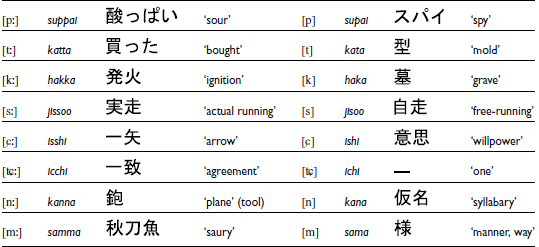
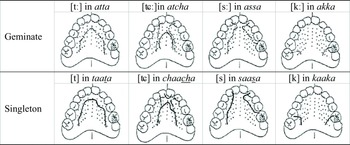
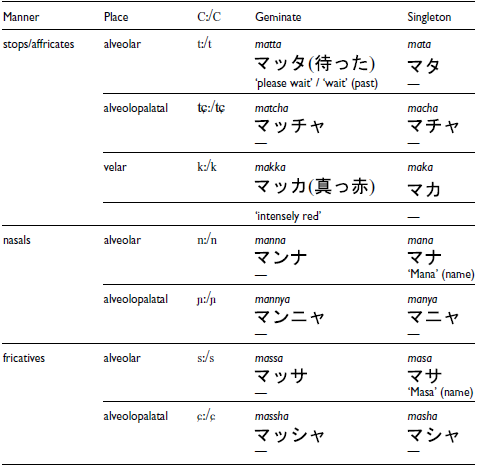
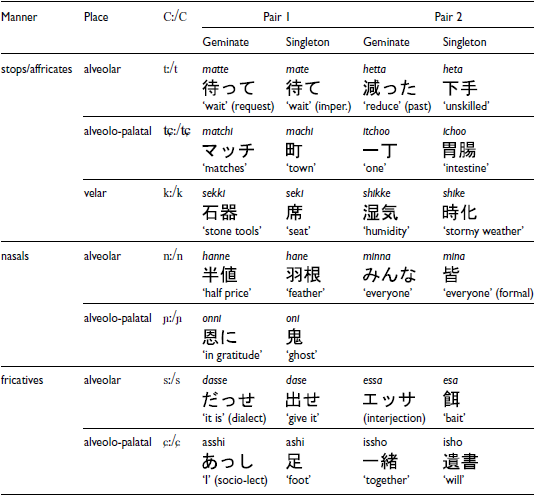
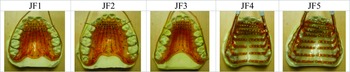
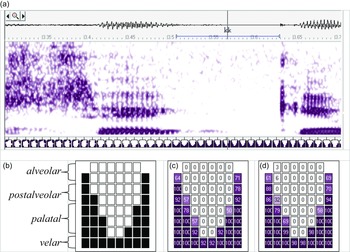
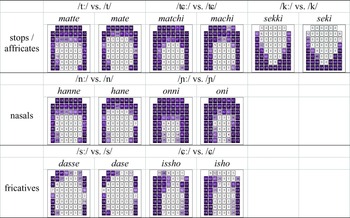
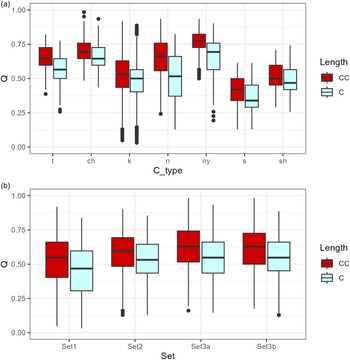
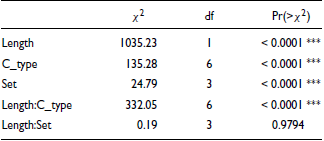
 χ
χ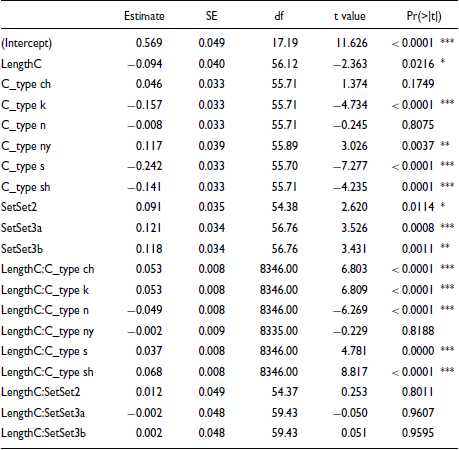
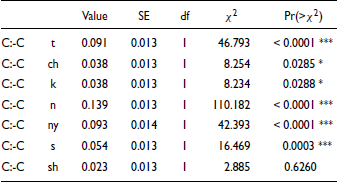
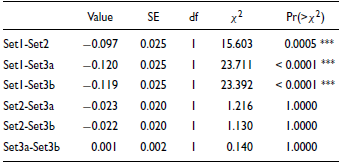
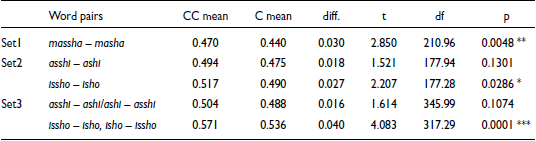
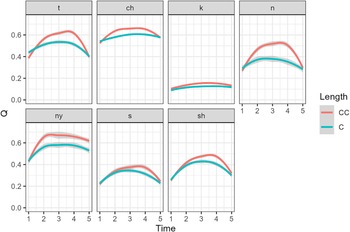
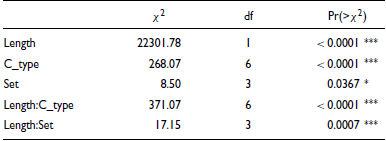
 χ
χ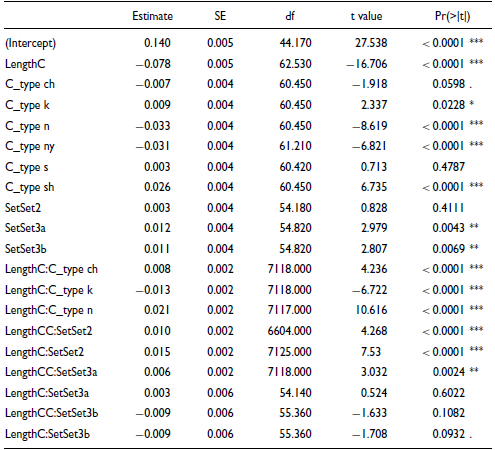
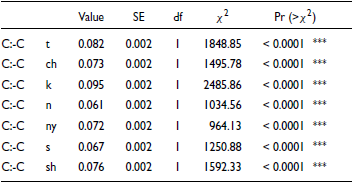
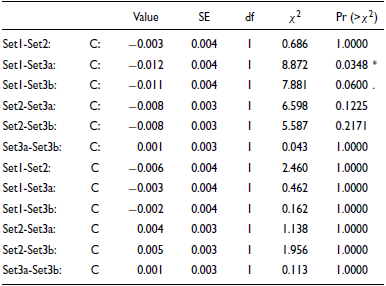
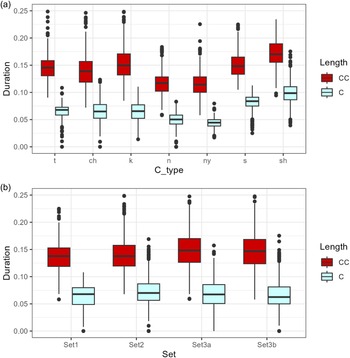
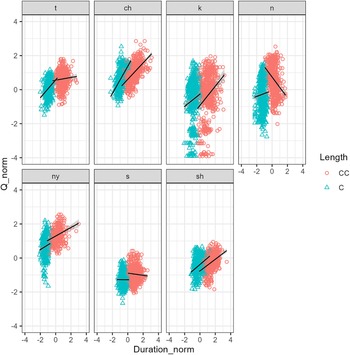
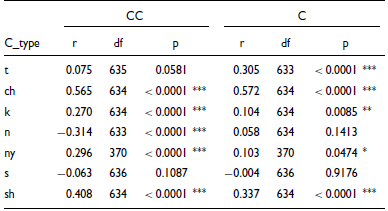
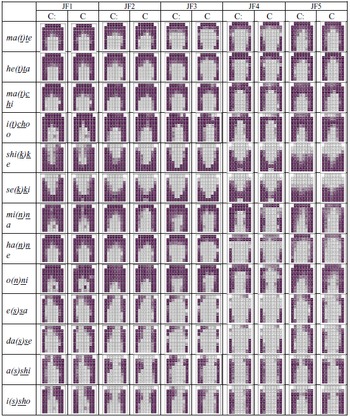
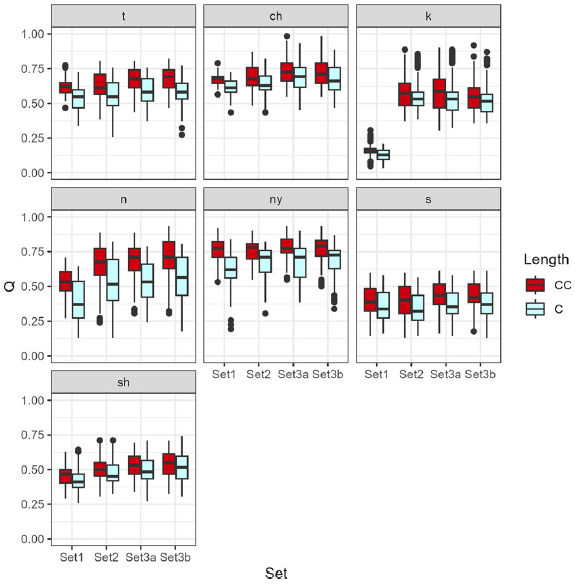
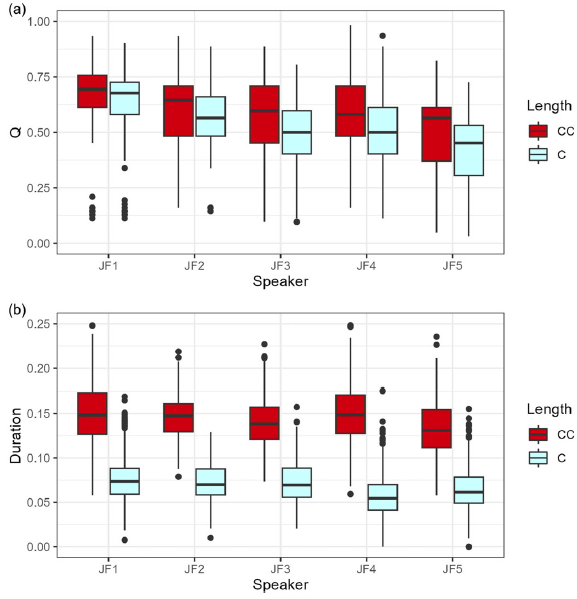

 Open access

