


Map of Belarus. (Adapted from https://commons.wikimedia.org/wiki/File:Minsk_in_Belarus.svg.)

Belarusian (ISO 639-3 BEL) is an Eastern Slavic language spoken by roughly seven million people in the Republic of Belarus (Zaprudski Reference Zaprudski2007, Census of the Republic of Belarus 2009), a land-locked country in Eastern Europe, bordered by Russia to the north and east, Ukraine to the south, Poland to the west and Lithuania and Latvia to the northwest (Figure 1). Within the Belarusian language, the two main dialects are North Eastern and South Western (Avanesaǔ et al. Reference Avanesaǔ, Matskevich, Arashonkava, Biryla, Vaĭtovich, Gaĭdukevich and Sheleg1963, Lapkoǔskaya Reference Lapkoǔskaya2008, Smolskaya Reference Smolskaya and Prygodzich2011). Two additional regional forms of Belarusian can be distinguished: the Middle Belarusian dialectal group, incorporating some features of North Eastern and South Western dialects together with certain characteristics of its own, and the West-Polesian (or Brest-Pinsk) dialectal group. The latter group is more distinct linguistically from the other Belarusian dialects and is in many respects close to the Ukrainian language (Lapkoǔskaya Reference Lapkoǔskaya2008, Smolskaya Reference Smolskaya and Prygodzich2011). The focus of this illustration is Standard Belarusian,Footnote 1 which is based on Middle Belarusian speech varieties. For details on the phonetic differences across dialects, the reader is referred to Avanesaǔ et al. (Reference Avanesaǔ, Matskevich, Arashonkava, Biryla, Vaĭtovich, Gaĭdukevich and Sheleg1963) and Lapkoǔskaya (Reference Lapkoǔskaya2008).
Currently, most speakers of Belarusian also speak Russian, and code-switching between the two is very common – so much so that the resulting spoken language has been given a name: Trasyanka, literally ‘a mixture of hay and straw’ (Zaprudski Reference Zaprudski2007: 111; Hentschel & Zeller Reference Hentschel and Zeller2014). Zaprudski has argued that Belarusian is ‘in the grip of replacive bilingualism’, yielding to Russian in certain spheres, e.g. science, higher education, and legislature (Zaprudski Reference Zaprudski2007: 98). Similarly, Ioffe (Reference Ioffe2003) has noted that Belarusian is often no longer used in daily life, even by Belarusians. Hentschel & Kittel (Reference Hentschel and Kittel2011), cited in Zeller (Reference Zeller2013: 231), conducted a survey on Belarusian bilinguialism and found that only 18% of respondents listed Belarusian as their language of primary communication; 42% listed Russian and 50% listed the Belarusian–Russian mixed speech, i.e. Trasyanka. In this context, many researchers consider Belarusian (as opposed to Trasyanka) to be an endangered language (Rzetelska-Feleszko Reference Rzetelska-Feleszko1997, Levy Reference Levy1999, Gutschmidt Reference Gutschmidt and Panzer2000, Smolicz & Radzik Reference Smolicz and Radzik2004, Zaprudski Reference Zaprudski2007, Ramza Reference Ramza2010, Zeller Reference Zeller2013).
Standard Belarusian is a codified form of the language that is accepted as the national norm. Similar to RP/BBC English, it is the language spoken by highly educated people and intellectuals who have a good command of the prescribed pronunciation (orthoepic) norms (Hentschel & Zeller Reference Hentschel and Zeller2014). These norms began to be developed right after 1917 with an aim to eliminate any differences between the spoken and written language (Azarka, Vasileǔskaya & Mikhalevich Reference Azarka, Vasileǔskaya and Mikhalevich2010: 27–28); by the end of the 1930s, the norms were fully codified and acted to prescribe Standard Belarusian pronunciation (Chakhoŭski & Chakhoŭskaya Reference Chakhoŭski and Chakhoŭskaya2010: 100–101).
A number of descriptions exist of the Standard Belarusian sound system, based on auditory, acoustic, and articulatory analyses (Biryla Reference Biryla1958; Chekman 1970; Padluzhny & Chekman Reference Padluzhny and Chekman1973; PadluzhnyFootnote 2 Reference Padluzhny1977, Reference Padluzhny1981, Reference Padluzhny1983; Burlyka et al. Reference Burlyka, Vygonnaya, Losik and Padluzhny1989; Vygonnaya Reference Vygonnaya1991; Krivitskiĭ, Mihnevich & Padluzhny Reference Krivitskiĭ, Mihnevich and Podluzhnyĭ2008; Chakhoŭski & Chakhoŭskaya Reference Chakhoŭski and Chakhoŭskaya2010). More recent work, focusing on colloquial Belarusian across dialects, includes Ramza (Reference Ramza2011a, b, Reference Ramza, Khaustovich and Timoszuk2012), Zeller (Reference Zeller2013), and Hentschel & Zeller (Reference Hentschel and Zeller2014). Both Ramza and Zeller have argued that there is a discrepancy between most traditional descriptions of Belarusian, which tend to be somewhat prescriptive, and the linguistic reality of Belarusian (see also Yankoŭski (Reference Yankoŭski1976: 10–20) and Padluzhny Reference Podluzhnyĭ [Padluzhny], Krivitskiĭ, Mihnevich and Podluzhnyĭ2008 on this topic).
The phonetic description below reflects the pronunciation of a single male speaker of Standard Belarusian in his early thirties, fluent in both Belarusian and Russian. He was born and raised in Minsk. His parents spoke Russian and Belarusian at home, and his grandparents, with whom he regularly spent time, lived in rural Belarus and spoke Belarusian. He also studied Standard Belarusian at school. In his daily life as an adult, he speaks mostly Russian, but continues to be exposed to Belarusian (e.g. in his friendships and through TV programming) and considers himself a fluent speaker. At the time of the recording, he had been living in Victoria, British Columbia, Canada, for approximately one year. He has since moved back to Belarus. Recordings were made in the University of Victoria’s Speech Research Laboratory, in a sound-treated booth, using a Sennheiser microphone and captured onto a PC computer using Sound Forge Pro. In addition, illustrative examples of articulation were recorded using a portable GE Logic E ultrasound machine with a convex 8C-RS probe, and processed using Sony Vegas Pro 12, VirtualDub 1.10.4, and Edgetrak (Li, Kambhamettu & Stone Reference Li, Kambhamettu and Stone2005).
Consonants
According to Grygor’jeva et al. (Reference Grygor’jeva, Andarala, Berdnik, Gulitski, Kachan, Mikhalevich, Mordas and Shumchyk2011: 54), the number of phonemes proposed for Belarusian has ranged from 33 to as many as 54. Variation results from how various consonants are analyzed – as separate phonemes vs. allophones, in particular geminate consonants (discussed further below) and relatively low-frequency consonants: /ɡ ɡʲ хʲ kʲ ɣʲ w d͡z/. Palatalized /ɡʲ хʲ kʲ ɣʲ/ have limited distribution: they are mainly found before /i/ and in a few borrowings (Chekman Reference Chekman1970: 131). They are therefore often treated as allophones of /ɡ х k ɣ/ rather than separate phonemes. Padluzhny (Reference Podluzhnyĭ [Padluzhny], Krivitskiĭ, Mihnevich and Podluzhnyĭ2008) and Ramza (Reference Ramza2011a, b) argue that, in general, /ɡ ɡʲ/ should be considered historical relics that are slowly being replaced with /ɣ ɣʲ/. In our experience, most Belarusian speakers pronounce /ɡ/, /ɡʲ/ as [ʁ], [ɣʲ], respectively, and this is certainly the case for the speaker that we worked with, e.g. ‘porch’ (from Polish) is pronounced [ˡʁanak] rather than [ˡɡanak], and
  ‘brother-in-law’ is pronounced [ˡʃvaɣʲer] rather than [ˡʃvaɡʲer] (see Figure 4c below).Footnote 3 The affricate /d͡z/ is found only in a limited set of words, including borrowings and onomatopoeic expressions (Padluzhny & Chekman Reference Padluzhny and Chekman1973). Finally, /w/ occurs exlusively after vowels in coda position, e.g.
  [braw] ‘he took’,
  [ˡprawda] ‘truth’,
  [ʃowk] ‘silk’,
  [ˡpownɨ] ‘full’. Padluzhny (Reference Padluzhny1969) described [w] as an allophone of the phoneme /v/ (see the details in GardzeĭReference Gardzeĭ2013); Chakhoŭski & Chakhoŭskaya (Reference Chakhoŭski and Chakhoŭskaya2010: 71–72) classify /w/ as a phoneme because it is contrastive, e.g.
 [tolk] ‘sense’ vs.
  [towk] ‘he ground’.
The consonant chart below includes all singleton consonants attested in our recordings, including those with relatively limited distribution, with the exception of [ɡ ɡʲ], which are not part of our speaker’s inventory – see above. IPA conventions are not used by Belarusian linguists, leading to a certain amount of difficulty in interpreting their descriptions of consonantal places of articulation. The symbols and terms used below reflect our own observations, supplemented by our re-analysis of the palatograms presented in Padluzhny & Chekman (Reference Padluzhny and Chekman1973), based on Harris’ (Reference Harris2006) guidelines for palatogram analysis.
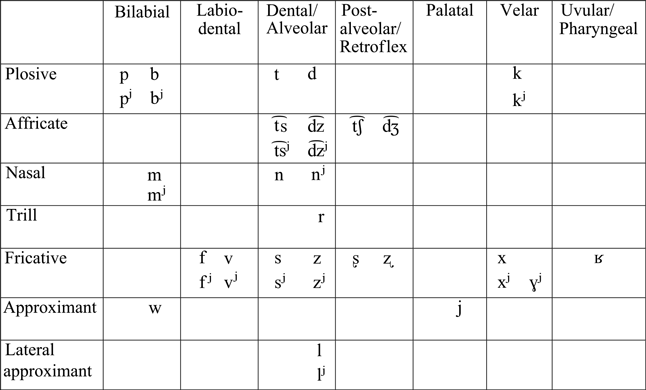
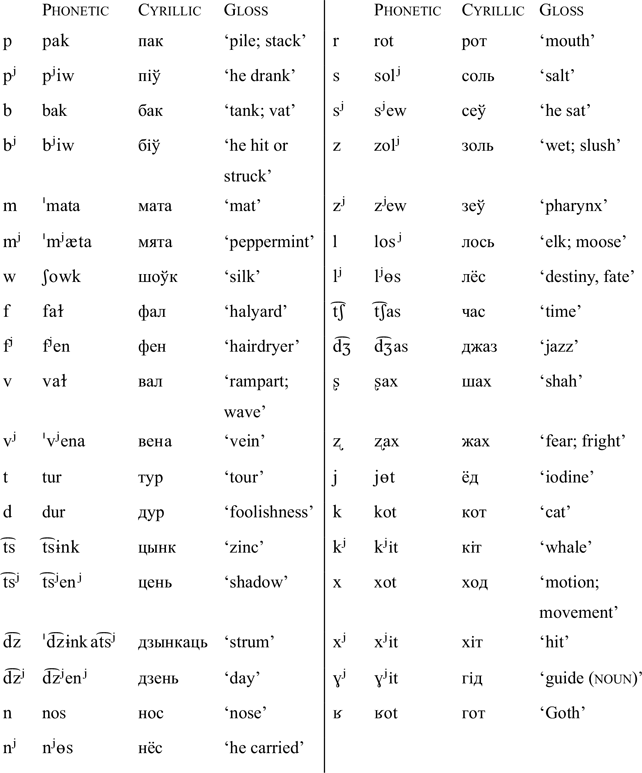
Phonetically, the Belarusian inventory is similar to that of other Slavic languages.Footnote 4 In terms of voicing, the contrast among Belarusian stops and affricates is between voiceless unaspirated /p pʲ t t͡s t͡sʲ k kʲ/ and prevoiced /b bʲ d d͡z d͡zʲ/. In terms of place of articulation, the primary feature of note is palatalization. As in other Slavic languages, Belarusian contrasts palatalized vs. non-palatalized consonants, commonly referred to as ‘soft’ vs. ‘hard’ consonants (see Bondarko Reference Bondarko2005 for justification of this terminology). Although the distribution of palatalized and non-palatalized consonants is closely linked to the distribution of vowels (see the ‘Phonotactics’ section below), palatalization is considered contrastive among consonants because both series of consonants can generally occur in all syllabic positions. Crucially, both can occur in word-final (coda) position, where no following vowel exists to dictate presence vs. absence of palatalization, e.g. [lʲѳn] ‘flax’ –
 [konʲ] ‘horse’,
 [lʲѳs] ‘destiny, fate’ –
 [losʲ] ‘elk’,
 [ʁol] ‘goal’ –
 [molʲ] ‘moth’. Nonetheless, Belarusian does exhibit certain restrictions on the distribution of palatalization. In particular, contrary to Russian, the contrast between palatalized and non-palatalized obstruents is maintained in final coda position for coronals only (Chekman Reference Chekman1970: 131; Kochetov Reference Kochetov2002: 26): /pʲ bʲ mʲ fʲ vʲ/ occur only before vowels and never in word-final position (Chakhoŭski & Chakhoŭskaya Reference Chakhoŭski and Chakhoŭskaya2010: 41; GardzeĭReference Gardzeĭ2013). Palatalized velars /хʲ ɣʲ kʲ/ are also restricted in Belarusian, occurring only before vowels, typically before /i/, in some borrowings before /e/, and very seldom before other vowels (Padluzhny Reference Podluzhnyĭ [Padluzhny], Krivitskiĭ, Mihnevich and Podluzhnyĭ2008: 42).
In terms of phonetic implementation, Chakhoŭski & Chakhoŭskaya (Reference Chakhoŭski and Chakhoŭskaya2010: 28) describe Belarusian as being distinctive among Slavic languages in the phonetic salience of the palatalized/non-palatalized contrast. The strong palatalization of /sʲ zʲ/ in particular has been given a name: shapyalyaviya ( ) in Belarusian, which translates to ‘lisping’. Certainly the contrast between /s/, /z/ and /sʲ/, /zʲ/ is more salient in Belarusian than in Russian, at least for our speaker (see Yanushevskaya & Bunčić’s (Reference Yanushevskaya and Bunčić2015) Russian IPA illustration). The realization of palatalization varies somewhat across consonants, although our recordings do not allow us to make any strong claims about how systematic this variation is. Examples of the differences between plain and palatalized consonants as produced by our speaker are provided in Figures 2 and 3.Footnote 5 Figure 2 contrasts plain /m/ in
 [ˡmata] ‘mat’ (a) with palatalized /mʲ/ in
 [ˡmʲӕta] ‘peppermint’ (b). The plain and palatalized consonants are similar within the nasal itself ([m]), differing primarily in their release (and in the following vowel): [ˡmʲӕta] has an audible [j] following [m], lasting approximately 47 ms; its F2 is relatively high (2023 Hz), and lowers to approximately 1480 Hz in the following vowel [ӕ]. In [ˡmata], F2 is relatively low (1210 Hz) right from the onset of the post-nasal vowel.
[ˡmata] ‘mat’ (a) vs.  [ˡmʲӕta] ‘peppermint’ (b).

Figure 3 contrasts /n/ from [nos] ‘nose’ (a) with /nʲ/ from
 [nʲѳs] ‘he carried’ (b). In this case, the plain and palatalized consonants differ within the nasal itself ([n]): /nʲ/ has a relatively high formant (2260 Hz), which is lacking in /n/. This results in a substantial transition in F2 between /nʲ/ and the following vowel, from approximately 2260 Hz down to 1074 Hz (b); no such transition exists for /n/ (a).
[nos] ‘nose’ (a) vs.  [nʲѳs] ‘he carried’ (b).

Comparing /nʲ/ and /mʲ/, there is a longer, more stable [j] following the nasal in [ˡmʲӕta] than in [nʲѳs] (47 ms vs. 22 ms). Padluzhny & Chekman (Reference Padluzhny and Chekman1973: 251) and Padluzhny (Reference Podluzhnyĭ [Padluzhny], Krivitskiĭ, Mihnevich and Podluzhnyĭ2008: 32) suggest that in Belarusian (in contrast to Russian), the palatalized coronal consonants /sʲ/, /zʲ/, /nʲ/, /d͡zʲ/, /t͡sʲ/ have a single palatal place of articulation rather than having two places of articulation, dental (primary) and palatal (secondary). Our observations offer preliminary support for their view: whereas /mʲ/ clearly has two sequential places of articulation (labial – palatal), /nʲ/ sounds more like [ɲ], with a single, palatal place of articulation.Footnote 6
For the velar consonants, the plain vs. palatalized counterparts are best illustrated in terms of their articulation directly. Figures 4–6 provide schematic renditions of our speaker’s tongue contours imaged using ultrasound, and then traced using Edgetrack (Li et al. Reference Li, Kambhamettu and Stone2005). Note that in these figures, the numbers on the axes do not correspond to particular points along the vocal tract; rather, they are reference points specific to Edgetrack. Figure 4 provides tongue contours of plain and palatalized /k/ ~ /kʲ/ (a), /х/ ~ /хʲ/ (b), and /ʁ/ ~ /ɣʲ/ (c), recorded in a_a context. In each figure, the palatal glide /j/ is also included as a reference point for the palatal region. These figures demonstrate that the tongue is fronted and raised in palatalized /kʲ хʲ ɣʲ/ compared to /k х ʁ/, corresponding phonetically to [k̟ʲ], [х̟ʲ], [ɣ̟ʲ] (Yanushevskaya & Bunčić Reference Yanushevskaya and Bunčić2015 describe the same articulation for Russian).
Superimposed tongue contours of /k kʲ j/ (a), /х хʲ j/ (b), and /ʁ ɣʲ j/ (c).

Figure 5 shows that the tongue is substantially lower and more retracted in /ʁ/ than in /х/ and /k/, /ʁ/ being articulated in the uvular or possibly even the pharyngeal region, as noted by Padluzhny (Reference Podluzhnyĭ [Padluzhny], Krivitskiĭ, Mihnevich and Podluzhnyĭ2008: 43) and Padluzhny & Chekman (Reference Padluzhny and Chekman1973: 219). Note that the palatalized counterpart of /ʁ/, /ɣʲ/, is similar in place of articulation to /kʲ/ and /хʲ/ (Figure 4).
Superimposed tongue contours of /ʁ х k/.

In terms of the non-palatalized consonants, Padluzhny & Chekman (Reference Padluzhny and Chekman1973) and Padluzhny (Reference Podluzhnyĭ [Padluzhny], Krivitskiĭ, Mihnevich and Podluzhnyĭ2008) have noted that in Belarusian they all have secondary velarization, except for /k х ʁ/, which are inherently velarized (or uvularized in the case of /ʁ/). As an initial investigation of the articulation of non-palatalized consonants in Belarusian, we focused on the post-alveolar fricatives transcribed here as [ʂ ʐ]. These two consonants have been described as ‘harder’ consonants in Belarusian than in Russian (Padluzhny Reference Podluzhnyĭ [Padluzhny], Krivitskiĭ, Mihnevich and Podluzhnyĭ2008: 32).Footnote 7 Figure 6 provides superimposed tongue contours of [ʂ ʐ ] as well as the velar consonant [х], as a reference. We can see that the back of the tongue body for all the three consonants coincides, suggesting strong velarization of Belarusian [ʂ ʐ]. In addition, Figure 6 also shows that the tongue front is raised in [ʂ ʐ], indicating that these sounds are retroflexed, as others have suggested for other Slavic languages (Hamann Reference Hamann2004, Litvin Reference Litvin2014, Yanushevskaya & Bunčić Reference Yanushevskaya and Bunčić2015). Further articulatory study is required to confirm the precise articulation of their affricated counterparts /t͡ʃ d͡ʒ/.
Superimposed tongue contours of /ʂ ʐ х/.

In terms of symmetry in the distribution of palatalized and non-palatalized consonants, two points are worth making: first, /r ʂ ʐ t͡ʃ d͡ʒ/ are always non-palatalized in Standard Belarusian, and do not have palatalized counterparts.Footnote 8 This contrasts with Russian, which has /rʲ/, and in which /t͡ʃ/ is always palatalized, i.e. phonetically [t͡ʃʲ]. Second, with respect to /t͡sʲ d͡zʲ/, the standard analysis is that they are in fact the palatalized counterparts of /t d/ rather than /t͡s d͡z/ (Padluzhny Reference Podluzhnyĭ [Padluzhny], Krivitskiĭ, Mihnevich and Podluzhnyĭ2008; Grygor’jeva et al. Reference Grygor’jeva, Andarala, Berdnik, Gulitski, Kachan, Mikhalevich, Mordas and Shumchyk2011). This is because [t͡sʲ], [d͡zʲ] alternate with [t], [d] (but not with [t͡s], [d͡z]) in derivational and inflectional morphology (Padluzhny Reference Podluzhnyĭ [Padluzhny], Krivitskiĭ, Mihnevich and Podluzhnyĭ2008), for example, xama
[ˡхata] ‘house’ vs. y  [u ˡхat͡sʲe] ‘in the house’;
  [vaˡda] ‘water’ vs.
  [u vaˡd͡zʲe] ‘in the water’.Footnote 9 The differences in manner and place of articulation between the non-palatalized /t d/ and their palatalized counterparts /t͡sʲ d͡zʲ/ are nonetheless salient enough that the processes by which /t d/ become palatalized/affricated have been given names in the Belarusian linguistic literature, dzekanne and tsekanne, and are considered among the most salient sound-related features of BelarusianFootnote 10 (Padluzhny Reference Podluzhnyĭ [Padluzhny], Krivitskiĭ, Mihnevich and Podluzhnyĭ2008).
Finally, in addition to the consonants listed in the inventory above, Belarusian exhibits two types of geminates, both arising from morphological concatenation (Padluzhny Reference Podluzhnyĭ [Padluzhny], Krivitskiĭ, Mihnevich and Podluzhnyĭ2008: 59): (i) as a result of two identical consonants coming together across a morpheme boundary (e.g.  [sːaˡd͡zʲit͡sʲ] ‘put off’, where [sː] results from concatenation of prefix-final /s/ with stem-initial /s/) and (ii) as a result of lengthening of a morpheme-final consonant between two vowels (e.g. [phˡtanʲːe] ‘question’, where stem-final /nʲ/ geminates between the last vowel in the stem (/a/) and the inflectional suffix /e/). The consonants /lʲ nʲ zʲ sʲ d͡zʲ t͡sʲ ʂ ʐ t͡ʃ/ can be geminated, representing another salient feature of the Belarusian language (for further details on geminates, see Gachko Reference Gachko2000; Padluzhny Reference Podluzhnyĭ [Padluzhny], Krivitskiĭ, Mihnevich and Podluzhnyĭ2008: 59; Chakhoŭski & Chakhoŭskaya Reference Chakhoŭski and Chakhoŭskaya2010: 81; Grygor’jeva et al. Reference Grygor’jeva, Andarala, Berdnik, Gulitski, Kachan, Mikhalevich, Mordas and Shumchyk2011: 42). Some researchers include geminates in the consonantal inventory, while others claim that because they are composites (at least historically), they are not in the underlying sound inventory of the language (GardzeĭReference Gardzeĭ2013). In support of the latter view, Chakhoŭski & Chakhoŭskaya (Reference Chakhoŭski and Chakhoŭskaya2010: 81) note that Belarusian does not contrast short and long consonants. In addition, borrowed words lose geminates in Belarusian: compare Belarusian vs. Russian ‘group’ and Belarusian
  vs. Russian
  ‘mass’. Finally, some regional varieties of Belarusian do not feature geminates at all, even as composites.
Vowels
Belarusian has five vowel phonemes (Chakhoŭski & Chakhoŭskaya Reference Chakhoŭski and Chakhoŭskaya2010: 71), broadly /i e a o u/.Footnote 11 The phonetic manifestation of these phonemes is determined by two factors: (i) their consonantal environment, which affects the quality of vowels, and (ii) stress, which determines the quantity (duration) as well as quality of vowels. In this section, we consider the consonantal environment; stress is discussed in the ‘Stress’ section immediately below.
Previous research has argued that each (stressed) vowel phoneme has four allophones, based on palatalization of the preceding and following consonants (Chakhoŭski & Chakhoŭskaya Reference Chakhoŭski and Chakhoŭskaya2010: 42; see also Timberlake Reference Timberlake2004, on Russian). In general, pre-vocalic consonants have a much greater influence on vowel quality than do post-vocalic consonants; this is reflected in the orthography, in the use of different letters for vowels following but not preceding palatalized consonants. In this illustration, we distinguish only two sets of vowel allophones in our transcriptions: [i e ӕ ѳ ʉ] (following palatalized consonants) vs. [ɨ ɛ a o u] (primarily following non-palatalized consonants). Nonetheless, illustrative words below include vowels in all four environments previously noted to affect vowel quality: C_C, C_Cʲ, Cʲ_C, and Cʲ_Cʲ; these are plotted in Figure 7 below, to show the more subtle variation that exists in the vowel system.


The vowel space in Figure 7 is based on our speaker’s pronunciation of the words listed above; it plots F1 and F2 (in Hz) at vowel midpoint, converted to the Bark scale using templates provided by Deterding (Reference Deterding2006); measurements are averaged over three repetitions of each word in the above word list. Transcriptions are narrower than those provided above, capturing the more subtle variation in vowel quality based on consonantal environment.
Belarusian vowel allophones (in stressed position). Ellipses delineate five vowel phonemes.

Figure 7 shows that vowels following non-palatalized consonants generally have a higher F1 and lower F2 than those following palatalized consonants. Beyond this, vowels differ in how well-defined the previously reported four-way allophonic distribution is: for /a/, there are four fairly distinct allophones; for /o/, there also appear to be four distinct, but closely clustered, allophones; for /i e u/, there seem to be only three surface allophones, although which two allophones are merged is vowel-specific. The vowel /i/ often devoices phrase-finally and when surrounded by voiceless consonants; this is illustrated in the transcription of ‘The North Wind and the Sun’.
Stress
As mentioned above, stress affects vowel duration as well as quality. In Belarusian, stress is lexically specified and contrastive (e.g.  [ˡkara] ‘punishment; retribution’ vs.
  [kaˡra] ‘bark (noun)’); it is also used to contrast inflected forms (e.g.
  [ˡzʲimɨ] ‘winters’ (nom) vs.
[zʲiˡmɨ] ‘winter’ (gen). In addition, stress in Belarusian may shift in word-derivation, as in the pair [vos] ‘cart’ vs. [vaˡzɨ] ‘carts’ (Chakhoŭski & Chakhoŭskaya Reference Chakhoŭski and Chakhoŭskaya2010: 51). The primary acoustic correlates of stress are amplitude, pitch and duration. In terms of duration, a three-way contrast is said to exist between stressed, immediately pre-stressed, and unstressed vowels (Padluzhny Reference Podluzhnyĭ [Padluzhny], Krivitskiĭ, Mihnevich and Podluzhnyĭ2008: 46; Chakhoŭski & Chakhoŭskaya Reference Chakhoŭski and Chakhoŭskaya2010: 52; see also Timberlake Reference Timberlake2004: 43–44, on Russian). The measurements presented in Table 1 are based on vowels in three repetitions each of two multisyllabic words recorded by our speaker:
[ˡzʲimɨ] ‘winters’ (nom) vs.
[zʲiˡmɨ] ‘winter’ (gen). In addition, stress in Belarusian may shift in word-derivation, as in the pair [vos] ‘cart’ vs. [vaˡzɨ] ‘carts’ (Chakhoŭski & Chakhoŭskaya Reference Chakhoŭski and Chakhoŭskaya2010: 51). The primary acoustic correlates of stress are amplitude, pitch and duration. In terms of duration, a three-way contrast is said to exist between stressed, immediately pre-stressed, and unstressed vowels (Padluzhny Reference Podluzhnyĭ [Padluzhny], Krivitskiĭ, Mihnevich and Podluzhnyĭ2008: 46; Chakhoŭski & Chakhoŭskaya Reference Chakhoŭski and Chakhoŭskaya2010: 52; see also Timberlake Reference Timberlake2004: 43–44, on Russian). The measurements presented in Table 1 are based on vowels in three repetitions each of two multisyllabic words recorded by our speaker:  [abaˡranak] ‘bagel’ and
  [spadaˡbat͡sːa] ‘to like’. Immediately post-stress vowels, which should be unstressed, are similar in length to immediately pre-stressed vowels in our recordings; this is likely because, in both words, the immediately post-stressed vowel is also the final one, and therefore lengthened due to a combination of word-final lengthening and the careful nature of the speech sample.
Average duration (ms) of the vowel /a/ in unstressed, immediately pre-stress, stressed, and immediately post-stress positions, in three tokens each of the Belarusian words  [abaˡranak] ‘bagel’ and
  [spadaˡbat͡sːa] ‘to like’.

It is generally assumed that unstressed vowels retain their qualityFootnote 13 in Standard Belarusian (Yankoŭski Reference Yankoŭski1976; Chakhoŭski & Chakhoŭskaya Reference Chakhoŭski and Chakhoŭskaya2010: 39; Grygor’jeva et al. Reference Grygor’jeva, Andarala, Berdnik, Gulitski, Kachan, Mikhalevich, Mordas and Shumchyk2011). For example, the words  [sɨˡrok] ‘cheese, curd bar’ vs.
  [suˡrok] ‘marmot, woodchuck’ are distinguished only by the unstressed vowels in the first syllable of the words (Padluzhny Reference Podluzhnyĭ [Padluzhny], Krivitskiĭ, Mihnevich and Podluzhnyĭ2008: 46). If vowel quality were lost in unstressed position, we would not expect the unstressed vowels to be distinguishable. However, the same multisyllabic words referred to in Table 1 above show that, at least for our speaker, unstressed vowels do undergo a certain degree of reduction in quality as well as quantity. Figure 8 provides average F1 and F2 values for stressed, immediately pre-stressed, immediately post-stressed, and 2nd pre-stressed (unstressed) /a/, extracted from
  [abaˡranak] ‘bagel’ (Figure 8a) and
  [spadaˡbat͡sːa] ‘to like’ (Figure 8b).
Formant values of /a/ in four syllables of the word  [abaˡranak] ‘bagel’ (a) and
  [spadaˡbat͡sːa] ‘to like’ (b).

Figure 8 suggests that the phonetic quality of /a/ does in fact depend on its position in relation to the stressed vowel: although location of the /a/s on the vowel chart differ by word, immediately pre-stress /a/ is consistently the closest to stressed /a/ and 2nd pre-stressed /a/ is the furthest from it – specifically, it has a much lower F1 than in other positions, indicating a higher vowel (approaching [Λ]).
Aside from affecting the realization of vowel quality, stress also affects the distribution of vowel phonemes. Only /i/ and /u/ occur as frequently in unstressed syllables as in stressed ones (Padluzhny Reference Podluzhnyĭ [Padluzhny], Krivitskiĭ, Mihnevich and Podluzhnyĭ2008: 47); the vowel /o/ only occurs in stressed position. The distribution of other vowels is limited due to two neutralization processes, termed in the Belarusian literature akanne and jakanne.Footnote 14 In akanne, the vowels /o/ and /e/ are realized as [a] in unstressed position after a hard consonant, for example in the following word pairs:  [vowk] ‘wolf’ vs.
  [vawˡk̟ʲi] ‘wolves’;
  [ˡrɛt͡ʃka] ‘river (noun)’ vs. [rat͡ʃˡnɨ] ‘riverine (adjective)’. In jakanne, the vowels /o/ and /e/ are realized as [ӕ] after a palatalized consonant in immediately pre-stressed position only (Chakhoŭski & Chakhoŭskaya Reference Chakhoŭski and Chakhoŭskaya2010: 42; Grygor’jeva et al. Reference Grygor’jeva, Andarala, Berdnik, Gulitski, Kachan, Mikhalevich, Mordas and Shumchyk2011: 34; Zeller Reference Zeller2013), as in
 [ˡvʲѳsnɨ] ‘Springs’ (pl) vs.
  [vʲӕsˡna] ‘Spring’ (sg);
 [ˡbʲelɨ] ‘white’ (3d sg masc) vs.
  [bʲӕˡlo] ‘white’ (3d sg neut). Neither process occurs in words of foreign origin (Grygor’jeva et al. Reference Grygor’jeva, Andarala, Berdnik, Gulitski, Kachan, Mikhalevich, Mordas and Shumchyk2011: 35), for example, .
 [dɛˡkrɛt] ‘decree’ (*
[daˡkrɛt]); .
[dɛˡkrɛt] ‘decree’ (*
[daˡkrɛt]); . [bʲenˡzʲin] ‘gasoline’ (*
[bʲӕnˡzʲin]). While jakanne is a distinctive feature of Belarusian, a process similar to akanne occurs in Russian as well (Timberlake Reference Timberlake2004, Yanushevskaya & Bunčić Reference Yanushevskaya and Bunčić2015). Interestingly, the two languages differ in whether or not they represent the process orthographically: in Russian, vowels are written based on their underlying form, e.g.
[bʲenˡzʲin] ‘gasoline’ (*
[bʲӕnˡzʲin]). While jakanne is a distinctive feature of Belarusian, a process similar to akanne occurs in Russian as well (Timberlake Reference Timberlake2004, Yanushevskaya & Bunčić Reference Yanushevskaya and Bunčić2015). Interestingly, the two languages differ in whether or not they represent the process orthographically: in Russian, vowels are written based on their underlying form, e.g.  [vaˡda] ‘water’ (sg nom) is spelled the same as
  [ˡvodɨ] ‘water’ (nom pl), despite the fact that /o/ is pronounced differently in the two words. In contrast, in Belarusian, the orthography is more phonetic in nature, e.g.
  [vaˡda] ‘water’ (sg) vs.
  [ˡvodɨ] ‘water’ (pl). This reflects the more general fact that the Belarusian orthography is more phonetically-based than is the Russian orthography. Finally, it should be mentioned that there is variation in whether or not stress-related vowel neutralization processes are realized in pronunciation, even in Standard Belarusian, e.g. can be pronounced [nʲӕˡma] (with jakanne) vs. [nʲiˡma] (without jakanne) (Padluzhny Reference Podluzhnyĭ [Padluzhny], Krivitskiĭ, Mihnevich and Podluzhnyĭ2008: 17).
Syllables
According to Chakhoŭski & Chakhoŭskaya (Reference Chakhoŭski and Chakhoŭskaya2010: 46), approximately 90% of all the words in Belarusian are made of between two and four syllables. The most common syllables are open (CV and CCV), e.g. [vaˡda] ‘water’,
  [ʁaradˡskaja] ‘municipal’ (Chakhoŭski & Chakhoŭskaya Reference Chakhoŭski and Chakhoŭskaya2010: 47–48). Onset and coda clusters are allowed however, with certain restrictions. Again according to Chakhoŭski & Chakhoŭskaya (Reference Chakhoŭski and Chakhoŭskaya2010: 94), the most infrequent clusters combine two sonorants; the most frequent clusters combine obstruents with other obstruents or resonants, e.g.
 [ˡslova] ‘word’,
 [ˡsʲlʲѳzɨ] ‘tears’,
  [ʁorn] ‘clarion’,
 [aˡlʲimp] ‘Olympus’. Clusters like /хv/, /sf/, /ʃl/, /mp/, /mfʲ/, /ps/, /ks/ are relatively infrequent, and found primarily in borrowings (Chakhoŭski & Chakhoŭskaya Reference Chakhoŭski and Chakhoŭskaya2010: 93), e.g.
  [psaˡlom] ‘psalm’,
 [ˡхvoja] ‘fir-needles’ (in fact, the recording of the latter word includes a short vocalic element between [х] and [v]).
Belarusian syllables are often slightly different (and simpler) than those in corresponding Russian words. First, word-initial consonant clusters tend to be avoided in Belarusian: in particular, unlike in Russian, unstressed [a] and [i] occur word-initially before combinations of sonorants /r l m w/ with other consonants, e.g.  [awˡtorak] ‘Tuesday’ (compare with Russian
  [ˡftornik]). Similarly, where Russian has word-final clusters of the type labial + l (e.g. /bl/, /ml/, /vl/), in Belarusian such clusters are broken up by a vowel between the labial and the liquid (see details in Yankoŭski Reference Yankoŭski1976: 17), e.g.
  [ruˡbʲelʲ] ‘ruble’ (compare with Russian
  [rublʲ]). Second, words generally do not begin with stressed onsetless syllables. Thus, words that begin with a stressed vowel in Russian, most often include a word-initial consonant in Belarusian cognates, either /v/, /j/, or /ʁ/Footnote 15 (Padluzhny Reference Podluzhnyĭ [Padluzhny], Krivitskiĭ, Mihnevich and Podluzhnyĭ2008: 48), e.g.
  [ˡvozʲera] ‘lake’ (compare to Russian
  [ˡozʲera]). Similarly, the glide [j] sometimes appears before a stressed /i/ in morpheme- and word-initial position, e.g
  /imˡʁla/ ‘haze, fog’ can be realized [jimˡʁla] (see details in Antanyuk & Plotnikaŭ Reference Antanyuk and Plotnikaŭ2006: 33).
Phonotactics
As mentioned above, Belarusian is similar to Russian in exhibiting fairly strict co-occurrence restrictions between consonants and following vowels, related to palatalization: palatalized velars /kʲ ɣʲ хʲ/ seldom combine with /a/ and /u/, and combine with /e/ primarily in borrowings, e.g.  [ɣʲeˡroj] ‘hero’; palatalized labial consonants also rarely occur with /u/, and again primarily in borrowings, e.g.
  [pʲʉˡrɛ] ‘puree’,
  [bʲʉˡro] ‘office, bureau’; unlike the palatalized velar consonants, they do occur with /a/; velar /k/, /ʁ/, /х/ seldom combine with /i/. Aside from restrictions related to palatalization, there are few restrictions on how consonants and vowels can combine (Chakhoŭski & Chakhoŭskaya Reference Chakhoŭski and Chakhoŭskaya2010: 90–91).
Belarusian also exhibits a number of phonological processes affecting consonants. Typical of many Slavic languages, Belarusian exhibits word-final devoicing, leading to the (partial) neutralization of word-final voicing contrasts, e.g pom [rot] ‘mouth (nom)’ – poma
[ˡrota] ‘mouth (gen)’ vs.  [rod̥]Footnote 16 ‘family; kin; clan (nominative)’ –
  [ˡrodu] ‘family; kin; clan (gen)’. Also typical of Slavic languages, Belarusian exhibits regressive assimilatory processes affecting voicing and palatalization. In terms of voicing, obstruents assimilate in voicing to a following obstruent, e.g.
  [ˡpʲerat ˡpolʲem] ‘in front of the field’ vs.
  [ˡpʲerad ˡdomam] ‘in front of the house’Footnote 17 (see also Timberlake Reference Timberlake2004, on Russian). In terms of palatalization, the patterns are more complex, and require further study. For our speaker, assimiliation seems to occur more consistently within morphemes than across morpheme boundaries, e.g.
  [d͡zʲvʲe] ‘two, fem’ vs.
  [ad ˡvʲeku] ‘from ancient’.
Transcription: `The North Wind and the Sun'
Phonemic transcription

Phonetic transcription

Orthographic transcription

Acknowledgements
We are very grateful to the Belarusian speaker who worked with us, as well as to two anonymous reviewers for their extremely valuable input on our work – 
Supplementary material
To view supplementary material for this article, please visit https://doi.org/10.1017/S0025100319000288.
 ‘decade’,
  ‘diaspora’,
  ‘theatre’,
  ‘thesis’, etc. (Antanyuk & Plotnikaŭ




