




Introduction
By 825 BC, a series of Phoenician outposts and emporia had been established around the coast of Iberia (Figure 1). Archaeologists of Early Iron Age Iberia (900–500 BC) have studied the interactions between the inhabitants of these Levantine settlements and the indigenous populations in relation to three geographical zones. Coastal areas set the scene for the earliest encounters between the two groups and these areas have been the most intensively researched (Arruda Reference Arruda2000; Vives-Ferrándiz Reference Vives-Ferrándiz2008; Dietler & López-Ruiz Reference Dietler and López-Ruiz2009). Driven by the arrival of traders and settlers familiar with the Eastern Mediterranean koiné, interactions were dominated by hierarchical urban societies and characterised by writing, specialised crafts and profit-seeking enterprises (Aubet Reference Aubet2001; López-Ruiz Reference López-Ruiz2021). In the ‘contact’ areas immediately buffering the coast, the indigenous peoples who were directly entangled with the Phoenician settlements became more centralised and developed their own urban centres, as in the case of Tartessos in south-western Iberia (Celestino & López-Ruiz Reference Celestino and Ruiz2016). Finally, far from the coast and its immediate contact zone, the indigenous communities of the interior thrived at their own pace and on their own terms. Central Iberia belonged to this latter area, and is often characterised as a marginal setting where both direct and indirect cultural interaction with the coastal and contact zones seems inconceivable.
Map of Iberia with location of Cerro de San Vicente, Phoenician coastal outposts, historical routes and the Tartessian area (figure by the authors).

Standard narratives of the Early Iron Age often share unwarranted assumptions. These include ill-defined notions such as one-way cultural assimilation and unspecific ‘influences’. In particular, the presence in the interior of imported and hybrid material culture are accepted as indices of cultural and ethnic acculturation, whereby unidirectional orientalising led to the assimilation of indigenous traditions (Arruda Reference Arruda2000; Aubet Reference Aubet2001; Dietler & López-Ruiz Reference Dietler and López-Ruiz2009). Within this intellectual framework, the intensity of acculturation is inversely correlated with physical distance. Moreover, the agency of indigenous peoples within these processes is envisaged as subordinate, indirect, shallow and ephemeral, and typically restricted to individual (male) elites adopting foreign customs and material culture.
During the first half of the first millennium BC, the Iberian Central Plateau was populated by small-scale peasant societies, noted for the supply of raw materials in high demand, especially metals (Álvarez-Sanchís Reference Álvarez-Sanchís2000). Since burial customs in this area are either exceptional or unknown, scholars have focused on household archaeology (Álvarez-Sanchís & Ruiz Zapatero Reference Álvarez-Sanchís, Ruiz-Zapatero, Fernández-Götz, Wendling and Winger2014). These societies were conservative, maintaining long-established traditions such as the deposition of bronze hoards. Yet, they also made use of some imported objects of the orientalising tradition, such as double-spring brooches, bronze jugs and glass beads, as well as structures including rectilinear buildings or tandoor-like domed ovens. Such occurrences are typically considered rare imports of ‘prestige goods’ trade as part of elite gift reciprocation (Aubet Reference Aubet2001).
In this article, we focus on a household setting chronologically and spatially distant from the well-studied early contact zones of Iberia. Recent findings on the Central Plateau have confronted conventional interpretations with new and unexpected evidence (Blanco-González et al. Reference Blanco-González, Padilla-Fernández, Alario, Macarro, Alarcón, Martín-Seijo, Chapon, Iriarte, Pazos, Sanjurjo, Dorado, Tomé and Mallol2022). One example emerges from the ongoing excavations at the Early Iron Age site of Cerro de San Vicente, within the city of Salamanca in the Duero Basin, Spain. Here, we draw on this site's later occupation phase, dated to c. 600 BC—a time following 8 to 10 generations of Levantine-indigenous interaction, and a period framed within the northward Phoenician expansion around the Atlantic coasts (Arruda Reference Arruda2000). Our approach centres on local craftworking practices, which echo Mediterranean customs, evidencing hybrid lifestyles that were both widespread and pervasively embodied as routinised know-how. These developments, we will argue, were most likely inculcated among, and performed by, women born in distant parts of Iberia who moved to Cerro de San Vicente, dwelling in a prosperous quarter of this village. In doing so, we aim to challenge prevalent notions regarding the wider so-called orientalising phenomenon.
Cerro de San Vicente
The site of Cerro de San Vicente was a long-lived, later prehistoric village set in the tableland of the northern Meseta Central, a landscape rich in metallic ores, especially tin and iron. The site was strategically located at a natural crossroads formed by a ford of the Tormes River, facilitating north-south movement (a prehistoric track was later replicated by the historical route known as the ‘via de la Plata’), and connections to the west, including the Portuguese region of Beira and the northernmost Phoenician outpost of Santa Olaia, 340km away on the Atlantic coast (Arruda Reference Arruda2000: 225–56; Figure 1). During the Early Iron Age, the site comprised a nucleated, walled hilltop village, 1.6ha in extent and occupied by some 250–300 inhabitants (Blanco-González et al. Reference Blanco-González, Alario and Macarro2017; Figure 2).
a) Orthophotograph of Cerro de San Vicente with excavated sectors and the wall; b) Photogrammetric plan of the open-area sector excavated in 2017–2021 (highlighted in red) (photogrammetry: A. Martín Esquivel and L. Chapon); c) Detail of buildings and features mentioned in the text (figure by the authors).

Extensive excavations (1990–2021) on the hilltop have explored the later prehistoric stratigraphy, revealing a high-density occupation characterised by dried mudbrick or adobe architecture (Blanco-González et al. Reference Blanco-González, Alario and Macarro2017, Reference Blanco-González, Padilla-Fernández, Alario, Macarro, Alarcón, Martín-Seijo, Chapon, Iriarte, Pazos, Sanjurjo, Dorado, Tomé and Mallol2022), very different from that of urban settlements in ‘pericolonial’ settings (Arruda Reference Arruda2000; Aubet Reference Aubet2001). Excavations on the lower slopes of the site have been able to investigate earlier layers due to the truncation of later stratigraphy by medieval activity. This article focuses on the final phase of occupation, dated to the late seventh and early sixth centuries BC. By that time, the dwellings were circular in plan, with a continuous bench around the interior and a rectangular central hearth; houses were entered by a square mud-brick antechamber or porch (Figure 2b–c). Judging from their small size (<30m2), each roundhouse likely hosted one conjugal household (Ensor Reference Ensor2013, Reference Ensor2021; Hrnčíř et al. Reference Hrnčíř, Duda, Šaffa, Květina and Zrzavý2020). Open spaces, or courtyards, between the houses were filled with smaller auxiliary buildings used for storage, and organic-rich ashy middens. The houses were emptied of their contents and thoroughly cleaned before their abandonment and destruction. The middens, however, provide abundant domestic wares, culinary refuse and other residues. Moreover, the spatial contiguity of these rubbish dumps to the houses, and the presence of conjoining sherds, allows us to track links between dwellings and middens with confidence.
Excavations have so far exposed only limited and discontinuous parts of the Early Iron Age site layout (Figure 2a). The total area uncovered on the hilltop is about 1200m2. In addition, approximately 1000m2 of the latest settlement phase—that is, without superimposed remains—have recently been surveyed using ground penetrating radar (GPR) (research not yet published). The combined results of these works reliably demonstrate that dwellings and smaller buildings were informally distributed and variably spaced. Moreover, whenever a sufficiently large individual area has been investigated, the roundhouses were arranged in quarters or compounds, a practice attested at nearby contemporaneous sites (Álvarez-Sanchís & Ruiz Zapatero Reference Álvarez-Sanchís, Ruiz-Zapatero, Fernández-Götz, Wendling and Winger2014). Recent fieldwork campaigns at Cerro de San Vicente (2017–2021 and 2018) have focused on two sectors dated to the final occupation of the site, clearly demonstrating the spatial organisation of houses into neighbourhoods (Figure 2b–c). Hence, although to date we have not excavated a single complete compound, their existence is not in doubt. In terms of social organisation, the overall unplanned distribution of dwellings across the site suggests a cognatic descent model, whereas the aggregation of dwellings in compounds indicates corporate residential groupings (Ensor Reference Ensor2013: 155–7, Reference Ensor2021: 22–8; Blanco-González et al. Reference Blanco-González, Padilla-Fernández, Alario, Macarro, Alarcón, Martín-Seijo, Chapon, Iriarte, Pazos, Sanjurjo, Dorado, Tomé and Mallol2022).
By conventional standards, the abundance of objects in the ‘orientalising’ style—both locally produced such as ceramic tripod bowls and vessels with lotus-flower motifs or post-firing graffiti, and imported such as the earliest wheel-made vessels, including Phoenician red-slip ware—or the presence of monumental architecture, would make the inhabitants of the final phase seem to be high-status, acculturated people. Yet cross-cultural assessment based on standard markers of household prosperity and quality of life devised for agrarian state societies (Smith Reference Smith, Isendahl and Stump2015) are not straightforwardly applicable. Our understanding of the diverse contemporaneous areas of the site is uneven and patchy (Figure 2a). Here, therefore, we use more flexible and scalable variables: a) abundance, exclusivity and diversity of material culture and architecture; b) number of houses as a proxy for population and labour; c) longevity of buildings’ occupation as an indicator for the social unit's success; d) concentration of specialised crafts; and e) ratios of different pottery classes. We focus on the neighbourhood structured around House 1 as an example.
The courtyard compound of House 1
In 2006, open-area excavation of 600m2 partially uncovered a concentric cluster of at least five roundhouses with porched entrances facing onto a central space, with 13 ancillary structures: the footings of built silos and two poorly defined rectilinear adobe buildings with entrances opening towards House 1 (Figure 2b–c). Recent excavations have also revealed large platforms of reddened earth, probably marking outdoor communal fireplaces. Standing out among the dwellings, House 1 was further excavated in 2017 and 2021 (Blanco-González et al. Reference Blanco-González, Padilla-Fernández, Alario, Macarro, Alarcón, Martín-Seijo, Chapon, Iriarte, Pazos, Sanjurjo, Dorado, Tomé and Mallol2022). Unlike the other contemporaneous dwellings, this house featured two benches suitable for up to 20 individuals and an unusual central fireplace, with an ox-hide-shaped plan echoing examples known from Tartessian sites (Celestino & López-Ruiz Reference Celestino and Ruiz2016: 238–53; Figure 2c). The trampled-earth floor of the house was periodically refurbished and covered with matting (García-Redondo et al. Reference García-Redondo, Calvo, Carrancho, Goguitchaichvili, Iriarte, Blanco, Dekkers, Morales, Alario and Macarro2021). All interior surfaces were also periodically replastered, while walls displayed brightly coloured coatings in red, white and black. The long-lived and uninterrupted genealogy of this building is evinced by the superimposition of its adobe foundations without evidence for hiatuses or intermingled midden strata. At the end of its life, after being carefully emptied, this building was subject to a violent and intentional conflagration, with fuel added to ensure intense combustion. This burning has been accurately dated to c. 650–575 BC by combined dating methods (García-Redondo et al. Reference García-Redondo, Calvo, Carrancho, Goguitchaichvili, Iriarte, Blanco, Dekkers, Morales, Alario and Macarro2021). After the fire, the house's burnt exterior walls were dismantled and the adobes used to infill the interior space.
The spatial arrangement of the roundhouses, around a focal courtyard space with shared facilities positioned in between, is common in the archaeological and anthropological literature. Such a compound suggests occupation by an extended or joint-family household: a corporate residential group owning and maintaining this property (Hayden & Cannon Reference Hayden and Cannon1982). Moreover, cross-culturally, this patterning of conjugal roundhouses that open towards a central courtyard, suggests organisation around virilocal or patrilocal groups (Ensor Reference Ensor2013: 65–7, Reference Ensor2021: 123–34).
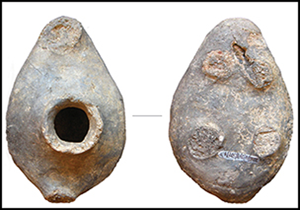
House 1 yielded a relatively opulent assemblage featuring a number of imported objects (Blanco-González et al. Reference Blanco-González, Padilla-Fernández, Alario, Macarro, Alarcón, Martín-Seijo, Chapon, Iriarte, Pazos, Sanjurjo, Dorado, Tomé and Mallol2022). Some 17 fragments of querns were abandoned, upside-down, on the house floor (Figure 2b–c) and 20 additional pieces were retrieved from its associated midden, representing at least different 15 querns—an extraordinary number for a single-family household. On the northern bench of House 1 were two ceramic handled vessels. These are poorly fired and exhibit sooting (Figures OSM S1–S4) indicating their use as lamps—a Mediterranean practice unprecedented in this region at this time. Adjoining middens yielded numerous culinary residues and bronze objects. The discarded ceramics unusually reverse the typical ratio attested in household rubbish, with handmade local painted tablewares for individual consumption outnumbering sherds of storage and cooking-ware vessels (Figure 3a). The former, totalling some 376 sherds represent more than 100 small and brightly painted bowls; some of these sherds had been clipped and reused as tokens (Figure 3b).
a) Painted ceramics, with b) some clipped and reused as tokens (figure by the authors).

Unique for such an inland site are several exotic items from the Eastern Mediterranean (Blanco-González et al. Reference Blanco-González, Padilla-Fernández, Alario, Macarro, Alarcón, Martín-Seijo, Chapon, Iriarte, Pazos, Sanjurjo, Dorado, Tomé and Mallol2022; Chapon et al. Reference Chapon, Padilla-Fernández, Dorado-Alejos and Blanco-Gonzálezin press): eight faience beads, a faience amulet of Hathor, a fragment of an Egyptian faience bowl and sherds from several Phoenician red-slip vessels, including plates, an unguentarium and a wine jug (oinochoe). Further objects include coroplastic pieces painted in red and white and eventually intentionally broken, including a bird-shaped askos (Figure 4c) and two terracotta animal protomes (Figure 4d–e). These latter objects have Tartessian and Phoenician parallels and were likely used for liturgical purposes (Gomes Reference Gomes2020). Importantly, nearby excavated sectors—e.g. those unearthed in 1990 and 2018 (Figure 2a)—have produced a few cases of such Mediterranean imports and customs (Blanco-González et al. Reference Blanco-González, Alario and Macarro2017).
Selected objects from the vicinity of House 1: a) terracotta item; b) fragments of a coiled artefact; c) bird-shaped askos (photograph by C. Alario); d) protome of a ram; e) protome of a canine (inset photos with and without colorimetry) (figure by the authors).

Finally, the sector uncovered in 2017–2021 also yielded specialist craft tools. Some were used for the spinning of fine threads with the so-called ‘supported’ technique (Gleba Reference Gleba, Herring and Lomas2009; Marín-Aguilera Reference Marín-Aguilera2019), such as three bone spindle whorls (45mm Ø, <15g in weight), one unfinished with the tip of a bronze awl still inserted (Figure 5a–b & OSM S5–S6). By contrast, most whorls from Cerro de San Vicente were made of clay and therefore heavier (>16g) and more suitable for the ‘drop-spinning’ method using thicker yarn. Other utensils include tools for finishing painted fine-ware vessels: a polished bone used for burnishing (Figure 5c), a clipped sherd recycled as a palette for pigments (Figure 5d), fragments of a quern stained with red ochre powder (Figure 6a) and a sherd with a red ochre accretion (Figure 6b). The significance of these findings—some unparalleled in this part of Iberia—is addressed below, after consideration of orientalising pottery production at the site.
Craft tools from the courtyard: a) & b) bone spindle whorls; c) bone polisher; d) pot sherd palette with pigments (inset images with and without colorimetry) (figure by the authors).

Craft tools from the courtyard: a) quern with ochre; b) pot sherd with ochre accretion during excavation (figure by the authors).

An archaeometrical assessment of the orientalising pottery
In this section, we delve deeper into the manufacturing processes of some of the orientalising pottery vessels from the site. To do so, we selected sherds from the middens excavated in 2018 and 2021, seeking a diversity of vessel forms, functions and decoration. These sherds were examined macroscopically to identify diagnostic production traces (Roux Reference Roux2019) and using compositional analysis (XRF) to establish the provenance of raw materials. The sample (Figures 7–9) comprises six sherds. Sherd 1 is a rare handle of a coarse and poorly fired handmade lamp like those from House 1, and very different in shape and production from contemporaneous wheel-thrown Phoenician examples (Figure 7c). The handle was attached to the rim and upper wall of a small coil-built vessel. The vessel was well built, but burrs at the join demonstrate little interest in smoothing of the finished surface. Sherd 2 comes from a finely burnished dish with a wide flattened rim (Figure 7d), imitating orientalising grey wares typical of southern Iberia (Gutiérrez-López et al. Reference Gutiérrez-López, Sáez-Romero, Reinoso-del-Río, Finlayson, Rodríguez and Celestino2020: 1291–2, figs. 2 & 3). The vessel was coil-built, with an added ring base; breakage lines and microcracks indicate that the base was added after a short drying process and the surface was smoothed to rectify these issues.
Ceramic sherds featuring orientalising traits selected for analysis: a) red-on-white painted rim (#3); b) white-on-red painted rim (#4); c) lamp handle (#1); d) plate with flattened rim (#2); e) burnished and graphite-coated base (#6); f) graphite-coated rim (#5) (figure by the authors).

Sherd 3 is a tableware painted in red-on-white in the Carambolo style (Figure 7a) comparable to specimens from the Tartessian necropolis of La Joya (Huelva) (Buero & Fernández-Gómez Reference Buero and Fernández-Gómez2010) or the Beira region in Portugal (Vilaça et al. Reference Vilaça, Soares, Osório and Gil2018). The compact paste indicates that it was formed by pressure using a mould. Narrow parallel striations indicate that the surfaces were smoothed on a wheel to a high standard. Sherd 4 is another painted tableware, finished in the white-on-red Medellín style (Figure 7b); the red finish has traditionally been regarded as imitating Phoenician red-slip ware or even vessels imported from beyond Iberia (Blanco-García Reference Blanco-García, Rodríguez and Celestino2019). The clay matrix is rough and barely compacted and small vesicular voids and fissures indicate coil construction.
Sherd 5 is a tableware rim sherd with a graphite coating (Figure 7f), a technique stylistically related to the Urnfield groups from eastern Iberia (Cerdeño et al. Reference Cerdeño, Pérez and Cabanes1995). The clay matrix comprises a flattened or compressed paste, diagnostic of mould-forming. Sherd 6 is the base of a tableware vessel coated with graphite and decorated with a grid or reticulation of burnished lines (Figure 7e), the latter considered characteristic of ceramics from the Tartessian heartlands (González-Fernández & Reguero-González Reference González-Fernández and Reguero-González2018). The symmetrical shape and compressed matrix indicate the vessel was formed in a mould.
These sherds were all locally made but feature orientalising forms, techniques or motifs. Most of the minerals in the clay—quartz, mica and haematite—are from Tertiary sediments that are abundant in proximity to the site (Arribas & Jiménez Reference Arribas and Jiménez1972; Vielba Reference Vielba2001; Figure 8). The sample evinces local adaptations of novel customs, such as artificial lighting, and the emulation of foreign objects, such as grey wares. The potting methods include traditional coiling (Figure 9a–c) but also moulding, a method hitherto undocumented in the region (Figure 9d–f). In particular, the painted vessels featuring local production techniques of coil building and the application of pigment after firing, with orientalising forms and motifs, discredit the suggestion that these vessels were imports (Figure 9a). Notably, we have even identified the combined use of techniques from distant Iberian regions on the same locally made vessel, such as moulding, the use of graphite and reticulate burnishing (Figure 7e); a true case of cross-fertilisation. To summarise, these technological observations and the architecture and portable finds from this neighbourhood do not fit with the standard narrative; the next section considers the significance of these disparate lines of evidence.
Principal components analysis of XRF results, collating the six analysed sherds with a sample of other unpublished imported wheel-thrown and local handmade wares from the same occupation phase (figure by the authors).

Pottery shaping techniques (arrows indicate coils): a) coiled rim (#4); b) coiled rim (#2); c) coiled lamp (#1); d) moulded rim (#3): e) moulded base (#6); f) moulded rim (#5) (figure by the authors).

Bilaterality, female mobility and transculturation
After several decades of bioarchaeological isotope analyses, the study of gendered mobility and post-marital residential patterns in prehistoric Europe has gained momentum (e.g. Frieman et al. Reference Frieman, Teather and Morgan2019; Reiter & Frei Reference Reiter and Frei2019; Ensor Reference Ensor2021). In Iberia, this avenue of enquiry is in its infancy, yet recent contributions on female mobility have broken new ground (Marín-Aguilera Reference Marín-Aguilera2019; Cintas-Peña & García-Sanjuán Reference Cintas-Peña and García-Sanjuán2022). Here, we aim to contribute to this debate from a distinctive perspective: in the absence of a mortuary record, we turn to household archaeology (Ensor Reference Ensor2013, Reference Ensor2021; Souvatzi Reference Souvatzi2017).
We start with architectural remains at Cerro de San Vicente and look to infer social and kinship arrangements from the wider site and, in particular, the sector excavated in 2017–2021 (Figure 2). The overall layout of the village, with randomly scattered houses lacking unitary spatial patterning suggests bilateral or cognatic descent (Ensor Reference Ensor2013: 148–55, Reference Ensor2021: 123–35; Souvatzi Reference Souvatzi2017) and house sizes indicate that these were conjugal family dwellings (Hrnčíř et al. Reference Hrnčíř, Duda, Šaffa, Květina and Zrzavý2020). House 1 stands out among these dwelling units, its greater capacity—with benches sufficient for perhaps 20 individuals—and large hearth, suggesting that it served as a hall for gatherings (Figure 2c). The unusual numbers of querns and banqueting pottery, both locally made (painted tablewares) and imported (including an Egyptian bowl and an oinochoe) reinforce this interpretation. We suggest that House 1 (Figure 2b) presided over a courtyard compound of conjugal family dwellings and was the hub of a joint-family household, a medium-sized social unit, managing a range of activities with access to above-average amounts of labour and storage capacity (Figure 10). We might speculate that such an arrangement points to House 1 as the home of the quarter's founding couple (i.e. the patriarch and his wife). Worldwide, the spatial pattern of small conjugal family dwellings encircling an open patio is repeatedly associated with patrilocal groups, a statistically significant cross-cultural generalisation (Ensor Reference Ensor2021: 123–6). In this context, the rectangular plan and tripartite internal division of Building 3 (Figure 10)— resembling a Phoenician temple and unique in Central Iberia—might indicate a shared central facility (Edrey Reference Edrey2018: 186–98; Suárez-Padilla et al. Reference Suárez-Padilla, Jiménez-Jáimez and Caro2021: 1496–501; Figure 2c). The entrance of this building opened on to an external hearth, with nearby middens containing terracotta objects of plausible votive or ritual character (cf. Palka Reference Palka2021). Was Building 3 devoted to cultic activities? If so, it likely hosted the domestic rituals of the corporate residential group, comparable to contemporaneous sites, such as Oropos in Greece (Mazarakis Reference Mazarakis, Westgate, Fisher and Whitley2007).
Archaeological findings and social interpretations (figure by the authors).

If we are correct, this sector of the site was likely part of a neighbourhood practising patrilocal residence. Following this line of interpretation, it is reasonable to suggest that House 1 and Building 3 were surrounded by smaller roundhouses, occupied by guests and visitors or by unmarried daughters and sons (House 6?), and dwellings of married sons and their families (Houses 2 and 4). Regardless, according to the overarching unplanned spatial arrangements of the village, the social cell occupying this residential aggregation was likely of bilateral descent rather than a (unilineal) patrilineage. These architectural patterns, however, are not fossilised archetypes but rather the mutable physical correlates of successive stages in the biographies of households. Assuming this interpretation to be correct, the inhabitants of this patrilocal compound received females from elsewhere, sending their own young women to live in other villages (Ensor Reference Ensor2013, Reference Ensor2021; Souvatzi Reference Souvatzi2017).
At Cerro de San Vicente, imported objects and practices are variably attested throughout the settlement and, therefore, we might propose a horizontally distributed or heterarchical social structure, rather than a centralised and hierarchical one. Neither conjugal units, nor individuals—let alone any male leader—exerted complete social control. In this sense, the lack of known burials and the prominence of households speak eloquently of the inhibition of individuality and the emphasis on group agency and genealogy. The settlement's pervasive communal ethos was manifest in every aspect of life; the key decision-making cells were joint-family households inhabiting courtyard compounds. A possible ethnoarchaeological parallel is a rich Oromo compound in Ethiopia, which comprises a handful of conjugal roundhouses with granaries and stockyards opening on to a central space with a shared rectilinear building (González-Ruibal Reference González-Ruibal2014: 288–5, fig. 5.15.b). This compound was home to a patrilocal group of peasants involved in market trade. Direct historical analogy is untenable, but such comparisons can aid thinking in sociological terms.
We have surveyed a range of activities and knowledge that combined the local and the foreign (Figure 10). Thus, the design of House 1 presents a mix of traditions: local adobe architecture used for traditional circular buildings—practised for more than two centuries—combined with an ox-hide-shaped hearth. Likewise, the custom of artificially lighting houses spread at this time, yet inhabitants of Cerro de San Vicente esteemed function over design, developing their own type of handled lamps (Figures 7c & OSM S1–S4)—the forms were likely copied from eastern Iberian handled vessels, but with no attempt to imitate contemporaneous and distinct Phoenician wheel-thrown lamps with their pinched nozzles (Aubet Reference Aubet2001). This situation is in stark contrast to the close and highly skilled reproduction of Tartessian grey wares. Here, local potters proficiently translated the original wheel-made plate shape (Gutiérrez-López et al. Reference Gutiérrez-López, Sáez-Romero, Reinoso-del-Río, Finlayson, Rodríguez and Celestino2020) into a handmade version, even adding unnecessary skeuomorphic traits on the inner rim (Figure 7d). On this occasion, both function and design were deemed essential.
Several foreign practices documented at Cerro de San Vicente could have been performed by straightforward mimicry, such as fastening woollen garments with bronze brooches. Yet the site has also produced evidence for crafts that cannot have been acquired by simple emulation (Figure 10). The clearest examples concern the intensive and specialised production of high-quality pottery or fine-yarn spinning, which require protracted and supervised learning to acquire motor skills, often from a young age (Gleba Reference Gleba, Herring and Lomas2009; Marín-Aguilera Reference Marín-Aguilera2019; Roux Reference Roux2019). Locally made fine-ware pottery deployed foreign and difficult-to-master techniques: moulding, reticulate burnishing and graphite coating. Provenance analysis disproves the widely assumed Tartessian or Phoenician origin of these ceramics. Indeed, by the seventh century BC, these wares were widespread in Tartessian and Phoenician areas, suggesting that proficient artisans—with their embodied technical knowledge—had relocated to the village. Further, ethnohistorical studies of preindustrial societies strongly suggest that skilled spinning and pottery making were mostly undertaken in household settings by women (Gleba Reference Gleba, Herring and Lomas2009; Roux Reference Roux2019; Padilla-Fernández Reference Padilla-Fernández2022). At Cerro de San Vicente, there is no evidence for dedicated textile or pottery workshops, rather these activities were integrated into domestic spaces, most likely undertaken in communal courtyards (Figure 2b). The role of high-ranking women in mastering these specialised crafts in the seventh–sixth centuries BC Iberia has been convincingly argued (Gorgues Reference Gorgues, Brysbaert and Gorgues2017; Marín-Aguilera Reference Marín-Aguilera2019) and may fit well with the patrilocal case at hand. We should therefore reconsider the contribution of mobile craftworkers—possibly married women—from distant regions in the transfer of technological know-how to Central Iberia. The most convincing model of individual relocation compatible with this proposal would be a ‘point-to-point’ mobility pattern (Reiter & Frei Reference Reiter and Frei2019: 457–60). If so, local kinship practices relied on bilaterality and post-marital female mobility (Figure 10). Such principles might have propelled the most affluent patri-ramages —i.e. bilateral patrilocal segments equivalent to unilineal patrilineages—to seek flexible and opportunistic unions with women from distant regions (Ensor Reference Ensor2013, Reference Ensor2021).
Such an interpretation of kinship and gendered mobility does not assume any heteronormative or ethnocentric premises. Here, we are following current scholarly opinion, embracing much-needed calls to avoid binary and stereotyped sex-based narratives (Ensor Reference Ensor2013, Reference Ensor2021; González-Ruibal Reference González-Ruibal2014; Souvatzi Reference Souvatzi2017; Frieman et al. Reference Frieman, Teather and Morgan2019; Cintas-Peña & García-Sanjuán Reference Cintas-Peña and García-Sanjuán2022). Instead of envisaging women as passive ‘pawns’, deprived of social agency within androcentric exogamous alliances, our interpretation recognises their crucial role in mastering crafts and social negotiation, ultimately leading to cultural hybridity. Nor do we envisage a tightly constrained residence framework, restricting female mobility after marriage. Here, the anthropological literature offers illuminating examples of patrilocal communities whose married women continued to visit their natal villages and kin, sometimes for extended periods (e.g. Scelza Reference Scelza2011). Such customs are driven and facilitated by the obligations of hospitality. The occasions for supervised hands-on learning of specialised and household-level craftwork—and therefore for cross-cultural interaction—would have been numerous. In this vein, our case study invites consideration of a more fluid scenario. Cerro de San Vicente provides abundant evidence for gathering and commensal activities, perhaps devoted to hosting transitory kin, including the cooperative performance of skilled craftwork. Conversely, the distribution of post-fire-painted handmade vessels across Western Iberia may attest to female mobility beyond the Duero Basin and social reciprocation. Such occurrences match the ‘back-and-forth’ mobility pattern proposed by Reiter and Frei (Reference Reiter and Frei2019: 460). Importantly, high-ranking women have been more likely to be involved in this sort of mobility than other groups (Reiter & Frei Reference Reiter and Frei2019; Cintas-Peña & García-Sanjuán Reference Cintas-Peña and García-Sanjuán2022).
Conclusions
Insights gained from investigation of the site of Cerro de San Vicente reported here challenge prevalent ideas about the orientalising phenomenon. The evidence attests a range of objects, customs and craft practices shaped in dialogue with distant regions of Iberia and even beyond. It suggests multiple means and ongoing opportunities for the transfer of knowledge at different scales. Conventional acculturation models, with their one-way, one-off flow of ideas are not useful in this context. Nor can the evidence for hybridisation in Central Iberia be explained by aristocratic gift exchange or prestige-good economies.
Here, instead, we have focused on several markers of relative affluence within one sector of the village, whose neighbours did not monopolise them. The status of this social unit entailed access to the restricted circulation of exotic and novel assemblages of objects and customs (Figure 10), yet such imports and practices were also present in a minority in further excavated quarters (Figure 2a). This corporate group also practised specialised spinning and pottery production at a household scale, which worked as a strategy of distinction. These villagers based their heterarchical configuration on a distributed network of power, with diverse sources of prestige, craft skills among them.
The site of Cerro de San Vicente demonstrates that this remote and non-urban region was fully connected into long-distance networks at the height of Phoenician expansion into the Atlantic in the seventh century BC (Arruda Reference Arruda2000). These networks enabled the circulation of people and objects. Traditionally, attention has been focused on the movement of metals or staple foods. This article spotlights some neglected considerations, namely social networks and the mobility of kin.
The picture emerging is one of deep cross-cultural permeability across this region. This raises important questions about the nature of social dynamics in Early Iron Age Iberia, with consequences for understanding the broader orientalising phenomenon. To conceptualise a fresh scenario, the notion of transculturation offers an attractive alternative (Liebmann Reference Liebmann and Card2013). Instead of abstract, homogeneous and superficial acculturation, this transculturation invokes the assorted array of cultural intermixing attested here: an oscillating and multi-directional cross-fertilisation of material culture and social practices. Peasants in these inland ‘small worlds’ absorbed Mediterranean ‘otherness’ and reworked the orientalising or ‘Phoenicianising’ (López-Ruiz Reference López-Ruiz2021) ideology for their own purposes (Riva Reference Riva2010). Physical distance from the Phoenician coastlands was less significant than the creation of social and kinship links. We have delineated several means of transculturation emphasising the role of female mobility. This might have involved the relocation through marriage of women from south-western or north-eastern Iberia to areas such as the Duero Basin and subsequent cycles of movement back to their places of birth, that is, ‘point-to-point’ or the ‘back-and-forth’ individual mobility, respectively (Reiter & Frei Reference Reiter and Frei2019). Within such a narrative, skilled female craftworkers may have been responsible for the hands-on training of new generations in the embodied know-how and practices of distant regions. The result was a profound and pervasive cultural hybridity among the Early Iron Age communities of Central Iberia.
Acknowledgements
Cristina Alario and Carlos Macarro collaborated as co-directors of the excavations in 2017, 2018 and 2021 at Cerro de San Vicente. The article has benefited from comments by two anonymous reviewers.
Funding statement
Fieldwork at Cerro de San Vicente was conducted with financial support from the Spanish Ministry of Science and Innovation (research project ARQPARENT, PID2019-104349GA-I00) and the Autonomous Government of Castile and Leon (grants 41/2017-SA and 21/086-SA).
Supplementary material
To view supplementary material for this article, please visit https://doi.org/10.15184/aqy.2023.96.


 Open access

