

The first time I heard Abdullah refer to the “circular economy” was in a lament that it would never arrive.Footnote 1 He had invited me to his public university in Pahang, a state on peninsular Malaysia’s east coast. The first day we would talk business and meet some of the chemists, processing engineers, and biologists who worked in his lab. The next day I would come back for the group’s Eid-ul Fitr celebration to share food and relax. As we walked through one of his laboratories that first morning, past fume hoods and assaying equipment, past organized bags of crushed and chemically treated rock, Abdullah relayed stories of movement and transformation. He described his own path into academia, the flow of students through his lab and into coastal Malaysia’s petrochemical industries, and the diversification of his group’s research from minerals refining into environmental remediation and policymaking. He charted the journeys that rock samples had taken from a mine in Western Australia and described where specific samples were headed next. As Abdullah listened to my questions about the earlier paths of these people and artifacts, he persistently redirected me toward their uncertain futures. What had already happened, he suggested, was mainly important for appreciating what the lab—and the nation—stood to lose.
“The Malaysian rare earths industry is facing a perception problem,” Abdullah complained as he sat down behind his desk. He assumed I knew about the local and national protests against Lynas, an Australian company that had operated a rare earth elements (REE) processing plant in nearby Gebeng since 2012 and served as a primary funder supporting his research. The anger driving the protests, Abdullah insisted, came from “confusion” over how the facility benefited Malaysia. “A rare earths mine is never just a mine,” he went on. “It can become so many different things for so many people.” Some Malaysians already knew that the materials Lynas produced would be used in electric car batteries, wind power generators, and other sophisticated technologies that require the unique electromagnetic properties of REE-based materials, he surmised. The true products of REE research and development work, he insisted, were not the minerals themselves but expertise. To help other Malaysians imagine hopeful futures for domestic REE-based industries, researchers had to point beyond industries dominated by foreign capital, and beyond applications that were already well known. Particularly if companies and universities could attract talented scientists who might otherwise leave the country in search of work, Abdullah suggested, research programs established around complex materials might eventually help Malaysia to move beyond mining entirely.
As Abdullah outlined the multiple forms of movement he believed would be impacted by his group’s work—global mineral flows; emigrating experts; entire industries arriving and departing—he persistently articulated his narrative through references to an emergent “circular economy” (CE). In Malaysia, a growing number of proponents had begun invoking CE as a conceptual framework to reframe developing industrial projects, arguing that new research initiatives would help “close the loop” around extraction, processing, design, manufacturing, and disposal practices, minimizing and eventually eliminating all waste produced through technology development. While the invocations I encountered in Malaysia seemed to convey a borderless sense of responsibility, I quickly came to appreciate that the semantic meanings and policy goals associated with CE had developed along idiosyncratic—and often distinctly national—trajectories. Chinese policymakers had coined the term in the 1990s while working to vertically integrate their own minerals production processes and reduce the country’s reliance on foreign expertise (Yuan, Bi, and Mirguichi Reference Yuan, Bi and Moriguichi2006). Soon thereafter, advocates throughout the Global North had begun applying CE concepts to everything from scaling up municipal recycling programs and repurposing legacy mining waste dumps to reforming nation-scale minerals import policies (Hobson Reference Hobson2016; Murray, Skene, and Haynes Reference Murray, Skene and Haynes2017; see also Ureta and Flores Reference Ureta and Flores2022). Recently, though, as middle-income countries had begun leveraging CE terminology while campaigning for more expansive roles within global supply chains, policymakers’ conversations about closing loops of material movements had become more freighted with promises of industrial growth.
Across myriad scales and locales, CE proponents present the moral management of material flows as a means of rendering futures more predictable. Some of the most ambitious CE-focused programs focus heavily on REEs, a notoriously complex class of materials whose limited availability and complicated processing requirements have tethered energy transition initiatives to multiple overlapping uncertainties (T. Özden-Schilling Reference Özden-Schilling2024). In Malaysia, mediating these uncertainties had recently become a lucrative business strategy. In 2010, immediately after China—which since the early 2000s had controlled almost all global production and processing capacity for REE ores—announced a temporary ban on REE exports to Japan and strict export quotas for other countries around the world, the Japanese government loaned hundreds of millions of dollars to Lynas to construct a new REE mine in Australia and an attendant processing plant in Pahang (Gee Reference Gee2014). The United States government, desperate for REE sources based outside China, followed suit with similarly sized loans and grants for Lynas. Aided by the anxious investments of three wealthy governments, Malaysia became the world’s second largest producer of REEs. Meanwhile, state university researchers in Pahang suddenly found their projects celebrated as a new form of technological diplomacy.
When I met Abdullah in 2022, I had already grown accustomed to reading Western news media hailing the Lynas plant as both symbol and proof of a Malaysia-wide industrial transformation. Within the country, though, many Malaysians clearly remained skeptical of such far-reaching claims. As continuing protests against the plant cast doubt on its future, policymakers had increasingly begun using CE concepts to reframe the plant’s value around the prospect of entirely new industries that might emerge in the future. Abdullah in particular championed projects that scientists in other countries ignored, including commercial applications that might be derived from Lynas’s wastes. One such product was to be called Condisoil: a phosphate-rich “soil conditioner” that farmers would mix with compacted, unproductive soils to change their texture and acidity in ways that could, in theory, facilitate the growth of food crops and other plants. Malaysia’s industries were too tied to the whims of other governments and markets, Abdullah complained; by framing his group’s work as steps toward deriving additional value from materials that normally flowed out of the country, he would show that Malaysian scientists could minimize foreign dependencies in the future.Footnote 2
CE concepts offered Abdullah and his colleagues compelling frameworks for conceptualizing and potentially controlling the futures of material flows. As we discussed their ambitions for different projects, though, it was clear that their facility with these terms had also encouraged them to draw designs on the future movements of other knowledge workers. The same terms gave shape to complaints about “brain drain” and other patterns of historical human movements by articulating them to narratives of industrial potential—including potentials both emergent and foreclosed. “‘Circular economy’ may be a buzzword in the West,” one graduate student offered with a grin, “but for us it’s a good way of describing how to use the opportunities we’ve got.” Ismail, a chemical engineering professor and former politician, saw the “opportunity” in more ominous terms. “We have oil and gas here, and we have very talented petrochemical engineers. But it won’t last forever. When the oil is gone, these people will leave. The same thing happened with tin.” Once the world’s largest producer of tin, Malaysia saw almost all its mines close when mineral prices crashed in the mid-1980s. “We never developed other industries around tin, and all those people, all that knowledge is gone. The rare earths story has to be different. Without a circular economy, the tailings will pile up and the experts will leave.”
Away from the university, other people I met in Pahang harbored different anxieties about the potential movement of Lynas’s wastes. Shortly after the construction of the plant was announced in 2008, a local high school teacher named Mr. Xu had begun working with a Pahang-based parliamentarian named Fuziah Salleh and other residents to study the plant’s environmental impact assessment documents. By 2011, the group had named itself Save Malaysia Stop Lynas (SMSL) and was organizing information campaigns and massive rallies in Kuantan, Pahang’s capital. Organizers decried the lack of storage plans for post-processing wastes and what they saw as insufficient structural safeguards to prevent toxic chemicals—including thorium and other radioactive nuclides concentrated within tailings during the refining process—from leaking into local waterways (Kwek Reference Kwek2012). In 2020, alarmed that researchers had begun dumping tailings at unmarked sites around neighboring communities for use in agricultural experiments (Daim, Yusoff, and Yunus Reference Daim, Yusof and Yunus2020), the group persuaded the Malaysian government to ban further research on Lynas’s wastes until legal challenges to the site were resolved (Mahalingam Reference Mahalingam2020). When I met with Mr. Xu and two other SMSL organizers two years later, though, Lynas was simultaneously challenging the ban and seeking to renew the plant’s operating permit. The organizers were growing weary.
“The company is nervous, so the promises are getting bigger,” Mr. Xu mused. Noting that “circular economy” references were proliferating in newspaper editorials and social media posts attacking Lynas’s critics, the group described other ambitious plans for economic diversification in Pahang that had emerged and dissolved in recent decades. The same references had dominated the news a few years earlier, when Malaysia had been inundated with plastic waste after China stopped accepting other countries’ materials for recycling (Marks Reference Marks2019). Few of the proposed reuse projects had materialized, they noted, and huge volumes of plastic remained warehoused throughout the country. Beyond these prominent failures, though, they also admitted that they resented hearing threatening lectures from university researchers when racial quotas governing student admissions and faculty hiring had already excluded some of their children from the same universities. Senior SMSL organizers who were not ethnic Malay had become resigned to watching their younger relatives leave Malaysia to build lives for themselves in Hong Kong, Australia, and Singapore, even though many wanted to pursue the kinds of technical career paths that CE proponents promised to be building toward in Pahang.
“They already believe there’s no future for them here,” Mr. Xu complained. “If the water is polluted too, why would anyone come back?” If new industrial developments promised to keep jobs and minerals within the country, it was difficult to imagine how this would happen without other people being driven away. Nobody could close a loop in Malaysia, it seemed, without wrenching another loop perilously open.
“Searching for Another Malaysia” in the Circular Economy
The rise of circular economy (CE) discourse in the extractive industries has altered the ways researchers, laborers, consumers, and activists conceptualize the movements of people and things. It has also transformed how diverse groups assign responsibilities to themselves and others for anticipating future movements and managing their affordances. In Malaysia, where government bodies and state research institutions are structured by pronounced racial disparities, assertions that industrial futures can be fixed by managing the movements of materials are inseparable from questions over national belonging. To researchers like Abdullah and Ismail, the dirt left behind after Lynas’s refining processes is productive material through which economic value, technical expertise, and institutional ties must be developed and grounded in Malaysia. To Mr. Xu and other anti-Lynas activists and allies, this same soil is a toxic residue that must be carefully separated from Malaysian land, either by being buried in a permanent storage facility or by being sent entirely out of the country. Both groups insist that the failure to properly manage these responsibilities will deepen destructive patterns of emigration and endanger the possible return of people who might otherwise live in Pahang. Yet by correlating their claims on these materials to their capacity to make plans for themselves, both groups’ senses of belonging have become increasingly anchored to processes unfolding outside Malaysia, and to forces beyond their control.
From everyday talk and political rhetoric to substantial frameworks for industrial change, CE concepts exemplify a crucial divergence in the ways people come to understand their own roles in the global reorganization of extractivism and in the futures these processes might produce. While explicitly promising stability, connectivity, and a broadened ethics of responsible attention, CE concepts also index distinct social aspirations and racialized histories of institutional exclusion. As James Smith argues, such distinctions, grounded in unique experiences of movement, can animate radically different senses of potential. Describing the lives of artisanal miners searching for coltan and other “digital minerals” in Eastern Congo, Smith (Reference Smith2022) shows how his interlocutors invoke their own concept of “movement” to refer to a “transformative dynamism […] that allows people to break out of their superimposed situation of inequality or debasement” (42). This grounded, reciprocal sense of dynamism, Smith observes, is utterly distinct from the “disembodied, frictionless transcendence” characterizing “dominant Euro-American understandings of the digital age” (52). Similarly transcendent understandings animate the circulation of CE concepts within Malaysia. Narrated by distant observers or by people with direct access to global markets, both coltan and REEs readily lend themselves to stories of social flourishing and economic mobility, routed through assertions of abstract potential. Closer to actual mines and manufacturing facilities, though, the transformative potential that different groups project onto these materials is harder to separate from the disparate potentials they are encouraged to see in themselves. Some people see industrial change as a chance to move up; others feel pressure to move out.
Explicit references to more localized or lateral human movements are elusive in CE, even though contemporary uses of CE concepts vary dramatically in depth and concreteness (Hobson Reference Hobson2016; Lau Reference Lau2023). Among the few commonalities linking contemporary instantiations of CE is a persistent lack of attention to the ways changes in the movements of materials will differentially impact diverse social groups, whether because of differences in historical attachments to specific places and industries, disparities in political power, or divergences in collective values. The imagined futures toward which most CE initiatives are addressed tend to be either highly specific (an individual minerals processing plant or material waste stream) or universally broad (climate change mitigation). While some CE proponents have begun to examine how new initiatives might affect the interests of specific groups or complicate their relationships with their respective states (Newell and Simms Reference Newell and Simms2021), most still emphasize sprawling geopolitical vulnerabilities associated with conventional material supply chains, framing these challenges as inevitable crises necessitating urgent compromises (see also Rabinow Reference Rabinow1999).Footnote 3 Meanwhile, within the national jurisdictions where the most consequential CE initiatives are actually designed and implemented, invocations of global crises and compromises have already begun to naturalize new visions of economic renewal, further obscuring the racialized patterns of exclusion and migration that have always accompanied the extractive industries (Yusoff Reference Yusoff2018).
In the Malay peninsula, stories about the conjoined movements of minerals and people have animated racializing discourses for centuries. As racial hierarchies initially developed by British plantation administrators moved into the peninsula’s enormous tin mines in the mid-nineteenth century, non-Malay ethnic groups were marked as permanently itinerant populations in ways that have persisted into the present day (Alatas Reference Alatas1977; Ross Reference Ross2014). The shadows cast by colonial categories turned post-independence Malaysia into a wellspring for critical studies of postcolonial nationhood (Goh Reference Goh2008; Mohamad Reference Mohamad2020; Ong Reference Ong2006). Historian Farish Noor (Reference Noor2005) uses the plaintive phrase “Searching for Another Malaysia” as the subtitle of his book, From Majapahit to Putrajaya, to signal his own frustrated yearning for “a radical project of internal critique and the interrogation of the foundational premises of the Malaysian nation” (65). Noor and others have shown repeatedly how the many patterns of movement that have shaped the Malay peninsula have never evenly translated into recognized senses of belonging (see also Somiah Reference Somiah2021). As new national technology plans coalesce around globally dispersed REE production processes and other CE-based initiatives, the new roles being imagined for Malaysian experts are further complicating questions of belonging.
Across the many narratives linking extraction, movement, and belonging throughout the Malay peninsula, the elusiveness of downstream industry development and local technical capacity is a common theme. While British officials restricted technology transfer in tin mining and processing to retain their preferred systems of trade, for instance, the involvement of ethnic Chinese laborers in the development of sophisticated dredging systems was treated by the colonial government as evidence of proxy imperial control (Kim Reference Kim1991). After independence, the need for a new class of technocrats compelled the Malaysian government to treat institution-building as a means of counteracting racialized colonial wealth and power disparities by promulgating a new “social contract” envisioning distinct political and economic roles for Malay and non-Malay citizens (Hirschman Reference Hirschman1986). Yet even as rising Malay nationalists increasingly accused non-Malay citizens of planning to take the new state’s wealth abroad, government administrators were developing plans to send their preferred class of future technocrats outside the country for training.
In the 1970s, cohorts of Malay youth were sent to British and other foreign universities for postgraduate degrees in engineering, business administration, and other disciplines identified by the government as areas of need (Rashid Reference Rashid2016). Many state-supported students became powerful business and political actors, and played instrumental roles in reorganizing the country’s telecommunications, manufacturing, and oil industries that drove Malaysia’s spectacular economic growth in the 1980s and 1990s. The assumption that economic expansion would prevent younger Malaysians from looking outside the country for their futures, though, soon picked up vocal detractors. Rehman Rashid, an early overseas student who later became a prominent journalist, reflected that the clientelist networks his classmates established had not only failed to encourage other educated Malaysians to invest their skills in developing the country’s institutions, but were effectively driving many to emigrate. By the early 2000s, Rashid (Reference Rashid2016) argues—shortly after he had experienced his own period of quasi-exile in Hong Kong—“[i]t wasn’t our desperate huddled masses we were exporting as migrant labour, but our most globally employable human capital” (277). Any economic transformation with durable benefits would have to account for these outflows.
By definition, CE discourse foregrounds attention to the movement of things, chiefly by challenging engineers, consumers, and policymakers to account for material flows in more comprehensive terms (McDonough and Braungart Reference McDonough and Braungart2002). By promoting dramatic forms of industrial reorganization and gesturing toward environmental and technological futures beyond mining, however, this discourse also carries far-ranging consequences for the movement of specific groups of people, including their place in future social and political orders and their varying capacities to authoritatively plan for multi-generational futures. These entailments are compounded for CE initiatives addressed to material flows affected by multiple overlapping uncertainties, where promises outlining the constrained management of production, processing, and waste are often bracketed by a relentless search for new markets and applications (T. Özden-Schilling Reference Özden-Schilling2024).
Critical minerals development projects and other CE-based initiatives often operate as nodes of knowledge work, and not solely as sites of extraction (see also Anant Reference Anant2025). Many workers know that these nodes are dynamic. For REEs used in advanced energy and communications technologies, processing techniques and potential uses are rapidly evolving even as research on potential alternative materials threatens to drastically reduce demand. Rather than wholly subverting workers’ capacities to plan, however, this multi-dimensional dynamism can intensify both positive and negative expectations by attaching them to historical experiences of inclusion in earlier industrial orders (Smith and Tidwell Reference Smith and Tidwell2016). CE-based visions of industrial reorganization actively encourage some groups to imagine new forms of geographic and class mobility. At the same time, they can also deepen disparities that encourage other groups to grow more certain that they and their descendants will eventually have to move elsewhere. Meanwhile, these initiatives also embed new kinds of uncertainties into existing industrial orders by deepening entanglements with economic and geopolitical processes playing out far beyond national borders.
Historical and ethnographic studies of mining have long provided rich terrain for theorizing relationships between movement, anticipation, and belonging. While scholars have long emphasized large-scale mines and mining rushes as major sources of human displacement, some have also shown how the movements of families, skilled laborers, and systems of practice between sites of mining and agricultural work formalize knowledge claims and senses of collectivity (Ferry Reference Ferry2005; Marston Reference Marston2020; d’Avignon Reference d’Avignon2022). Others have emphasized how new forms of life take hold as minerals move to refineries and markets, and as markets and capital move on (Sandlos and Keeling Reference Sandlos and Keeling2015; Walsh Reference Walsh2015). Other kinds of things move alongside laborers and commodities, though, including aspirations (Ferguson Reference Ferguson1999; Tsing Reference Tsing2005), ethical frameworks (Smith Reference Smith2021), and racialized hierarchies of expertise (Hecht Reference Hecht2012). In some cases, the continual reorganization of mining operations actively prevents people from moving, whether by recruiting rural residents into stopgap training programs (Bell Reference Bell2023), or by briefly raising standards of living only to leave erstwhile workers feeling “stuck” after mines close (Hage Reference Hage2009; see also C. Özden-Schilling Reference Özden-Schilling2023). Across these diverse arrangements, the interrelations between real and imagined trajectories of movement are becoming steadily more intertwined.
As global extractive operations reorganize around new technologies and concepts of circularity, new regulatory techniques have sought to frame movement in moral terms. At times, these framings have obscured the ways some laborers articulate futures and senses of belonging through their work. James Smith (Reference Smith2022: 30) shows how Congolese artisanal miners’ idioms of reciprocity (“many hands touching money”) are taking on new meanings amid his interlocutors’ “violent and unpredictable relationship with global capitalism,” where experiences of “temporal dispossession, or the inability to plan, predict or build futures in an incremental way” (Smith Reference Smith2011: 17) transcend specific jobs and relationships (see also D’Angelo Reference D’Angelo2015). Paradoxically, Smith argues, this unpredictability is a direct consequence of other people’s efforts to conceptualize mineral movements in predictable terms. During the war in Eastern Congo, American and European policymakers devised tracking systems to demarcate Western-certified coltan production chains from those of supposed “conflict minerals” (see also Calvão and Archer Reference Calvão and Archer2021). These difficult-to-access accounting systems empowered large, mechanized Western mining companies while rendering the livelihoods of many thousands of Congolese illegal. By narrating movements of Congolese ore in terms that were legible to consumers in the global North, policymakers made it more difficult for people outside Africa to comprehend miners’ movements without resorting to universalizing ethical claims (see also Petryna Reference Petryna2009). They also effaced the “grounded philosophy” (Smith Reference Smith2022: 41) that Congolese miners developed to valorize the many forms of movement shaping their potential futures and sense of connectedness, a philosophy built through acts of “collaborating across differences and dimensions, and developing relationships of reciprocity based on trust” (41).
As Smith’s work makes clear, discerning how laborers’ theories of movement ground their experiences of new industrial orders requires careful attention to the moral promises attending emergent technologies. In recent years, a growing number of social scientists have expressed skepticism toward the concepts of justice enframing CE initiatives (Corvellec, Stowell, and Johansson Reference Corvellec, Stowell and Johansson2022; Heffron Reference Heffron2020). Recent scholarship highlights incommensurabilities between the ethical frameworks utilized by CE proponents and the groups affected by waste reuse projects (Gregson et al. Reference Gregson, Crang, Fuller and Holmes2015; Levidow and Raman Reference Levidow and Raman2020). This scholarship has at times pushed policymakers to acknowledge that abrupt industrial changes will carry tremendous social costs, particularly for women already engaged in organized systems for re-purposing refuse (Pansera et al. Reference Pansera, Barca, Alvarez, Leonardi, D’alisa, Meira and Guillibert2024) and for other laborers in parallel economies (Newell and Simms Reference Newell and Simms2021). Government-sponsored CE programs will have especially disruptive effects in South Asia, scholars there note, since such parallel economies have already altered livelihoods (Bhattacharya Reference Bhattacharya2018) and even concepts of caste (Kornberg Reference Kornberg2019) for hundreds of thousands of people, many of whom have already felt recent electronic waste import policy changes alter the geographies of this labor (Rathore Reference Rathore2020).
Scholarly work on waste often emphasizes senses of marginalization and precariousness emerging around sites of rapid industrial change. Yet if we follow the example of many CE proponents and examine mining waste transformations and movements mainly as platforms for the development of expertise, we see evidence that promises of more predictable industrial futures can also deepen uncertainties surrounding individual livelihood practices and careers. Some scholars argue that the kinds of transitions championed by CE proponents are unlikely to be transformative enough to prevent traditional extractive industries from reasserting themselves in new forms (Hobson and Lynch Reference Hobson and Lynch2016). Geographers, for instance, have shown that expanded interest in tailings and other waste streams has already done much to keep old mines open, both by generating secondary feedstocks for existing refineries that can help keep these sites operating during fluctuations in commodity prices (Knapp Reference Knapp2016) and by reducing the urgency driving research on substitute materials (Hine, Gibson, and Mayes Reference Hine, Gibson and Mayes2023). Both arguments are highly relevant to Malaysia, where the Lynas plant and its associated research networks have already been cited by government officials as both exemplars and potential support systems for additional future REE mines and refineries within the country (Arif Reference Arif2023). Whether CE-based developments portend radically disruptive industrial changes or lock-in for existing systems, in other words, the interplay between the infrastructural and imaginary transformations proffered by new initiatives is making their actual human impacts more difficult to predict.
Assessing how human movements and senses of belonging come to matter as CE discourse and initiatives proliferate increasingly means attending to multiple promissory logics, some of which address conflicting goals. In many locales, policymakers have adopted the promotional rhetoric employed by CE proponents elsewhere, and have presented the training requirements, infrastructure demands, and research and business opportunities surrounding CE-based material supply chains as potential “win-win” solutions to local problems associated with climate change and economic precariousness (Zeng Reference Zeng2023). While such promises have in some cases led to concrete shifts in industry practice, other invocations have signaled more insidious goals. During Malaysia’s first major phase of CE-focused policy discussion in 2014, for instance, representatives of Akademi Sains Malaysia (ASM) (Reference Malaysia2014:126) explicitly cited the positive connotations of CE terminology as part of potential “branding” campaigns for industrial parks seeking to decrease “social resistance” to their operations.
The fact that major policy documents support such radically divergent interpretations of the meaning of CE—as mollifying propaganda or as concrete and carefully considered plans for developing new industries—mirrors many Malaysians’ disorienting experiences of late twentieth-century industrialization: as a period of both profound social dislocation and abrupt changes in standards of living (Ong Reference Ong2010; Thompson Reference Thompson2007). Contemporary policy, SMSL activists often reminded me, remains socially disorienting. Even as the Malaysian state increasingly invokes racial, religious, and nativist categories in the name of expansive national capacity-building initiatives (Mohamad Reference Mohamad2020), neo-colonial industrial agreements and financial dependencies have grown more entrenched (Lebdioui Reference Lebdioui2022).
Tracking how disparate narratives of belonging become attached to promises of industrial transition can illuminate the ways future-oriented technology initiatives selectively recognize the movements and pasts of particular groups. This work can also help to re-scale the moral language surrounding CE. The broad geopolitical anxieties that typically enframe CE discourse frequently lead experts to project novel designs onto specific materials in ways that occlude more specific memories and historical associations (Bleicher, David, and Rutjes Reference Bleicher, David and Rutjes2019; see also Alexander and O’Hare Reference Alexander and O’Hare2023). Radioactive materials, as well as non-radioactive elements like the REEs that are mined alongside radioactive co-products, are especially susceptible to such reframings, where what counts as “nuclear work” depends heavily on the ways specific labor practices are articulated through visions of national progress (Hecht Reference Hecht2012; Masco Reference Masco2021). As Chloe Ahmann (Reference Ahmann2019) shows for proposed waste-to-energy infrastructure developments in Baltimore, such strategies of deferral provide potent imaginaries in post-industrial landscapes, where even failed projects can lend shape to comparisons between potential futures in ways that transform political claims in the present. For these transformative potentials to persist beyond the end of a given project, though, the CE proponents I met in Malaysia knew that they had to frame their developing expertise as capacities for the nation writ large.
Like many aspiring knowledge workers building careers within would-be nuclear nations, Abdullah, Ismail, and other university researchers I met in Pahang were clearly aware of the currency that specific terms carried within different circuits of power. At times, they echoed Malaysian policymakers by obfuscating the potential harms associated with REEs through reference to generalized risk thresholds established for other industrial processes or used specialized synonyms for REEs (e.g., “lanthanides”) unfamiliar to most audiences. Some of my interlocutors also began referring to the entire class of materials as “non-radioactive REEs” after the Malaysian government began using the term in 2023 to differentiate Lynas from an earlier REE processing site, the memory of which had catalyzed early SMSL rallies (Tham and Neo Reference Tham and Neo2023).
My interlocutors’ accounts of the former site cast its implications for Malaysian-led technological development in utterly divergent terms. From the mid-1980s until 1992, the Mitsubishi-owned Asia Rare Earths (ARE) processing plant in Perak state had operated with minimal environmental safeguards; an abnormally high number of nearby residents developed leukemia, and at least one plant worker gave birth to a baby with severe birth defects (Bradsher Reference Bradsher2011). To Mr. Xu and other aging SMSL organizers, the fact that wastes at the site were only moved to permanent storage two decades after the ARE facility closed made it clear that Malaysian regulatory authorities were unable or unwilling to manage the risks inherent in handling these materials, particularly when foreign capital was involved. To some university researchers in Pahang, though, the possibility that research at the site might have eventually produced nuclear fuel made the plant’s closure a source of regret.
Across the many countries involved in REE research, the promises and warnings articulated amid CE discourse are as varied as each country’s histories of industrial development. In recent years, though, as REE projects have been organized into globally dispersed partnerships, understanding relationships between patterns of movement and social imaginaries has increasingly meant contending with many different histories and futures at once. The U.S. Department of Energy has sponsored hundreds of projects focused on the recovery of REEs and other critical minerals from electronic wastes, seawater, coal ash, and contaminated soils, each of which evinces different claims about the potential futures of deindustrialized cities and historic mining regions (Diallo et al. Reference Diallo, Baier, Moyer and Hamelers2015). Australian policymakers have funded similar research in response to longstanding complaints about the country’s failure to move beyond primary minerals production (Sinclair and Coe Reference Sinclair and Coe2024). Both Malaysian and Australian institutions have leveraged international CE initiatives, including joint REE development plans with Japan and the United States, to recast accusations of offshoring and under-development as diplomatic “friend-shoring” (Vivoda Reference Vivoda2023).
The blithe sense of inclusivity underlying contemporary CE discourse belies the complex and often conflicted senses of identification that experts, citizen activists, and others can feel toward the collective value of their work (see Smith and Tidwell Reference Smith and Tidwell2016). For Malaysians who have struggled to secure government jobs or who have otherwise found their voices marginalized within national projects, the sense of circularity conveyed through this discourse can feel more like an excluding wall, rather than a hopeful embrace. This has been particularly true for Malaysian Chinese (Malaysian citizens of Chinese descent), Malaysian Indian, and Indigenous peoples, who sometimes find themselves excluded from prevailing visions of Malaysian nationhood (Tan Reference Tan2001). Some of these exclusions directly impact the emancipatory promises surrounding CE. Even as national political figures have begun to celebrate proposed CE-based industrial transformations for potentially enabling the country to broaden its industrial base, retain skilled workers, and improve upon the woeful environmental legacies surrounding local minerals production (see Kuan, Ghorbani, and Chieng Reference Kuan, Ghorbani and Chieng2020), the racializing histories and politics surrounding much of Malaysia’s “brain drain” remain taboo topics of discussion (Tyson Reference Tyson2011).
In the following sections, I explore three different spaces in Pahang where uncertainties surrounding the future movements of REE tailings intersect with anxieties over the future movements of people. Alongside engineering researchers at a university laboratory, I show how conversations about ongoing projects merge with speculative discussions about potential shifts in REE production in Malaysia, and about the kinds of jobs and research opportunities that a diversified REE mining and processing industry might afford. With SMSL organizers, I examine how retired teachers’ and other senior activists’ experiences with Malaysian policymaking institutions and their views on the possibility of economic diversification are shaped by their relationships with their children who now live and work overseas, several of whom now play active roles in SMSL organizing and legal work. I conclude at an abandoned research site, with a senior activist’s reflections on the divergent senses of opportunity that researchers, companies, and Malaysian state institutions have articulated through land in Pahang. In each space of conversation, I show how the senses of circularity and responsibility that inform my interlocutors’ reflections convey different assumptions about who in Malaysia is allowed to articulate multi-generational plans for the future, and who is expected to move on.
Malaysia’s Problem
When I first met Abdullah and Ismail in person in early 2022, all of Pahang seemed to be in motion. Thousands of cars filled highways as long-separated families prepared to reunite for Hari Raya, Malaysia’s biggest annual holiday, after two years of COVID-related travel restrictions were finally lifted. Tourists and other visitors had begun returning to the state, too. A month earlier, the laboratory had begun hosting French university students who had come to Pahang for internships with Lynas. My first day on campus, lab members and interns talked excitedly about upcoming trips as they passed through the laboratory’s waiting room to ask the group leaders questions about ongoing projects. Some shared stories that charted other scales of regional movement. Over lunch, several staff scientists asked me if I was planning to visit Sungai Lembing, a former tin mine recently transformed into a countryside retreat. SMSL activists recommended the site, too; several had had parents or grandparents who had worked in the mine after their families immigrated from China or from elsewhere in Malaysia. Even amid musings about the myriad places and research topics that my interlocutors saw on their future horizons, reflections on earlier, scene-setting movements kept entering our conversations as well.
Outside the laboratory, times were tense. For two years, COVID restrictions had muted local protests against the Lynas plant. As businesses began to reopen and economic anxieties loomed for people who had lost jobs during the shutdown, it was difficult to predict how new confrontations over the plant might unfold. A few years earlier, several protests had been met with police violence (Lee Reference Lee2014; Yew Reference Yew2016). The resulting turmoil upended Malaysia’s national elections. Buoyed in part by the controversy, a new coalition government elected to lead Malaysia’s federal parliament in 2018 demanded that Lynas move all its existing waste and several stages of its refining process out of Malaysia—a demand that was subsequently challenged and reversed multiple times (Daim, Yusoff, and Yunus Reference Daim, Yusof and Yunus2020). By the time I met them, most SMSL organizers had redirected their efforts away from public protests to focus on lawsuits challenging the company’s construction plans for its long-delayed permanent disposal facility.
My conversations with Abdullah and Ismail’s research group only occasionally touched on the earlier protests. When a graduate student began describing a shift in her thesis topic after the Condisoil research ban went into effect two years earlier, though, Abdullah interrupted. He mentioned an article he had read about Mr. Xu and other SMSL activists staging a protest at a Lynas shareholders meeting in Sydney in the hopes of forcing the company to repatriate the plant’s voluminous tailings. “Sending the tailings back to Australia would be an embarrassment for Malaysia. What kind of country does this?” Lynas’s critics, he went on, were not simply dismissing an opportunity to produce a new product. They were setting a bad precedent for future technological development, one that could discourage a generation of scientists from building careers in Malaysia. “Even if this material wasn’t already valuable for researchers and farmers, we still have a responsibility to deal with it appropriately,” he pleaded. “It is Malaysia’s problem now.”
Abdullah’s curt definition of Lynas’s wastes as “Malaysia’s problem” echoed other references I heard at the university equating present risks with future opportunities. Throughout peninsular Malaysia, the allure of increased technical expertise in the mining industry had driven similar compromises and financial entanglements for over a century. British engineers and predominantly ethnic Chinese mine laborers built hydraulic systems for open pit tin mining in central and western Malaysia throughout the late nineteenth century, then developed massive dredging systems in the early twentieth century. Iron ore mines in Pahang and neighboring Terengganu were developed in part through Japanese investments during the early twentieth century before being seized during the World War II occupation (White, Barwise, and Yacob Reference White, Barwise and Yacob2020). These same mines were then rapidly expanded through sales agreements with Japanese purchasers during the early 1960s, until Western Australia took Malaysia’s place as Japan’s primary iron supplier later that decade (University of Singapore 1973). At each stage, Abdullah and Ismail reflected, the collapse of global market prices for a mineral or the swift reorganization of international trade arrangements caused waves of mine closures, just as Malaysian expertise was consolidating (see also Soto Laveaga Reference Soto Laveaga2009). Promising researchers, they lamented, kept moving away.
Remarkably, the most common cautionary tale I heard at the university was the torturous story of the ARE facility in Bukit Merah, Perak—the primary example SMSL organizers cited to criticize government engagements with foreign-owned REE companies. In the late 1980s, Ismail himself had worked with ARE as a consulting researcher to develop a method for extracting uranium from the company’s wastes. Early on, he remembered, he had even met the then-prime minister of Malaysia and had urged the leader to invest in REE production as a broad new space of innovation. When the refinery closed in 1992, he and several colleagues had been on the verge of developing an expanded process that would have enabled uranium production at commercial scale. While Ismail took care not to dismiss residents’ experiences or the violence suffered by protesters, he nevertheless described the timing of the closure as a “missed opportunity” for his earlier company and for the nation at large—the same language that he used to complain about the Condisoil research ban.
The “opportunities” that oriented Ismail’s narratives took shape as forks in a personal path through geopolitical chaos. While Ismail and his colleagues quickly greeted the arrival of REE processing in Pahang as a boon for the state’s research community, many policymakers initially expressed doubts about the broader industry’s future. In 2014, representatives from ASM and the Ministry of Science, Technology and Innovation (MOSTI) issued a detailed report emphasizing costly uncertainties surrounding alternative processing methods for REEs—uncertainties that, the authors argue, justified continued investment in conventional extraction. “There is little doubt that recycled rare earths could reduce the ecological footprint of mining but the cost of extraction from products in which rare earths get embedded makes recovery less competitive” (Akademi Sains Malaysia Reference Malaysia2014: 122). In a moment of optimism, though—immediately after the only explicit mention of CE in the 2014 report—the authors briefly reframe the numerous uncertainties affecting globally distributed REE development as a broad space of opportunity, albeit one that would require “a deliberate and detailed monitoring system which should be adaptive to technological changes” (123). Concluding without specific recommendations for a deliberative system capable of actually assessing new REE developments, the ASM-MOSTI report effectively left researchers themselves responsible for securing the “adaptiveness” of the nation’s rapidly shifting extractive economy, even as individual researchers were struggling to adapt themselves (see also T. Özden-Schilling Reference Özden-Schilling2022).
If the portrait of innovation articulated in the 2014 ASM-MOSTI report freighted early REE researchers with overly broad expectations without offering a clear mandate or organizational strategy, the subsequent decade found researchers animating ambitious developmental narratives themselves, primarily by diversifying their lines of research. At a few state universities, administrators began using small grants from Lynas to organize new multidisciplinary research centers or expand institutional restructuring efforts already underway. Ismail and Abdullah’s lab group was particularly enterprising. Within two years of receiving their first grants, members had initiated new projects on REE mineralogy, process engineering, policy analysis, and environmental remediation, and had even briefly produced an English-language journal devoted to multidisciplinary REE-focused research. Throughout our conversations, these researchers repeatedly emphasized this diversity of activities as an end in itself. They also described in animated terms their projects on environmental remediation, often in response to questions about anti-Lynas sentiment circulating throughout Pahang.
Aside from a handful of company logos on pamphlets and conference posters, Lynas was not a particularly visible presence throughout Abdullah and Ismail’s offices when I began visiting in 2022. Several researchers were still working with the company to optimize processing steps at the plant. Others, though, talked about the group’s early funding from the company as if it were part of a history they were already leaving behind. Each researcher who directly mentioned Lynas acknowledged that REE processing was messy. Most, though, downplayed the radioactivity of Lynas’s wastes and other issues associated with the site by framing their remarks through comparisons to other industrial processes. Conventional cracking and leaching—the processes that Malaysian government officials had previously demanded Lynas relocate to Australia—required tremendous amounts of energy, water, and acids, “like most of the other chemical processing plants in Gebeng,” as one researcher insisted. Because Lynas’s target minerals represented only about four percent of the initial ore, each processing stage produced large volumes of leftover rock. As we discussed how future uses of REE processing work might open more avenues for research, lab members never referred to this material as waste, but rather as tailings, byproducts, or gangue.
The deft rhetorical work I encountered among Ismail and Abdullah’s colleagues often included the kind of critical self-reflection now common throughout the mining industry (see Smith Reference Smith2021). Particularly among those who emphasized the multi-disciplinary aspects of their research, though, these discussions also signaled affinities with knowledge workers in other locales. A few mentioned conversations with Lynas engineers from Pahang who were preparing to travel to the company’s new plant in Western Australia and expressed pride that the staff there “needed Malaysian engineers to show them how to actually run things.” Other lab members deployed CE terms while making jokes about Europeans “finding new ways to feel good about recycling”—still a sore subject after the country’s coastal warehouses remained full of plastic waste rejected by Chinese importers. Abdullah participated in these jokes with a tired smile. Malaysian researchers and policymakers already focused too much on Western companies and Western consumers, he complained. To keep the focus of his group’s work on Malaysia, he admitted, his colleagues had to remember how much they stood to lose if the country’s political climate continued to change.
Shortly after the Condisoil research ban went into effect, most of the group’s process engineers and scientists had moved on to other projects. Ismail and Abdullah, however, wrote editorials for newspapers and industry journals urging regulators to allow research on other potential commercial uses of the wastes. Most of their articles repeated the same justifications that spokespersons for Lynas had used to defend the plant since its inception: namely, that new applications would generate wealth and jobs. As 2022 wore on, though, a looming federal election and increasing uncertainty surrounding the renewal of Lynas’s operating license for the plant led both researchers to step up their criticisms of SMSL-led lawsuits. The very idea of a permanent disposal facility, they complained, was an affront to the ethos of “cradle-to-cradle” development—the CE principle that all materials should be continuously cycled back into productive use—one that would keep Malaysian inventors permanently beholden to the dictates of other countries.
During my travels outside Pahang, Ismail occasionally recommended that I visit other scientists he assumed would echo his foreboding. Several of these people reflected on the country’s brief foray into nuclear fuel processing research in the early 2000s, when dozens of young Malaysians were recruited to complete doctorates in related fields before MOSTI summarily halted its nuclear program, leaving a generation of researchers adrift. One scientist I spoke with in Kuala Lumpur in 2023 connected his memories of the canceled program with reflections on other potential systems of innovation that he believed were being prematurely foreclosed by the Condisoil ban. While he had succeeded in building an academic career at one of Malaysia’s top universities, most of his fellow graduates had either left Malaysia or taken jobs as safety and compliance officers at oil refineries. New research on thorium processing, he lamented—another potential subsidiary industry that might yet take advantage of waste streams from typical REE ores—was over before it began.
Throughout my conversations in Pahang, researchers emphasized the sheer breadth of the new industries they believed a CE-oriented REE processing facility could engender. Abdullah echoed this hopeful open-endedness by continually highlighting the diversity of his students’ career paths, excitedly describing the many ways they would each be “useful” to the country. He described broad changes that were starting to take shape across peninsular Malaysia’s mineral processing and manufacturing industries—many with substantial foreign investment—and talked about how new companies might evolve under the direction of Malaysia-trained PhDs. It was a revolutionized and expanded industrial economy, rather than a single project, he argued, that Malaysia stood to lose if it refused to commit to the broad vision underlying CE. By sending Lynas’s wastes out of the country or burying them in the ground before all experimental affordances, expert training opportunities, and potential product lines could be extracted, Abdullah’s stories suggested, Malaysia’s policymakers were effectively asking researchers to foreclose their own hopes for alternative futures.
In the following section, I turn to longtime anti-Lynas activists who have publicly challenged recent CE proposals and outdoor research sites amid continuing skirmishes with government authorities over the design and construction of a permanent waste storage facility. I examine how their reflections on the movement of family members within and away from Malaysia reflect altogether different senses of inclusion within Malaysian political orders. Like my interlocutors in Pahang’s public universities, SMSL activists’ perceptions of the roles they might play in future industrial transitions are shaped by middle-class experiences and aspirations, and by frustrations over underutilized human potential. While researchers’ confidence in their own institutional trajectories caused them to frame these foreclosed potentials mainly as “missed opportunities” for industrial growth, however, my SMSL interlocutors correlated them to experiences of state violence that convinced them and their families that the realization of these potentials must happen elsewhere.
Spiraling Outward, Circling Back
Mr. Lim, a Kuantan-based lawyer whose day-to-day work primarily covered local concerns like divorces and property disputes, made his skepticism clear before I sat down for our first conversation. “I read your university webpage,” he called out through his office door as I was making my way past his staff members’ desks in the cramped antechambers leading to the small room where he sat, surrounded by stacks of paper. “It said something about companies and governments trying to build ‘infrastructures of research.’ You and I both know that’s nonsense.” After a few seconds of awkward silence, Mr. Lim flashed a smile and gestured for me to sit. “They always say there’s a plan, but there’s never a plan. I’m sure you know that by now.”
As the SMSL group’s original legal advisor, Mr. Lim had encountered many different languages of “planning” over the course of his career in Pahang. A few days earlier, Mr. Xu had pointed out Mr. Lim’s law office as we drove past the school where he had started his teaching career—a narrow entrance hidden between convenience stores and motorcycle repair shops. Mr. Lim could tell me more about the laws and policies that had guided the SMSL group’s various lawsuits against Lynas’s construction and operating permits, Mr. Xu promised, but he could also share stories about how a decade of legal labor had affected organizers’ lives. At first, Mr. Lim was reluctant to articulate connections. For the first hour of our meeting, he offered anecdote after anecdote detailing inconsistencies in the enforcement of Malaysia’s environmental assessment laws (see, e.g., Alagesh Reference Alagesh2021). Family ties were indeed relevant to understanding Pahang’s legal system if the goal was appreciating the pervasiveness of corruption, he offered half-jokingly, listing regulatory complaints he had assembled that were dismissed in court after a judge was spotted dining out with a politician’s relative. When I finally asked him how the SMSL group’s efforts had eventually come to involve their own family members, though, he responded with a tired grin. “We try not to think about it much,” he admitted. “Everyone in Kuantan has stories about children leaving Malaysia.”
Like my interlocutors at the university, Mr. Lim and other SMSL organizers described the emigration of colleagues and kin as rational responses to grimly imagined futures. Such bleak appraisals of “brain drain” are common in Malaysia, even if policymakers and social scientists disagree over the primary cause (Tyson Reference Tyson2011). Some analysts cite the 1997 Asian financial crisis for driving skilled workers away. Some blame higher salaries in neighboring Singapore and call on government officials to expand sector-specific incentives to keep talented workers from leaving (Ong Reference Ong2024). Mr. Lim and many others, though, primarily blamed the long shadow of Malaysia’s New Economic Policy (NEP) introduced in 1971. A complex framework of affirmative action policies, the NEP governed university placements, government positions, housing loans, and other benefits and rules governing the ownership of publicly traded companies—all designed to benefit the offspring of Bumiputera (literally “sons of the soil,” or ethnic Malays) over Malaysian Chinese and Malaysian Indians. Particularly after a series of violent police responses to public rallies for electoral reform, many Malay men and women have become increasingly vocal in their criticisms of the country’s racial policies as well, arguing that the strict policing of mere discussions of race and religion throughout the country had deepened divisions between economic networks and social spaces and enabled negative stereotypes to fester (Mokhtar Reference Mokhtar2010; Tyson et al. Reference Tyson, Jeram, Sivapragasam and Azlan2011).
The skepticism that Mr. Lim expressed toward Lynas’s ambitious industrial plans mirrored his reflections on the seeming impossibility of planning a life for non-Bumiputera Malaysians. He rolled his eyes as he described the broad promises of economic diversification that the company’s supporters had begun promoting alongside legal challenges to the waste reuse research ban and chuckled scornfully at the notion of the federal government accepting any blame for its role in either emigration or pollution. The experience of dislocation in Pahang was such a common one among middle-class families, he went on, that it took him nearly an hour into our conversation to remember how inextricably linked the phenomenon was to his original role with SMSL. More than a decade earlier, he had joined the group shortly after it began organizing its first major protests against the as-yet-unbuilt Lynas plant. The fact that the group’s founders had needed to enlist an aging friend to organize their crucial opening legal challenges, Mr. Lim acknowledged, underscored just how many young people who grew up in Pahang had already left.
To SMSL organizers, government responses to the initial wave of anti-Lynas protests in Pahang exemplified the way questions of identity and belonging preempted all public debates in Malaysia, particularly debates over economic diversification. For more than a decade, federal officials had repeatedly emphasized the preponderance of Malaysian Chinese among anti-Lynas event organizers, and framed questions about potential hazards as motivated by either ignorance or by conspiracies initiated by the Chinese government.Footnote 4 The fact that prominent activists were so readily othered by the company’s defenders, though, underscored the complexity of the networks that activists had established as their families built lives across multiple locales. As other critics of Lynas noted during our conversations elsewhere in Malaysia, many SMSL organizers were also well educated and had worked as engineers, high school and university instructors, and healthcare professionals—experiences and qualifications, allies argued, that enabled them to see risks and regulatory problems that others might not perceive. These same experiences sometimes worked against organizers, too. “For sure Lynas execs happy some of the most visible activists are middle-class retirees,” one NGO employee offered with a smirk when we met for coffee in Kuala Lumpur. “Can just say, ‘Not real Malaysians, lah. Only NIMBYs, only trying to save Kuantan to retire by the beach.’”
My interlocutor’s sarcastic imitation captured multiple tensions that were increasingly shaping conversations about movement and belonging in peninsular Malaysia and defining the stakes for speculating about whether promised CE-based industries might actually come to pass. More aging people were indeed retiring in coastal areas, including in the cities of Kuantan and Johor Bahru and throughout the east coast state of Penang. People of all ethnicities were coming from large cities with prohibitively high costs of living, particularly Kuala Lumpur and Singapore (Tan Reference Tan2024). Musings about migrating retirees often came up during conversations about the ongoing construction of the East Coast Rail Line (ECRL), a freight and passenger rail corridor ostensibly designed to link the ports of the west coast with the peninsula’s manufacturing centers in Kuala Lumpur and Selangor.Footnote 5 While news coverage often framed the developments as a zero-sum conflict pitting middle-class desires against the inevitable expansion of chemical and mineral processing industries, most people I met in Pahang treated these transitions as deeply intertwined. Numerous migrating retirees, including multiple members of the SMSL group, had grown up in Kuantan before moving elsewhere for work. Among the dozen or so returnees I met during my fieldwork, a handful expressed furtive hopes that their children and grandchildren might eventually join them in Kuantan.
In some cases, the distance had deepened younger relatives’ sense of familial attachment to Pahang. Several organizers introduced me to relatives who had joined environmental NGOs and other aid groups with international reach who had spent years soliciting expert opinions and conducting research to support anti-Lynas lawsuits and lobbying efforts. One senior organizer’s niece who met with me in Kuala Lumpur had used drones to visually assess water flow patterns around the site and ground-truth Lynas-produced maps. Others maintained regular contact with process engineering experts as new proposal documents were circulated for public comment. In some ways, these relationships formed precisely the kind of global network of experts sought by university researchers in Pahang, yet they had developed amid organizers’ alienation from these same universities. “Engineering, chemistry, these are the things our children left Malaysia to study,” one organizer offered wistfully. The fact that most of these young people had effectively given up on building careers in Malaysia, several parents lamented, made the inclusive rhetoric surrounding promised CE-based industries doubly difficult to bear. Government proposals for reversing brain drain by developing technological industries simply “cannot be taken seriously,” one scoffed, when “leaders for so long ignore people already here.” It was hard to believe in a circular economy of materials, it seemed, when their families’ professional trajectories kept spiraling outward.
As anchors for speeches about global interconnection and cooperation, both the Lynas plant and the ECRL offered SMSL organizers foreboding reminders of arguments made in defense of the ARE facility in Bukit Merah more than thirty years earlier. In the late 1980s, as more cases of juvenile leukemia were discovered in the village neighboring the plant, thousands across the country joined marches and hundreds began hunger strikes protesting the continuing operation of the facility. Yet even as protests swelled, SMSL organizers remembered, parliamentarians kept publicly scolding activists for damaging Malaysia’s resurgent trade relationship with Japan.Footnote 6 “We already knew that maintaining the investment was a higher priority than the health of Malaysians,” Mr. Xu offered, “but that got more obvious when protesters were arrested.” All the organizers who spoke to me about Bukit Merah reminded me that dozens of protesters had been detained through the Internal Security Act, a policy initiated after the country’s 1969 riots that was subsequently used against political dissidents. The arrests turned out to be the opening salvo of “Operasi Lalang,” a broad sweep of intellectuals, opposition politicians, artists, scientists, and others in 1987 accused of stoking “racial tensions” (Koh Reference Koh2012; Lee Reference Lee2008).
When we first met in 2022, Mr. Xu proudly described how several people arrested during the Bukit Merah protests had been among the first to speak out against Lynas. As I got to know him and other organizers, though, some recalled the deep anxiety they experienced as Operasi Lalang wore on. Several weeks into the crackdown, one organizer remembered, friends and neighbors in Kuantan began having more conversations about sending their children out of the country. Mr. Xu offered a longer reflection on the shadow that Operasi Lalang had cast over his neighbors’ lives. “It wasn’t so much that they were afraid of what might happen,” he insisted. “It just made people feel hopeless. When there is such an obvious problem and no one will fix it, what kind of faith can you put in the people in charge? How can you trust when they say there’s a bigger plan?”
In the following section, I join two SMSL organizers on a visit to a dormant Condisoil research site adjacent to a government-run village for resettled peasants. I briefly describe how FELDA, the federal agency overseeing over three hundred such villages across Malaysia, has shaped peasant families’ migration according to shifting national visions of economic transition and political inclusion before examining organizers’ reflections on an ongoing legal stalemate preventing FELDA residents from utilizing their lands. I show how the apparent abandonment and disuse of the testing site exemplifies for my interlocutors both the impossible expectations placed on Malaysian groups seeking movement, and the inevitability of abandonment as future visions change.
Re-placing Experiments
Joining me for lunch in Kuantan a year after our first meeting, Mr. Xu admitted that our conversations kept reminding him that most of his fellow organizers and their families still had options, particularly compared to communities whose movements were directly constrained by the state. A few kilometers north of Kuantan in Bukit Goh, a village established through the Malaysian government’s FELDA program for resettling the rural poor into oil palm plantation collectives, all labor and movement had come to hinge on the aftermath of mineral extraction. Between 2013 and 2015, a rush of unregulated bauxite mining around Bukit Goh had resulted in hundreds of residents cutting down palms and leasing their plots to middlemen sending unprocessed ore into China’s markets (Au Reference Au2016). Thousands of uncovered trucks had passed through the village bound for nearby Gebeng port, Mr. Xu remembered, leaving the town coated in red dust and afflicting hundreds of children with respiratory problems (Syakila, Hashim, and Feisal Reference Syakila, Hashim and Feisal2019). When the federal government issued a temporary moratorium against bauxite mining in 2016, though, settlers were forbidden from cutting down old, unproductive palms and replanting, to prevent would-be miners from accessing cleared land (Alagesh Reference Alagesh2023).
“FELDA settlers in Bukit Goh are facing a terrible situation,” Mr. Xu said. “They can’t mine bauxite anymore, they can’t replant trees, but most also cannot go anywhere else without losing their land completely. This is the kind of situation Malaysians must think about when they hear all this circular economy talk, when someone tells them there’s a plan.” Many Malaysians had come to see Bukit Goh’s short-lived bauxite boom as an unmitigated disaster (Chu Reference Chu2021). For some local researchers, though, the indeterminacy offered opportunity. In 2018, two years after the moratorium took effect, truckloads of Condisoil-treated tailings were dumped onto mined lands, sections of which were then cordoned off for agricultural tests (Daim, Yusoff, and Yunus Reference Daim, Yusof and Yunus2020). “The entire point of FELDA when it started was to give poor people in Malaysia the chance to move somewhere new, for opportunity,” Mr. Xu offered as we finished lunch. “It’s become something else since then, I know,” he admitted, alluding to the FELDA corporation’s controversial role in the massive expansion of the global palm oil industry. “But that was the original idea. Movement for opportunity. Now if villagers want to do anything, they have to leave completely, or let other people tell them to take big risks.” Seeing as the Condisoil research ban might soon be lifted, Mr. Xu suggested, perhaps we should visit the testing site to see how the agricultural experiments were progressing.
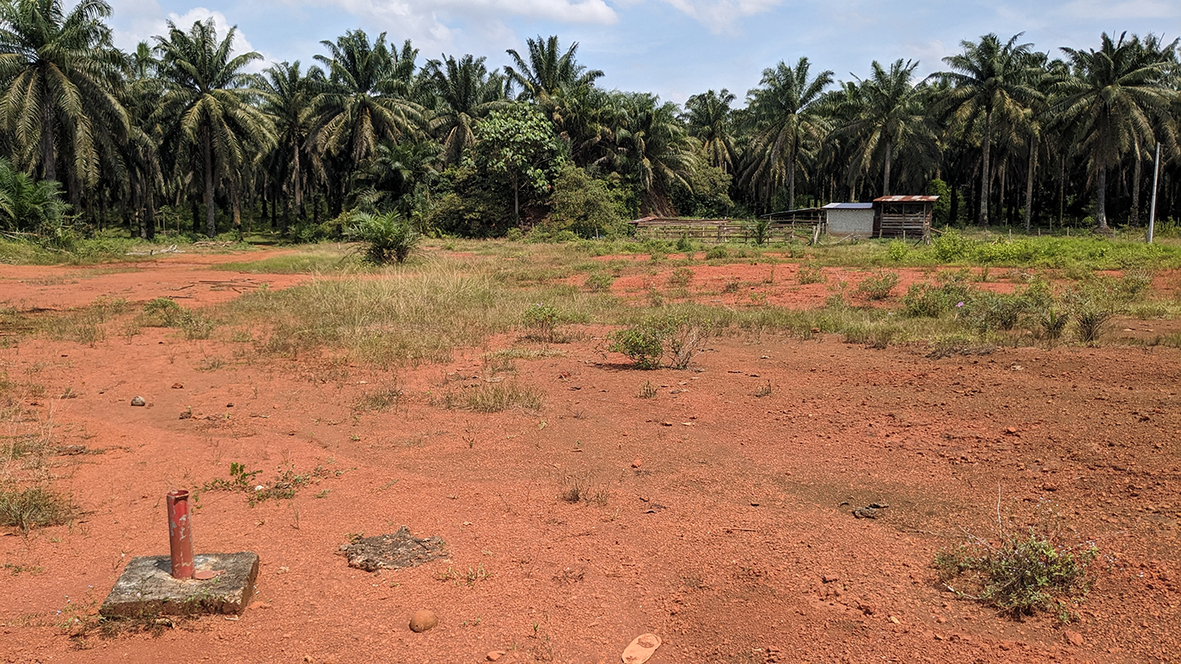
An hour later, riding with a younger SMSL ally to Bukit Goh, Mr. Xu recounted conversations around Kuantan five years earlier that had alerted him to the scale of operations at the site. A friend who owned an excavation company had rented equipment to a group planning to fill a thirty-meter-deep pit carved out during the bauxite boom, immediately outside the Bukit Goh townsite. After we arrived at the site, we saw this depth—thirty meters—printed on small tags affixed to a handful of red metal monitoring tubes protruding from the large expanse of red dirt (see Figure 1). Such an enormous hole could hold a lot of waste, Mr. Xu mused as we walked, even if it was only the top thirty centimeters that were relevant to scientists’ experiments (see Hanafi et al. Reference Hanafi, Azizi, Akinbola, Ismail, Sahibin, Razi and Ismail2021).
A soil conditioner testing site near FELDA Bukit Goh (photo by author).
“I think people assume FELDA settlers are always ready to be in somebody else’s experiments, like they need to show that their communities and the way they use the land won’t be a burden on the nation,” Mr. Xu went on. For decades before the bauxite mining boom, researchers and government officials had routinely visited Bukit Goh to ask residents questions about everything from their farming techniques to the career aspirations of their children. Researchers were particularly anxious to know whether FELDA settlers’ descendants planned to leave Bukit Goh for Malaysia’s urban centers—a question that young people almost invariably answered affirmatively (see, e.g., Bahrin, Thong, and Dorall Reference Bahrin, Thong, Dorall, Manshard and Morgan1988). In the wake of the mining moratorium, numerous visiting researchers focused on persuading young residents to develop new kinds of businesses within the community. Representatives from a German company and a local NGO promoted a potential solar farm for the affected lands (Alagesh Reference Alagesh2023). “It would be excellent if young people here turned these projects into businesses,” Mr. Xu remarked as we returned to the car, “but like our neighbors in Kuantan, I’m sure many think only of leaving.”
As we drove back to Kuantan, Mr. Xu showed me pictures of himself standing on the same plot of land in 2018, a few days after the dirt was deposited. A corrugated metal fence ringed the flat testing area, an expanse of red earth that was barren except for a dozen or so green saplings, arranged in two rows near the middle of the field. At the edges of the photos, the same red metal monitoring tubes poked up through the same small squares of concrete, helping me to align my new photographs with these earlier views, now that the fence was removed, all the saplings were gone, and a small goat farm had been built next to the clearing. “When people in Kuantan talk about the circular economy, I want to take them here so they can see this. I want to ask them if this looks like research to them, if this looks like a new economy.” Compared to the densely ordered rows of durian trees and other plants, neat equipment houses, and profusion of information stands that we had seen while driving by the Bukit Goh Agricultural Center (a separate, government-run research facility) only a few minutes earlier, Mr. Xu’s photos of the original testing site did not convey a site designed for public visibility. It was clear, however, that whoever had once treated the experiments there as objects of investment had already decided to move on.
Conclusion
Both SMSL organizers and REE researchers in Pahang insist that moral questions about material flows are inseparable from questions about belonging. Whether they feel optimistic or skeptical about the generative potential of a circular economy, conversations about these flows remind them all of mismanaged flows of people: scientists, technicians, and other REE knowledge workers drawn overseas for better pay and fewer uncertainties; children leaving for school or for post-college jobs after struggling to find positions in Malaysia. Rather than mirroring the kinds of “closed loops” of material movements imagined by CE proponents, my interlocutors’ complaints suggest, both pipelines have been leaking for decades. In some sense, both kinds of failed loops are also middle-class constructions, predicated on technological imaginaries and forms of professional mobility available only to a small subset of Malaysians, and not to people like FELDA settlers or the many others enrolled in state-managed programs. Despite their similarities, though, my interlocutors nevertheless hold radically different understandings of what “closing” these loops might entail, including whether or not any government institutions can be entrusted to help. For some, the insistent, all-encompassing promises of CE simply remind them of narratives of Malaysian nationhood that acknowledge some groups’ aspirations and senses of place while pointedly ignoring their own.
The tensions between CE-based imaginaries and affected communities’ experiences of movement represent a serious challenge for assessing how new projects to repurpose waste will affect mobility and migration throughout the world. Transcendent conceptualizations of movement implicitly premised on the production of depersonalized expertise will likely become even more common as mineral processing and waste reuse proposals grow more technologically complex. Similar challenges surround other globalizing industries organized around promises of responsibility. Describing the impacts of “flexible” ethics protocols on pharmaceutical test subjects as the clinical trials industry began spreading internationally in the early twenty-first century, Adriana Petryna (Reference Petryna2009) presses expert institutions to acknowledge the complex roles they play in linking lives and decision-making processes across different locales. “What ethical deliberations and actions are possible in arenas fraught with high financial and political stakes? What is transparency and what are the risks of distortion? How are those risks distributed, deferred, or mitigated, and what spaces of negotiation open in their wake?” (15). None of these questions are easy to answer for new CE initiatives, nor do most government-authored planning documents address the historical experiences that cause different groups to understand these risks and their moral stakes differently.
One way to start answering these questions is to first ask how different concepts of movement become meaningful to people building lives around industrial formations in flux, rather than transposing transcendent concepts developed elsewhere. “Since minerals do not start as resources but are rather made into them,” James Smith (Reference Smith2022) observes, “movement” within the mining industry is inherently “transdimensional” (32). The forms of movement Smith attends to among coltan miners in Eastern Congo link human plans to the affordances of rocks and other physical things, but they also complicate connections among people in ways that are not well captured by prevailing critiques of supply-chain capitalism. For Smith’s interlocutors, “[m]ovement was irreducible to market logics, nor was it simply an expression of neoliberalism run amok (‘the market’ unfettered), in part because it often involved reciprocal relationships that offset whatever was happening to price at the level of the ‘world market’” (46). For researchers working to secure opportunities for future colleagues, or for peripatetic retirees trying to re-establish intergenerational continuity in their ancestral homes, the influence of such relationships belies simplistic attempts to treat future movements as unbroken circles.
Ethnographies of extractivism must recognize how patterns of mobility and aspiration are changing in an era when projects are constantly moving and proponents are making ever-grander promises in each new locale. These patterns will only grow more complex as the promises made to secure sites of extraction include more assurances of future industry reform. Still, scholars cannot afford to dismiss industry experts’ pleas for new standards, disingenuous as they sometimes may seem. More Malaysian mining engineers are calling on government officials to take responsibility for regulatory inconsistencies and severe environmental harms that have plagued their industry since the colonial period. Some are also castigating companies based outside Malaysia for treating the country as an environmental sacrifice zone while reneging on technology transfer agreements (Kuan, Ghorbani, and Chieng Reference Kuan, Ghorbani and Chieng2020). Many complaints emphasize Malaysia’s status as a key intermediary between Western and Chinese companies, arguing that this status ought to help would-be regulators and watchdog organizations by multiplying potential sources of leverage. In these spaces of discussion, however, CE-based transitions are still largely treated as unalloyed goods, as if reorganizing the industry to keep more processing steps within the country will necessarily benefit every Malaysian.
The movements championed in CE discourse are complex flows requiring constant attentiveness, from engineers, activists, and ethnographers alike. Yet perhaps the biggest challenge to finding one’s footing in evolving circular economies will not be describing how people spiral outward as minerals move and entire industries reorganize, but examining what gets left behind. Since mineral processing expertise is often the main goal of CE-based research investments, rather than material products per se—a goal continually emphasized by my university-based interlocutors—static stores of materials at sites like Bukit Goh will likely be continually created and forgotten as new techniques and sites of interest arise. Indeed, since late 2023, Lynas’s critics outside Pahang have largely shifted attention to the sudden appearance of two new REE mines within Malaysia: an illegal site near the Thailand border and a government-supported “pilot project” in the central peninsula (Arif Reference Arif2023; Sinnappan Reference Sinnappan2023). Worryingly, both projects combine extraction and initial refining through “in-situ leaching,” a process of pumping toxic solvents directly into the ground so that materials begin to separate before surfacing.
For now, it seems that a new kind of economy is indeed materializing in Malaysia—not the one CE proponents promised. News coverage of the new mining sites has already begun normalizing the prospect of additional REE mines elsewhere in Malaysia, an SMSL ally lamented to me when we met in Kuala Lumpur. “New projects are coming, for sure. And companies will want to process here, too, thanks to Lynas.” A continuous loop keeping REE products and processing within the country is already emerging, his comments suggested, even as the futures of wastes and the roles to be played by scientific experts grow less certain. Whether there will be enough activists to meaningfully contest future developments, though, or enough conscientious researchers to replace them, is becoming harder to say.
Acknowledgments
I am very grateful to Vilashini Somiah and my Malaysian research sponsor Kamal Solhaimi bin Fadzil, both at Universiti Malaya, for their continuing guidance on this project ever since our first discussions in 2022. Additionally, I received crucial feedback on this essay from Canay Özden-Schilling, Cher Hui Yun, Jacob Rinck, Sahana Ghosh, Zach Howlett, Chen Ying, Emily Chua, Sayd Randle, Ting Hui Lau, Erica Larson, Al Lim, and Elliott Prasse-Freeman. I was also greatly helped by comments at conference panels organized by Javiera Barandiarián, Caroline Schuster, Bronwyn Isaacs, and Helena Varkkey, and from other audiences at the Korean Advanced Institute of Science and Technology and the Taiwan Contemporary Culture Lab. Finally, I am indebted to my reviewers, whose insights greatly improved the piece.

 Open access

