





Policy Significance Statement
This article covers a timely and important development in international student mobility in response to two major exogenous shocks: the UK withdrawal from the EU (Brexit) and the COVID-19 pandemic. Using novel applications data from the UK Colleges and Admissions Service (UCAS), the article empirically demonstrates that the UK’s withdrawal from the EU in 2021 led to a substantial drop in applications to UK universities from EU-domiciled students, even when considering the co-occurring restrictions related to the COVID-19 pandemic. We are able to explore the heterogeneity of these impacts across different subject areas, types of institutions, and across different EU countries of origin. Given the current UK policy debates around curbing migration and international students, it is important to understand how changes to the UK policy environment and limitations to study and travel can and will affect the UK HE industry and the diversity of its student bodies.
1. Introduction
The UK is the secondleading destination for international students in the world (UK House of Commons, 2024). According to the UK Higher Education Statistics Agency (HESA), in the 2020/21 academic year, over 600,000 international students were studying at UK Higher Education Institutions (HEIs) (Universities UK, 2022). The net benefit of international students to the UK economy was estimated to be £25.9 billion in the 2018/19 academic year with approximately 18% of this net benefit being associated with EU-domiciled students, and the remaining 82% coming from non-EU students (Hillman, Reference Hillman2021). Current UK government policy aims to increase the value of educational exports through international student recruitment by £35 billion by 2030, assuming a 4% annual growth rate in demand from international students each year (Department for International Trade and Department for Education, 2021).
There has been a policy focus on the recruitment of international students into UK universities by both the UK government and individual institutions. The UK government has tended to enact national policies that allow the country and HEIs to compete in the global education market (Lomer, Reference Lomer2018). However, one of the greatest changes to the policy environment around international students has occurred as a result of the UK’s official withdrawal from the EU trading bloc (Brexit) on 31st December 2020. Before withdrawal, EU-domiciled students paid the same fees (£9250 per annum) as UK-domiciled students and were similarly entitled to a student loan to cover their living expenses. However, from 1st August 2021, UK-domiciled and EU-domiciled tuition fees were decoupled, and EU students were required to pay the same, and much higher, fees as other international students. EU students now face visa requirements and are no longer able to secure a UK student loan (Department for Education, 2022). In a potential response to an increase in fees, data from HESAFootnote 1 (HESA, 2023) reports that there was a 53% decline in the number of EU domiciled students studying in the UK between the 2020/21 and 2021/22 academic years.
However, the context of the COVID-19 pandemic complicates the picture. Restrictions related to the COVID-19 pandemic began in early 2020 and lasted until the 2022 academic year, with the end of free movement due to Brexit occurring in the middle of the pandemic. As such, it is not clear how pandemic restrictions interact with policy changes related to Brexit. The COVID-19 pandemic led to significant disruption to the global economy and global movements, and within the context of this study, made it more difficult for international students to travel abroad to study. In addition, many university campuses were closed, and classes were moved online. Despite the importance of the pandemic to global mobility, research on the impact of the pandemic on international student flows is still in its infancy.
Given the combined impact of a global pandemic during Brexit related to changes to the UK’s relationship with the European trading bloc, there is an increased urgency to develop new models of international student flows that account for these system-wide impacts. There is currently a gap in the empirical literature that considers how international students responded to both Brexit and the pandemic, but also how international students respond to external shocks and policy changes more broadly.
Using a unique data set on accepted applications of international students into the UK from 2012 to 2022 provided by the UK Colleges and Admissions Service (UCAS), data on COVID-19 stringency measures from the Oxford COVID-19 Government Response Tracker (Mathieu et al., Reference Mathieu, Ritchie, Rodés-Guirao, Appel, Giattino, Hasell, Macdonald, Dattani, Beltekian, Ortiz-Ospina and Roser2020), and ancillary data sources on country-level influences on international student mobility based on previous work by Neville et al. (Reference Neville, Rowe and Singleton2024). We employ a difference-in-differences (DID) methodology within a multilevel modeling framework to understand the impact of Brexit and COVID-19 on international student applications, and how the impact varies by type of institution (Russell Group or non-Russell Group), subject, and country of origin. Through this approach, we aim to untangle the nexus of interactions that impacted international student flows into the UK during the period of the pandemic and the end of free movement. In this study, we focus on EU students, assessing both the combined impact of Brexit and pandemic-related restrictions, we also compare how EU student flows compare to their non-EU counterparts. Our approach and data granularity enable us to unpack these impacts across different types of institutions and subject areas, as well as how different countries in the EU were impacted by these changes. Understanding how these relationships vary by institution and subject adds a layer of complexity, which allows us to note points of sensitivity and vulnerability in the UK HE system.
Understanding how the impact of these factors operated in heterogeneous ways across different EU countries of origin allows us to understand which countries are particularly vulnerable to changes and external shocks. Analyzing these distinctions is key to develop a greater understanding of how international students respond to external shocks and policy changes.
The paper is structured as follows. First, we consider literature related to the determinants of international student mobility, and literature that considers policy changes and external shocks to international students. Second, we present our hypotheses. Thirdly, a method section outlines in more detail the data used in this research, including the use of the COVID-19 stringency measures and modelling approach. Fourth, we present and discuss the results of our analysis. Finally, we conclude by identifying the key findings of the paper, the limitations of our study, and the implications of our findings for future research.
2. Literature review
2.1. Brexit: The Impact on Migration
Although our research focuses chiefly on international student mobility, it is important to understand more broadly how Brexit and the end of free movement impacted migration into the UK. The UK voted to leave the EU in a referendum held on June 23, 2016. Although the referendum to leave the EU occurred in 2016, free movement ended on December 31, 2020 when the UK officially withdrew from the EU single market and the transition period ended. Prior to withdrawal, EU nationals were able to freely live, work, and study in the UK without additional visa requirements and vice versa. However, from 2021, new and stricter requirements were placed on those who wanted to move between the UK and the EU (UK Parliament, 2020).
While the UK had previously been a popular destination for EU migrants, research indicates a decline in its popularity as a destination after 2016. Before 2016, EU citizens comprised the majority of net migration to the UK. According to figures from the Office for National Statistics (ONS) and the Migration Observatory, EU citizens accounted for between 59% and 77% of net migration in the year ending 2015 (The Migration Observatory, 2024). However, following the referendum, evidence shows a decline in EU migration to the UK.
Using a DID approach, Di Iasio and Wahba (Reference Di Iasio and Wahba2023) demonstrated a decrease in net migration of EU nationals from the UK after the EU referendum, particularly among those whose primary motive was to work in the UK. Additionally, Sîrbu et al. (Reference Sîrbu, Goglia, Kim, Magos, Pollacci, Spyratos, Rossetti and Iacus2024), utilizing a combination of traditional and digital trace data, reported a decline in movements between EU countries and the UK from 2016 to 2020. Further, Rampazzo et al. (Reference Rampazzo, Bijak, Vitali, Weber and Zagheni2024), using digital trace data, identified a decrease in migration to the UK from the EU post-referendum, especially among those aged 20–29. Both Sîrbu et al. (Reference Sîrbu, Goglia, Kim, Magos, Pollacci, Spyratos, Rossetti and Iacus2024) and Rampazzo et al. (Reference Rampazzo, Bijak, Vitali, Weber and Zagheni2024) also highlighted that Eastern and Central European countries were particularly affected by these declines.
Less work has focused on the post-withdrawal period beginning in January 2021. This is in part due to the added complexity of the COVID-19 pandemic, as well as the availability of timely data. That said, Official statistics from the Office of National Statistics (ONS) show a decline of around 40% in EU migration to the UK between December 2020 and December 2023 (Office for National Statistics, 2024). Also, the ONS shows that although there were declines in EU migration from the 2016 referendum onward, the steepest declines occurred after the first COVID-19 lockdown in 2020 (Office for National Statistics, 2021). Further, data from the Migration Observatory indicates that declines in migration were the greatest for Eastern European countries such as Poland, Romania, Lithuania and Bulgaria (The Migration Observatory, 2021).
Given these marked declines in migration and mobility from EU countries to the UK, it makes sense that student mobility would also decline. It is important to understand how student applications can be contextualized within broader changes to EU migration into the UK post-Brexit.
2.2. Brexit: The Cost of Ending Free Movement for International Students
For EU students, the cost of studying increased due to the end of parity with UK student fees, reduced opportunities to secure loans, and tightened visa requirements. There is an undoubtable economic impact of Brexit on EU students, making the costs associated with studying in the UK much higher for cohorts beyond the 2021/22 academic year than for their predecessors.
Literature on the influences on international student mobility often discusses the impact of financial costs on the decision to study abroad. Mazzarol (Reference Mazzarol1998) and Mazzarol and Soutar (Reference Mazzarol and Soutar2002) include the cost of fees, alongside the cost of living, as a key influence on international student mobility. There is also evidence that EU students have responded negatively to increased fees in the past, with applications dropping in 2012 following an increase in fees from £3375 to £9000 in England, Wales and Northern Ireland. The 2012 increase saw a 13-percentage point decline in the number of EU students studying in the UK after its initial introduction, although this did recover (QS, 2019). Issues of financial burden have arguably prevailed as an enduring concern, with a survey conducted on prospective international students in 2019 finding that 36% of students from the EU who would have considered studying in the UK became “less interested”, with 65% of those stating that this is because the UK is now a less financially viable option (QS, 2019). Although fees are the only one deterring costs for international students, it is an important one. The increase in fees will have played a role in declining numbers of applications from students from EU countries.
In addition to increased fees, the end of free movement limits EU students’ ability to remain in the UK to work after graduation. In an analysis of international students’ intention to return after graduation Falkingham et al. (Reference Falkingham, Giulietti, Wahba and Wang2021) showed that, after the triggering of Article 50 to leave the EU, EU students were much more likely than non-EU students to plan on leaving the UK after graduation. In addition, they found that this effect was greatest for those from countries who joined the EU after 2004 enlargement.Footnote 2 In the literature more generally there is evidence that international students will seek to stay in the host country post-graduation. Rosenzweig (Reference Rosenzweig2008) highlights how international students are likely to stay in the host country once they have completed their studies. Likewise, Robertson (Reference Robertson2011) identified how students who come from less wealthy backgrounds may be motivated to convert to a long visa after graduation. However, given that the right to remain for EU students was revoked by Brexit, the impact of having to apply for a visa and the extra costs associated with this are likely to negatively impact the attractiveness of the UK as a destination. In a survey of prospective EU students conducted post-referendum but before the end of free movement or the pandemic, of those who were deterred by Brexit from studying in the UK, 47% were worried that it would be harder to get a job when they graduated, and 42% were worried it would be harder to get a visa (QS, 2019). Such responses point to an unease around prospective job opportunities post-Brexit.
Literature on international student mobility often points to the relative wealth between countries as a driver for students studying abroad. Many authors have explored the relationship between per capita income of the origin country and outward flows of international students. The negative impact of per capita income in the origin country on outward student flows has been well documented. When considering the UK as the sole destination, countries with lower GDP per capita tend to have smaller flows of internationally mobile students (Zheng, Reference Zheng2014; Neville et al., Reference Neville, Rowe and Singleton2024). In relation to Brexit specifically, in a study considering changes in applications in EU students immediately after the 2016 referendum Amuedo-Dorantes and Romiti (Reference Amuedo-Dorantes and Romiti2021) found the largest drops came from countries with a lower GDP per capita and higher unemployment rate. These results could suggest that in a post-Brexit context, we can expect to see the greatest declines from those countries where GDP is lower.
2.3. Brexit: Negative Sentiments Towards Immigration
Further to financial and economic effects, other confounding factors that have been shown to deter international students include the wider socio-political environment. The decision to leave the EU was, in part, driven by campaigns that promoted negative feelings towards immigration (Goodwin and Heath, Reference Goodwin and Heath2016; Goodwin and Milazzo, Reference Goodwin and Milazzo2017; Hobolt, Reference Hobolt2016). Immigration was a central component of the debate during the referendum to leave the EU, with dissatisfaction with the EU being associated with anti-immigrant sentiment (Ford and Goodwin, Reference Ford and Goodwin2017). Data from the British Election Study shows that over half of Leave voters were “intensely opposed” to immigration, with 65% viewing immigration as “bad for the economy”, and 72% perceiving immigration as “undermining culture” (Goodwin and Milazzo, Reference Goodwin and Milazzo2017).
In relation to international students specifically, less research has been conducted on their experiences of and reactions to anti-immigrant sentiment. However, Mazzarol (Reference Mazzarol1998) and Mazzarol and Soutar (Reference Mazzarol and Soutar2002) highlight the risk of discrimination and lack of safety as two key social costs that prospective students consider when deciding where to study abroad. There have been several calls to investigate international student responses to more hostile policy environments. In the context of the U.S. Laws and Ammigan (Reference Laws and Ammigan2020) draws attention to the reduction in international student numbers following the election of Donald Trump in 2016. Similarly, Rose-Redwood and Rose-Redwood (Reference Rose-Redwood and Rose-Redwood2017) express the need for researchers to consider the impacts of anti-immigration policy environments on international students. Bartram (Reference Bartram2018) refers to the current political climate as a “landmark political and cultural shift with potentially significant implications and consequences for international students.” Despite these calls, there has been a lack of empirical work on how international students have been affected by anti-immigrant sentiment and hostile policy environments.
Although quantitative evidence that EU students were deterred by anti-immigrant sentiment is limited, recent results from surveys indicate that there has been an increased sense of a hostile environment since the referendum in 2016. Of those prospective students from the EU who were deterred from studying in the UK as a result of Brexit, the second biggest reason (after financial vulnerability) was that the “UK is less welcoming to international students like me” – with 57% of prospective EU students responding in this way (QS, 2018). Furthermore, in the 2022 iteration of the survey, prospective students from Western Europe and to a greater extent Eastern Europe were less likely to see the UK as “extremely” or “somewhat” safe in comparison to their counterparts in Latin America, North America, or Africa and the Middle East (QS, 2022). These results all point to a sense of vulnerability being experienced by prospective EU students that exists beyond financial insecurity.
2.4. COVID-19: The Impact on International Student Mobility
While the impacts of Brexit and the end of free movement came into force from August 1, 2021 for international students, earlier restrictions were enacted as measures of response to control the spread of COVID-19. The COVID-19 pandemic led to significant disruption to the global economy and movement of people between countries and made it more difficult for international students to travel abroad to study. The scale of disruption caused by the pandemic became clear in the Spring of 2020. Within the UK context, lockdown restrictions legally came into force at the end of March 2020. However, the pandemic and its responses progressed at different rates in different parts of the world, and other countries began their restrictions earlier. UK lockdown persisted on and off across 2020 and into early 2021, while restrictions remained in place into 2022.
The 2020 closure of university and college campuses had a significant impact on higher education providers, with many courses being delivered online (Hubble and Bolton, Reference Hubble and Bolton2020). While universities did attempt to mitigate the impact of COVID-19 on students there was a significant fear that overseas student numbers would fall as a result of the pandemic (European Commission, 2020). Concern arose that restrictions would lower applications for the 2020/21 academic year and that students would instead wait until the pandemic was over.
Surveys conducted into the deterrents for international students from OECD and EU countries to any destination as a result of the pandemic by the European Commission (2020) identified several key concerns for students from member states. These concerns included the ability to return to their country of origin due to travel restrictions, with 84% of prospective students being concerned about restricted travel options. Additionally, there was a concern that national administrations and universities would not be in operation, and as such student visas, residence permits, and admissions procedures would be affected. Another key concern was the ability of international students to support themselves financially due to the lack of student jobs.
Studies on the impact of the COVID-19 pandemic restrictions on international students are still in their infancy. Although research from González-Leonardo et al. (Reference González-Leonardo, Rowe, Potančoková and Goujon2024) shows how there was a decline in migration into high-income countries in Europe as a result of the pandemic, less is known about international students. However, looking at applications to UK universities during the pandemic, Di Pietro (Reference Di Pietro2023) found that the COVID-19 pandemic period was associated with a reduction in the number of overseas applications (not accepted applications) to UK universities of between 11% and 14% for those applying in the Summer and Autumn of 2020. Furthermore, the author finds that these declines were heterogeneous across different countries of origin, with greater declines seen in affluent countries. Other research takes a more global perspective, with Yang et al. (Reference Yang, Shen and Xu2022) pointing to evidence of a contraction in the global market for international student mobility as well as changes in the geographic patterns of international student mobility.
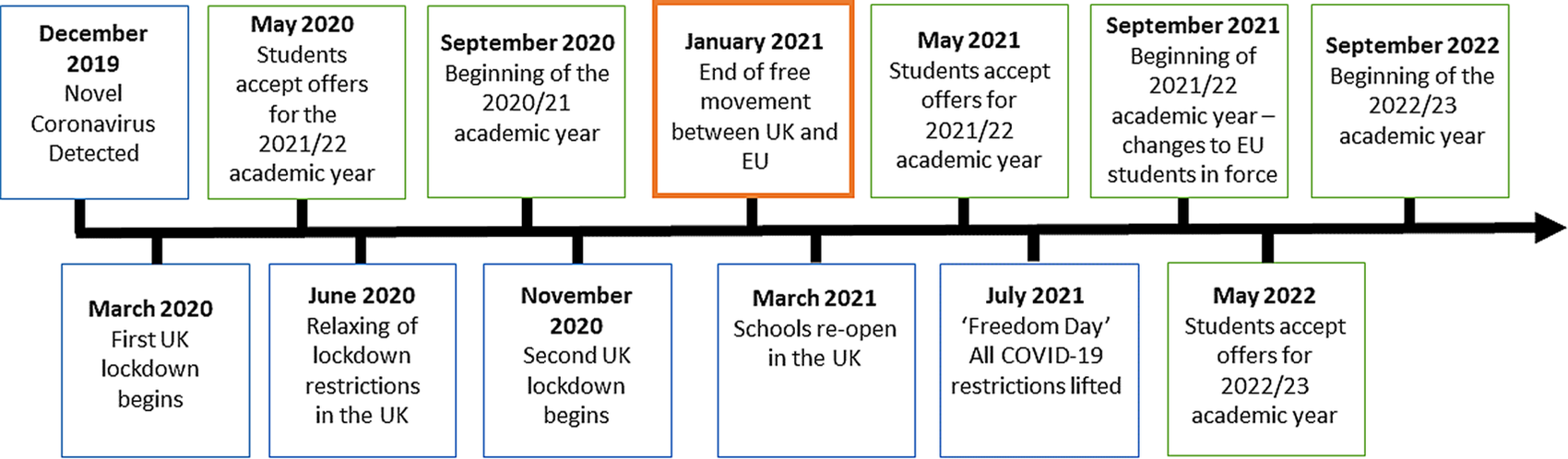
While literature points to a potential decline in international student mobility as a result of the pandemic, data of registered students released by HESA (2023) determines that there was little difference in the 2020/21 enrolments compared to a normal year. However, there are no studies with such recent application data as our study. Furthermore, analysis of the impact of COVID-19 has often overlooked the impact of Brexit, and vice versa, despite the two events being temporally linked (Figure 1).
Timeline for COVID and Brexit events.
2.5. Heterogeneity in the System: Differences Between UK Higher Education Institutions and Subjects
There are several studies that identify the importance of an institution’s reputation in the attracting of international students. The reputation of the institution is often considered an important “pull” factor for international students when choosing where to study Mazzarol (Reference Mazzarol1998). The reputation of the academic institution allows potential students to choose between the options available and provide some knowledge about the institution (Mazzarol and Soutar, Reference Mazzarol and Soutar2002; Beine et al., Reference Beine, Noël and Ragot2014). Given the importance of reputation, when exogenous shocks and policy changes occur, it may be the case that certain institutions are privileged over others. In these cases, universities that do not have as good of a reputation may suffer to a greater extent.
The UK system is marked by heterogeneity, and some differences exist within it that may be impacted variably by declines in student numbers. UK institutions vary depending on their research activity, perceived quality of teaching and learning, and the socio-economic mix of their students (Boliver, Reference Boliver2015). Croxford and Raffe (Reference Croxford and Raffe2015) suggest that an institutional hierarchy is deeply embedded within the UK HE system. These differentiations are best represented by the Russell Group, which was established in 1994 and represented the largest aggregation of research-intensive institutions in the country (Singleton, Reference Singleton2010). The Russell Group represents 24 leading research-intensive universities and began meeting in 1994 after the creation of the “new” universities. As of 2019/20, the Russell Group produces 68% of the UK’s world-leading research and teaches a quarter of all undergraduate students and a third of all post-graduate students (Russell Group, 2020).
Beyond institutions, there are differences across subject areas. From an economic perspective, different subject areas have different impacts on graduate earnings. According to reports from the Institute of Fiscal Studies (2018), the returns on early-career earnings are much greater for students who study subjects such as Medicine or Economics compared to subjects like Creative Arts and Agriculture. These returns are reflected in the popularity of different courses for international students, with UCAS (2022) reporting that the courses that attracted the most international students were Business and Management, Engineering, Law, and Computing. However, Creative Arts and Design was still a popular choice for international students, suggesting that economic returns are not the only driver of course choice for international students. Interesting, when considering the post-referendum period, work by Amuedo Dorantes and Romiti (Reference Amuedo-Dorantes and Romiti2021) identified a greater slowing in the growth of applications from EU students for STEM subjects compared to non-STEM subjects after the 2016 referendum despite the expected resilience of STEM subjects. All considered, it is likely that different subjects will see different effects from the impact of Brexit in terms of the reduction in student numbers. It is therefore important to consider these when understanding changes to external shocks and policy changes.
3. Hypothesis
Based on the existing literature and available data, we propose four hypotheses:
-
1. Decline in EU student applications: We expect to see a decrease in the number of accepted applications from EU students from the 2021 academic year onward. This is anticipated due to the increased costs associated with studying in the UK.
-
2. Negative impact of COVID-19 stringency: We hypothesize that higher rates of COVID-19 stringency will have a deterring effect on international student applications. Given that COVID-19 restrictions limited students’ ability to travel and led to campus closures, it is likely that there will have been a noticeable impact on the number of applications.
-
3. Greater decline for non-Russell Group Institutions and STEM subjects: We expect the decline in EU student applications to be greater for non-Russell Group institutions and STEM subjects. The reputation of the institution serves as an important “pull” factor for international students, and previous research indicates that applications for STEM subjects slowed the most in the post-referendum period.
-
4. Greatest declines for Eastern and Central European Countries: We anticipate the most substantial declines in applications from Eastern and Central European countries. This expectation is based on previous research showing declines in migration from these regions in response to the referendum result, and the notion that students from less wealthy countries or those experiencing higher levels of prejudice may be less inclined to study in the UK.
In summary, our hypotheses suggest an increase in EU student applications that predominantly affects less prestigious universities, STEM subjects, and students from Eastern and Central European countries. Additionally, we hypothesize that the COVID-19 pandemic will have contributed to the decline of EU and non-EU domiciled international students.
4. Methodology
4.1. Data
Our data are sourced from the UK Universities and Colleges Admissions Service (UCAS) to capture successful undergraduate applications to UK HEIs, which we use as a proxy for origin-destination undergraduate student migration flowsFootnote 3 In the UK, UCAS is the main route of applications for students who want to study an undergraduate degree at a UK HEI and is the largest channel for internationally mobile students entering the UK (UCAS, 2020). We have access to count data indicating the number of students by country of origin who were accepted to study a particular subject in a particular institution for a given year using the UCAS applications service between the 2012/13 and 2022/23 academic years. These data accounted for 95% of all EU entrants and 60% of all non-EU entrants in 2019. Students from the Republic of Ireland were excluded from the analysis as they are not required to pay higher tuition fees and can still move freely to the UK and within the EU.Footnote 4
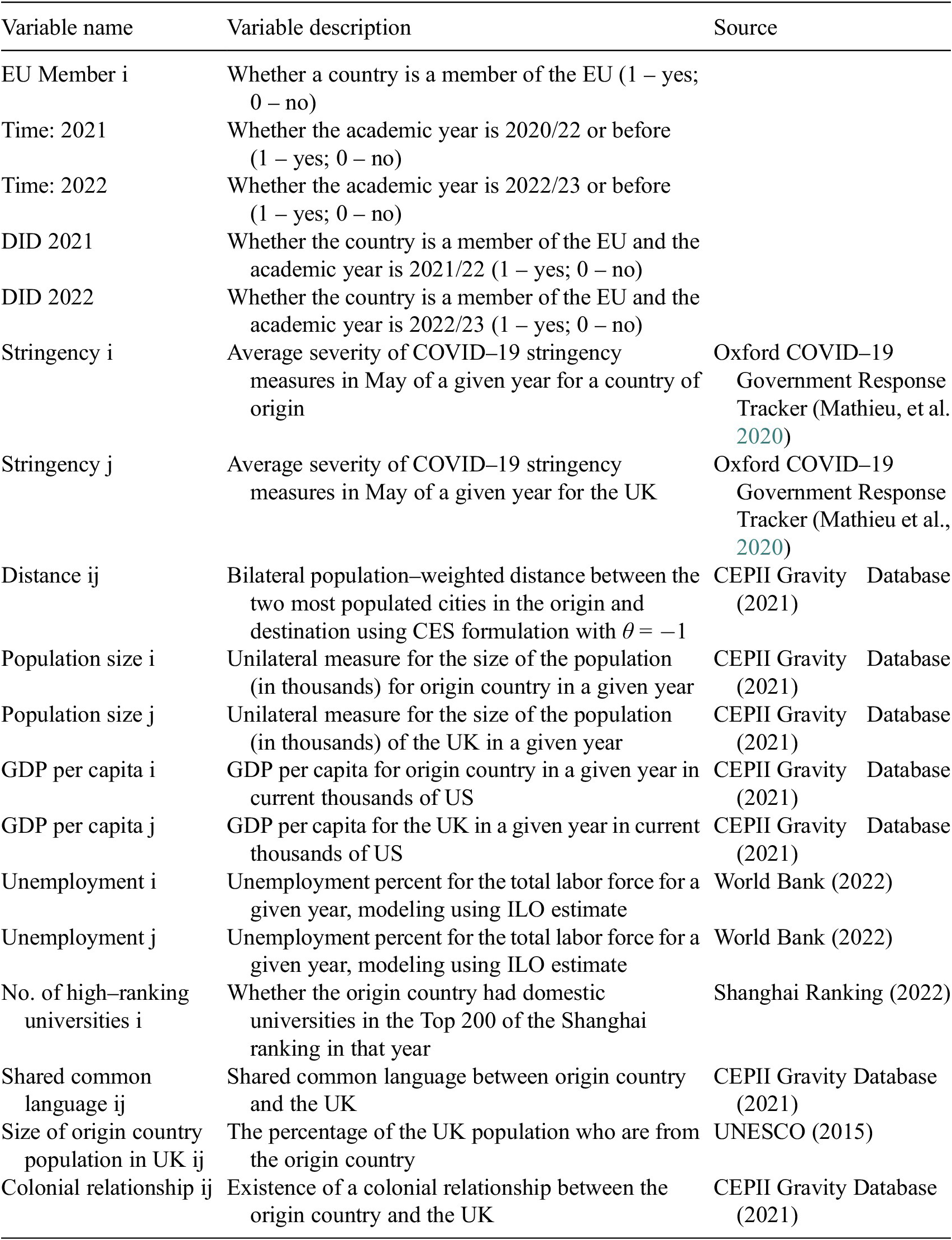
In addition, contextual data on stringency measures were obtained from the Oxford COVID-19 Government Response Tracker (Mathieu et al., Reference Mathieu, Ritchie, Rodés-Guirao, Appel, Giattino, Hasell, Macdonald, Dattani, Beltekian, Ortiz-Ospina and Roser2020). These data provide an index that measures the strictness of government policies related to COVID-19 in individual countries. A score of 100 represents the strictest response level, and 0 is the lowest level of stringency. The index was calculated for each day during the pandemic and is built of nine metrics: school closures, workplace closures, cancellation of public events, restrictions on public gatherings, closures of public transport, stay-at-home requirements, restrictions on international movements, and international travel controls. For our study, we took the mean value of the total stringency index for the month of May for both the country of origin and the UK in 2020, 2021 and 2022. The month of May was chosen as this is the final month students can accept their offers via UCAS. A range of other measures, in line with previous research by Neville et al. (Reference Neville, Rowe and Singleton2024), were gathered from ancillary data sources, which are shown in Table 1. These measures were integrated alongside the UCAS data in order to create a unique database of origin-destination flows augmented by characteristics of both the origin country and the UK for each year between 2012 and 2022.
Data and sources
4.2. Difference-in-Differences (DID)
To assess the impact of Brexit on restrictions, we employ a DID methodology. DID is a quasi-experimental methodological approach that allows researchers to compare the characteristics of different sub-groups of the population, a control group and a treatment group, before and after an intervention or policy change, that is, a treatment. DID allows researchers to mimic an experimental research design using observational study data (Angrist and Pischke, Reference Angrist and Pischke2009). The aim of the method is to calculate the impact of the treatment on an outcome by comparing the average change over time in the outcome variable for the treatment group to the average change over time for the control group. In the case of this research, we aimed to estimate the impact of Brexit on EU student mobility. We compute this by comparing the numbers of EU student applications before and after the end of free movement against non-EU student applications who were not directly affected by Brexit.
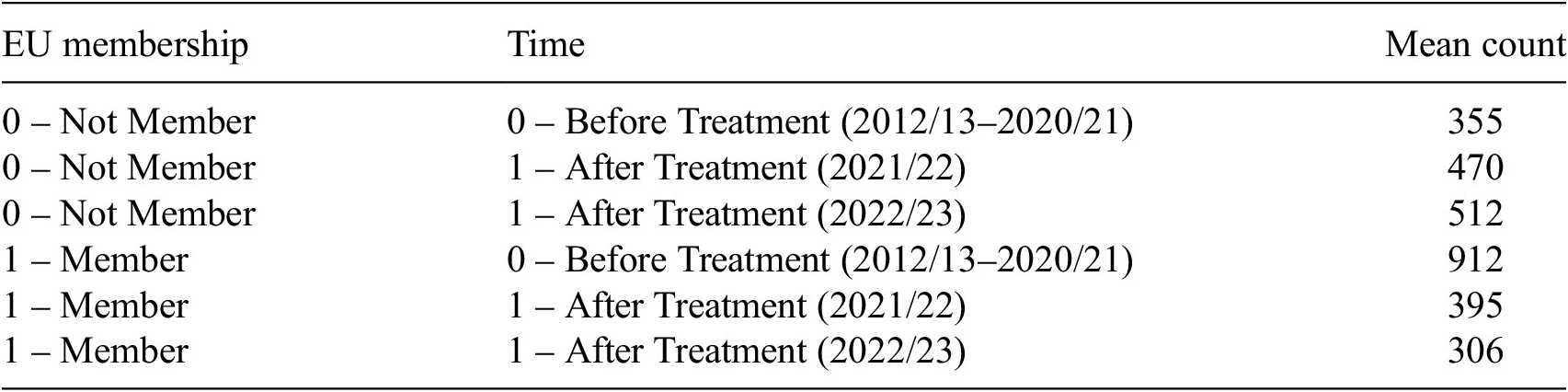
For the DID analysis, we formally defined our treatment and control groups and before and after variables. A binary “treatment” indicator was created to differentiate between EU (treated) and non-EU (untreated) countries. We create two binary time-related variables to indicate whether the year was 2021 or 2022. The interaction between these variables was then used to assess the impact of Brexit on international student mobility. Table 2 shows the mean count of acceptances for each indicator.
Distribution of control and treatment groups
A key consideration for the implementation of DID is its equal trends assumption. This assumption states that no time-varying differences exist between the treatment and the control group and the trend of the treatment and the control are assumed to be the same in the absence of the treatment (Bharadwaj, Reference Bharadwaj2010). In the case of our research, we assumed that the trend for non-EU international students and EU international students would have continued at the same rate if the change in free movement had not occurred and therefore they are suitably comparable. In addition, we ran a placebo test whereby we pretended the intervention occurred in the 2014/15 academic year to assess whether there were any notable changes in the interaction term. We chose 2014/15 as it is after the increase in fees in 2012/13 but before the Brexit referendum in 2016/17. We also include a DID estimator for the referendum in 2016 in order to control for the impact of the referendum before the tangible changes in policy began in 2021.We obtained a near-zero coefficient on both counts, which indicates common pre-trends across groups and suggests a common path of untreated potential outcomes if the treatment had not occurred.
The next stage was to split the data into Russell Group and non-Russell Group and different subject groupings. By splitting the data in these ways and running the analysis on each, we can uncover how the impacts of COVID-19 and Brexit manifest across different institutions and subject types. We aggregated subjects into five broader subject groupings using the coding scheme called JACSFootnote 5. The five subject groupings are: Arts and Languages; Business and Administration; Health and Life Sciences; Physical Sciences and Engineering; and Social Sciences and Humanities.
4.3. Modelling
To assess the impacts of Brexit on EU student applications when controlling for pandemic restrictions, we perform our DID in a hierarchical regression modeling framework. Specifically, we use a generalized mixed model framework as this is a flexible framework to incorporate a combination of random and fixed effect parameters as predictor variables and accommodate non-continuous responses such as counts (Rowe et al., Reference Rowe, Lovelace and Dennett2024). The annual count of accepted applications represents our dependent variable. Given that the distribution of the accepted applications count data is right-skewed and over-dispersed, a negative binomial regression model (NBRM) was implemented (see Rowe (Reference Rowe2021)).
Our models include a random intercept for origin country and random slopes for the DID estimator. The random intercept for origin country accounts for variation in the outcome variable attributable to the country, capturing differences between countries that might influence the outcome but are not explicitly modeled. The random slope allows the effect of Brexit to vary across different origin countries, capturing variations in the change in outcome before and after Brexit in each country. Before entering our model, independent continuous variables are standardized by subtracting their mean and dividing by their standard deviation. We then extract the random effects for DID estimator for each of our models, allowing us to plot the varying severity of the impact of Brexit across countries in the EU. The general equation for our model formalized in Eq. (1):
 $$ {Y}_{it}=f\left({a}_i+{d}_i+{p}_{it}+{p}_i+{p}_{jt}+\mathrm{eu}+\mathrm{post}+\mathrm{post}\times \mathrm{eu}+{\mathrm{string}}_it+{\mathrm{string}}_jt\right)+{\varepsilon}_{it}, $$
 $$ {\zeta}_{it}\sim N\left(\zeta, {\sigma}_{\zeta}\right). $$ $ {Y}_{it} $
captures the volume of flows between the country of origin and the UK
$ {Y}_{it} $
captures the volume of flows between the country of origin and the UK $ (j) $
in a given year
$ (j) $
in a given year $ (t) $
.
$ (t) $
. $ {\alpha}_i $
is a random intercept that varies by origin country
$ {\alpha}_i $
is a random intercept that varies by origin country $ i $
;
$ i $
; $ {d}_i $
relates to the distance between the origin and destination;
$ {d}_i $
relates to the distance between the origin and destination; $ {p}_{it} $
refers to origin-destination factors in a given year such as the size of the origin country population in the UK, origin country population size, origin country GDP per capita, rank of origin country institutions, the size of trade flows between the origin country and the UK, size of the origin country population at student age, and origin country unemployment.
$ {p}_{it} $
refers to origin-destination factors in a given year such as the size of the origin country population in the UK, origin country population size, origin country GDP per capita, rank of origin country institutions, the size of trade flows between the origin country and the UK, size of the origin country population at student age, and origin country unemployment. $ {p}_i $
relates to factors at the origin that do not change over time, such as colonial relationships and common language.
$ {p}_i $
relates to factors at the origin that do not change over time, such as colonial relationships and common language. $ {p}_{jt} $
relates to destination factors at a given year, including UK population, UK GDP per capita, and UK unemployment. eu is a binary indicator that shows whether a country is a member of the EU or not and post refers to a binary variable that identifies whether the time period is after the intervention. Post × eu is the interaction term (or DID indicator) of the effect of being a member of the EU in the post-intervention time period.
$ {p}_{jt} $
relates to destination factors at a given year, including UK population, UK GDP per capita, and UK unemployment. eu is a binary indicator that shows whether a country is a member of the EU or not and post refers to a binary variable that identifies whether the time period is after the intervention. Post × eu is the interaction term (or DID indicator) of the effect of being a member of the EU in the post-intervention time period. $ {\mathrm{string}}_{it} $
and
$ {\mathrm{string}}_{it} $
and $ {\mathrm{string}}_{jt} $
refer to the severity of COVID-19 stringency measures in a given year.
$ {\mathrm{string}}_{jt} $
refer to the severity of COVID-19 stringency measures in a given year.
5. Results
5.1. Global Governing Relationships
We seek to quantify the impact of the end of free movement on international students when controlling for impact of COVID-19 restrictions and other factors that are known to influence international student mobility. We first sought to understand the general trends of applications from EU and non-EU students before and after the referendum and within the context of the COVID-19 pandemic. Figure 2 displays the trends of successful applications to UK universities from EU and non-EU students between 2012 and 2022, with the severity of COVID-19 restrictions highlighted in orange in the 2020, 2021 and 2022 academic years. We can see that accepted applications sharply dropped in 2021 for EU students, but not for non-EU students. We do see that applications slowed in growth after the 2016 referendum, but that the most severe declines did not occur until 2021.
Trends of successful applications into UK universities from EU and non-EU countries between 2012 and 2022 with COVID-19 Stringency.
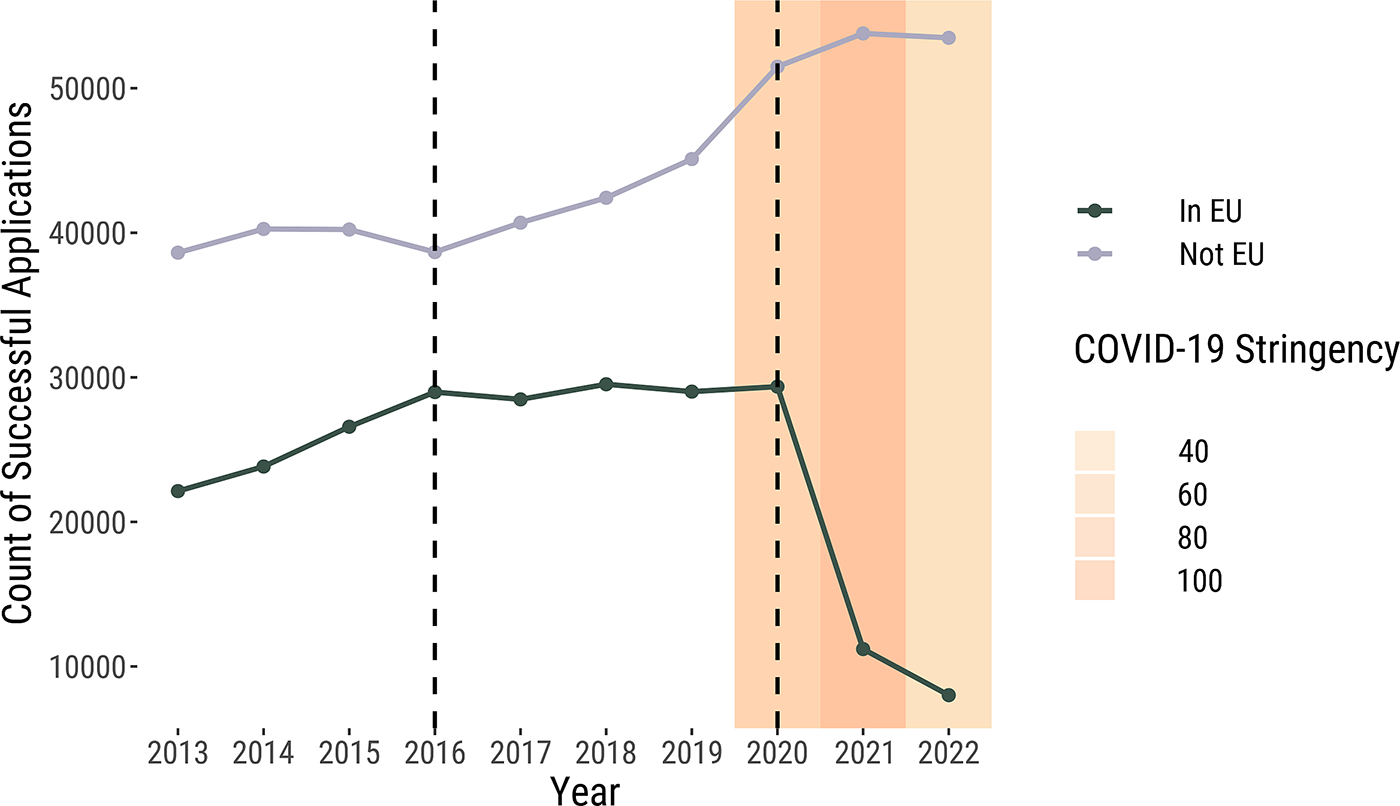
Figure 3 displays our modeling estimates. Individual coefficients relate to the expected log of international student applicant counts. A positive coefficient indicates an overall increase in international student applications, while a negative coefficient represents a decline. The results reveal a decline in EU student applications relative to non-EU students’ applications post-Brexit in 2021 and 2022 while controlling for pandemic restrictions, but that the 2016 referendum did not lead to a statistically significant decline in EU student applications. The coefficient for EU membership prior to 2021 shows a positive effect above 1, indicating that EU member countries tended to send a larger number of students to the UK than non-EU member states before 2021. In contrast, coefficients for EU membership for 2021 and 2022 were negative and statistically significant. These coefficients indicate that the number of international student applications from EU member countries dropped below the number of student applications from non-EU countries. We see an on-average decline of around 65% (670 students) in 2021 and around 75% (859 students) in 2022 for an EU country when controlling for all other factors. The results also show that applications from students from non-EU students continued to increase in 2021 and 2022, despite pandemic restrictions.
Coefficients for Difference-in-Difference Multilevel Negative Binomial Model (M1) showing influence of factors at the origin (i), destination (j), and bilaterally between both (ij) on the number of successful UCAS applications. EU member (i) (2016) and EU Member (i) (2020) and EU Member (2021) relate to difference-in-difference coefficients in each respective year.
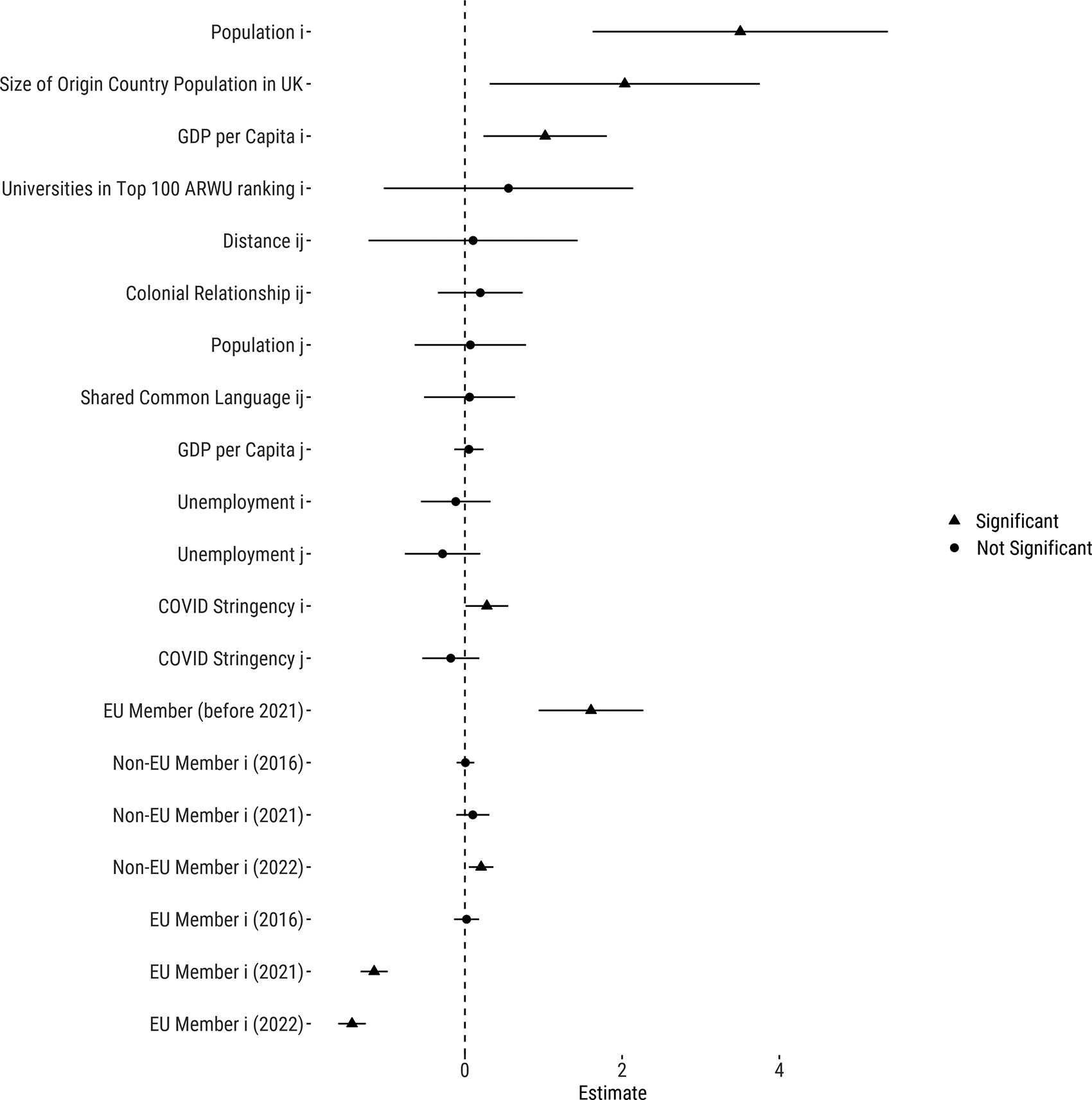
Results for the UK pandemic stringency have a negative but not statistically significant relationship with applications of international students, while origin country stringency has a small but positive and statistically significant relationship with applications. These results are intriguing given the limitations on mobility at this time, however, it could be argued that students may have sought the opportunity to move abroad for the university as a means to leave countries with higher stringency COVID-19 restrictions. As we are considering applications and not flows, these results give us a picture of how many students still intended to enroll in a UK HEI despite limits on traveling. However, the impact of the pandemic is small compared to changes as a result of the UK’s withdrawal from the EU. We also see evidence that countries not impacted by Brexit continued to increase their applications in 2021 and 2022.
The results also point to the importance of the population size of the origin country, the size of the origin country’s population in the UK (diaspora), and GDP per capita of the origin country in influencing larger numbers of applications into UK universities with positive and statistically significant relationships across these variables. We can infer that wealthier countries with stronger ties to the UK will tend to send larger numbers of applicants and therefore be more resilient to external shocks. We also see a negative, but not statistically significant relationship, between unemployment rates of the UK and applications, signaling that employment prospects are important for international applicants to UK HE.
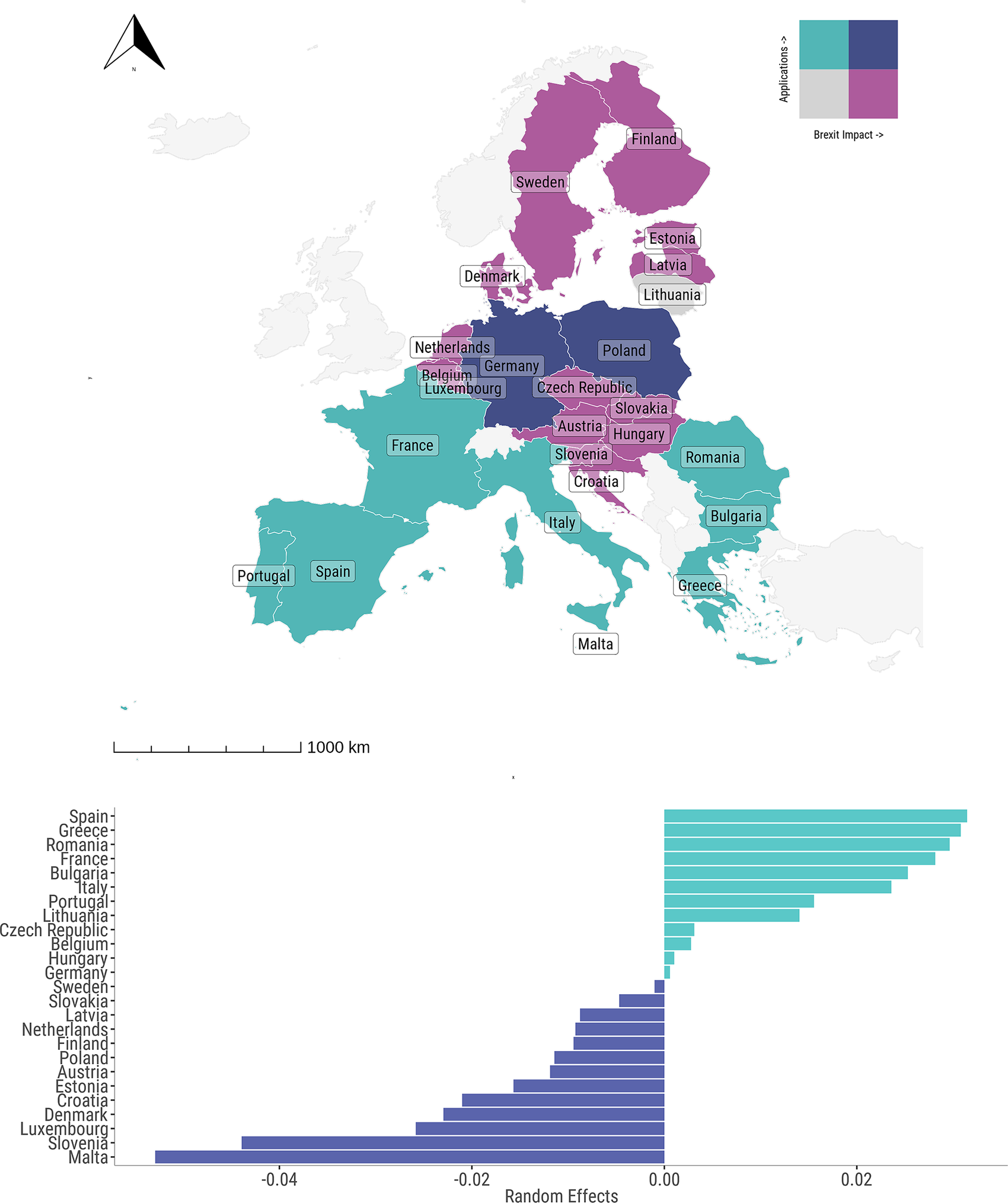
We also consider how the difference-in-difference indicator varies by country of origin by extracting and plotting the random effects. Extracting the random effects allows us to understand the differentiated effects of Brexit in different countries of origin. Figure 4 depicts the relative impact of Brexit on students from different EU countries against their average number of applications prior to 2020. Although all countries are negatively impacted by Brexit, the extent of this impact is heterogeneous. We see that Poland and Germany (dark blue) experienced the greatest impact of Brexit, given that they had previously sent high numbers of students to the UK, and the impact of the DID indicator is greater. These results are interesting given that Germany offers free higher education to its citizens. For Poland, it is interesting in that this is a country typically prejudiced by anti-EU sentiment, and one where students surveyed claimed they felt the UK was too expensive and less welcoming as a result of Brexit. These results signpost what countries could be of particular concern for a longer-term decline. On the other hand, we see that some countries that had tended to send high numbers of students to the UK, such as France, Spain, Portugal, Italy, Romania, Bulgaria, and Greece, were less impacted, signalling where there could be future recovery.
Distribution of random effects from DID estimator (impact of Brexit) and mean count of applications for each EU origin country before 2020.
5.2. Relationships by Institution Type and Subject
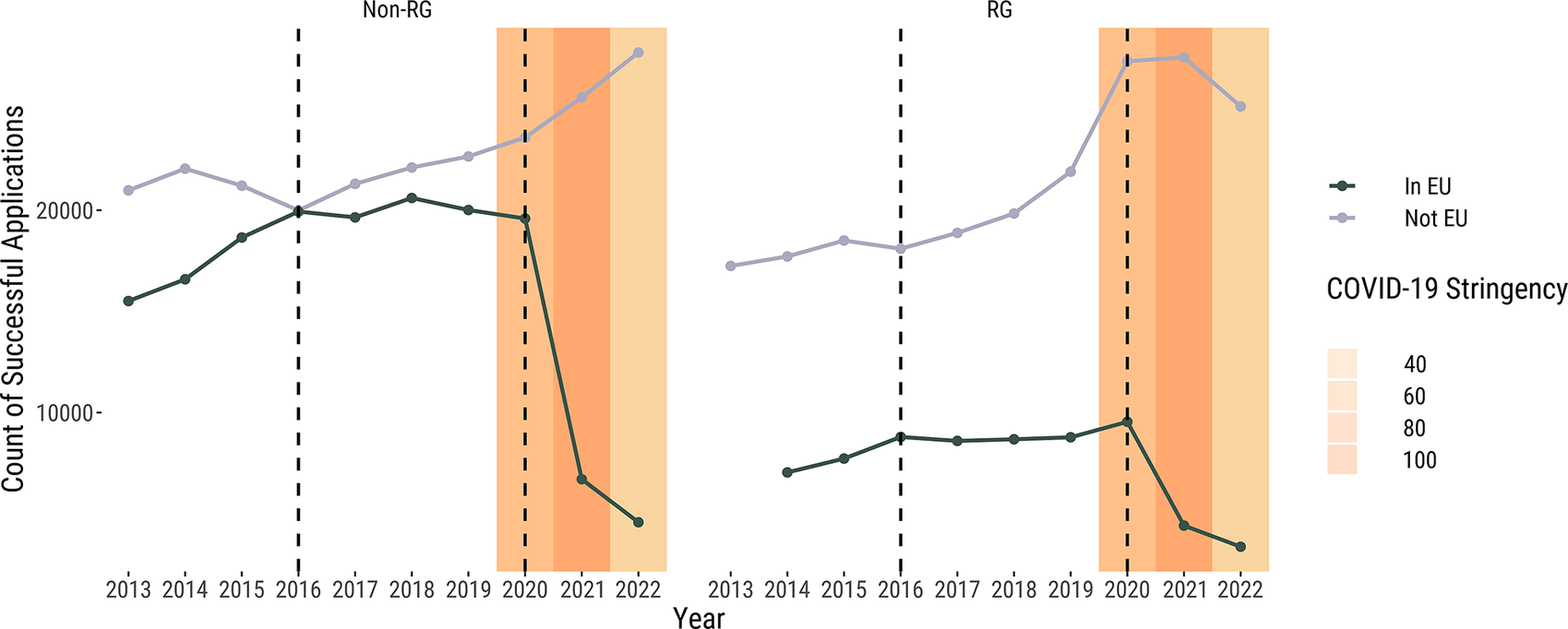
We additionally analyzed the impacts of the end of free movement on international student applications across different institutions and a number of subject groups. The results show a systematic reduction in the number of student applications from EU member countries across all five subject groupings and both types of institutions. Figures 5 and 6 show the trends for different types of institutions and subject groups between 2012 and 2022, respectively, including the relative COVID-19 stringency in 2020, 2021, and 2022.
Trends of successful applications into Russell Group and Non-Russell Group UK universities from EU and non-EU countries between 2012–2022 with COVID-19 Stringency.
Trends of successful applications into different subject groupings at UK universities from EU and non-EU countries between 2012–2022 with COVID-19 Stringency.
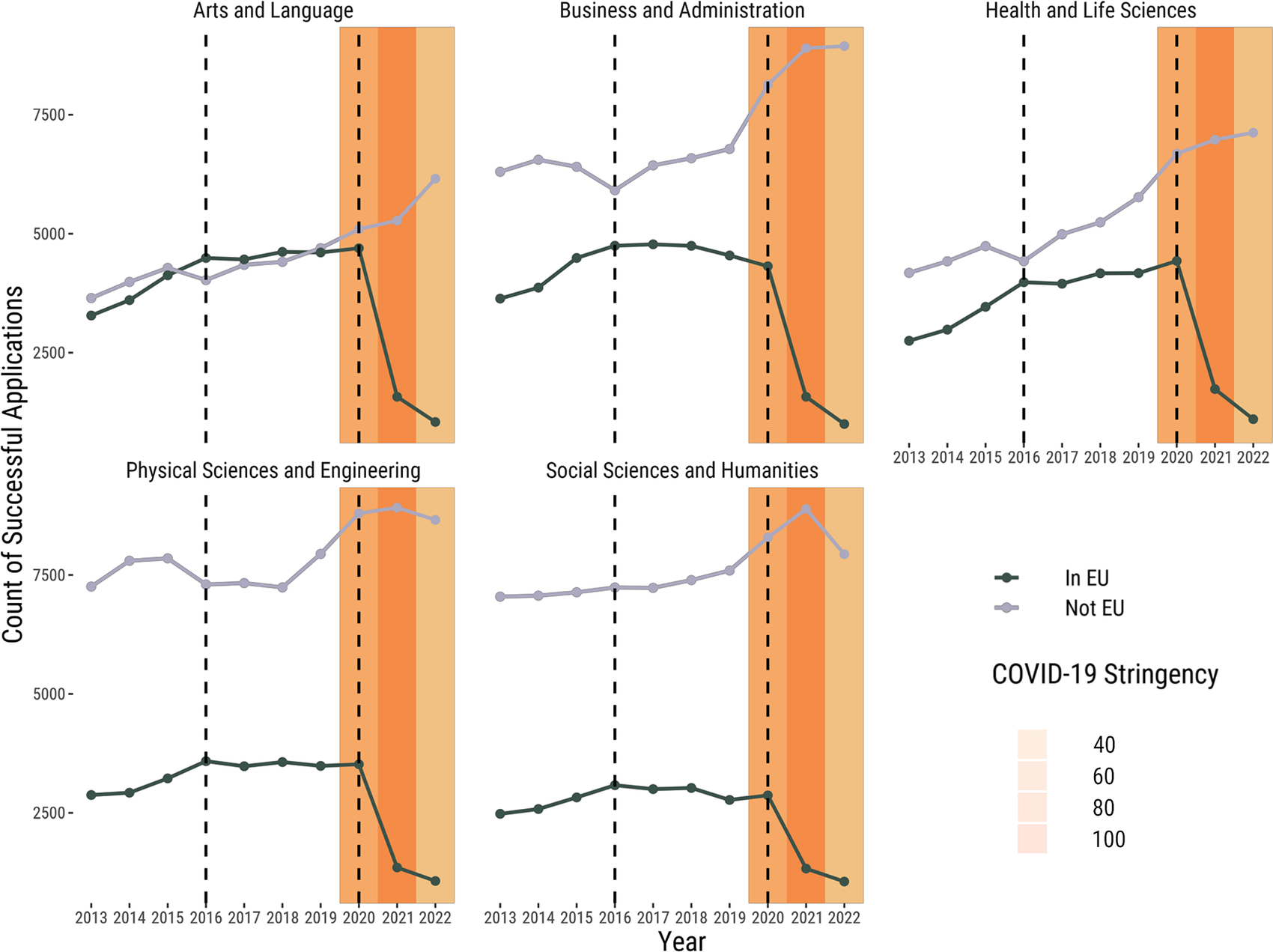
Figure 5 shows the trends for Russell Group and non-Russell Group institutions and the decline in applications for EU students in the 2021 academic year. We can see that, typically, Russell Group institutions had attracted, on average, many more EU students than non-EU students, while non-Russell Group institutions attracted more non-EU students but by a smaller margin.
Figure 6 shows that although the trends up until 2021 vary for EU and non-EU countries, we see that in all cases there is a large decline in EU students at the commencement of the 2021 academic year. In some instances, such as Arts and Languages and Health and Life Sciences, EU and non-EU countries sent roughly similar numbers of students before withdrawal. However, in other cases such as Social Sciences and Humanities, Physical Sciences and Engineering, and Business and Administration, there had been a larger gap between EU and non-EU countries. These gaps are important as they signal where subject areas may struggle more when faced with a large loss of EU students.
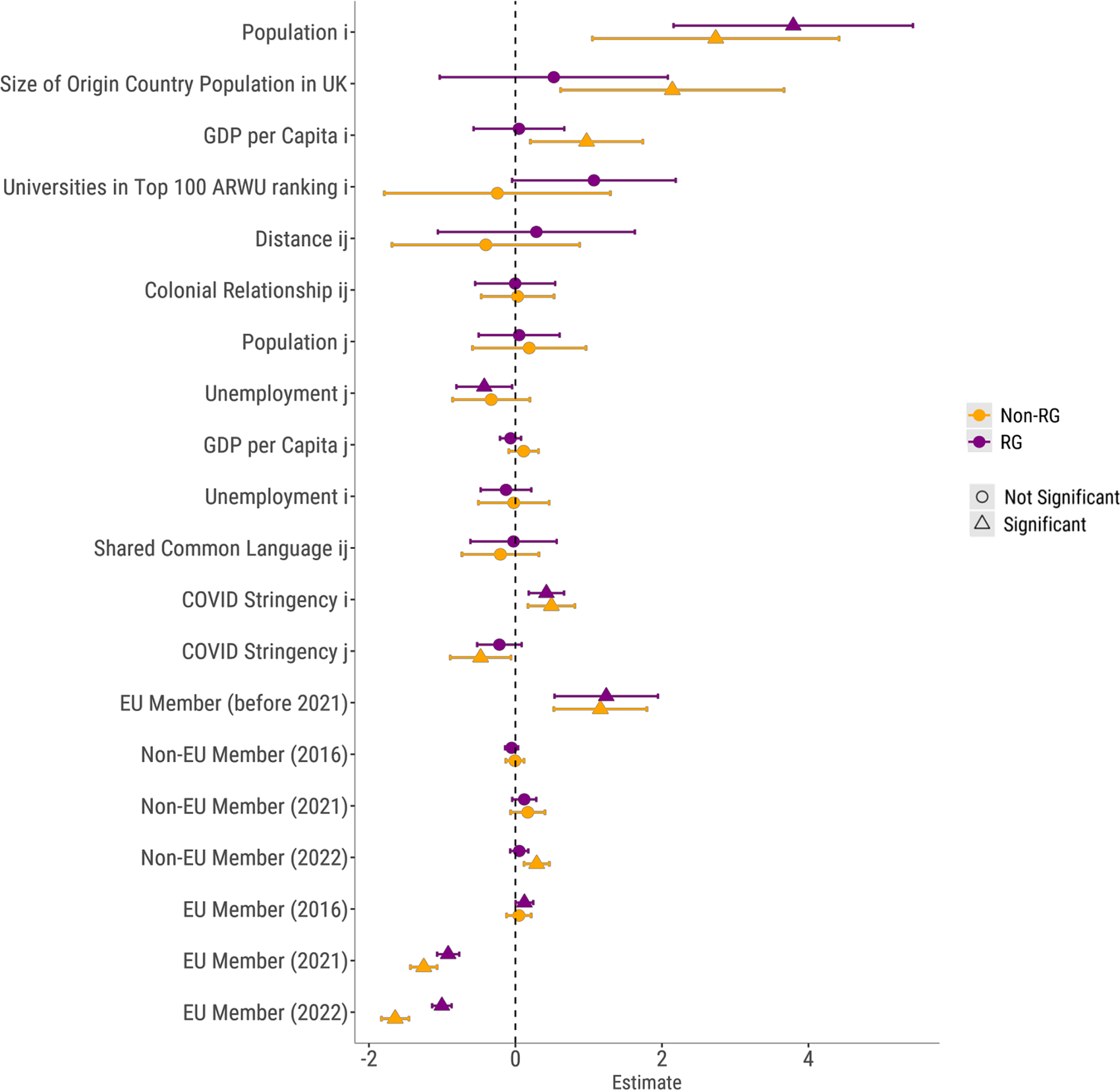
Figures 7 and 8 display our modeling estimates by different types of institutions and subject groups, respectively. Patterns of decline post-2021 tend to be systematic across all institutions and subjects, however, some suffered more than others. Modelling estimates shown in Figure 7 indicate that non-Russell Group institutions were more affected by UK withdrawal (80% decline of 490 students on average) than Russell Group institutions (60% decline of 350 students on average) when controlling for pandemic restrictions. Figure 7 shows a similar picture for subjects, whereby all subjects were negatively impacted, with Social Sciences and Humanities being affected slightly less than any other subject area. These results point to limited heterogeneity in the influence of Brexit across different subject areas, but that the effect of Brexit was not limited to specific institutions or subject types.
Coefficients for Difference-in-Difference Multilevel Negative Binomial Model (M3) showing influence of factors at the origin (i), destination (j), and bilaterally between both (ij) on the number of successful UCAS applications. EU member (i) (2016) and EU Member (i) (2020) and EU Member (2021) relate to difference-in-difference coefficients in each respective year in Russell Group and non-Russell Group institutions.
Coefficients for Difference-in-Difference Multilevel Negative Binomial Model (M3) showing influence of factors at the origin (i), destination (j), and bilaterally between both (ij) on the number of successful UCAS applications. EU member (i) (2016) and EU Member (i) (2020) and EU Member (2021) relate to difference-in-difference coefficients in each respective year in different subject groups.
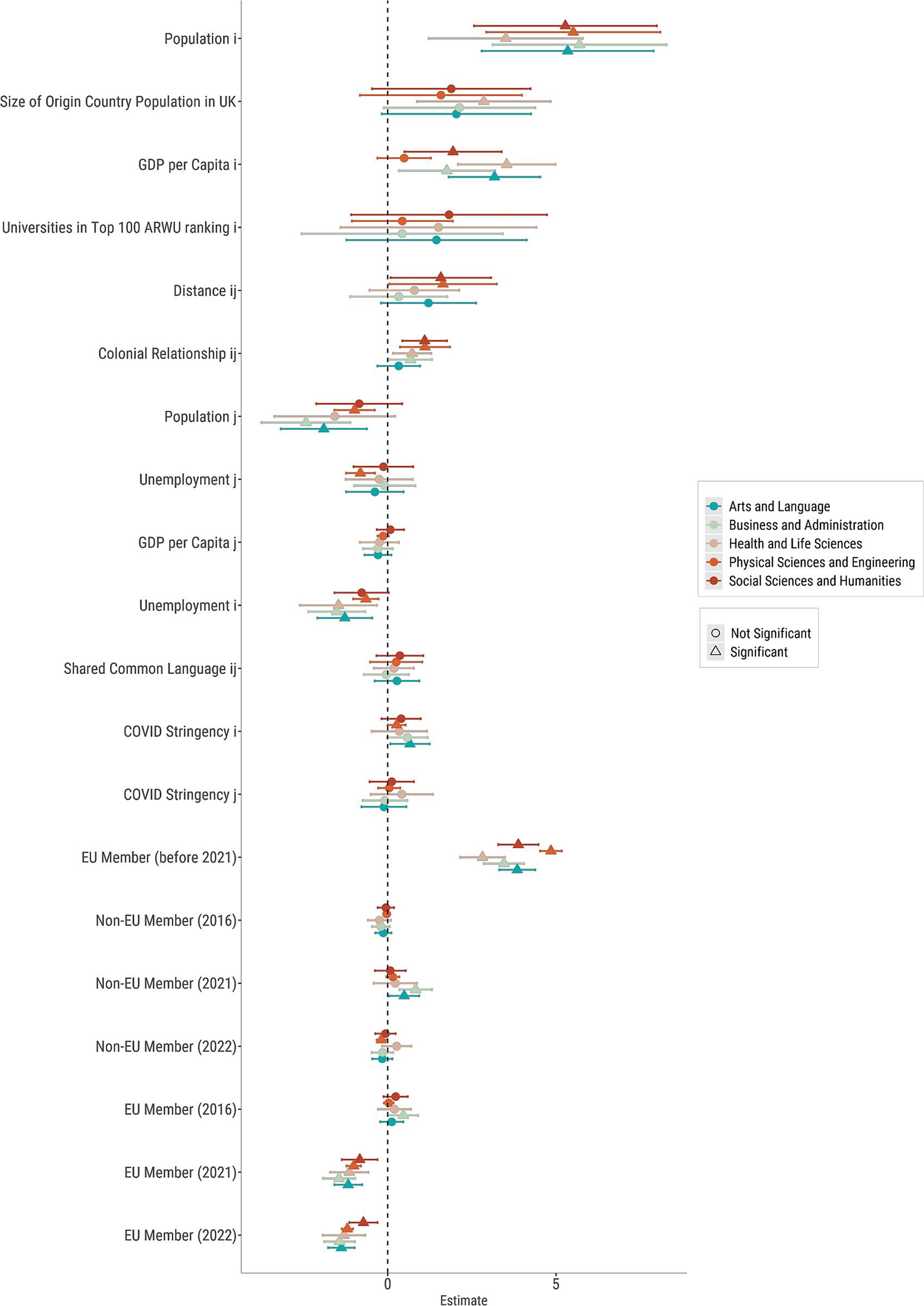
Results for UK pandemic stringency similarly show limited evidence of heterogeneity, except for Physical Sciences and Engineering, Health and Life Science, and Social Sciences and Humanities, where we see a not statistically significant increase in applications when UK stringency is higher. However, the effect of higher rates of COVID stringency in the country of origin leads to greater applications in all cases.
We can uncover heterogeneity in the influence of other key factors across Russell Group and non-Russell Group institutions. The results show that applicants to non-Russell Group institutions tend to come from countries with a larger origin country population in the UK and a higher GDP per capita. It is also interesting to note that in these cases, larger distances are less of a deterrent, perhaps pointing to a trade-off between connection and distance. Further, we see some heterogeneous relationships across subjects. Applicants from Health and Life Science are most influenced by the size of the origin country population in the UK and tend to come from higher GDP per capita countries. Students applying for Physical Sciences and Engineering are the most deterred by higher rates of UK unemployment.
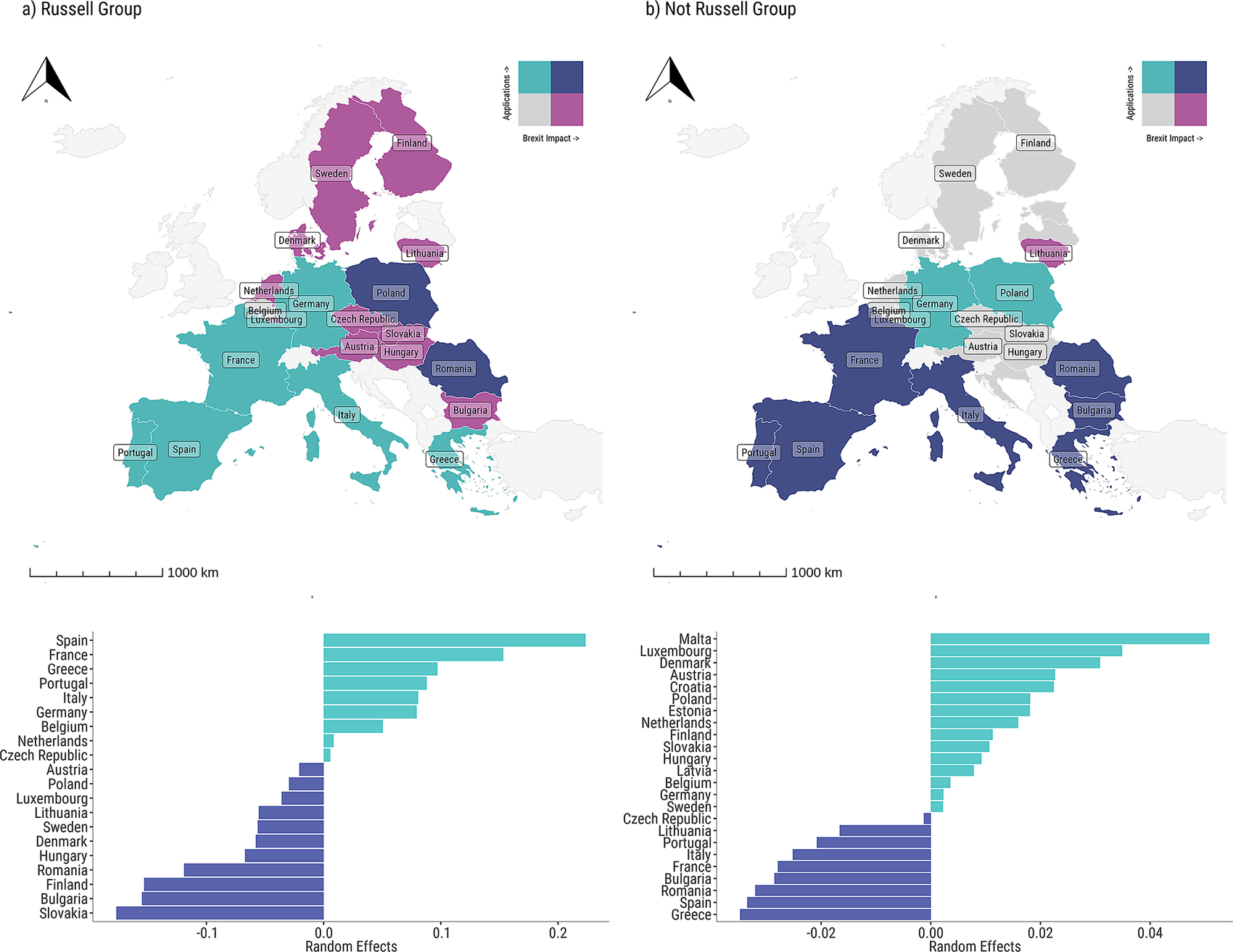
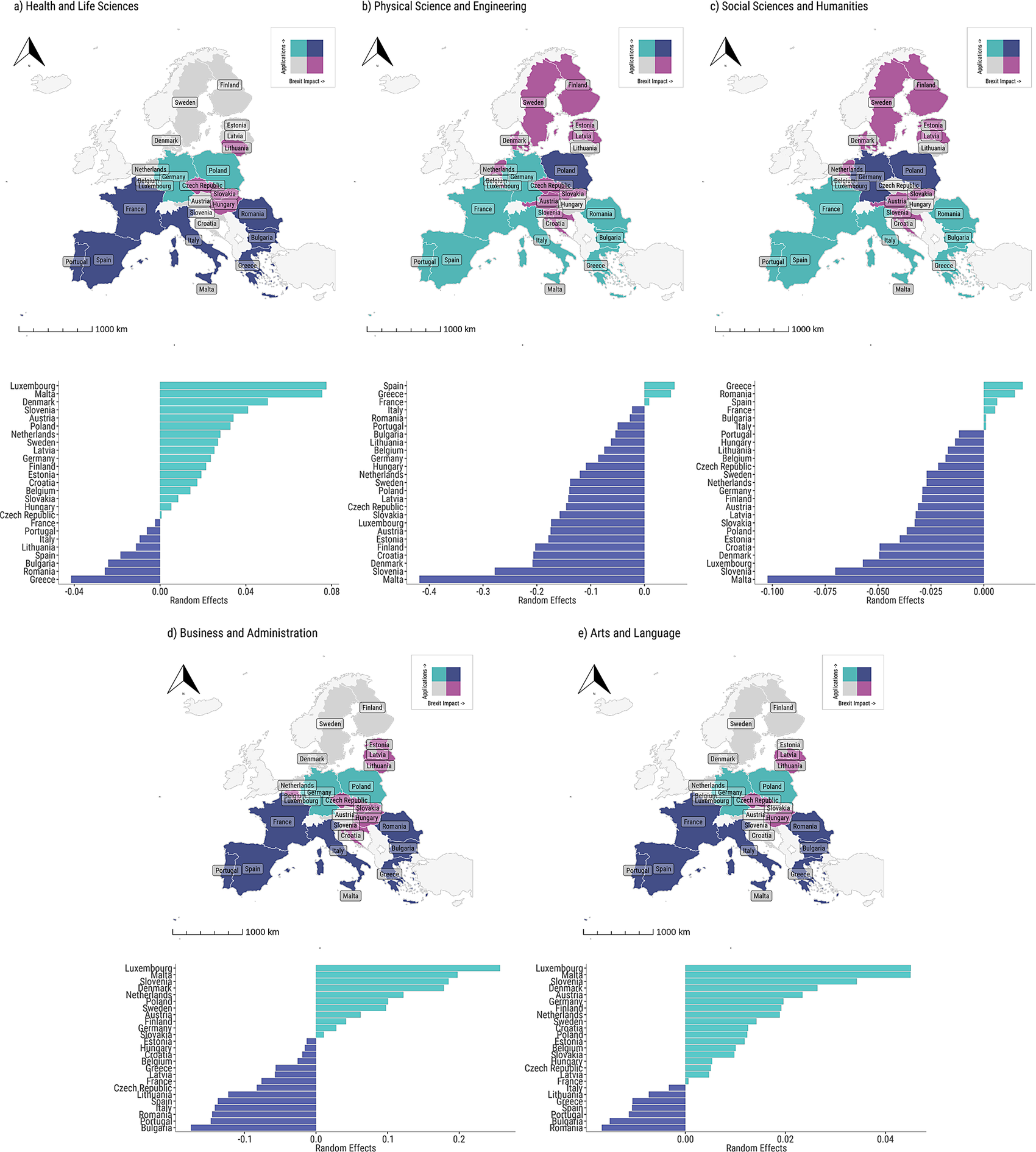
We also consider how DID indicator varies by country of origin by extracting and plotting the random effects, as shown in Figures 9 and 10. By extracting these random effects, we do see notable heterogeneity in the impact of Brexit in different countries of origin. Figure 9 shows how the impact varies for Russell Group and non-Russell Group applications, showing an almost inverse relationship. For non-Russell Group applications, there are a greater number of countries acutely impacted by Brexit when compared to Russell Group applications. While the Russell Group institutions appear to be more resilient against declines from Western European countries, non-Russell Group institutions suffer more systematic declines. These results signal the increased resilience to external policy shocks for Russell Group institutions versus their non-Russell Group counterparts. We also see substantial heterogeneity across subject areas as shown in Figure 10, with Health and Life Sciences and Arts and Languages being particularly negatively impacted across a larger number of EU countries. On the other hand, severity is more concentrated in a smaller number of countries for all other subject areas. Evidence of more widespread severity is important as it signals declines from a larger number of markets, which may have more long-lasting or difficult effects for some types of institutions and subject groups.
Distribution of random effects from DID estimator (impact of Brexit) and mean count of applications for each EU origin country before 2020 for Russell Group and non-Russell Group institutions.
Distribution of random effects from DID estimator (impact of Brexit) and mean count of applications for each EU origin country before 2020 for different subject groups.
6. Discussion and Conclusion
This paper has explored the impact of Brexit, while controlling for the COVID-19 pandemic and other key factors related to international student mobility, on the applications of international students into UK HEIs. We examined how these impacts varied by institution type, subject, and country of origin using a DID approach and multilevel modeling.
The results support most of our hypotheses. First, we hypothesised that there would be a decline in EU student applications as a result of Brexit. Our results confirm a sharp decline in EU student applications in 2021 and again in 2022, with a 65% decline in successful applications. This supports the hypothesis that Brexit and the associated costs have led to a significant reduction in applications from EU students.
Second, we hypothesised that higher rates of COVID-19 stringency would have a deterring effect on international student applications. Our analysis shows that UK pandemic stringency rates had a negative but not statistically significant relationship with international student applications. In contrast, higher COVID-19 pandemic stringency in the students’ country of origin was associated with a small but statistically significant increase in applications. These findings partially support the hypothesis, indicating that while UK restrictions did not significantly deter applications, stricter restrictions in the origin country led students to seek opportunities abroad.
Third, we expected the decline in EU student applications to be greater for non-Russell Group institutions and STEM subjects. Our findings do confirm that non-Russell Group institutions experienced a more significant decline (around 80%) in EU student applications compared to Russell Group institutions (around 60%). Additionally, the data show systematic reductions across all subject groups, with notable declines in Health and Life Sciences and Arts and Languages. This somewhat supports our hypothesis, showing that less prestigious institutions faced more substantial declines, but not necessarily STEM subjects in particular.
Finally, we anticipated that the most substantial declines in applications would be from Eastern and Central European countries. The results reveal that countries like Poland and Germany experienced the greatest declines, which somewhat aligns with our hypothesis. These countries, which had previously sent large numbers of students to the UK, saw significant reductions post-Brexit. However, some countries, like France, Spain, Portugal, Italy, Romania, Bulgaria, and Greece, were less impacted, indicating heterogeneous effects across different EU countries, but that these are not related to a specific region. Furthermore, when looking at types of institutions specifically, we saw particularly large declines from Eastern and Central European countries into Russell Group institutions compared to their Western European counterparts.
These findings have important implications for policymakers and educational institutions. Given the considerable decline in the number of EU students, policies are needed to attract students from new markets or encourage EU students to study in the UK. Some universities, such as Royal Holloway and the University of Portsmouth, have begun offering reduced fees to match UK student fees for EU students (Royal Holloway, 2021; The University of Portsmouth, 2021). Quantifying the decline in EU students helps evidence the need for such policies for some institutions.
Furthermore, institutions and subject areas that are more affected by these negative changes should develop new recruitment strategies. For example, they could focus on markets with stronger ties to the UK or those with higher GDP per capita. The pandemic has ultimately introduced new dynamics in student mobility, suggesting that students sought to leave countries with higher restrictions. Understanding these trends can help institutions better navigate future external shocks.
While this study provides valuable insights, there are several limitations and areas for future research. Our analysis is based on data up to 2022. As more data becomes available, it would be important to examine whether these declines are permanent or if there will be a bounce-back in EU student applications. Additionally, future research should consider competitor countries to understand where EU students are going instead of the UK. This will help in assessing the elasticity of demand for UK higher education.
More broadly, the social impacts of Brexit and other populist political policies on international students is an important route to explore further. Not only is the case for EU students, but also other international students if discrimination is present or economic situations change. In recent months, the last Conservative UK government has begun rolling out further restrictive policies on international student mobility with a view to reduce UK net migration. These policies include preventing switching from student to work visas until the study is complete, increased reviews of available funds of potential students, and limits on dependents Reference Bharadwaj2010. Considering international student response to policy is of increasing importance as the policy environment changes.
Our research has provided a useful and novel insight into the demand for UK higher education and how different countries have responded to the end of free movement when controlling for pandemic restrictions. The findings highlight the significant loss of EU students and the need for targeted policies and recruitment strategies to mitigate these declines. With more turbulence on the horizon, thinking about different countries’ relationships with the UK and the impact of wider social and economic costs will become increasingly important.
Ultimately, the impact of the end of free movement has led to a significant loss of EU students into UK HEIs, which will in turn reduce diversity and take away a richness from the student experience and the wider economy post-graduation. It has been important to consider this decline and the factors associated with it, and it will become ever more important to continue to monitor these changes over time. International students’ responses to wider cultural and economic issues are a relatively understudied field, and future research should begin to consider the impacts of political decisions and cultural changes on their behavior.
Data availability statement
The data that support the findings of this study are available from UCAS. Restrictions apply to the availability of these data, which were used under license for this study. Data are available from the author(s) with the permission of UCAS.
Author contribution
Conceptualization: R.N; F.R. Methodology: R.N; F.R. Data curation: R.N. Data visualization: R.N. Discuss results: R.N, F.R, A.S. Writing original draft: R.N. Revised manuscript: R.N; F.R; A.S. Supervision: F.R, A.S All authors approved the final submitted draft.
Funding statement
This research was supported by grants from the Economic and Social Research Council (ES/P000401/1).
Competing interest
The authors have no competing interests to declare.
Ethical standard
The research meets all ethical guidelines, including adherence to the legal requirements of the study country.


 Open access


Comments
No Comments have been published for this article.