





1. Introduction
Interpreting is a complex and intense bilingual task, in which both languages involved are highly activated, and the rapid translation from the source language (SL) to the target language (TL) has to be carried out under extreme time pressure. To ensure that the SL does not interfere during TL production, language control is a necessary cognitive task, and to ensure that the SL-to-TL translation be carried out successfully, processing control is also critically needed. Both types of control are therefore essential parts of cognitive control for interpreting (i.e., “interpreting control”). However, the issue of language control in interpreting (Paradis, Reference Paradis1994; Grosjean, Reference Grosjean1997; Christoffels & de Groot, Reference Christoffels, de Groot, Kroll and de Groot2005; de Groot & Christoffels, Reference De Groot and Christoffels2006) and the one of processing control (e.g., Darò & Fabbro, Reference Darò and Fabbro1994; Gile, Reference Gile1995/2009; Reference Gile, Pöchhacker and Shlesinger1997/2002) have been examined in isolation in the literature (except for de Groot, Reference De Groot2011, which took both into consideration in a review). In this paper, we propose a model to account for both types of control in interpreting.
What distinguishes interpreting from general bilingual processes? First, it is the frequency and regularity of switching between two languages. In a monolingual or general bilingual situation, the bilingual speaker chooses which language to use and may have to inhibit the other language, especially when it is the stronger language (e.g., Green, Reference Green1998). More often than not, a bilingual speaker sticks to just one language to achieve a specific communication purpose, and switches to another language when communication in that language is no longer efficient (e.g., appropriate words not available) or practicable (e.g., switching to a listener who does not understand that language well). In a situation of interpreting, however, the interpreter does not choose a language to speak; instead, he or she has to follow the predetermined direction of translation: expressing in the target language whatever messages received in the source language. The direction of translation (with the TL primed by the SL) must be encoded in a task schema, with “task schema” referring to “networks detailing action sequences” (Green, Reference Green1998:68). Typically, an interpreter has to alternate between listening to one language and speaking in another language every few minutes in consecutive interpreting and almost simultaneously in simultaneous interpreting. In a word, compared with the general bilingual speaker, the interpreter switches between two languages more frequently and more regularly, with features of a switch such as its direction and duration often predetermined and anticipated. Second, interpreting, as compared with general bilingualism, demands high multi-tasking. Widely recognized in the literature (e.g., Chernov, Reference Chernov, Lambert and Moser-Mercer1994; Strobach, Becker, Schubert & Kühn, Reference Strobach, Becker, Schubert and Kühn2015), this multi-tasking feature is formulated in the Effort Models of Gile (Reference Gile, Pöchhacker and Shlesinger1997/2002), according to which coordination during interpreting is an effort to deal with the multi-tasking requirement. Specifically, for simultaneous interpreting (SI), SI = L (“listening”) + P (“production”) + M (“memory”) + C (“coordination”). For the input phase of consecutive interpreting (CI): CI (listening) = L (“listening”) + M (“memory”) + N (“note-taking”) + C (“coordination”), and for the output phase of CI: CI (reformulation) = Rem (“remembering”) + Read (“note-reading”) + P (“production”).
Current models of bilingual control (e.g., Green, Reference Green1998; Green & Abutalebi, Reference Green and Abutalebi2013; see Grant, Legault & Li, Reference Grant, Legault, Li and Schwieter2018 for a recent review) have been based on general bilingualism rather than interpreting situations, and therefore cannot adequately account for issues of language control and processing control in interpreting. Although the Adaptive Control Hypothesis (Green & Abutalebi, Reference Green and Abutalebi2013) has rich implications for interpreting control, it is still a general account of bilingual control and does not take into considerations the specific features of interpreting, such as the regularity of switching and the multi-tasking feature. In this paper we propose an attentional control model to account for language and processing control in both consecutive interpreting and simultaneous interpreting, considering the specific features of the interpreting task as discussed above. We aim at a framework that may explain better relevant empirical findings about processing in interpreting, which could also shed light on general bilingual control.
Attention enables us to allocate limited cognitive resources to the most immediate tasks in the environment (Carrasco, Reference Carrasco2009), and attentional control chooses what to pay attention to and what to ignore. Low attentional control is often associated with a variety of symptoms such as ADHD (attention deficit hyperactivity disorder), autism, anxiety and depression, Down Syndrome, Williams Syndrome, schizophrenia, Alzheimer's disease, and PTSD (Posttraumatic stress disorder). In the case of language processing, attention deficit is related to reading disorders (Pavlidis, Reference Pavlidis1981), specific language impairment (Finneran, Francis & Leonard, Reference Finneran, Francis and Leonard2009), and aphasia (Tseng, McNeil & Milenkovic, Reference Tseng, McNeil and Milenkovic1993). In other words, adequate attentional control is essential for everyday life cognitive performance, including language use and processing. Although executive attention and attention management have been terms used in some previous studies on processing control in interpreting (e.g., de Groot, Reference De Groot2011) and bilingual language control (e.g., Bialystok, Reference Bialystok2017), there has been no systematic research that integrates the concept of attentional control to account for control processes in the complex bilingual task of interpreting.
In cognitive psychology, “focused attention” and “divided attention” are two important aspects of attention (e.g., Eysenck & Keane, Reference Eysenck and Keane2000). Focused attention (sometimes also referred to as “selective attention”, e.g., Eysenck & Keane, Reference Eysenck and Keane2000; Diamond, Reference Diamond2013) is studied by presenting people with two or more stimulus inputs at the same time and asking them to respond to only one, while divided attention typically involves tasks in which participants are asked to attend to and respond to all the stimulus inputs at the same time. The use of focused attention or divided attention (i.e., whether to attend to only one of the stimuli or all of them) is determined by “goal-driven or top-down attentional control processes” (Eysenck & Keane, Reference Eysenck and Keane2000:120). In the study of visual focused attention, Posner and Petersen (Reference Posner and Peterson1990) proposed a theoretical framework to account for various disorders in visual attention. This framework is highly relevant to our discussion of interpreting here because it consists of engagement, shifting, and disengagement of attention. With regard to divided attention, Eysenck and Keane (Reference Eysenck and Keane2000) illustrated three main factors that can influence multi-tasking performance: task similarity (e.g., more demanding when using the same modality), practice (e.g., practice reducing demands on attentional resources) and task difficulty (e.g., more difficult task requiring more attentional resources). In addition, the cognitive resource demands for two tasks performed together are more than the sum of demands of the two tasks performed separately because coordination is needed to distribute appropriate attentional resources to each task. These perspectives from cognitive psychology on attention have provided us with a good basis to examine language and processing control in interpreting.
In what follows, we first propose that language control in interpreting is achieved by the dual mechanism of (a) a structural framework of language-modality connections (as the task schema) and (b) focused attention that helps establish the task schema in the first place. We then propose that processing control in interpreting is achieved by the dual mechanism of (a) divided attention and (b) language processing efficiency. Finally, we integrate the two specific proposals in a general attentional control model, and discuss implications for general bilingual control.
2. Language control in interpreting
2.1 Previous accounts and their limitations
The nature of the interpreting task poses an important question on language control: how can the interpreter avoid interference from the SL during TL production? There are three main proposals in the literature. The first proposal (Paradis, Reference Paradis1994) is based on the idea of differential activation in the two languages: the threshold of the SL is set higher than the threshold of the TL so that only TL elements are produced. The second proposal, according to Grosjean (Reference Grosjean1997), is that a language control model in interpreting should have input and output components, such that the TL output is highly activated, while the SL output is deactivated, thus prohibiting SL interference during TL production. Both SL and TL input components are activated, although the activation of SL is higher than that of TL, allowing the interpreter to monitor his or her own words. The third proposal is by Christoffels and de Groot (Reference Christoffels, de Groot, Kroll and de Groot2005), according to which there are separate input and output lexicons and differential activation of language subsets. Figure 1 sketches the relationship between the four lexicons (input lexicon: source and target; output: source and target), and the translation routes (deverbalization by conceptual representation, and transcoding by semantic representation). Compared with the second proposal, this third proposal situates language control in the context of translation routes by a diagram so that the differential activation of the language subsets becomes more specific and meaningful.
Language control in simultaneous interpreting (Christoffels & de Groot Reference Christoffels, de Groot, Kroll and de Groot2005). Different lexicons are activated to different degrees to ensure successful rendition (i.e., source language comprehension and target language production, monitoring of ones’ own speech, and no interference from source language during target language production).

The above views are important in the development of theoretical accounts of language control in interpreting, but there are limitations in each of them. For example, one problem with Paradis’ (Reference Paradis1994) view is that SL comprehension may be impeded because of the assumption of a higher threshold. This problem is largely avoided in the other two views (Grosjean, Reference Grosjean1997; Christoffels & de Groot, Reference Christoffels, de Groot, Kroll and de Groot2005) because of the separation of input and output components for each language. As illustrated in Figure 1, the input source lexicon and the output target lexicon are equally activated to a maximum to ensure successful SL comprehension and TL production. However, the assumption of differential activation or thresholds in these models (e.g., see the different shades of color in Figure 1) seems not very adequate to account for language control in interpreting. First, differential activation depends on the interpreter's language proficiency in the two languages. It is rarely the case that a bilingual is equally proficient in the two languages along every aspect of language processing, and the SL could be either the dominant or the weaker language. Some control mechanism is therefore needed to adjust the relative activation of SL vs. TL components during interpreting. Second, the frequency and regularity of switching between the two languages in interpreting, as analyzed above, suggest that the connections between the different components in Figure 1 are probably more important for language control in interpreting. The control mechanism of focused attention and the structural framework of language-modality connections that we are to propose in this paper are intended to fill these two gaps.
Research for general bilingual language control has implications for the issue of language control in interpreting. Evidence for models in bilingual control is largely based on two categories of experiments. First, experiments on bilingual lexical processing have shown that the bilingual's two lexicons are non-selectively activated even in a monolingual mode (e.g., Van Heuven, Dijkstra & Grainger, Reference Van Heuven, Dijkstra and Grainger1998), and therefore the important issue is how we inhibit the other language not needed in the situation or at the moment. Second, experiments with language switching have shown that switching to the stronger language is more difficult than to the weaker language (e.g., Kolers, Reference Kolers1966; Macnamara, Reference Macnamara1967). This asymmetry in switch cost, contrary to our intuition, is considered typical evidence for inhibition-based accounts of bilingual control, for example, the Inhibitory Control Model (Green, Reference Green1998). This evidence has been challenged (see Declerck & Philipp, Reference Declerck and Philipp2015, for a review of models for bilingual control). A recent study (Philipp & Koch, Reference Philipp, Koch and Schwieter2016) found that in language-switching tasks (digit-naming in either L1 or L2), the typical asymmetry in switch cost disappeared if the previous trial was not overtly articulated, suggesting the importance of articulation-related processes for language-switch costs. In other words, it is the process of overt articulation that leads to the asymmetry in switch costs, indicating that overt articulation plays a critical role in hampering swift switch to articulation in another language. This finding about the role of overt articulation in language control is consistent with the modality effects discussed in Emmorey, Giezen and Gollan (Reference Emmorey, Giezen and Gollan2016). According to Emmorey and colleagues, compared with unimodal bilinguals, bimodal bilinguals (bilinguals in an oral language and a sign language) may experience fewer demands on language control because of the absence of perceptual and articulatory competition at the phonological level. Taken together, these studies suggest that for the issue of language control in interpreting, overt articulation in the target language in interpreting is probably very critical. The importance of overt articulation is to be shown in the language-modality connections we are to propose in the next section.
2.2. Structural account of language control: language-modality connections
We propose that language control in interpreting is mainly achieved by the language-modality connections established in the practice of interpreting (with interpreting characterized by frequent and regular switches). In a specific interpreting task, one of the two languages is connected to a certain input modality, mostly the auditory modality (as the source language), while the other is connected to a certain output modality, mostly the vocal modality (as the target language). Training or experience in a certain mode of interpreting establishes the language-modality connections required for that mode of interpreting, and the connection pattern is then stored as a task schema (i.e., “networks detailing action sequences”, Green, Reference Green1998:68). Figure 2 is an illustration of these connections.
A structural account of language control in interpreting.

Here is an example for the common mode of oral interpreting from L2 to L1:
(1) The auditory-L2 connection prepares the interpreter to receive and anticipate L2 input in the auditory modality and to focus on L2 input, especially in simultaneous interpreting. Anticipating input helps save the interpreter's attentional resources for other task components (e.g., TL production, taking notes, memorizing). Because of this training or experience at anticipation or prediction, interpreters are generally considered experts in prediction during language comprehension (e.g., Setton, Reference Setton, Gerzymisch-Arbogast and Van Dam2005). In addition, good comprehension of the SL is a prerequisite for quality TL production, but it has been found that simultaneously translating what is heard reduces one's sensitivity to errors in TL output (e.g., Fabbro & Darò, Reference Fabbro and Darò1995), a result of the interpreter's effort to concentrate on L2 input.
(2) The L2–L1 connection requires the interpreter to transcode or deverbalize L2 messages in L1, thus prohibiting repetitions of L2 input. This connection ensures the switch from the input language to the output language, either through transcoding (i.e., keeping SL lexico-semantic features when they are not consistent with corresponding TL features such as word order) or deverbalizing (aiming at transmitting conceptual messages and adopting TL features when SL features are not consistent). During the process of interpreting, the two languages must be in an active state, but it does not mean that each word is highly activated. When an L2 word comes in, it may directly and automatically activate its L1 translation equivalent, which needs little attention and saves resources (Dong & Lin, Reference Dong and Lin2013). But in most cases, the translation of messages requires efforts. In rare cases, the SL expression may be reproduced (together with an explanation in the TL) when the TL expression is not available, which is considered a strategy and not an SL interference (e.g., Bartłomiejczyk, Reference Bartłomiejczyk2006).
(3) The L1–vocal connection channels the L1 message to the vocal modality and prepares the vocal modality only for the L1, thus further excluding repetitions of the L2 input. As introduced above, Philipp and Koch (Reference Philipp, Koch and Schwieter2016) found that the typical asymmetry in switch cost disappeared if the previous trial was not vocalized, suggesting that the vocalization of one language hampers swift switch to the vocalization of another language. Applying this finding to an interpreting situation, we may infer that, while vocalizing in the TL, the interpreter does not switch easily to speaking in the SL (unless the interpreter could not find the TL expression in rare cases).
(4) The auditory–vocal connection ensures the flow of messages from auditory to vocal. Formed during language learning early in life (e.g., listening to adults’ speech and mimicking their utterances; simple dialogues), this input-output modality connection is considered compatible and strong (when compared to other connections such as auditory-manual) (e.g., Stephan & Koch, Reference Stephan and Koch2010). It optimizes or harmonizes the operation of the two modalities. In addition, the auditory-vocal connection must be particularly strong for even a novice interpreter, because an interpreting task essentially consists of repeated turns of listening (to messages in the auditory modality) and speaking (delivering the messages in the other language).
Thus, the above set of four connections, once established with training or experience (e.g., oral interpreting from L2 to L1), are stored as a task schema (as used in Green, Reference Green1998), and will work to ensure that no SL words would interfere in TL production. Apart from SL words, other forms of SL interference in TL production may include certain sentence structure interferences (e.g., word orders that are different in SL and TL), such that the SL structure may be used in the TL output, which is often considered acceptable as transcoding (vs. deverbalization; de Groot, Reference De Groot2011; Dong & Lin, Reference Dong and Lin2013). We may therefore conclude that similar to language control in general bilingual processing, language control in interpreting may also involve competitions and inferences from SL words or structures. If the above set of connections are not well established, or if one of the connections has to change during the process of interpreting (e.g., changing direction of interpreting), interpreters would have to spend more time establishing the connections, which would result in more disfluency or inaccuracy.
There may be variations in the pattern of language-modality connections. First, the input–output modality combination may vary. Although the auditory–vocal connection is probably the strongest in the interpreting task schema, in principle, the input language can be presented auditorily or visually, and the output language can be vocal or manual. For example, the auditory–manual connection is established in sign-language translation, and the visual–vocal connection in sight translation (with written text as input). The mode of interpreting with visual input and manual output is rare in reality, although the visual–manual connection is common for communications between users of sign language. These connections are important for communication efficiency. Fintor, Stephan and Koch (Reference Fintor, Stephan and Koch2018) replicated their previous findings (e.g., Stephan & Koch, Reference Stephan and Koch2010) and found evidence for the stimulus–response modality compatibility effects in task switching (i.e., benefits for switching between auditory–vocal and visual–manual tasks, when compared with switching between auditory–manual and visual–vocal tasks). For the average person, the auditory–vocal and visual–manual input–output connections are established through learning experiences and are therefore more compatible than the other combinations. In the task of interpreting, we assume that once the input–output modality connection is established, the input modality and the output modality could prime each other, reflecting the effects of the modality connection.
Second, the language-modality connections could be a one-way association or a two-way association in a certain mode of interpreting. In other words, the interpreter may translate only from a certain language to another (e.g., conference interpreting), or he or she may have to alternate between the two translation directions (e.g., interpreting between two speakers who do not understand each other). In general, the interpreting mode of a two-way association requires more switching than that of one-way association: switching between the L1 input–L2 output connection and the L2 input–L1 output connection. More specifically, while the language-modality connections in the one-way association mode can be fixed, they cannot be fixed as much in the two-way mode, because for each switching between the two translation directions, the languages have to be swapped (e.g., with the L1 swapped from the output modality to the input modality, and the L2 the other way around). The frequent swapping of the two languages suggests a conflict: that is, strong language-modality connections facilitate control and execution in interpreting in the one-way interpreting mode, but would hinder swift switching to other connections in the two-way mode. This would also result in switch cost in response time (i.e., disfluency) and/or accuracy. Because of this difficulty, the two-way interpreting generally occurs in situations that are not very demanding in information density (i.e., how much information is conveyed given fixed length of speech) and memorization, e.g., translating between two people facing each other.
In short, the language-modality connections, established during interpreting training but subjected to variations in different modes of interpreting, may provide a structural account for language control in interpreting. Because of the frequent switches and switching features analyzed above (e.g., cognitive demands in time and accuracy), it can be predicted that those well trained in interpreting are better at tasks of switching when compared with general bilinguals, which received support from empirical studies (e.g., Yudes, Macizo & Bajo, Reference Yudes, Macizo and Bajo2011; Dong & Liu, Reference Dong and Liu2016; Becker, Schubert, Strobach, Gallinat & Kühn, Reference Becker, Schubert, Strobach, Gallinat and Kühn2016; Babcock & Vallesi, Reference Babcock and Vallesi2017). We will discuss this point in further detail in Section 2.4.
2.3. Processing account of language control: focused attention
As analyzed above, interpreters must establish certain language-modality connections for a certain mode of interpreting (e.g., listening to L2 input and producing its translation in L1). But how could they establish these connections in the first place?
We propose here that focused attention is the mechanism with which interpreters can establish the language-modality connections. Focused attention, a process through which the individual pays attention to goal relevant stimuli while ignoring irrelevant distractors, is often considered the attentional mechanism underlying inhibitory control (e.g., Diamond, Reference Diamond2013), and is often tested by a variety of interference tasks such as the Flanker task (e.g., Eriksen & Eriksen, Reference Eriksen and Eriksen1974) and the Stroop task (e.g., Stroop, Reference Stroop1935), which is the same for selective attention (e.g., Lavie, Hirst, De Fockert & Viding, Reference Lavie, Hirst, De Fockert and Viding2004; Gazzaley & Nobre, Reference Gazzaley and Nobre2012). What all interference tasks (e.g., Flanker, Stroop, ANT, Simon, Antisaccade) share is that they all include three types of stimulus conditions: congruent, incongruent, and neutral. For example, in the Flanker task, the participants are required to focus on the central arrow, ignoring the flankers on both sides. Similarly, in the tasks of Stroop, Simon, and antisaccade, participants must focus on a weaker attribute of the stimulus (e.g., naming the print color in the Stroop task), ignoring the stronger and potentially distracting attribute (e.g., naming the word in the Stroop). The term “focused attention” emphasizes focusing on the target in an interference task, while the term “selective attention” emphasizes the selection process (i.e., selecting what to pay attention to). We believe that term “focused attention” captures better what an interpreter needs so as to accomplish the demanding task of interpreting (apart from “divided attention”), we prefer to use this term instead of “selective attention”. For a specific interference task, a smaller RT difference between incongruent trials and congruent or neutral trials indicates better focused attention. If such differences are not significant, but one participant group performed faster regardless of congruency, this faster group is considered to be better at monitoring (i.e., monitoring tasks involving conflicts or interferences).
Focused attention may operate through inhibition (i.e., inhibiting or suppressing the nontarget) or enhancement (i.e., enhancing target activation, sometimes also referred to as “target enhancement”), and the question of whether attention operates through inhibition or enhancement in switching tasks has been discussed since Pillsbury (Reference Pillsbury1908). Some studies preferred an inhibition account (e.g., Meuter & Allport, Reference Meuter and Allport1999), while others assumed no role for inhibition (e.g., Li, Reference Li1998; Yeung & Monsell, Reference Yeung and Monsell2003). In recent years, the inhibition account has received more attention in the bilingualism literature due to the Inhibitory Control model (Green, Reference Green1998) and the BIA+ model (Dijkstra & Van Heuven, Reference Dijkstra and Van Heuven2002). However, inhibition and enhancement may involve separate mechanisms: Sikora and Roelofs (Reference Sikora and Roelofs2018) compared participants’ switching performance in an oral noun-phrase production task and a color-word Stroop task, and found that switching between long and short spoken noun-phrase production involved inhibition while switching between color naming and word reading involved enhancement, suggesting that the issue of inhibition versus enhancement may be task-dependent. In Dijkstra et al.’s (Dijkstra, Wahl, Buytenhuijs, Van Halem, Al-Jibouri, De Korte & Rekké, Reference Dijkstra, Wahl, Buytenhuijs, Van Halem, Al-Jibouri, De Korte and Rekké2018) new computational model Multilink, there was not a role for inhibition, and Multilink is more consistent with empirical data than is the BIA+ model, including data from bilingual lexical decision, word naming, and forward and backward translation tasks.
Since the task of interpreting requires frequent and regular switching between two languages, it is neither economical nor practical for inhibition to play a constant role in modulating the two languages. Even with the assumption of four knowledge stores (Grosjean, Reference Grosjean1997) or lexicons (Christoffels & de Groot, Reference Christoffels, de Groot, Kroll and de Groot2005; see section 2.1), it is more economical and practical to assume an enhancement of what is needed at the moment, letting irrelevant information simply be ignored. Furthermore, inhibiting or suppressing what is not needed at the moment is not equivalent to a stronger activation of what is needed. Target enhancement is therefore a key function by which focused attention maintains and achieves language control in interpreting. This term could be well replaced by terms of “task engagement” in Green and Abutalebi (Reference Green and Abutalebi2013) and “engaging” in Eysenck and Keane (Reference Eysenck and Keane2000) because engaging in a target generally results in the enhancement of the target. However, for consistency here we will use the term “enhancement” to contrast with inhibition, and to highlight the special case of interpreting during which the two languages must remain activated.
With the assumption of enhancement (instead of inhibition Grundy, Chung-Fat-Yim, Friesen, Mak & Bialystok, Reference Grundy, Chung-Fat-Yim, Friesen, Mak and Bialystok2017) or “disengaging” (e.g., Eysenck & Keane, Reference Eysenck and Keane2000) to explain what is considered canonical evidence for inhibition accounts in bilingual language control (e.g., Green, Reference Green1998; de Groot, Reference De Groot2011), i.e., unbalanced bilinguals’ asymmetry in switch costs in language-switching tasks (e.g., Kolers, Reference Kolers1966; Macnamara, Reference Macnamara1967). Specifically, to achieve adequate processing in the weaker L2, one has to focus more on the L2, and the empirical finding that switching to the stronger L1 takes more time than to the weaker L2 is probably due to the stronger effort and longer time to get one's attention disengaged from the weaker L2. In fact, Grundy et al. (Reference Grundy, Chung-Fat-Yim, Friesen, Mak and Bialystok2017) found that bilinguals did not differ from monolinguals in the Flanker effect (a typical index of inhibition), but the two groups of participants did differ in the sequential congruency effect which was considered an index of disengagement from previous trials. They concluded that bilinguals were better than monolinguals at disengaging from previous trials. Since interpreters have to switch frequently between listening to the SL and speaking in the TL, task disengagement could therefore be a function by which focused attention maintains its goal in language control.
Because switching between subtasks (listening to the SL and speaking in the TL) is a distinctive feature for interpreting, the executive function of shifting (or mental set shifting, switching, cognitive/mental flexibility; see Diamond, Reference Diamond2013 for review) together with monitoring (e.g., monitoring the moment of shifting) could be another function by which focused attention keeps its goal in language control. Shifting ability is frequently tested by color-shape switching tasks (e.g., Babcock & Vallesi, Reference Babcock and Vallesi2017) and WCST (Wisconsin Card Sorting Test, e.g., Yudes et al., Reference Yudes, Macizo and Bajo2011). In a typical bivalent color-shape switching task (e.g., Babcock & Vallesi, Reference Babcock and Vallesi2017), participants judge the color or shape of a stimulus (e.g., red square) in either a color or shape “single-task block” or according to cues of color or shape in a “mixed-task block”. In the univalent version (e.g., Dong & Liu, Reference Dong and Liu2016), each stimulus is defined by only one of the two attributes, e.g., a colorless square. Three indexes are calculated: switch cost (difference between non-switch trials and switch trials), mixing cost (difference between non-switch trials in the mixed-task block and trials in the single-task block) and global RT. The switch cost and the mixing cost are respectively considered indices of one's ability in shifting and monitoring.
In addition, working memory (WM) is often considered a function that facilitates focused attention (e.g., Conway, Cowan & Bunting, Reference Conway, Cowan and Bunting2001; Lavie et al., Reference Lavie, Hirst, De Fockert and Viding2004). In a dichotic listening task in which participants were required to focus on messages from only one ear and ignore messages from the other, Conway et al. (Reference Conway, Cowan and Bunting2001) found that when the participant's name was presented to the ignored ear, 65% of participants with low WM capacity reported hearing their name, compared to 20% of participants with high WM capacity, suggesting better focused attention for participants of high WM capacity. Lavie et al. (Reference Lavie, Hirst, De Fockert and Viding2004) found that, in situations of low perceptual load when distractors are perceived, cognitive functions such as WM are required so that current processing priorities are maintained and low-priority stimuli do not gain control of behavior.
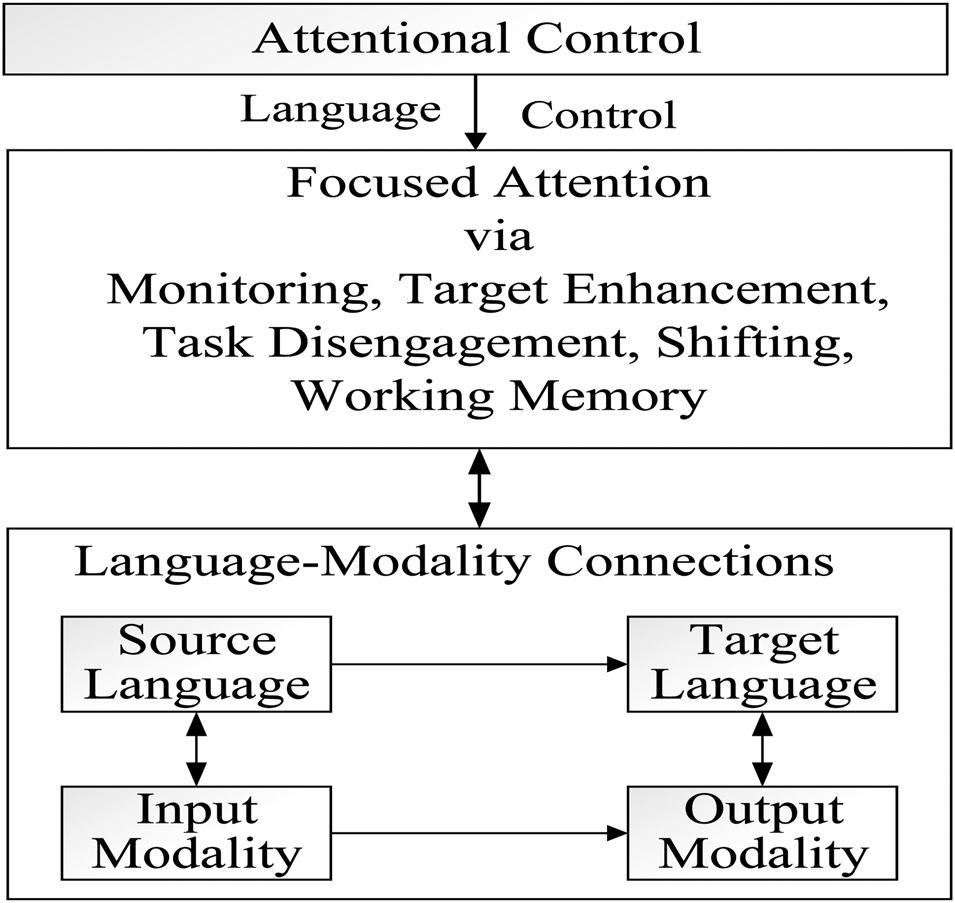
In short, given the nature of the task of interpreting, we propose that focused attention in interpreting operates through cognitive functions of monitoring, target enhancement (rather than nontarget inhibition), task disengagement (from previous trials), shifting, and WM, and that focused attention is the main process of language control, a process that helps build up, strengthen and adapt the language-modality connections as described in section 2.2. On the other hand, the language-modality connections, once established as a task schema, ease the functioning of focused attention because the connections in the schema help direct attention to the target and reduce potential interferences.
Figure 3 is a summary of both the structural and processing accounts of language control in interpreting.
Language control in interpreting is achieved by the dual mechanism of a structural framework of language-modality connections that has been established in interpreting training and stored as a task schema, and focused attention that operates via specific functions of monitoring, target enhancement, task disengagement, shifting and WM. Focused attention helps establish the language-modality connections in the first place and adapt them to changes in different modes of interpreting, while language-modality connections aid the functioning of focused attention.
2.4. Empirical findings: Effects of language control in interpreting
Professional interpreters have to be successful in language control, and if the above analysis is correct, interpreting training or experience would most probably strengthen one's ability in tasks that involve specific functions of monitoring, target enhancement, task disengagement, shifting and WM. Among these functions, monitoring is involved in tasks containing interferences (e.g., the Flanker task) or switches (e.g., color-shape switching task); target enhancement is an alternate account of the “inhibition” effect in interference tasks. Task disengagement and shifting are reported in studies using switching tasks (e.g., Grundy et al., Reference Grundy, Chung-Fat-Yim, Friesen, Mak and Bialystok2017), but, to date, there seems to be no study of interpreters in the literature reporting task disengagement. On the other hand, the relationship between WM and interpreting experience has been reported by many studies in the literature, as discussed below.
We have identified seven relevant behavioral studies in the literature that have investigated the effects of interpreting experience with interference tasks including Flanker, ANT, Simon, Stroop and antisaccade (Köpke & Nespoulous, Reference Köpke and Nespoulous2006; Yudes et al., Reference Yudes, Macizo and Bajo2011; Dong & Xie, Reference Dong and Xie2014; Timarová, Čeňková, Meylaerts, Hertog, Szmalec & Duyck, Reference Timarová, Čeňková, Meylaerts, Hertog, Szmalec and Duyck2014; Morales, Padilla, Gomez-Ariza & Bajo, Reference Morales, Padilla, Gomez-Ariza and Bajo2015; Dong & Liu, Reference Dong and Liu2016; Babcock & Vallesi, Reference Babcock and Vallesi2017). Only one of these seven studies (Timarová et al., Reference Timarová, Čeňková, Meylaerts, Hertog, Szmalec and Duyck2014) reported weak evidence for an interpreter's advantage. Dong and Zhong (Reference Dong and Zhong2017) reasoned that these studies may not have been sensitive enough to identify effects of interpreting, due to the behavioral paradigms used in the studies. By using the ERP method, the authors did find robust evidence. They compared student interpreters with different amount of interpreting training in two experiments. Both experiments indicated that interpreting experience enhanced early attentional processing, conflict monitoring, and conflict resolution. Based on the analysis in section 2.3, an advantage in conflict resolution in the Flanker task can be considered the result of an advantage in target enhancement (i.e., enhancement of the central target arrow in the task instead of inhibition of the flanking arrows). In Dong and Zhong's (Reference Dong and Zhong2017) first experiment, there was an advantage of interpreting experience for earlier attentional processing in N1 (30-130ms), for conflict monitoring in N2 (240-380ms) and the first half of P3 (320-440ms), and for target enhancement in the second half of P3 (440-520ms) and in the RT. In their second experiment, the advantage of focused attention appeared earlier (in the first half of P3 time window), but it also decreased earlier, leading to a marginal interpreter advantage indexed in RT. These ERP data may explain why previous behavioral studies failed to find an interpreter advantage in interference tasks, probably because the advantage may have appeared and decreased before participants’ overt responses (i.e., with button presses). The “temporal” nature of focused attention in interference tasks illustrated by Dong and Zhong (Reference Dong and Zhong2017) is significant, suggesting that the ERP technique provides a more sensitive measure of the temporal effects of language experience on participants’ performance in interference tasks.
Several other studies have investigated the effects of interpreting experience on participants’ performance in switching tasks. Yudes et al. (Reference Yudes, Macizo and Bajo2011) found that simultaneous interpreters outperformed general bilinguals in the switching task of WCST, as shown by fewer errors and fewer trials for the correct rules in the interpreters. Dong and Xie (Reference Dong and Xie2014) conducted a similar study with the WCST, and found that students with interpreting training performed better than students with no such training, and that students with three years’ interpreting training performed better than students with only one year's training. With a univalent color-shape switching task in a longitudinal design, Dong and Liu (Reference Dong and Liu2016) found that 32 hours of consecutive interpreting training in one semester increased students’ shifting ability indexed by switch cost, and this advantage was further verified in a post-test of the WCST. However, with a typical bivalent color-shape switching task, Becker et al. (Reference Becker, Schubert, Strobach, Gallinat and Kühn2016) and Babcock and Vallesi (Reference Babcock and Vallesi2017) did not find an interpreter advantage in switch cost, but an advantage in shorter response time (RT) and in mixing cost, indicating an interpreter advantage in monitoring. We may conclude that interpreting experience does strengthen one's performance in switching tasks, and, as for the difference between the bivalent and univalent versions of the color-shape task, further studies are warranted.
Updating and WM spans have been investigated for the issue of an interpreter advantage in WM. Based on Cowan's (Reference Cowan1988) process model of WM, Dong, Liu and Cai (Reference Dong, Liu and Cai2018) analyzed in detail similarities between consecutive interpreting features (e.g., recalling in another language what has been heard in the input language) and features of WM updating and WM spans. They then predicted that consecutive interpreting training would first enhance WM updating and then WM spans. In a longitudinal design with two comparable groups of Chinese learners of English receiving either consecutive interpreting or general L2 training for one semester, Dong et al. (Reference Dong, Liu and Cai2018) found that updating efficiency (indexed by RT in a spatial n-back task) in both the pretest and posttest correlated with consecutive interpreting performance, and that consecutive interpreting training enhanced updating efficiency while general L2 training did not. At the same time, as a comparison, they found that the correlation between verbal spans (L2 listening span and letter running span) and consecutive interpreting performance was weaker, and consecutive interpreting training, compared with general L2 training, did not make a unique contribution to these spans. Since consecutive interpreting training is basic training for interpreters, professional interpreters who are also often simultaneous interpreters may also outperform matched bilinguals in updating: Timarová et al. (Reference Timarová, Čeňková, Meylaerts, Hertog, Szmalec and Duyck2014) found positive correlations between simultaneous interpreting performance (tested by the interpretation of numbers) and updating ability (indexed by accuracy in a letter 2-back task). Morales et al. (Reference Morales, Padilla, Gomez-Ariza and Bajo2015) also reported higher updating skills from simultaneous interpreters when compared to general bilinguals.
Many studies have investigated the issue of an interpreter advantage in WM spans. While most of them supported an interpreter advantage in one way or another, the specific findings are not always consistent across the studies (see Dong & Zhong, Reference Dong, Zhong and Schwieter2019, for a review). For example, Padilla, Bajo, Canas, and Padilla (Reference Padilla, Bajo, Canas, Padilla and Tommola1995) found an interpreter advantage in the WM tasks of reading span and free recall with articulatory suppression (i.e., a task in which participants repeat the same syllable such as “bla” while reading and remembering lists of words visually presented). Christoffels, de Groot, and Kroll (Reference Christoffels, de Groot and Kroll2006) reported an interpreter advantage in speaking and reading spans in both L1 and L2 (with no restriction on recall order). Signorelli, Haarmann, and Obler (Reference Signorelli, Haarmann and Obler2012) found that interpreters outperformed non-interpreters in reading span and non-word repetition, suggesting that interpreters are better at WM and storing sub-lexical phonological representations. However, there were also studies failing to find evidence for an interpreter advantage in WM span. Unlike Padilla et al. (Reference Padilla, Bajo, Canas, Padilla and Tommola1995), Chincotta and Underwood (Reference Chincotta and Underwood1998) found no interpreter advantage in WM in the task of digit span with articulatory suppression administered in both L1 and L2. Liu, Schallert, and Carroll (Reference Liu, Schallert and Carroll2004) also failed to find an interpreter advantage in listening span. In a comprehensive review Dong and Zhong (Reference Dong, Zhong and Schwieter2019) concluded that the mixed findings are mainly due to three factors: (1) participant groups were not matched in age (e.g., Köpke & Nespoulous, Reference Köpke and Nespoulous2006) or in L2 proficiency (e.g., Tzou, Eslami, Chen & Vaid, Reference Tzou, Eslami, Chen and Vaid2012); (2) participant sample sizes were often too small (e.g., 11 in Liu et al., Reference Liu, Schallert and Carroll2004; 12 in Chincotta & Underwood, Reference Chincotta and Underwood1998); (3) there was not enough training to lead to sufficient interpreting experiences (Dong et al., Reference Dong, Liu and Cai2018). Future studies should pay more attention to research design, particularly as regards participants’ age, language proficiency (and language learning history), sample size, and the use of a control group in longitudinal studies.
In short, a review of the existing literature has shown that interpreting training helps enhance specific functions of monitoring (tested in tasks involving interferences or switches), target enhancement (tested in interference tasks), shifting (tested in switching tasks), and WM (tested in nonverbal n-back updating tasks and various verbal or nonverbal span tasks). No empirical study has been conducted in this respect with task disengagement.
3. Processing control in interpreting
3.1. Previous accounts and their limitations
In addition to successful language control (i.e., how to avoid SL interference in TL production), as discussed, a significant challenge to interpreting students is how to execute all the component tasks in concert under time pressure. This is the issue of processing control in interpreting (de Groot, Reference De Groot2011). Although researchers are aware of the significance of the issue, there are only a few studies that directly address it. According to de Groot (Reference De Groot2011), processing control in simultaneous interpreting is achieved by a set of skills that simultaneous interpreters are especially good at (i.e., better than matched bilinguals), including faster word-retrieval and word-recognition skills (Bajo, Padilla & Padilla, Reference Bajo, Padilla and Padilla1999), larger WM capacities (e.g., Christoffels et al., Reference Christoffels, de Groot and Kroll2006) and good coordination skills (Strobach et al., Reference Strobach, Becker, Schubert and Kühn2015; Becker et al., Reference Becker, Schubert, Strobach, Gallinat and Kühn2016). Morales et al. (Morales, Gomez-Ariza & Bajo, Reference Morales, Gomez-Ariza, Bajo and Schwieter2016) further argued that the theory of inhibitory control (Green, Reference Green1998) could not account for processing control in interpreting, and emphasized the adaptive nature of bilingual control (Green & Abutalebi, Reference Green and Abutalebi2013): that is, different control processes may be involved in different bilingual contexts. While there has not been a large literature on the neurobiology of control in simultaneous interpreting, Hervais-Adelman and Babcock (Reference Hervais-Adelman and Babcock2020) reviewed the relevant literature and suggested that control in simultaneous interpreting recruit brain networks associated with domain-general cognitive and behavioral control, highlighting the interation between language control and cognitive control.
Seeber and colleagues (e.g., Seeber, Reference Seeber2011; Seeber & Kerzel, Reference Seeber and Kerzel2011) have proposed the Cognitive Load Model that describes the amount of cognitive load generated during the simultaneous interpretation of structurally different languages (e.g., translating German verb-final sentences into English verb-initial sentences). Based on Wickens’ Multiple Resource Model (Wickens, Reference Wickens, Parasuraman and Davies1984), Seeber (Reference Seeber2011) broke the comprehension and production tasks into three demand vectors: perceptual auditory verbal processing of input and output, cognitive-verbal processing of input and output, and verbal-response processing of output. A matrix is formed by these demand vectors, and interferences are calculated if comprehension and production demands overlap. Cognitive load is managed at the macro level (e.g., meaning-based strategies and transcoding), and at the micro level (i.e., waiting, stalling, chunking and anticipating). The model predicts an increase in cognitive load towards (and beyond) the end of verb-final constructions, which is verified in pupillary response data as reported in Seeber and Kerzel (Reference Seeber and Kerzel2011).
Although previous studies did contribute significantly to the issue of how interpreters manage the multitasking nature of interpreting, the limitations are obvious. First, no systematic research has been conducted on the issue of processing control in interpreting. The Cognitive Load Model (Seeber, Reference Seeber2011) illustrates the ways or strategies (i.e., waiting, stalling, chunking and anticipation) that interpreters may use to ease cognitive load when production and comprehension interfere with one another in simultaneous interpreting tasks. But we still need a model that is more comprehensive, a model that is similar to the language control model we have proposed (Figure 3). Second, almost all previous studies in this literature have focused on simultaneous interpreting (e.g., de Groot, Reference De Groot2011; Seeber, Reference Seeber2011; Morales et al., Reference Morales, Gomez-Ariza, Bajo and Schwieter2016; Hervais-Adelman & Babcock, Reference Hervais-Adelman and Babcock2020), although both types, consecutive and simultaneous, interpreting require the accomplishment of several component tasks under time pressure (e.g., Gile, Reference Gile, Pöchhacker and Shlesinger1997/2002). Aiming at filling these gaps in the literature, we propose the processing control model for interpreting, as discussed in the following section.
3.2. Processing control: Divided attention and language processing efficiency
Both simultaneous interpreting and consecutive interpreting are characterized by their multi-tasking nature, although the former may be more demanding in time. In simultaneous interpreting, the speaker's speech and the interpreter's translation of it overlap about 70% of the time (Chernov, Reference Chernov, Lambert and Moser-Mercer1994). The major component tasks in simultaneous interpreting include: comprehending the SL input (and actively anticipating incoming information), producing the TL output, and memorizing parts of the analyzed input that must wait for expression because of sequencing differences between the SL and the TL (de Groot, Reference De Groot2011). Simultaneous interpreting requires the simultaneous execution of all the component tasks, and it is this requirement that makes simultaneous interpreting a highly demanding task that needs special training and probably talent to accomplish. Consecutive interpreting also requires multi-tasking to a significant extent. During the input phase, apart from the main subtask of comprehending the incoming information, the interpreter generally has to take notes at the same time; during the output phase, apart from the main subtask of producing the TL, the interpreter generally has to consult notes to reconstruct the messages. Compared with simply listening to a segment of speech and taking notes without having to recall it later in another language, the input phase in consecutive interpreting is more multi-tasking because while listening to the input speech, the interpreter is already searching for translation equivalents in the mind (e.g., Dong & Lin, Reference Dong and Lin2013), and notes may be taken in either the input or the output language. What is more, the interpreter is required to be as accurate as possible in the transmission of messages, which puts more demands on the input phase when messages have to be registered either in the mind or in the notes.
In cognitive psychology, coordinating attention so as to accomplish more than one task at the same time is the job of divided attention (e.g., Eysenck & Keane, Reference Eysenck and Keane2000). To deal with the multi-tasking requirement in an interpreting task, the interpreter has to divide attention between component tasks. As compared with typical dual-task experiments in the cognitive psychology lab, the task of interpreting is more demanding in how attention is distributed to each of the component tasks: it is influenced by the continuously changing demands posed by the SL input (e.g., clarity of articulation), the TL output (e.g., availability of diction) and the information to be temporally retained (e.g., information density). Execution of all the component tasks in concert or coordination of these subtasks is therefore an essential skill, especially for professional interpreters.
WM is another important function supporting multi-tasking (e.g., Colflesh & Conway, Reference Colflesh and Conway2007; Gray, Hahn, Robinson, Harvey, Leonard, Luck & Gold, Reference Gray, Hahn, Robinson, Harvey, Leonard, Luck and Gold2014). In a dichotic listening task in which participants were required to shadow messages from one ear and at the same listen for their own name from the other (i.e., a multi-task), Colflesh and Conway (Reference Colflesh and Conway2007) found that 66.7% of high WM capacity and 34.5% of low WM capacity participants detected their name, suggesting that WM capacity facilitates multi-tasking performance. In another study of people with schizophrenia, Gray et al. (Reference Gray, Hahn, Robinson, Harvey, Leonard, Luck and Gold2014) measured the ability to distribute attention by means of a UFOV (Useful Field of View) task, in which participants must divide attention so that they can discriminate a foveal target and at the same time localize a peripheral target. The study found that people with schizophrenia exhibited severe impairments in UFOV performance (i.e., multi-tasking performance), and their UFOV performance was highly correlated with WM capacity (r = −.61).
To accomplish the demanding task of interpreting, mastery of both languages and appropriate use of interpreting strategies (e.g., Bartłomiejczyk, Reference Bartłomiejczyk2006; Seeber, Reference Seeber2011; Dong, Li & Zhao, Reference Dong, Li and Zhao2019) are essential skills. The former implies proficiency in both SL and TL, and the latter refers to a method that is used deliberately to prevent or solve potential problems in interpreting or to enhance interpreting performance (Dong et al., Reference Dong, Li and Zhao2019). Typical examples of interpreting strategies include “visualization” (generating mental pictures of the SL message in order to recall the SL information more efficiently), “anticipation” (anticipating upcoming SL information or expressions according to the intra-lingual or extra-lingual context) and “compression” (i.e., expressing succinctly and concisely in the TL by removing redundancy in the input). Mastery of both languages is often the main criteria of evaluation in admission examinations that recruit interpreter trainees, and interpreting strategies are often the main criteria in an interpreting training class. For simplicity, we use the term “language processing efficiency” to cover both of them, because both components are used for the purpose of processing efficiency.
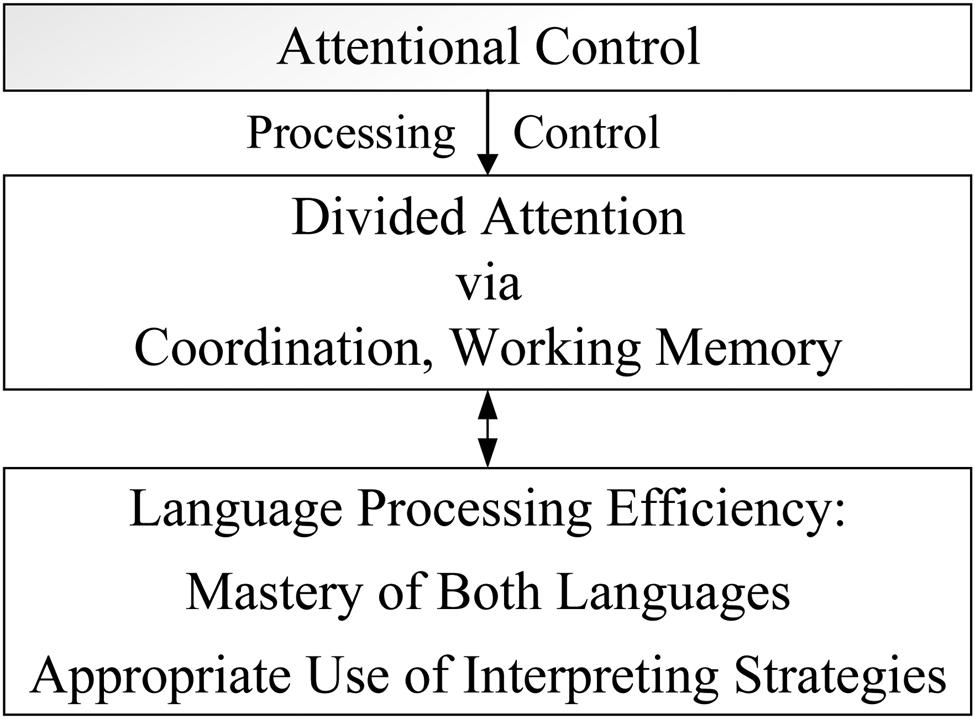
Divided attention and language processing efficiency are thus two important ingredients of processing control for interpreting, but they are not totally independent of each other and may interact to ensure the orchestration of component tasks. On the one hand, language processing efficiency (i.e., language proficiency and interpreting strategies) may relate to one's capacity in verbal WM and in the coordination of verbal tasks (which in turn relate to divided attention as discussed above). On the other hand, divided attention, once practiced and enhanced in interpreting training, most probably leads to better coordination skills, which in turn may lead to better language processing efficiency (e.g., better use of interpreting strategies in places of difficulties during interpreting). Unfortunately there has not been much empirical work done to examine their interaction in this regard, and more research is needed. Figure 4 presents an illustration of processing control in interpreting.
Processing control in interpreting is achieved by divided attention and language processing efficiency. Divided attention mainly operates via specific functions of coordination and WM. Language processing efficiency is mainly achieved by the mastery of both languages and the appropriate use of interpreting strategies. Divided attention and language processing efficiency interact with each other to ensure the orchestration of component tasks in interpreting.
3.3. Empirical findings: Effects of processing control in interpreting
Since successful performance in interpreting requires processing control, processing control may get strengthened by continued practice in interpreting. Since processing control is achieved mainly through coordination, WM, and language processing proficiency, we hypothesize that interpreting training enhances coordination ability, WM capacity, and language processing efficiency.
Two studies (Strobach et al., Reference Strobach, Becker, Schubert and Kühn2015; Becker et al., Reference Becker, Schubert, Strobach, Gallinat and Kühn2016) have been conducted to examine whether interpreting experience enhances one's coordination ability, and both have found evidence for a positive effect. Coordination ability is often tested in a dual task in which participants are asked to respond to a primary task (e.g., listening to a tone and judging whether it was high, medium or low) and a secondary task (e.g., in a visual task, judging whether a triangle was large, medium or small). Group differences in single-task blocks (i.e., with only one of the two tasks in a block) and in mixed-task blocks are calculated. If no group differences exist in single-task blocks but one group performs better in mixed-task blocks, that group is considered better in coordination. With such a dual task, Strobach et al. (Reference Strobach, Becker, Schubert and Kühn2015) found that interpreters outperformed their controls in the primary task in the single-task blocks, and the group difference was significant when responding to the primary task in the mixed block, suggesting better coordination in simultaneous interpreters. In an fMRI study, Becker et al. (Reference Becker, Schubert, Strobach, Gallinat and Kühn2016) reported higher grey matter density in the left frontal pole for interpreters than for translators, and that this region exhibited higher resting-state connectivity with a global brain network. These results were considered a consequence of practice in language-related multi-tasking.
In section 2.4 we reviewed evidence on how interpreting training strengthens WM. Since both language control and processing control involves WM, we cannot distinguish at the present stage whether it is the exercise of language control or that of processing control that leads to enhanced WM. Since both types of control involves language processing, we do not know either if there is any correspondence between the types of control and the types of WM (e.g., verbal vs. nonverbal WM).
With regard to whether interpreting experience improves language processing efficiency, Bajo et al. (Reference Bajo, Padilla and Padilla1999) found that professional interpreters were faster than amateurs in word recognition and meaning assignment. Cai, Dong, Zhao and Lin (Reference Cai, Dong, Zhao and Lin2015) found that L2 proficiency not only correlated with interpreting performance but predicted the development of interpreting competence. Setton (Reference Setton, Gerzymisch-Arbogast and Van Dam2005) suggested that the ability to predict is a prerequisite for being a professional interpreter. As for interpreting strategies, they are considered special skills to cope with difficulties and problems in an interpreting task (e.g., Bartłomiejczyk, Reference Bartłomiejczyk2006). In a longitudinal study with 66 interpreting students, Dong et al. (Reference Dong, Li and Zhao2019) identified 21 strategies used by these students, and found a positive correlation between how frequently students employed strategies recommended by instructors and how well they performed in an interpreting test, and that interpreting training was effective for the acquisition of interpreting strategies.
In short, although not many studies have been conducted in this respect, a brief review of the existing literature has shown that interpreting training helps enhance one's coordinating ability and language processing efficiency (including interpreting strategies), and this enhancement is on top of the WM effects as reviewed in section 2.4.
4. General discussion
Based on what has been illustrated above (see Figure 3 and 4), an integrated view of attentional control for interpreting is presented in Figure 5. This general attentional control model is a theoretical account of both language control and processing control in interpreting (including consecutive and simultaneous interpreting). Both types of control are supervised by “attentional control” (sometimes also referred to as “supervisory attentional system”), which is essential to normal functioning in our everyday life.
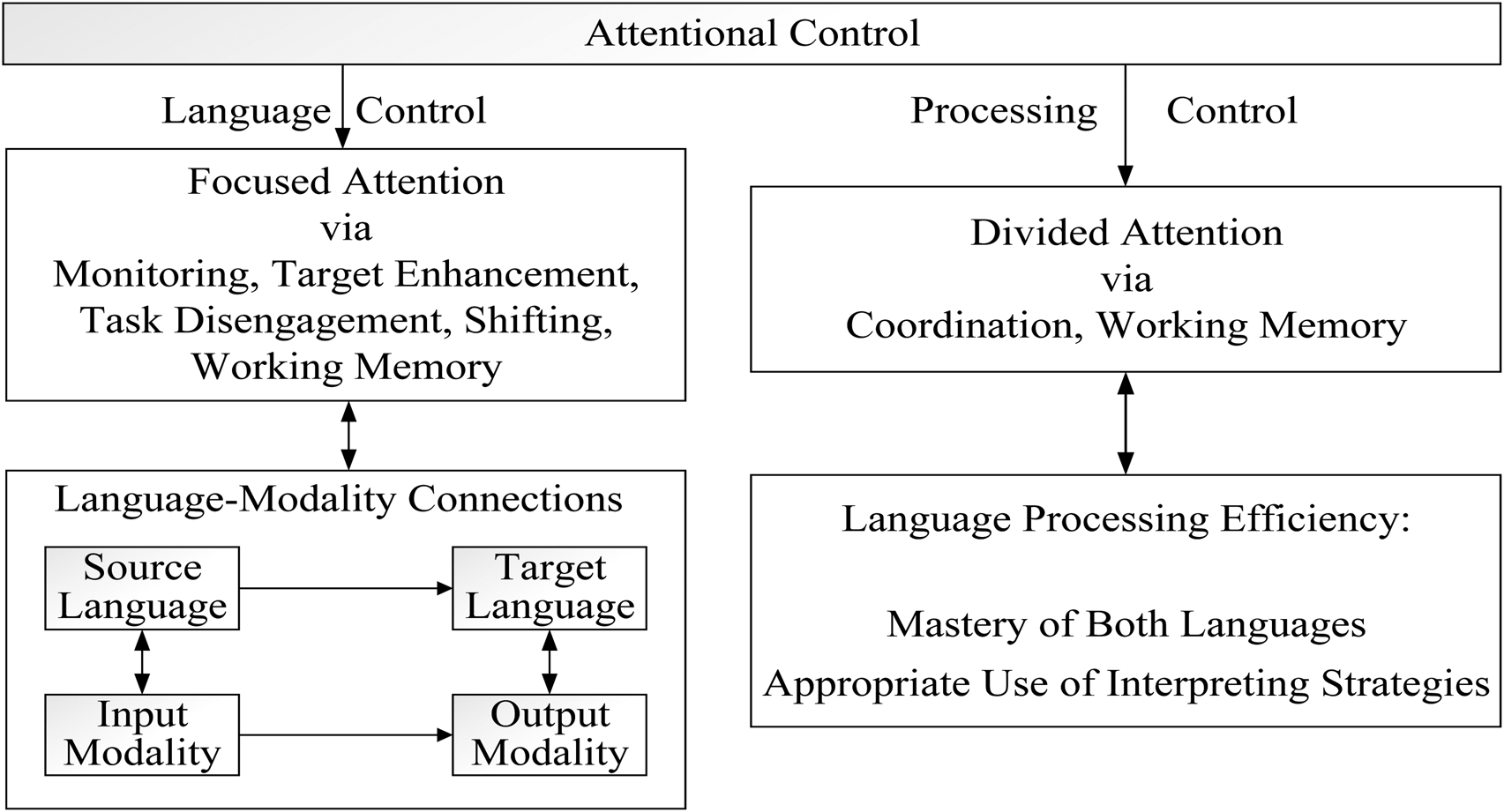
Compared with previous proposals about language control in interpreting (Paradis, Reference Paradis1994; Grosjean, Reference Grosjean1997; Christoffels & de Groot, Reference Christoffels, de Groot, Kroll and de Groot2005), our proposal differs mainly in the following two ways. First, instead of differential activations (Paradis, Reference Paradis1994; Grosjean, Reference Grosjean1997; Christoffels & de Groot, Reference Christoffels, de Groot, Kroll and de Groot2005), connections are emphasized in our proposal. The structural framework of language-modality connections takes into account the feature of regular and frequent switching between listening to the SL and translating the message in the TL. Once established, the framework for each mode of interpreting (e.g., oral interpreting from L2 to L1) will be stored as a task schema, and will get easily activated if triggered. One end of a connection (e.g., message in SL) primes the other end of the connection (e.g., message in TL), thus preventing SL interference in TL production. Second, we do not know how differential activations are created or maintained in previous proposals, but focused attention is considered in our proposal the main mechanism that helps establish the language-modality connections in the first place and adapt them to changes in different modes of interpreting. To achieve this purpose, focused attention operates via specific functions of monitoring, target enhancement, task disengagement, shifting and WM. The function of inhibition, which has been considered critical to bilingual control (e.g., Green, Reference Green1998), does not play an obvious role in language control in interpreting.
As regards processing control in interpreting that aims to account for the multi-tasking feature, our proposal differs from previous relevant research in the following three aspects. First, apart from good mastery of both languages (e.g., faster lexical retrieval) as indicated in previous research (e.g., Bajo et al., Reference Bajo, Padilla and Padilla1999; Setton, Reference Setton, Gerzymisch-Arbogast and Van Dam2005; de Groot, Reference De Groot2011), our proposal also takes into account the appropriate use of interpreting strategies, which helps prevent or solve problems and enhance interpreting performance, and which is at least one of the main purposes of interpreting training. Second, our proposal tries to sort out the relationship between the concepts of divided attention, coordination and WM in the context of processing control in interpreting (see Figure 4 and 5). Third, our proposal considers an interaction between divided attention (via coordination, WM) and language processing efficiency (i.e., mastery of both languages and appropriate use of interpreting strategies). All these considerations are for the purpose of achieving skills to deal with the multi-tasking nature of interpreting.
There have been a few neuroimaging studies of cognitive control in interpreting supporting the involvement of attentional processes (e.g., Hervais-Adelman, Moser-Mercer & Golestani Reference Hervais-Adelman, Moser-Mercer and Golestani2015a; Hervais-Adelman, Moser-Mercer, Michel & Golestani, Reference Hervais-Adelman, Moser-Mercer, Michel and Golestani2015b). For example, with fMRI data from two scans of participants before and after a 15-month intensive training program (and data from control participants), Hervais-Adelman et al. (Reference Hervais-Adelman, Moser-Mercer and Golestani2015a) concluded that interpreting training shapes the brain networks involved in cognitive control. Specifically, the right caudate nucleus showed significant decrease in recruitment during SI after training, indicative of refinement of the brain network engaged in the task. According to the authors’ analysis, the changes in the caudate nucleus is probably due to increased efficiency in managing the lexico-semantic representations of the two languages required for the execution of SI. Further, Hervais-Adelman et al. (Hervais-Adelman, Moser-Mercer, Murray & Golestani, Reference Hervais-Adelman, Moser-Mercer, Murray and Golestani2017) showed that, consistent with the fMRI data, structural brain changes including increase in cortical thickness were evident after simultaneous interpreting training, in key areas implicated in cognitive control and language processing.
It is important that, given these neuroimaging studies, we should be mindful of how to interpret the specific results. Hervais-Adelman et al. (Reference Hervais-Adelman, Moser-Mercer, Michel and Golestani2015b) found that activation in putamen varied with the duration of the overlap between listening and speaking in interpreting compared with shadowing, which could be interpreted as a reflection of inhibition on the SL at the output level. However, this finding may reflect the outcome of multiple processes, not just inhibition. Specifically, although the two tasks of interpreting and shadowing share common processes (e.g., simultaneity in listening and speaking), interpreting differs fundamentally from shadowing because it requires speaking in another language. This fundamental difference may entail many other differences. For example, although the SL primes the TL in the Language-Modality Connections as shown in Figure 5 for both interpreting and shadowing, one has to be more focused in interpreting than in shadowing, thus involving processes of monitoring, target language enhancement, source language disengagement, shifting and WM (which is especially true for beginning interpreters as the participants in Hervais-Adelman et al., Reference Hervais-Adelman, Moser-Mercer, Michel and Golestani2015b). Furthermore, compared with shadowing, interpreting obviously requires more coordination. Therefore, the neuroimaging differences revealed in interpreting and shadowing tasks may reflect differences in multiple control processes in the two tasks.
The attentional control model that we have proposed for interpreting has implications for language control in general bilingual processing (simply referred to as “bilingual control”). First, although we cannot dismiss inhibition in bilingual control as we did in interpreting control (because of the language-modality connections), the concept of inhibition may not be as critical to bilingual control as hypothesized in the Inhibitory Control Model (Green, Reference Green1998) or BIA+ model (Dijkstra & Van Heuven, Reference Dijkstra and Van Heuven2002). In section 2.3 where we argued for the view that inhibition does not capture very well the essence of language control in interpreting, many of the arguments are in fact from research on general bilingual control (Li, Reference Li1998; Yeung & Monsell, Reference Yeung and Monsell2003; Grundy et al., Reference Grundy, Chung-Fat-Yim, Friesen, Mak and Bialystok2017;Sikora & Roelofs, Reference Sikora and Roelofs2018; Dijkstra et al., Reference Dijkstra, Wahl, Buytenhuijs, Van Halem, Al-Jibouri, De Korte and Rekké2018). “Target enhancement” (Sikora & Roelofs, Reference Sikora and Roelofs2018; or “task engagement” in Green & Abutalebi, Reference Green and Abutalebi2013) and “task disengagement” (Green & Abutalebi, Reference Green and Abutalebi2013; Grundy et al., Reference Grundy, Chung-Fat-Yim, Friesen, Mak and Bialystok2017) have been proposed to account for empirical findings that were originally accounted for by “inhibition” (or “nontarget inhibition”). Specifically, in a language-switching naming task, to achieve adequate processing in the weaker L2, one has to focus on it and enhance its activation, which would then require more processing time to get disengaged from it, leading to more time to switch to L1 than the other way around.
This asymmetry in switch cost could be accounted by enhancement and disengagement instead of inhibition. A less ambiguous marker for the notion of inhibition in language switching is the n-2 repetition cost, which refers to the longer response times (RT) as follows: RT to Language A after Languages A and B > RT to Language A after Languages C and B (i.e., in a language switching series of ABA vs. CBA; see Declerck & Philipp, Reference Declerck and Philipp2015 for a comprehensive review). The term “persisting inhibition” has been used to account for this negative effect, emphasizing the persistence of inhibition of Language A after responding to Language B in the series ABA. We prefer the term disengagement because in the semantics of the word “disengagement” or “disengage”, there is a path or direction element, as in the phrase “disengage from” (or simply “leaving”, probably with an effort), and a return (or “coming back”) to the previous situation will incur a processing cost (when the activation of Language A is overridden by the activation of Language B in the series ABA). As for the asymmetry between the languages in this n-2 repetition paradigm, empirical evidence is quite mixed (Declerck & Philipp, Reference Declerck and Philipp2015), probably because what really matters in the contrast between ABA and CBA is a cost to return, a somewhat natural consequence of the previous mental effort of disengagement. In short, the box of “focused attention via functions of monitoring, target enhancement, task disengagement, shifting and WM” in Figure 3 and 5 may also work for bilingual control, but the adaptive control hypothesis proposed by Green and Abutalebi (Reference Green and Abutalebi2013) suggests that the situation of bilingual processing is probably more complex.
Second, context in genuine language use is a factor that cannot be ignored in the issue of bilingual control. While the language-modality connections established in interpreting training ensures success in language control in interpreting, features in a language use context may work to prevent or limit interferences from the nontarget language in general bilingual processing. For example, compared with a bilingual context, a monolingual context is beneficial for the speaker to prevent interferences from the language not needed at the moment. The importance of language use context in language control can be illustrated by a contrast with language control in experimental settings. As discussed by de Groot (Reference De Groot2011), language control in genuine language use is more endogenous (i.e., with control triggered by one's intention to use a certain language for a certain purpose), global (with control exerted on the whole language system or one of the languages) and proactive (e.g., in a situation when a speaker intends to speak one language instead of the other, resulting in a preparatory setting of the language system), while language control in the lab is more exogenous (i.e., with control triggered by stimuli presented to the system), local (with control exerted on specific items in a language subset) and reactive (e.g., with control working on the imminent output of the language system such as preventing certain elements from emerging in production). A thorough analysis of genuine language use context may help reveal the mechanism underlying bilingual control.
To sum up, we proposed an attentional control model (Figure 5) to account for both language control and attentional control in interpreting. Based on models of general bilingual control (e.g., Green, Reference Green1998; Green & Abutelabi, Reference Green and Abutalebi2013) and previous models of language control in interpreting (Paradis, Reference Paradis1994; Grosjean, Reference Grosjean1997; Christoffels & de Groot, Reference Christoffels, de Groot, Kroll and de Groot2005), our proposal for language control in interpreting tries to capture one of the most distinguishing features in interpreting, i.e., the frequency and regularity in switching between listening to a language and translating the message in another language. Based on previous relevant research (e.g., de Groot, Reference De Groot2011; Strobach et al., Reference Strobach, Becker, Schubert and Kühn2015), our proposal for processing control in interpreting tries to be comprehensive when accounting for the multi-tasking nature of interpreting. And yet, more empirical research is needed to verify many of the details of the attentional control model.
Acknowledgements
This research was supported by a grant (15AYY002) from the National Social Science Foundation of China.


 Open access

