





Highlights
-
• Studies vary in how they operationalize and measure interactional contexts.
-
• Interactional contexts are dynamic and continuous rather than categorical.
-
• Evidence on the relationship between bilinguals’ language-use patterns and EF is mixed.
1. Introduction
More than half of the world’s population today is bilingual (Grosjean, Reference Grosjean2021). While the benefits of bilingualism in economic and social spheres are commonly acknowledged, ongoing discussions persist regarding whether speaking multiple languages can confer advantages in cognition, specifically in executive functioning (EF). EF is a broad umbrella term that encompasses (Miyake et al., Reference Miyake, Friedman, Emerson, Witzki, Howerter and Wager2000) the interrelated components of cognitive flexibility (the ability to purposefully switch between tasks, thoughts or actions), monitoring (the ability to update and monitor working memory representations) and inhibition (the ability to intentionally suppress prepotent responses). Bilinguals need to suppress one language in order to use another and attend to linguistic cues to choose an appropriate language in different linguistic situations. Such language control is thought to involve and consequently strengthen their EF (Abutalebi et al., Reference Abutalebi, Della Rosa, Green, Hernandez, Scifo, Keim, Cappa and Costa2012; Bialystok et al., Reference Bialystok, Martin and Viswanathan2005; Costa et al., Reference Costa, Hernández and Sebastián-Gallés2008). However, the debate around this so-called bilingual effect is still unsettled (Bialystok & Craik, Reference Bialystok and Craik2022; Lehtonen et al., Reference Lehtonen, Fyndanis and Jylkka2023). With this scoping review, we contribute to the debate by examining how patterns of bilingual language use in different social environments are related to bilinguals’ EF.
The bilingual effect has traditionally been investigated by comparing monolingual groups’ and bilingual groups’ performance on EF tasks. While earlier studies reported cognitive benefits of bilingualism (Bialystok et al., Reference Bialystok, Martin and Viswanathan2005; Costa et al., Reference Costa, Hernández, Costa-Faidella and Sebastián-Gallés2009; Prior & MacWhinney, Reference Prior and MacWhinney2010), recently, several meta-analytic and systematic reviews (Gunnerud et al., Reference Gunnerud, Ten Braak, Reikerås, Donolato and Melby-Lervåg2020; Lehtonen et al., Reference Lehtonen, Soveri, Laine, Järvenpää, De Bruin and Antfolk2018; Lowe et al., Reference Lowe, Cho, Goldsmith and Morton2021) have pointed to an increasing number of studies failing to replicate the results and find the differences between monolinguals and bilinguals. While doubts about the beneficial effects of bilingualism on EF are rising (Festman et al., Reference Festman, Czapka, Winsler, Kersten and Winsler2022; Paap et al., Reference Paap, Johnson and Sawi2015), studies showing both positive and null effects continue to be published. The current debate is not about which results are more valid, positive or null, but rather under what circumstances (i.e., what boundary conditions define the effect) the bilingual effect is present or absent (Bialystok & Craik, Reference Bialystok and Craik2022; Luk, Reference Luk2023; Paap et al., Reference Paap, Johnson and Sawi2015).
In recent years, there has been an increased focus on various individual bilingual experiences that might shape bilinguals’ EF. These studies have moved the conversation away from a deadlocked comparison between monolinguals and bilinguals. Within-group and between-group study designs have been applied to examine the role of language proficiency (e.g., Iluz-Cohen & Armon-Lotem, Reference Iluz-Cohen and Armon-Lotem2013; Mishra et al., Reference Mishra, Padmanabhuni, Bhandari, Viswambharan and Prasad2019; Rosselli et al., Reference Rosselli, Ardila, Lalwani and Vélez-Uribe2016), language dominance (e.g., Goral et al., Reference Goral, Campanelli and Spiro2015; Nicoladis et al., Reference Nicoladis, Hui and Wiebe2018), age of acquisition (e.g., Kalia et al., Reference Kalia, Wilbourn and Ghio2014; Luk et al., Reference Luk, de Sa and Bialystok2011) and other individual differences in accounting for cognitive advantages induced by bilingualism. Recently, consistent with the idea that language experience does not occur in a social vacuum (Luk, Reference Luk2023), a surge of studies has emerged on the patterns of bilingual language use in different social environments (e.g., Beatty-Martínez et al., Reference Beatty-Martínez, Navarro-Torres, Dussias, Bajo, Guzzardo Tamargo and Kroll2020; Gullifer & Titone, Reference Gullifer and Titone2020; Hartanto & Yang, Reference Hartanto and Yang2016; Jiao et al., Reference Jiao, Liu, de Bruin and Chen2020). Most studies have embedded their discussions in the theoretical framework of the adaptive control hypothesis (ACH, Green & Abutalebi, Reference Green and Abutalebi2013).
The ACH specifies the language control processes involved in different interactional contexts. By “interactional contexts,” Green and Abutalebi (Reference Green and Abutalebi2013) refer to recurrent patterns in conversational exchanges. The authors suggest that although the ACH primarily addresses language control, it can also serve as a basis for more precise predictions about performance on nonverbal tasks, particularly in relation to measures of EF. Consequently, it was assumed and tested in several studies that different habitual patterns of language use engage distinct domains and components of bilinguals’ EF.
The ACH identifies three interactional contexts: single-language (SL), dual-language (DL) and dense code-switching (DCS) contexts. In a SL context, bilinguals use one language in one environment and the other in a second different environment (e.g., using English at work and Russian at home). In a DL context, bilinguals use both languages in the same environment but with different speakers (e.g., using English when interacting with one colleague and Russian with another colleague). In a DCS context, speakers mix their languages within a single utterance and insert words from one of their languages in the context of the other (e.g., saying “Pass me воду [vodu, water], please”). The three interactional contexts differ in how bilinguals switch between their languages in a given social environment. They either do not switch (SL context) or switch between conversations (DL context) or within conversations (DCS context).
These patterns of bilingual language use are claimed to differentially shape bilinguals’ control processes. Green and Abutalebi (Reference Green and Abutalebi2013) refined the three-component EF model by Miyake et al. (Reference Miyake, Friedman, Emerson, Witzki, Howerter and Wager2000) into eight control processes, suggesting that these processes are essential for maintaining a conversation in a DL context. The eight processes are goal maintenance, conflict monitoring, interference suppression, salient cue detection, selective response inhibition, task engagement, task disengagement and opportunistic planning.
To successfully converse in a DL context, bilinguals must first maintain the goal of speaking in the language(s) appropriate to the communicative situation. To sustain this goal, they rely on processes that control interference. Specifically, they need to monitor conflicts and suppress interference from lexical and syntactic competitors in another language. Additionally, they must detect salient cues (e.g., the arrival of an interlocutor speaking a different language) signaling the need to switch languages. At this point, a subsequent cascade of control processes is activated: bilinguals need to purposefully inhibit the response in one language, disengage from the conversation and then engage in a conversation in the other language.
Unlike a DL context, in a SL context, only one language is present. However, since both languages are still active, language task schemas remain in a competitive relationship. Therefore, bilinguals still need to maintain the goal of speaking in the appropriate language. This requires the process of goal maintenance. Consequently, as in a DL context, bilinguals in a SL context also need to control interference to stay in the language appropriate for the particular social environment. Furthermore, as there is no need to purposefully switch to another language, SL context bilinguals do not need to engage in salient cue detection and the cascade of control processes it triggers in a DL context.
As in a DL context, in a DCS context, both languages are present, but language task schemas are in a cooperative relationship, allowing bilinguals to switch freely between languages. Therefore, the demands on the indicated control processes in a DCS context are not as high as in a DL context. However, in this context, bilinguals make use of opportunistic planning. Green and Abutalebi (Reference Green and Abutalebi2013) suggest that bilinguals opportunistically plan how to integrate the morphosyntactic properties of words from one language into the morphosyntactic frame of another, which does not occur in SL and DL contexts.
The ACH is noteworthy in its attempt to account for nuanced individual language experiences during everyday communication and their impact on bilinguals’ control processes (Luk, Reference Luk2023). Over the past decade, researchers have sought to test both behavioral and neuroimaging predictions of the ACH. Importantly, the researchers have also attempted to extend the ACH predictions about language control processes to EF processes, as suggested by the authors. However, the results have been inconsistent (e.g., Hartanto & Yang, Reference Hartanto and Yang2016, Reference Hartanto and Yang2020; Kałamała et al., Reference Kałamała, Szewczyk, Chuderski, Senderecka and Wodniecka2020, Reference Kałamała, Walther, Zhang, Diaz, Senderecka and Wodniecka2022). These inconsistencies may stem from considerable methodological differences between the studies. For example, the studies have investigated different EF domains and used various EF tasks. Other potential moderators of effect size include different approaches to the operationalization and measurement of interactional contexts, sampling differences and other specific factors.
Understanding the moderators of effect sizes and the specific conditions under which the effects occur is an important step for future investigations. To our knowledge, no systematic research synthesis of empirical studies has examined interactional contexts in relation to bilinguals’ EF. However, several studies inspired by the ACH were critically reviewed by Paap et al. (Reference Paap, Mason and Anders-Jefferson2021). The main objective of this scoping review is to identify and summarize research on the role of interactional contexts in bilinguals’ EF ability at the behavioral level. The methods used to measure or manipulate interactional contexts, and sample characteristics such as where studies were conducted, language pairs of bilinguals and participant demographics are also mapped out. This is performed to highlight methodological decisions that may also undermine conclusions.
The decision to conduct a scoping review rather than a systematic review stemmed from a lack of studies employing similar methodologies to assess or experimentally manipulate interactional contexts. Instead, the scoping review methodology provides an in-depth picture of how interactional contexts are operationalized, measured and related to bilinguals’ performance on EF tasks.
2. Methods
2.1. Methodological framework
The review was guided by the methodological framework proposed by Arksey and O’Malley (Reference Arksey and O’Malley2005). The Preferred Reporting Items for Systematic Reviews and Meta-Analyses, an extension for Scoping Reviews (PRISMA-ScR) framework was used to structure the review (Tricco et al., Reference Tricco, Lillie, Zarin, O’Brien, Colquhoun, Levac, Moher, Peters, Horsley, Weeks, Hempel, Akl, Chang, McGowan, Stewart, Hartling, Aldcroft, Wilson, Garritty and Straus2018). The Nested Knowledge AutoLit semi-automated systematic review platform was chosen as a tool for the screening of title and abstract and full-text screening (Adusumilli et al., Reference Adusumilli, Pederson, Hardy, Kallmes, Hutchison, Kobeissi, Heiferman and Heit2021). The scoping review’s pre-registration protocol, along with the Online Resources 1 and 2 supporting this review, can be accessed online via the Open Science Framework (OSF) at https://doi.org/10.17605/OSF.IO/E8V4Q.
2.2. Identifying the research question
The primary research question of this scoping review was: “What does the current research suggest about the role of interactional contexts in bilinguals’ EF performance?” The research sub-questions that guided the review were as follows:
-
1. What methodologies are used to measure and manipulate bilingual interactional contexts?
-
2. What EF domains are examined in existing studies, and what EF tasks are used to assess them?
-
3. What conclusions can be drawn about the relationship between interactional contexts and bilinguals’ EF?
2.3. Search strategy
Published studies were systematically identified through searches on electronic databases, including ERIC, PubMed, PsycINFO, Scopus and Web of Science. The first search was conducted on April 27, 2022. To update the initial search, additional searches were conducted on July 3, 2024, and January 23, 2025. The search strategy was constructed around three key concepts: (1) interactional contexts and individual bilingual experience, (2) language repertoire and (3) executive functions. The concepts and related key terms, including wildcard operators, are presented in Table A1 in the Appendix.
The first key concept combines two elements: an interactional context and an individual bilingual experience. The broad concept of bilingual experience was used because, initially, this scoping review addressed the following question: What does the current research suggest about the role of individual differences in bilingual profiles, including interactional contexts, and in bilinguals’ EF performance? As was discussed, individual bilingual experience is a multifaceted phenomenon that comprises aspects such as age of second language (L2) acquisition, everyday exposure to languages, interactional contexts, switching habits, proficiency in languages, linguistic distance between the first language (L1) and L2, and cultural identity (Grosjean, Reference Grosjean2022). These aspects of language utilization collectively form a bilingual profile (Studenica et al., Reference Studenica, Laketa, Chrysochoou, Blakey and Vivas2022). However, the operationalization of bilingual profiles varies greatly across existing studies, and most importantly, most of the studies view bilingualism-related factors as distinct sources of bilingual effects on EF (Jones et al., Reference Jones, Davies-Thompson and Tree2021; Yow & Li, Reference Yow and Li2015). Crucially, each such factor of language experience differs across bilinguals. Thus, the focus of this scoping review shifted toward a specific bilingualism-related factor – the interactional context, the least explored aspect of bilingualism. This decision was made after the full-text screening stage. Related changes to the protocol are extensively described in the updated protocol on OSF.
The second key concept is language repertoire. In addition to studies on bilinguals, we also included studies with samples composed of multilinguals who know more than two languages. The third key concept is EF, and its key terms are based on the model proposed by Miyake et al. (Reference Miyake, Friedman, Emerson, Witzki, Howerter and Wager2000). Initially, the review did not include the domain of cognitive flexibility, focusing instead on the reported impacts of bilingualism on inhibitory control (Green, Reference Green1998) and attention (Bialystok & Craik, Reference Bialystok and Craik2022). However, as it is related to interactional contexts, switching between languages in different contexts was suggested to train cognitive flexibility (Hartanto & Yang, Reference Hartanto and Yang2016). An update to the initial search was conducted on January 9, 2023, to include studies on cognitive flexibility. The consecutive searches were in line with this update.
2.4. Selection of studies
2.4.1. Inclusion criteria
Studies meeting the following inclusion criteria were selected in the intended review: (1) studies that examine bilingual interactional contexts. The contexts might be experimentally induced or quantified using self-report data. The variable “interactional contexts” is included in the analysis, and the analysis examines how contexts influence bilinguals’ EF; (2) studies that investigate switching behavior where the types of switching are alternation, insertion and congruent lexicalization. In studies on switching, alternation is treated as the proxy for either a DL (Ng & Yang, Reference Ng and Yang2022) or DCS context (Hofweber et al., Reference Hofweber, Marinis and Treffers-Daller2020b); insertion and congruent lexicalization are considered as the proxy for a DCS context; (3) studies that include nonverbal tasks assessing at least one domain of EF; (4) studies that explore the sample with the cutoff age of 9 months and older; and (5) studies that are peer-reviewed, published in the English language and appeared after January 2010. In this scoping review, we included studies published after 2010 as the field of bilingualism research has turned to an extensive evaluation of the role of interactional contexts in bilinguals’ EF after the seminal works by Wu and Thierry (Reference Wu and Thierry2013) and Green and Abutalebi (Reference Green and Abutalebi2013) were published.
2.4.2. Exclusion criteria
Studies meeting the following criteria were excluded from the proposed review: (1) studies on clinical populations such as children with autism spectrum disorder and/or developmental language disorder; adults with Alzheimer’s disease; and children and adults with complete and partial hearing disability; (2) nonempirical research articles; (3) intervention studies; (4) studies that report only neuroimaging results; (5) studies that use in the analysis the combination of contexts with other variables as influencing EF; and (6) studies that examine only the following types of code-switching: intrasentential, intersentential and DCS, as these types of switching behavior occur only in a DCS context.
When necessary, the corresponding authors of original studies were contacted to obtain full texts of articles and/or ask for further information regarding the inclusion and exclusion criteria.
2.5. Screening strategy
All extracted articles were imported to Zotero (2020) to remove duplicates. Four reviewers independently double-screened the titles and abstracts of potentially relevant articles using the Nested Knowledge AutoLit platform. Abstracts on which the two screeners disagreed were adjudicated by the first author. The inter-rater reliability (IRR) at the abstract screening stage was 82%, indicating strong agreement. Full-text copies of the articles were then obtained and independently double-screened for eligibility by five reviewers, with the IRR reaching 73%. Disagreements about article eligibility were resolved through group discussion or by consulting the first author. Before each review stage, the team conducted a pilot screening to ensure maximum agreement (Table 1).
Demands on language control processes in different types of interactional contexts as postulated by the adaptive control hypothesis

Note. “+” indicates that the interactional context increases the demand on the corresponding control process (greater demands if “+” is in boldface); “=” indicates similar demands on the corresponding control process. From Green, D. W., & Abutalebi, J. (2013). Language control in bilinguals: The adaptive control hypothesis. Journal of Cognitive Psychology, 25, 519. Copyright 2013 by © 2013 The Author(s). Published by Taylor & Francis.
The PRISMA flow diagram shown in Figure 1 (modeled after Haddaway, Reference Haddaway, Page, Pritchard and McGuinness2022) summarizes the selection process and shows the number of records that were identified, included and excluded, along with the reasons for the exclusion.
A combined PRISMA flow diagram for four searches.
Note. The search was limited to peer-reviewed articles published between January 2010 and January 2025, with dissertations and book chapters filtered out. Articles only in English were selected. The first search was conducted on April 27, 2023. The second search was conducted on January 9, 2023, to include studies on cognitive flexibility. The third and fourth searches were undertaken on July 3, 2023, and January 23, 2025, to ensure that more recently published studies were included in this scoping review. PRISMA flow diagrams for each search are available for download in Online Resource 2 via the Open Science Framework at https://doi.org/10.17605/OSF.IO/E8V4Q.

2.6. Data extraction
To chart the data and keep records of the extracted studies, a digital spreadsheet-based table customized to the needs of the proposed review was used. Pilot data extraction was conducted before its use. To optimize the data extraction procedure, one reviewer conducted the data extraction, and the other reviewer in the pair verified the accuracy of the first reviewer’s work. If any discrepancies arose, the two reviewers discussed them collaboratively. If they were unable to reach an agreement, the issue was brought to the team during weekly meetings. While we consider this approach to be efficient, it did not allow us to compute the IRR for the coding process. Extracted data included information on: (1) bibliography, including authors, titles, year of publication, journal and laboratory name; (2) study aim and relevant hypotheses and/or research question(s); (3) participants’ information, including average age, sex, languages spoken, immigration status, socio-economic status and country of birth; (4) study design, including types of interactional contexts, approaches to measure and manipulate interactional contexts, language background questionnaire, EF domains and task(s) used to assess EF; (5) study results, including methods used for data analysis, confounding variables included in the analysis, brief results and key findings’ description; (6) ACH testing, study limitations and future directions. The table with the extracted data can be accessed on the OSF platform [Anonymized link: https://osf.io/e8v4q/?view_only=7e1aa92bc5c445c9a15502728e0cb9b1]. Simplified versions of the table showcasing important results are presented in Tables 2, 3 and 4.
Participant-related information of the included studies

Note. In the column “Sample’‘, B: bilingual speakers; T: trilingual speakers. In the column “Age,” age is reported in years in the format: [age range], mean(SD); NI: no information. In the column “Country of residence,” participants’ current countries of residence are reported.
a L1: German, Dutch, French, Polish, Swedish, Danish, Catalan, Ukrainian.
b L2: Chinese, Malay, Indonesian, Hindi, Tamil, Malayalam, Vietnamese, Korean.
c L1: Germanic (n = 11), Romance (n = 13), Slavic (n = 7), Iranian (n = 9), Indo-Aryan (n = 5), Sinic and Tibeto-Burman (n = 6), other (n = 9).
d L1: Germanic; Romanic; Slavic; Iranic; Indo-Aryan; Sinic and Tibeto-Burman, and other languages, including Vietnamese, Greek, Cambodian, Azerbaijani, Malay, Filipino, Malayalam and Shona.
e L3: Cantonese, Hokkien, Teochew, Shanghainese, Malay, Japanese, Korean, German, French, Latin.
f L1: English, Chinese, Cantonese, Vietnamese, Bahasa.
g L2: Chinese, Malay, Spanish, German, French, Chinese, Japanese, French, German, Italian, Chinese, Spanish, Polish, Greek, Punjabi, Urdu, Czech, Swedish, Russian, Hungarian, Romanian, Serbian, Slovenian.
h L2: Chinese, Spanish, Tagalog, other non-specified languages.
i L2: Chinese, Spanish, Tagalog, other non-specified languages.
j L1: Dutch, English, Italian, German.
k L1: Afrikaans, Arabic, Bulgarian, Danish, French, German, Greek, Hokkien, Indonesian, Italian, Korean, Mandarin, Norwegian, Portuguese, Russian, Serbian, Sinhalese, Spanish, isiZulu.
l L1: Cantonese, French, German, Hindi, Hokkien, Indonesian, Japanese, Korean, Malay, Mandarin, Tamil, Telugu, Teochew.
m L2: English, German, Italian, Spanish, Frisian, Brazilian Portuguese, Catalan, Dari, Norwegian, West-Flemish, Czech, Chinese, Baha Indonesia.
n L1/L2: English, Mandarin Chinese, Chinese dialect, Tamil, Malay.
Results of the studies that operationalized interactional contexts as lifelong language experience

Note. Column “Context type”: SLC = single-language context; DLC = dual-language context; DCSC = dense code-switching context. Full names of the questionnaires in the column “Measure of int.contexts” are presented in Table 5. Column “Operationalization of int.contexts”: LPA = latent profile analysis. Column “Social contexts”: NA = not applicable; PCA = principal component analysis. Column “EF task”: CSST = color–shape switching task; AX-CPT = AX continuous performance task; ANTI-V = attention network test for interactions and vigilance; ANT = attention network test; TEA elevator task = test of everyday attention, elevator counting subtest; D-KEFS = Delis–Kaplan executive function system. Column “Results”: the following logic was applied to report the findings: (1) the EF domains are specified if the results are reported for several EF domains; (2) the EF tasks are specified if one EF domain is examined through several tasks; (3) neither EF domains nor EF tasks are specified if one domain is examined through one task. Column “Results”: the symbol “=” indicates that the contexts did not differ regarding their effects on EF; “>” indicates that the first context compared to the second context contributes to the enhancement of EF in bilinguals; “n.e.” indicates that there were no statistically significant effects of the contexts as predictors of the performance in EF tasks; “↓” indicates that the context type predicts disadvantages in the corresponding EF domain; RT = reaction time; ACC = accuracy; NR = not reported. Please refer to the text for additional information on data coding scheme.
Results of the studies that experimentally induced interactional contexts

Note. Column “Context type”: SLC = single-language context; DLC = dual-language context; DCSC = dense code-switching context. Column “EF task”: ANT = attention network test. Column “Results”: the following logic was applied to report the findings: (1) the EF domains are specified if the results are reported for several EF domains; (2) the EF tasks are specified if one EF domain is examined through several tasks; (3) neither EF domains nor EF tasks are specified if one domain is examined through one task. Column “Results”: the symbol “=” indicates that the contexts did not differ regarding their effects on EF; “>” indicates that the first context compared to the second context contributes to the enhancement of EF in bilinguals; “n.e.” indicates that there were no statistically significant effects of the contexts as predictors of the performance in EF tasks; RT = reaction time; ACC = accuracy; NR = not reported. Please refer to the text for additional information on the data coding scheme.
Language background questionnaires used to quantify international contexts

Note. The total number of studies using language background questionnaires to quantify international contexts was 30. Among them, in 11 studies, participants filled in unspecified language background questionnaires or less standardized background questions. Nine studies employed two or more questionnaires.
2.7. Data coding scheme
We created the coding scheme (Table A2 in the Appendix) to report the results and draw conclusions about whether the study results were in line with, partially supportive to or against the ACH theoretical predictions. The coding scheme in the columns “ACH” and “Results” is based on the predictions of the hypothesis (see Table 1 from Green & Abutalebi, Reference Green and Abutalebi2013, p. 519). The results are considered mixed in two instances: when the reaction times (RTs) and accuracy results contradict each other and when the results differ across EF domains studied or EF tasks administered.
The following logic was applied to report the findings in the column “Results”: (1) the EF domains are specified if the results are reported for several EF domains; (2) the EF tasks are specified if one EF domain is examined through several tasks; and (3) neither EF domains nor EF tasks are specified if one domain is examined through one task.
Among the selected studies, ten (20.41%) investigated predictions of the ACH not only at the behavioral level but also at the neural level. These studies had varying aims: seven employed electroencephalography to examine event-related potential components such as P2, N2 and P300 (e.g., Timer, Costa et al., 2021) and interbrain synchronization (e.g., Liu et al., Reference Liu, Li, Zuo, Wang, Guo and Schwieter2022). The remaining three studies used functional magnetic resonance imaging to explore functional brain connectivity of inhibitory control, interference suppression and proactive control processes (e.g., DeLuca et al., Reference DeLuca, Rothman, Bialystok and Pliatsikas2020). However, the focus of this scoping review was solely on behavioral predictions. Primarily, we extracted RT data because the anticipated adaptive effects are expected to manifest in RTs in conflict tasks (Green & Abutalebi, Reference Green and Abutalebi2013). Additionally, we extracted the accuracy results if reported. In ten (20.41%) studies, due to ceiling effects for accuracy, only descriptive data of accuracy were provided, in which case they were marked with an “NR” (not reported) code.
Due to variations in operationalization and measurement approaches across studies, the number and types of contexts also varied. Some studies compared bilinguals’ EF performance across all three contexts; others juxtaposed two contexts, often SL and DL contexts. Certain studies did not differentiate between DL and DCS contexts, in which case the contexts were marked as DLC/DCSC. Kałamała et al. (Reference Kałamała, Szewczyk, Chuderski, Senderecka and Wodniecka2020) introduced the concept of the “DL context intensity” (discussed in detail below). For studies focusing on the intensity of the DL context experience, the results were reported using the codes “more intense DLC” and “less intense DLC.” Similarly, we applied the codes “more/less intense” to describe results for studies examining DCS types. For example, Hofweber et al. (Reference Hofweber, Marinis and Treffers-Daller2020b) state that alternation was treated as a “less intense DCSC” and DCS as a “more intense DCSC.” Importantly, since no consistent criteria for measuring context intensity exist, we acknowledge that variations in context intensity may also lead to different interpretations of the results (Table 1).
3. Results
3.1. Papers selected
We retrieved 3266 publications from our searches. After removing 1251 duplicates, 2015 publications were screened for the relevance of the title and abstract, resulting in the exclusion of another 1668 articles. Hence, full texts of 347 publications were evaluated. Of those, 301 articles were excluded according to the exclusion and inclusion criteria. A total of 46 articles were selected for data synthesis. Among them, three articles reported the results of two studies with distinct samples that were relevant for this review. Overall, 49 studies were included in the final review. The results of the searches and selection process are presented in Figure 1. Notably, 13 out of the 49 studies did not directly aim to investigate the effects of interactional context. However, these studies provided data and analyses relevant to our scoping review.
3.2. General characteristics
The 49 studies, published between January 2010 and January 2025, had a total sample size of 4378 participants, ranging from 18 to 771 participants per study, with an age span from 3.2 years to 86.0 years. However, in 25 studies, the age range was not stated. The weighted mean age was 23.37 years. In one study, the mean age was not stated. The majority of the studies recruited young adults (40 studies, 81.63%), with the remaining studies reporting the results for children (three studies, 6.12%), adolescents (two studies, 4.08%), middle-aged adults (one study, 2.04%) and elders (two studies, 4.08%). Reviewed studies included participants who at the time of the study resided in various countries (Figure 2), with the majority coming from China, Singapore and the USA. The participants spoke a variety of languages (e.g., Dutch, French, Polish, Tamil and others). The most common pair of languages reported across the studies was English and Chinese (26 studies, 53.06%). Two studies’ samples included trilinguals. Regarding study designs, the majority adopted within-group analysis among bilinguals (n = 34; 69.39%). Fifteen (28.57%) studies adopted comparisons between groups of bilinguals. All included studies are reported in Tables 2, 3 and 4.
Included studies by participants’ country of residence.

3.3. Interactional contexts
3.3.1. Terminology
All included studies explored the hypothesis that bilinguals’ patterns of everyday language use impose distinct demands on their EF. However, the terminology used to describe these patterns differed across the selected studies. Twenty reviewed studies (40.82%) adopted the terminology proposed by Green and Abutalebi (Reference Green and Abutalebi2013), which includes SL, DL and DCS contexts. The rest of the studies (29 studies, 59.18%) adopted other classifications. Thus, Beatty-Martínez et al. (Reference Beatty-Martínez, Navarro-Torres, Dussias, Bajo, Guzzardo Tamargo and Kroll2020) distinguished between separated, integrated and varied contexts, conceivably corresponding to SL, DCS and DL contexts, respectively. Khodos et al. (Reference Khodos, Moskovsky and Paolini2021) and Khodos and Moskovsky (Reference Khodos and Moskovsky2021) suggested differentiating between dual and separated contexts, where the dual context combines the features of both DL and DCS contexts. Gullifer and Titone’s (Reference Gullifer and Titone2021) classification included compartmentalized and integrated contexts, where the former corresponds to a SL context and the latter incorporates aspects of DL and DCS contexts. Ng and Yang (Reference Ng and Yang2022) used the classification of code-switching types proposed by Muysken (Reference Muysken2000) and matched them with the contexts described in the ACH: alternation equates to a DL context, while insertion and congruent lexicalization represent a DCS context. At the same time, using the aforementioned classification in their experimental paradigm, Hofweber and co-authors (Reference Hofweber, Marinis and Treffers-Daller2020a) treated alternation as a DCS context. In other experimental studies, contexts were either a SL context, also referred to as a monolingual context (Timmer, Costa, et al., Reference Timmer, Costa and Wodniecka2021; Timmer, Wodniecka, et al., Reference Timmer, Wodniecka and Costa2021; Wu & Thierry, Reference Wu and Thierry2013), or a DL context, also referred to as a bilingual (Timmer, Costa, et al., Reference Timmer, Costa and Wodniecka2021; Timmer, Wodniecka, et al., Reference Timmer, Wodniecka and Costa2021) or mixed-language context (Huang et al., Reference Huang, Lu, Deng, Tang, Zeng, Zhu and Xiong2024; Jiao et al., Reference Jiao, Liu, Liang, Plummer, Perfetti and Chen2019, Reference Jiao, Liu, de Bruin and Chen2020; H. Liu et al., Reference Liu, Li, Zuo, Wang, Guo and Schwieter2022). Overall, although the studies employed diverse terminology, they largely aligned in their interpretation of each context, which made the comparison across contexts possible for all reviewed articles.
There were also studies that examined the intensity of engagement in the contexts. For example, Kałamała et al. (Reference Kałamała, Szewczyk, Chuderski, Senderecka and Wodniecka2020) focused on the intensity of a DL context use. Although intensity is not the term proposed by the ACH, Kałamała et al. (Reference Kałamała, Szewczyk, Chuderski, Senderecka and Wodniecka2020) referred to it as the interplay between the co-occurrence of languages and the frequency of language mixing. The DL context intensity meant that bilinguals used different languages in a DL context but did not mix them in a single utterance. A higher intensity of a DL context was predicted to result in bilinguals’ better response inhibition. In Tables 3 and 4, we present an account of the terminology used by different authors to describe the types of interactional contexts. In the tables, we propose a mapping between the studies’ terms and the terms used in the ACH to ensure consistency when reporting the study results.
In addition to the interactional context types, we also specified the context settings. Bilinguals adopt distinct patterns of language use depending on social settings, interlocutors and activities. Social settings are broadly categorized into two groups: the first being home, also referred to as close social settings, and the second being outside of home, also known as broad social settings. The latter encompasses university, work and other social environments. Twenty studies (40.82%) reported the data on social settings, which were taken into account when operationalizing context types (e.g., Gullifer et al., Reference Gullifer, Chai, Whitford, Pivneva, Baum, Klein and Titone2018; Hartanto & Yang, Reference Hartanto and Yang2020; X. Li et al., Reference Li, Ng, Wong, Lee, Zhou and Yow2021).
3.3.2. Operationalization and measurement
After analyzing the findings, we outlined two lines of research that investigated the interplay between interactional contexts and bilinguals’ EF. The first line of research considered contexts as the patterns of bilinguals’ habitual long-term language use in various social settings, and the second involved manipulating interactional contexts in experimental settings.
3.3.3. Habitual long-term language use
Studies that examined the patterns of habitual language use operationalized interactional contexts through one of the two main approaches. One approach was score-based, wherein data from language background questionnaires were entered into different formulas or calculated as percentages. For instance, Gullifer and Titone (Reference Gullifer and Titone2020) suggested using language entropy to measure individual differences in applying distinct interactional contexts in various social environments. To compute a language entropy score, the data on the proportion of time using each language in various social environments are entered into the equation $ H=-{\sum}_{i=1}^n Pi\;\mathrm{Log}2(Pi) $
using the methods available in the languageEntropy R package (Gullifer & Titone, Reference Gullifer and Titone2018). The entropy distribution ranges from zero to one. An entropy value of 0 indicates that bilinguals keep their languages completely compartmentalized (similar to a SL context). An entropy value of 1 suggests that bilinguals use their languages in an integrated manner, i.e., speaking all languages regardless of the social context (similar to DL and DCS contexts); an integrated context often implies language mixing either across or within utterances. Overall, 26 studies (53.06%) adopted the score-based approach (see Table 3).
$ H=-{\sum}_{i=1}^n Pi\;\mathrm{Log}2(Pi) $
using the methods available in the languageEntropy R package (Gullifer & Titone, Reference Gullifer and Titone2018). The entropy distribution ranges from zero to one. An entropy value of 0 indicates that bilinguals keep their languages completely compartmentalized (similar to a SL context). An entropy value of 1 suggests that bilinguals use their languages in an integrated manner, i.e., speaking all languages regardless of the social context (similar to DL and DCS contexts); an integrated context often implies language mixing either across or within utterances. Overall, 26 studies (53.06%) adopted the score-based approach (see Table 3).
Another approach involved classifying bilinguals into groups based on certain common features. Overall, five studies (10.20%) adopted this approach (see Table 3). In the selected studies, these shared features included the country (Beatty-Martínez et al., Reference Beatty-Martínez, Navarro-Torres, Dussias, Bajo, Guzzardo Tamargo and Kroll2020; Ooi et al., Reference Ooi, Goh, Sorace and Bak2018) or state of residence (Freeman et al., Reference Freeman, Robinson Anthony, Marian and Blumenfeld2022), the type of language courses attended by bilinguals (Xie & Antolovic, Reference Xie and Antolovic2022) and whether they belonged to diglossic or non-diglossic bilingual speakers (Alrwaita et al., Reference Alrwaita, Houston-Price, Meteyard, Voits and Pliatsikas2024). For example, Beatty-Martínez et al. (Reference Beatty-Martínez, Navarro-Torres, Dussias, Bajo, Guzzardo Tamargo and Kroll2020) categorized Spanish+ bilinguals residing in Spain as “separated context bilinguals,” those from Puerto Rico as “integrated context bilinguals,” and those from the USA as “varied context bilinguals.” Raisman-Carlovich et al. (Reference Raisman-Carlovich, Arias-Trejo and Carrasco-Ortiz2024) used both approaches. The study by H. Yang et al. (Reference Yang, Tng, Ng and Yang2023), included in this scoping review, somewhat stands apart from the rest of the studies. The authors employed a latent profile analysis (LPA) to categorize participants into SL, DL and DCS context bilinguals. The LPA variables included not only interactional contexts but also the age of acquisition and receptive vocabulary. The results, however, are difficult to compare with other studies’ outcomes.
3.4. Language background questionnaires
The selected studies also differed in terms of language background questionnaires used to elicit information on the patterns of everyday language use. The total number of studies using language background questionnaires to quantify interactional contexts was 30. Nine studies employed two or more questionnaires. The most reported questionnaires were the Language Experience and Proficiency Questionnaire (LEAP-Q) (Marian et al., Reference Marian, Blumenfeld and Kaushanskaya2007), utilized in ten studies (33.33%), and the Language and Social Background Questionnaire (LSBQ) (Anderson et al., Reference Anderson, Mak, Keyvani Chahi and Bialystok2018), including adapted versions and the version by Luk and Bialystok (Reference Luk and Bialystok2013), used in six studies (20.00%). A full account of the questionnaires is presented in Table 5. Nine studies (30.00%) employed two or more questionnaires. Eleven studies (36.67%) administered author-developed or unspecified language history questionnaires and less standardized background questions. Notably, questionnaires were often modified and adapted to the needs of particular studies. Two main types of data to quantify interactional contexts were obtained from the questionnaires. First was the amount of time bilinguals speak each of the languages in various social settings (home, work, university, among others), with various interlocutors (parents, partners, colleagues and others), while engaging in different activities (reading, watching TV, among others). Second was bilinguals’ switching habits, which depended on different social environments, interlocutors and activities.
3.4.1. Experimentally induced contexts
Studies that experimentally induced contexts examined whether and how EF adapted to short-term changes in language contexts. Two main approaches were employed to experimentally manipulate contexts in the identified studies.
One approach involved interspersing EF task trials with trials containing words or sentences in L1, L2, or both L1 and L2 to create intended contexts. Overall, 13 studies (26.53%) applied this type of design (Table 2). An issue concerning such studies is that they compare bilinguals’ performance on EF tasks in two contexts: L1 SL and/or L2 SL and mixed-language contexts. In real-life settings, a mixed-language context can correspond to both DL and DCS contexts. At the same time, the ACH makes clear distinctions regarding the demands these two contexts impose on the aspects of bilinguals’ cognitive control.
Another approach entailed administering a context-inducing task before the EF task. This design was employed by four studies (8.16%). For example, in the study by Kałamała et al. (Reference Kałamała, Walther, Zhang, Diaz, Senderecka and Wodniecka2022), participants played language games with three types of context (L1 SL, L2 SL and mixed-language contexts) before completing stop-signal and Stroop tasks. Two studies (4.08%) by Rafeekh and Mishra (Reference Rafeekh and Mishra2021) employed both approaches.
3.5. Executive functions
3.5.1. Domains
Our search was not limited to the eight control processes outlined in the ACH but instead focused on a broader range of EF domains, namely inhibition, shifting, working memory and attention as specified within the theoretical frameworks of Miyake et al. (Reference Miyake, Friedman, Emerson, Witzki, Howerter and Wager2000) and Bialystok and Craik (Reference Bialystok and Craik2022). However, studies examining EF domains and their components within other frameworks were also included to provide a more comprehensive overview of existing research. Tables 3 and 4 present a detailed account of the examined EF domains. Due to the lack of conceptual clarity in the EF literature (Huizinga et al., Reference Huizinga, Dolan and Van der Molen2006; Tiego et al., Reference Tiego, Testa, Bellgrove, Pantelis and Whittle2018), many studies in this review applied different terms to cognitive processes that have been unified under the umbrella term “inhibition” in the EF literature. Some discussed a cognitive process that is not reliably referred to as “inhibition” by researchers but required inhibition as part of the process (e.g., inhibiting a tendency to respond to task-irrelevant ink color information during a color–word Stroop task described as testing “cognitive control”). The terms were inhibitory control (e.g., Haft et al., Reference Haft, Gys, Bunge, Uchikoshi and Zhou2022; Han et al., Reference Han, Wei and Filippi2023), executive control (Chung-Fat-Yim et al., Reference Chung-Fat-Yim, Poarch, Comishen and Bialystok2021; Jiao et al., Reference Jiao, Liu, de Bruin and Chen2020), cognitive control (Adler et al., Reference Adler, Valdés Kroff and Novick2020; Verhagen et al., Reference Verhagen, de Bree and Unsworth2020), reactive inhibitory control (Gullifer et al., Reference Gullifer, Pivneva, Whitford, Sheikh and Titone2023), reactive control (e.g., Hofweber et al., Reference Hofweber, Marinis and Treffers-Daller2020b; Khodos et al., Reference Khodos, Moskovsky and Paolini2021), inhibition (Smith et al., Reference Smith, Briggs, Pothier and Garcia2019) and others. More clarity exists regarding shifting and working memory domains. Still, the umbrella term “shifting” united terms such as cognitive flexibility (Liu et al., Reference Liu, Jiao, Sun and Wang2016), shifting (Yang et al., Reference Yang, Tng, Ng and Ng2023), task-switching (Hartanto & Yang, Reference Hartanto and Yang2016, Reference Hartanto and Yang2020; Smith et al., Reference Smith, Briggs, Pothier and Garcia2019) and set-shifting (e.g., van den Berg et al., Reference Van Den Berg, Brouwer, Tienkamp, Verhagen and Keijzer2022; Xie & Antolovic, Reference Xie and Antolovic2022). The term “working memory” was used interchangeably with “updating.” In Tables 3 and 4, we retained the exact terminology used by the authors. We also provided a breakdown of the EF tasks employed in each selected study and matched them with the corresponding EF domains and components (Figure 3). The EF task–EF component pairs were taken directly from the studies, while further classification to broader groups of “inhibition,” “attention,” “shifting” and “working memory” was performed by us. This classification was based on: (a) the definitions of EF facets provided by the authors (see Table A3 in the Appendix for details); and (b) the tasks employed, which are claimed to measure distinct EF components, as described by Miyake et al. (Reference Miyake, Friedman, Emerson, Witzki, Howerter and Wager2000). It is important to emphasize that we did not aim to build a comprehensive model of EF domains and components but rather to provide a classification scheme specific to the studies included in this scoping review. This approach was taken to present the review results more succinctly.
Breakdown of the EF tasks and corresponding domains in the reviewed studies.
Note. The EF components’ labels and the correspondence between components and tasks are specified as they appear in the original studies.

3.5.2. Tasks
The EF tasks have been identified as a potential source of variability in research exploring the bilingual effect (Antoniou, Reference Antoniou2019; Bialystok & Craik, Reference Bialystok and Craik2022). Indeed, in some selected studies, the same domains were assessed by different tasks. For example, goal maintenance was examined in three studies, each of which used distinct tasks: the task-switching paradigm (Hartanto & Yang, Reference Hartanto and Yang2020), the global–local task (Lai & O’Brien, Reference Lai and O’Brien2020) and the color–shape switching task (X. Li et al., Reference Li, Ng, Wong, Lee, Zhou and Yow2021; van den Berg et al., Reference Van Den Berg, Brouwer, Tienkamp, Verhagen and Keijzer2022). Furthermore, three studies utilized latent variable analysis with a set of different tasks (Hartanto & Yang, Reference Hartanto and Yang2020; Kałamała et al., Reference Kałamała, Szewczyk, Chuderski, Senderecka and Wodniecka2020; Paap et al., Reference Paap, Mason and Anders-Jefferson2021). For example, Paap et al. (Reference Paap, Mason and Anders-Jefferson2021) used the Simon task, spatial Stroop task and vertical Stroop task to measure the latent variable of interference control. Other studies employed one or up to four various tasks separately to assess one or multiple EF domains and their components. Furthermore, the same task was employed across different studies to measure distinct EF components. For example, the color–shape switching task was used to assess goal maintenance (X. Li et al., Reference Li, Ng, Wong, Lee, Zhou and Yow2021; van den Berg et al., Reference Van Den Berg, Brouwer, Tienkamp, Verhagen and Keijzer2022), switching (Alrwaita et al., Reference Alrwaita, Houston-Price, Meteyard, Voits and Pliatsikas2024; Hartanto & Yang, Reference Hartanto and Yang2016, Reference Hartanto and Yang2020; X. Li et al., Reference Li, Ng, Wong, Lee, Zhou and Yow2021; van den Berg et al., Reference Van Den Berg, Brouwer, Tienkamp, Verhagen and Keijzer2022), conflict monitoring (Hartanto & Yang, Reference Hartanto and Yang2016; X. Li et al., Reference Li, Ng, Wong, Lee, Zhou and Yow2021; van den Berg et al., Reference Van Den Berg, Brouwer, Tienkamp, Verhagen and Keijzer2022) and proactive and reactive control processes (Khodos & Moskovsky, Reference Khodos and Moskovsky2021; Khodos et al., Reference Khodos, Moskovsky and Paolini2021).
The most used task was the Flanker task (23 studies, 46.94%), including modified versions in cases of the studies that experimentally induced interactional contexts (12 studies, 24.49%). The second most frequently employed task was the Stroop task, along with its modifications (16 studies, 32.65%). The color–shape switching task was used in 11 studies (22.45%), primarily to examine bilinguals’ shifting abilities. Among other tasks that were used to assess different EF domains were the anti-saccade task, go/no-go task, stop-signal task and others. A detailed account of the tasks is provided in Tables 3 and 4, and Figure 3.
Most studies reported both RTs and accuracy (e.g., percentage of correct responses) results. Although the ACH does not make predictions related to the adaptive effects on accuracy in conflict tasks, we still mapped out the reported accuracy results. Interestingly, in some studies, the demands of interactional contexts on EF were evident in the RT or accuracy alone, both, or neither of the two measures. This variability might be attributed to the speed–accuracy tradeoff (Wickelgren, Reference Wickelgren1977). Bilinguals tend to prioritize accuracy over speed when responding to speeded stimuli (Incera et al., Reference Incera and McLennan2016). However, in this review, we did not aim to identify systematic differences in speed–accuracy tradeoffs. Otherwise, the lack of significance in accuracy measures could have reflected the ceiling effects. Thus, ceiling effects for accuracy were reported in ten (20.41%) reviewed studies.
3.6. Bilinguals’ interactional contexts and EF
In this section, we present the results on the relationship between interactional contexts and bilinguals’ performance in EF tasks according to the following logic. First, we reviewed and discussed the studies on the control processes outlined in the ACH, as the hypothesis provides clear predictions on their account. Second, we focused on the results of the studies examining EF under the umbrellas of “inhibition,” “shifting” and “working memory.” Third, we analyzed the studies investigating attentional control processes. We interpreted the results through the lens of the ACH, as was done in the selected studies. This facilitates a data-driven exploration to augment existing theoretical conjectures concerning interactional contexts and their impact on bilinguals’ EF. Before presenting the results by EF domains, it is important to note that this analysis is exploratory and focuses solely on cognitive processes, excluding factors such as sample size, participants’ individual characteristics, and approaches to measuring interactional contexts and EF. While these details are crucial for understanding the findings, their broad variability makes it impossible to fully account for them. For example, sample sizes ranged from 18 to 771 participants, who were proficient in various language pairs. In future research, these factors should play a crucial role in the interpretation of findings. They can serve as moderators in a future quantitative synthesis when such an analysis becomes feasible. At this stage, however, the substantial variability across individual studies limits our ability to account for these factors in the present study. Therefore, we urge readers to interpret the results with caution and refer to Tables 2, 3 and 4 for study-specific details.
4. Results by domains
4.1. Domains using the ACH terminology
4.1.1. Goal maintenance
Five studies directly examined the goal maintenance process (Han et al., Reference Han, Li and Filippi2025; Hartanto & Yang, Reference Hartanto and Yang2020; Lai & O’Brien, Reference Lai and O’Brien2020; Li et al., Reference Li, Ng, Wong, Lee, Zhou and Yow2021; van den Berg et al., Reference Van Den Berg, Brouwer, Tienkamp, Verhagen and Keijzer2022). In three studies that reported only RT results, higher reported engagement in a DL context did not reliably predict better performance in the administered EF tasks. Only the study by van den Berg et al. (Reference Van Den Berg, Brouwer, Tienkamp, Verhagen and Keijzer2022) provided evidence of improved goal maintenance in bilinguals who used their languages in a more integrated manner and more frequently faced language ambiguity. However, this enhancement was observed only for general entropy, which accounted for language-use patterns in all contexts except university (i.e., home, work and other social settings). In contrast, in university settings, a SL context demonstrated a modulating influence. In the study by Hartanto and Yang (Reference Hartanto and Yang2020), who used a latent variable approach, not a DL but a DCS context contributed to better goal maintenance performance. Conversely, Han and colleagues (2024) demonstrated, based on RT and accuracy results, that bilinguals with lower entropy scores for home, work and school contexts outperformed those with higher entropy scores.
4.1.2. Interference control (conflict monitoring and interference suppression)
Interference control is decomposed into conflict monitoring (i.e., the ability to monitor conflicting information) and interference suppression (i.e., the ability to suppress conflicting information) in the ACH. Still, interference control separately was examined in three studies that showed no statistically significant differences between the three context types in terms of the RT data; accuracy scores either were not reported or also demonstrated no effects (Lai & O’Brien, Reference Lai and O’Brien2020; Ng & Yang, Reference Ng and Yang2022; Paap et al., Reference Paap, Mason and Anders-Jefferson2021). Eleven studies specifically focused on the domain of conflict monitoring. Regarding RT results, six studies found that DL context bilinguals exhibited more enhanced conflict monitoring compared to SL context bilinguals (Alrwaita et al., Reference Alrwaita, Houston-Price, Meteyard, Voits and Pliatsikas2024; Hartanto & Yang, Reference Hartanto and Yang2016; Jiao et al., Reference Jiao, Timmer, Liu and Chen2022; Jiao et al., Reference Jiao, Liu, Liang, Plummer, Perfetti and Chen2019, experiments 1 and 2; Xie & Antolovic, Reference Xie and Antolovic2022). Rafeekh and Mishra (Reference Rafeekh and Mishra2021) revealed that engagement in more intense as opposed to less intense DL and DCS contexts resulted in better conflict monitoring. In contrast, two studies (H. Liu et al., Reference Liu, Li, Zuo, Wang, Guo and Schwieter2022; Van Den Berg et al., Reference Van Den Berg, Brouwer, Tienkamp, Verhagen and Keijzer2022) demonstrated superior performance of a SL (L2 but not L1) context relative to the DL context bilingualism. At the same time, Raisman-Carlovich et al. (Reference Raisman-Carlovich, Arias-Trejo and Carrasco-Ortiz2024) showed that bilinguals in SL and DL contexts did not differ in their performance in the Flanker task. Accuracy results were reported in six studies, of which only one (Alrwaita et al., Reference Alrwaita, Houston-Price, Meteyard, Voits and Pliatsikas2024) confirmed better performance in a DL context than in a SL context, but only in the Flanker and not in the Stroop task. Interference suppression was the focus of two studies. C. Liu et al. (Reference Liu, Jiao, Sun and Wang2016) found a positive association between DL context and interference suppression in RT, but not with accuracy data. DeLuca et al. (Reference DeLuca, Rothman, Bialystok and Pliatsikas2020) found no effect of interactional contexts and presented only RT data.
4.1.3. Salient cue detection and selective response inhibition
Only Ng and Yang (Reference Ng and Yang2022) and DeLuca et al. (Reference DeLuca, Rothman, Bialystok and Pliatsikas2020) investigated the domain of salient cue detection. The accuracy results in Ng and Yang (Reference Ng and Yang2022) demonstrated that the DL context did not contribute to the enhancement of the EF domain, and moreover, a DCS context was found to predict disadvantages in salient cue detection. DeLuca et al. (Reference DeLuca, Rothman, Bialystok and Pliatsikas2020) also did not demonstrate a modulation role of contexts in salient cue detection for RT data, whereas accuracy results were not reported. Further, Lai and O’Brien (Reference Lai and O’Brien2020) was the only study that specifically examined selective response inhibition. It showed no effect of contexts in RT data, while accuracy results were not presented.
4.1.4. Task engagement, task disengagement and opportunistic planning
No studies examined the interplay between interactional contexts, and the domains of task engagement, task disengagement and opportunistic planning. However, as discussed in the Results – Executive Functions – Domains section, the lack of conceptual clarity in the EF literature (Tiego et al., Reference Tiego, Testa, Bellgrove, Pantelis and Whittle2018) has led to inconsistencies in terminology. Many studies use different terms to describe the same cognitive processes, with some researchers interchangeably referring to task engagement, task disengagement, switching, shifting and others (Alrwaita et al., Reference Alrwaita, Houston-Price, Meteyard, Voits and Pliatsikas2024). In this review, we adhered to the exact terminology used by the original authors. Therefore, findings related to the EF domains that we grouped under the umbrella term of cognitive flexibility are discussed further in the paper.
4.2. Domains using terminology different to those in the ACH
4.2.1. Inhibitory control
The studies that examined EF domains under the umbrella term “inhibition” were the most numerous. However, due to divergent results not only across different but also within individual studies, driven by the differences in RT and accuracy, making clear-cut conclusions was unrealistic. In this section, we described the results of the studies that applied similar definitional approaches to EF domains.
Nineteen studies used the term inhibitory control. Based on RT results, only five studies confirmed the ACH predictions, showing that DL context bilinguals performed better than SL and DCS context bilinguals (Alrwaita et al., Reference Alrwaita, Houston-Price, Meteyard, Voits and Pliatsikas2024; Jiao et al., Reference Jiao, Liu, Liang, Plummer, Perfetti and Chen2019, experiments 1; Han et al., Reference Han, Wei and Filippi2023; Huang et al., Reference Huang, Lu, Deng, Tang, Zeng, Zhu and Xiong2024) and that SL context bilinguals outperformed DCS context bilinguals in EF tasks (Hofweber et al., Reference Hofweber, Marinis and Treffers-Daller2020a). Seven other studies found no statistically significant differences in performance depending on context type (Jiao et al., Reference Jiao, Liu, Liang, Plummer, Perfetti and Chen2019, experiments 2; X. Li et al., Reference Li, Ng, Wong, Lee, Zhou and Yow2021; Liu et al., Reference Liu, Li, Zuo, Wang, Guo and Schwieter2022; Raisman-Carlovich et al., Reference Raisman-Carlovich, Arias-Trejo and Carrasco-Ortiz2024; Xie & Antolovic, Reference Xie and Antolovic2022; H. Yang, Tng, Ng, & Ng, Reference Yang, Tng, Ng and Ng2023; H. Yang, Tng, Ng, & Yang, Reference Yang, Tng, Ng and Yang2023; Yang et al., Reference Yang, Ye, Wang, Zhou and Wu2018). One study did not report RT results (Haft et al., Reference Haft, Gys, Bunge, Uchikoshi and Zhou2022), and another that computed a latent variable of inhibitory control found no differences in performance between the context types (Hartanto & Yang, Reference Hartanto and Yang2020). As for accuracy results, nine studies found no differences between context types. Yang et al. (Reference Yang, Ye, Wang, Zhou and Wu2018) and Rafeekh and Mishra (Reference Rafeekh and Mishra2021) demonstrated enhanced EF in a more intense DL context compared to a less intense DL context; however, results varied depending on whether RT or accuracy was reported.
Furthermore, five studies inspected bilinguals’ reactive control. In terms of RT results, four studies confirmed the prediction that engagement in a DL context enhances bilinguals’ reactive control (Khodos & Moskovsky, Reference Khodos and Moskovsky2021; Khodos et al., Reference Khodos, Moskovsky and Paolini2021; Timmer et al., Reference Timmer, Calabria and Costa2019). At the same time, Beatty-Martínez et al. (Reference Beatty-Martínez, Navarro-Torres, Dussias, Bajo, Guzzardo Tamargo and Kroll2020) demonstrated that separated-context bilinguals relied more on reactive control than varied-context bilinguals. However, it is essential to note that the authors characterized their separated-context bilinguals as operating in both SL and DL contexts, which may have influenced the observed outcomes. Furthermore, results from Hofweber et al. (Reference Hofweber, Marinis and Treffers-Daller2020b) favored a more intense DCS context over a less intense one. Accuracy rates across five studies either were not reported or exhibited no statistically significant results favoring any particular context type. Finally, accuracy results in the study by Beatty-Martínez et al. (Reference Beatty-Martínez, Navarro-Torres, Dussias, Bajo, Guzzardo Tamargo and Kroll2020) indicated that DL context bilinguals performed better on the AX continuous performance task (AX-CPT) task than bilinguals operating in SL and DCS contexts every day.
Six studies administered EF tasks evaluating proactive control without differentiating between its components of goal maintenance, conflict monitoring and interference suppression. RT results from four studies supported the prediction that bilinguals, constantly engaging in a DL context, exhibited better proactive control processes than SL bilinguals (Gullifer & Titone, Reference Gullifer and Titone2021; Gullifer et al., Reference Gullifer, Chai, Whitford, Pivneva, Baum, Klein and Titone2018; Khodos & Moskovsky, Reference Khodos and Moskovsky2021; Khodos et al., Reference Khodos, Moskovsky and Paolini2021). This observation, however, was not corroborated by the other two studies, where SL and DL bilinguals demonstrated similar performance (Timmer et al., Reference Timmer, Calabria and Costa2019). Accuracy results were presented in three studies, two of which demonstrated no significant differences between SL and DL context bilinguals (Timmer et al., Reference Timmer, Calabria and Costa2019). Beatty-Martínez et al. (Reference Beatty-Martínez, Navarro-Torres, Dussias, Bajo, Guzzardo Tamargo and Kroll2020) demonstrated that varied-context bilinguals relied more on proactive control than separated-context bilinguals based on both RT and accuracy results.
Finally, nineteen studies examined domains that were defined as response inhibition (Hofweber et al., Reference Hofweber, Marinis and Treffers-Daller2020b; Kałamała et al., Reference Kałamała, Szewczyk, Chuderski, Senderecka and Wodniecka2020, Reference Kałamała, Walther, Zhang, Diaz, Senderecka and Wodniecka2022; Liu et al., Reference Liu, Jiao, Sun and Wang2016, experiment 2), conflict resolution (Keijzer & Schmid, Reference Keijzer and Schmid2016; Wu &Thierry, 2013), inhibition (Freeman et al., Reference Freeman, Robinson Anthony, Marian and Blumenfeld2022; Smith et al., Reference Smith, Briggs, Pothier and Garcia2019; Vassiliu et al., Reference Vassiliu, Leong and Hendriks2024), executive control (Chung-Fat-Yim et al., Reference Chung-Fat-Yim, Poarch, Comishen and Bialystok2021; Jiao et al., Reference Jiao, Liu, de Bruin and Chen2020), prepotent response inhibition (H. Yang, Tng, Ng, & Yang, Reference Yang, Tng, Ng and Yang2023), proactive monitoring (Hofweber et al., Reference Hofweber, Marinis and Treffers-Daller2020b), conflict adaptation (Gullifer et al., Reference Gullifer, Pivneva, Whitford, Sheikh and Titone2023), facilitation (DeLuca et al., Reference DeLuca, Rothman, Bialystok and Pliatsikas2020; Freeman et al., Reference Freeman, Robinson Anthony, Marian and Blumenfeld2022), reactive inhibitory control (Gullifer et al., Reference Gullifer, Pivneva, Whitford, Sheikh and Titone2023) and proactive inhibitory control (Han et al., Reference Han, Li and Filippi2025). As their results are extremely divergent, we do not provide a summary of the studies. The results of each study are presented in Tables 3 and 4.
4.2.2. Cognitive flexibility
Twelve studies reported the results for the EF domains that we grouped under the umbrella term of cognitive flexibility. Other terms used were set-shifting (Han et al., Reference Han, Li and Filippi2025; X. Li et al., Reference Li, Ng, Wong, Lee, Zhou and Yow2021; van den Berg., Reference Van Den Berg, Brouwer, Tienkamp, Verhagen and Keijzer2022; Vassiliu et al., Reference Vassiliu, Leong and Hendriks2024); Xie & Antolovic, Reference Xie and Antolovic2022), shifting (H. Yang, Tng, Ng, & Ng, Reference Yang, Tng, Ng and Ng2023; H. Yang, Tng, Ng, & Yang, Reference Yang, Tng, Ng and Yang2023), task-switching (Hartanto & Yang, Reference Hartanto and Yang2016, Reference Hartanto and Yang2020; Smith et al., Reference Smith, Briggs, Pothier and Garcia2019), switching (Alrwaita et al., Reference Alrwaita, Houston-Price, Meteyard, Voits and Pliatsikas2024), cognitive flexibility (Liu et al., Reference Liu, Jiao, Sun and Wang2016, experiment 2) and attention-shifting (Haft et al., Reference Haft, Gys, Bunge, Uchikoshi and Zhou2022). The results differed in terms of RT and accuracy across and within the reviewed studies. Six studies reported RT results, of which three showed better performance in a DL than in a SL context. Among eight studies that reported accuracy results, five studies demonstrated no effect of interactional contexts. Smith et al. (Reference Smith, Briggs, Pothier and Garcia2019) indicated better performance in a more intense compared to a less intense DL context. In the study by Yang et al. (Reference Yang, Tng, Ng and Ng2023), more enhanced EF were in a DL and in a SL context when compared to a DCS context, while DL and SL contexts did not differ in their effect on EF. In Xie and Antolovic (Reference Xie and Antolovic2022), DL bilinguals performed better than SL bilinguals. Conversely, Vassiliu et al. (Reference Vassiliu, Leong and Hendriks2024) demonstrated that SL context bilinguals performed better than DL and DCS context bilinguals. Finally, Hartanto and Yang (Reference Hartanto and Yang2020) used a LPA and showed more enhanced EF in a DL compared to SL context but no difference in performance in DL and DCS contexts and in SL and DCS contexts.
4.2.3. Working memory
The working memory domain was examined in four studies (Hartanto & Yang, Reference Hartanto and Yang2020; Vassiliu et al., Reference Vassiliu, Leong and Hendriks2024; Yang, Tng, Ng, & Ng, Reference Yang, Tng, Ng and Ng2023; H. Yang, Tng, Ng, & Yang, Reference Yang, Tng, Ng and Yang2023). Three studies reported accuracy results, while one assessed a latent variable of working memory. None of these studies found statistically significant differences between context types.
4.2.4. Attention
Five studies examined attention, providing detailed results for selective attention, auditory attention and three attention networks (alerting, orienting and executive control). The findings generally demonstrated that the context types did not statistically significantly differ in predicting more enhanced attentional control processes, holding true for both RT and accuracy data. Two studies’ outcomes (Ooi et al., Reference Ooi, Goh, Sorace and Bak2018; Verhagen et al., Reference Verhagen, de Bree and Unsworth2020), however, stand aside. In the study by Ooi et al. (Reference Ooi, Goh, Sorace and Bak2018), Singapore bilinguals (characterized as bilinguals operating in DL and DCS contexts) demonstrated better RTs than Edinburgh bilinguals (SL context bilinguals) for the indices of overall attention, alerting and executive control networks. No differences between contexts were observed for other components of attention for both RT and accuracy scores. In Verhagen and colleagues’ study (2020), SL and DL contexts were operationalized by measuring parents’ and children’s L1 and L2 use. Better performance on the selective attention task was associated with a SL context but only when the contexts were operationalized through parents’ and not children’s L1 and L2 use.
5. Discussion
The main objective of this scoping review was to accumulate existing research to understand the role of interactional contexts in bilinguals’ EF performance. This review is broadly comprehensive regarding the sample characteristics and includes studies focusing on children and adults, bilinguals and trilinguals, both sequential and simultaneous, and speakers of various language pairs residing in different countries. Furthermore, no constraints were applied in terms of EF domains and tasks investigated in the studies. The review also includes studies that did not explicitly aim to examine the relationship between interactional contexts and EF but still provided data and analysis relevant to our scope. Our analysis centered around three key issues. First, we scrutinized how interactional contexts are operationalized and measured. Second, we examined what EF domains were studied and what tasks were employed to assess them. Third, we evaluated whether the ACH predictions found support across selected studies. Additionally, we mapped how sample characteristics, such as bilinguals’ country of residence, language pairs and age, differed across the studies.
5.1. Dynamic nature of interactional contexts
Studies included in this review used different approaches not only to operationalizing contexts in terms of measurement but also in terms of research design. Though minority, several studies categorized participants into distinct SL, DL and DCS context groups and conducted a between-group analysis (Alrwaita et al., Reference Alrwaita, Houston-Price, Meteyard, Voits and Pliatsikas2024; Beatty-Martínez et al., Reference Beatty-Martínez, Navarro-Torres, Dussias, Bajo, Guzzardo Tamargo and Kroll2020; Ooi et al., Reference Ooi, Goh, Sorace and Bak2018). Other studies adopted a within-group design, assessing the extent to which each individual was involved in each type of interactional context.
Although bilinguals may operate in sociolinguistic contexts where languages are always kept separate and switching is rare, it is highly likely that they are still exposed to both languages and switch between them. This is common in multilingual societies such as Singapore, Canadian francophone regions, Spanglish areas in the USA and multilingual regions in Russia. In line with this notion, Hartanto and Yang (Reference Hartanto and Yang2020) and Gullifer and Titone (Reference Gullifer and Titone2020) suggested that a bilingual interactional context should be seen as a dynamic experience rather than a categorical variable. Lai and O’Brien Reference Lai and O’Brien2020) also supported the idea that interactional contexts exist on a continuum.
Therefore, treating bilinguals as operating in one distinct context seems controversial as we risk overlooking subtle variations in bilinguals’ everyday language-use patterns, which further influence their cognitive control processes. Importantly, regarding interactional contexts as a continuous variable may help capture such variations. Figure 4 depicts several scenarios of L1 and L2 use at home and work. For example, the situations “I can speak L1 and L2 but every day I use only L1” and “I speak L1 at home and L2 at work as I work in an international company” illustrate a SL context. However, these contexts differ in the intensity of language use. In the first case, L2 is not used, but language task schemas in L2 are still active and need to be suppressed. Similarly, the situations “At work, I speak L1 and L2 to one of the colleagues but do not switch the languages within utterances” and “At work, I speak L1 to all colleagues except for two visiting colleagues who do not know L1. I speak L2 to them” represent a DL context. However, in the first case, more control is needed to avoid switching languages since the colleagues understand both languages but had agreed not to mix them. The last three situations on the continuum represent a DCS context, which again differs in intensity and might require control processes to different degrees. Kałamała et al. (Reference Kałamała, Szewczyk, Chuderski, Senderecka and Wodniecka2020) introduced the term “intensity of dual-language context,” defining it as the “interplay between the co-occurrence of languages and the frequency of language mixing” (p. 4). In this vein, “intensity” can also be applied to SL and DCS contexts. The intensity of the DCS context can further be reflected in the code-switching types (e.g., alternation, insertion, DCS), as in Hofweber et al. (Reference Hofweber, Marinis and Treffers-Daller2020b). However, if intensity is to be measured, clear criteria must be identified and applied across studies to ensure comparability. In summary, artificially discretizing initially continuous variables is useful for understanding the concept of interactional contexts. However, as research in bilingualism evolves, such categorical divisions may prove insufficient.
Sociolinguistic situations demonstrating the continuity of interactional contexts.

The continuous nature of interactional contexts further points to their fluidity. Thus, bilinguals might find themselves in several or all the situations in Figure 4, depending on the circumstances. The preponderance of the reviewed studies differentiated between SL and DL contexts. Fewer studies acknowledged a DCS context. Importantly, several studies did not draw a clear-cut borderline between DL and DCS contexts (e.g., DeLuca et al., Reference DeLuca, Rothman, Bialystok and Pliatsikas2020; Freeman et al., Reference Freeman, Robinson Anthony, Marian and Blumenfeld2022; Haft et al., Reference Haft, Gys, Bunge, Uchikoshi and Zhou2022). This often occurs when bilinguals live in areas where both languages are widely used in socially diverse environments. For example, in the study by Ooi et al. (Reference Ooi, Goh, Sorace and Bak2018), Singaporean bilinguals were highly exposed to both languages and switched regularly between them. Lai and O’Brien (Reference Lai and O’Brien2020), whose participants also came from the Singaporean context, echoed the idea of fluidity between bilinguals’ interactional contexts. Although DL and DCS context bilinguals were expected to differ in the way they switched between their languages, the contexts in these studies could not be clearly distinguished. Paap et al. (Reference Paap, Mason and Anders-Jefferson2021) also suggested that bilinguals constantly engage in all three scenarios to some extent (see also Santacruz et al., Reference Santacruz, Torres and Kroll2025). DL and DCS contexts cannot always be mutually exclusive. In fact, they can be further decomposed into distinctive contexts depending on the switching type, as proposed in the control process model of code-switching (Green & Wei, Reference Green and Wei2014). The model posits testable hypotheses about the involvement of EF in different types of code-switching (i.e., alternation, insertion from L1 to L2 and vice versa, congruent lexicalization). This can help understand more thoroughly the adaptive demands that switching between languages imposes on bilinguals’ EF.
5.2. Adaptation of cognitive control processes to the demands of interactional contexts
The results of this review suggest that not all cognitive control processes might adapt to various interactional contexts. Admittedly, caution should be exercised when interpreting the results due to the limited number of reviewed studies and substantial variations in their designs, sample sizes and participants’ individual characteristics. EF components under the umbrella of “inhibitory control” were the focus of the majority of the reviewed studies, the results of which prompted two considerations, both of which are the trademark of the bilingual advantage hypothesis field. The first consideration involves the issue around the EF terminology, and the second touches upon EF tasks and paradigms.
Studies have adopted different definitions and employed various tasks to assess the same EF domains, as shown in Figure 3 and Table A3 in the Appendix. For example, proactive control has been defined as the core mode of executive control that is applied to resolve conflict ahead of time (Gullifer et al., Reference Gullifer, Chai, Whitford, Pivneva, Baum, Klein and Titone2018, 2021) or as mechanisms that enable humans to keep two competing tasks in mind (Khodos & Moskovsky, Reference Khodos and Moskovsky2021; Khodos et al., Reference Khodos, Moskovsky and Paolini2021) or are associated with the ability to actively maintain the two languages of bilinguals (Timmer et al., Reference Timmer, Calabria and Costa2019). Despite these comparable definitions, studies employed different tasks to measure proactive control, including the AX-CPT task (Beatty-Martínez et al., Reference Beatty-Martínez, Navarro-Torres, Dussias, Bajo, Guzzardo Tamargo and Kroll2020; Gullifer & Titone, Reference Gullifer and Titone2021) and the color–shape switching task (Khodos et al., Reference Khodos, Moskovsky and Paolini2021; Khodos & Moskovsky, Reference Khodos and Moskovsky2021; Timmer et al., Reference Timmer, Calabria and Costa2019). Similarly, reactive control has been defined as the mechanisms involved in the preparation and execution of the actual switch (Khodos & Moskovsky, Reference Khodos and Moskovsky2021; Khodos et al., Reference Khodos, Moskovsky and Paolini2021) or has not been explicitly defined (Beatty-Martínez et al., Reference Beatty-Martínez, Navarro-Torres, Dussias, Bajo, Guzzardo Tamargo and Kroll2020; Gullifer et al., Reference Gullifer, Chai, Whitford, Pivneva, Baum, Klein and Titone2018, 2021; Timmer et al., Reference Timmer, Calabria and Costa2019). To measure reactive control, the studies used the AX-CPT task (Beatty-Martínez et al., Reference Beatty-Martínez, Navarro-Torres, Dussias, Bajo, Guzzardo Tamargo and Kroll2020), the Flanker task (Hofweber et al., Reference Hofweber, Marinis and Treffers-Daller2020b) and the color–shape switching task (Khodos & Moskovsky, Reference Khodos and Moskovsky2021; Khodos et al., Reference Khodos, Moskovsky and Paolini2021; Timmer et al., Reference Timmer, Calabria and Costa2019). The potential issue with using different tasks to measure the same construct is that the control demands of a particular task depend on task complexity (Bialystok & Craik, Reference Bialystok and Craik2022). More complex tasks such as AX-CPT require substantial resources and control abilities. Therefore, such tasks have a greater capacity for tapping into differences in bilinguals’ cognitive control.
A related issue concerns task impurity since the tasks measure not only the core cognitive control process but also non-EF processes such as reading and color differentiation. To address this issue, Hartanto and Yang (Reference Hartanto and Yang2020), Kałamała et al. (Reference Kałamała, Szewczyk, Chuderski, Senderecka and Wodniecka2020) and Paap et al. (Reference Paap, Mason and Anders-Jefferson2021) recommend administering a range of tasks, including employing a latent variable approach. Furthermore, experimental paradigms that involve imitating contexts through artificial experimental tasks (e.g., the Flanker task interspersed with language-related stimuli) are claimed to have relatively low ecological validity (Blanco-Elorrieta & Pylkkänen, Reference Blanco-Elorrieta and Pylkkänen2018). This might also be one of the reasons for inconsistent results. The adoption of more ecologically valid manipulations of language-use experience might be beneficial. For example, Kałamała et al. (Reference Kałamała, Szewczyk, Chuderski, Senderecka and Wodniecka2020) propose conducting language games that involve authentic conversations as primes before EF tasks.
Taking into account the issues with terminology, tasks and study designs, it is evident that only tentative conclusions can be drawn about the interplay between interactional contexts and EF domains examined in the reviewed studies. This hinders understanding at which stage of a conversational exchange brain circuits adapt as the response to linguistic and other cues in a surrounding environment. Nonetheless, some speculations can be made regarding several EF domains and their components as described in the ACH.
This way, bilinguals in a DL context are expected to rely more on the goal maintenance process than bilinguals in a SL context, whereas bilinguals in a DCS context are not expected to exhibit more enhanced goal maintenance at all (Green & Abutalebi, Reference Green and Abutalebi2013). Though not substantial, the results suggest that speakers in all three contexts might need to establish and maintain a task goal of speaking in one language rather than another (Hartanto & Yang, Reference Hartanto and Yang2020; X. Li et al., Reference Li, Ng, Wong, Lee, Zhou and Yow2021; van den Berg et al., Reference Van Den Berg, Brouwer, Tienkamp, Verhagen and Keijzer2022). Even when operating in a DCS context, bilinguals still have one dominant language, albeit allowing intrusions from another language. This was illustrated in the study by Hartanto and Yang (Reference Hartanto and Yang2020), where not a DL but a DCS context contributed to better goal maintenance performance.
Furthermore, the intensity of switching draws on interference control (conflict monitoring and interference suppression). Indeed, in most of the reviewed studies, the demands on conflict monitoring were highest in the DL context. This was true for both studies that operationalized interactional contexts as lifelong language experiences and those that experimentally manipulated the contexts. However, two studies on interference suppression produced opposite results. The extent to which these control processes are engaged might also depend on individual language characteristics such as L1 and L2 proficiency and balanced use of these languages, including those of an interlocutor. In their experimental study, Rafeekh and Mishra (Reference Rafeekh and Mishra2021) illustrated that bilinguals adapted their cognitive control processes based on the knowledge of their interlocutors’ linguistic background, as well as their own L2 proficiency. Bilinguals with high L2 proficiency encountered less conflict when they were aware that their interlocutors were balanced bilinguals compared to when their interlocutors were unbalanced and those whose language use was unknown. For bilinguals with low L2 proficiency, the conflict effect was reduced when their interlocutors were unbalanced bilinguals. These results further support the claim that bilinguals’ interference control processes adapt to the demands of the immediate linguistic environment. Khodos and Moskovsky (Reference Khodos and Moskovsky2021) also suggested that improved task-switching performance in a DL context may be attributed not only to language-use patterns but also to higher levels of language proficiency. Similarly, Jiao et al. (Reference Jiao, Liu, de Bruin and Chen2020), Wu and Thierry (Reference Wu and Thierry2013) and Yang et al. (Reference Yang, Ye, Wang, Zhou and Wu2018) emphasized the need to further investigate L2 proficiency as a potential moderating factor of bilinguals’ control processes in different interactional contexts.
Generally demonstrating controversial results, shifting performance also merits discussion. Mixed findings, with about half of the studies suggesting no differences between contexts in enhancing bilinguals’ cognitive flexibility and the remainder directly indicating the benefits of operating in a DL context, can be rooted, at least, in two factors. These are potential confounding factors of bilinguals’ age and proficiency that are not accounted for in the ACH (H. Yang, Tng, Ng, & Yang, Reference Yang, Tng, Ng and Yang2023). Indeed, five reviewed studies examined samples of young adults, two with samples of older adults and one with preschoolers with varying levels of proficiency in L1 and L2. Notably, existing research suggests that L2 proficiency and frequency of code-switching together modulate the bilingual advantage in cognitive control, with highly proficient frequent code-switchers showing better conflict adaptation (Kheder & Kaan, Reference Kheder and Kaan2021). To determine whether similar patterns might be expected in the cognitive flexibility domain, further studies with diverse populations are warranted. Besides, the reviewed studies also varied in the operationalization of context types, adopting both score-based and common trait-based approaches, as well as inducing contexts experimentally. Evidently, additional studies with comparable research designs are needed.
A handful of studies explored the impact of interactional context demands on working memory and attention, with almost all demonstrating no differences in performance between the context types. While the ACH makes no predictions regarding these two domains, the results of the three reviewed studies suggest that cognitive demands on bilinguals’ working memory are similar despite interactional contexts (Hartanto & Yang, Reference Hartanto and Yang2020; Vassiliu et al., Reference Vassiliu, Leong and Hendriks2024; H. Yang, Tng, Ng, & Yang, Reference Yang, Tng, Ng and Yang2023). Regardless of the context type, bilinguals need to constantly manage competing language representations, which requires them to update information regularly and employ working memory capacity (H. Yang, Tng, Ng, & Yang, Reference Yang, Tng, Ng and Yang2023). Alternatively, Hartanto and Yang (Reference Hartanto and Yang2020) suggest that compared to other EF domains, the influence of different context types on working memory may be more challenging to trace since working memory involves the cooperative performance of numerous control processes. These control processes might be manifested to different degrees depending on the context type.
Similarly, attention is also not a unitary function and comprises the subcomponents of alerting, orienting and executive control networks (Petersen & Posner, Reference Petersen and Posner2012). Bialystok and Craik (Reference Bialystok and Craik2022) further theorize that attentional control is an even broader construct composed of a repertoire of processing operations, including but not limited to selection, goal maintenance, temporary holding and others. These components, as described above, are not implicated in distinct interactional contexts to the same degree.
6. Conclusions
As highlighted in the introduction to this article, the ongoing debate surrounding the bilingual advantage hypothesis focuses on understanding the circumstances under which bilingual effects manifest. This scoping review, primarily qualitative and descriptive in nature, demonstrated that current empirical literature offers mixed results regarding the hypothesis that bilinguals’ cognitive control processes adapt to the demands of the immediate language environment. The results of the review highlight the diversity and complexity of existing findings. The field needs clearer hypotheses on the associations between EF domains, EF tasks and bilinguals’ patterns of language use. Several considerations based on the findings of this review can be drawn.
The classification of interactional contexts may benefit from a reexamination that would establish clearer distinctions between DL and DCS contexts. Both involve language-switching within one social context, yet the borderline between them is often ambiguous. This ambiguity can be addressed by introducing a minimum threshold of engagement in each context, as proposed by Lai and O’Brien (Reference Lai and O’Brien2020). Following the recommendations of H. Yang, Tng, Ng and Ng (Reference Yang, Tng, Ng and Ng2023), the classification could be enriched by incorporating different forms of code-switching, such as insertion, alternation and congruent lexicalization (Muysken, Reference Muysken2000). These forms have been demonstrated to have varying impacts on bilinguals’ cognitive control (Hofweber et al., Reference Hofweber, Marinis and Treffers-Daller2020a, Reference Hofweber, Marinis and Treffers-Daller2020b). Related predictions are proposed by Green and Wei (Reference Green and Wei2014) in the control process model of code-switching.
Furthermore, since the majority of studies have primarily focused on domain-general inhibitory control, more research is needed into other underexplored domains and components. To assess the EF domains, a multitask approach, particularly the use of a latent variable methodology, was proposed as promising because it could enhance statistical power and yield more robust results (Hartanto & Yang, Reference Hartanto and Yang2020; Kałamała et al., Reference Kałamała, Szewczyk, Chuderski, Senderecka and Wodniecka2020; Paap et al., Reference Paap, Mason and Anders-Jefferson2021).
Future research might also consider individual bilingual characteristics, such as L2 proficiency, age of L2 acquisition and typological proximity between languages, as contributing to the modulation effects of the contexts. This prospective avenue was advanced in several reviewed studies (e.g., Jiao et al., Reference Jiao, Liu, de Bruin and Chen2020; Khodos et al., Reference Khodos, Moskovsky and Paolini2021; H. Yang, Tng, Ng, & Ng, Reference Yang, Tng, Ng and Ng2023). Ultimately, what the field seems to require is a consensus on the constructs being measured and their operationalization – for example, establishing clearer mappings between EF domains and specific tasks, as well as between types of language contexts and the methods used to quantify them. A promising way forward could be a consensus-building effort (e.g., such as the Delphi method), allowing researchers to collaboratively define core constructs, identify task features that tap into particular EF components and specify important dimensions of bilingual experience. On this basis, the theoretical and computational models could be further developed to explain the relationship between EF and bilingual language use and its potential moderators.
7. Limitations
This scoping review has limitations. The search terms we used may not be exhaustive enough to capture all relevant articles. Initially, this scoping review was aimed at examining differences in bilinguals’ EF depending on their individual bilingual profiles. However, after the initial evaluation of the identified studies, it was decided to focus on one distinct bilingualism-related factor – interactional contexts. In view of this, our key terms did not include all EF domains outlined by Green and Abutalebi (Reference Green and Abutalebi2013). At the same time, the review consisted of studies investigating the domains of working memory and attention, which were not specified by the hypothesis. In addition, by only including peer-reviewed papers from research journals available online, we could potentially miss out on important work in the field that was published in books, edited volumes and dissertation theses. Additionally, by limiting publications to those that appear in English only, we possibly excluded some country-specific journals. Future work will need to address this shortcoming by including a wider range of sources. Finally, this review focused exclusively on behavioral findings, omitting neuroimaging studies that could have offered a more comprehensive perspective. Future reviews should synthesize neuroimaging results to address this literature gap.
Data availability statement
The datasets generated and analyzed during the current study are available in the OSF repository, [Anonymized link: https://osf.io/e8v4q/?view_only=7e1aa92bc5c445c9a15502728e0cb9b1].
Author contribution
The authors confirm their contribution to the paper as follows:
Conceptualization: E.S., T.L., and L.C.; Data curation: E.S.; Formal analysis: E.S., T.L., M.N., K.R., K.C., and L.C.; Investigation: E.S.; Methodology: E.S., T.L., and M.N.; Project administration: E.S.; Supervision: E.G.; Writing – original draft preparation: E.S.; Writing – review and editing: E.S., T.L., L.C., and E.G.; Funding: E.G. and T.L.
Funding statement
This research was supported by the Ministry of Science and Higher Education of the Russian Federation: project conceptualization, study design, conduction, analysis, and writing—original draft preparation were supported by the Ministry of Science and Higher Education of the Russian Federation, Agreement 075-10-2021-093, project COG-RND-2138. The manuscript writing—review and editing was conducted under the support of the Ministry of Science and Higher Education of the Russian Federation, Agreement 075-10-2025-017 from 27.02.2025.
Competing interests
The authors declare none.
Appendix
The key concepts and related key terms used to create the search strings

Note: The finalized search strings, tailored to the specific online database, are available for download in Online Resource 1 via the OSF at https://doi.org/10.17605/OSF.IO/E8V4Q.
Coding scheme for the adaptive control hypothesis testing

Note: “=” indicates that the contexts did not differ regarding their effects on EF; “>” indicates that the first context compared to the second context contributes to the enhancement of EF in bilinguals; “n.e.” indicates that there were no statistically significant effects of the contexts as predictors of the performance in EF tasks; “SLC” stands for single-language context; “DLC” stands for dual-language context; “DCSC” stands for dense code-switching context.
A summary of the EF facets’ definitions in the reviewed studies


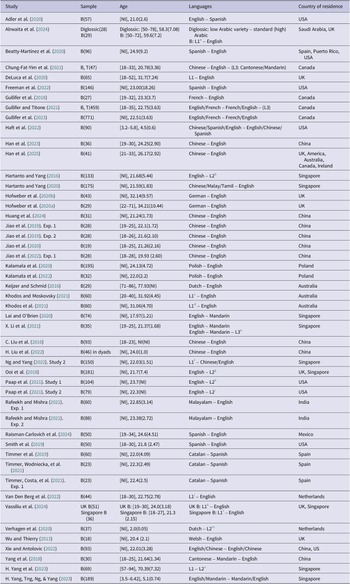


 Open access

