


Introduction
The jaguar Panthera onca is the largest felid species in the Americas, the top predator in Neotropical environments, and an important icon or deity for many indigenous cultures (Redford & Robinson, Reference Redford, Robinson, Medellín, Equihua, Chetkiewicz, Crawshaw, Rabinowitz and Redford2002). The species currently ranges from the south-western USA to northern Argentina. The jaguar faces severe conservation problems in most of its former range, to the extent that its current distribution has declined by 46% in the last 100 years (Sanderson et al., Reference Sanderson, Redford, Chetkiewicz, Medellín, Rabinowitz, Robinson and Taber2002). The main threats are habitat destruction and poaching of both jaguars and their main prey (Sanderson et al., Reference Sanderson, Redford, Chetkiewicz, Medellín, Rabinowitz, Robinson and Taber2002; Caso et al., Reference Caso, Lopez-Gonzalez, Payan, Eizirik, de Oliveira and Leite-Pitman2008; Manzanos, Reference Manzanos2009). Additionally, jaguars are the least known of the four species of the genus Panthera. A survey of the literature for 1965–2009 in the Institute for Scientific Information resulted in a total of 1,258 articles published on all four species, of which only 517 reported information on felids in the wild. Of these, 190 articles dealt with the lion Panthera leo, 135 with the tiger Panthera tigris, 128 with the leopard Panthera pardus, and only 64 with the jaguar (i.e. only c. 12% of published studies on Panthera spp.).
In Mexico the original distribution of the jaguar included tropical and subtropical regions southwards from Sonora and Tamaulipas, following the coastal plains south along the Gulf and Pacific to Chiapas and Yucatan, and into the Balsas River Basin to the state of Mexico (Ceballos et al., 2006), but the species has disappeared from > 60% of its historical distribution. The jaguar is categorized as Endangered in Mexico (SEMARNAT, 2001; Ceballos et al., 2006) and as Near Threatened globally (Caso et al., Reference Caso, Lopez-Gonzalez, Payan, Eizirik, de Oliveira and Leite-Pitman2008). Although the species has been recorded recently in 16 of Mexico’s 32 states the number of jaguars, the relative importance and connectivity of populations and the conservation status of these are unknown for most of Mexico (Sanderson et al., Reference Sanderson, Redford, Chetkiewicz, Medellín, Rabinowitz, Robinson and Taber2002; Ceballos et al., 2006).
A critical priority action for the conservation of the species in Mexico, as identified both by experts and by the federal government, is to assess the current status of the remnant populations nationally (Ceballos et al., 2006; Chávez et al., Reference Chávez, Ceballos, Medellín, Zarza, Ceballos, Chávez, List and Zarza2007). This will help determine priority areas for conservation and the design of corridors to maintain connectivity. National population surveys are being conducted, with standard camera-trapping protocols, as part of the Mexican National Jaguar Survey. These protocols were developed in consensus between Mexican and non-Mexican jaguar researchers and the federal government (Chávez et al., Reference Chávez, Ceballos, Medellín, Zarza, Ceballos, Chávez, List and Zarza2007).
One of the most important jaguar populations in Mexico is in the Greater Lacandona Ecosystem, Chiapas, which is part of the Mayan Forest (Medellín, Reference Medellín1994; Sanderson, et al., Reference Sanderson, Redford, Chetkiewicz, Medellín, Rabinowitz, Robinson and Taber2002; Azuara et al., Reference Azuara, Medellín, Cruz, Palacios-Mendoza, Chávez and Ceballos2006). This Ecosystem is part of one of the most important Jaguar Conservation Units (Selva Maya, JCU No. 155), extending from south-east Mexico to Guatemala and Belize. This JCU has the highest probability of long-term conservation of jaguars in Central America and Mexico (Sanderson et al., Reference Sanderson, Redford, Chetkiewicz, Medellín, Rabinowitz, Robinson and Taber2002). However, little is known about the jaguar population of the Greater Lacandona Ecosystem and estimation of its size is required to ensure its long-term protection. In the study reported here our objective was to estimate the abundance of jaguars in the Montes Azules Biosphere Reserve in this Ecosystem. This study is also the first attempt to estimate jaguar density using the federally approved standardized protocol developed for the survey of jaguar populations in Mexico.
Study area
The Greater Lacandona Ecosystem of south-east Mexico (Fig. 1a) contains the largest remaining portion of tropical rainforest in the country and is also a priority conservation area for the Mexican government and many NGOs. It is the most biodiverse area in Mexico, with many threatened species and many populations of these restricted to this area (Medellín, Reference Medellín1994). This Ecosystem is an important part of the Mayan Forest, the largest extension of tropical rainforest north of the Panama Isthmus and one of the few forests in Mesoamerica large enough to maintain viable populations of jaguar, white-lipped peccary Tayassu pecari and Baird’s tapir Tapirus bairdii (March, Reference March and Oliver1993; Medellín, Reference Medellín1994; Matola et al., Reference Matola, Cuarón, Rubio-Torgler, Brooks, Bodmer and Matola1997; Sanderson et al., Reference Sanderson, Redford, Chetkiewicz, Medellín, Rabinowitz, Robinson and Taber2002).
(a) Location of the Greater Lacandona Ecosystem in Mexico, and (b) location of the seven Natural Protected Areas of the Greater Lacandona Ecosystem, the effective sampling area used to estimate jaguar Panthera onca density in the 2008 rainy season, calculated using full overall mean maximum distance moved (OMMDM; see text for details), and land cover of potential jaguar habitat.

Nevertheless, the Greater Lacandona Ecosystem is severely threatened by imminent anthropogenic destruction. Of its original 1,500,000 ha of rainforest, two-thirds have been lost in the past 40 years (Mendoza & Dirzo, Reference Mendoza and Dirzo1999; De Jong et al., Reference De Jong, Ochoa-Gaona, Castillo-Santiago, Ramirez-Marcial and Cairos2000). The main threats are rapid human growth, oil exploitation and unregulated extraction of flora and fauna (Medellín, Reference Medellín1994). The Ecosystem includes seven Natural Protected Areas: the Montes Azules and Lacantún Biosphere Reserves, the Bonampak and Yaxchilán Natural Monuments, and the Chan-kin, Naha and Metzabok Areas for Flora and Fauna Protection (INE-SEMARNAP, 2000; Fig. 1). For details of the climate of the region see O’Brien (1995). We surveyed for jaguars in southern Montes Azules Biosphere Reserve, which is delimited by the Lacantún River to the south (Figs 1 & 2). The study area comprises c. 80 km2 of mostly tropical rainforest (Siebe et al., Reference Siebe, Martínez-Ramos, Segura-Warnholtz, Rodríguez-Velázquez, Sánchez-Beltrán and Sigmarangkir1996).
Spatial arrangement of camera-trap stations, and effective sampling areas, for the three surveys in the southern Montes Azules Biosphere Reserve (dark shaded area in Fig. 1).

Methods
Jaguar abundance and density were estimated using capture–recapture techniques with camera trapping (Karanth & Nichols, Reference Karanth and Nichols1998). This method has two assumptions: (1) demographic closure of the sampled population (the models assume no births, deaths or migration during the sample period); (2) no jaguar within the sampled area has a zero probability of being captured (Otis et al., Reference Otis, Burnham, White and Anderson1978; Karanth & Nichols, Reference Karanth and Nichols1998). In Montes Azules Biosphere Reserve there were no pre-existing roads or trails on which to set the camera-trap stations and therefore in January 2007 we opened eight 5–8 km long trails from the edge to the interior of the Reserve. Camera-trap surveys were conducted in the dry season of 2007 (March–May), at the end of the rainy season of 2007 (November 2007–January 2008) and in the dry season of 2008 (March–May).
Sampling effort and camera-trap brands varied between surveys. In the first 30 days of the dry season of 2007 the sampling area was surveyed with 16 camera-trap stations in two blocks (Fig. 2); subsequently these 16 camera-trap stations were moved to two adjacent blocks for a further 30 days (60 days in total, with 935 effective trap nights). The area covered in this survey defined by the perimeter of the camera-trap stations was 81 km2. We used 20 Stealth-Cam (model MC1-DV: Stealth-Cam LLC, Bedford, Texas) and four Camtrakker camera traps (Camtrakker TM, Camtrack South Inc. Georgia).
During the rainy season of 2007 the entire study area was sampled simultaneously with 33 camera-trap stations (Fig. 2) for 60 days (1,920 effective trap nights). The area covered by the perimeter of the camera-trap stations was 82 km2. We used a combination of 29 Camtrakker and 21 Deer Cam camera traps (model DC-200: Non Typical Inc., Park Lane, Park Falls, EU).
In the dry season of 2008 the entire study area was sampled simultaneously with 42 camera-trap stations (Fig. 2) for 60 days (2,520 effective trap nights). The area covered by the perimeter of the camera-trap stations was 77 km2. We used a combination of 22 Camtrakker, 14 Deer Cam and 24 Stealth-Cam camera traps.
A period of 60 days is a reasonable time to fulfil the demographic closure assumption for jaguars (Maffei et al., Reference Maffei, Cuellar and Noss2004; Silver et al., Reference Silver, Ostro, Marsh, Maffei, Noss and Kelly2004; Soisalo & Cavalcanti, Reference Soisalo and Cavalcanti2006). To increase the probability of individual identification several camera-trap stations in all surveys comprised two cameras, one on either side of the trail, to photograph simultaneously both sides of any jaguars that passed (16 for dry season 2007, 17 for rainy season 2007 and 18 for dry season 2008). Camera traps were positioned 40–50 cm above the ground and at least 3 m off the trails.
Camera-trap stations were 1–3 km apart. An important consideration was to ensure coverage of the entire area, avoiding gaps large enough to accommodate an adult female home range (Rabinowitz & Nottingham, 1986; Chávez, Reference Chávez2006), so as to satisfy the assumption that no adult jaguar had a zero probability of being photographed. The survey was, however, designed to cover the study area homogeneously to maximize the chance of photographing all jaguars present in the area (Karanth & Nichols, Reference Karanth and Nichols1998; Maffei et al., Reference Maffei, Cuellar and Noss2004; Silver et al., Reference Silver, Ostro, Marsh, Maffei, Noss and Kelly2004). Camera-trap stations were therefore placed in sites where jaguar signs (tracks, scats, scrapes) had been previously observed or in sites similar to these sites at short distance from pre-selected points. Camera traps were active 24 hours per day. Each day was defined as a sampling occasion. However, for the dry season 2007 survey we considered the two 30-day surveys as simultaneous; i.e. the number of captures for the first capture event was the total number of captures on the first day of trapping of the two surveys, the number of captures and recaptures for the second capture event was the sum of captures and recaptures on the second day, and so on (30 capture events for the dry season 2007 survey, and 60 each for the rainy season 2007 and dry season 2008 surveys).
Individual jaguars were identified in photographs by the spots and patterns of their pelage and abundance was estimated, from data on individuals photographed and re-photographed, using CAPTURE (Otis et al., Reference Otis, Burnham, White and Anderson1978; Rexstad & Burnham, Reference Rexstad and Burnham1991). CAPTURE generates an estimate of absolute abundance using four models that assume different sources of variation in capture probability and various combinations of these (Otis et al., Reference Otis, Burnham, White and Anderson1978; Rexstad & Burnham, Reference Rexstad and Burnham1991). The four models were tested but we report the results of the model of heterogeneity of capture (Mh). This model incorporates variable probabilities of capture of individual jaguars, and of the available models it is the one considered to be the most biologically realistic (Karanth & Nichols, Reference Karanth and Nichols1998; Maffei et al., Reference Maffei, Cuellar and Noss2004; Silver et al., Reference Silver, Ostro, Marsh, Maffei, Noss and Kelly2004).
To estimate jaguar density we calculated the effective sampling area, as encompassed by the area defined by the perimeter of the camera-trap stations with a buffer around the outside to take account of those individuals whose home ranges may include areas that were only partially contained within the sampling area (Nichols & Karanth, Reference Nichols, Karanth, Karanth and Nichols2002). We used the maximum distances moved by jaguars recaptured across the three surveys to calculate the overall mean maximum distance moved (OMMDM). We excluded the jaguar recaptures at single camera-trap stations (zero-distance moved) from the buffer size analysis to give a more conservative estimate of densities (Dillon & Kelly, Reference Dillon and Kelly2007). Two approaches have been used to estimate buffer width in such surveys: (1) ½ of the mean maximum distances moved (½MMDM, Maffei et al., Reference Maffei, Cuellar and Noss2004; Silver et al., Reference Silver, Ostro, Marsh, Maffei, Noss and Kelly2004; Salom-Pérez et al., Reference Salom-Pérez, Carrillo, Sáenz and Mora2007), and (2) the more conservative mean of maximum distances moved (MMDM, Soisalo & Cavalcanti, Reference Soisalo and Cavalcanti2006). Studies have indicated that use of ½MMDM could overestimate densities of large felids (Soisalo & Cavalcanti, Reference Soisalo and Cavalcanti2006; Dillon & Kelly, Reference Dillon and Kelly2008). We therefore calculated the effective sampling area using both ½OMMDM and OMMDM as the buffer width (Fig. 2). To obtain jaguar densities we divided the absolute abundance calculated with CAPTURE by the effective sampling areas. Variance in the density estimates was calculated following Karanth & Nichols (Reference Karanth and Nichols1998).
To estimate the population size of jaguars inside the seven Natural Protected Areas of the Greater Lacandona Ecosystem we estimated the potential habitat for jaguars within each area. For this we used 1 : 250,000 data from the Mexican National Forestry Inventory of 2000–2001 (SEMARNAP, 2001). We defined potential habitat as the area covered by tropical rainforest and tropical rainforest combined with secondary vegetation. This criterion is based on prior studies in other Mayan Forest sites, which have reported that jaguars prefer habitats with good vegetation cover and avoid areas modified by humans (Chávez, Reference Chávez2006; Zarza, Reference Zarza2008). Using ArcView v. 3.2 (ESRI, Redlands, USA) we overlaid the forest layers with polygons of the protected areas and estimated the area covered by these vegetation types inside the polygons. To estimate the potential jaguar population in the Ecosystem we extrapolated our estimates of jaguar densities to the potential habitat for jaguars inside the protected areas.
Results
Capture frequencies of jaguars in the 2007 dry, 2007 rainy and 2008 dry seasons were 5.2, 6.4 and 1.9 per 1,000 trap-days, respectively. During the three surveys a total of eight, or possibly nine, different jaguars were photographed. As there was not enough evidence to classify JA-08 as a separate individual (Table 1) this record was not included in the abundance analysis. Only male JA-01 and female JA-03 were photographed in all three surveys (Table 1). The OMMDM calculated using data across the three surveys was 5.3 ± SE 2.10 km).
Jaguar Panthera onca individuals photographed, number of captures + recaptures and maximum distance moved (MDM) in each of the three surveys, and the overall maximum distance moved (OMDM) in the three surveys combined in southern Montes Azules Biosphere Reserve (Fig. 1).
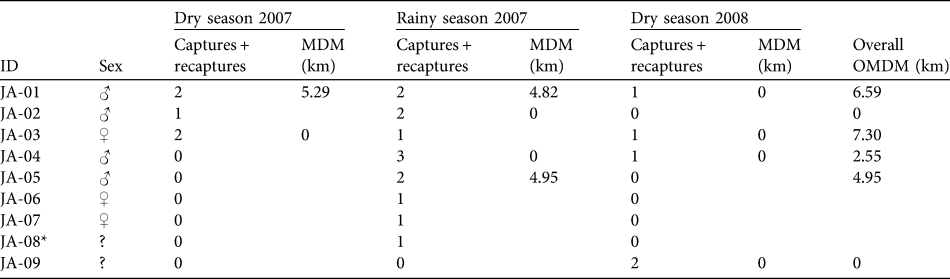
* Probably jaguar JA-07
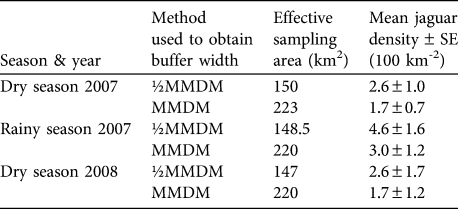
Three estimates of absolute abundance were calculated. For the 2007 dry, 2007 rainy and 2008 dry seasons the estimates using the Mh model were 4 ± SE 1.48 (95% confidence interval, CI, 4–11), 7 ± SE 2.29 (95% CI 7–19) and 4 ± SE 2.62 (95% CI 4–22), respectively. Closure tests from CAPTURE indicated that the population was closed in all three surveys (z = -0.67, P = 0.24; z = -1.21, P = 1.1; z = -0.73, P = 0.23; respectively). The effective sampling areas and density estimates are presented in Table 2. Density estimates for the 2007 dry and 2008 dry seasons were practically the same, despite the different sampling efforts.
Density estimates of jaguar in southern Montes Azules Biosphere Reserve (Fig. 1) using ½ mean maximum distance moved (½MMDM) and MMDM.
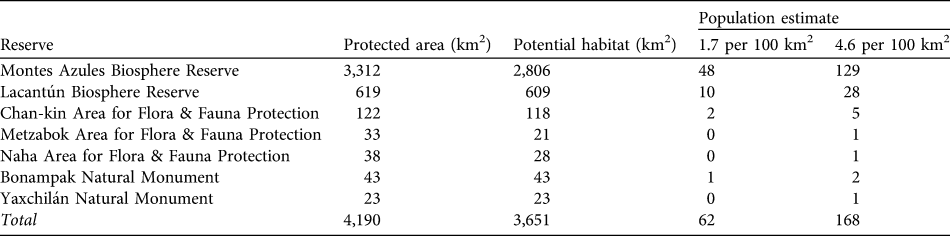
In the Greater Lacandona Ecosystem the seven protected areas cover c. 4,190 km2. However, not all the area is properly protected and can be considered potential habitat for the jaguar. We estimate that there is only a total of c. 3,651 km2 of potential jaguar habitat within the seven areas (Fig. 1). Extrapolating our density estimates to this potential habitat we calculated, using the lowest and highest estimates of jaguar density (Table 2), that the Ecosystem could contain a minimum of 62 or maximum of 168 jaguars (Table 3). The contiguous Montes Azules and Lacantún Biosphere Reserves and Bonampak Natural Monument (Fig. 1), have a combined capacity to support a minimum of 59 or maximum of 159 jaguars.
Area protected by the federal Natural Protected Areas of the Greater Lacandona Ecosystem (Fig. 1), the potential jaguar habitat of these Areas, and population size estimates based on the smallest and largest density estimates obtained in this study.
Discussion
Our density estimates showed a temporal variation in jaguar densities between dry and rainy seasons. Temporal variation in abundance and spatial distribution of jaguars has been documented in other studies (Schaller & Crawshaw, Reference Schaller and Crawshaw1980; Crawshaw & Quigley, Reference Crawshaw and Quigley1991; Nuñez et al., Reference Nuñez, Miller, Lindzey, Medellín, Equihua, Chetkiewicz, Crawshaw, Rabinowitz and Redford2002; Scognamillo et al., Reference Scognamillo, Maxit, Sunquist, Farrell, Medellín, Equihua, Chetkiewicz, Crawshaw, Rabinowitz and Redford2002) and may result from environmental changes in jaguar habitat and seasonal changes in the distribution of prey. However, our results could have been influenced by differing capture success of the various camera-trap models used as each model has a different probability of capture (Kelly & Holub, Reference Kelly and Holub2008).
Using our estimates of jaguar density based on ½OMMDM to calculate the effective sampling area, a mean of 3.6 jaguars per 100 km2 was obtained for the three sampling periods. This estimate is similar to or higher than those reported for other sites in Mexico and South America (0.20–3.10 per 100 km2; Crawshaw & Quigley, Reference Crawshaw and Quigley1991; Nuñez et al., Reference Nuñez, Miller, Lindzey, Medellín, Equihua, Chetkiewicz, Crawshaw, Rabinowitz and Redford2002; Scognamillo et al., Reference Scognamillo, Maxit, Sunquist, Farrell, Medellín, Equihua, Chetkiewicz, Crawshaw, Rabinowitz and Redford2002; Wallace et al., Reference Wallace, Gómez, Ayala and Espinoza2003; Maffei et al., Reference Maffei, Cuellar and Noss2004; Silver et al., Reference Silver, Ostro, Marsh, Maffei, Noss and Kelly2004; Paviolo et al., Reference Paviolo, De Angelo, Di Blanco and Di Bitetti2008; Silveira et al., Reference Silveira, Jácomo, Astate, Sollmann, Tôrres, Furtado and Marinho-Filho2009). However, our estimate is lower than that obtained in Calakmul, Mexico, using radio-telemetry technique (6 jaguars per 100 km2; Ceballos et al., Reference Ceballos, Chávez, Rivera, Manterola, Wall, Medellín, Equihua, Chetkiewicz, Crawshaw, Rabinowitz and Redford2002; Chávez, Reference Chávez2006), and densities obtained via camera trapping in Cockscomb Basin and Chiquibul, Belize (8.80 ± SE 2.25 and 7.80 ± SE 2.74 per 100 km2 respectively; Silver et al., Reference Silver, Ostro, Marsh, Maffei, Noss and Kelly2004), Corcovado, Costa Rica (6.98 ± SE 2.36 per 100 km2; Salom-Pérez et al., Reference Salom-Pérez, Carrillo, Sáenz and Mora2007) and Cerro Cortado, Bolivia (5.11 ± SE 2.10 per 100 km2; Maffei et al., Reference Maffei, Cuellar and Noss2004).
The lower jaguar density in southern Montes Azules Biosphere Reserve compared to other sites could be explained by local differences in prey availability and degree of human disturbance (Rabinowitz & Nottingham, 1986; Quigley & Crawshaw, 1992). Availability of prey on the edge of the Montes Azules Biosphere Reserve has probably been reduced by subsistence hunting (Jorgenson & Redford, Reference Jorgenson and Redford1993; Carrillo et al., Reference Carrillo, Wong and Cuaron2000; Escamilla et al., Reference Escamilla, Sanvicente, Sosa and Galindo-Leal2000), as our survey area is located just north of the southern border of the Reserve, the Lacantún River, which separates it from the nearest villages (Woodroffe & Ginsberg, Reference Woodroffe and Ginsberg1998).
Another possible explanation for the low estimate of jaguar density in our study is that some jaguars may not have been detected. We opened new trails 2 months before the first survey took place and resident jaguars may not have had sufficient time to become accustomed to them. New trails may be used less than old roads or trails (Maffei et al., Reference Maffei, Cuellar and Noss2004; Silver et al., Reference Silver, Ostro, Marsh, Maffei, Noss and Kelly2004; Weckel et al., Reference Weckel, Giuliano and Silver2006; Dillon & Kelly, Reference Dillon and Kelly2007). However, our low estimates of density could also be a reflection of different sampling designs (i.e. camera-trap station spacing and spatial arrangement, and area covered; Maffei & Noss, Reference Maffei and Noss2008) and different analysis techniques (i.e. inclusion or exclusion of zero distances moved in density estimation; use of ½MMDM or MMDM as the buffer width; Soisalo & Cavalcanti, Reference Soisalo and Cavalcanti2006; Dillon & Kelly, Reference Dillon and Kelly2007). It is therefore important to have a standardized protocol of sampling design and data analysis for camera-trapping studies of jaguars at the continental scale.
Our extrapolation of density estimates across the Greater Lacandona Ecosystem should be considered cautiously, especially as the sampled area is only a small proportion of the Ecosystem. Nevertheless, our minimum and maximum estimates suggest that the protected areas of this Ecosystem maintain a significant number of jaguars, highlighting the importance of conserving them, along with their habitat and their prey species, to ensure the viability of the jaguar population of the Mayan Forest, the largest and most important population in Mesoamerica (Ceballos et al., Reference Ceballos, Chávez, Rivera, Manterola, Wall, Medellín, Equihua, Chetkiewicz, Crawshaw, Rabinowitz and Redford2002; Sanderson et al., Reference Sanderson, Redford, Chetkiewicz, Medellín, Rabinowitz, Robinson and Taber2002). However, considering it has been speculated that the Greater Lacandona Ecosystem could maintain the second largest population of jaguars in Mexico after Calakmul, Campeche (Ceballos et al., Reference Ceballos, Chávez, Rivera, Manterola, Wall, Medellín, Equihua, Chetkiewicz, Crawshaw, Rabinowitz and Redford2002; Azuara et al., Reference Azuara, Medellín, Cruz, Palacios-Mendoza, Chávez and Ceballos2006), our estimate of the population is lower than expected. If the population of the Greater Lacandona Ecosystem becomes isolated from other populations in the Mayan Forest it would not be viable in the long-term (Eizirik et al., Reference Eizirik, Indrusiak, Johnson, Medellín, Equihua, Chetkiewicz, Crawshaw, Rabinowitz, Redford and 2002) and the future of jaguars in the Mayan Forest would be compromised.
The contiguous Montes Azules and Lacantún Biosphere Reserves and Bonampak Natural Monument have a combined capacity to support an important jaguar population. The other four protected areas are too isolated and small to protect, by themselves, relevant jaguar populations (Table 3). Nevertheless, we consider that these small protected areas are crucial to ensure the connectivity across the Greater Lacandona Ecosystem and the Mayan Forest jaguar population.
An essential requirement for the conservation of the jaguar population of the Greater Lacandona Ecosystem is to manage the Mayan Forest population as a unit by maintaining connections between the protected areas to facilitate movement of individuals. However, the protected areas of this region are threatened and could be isolated by a matrix of disturbed areas as a result of habitat fragmentation and resource exploitation. As a priority, a strategy for conservation of the jaguar outside protected areas is required. Payment for ecosystem services and additional incentives should be provided to communities that maintain sizeable fragments of forest and provide protection for jaguars and their prey. This strategy could include the implementation of sustainable development alternatives such as selective logging practices and wildlife management units. These measures would secure the conservation of potential corridors for jaguars between the protected areas of the Mayan Forest and ensure that the matrix outside the reserves is compatible with the conservation of the region.
Given current development in the Mayan Forest it is crucial to prepare and implement a programme for the conservation of the jaguar and other species in this region. Within this the implementation of standardized surveys for the jaguar can be used to identify core areas for jaguar conservation and to identify the most suitable sites to maintain connectivity between core areas. Combining this scientific information with the implementation of conservation–development policies will increase the chances of ensuring the long-term persistence of the most important jaguar population of Mesoamerica.
Acknowledgements
We thank our field assistants Rafa Lombera, Tepo Lombera, Max Cornelio, Don Chilo, Hugo and Enrique Baldovinos, the Lombera Family of the Chajul Ejido who kindly received us in their home, Cuauhtémoc Chávez, Heliot Zarza, Osiris Gaona, Horacio Bárcenas, Gerardo Ceballos, Enrique Martinez-Meyer, David Valenzuela and Jaime Zuñiga for their helpful suggestions in the development of this study, Osiris Gaona for technical support, Karina Tavera, Gerardo Cerón, Alejandro Gomez Nisino and Ana Di Pierro who recorded information during field surveys, and A. Menchaca and two anonymous reviewers for constructive suggestions. We appreciate the financial support of the Rufford Small Grants Foundation, the Sea World & Busch Gardens Fund, and the Jaguar Conservation Program of the Wildlife Conservation Society. We express our appreciation to the Commission of Natural Protected Areas of the Mexican Federal Government for supporting this research. Partial funds were also received from the WWF–TELCEL Alliance. This is a contribution of the EcoHealth Alliance. This paper was completed whilst RM was on sabbatical at the Arizona-Sonora Desert Museum in Tucson. RM thanks ASDM and DGAPA-UNAM for the support.
Biographical sketches
J. Antonio de la Torre has studied the abundance of jaguars and their prey in the Greater Lacandona Ecosystem and conducts research to improve the connectivity of the Mayan Forest jaguar population. He is interested in carnivore behaviour, ecology and conservation. Rodrigo A. Medellín has studied the ecology and conservation of mammals in Mexico for 30 years. One of his main lines of research is the study of the effect of human disturbances upon the Greater Lacandona Ecosystem and the implication of this for conservation and sustainable development.



