



The benefits of breast-feeding for mother and child are well established( 1 , 2 ). Variables associated with breast-feeding rates include socio-economic status, education, smoking, maternal age and pre-pregnancy weight( Reference Tarrant, Younger and Sheridan-Pereira 3 – Reference Amir and Donath 6 ). The postpartum period has been associated with an increase in food intake and a decrease in physical activity level (PAL)( Reference Clark and Ogden 7 – Reference Symons Downs and Hausenblas 9 ). Breast-feeding also has been shown to be positively associated with improved dietary quality in overweight and obese women( Reference Wiltheiss, Lovelady and West 10 , Reference Huseinovic, Winkvist and Bertz 11 ). However, no differences in PAL have been observed between women who never initiated breast-feeding and those who practise exclusive breast-feeding (EBF)( Reference Sharma, Dee and Harden 12 ).
The influence of breast-feeding on postpartum weight changes is not clear. Some studies suggest that breast-feeding aids postpartum weight loss while others challenge that belief( Reference Neville, McKinley and Holmes 13 ). EBF has been associated with greater weight loss; however, this relationship is not consistent between studies( Reference Neville, McKinley and Holmes 13 ). Longitudinal studies that investigate breast-feeding and postpartum weight changes usually rely on self-reporting of maternal pre-pregnancy weight, which has limitations( Reference Neville, McKinley and Holmes 13 , Reference Turner 14 ). Self-reporting of weight in obese women may be particularly subject to error( Reference Fattah, Farah and O’Toole 15 ). There is a lack of longitudinal studies in which both maternal pre-pregnancy and postpartum weights are measured and weight changes analysed by infant feeding practices. Further studies are also needed to ascertain whether some breast-feeding women lose weight postpartum more readily than others.
Conflicting results have also been found with regard to breast-feeding and its effect on maternal body composition. The majority of studies report little or no association between breast-feeding and body composition. However, many of these studies rely on small sample sizes( Reference Neville, McKinley and Holmes 13 ). There is a paucity of research investigating the association between breast-feeding and other maternal variables that can be examined independently of dietary quality and physical activity.
The purpose of the present paper was to examine whether breast-feeding, and in particular EBF, was associated with maternal weight and body composition changes after delivery independently of other variables such as diet, physical activity, smoking, socio-economic disadvantage and demographic differences.
Methods
The Coombe Women and Infants University Hospital is one of the largest maternity hospitals in the European Union and cares for women from all socio-economic groups and from across the urban–rural divide. Women were recruited at their convenience after an ultrasound examination confirmed an ongoing singleton pregnancy.
Clinical and sociodemographic details were computerised routinely at the first visit and after delivery. In addition, socio-economic, health behavioural and PAL data were collected at the first visit using standardised questionnaires. Height was measured to the nearest centimetre using a Seca wall-mounted digital height measure with the woman standing in her bare feet. Weight and body composition were measured using advanced, eight-electrode bio-electrical impedance analysis (Tanita MC 180, Tokyo, Japan) and BMI was calculated. Women received no lifestyle interventions as part of the research during or after pregnancy other than the standard antenatal care.
Women were invited back to the hospital for review at 4 months postpartum. Socio-economic, health behavioural and PAL data were again gathered at this visit, and the woman’s weight, body composition and BMI re-measured. The women’s dietary quality information was also gathered. The study was approved by the Hospital’s Research Ethics Committee on 16 May 2012. Written informed consent was obtained from each participant.
Inclusion/exclusion criteria
The main inclusion criteria were attendance for antenatal care following ultrasound examination and confirmation of an ongoing singleton pregnancy in the first trimester. To reduce the number of confounding variables, the main exclusion criteria were multiple pregnancy, women <18 years of age and women with a gestational age >18 weeks at the first booking visit. Women who delivered elsewhere were also excluded.
Health behavioural information and socio-economic status
The health behavioural information gathered included any medical conditions, medications, smoking status and PAL. Additional questions collecting socio-economic data were derived from the Survey on Income and Living Conditions 2012( 16 ). Material indices of socio-economic status included relative income poverty and relative deprivation status, while consistent poverty status was also calculated( 17 ). Relative income poverty was calculated by comparing equivalised household income against the 60 % median income threshold. Relative deprivation was assessed by determining whether respondents had experienced the enforced absence (due to financial constraint) of two or more basic necessities from a list of eleven over the previous year. Consistent poverty was identified if a respondent’s equivalised household income fell below the relative income poverty threshold, in addition to experiencing the enforced absence of two or more of the eleven basic markers of deprivation over the previous year( 17 ).
Self-assessed habitual PAL was also collected using a self-administered, unsupervised questionnaire. Individual PAL was estimated for each participant from 1·45 MET (seated work with no option of moving around and no strenuous leisure-time activity) up to 2·20 MET (strenuous work or highly active leisure-time activity, e.g. competitive athletes in daily training)( 18 ), where MET is metabolic equivalents of task.
Dietary quality data
Dietary quality data were collected using a self-administered, unsupervised questionnaire. This included information about the respondent’s meal pattern (number of meals per day) and her habitual intakes of fruit and vegetables, breakfast cereals and oily fish. Participants’ starchy food, meat and poultry, dairy food and sugary food and drink intakes were also recorded. Intakes of fat-rich foods including chips and savoury snacks were determined next, with participants finally asked to estimate their habitual alcohol intake and their daily intakes of water and other sugar-free fluids.
Each of the dietary domains was ranked, based on its respective nutritional importance in pregnancy. For example, breakfast cereals were highlighted as a priority food group due to their high content of critical nutrients for pregnancy including folate, Fe and vitamin D( 19 – 21 ). Dietary domain scores were derived for each domain based on the participant’s consumption of foods within that domain, and these scores were amalgamated to yield one composite score reflecting the overall quality of the participant’s diet (range of 0 to 100).
Infant feeding practices
When they returned for their 4-month postpartum visit women were asked by questionnaire whether they had breast-fed after delivery. Breast-feeding women were also asked at this postpartum visit whether they had exclusively breast-fed (EBF; only breast milk, no formula) or engaged in partial breast-feeding (breast milk and formula combined). Women were asked how long they had breast-fed for, with options ranging from ‘0 to 3 days’, ‘4 to 6 days’, ‘1 week’ with weekly options up to ‘12 weeks’, ‘3 months’ with monthly options to ‘5 months’ to finally whether they were ‘still breast-feeding’.
To capture both the intensity and duration of breast-feeding we used a scale that reflects the energy costs of full and partial breast-feeding( 22 , Reference Baker, Gamborg and Heitmann 23 ). Women were assigned 1 point/week for EBF and 0·5 point/week for partial breast-feeding. The breast-feeding scale was used as a continuous scale.
Statistical analysis
Data analysis was carried out using the statistical software package IBM SPSS Statistics version 20·0. Baseline anthropometric characteristics of the women who returned for follow-up were compared with those of the total original sample using independent-samples t tests, to ensure that the final prospective cohort was representative of the broader study population. Age and anthropometric characteristics of the exclusive breast-feeders were compared with those of women who formula-fed using independent-samples t tests. Cross-tabulation with χ 2 analyses were used to test differences between the proportions of exclusive breast-feeders and women who formula-fed in different socio-economic and health behavioural groups.
Binary logistic regression was performed to assess the unconfounded association between a number of factors and participants’ self-reported EBF and formula-feeding practices. The final model comprised seven independent variables (nativity, obesity, relative income poverty, relative deprivation, consistent poverty, nulliparity and current smoking status). Factors were included in the multivariate model based on a statistically significant association with infant feeding method upon univariate analyses (P<0·05).
Differences in maternal body weight and body composition changes between baseline and 4 months postpartum between women who EBF and women who formula-fed were analysed by the Mann–Whitney U test as these data were non-normally distributed. Differences in PAL and dietary quality at 4 months postpartum were analysed according to infant feeding practices using the Kruskal–Wallis test.
Binary logistic regression was performed to assess the association between a number of factors and maternal weight and body fat percentage gain or loss postpartum. The model contained eight independent variables (early pregnancy obesity status, nulliparity, stage of gestation at booking visit, birth weight, dietary quality score, breast-feeding scale, PAL and EBF).
Results
The total sample recruited initially in the first trimester was 1035 women and 98 % (n 1018) delivered a live-born baby in the Hospital between November 2012 and March 2014. At 4 months postpartum, 470 women agreed to return for repeat measurements for research purposes and completed the breast-feeding questionnaire. Women who returned for follow-up (n 470) did not differ from the full baseline sample (n 1035) in weight, BMI or stage of gestation at booking visit. Women who did not return were younger (28·9 v. 30·9 years, P=0·001) and more likely to be current smokers (20·2 v. 9·7 %, P=0·001) than women who returned.
The mean stage of gestation at booking (n 470) was 12·4 (sd 1·7) weeks and mean postpartum follow-up was at 18·0 (sd 2·2) weeks. The mean age at recruitment was 30·8 (sd 5·0) years. The mean antenatal weight was 69·2 (sd 14·2) kg and mean antenatal BMI was 25·3 (sd 5·1) kg/m2, with 14·9 % of participants (n 70) obese. Forty-three per cent (n 213) of the women were nulliparous. The women’s mean dietary quality score was 68·3 (sd 26·0). Women who EBF had a mean breast-feeding scale score of 11·8 (sd 5·2) and women who partially breast-fed a breast-feeding scale score of 4·1 (sd 3·1).
The mean postpartum weight was 70·9 (sd 14·2) kg and the mean BMI was 25·9 (sd 5·0) kg/m2. The characteristics of the study population analysed by postpartum infant feeding method are shown in Table 1. Women who EBF reported breast-feeding for 86·0 (sd 46·6) d (range 1·5–168 d), whereas women who partially breast-fed reported breast-feeding for 56·8 (sd 43·5) d (range 1·5–168 d; P<0·001). When binary logistic regression was performed to assess the association between a number of maternal factors and the likelihood that women would EBF or not breast-feed, relative income poverty (P=0·04), deprivation (P=0·02), Irish nativity (P<0·001) and current tobacco use (P=0·01) remained negatively associated with EBF (Table 2).
Characteristics of the study population at 4 months postpartum analysed by postpartum infant feeding method (n 470), Dublin, Republic of Ireland
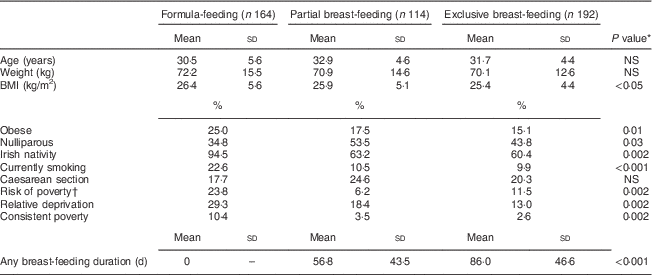
*P value testing for significant difference between formula-feeding and exclusive breast-feeding (except for ‘Any breast-feeding duration’ variable, where P value tests for significant difference between partial breast-feeding and exclusive breast-feeding) using independent-samples t tests and χ 2 analyses.
† Data available on n 469.
Binary logistic regression of postpartum factors associated with exclusive breast-feeding compared with formula-feeding (n 356), Dublin, Republic of Ireland
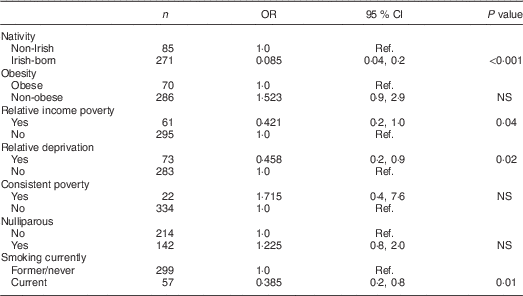
Ref., reference category.
There was no difference in maternal weight change from baseline to 4 months postpartum between women who EBF and those who did not breast-feed (Table 3). Women who EBF, however, had an increased fat mass (P=0·03) and percentage body fat (P=0·02) between early pregnancy and 4 months postpartum compared with non-breast-feeders. We found no relationship between infant feeding and postpartum changes in fat distribution (Table 4). Women who EBF had a better dietary quality score than women who did not breast-feed or those who partially breast-fed (P<0·001). There was no relationship between PAL and infant feeding practices (Table 5).
Differences in maternal weight and body composition changes between early pregnancy and 4 months postpartum according to infant feeding practices (n 470), Dublin, Republic of Ireland
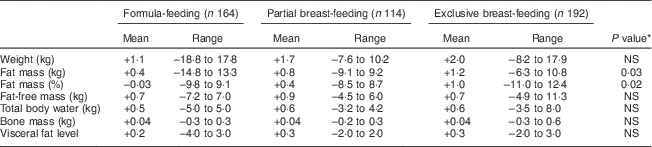
*P value testing for significant difference between formula-feeding and exclusive breast-feeding using Mann–Whitney U test.
Difference in maternal segmental body composition changes between early pregnancy and 4 months postpartum according to infant feeding practices (n 467), Dublin, Republic of Ireland
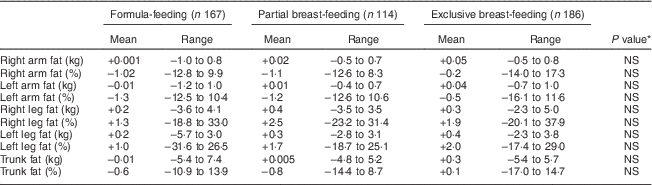
*P value testing for significant difference between formula-feeding and exclusive breast-feeding using Mann–Whitney U test.
Dietary quality scores and physical activity levels according to infant feeding practices (n 450), Dublin, Republic of Ireland

MET, metabolic equivalents of task.
*P value tested using Kruskal–Wallis test.
After controlling for breast-feeding, breast-feeding scale, nulliparity, stage of gestation at booking and PAL, only early pregnancy BMI<30·0 kg/m2 and diet quality score remained associated with weight and body fat percentage gain at 4 months postpartum (Table 6).
Logistic regression of factors associated with maternal weight and body fat percentage gain at 4 months postpartum (n 337 for whom all variables were available), Dublin, Republic of Ireland
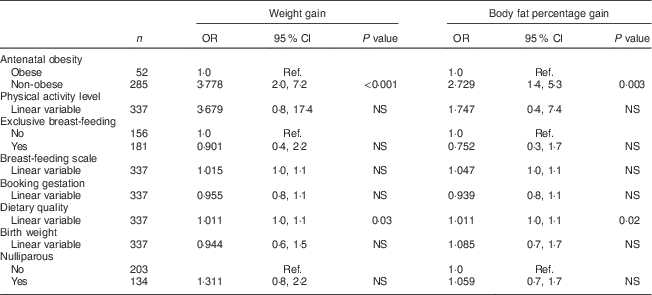
Ref., reference category.
Discussion
We found in a longitudinal observational study that on univariate analysis obese women were less likely to breast-feed, but that EBF was associated with an increase on average in maternal weight and an increase in maternal adiposity. Women who breast-fed were more likely to put on weight and to become fatter even though their diet quality was superior and their PAL was similar to women who formula-fed. They were also less likely to smoke, less likely to be socially deprived and less likely to have been born in Ireland. EBF was not associated with postpartum maternal weight or body fat percentage changes after adjusting for maternal obesity, breast-feeding duration, PAL, booking gestation, dietary quality, infant birth weight and nulliparity. Therefore, we found no evidence to support promoting breast-feeding on the basis of improving maternal weight postpartum. As part of a public health strategy to promote breast-feeding there are more convincing reasons why a woman should breast-feed exclusively( 1 , 2 ).
Our study has strengths. The study population is well characterised. The clinical and sociodemographic details were computerised as usual at the first antenatal visit and after delivery, but additional data were collected prospectively using detailed questionnaires that gathered information on breast-feeding, dietary quality, physical activity and social disadvantage.
A further strength of our study was the clinical measurement (rather than self-reporting) of early pregnancy weight. The baseline weight measurement and BMI calculations were obtained before 18 weeks’ gestation, which is optimal( Reference O’Higgins, Doolan and Mullaney 24 ). There are few studies investigating measured differences in weight and BMI between early pregnancy and the postpartum period, with many studies relying on self-reported pre-pregnancy weight which is unreliable and leads to BMI misclassification( Reference Turner 14 ). Self-reporting of weight in obese women may be particularly subject to error( Reference Fattah, Farah and O’Toole 15 ). To our knowledge, the present study is one of the largest to measure maternal body composition directly using advanced bio-electrical impedance analysis, which means that trajectories in fat and fat-free mass can be tracked over time and analysed by infant feeding practices.
Another strength of the study is that its prospective design minimises recall bias which is a potential problem with post-pregnancy research( Reference Rockenbauer, Olsen and Czeizel 25 ). The study also highlights the advantage of longitudinal studies. Based on a cross-sectional analysis postpartum maternal obesity was associated with formula-feeding; however, on longitudinal analysis maternal weight gain was associated with breast-feeding. Our longitudinal study design overcomes this critical inability of cross-sectional studies to measure changes in anthropometric status between the antenatal and postpartum time points.
A potential weakness of the study is that recall bias may have occurred at 4 months postpartum when women reported their breast-feeding duration. Women were asked how long they had breast-fed. While the inability of this question to differentiate between EBF and partial breast-feeding introduces a degree of imprecision, this limitation is mitigated by the use of a scale that captures the intensity and duration of breast-feeding (and hence estimates the overall bio-energetic cost of breast-feeding during the postpartum period) for both EBF and partial breast-feeding mothers. Another potential weakness of the study is that convenience recruitment may introduce an unforeseen bias that was not addressed in the multivariable analysis. However, consecutive recruitment is practically challenging in a longitudinal study whose timeframe spans early pregnancy until four months following a woman’s discharge home with her newborn baby. We are also uncertain whether our observations are applicable in the developing world.
The benefits of breast-feeding for mother and child are well established( 1 , 2 ). Many factors have been associated with breast-feeding rates including nationality, socio-economic status, education, smoking status, maternal age and pre-pregnancy weight( Reference Tarrant, Younger and Sheridan-Pereira 3 – Reference Amir and Donath 6 ). In the present study, multivariate analysis showed that women who smoked, who were Irish and who were living in relative income poverty and deprivation were less likely to EBF.
It has been suggested that common lifestyle risk factors cluster among adults( Reference Schuit, van Loon and Tijhuis 26 ). In this context, our study suggests a clustering of poorer health behaviours among women who choose to formula-feed. This suggestion is further strengthened by our finding that women who EBF had better dietary quality scores than women who partially breast-fed or formula-fed. Insight into the prevalence of clustering is important, because it can potentially help in locating high-risk groups where multi-component health promotion initiatives may yield extra benefit( Reference Schuit, van Loon and Tijhuis 26 ). Our study findings have public health implications as they show that additional emphasis on breast-feeding promotion may be needed in women of low socio-economic status who have other adverse health behaviours such as smoking.
There is insufficient evidence to assert a benefit for breast-feeding in postpartum weight loss( Reference Neville, McKinley and Holmes 13 ), yet this remains a commonly held belief( 2 , Reference Krause, Lovelady and Østbye 4 , Reference Murimi, Dodge and Pope 27 ). Many studies in this area rely on self-reporting of maternal weight, which has limitations( Reference Turner 14 ). Consequently, it has been suggested that more robust studies are needed to reliably assess the impact of breast-feeding on postpartum weight management( Reference Neville, McKinley and Holmes 13 ). In our study, there was no difference in weight change from early pregnancy to 4 months postpartum between women who EBF and those who formula-fed. The perception that breast-feeding aids postpartum weight loss may, therefore, not be true for all women. Overweight and obese women with persistently high, unrealistic expectations of breast-feeding and weight loss have been shown to give up on breast-feeding earlier( Reference Krause, Lovelady and Østbye 4 ). For this reason, evidence-based breast-feeding promotion strategies may need to focus on health benefits to the mother and child other than weight loss.
In our study, women who EBF had a greater increase in postpartum fat mass and percentage body fat compared with women who formula-fed. Conflicting results have also been found in relation to breast-feeding and its effect on maternal body composition, with the majority of studies reporting little or no association between breast-feeding and body composition. However, many of these studies rely on small sample sizes( Reference Neville, McKinley and Holmes 13 ). When dual-energy X-ray absorptiometry was used to measure body composition in a US study (n 168), non-breast-feeding women lost whole-body, arm and leg fat at a faster rate than the breast-feeding women (who intended to breast-fed for >6 months and to provide no more than one formula feeding per day) between 2 weeks and 6 months postpartum( Reference Wosje and Kalkwarf 28 ).
It has been reported that body fat deposition during lactation occurs at central sites, for example, on the trunk and thighs( Reference Butte and Hopkinson 29 ). Although no difference in body fat distribution between lactating and non-lactating women was observed in our study, it may be that lactating women have an overall physiological increase in body fat to support the extra energy costs of lactation. Further longitudinal studies are needed to clarify whether postpartum changes in fat distribution are influenced by breast-feeding.
Conclusions
The present study found that exclusive breast-feeding was not associated with postpartum maternal weight or body fat percentage changes after adjusting for important confounders. Breast-feeding promotion strategies may need to focus on women of low socio-economic status. These women, who may be subject to a clustering of poor lifestyle behaviours, such as smoking and poorer dietary quality, may benefit from the established advantages to mother and child of breast-feeding. The perception that breast-feeding aids postpartum weight loss, however, is not true for all women. Clinicians should be cautious when advising mothers about expected rates of weight and fat loss during lactation. Breast-feeding promotion strategies should instead focus on health benefits to mother and child other than maternal weight loss.
Acknowledgements
Acknowledgements: The authors acknowledge with gratitude the participation of the pregnant women who took part in this study. Financial support: This project was supported by the UCD Centre for Human Reproduction and was partially funded by an unlimited educational grant from Danone Nutricia Early Life Nutrition for the first author. Danone Nutricia Early Life Nutrition had no role in the study design, data analysis, data interpretation or writing of this article. Conflict of interest: The authors declare no conflict of interests. Authorship: All authors contributed to this work. L.M., A.C.O.H., D.Mc.C. and M.T.J. formulated the research question and developed the experimental design. L.M., A.C.O.H., S.C. and R.K. collected the data. L.M. analysed the data. All authors contributed to drafting and revisions of the manuscript and approved the final version prior to submission. Ethics of human subject participation: This study was conducted according to the guidelines laid down in the Declaration of Helsinki and all procedures involving human subjects/patients were approved by the Research Ethics Committee of the Coombe Women and Infants University Hospital. Written informed consent was obtained from all subjects/patients.



