


The US population consists of 121 million older adults including 26% adults aged 45–64 years and 13% aged 65+(Reference Howden and Meyer1). As the population of older adults grows, health professionals need to clearly understand the nutritional needs and food-related perceptions of this population as diet can impact physical health (e.g. diabetes, cardiovascular disease, cancer) and mental health (e.g. dementia)(Reference Pi-Sunyer, Becker and Bouchard2). Furthermore, the food choices of older adults not only affect their own well-being but also the food consumption of those they influence (i.e. grandchildren)(Reference Roberts and Pettigrew3).
Several studies have examined the food choices and perceptions of older adults. Factors include personal taste, convenience, cost, living circumstances, cultural norms, and health concerns(Reference Payette and Shatenstein4–Reference van der Zanden, van Kleef and de Wijk10). Studies show older adults are aware of the connection between food and health(Reference Marantos, Martinez and Dwyer11,Reference Wilcox, Sharkey and Mathews12) . This group conceptualizes healthy eating as having well-balanced meals and a variety of different foods in their diets(Reference McKie8), but they acknowledge the limitations of healthy eating based on decreased income, weak social networks, and access to healthy foods(Reference Payette and Shatenstein4,Reference Conklin, Forouhi and Surtees13) . Perceptions may or may not be rooted in accurate information. Some older adults report that their physicians are their primary provider of nutritional information(Reference Bruss, Morris and Dannison14,Reference Heuberger and Ivanitskaya15) , and others rely on their own feelings, family members, and popular media(Reference McKie8,Reference Ahye, Devine and Odoms-Young16) .
In addition to affecting their personal health, older adults’ perceptions about food and their food choices can affect the health of younger generations. There are 65 million grandparents in the USA(Reference Ellis and Simmons17), and they typically provide their grandchildren with unhealthy food(Reference Roberts and Pettigrew3). Of this population, a tenth live with at least one grandchild, which accounts for 3% of all households. In multigenerational households, children are more likely to be overweight or obese compared with children who have never shared a home with a grandmother(Reference McKinney18). More than 60% of these multigenerational households are led by the grandparent(Reference Ellis and Simmons17). Custodial grandparents are more conscious of nutrition and food safety compared with when they were first-time parenting(Reference Higgins and Murray19). Yet, being conscious of these issues may not translate to action. Nine studies in a systematic review showed that grandparents demonstrate detrimental feeding attitudes and behaviours towards their grandchildren that can impact what the grandchildren eat and their weight(Reference Young, Duncanson and Burrows20).
Grandparents are found to model unhealthy eating more than the children’s parents, and that behaviour is linked to maladaptive feeding practices(Reference Farrow21). Given that childhood obesity (ages 2–19) rates are about 17% with high rates for African American (19·5%) and Hispanic/Latino children (21·9%)(Reference Ogden, Carroll and Lawman22), it is particularly important to better understand grandparents’ food behaviours in order to intervene to prevent and/or address overweight and obesity and their medical sequelae in younger generations. In searching for solutions, we must take into account Devine’s life course perspective, which emphasizes that food choices are based on ‘changing temporal, social, and historical contexts’(Reference Devine23). In addition, we have to gain perspective on how grandparents interpret their adult children’s and grandchildren’s role in their dietary practices, and how the younger generations influence them.
To our knowledge, little research has been conducted to explore food influence between grandparents and their grandchildren, and this relationship could be a potential lever to enhance or hinder healthful eating. This study aims to explore food perceptions among grandparents and understand the influence of these perceptions on food choice for the younger generations in their family. Since qualitative methods are helpful in understanding context and meaning, we selected focus groups to collect the data(Reference Creswell and Creswell24). Our focus groups include Black, Hispanic, and White people representing different socioeconomic status (SES) in a range of living situations to try to elucidate insights to contribute to a healthier eating environment for all generations.
Methods
Participants
Grandparents were recruited to participate in a study about ‘Food, Health and Your Family’ via flyers posted at a local retirement community, a local education centre for older adults, a local public health and advocacy organization, local churches, gas stations, grocery stores, community centres, YMCAs, and from an existing database of older adult research volunteers. Although the majority of our sample comprised older adults (aged 65+ years), as defined by the US Census(Reference Ortman, Velkoff and Hogan25), we included all grandparents who wished to participate, including grandparents under the age of 65.
Procedures
The current study was approved by the Institutional Review Board and all participants provided written informed consent. Focus groups were selected as the data collection method to best understand how groups make meaning regarding food perception and food choice within their culture(Reference Creswell and Creswell24). Fourteen focus groups were held in locations most accessible for participants and included locations on and off the university campus between 2013 and 2014. Focus groups were conducted until saturation was reached. Groups ranged in size from two to eight participants and comprised seven White, three Black, and four Hispanic same-race focus groups. Focus groups lasted 60–120 min and were moderated by a trained student researcher. The Hispanic focus groups were conducted in Spanish, and then the audio recordings were translated into English.
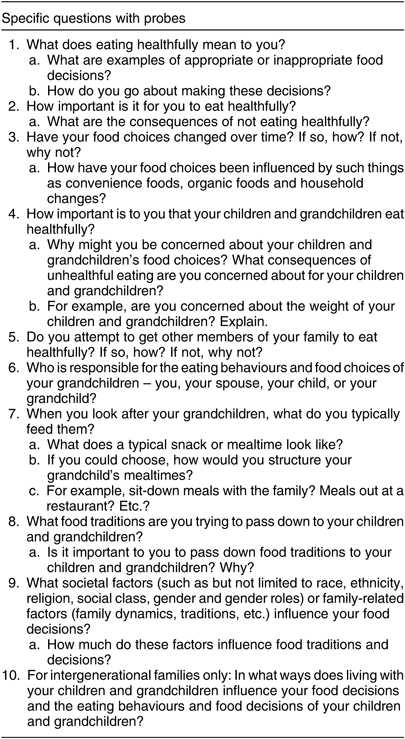
The moderator posed ten open-ended questions consisting of the following topics: healthy eating, changes of food choice over time, importance of children and grandchildren eating healthy, attempts at influencing food choice, dietary practice responsibility, foods provided to grandchildren when under their care, food traditions, and societal factors affecting food decisions. Table 1 lists the specific questions with probes. All groups were audio-recorded. After the discussion ended, participants were asked to complete a demographic form about their gender, nationality, age, education, BMI, number of grandchildren, and if they lived with their grandchildren. In addition, they were asked about their perceived health status (‘How would you rate your current health?’ Rated on a scale from 1 ‘poor’ to 5 ‘excellent’) and their perceived health barriers (‘How much do health problems stand in the way of doing things you want?’ Rated on a scale from 1 ‘not at all’ to 5 ‘greatly’). The compensation for participating in the focus group and completing the demographic form was $15.
Focus group questions
Data analysis
A total of fourteen audio recordings were transcribed via Rev.com. After transcription, the study team utilized a directed content analysis approach, which uses existing theory and literature to guide interpretation along with leaving space for new findings(Reference Graneheim and Lundman26). The study team developed the codebook based on the literature review, the focus group questions, and by reading four transcripts together to allow for new codes to emerge. The researchers used HyperResearch (ResearchWare, Randolph, MA) as the qualitative data management tool. Two more transcripts were both independently coded by two researchers. The study team reviewed the coded transcripts to compare agreement. Most of the coding between the researchers was the same, and each discrepancy was discussed until the study team reached consensus. Then researchers coded the remaining eight transcripts independently, and the study team met to discuss the findings.
Results
The participants’ demographics are captured in Table 2. Participants were fifty-eight predominantly female (72%), aged 44–86 (mean = 65·4 (sd 9·97) years), 28% Black, 36% Hispanic, and 36% White. Most participants had a high school/GED or less educational level. The mean body mass index (BMI) was in the overweight category (mean = 26·38 kg/m2 ± 5·58-point score). The participants reported relatively high perceived health status (mean = 3·97 ± 1·21-point score) and lower perceived health barriers (2·19 ± 1·6-point score).
Demographic information
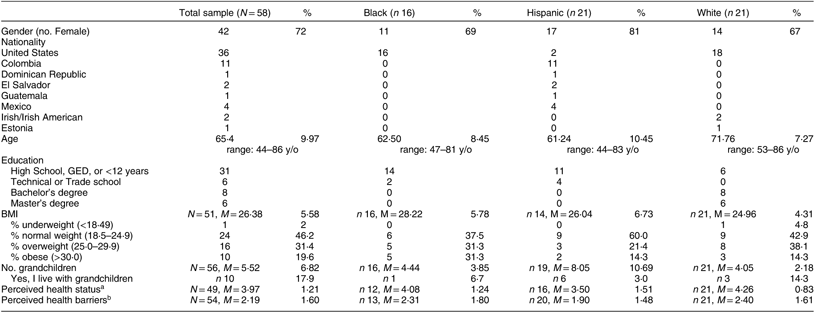
a ‘How would you rate your current health?’ Rated on a scale from 1 ‘poor’ to 5 ‘excellent’.
b ‘How much do health problems stand in the way of doing things you want?’ Rated on a scale from 1 ‘not at all’ to 5 ‘greatly’.
Analyses revealed the following themes about grandparents’ perceptions related to personal food choice, as well as grandparents’ perceived influence on their children’s and grandchildren’s food choices.
Grandparents’ perceptions related to their personal food choice
The two themes within this section are (i) health issues and (ii) media. These categories seem to impact grandparents’ perception of their personal food choices.
Health issues
Personal medical conditions
Many participants focused on how personal medical conditions affect their perceptions and food decisions for themselves. The main health issues listed among the Black, White, and Hispanic groups were diabetes, high cholesterol, hypertension, heart disease, arthritis, and mental illness. Participants in Hispanic groups reported more about the role of allergies and discomfort from eating certain foods such as pizza and pork. Many participants reported that they read food labels and tried to limit salt, meat and sugar intake. One participant reported:
‘Obviously, what would be appropriate is based on what your physical condition is. If you have cholesterol problem, you need to recognize that. If you have a heart problem, you need to recognize that. Depending upon, really, what your health situation is, it should determine the kind of food you should eat, and consequently will make amends to what ailment you might have’. (White Man, FG6)
Medical conditions of their partner/family members
Most participants shared how the medical conditions of their partner/family members impacted their own personal food choices. Furthermore, one participant stated how his partner’s health affects their grandchild’s eating as well:
‘My grandson stays with me and of course my wife eats healthy because she’s diabetic. I want to be around, and she has high blood pressure and she diabetic, so I don’t allow too much fried foods and a lot of that pork. When I got a good chance I try to cook, and I will bake and broil everything. I want my grandson to eat healthy’. (Black Man, FG7)
Life stage
In addition, many participants were acutely aware of the impact of their life stage on their personal food choice, including being a widow and not having to prepare food for anyone else (relationship status), living in a nursing home and not having food choice (living situation), and age-related body changes. A participant reported, ‘As we get older, we don’t metabolize as well and we don’t need the calories as much’ (White Woman, FG1).
Media
The participants in all groups reported varying views on the media regarding their personal food choice, ranging from it providing helpful nutrition and health-based information, to providing confusing conflicting nutrition messages, and to marketing unhealthy foods. Among all the focus groups, the White male focus groups discussed the role of the media the most.
Nutrition and health-based information
Some participants reported that the media facilitated making healthy nutrition and lifestyle choices for themselves because of the ubiquitous health-based messages. A participant stated, ‘It’s interesting that we’re talking about the change that we made in lifestyle and nutrition and some of it is probably because of media and having it brought to our attention’ (White Man, FG2). Other participants mentioned how people use media for advice-seeking: ‘you got a lot of people going to the internet now, researching food now too. A lot of people getting on the internet and finding out what certain things contain. You know we have to invest in our food and eating right, like with everything else’ (Black Man, FG7).
Conflicting messages
Some participants stated that the media was full of ambiguity because the messages about how food impacts health were consistently changing: ‘Obviously, you get your newsfeeds, and you get all the new studies that are coming out about food and things like that. It’s constantly changing based on new information that you get’ (White Man, FG2).
Impact of food marketing
Other participants deemed that advertising definitely had an effect on their personal food choices: ‘marketing is a tremendous motivator and controls a lot of food habits’ (White Man, FG6). One participant reported that, ‘You can’t hardly watch broadcast television without getting up and getting a snack. You are just barraged; eat this, eat this, eat this. It’s horrible, it really is’ (White Man, FG2).
Grandparents’ perceived influence on their children’s and grandchildren’s food choices
The following themes provided a deeper understanding about grandparents’ influence on their children’s and grandchildren’s food choice: (i) proximity and power; (ii) healthy v. unhealthy spoiling; (iii) cultural food traditions; and (iv) reciprocal exchange of knowledge.
Proximity and power
Participants indicated that level of influence was based on an interaction of geographical proximity to their grandchildren and the power given to them by their children and grandchildren to make food decisions.
Participants shared how they were able to interject more influence through food-related advice to grandchildren who lived closer to them. One participant said, ‘We try to have a big influence, at least on the two that live here. The three that live in Greensboro, we have less influence on what they eat’ (White Man, FG2). Another participant who watches her grandchildren after school reported, ‘I throw them an apple right quick, you know. I don’t give them sweets at all, period’ (Black Woman, FG7).
Racial differences
Across race, it seemed that Hispanic participants reported having a larger impact on food choice for the grandchildren who live in the same area or within the same house. For instance, one participated stated,
‘A while back they sent two to me [and] I began to give them just healthy food and I didn’t let them watch TV, or play in the computer except go outside and play and they lost weight right away – they used to be heavy and overweight. But they only ate pizza, sandwiches, and donuts, at home. I threw everything, everything out’. (Hispanic Woman, FG12)
Another Hispanic participant reported how she passed on her habits to her grandchildren, ‘I have taught all my grandchildren how to eat healthy because I have taken care of myself. After school they come home to me. I don’t have bread, ham, nothing like that for them. I have rice, beans, and grilled chicken’ (Hispanic Woman, FG12).
In contrast, some of the White participants stated that their grandchildren’s unhealthy individual food preferences were more powerful than their influence in the home:
‘It was a big change for me when my daughter and I decided to move in together with her two children… However, when we first moved in together, I thought the best thing I can do is do all the grocery shopping, prepare the meals and take care of all that. I very quickly learned that they didn’t like most of the food I cooked. In fact, for two years, my younger granddaughter ate only corn dogs for dinner. … That was a major disappointment… We rarely eat together other than on the weekends… They eat a lot of pizza and I don’t much like pizza’. (White Woman, FG5)
Another White participant stated, ‘We served several really healthy type dinners when the kids were here and some of them ended up eating peanut butter and jelly because they didn’t like anything they were being served’ (White Man, FG6).
Power dynamics with children
As expected, there were participants who said that they ‘took the lead’ from their children regarding their grandchildren’s food options. One participant said, ‘In my case, I will take my lead from my children… But essentially, it will be their call, because it is their child and I will do what they tell me to do, so that means that I am on the honor system’ (White Woman, FG1). Another participant reported that grandparents have only a ‘limited’ influence on their grandchildren because ‘their parents really have direct control over eating habits’ (White Man, FG2).
Several participants reported that a key aspect to influence was to lead by example: ‘tell the kids not to eat this [but] if the grown-ups aren’t doing it, the kids won’t do it either’ (Hispanic Women, FG13). Another participant reported ‘I have to also guide my grandchildren – I have a two-year-old granddaughter, and she wants to drink from my soda’ (Hispanic Man, FG12). Others reported sending their children nutrition information via books and Facebook: ‘Now that she has a child, I sent her a book on how to make your own baby food. I didn’t know what she would say, but she ended up sending me an email thanking me because she likes to cook so much’ (White Woman, FG1). Other participants reported using word-of-mouth and the varying degree of success. One participant stated, ‘we get in trouble preaching sometimes, but at least our son and daughter-in-law know what’s healthy’ (White Man, FG2). Another participant shared an extremely negative impact of providing their child advice:
‘[It] is totally out of my control. Of course, I would like to see my daughters give my grandchildren healthy food, but I open my mouth too many times and have been thrown out of the house. Because “All you talk about is nature and real food.” So, I didn’t see my grandchildren for a year’. (White Female, FG4)
Healthy v. unhealthy spoiling
Several participants reported that it is the parents’ responsibility to ensure that their children eat healthy so the grandparent can spoil their grandchildren with unhealthy foods. One participant said, ‘That’s one of the advantages of being a grandparent, you can spoil them and … That’s up to the parents to take care of, make sure that they eat healthy’ (White Man, FG6). Another participant stated, ‘My grandkids live with their parents, and they eat healthy… I’m kind of like the spoiler, you know what I mean? I’m pretty much the junk food guy’ (Black Man, FG7).
Some participants used the same ‘spoiling’ term to indicate that influence could be used for healthy food choices – ‘healthy’ spoiling. A participant reported, ‘Grandparents will spoil you… Grandparents are very strong, positive influence on grandkids. With my grandson if I tell him to eat something, he’ll eat it’ (Black Man, FG7). Another participant stated, ‘you try to spoil your grandkids… You try to stock up on some treats anyway, but you want them to be healthy treats. So, with the fruit and the fresh things like that, the strawberries and things like that are what we tend to go for these days’ (White Man, FG2).
Cultural food traditions
Several participants in the Hispanic and Black focus groups reported the importance of culture in influencing their grandchildren’s food choice. With regard to Hispanic participants, several mentioned how their traditional foods are being replaced with less healthy, American foods (e.g. fast food). Specifically, those who immigrated to the USA shared their concerns about their children’s food choices. One participant stated, ‘the kids here become Americanized’ (Hispanic Woman, FG11). Another participant said,
‘Latinos have several ways of our people that are healthy. And when we arrived in this country children grow up, and they no longer know how to eat. They lost their Latin flavor. They start to focus just on fast foods, canned food and very different from our meals’, (Hispanic Man, FG12)
Several participants indicated that they would like their children and grandchildren to keep their traditional food choices because it is healthier, but that transfer of their food culture ‘gets difficult, it gets harder’ (Hispanic Man, FG12).
In contrast, some participants from the Black group reported how they wanted their children and grandchildren to move away from some of their traditional food culture because it was unhealthy. A participant said:
‘Some generation [has] to stop it. So, I did it … I was big/huge … That’s not the way God wants it … He wants me healthy. I want my grandbabies healthy … I just want them healthy because none of them [are] big. My grandbabies are slim. They get plenty of exercise, basketball, football … It’s so important that if I don’t stop, I call it a generational curse, greasy food … from my grandma to my momma’. (Black Woman, FG8)
Reciprocal exchange of knowledge
Many participants shared how they teach their children and grandchildren about food, and how they learn new information and behaviours about food from their children and grandchildren. This flux of knowledge demonstrates oscillating influence. Many participants start when their grandchildren are young: ‘the younger the grandchildren are, I think the more influence you can have over them’ (White Man, FG2).
Some participants gave specific examples on how their grandchildren have educated them:
‘And if you got kids, it’s going to change your eating habits because you got to feed them … You got to take care of them kids and make sure they eat right. Because the schools nowadays are mandatory to fix nutritious meals for the kids. And so, my grandkids, they come home and say we ain’t supposed to eat that right there, you know. No fried foods, no chicken and everything. That’s not good for you, momma. So I learn a lot from my grandkids about the basics of what we do’. (Black Woman, FG7)
In addition, the participant went further to say how that information changed her behaviour: ‘Like my granddaughter, she had brought it from school that said that carrots are good for your eyes. And I said, I don’t like this, so I went got them and tried them. And I been eating them ever since, carrots’ (Black Woman, FG7). Another participant stated how her family ate ‘more vegetarian’ after the daughter in the family became a vegetarian (White Woman, FG1).
Discussion
This study explored food perceptions among grandparents and the factors that affect their personal food choices as well as the food choices for the younger generations in their family. We utilized the life course perspective to provide a lens to investigate how older age affects the perceptions of food choice, food-related behaviours, and the influence of inter-generational relationships through acknowledging the role of social and historical contexts over time. With this perspective as a guide, we found that perceptions of grandparents’ personal food choice for themselves were related to health issues and the media, and that grandparents’ influence on their children’s and grandchildren’s food choice was described through the themes of proximity and power, healthy v. unhealthy spoiling, cultural food tradition, and reciprocal exchange of knowledge.
Health issues
Our findings suggest that older adults seem to pay more attention to nutrition when health issues for themselves or other family members (e.g. spouses) are concerned. Specifically, participants in our study reported focusing more broadly on limiting salt, meat, sugar and fried food intake for personal health purposes. Similarly, other research has found that as older adults age, health typically declines and becomes a primary focus in their lives(Reference Diehr, Thielke and Newman27), and that food choice can impact their health(Reference Geirsdottir, Arnarson and Ramel28,Reference Gopinath, Flood and Wang29) . Since our study participants were attending to their health, the results suggest that future research might explore better ways to promote the importance of nutrition before health issues develop, and to capitalize on nutrition education when health issues arise, especially since modelling healthy eating can influence younger generations’ food choices, including grandchildren(Reference Farrow21). As medical physicians are not usually experts in nutrition, incorporating dietitians into an older adults’ medical team may be key for timely dissemination of accurate nutrition information. Also, this type of education has the potential to impact the type of food that grandparents offer to their grandchildren.
Media
In our study, participants reported receiving food-related messages from the media, both passively (e.g. food advertisements) and actively (e.g. seeking out information on the internet), and reported how the messages impacted their perception of food choice. Some participants focused on the food advertisements, which were perceived to highlight fried and high fat foods, and other participants stated that media seemed to tout health messages. Some participants took an active approach concerning their personal food choices by searching the internet for nutrition information. Participants further commented on the conflictual nature of the food-related information available via various media sources. Our findings are consistent with a survey of older adults (age > 50) that found that 90% use websites such as Facebook and Twitter to find and share health information(Reference Tennant, Stellefson and Dodd30). Another study focused on grandparents caring for their grandchildren found that they preferred to obtain nutrition education for their grandchildren through printed or video materials(Reference Higgins and Murray19). Collectively, these findings suggest that the media can provide food- and health-related information but that the messages can be conflictual. Future research can help elucidate grandparents’ interaction with intentional and unintentional media exposure to identify effective communication mechanisms that can influence healthy food choices for grandparents that could potentially impact younger generations.
Proximity and power
Studies have found proximity has an impact on dietary behaviours for children, specifically in intergenerational homes with the parents and children, for grandparents who raise their grandchildren, and grandparents as caregivers when parents are working(Reference Roberts and Pettigrew3,Reference Higgins and Murray19,Reference Knight, O’Connell and Brannen31) . One qualitative study found that grandmothers and mothers greatly influence the food choice in the household, and that the grandparents and children even shared a relationship concerning dietary behaviours(Reference Rhodes, Chan and Prichard32). A cross-sectional study with Hispanic grandparents in the USA found that there was no relationship between grandparent involvement and physical activity behaviours, but that caregiving grandparents seemed to have a protective function against childhood obesity in Hispanic youth(Reference Pulgarón, Patiño-Fernández and Sanchez33). Our study found that Hispanic grandmothers seemed to have more power concerning food choices in the household than the White and Black participants in our focus groups. For future health interventions, the role of power should be assessed as part of a holistic approach to addressing dietary influence. For instance, our results also highlighted how power dynamics can also prevent sharing of important nutrition information between grandparents, their children and grandchildren. Future interventions could consider explicitly discussing power within the multigenerational relationships and express how to bolster healthy food environments and behaviours for grandchildren.
Healthy v. unhealthy spoiling
Some of our participants shared that the grandparent role allowed them to spoil their grandchildren by giving their grandchildren sugary or fried foods because their parents should be responsible for the primary food preparation and choice. We labelled this ‘unhealthy’ spoiling. In contrast, other grandparents spoke of ‘healthy’ spoiling, which involved providing grandchildren with healthy treats. A study on intergenerational homes found that the grandmother and mother had the most influence on the household fruit and vegetable intake, and that they established conditional treats such as eating fruit before a particular snack and limiting fast foods to the weekends(Reference Rhodes, Chan and Prichard32). In our study, it seems that ‘healthy’ spoiling could also apply for grandparents who live outside their grandchildren’s home. This term could potentially help grandparents reframe the traditional notion of spoiling and could be the focus of a health education programme.
Cultural food tradition
Food culture is a critical component in the life course perspective because it takes into account racial, ethnic, and social dynamics. Some Hispanic, Black and White older adults report that eating habits and behaviours are rooted in childhood, preferred foods that are familiar to them, and admitted that some traditional foods are not healthy(Reference Drummond and Smith34–Reference Smith, Quandt and Arcury37). In our study, Hispanic and Black grandparents acknowledge the role of culture in food preferences with traditional foods varying from being ‘less’ healthy to ‘more’ healthy, depending on the culture. Our findings show that Hispanic grandparents view their traditional food as healthier than much of the food in the United States, but that their children and grandchildren prefer ‘Americanized’ food. Similarly, one qualitative study found that Hispanics find it very difficult to retain their food traditions and that they often lose them in the mix of the new culture. This group is eating more high-fat, high sugar foods than before their immigration to the United States(Reference McArthur, Anguiano and Nocetti38). This suggests a need for help preserving traditional foods with healthier (lower calorie) recipes and validating cultural foods in our school systems so that, for example, Hispanic grandchildren are more welcoming of their traditional foods.
In our study, Black grandparents viewed their traditional food as less healthy. Consistent with our findings, a study examining ‘Project Healthy Grandparents’ found that Black grandparents raising their grandchildren listed traditional food culture a barrier to healthy eating, but that the programme provided helpful tools to address the issues, even though some participants still had resistance to changing their food preparation(Reference Kicklighter, Whitley and Kelley39). In addition, our study found little mention of passing down food traditions from the White participants. One potential explanation is that White food culture is predominantly displayed in the USA so food traditions are inherently captured within society(Reference Guptill, Copelton and Lucal40). Another study provides a potential rationale, citing White parents and grandparents who found that they were unable to pass on their eating behaviours to younger generations owing to poor communication skills and intergenerational arguments regarding which food behaviours were worth passing down(Reference Kaplan, Kiernan and James41). Interventions might consider directly targeting how grandparents can communicate about and make decisions regarding healthy dietary information and behaviours with their grandchildren.
Reciprocal exchange of knowledge
In our study, grandparents reported that the transfer of knowledge was bidirectional between them and their grandchildren. This finding suggests that not all older adults have received adequate nutrition information. Although typically family-based lifestyle weight management interventions target the weight of children/adolescents and their parents(Reference Chai, Burrows and May42,Reference McLean, Griffin and Toney43) , these findings suggest that similar interventions could have an impact on grandparents as well. Future research should explore the broader impact of successful weight management interventions and determine whether these are beneficial for extended relatives, particularly grandparents. In addition, the themes of the reciprocal exchange of knowledge and proximity and power could potentially influence each other so it would be helpful to study the interaction between the two concepts in the future.
Conclusion
Our qualitative study highlighted the rich narratives of a racially diverse group of grandparents. Some limitations should be noted. There were not many men represented in our sample, but our sample was likely a reflection of grandparents who have a degree of food-related interactions with their grandchildren. Also, we had a small sample size, but we did reach saturation within our 14 focus groups, which is paramount in qualitative research. The grandparents in our study cared about their food choices and were aware of how food choices affected their health. They also appeared to be aware of the food choices of their children and grandchildren. Our results highlight potential target areas for nutrition interventions for older adults as well as the factors that should be taken into account when engaging grandparents concerning food decisions for their children and grandchildren to promote health.
Acknowledgements
Acknowledgements: Thank you to the study participants. Financial support: This research was supported by funds from the undergraduate research office at Furman University (no grant number to report). Conflict of interest: None. Authorship: S.C.: leading and conducting data analysis, writing the article M.H.: formulating research questions, designing the study, data collection, analysing data, contributing to writing the article K.W.: analysing data and contributing to writing the article J.N.: analysing data and contributing to writing the article K.J.St.H.: data collection, analysing data, and contributing to writing the article M.A.S.: data collection, analysing data, and contributing to writing the article K.K.B.: formulating research questions, designing the study, data collection, analysing data, contributing to writing the article. Ethics of human subject participation: This study was conducted according to the guidelines laid down in the Declaration of Helsinki and all procedures involving human subjects/patients were approved by the Furman University Institutional Review Board. Written informed consent was obtained from all subjects.



