



Obesity, defined as abundant and abnormal accumulation of fat in the body, has negative, long-term effects on health(1). This chronic disease is a serious concern in developed and developing countries(1–Reference Capodaglio and Liuzzi3). According to the Surveillance of Risk Factors of Non-Communicable Diseases-2007 (SURFNCD-2007), the prevalence of obesity and central obesity was 22·3 and 53·6 %, respectively, in Iran(Reference Esteghamati, Meysamie and Khalilzadeh4) and WHO results showed that more than half of Iranian adults were overweight and obese in 2010(Reference Tabrizi, Sadeghi-Bazargani and Farahbakhsh5). Obese people are exposed to various illnesses, such as CVD, gastrointestinal disorders, type 2 diabetes, joint and muscular disorders, respiratory problems and psychological issues, which have significant effects on quality of life, and increase the risk of early mortality(Reference Fruh6). Obesity is regarded as a multifactorial disorder that involves genetics, hormonal, metabolic and behavioural aspects(Reference Walls, Peeters and Son7). Nutritional changes, particularly towards high-energy and high-fat diets and decreased physical activity, are some of the most important factors in increasing the prevalence of obesity(Reference Brantley, Myers and Roy8–Reference Anderson and Butcher10). Although the Iranian dietary pattern mainly contains carbohydrate (65 %), especially bread and white rice(Reference Abdollahi, Mohammadi-Nasrabadi and Houshiarrad11), interest in processed foods high in fat and sugar as an indicator of a lifestyle characterised by urbanisation and not having enough time to prepare food has increased in recent years. More than 300 000 deaths, annually reported in the USA, are attributed to poor nutritional behaviours, physical inactivity and obesity-related issues(Reference Fonseca, Silva and Matos12), and thus, the importance of nutritional behaviours and consequential obesity is a serious concern(Reference Veghari, Sedaghat and Joshaghani13).
Advanced glycation end products (AGE) are compounds obtained from non-enzymatic reactions between reducing sugars and free amino groups in proteins, lipids or nucleic acids(Reference Singh, Barden and Mori14). AGE can cause oxidative stress and chronic inflammation when they bind their receptors that are present in epithelial, immune and endothelial cells(Reference Cheng, Tsuneyama and Kominami15). In addition to AGE endogenous formation, the diet also affects the amount of bodily AGE, where it has been reported that 10 % of a high-AGE diet will be absorbed(Reference Koschinsky, He and Mitsuhashi16). Foods with high amounts of fat and meat are considered high in AGE, especially if cooked with dry heat(Reference Uribarri, Woodruff and Goodman17). It has been shown that increasing the food AGE leads to weight gain, and decreased insulin sensitivity and albumin excretion(Reference Šebeková and Somoza18). Moreover, studies have also shown the effect of receptor for AGE on weight gain, abdominal obesity, adipocyte size, development of CVD and insulin resistance(Reference Singh, Barden and Mori14,Reference Schmidt, Hori and Brett19,Reference Leuner, Max and Thamm20) . Carboxymethyl lysine (CML), which is the main type of AGE in the diet, is typically used as a dAGE marker(Reference Goldberg, Cai and Peppa21). Controversial data exist regarding the effects of dAGE on its circulating levels. Indeed, the results of some studies emphasise that intakes of CML can lead to excess serum AGE levels(Reference Uribarri, Peppa and Cai22), whereas others show no effect of dAGE on circulating levels of AGE(Reference Piroddi, Palazzetti and Quintaliani23). Few studies have reported on the relationship between intake of dAGE and chronic disease, such as kidney disease, the metabolic syndrome and CVD. Thus, in the present study, we sought to investigate the relationship between dAGE and obesity and body composition in Iranian adults.
Methods
Study population
This cross-sectional study was conducted on 265 subjects, aged 18–75 years, recruited by way of convenience sampling. Inclusion criteria were aged 18–75 years and to be willing to participate in this study, whilst exclusion criteria included extreme values of dietary intake (<3347 kJ/d or >17 572 kJ/d, respectively), suffering from kidney, liver and lung diseases and other conditions affecting the cardiovascular or respiratory system health, or, infectious and active inflammatory diseases, pregnancy, lactation, routine supplement or drug use, such as weight loss, hormonal, sedative drugs, thermogenic supplements like caffeine and green tea, conjugated linoleic acid etc., and the final analysis was conducted in 265 participants.
Dietary assessment
Participants’ consumption frequency for each food item, during the past year, on a daily, weekly or monthly basis, was recorded by trained dietitians using a validated semi-quantitative FFQ, which contains 168 food items. The reliability and validity of the FFQ for food group intakes have been assessed and found to be acceptable(Reference Esfahani, Asghari and Mirmiran24). The reported amounts were converted to g/d by the manual for household measures book. Then, each participant’s nutrient consumption was analysed by Nutritionist IV software.
The most important type of dAGE, CML, is usually used as a dAGE marker(Reference Goldberg, Cai and Peppa21). Because the Iranian Food Composition Table does not detail AGE content, we collected data from the published food CML–AGE database for 549 routinely consumed food items for the Northeastern American multiethnic urban population, which was assessed by a validated immunoassay method(Reference Uribarri, Woodruff and Goodman17,Reference Goldberg, Cai and Peppa21) . We calculated CML–AGE values per d, according to kilo unit (kU) amounts in 100 g solid food or 100 ml liquid for 151 out of 168 food items in the validated FFQ list, determined by this database. The values for some Iranian-specific food items, for example, some kinds of bread and cookie like Sangak, Lavash and Pirashki that there are not in the table, were estimated from similar food items and seventeen items that had no similar food like some kinds of confectioneries, for example, Gaz, Noghl and Sohan, were considered as missing. Because AGE amounts were not available for all fruits and vegetables, in this instance, we considered the mean values of comparable fruits and vegetables(Reference Jiao, Kramer and Chen25). To make the AGE intake assessment independent of energy, these amounts were divided by total energy intake and considered as dAGE/total energy intake. Because AGE intake does not have a normal range, to improve association detection in narrow classes, AGE intakes were categorised by tertile cut-offs (<2·96, 2·96–4·45 and <4·45).
Data collection
According to inclusion and exclusion criteria, subjects were chosen and interviewed to collect data on demographics, smoking status, physical activity, diet and supplement use. Then, anthropometric assessment was conducted. We used the short form of the International Physical Activity Questionnaire to assess the physical activity of the participants during the preceding week(26). According to the International Physical Activity Questionnaire criteria, data were recorded regarding vigorous and moderate activity and walking, for at least 10 min/d during the previous 7 d. Duration and frequency of activity days were multiplied by the metabolic equivalent task value of the activity to calculate the activity. The total physical activity per week was used to calculate the sum of the scores and categorised into three groups: low, moderate and high. Also, the International Physical Activity Questionnaire was computed for a continuous score and reported as metabolic equivalent-minutes per week.
Subjects’ weight was recorded while wearing light clothing and unshod, to the nearest 0·1 kg, using digital scales (Seca 808). Height was measured to the nearest 0·1 cm using a stadiometer (Seca 206), in standing position, unshod. BMI was calculated as weight (kg) divided by square of height (m2). Waist circumference (WC) was measured between lower rib and iliac crest, at the widest portion, with light clothing, using a tape meter (Seca 201) without any pressure to the body(Reference Kouchi27). Waist:hip ratio (WHR) was calculated as WC (cm) divided by hip circumference (cm). Blood pressure was measured twice, in a seated position following a 10–15 min rest, using a digital sphygmomanometer (Beurer, BC 08), and the mean of the two measurements was considered as the participant’s systolic and diastolic blood pressure.
We used bioelectrical impedance analysis (InBody S10, JMW140) to assess visceral fat level, skeletal muscle mass, body fat percentage, body fat mass, fat-free mass (FFM) and trunk fat. For increased accuracy, participants were advised to refrain from moderate and intense exercises 1–2 h before using bioelectrical impedance analysis and to urinate before testing. Muscle mass index (MMI) was calculated as skeletal muscle mass (kg) divided by height square (m2).
Obesity definition
General obesity was defined as BMI ≥ 30 kg/m2, whilst WC ≥ 102 cm for men and ≥88 cm for women, and WHR > 0·9 for men and >0·85 for women were used as central obesity risk factors(28). We then used the median to categorise the visceral fat level and body fat mass into two groups.
Statistical analysis
Analysis was conducted on 265 subjects. Participants were categorised based on the tertiles of the AGE. For comparison of the participant characteristics among the AGE tertiles, one-way ANOVA and χ 2 tests were used for quantitative and qualitative variables, respectively. ANOVA was performed to report dietary intakes of participants across the tertiles of the AGE. We used ANOVA in crude models and ANCOVA in adjusted models for age, sex, physical activity, smoking status, education status, metabolic diseases and energy intake to investigate the association of dAGE intake and anthropometric measures and body composition.
According to WHO guidelines, BMI ≥ 30 kg/m2 was used to classify general obesity, and WC ≥ 102 cm for men and ≥88 cm for women and WHR > 0·9 for men and >0·85 for women were considered as markers of central obesity(28). OR and 95 % CI were obtained using logistic regression to determine the relationship of the AGE and risk of obesity. Logistic regression models included a dichotomous outcome (general obesity (yes or no) or central obesity (yes or no)) and AGE as exposure. The risk was reported in crude and three adjusted models for age, sex, physical activity, smoking status, education status, metabolic diseases and energy intake. In this analysis, the first tertile of exposure was considered as the reference category. Non-linear regression was conducted to investigate non-linear associations between AGE and body composition measurements. We accepted statistical significance, a priori, at P < 0·05. We used SPSS version 22 (IBM) for all analyses.
Ethical approval
This study was conducted according to the guidelines laid down in the Declaration of Helsinki, and all procedures involving human subjects were approved by the ethics committee of Tehran University of Medical Sciences (ethics number: IR. TUMS.VCR.REC. 1398.503). Written informed consent was obtained from all subjects.
Results
The means of age and BMI of the participants (44·1 % male) were 36·6 (sd 13·1) years and 25·6(sd 4·69) kg/m2, respectively. The mean dAGE/total energy intake was 4·05 (sd 1·83) kU/kcal (3·83 kU/kcal in men and 4·23 kU/kcal in women). The mean consumption of AGE in each tertile was 2·37, 3·67 and 6·13. Also, the results of dAGE were not dependent on energy intake.
Demographic characteristics of all 265 participants across tertiles of AGE are shown in Table 1. The distribution of the age and height in the tertiles of dAGE was significant, so that participants in the higher tertile were younger (P = 0·003) and taller (P = 0·02). Subjects in the lowest compared with the highest tertile of AGE had significantly more history of metabolic diseases (P = 0·003). Participants in the second and third tertiles of AGE had higher activity score, although this result was not significant. Other participants’ characteristics were not related to intake of dAGE.
Characteristics of participants according to tertiles of advanced glycation end product (AGE) intakes
(Mean values and standard deviations; numbers and percentages)

WC, waist circumference; WHR, waist:hip ratio; SBP, systolic blood pressure; DBP, diastolic blood pressure.
* Calculated by χ 2 and ANOVA for qualitative and quantitative variables, respectively. P value is considered significant at <0·05.
† Hypertension, dyslipidaemia, CVD, stroke, myocardial infarction, cancer, respiratory disease and osteoporosis.
Dietary intakes of participants according to tertiles of dAGE intakes are presented in Table 2. The percentage of fat intake and meat consumption was significantly higher in participants with the highest, compared with the lowest consumption of AGE (P < 0·001). In addition, there was a significant decreasing trend in the percentage of carbohydrate intake across the increasing trend of AGE consumption (P < 0·001) and the most intake of protein was related to second tertile of AGE (P < 0·001). However, there was no significant difference in energy intake and fibre consumption across tertiles of AGE consumption. We also re-analysed data based on sex and found that results remained unchanged (online Supplementary Table 1).
Dietary intakes of participants according to tertiles of dietary advanced glycation end product (AGE) intakes
(Mean values and standard deviations)
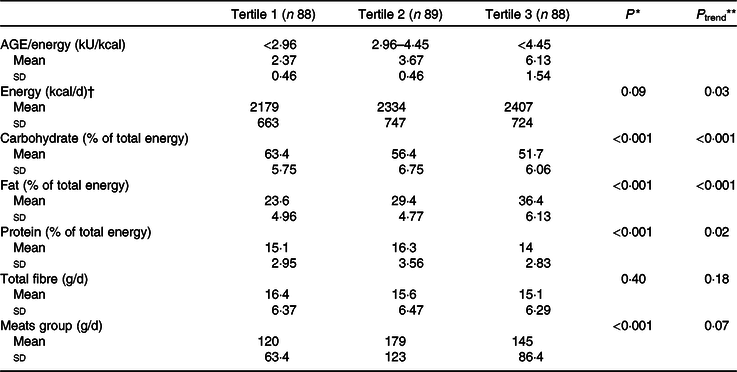
*P value compared the dietary intakes of participants across tertiles of AGE using one-way ANOVA. **P trend is considered significant at < 0·05.
† To convert kcal to kJ, multiply by 4·184.
Table 3 shows the association between dAGE intake and anthropometric measures and body composition. There were no significant associations between BMI (P = 0·09), WC (P = 0·10), WHR (P = 0·20), visceral fat level (P = 0·35), skeletal muscle mass (P = 0·23), body fat percentage (P = 0·89), body fat mass (P = 0·22), FFM (P = 0·14), MMI (P = 0·13) and trunk fat (P = 0·23) and AGE intake before and after adjustment for possible confounders such as age, sex, physical activity, smoking status, education status, metabolic diseases and energy intake. Analyses according to sex showed that results remained unchanged (online Supplementary Table 2).
Association of dietary advanced glycation end product (AGE) intake and anthropometric measures and body composition
(Mean values and standard deviations)
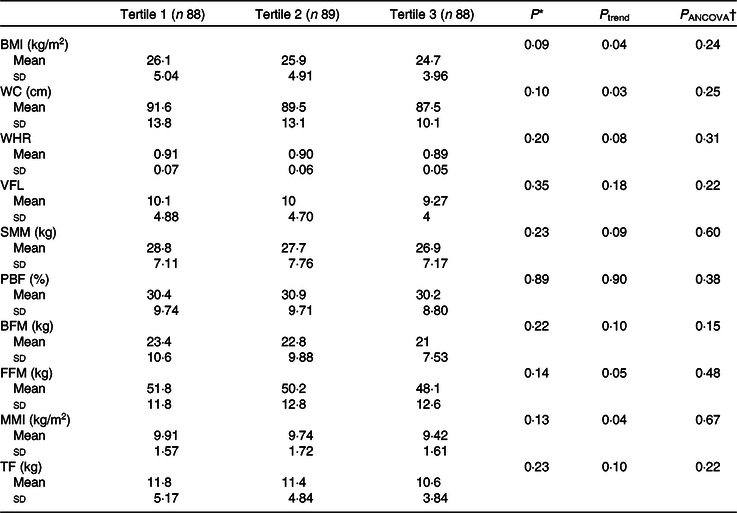
WC, waist circumference; WHR, waist:hip ratio; VFL, visceral fat level; SMM, skeletal muscle mass; PBF, percentage body fat; BFM, body fat mass; FFM, fat-free mass; MMI, muscle mass index; TF, trunk fat.
* Calculated by ANOVA in the crude model and ANCOVA in adjusted models and is considered significant at <0·05.
† Adjusted for age, sex, physical activity, smoking status, education status, metabolic diseases and energy intake.
The results of linear and non-linear models association between AGE intakes and body composition measures are presented in Fig. 1. In linear models, with increases in AGE intake, significant decrease in BMI (P linearity = 0·04), WC (P linearity = 0·03), FFM (P linearity = 0·02) and MMI (P linearity = 0·03) was observed. In non-linear models, BMI (P non-linearity = 0·01), WC (P non-linearity = 0·01), WHR (P non-linearity = 0·03), FFM (P non-linearity =0·02) and MMI (P non-linearity = 0·01) were significantly decreased along with increased AGE intake.
Linear and non-linear relationships between advanced glycation end products (AGE) intake and body composition measures. EI, total energy intake; WC, waist circumference; WHR, waist:hip ratio; VFL, visceral fat level; SMM, skeletal muscle mass; PBF, percentage body fat; BFM, body fat mass; FFM, fat-free mass; MMI, muscle mass index; TF, trunk fat.  , Observed;
  , linear;
  , logarithmic.

OR and 95 % CI for general and central obesity in each tertile category of AGE intake are presented in Table 4. The association between AGE consumption and central obesity that measured by WC (P = 0·05), WHR (P = 0·83) and body fat mass (P = 0·07), were not statistically significant after controlling for confounders. However, the odds of central obesity assessed by visceral fat level had decreasing trends across increasing tertiles of AGE intake in model 2 (P = 0·03) and model 3 (P = 0·03). Also, risk of general obesity was not significantly different across tertiles of AGE intake.
General and central obesity according to categories of dietary advanced glycation end products (dAGE)†
(Odds ratios and 95 % confidence intervals)

WC, waist circumference; WHR, waist:hip ratio; VAT, visceral fat level; BFM, fat mass.
* P values are reported based on the logistic regression test and are considered significant at <0·05.
† Model 1: adjusted for age and sex. Model 2: model 1 + physical activity, smoking status, education status and metabolic diseases. Model 3: model 2 + energy intake.
Discussion
We found that there was no association between intake of AGE, body composition and odds of central and general obesity. However, the relationship between BMI, WC, WHR, FFM and MMI and intake of AGE in the non-linear model was significant. Moreover, higher intake of AGE was associated with higher intake of fat and meat and lower intake of carbohydrate considering that mentioned findings were independent of total energy intake. Re-analysing data based on sex also did not change our findings.
An important finding of the present study was that higher intake of AGE was not related to general and central obesity. Our results confirmed the findings of a cross-sectional study done by Mendoza-Herrera et al.(Reference Mendoza-Herrera, Aradillas-García and Mejía-Diaz29), who reported that higher intake of AGE was not associated with higher risk of abdominal obesity. Another study by Angoorani et al.(Reference Angoorani, Ejtahed and Mirmiran30) also showed that there was no significant association between AGE intake and general obesity. Furthermore, they reported a significant association between AGE intake and abdominal obesity that may be related to dietary energy and macronutrient intakes which disappeared after adjustment of confounding factors. Abdominal obesity is one of the risk factors for the metabolic syndrome, and it has been reported that patients with the metabolic syndrome had a notably greater consumption of dAGE(Reference Uribarri, Cai and Woodward31). In our study, older people had lower intake of AGE which may be related to the history of metabolic diseases like hypertension, dyslipidaemia, CVD and as a result following a special diet like a diet with reduced fat and free sugar and eating more boiled and steamed instead of fried foods.
In the present study, we also found that body composition was not different across tertiles of AGE. Poulsen et al.(Reference Poulsen, Andersen and Hedegaard32), in a murine model, indicated no difference in body composition between high- and low-AGE diet groups. On the other hand, Mirmiran et al.(Reference Mirmiran, Hadavi and Mottaghi33) showed there were significant associations between dAGE intake and BMI, WC and body adiposity index in crude models, and after adjustment for possible confounders, a relationship is independent of energy and macronutrient intake. Increased visceral adiposity is the important indicator of accumulated adipose tissue and is significantly related to oxidative stress biomarkers in systemic levels(Reference Couillard, Ruel and Archer34–Reference Steffes, Gross and Lee36). CML–AGE is harmful when it binds to receptor for AGE, which causes a damaging cycle of chronic inflammation and production of reactive oxidative species(Reference Bierhaus, Humpert and Morcos37). Iranian culture includes diverse food and cooking methods. Although traditional foods do not include processed products and have a higher carbohydrate content, especially white rice, compared with fat and meat, the common cooking method is along with higher temperature and longer time and also, fried onion and green vegetables are the basic items in preparing some of the Iranian foods that all together can increase AGE formation.
Another finding of the present study was significant decrease in BMI, WC, WHR and FFM and MMI across the AGE categories. Assessment of associations in non-linear models is an important aspect of nutritional epidemiology(Reference Boeing38); indeed, according to our knowledge, this is the first study to use non-linear models to show this kind of relationship and we have no similar data in other studies.
A further finding of this study was that higher intake of AGE was associated with higher intake of fat and meat and lower intake of carbohydrate. These results were in agreement with the finding of Ejtahed et al.(Reference Ejtahed, Angoorani and Asghari39); however, their results showed a decreasing intake of fibre in the highest quartile of AGE intake. It was reported that fibre contains more antioxidant content that prevents AGE formation in body(Reference Demirci, Tutal and Eminsoy40). Mean dietary intake of AGE in our study (9401 kU/d) was lower than the cohort of healthy adults from the New York City (14 700 kU/d)(Reference Uribarri, Cai and Peppa41), which may be because of differences between Iranian and Western dietary patterns. In comparison with a Western diet that includes more fat and meat foods, the Iranian population diet contains more complex carbohydrates and less fat and meat and lower contents of AGE(Reference Barbaresko, Koch and Schulze42,Reference Ghassemi, Harrison and Mohammad43) . It has been observed that fat and meat include relatively greater amounts of AGE than carbohydrates because the carbohydrate-based foods have higher water content, lower reducing sugar and higher levels of antioxidants and vitamins, which may prevent AGE formation(Reference Uribarri, Woodruff and Goodman17). Additionally, the difference may also be related to the dietary intake assessment tools. Although we obtained dAGE amounts by FFQ, 3-d dietary food records were used in a cohort study(Reference Uribarri, Cai and Peppa41). Contrary to our study, they included healthy people without any history of hypertension, CVD and other diseases associated with inflammation and oxidative stress. The dAGE intake in the present study was higher than that reported by Mirmiran et al.(Reference Mirmiran, Hadavi and Mottaghi33) in participants from Iran (7043 kU/d) which may be due to the larger sample size, using an FFQ with 147 food items (v. 168-item FFQ) and characteristics of the participants such as age and living district. It should be noted that comprehensive information about dAGE intake in different populations is not available.
It has been shown that 10 % of a high-AGE diet will be absorbed in the body(Reference Koschinsky, He and Mitsuhashi16); however, controversial data exist regarding the effects of dAGE on its circulating levels. The results of some studies emphasise that intakes of CML can lead to excess serum AGE levels(Reference Uribarri, Peppa and Cai22), whereas others show no effect of dAGE on circulating levels of AGE(Reference Piroddi, Palazzetti and Quintaliani23). Furthermore, the method of cooking is very important in AGE generation; for instance, broiled chicken (5828 kU/100 g) and broiled beef (5963 kU/100 g) contain amounts of AGE, but can be considerably limited (1124 and 2230 kU/100 g, respectively) by either boiling or stewing. Additionally, using acidic marinades, such as lemon juice and vinegar before cooking, may decrease dAGE formation(Reference Uribarri, Woodruff and Goodman17,Reference Chen and Smith44) . However, these methods are not widely used in the Iranian population.
The modern Western diet not only includes fast foods with high amount of energy, added sugar and fat but also consists of AGE-rich components which may contribute to the increased risk of obesity and adverse effects on weight management and health through cellular mechanisms(Reference Bettiga, Fiorio and Di Marco45). Therefore, limiting dAGE intake for obesity prevention should be advocated. Many studies have indicated the effect of AGE intake on complications like increasing oxidative stress, diabetes, impaired kidney function, CVD is associated with abdominal obesity(Reference de Heredia, Gómez-Martínez and Marcos46–Reference Jung and Choi48). Mechanisms of how dAGE consumption can increase obesity are not well understood yet, but one pathway is the effect of AGE on insulin resistance, where circulating insulin increases and thus promotes the storage of fat, obesity and diabetes. dAGE, such as CML, pyrraline and pentosidine, are absorbed in intestine at different rates and their pathways are not clear(Reference Luevano-Contreras and Chapman-Novakofski49). Additionally, recent studies have shown that the dAGE had no effect on circulating AGE(Reference Uribarri, Peppa and Cai22,Reference Semba, Ang and Talegawkar50) . One prior study indicated that the serum levels of CML were not a useful biomarker for estimating the progression of chronic diseases, and serum levels of glyceraldehyde-derived AGE are more reliable than CML AGE(Reference Takeuchi, Takino and Furuno51).
Although our study provides a much-needed insight into dAGE and obesity, it has several limitations. In Iran, there are no published food AGE databases for Iranian food; thus, we used an American-based database, where only CML was measured as a marker of dAGE, whilst the other dAGE markers, such as glyceraldehyde-derived AGE, that may be an important indicator, were not measured. Furthermore, some of food items do not exist in the American-based table, and we had to estimate the AGE content of those foods from similar food items for which the CML–AGE value was available. Moreover, we used bioelectrical impedance analysis (InBody S10) to evaluate body composition. However, dual-energy X-ray absorptiometry provides accurate estimates of fat and lean soft tissue(Reference Buckinx, Reginster and Dardenne52). Additionally, we did not record different cooking methods which may substantially affect the AGE content of foods. Being cross-sectional in study design was a further limitation, because this kind of study prevents any indication of causality between AGE intake and body composition and obesity. We used FFQ for the collection of data regarding participants’ diet; however, recall bias is possible, whilst low sample size was another limitation that may result in a lack of association. In addition to all this, not measuring serum AGE level was a major limitation of present study because it could help us to confirm if dAGE intake affects serum AGE level or not. To the best of our knowledge, this is the first study to have investigated the association between dietary consumption of AGE and body composition measurements and obesity. Controlling for confounders was a further strength of this study; furthermore, we measured different components of body composition and non-linear regression was conducted to investigate non-linear associations between exposure and outcome.
In summary, increasing intake of AGE was associated with increasing intake of fat and meat. In linear models, AGE intake had no significant relationship with body composition measurements because of confounding variables, although non-linear associations were found. We did not observe an association between AGE intake and odds of obesity with attention to independence of dAGE intake into energy intake in our study. However, further investigation, without all the limitations of this study, particularly considering cooking methods, is needed to confirm the veracity of our findings.
Acknowledgements
We would like to acknowledge all participants who made this research possible.
This research received no specific grant from any funding agency, commercial or not-for-profit sectors.
P. G. and S. S. B. contributed to conception/design of the research; P. G., N. B., S. D. and M. E. contributed to acquisition, analysis or interpretation of the data; P. G. drafted the manuscript; K. D., C. C. T. C. and S. S. B. critically revised the manuscript; and S. S. B. agree to be fully accountable for ensuring the integrity and accuracy of the work. All authors read and approved the final manuscript.
The authors declare that there are no conflicts of interest.
Supplementary material
For supplementary material referred to in this article, please visit https://doi.org/10.1017/S0007114520002871



