1 Introduction
1.1 In Times of Crises
No one talks enough about the climate crisis. Among all those we are currently facing, undoubtedly this is the crisis discussed the least not only at the public level, but also within our own personal spheres. And yet all crises are inextricably linked and emanate from the impact generated by the economic system we all live under. However, as Dipesh Chakrabarty implies, “a critique of capital is not sufficient for addressing questions relating to human history once the crisis of climate change has been acknowledged and the Anthropocene has begun to loom on the horizon of our present” (Chakrabarty, Reference Chakrabarty2009: 212), since there is a disconnection between the climate crisis, its impact on our daily lives, and the measures that are taken by our representatives at the institutional level.
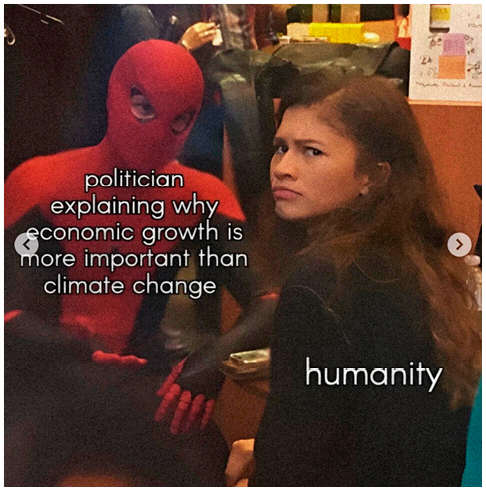
This may seem unrelated to what we do in our Second Language (SL) / Heritage Language (HL) classes. However, a glimpse at social media and new forms of popular culture show us otherwise. Let us take a look, for example, at the Instagram account @earthlyeducation, which recently published a post with a carousal of memes worth checking out. The account defines its profile with the following keywords: climate, nature, justice; and offers links to campaigns on such topics. One of the memes reads as follows:Footnote 1
The meme (Figure 1) insists, in a more colloquial register, on the dissonance between politicians’ words and the needs and beliefs of “humanity” (to quote the meme’s vocabulary). We are bringing it up because this is the kind of media that our students read and produce – the generations we are teaching right now are the ones who will suffer the most from the consequences of the climate crisis, and the ones who need to find new forms of living and adapting to this new situation. And also, as Chakrabarty suggests, “the crisis of climate change calls on academics to rise above their disciplinary prejudices, for it is a crisis of many dimensions” (Chakrabarty, Reference Chakrabarty2009: 215). Indeed, we conceive of such a climate emergency as a threefold discursive, humanitarian, and scientific crisis.
Politicians versus humanity.
The intent of this Element, therefore, is to bring the climate crisis as a multifaceted discourse into the classroom, and to make it part and parcel of our language curriculum. This is not really new, since the US academy has already (although very recently) inaugurated the field of Environmental Humanities, emphasizing humanists’ unique contributions to climate scholarship (see, for example, Philippon, Reference Philippon2012; Reynolds, Reference Reynolds2010; Viakinnou-Brinson, Reference Viakinnou-Brinson2018). Among many voices that have helped shape this transdisciplinary field, we want to bring attention to a couple of theorists who have contributed to our understanding of it. Angela Antunes and Moacir Gadotti are two educators from Brazil working at the Paulo Freire Institute who discuss what they call “eco-pedagogy” as a sustainable praxis, arguing that “the preservation of the environment depends on an ecological conscience and shaping this conscience depends on education” (Antunes and Gadotti, Reference Antunes and Gadotti2005: 135). Thus, they put forward a “democratic and understanding pedagogy, a pedagogy for everyday life” (Reference Antunes and Gadotti2005: 135). This vision of an “everyday life pedagogy” relies on a conception of Earth not just as a space for domination, an object of research, but as “a living space, a space giving us ‘solace’ and requiring from us ‘care’” (Reference Antunes and Gadotti2005: 135). At the curricular level, content must be meaningful to students, in the sense that it should be “meaningful to the health of the planet and to a context greater than that of the individual student” (Reference Antunes and Gadotti2005: 136). Therefore, thinking of sustainability in these terms implies a way of proceeding that goes beyond individual projects because it pays attention to the impact made by human societies on the natural environment, allowing for the development of new models of living that may challenge economic, social, and cultural structures.
Now, we are sure that this is not the first time that you, dear reader, have heard the term ‘sustainability’ applied to education. Actually, Gadotti has discussed such a label as the foundation of a livable life that respects human rights, and has, as well, provided an institutional framework. In his work, Gadotti has referred to UNESCO to emphasize “the need to reorient education at all levels towards a culture of peace and sustainability” (Gadotti, Reference Gadotti2010: 204), explaining that sustainability “is a dynamic balance with others and the environment” (Reference Gadotti2010: 204). Understood as such, maintaining this balance and preserving the environment depends on ecological awareness, which simultaneously depends on education – we teach how to awaken that consciousness and what to do with it. More than that, this conception of sustainability relies on eco-pedagogy as a pedagogy that has overcome “the anthropocentrism of traditional pedagogies” (Reference Gadotti2010: 205) and therefore requires a specific curricular orientation, as argued before. Taking sustainability not as greenwashing, but as a way of producing new knowledge with the aim of developing a new paradigm, means that our classroom practices need to integrate the local economy, pay attention to human interactions and biodiversity, and put forward “a systematized knowledge” based on “new habits for sustainable living” (Reference Gadotti2010: 207). Therefore, the focus should be on our local communities, emphasizing what kind of economy is circulating, and what kind of life is allowed within that ecosystem. This refers, in the end, to systematizing a kind of knowledge centered on sustainability and not on growth.
Caroline Levine, from a humanities and cultural studies perspective, has traced a connection between this idea of sustainability and the current global context, emphasizing what faculty and instructors from the humanities can do within an environmentalist framework. In her book The Activist Humanist: Form and Method in the Climate Crisis, she proposed to understand sustainability as a term that is “genuine” (Levine, Reference Levine2023: 13), meaning that it should enable just conditions that will allow “a rich variety of lives to continue into the future” (Reference Levine2023: 14) – reading it as part of an intergenerational project. Levine problematizes the use of the term ‘sustainability,’ considering that it “implies the continuation of life as we know it, which for many in business and politics includes expectations of economic growth, competition, and accumulation” (Reference Levine2023: 13). In fact, she adds that it might even work as a neutral term, referring to “the capacity to keep any state of affairs going over time” (Reference Levine2023: 13). In order to resignify the term, she ties the concept of sustainability to that of “collective continuance,” that is to say, “the establishment of political, cultural, environmental, and economic conditions that allow collective life-worlds to flourish over time” (Reference Levine2023: 13). The idea, therefore, is to enhance a culture of sustainability in order to foment cooperation and to answer questions (essential questions) related to human and democratic rights.
1.2 State of the Art
Among the humanities, we have seen environmental projects in anthropology, history, geography, sociology, political science, and performing and visual arts. In the field of language arts, we have recently witnessed environmental research and education in literary and cultural studies. However, language education is not part of the equation yet. Climate discourses and action are relegated to single unit projects, lesson plans, or sections of the textbook, usually as a connecting thread to cover and practice pre-established grammatical and lexical expressions (Contreras et al., Reference Contreras, Pérez Zapatero and Rosales Varo2020). Some initiatives are taking place in English as a second language (Braselmann et al., Reference Braselmann, Katharina and Volkmann2021; British Council n.d.; Deetjen and Ludwig, Reference Deetjen and Ludwig2021; Green Action ELT n.d.), also in Foreign Languages (Eppelsheimer et al., Reference Eppelsheimer2014; Melin, Reference Melin, Swaffar and Urlaub2014, Reference Melin2021; MLA, 2007; Nuessel, Reference Nuessel2010; Revista de la Asociación Internacional de Literatura y Cine Españoles, 2025; Ter Horst and Pearce, Reference Ter Horst and Pearce2010; Walther, Reference Walther2007), but the truth is that we lack a true institutional and curricular conceptualization and restructuring of language education with respect to the climate crisis (Marín Cobos and Aguiló Mora, Reference Marín Cobos, Aguiló Mora, Fernández Ulloa and Ahuactzin Martínez2024). An initiative that is worth mentioning is “Greening Modern Languages: Research and Teaching,” defined as a “collaborative project that aims to think about the role that our discipline has to play in times of ecological crises” (“Greening Modern Languages,” 2023). Faculty from modern languages departments from Wales, Ireland and the UK come together in order to ‘green’ their field, that is to say, “rethink our academic practice as educators, scholars and eco-citizens” with the twofold purpose of decentering and decolonizing the curriculum, as well as a collective reconsideration of the role of languages within environmental humanities. Precisely, what we propose here is the incorporation of climate discourse at the foundational level: in the basic language program, the trunk of the departmental tree (Aguiló Mora and Marín Cobos, Reference Aguiló Mora and Marín Cobos2025). We cannot ignore the fact that languages are a core component of the humanities, and considering the great number of students who learn languages through basic course offerings, working at the level of the tree trunk means merging climate and sustainability with the language program.
At the institutional level, there is an interest in addressing the situation, as can be seen in the importance of organizations such as the Association for the Advancement of Sustainability in Higher Education or the success of journals such as the International Journal of Sustainability in Higher Education. In addition, many US universities include among their academic objectives the promotion of sustainability, and undoubtedly the pressure exerted by students foments these kinds of measures. Faculty and staff participation in committees designed to advise the university in complying with their own environmental agreements is also increasingly higher. Luis I. Prádanos suggests in his article “La enseñanza del español en la era del antropoceno: Hacia la integración de la sostenibilidad en las clases de español como lengua extranjera” that at this point it is obvious that sustainability is not an exclusive endeavor on the part of faculty and programs related to environmental studies, but a skill that should be acquired by all faculty and students (Prádanos, Reference Prádanos2015a: 334). However, rather than simply teaching sustainability as a skill, we are focused on sustainable ways of teaching, learning, and researching. This approach begins at the roots, so that it can grow in a robust trunk to permeate all the branches and give rise to new leaves. That is why we focus on changing our praxis through course design, not the other way around: It is not about creating new courses for the sake of amplifying and diversifying content – that is actually a very unsustainable practice; instead, it is about changing the way we teach.
Prádanos reviews the role of higher education in today’s society and wonders if today’s education should be at the mercy of the market economy and economic growth or, instead, should be at the service of a civic society that is sustainable, engaged with, and responsible to the world we live in (Prádanos, Reference Prádanos2015a). He suggests that a way of introducing sustainable practices in SL programs, specifically Spanish, is by enhancing critical-thinking skills, making students aware of the socioeconomic model, and making them assess its own sustainability in a context of global environmental restrictions. Thus, he exposes how Spanish as a SL (SSL) can contribute to a change in the cultural logic that would take us from consumerism to sustainability by incorporating an ecological intelligence.
His has been one of the few works in the last ten years that has specifically addressed a set of practices to be incorporated both at the elementary and advanced levels (see also Melin, Reference Melin2019, for a compilation of works that put into practice environmental thinking through language and go beyond the humanities/sciences dualism; and Barbas-Rhoden, Reference Barbas-Rhoden and de la Fuente2021, for an environmental humanities content-based Spanish course at the intermediate-advanced level). Nevertheless, these practices work as add-ons, as branches of a tree whose trunk remains intact. We do not see any curricular or institutional questioning, nor a sustainable way of teaching as defined here. Instead, the work occurs at the level of course content and at the instructional level, exploring pedagogical variations. However, they all lack a holistic perspective, an integrated approach to language climate teaching. Thus, these proposals would require a true reconceptualization that looks beyond the microunits of a language level and allows for a macrointervention in the program itself.
Prádanos uses the textbook (referencing samples of those most commonly used in US Spanish language programs) as a point of departure and proposes a series of criteria to assess whether the textbook contributes to normalizing and legitimizing questionable actions and attitudes from a socioecological point of view. These criteria are that the textbook: (1) promotes and doesn’t problematize a culture based on irresponsible consumption, (2) perpetuates and doesn’t question unsustainable eating habits, (3) normalizes an inefficient use of energy, (4) doesn’t teach about the need to stop generating waste, and (5) takes a superficial approach on topics related to sustainability and the ecological crisis (Prádanos, Reference Prádanos2015a: 336). In his article, he goes into depth on examples that can be applied in different units at the elementary level, always using the textbook as a starting point to be amended and to be used as a tool to raise students’ concerns about the climate emergency. Yet, for intermediate and more advanced levels, he does detach himself from the textbook and devises an approach based on writing and oral skills, including Hispanic cultural manifestations that focus on environmental issues, as well as some ideas for courses that are taught with specific purposes (such as Spanish for Medical Purposes) and for study abroad programs. In addition, he reflects on the fact that not all language instructors have the ecological knowledge necessary to put these measures into practice. With that in mind, Prádanos refers to institutional resources available to faculty to complement their skills at this level. Overall, he emphasizes the importance and relevance of this approach, which would ultimately help students see the connections among disciplines and help them think in more complex and transdisciplinary terms (see also Prádanos, Reference Prádanos2015b).
1.3 The Missing Piece
Even though Prádanos’s ideas are valuable and original as barely no one had tried to incorporate climate discourse(s) in the language classroom, his overall approach remains at the textbook level, without looking at the curricular level, at the whole program – the trunk of the tree, to follow our metaphor. Hence, he still relies on the textbook as the main tool setting the tone and topics, without questioning the very nature of Spanish as a colonial language and the ways in which Spanish is instrumentalized and decontextualized in the SL/HL classroom.
We understand that such an approach is realistic, particularly given that language instructors normally hold precarious teaching positions, with a high student–teacher ratio and heavy teaching loads per semester; and they lack institutional support – funding – to conduct scholarly research to develop new courses and new teaching praxis. With this in mind, a logical first step is to challenge the textbooks we use. These working conditions are parallel to a consideration of the basic language programs as having secondary value (Kern, Reference Kern2000). However, we believe, and Prádanos’s plan also heads in this direction, that basic language programs are the foundation – again, the trunk of the tree – to begin a sustainable education, to imprint on our students the need for ecological awareness also in a SL, because language is the main sociocultural mediating tool for cognitive development through which we build thought and knowledge of the world, a tool for inter- and intrapersonal construction (see Negueruela-Azarola et al., Reference Negueruela-Azarola, García, Escandón, Negueruela-Azarola, García and Escandón2024).
Along with the inherently radical approach of incorporating climate and sustainability at the trunk of university academic programs while revisiting the roots, we strive for sustainable teaching practices in the SL/HL classroom. The following ethical dilemma has driven our thinking since we started to conceive of this curricular innovation: How can we teach and learn Spanish – a colonial language mostly in Latin America, but also in the US, Africa, Asia, and even Oceania – in the context of climate and the environment without somehow perpetuating the colonial imperative (del Valle, Reference del Valle2014; Train, Reference Train2010)? How to avoid propagating “colonialingualism,” in other words, “privileging dominant colonial knowledges, languages, and neoliberal valorizations of diversity” (Meighan, Reference Meighan2022: 146)? If we acknowledge that the climate crisis is the result of intersectional colonial and neocolonial processes at various levels, we need to decolonize our teaching dynamics (Behari-Leak, Reference 72Behari-Leak2020; Mintz, Reference Mintz2021; Phipps, Reference Phipps2021; Twyman-Ghoshal and Lacorazza, Reference Twyman-Ghoshal and Lacorazza2021). To tackle these questions, we propose a root-level transformation of the language programs that, scaffolded by the following teaching principles, will allow for a curricular development: (1) decentralization of climate discourse in English toward an integration of climate discourse in other languages, (2) contextualization of an often decontextualized language teaching, and (3) shared expertise and transdisciplinarity toward an integrated approach. These principles will enable the implementation of language courses from a critical social justice perspective, focused on the living nature of languages and their interconnection with society beyond academia.
This curriculum centers on developing students’ critical thinking skills through the analysis of climate-related topics, emphasizing a range of diverse texts, such as literature, film, documentaries, social networking platforms, press articles, and realia. Students engage deeply with these materials, working on their communicative skills and metalinguistic awareness as they critically assess various representations of the climate emergency across different media. This type of teaching and learning contextualizes language by addressing the colonial history and ongoing impact of Spanish and its regional varieties (in our case), ensuring that the voices of marginalized communities –such as women, racialized groups, and Indigenous peoples – are part of the conversation. Students compare climate discourse across the Spanish-speaking world, analyzing rhetorical and aesthetic choices, and explore how metaphors and communicative strategies in both Indigenous and colonial languages shape environmental beliefs. Finally, scientific knowledge in English bridges with alternative epistemologies in other languages, connecting academic and public spheres to address the political and social dimensions of the climate crisis (see Aguiló Mora and Marín Cobos, Reference Aguiló Mora and Marín Cobos2025).
1.3.1 Colonialingualism, Epistemic Injustice, and Transepistemic Language Education
Building upon the previously mentioned ethical dilemma as SSL/SHL instructors, it is worth delving into what Meighan refers to as “the Western epistemological error” (Reference Meighan2022, Reference Meighan2023) – a worldview characterized by linguistic and cognitive imperialism, the belief in human superiority over nature, and white (epistemological) supremacy (Reference Meighan2022: 146) – which is all too often embedded in our classroom dynamics. To that regard, although Meighan refers to English language teaching, we agree with the proposal of an epistemic (un)learning of the Western epistemological error in SL/HL language classrooms to enable “equitable validation of all languages and knowledge systems, including those Indigenous and minoritized” (Meighan, Reference Meighan2023: 2). This type of linguistic and cognitive imperialism (Battiste, Reference Battiste2017) is what Meighan calls “colonialingualism,” which “upholds colonial legacies, imperial mindsets, and inequitable [pedagogical] practices” (Meighan, Reference Meighan2022: 146) and “is subtractive and detrimental to multilingual, multicultural learners’ identities and heritages; endangered, Indigenous languages and knowledges; minoritized communities; and our environment” (Reference Meighan2022: 146–147), since Indigenous languages and knowledges are closely interrelated to culture and land (Chiblow and Meighan, Reference Chiblow and Meighan2021). ‘Colonialingual’ languages such as English can be disconnected from the land and treated simply as a resource to generate profit within a Global North, neoliberal system that mainly serves powerful corporations and wealthy elites (Meighan, Reference Meighan2023: 4). Spanish, among others, also carries “a colonial, imperialist legacy and a eurocentric, human-centered worldview” (Meighan, Reference Meighan2022: 147).
Thus, SL/HL classrooms need to question this ‘colonialingual’ view of language(s) that normalizes and legitimizes environmental racism and injustice in times of climate crisis (McGregor et al., Reference McGregor, Whitaker and Sritharan2020; Meighan, Reference Meighan2023: 4). A specific way to do this is by problematizing ecologically destructive metaphors in English vis-à-vis the target language (Spanish in this case) and other Indigenous languages in contact. Some metaphors are deeply embedded in English and European philosophical traditions or have a direct and harmful impact on Indigenous voices. Fine et al. enumerate several of these (Reference Fine, Love-Nichols and Perley2023: 85–86), including (1) the terra nullius metaphor, which imagines newly colonized lands as ‘empty’ so they can be renamed and claimed (see also Saïd, Reference Saïd1979); (2) the framing of natural systems as inanimate ‘machines’ in colonial languages, contrasted with more animistic understandings in Indigenous languages (Rout and Reid, Reference Rout and Reid2020); and (3) the metaphor of biodiversity as a ‘library,’ suggesting it exists primarily for human benefit and extraction (Stibbe, Reference Stibbe, Döring, Penz and Trampe2008). In her proposal for metaphors that foster a mutualistic relationship between scientific and traditional ecological knowledge, Robin Wall Kimmerer argues that “Indigenous ways of framing and communicating concepts, through shared narratives and symbols, effectively engage the power of metaphors to encompass both material and spiritual dimensions of a matter” (Reference Kimmerer, Young and Longboat2013: 50). Why not give space to these voices in the language classroom, especially since they often coexist with the languages we teach?
By working with a variety of epistemic discourses, we can shape students’ understanding of how knowledge(s) on climate and the environment are constructed and validated. Quoting bell hooks on the English language and what the oppressors do with it (hooks, Reference hooks, Dingwaney and Maier1995: 296), Meighan states that “it is what speakers do with language – how language can inform worldviews, thinking, mindsets, behaviours, and relationships with peoples, environments, and lands – that matters” (Reference Meighan2023: 3). The scholar highlights that the unrelenting spread of English (episteme) worldwide, also in climate discourse we should add, has caused the disenfranchisement, minoritization, and forceful eradication of Indigenous and HLs in Western mainstream education through top-down, colonial medium-of-instruction policies, and, in what is at stake here, climate communication. On that note, Meighan proposes a transepistemic language education which enables learners and educators to engage in what Mignolo defines as a “decolonial and pluriversal” (Reference Mignolo2017) sharing of languages, knowledges, and worlds for more equitable and sustainable language teaching and learning (Meighan, Reference Meighan2023: 3).
1.3.2 Contextualizing the Languages We Teach: A Synchronic and Diachronic Inquiry
In our specific case, Spanish language(s) and discourse(s) reflect a relative position depending on the context. In the Spanish-speaking world, owing to language ideologies shaped by colonial history, the nation-building projects of the independent republics in the nineteenth century and current processes of mass migrations and globalization – all linked to questions of economy, social class, race, generation, and gender – Spanish holds a privileged position in relation to the original languages it is in contact with (for example, Quechua, Nahuatl, Aymara, Guaraní, Mayan, Zapotec, and Kawésqar in Latin America; or Galician, Catalan, and Euskera in Spain; or fa d’ambô and bantu languages in Equatorial Guinea; or hassaniya in Western Sahara). In the US, Spanish is the second most spoken language. It is not surprising, then, that the teaching of Spanish has become a highly institutionalized professional practice (del Valle, Reference del Valle, Mar-Molinero and Stewart2006).
While the Spanish language and its speakers are often marginalized, minoritized, and delegitimized in the US, Spanish is also perceived as “a valuable, standardized global language” (del Valle, Reference del Valle, Mar-Molinero and Stewart2006: 29), as both a local and global sociocultural commodity that facilitates an entrance to national and global marketplaces. Given its recognized instrumentality for professional growth, as well as its ability to connect learners to their linguistic heritage (Carreira and Kagan, Reference Carreira and Kagan2011: 57), Spanish is the language that the vast majority of students choose to fulfill the requirement at US universities (Lusin et al., Reference Lusin, Hor and Pylkkanen2022: 49).
That recognized instrumental perspective leads to the perception of this language as universal, non-ethnic, neutral, and objective (Woolard, Reference Woolard and del Valle2007). When taught from a purely instrumental viewpoint, accents are erased under the conception of ‘anonymity’ on which hegemonic (standard) languages base their authority, according to Kathryn A. Woolard. Like English, Spanish is positioned to become a global lingua franca that is presumed to be understood by everyone, at least in the Spanish-speaking world, including the US – ignoring the fact that competence in the language is closely tied to social class and access to formal education. Regional varieties of Spanish are thus viewed as ‘authentic’: They are seen as deeply rooted in specific social and geographical territories, marked as private and particular – languages that come from “somewhere” (Woolard, Reference Woolard and del Valle2007). Woolard argues that the ideological value of “authenticity” is typically assigned to minority languages and nonstandard varieties, which are perceived as situated and localized. In contrast, official languages and standard varieties are ideologically valued as “anonymous” and universal, representing a “view from nowhere.” Spanish, however, moves across both sides of this ideological dichotomy, and at times even blurs the line between them.
At the same time, through the also ideological process of fractal recursivity (Irvine and Gal, Reference Irvine, Gal and Duranti2009), the dichotomy between Spanish and originary languages is reproduced (in terms of identity and sociology) within the Spanish side of the original dichotomy – yielding a new opposition: English/Spanish, where English is dominant and Spanish is minoritized and racialized in the US. This notion may be extrapolated to the context of climate discourse, where English has dominated global discourse(s) and, with it, Western thought has shaped how we conceptualize and interact with the environment. That is why it is so important to talk about climate in languages other than English in order to diversify the mainstream discourse that often excludes the very communities who perhaps best understand the environment and suffer most from the climate crisis. At the same time, Spanish, as a (neo)colonial language, has been the linguistic medium in processes of land exploitation, resource extraction, and deforestation through activities such as mining, illegal logging, and infrastructure development, often carried out by white creoles. The goal is not to romanticize the idea that Indigenous peoples are the only stewards of the environment, as Luis de la Cruz, a specialist in environmental anthropology and president of the Fungir Foundation, emphasizes:
La visión romántica de que los indígenas son los únicos que cuidan el ambiente y los criollos sólo depredan es equivocada. Por falta de medios de vida, los indígenas son generalmente la mano de obra barata para la extracción ilegal de madera. Y los criollos, a medida que obtienen seguridades de que no van a ser expulsados, realizan prácticas más conservacionistas.
(The romanticized notion that indigenous peoples are the sole guardians of the environment while Creoles merely act as predators is misguided. Since it is difficult to find ways of making a living, indigenous peoples often serve as cheap labor for illegal logging. And Creoles, as they gain assurances that they will not be evicted, they tend to adopt more conservationist practices.)
That said, these neocolonial practices are intrinsically connected to environmental racism and inequality suffered by marginalized communities such as women, racialized groups, and Indigenous peoples for whom, many times, Spanish is an imposed colonial language (consider the role of other languages that you may be teaching as well). Being aware of – even to a small extent – the diachronic and synchronic sociolinguistic perspectives of the language we teach/learn provides a richer understanding of the language’s evolution and current usage, revealing the dynamic nature of language within different communities.
1.4 The Climate Turn in Language Teaching
The Climate Turn in Language Teaching’s central argument is that language education requires an epistemological and curricular shift – what we term a ‘climate turn’ – toward transepistemic, decolonial, and sustainability-oriented pedagogies. This Element aims to help close the gap between research and language teaching practices on the one hand – as if pedagogy was not research-informed and vice versa – and language and climate (discourse) on the other hand. We believe that this Element offers a rare and much-needed glimpse into the intersection of SL/HL pedagogy and climate in the actual language classroom. As mentioned earlier, the literature of this intersection has only begun in other areas of the humanities, and it is largely absent from language instruction itself.
As a first step to implement the pedagogical approach proposed here, we reconceptualized and redesigned a ‘regular’ fourth-semester Spanish course in our basic language program with a focus on topics of climate discourse, which we have been successfully delivering for the last couple of years, entitled “Intermediate Spanish II: Topics on Climate Discourse.” Our language program at Columbia/Barnard follows a four-semester sequence (Elementary I, Elementary II, Intermediate I, and Intermediate II), followed by a bridge course (Advanced Language through Content) for students continuing their language studies in advanced content courses or pursuing a major or minor. Although the examples provided in this Element are mainly drawn from this and other language courses we teach at these US higher education institutions and from their local context, peer researchers and practitioners can creatively adapt this pedagogical approach to other educational levels and languages of instruction, across diverse geographical contexts with varying synchronic and diachronic particularities. To that end, our didactic proposal is not fixed or prescriptive, but rather open to context-specific adaptation to the target language. Hopefully, the theoretical and conceptual framework we propose here will also prompt our readers to reflect on ingrained everyday practices outside the classroom that lead to (non)sustainable and (non)ethical outcomes.
Thus, this Element provides the reader with an overview of how we conceptualize sustainable pedagogical practices through the teaching of SL/HLs from a climate perspective – Spanish being an illustrative case of this effort, not an exclusive one. Thus, dear reader, every time you read ‘Spanish,’ please translate it to the target language you are teaching or consider whether what we are saying may extrapolate – or not – to your classroom/research. The goal is to make you – teachers, administrators, scholars, and students alike – think and reflect on your own teaching and learning practices and the ideologies behind them. We also provide resources for classroom use, along with practical examples for instructors interested in teaching about, through, and for climate and the environment, demonstrating how to adapt and implement this pedagogical approach at all educational levels – elementary, intermediate, and/or advanced; as well as primary, secondary, and higher education contexts.
Our focus, as it will be developed in detail in Sections 2, 3, and 4, is literacy-based, text-based, and emphasizes multiliteracies informed by critical pedagogy. One might ask: But how is grammar taught? What about vocabulary? We believe that these questions do not point in the right direction. If we decontextualize language and break it into parts, language could not be understood as discourse – which is our point of departure. We advocate for a contextualized SL/HL teaching that would allow for a problematization of the language and its existence in contact with the world we share with our students. Thinking solely in terms of grammar, vocabulary, or any other isolated units of the language inhibits language’s very nature as a living object, as a mediating sociocultural tool that grants speakers the possibility of making sense of the world around them. In this vein, climate is everything and is everywhere – and, on top of it, it allows us to take a critical standpoint when learning a new language, acquiring a perspective that goes beyond utilitarianism or instrumentality by enhancing students’ (and our own) critical-thinking skills. We can still teach about clothes, but problematize fast fashion and bring up topics such as desiertos de ropa (fast fashion dumping grounds); the same can be said about food, with a focus on sustainable eating and agriculture and a questioning of the food we eat depending on where we live; we can cover eco-anxiety, developing structures to channel our feelings with respect of the climate crisis; and so on. All of these topics elicit specific grammatical and lexical structures that will be learnt from an inductive perspective, prioritizing where we want to go and consciously reflecting on the path we are taking to get there instead of focusing on certain grammar structures as the result of learning more than a tool for learning (Negueruela-Azarola, Reference 80Negueruela-Azarola, Lantolf and Poehner2008: 190–191). Therefore, language becomes more than a tool deprived of meaning; instead, it is appreciated as a twofold skill, enhancing students’ cultural and critical-thinking competencies.
All of this is not to say that we do not recognize the main pedagogical goal of our classes: that students get to be able to communicate in the target language and become critical connoisseurs of the cultural backgrounds of its speakers. But this can be achieved from an ethical pedagogical perspective of a decentralizing and contextualized SL/HL teaching and learning. In the classroom, this translates in the first place into an explicit analysis of the rhetorics and aesthetics of climate discourse. Second, it translates into the study of the systematicity of bilingual discourse and the teaching of literacy – more specifically climate discourse literacy – as a basis for cultural analysis (Kern, Reference Kern2000) by means of incorporating texts by authors who hold nondominant, ecocentric perspectives (such as Indigenous and local writers and creators) alongside, or instead of, those already present in the curriculum. Lastly, it translates into going beyond traditional boundaries in language teaching and cultural studies, coming up with “against-the-grain pedagogical frameworks [that] can promote non-hierarchical student cooperation” (Chattopadhyay et al., Reference Chattopadhyay, Gahman and Watson2019: 27). How we conceive and materialize these ideas is developed subsequently.
Sections 2, 3, and 4 – and our three teaching principles – build on and advance from the models discussed previously in two ways: first, sustainability is thought beyond content – it is not about what we teach so much but about how we teach it; second, and as a consequence of the former, our approach begins and is nurtured in the basic language programs, what we have termed the trunk of the tree. Above all, our consideration of language as discourse is at the core of this pedagogical move; the questioning and problematizing of our target language is what allows us to go beyond content and levels and offers an alternative that places transdisciplinary and transepistemic discourses at the center of the curriculum.
It is also in this vein that this Element translates to other languages and educational contexts, since the climate crisis is the global issue that defines our Anthropocene era as well as the immediate future. Following sustainability oriented and sustainable pedagogies, our climate turn alludes to an epistemological and curricular shift that (1) de-centers the climate discourse by including other languages, knowledges, and epistemologies beyond scientific communication and mainstream languages; (2) contextualizes the teaching of the target language by making sense of it and problematizing the context from which it arises and the language(s) and culture(s) in contact with it; and (3) goes beyond presumed disciplinary boundaries by incorporating students’ own expertise as a way of imagining livable and just futures. Such a threefold approach allows us to move climate discourse to the program level, proposing a holistic view of the climate crisis from the language classroom. Lastly, interrogating the colonial legacy and neocolonial imprint of languages such as Spanish highlights their connection to contemporary environmental racism and linguistic hierarchies. Consequently, questioning both our subject matter and our teaching practices positions this Element to rethink the field, with the intention to join other Cambridge Elements in Language Teaching (such as Intercultural and Transcultural Awareness in Language Teaching) and to shape the conversation around the climate crisis in and beyond the classroom.
2 Decentralization
2.1 Climate and/in Language(s)
Crucial to this proposal of language and climate teaching is the analysis of how the climate crisis is discursively framed in scientific debates, the media, and diverse cultural productions in the target-language contexts. In class, we may want to explore how climate discourse is (re)framed and (re)negotiated, and how the linguistic and rhetorical strategies employed both shape and are shaped by the (geo)political economy of climate debates. Our role, as facilitators of knowledge in the classroom, is that of providing students with tools to interrogate sources of information and then to perform a mediating role between specialized knowledge production and the public. To foster critical and reflective thinking, students must engage in a process that involves questioning, experiencing uncertainty, and grappling with doubt – ultimately leading them to investigate and uncover new information that either supports or challenges their initial assumptions (see Dewey, Reference Dewey1910: 9).
We can start our language courses by questioning who ‘we’ are – nosotros, nous, wir, noi, nós, 私たちは (watashitachiha), نحن (nah.nu), and so forth – and what is our role in the climate crisis conversation. In the preface of her book The Language of Climate Politics, Genevieve Guenther reflects on the natural use we make of the pronoun “we” when we talk about climate change in expressions such as “We are emitting more carbon dioxide than ever,” and she argues that:
Given that human beings are in fact causing climate change, the impulse to use the word “we” makes sense. But there’s a real problem with it: the guilty collective it invokes simply doesn’t exist. The “we” responsible for climate change is a fictional construct, one that’s distorting and dangerous. By hiding who’s really responsible for the crisis, the word “we” provides political cover for the people who are happy to destroy a livable climate to gain more profit and power. Let’s think about it. Who is this “we”? Does it include the nearly 700 million people who live on less than $2.15 a day?
The climate change activist elaborates on how even a small, apparently harmless word such as ‘we’ can carry and reinforce fossil-fuel ideology. This ability of language to influence perceptions – although subtly – and spread ideologies without people even realizing it reveals the political power of words. Just as we consider questions of inclusive language when teaching subject pronouns in the target language, or when explaining regional varieties such as vosotros (in Spain) or vos (in Argentina), or even when addressing pragmatic questions such as levels of formality (tú versus usted), students must also become aware of how pronouns can include or exclude perspectives; particularly in the context of the climate crisis. Such a simple reflective task can take place in the most elementary levels of the target language.
A good way to continue the conversation in the classroom is by posing the question of what the interconnection between language and climate may be. Following Dewey’s inquiry-based learning approach – grounded in research and characterized by its student-centered, question-driven nature (see also Ai et al., Reference Ai, Bhatt, Chevrier, Ciccarelli, Grady and Kumari2008; Lee et al., Reference Lee, Greene, Odom, Schechter, Slatta and Lee2004), students come to class with ideas from sources in the target language of what that connection may translate into. As a way of activating the discussion topic, students read authentic materials and discuss in a meaningful and critical way. For example, our students at the intermediate level brought articles that explain how certain Indigenous languages are changing owing to the climate crisis: In the North Sami language of the Arctic, the word jiekŋaguolli, referring to the salmon in spring immediately after the river ice breaks, is as imperiled as the species themselves (Benke, Reference Benke2024). Others listed hurricanes, droughts, floods, wildfires, desertification, and/or the sea level rise as other causes of climate migrations and the consequent gradual disappearance of languages spoken in the most vulnerable areas (Grupo Banco Mundial, 2019; McVeigh, Reference McVeigh2023). It was highlighted how Indigenous knowledge systems are a valuable resource for learning how to help mitigate the climate crisis and protect biodiversity. As such, Indigenous languages are a rich source of environmental knowledge found at all levels of these language structures (lexical, grammatical, syntactical) that need to be preserved and promoted (Zimmer, Reference Zimmer2024). The emerging field of environmental linguistics speaks to this notion and “recognizes the mutual relationship between cultural and ecological diversity, documenting linguistic structures and verbal practices by which speakers conceptualize, encode, and transmit knowledge about the natural world” (Harrison, Reference Harrison2023: 113). According to Harrison, this field contributes to the decolonization of linguistics by emphasizing the cocreation of knowledge rather than the extraction of data (Reference Harrison2023: 113). From another perspective, some students started to acknowledge the performative aspect of language; in other words, how important the language we use in climate crisis discourse is for creating new subjectivities, accountabilities, and governmental and economic structures because language shapes how we understand, perceive, and act on this global issue. For example, Palomeque (Reference Palomeque2023) explains that the environmental movement is debating how to use the concept of colapso (collapse). Does it encourage or hinder political action? Does it provoke productive fear or may it fuel passivity or authoritarian responses? The language used can certainly either inspire action or create apathy (Crymble, Reference Crymble2022).
Thus, equally important is to think about how we want to convey so-called climate change (cambio climático) by what we call the phenomenon itself. Carles Porcel, coach for politicians and activists, illustrates how conservative analyst Frank Luntz, a frequent contributor to Fox News, was responsible for advising the George W. Bush administration to popularize the term ‘climate change’ instead of ‘global warming’ (calentamiento global), as the former was more ambiguous and evoked less fear (Reference Porcel2024). Scholars such as Fine et al. now prompt us to explore how mass media “portrays climate change as uncertain through epistemic markers even as the effects of the climate crisis become more and more apparent” (Reference Fine, Love-Nichols and Perley2023: 87). They advise us against the use of terms such as ‘climate change,’ because it elicits no specific consequences and can even imply that the climate is changing with no human interaction. They advocate for the terms ‘climate crisis’ (crisis climática) and ‘climate emergency’ (emergencia climática) because they metaphorically offer “a greater sense of immediacy and alarm,” although these may erase to some extent “the connections between the climate crisis and the crisis of colonial violence that Indigenous communities have endured for centuries” (Reference Fine, Love-Nichols and Perley2023: 87). By stating that words matter for persuasive communication from a behavioral linguistics perspective, in her article for the Academy of Science of South Africa “The Role of Language in Climate Change Conversations,” Tegan Crymble explains that other climate campaigners, including the United Nations, also choose to talk about a “climate emergency,” and adds that “the move away from the word ‘change’ reflects the idea that change is not necessarily negative, whereas ‘crisis’ and ‘emergency’ have a much clearer sense of imminent danger and invoke a stronger, and more immediate, call to action” (Crymble, Reference Crymble2022: 13). More recently, the UN Secretary-General, António Guterres, has used the term ‘global boiling’ (ebullición global) to emphasize that the era of global warming is over and that we are now entering a more extreme and dangerous phase of climate change (Palomeque, Reference Palomeque2023).
We propose to bring this conversation into the language classroom to make students aware of the importance of words when describing the climate crisis while we learn how we describe this phenomenon in the target language. For the SSL classroom, Fundéu RAE offers definitions for the common denominators of the crisis found in mass media. The debate on which term best represents the current climate situation can start with a simple matching activity followed or preceded by a listening comprehension task of a less-than-three-minute episode (2019) titled “crisis climática,” from the podcast “El español urgente con FundéuRAE” by Esmeralda Antona and Javier Bezos.
Certainly, how we frame language as well as its context in use shapes how we perceive and interact with the environment. In line with this, The Guardian newspaper updated its style guide in 2019 with regard to reporting on environmental issues, making decisions such as the following: (1) “Climate science denier” or “climate denier” instead of “climate sceptic,” the former having more negative connotations while the latter suggests a certain degree of critical thinking; (2) “wildlife” instead of “biodiversity” because it is a simpler and more relatable way to refer to all the animals we share the Earth with, humanizing them; (3) “fish populations” instead of “fish stocks” to highlight that fish are not just here for humans to catch – they are essential to maintaining the health of ocean ecosystems; or (4) “global heating” not “global warming” because it is more scientifically accurate (see Crymble, Reference Crymble2022; Zeldin-O’Neill, Reference Zeldin-O’Neill2019). As soon as The Guardian chose to use the term “climate crisis” instead of “climate change” in its reporting following this editorial shift, the use of “climate crisis” increased by 40 percent in 2021 compared with earlier years (Crymble, Reference Crymble2022).
In class, we investigate if these changes are also taking place in the Spanish-speaking media. For example, both ‘global heating’ and ‘global warming’ translate as calentamiento global in Spanish; that is why a term such as ‘ebullición global’ (global boiling) may fit although its use is not still widespread. Is this linguistic environmental frame mediated by the English language? Or do Spanish language regional varieties follow their own linguistic epistemologies? How do audiences in other languages react to English-mediated climate discourse? We explore what the consequences are of mediating other voices and thoughts through a dominant language such as English.
2.2 Climate Metaphors We Live By
2.2.1 Mainstream Metaphorical Discourse(s)
Through a thoughtful engagement with the decentralizing practices described earlier, we put forward the need to study metaphorical figures of speech as regards climate in the target language in comparison with figures of speech in English and Indigenous and/or minoritized languages in contact, problematizing ecologically destructive metaphors and proposing new, more effective ones is a possible path to follow. The comparison of geopolitical differences central to the climate debate through texts published in the US and in the rest of the Spanish-speaking world leads us to issues of diversity and inclusion by paying attention to rhetorical and aesthetic decisions. Students learn to infer the discursive features of the scientific and public spheres that are used to talk about climate, specifically distinguishing how metaphors and communicative standards in Indigenous, regional, and colonial languages and cultures shape our environmental beliefs and actions differently.
As a pedagogical example, in class we work with the mainstream US film Don’t Look Up (Reference McKay2021) – a satire of the political, scientific, and societal responses to the climate crisis and its discourses. The movie serves as a powerful metaphor for the climate emergency. It illustrates how scientific warnings of imminent disaster are often met with denial, inaction, disinformation, economic profiteering, and public scorn or indifference by a wide range of stakeholders: the Ivy League scientific community, political authorities, mass media, social media users, the military, celebrities, religious and spiritual groups, corporate moguls and executives of major tech companies, the general population, and even wildlife. Students watch the movie dubbed in Latin American Spanish (it is also interesting to discuss the ideological implications of offering a ‘Latin American’ dubbing option alongside a Spanish-from-Spain version). They are assigned in advance one of the stakeholders in the climate crisis debate as portrayed in the film. Then, they come to class prepared to perform the role. They must negotiate arguments and discursive choices to advance the meaning conveyed by their assigned character. Through this role-play, students engage with complex scenarios and unfamiliar viewpoints. We also comment on selected quotes from the movie and work transversally on skills such as reported speech, resulting in a more comprehensive analysis of the diverse discourses of the movie as a whole.
A mainstream, big-budget production featuring Hollywood stars such as Leonardo DiCaprio, Cate Blanchett, Jennifer Lawrence, and Meryl Streep serves as a type of meta-metaphor for climate discourse; that is, how climate discourse(s) in the Anglophone Global North (whether in science, politics, or the media) are released on major streaming platforms and theaters, which translates into global reach, and therefore further possibilities for influencing public perception, versus the lack of accessibility and outreach of alternative cultural productions.
2.2.2 War Metaphors
Other pedagogical work can be done with metaphorical discourse in the target language. Climate communication requires narrative resources and linguistic abstractions that help people visualize and conceptualize what is happening. Students learn about what metaphors and metaphorical frames are, that we live by them (Lakoff and Johnson, Reference Lakoff and Johnson1980), their importance, how they may call to action when they are performative, and how metaphorical cultural translation can be deceitful – which is why it’s so important to examine metaphors in their original languages.
That is why we analyze in class the most common metaphorical frames used to talk about the climate crisis in Spanish. From an inductive approach, students learn about the cognitive and persuasive role of metaphors (Lakoff and Johnson, Reference Lakoff and Johnson1980) beyond their literary and poetic uses, and their part in the social and political construction of reality through discourse(s), shaping not only the way we speak, but also our thoughts and actions. In discourse(s), metaphors connect concepts to establish a frame of reference, helping us to know and conceptualize a new reality (target domain) from already known realities (source domain). For example, students reflect on the metaphorical framing of time as money. This notion is shared in both English and Spanish (el tiempo es oro and time is money) showing a modern, Western worldview in which time is seen as a limited and valuable resource in postindustrial and capitalist contexts where productivity and efficiency are highly valued. We will revisit this metaphor in Section 3.2.1, comparing it with other worldviews regarding the concept of time.
We activate the topic by showing authentic examples of metaphors and metonymies in Spanish-speaking media. For instance, it is extremely common to read and hear about metaphors of similarity that see global warming as the enemy: la lucha contra el calentamiento global (the fight against global warming). War metaphors are very much used to manage the climate crisis. Also, calentamiento global is sometimes explicitly referring to the gradual increase in the average temperature of Earth’s atmosphere due to the greenhouse gases as we burn fossil fuels. However, it is often also used as a metonymy, where this specific aspect (i.e. the increased global temperature) represents the larger, more complex climate crisis, which involves other shifts in weather patterns, rainfall, and the intensity and/or frequency of extreme weather phenomena. We may infer the difference between these two rhetorical figures of speech in examples such as the headline “La Casa Blanca reclama unión bipartidista para combatir la crisis climática” (Los Angeles Times, July 6, 2021), in which The White House is a mentonym for the US president, the US administration, or the executive branch of the US government; whereas combatir belongs to a metaphorical frame that evokes a war, an enemy to combat in the battlefield.
Students in our intermediate course on climate topics understand or in some cases review the comparative aspect between two seemingly unrelated parts in a metaphor, versus the associative aspect of the metonymy, which involves replacing a word or phrase with another one with which it is closely related. From here, they do some research within Spanish-speaking mass media to detect what metaphors are most commonly used to talk about the climate crisis. The war metaphor is one of the most prevalent and striking frames used in the press in headlines such as “‘Gótico botánico’: bosques vengadores y hiedras invasoras.” (Lucendo, Reference Lucendo2025) and subheadings including: “Crisis climática sin tregua” (Planelles, Reference Planelles2024).
Through critical metaphor analysis, based in Charteris-Black (Reference Charteris-Black2004) and the STAVE (Systematic Tool for Behavioural Assumption, Validation and Exploration) method, Capdevila et al. critically analyze the metaphors used to define the phenomenon of the climate crisis and its political manifestations in the Spanish press (El Mundo, El País, and La Vanguardia). They observe how a qualitative sample of participants interpret and redefine those metaphors over a two-week period, from November 28 to December 11, 2015, the same year that the Climate Summit (COP-21) was held in Paris. The study identifies five target domains: climate change, environmental policies, the geopolitics of the climate crisis, the Paris Summit, and the countersummit (Reference Capdevila, Moragas-Fernández, Gómez-Puertas, Espluga Trenc, Prades and Espluga Trenc2020: 53–54). Among other results, they conclude that the source domains of “war–conflict–battle” and “path–movement–speed” were generally the most used among the five target domains. Our students also found some examples of the “path–movement–speed” frame: “en este momento tan crucial para la humanidad, estamos viendo a muchos gobiernos titubear. Frenar el paso cuando se necesita avanzar más rápido. O incluso negar la evidencia, darse la vuelta y caminar hacia atrás” (At this crucial moment for humanity, we are seeing many governments falter. Slowing their pace when they need to move faster. Or even denying the evidence, turning around, and walking backward) (President of Spain Pedro Sánchez’s speech before the plenary session. Piña, Reference 81Piña2024).
As a guest speaker, Prof. Khan presented to our class the metaphorical frame of incautación policial (police seizure frame) in Spanish to refer to the capture of CO2 (Khan, Reference Khan2025), previously analyzed by Haddad and Montero-Martínez (Reference Haddad and Montero-Martínez2019) in English and Arabic: “Carbon Capture (CAPTURE) and Transportation (TRANSPORT) are carried out by scientists (POLICE), taking CO2 (CRIMINAL) to deep sea-beds or underground (PRISON), by means of pipelines (POLICE CARS),” p. 7. They all examine how English, as the global lingua franca, affects the transfer of the neologism “carbon capture and sequestration” through translation, and how this contributes to the phenomenon of domain loss in the target language. And, we wonder, what effects does the influence of English in shaping metaphorical frames, such as “carbon capture and sequestration,” have on speakers from communities whose knowledge systems differ greatly from those of the Anglophone world? This mediation may standardize in the target language the conceptual constructions found in the English metaphorical source domain (Haddad and Montero-Martínez, Reference Haddad and Montero-Martínez2019: 11), but it also has broader consequences, such as the noncreation of new terms in languages other than English (Hultgren, Reference Hultgren2013); the impoverishment of conceptual systems; and the prevention of the cultural and conceptual growth of scientific languages (Bordet, Reference Bordet2016), all quoted in Haddad and Montero-Martínez (Reference Haddad and Montero-Martínez2019). Metaphorical translation and its scope and outcomes are topics we may also work on in class, in relation to the climate narratives we are consuming and sharing. Within this specific metaphorical frame of ‘police seizure,’ CO2 is also portrayed as an enemy to be fought.
Interestingly, Lakoff and Johnson discuss a similar framework in the metaphor “argument is war” (ataque, defensa, contraataque, etc.), where the goal is to win the discussion (Reference Lakoff and Johnson1980: 40). They propose imagining a culture in which the frame of reference for an argument is a dance instead: Participants are dancers and the interaction is carried out in a balanced and aesthetically beautiful way. In such a culture, people would view, experience, conduct, and speak about arguments differently (Reference Lakoff and Johnson1980: 41). However, in our culture, where arguments are framed as war, we might not even recognize such an exchange as an argument. Lakoff and Johnson conclude that, although often unconsciously, metaphors shape not only the language we use but also, in this case, our very conceptualization of what an ‘argument’ is. Thus, we speak about arguments this way because we conceive of them this way, and consequently we act accordingly (Reference Lakoff and Johnson1980: 42).
This is eye-opening for students, who then start questioning what they see in public discourse: the use of a war frame to talk about the climate crisis. On the one hand, the war metaphor may make people perceive more urgency and risk surrounding the climate crisis and they may be urged to increase conservation behavior (Flusberg et al., Reference Flusberg, Matlock and Thibodeau2017). On the other hand, the fight against climate change may be perceived as David failing to defeat Goliath, which results in disappointment and frustration. Journalist Kate Yoder wonders: “by putting one group against another, do war metaphors undermine our ability to address the complex problem of climate change, the biggest global crisis we face? Are there other ways to frame our predicament and convey the sense of urgency that’s needed – without dividing us?” (Reference 84Yoder2018). Rather than portraying the climate crisis as a dichotomous choice (Johnstone and Stickles, Reference 77Johnstone and Stickles2024: 1) through the image of a divisive war we are destined to lose, Yoder proposes a more peaceful frame that unites us and offers solutions. We may think of metaphorical frames that do not focus on conflict and that evoke emotions other than hopelessness. If we feel that this ‘war’ is just too long and unwinnable, that leads to doomism, which at the same time produces “paralyzing eco-anxiety and subsequently inaction” (Johnstone and Stickles, Reference 77Johnstone and Stickles2024: 1). Which alternatives exist?
2.2.3 Health Metaphors
In the article “El cambio climático necesita nuevas metáforas,” Vidart-Delgado (Reference Vidart-Delgado2018) proposes that it’s not enough to talk about climate change based on its most catastrophic consequences. It’s also insufficient to think of it in terms of thermal sensations (like calentamiento global), as these metaphors and metonymies do not capture the severity of the geophysical and social consequences of global temperature rise, which disproportionately affects the bodies of those who have been historically marginalized.
The author makes the case with the sugarcane cutters in northern Nicaragua and how they suffer from chronic kidney diseases owing to prolonged exposure to heat. As an alternative, it is suggested we use metaphors that evoke these daily, personal experiences. Thus, framing the climate crisis with metaphors of perjuicio (harm) – such as injury, wound, and loss – may better capture the violence of its impacts, and imply that the planet needs care and healing. From elementary levels, students are encouraged to explore how the narratives that frame the climate crisis may be metaphorically shifting toward health metaphors such as “Un planeta enfermo: el ser humano ha traspasado todos los límites para su seguridad.” (Euronews Green, 2023), which may prompt proactive healing measures. For instance:
Claves para enfrentar el cambio climático: curar y sanar las heridas de un planeta enfermo. El debate sobre el cambio climático muchas veces está en la base de decisiones que las instituciones tienen que tomar para cuidar del bienestar del planeta y de sus habitantes. Por sí mismo, el cambio climático se interpreta como una patología planetaria, con sus causas (entre ellas, las actividades humanas) y sus consecuencias (como el calentamiento global). De ahí la necesidad de una cura, que no alivie solo los síntomas, sino que permita entender y resolver la fuente del desequilibrio.
Referring to the 2020 Greenpeace manifesto entitled “A Green Recovery: How We Get There,” in her book Metaphor and Argumentation in Climate Crisis Discourse, Augé explains that:
the conceptualisation of the HEALTH of the environment metaphorically refers to these activities as a DISEASE. The outcome is twofold: either humans help the environment to RECOVER, or they do not, and they put humanity – not (only) the environment – at risk. Hence, by relying on a metaphorical reference to HEALTH, Greenpeace … emphasises the link existing between the well-being of humanity and the well-being of the environment.
Farré et al. (Reference Farré, Prades, Gonzalo, Capdevila, Moragas-Fernández, Gómez-Puertas, Espluga Trenc, Prades and Espluga Trenc2020) quote Roser-Renouf and Maibach (Reference Roser-Renouf and Maibach2010), who suggest that establishing connections between the effects of the climate crisis and questions of public health could help generate emotions that involve more positive responses. Extreme climate situations can have a toll on people’s mental health, as well as limiting access to medical assistance and food (Reference Roser-Renouf and Maibach2010: 46).
To make even more evident the fact that we constantly live by metaphors, and also to make students aware that the climate crisis intersects with other socio-economic problems we face today, we can also work with mental illness metaphors such as the one of ‘tourismphobia’. Students can watch this short TV news piece at home: “Turismofobia: ¿Por qué Europa está rechazando a los turistas?” (El País, 2025). With the help of a listening guide, or not depending on the students’ level, they can answer some comprehension questions at home before class, as well as grammar questions that may pose difficulty, and prompts that help them to interpret the metaphors used in the text (such as El turismo, la gran gallina de los huevos de oro). They can even start reflecting on the connection between such a problem and the climate crisis.
Then, in class, we expand this activity through the reading of a segment of the review “¿Es necesario viajar para acercarse al mundo? Reseña de Contra el turismo” (Elena Krause, Reference Krause2024). Arnau Sala Sallent proposes a didactic unit that offers a critical analysis of tourism based on the book Contra el turismo, while also integrating key linguistic practice (Sala Sallent, Reference Sala Sallent2024b). The text questions the notion of traveling as truly necessary to connect with the world and the common belief that travel leads to personal growth. It also questions the sustainability of mass tourism in the face of the climate emergency. Students examine the key takeaway of the book review: Tourism is a mass industry in the midst of consumerism and capitalist systems that more often than not results in economic inequality, cultural commodification, and environmental deterioration. We learn critical vocabulary on the subject matter (e.g. hipermovilidad, demanada hídrica, coste de la vida [hypermobility, water demand, cost of living]) and interpret metaphors (e.g. una gota en el océano del sector turístico [a drop in the ocean of the tourism sector]), as well as identify human contradictions we can all relate to. This improves both language comprehension and critical thinking.
The comprehension questions we pose encourage learners to evaluate bold claims and articulate their own informed opinions on the future of tourism using precise, argumentative language. This didactic unit can be enriched with an Instagram post that contains these five pieces of advice for sustainable and responsible tourism on World Tourism Day (ONU: Programa para el Medio Ambiente [UN Environment Programme], 2024), to review key words and ways to offer suggestions.
2.3 Climate Metaphors in Literature and Other Artistic Production
The metaphorical frames previously covered and other climate-related metaphors also appear in creative works. We can certainly approach climate discourse through literature at all levels of instruction. One possibility is to study which metaphors and other stylistic resources are used in poems on or for the climate, such as Pablo Neruda’s “Eco,” Joy Harjo’s “La canción de Gaia,” Mary Oliver’s “Oda a la tierra,” Morela Maneiro’s Benko enuuru/Ojos de hormiga, Jesús María Villar Pavón’s “Poema al cambio climático,” José María Gómez Valero’s “Cambio climático,” and Gloria Fuertes’s “Naturaleza,” “El corazón de la tierra” and “Medio ambiente.” Moreover, a way of integrating Indigenous languages that are in contact with Spanish is by means of Indigenous words that are untranslatable in the target language. The book Intraducibles (Pineda, Reference Pineda2021) lists and explains words in Mexican Indigenous languages that have no easy translation into Spanish because they convey a different cosmovision, such as the ecological word jiku’u in Dibaku (or the Cuicateco language). This term conveys the place where guardians who protect their water, flora and fauna live. These spiritual beings bring disease upon those who pollute or cut trees, or take them to their world with no prospect of return (Reference Pineda2021: 147). Assignments like this one present an opportunity for students to consider terms in their own languages that may or may not relate to this concept.
The following additional selections of texts and pedagogical proposals (Sala Sallent, Reference Sala Sallent2024a) broaden the meaning of metaphors about the climate crisis to also include alegorías climáticas, that is, a sustained metaphor about the ecological crisis. It consists of two literary texts, each paired with a journalistic podcast from El Hilo, a program on Latin American political current events produced by Radio Ambulante Estudios.
The first two texts focus on river pollution and the struggle to secure rights – not just climate-related – in Latin America. The literary text is the short story “Bajo el agua negra” by Argentine author Mariana Enríquez, from the collection Las cosas que perdimos en el fuego (Enríquez, Reference 75Enríquez2016). “Bajo el agua negra” initially functions as detective fiction: Marina Pinat, a prosecutor in Buenos Aires, investigates the death of Emanuel López, a fifteen-year-old boy, allegedly killed in yet another case of police brutality and thrown into the Riachuelo River. When she visits the scene, the deteriorating neighborhood of Villa Moreno (a stand-in for the neighborhood Villa 21–24, in Barracas), she discovers that the river’s pollution has unleashed more than the “usual” mutations in newborns – mutations to which people in Buenos Aires seem to have become accustomed. This fictional version of the effects of river pollution (though the contamination of the Riachuelo is far from fictional) is proposed to be read alongside the Kukama community’s fight to grant legal rights to the Marañón River in the Peruvian Amazon, polluted for decades by mining and oil spills, through the podcast “Un río peruano con derechos: las defensoras del Marañón,” edited by Silvia Viñas and Eliezer Budasoff (Reference Viñas and Budasoff2024b).
To prepare for the reading and listening tasks, students may locate the Riachuelo River and Villa 21–24. Information on Riachuelo contamination can be found on Greenpeace’s site (Greenpeace Argentina, 2025) and on ACUMAR’s site (ACUMAR, 2025). Students may also read Jorge Luis Borges’s poem “Fundación mítica de Buenos Aires,” which references Riachuelo. As a class discussion, they can consider the question: What does it mean that Buenos Aires is, in some sense, founded upon the Riachuelo?
Another task may be that half of the class lists the sources of contamination in the Riachuelo described in the short story. For example: “el Riachuelo no tiene casi corriente, está quieto y muerto, con su aceite y sus restos de plástico y químicos pesados, el gran tacho de basura de la ciudad” or “la fábrica de cuero que echaba cromo y otros desechos tóxicos al agua.” These examples include the river being nearly stagnant and lifeless, filled with chromium and other toxic waste from the leather factory, as well as with plastic debris and heavy chemicals. The other half may list the effects of contamination on people, explaining how children exposed to the polluted water became gravely ill, with some dying quickly or suffering severe skin damage, and babies were born with serious deformities:
los hijos de las familias que vivían cerca de esa agua, que la tomaban, aunque sus madres intentaran quitarle el veneno hirviéndola, se enfermaban, morían de cáncer en tres meses, horribles erupciones en la piel les destrozaban brazos y piernas. Y algunos, los más chicos, habían empezado a nacer con malformaciones. Brazos de más (a veces hasta cuatro) …
Personifications can also be noted: “pero no podía olvidarse de que el río negro que bordeaba la ciudad básicamente estaba muerto, en descomposición: no podía respirar.” The river is described as “dead.” It is also said that the river “cannot breathe” and that it is “in decomposition,” suggesting it undergoes a human-like process of decay and death. All of these turn the river into a living (or once-living) entity with human characteristics, emphasizing the severity of its pollution. Students can also compare the supernatural effects of Riachuelo’s pollution with the real effects – physical, environmental, and economic – of the Marañón’s contamination, as described in the El Hilo podcast by Mari Luz Canaquiri, Leader of the Kukama people and president of the Huaynakana Kamatahuara Kana women’s federation:
Y todo ese río se mancha, se cambia de color, se pone todo el río negro, bien negro. Después de cada derrame siempre la población se enfermaba, nos enfermábamos. Con vómitos, diarrea, dolor de cabeza, comezón en la piel, dolor de estómago. Y entonces, ya la gente ya empezó a darse cuenta, ¿no? Porque después de cada derrame de petróleo los peces empezaban a morir, ¿no? A bajar por el río bastantes peces muertos. Nosotros vivimos de los peces, pescamos para los alimentos, antes vendíamos los pescados ¿no? pues ahora ya no, ya no se puede pescar para vender. Nos ha afectado tanto en la parte de alimentación y en la economía también.
(And that entire river becomes tainted; it changes color, the whole river turns black, pitch black. After every spill, the community would invariably fall ill, we would fall ill. We suffered from vomiting, diarrhea, headaches, itchy skin, and stomach pains. And so, people began to realize, you know? Because after every oil spill, the fish would start dying, you know? Dead fish floating downstream in large numbers. We depend on fish for our livelihood, we fish to feed ourselves. We used to sell our catch, you know? but not anymore. Now, it is no longer possible to fish for sale. It has taken a heavy toll on us, both in terms of our food supply and our economy.)
To deepen the understanding of metaphor, students may discuss the question raised by the podcast’s editors regarding a river as a rights-bearing entity: “¿Qué significa que un río sea sujeto de derecho?” Similarly, what do we mean when we talk about derechos animales?
The second group of texts addresses another dimension of climate violence: the one carried out by companies that exploit natural resources, specifically, the United Fruit Company (UFCO), rebranded as Chiquita. The literary text proposed is the chapter “La masacre de las bananeras,” from the canonical novel Cien años de soledad, in which Gabriel García Márquez fictionalized the repression of striking UFCO workers in 1928. The chapter is short and can be understood independently of the novel as a whole. It is suggested that this long history of violence carried out by US multinational corporations be paired with the El Hilo podcast covering the recent court ruling that found Chiquita guilty of financing eight murders committed by a Colombian paramilitary group. The podcast “Una condena para Chiquita, la bananera que financió asesinatos en Colombia,” edited by Silvia Viñas and Eliezer Budasoff (Reference Viñas and Budasoff2024a) places the UFCO-Chiquita history in perspective and references the episode narrated by García Márquez.
El Hilo podcasts always include transcripts, which makes it easy to work with selected segments at different levels. The two text groups can be studied separately, but if analyzed together, one way to link them is through hyperbole on the one hand, the supernatural exaggeration of pollution effects in Enríquez (but then again, what are the real effects we don’t see, and aren’t they just as terrifying?), and on the other hand, the inflated death toll in the banana strike (it wasn’t 3,000, as Gabo wrote, but far fewer – though how many victims in other hidden cases do we not know about?).
Before this task, students may do prior research on UFCO-Chiquita and la masacre de las bananeras (Colombia Informa, 2015). As García Márquez once said about this passage in Cien años de soledad: “Las bananeras es tal vez el recuerdo más antiguo que tengo” (The banana massacre is quite probably the oldest memory I have). They can compare this with what is stated in the El Hilo podcast:
Silvia : “Y parte del pasado oscuro de Chiquita en la región … tiene que ver con masacres. La primera fue en 1928. La empresa jugó un papel importante en una huelga de trabajadores bananeros en Colombia que terminó en lo que se conoce como la masacre de las bananeras. Tal vez les suena algo de esto … porque Gabriel García Márquez la incluyó en Cien Años de Soledad.”
Ignacio : “Es una especie de trauma histórico en Colombia. Y cuando volvieron a suceder masacres bananeras pues era obvio que la empresa que estaba detrás de estas era la misma y que nos íbamos a encontrar frente a una situación muy similar. Pero era difícil encontrar las evidencias.”
Silvia explains that the first massacre involving Chiquita’s dark history in the region was in 1928 and connects the tragedy to García Márquez’s novel. Ignacio adds that this represents a kind of historical trauma in Colombia. When banana-related massacres occurred again, it was clear that the same company was involved and a very similar situation was unfolding, though gathering evidence proved difficult. Students may reflect on how Gabo’s hyperbole – 3,000 dead rather than twenty, or however many there actually were, might offer a more objective account than the official history, given how much has been hidden. A final point of reflection might be on corporate rebranding: UFCO becomes Chiquita, a more “friendly” name. So what might their next name be?
A text, taken in its broadest sense, offers multiple possibilities for exploration in the SL/HL classroom. Through a text-based approach, students strengthen their communicative, metalinguistic, and literacy competence in Spanish – as well as their critical thinking skills – through climate-related readings and critical analysis of diverse types of texts, which portray language as a living phenomenon that is intrinsically connected to its sociocultural history and surroundings. Accordingly, culture is not studied separately or as a mere excuse to mobilize predetermined language structures. Instead, we study culture through language and language through culture, analyzing ideological, moral, and sociopolitical implications of language uses and choices both synchronically and diachronically. We cannot study languages without considering its users as we cannot study the climate emergency and climate discourse in the Anthropocene without acknowledging the impact of human activity on the planet. We recognize and highlight “the impact of climate change on culture, and … the potential of culture for global climate action” (UNESCO, n.d.). This allows for a connection between what students learn in the classroom and the outside world and for a better preparation to dissect and generate environmental discourse about the present and future of our planet in the target language.
As a group project for this whole unit on climate metaphors toward more effective communication about the climate crisis, students choose a research topic on discourse and metaphor(s). They conduct research in Spanish, write an annotated bibliography, give a presentation, and create a report incorporating storytelling through a series of Instagram-like posts. These combine visuals and captions to form a narrative on their selected metaphor-related topic. As an illustration, some students analyzed the linguistic strategies of doomerist discourse in Spanish (vis-à-vis examples of this discursive position in English) in the media and/or political arena, and developed metaphors that suggest potential responses. In that regard, Zion Lights condemns doomerism as it is not going to solve climate change, end poverty, or address air pollution, and believes that to achieve climate-smart global prosperity, we need to use the language of solutions (Lights, Reference Lights2023). Other students also carried out a comparative project that examined in the target language the metaphorical discourse of deniers and that of those perceived as alarmists. Guenther classifies the network of climate discourse in the following groups: lukewarmers, techno-optimists, the alarmed, climate scientists, and doomers (Reference Guenther2024: 9–25). It is interesting to see which discourses in Spanish fall into these categories – and by whom these are produced. It is also compelling to survey which metaphors in the SL/HL are misleading – in the sense that they seek to calm any concern and anesthetize any reaction – and dismantle them. For example, the notion of ola de calor (‘heatwave’ as well in English) refers to something temporary that erupts and then retreats without any consequences. So, we can deduce, we don’t need to do anything about it. Just endure the anomaly and wait for it to leave as it came (Castro, Reference Castro2023). However, data shows that the climate crisis is incentivizing the frequency and duration of these high temperatures. Should we still be speaking of ‘waves’? Other students analyzed metaphorical resources related to war or disease to address the climate emergency. Another group explored which metaphors were used during Hurricane María in Puerto Rico and the US in contrast to the more romanticized depictions of natural disasters in nineteenth-century poetry. This project can be adapted to elementary and intermediate courses, facilitating strategies and encouraging students to use the tools available to their levels. When sharing their findings in class, instructors can comment on the ideologies behind the use of certain metaphors to amplify the scope of students’ projects, just as we were doing here.
Figurative language, specifically realized as metaphor, should become an essential aspect of any pedagogical language program, starting at the elementary levels. Toward the commitment to sustainable environmental practices, all these pedagogical applications help to unlearn the epistemological error in dominant Western thought – still very much present in the SL/HL classroom – and cocreate knowledge with other languages, that is, voices. The idea is to generate metaphorical competence and awareness in students so that they understand metaphors as an ubiquitous cognitive phenomenon and a mediator of our comprehension of the world (see Peña Pascual, Reference Peña Pascual2023). We believe that this inclusive engagement at diverse epistemic and (socio- and ethno)linguistic levels promotes the acquisition of conceptual, creative, pragmatic, and semantic discursiveness in the SL/HL classroom. Our main goal and challenge are to diversify climate discourse and communication, predominantly in English, while mainstreaming climate and sustainability education so that students are as prepared as possible from multiple standpoints to see, listen to, and help the world in which they live.
3 Contextualization
3.1 (Re)Contextualizing Language Teaching and Learning through Climate Discourse(s)
Let us start with a small scene.
A student learns the word maíz – corn. The textbook shows bright colors and smiling families eating at a Mexican restaurant. What it doesn’t show are the milperas of the Yucatán Peninsula or the sembradoras in the Peruvian Andes who sustain traditional, organic ways of working the land: women who ask, “¿Qué va a pasar si dejamos de sembrar maíz? ¿Dejaremos de existir?” (What will happen if we stop planting corn? Will we cease to exist?) (Sarmiento and Sarmiento, Reference Sarmiento Pagán and Sarmiento Pagán2019). This gap between what we teach and what we silence is why language education must change in the age of climate crisis.
For too long, language teaching has focused on structures: grammar, vocabulary lists, tidy communicative tasks, a bit of culture. For too long, climate education has been dominated by English, Western epistemologies, and decontextualized scientific discourse.
This creates a double blind spot. On the one hand, we teach language without the plurality of worlds students must navigate. We teach vocabulary, but not the social and environmental systems that words describe. We prepare students to speak, but not to understand. Textbooks normalize unsustainable habits; syllabi tokenize culture; Indigenous and/or minoritized languages – often in contact with the very languages we teach – go unheard. Spanish, for instance, shaped by colonial histories, often enters the classroom stripped of its political and environmental contexts. On the other hand, we teach climate issues without the voices of the people most affected by it. And when the conversation opens to the humanities, SLs are often excluded, erasing perspectives essential for understanding and action.
Specifically, Spanish is often taught in the US from an instrumental perspective, accompanied by a structural view of languages. Under these ideological premises (del Valle, Reference del Valle2014), language is still conceptualized as a disembodied resource. We must reject the assumption that a utilitarian perspective is ideology-free. On the contrary, every utilitarian framing of education is ideological. Understanding language learning as a mere tool for the job market or for transactional communication is to ignore its humanistic, cultural, and political dimensions. Language education should not only prepare students to communicate but also to critically discern predominant discourses and engage with a multiplicity of voices and perspectives.
The American Council on the Teaching of Foreign Languages’ 5Cs goal areas for language learning – Communication, Cultures, Connections, Comparisons, and Communities – emphasize the application of language skills to create meaning beyond the classroom, through interaction with diverse cultures and multilingual communities. As mentioned in the Introduction, we should think of instrumentalism as based on environmental action for climate change mitigation and adaptation. The problem is that curriculums, students, and instructors are still very much exclusively focused on a decontextualized teaching/learning of grammar, which is too often perceived as a synonym of what ‘language’ is (Negueruela-Azarola, Reference 80Negueruela-Azarola, Lantolf and Poehner2008: 190–191). When cultural, ideological, and sociopolitical issues are brought into the SL syllabus – sometimes even the HL one – it is frequently done as an addendum, a leaf of the twig, for example in separate sections of the textbook, or as a connecting thread to practice pre-established grammatical and lexical expressions. Meighan asserts that even translanguaging (García and Wei, Reference García and Wei2014) and plurilingual approaches, which have been promoting more equitable language education, “still tend to reflect the knowledge and belief systems of dominant, nation-state, ‘official,’ and/or colonial languages as opposed to those of endangered and Indigenous languages” (Meighan, Reference Meighan2022: 146). In other words, although we live in an increasingly interconnected world in which multilingualism is the norm, the monolingual imperative prevails through the imagined “one-nation, one-language, one-culture” ideological motto associated with the idea of a nation-state.
A consequence of this is the (not so) implicit ideological supremacy of certain varieties – that is, white, peninsular, urban, monolingual, ‘official,’ standard, academic – that are erroneously perceived as ‘neutral.’ This assumed ‘neutrality’ and ‘usefulness’ of these varieties of Spanish imply the erasure of other varieties and languages in contact. By ‘erasure’ we refer to the process by which language ideology, in simplifying the sociolinguistic field, renders some people and sociolinguistic phenomena invisible (Irvine and Gal, Reference Irvine, Gal and Kroskrity2000: 38). This process of linguistic erasure also discredits other knowledge epistemologies that do not fall under the Western gaze. In the SL/HL classroom, teaching materials – whether textual or audiovisual – used to develop communicative competence are still typically selected or created in a monolingual format. Even when efforts are made to help students understand that European varieties are not ‘the languages’ per se – through exposure to a diverse array of regional varieties – the underlying belief that only the dominant linguistic norms are ‘correct’ still persists. Furthermore, a specific nation (or sense of nationness) is assumed to be represented by those geolects, erasing other coexisting varieties, often racialized or spoken by lower classes. For example, our current program’s textbook offers the opportunity to listen to the same texts in four different regional varieties: those ‘corresponding to’ Colombia, Spain, Mexico, and Cuba. However, Mexican varieties spoken by Indigenous communities are rarely represented in the classroom, nor are Afro-Cuban dialects or contact varieties of Spanish spoken in places such as Catalonia.
In their research on the relationship between language and environmental ideologies, Fine et al. suggest that “the removal of a language from its environmental context can result in more harmful environmental practices by divorcing it from the ecological knowledge in which it arose” (Reference Fine, Love-Nichols and Perley2023: 86). The decontextualization of language in the creation of standard forms of communication, such as scientific discourse and other types of academic writing – reflected in certain pedagogical practices as well – lead to noninclusive, nonequitable, and nondiverse academic and institutional dynamics, and at the same time establish unsustainable environmental practices by using “forms that obscure agentive and affected participants” (Reference Fine, Love-Nichols and Perley2023: 87). It is essential to understand science not as a neutral endeavor, but as a socially embedded practice shaped by power relations and ideologies; one that actively influences how we relate to nature, organize society, and construct individual identities (Mejía Cáceres et al., Reference Mejía Cáceres, Araújo and Monteiro2024: 434). Building on this, our pedagogical approach to SL/HL teaching and learning highlights the essential role of empathy in scientific work.
Likewise, we may reveal the colonial moves that continue to cause the erasure of Indigenous languages and the undermining of Indigenous ownership over their languages and environmental epistemes. We highlight these racialized languages and study these epistemes in contact with the target language. The languages that are in contact with Spanish/es in the US, Latin America, and Spain – together with those that were lost or are on the verge of extinction – are embraced, included, and studied from a sociolinguistic perspective of bilingualism beyond structuralist, synchronic notions of language and identity, and modern views of nationhood (Heller, Reference Heller and Heller2007). How does this approach translate into classroom practice?
3.2 Humanizing Climate Discourse
3.2.1 Climate Storytelling
When it comes to climate issues, scientific discourse doesn’t always reach all audiences. It is also perceived as inaccessible by many. As stated before, scholarly literature and activists alike have started to uphold new forms of communication about the climate crisis that help people redefine and contextualize their role into the nuanced complexity of such a multidimensional phenomenon. Mejía Cáceres et al. (Reference Mejía Cáceres, Araújo and Monteiro2024) propose to explore the “deep emotional implications of climate change” through “esthetic experiences, especially those involving introspection and emotional resonance,” integrating Paulo Freire’s critical pedagogies in response to the oppressive and dehumanizing effects of the climate crisis (Reference Mejía Cáceres, Araújo and Monteiro2024: 431–433). That perspective implies transforming traditional educational paradigms to engage with climate discourse. For that purpose, they refer to the Office for Climate Education and its contribution to the Latin American context through the Latin America for Climate Education project, “which aims to promote climate change education (CCE) from three key aspects: adapting pedagogical resources to the local context, professional development of teachers, and the creation of a community of practice” (Reference Mejía Cáceres, Araújo and Monteiro2024: 431). After acknowledging the lack of comprehensive strategies for teacher training in education on the climate crisis – which we highlighted as well specifically from the perspective of SL/HL teaching, the authors pose the following question: “How can we conceptualize a CCE program from a critical and humanizing perspective?” (Reference Mejía Cáceres, Araújo and Monteiro2024: 431). As the authors emphasize, “integrating emotions and holistic perspectives into education fosters deeper connections with oneself, others, and the environment” (Reference Mejía Cáceres, Araújo and Monteiro2024: 433).
Likewise, during the Primer Coloquio Internacional: La Humanidad Amenazada, ¿Quién se hace cargo del futuro?, held at Universidad Nacional Autónoma de México (UNAM) in 2023, the Canadian Inuk activist Sheila Watt-Cloutier noted that emotional value is very important because it connects Indigenous people’s identity to family and ancestors, and to the spiritual strength of women. She added that humanizing climate issues is essential in the fight against the crisis (DGCS-UNAM, 2023). In language courses, where identity is a focus from the earliest stages of learning, the relationship between identity, culture, and nature is central.
In the short movie Ja chomobicho baneni (La última tinaja) (Reference Delgado Maldonado and Mahua Fasanando2019), Lola is an elderly Shipibo-Konibo woman in the Peruvian Amazon rainforest who has witnessed how the mestizo population has deforested the lands that traditionally belonged to her community. As a result, she can no longer access the materials she once found in the forest to make her ceramic jars (“Ya no hay mei,” she complains). In a deeply intimate way, Lola shares her daily reflections on witnessing the gradual loss of her culture across generations – with the younger generations being forced to leave to the city in search of job opportunities – and her struggle to preserve and transmit it: “Siento que estas son mis últimas palabras … el último mensaje que les dejo” (I feel these are my last words … the last message I leave behind), Lola mourns. The movie may be seen in the original Shipibo language with Spanish subtitles. Lola exclaims, “Cuando se pierdan nuestras costumbres, ¿qué pasará con mis nietos cuando yo ya no exista?” (When our traditions are lost, what will happen to my grandchildren when I cease to exist?). Here, grammatical items arise naturally in a meaningful context. In this case, the use of the subjunctive in relative clauses referring to a hypothetical or nonfactual future emerges as a lament for the loss of traditional means of survival in the face of an uncertain future – one that involves assimilation into a capitalist way of life at the expense of the community’s own identity, language, culture, and traditional barter-based economy.
This short movie can be contrasted with El tiempo es agua (2017). From a more activist perspective, the short film explains the struggles the Wampis are facing owing to the lack of water in their region. The Wampis are an Indigenous group made up of thousands of people whose ancestors have lived in the Amazon rainforest of northern Peru for centuries (Ministerio de Cultura, Perú, Reference Ministerio de Cultura2025b). The incursions of loggers, miners, and oil prospectors, along with policy changes favoring industrial exploitation, have left the Wampis increasingly concerned about the future of their home. To defend their people and ensure the survival of their forest against deforestation, they legally organized under the First Indigenous Autonomous Government of Peru. The movie is bilingual in Spanish and Wampi.
In class, we conduct a comparative analysis of content, form, language(s), and culture(s) in both movies. Students are asked to choose one of the two short movies to see at home. If they choose La última tinaja, they need to contextualize it through some research and reading on Shipibo-Konibo from Perú’s Base de Datos de Pueblos Indígenas u Originarios (Database of Indigenous or Native Peoples) (Ministerio de Cultura, Perú, Reference Ministerio de Cultura2025a). If they choose El tiempo es agua, they learn on the Wampis from the same source. Students can also bring articles they find in digital newspapers (for example, El País, 2017). All students prepare the same set of questions that they will answer according to the visualized short movie.
In the following class, students divide into two groups based on the movie they watched and share their answers to the questions, along with their critical analysis of the film, within their group. When they analyze the title El tiempo es agua, they return to the metaphor El tiempo es oro/Time is money and realize how the Wampis’ epistemic discourse differs from the capitalist, production-oriented discourse that emphasizes the economic value of time. For the Wampis, they can live without money, but they cannot live without water. This is an idea that Lola herself expresses: “Antes la plata no era necesaria para vivir” (In the past, money was not necessary to live). In the next class session, students watch the short film they did not see in the previous class. In a whole-class discussion, they can now compare and contrast both films, which convey similar messages through different visuals and cinematic narratives. The films’ stylistic elements reflect the intimate, personal storytelling of Lola and the more political, organized activism of the Wampis.
A way of humanizing climate discourse(s) in the SL/HL classroom is indeed through storytelling. As Crymble points out, “Storytelling is crucial in the fight against climate change. Content creators need to find a way to create compelling stories or narratives to make people feel a sense of shared purpose and identity and pay attention to our global environmental issues” (Reference Crymble2022: 13). Here, we use ‘humanizing’ to mean making climate discourse more ‘human,’ relatable, and accessible through the lens of the ‘humanities.’ For example, the Colombian government created a story using scientific language that remains accessible to all audiences – titled Vientos de cambio: una historia de carbono neutralidad (Gobierno de Colombia, 2021) – to help children understand Colombia’s long-term climate strategy, E2050, developed to comply with the Paris Agreement and its commitment to becoming carbon neutral. In the story, the audience is addressed in this way: “Acompáñanos en este viaje que se desarrolla en el año 2050 en Colombia, el año en el que esperamos lograr la carbono neutralidad. A través de esta historia, escrita para ti, conocerás y aprenderás algunas de las grandes transformaciones que implica este gran reto para la humanidad y la protección del planeta” (Join us on this journey set in the year 2050 in Colombia, the year in which we hope to achieve carbon neutrality. Through this story, written just for you, you will discover and learn about some of the major transformations that this monumental challenge entails for humanity and the protection of the planet).
Told in simple terms as a first-person narration by Valeria, the story helps children understand and engage with the topic, which may also feel relatable since it takes the shape of a personal narrative. Valeria starts the narrative by introducing herself: “Hola, soy Valeria y estamos en el año 2050. Hoy les contaré del viaje que nos cambió la vida a mí y a mi familia” (Hi, I am Valeria and we are in 2050. Today I will tell the story of a trip that changed the lives of my family and me). It features a family made up of Valeria, Martín, Victoria, Tomás, and Rocío. They decide to follow in the footsteps of their grandfather Jorge in order to discover his favorite places and what he accomplished there. The journey shows how the city and countryside have gradually changed for the better and living conditions have significantly improved thanks to reaching net-zero greenhouse gas emissions.
Bringing this story into the classroom, we review key concepts and lexicon on climate and sustainability, such as ecoeficiente, gases de efecto invernadero (GEI), energía renovable, medios eléctricos de transporte masivo, refinería de petróleo, planta de hidrógeno, and biomasa (ecoefficient, greenhouse gases, renewable energy, electric mass transit systems, oil refinery, hydrogen plant, and biomass). These notions are integrated within the story and also compiled in a glossary at the end. Elementary levels can also review vocabulary related to professions (arquitecta, profesor, médica, agricultora, diseñadora [architect, professor, doctor, farmer, designer]) or animals (vacas, pájaros, ardillas, conejos, cucarrones, mariposas, abejas [cows, birds, squirrels, rabbits, large beetles, butterflies, bees]).
We also foster discussion with prompts that delve into the ways in which the climate crisis is humanized, focusing on rhetorical decisions and its impact on the expected audience. Through these discussion questions, students reflect on both the local (Colombia) and global (the Paris Agreement) contexts of the story; the intended audience and how it shapes the narrative; and the environmental goals presented in the plot. They discuss how the true power to confront the effects of global warming lies in education. Students also learn about possible solutions to the climate crisis – such as silvopastoral farms, electric transportation, or energy harnessing – that future generations can integrate in their personal and professional paths. They may share if some of these practices are already taking place in the towns they live in or in cities they have visited. From a utopian perspective, the climate crisis is humanized through a children’s story of a family that could be any of ours. However, students have demonstrated critical thinking by pointing out that the overly idealized future depicted in the story makes it less credible and relatable. We also revisit previously acquired metaphorical skills by analyzing the metaphor in the title Vientos de cambio (Winds of Change), which may refer to renewable wind energy but also to the need for a paradigmatic shift in how we interact with the environment. This metaphor also ties into the broader narrative theme of a journey in the story. The literal train journey mirrors a metaphorical one, in which each stop represents an environmental goal to be achieved by 2050.
The story also serves as an excellent example of how to narrate in the past in Spanish:
Mamá nos explicó que, siendo muy joven, el abuelo creó un pequeño huerto en la casa y sembró un jardín vertical en la fachada de su edificio. Él soñaba con un futuro en el que todos los hogares tuvieran energía renovable y ayudaran a mejorar el aire que respiramos. Era curioso que en el lugar donde el abuelo creció ahora existiera un edificio exactamente como el que él había imaginado.
The conceptual differences in narration between the preterite (we see the action from the outside; we introduce and list completed actions that advance the story), the imperfect (we see the action from the inside, as happening at the time – the timeline stops to give context by describing people, things, or circumstances, as well as ongoing situations or developing actions), and the past perfect (we indicate earlier finished actions) are clearly noticed. As a production post-task, students can write their own story. The prompt may read as follows: “Mi viaje de cambio – Inspirada en la historia del abuelo, escribe en un párrafo o dos tu ‘viaje de cambio’ hacia una vida más ecológica y sostenible ambientada en el 2050 y narrando en el pasado cómo llegaste hasta ahí” (My Journey of Change – Inspired by the grandfather’s story, write a paragraph or two describing your own “journey of change” toward a more ecological and sustainable life, set in the year 2050 and narrated in the past tense to recount how you arrived at that point). In their responses, students organically mobilize the vocabulary and structures noticed in the short story Vientos de cambio to produce a follow-up story inspired by that of Valeria’s grandparents. They imagine an ecologically ideal future as the result of their generation’s efforts.
Children’s stories can also serve as a basis for collaborations within the community. After the summer, a Bolivian friend from New York City (NYC) gave the daughter of one of us the children’s book Abuela Grillo y la defensa del agua, by Denis Chapón and Claudia Michel (Reference Chapón and Michel2020). One particularly interesting feature of this edition is its quadrilingual format: Castilian, Guaraní, Quechua, and Catalan. We quickly saw the story’s potential for our class. The epigraph says: “El texto de este cuento, fruto de una coedición entre Bolivia y Catalunya, lo encontrarás escrito en cuatro idiomas: guaraní, quechua, castellano y catalán. El orden de los idiomas está elegido en relación a la proximidad con el mito original” (The text of this story, the result of a co-edition between Bolivia and Catalonia, appears in four languages: Guaraní, Quechua, Spanish, and Catalan. The order of the languages was chosen based on their proximity to the original myth). Guaraní appears first in the story because it is the language closest to the original myth. The story is an adaptation of the Bolivian animated short film under the same title (dir. Chapón, Reference Chapón2010) based on an Ayoreo myth about a grandmother cricket, Direjná, the guardian of water, whose songs bring rain. She settles in a village, but her grandchildren and other members of the community are afraid that too much rain will cause floods and ask her to leave. Once expelled, she falls into the hands of a greedy water cartel that exploits her gift for profit by privatizing water. This causes a drought and prompts the need for harmony between people and nature among villagers. The adaptation highlights the ongoing struggle of communities to defend water as a fundamental right against commercial exploitation and makes direct references to the Guerras del Agua in Bolivia.
Students watched the short film and read the story while paying attention to the four written languages. At first glance, they could already notice some differences among them, and especially vis-à-vis Spanish, or even English. For example, they observed that words seemed longer in Guaraní and Quechua, which led to a discussion of what an agglutinative language is; namely, a language in which grammatical categories are indicated by suffixes. They also noticed that Quechua has three vowels (compared with the five in Spanish), its more frequent use of the letter k, the special characters for nasality in Guaraní, and the grave accents in Catalan. This multilingual practice may even support their first language by fostering metalinguistic awareness and encouraging cross-linguistic transfer.
We also discussed the questions proposed by the referenced printed edition. For example: “¿Te imaginas vivir sin agua?” “¿Y si el agua costase mucho MUCHO más de lo que puedes pagar?” “¿Cómo beberías, te bañarías, lavarías, cocinarías?” and “¡El agua es de todas y todos!, gritaban en las Guerras de Agua en Bolivia. Esto es lo que llamamos bienes comunes, porque son para el bien común. ¿Qué otros bienes comunes conoces?” (Can you imagine living without water? What if water cost much MUCH more than you could afford? How would you drink, bathe, wash, or cook? and “Water belongs to everyone!” they shouted during the Water Wars in Bolivia. This is what we call common goods because they serve the common good. What other common goods do you know of?). Through these questions, we learned more about Bolivia, its geography, and its linguistic landscape. We realized that what may be a hypothetical situation for some is the reality for too many people. We engaged in a conversation about what constitutes a common good and how it is not always obvious, as it is a concept too often mediated by economics, law, and social structures. We discussed whether water and other assumed common goods are a right or a privilege. We even talked about songs and sayings from our other languages that are believed to bring rain (“Que llueva, que llueva”) or make it stop (“Rain, rain go away”). Finally, we discussed water businesses in NYC, as well as in the various places where the students come from, and how their water systems operate.
In collaboration with their Spanish teacher, all the eighth graders (last year of middle school in the US) in a neighboring affiliated school worked with the same story at the same time, and their science teacher dedicated a class to climate change in connection with the same didactic unit. Our intermediate class then worked in groups to prepare a mini-lesson on the story, which they taught to the fifty eighth graders who visited us at the university.
This collaboration trained our students in preparing an instructionally effective lesson plan and developing presentational skills in the target language. It required them to interact in Spanish with an audience of varying proficiency levels, and enabled them to spread the climate message beyond the confines of the classroom and university, reaching future generations. The eighth graders continued to think of the meanings of the story and connect it to their own water privileges and (ir)responsible uses, all while learning from university students who served as role models. The instructors at both institutions fostered a sense of community, shared pedagogical ideas, and collaborated transdisciplinarily in a meaningful way.
3.2.2 In Their Words: Testimonies
Also meaningful is to listen to testimonies of people narrating the changes that the climate crisis is bringing to their lives and surroundings. In line with the idea of humanizing climate discourse through storytelling and/by multiple voices, in class we may work with the campaign of United Nations Development Programme (UNDP) in El Salvador, “Voces por el clima,” which aims at promoting dialogue and intergenerational reflection on the climate crisis. Several participants, including farmers, students, and other members of the local communities between the ages of twenty-six and ninety, shared how the climate has changed over the years and how it has affected them. These testimonies offer first-person narratives from those who have experienced extreme weather events, as well as from those whose future will be heavily impacted by climate change.
Narrating in the past is most probably one of the most conceptually challenging aspects for Spanish SL/HL learners. The traditional academic approach – often characterized by decontextualization and oversimplified rules of thumb for the use of the Preterite (Simple Past), Imperfect, and Past Perfect in narration – makes it even more difficult. From the communicative approach emerging in the 1970s, more language curricula are increasingly offering a thematic organization of programs (e.g., technology, pastimes, travel) along with communicative functions and tasks (e.g., giving opinions, narrating a story, describing your family). More recently, we also find a project-based, content-focused approach (see Contreras et al., Reference Contreras, Pérez Zapatero and Rosales Varo2020). Projects are meaningful along with thematic contents, as they help students interpret the world they live in. But we feel that on many occasions grammar is still the true skeleton of SL/HL curricula organization and conceptualization, which follow formal features to articulate the pedagogical sequences in courses (e.g., first present tense, then past tenses, and then more complex syntactic structures). The conventional activities proposed in textbooks or other classroom materials often feel like an excuse to practice certain grammatical structures – presented as the learning goal and taking up most of the classroom time and textbook space – rather than treating them as tools for understanding, producing meaning, or completing a contextualized task or project.
For example, to practice the imperfect tense along with time markers to introduce a contrast with the present, such as ya no and todavía, the textbook Proyectos (Contreras et al., Reference Contreras, Pérez Zapatero and Rosales Varo2020) uses the well-suited theme of “generations.” One specific exercise compares what life was like in our grandparents’ time versus now. Another activity presents two pictures of the same man sitting on the couch in his living room; the one on the left represents ‘before,’ and the one on the right represents ‘after.’ Some changes have occurred. For example: “El hombre antes llevaba barba y el pelo largo, y ahora ya no or El hombre estaba casado, pero ya no lo está. Además, tenía un perro, pero parece que ya no lo tiene. Podría estar muerto” (The man used to have a beard and long hair, but he no longer does. Or: The man was married, but he isn’t anymore. Furthermore, he had a dog, but it seems he no longer has it. It could be dead). This is a fun and interactive exercise to practice the imperfect and specific time markers in order to talk about events that used to happen before and still do, or not anymore.
But, how is that different if we listen to Reyna, a seventy-two year old who has lived her entire life in Santa Tecla, near the city of San Salvador? She is concerned about the changes she has noticed in the climate over the years:
Yo recuerdo de mi niñez que, por ejemplo acá en Santa Tecla, era muy frío. Pero este tiempito atrás, los meses no parecen los de antes. El calor está muy fuerte; el sol se siente demasiado fuerte. Yo les cuento a mis nietos, “antes por este tiempo salían los zompopitos,” y uno decía, “son los zompopos de mayo.” Hoy ya vienen que, los vientos de octubre, pero hoy ya no, se han sentido hoy en noviembre. Todo ha cambiado bastante. Los árboles los botan, muchas colonias, y todo eso ha afectado bastante el clima y el medio ambiente.
(I remember from my childhood, here in Santa Tecla, for instance, that it used to be very cold. But lately, the months just don’t feel like they used to. The heat is intense; the sun feels incredibly strong. I tell my grandchildren, “Back in the day, around this time, the little leaf-cutter ants would come out,” and people would say, “These are the May ants.” Nowadays, the October winds, we’ve been feeling them now, in November. Everything has changed quite a bit. People are cutting down trees, and all of that has had a significant impact on the climate and the environment.)
Students can infer the use of the imperfect tense in contrast with the present in Reyna’s testimony when she explains the environmental phenomena that used to occur but no longer do or, at least, not in the same way. Here, the structures used to express contrast between the past and the present we were practicing earlier become more meaningful when contextualized through climate changes that directly affect people. A post-task reflection may take place on environmental changes impacting students’ own local communities, allowing them to use these structures in ways that are relatable. This kind of inductive inference can be facilitated through a listening comprehension task to answer the following questions: ¿Qué solía pasar antes en Santa Tecla (El Salvador) que ya no ocurre? ¿Cómo ha cambiado el clima? ¿Qué efectos medioambientales concretos tienen estos cambios? Escucha y anota todos los verbos en pasado que entiendas. ¿En qué pasado están y por qué? “(What used to happen in Santa Tecla (El Salvador) that no longer occurs? How has the climate changed? What specific environmental effects do these changes have? Listen and note down all the verbs in the past tense that you understand. Which past tense are they in, and why?”).
Students are exposed to a Central American variety of Spanish and learn regional vocabulary, also specific to local species, such as zompopo de mayo. Zompopo is the Mayan word for ‘ant,’ and de mayo refers to the month in which they emerge from their nests, when the rainy season begins, and are sometimes harvested. Through this exercise, not only narrative structures naturally arise in a contextualized way, but bilingual discourse is also embraced, and Indigenous languages – such as Mayan – are acknowledged and highlighted in their natural interaction with Spanish.
Reyna continues: “Antes esta era una ciudad fresca, donde en la mitad del año se necesitaba un suéter, había que abrigarse porque desde las montañas bajaba una brisa fría, pero ahora ya nada de eso. Es bien raro que uno necesite abrigarse, es caluroso y los meses de calor no son como antes, el calor es demasiado y es agobiante” (This used to be a cool city; a place where, for half the year, you needed a sweater; you had to bundle up because a cold breeze would drift down from the mountains. But now, none of that remains. It is quite rare to need to bundle up anymore; it is hot, and the warm months are nothing like they used to be – the heat is excessive and stifling). Through the use of authentic materials such as these testimonies, students learn other structures that are in use to express the same notion, such as ahora ya nada de eso instead of the typical ya no that the textbooks present. Language is shown and learnt as contextualized, bilingual, diverse, and alive, and in clear connection to the environment.
And when language is alive and is learnt as it is, that is, in a descriptive more than a prescriptive fashion, we will find examples of forms that are used in oral, informal, social, and generational registers that do not necessarily correspond to normative and academic uses of the language corresponding to formal and written registers. For instance, in Lillian’s testimony, we can hear: “Nací en Apaneca, pero después dejé de ir mucho tiempo. Me crié cerca de San Marcos Lempa. Allí era el paraíso. Yo me acuerdo del Lempa, del Roldan. Habían bosques; teníamos monos, pero eran manadas de monos, solo miraba uno para arriba y habían monos; habían jabalíes; habían venados; habían toda esa clase de animales allí.”Along with a clear use of the preterite/imperfect contrast, and a varied lexicon for species, students can hear the use of habían, although the close captions insist in correcting it as había. It is precisely the merging/equivalence of register and correctness that feeds linguistic colonization. Forms like habían (the impersonal plural of haber with the meaning of existence) are normally taught to be ‘incorrect’ and are socially stigmatized or ridiculed. Real Academia Española’s (RAE) Diccionario panhispánico de dudas resolves this by saying: “aunque es uso muy extendido en el habla informal de muchos países de América y se da también en España, especialmente entre hablantes catalanes, se debe seguir utilizando este verbo como impersonal en la lengua culta formal, de acuerdo con el uso mayoritario entre los escritores de prestigio” (although it is a very widespread usage in the informal speech of many countries in the Americas and also occurs in Spain, particularly among Catalan speakers, this verb should continue to be used impersonally in formal, cultivated language, in accordance with the predominant usage among prestigious writers). According to the RAE itself, the form habían is widely used informally in certain regions of Latin America, as well as by bilingual speakers of Catalan and Spanish in Spain. It is clearly stated, then, that the preference for había is a matter of register, not correctness. Since había is used in formal and canonical registers, it is socially regarded as more prestigious. It would be interesting to know whom the RAE considers escritores de prestigio (prestigious writers) as opposed to those who are not deemed prestigious. In any case, rather than simply penalizing the use of habían in this context, it is far more enriching for students to learn that the standard form used in formal and written registers is había – when the verb refers to ‘existence’ and is, therefore, impersonal. At the same time, it’s important that they understand the notion of linguistic prestige is highly ideological; that habían represents a legitimate regional variety in Latin America within oral and informal registers, as well as in certain bilingual discourses in Spain. As sociolinguist Glenn Martínez asserts with the use of haiga versus haya in heritage speakers of Spanish,
If our students walk into the class saying haiga and walk out saying haya, there has been, in my estimation, no value added. However, if they walk in saying haiga and walk out saying either haya or haiga and having the ability to defend their use of haiga if and when they see fit, then there has been value added.
As instructors, we need to encourage students to use forms such as había or haya in formal and academic contexts. However, as language educators, we also have the ethical responsibility to teach about registers and regional varieties that challenge a monocentric and centralist notion of nationhood – varieties that are bilingual, accented, racialized, and in which registers are distinctly marked.
To continue to work on storytelling and personal narratives, we can also address the notion of climate migrations. A source that links testimonies and the impact of climate migration in Latin America is an initiative by La data cuenta, an independent journalism platform based on data analysis and visualization of information about the climate crisis, migration, and human rights from a gender perspective. Shared for the first time in front of la Comisión Interamericana de Derechos Humanos (Inter-American Commission on Human Rights) in Washington DC, the testimonies that we find in the resource “Hogares inundados, raíces arrancadas” may be accompanied by episode 64 of the podcast Rumbo al Norte, both on migrations forced by the effects of climate change in Latin American and the Caribbean (Rumbo al Norte, 2024). From a similar perspective, the animated film Mariposas negras (Reference Baute2024) is inspired by three women – Tanit, Valeria, and Shaila – who lose everything owing to the effects of global warming and are forced to migrate from Africa, the Caribbean, and Asia toward an uncertain future.
By getting to know real first-person stories on the climate crisis by other voices that are not mainstream, scientific concepts blend with emotional dimensions, because learning is not merely cognitive but intertwined with affective, contextual, and cultural experiences (Mejía Cáceres et al., Reference Mejía Cáceres, Araújo and Monteiro2024: 433). More empathetic educational practices may lead to a bigger climate resilience. As Freire stated, “If we have any serious regard for what it means to be human, the teaching of contents cannot be separated from the moral formation of the learners” (Reference Freire2000: 17). When learners gain a critical understanding of their reality, that moral formation may lead to a transformation of themselves and their environment; a transformation relies on the understanding that meaning is not pre-given, but rather emerges through human interaction with the world, i.e. through context(s). Hand in hand is the previously mentioned idea that identity, culture, and nature are intrinsically interconnected. The view of people as separate from the natural world only perpetuates colonial hierarchies that legitimize ecological degradation. Mejía Cáceres et al. point at the term “ecogenoethnocide,” that is, the combined destruction of ecosystems, cultures, and identities, which captures the historical and ongoing injustices experienced in Latin America (Reference Mejía Cáceres, Araújo and Monteiro2024: 442). This lens calls for educational practices that not only resist extractivist and colonial paradigms but also actively support cultural survival, environmental restoration, and a diversity of voices and cosmovisions.
3.3 Diversifying Climate Epistemic Discourse through Multiple Cosmovisions
3.3.1 La Milpa
Es una tradición; es una herencia; es una idea
brillante; es una expresión cultural; es una forma
de cuidar el campo (y la salud); es un ecosistema:
¡es todo eso!
Sí, la milpa es, además, un motivo de orgullo, porque ha sobrevivido siglos
y siglos y ha probado ser un sistema inteligente, autosustentable y hermoso
para cultivar los productos que son la base de nuestra alimentación. ¡Imagina
que hay poblados donde la gente obtiene todos los días la comida para sus
familias de una milpa comunitaria sin comprar nada en la tienda!
Eso sí: la milpa requiere mucho trabajo, cuidado y conocimiento.
Learning languages, especially those with a colonial history, also involves revealing the languages and cultures they have come into contact with; almost as an act of preservation. There is no need to mention that Indigenous knowledge(s) is/are key in the climate debate (PNUD, 2023). However, not all Indigenous voices feel they are heard or included in the conversation. At the last COP 30, on the edge of the Amazon in Brazil, Cacique Glison, leader of the Tupinambá de Baixo, called for the freedom of their territories from logging, mining, and oil exploitation (El País, 2025 “Una protesta”). Ailton Krenak, an influential Indigenous thinker in Brazil, denounces the mercantilization of the UN’s climate conference: “La COP30 fue secuestrada por una perspectiva económica. El clima pasó a ser un mercado. La COP dejó de lado la ecología y adoptó la perspectiva de servicios ambientales” (COP30 was hijacked by an economic perspective. The climate became a market. The COP left behind ecology and adopted the perspective of environmental services), affirms Krenak (El País, 2025 “Ailton”).
Parallel to this still prevailing ideology, Spanish is a language that blends with co-official languages in Spain and Indigenous epistemes in Africa and Latin America, among others. Therefore, in a way, it is a transepistemic language, but we rarely learn it or think of it this way. Many Spanish speakers never see the need to learn the languages they share a territory with, which they feel are foreign although they are not.
This is not the case for PhD candidate Renata Ruiz Figueroa, whom we welcomed in class. She told us that she started studying Nahuatl – a language spoken in the part of México she is from – at the same time she began to teach Spanish. This parallel experience as a learner and instructor, gave her the chance to observe how each language structures a distinct way of perceiving the world. Her Nahuatl classes would center on agricultural cycles, the numerous names for maize, local markets, myths, and histories of discrimination – subjects largely absent from the conventional Spanish language curricula (covering fashion, travel, advertising, job interviews, etc.). This contrast underscored a broader principle: One cannot learn a language without engaging with the world it names, or the one it has named. She argued that language learning cannot be separated from history, since every language encodes narratives that function as natural histories, which, at the same time, have shaped the world we live in and will continue to shape the world that follows. Ruiz Figueroa noted that even what we imagine as ‘nonnatural’ linguistic themes remain tied to nature because humans are part of ecological systems. Is a building not as much a part of some people’s environment as an anthill or a beehive is for others? If language represents the world we know, she affirmed, we now require linguistic lenses that help us describe the world we are creating and interpret the one we are leaving behind. Understanding the histories of lost and emerging wor(l)ds is essential, as linguistic change can preserve but also damage ecosystems. Thus, learning multiple languages and knowledge systems, especially those connected to the spaces we inhabit, is not purely enriching but a collective responsibility, she claimed.
Accordingly, in class we study the ancient Mayan agricultural system known as la milpa, which is more than just a way to grow food, as expressed in the epigraph. It is rather a cosmovision based on a sustainable agricultural system that has helped preserve the forests of the Yucatán Peninsula for over 3,500 years. The milpa consists of the rotation of crops such as corn, beans, squash, and other vegetables in forested areas for the purpose of natural land rest and regeneration. This mixture of farmland and forest supports biodiversity and maintains the fertility of the soil. Students watch and listen about this millenary agricultural system through a UNDP project (UNDP, 2025). They pay attention to how certain terms related to farming and the environment are pronounced in Spanish (to sow, to harvest, landscape, self-consumption, and agrarian rights). The video and reading also highlight the social and economic challenges the milperas face today. Younger generations have migrated to the cities, and with them, traditional knowledge is being lost. Women are now the main caretakers of the milpa, but have no agrarian rights, even though they depend on this system as a means of subsistence. Additionally, the availability of the necessary forest land for the milpa to function properly is decreasing owing to pressures from industrial agricultural methods, the tourism industry, and urban development.
The milpa symbolizes a broader Indigenous worldview that situates humans in close relation to maize and the wider agro-ecosystem that sustains Nahua and Mayan communities. Humans are understood as integral components of the natural world, together with plants. This relational perspective becomes evident when studying Nahuatl or Mayan languages, which contain an abundance of terms for each stage of maize’s growth, every part of the plant, its diverse uses, and the rituals associated with it. The absence of comparable nuances in contemporary Spanish reveals an erosion of rural vocabulary and the knowledge it once carried. Some of these ancient terms survive only in the speech of elders at local markets, vague traces of linguistic worlds tied to agricultural practices now endangered (Ruiz Figueroa, Reference Ruiz Figueroa2024). Works such as María Sánchez’s Almáciga: un vivero de palabras de nuestro medio rural attempt to document these lexical remnants, in an act of beauty and ethical responsibility (Sánchez, Reference Sánchez2020).
In Mexico, the importance of educating about these ancestral practices is gradually being recognized; not only in rural areas but, more importantly, in urban ones. This growing awareness has given rise to educational projects aimed at creating didactic materials that highlight essential aspects of Mexican culture such as, precisely, la milpa. Sabores y saberes de la milpa, published as open access in both Spanish and Nahuatl, is the result of an extensive process of exchange, collaboration, and care between Casa Gallina and Calpulli Tecalco (Casa Gallina and Calpulli Tecalco, 2023). Its pages document an educational journey developed jointly by both organizations, including a series of workshops and field visits designed to explore and better understand key elements of milpa culture: its products, their culinary uses, and traditional recipes. The project has now taken shape as a publication that seeks to foster dialogue between the residents of Malacachtepec Momoxco, Milpa Alta, and neighbors from the Santa María la Ribera neighborhood around a shared cultural interest. Typical milpa products – such as tlaolli (corn) in its many varieties, yetl (beans), and both wild and cultivated plants such as quelites, chilacayohotl, and metl (maguey) – are featured along with vital practices of the regional food culture, such as nixtamalization, a process for the preparation of maize (corn), among other grains (Cerda Campero and Ruiz Figueroa, Reference Cerda Campero and Ruiz Figueroan.d.).
Somos maíz is a book addressed to the children from the Santa María la Ribera neighborhood in Mexico City and those from Maya, Zapotec, and Nahua communities. The goal is to celebrate and encourage the consumption of corn in Mexico, where sixty-four different types of corn are grown, of which fifty-nine are native. Students learn that this rich biodiversity is closely tied to a deep cultural complexity that forms an important part of their local identity. Somos maíz was published in four languages. The Spanish editions were distributed among residents of Santa María la Ribera, both individually and through community spaces for gathering and exchange such as libraries, public schools, cafés, and more. The Nahuatl, Maya, and Zapotec editions were distributed through partner initiatives of Casa Gallina in regions where each language is spoken. Students in our classes can engage with these educational materials in a meta-educational way, that is, by reflecting on the project as a way of educating the younger generations on their own heritage. Or they can simply complete the myriad of activities featuring recipes, sayings, myths and legends, and interesting facts related to la milpa (Cerda Campero and Ruiz Figueroa, Reference Cerda Campero and Ruiz Figueroan.d.). Students can explore which aspects of Mexican heritage are considered important to recover, and reflect on what might be meaningful to preserve and study in schools within their own region. Additionally, they can observe how the diverse languages spoken in Mexico are represented and applied in these materials, depending on the audiences they seek to reach. All in all, the goal is that students learn the milpa cosmovision in its complexity: as tradition, heritage, cultural expression, a way of healthcare, and as a whole ecosystem in which humans and nature inextricably coexist.
3.3.2 Nature and Humans: Challenging the Subject–Object and Urban–Rural Dualisms
NYC most probably represents the quintessential urban imaginary. Alicia Keys described the city as a “concrete jungle” in her song with rapper Jay-Z “Empire State of Mind.” In a kind of oxymoron, this image of a jungle made of concrete connects the two parts of a dualism that has been imagined as separate for a long time. Starting in the sixteenth and seventeenth centuries, with the birth of Western scientific and industrial revolutions, also following fifteenth-century colonial religious practices, and throughout modernity, nature was perceived as an inert and passive state, subject to human domination. But this new conception did not apply to all humans equally. Only certain groups (namely white, Western, male) were imagined as ‘modern’ and, therefore, having transcended nature; while others, including Indigenous peoples, racialized groups, colonized populations, and women, were positioned as closer to the natural world and therefore considered inferior, irrational, primitive, or subhuman (see Mbembe Reference Mbembe2017; Merchant, Reference Merchant1980; Wynter, Reference Wynter2020) with attributed traits of purity, femininity, or an idealized natural purity (see Saïd Reference Saïd1979). Fortunately, the ‘human’ category is now more inclusive. However, this underlying dualism persists in predominant ideas of civilization, modernity, and progress, or, as per today, ‘development.’
This idea of ‘progress’ and ‘modernity’ extends to the assumed superiority of the city. In many of the texts we interact with we are told that many men – women in many cases stay to work the land – have migrated to cities in search of employment, education, or, more broadly, in pursuit of ‘development,’ and in some cases to escape discriminatory narratives and situations. This movement increases the obstacles to land preservation and to maintaining ancestral, organic agricultural systems. Ailton Krenak argues that the market-driven logic of the cities is contaminating everything: “Existe una tendencia colonialista de la ciudad. Es como si (la ciudad) intentara resolver los problemas de un lugar que en realidad tiene otras demandas y no quiere que el mercado se infiltre en la vida cotidiana de sus comunidades. La ciudad envenena las relaciones” (There is a colonialist tendency within the city. It is as if [the city] was attempting to solve the problems of a place that, in reality, has different demands and does not want the market to infiltrate the daily life of its communities. The city poisons relationships) (El País, 2025 “Ailton”). The writer, philosopher, journalist, environmentalist, and Indigenous activist affirms the city carries a colonial impulse, imposing profit-oriented solutions on places with different needs and poisoning the fabric of community life.
These hierarchies extend to language. The language and varieties spoken by populations placed in the ‘less developed’ and ‘closer to nature’ categories are often socially diminished, reinforcing long-standing racial and linguistic inequalities (Irvine and Gal, Reference Irvine, Gal and Kroskrity2000, Reference Irvine, Gal and Duranti2009). This claim is of course problematic when treated as an inherent trait, but it is true that many Indigenous languages contain lexicons that emerge from land-based, preindustrial forms of life. However, and in order to avoid essentialist claims, are not all languages fundamentally place-based? For example, let’s go back to NYC, aka “the city of skyscrapers,” and let’s consider this same word: Rascacielos, which literally means ‘sky-scraper’ or ‘scrapes the sky.’ It describes a very specific urban, industrial, and architectural phenomenon: tall buildings that dominate the cityscape. Like Indigenous ecological terms, it arises from the relationship between humans and their environment, but in this case, the ‘environment’ is man-built and urban rather than ‘natural.’ In Section 3.3.1, we saw that Indigenous words for maize growth stages encode ecological, agricultural, or cosmological relationships. Similarly, rascacielos encodes a modern, industrialized human–environment relationship. Both examples illustrate that vocabulary reflects the world humans inhabit, whether natural or built, rural or industrial.
The article “There Is No Word for ‘Nature’ in our language” (Reed et al., Reference Reed, Brunet, McGregor, Scurr, Sadik, Lavigne and Longboat2024) explains that the idea of ‘nature’ as a separate domain makes no sense in certain Indigenous’ worldviews that perceive the land, water, animals, humans, and spirits all part of the same whole:
Spencer Greening (La’goot), Tsimshian, explained broadly why this was the case: “…there isn’t really a word for [nature] in a lot of languages. And so it only becomes something when we other it. And so in an Indigenous sense, like, nature is just our place, our home, where we belong to. And you wouldn’t need to define it in that way. But in a Canadian or Western sense, we’re able to define it because we’ve othered it.”
When we ‘other’ nature, we reduce it to an object, which we can exploit, and the resources of which we can extract. The documentary Maya Land: Listening to the Bees (Reference Beilin and Weinstein2022) contradicts this idea, showing how Indigenous Maya communities understand humans as part of the ecological web, with a warning of the consequences of disregarding this relational worldview:
La mirada de los pueblos mayas, y todos los pueblos de Mesoamérica, difiere mucho de ese universo occidental donde fundamentalmente hay dos sujetos: Dios y el hombre. Por lo tanto, todo el resto es objeto, objeto de abstracción. En la mirada o en la cosmología de los pueblos originarios, en ese universo no hay objetos. Todos somos sujetos, incluyendo los árboles, las plantas, las piedras, los animales. Es un universo donde no hablamos de proteger los animales o proteger la naturaleza, sino más bien de convivir con ella, porque proteger implica una superioridad del hombre sobre el resto de la creación.
(The worldview of the Mayan peoples, and of all the peoples of Mesoamerica, differs greatly from that Western universe, wherein there are fundamentally only two subjects: God and man. Consequently, everything else is an object, an object of abstraction. In the worldview or cosmology of indigenous peoples, there are no objects within that universe. We are all subjects, including the trees, the plants, the stones, and the animals. It is a universe in which we do not speak of protecting animals or protecting nature, but rather of coexisting with it, for the very act of protecting implies a superiority of man over the rest of creation.)
This implies another disruption of dualism; not only the hierarchical dominance of humans over nature, or the urban over the rural, but also the binary opposition of subject and object, or even the questioning of what a ‘subject’ is. Krevak proposes a notion to escape the colonial weight of these hierarchical binary oppositions, and of the city in particular: that of florestanía: “La floresta era considerado un no lugar. Necesitabas derribar la floresta, abrir un claro, producir ciudad, una villa para poder tener ciudadanía” (The forest was considered a non-place. You had to cut down the forest, clear a space, produce the city, a place where to obtain citizenship), states the member of the Academia Brasileña de las Letras. Krevak suggests a mutually beneficial exchange between the forest and the city: “Quien vive en la floresta [en la selva], reclama un tipo de ciudadanía que es la florestanía. Quien vive en la ciudad, ya exhausto, reclama una floresta” (Those who live in the forest claim for a kind of citizenship that is called florestanía. Those who live in the city, exhausted, reclaim a florestanía) (El País, 2025 “Ailton”).
Along the same lines we find the documentary Sembradoras de vida (Reference Sarmiento Pagán and Sarmiento Pagán2019). Directed by the Sarmiento brothers, it is a bilingual Spanish-Quechua film that centers on five women from the Andean highlands and their efforts to sustain a traditional, organic approach to agriculture, guided by an Andean cosmovision in which women and the earth are deeply interconnected. The film highlights the horizontal, reciprocal relationships between the protagonists and the land. The title itself emphasizes the intrinsic bond between land and life. These sembradoras cultivate the soil but are also, in their role of mothers, in charge of transmitting their culture and traditions to future female generations. The documentary draws a comparison between the land and the role of women: From a biological perspective, the women describe planting seeds as giving life, paralleling their everyday roles as sembradoras. This comparison, however, is not presented in an essentialist way that frames women as passive caregivers. Instead, the film portrays an egalitarian relationship with the land, of mutual respect; women are described as “delicate” like the land and the harvest, but not weak, as they perform physically and mentally demanding roles: “en el mundo andino he aprendido de ellos, de mis abuelos, te van ubicando un poco que la mujer es más delicada. No en un sentido de delicadeza, que no, en un sentido del rol que debes cumplir como mujer” (In the Andean world, I have learned from them, from my grandparents, they gradually instil in you the idea that a woman is more delicate. Not in the sense of physical fragility, but rather in terms of the role you are expected to fulfill as a woman) (Reference Sarmiento Pagán and Sarmiento Pagán2019: 1:05’–2:18’).
This egalitarian connection is further reflected in the idea that “we are what we eat.” The women express concern about how the climate crisis will affect their seguridad alimentaria (food security), that is, their lives, through its impact on the food they cultivate (32’–35’). The semillas (seeds) are described as “hijitos” (babies) (1:03’), which must be cared for to ensure the planet’s future. At the end of the documentary, we see them depositing seeds in the Svalbard Global Seed Vault, an underground facility in Norway that safeguards the world’s crop diversity. In this way, they maintain local traditions and ‘seeds’ of knowledge while contributing to global sustainability efforts.
If we see ourselves as separate from or above nature, we risk adopting a dominating, colonial mindset. This perspective also overlooks the fact that we are inherently social beings, whose ways of relating to the natural world are shaped by cultural context. Culture, then, is not just an expression of human life; it is a means through which communities interact with and adapt to their environment, offering alternatives to purely economic or extractive relationships with nature (Ángel-Maya, Reference Ángel-Maya1997; Mejía Cáceres et al. Reference Mejía Cáceres, Araújo and Monteiro2024: 441).
In class, we have the kinds of conceptual and philosophical conversations described here, far from the oftentimes infantilized conception of language classes, where we sometimes forget that our students are mature thinkers in their own language and can be just as sophisticated in the target language. Learners at all levels and through different types of pedagogical scaffolding are fully capable of engaging with complex, abstract, and philosophical ideas, even if their proficiency in the target language is still at an initial stage. Challenging conversations actually support enduring language acquisition. The goal is for them to develop nuanced arguments while cultivating a sophisticated understanding of themselves and the world around them, encouraging critical self-reflection and thoughtful questioning of their own assumptions.
With these pedagogical practices, we move beyond colonialingual ideologies and pedagogies. In line with what Meighan claims (Reference Meighan2023: 4), this approach moves away from monolingual and monocultural classroom settings that typically center ethnocentric, white ‘native-speaker’ norms and materials – resources that often ignore or erase the knowledge and voices of local speaker communities and their relationships with land. It also challenges the idea of language as a detached, neutral system to be mastered through disconnected grammar drills or simplistic comprehension exercises. Instead, language is recognized as diverse and culturally grounded. The dominance of the Western literary canon and so-called standard language forms is questioned, making room for alternative voices, nonstandard varieties, and local ways of speaking. Within this framework, place-based learning, community-rooted language practices, and visual literacies are not only accepted but deeply valued.
4 Transdisciplinarity
4.1 A Transdisciplinary Agenda while Teaching a Second/Heritage Language
Our curricular approach places at the center both the climate crisis and its impact on our daily lives. Because of this, and following what Chattopadhyay et al. (Reference Chattopadhyay, Gahman and Watson2019) propose, transdisciplinarity must inform our teaching practices, since it works as a connecting thread within climate humanities and adjacent fields. Therefore, we present here a vision of transdisciplinarity that is sound in its theoretical foundation and, simultaneously, arises from our praxis, hence paying close attention to the world around us and its ideological components. We rely on this vision with the aim of going beyond traditional boundaries in language teaching and cultural studies, coming up with unconventional pedagogical frameworks that can promote equitable student cooperation on projects in class and, if desired, in local communities. In this way, pedagogy is not a “set of loose ideas or prejudices … passively spilling over information” (Chattopadhyay, Reference Chattopadhyay, Gahman and Watson2019: 27), but a way to put forward socially constructed knowledge connected to history, power, and politics.
For these reasons, we propose to think about transdisciplinary in the terms that have been established by Meighan (Reference Meighan2023), that is to say, via the relationship between language and environment. As he argues, “for Indigenous peoples, language, land, culture, and worldview are an inseparable whole” (Reference Meighan2023: 1); in fact, thinking about these items as disentangled makes their exploitation easier. Such focus intends to do away with the “epistemological error” that dominates the current mainstream Western worldview (Reference Meighan2023: 2), as we have seen. Only by unlearning this Western epistemological error will we, as instructors, be able to provide an “equitable validation of all languages and knowledge systems” (Reference Meighan2023: 2). Therefore, Meighan values and brings into the classroom students’ and educators’ heritage and expertise, making our own lived experiences and intersectionality part and parcel of our multidimensional communities of learners and instructors.
Spanish’s colonial imprint and the traces left on the language are something we should definitely acknowledge and problematize in our classroom, as we have already mentioned. That is how we flee from normalization and legitimation of environmental racism and injustice in times of climate crisis. It is the time to assess our students and our own heritage in a learning process centered on the Earth. By critically assessing our positionality, both students and instructors open the possibility to either legitimating our background or recognizing one’s own privilege. This point of view entails a process of decommodification of the teaching of Spanish, in our case, as well as a critical assessment of its usage, history, and impact. In addition, such an approach also carries an affective component, since incorporating our students’ and our own heritage grants a positive value to it.
All in all, Meighan’s view allows us to conceive of language education as an opportunity to build knowledge that is complex in its essence, that is continuously in construction, permanently changing, nonhierarchical, and collective. Language knowledge, therefore, should not be imposed, but instead in constant transformation. Thus, this view “centres our learners’ diverse worldviews and knowledge systems in increasingly fluid, multicultural, multilingual, and transnational global contexts” (Meighan, Reference Meighan2023: 5), proposing new links between language, culture, land, and place and emphasizing a plurality of information. Students will be languaging and making meaning in the target language, Spanish in our case, while also reviewing worldviews with each other and cocreating new insights through the lens of their own heritages.
4.2 Shared Expertise and a Local Take on Our Learning Goals
Our own approach to transdisciplinarity is rooted in critical pedagogy and comes, precisely, after considering the integration of multiple disciplines within climate humanities with the intention of arriving at a new place. Specifically, such a new place aims at problematizing languages and dissecting discourses from a critical standpoint. With that idea in mind, and thinking about ways of bringing our students’ own knowledge and heritage to the table, we like to think in terms of big and essential questions in order to provide a contextualized analysis of climate discourse(s). We want students to unpack and challenge the climate discourses they encounter, and we want them to do so by bringing in their expertise and by addressing ample questions that enhance their critical-thinking skills in the target language. Such an approach is discussed in this section.
One of the learning objectives of SSL curricula is that students identify the geographic and cultural diversity of the Spanish-speaking world, and what better way to do so than by starting from one’s current location – in our case, NYC. The conversation becomes even more enriching when issues of climate justice, race, social class, and linguistic background come into play. Students, indeed, are learning the tools they need in the target language to realize a problem around them and to question the reality they live in. This is an area of transdisciplinary shared expertise because, presumably, maybe only a few are experts on the climate emergency, but all can contribute with their knowledge of the city, to begin with, and the prospective interests, majors, and concentrations they will be pursuing – incorporating their own knowledge in urban studies, architecture, engineering, or public health (among other subjects). We have had students coming from multiple fields, also student-activists. Many have highlighted how discussing and analyzing the climate crisis in the target language has helped them gain a deeper understanding of the subject matter and convey better their disciplinary ideas in their own language.
In order to fulfill and enrich such a learning goal, it is paramount to remember that language is relational and that we want to include in our classes place-based knowledge. Meighan and Lin have both dealt with these questions in an article recently published, titled “Languages of the Land: Indigenous Knowledges, Linguistic and Epistemic Justice, and Multilingual Futures” (foreword to the edited issue, Reference Meighan and Lin2025). In it, they question multilingualism from a decolonial and social justice-oriented approach to emphasize how it is connected to “community identities, self-expression, embodiment, and linguistic and biocultural diversity” (Reference Meighan and Lin2025: 1). Therefore, they show that a revised notion of multilingualism – that understands language(s) as living embodiments of relationships to land, self, ancestors, and belief systems – is intertwined with Indigenous knowledge, climate actions, and sustainability. As they propose, such a notion of multilingualism must be part of language education, especially if our goal is to enhance sustainable and equitable teaching practices. Some of the themes they highlight in the issue that they coordinate are as follows, and these will come up in the activities designed in the upcoming subsections: how language encodes, sustains, and conveys ecological knowledge; how our analysis and contributions must refuse colonial logics; how languages work as networks of relations between peoples, places, histories, and futures; and how we have to make an effort to go beyond Eurocentric paradigms and colonialingual ideologies (Reference Meighan and Lin2025: 5). These themes enact a view of language that is not only spoken or used, but rather lived. Language education, indeed, works as a “vessel of ecological memory” and a “terrain of struggle” from which to reimagine its own field (Reference Meighan and Lin2025: 3).
4.2.1 Mapping Indigenous Traces and Climate Impact in NYC
NYC is said to be a melting pot, where many cultures and languages are in contact with each other and even coexist. More than just an expression, NYC shows a history of attracting and integrating vast and diverse migrant populations. However, not all languages – and their respective cultures – are equally legitimate in institutional terms and not all of them occupy the same spaces. We want to acknowledge NYC as a multilingual city where a very diverse range of Spanish(es) is/are used, spoken, and lived, and we want to incorporate our land into our classroom practices. Above all, we want to emphasize if the practices that the city, from a governmental perspective, puts forward are sustainable and what kind of daily routines are considered to be more valid or valuable than others. For each of the assignments outlined here, we are going to provide maps of different sorts, along with audiovisual media that can help students understand the linguistic landscape around them and problematize the contextualized use of the language and the knowledge it encompasses. A set of guiding principles and questions will accompany each map, attending to different levels of instruction, with the goal of critically assessing linguistic diversity from a perspective of climate and linguistic justice. These assignments show our intention to exploit NYC as our common ground, as what students and ourselves share in the classroom. That does not mean that this model should be imitated, but the ideas and principles of this land-based approach can be replicated across different places worldwide and adapted to the needs of every classroom.
First of all, the Endangered Language Alliance (ELA), a nonprofit organization “dedicated to documenting Indigenous, minority, and endangered languages, supporting linguistic diversity in New York City and beyond” (as stated on their website), has put together a language map that showcases 700 language varieties at over 1,200 significant sites in NYC, the world’s so-called most linguistically diverse city (ELA, 2025). A quick look at the map shows that, in the neighborhoods surrounding our own campuses – clustered in Morningside Heights and Washington Heights – at least four varieties of Spanish are spoken: Dominican, Puerto Rican, Castilian, and Spanglish, and even an Indigenous language from the Caribbean, Taíno. Just by taking a look at the whole map and exploring different boroughs, one can get a very clear idea of the diversity of Spanish(es) spoken across the city, of the languages in contact with these varieties beyond English, and of the original languages of this area.
We may ask: What kind of Spanish are we teaching in our classroom? What is the point of teaching a standard or normative (meaning prescriptive) version of the language that barely no one speaks in the communities that surround our own workplaces? Having access to a resource like this allows us, in the first place, to question the standardization of the language and to challenge the conventions under which such a process has happened. In lower levels, students can explore the neighborhoods where these varieties are spoken, delving into the linguistic landscape around them: They can go on a trip off campus and pay attention to posts and signals written in Spanish, observing the needs and queries of the community. When back in class, students can present their findings, show pictures, and we can all discuss the nationalities and the demographics of the neighborhood that they visited.
This map can also be supplemented by looking at another one that classifies the languages by world region and gives a brief overview of the history of how the language – and its speakers – arrived in NYC, and in which neighborhood(s) it is spoken now (Perlin et al., Reference Perlin, Daniel, Jason, Maya, Mark and Craign.d.). There is also census data that includes the number of speakers of different languages – Spanish among them – and their varieties, and some of the varieties also include links to audio and video files with authentic pieces of the language in question.Footnote 2 For higher levels of instruction, students can read over the information in English and translate it into Spanish, creating a sort of equivalent digital/analog mapping of Spanishes spoken across the city. As a linguistic landscape project, students can also analyze in situ and through research the ethnolinguistic identities and regional varieties that are more present in these neighborhoods; what kind of businesses flourish in these areas; which languages are visually occupying public spaces and which aboriginal languages are not; how this relates to processes of gentrification; and so on.
The question of diversity also includes Indigenous languages (Taíno has already come up). And the reality is that many of the communities where Spanish is spoken in NYC are migrant communities, whose mother language might be – or not, or not only – Spanish. Ross Perlin, the Columbia University professor behind the previous initiative, has also put together a blog that showcases speakers of Indigenous languages across the Americas (Perlin, Reference Perlin2022). This blog includes information about the community organizing efforts of some participants and, most importantly, videos featuring testimonials of their stories. These videos include captions in English and talk about the struggles these speakers go through when speaking a marginalized language. Working with testimonials, as we have explained before, is also a way of incorporating an affective component into discourse analysis and, at the same time, humanizing discourse, making it more accessible. They can be used in our classes at all levels because, when listening carefully, students can detect the use of Spanish words to either convey ideas or concepts that cannot be translated, as well as words that have been incorporated into their own languages. With lower levels, the identification of Spanish words is already an advantage that helps to see Spanish from the other side – that is to say, Spanish as the auxiliary language but still exercising its colonial power; with higher levels, students can explore the meaning behind the words used and the need for it, working with the concept of untranslatability.
While it is true that these maps are not strictly related to climate, they still help lay the foundation for the work that is coming up in the next proposed activity. In addition, all of these assignments are thought of as group activities, where students share the labor and combine their own expertise and knowledge to build a transdisciplinary understanding of the language. We have also dealt with the potential of using testimonials to humanize discourse in Section 3.2, and that should be also noted here. In any case, these maps help enrich and problematize the nature of Spanish as it could be presented in a textbook. What we are proposing here is a land- and place-based education that helps contextualize language; that is to say, that helps students learn Spanish in context and in contact with other languages that are equally and rightfully sharing the same space.
Aside from the linguistic diversity just explored, when it comes to climate, it is worth mentioning that the NYC Mayor’s Office has been running an Office of Climate & Environmental Justice since Bill DeBlasio was mayor (2014–2021) (New York City Mayor’s Office, 2025). Their website, roughly translatable into Spanish via Google, includes information about the working team, what they do specifically in the city, the hazards that the city faces, plus maps of green areas and what have been called “cool zones” in all five boroughs – public spaces where one can head to during a heatwave. In our understanding, in courses that are increasingly diverse in terms of social background and origins, approaching the city we all live in from this perspective is indeed a way of understanding the connection between climate discourses and climate actions, as well as the connection between neighborhoods, their demographics, and socioeconomic status (for the original iteration of this assignment, see Aguiló Mora and Marín Cobos, Reference Aguiló Mora and Marín Cobos2025).
If we consider the kind of students we have in our classroom, we will find a diverse range of prospective majors and concentrations. Our goal is that students perform a mediating role between official climate discourse and daily lives, unpacking its impact in their own routines. With that objective in mind, we can divide the class into groups – in our case, one group per borough up to a total of five. Each group can have a poster-sized blank paper to draw and add the information that they will share with the class, or a blank digital poster to fill – depending on the instructor’s preference for the use of digital versus analog devices. The main task, which can be applied at the elementary level in its most basic format, is to identify the areas where NYC has (or has not) taken action with respect to the climate crisis, and describe those areas: what kind of people live there, what is their socioeconomic status, poverty/wealth index, and so on (all of this information is easily searchable online). Once students have compiled this data, there can be a collective sharing of information in an interactive round of presentations. The instructor might facilitate a conversation about the findings, asking about the possible relation between the city’s interventions and the specific areas’ living conditions.
We envision the classroom as a space for action and experimentation, exchanges, and, above all, multidirectional cooperation. This horizontal environment is possible when there exists a nurtured collaboration between students and instructor. The instructor’s role is, therefore, centering students’ voices as well as channeling their queries. In this way, we can talk about ‘shared expertise’ in the sense that the class builds on each one’s participation and input, where all the contributions are necessary in order to gain a common understanding of the subject matter. The idea of shared expertise goes beyond content itself and builds on a concept coined by James Engell – that of “co-mentorship,” that encourages us to consider our work in the classroom alongside students. Engell argues that, in order to engage with the climate crisis, “we must act as mutual, reciprocally subservient co-mentors” in a sort of multiple mentorship (Reference Engell, Siperstein, Hall and LeMenager2016: 25). In this model, he underlines the importance of connection, suggesting: “we become a community of mutual, reciprocal mentors, collaborators, when we listen to – and teach, and teach with – those outside our own training and bailiwick” (Reference Engell, Siperstein, Hall and LeMenager2016: 27). This kind of co-mentoring is feasible if we take into serious consideration the knowledge and ideas that everyone brings into the classroom, where everyone is willing to listen to others and build on each other’s ideas, while raising awareness of the challenges faced when we position ourselves outside our communities of scholarly practice.
With an assignment like this one, we aim not to cover grammatical structures as isolated units (in this case, describing places and reading maps), but to merge linguistic understanding of keywords with the context where those words gain meaning. Moreover, we want to bring into the language classroom the various expertises of our students and ourselves in order to learn together how to challenge climate discourses following a place-based approach that also explores the surrounding land’s linguistic histories.
4.3 Imagining Transdisciplinarity
In their study titled Tackling Wicked Problems Through the Transdisciplinary Imagination, Brown et al. (Reference Brown, Harris and Russell2010) lay the foundation of what it means to imagine a transdisciplinary approach and the potential political implications of it. They characterize transdisciplinarity, as opposed to multidisciplinarity and interdisciplinarity, as collective and open. Along the lines of what Meighan described as transepistemic, their vision not only includes disciplines, but also “all validated constructions of knowledge and their worldviews and methods of inquiry” (Reference Brown, Harris and Russell2010: 4). That is why transdisciplinarity is considered to be a collective understanding of an issue, including the personal, the local, and the strategic dimensions of it. In fact, such open and collective features rely on a specific understanding of imagination. As they argue: “imagination is associated with creativity, insight, vision and originality; and is also related to memory, perception and invention” (Reference Brown, Harris and Russell2010: 5). These characteristics are paramount when facing a world of continual change, like the one we live in under the climate emergency. If the way we have been dealing with the climate crisis has not been enough, why not try to think out of the box? Instead of adding ‘climate topics’ to our textbooks, why not flip our classroom dynamics and teach our students to use and critically engage with the target language, activating their imagination?
Critical inquiry is at the base of this transdisciplinary approach. It is through critical inquiry that we can bring together different thoughts and cultures “in such a way that they can inform each other synergistically, rather than, as now, competing for legitimacy” (Brown et al., Reference Brown, Harris and Russell2010: 11). Such a goal is only possible via cooperation, accompanied by an exercise of dismantling power structures. That is why it is important that both instructors and all students work as co-mentors, sharing their respective expertise with the goal of asking the right questions. However, the questions will never be the same and will be evolving – we live in a diverse, hyperconnected world, where inquiry must come from a myriad of angles that acknowledges the nature of our complex and multidimensional reality. Practicing this critical inquiry from the point of view of an imaginative transdisciplinarity, we will leave behind the isolated vision of the ‘expert’ to, instead, foment an environment where everyone brings their own experience and expertise to contribute to the subject matter. We will also overcome the lack of communication and transfer of knowledge between so-called specialists and the general public characteristic of vertical disciplinarity, emphasizing once more the role of our students as mediators of discourses. Last but not least, “the leap of the imagination” (Reference Brown, Harris and Russell2010: 17) will allow everyone to put themselves in each other’s shoes.
All in all, the main point of this approach to transdisciplinarity is to challenge knowledge fragmentation, encouraging a comprehension of what we learn in class as a context-specific negotiation of knowledge. The activities that will be described in the next subsections require close collaboration between students and faculty – as described earlier, addressing real-world topics and generating knowledge that can contribute to a better understanding of societal issues and to the role that discourses play on them. Knowledge generation is indeed embedded in social contexts; bearing this in mind, the knowledge that we produce, even in an academic/educational context, is at the service of society and avoids the risk of being commodified. Therefore, language as we would teach it, is not only contextualized but also decommodified, examined, and learnt from a critical point of view. As Brown et al. argue, “collectively, transdisciplinary contributions enable the cross-fertilization of ideas and knowledge from different contributors that promotes an enlarged vision of a subject … Transdisciplinarity is a way of achieving innovative goals, enriched understanding and a synergy of new methods” (Reference Brown, Harris and Russell2010: 20). Such an approach recognizes that knowledge, like languages, is alive and hence open to revision. In the same way that our knowledge about the climate crisis has evolved tremendously during the past few decades and continues to do so, our language to talk about it and to deal with it is also in continuous change, adapting to the needs of the communities that we aim to serve.
4.3.1 Using Our Imagination and Looking at Both Maps Simultaneously
Hence, we may wonder: What if we use the maps referred to here as layers of the same holistic map? What if we were to look at more complex maps putting together information about Indigenous languages, linguistic diversity, and climate impact? What kind of language(s) are prioritized when it comes to official channels of communication? What other languages or varieties are left behind? Issues of climate justice, race, social class, and linguistic background come into play for sure. How can we incorporate and discuss all this knowledge in our language classes?
The questions and guidance that follow can be adapted to different levels, depending on the students’ competence and on the instructor’s willingness. The main goal is to analyze the impact of the climate crisis in the areas where we can find greater linguistic diversity. First, we can compare the findings of Section 4.2, related to the facilities that the government has provided for certain areas, with the languages/varieties spoken in those areas. Second, we can identify the kind of language that the city has used to communicate its measures with the language that is actually spoken in the area. How do these registers differ? Are there any specific idioms or collocations used by the community incorporated into official discourse? If the answer is positive, then we can discuss in class what terms are chosen and infer what the intention is. If the answer is no, then we can devise ways of making the information accessible to the actual community.
Beyond these discussions, which undoubtedly elicit students’ critical thinking skills in addition to strengthening their competence in the target language, we can propose that students at different levels create maps like the ones reviewed here applied to diverse areas, depending on where we are working. This kind of place- and land-based project would be a collective endeavor and should be scaffolded throughout the semester, so that students would have time and space to gather data and information, to organize that information, and to be able to make it useful and digestible to a wider audience. All in all, a complex assignment like this one emphasizes a transepistemic approach that challenges us to unlearn the Western gaze and to valorize diverse and Indigenous (or nonmainstream) epistemologies to be critically assessed from a perspective that joins climate and linguistic justice. Such a point of view, encompassing a student-centered environment, the incorporation of guest voices to our classroom discussions, along with transdisciplinarity as a backbone principle to our teaching practices, allows us to maintain and fortify that critical perspective and work with all materials as equally legitimate and valid. This is what the climate turn is about.
4.4 Radical Hope
Therefore, our approach to sustainable language teaching and learning, as Megan Cole asserts when explaining the reason for climate humanities, goes against perpetuating “a ‘one-sided’ climate change discourse” dominated mainly by the sciences (Reference Cole2023: 2795). Cole, indeed, recognizes the necessity of data sets and cost–benefit analyses, especially when these are elevated thanks to the exercise of contextualization and intervention carried out by the humanities. The maps that we have used here show precisely that: In our language classes, instead of just being a representation of data, maps become alive when students interpret the data, when they do not only see a diversity of languages and living conditions, but are also able to make connections between who lives where and what their daily lives look like. Humanist frameworks, like the ones proposed here, “can highlight historical, cultural, and social structures that can support or hinder the scalability of climate solutions” (Reference Cole2023: 2799). In this vein, our language classes become a site for critical thinking, a space where it is possible to question the nature and the use of language and, above all, a subject matter that is alive and that helps us to consider the climate crisis from a global perspective, impressing on students a sense of responsibility for environments that are close to and far from them. We do not know what the future holds, but still we care about equipping our students with the tools needed to face it critically.
For all this, we like to think of this uncertainty that the climate crisis brings as a space for radical hope. We live in a society where the redefinition of a human being is at stake, and it is paramount to work together, humanities and sciences, to imagine a livable future. Maybe the key is to escape both pessimistic and apocalyptic discourse, as well as a magical thinking approach to our current situation (Valverde Gefaell, Reference Valverde Gefaell2023; see also Bargués, Reference Bargués2023), and imagine alternative futures with the inventiveness and creativity that a radical hope allows. That way, we are also making evident that our approach, as a sustainable pedagogical praxis rooted in diversity, equity, and inclusion, is part and parcel of our way of imagining a livable future, and is actually useful beyond serving a neoliberal and mere public relations strategy for the institution’s benefit.
Radical hope ignites a passion for inventing and rethinking solutions to the crisis, resisting widespread apathy. It holds the conviction that everything can change, that a better future is possible, and fuels humanity’s drive to keep imagining what now seems impossible. An idea to close the last unit of a Spanish course on climate discourse is to review and discuss this notion of radical hope with the reading of these two articles: “Frente a la crisis, una esperanza radical” (Bargués, Reference Bargués2023) and “Ni optimismo ni pesimismo: Esperanza radical ante el cambio climático” (Valverde Gefaell, Reference Valverde Gefaell2023); both offer opportunities to explore this notion of “radical hope” and give students tools and ideas to continue thinking about it. As a final individual project for the unit, students may investigate an initiative from the Spanish-speaking world (or the language of your choice) that relates to their field of interest or expertise, helps mitigate or bring visibility to the climate crisis, and serves as a model for radicalizing our hope.
As an example, a former student who specializes in human and legal rights presented on the More Than Human Life (MOTH) Project,Footnote 3 an interdisciplinary initiative (merging law, science, and the arts) that advances “rights and well-being for humans, non-humans, and the web of life that sustains us all.” This project connects to the conceptual ideas explored in class about debunking nature/human dualism. It also exemplifies the notion of ‘radical hope’ in the sense that it imagines new realities through creative means. In a groundbreaking move for legal and environmental history, the MOTH Life Collective is submitting a petition to Ecuador’s copyright office to recognize the Los Cedros cloud-forest as the cocreator of a song titled “Song of the Cedars,” composed in collaboration with musician Cosmo Sheldrake, writer Robert Macfarlane, field mycologist Giuliana Furci, and legal scholar César Rodríguez-Garavito. The petition proposes to extend the already established legal personhood of the Los Cedros Biological Reserve, recognized by Ecuador’s Constitutional Court in 2021 when it ruled in favor of canceling mining permits in the reserve. This will be the first legal attempt to recognize an ecosystem’s moral authorship in the cocreation of a work of art: “a noisy, musical place with the power to change the way we think, feel and imagine” (as stated on their website). This project aligns with seeing the climate crisis as a source of creative abundance.
Worth mentioning is their podcast Crossing the River, which MOTH defines as one in which “we hear from Indigenous leaders that defend life on earth every day, in their own words, because they are the protagonists of their stories” (MOTH Project, 2025a). Many of the episodes are in Spanish. To work with the podcast in the classroom or other spaces, the MOTH team propose “to pay attention and learn from Indigenous leaders; to gather in a circle; to listen across currents; to build a space where voices meet, breathe, and open; and to strengthen our communities.” It is what they call círculos de escucha (listening circles): “El sonido es acción; solo existe en el encuentro y en el intercambio … Escuchar en colectivo nos ayuda a fortalecer lazos y redes, a construir comunidad y a veces, incluso, a pensar acciones en conjunto” (Sound is action; it exists only in encounter and exchange. … Listening side by side helps us strengthen bonds and networks, build community, and even contemplate actions as a group). This is an invitation to transform pedagogical practices in which students would normally listen to the podcast at home and then work on its analysis at different levels in class, or in which the instructor would play only a few selected excerpts. The proposal here is revolutionary because it asks us to pause and truly listen – to focus on the process rather than the result – even if that experience may feel uncomfortable, since listening to a podcast is something we typically do alone, even intimately. Yet, as MOTH reminds us in its podcast, “sound, by definition, is relational and collective” (MOTH, 2025b). This sense of collectivity among listeners is mirrored in the voices we hear; those of leaders, attorneys, artists, writers, and scientists. It becomes a truly transdisciplinary act of listening. As Fine et al. suggest in their analysis of climate and language as an entangled crisis, we agree that “it will take our collective wisdom to imagine justice that transforms our world as entangled modes of being” (Reference Fine, Love-Nichols and Perley2023: 93). Social justice and linguistic justice go, therefore, hand in hand.
5 Conclusion
We would like to close this Element with an anecdote about one of the materials we have included in our courses, the movie Maya Land: Listening to the Bees/La tierra maya: meliponas, milpa y la defensa de la vida (Reference Beilin and Weinstein2022), directed by Kata Beilin and Avi Paul Weinstein. The film was projected at the Cinema Village, an independent movie theater in NYC, as part of the Socially Relevant Film Festival. The movie is narrated in English, though participants speak in their own languages; mainly Spanish, with some Mayan. During the Q&A with one of the producers, an audience member (a journalist, if we remember correctly) complained about the Spanish parts despite the English subtitles, arguing that they disrupted the flow and made the message less accessible. We were shocked at this comment, especially considering that such a reaction occurred in an independent theater that serves as a cultural hub for critical thought and cinematic exploration.
The goal of our classes, as this anecdote depicts, extends beyond our own classroom. Rather than sugarcoating linguistic reality to cater to certain audiences with implicit – often unconscious – linguistic attitudes and ideological perceptions, we strive to present it as it is: bilingual, complex, accented, and heterogeneous. If we fail to do so, we risk erasing not only other languages but also the cosmovisions that accompany those linguistic realities. And in our case, Spanish has been, and still is, in contact with other languages that are not always colonial, global, or European.
One main concern has shaped our approach to language climate teaching: If Spanish is a colonial language in most of the territories where it is spoken, how can we teach it in the context of a climate emergency without problematizing its colonial legacy, specifically acknowledging that the climate crisis is the result of colonial and neocolonial processes at various levels? This question points towards a teaching of the language from a critical justice perspective and underlines the connection between land and language, the living nature of Spanish/es, and, last but not least, its contextualization within society. The challenge, indeed, is to change the paradigm of how to teach a language, and doing so considering its collective dimension and its societal impact. Therefore, this is not an individual endeavor.
In order to teach language from a climate perspective in all its complexity, we have rejected both the idea of merely adding sections or units on the topic, and that of simply expanding or questioning the textbook’s editorial and thematic choices. Instead, we have proposed here a radical approach in the sense that change begins at the root, the trunk of the tree – that is to say, the basic language programs. Starting from below is the only way to imprint on our students the need for ecological awareness; because language is, after all, our primary tool for making sense of the world around us and for forming meaningful connections with others.
The transformation of language classrooms as we see it is scaffolded by the teaching principles that have informed each of our three sections: (1) decentralization of climate discourse in English toward an integration of climate discourse in other languages, (2) contextualization of an often decontextualized language teaching, and (3) transdisciplinarity toward an integrated approach. All of them make our language teaching and learning sustainable in diverse ways. First, they help us unlearn the Western epistemological error, that is to say, an imperialistic worldview dominated by white epistemological supremacy and the superiority of humans over nature. The idea, then, is to validate all languages and all knowledge systems, especially bearing in mind that we live in a hyperconnected world and our classes are increasingly filled with a diverse student population, including us faculty on that count. Second, deconstructing our Western prejudices raises the need to also challenge how colonial languages can normalize and legitimize environmental racism and injustice. Therefore, we make room for other languages in contact with our target language, problematizing their relationship and unveiling connections. Third, it is paramount to move climate discourses beyond scientific and policy issues in order to foster a climate communication that is meaningful and inclusive. Fourth, teaching the target language alongside critical thinking skills, we follow a transdisciplinary framework with the goal of incorporating the diverse expertises of our students along with those of external collaborators and, thus, enhancing ideas instead of content – thinking in terms of big questions instead of isolated units of the language. And fifth, the target language is not taught from a mere instrumental perspective, but as a language that is alive and linked to diverse cultural contexts. All this makes our teaching sustainable because it brings a long-lasting learning, since the questioning begins at the trunk of the tree.
The real pedagogical impact that is already revolutionizing our language courses has barely scratched the surface. As both language and cultural studies faculty, we know the theory and its potential for SL/HL teaching and learning. But most importantly, as both language instructors and teacher trainers, we also know that a SL/HL curriculum centered on climate and sustainability is already working out and yielding positive and motivating results in day-to-day language courses from elementary to advanced levels of proficiency, with engaged students in a transdisciplinary learning process. Indeed, our students affirmed that learning the language focusing on climate discourses makes the process less arbitrary. They emphasized that critical discussions can happen at any stage in the language process and agreed that language, and all languages, matter in climate discourses – as well as how we talk about climate, who talks, and to whom. In addition, they appreciate not only becoming aware of discursive nuances and linguistic varieties, but also expanding on grammar and vocabulary through contextualized practice, while gaining new insights into climate topics. Finally, students also recognized that climate is a global issue, and that voices beyond the US and from all over need to be an active part of the conversation. They also underscored the opportunity to bring their own disciplines of study into dialogue with the course content. Together, these reflections illustrate how our approach has reshaped their thinking about both language learning and climate.
As this overview and this whole framework of thought conveys, we bring here a change of paradigm that starts off questioning what a language is and what a language does. To us, language is not fixed, but alive, and a language, from a performative point of view, does things. We have shown a dissection or, more appropriately to the subject matter, a deconstruction of how to teach a SL/HL, specifically Spanish, from a discursive perspective. We conceive of our target language as a discourse, as a set of meanings that responds to a context and is mediated by its producers. This is our stance and conceptual framework – ultimately, the bridge that allows us to teach language from a climate perspective that is sustainable, inclusive, and grounded in care for social justice, others, and the planet.
In the spirit of radical hope, three main ideas can help us change course.
First: language is discourse, not mechanics. Language is how people make sense of their environment – where identities, fears, hopes, eco-anxieties, and injustices are articulated. Understanding climate means understanding how different cultures and disciplines speak climate across different discursive layers.
Second: climate discourse must be decentered and decolonized (a hard endeavor when climate change is a colonial product). Teaching climate through languages widens who gets to produce environmental knowledge. Students compare metaphors, narratives, and rhetorical choices across languages, and see how those choices shape environmental beliefs. They also learn languages through a land-based lens, recognizing that languages never exist in a vacuum.
Third: we need transdisciplinarity. Climate is not ‘another unit.’ It intersects with food systems, public health, migration, extractivism, fast fashion, philosophy, agriculture, and justice. Connecting these themes to language learning frees students from the grammar box and reveals the planet as interconnected.
What might this look like in the classroom?
Students explore clothing vocabulary by analyzing desiertos de ropa.
They examine who the pronoun we/nosotros includes in the climate crisis – showing how even simple pronouns shape power, responsibility, and perspective.
They learn food language through sustainable agriculture and food justice.
They express emotions by naming eco-anxiety.
They question terms: Is this ‘climate change’ or ‘climate emergency’? Calentamiento global or ebullición global? Do we ‘fight’ the crisis or ‘care for’ the planet?
They compare Indigenous and Western ecological epistemologies through translation.
They read testimonies from local communities, women, and racialized groups, noticing how climate discourse shifts between English, the target language, and languages in contact.
They reflect on dualisms of human/nature, subject/object, urban/rural, and sciences/humanities.
They question the place they inhabit, its institutional policies, and the politics behind.
They engage with guest speakers and share their learning with the community.
Here, grammar emerges through inquiry, and vocabulary becomes a tool for critical thinking. The classroom becomes a space where ecological intelligence is cultivated; where students don’t just learn a language but learn to understand the world they are inheriting.
Climate is everywhere. Language is everywhere. When we teach them together – critically, pluriversally, transdisciplinarily – we humanize the climate crisis. And in doing so, we’re not just building communicative skills; we help rebuild solid foundations for more just and sustainable futures.
We encourage our readers to engage further in this ongoing conversation.
Acknowledgments
We wish to express our particular thanks to those listed here for their invaluable help in thinking through this Element in a variety of ways:
Profs. Jim McKinley and Heath Rose, the editors of the series, for including us in this project and for all the invaluable input they have offered since we first met at the International Association of Applied Linguistics in 2024 in Kuala Lumpur.
Prof. Aaron Boalick, for being the first external reviewer of this manuscript, and for his thoughtful insights in form and content.
Prof. Ronald Briggs, for bringing Caroline Levine’s reading to our attention, which has allowed us to look at the debate around climate humanities from a wider scope.
Prof. Irene Domingo, friend and colleague who has shared with us several readings that have been of great inspiration to write the introduction.
Prof. Reyes Llopis-García, for sharing valuable tips on the process of writing this Element and for always supporting our work in various ways – with collegiality, enthusiasm … and happy hours!
Prof. Guadalupe Ruiz-Fajardo, for giving us the opportunity to share our research at the sixteenth edition of the Methodological Workshop for teachers with a focus on the climate emergency in the language classroom.
Dr. Lizette B. Suxo, for believing in heritage language preservation and for thinking of a multilingual book as the perfect gift for a child.
All of our students across the different iterations of the Intermediate Spanish II course on climate discourse, whose openness, creativity, humanity, and collaboration brought ideas, projects, and perspectives we might never have otherwise encountered.
To the many friends and colleagues at Barnard, Columbia, and beyond, who believe in what we do and continually offer support, encouragement, and smiles. You know who you are, sabéis quiénes sois, sabeu qui sou.
We also want to acknowledge the institutional funding and support received from our universities. Columbia University’s College of Arts and Sciences with a course relief grant and Columbia’s Language Resource Center with funding have made possible the design and delivery of the first section of Spanish Intermediate II with a focus on climate discourses. Their financial support has also facilitated a sustained collaboration with our graduate students. Special thanks to Mónica Cerda Campero, Renata Ruiz Figueroa, and Arnau Sala Sallent. Much of their work and ideas is reflected in these pages and has been transformed into pedagogical materials to be incorporated into our classes and resources to be shared openly with colleagues in the field. Barnard College’s Office of the Provost has provided the means to design and develop the first section of Spanish Intermediate I with a focus on the climate crisis. Thanks also to Columbia’s Just Humanities Initiative award by the Division of Humanities which allowed us to share our research, thoughts, and perspectives with other departments in the humanities and other disciplines at Columbia and Barnard, and allowed us to have a conversation with members of the MOTH Project at NYU. Special thanks to Carlos Andrés Baquero-Díaz and Lynnete Widder for generously sharing their work.
Last but not least, this Element is dedicated to our families, who have listened to our doubts with care and attention – and especially to our children, Quelenn, Olivia, Lucía, and Alba, whose future is at stake. David and Gianny, thank you for always being there, not only in our personal and daily lives, but also for your thoughtful review of our work and your valuable collaborations and insights on sustainability. Working together to create a better world for our children makes the journey all the more meaningful.
Heath Rose
University of Oxford
Heath Rose is Professor of Applied Linguistics at the University of Oxford and Deputy Director (People) of the Department of Education. Before moving into academia, Heath worked as a language teacher in Australia and Japan in both school and university contexts. He is author of numerous books, such as Introducing Global Englishes, The Japanese Writing System, Data Collection Research Methods in Applied Linguistics, and Global Englishes for Language Teaching.
Jim McKinley
University College London
Jim McKinley is Professor of Applied Linguistics at IOE Faculty of Education and Society, University College London. He has taught in higher education in the UK, Japan, Australia, and Uganda, as well as US schools. His research targets implications of globalization for L2 writing, language education, and higher education studies, particularly the teaching-research nexus and English medium instruction. Jim is co-author and co-editor of several books on research methods in applied linguistics. He is an Editor-in-Chief of the journal System.
Advisory Board
Gary Barkhuizen, University of Auckland
Marta Gonzalez-Lloret, University of Hawaii
Li Wei, UCL Institute of Education
Victoria Murphy, University of Oxford
Brian Paltridge, University of Sydney
Diane Pecorari, Leeds University
Christa Van der Walt, Stellenbosch University
Yongyan Zheng, Fudan University
About the Series
This Elements series aims to close the gap between researchers and practitioners by allying research with language teaching practices, in its exploration of research informed teaching, and teaching-informed research. The series builds upon a rich history of pedagogical research in its exploration of new insights within the field of language teaching.