

Introduction
Intergovernmental organizations (IGOs) play a significant role in overseeing compliance with international rules and norms. When violations are alleged, IGOs may be required to conduct on-site monitoring missions to investigate and gain an accurate understanding of the situation on the ground. These missions can be carried out by global IGOs, such as various human rights bodies of the United Nations (UN), the International Labour Organization (ILO), and the World Health Organization, as well as by regional IGOs, including the African Union (AU), the Council of Europe (CoE), the Organization of American States (OAS), and the Organization for Security and Co-operation in Europe (OSCE). Unlike self-reporting monitoring systems,Footnote 1 on-site monitoring missions allow IGOs to collect information first hand and conduct direct assessments. Although the structure, mandate, and design of these missions vary across and within IGOs, they typically involve (1) collecting information and documenting alleged violations of international agreements, (2) assessing and analysing the collected data, and (3) providing policy recommendations and offering technical support to help countries meet their international obligations.
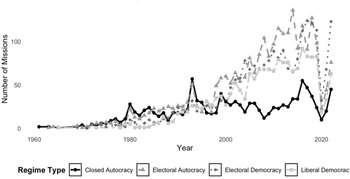
Since the 1980s, the number of IGO on-site monitoring missions has increased dramatically (Figure 1). Today, virtually all governments, including those of highly isolated countries like North Korea, have hosted at least one such mission. Over the past decade, the average number of monitoring missions has exceeded 200 annually, excluding years affected by COVID-19. Notably, a significant proportion of these missions take place in authoritarian regimes. Conducting on-site monitoring in repressive states presents a far more complex operational environment than in democracies. Authoritarian governments are more likely to employ a range of tactics to control and suppress critics, both domestically and internationally.Footnote 3 Research shows that IGO missions investigating human rights violations in such contexts are often denied entry or face severe restrictions that prevent thorough investigations.Footnote 4 Yet, there are instances in which authoritarian states permit missions to operate with minimal or no interference. For example, missions by the UN’s Office of the High Commissioner for Human Rights (OHCHR) in Kazakhstan, Saudi Arabia, and Zimbabwe reported no significant obstruction. Interviews with practitioners further suggest that some authoritarian states not only allow monitoring missions to proceed but may also actively collaborate, creating conditions for more robust investigations.Footnote 5 This behaviour challenges prevailing assumptions about authoritarian governance,Footnote 6 particularly when monitoring concerns politically sensitive issues such as human rights that regimes typically seek to shield from scrutiny.
IGO on-site monitoring missions, 1960–2022.Footnote 2

To address this puzzle, this article asks why and when on-site monitoring missions by IGOs are accepted and sustained in authoritarian states. I focus specifically on monitoring missions dealing with human rights violations, where autocrats are expected to resist external scrutiny and have strong incentives to conceal or obfuscate damaging evidence.Footnote 7 While existing research has studied the activities of non-governmental organizations (NGOs) in such environments,Footnote 8 we know little about why and when IGO monitoring missions are not only accepted but also sustained under authoritarian rule.
I argue that for IGO on-site monitoring missions to successfully establish meaningful collaboration with authoritarian regimes, two complementary yet distinct conditions must be met: international pressureFootnote 9 and sustained interpersonal trust-building efforts.Footnote 10
Building on international relations and human rights studies, I argue that international pressure is crucial in prompting political elites to reconsider their current stance. When international pressure is applied by state and non-state actors, autocratic regimes have more incentives to engage in cooperation than to resist.Footnote 11 However, the incentives generated through such mechanisms are likely to result in shallow complianceFootnote 12 and may not be sufficient for autocrats to permit robust monitoring. As seen in many human rights monitoring missions in authoritarian contexts, missions allowed under international pressure are often obstructed from carrying out their work effectively, with governments formally permitting on-site missions while avoiding actual engagement in human rights improvements.Footnote 13
Drawing on rational and social psychology studies, I argue that to achieve a successful collaboration, interpersonal trust-building efforts need to be in place.Footnote 14 Interpersonal trust-building, here understood as a continuum, involves efforts to decrease uncertainty and increase confidence by honouring commitments made to each other and demonstrating a willingness to accept reasonable compromises.Footnote 15 To develop trust between involved actors requires face-to-face meetings in a relatively small group of elites, where different interests and conflicts are discussed.Footnote 16 While autocratic elites need to demonstrate that they can keep their promises of transparency, non-interference in the mission, and a willingness to improve the situation on the ground, IGO officials need to demonstrate their impartiality and credibility to autocrats, who are likely to have reasons to distrust international scrutiny of domestic practices.Footnote 17 Though interpersonal trust is a process that takes time, it can facilitate collaboration when partners feel a sense of trustworthiness between each other – or at the very least, do not feel distrusted.Footnote 18
To be clear, in my theoretical model, the decision to allow IGO monitoring missions is made separately from the decision to allow less or more intrusive forms of monitoring. In the context of monitoring missions in authoritarian regimes, autocratic elites have few incentives to engage in activities that foster interpersonal trust – especially when the mission aims to investigate human rights violations allegedly committed by those same elites. However, when both international pressure and interpersonal trust-building are present, IGOs and autocratic elites are more likely to develop a collaborative relationship. I label this a pragmatic partnership.Footnote 19 A pragmatic partnership here refers to a cooperative relationship between an IGO and an authoritarian regime that arises from a combination of strategic incentives – driven by international pressure – and deliberate, incremental trust-building efforts. Unlike purely instrumental cooperation, a pragmatic partnership relies on sustained interactions, repeated face-to-face meetings, mutual compromise, and incremental confidence-building, enabling IGOs to operate in authoritarian contexts despite initial suspicion and divergent interests. In its most developed form, a pragmatic partnership allows authoritarian regimes to acknowledge previously denied problems, enables IGOs to establish direct links with government elites, and creates opportunities for incremental improvements that may ultimately lead to greater compliance with international rules and norms.
I illustrate my theoretical argument through an in-depth case study of the ILO’s monitoring mission in Uzbekistan regarding allegations of child labour and forced labour. As a UN specialized agency, the ILO is the principal organization responsible for creating and promoting international labour standards and has a long history of conducting on-site monitoring missions. Uzbekistan is recognized as one of the world’s most entrenched autocracies, where the legal operation of opposition parties is highly restricted. I use within-case process tracing to identify key phases in the evolution of the ILO–Uzbek relationship and tracing the mechanisms linking external pressure, trust-building, and sustained cooperation. Evidence is triangulated across interviews, official documents, NGO reports, and secondary sources.
This study contributes to several bodies of literature. It adds to the interdisciplinary scholarship on human rights investigations by examining the political dynamics of these missions in authoritarian contexts.Footnote 20 This is a valuable contribution, as existing research primarily focuses on the methodological aspects of fact-finding rather than the political challenges these missions face. Moreover, it contributes to comparative politics and international relations literature on the role of IGOsFootnote 21 and IGO bureaucraciesFootnote 22 in promoting human rights, as well as the study of authoritarian practices.Footnote 23 While much of the literature emphasizes the critical role of IGOs in democratization,Footnote 24 this study highlights the potential risks of collaboration between autocratic regimes and IGOs, which may not only fail to advance democratic change but could also weaken domestic pro-democratic forces.
In the following sections, I first develop my theoretical arguments, followed by an empirical analysis of the ILO’s monitoring mission in Uzbekistan from 2005 to 2022. I conclude with a summary of the main findings and their implications.
The argument
Authoritarian governments frequently permit IGOs to conduct on-site monitoring missions despite their reservations about external scrutiny. Such permissions might be motivated by a desire to enhance their reputation as cooperative members of the international community and showcase their adherence to international commitments. For instance, China has granted access to multiple on-site missions focusing on human rights situations as well as on the origins of COVID-19. The conditions under which IGO staff operate are generally constrained and fraught with political sensitivity.Footnote 25 The success of these missions heavily relies on the cooperation of authorities once entry into the country is allowed. There are numerous examples of reluctance to cooperate with on-site monitoring missions. For example, when the CoE conducted an on-site investigation into torture in Azerbaijan in 2011, it was obstructed from accessing relevant facilities, and as the mission report states, the delegation ‘encountered verbal hostility from some criminal investigators, who also attempted to pressure one of the delegation’s interpreters’.Footnote 26 Indeed, investigators often face surveillance and sometimes direct threats from local authorities.Footnote 27 It is not unusual for IGO monitoring missions to suspend their work due to such difficulties, occasionally relocating their operations to neighbouring countries.
The research problem, then, is to understand why and when on-site monitoring missions by IGOs are accepted and sustained in authoritarian states, allowing investigators access to restricted sites and, in some cases, even bringing government policies in line with international norms. I refer to this form of collaboration as a pragmatic partnership. I contend that two conditions must be met for such partnerships to emerge in the context of monitoring missions: international pressure and interpersonal trust. The presence of international pressure constitutes a necessary, though not sufficient, condition for the formation of such a pragmatic partnership.
International pressure is understood here as coordinated efforts by transnational advocacy networks, IGOs, and states to raise the political, reputational, and material costs of non-cooperation for targeted governments.Footnote 28 Coordinated pressure from NGOs and governments can increase the incentives of autocratic governments to accept an on-site monitoring mission despite their reluctance to be scrutinized in politically sensitive issue areas such as human rights. This logic is well established in the literature on transnational advocacy networks, which shows how domestic activists and international NGOs mobilize external allies to exert pressure on resistant governments through the so-called boomerang or spiral model, potentially triggering processes of norm contestation and adaptation over time.Footnote 29
It is also well anchored in international relations scholarship that governments across regime types care about their international reputation in order to secure material benefits from cooperation, maintain access to international markets, and be recognized as reliable partners.Footnote 30 Existing research suggests that international pressure can damage countries’ reputations and lead to material losses, including trade deficits and reduced foreign direct investment.Footnote 31 Studies further suggest that citizens – even in autocratic regimes – may respond negatively when governments are perceived to violate international norms, thereby amplifying the domestic political costs of sustained non-cooperation. In the absence of international pressure, authoritarian governments may have little motivation to allow on-site monitoring missions, as doing so inherently carries unnecessary reputational risks.Footnote 32
However, incentives triggered by international pressure alone are unlikely to result in a meaningful mission.Footnote 33 Autocrats, for instance, may invite election monitoring missions to signal compliance with international obligations while simultaneously attempting to manipulate investigators.Footnote 34 To be clear, international pressure alone may often be sufficient to compel autocrats to permit international scrutiny, accounting for initial access or symbolic cooperation, but it is not enough to establish what I describe as a pragmatic partnership. The rational response from an autocrat is to allow an on-site monitoring mission as a symbolic gesture of cooperation with international norms – without genuinely exposing wrongdoing. To pave the way for a pragmatic partnership, it is essential that the issues of uncertainty and mutual suspicion are addressed.Footnote 35 I thus distinguish between two related but distinct decisions faced by authoritarian governments: whether to permit an on-site monitoring mission in the first place, and how that mission is conducted once access is granted. International pressure primarily affects the former by increasing the material and reputational costs of refusal. By contrast, the latter depends to a much greater extent on interpersonal trust-building efforts, which shape whether cooperation remains shallow and symbolic or evolves into a pragmatic partnership involving concessions, access, and sustained engagement.
Building and fostering interpersonal trust is essential for addressing the underlying suspicions between investigators and autocratic elites. I draw on both rationalistFootnote 36 and social psychologyFootnote 37 perspectives on interpersonal trust. Although these approaches emphasize different mechanisms for how trust emerges, both recognize it as a crucial factor in achieving cooperation.Footnote 38 Accordingly, I define interpersonal trust as confidence or faith in another’s willingness to keep promises, negotiate honestly, and respect differing viewpoints.Footnote 39 This suggests that interpersonal trust is not solely based on strategic calculations and incentives but also involves social and cognitive dimensions. Furthermore, trust is inherently relational, requiring time and shared interests to develop.Footnote 40
I view interpersonal trust as a continuum rather than a binary state, varying in degrees rather than being simply present or absent. In international relations, interpersonal trust helps set clear expectations, mitigate commitment issues, reshape perceptions of self and others, and foster cooperation.Footnote 41 It plays an important role in on-site monitoring missions in repressive regimes, where IGO officials and the autocratic governments they monitor often begin from a position of mistrust.
I assume that the initial phase of a pragmatic partnership is characterized by both mutual suspicion and the recognition of shared needs and interests. For autocratic elites, interpersonal trust is fostered when the fear of embarrassment is minimal or non-existent.Footnote 42 A certain level of trust can be considered established between IGO officials and autocratic elites when monitoring staff can operate without fear of surveillance and are granted access to relevant sites. Practically, trust-building can be achieved through actions such as keeping promises, making concessions, engaging in symbolic gestures, demonstrating restraint, fostering open dialogue, and participating in repeated face-to-face meetings and interpersonal bonding.Footnote 43 These activities allow IGO representatives and autocratic officials to address concerns, clarify misunderstandings, and promote transparent communication.Footnote 44
Interpersonal trust building under international pressure
In my theoretical model, the initial phase of the pragmatic partnership is likely to be marked by both mutual suspicion and shared needs and interests.Footnote 45 Tensions arise between the international agendas represented by IGOs and their officials and the respective national interests of the involved authoritarian state.Footnote 46 For example, IGO officials might exhibit scepticism towards the conditions and practical access to sites, data, and organizations – all of which are often important for conducting a comprehensive and robust monitoring mission. Additionally, IGO officials may harbour doubts about the autocrat’s genuine intentions to improve conditions on the ground and align their practices with international commitments. Conversely, autocrats can harbour suspicions concerning the impartiality and political motivations of IGO officials, the purposes of their on-site visits, and the methods intended to expose their regime’s transgressions, thus attracting unfavourable international and domestic attention and potential repercussions. Indeed, for autocratic leaders, granting access to certain locations and information could have unforeseen outcomes, potentially even destabilizing their rule.Footnote 47 This particular dynamic can be characterized as a mutual suspicion dilemma, generating an information asymmetry wherein the monitoring IGO and the scrutinized autocrat possess incomplete information regarding each other’s motivations.Footnote 48
Yet, it is important to recognize that both monitoring IGO officials and scrutinized autocrats might share mutual interests under international pressure – both parties have incentives to conduct the monitoring mission in a manner that avoids counterproductive outcomes. While for autocratic elites’ willingness to cooperate may stem from material or social concerns, for IGO officials, achieving success in their tasks and delivering tangible results is imperative. This willingness to attain outcomes despite constrained circumstances can be rooted in material security but also in ideological considerations.Footnote 49 IGOs rely on funding and resources, and to secure and expand these resources, they must demonstrate that their actions yield results.Footnote 50 The constraints of limited resources can endanger the organization’s reputation and the prospects of individual officials. In a competitive landscape, where performance evaluations can lead to either displacement by rivals or increased funding and expansion, IGO officials are often motivated to achieve results.Footnote 51
Establishing a pragmatic partnership depends on both actors’ ability to demonstrate that their initial promises are not merely ‘cheap talk’.Footnote 52 For IGO officials tasked with monitoring in repressive settings, maintaining the pragmatic partnership may require deviations from standard protocols.Footnote 53 This could involve assuring governments that they will not be publicly criticized, prioritizing educational and capacity-building initiatives,Footnote 54 endorsing positive developments within the authoritarian regime, and even actively promoting its international image. At the same time, deliverables from autocratic governments are also essential. For the monitoring mission to be perceived as credible and to effectively achieve its objectives, the autocratic government must refrain from misleading or manipulating the mission’s activities. This may include allowing citizens to voice complaints without fear of repression, permitting monitoring at sites selected by IGO officials rather than by government representatives, and, no less importantly, implementing costly policies required by the IGO.
Scope conditions of the pragmatic partnership
While my theoretical framework helps explain the emergence of pragmatic partnerships, there are important scope conditions that limit when such partnerships can be established. These scope conditions draw on complementary strands of scholarship on international pressure, including work on transnational advocacy and reputational politics, trust-building under uncertainty, and bureaucratic mandate.Footnote 55 First, a pragmatic partnership is more likely to emerge when authoritarian governments are vulnerable to international pressure that imposes material and reputational costs.Footnote 56 Second, domestic political stability is a critical precondition for pragmatic partnership. Political instability and elite fragmentation within authoritarian regimes often result in unstable coalitions and frequent turnover among elites, making it difficult to establish the repeated and predictable interactions required for sustained interpersonal trust.Footnote 57 Finally, pragmatic partnerships are more likely to occur when IGO bureaucrats possess a clear mandate to engage in deliberations with authoritarian regimes.Footnote 58 In the absence of mandate clarity, officials may lack both the authority and organizational protection required to exercise restraint and pursue the trust-building practices on which pragmatic partnerships depend.
Analytical framework
I use process-tracing to analyse events leading up to and during the ILO’s monitoring mission to Uzbekistan, covering the period from 2005 to 2022. Empirically, I draw on a diverse range of sources to answer our research questions. For this study, I conducted 21 elite interviews with local and exiled Uzbek activists, representatives of international NGOs, senior officials from the ILO and World Bank (WB), high-ranking U.S. government officials, and one former representative of the Uzbek government. All interviewees were significantly engaged in the case at some point of time. Given the circumstances, and in line with established practices for interviews in authoritarian states, all interviews have been anonymized and presented in a manner that prevents identification of specific individuals – and in certain cases, certain participating organizations. Given the sensitivity of the case and the limited number of highly involved actors, I generally prioritize respondent protection and triangulation over verbatim quotation. Interviews were conducted either in-person, via phone, or via video calls.Footnote 59 In several cases, multiple interviews were conducted with the same individuals. While most interviews took place in English, some were conducted in Russian and subsequently translated into English. Moreover, this study also draws on descriptive statistics on IGO missions to Uzbekistan and a range of documents that provide further insights into the case, including meeting records and other official documents from the ILO and WB, as well as reports, letters, and statements from international NGOs, local activists, and Uzbek government representatives.
I trace the two main factors through observable patterns in the empirical material. My aim is not to establish causal mechanisms conclusively, but to identify, trace, and illustrate how these mechanisms operate over time. International pressure is traced through changes in external demands directed at the Uzbek government, including coordinated pressure by international NGOs, foreign governments, and IGOs, as well as articulated concerns about reputational and material costs of non-cooperation.Footnote 60 Interpersonal trust-building is traced through repeated interactions over time, continuity of key interlocutors, and evidence of restraint and accommodation in sensitive moments, particularly where actors refrain from exercising available leverage or public condemnation despite ongoing disagreement.Footnote 61 Empirically, I identify the emergence of a pragmatic partnership when cooperation moves beyond formal access and is sustained over time, reflected in continued access to sensitive sites, stable working relations, and mutual adjustment.
My focus on this case is motivated by several factors. First, the ILO mission in Uzbekistan attracted considerable attention and debate among news outlets, international human rights NGOs, and other stakeholders, making it a particularly salient and contested case. Second, the case shows meaningful variation over time, allowing us to trace how interactions between the ILO and the Uzbek government evolved from initial resistance to sustained cooperation. This temporal leverage is central to assessing how international pressure and interpersonal trust-building operate sequentially and jointly. Third, the availability of extensive public documentation before, during, and after the mission enables us to systematically trace and substantiate our arguments. Finally, because the violations were state-orchestrated and closely tied to regime interests, the gradual emergence of cooperation in this case provides analytical leverage for illustrating how the two mechanisms operate under conditions inhospitable to engagement.
No less important, the ILO case should be understood in the context of institutional variation among international monitoring bodies. The ILO differs from many human rights monitoring mechanisms, such as the UN Special Procedures, in that it combines monitoring with technical cooperation, is more oriented towards dialogue than confrontation, and operates through a tripartite structure involving governments, employers, and workers.Footnote 62 At the same time, the dynamics examined in this study are not unique to the ILO. Similar forms of engagement can be observed in other IGOs that rely on iterative monitoring, field-based interaction, and capacity-building rather than adversarial scrutiny or public shaming, including parts of the WB, the UN Development Programme, the UN Children’s Emergency Fund, and certain regional organizations. In such settings, cooperation often unfolds through negotiated access, restraint, and repeated interaction, creating conditions under which pragmatic partnerships, rather than purely symbolic compliance, can emerge.
The case of child labour and forced labour in Uzbekistan
As a UN specialized agency, the ILO’s engagement with Uzbekistan was grounded in the legal and institutional mandate of the ILO. By virtue of its membership in the ILO, Uzbekistan was legally bound to respect and promote fundamental principles and rights at work, as stipulated in the ILO Constitution. Moreover, Uzbekistan ratified all relevant fundamental conventions on child labour and forced labour between the early 1990s and late 2000s, well before the first on-site monitoring mission took place. The ILO’s supervisory system, however, has historically relied less on adversarial enforcement and public condemnation than on dialogue, persuasion, and sustained engagement with national authorities through its tripartite structure.Footnote 63 The existence of clear legal obligations, and the Uzbek government’s ratifications of the relevant conventions, however, did not in themselves translate into access or meaningful cooperation on the ground.
Uzbekistan, similar to other post-Soviet nations, affiliated itself with the ILO soon after the Soviet Union dissolved and became an ILO member in 1992. Under the leadership of then-president Islam Karimov, the country showed minimal interest in the ILO and its fundamental conventions. Indeed, in the 1990s, Uzbekistan took a radical step in barring Uzbek unions from collaborating with international organizations. However, in the early 2000s, the ILO’s main supervisory bodies, the Committee of Experts on the Application of Conventions and Recommendations (CEACR) and the Conference Committee on the Application of Standards (CAS), initiated their examination of Uzbekistan, requesting details about issues like forced labour and discrimination.Footnote 64 In 2008, the CEACR released stern criticism against Uzbekistan based on data provided by the International Organization of Employers (IOE), suggesting prevalent child labour and forced labour in the public cotton production sector.Footnote 65 While the Uzbek government dismissed these allegations and refuted any government involvement, by 2008, the Uzbek government felt a need to respond to allegations in order to be able to sell the cotton in international markets. It responded by introducing a decree prohibiting child labour on cotton farms. It also accepted an ILO action plan aimed at enforcing the Abolition of Forced Labour Convention (C105) and the Worst Forms of Child Labour Convention (C182). However, further reports from the IOE and other stakeholders suggested persistent and systemic child and forced labour in the cotton industry.
In 2010, the CAS – the tripartite supervisory body of the ILO, where major violators of international labour norms are addressedFootnote 66 – criticized the Uzbek government for breaching the convention concerning the worst forms of child labour (C182). A high-level Uzbek official attended the ILO session in Geneva to address the allegations. During this session, the Uzbek representative dismissed allegations from international NGOs, employer organizations and unions on child and forced labour in Uzbekistan as a ‘politically motivated campaign’.Footnote 67 Numerous governments, including the U.S., emphasized the need for an on-site ILO monitoring mission with unrestricted access to sites in order to assess the implementation of conventions pertaining to child and forced labour during the impending cotton harvest.Footnote 68
Despite the international push, the Uzbek government remained reluctant to on-site monitoring missions. In subsequent years, international criticisms against Uzbekistan’s child labour practices intensified from around 2008 onwards, accompanied by threats of trade restrictions and preferential trade withdrawals by both the U.S. and the EU, including measures linked to U.S. import bans on goods produced with forced labour and debates within the EU over Uzbekistan’s access to trade preferences. A collective of NGOs and other non-state actors united to form the Cotton Campaign, which introduced the Uzbek Cotton Pledge Against Forced Labor.Footnote 69 Over the years, the pledge garnered support from over 300 global brands and retailers, all of whom committed not to source cotton from Uzbekistan due to concerns over forced labour practices.
In parallel, the ILO office repeatedly attempted to enter Uzbekistan to oversee the cotton harvest and engage in high-level dialogues with the Uzbek authorities. However, these efforts were repeatedly denied.Footnote 70 While forced labour presented a significant issue, the supervisory bodies of the ILO, alongside the ILO Office, strategically prioritized allegations of child labour. This focus aligned with the concerns of NGOs and other governments regarding child labour.Footnote 71 Within the ILO, the employers’ organization was especially proactive. Union representatives advocated for a regional focus rather than singling out one nation, as child labour was not specific to Uzbekistan.Footnote 72 NGOs disagreed, arguing that Uzbekistan was unique in that the government itself was the primary instigator of child labour, setting it apart from practices in other countries.Footnote 73
Information from the IOE suggested that the police forces guarded cotton farms, preventing local human rights activists from entering the sites to conduct monitoring.Footnote 74 Several sources suggested that there were between one million and three million individuals who were forced into the cotton harvest.Footnote 75 Interviewees consistently indicate that this international pressure was decisive in pushing the Uzbek government to reconsider its initial refusal and agree to an on-site monitoring mission, even though suspicions towards external scrutiny persisted.Footnote 76 Initially, discussions about the issues were ad hoc, but they established the foundation for more systematic meetings. Indeed, the explicit goal of these meetings was to reduce feelings of mistrust and foster the development of interpersonal trust.Footnote 77 However, the first round of meetings about an on-site mission reached no fruitful conclusion.
For ILO officials, executing an on-site monitoring mission was a top priority.Footnote 78 This mission would pave the way for providing technical assistance and promoting adherence to ILO’s fundamental conventions.Footnote 79 Despite reluctance from the Uzbek government to agree on a comprehensive on-site monitoring mission, the ILO office continued its efforts to establish dialogues with Uzbek officials. For example, in an effort to address the issues more directly and build trust, ILO officials began proposing face-to-face meetings in Tashkent rather than at international venues such as Geneva or Washington, D.C., with the specific aim of making Uzbek officials feel more comfortable with the ILO’s presence in the country.Footnote 80 From a trust-building perspective, relocating meetings to Tashkent reduced the symbolic asymmetry associated with headquarters, facilitating more face-to-face exchanges on Uzbek soil.Footnote 81 Contacts on both sides remained limited to a small and stable group throughout this early phase, with the same ILO team engaging repeatedly with the same senior Uzbek interlocutors. The trust-building literature treats this kind of continuity as an enabling condition for interpersonal confidence.Footnote 82 In addition, the ILO officials strategically emphasized the potential benefits of technical support during the mission and stressed the adverse impacts of pesticides and herbicides used in cotton fields on children. Some reports and interviews suggest that these angles made government officials, gradually, more receptive to acknowledging the problem.Footnote 83
At the same time, the international pressure on the Uzbek government grew for almost each day they refused to cooperate. International NGOs, including Anti-Slavery International and the Environmental Justice Foundation, as well as efforts from the Uzbek-German Forum, played a significant role in urging the Uzbek government to initiate dialogue with international organizations.Footnote 84 Members of the Cotton Campaign coalition orchestrated coordinated campaigns to highlight child labour issues in Uzbekistan. They frequently called for a boycott of Uzbek cotton and advocated for the imposition of multilateral and bilateral sanctions. Their efforts were impactful, with major global brands like H&M, IKEA, and Adidas pledging not to source cotton from Uzbekistan.Footnote 85 The advocacy work of the Cotton Campaign coalition and other NGOs influenced the European Parliament’s decision not to extend the Textile Protocol, a trade agreement favouring textile products from Uzbekistan.Footnote 86 For example, Nicole Kiil-Nielsen, a member of the European Parliament, speaking on behalf of the Committee on Foreign Affairs, emphasized the EU’s moral duty, arguing that Parliament should withhold its consent to the agreement until Uzbekistan grants access to an independent on-site ILO mission.Footnote 87
Although the Uzbek government continued to deny child labour and forced labour allegations, it began displaying openness to discussing on-site investigation modalities.Footnote 88 The progress was gradual but evident. A key indicator of this shift was the Uzbek government’s willingness to host an ILO team to train Uzbek worker unions in overseeing cotton farms. Interviews with representatives from the ILO, the Uzbek government, and other stakeholders involved in the process suggest that international pressure was a key factor in leading the Uzbek government to consider hosting an ILO mission.Footnote 89
Initiation of the pragmatic partnership: the first ILO mission
In 2012, the ILO Office and the Uzbek government engaged in a series of discussions and roundtables. Given the sensitivity of labelling their mission purely as ‘monitoring’, ILO officials framed it primarily as technical cooperation. According to Tapiola,Footnote 90 who was responsible for the ILO’s mission in Uzbekistan, this approach was a tactic to reassure the Uzbek government of the ILO’s genuine intent to assist rather than to damage its international image. From a trust-building perspective, such framing can function as a signal of restraint and reassurance, reducing perceived threats and reputational risks for authoritarian elites by emphasizing assistance over exposure.Footnote 91 Despite initial reservations and scepticism from certain Uzbek representatives, particularly then Labour Minister Akmat Khaitov, the government – under the influence of the more progressive Tanzila Narbaeva, then Chairperson of the Council of the Federation of Trade Unions of Uzbekistan and later Deputy Prime Minister – ultimately approved the first ILO mission.
Interviews with senior ILO officials involved in the negotiations highlight the crucial role of interpersonal trust-building efforts that started to take form, especially with Narbaeva.Footnote 92 Following the agreement that an on-site mission will take place, the focus shifted to establishing the monitoring method and its specifics on the ground. Narbaeva took the lead for the Uzbek government in these negotiations. To foster interpersonal trust, both parties decided on a joint monitoring approach, where the ILO would maintain transparency regarding its activities, keeping the Uzbek government fully informed at all times. This arrangement was described as a ‘trial balloon’ for the pragmatic partnership from both perspectives.Footnote 93 Even though this mutual arrangement faced criticism for potentially undermining the impartiality of the mission, it facilitated the ILO’s access to some cotton plantations and schools.Footnote 94 The monitoring teams included ILO experts alongside representatives from the Uzbek government and unions. The information gathered from these visits was processed by the ILO, with regular updates shared with the Uzbek government. From the perspective of the ILO office, conducting a joint on-site monitoring mission under these terms laid the groundwork for further collaboration and engagement with the Uzbek government. It presented an opportunity to demonstrate the ILO’s commitment as a reliable partner.Footnote 95 From the Uzbek government’s standpoint, the set-up of the on-site mission served as a means to maintain some control but also made them trust, to some degree, that the ILO will not undertake any unexpected actions.Footnote 96
Despite government presence during these visits, instances of child labour were still identified. This was anticipated by both the Uzbek government and the ILO, as no cases of child labour would undermine the credibility of the mission.Footnote 97 However, there were numerous attempts from the Uzbek side to mask certain activities. Observations like children hastily leaving upon the arrival of the mission team, or those found ‘reading books’ in the cotton fields, raised eyebrows.Footnote 98 A new category of ‘children reading in the cotton fields’ was created by the ILO officials, which was initially opposed by the Uzbek government, as they were not seen as instances of child labour but rather children doing their school assignments. In such circumstances, the ILO had to play the role of an ‘inconvenient partner’.Footnote 99 There were compromises from the ILO’s side in order to show the commitment of the ILO to their collaboration, ‘but not in all matters’.Footnote 100 In essence, while the ILO strategically chose approaches to avoid embarrassing the Uzbek government, it remained committed to conducting robust assessments on the ground. In total, 63 children were identified working in cotton picking. These findings contradicted those of independent reports, such as the Uzbek-German Forum for Human Rights, which documented the systemic use of child labour in Uzbekistan’s cotton industry.Footnote 101 Nonetheless, this first on-site mission was considered a success by many within both the ILO and the Uzbek government.Footnote 102 Such restraint – where contested findings were absorbed without public confrontation and disagreements were voiced through private channels – is understood in the trust-building literature as a signal of commitment that invites reciprocal accommodation.Footnote 103
During this first on-site monitoring mission, the pragmatic partnership between the ILO and Uzbekistan began to take form.Footnote 104 The previously evasive stance of the Uzbek government on child labour began to shift.Footnote 105 The ILO, on the other hand, framed its arguments around the health and education of the children and the ineffectiveness of child labour in meeting the cotton quotas set by the government. Because of the on-site monitoring mission, the ILO officials could speak directly to government representatives at all levels, from national to local ones. The ultimate message conveyed was that relying on child labour was not only a violation of international labour standards but also counterproductive in terms of meeting the centrally set quotas.Footnote 106
Though the report of the first monitoring mission was intended to be formally written and presented at a high-level meeting in Tashkent, the ILO team chose to showcase it through a PowerPoint presentation to circumvent potential disagreements.Footnote 107 The main conclusion drawn was that there was no evidence pointing to a systematic use of child labour, a finding which went unchallenged by the Uzbek officials.Footnote 108 Naturally, the findings from a reputable international organization like the ILO came as a relief to Karimov’s regime, allowing the government to sidestep the conflicting reports from international NGOs such as the IOE and Human Rights Watch, as well as from domestic groups. The findings, however, encountered their share of criticism.Footnote 109 Well before the mission, when details of the first ILO on-site monitoring missions began to emerge publicly, Cotton Campaign members expressed concerns that ILO monitors would (1) be accompanied by Uzbek authorities, (2) lack access to all cotton fields, and (3) not have the mandate to assess the situation of forced labour.Footnote 110
As articulated by several ILO officials during interviews, the objective of the mission was not to corner the Uzbeks. Instead, the intention was to strengthen and evolve the relationship with the government.Footnote 111 While the mission was primarily centred on child labour, the allegations of forced labour could not be overlooked, especially by the ILO’s supervisory body, the CEACR. Intriguingly, some officials saw the first on-site mission on forced labour as an initial step to broach the more challenging subject of forced labour.Footnote 112 As the ILO’s on-site mission focused on investigating and assessing child labour practices in cotton fields, observers began to notice a substitution effect: specifically, the Uzbek authorities appeared to be increasingly replacing child labour with forced adult labour.Footnote 113 However, initiating discussions on government-orchestrated forced labour required a significant amount of interpersonal trust, as the issue was far more sensitive and complex than that of child labour. Methodologically, distinguishing children from adults is straightforward, but differentiating between those forced into labour and others is a complex endeavour.Footnote 114 Politically, the intricacies of evaluating forced labour necessitate a focus on the government’s recruitment procedures, leaving the Uzbek government with minimal room to point fingers at the cotton farmers or other factors outside of the Uzbek government’s responsibility.
Reflecting on their positive experiences with the child labour mission, the Uzbek government considered the ILO’s expertise regarding the Abolition of Forced Labour Convention (C105). Yet, no on-site monitoring mission centred on forced labour was greenlit for the upcoming year. Instead, the agreed-upon plan was for the Uzbek authorities to carry on with child labour monitoring on-site, drawing on the ILO’s training. This arrangement sidestepped the pressing issue of forced labour, a matter the ILO started to highlight in its dialogues with the government. The Uzbek government was highly suspicious and perceived any expansion of the mission’s scope as a potential threat to its regime.Footnote 115 At the same time, the ILO was financially constrained – it had used most of its core funding on the first monitoring mission – and committing to another more resource-intensive task of evaluating forced labour on the ground was not feasible without additional funding from donors.Footnote 116 This scenario changed dramatically with the WB’s involvement. The WB came with both money and additional pressure on the Uzbek government.Footnote 117
Developing the pragmatic partnership
In 2013, several Uzbek NGOs, with the assistance of the Cotton Campaign, lodged a complaint with the WB’s Inspection Panel, which is tasked with assessing the WB’s adherence to its own policies. The complaint highlighted concerns about both child and forced labour. Previous to this official complaint, NGOs lodged multiple complaints to pressure the WB to suspend its agriculture loans.Footnote 118 Upon agreeing to assess the complaint, the Inspection Panel opted for an on-site visit to the WB-supported sites in Uzbekistan. Despite some challenges with the local authorities – such as being shadowed by a government official and having their passports confiscated by a police officerFootnote 119 – the WB team could make an assessment of the situation. To the surprise or disappointment of many, the Inspection Panel did not recommend an immediate investigation but rather a postponement, with a planned follow-up visit the subsequent year. The decision drew sharp criticism from international NGOs.Footnote 120 The Cotton Campaign had hoped for the Inspection Panel to advocate for a comprehensive probe, possibly leading to the suspension of an agricultural loan extended by the WB.Footnote 121 The Inspection Panel justified its conclusion by pointing to the positive developments in the country, indicating a commitment to introduce more rigorous measures to combat child and forced labour.Footnote 122 Interviews with high-level internal sources, however, reveal that the WB was alarmed by the allegationsFootnote 123 but lacked (at the time) strong labour safeguards that would mandate a full-scale investigation or compel them to halt or rescind the loan. However, the consistent pressure from the Cotton Campaign steered the WB towards addressing the concerns of child and forced labour.Footnote 124
The WB’s initial plan was to commission an independent on-site monitoring mission through private firms.Footnote 125 However, this proved challenging, as none of the approached firms possessed the necessary access, nor did they express strong willingness to undertake such a mission in Uzbekistan’s politically tense and repressive environment. The context posed potential safety threats to both the firm representatives and the interviewees.Footnote 126 The Uzbek government was also resistant to scrutiny from NGOs, which it perceived as politically motivated.Footnote 127 After facing these setbacks, the WB reached out to the ILO, seeking collaboration to address both child and forced labour issues.
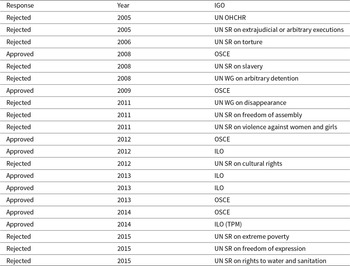
The Uzbek government’s agreement to be scrutinized by the ILO was not coincidental but rather the result of both international pressure and prior interpersonal trust-building efforts. The earlier pragmatic partnership experience in the context of the on-site monitoring mission on child labour helped reduce the Uzbek government’s suspicions towards the ILO. In addition to interview evidence, I also support this claim by analysing data on all missions to Uzbekistan from 2005 to 2015.Footnote 128 Table 1 situates the ILO’s engagement with Uzbekistan within the broader pattern of the government’s interaction with international monitoring bodies. This pattern suggests that the Uzbek government did not reject international monitoring as such, but adopted a selective and strategic approach to access. The ILO stands out as the only investigative monitoring body whose access was progressively expanded over several years in relation to allegations of child and forced labour.Footnote 129 By contrast, Uzbekistan refused access to the UN Special Rapporteur on contemporary forms of slavery, even though allegations of state-imposed mobilization and coercion in the cotton sector fell squarely within the Rapporteur’s mandate. At the same time, the government permitted visits by the OSCE, predominantly by the OSCE High Commissioner on National Minorities. These visits involved an assessment of conditions on the ground, but they were generally less intrusive and less publicly investigative than Special Rapporteur visits, operating more through preventive diplomacy and quiet engagement. Overall, the pattern suggests that reduced suspicion emerged not towards international monitoring in general, but towards the ILO specifically, as an organization with which Uzbek authorities had accumulated prior experience and developed interpersonal trust. As one source put it, the Uzbek government had ‘much more trust’ in the ILO because of their past collaboration, while other organizations were not perceived as neutral but rather as political.Footnote 130
Approved and rejected monitoring missions to Uzbekistan, 2005–2015.

Table 1 Long description
The table lists monitoring mission requests to Uzbekistan from 2005 through 2015, showing the year, the intergovernmental body, and whether the visit was approved or rejected. Approvals are recorded only for OSCE and ILO missions: OSCE approvals occur in 2008, 2009, 2012, 2013, and 2014, and ILO approvals occur in 2012, twice in 2013, and in 2014 as an ILO TPM mission. All UN-related entries are rejections, including UN OHCHR and multiple UN Special Rapporteurs and Working Groups. Rejections appear in 2005 and 2006, rise again in 2008, and cluster most heavily in 2011 and 2015, with three rejected UN mandates in each of those years. The pattern suggests Uzbekistan was more willing to accept OSCE and ILO monitoring than UN human rights mandate-holder visits during this period. One year, 2013, includes multiple approved missions from the same organization, indicating repeated visits or separate missions rather than a single event.
After a series of deliberations, in October 2014, the WB and the ILO formalized their partnership by signing a Memorandum of Understanding. As per the agreement, the WB would fund a ‘Third-Party Monitoring’ (TPM) mission to be carried out by the ILO. This agreement granted the ILO autonomy in devising a suitable methodology for the mission and required them to report their findings to the WB. Furthermore, a public Feedback Mechanism was established to address any grievances that arose. While some senior officials at the WB initially doubted the longevity of this arrangement,Footnote 131 the monitoring mission in Uzbekistan has since proven its resilience, continuing to operate annually.
The initial report from the TMP mission in Uzbekistan found no evidence of forced labour practices in the areas supported by the WB, allowing the Uzbek government to continue receiving loans from the WB. However, the report did highlight issues of forced labour at other sites.Footnote 132
The pragmatic partnership in action
The WB’s engagement brought about a realization within the Uzbek political elite: the pragmatic partnership with the ILO had the potential to be expanded to address forced labour, despite the topic’s extreme sensitivity.Footnote 133 The Uzbek government was concerned that the WB might either suspend the loans or – even worse – exit the country altogether.Footnote 134 Such a move would tarnish the government’s reputation and impede its ambitions to attract investments into the agricultural and infrastructure sectors.Footnote 135 Though the government now acknowledged the issue of child labour, it did not recognize the existence of forced labour. Of great concern was the fact that forced labour, if admitted or found, would be intrinsically tied to the state, given its state-orchestrated mobilization.Footnote 136 Such an admission could, in theory, initiate various legal actions and could be classified as a criminal offence. This situation put the pragmatic relationship between the ILO and Uzbekistan to a critical test.
The ILO’s approach to this dilemma was not to pinpoint concrete evidence, such as an exact or estimated count of individuals subjected to forced labour. Instead, they proposed a shift in dialogue with the Uzbek government, emphasizing the ‘risks’ associated with forced labour rather than presenting definitive numbers.Footnote 137 This approach resonated with the Uzbek officials. Discussing potential risks did not equate to categorically identifying individuals in forced labour, an infringement directly implicating the government.Footnote 138 Consequently, this method steered the government clear of overt international criticism and potential severe sanctions.Footnote 139 From 2016 onwards, the on-site monitoring missions were effectively focused on evaluating the effects of the Uzbek government’s initiatives to combat both child and forced labour.Footnote 140
Subsequent policy commitments by the government, followed by their implementation, epitomize the mature phase of the pragmatic partnership between the ILO and the Uzbek government. While the ILO adopted a methodological stance that drew criticism from both NGOs and other observersFootnote 141 – ILO officials were firmly convinced that maintaining a presence in Uzbekistan would eventually yield results in eliminating both child labour and forced labour because of the commitments made by both sides.Footnote 142 As a high-level ILO official conveyed to the Financial Times in 2017, the ILO’s involvement in Uzbekistan stemmed from a belief that its approach was likely to catalyse progress on the ground.Footnote 143 The ILO Office was also convinced that crafting an ideal monitoring system might be a clear-cut task, crafting one that would be effective in a context like Uzbekistan is much more difficult.Footnote 144
The later stage of the partnership was characterized by a firm bond between a small team of ILO officials responsible for monitoring and a select group of high-ranking individuals within the Uzbek government.Footnote 145 This aligns with studies showing that smaller and more stable groups of elites are more likely to foster interpersonal trust than larger groups.Footnote 146 In fact, the ILO’s actions were at times carefully calibrated to protect its key contacts within the government. For example, the 2016 monitoring report was described as ‘very careful’ and ‘less sensitive’ due to the turbulent political climate following the death of former President Karimov. The ILO was cautious not to jeopardize its ties with the government by causing problems, particularly for its focal points within the administration.Footnote 147 This is also in line with trust literature that underlines continuity of key interlocutors – in this case, most notably Tanzila Narbaeva and her team on the Uzbek side and a small group of senior ILO officials – for fostering and sustaining interpersonal trust.Footnote 148
For the Uzbek government, the pragmatic partnership with the ILO offered a multitude of advantages. Prior interactions with ILO missions laid a foundation for the monitoring initiatives funded by the WB. A direct channel had been established between the ILO Office and top-tier representatives of the Uzbek government.Footnote 149 Familiar with the ILO’s approach, the Uzbek authorities were assured that the organization would avoid publicly denouncing the nation, sidestep political controversies, and maintain discretion in information sharing.Footnote 150 The ILO Office’s adeptness in handling nuanced matters, such as discussing risks rather than disclosing concrete figures of those in forced labour, bolstered the mutual trust underpinning the pragmatic partnership.Footnote 151
Equally important was the fact that the partnership enabled the ILO to endorse Uzbekistan’s policies in the international arena. ILO officials clarified to Uzbek authorities that their official statements would only gain credibility if echoed and supported by the ILO.Footnote 152 In turn, this entailed that the government had to undertake substantive policy endeavours, with tangible costs, aimed at tackling the challenges of child and forced labour. Indeed, starting in 2016, a battery of policies was rolled out and enforced more rigorously. These included the termination of the longstanding cotton production quota system, widely regarded as the principal driver behind child and forced labour. Notably, what set Uzbekistan apart from other nations grappling with child and forced labour was the quota system. Few countries orchestrated child and forced labour on such a vast scale.
The demise of former President Karimov played a part in catalysing the adoption of anti-forced labour policies. Yet, interviews indicate that while Karimov’s passing was undeniably influential, it was not decisive; a fair share of these policy shifts had already been underway during his tenure,Footnote 153 and the first on-site monitoring mission took place under the Karimov’s regime. As of 2021, both independent evaluators and the ILO’s own assessments failed to identify systematic indications of state-endorsed forced labour within Uzbekistan’s cotton sector. By 2022, the Cotton Campaign – the most fervent critic of the pragmatic partnership between the ILO and Uzbekistan – ended its Uzbek Cotton Pledge Against Forced Labor, an initiative launched in 2009 where over 300 brands and retailers committed not to source Uzbek cotton.Footnote 154
The pragmatic partnership between the ILO and the Uzbek government witnessed significant enhancement starting from early 2020. For instance, the ILO maintained direct and immediate communication with the deputy head of the Uzbek government, facilitating unhindered discussions with other top-tier officials on child labour and forced labour topics.Footnote 155 Another testament to the ILO’s influence is its capacity to informally address complaints from diverse groups and subsequently bring these issues to the government’s attention. This mechanism empowers the ILO with information that is not under the government’s jurisdiction, underscoring the degree of interpersonal trust the Uzbek government places in its relationship with the ILO.Footnote 156
Though the pragmatic partnership played a role in eradicating systemic state-sponsored forced labour through monitoring, capacity-building, and technical assistance, its political nature remained contested by various actors and carried the risk of legitimizing autocratic practices, undermining the ILO’s credibility, and disadvantaging pro-democratic Uzbek activists.
Unintended consequences and contestation
Without offering a fully comprehensive account of the effects, this section draws on the Uzbek case to highlight some recurrent forms of contestation and tension associated with pragmatic partnerships between IGOs and authoritarian regimes, involving disputes over practices, authority, and the political implications of cooperation.
There are reasons to assume that pragmatic partnerships as defined here are likely to generate both internal and external contestation due to the inherently political nature of collaboration with repressive regimes.Footnote 157 Within IGOs, stakeholders may challenge arrangements that constrain organizational independence or limit the ability to publicly condemn violations. Within authoritarian regimes, elites may question the costs of cooperation with IGOs that demand access to sensitive policy areas and potentially expose internal practices to scrutiny.Footnote 158 Domestic activists may likewise object to such partnerships, viewing them as normalizing or legitimizing authoritarian rule. International NGOs, in turn, may contest pragmatic partnerships when they perceive monitoring missions as insufficiently independent or overly accommodating towards repressive governments.Footnote 159
In the Uzbek case, the pragmatic partnership between the ILO and the government became a focal point of contestation, particularly among international human rights NGOs. The Cotton Campaign coalition – including organizations such as Human Rights Watch – emerged as a prominent critic, accusing the ILO of overlooking forced labour due to its close cooperation with the Uzbek authorities.Footnote 160 Initially, however, these actors supported the ILO’s involvement. In 2013, Human Rights Watch emphasized that accepting an ILO monitoring mission was ‘absolutely key’ to ending forced labour in the cotton harvest.Footnote 161 This support eroded over time as concerns mounted over the ILO’s dual role as both partner and monitor.
A central point of contention concerned perceived conflicts of interest. Critics argued that an IGO embedded in a cooperative relationship with the government it was tasked with monitoring could not provide sufficiently independent assessments.Footnote 162 This concern was compounded by the ILO’s evolving role, which some NGOs viewed as departing from its traditional function as a standard-setter and technical advisor. Statements by senior ILO officials portraying Uzbekistan as ‘open for business’ intensified these concerns and were widely interpreted as signalling a shift towards legitimizing the regime.Footnote 163
The methodology of the monitoring missions also attracted criticism. The inclusion of government officials in monitoring teams and reliance on official sources was seen by NGOs and some researchers as undermining the credibility of the findings.Footnote 164 Subsequent reports by independent researchers and NGOs challenged the accuracy of the ILO’s assessments and documented continued government-orchestrated forced labour, further fueling contestation.Footnote 165
These external challenges were mirrored by internal disagreements within the ILO. While much criticism remained internal, some officials openly questioned the organization’s approach, arguing that cooperation with the Uzbek government compromised institutional independence.Footnote 166 Others, however, defended the pragmatic partnership, acknowledging methodological limitations but emphasizing perceived long-term gains and the necessity of engagement under difficult conditions.Footnote 167 The criticism from international NGOs sometimes had unintended effects. Several interviewees noted that sustained external criticism reinforced the Uzbek government’s perception of the ILO as a committed and reliable partner, thereby strengthening the pragmatic partnership rather than undermining it.Footnote 168 From the government’s perspective, the ILO’s restraint in the face of public contestation signalled loyalty to the cooperative arrangement.
Within Uzbekistan, contestation also emerged among political elites and civil society actors. Older regime-loyal factions expressed concern that the ILO’s presence could facilitate independent mobilization and weaken state control.Footnote 169 Civil society actors directly involved in the ILO’s monitoring generally viewed the partnership positively, emphasizing incremental improvements and international visibility. Others, including activists excluded from the process or operating in exile, criticized the partnership for marginalizing independent monitoring and constraining, as well as intimidating grassroots activists.Footnote 170
In practice, access to monitoring sites became increasingly restricted for independent activists, who were often prevented from conducting parallel assessments. Several interviewees described this as one of the most problematic consequences of the pragmatic partnership, as it limited alternative sources of information and reduced space for contestation outside the ILO framework.Footnote 171 From the government’s perspective, such restrictions were necessary to prevent contradictory findings and protect the cotton industry from reputational damage.
Conclusions
In this study, I argued that for IGO missions to endure and effectively conduct on-site monitoring in repressive regimes, both international pressure and interpersonal trust must be present. While external economic and political pressures may compel authoritarian regimes to permit IGO monitoring, they are insufficient to sustain a pragmatic partnership without interpersonal trust. Such trust is cultivated through ongoing dialogue, recurrent face-to-face meetings, joint activities, mutual commitments, and symbolic gestures.
This study makes several contributions. First, it shows that IGO monitoring missions that endure and function effectively within a pragmatic partnership with authoritarian regimes are inherently political rather than independent monitoring mechanisms. While a partnership between an IGO and an authoritarian regime can address challenges and lead to incremental improvements, it is rarely straightforward. The extent of success depends on both international pressure and interpersonal trust-building efforts.
Second, this study also provided an initial analysis of the consequences of such partnerships, particularly the contestation and trade-offs they entail. It stresses the risks of legitimizing authoritarian practices, undermining the credibility of IGOs, and constraining the space for local activists. These contributions are significant, as existing research primarily focuses on the methodological aspects of monitoring missions rather than the political challenges they face.Footnote 172
Finally, the findings of this study also contribute to the international relations literature on the role of IGOsFootnote 173 and IGO bureaucraciesFootnote 174 in promoting human rights. While much of the literature emphasizes the critical role of IGOs in democratization,Footnote 175 this study stresses the risks of collaboration, including the potential to sideline democratic claims and weaken domestic pro-democratic forces.
No less important, the analysis points to inter-organizational dynamics as a further factor shaping how pragmatic partnerships emerge and evolve. The ILO’s engagement with Uzbekistan did not unfold in isolation but alongside the presence of other IGOs that sought access at the same time and applied different forms of pressure. The Uzbek government did not respond to all of them in the same way. It refused most UN Special Procedures and progressively deepened cooperation with the ILO. This suggests that pragmatic partnerships are not only bilateral relationships but also responses to the broader configuration of IGO engagement, that is, cooperation with one organization can absorb pressure that other organizations are applying. The WB’s eventual decision to fund a TPM mission carried out by the ILO is itself an instance of this dynamic, with one IGO routing its access through another that had already built a working relationship with the regime. Relatedly, there are also reasons to expect that pragmatic partnerships are most likely to develop with IGOs whose mandates combine monitoring with technical cooperation rather than rely only on investigative mechanisms. Cooperation with one IGO may also serve to deflect pressure from other monitoring bodies operating in the same country. I leave the systematic assessment of these expectations to future research.
The findings also generate important policy considerations for future IGO missions in repressive contexts. Careful attention must be given to the methodological design of monitoring missions to enhance credibility and prevent undue criticism. Particularly, fostering collaboration between IGOs, NGOs, and civil society actors in monitoring efforts could help mitigate conflicts and strengthen accountability. Moreover, monitoring missions in such settings would benefit from detailed risk assessments to evaluate potential threats to civil society actors operating within the country. Without such considerations, monitoring missions risk unintentionally, or otherwise, harming local activists. Lastly, IGOs must remain aware of how their activities may inadvertently reinforce autocratic practices. Clear guidelines should be established to ensure that officials act in accordance with their organization’s mandate while maintaining transparency and accountability in their engagement with authoritarian regimes.
Acknowledgements
I am grateful to the participants of the workshop Autocracies as International Lawmakers held in Oslo in 2025, especially Alexander Dukalskis, Siri Gloppen, Maria Debre, and Nina Reiners, as well as to participants in the Global and Regional Politics Research Group at the Department of Political Science, Stockholm University, for their valuable comments on an earlier version of this study. I also thank the Department of Political Science at the University of Gothenburg and Södertörn University for the opportunity to present this research and receive helpful feedback. Special thanks go to Kari Tapiola, whose work inspired me to initiate this study. Finally, I am deeply grateful to all interview participants; without their time, generosity, and willingness to share their experiences, this research would not have been possible.
Funding statement
This research was funded by the Swedish Research Council (grant no. 2022-02029) and the ERC Advanced Grant DEMCOOP (grant no. 101097437).

 Open access

