


Non-communicable diseases (NCD) play an important role in the morbidity and mortality of human populations both worldwide and in Brazil. According to the WHO, NCD were responsible for 58·5 % of all deaths worldwide and for 45·9 % of the global burden of disease in 2001( 1 ). In Brazil in 2004, NCD were the primary cause of 62·8 % of all deaths with known cause( 2 ). Furthermore, the proportion of deaths due to NCD in the Brazilian state capitals has more than tripled between the 1930s and the 1990s( Reference Malta, Cezário and Moura 3 ). It has been estimated that in Brazil, NCD were responsible for 59 % of the total years of life lost due to premature death and for 66·3 % of disability-adjusted life years in 1998( Reference Malta, Cezário and Moura 3 ).
According to the WHO, a small number of modifiable risk factors are responsible for the majority of deaths and for an important part of the global burden of disease due to NCD. These factors include smoking, alcohol abuse, obesity, excessive saturated fat intake, insufficient fruit and vegetable intake and physical inactivity( 1 ).
In order to monitor the prevalence of the main NCD risk factors, in 2006 the Brazilian Ministry of Health started an ongoing Surveillance System of Risk and Protective Factors for Non Communicable Diseases through Telephone Interviews (Vigilância de Fatores de Risco e Proteção para Doenças Crônicas por Inquérito Telefônico, VIGITEL)( 4 ). To date, analyses based on the data from VIGITEL have focused mainly on exploring the frequency and distribution of risk and protective factors for NCD individually( Reference Jaime, Figueiredo and Moura 5 , Reference Gigante, Moura and Sardinha 6 ). Using multivariate techniques to understand how the different risk and protective factors are grouped in the population as behavioural patterns is an important step towards measuring the combined effect of different variables on the prevention of NCD.
Some researchers have found that the risk of developing an NCD increases with the number of unhealthy behaviours such as smoking, excessive alcohol consumption, unhealthy dietary habits and sedentary behaviour( Reference Laaksonen, Prattaila and Lahelma 7 – Reference Segovia, Bartlett and Edwards 10 ). The fact that some unhealthy behaviours may interact, producing an even greater risk than if the individual risks are added together( Reference Luoto, Prätälä and Lutela 11 , Reference Meng, Maskarinec and Lee 12 ), may be an important issue to consider in health promotion( Reference Laaksonen, Prattaila and Lahelma 7 ).
Furthermore, as Hu pointed out in 2002( Reference Hu 13 ), with regard to nutritional epidemiology and the conceptual and methodological limitations of studying a single food or nutrient as a risk factor, we may highlight the following drawbacks to studying a single behavioural risk factor in contrast to studying behavioural patterns. First of all, people are not exposed to single risk factors but to a combination of them which are frequently interactive or synergistic. Second, the high level of intercorrelation between some single risk factors makes it difficult to study their effects separately. Third, the effect of a single risk factor may be too small to detect; this may not happen with the cumulative effect of all of the risk factors included in a behavioural pattern. Fourth, statistically significant associations may be due to chance in analyses which include a large number of risk factors. Last of all, single risk factor analysis may be confounded by behavioural patterns( Reference Hu 13 ).
Principal component analysis (PCA) is a mathematical model that allows the reduction of several variables into a smaller number of components (patterns) which are uncorrelated linear combinations of the initial variables and which maximize the explained variance. The PCA can offer some benefits such as overcoming collinearity or measuring the combined effect of different behaviours( Reference Hu 13 ).
Most published studies have focused on using PCA to define dietary patterns rather than behavioural patterns which include not only diet but other risk and protective indicators such as alcohol abuse, smoking or physical activity. Many of these studies have identified a ‘prudent pattern’ defined by higher fruit, vegetable, whole grains, fish and poultry intakes and a ‘Western pattern’ richer in fat, meat and refined grains( Reference Kant 14 ).
The present study aimed to identify behavioural patterns of protective and risk factors for NCD and to explore the association between these patterns and sociodemographic characteristics in the population living in the twenty-six Brazilian state capitals and the Federal District.
Methods
Source population and study design
Data from VIGITEL from the years 2009 and 2010 were used in the present study. VIGITEL is a surveillance system based on telephone interviews which was developed and implemented in the capital of the state of São Paulo in 2003( Reference Monteiro, de Moura and Jaime 15 ) and expanded to the other state capitals and the Federal District of Brazil in 2006( Reference Moura, Malta and Morais Neto 16 ). Every year the system interviews a probabilistic sample of ∼54 000 adults (aged 18 years or older) living in households with a landline telephone in the twenty-six Brazilian state capitals and the Federal District.
In each city, sampling is performed in two steps: random selection of households with landline telephones in the first step and random selection of prospective interviewees in the second. A minimum of 2000 interviews are conducted in each city to ensure a maximum error of 2 % and a 95 % confidence interval in the estimation of any of the surveyed data. Due to the similarity between the proportions of men and women in the survey sample, maximum errors of 3 % are expected for certain data frequency estimates reported by sex. Further details regarding the sampling procedure have been published previously( Reference Monteiro, de Moura and Jaime 15 , Reference Moura, Malta and Morais Neto 16 ).
Interviews collect information about sociodemographic characteristics, food consumption, physical activity, smoking, alcohol abuse, UV protection, self-reported weight and height, and self-reported medical diagnosis of several health conditions.
Variable description
In our study, the following indicators were included as protective factors: (i) bean consumption on ≥5 d/week (‘Regular bean consumption’); (ii) vegetable consumption on ≥5 d/week (‘Regular vegetable consumption’); (iii) consumption of fresh fruit juice daily (‘Daily fresh-fruit juice consumption’); (iv) fruit consumption on ≥5 d/week (‘Regular fruit consumption’); (v) consumption of reduced-fat milk (‘Fat-reduced milk consumption’); (vi) practice of low or moderate physical activity for ≥30 min/d on ≥5 d/week or practice of intensive physical activity for 20 min/d on ≥3 d/week (‘Sufficient leisure-time physical activity’); and (vii) daily sun exposure of <30 min, or otherwise use of sunscreen, hat/sunshade and appropriate clothing (‘Efficient protection against UV radiation’).
Regarding the risk factors, the following indicators were considered: (i) habit of consuming visible fat in fat-rich red meat or poultry skin (‘Fat-rich meat consumption’); (ii) consumption of soft drinks on ≥5 d/week (‘Regular soft drink consumption’); (iii) consumption of >4 (women) or >5 (men) alcoholic beverages in a single occasion in the past 30 d, where one alcoholic beverage is equivalent to one measure of a distilled beverage, one can of beer or one glass of wine (‘Excessive alcoholic beverage consumption’); (iv) watching television for >3 h/d on ≥5 d/week (‘Watching television in excess’); and (v) smoking, independently of the frequency and intensity of the smoking habit (‘Smoking’).
Both risk and protective factors were analysed as dichotomous variables (‘yes’ or ‘no’).
The following sociodemographic covariables were taken into account in the study: (i) gender; (ii) region (more developed = Centre-West, Southeast and South; less developed = Northeast and North); (iii) age in years (18–24; 25–34; 35–44; 45–54; 55–64; ≥65); and (iv) years of schooling (0–8; 9–11; ≥12). Missing information regarding years of schooling were imputed according to the mean valid values for the same sex and age.
Statistical analysis
The sociodemographic distribution and the frequency of protective and risk factor indicators were estimated in the sample.
Using PCA (through the correlation matrix) we identified the behavioural patterns in the sample. Protective and risk disease indicators from the questionnaire were entered in the PCA and the number of components retained was based on the Kaiser criterion (eigenvalue >1·0) and the interpretability of the components. The components were rotated using the varimax procedure in order to facilitate the interpretability of the results.
Linear regression was used to study the association between the score of each of the two factors and the chosen sociodemographic characteristics in multivariate-adjusted models. We adjusted for the following potential confounders in the regression models: gender, region, age and years of schooling.
VIGITEL data include weighting factors designed in order to avoid design bias and allow the data to represent the entire population of each study site. Weighting factors were developed in three stages: the first was designed to reflect the ratio between the number of adults living in each household and the number of telephone landlines; the second took into account the ratio between the percentage of people in a given census category (by sex, age and education level) from the year 2000 and the percentage of the same category in VIGITEL; and the third factor considered the ratio between adults living in each city and adults studied through VIGITEL( Reference Moura, Morais Neto and Moura 17 ).
No re-weighting was incorporated in the estimation of the correlation matrix in the PCA. Re-weighting was considered in all other analyses.
The Stata statistical software package version 11 was used to perform the analyses. All mentioned analyses were performed in the complete sample and separately for men and women. All P values were two-sided.
VIGITEL was approved by the National Human Research Ethics Committee of the Brazilian Ministry of Health.
Results
The sociodemographic characteristics for the total sample (n 108 706) and among men and women separately are shown in Table 1 (weighted values). Fifty per cent of the data came from the 2009 sample and 50 % from the 2010 sample. Men represented 46·1 % of the sample and 63·4 % of the sample were from the more developed region. The percentage of people in each age group ranged between 8·6 % (in the ≥65 years age group) and 25·3 % (in the 25–34 years age group). The group with 0–8 years of schooling represented 53·3 % of the sample, 30·0 % had 9–11 years of schooling and 16·6 % had ≥12 years of schooling.
Sociodemographic characteristics of the sample by gender. Brazilian Surveillance System of Risk and Protective Factors for NCD through Telephone Interviews (VIGITEL), 2009–2010

†More developed region = Centre-West, Southeast and South; less developed region = Northeast and North.
The frequencies of the protective and risk factor indicators included in the PCA are displayed in Table 2 (weighted values). The protective factors are listed first and the risk factors follow. Sixty-six per cent of the sample ate beans regularly, 44·3 % ate vegetables regularly, 71·2 % consumed fresh fruit juice daily, 57·1 % consumed fruit regularly, 16·9 % consumed fat-reduced milk, 14·8 % practised sufficient physical activity during leisure time and 46·2 % of the sample practised efficient protection against UV radiation. With regard to the risk factors, 33·6 % consumed fat-rich meat, 24·9 % consumed soft drinks regularly, 18·5 % consumed alcohol in excess, 27·0 % watched television in excess and 15·3 % were current smokers.
Frequency (%) of behavioural protective and risk factor indicators in the sample by gender. Brazilian Surveillance System of Risk and Protective Factors for NCD through Telephone Interviews (VIGITEL), 2009–2010
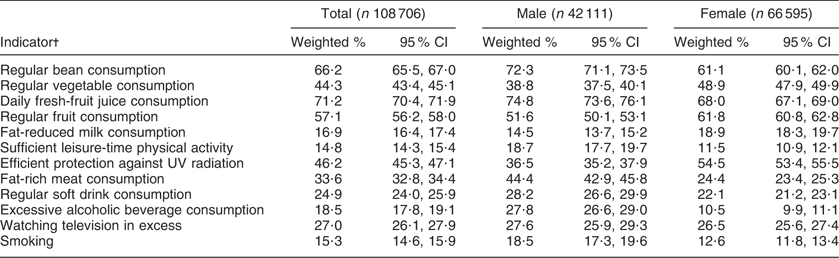
†For details on indicators, see Methods section.
Through PCA, four of the twelve components had an eigenvalue >1·0 and explained 42 % of the variance in men and 43 % in women. Based on the interpretability of each component, two components were retained in men and women. After rotation, these two components explained ∼25 % of the variance in men and 26 % of the variance in women. The rotated factor loadings on each of the two components, for the total sample and among men and women separately, are displayed in Table 3 (factor loadings above 0·25 and below −0·25 have been indicated in bold font).
Rotated factor loadings for the first two components from principal component analysis by gender. Brazilian Surveillance System of Risk and Protective Factors for NCD through Telephone Interviews (VIGITEL), 2009–2010

†For details on indicators, see Methods section.
‡Proportion of the variance explained by each factor after orthogonal varimax rotation (Kaiser criterion).
§Items with a factor loading above or below 0·25 and −0·25 are indicated in bold font.
The first component, hereafter termed the ‘prudent pattern’, was very similar for men and women and was characterized by regular vegetable consumption, daily fresh-fruit juice consumption, regular fruit consumption, fat-reduced milk consumption, sufficient physical activity practice during leisure time, efficient protection against UV radiation and reduced regular soft drink consumption (variables with factor loadings above 0·25 and below −0·25).
The second component, hereafter called the ‘risky pattern’, was defined by fat-rich meat consumption, excessive alcoholic beverage intake and current smoking habit in the total sample and both men and women. In men, watching television in excess also showed a factor loading above 0·25 in this component. In women, it was regular soft drink consumption which presented a factor loading above 0·25.
As illustrated in Table 4 (multivariate-adjusted weighted models), individuals with higher scores on the first component were more likely to be female, from the less developed region, older, and with more years of schooling. Regarding the second component, individuals with higher scores were more likely to be male, from the more developed region, younger, and with less years of schooling. This held true as well when men and female were analysed separately.
Multivariate-adjusted weighted means for the two factor scores, adjusted for gender, region, age and schooling, by gender. Brazilian Surveillance System of Risk and Protective Factors for NCD through Telephone Interviews (VIGITEL), 2009–2010

†Regression coefficient: *P ≤ 0·05; **P ≤ 0·01; ***P ≤ 0·001.
‡More developed region = Centre-West, Southeast and South; less developed region = Northeast and North.
Discussion
The detailed record of information about risk and protective behaviours for non-communicable diseases made by VIGITEL, in more than 100 000 interviews, allowed the identification of clear patterns of behaviour in the Brazilian population. Two behavioural patterns have been identified in the present analysis. The first one, the prudent pattern, was defined by regular vegetable consumption, daily fresh-fruit juice consumption, regular fruit consumption, fat-reduced milk consumption, sufficient physical activity practice during leisure time, efficient protection against UV radiation and reduced regular soft drink consumption. The prudent pattern showed a positive association with being female, from the less developed region, with age and with years of schooling.
The second one, the risky pattern, was characterized by fat-rich meat consumption, excessive alcoholic beverage intake and current smoking habit. While in men watching television in excess also defined this pattern, in women it was regular soft drink consumption that did. This pattern was negatively associated with being female, from the less developed region, with age and with years of schooling.
The main limitation of the present study is that the survey sample included only the population from the twenty-seven studied cities that had a landline telephone, which coverage varied from city to city between 34 % and 82 %( 18 ). This implies that the results from the study can be generalized only to the urban Brazilian population with a landline telephone. However, the selection bias generated by the over-representation of women, older in age and with more years of schooling in the VIGITEL sample was minimized through the use of post-stratification weights, as is done in similar studies such as the Behavioral Risk Factor Surveillance System (BRFSS) in the USA( Reference Moura, Malta and Morais Neto 16 , 19 ).
Given the fact that in Brazil the census is performed every 10 years, VIGITEL was forced to weight the distribution of gender, age and years of schooling according to the Brazilian national census for the year 2000. This could also be considered a limitation as the post-stratification weights may not correspond exactly to the targeted population in the 2009 and 2010 samples.
Also, it is important to consider several limitations inherent to the use of PCA, including the following arbitrary choices: the number of components to extract, the method of rotation and the naming of the components( Reference Martinez, Marshall and Sochrost 20 ).
We have no knowledge of other studies in which food intake and non-dietary health behavioural variables have been jointly used to establish patterns through the use of PCA. As not only diet but other indicators such as smoking, physical activity and alcohol intake are known to be risk factors for NCD, we consider that it is important to identify behavioural patterns that include both dietary and non-dietary variables.
The present study shows that protective and risk indicators group together in behavioural patterns (prudent and risky patterns) in different subgroups of the Brazilian population. Our findings seem consistent with what has been published in studies that have performed PCA using exclusively dietary indicators. Most of these have identified a prudent pattern defined by higher intakes of fruit, vegetables, whole grains, fish and poultry and a Western pattern richer in fat, meat and refined grains( Reference Hu 13 , Reference Kant 14 ). In accordance with our results, other studies have found that the more healthy dietary patterns have a positive association with age and education( Reference Kant 14 ).
Some studies have shown that health behaviours, when analysed independently, are associated with sociodemographic characteristics such as gender, age and educational level( Reference Aromaa, Koskinen and Huttunen 21 , Reference Helakorpi, Uutela and Prättälä 22 ). For example, Finnish women behave more healthily than men regarding all risk factors with the exception of the fact that they perform less physical activity( Reference Laaksonen, Prattaila and Lahelma 7 ). Yet when analysed as patterns (i.e. through the use of a number of risk factors), most people have shown mixed combinations of both healthy and unhealthy behaviours and completely healthy or unhealthy patterns were infrequent( Reference Blaxter 23 , Reference Patterson, Haines and Popkin 24 ). Even so, the number of people with multiple unhealthy behaviours has been shown to be more frequent than expected if the behaviours were not related to each other( Reference Karisto, Prättälä and Berg 25 , Reference Laaksonen, Prättälä and Karisto 26 ). This is in agreement with our findings by which healthy and unhealthy behaviours group together in the prudent and risky patterns, respectively, both patterns being associated with gender, age, region and years of schooling.
Two health promotion strategies can be used in the prevention of NCD: a population-based one, which may have significant net effects, and a high risk one, which may have higher costs per person but prove to be more cost-efficient( Reference Laaksonen, Prattaila and Lahelma 7 , Reference Rose 27 ). The fact that previous findings have shown there is a positive association between the number of risk factors and development of NCD( Reference Laaksonen, Prattaila and Lahelma 7 – Reference Segovia, Bartlett and Edwards 10 ) can be an indication that certain subgroups could be targeted when designing campaigns to incentivize healthy behaviours and dissuade risky ones. If a high risk approach were to be used, public health measures to decrease NCD should aim on reaching younger men, with lower education, from the more developed region in order to improve their efficiency as it is in this subgroup in which both the prudent and the risky pattern behaviours are concentrated.
We consider that future studies should concentrate on both the identification of behavioural patterns through PCA and the exploration of the association between these and NCD outcomes. The fact that studies exploring the association between dietary patterns and NCD are not consistent further enhances this need. While some studies have found a negative association between higher prudent diet scores and NCD outcomes( Reference Osler, Heitmann and Gerdes 28 – Reference Fung, Hu and Fuchs 33 ) and a positive association between higher Western diet scores and NCD outcomes( Reference Hu, Rimm and Stampfer 29 , Reference Fung, Willett and Stampfer 30 , Reference Slattery, Boucher and Caan 32 , Reference Fung, Hu and Fuchs 33 ), others have failed to show any association( Reference Newby and Tucker 34 ).
Acknowledgements
Sources of funding: The present research was funded by the National Council for Scientific and Technological Development (CNPq – Process No. 486072/2011-8). A postdoctoral fellowship was received from the São Paulo State Research Foundation (no. 2010/08421-7). Conflicts of interest: The authors declare that they have no conflicts of interest. Authors’ contributions: R.M.C. and C.A.M. conceived the project. All authors (E.M.S., R.M.C., C.A.M.) contributed to the conception, design, analysis, interpretation and discussion of the data, and all authors drafted and revised the initial version of the manuscript and contributed to and approved the final version.



