




Introduction
About 95 per cent of hip fractures in older adults are caused by falls (Scott et al., Reference Scott, Wagar and Elliott2010). Hip protectors are a type of protective clothing that contain pads over the hip region for cushioning the impact of a fall and lowering fracture risk (Robinovitch et al., Reference Robinovitch, Evans, Minns, Laing, Kannus, Cripton, Derler, Birge, Plant, Cameron, Kiel, Howland, Khan and Lauritzen2009). Hip protectors are a clinically and cost-effective strategy for preventing hip fractures in long-term care (LTC) facilities and geriatric wards of hospitals (de Bot et al., Reference de Bot, Veldman, Witlox, van Rhijn and Hiligsmann2020; Korall et al., Reference Korall, Feldman, Yang, Cameron, Leung, Sims-Gould and Robinovitch2019; Santesso et al., Reference Santesso, Carrasco-Labra and Brignardello-Petersen2014).
Hip protectors may be of similar benefit for the large population of older adults living independently in the community who are frail or transitioning to frailty (Bentur et al., Reference Bentur, Sternberg and Shuldiner2017). A recent study showed that hip fracture rates were nearly twice as high among older adults who lived in the community prior to hip fracture and were discharged to long-term care than among those living in long-term care prior to hip fracture (AbuAlrob et al., Reference AbuAlrob, Ioannidis, Jaglal, Costa, Grifith, Thabane, Adachi, Cameron, Hillier, Lau and Papaioannou2024). There is a strong need for improved hip fracture prevention strategies in this high-risk population.
Unfortunately, unlike the LTC setting, the benefit of hip protectors among community-dwelling older adults is unclear. Clinical trials have not generated evidence to support the clinical effectiveness of hip protectors among community-dwelling older adults, largely due to the low compliance among this population in wearing hip protectors (Santesso et al., Reference Santesso, Carrasco-Labra and Brignardello-Petersen2014). In Canada, the use of hip protectors is much lower among community-dwelling older adults than in long-term care. A 2019 study showed that about 60 per cent of older adults in long-term care homes in British Columbia wore hip protectors (Korall et al., Reference Korall, Feldman, Yang, Cameron, Leung, Sims-Gould and Robinovitch2019). In contrast, a 2018 study of community-dwelling older adults who visited a fall prevention clinic in British Columbia found that only 26 per cent of the clients were advised to use hip protectors, and only 14 per cent of these individuals had purchased hip protectors at a 12-month follow-up (Singh et al., Reference Singh, Kwon, Whitehurst, Friesen, Scott, Hejazi and Feldman2018).
Improved understanding is required on the barriers to the use of hip protectors among community-dwelling older adults who are at high risk for falls and hip fractures. While several studies have explored barriers and facilitators to the use of hip protectors in long-term care settings (Cameron et al., Reference Cameron, Kurrle, Quine, Sambrook, March, Chan, Lockwood, Bronwyn and Frederieke2011; Korall et al., Reference Korall, Feldman, Scott, Wasdell, Gillan, Ross, Thompson-Franson, Leung and Lisa2015; Margot & Price, Reference Margot and Price2014), research in community settings remains limited (Blalock et al., Reference Blalock, Demby, McCulloch and Stevens2010; Cameron & Quine, Reference Cameron and Quine1994). The current study addresses the knowledge gap by examining three relatively unexplored research questions: (1) What are the opinions of community-dwelling older adults at high risk of falls on the perceived benefits of hip protectors? (2) What design features of hip protectors are preferred by this population? And (3) Is cost a barrier to hip protector use in this population? We addressed these questions by interviewing older adults who attended the Fraser Health Fall Prevention Mobile Clinic (FH-FPMC) in British Columbia, Canada.
Methods
Theoretical perspective
This study is consistent with pragmatism, a philosophical approach that bridges the gap between the scientific rigour of post-positivism and the participant-focused methods of constructivism (Kaushik & Walsh, Reference Kaushik and Walsh2019). Pragmatism posits that human actions are influenced by past experiences and beliefs formed from those experiences (Kaushik & Walsh, Reference Kaushik and Walsh2019). Knowledge, according to pragmatism, is not fixed or absolute but is continually shaped by our interactions with our environment and experiences (Baker & Schaltegger, Reference Baker and Schaltegger2015; Morgan, Reference Morgan2014). This paradigm emphasizes the practical application of ideas and the importance of outcomes in shaping our understanding of the world (Morgan, Reference Morgan2014). In the context of this study, pragmatism aligns with our objectives of understanding older adults’ perceptions on the benefits of hip protectors and preferred design features of hip protectors and our long-term goal of arriving at recommendations to make these devices more effective and appealing to community-dwelling older adults.
Participants
Participants consisted of a purposeful sample of 27 individuals (13 men and 14 women) of mean age 74.8 (SD (9.3)) (Palinkas et al., Reference Palinkas, Horwitz, Green, Wisdom, Duan and Hoagwood2015). All participants were older adults who visited the Fraser Health Falls Prevention Mobile Clinic (FH-FPMC). The FH-FPMC is a free clinic designed to help community-dwelling older adults living in the Fraser Health region of British Columbia (and their care providers) recognize and reduce their risk of falls (Singh et al., Reference Singh, Kwon, Whitehurst, Friesen, Scott, Hejazi and Feldman2018); clients may be referred to the FH-FPMC by a health professional (e.g., family doctor or emergency department physician), or they may self-refer. The clinic is staffed by physiotherapists, pharmacists, and kinesiologists who work together to identify risk factors for falls and recommend strategies for preventing falls and fall-related injuries. The recommendations may relate to exercise, medication change, bone health assessment, calcium and vitamin D, assistive devices, home safety checks, and protective gear (including hip protectors). The clinic schedules visits at different senior centres and community centres in the Fraser Health region of British Columbia. On average, 12 clients are seen per visit. Three months after an individual’s initial visit, the clinic makes follow-up calls to determine how the individual is integrating the recommendations into their daily lives. Individuals were asked by the research assistant (CW) or clinic staff to consider participating in our study when scheduling their initial appointment at the FH-FPMC, or at their 3 months follow-up call.
Interviews
Data were collected using semi-structured interviews conducted by two researchers (HC and CW) between January and July 2021. All interviews occurred after the participants’ visit to the FH-FPMC and were conducted remotely (over Zoom), given the constraints of the COVID-19 pandemic. The study was reviewed and approved by the Research Ethics Boards at Simon Fraser University and the Fraser Health Authority, and all participants provided consent for participation.
At the start of each interview, the participant was provided with a brief explanation of the nature and purpose of hip protectors in reducing the risk for hip fractures during falls. They were then shown four models of hip protectors (Table 1). The four models were selected to provide a wide range of pad thicknesses and styles. Three of the designs were undergarments while one was a wrap-around (belt) style.
Types of hip protectors shown to participants

We developed our interview guide based on previous research and published literature. Initial questions were open-ended, allowing participants to spontaneously share their thoughts and experiences (Supplementary Appendix 1). Participants were asked to describe their preferences on the styles of hip protectors shown to them and their opinions of what would make hip protectors more appealing to wear. Participants were also asked whether they would consider wearing hip protectors for different types of activities and to discuss the importance of biomechanical effectiveness on their willingness to wear hip protectors. Furthermore, participants were asked whether the cost of hip protectors would be a barrier to use. While design preferences and the role of cost as a barrier were directly probed by our interview questions, we avoided directly asking participants to describe their opinions on the benefits of hip protectors to minimize the potential for bias (e.g., participants telling us what they thought the research team wanted to hear). Instead, participant perceptions on the benefits of hip protectors were based on their comments emerging from the interview, related to the role of hip protectors in influencing their risk for hip fracture, their fear of falling or confidence, and their activity level. The interviews were audio and video recorded and subsequently transcribed verbatim by members of the research team (HC and CW). Interviews ranged from 60 to 90 minutes.
Questionnaires
Prior to the interview, each participant completed a structured questionnaire administered by the researchers (HC and CW), which gathered information on participant demographics, fall history (number of falls in the past 12 months, circumstances and injuries sustained from the most recent fall), and use of hip protectors (whether the participant owned hip protectors, their history of wearing hip protectors, and whether they were advised to wear hip protectors during their visit to the FH-FPMC).
Data analysis
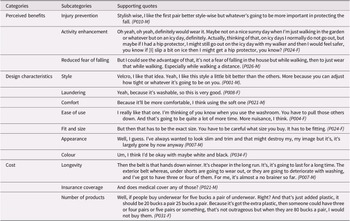
Each interview transcript was imported into NVivo software (Version 14) for directed content analysis. Data were analyzed by two independent researchers (CO and FK). We started with a deductive approach of organizing codes into three initial categories that were directly related to the research questions: (a) perceived benefits of hip protectors, (b) preferred design characteristics of hip protectors, and (c) cost-related barriers to the adoption of hip protectors (Table 2). Subsequently, we used an inductive approach, allowing for the emergence of codes grounded within the data that further described the initial categories (Bingham & Witkowsky, Reference Bingham, Witkowsky, Vanover, Mihas and Saldaña2021). Sub-categories were established based on phrases or words that best summarized the individual codes. The sub-categories were then organized according to their differences and similarities and linked into the initial categories that directly aligned with the research questions. Following their individual efforts related to categorization and coding, the researchers met to discuss the categories emerging from the codes, ensuring consensus was reached on data interpretation (Bingham & Witkowsky, Reference Bingham, Witkowsky, Vanover, Mihas and Saldaña2021).
Categories, subcategories, and supporting quotes

Results
Participant characteristics related to fall history and use of hip protectors
Among the 27 participants, 2 reported no falls in the last 12 months. The remaining 25 participants reported experiencing an average of 3.1 falls (SD = 1.5) over the past 12 months. Of the 25 participants who experienced at least one fall, 88 per cent (22/25) described that their most recent fall resulted in injury, and 52 per cent (13/25) received medical attention. Bone fractures occurred in 20 per cent of falls (5/25; 3 upper limb fractures, 1 hip fracture, and 1 skull fracture), impact to the head occurred in 56 per cent of falls (14/25), and 80 per cent (20/25) of falls resulted in the individual modifying their behaviours or activities. Fifty-two per cent of participants (14/27) stated they were somewhat fearful of falling, 19 per cent (5/27) stated they were very fearful of falling, and 30 per cent (8/27) stated that they were not fearful of falling. The one participant (4%) who wore hip protectors stated that doing so reduced their fear of falling.
Six participants (22%) were advised to wear hip protectors during their initial visit to the FPMC. At the 3-month follow up, one reported having recently bought a hip protector and two reported having bought hip protectors before visiting the clinic. Among these three, only one participant reported routinely wearing hip protectors.
Perceived benefits of hip protectors
Injury prevention
Most participants expressed positive attitudes on the benefits of hip protectors in preventing hip fracture from a fall ‘It protects the hip, yeah? It protects the bone? It’s very good plan’ (P020-M). Some participants stated that they care more about the protective capacity of hip protector than its appearance (‘I guess it matters more that they work, than how you look in them’(P011-F)). However, some described they would prefer to wear a design that combined a suitable appearance with protective capacity in reducing the risk for hip fracture. For example, one participant stated ‘You [can] probably get better protection, but we also have to look decent’ (P024-F). Further details are provided below on preferences related to product design.
Physical activity enhancement
Most participants recognized the benefits of hip protectors in supporting physical activity. Several participants referred to the value of hip protectors for enhancing their safety and confidence when pursuing risky activities such as walking on ice during the winter. One participant stated: ‘Oh yeah, oh yeah, definitely [I] would wear it. Maybe not on a nice sunny day when I’m just walking in the garden but on an icy day, definitely. Actually, thinking of that, on icy days I normally don’t go out, but maybe if I had a hip protector, I might still go out on the icy day with my walker and then I would feel safer, you know if [I] slip a bit on ice then I might get a hip protector, you know?’ (P024-F).
Reducing fear of falling
Most participants recognized the value of hip protectors in improving confidence for those who were prone to fear of falling. For example, one participant stated, ‘If I was, you know, feeling really vulnerable to falling and possibly breaking a hip or something, yeah, I would wear something’ (P014-M). Other participants stated that hip protectors would not eliminate their fear of falling: ‘I think it (fear of falling) would be the same, I wouldn’t want to fall’. (P034-F).
Willingness to wear hip protectors
Most participants perceived the benefits of hip protectors in reducing the risk of hip fractures, enhancing their physical activities and reducing fear of falling; however, most of them do not believe they were at sufficient risk for falls and hip fractures to warrant wearing hip protectors. Some but not all participants described that they would consider wearing hip protectors. Participants who stated they were unwilling to wear hip protectors described that they were not at high risk for falls and/or hip fracture or were pursuing other strategies to reduce their risk. One participant stated ‘You have to have protection if you have fear of falling, [or] you know you’re going to fall. So right now, I feel quite energetic because I do exercises and maintain my diet and other stuff. You know, like I am 70 years old right now and later on I might need it’. (P021-M). Several individuals stated that they would consider wearing hip protectors if recommended by their primary physicians: ‘I wouldn’t want to wear them…I think it’d be uncomfortable…but if my doctor really thought I should wear them, I’d wear them’. (P034-F).
Preferred hip protector design characteristics
Style
Among the four different hip protectors presented to participants (Table 1), Pad D (the wrap-around design) was most preferred due to its perceived adjustability, ease of use, flexibility for individuals with incontinence, and lower laundering requirements (when compared with undergarment designs). One participant commented ‘Velcro (Pad D), I like that idea. Yeah, I like this style a little bit better than the others. More because you can adjust how tight or whatever it’s going to be on you’ (P001-M). Another participant stated ‘The belt (Pad D) is that hands down winner. It’s cheaper in the long run. It’s going to last for a long time whereas under shorts are going to wear out, or they’re going to deteriorate with washing, and I’ve got to have three or four of them. For me, it’s almost a no brainer’ (P007-M).
The Pad A (removable pad design) was preferred by some participants because the removable pad design was perceived as a benefit for easy washing and drying. One participant stated ‘I think this removable pad is very good. Yeah, because it’s washable, so this is very good’ (P004-F). Some participants preferred Pad B (the integrated panel design) and Pad C (thicker integrated soft-shell pad) because they perceived them to be more protective. One participant stated ‘to be truthful I don’t think the foam would really stop me. I’m 200–250 pounds so that more rigid one (Pad B) would make more sense’ (P001-M). Another participant described ‘My first impression is that this (Pad C) is probably a more effective one, because of the [large surface area]. I would suspect that [it would] absorb impact better than the [other] pads’ (P007-M).
Appearance
Most participants were concerned that hip protectors might alter their appearance and be a source of embarrassment if others could detect they were wearing hip protectors. For example, one participant stated, ‘They would have, they would have to hide, be able to be better hidden. So, if I went out, I don’t want these things sticking out on my sides, I wouldn’t like that, I wouldn’t wear them to go out’ (P025-F). Another participant described ‘I don’t know, I might be a little embarrassed, wearing those[the wrap around] over my walking shorts in the summer’. A third participant stated ‘Well, I guess I’ve always wanted to look slim and trim and that might destroy my image but it’s largely gone by now anyway’ (P007-M).
Colour
Colour was not a major concern for most participants. One participant stated ‘No, colour doesn’t make a difference’ (P017-M). However, a few participants expressed preferences for specific colours. For instance, one participant mentioned, ‘I think I’d be okay with white [or] black’ (P034-F).
Fit and size
Some participants described the importance of proper fit and sizing on their willingness to wear hip protectors. For example, one participant stated ‘[It] has to be the exact size. You have to be careful what size you buy. It has to be fitting’. (P024-F).
Pad thickness
Some participants discussed how the bulkiness and thickness of the pad may affect their willingness to wear it. Some participants favoured thinner designs. One participant stated ‘It just seems that it (Pad A) would be more compact and fit under your pants, much easier than the bulky things (Pad C) on the side’ (P034-F). Another participant stated ‘Well, I find them a little bulky’ (P016-M). However, other participants expressed their willingness to wear thicker pads if they provided better protection from injuries. For these participants, the ability of a hip protector to prevent hip fracture was a priority. As mentioned above, one participant described ‘Yeah, I guess it matters more that they work, than how you look in them’ (P011-F). Another participant stated, ‘I like the first pair (Pad A) better style-wise but whatever’s going to be [better] in protecting the fall’ (P010-M). A third participant stated ‘I would go for the thicker ones, it would seem to me, all other things being equal, thicker is better. I would suspect that this would give a higher level of impact resistance, or I don’t know, I guess it depends on, on how that sort of hole is cut out in the middle of it’ (P007-M).
Laundering
Many participants expressed concerns related to laundering (washing and drying) of hip protectors. Participants were attracted to Pad D because of the perceived need for less regular washing. One participant stated: ‘Well, that’s, that’s kind of what I mean because the other ones are like underwear that you kind, kind of want to wash every day, whereas this one (Pad D) maybe not so much’ (P025-F). Some participants expressed concerns about the cost of having to buy multiple pairs of undergarment designs due to the need for regular washing. A participant described: So the normal routine would be to take the pad out and just wash the under shorts and then put the pad back in, and maybe every once in a while, wash the pad. Oh, then probably, I’d need at least three pairs of these, so whatever they cost I would have to buy three of them, not very exciting (P007-M). Some participants were also concerned about the product’s durability after repeated washing.
Ease of use
Participants expressed a preference for hip protectors that were easy to don and doff especially when toileting. In this regard, participants were again attracted to Pad D as it is easier to put on and take off than undergarment-type devices. One participant stated: ‘And it (Pad D) is so easy to put on and off, you don’t have to step in. When you get older, I mean, your feet are getting further and further away from your body. So, it’s harder to step into things’ (P004-F).
Comfort
Pad A and Pad D were perceived to be more comfortable by most participants because of their perception of the softness of Pad A and the adjustability of Pad D. A participant stated: ‘Yeah, I think [Pad A], would be more comfortable than this one [Pad B]’.(P025-F) Another participant stated: ‘Velcro(Pad D), I like that idea. Yeah, I like this style a little bit better than the others. I think the yeah the comfort and the adjustability basically that’s it’ (P001-M). Another participant also was concerned about the stiffness of Pad B and stated: ‘Yeah, it to me it just doesn’t look overly comfortable, like I think it would bother me, more so than the softer pads’ (P025-F). Comfort in using hip protectors in bed at night was a concern for some participants. A participant stated ‘when I go to bed, I move and move until I get exactly in the right place, and I think that might bother me’ (P019-F).
Cost as a barrier to use of hip protectors
Many participants expressed concern about the cost of hip protectors, which was described as $60–120 per pair. Some expressed the cost as prohibitive for those with limited financial resources. One participant stated: ‘That would be expensive. Yeah, for seniors who are just getting by, that would be out of, out of mind’. (P004-F). Some participants expected that hip protectors would be covered by medical insurance. One participant stated: ‘And does medical cover any of those?’ (P025-F).
Some participants stated that cost will not be a barrier to use. These individuals tended to express strong beliefs on the benefits of hip protectors. One participant described: ‘cost would not be my, you know, would not be any kind of a major factor. Whatever I thought, you know, was going to be best for me’. (P014-M).
Discussion
Most participants in our study had experienced recent falls and described having a fear of falling; many had experienced serious injuries from a recent fall. All had recently visited a fall prevention clinic. However, only one of the 27 participants in our study reported wearing hip protectors routinely. Our results provide insight on the barriers to use of hip protectors in the population we studied.
Despite recognizing many benefits of hip protectors, few participants regarded themselves as being vulnerable enough to need hip protectors. Most participants perceived the value of hip protectors in reducing the risk for hip fracture, enhancing physical activity, and reducing fear of falling. Previous studies have reported that the willingness of older adults to wear hip protectors is associated with their perceived protective benefits in preventing fractures (Blalock et al., Reference Blalock, Demby, McCulloch and Stevens2010). However, other studies have found that, even among older adults who recognized the value of hip protectors in preventing hip fractures, reducing fear of falling, and enhancing physical activity, many were unwilling to wear hip protectors (Cameron et al., Reference Cameron, Stafford, Cumming, Birks, Kurrle, Lockwood, Quine, Finnegan and Salkeld2000; Hall et al., Reference Hall, Boulton and Stanmore2019; Ledsham et al., Reference Ledsham, Boote, Kirkland and Davies2006; Sims-Gould et al., Reference Sims-Gould, McKay, Feldman, Scott and Robinovitch2014; Tavener-Smith & De Vet, Reference Tavener-Smith and De Vet2006).
Participants were more likely to describe the benefits of hip protectors for others (those who have fear of falling, or know they are going to fall) or state that they might need hip protectors in the future. This finding is consistent with previous studies showing that older adults often do not see themselves as old enough or at significant enough risk for falls and hip fracture to justify wearing hip protectors (Bulat et al., Reference Bulat, Powell-Cope, Nelson and Rubenstein2004; Cameron & Quine, Reference Cameron and Quine1994; Hall et al., Reference Hall, Boulton and Stanmore2019; Yardley et al., Reference Yardley, Donovan-Hall, Francis and Todd2006). Strategies are needed to address the emotional issues (related to stigma, dignity, and vulnerability) that may underlie the reluctance of older adults to regard themselves as candidates for hip protectors.
Hip protectors were rarely recommended to participants by their care providers. Staff at the FH-FPMC recommended hip protectors to only 22 per cent of participants. We cannot determine from our data why so few older adults were recommended hip protectors; perhaps staff doubted whether clients would act on the recommendation, so it would be futile to recommend hip protectors. Or perhaps staff questioned the value of hip protectors for community-dwelling older adults, even if clients were willing to wear them. Several participants stated that they would use hip protectors if their doctor recommended them, consistent with previous findings showing that the commitment of healthcare providers enhances the use of hip protectors (Korall et al., Reference Korall, Loughin, Feldman, Cameron, Leung, Sims-Gould, Godin and Robinovitch2018). Improved strategies are required for guiding care providers in identifying and delivering recommendations to patients who would benefit from and be receptive to wearing hip protectors. One such group is individuals with osteoporosis who have experienced a recent index fracture and have just started a course of osteoporosis medication. These individuals have a window of vulnerability lasting up to 6 months before realizing the benefit of osteoporosis medications on bone strength and fracture risk (Brown et al., Reference Brown, Roux, Ho, Bolognese, Hall, Bone, Bonnick, van den Bergh, Ferreira, Dakin, Wagman and Recknor2014). There is a high risk for subsequent (‘imminent’) fracture during this period (Iconaru et al., Reference Iconaru, Charles, Baleanu, Surquin, Benoit, Mugisha, Moreau, Paesmans, Karmali, Rubinstein, Rozenberg, Body and Bergmann2022), when hip protectors can be a bridging approach that is acceptable to patients. After this imminent fracture period, patients can choose whether or not to continue using hip protectors. In this and other high-risk populations, hip protectors may be more acceptable for secondary as opposed to primary injury prevention.
A novel finding from our study is that participants preferred the wrap-around, belt-based design of the hip protector over the undergarment-based designs. Participants liked that there was no need to step into and out of the belt-based garment during donning and doffing and the continuous adjustability in fit provided by the Velcro. These findings complement results from a previous study, where the Velcro belt-based design was preferred by nursing personnel due to its adjustability (Honkanen et al., Reference Honkanen, Dehner and Lachs2006). Older adults also liked the reduced laundering requirements of the belt design when compared with undergarment designs and the lower cost of having to purchase a single device as opposed to multiple pairs of undergarments. Laundering challenges are consistently identified as barriers to the use of hip protectors (Bulat et al., Reference Bulat, Powell-Cope, Nelson and Rubenstein2004; Burl et al., Reference Burl, Centola, Bonner and Burque2003).
The cost of hip protectors was seen as a barrier to use, which aligns with previous studies reporting that hip protectors were perceived as unaffordable, especially for those whose sole source of income was from pensions (Cameron & Quine, Reference Cameron and Quine1994; Hall et al., Reference Hall, Boulton and Stanmore2019; Tavener-Smith & De Vet, Reference Tavener-Smith and De Vet2006). Further research is required on the cost-effectiveness for health authorities or insurance providers to help cover the cost of hip protectors.
Opinions on the desired thickness and surface areas of hip protectors were less consistent. Several participants were concerned that hip protectors would affect their appearance and cause them to be embarrassed about wearing something that was ‘sticking out’ at their hips. Consistent with other studies, these participants wanted a hip protector that was not visible and did not affect their profile (Blalock et al., Reference Blalock, Demby, McCulloch and Stevens2010; Cameron & Quine, Reference Cameron and Quine1994; Patel et al., Reference Patel, Ogunremi and Chinappen2003). Other participants were willing to forsake appearance for protective benefits. However, among these participants, some thought the thickest pad would be most protective, while others thought a larger surface area or higher stiffness would offer more protection. While the Canadian Standard Association (CSA) recently published a standard for biomechanical testing and labelling of hip protectors, few manufacturers have provided information on the force attenuation provided by specific products (Keenan & Evans, Reference Keenan and Evans2019). Efforts are required to persuade manufacturers to comply with the labelling recommendations in the CSA standard to help guide product selection for consumers.
Our study has important limitations. The interviews were conducted through video conferencing, and participants did not have an opportunity to try wearing the four types of hip protectors. Instead, the products were demonstrated by the researchers. As such, our design simulates an online purchasing experience more than a visit to a brick-and-mortar store. We included four models of hip protectors, which may not fully represent the range of products available. Participants were not provided with information on the protective benefits of the different products. We did not explore the perceptions of older adults on the value and acceptability of active ‘airbag’ hip protectors (Tarbert et al., Reference Tarbert, Zhou and Manor2023). On the one hand, older adults might find active hip protectors to be more acceptable than passive appliances, due to their slender profile and non-obtrusive nature in the undeployed state. On the other hand, active devices are more expensive and may not overcome the issues we encountered of dignity and reluctance to admit vulnerability causing older adults to refuse to wear hip protectors. Clearly, this is a rich area for future research. Finally, we focused only on hip protectors, and future research should explore the perceptions of older adults on other forms of fall protective gear, including helmets, wrist guards, or devices designed to prevent fall-related fractures of the pelvis or spine.
In conclusion, community-dwelling older adults who visited the Fraser Health Fall Prevention Mobile Clinic recognized the potential benefits of hip protectors in reducing their risk for hip fracture, enhancing their physical activity, and reducing their fear of falling. However, most participants believed they were not at sufficient risk for falls and hip fracture to warrant wearing hip protectors. Participants were concerned about appearance, comfort, ease of donning and doffing, laundering, fit, and cost. A wrap-around belt-based design was favoured over undergarments, due to adjustability, reduced laundering needs, and lower cost. The concerns about hip protectors expressed by our participants may be addressed in part by improvements in product design. However, approaches are also required to overcome the reluctance of older adults to admit their risk for falls and fall-related injuries, including hip fracture. Further research is also required to understand why care providers rarely recommend hip protectors to high-risk older adults living in the community.
Supplementary material
The supplementary material for this article can be found at http://doi.org/10.1017/S071498082510007X.



 Open access

