




1. Introduction
This paper focuses on clitic resumption in two varieties of Spanish, namely, Peninsular and Rioplatense Spanish. Based on an acceptability judgment task comparing sentences involving dislocated direct and indirect objects with and without resumption, we investigate the extent to which clitic resumption in clitic left dislocation (CLLD) is compulsory in the two varieties under investigation, as has been discussed in the literature (see Leonetti Reference Leonetti2008 for an overview). This question is motivated by the following two observations related to structures without dislocation.
First, in Peninsular Spanish, clitic doubling with dative (nominal) objects is optional but doubling of (nominal) accusative objects is very marginal at best (Fernández Soriano Reference Olga, Bosque and Demonte1999). This has been associated with different types of clitics, namely, determiner-like (argumental) accusative clitics on the one hand and agreement-like dative clitics on the other (Ormázabal & Romero Reference Ormazábal and Romero2013). Second, in contrast to Peninsular Spanish, doubling of accusatives is an option under specific conditions in some varieties of Spanish, such as Rioplatense (as well).Footnote 1 The greater availability of doubling has been associated with a higher degree of grammaticalization toward a more agreement-like behavior of accusative clitics in Peninsular vs. Rioplatense Spanish (see Ormazábal & Romero Reference Ormazábal and Romero2013, Baker & Kramer Reference Baker and Kramer2018).
While clitic resumption in dislocation structures has been claimed to be compulsory (and independent of CD) across Spanish varieties, we ask whether these differences between dative and accusative clitics within and across Spanish varieties are also reflected in sentences involving topicalization and resumption. Concretely, we ask whether the above-mentioned asymmetries observed in clitic doubling are also reflected in cases with dislocation if we compare sentences with dislocation involving indirect (dative) vs. direct (accusative) objects in Peninsular vs. Rioplatense Spanish.
Because object agreement is in general not compulsory across languages (and depends, like clitic doubling, on semantic properties of the respective element to be doubled), we expect to find a more strict use of resumption when the clitic is argumental and more variability when the clitic is more agreement-like – if the different status of the accusative clitics plays a role. Hence, we would expect accusative resumption to be more strict than dative resumption in Peninsular Spanish and less strict in Rioplatense (vs. Peninsular) accusative topicalization. Further, there is another development in Rioplatense Spanish that deserves consideration and may lead to a similar outcome concerning dialectal differences. Rioplatense Spanish has been shown to develop a definite and specific null clitic, giving rise to null object constructions (see Schwenter Reference Schwenter, Face and Klee2006, Rinke Reference Rinke, di Tullio and Kailuweit2011, Masullo Reference Masullo2017). The availability of such a null clitic has been associated with the availability of topicalization without resumption in European Portuguese (Raposo Reference Raposo2004, Kato & Raposo Reference Kato, Raposo and Moura2005) and could in principle also lead to higher acceptability of accusative topicalization without resumption in Rioplatense Spanish.
The paper is organized as follows. In section 2, we introduce the relevant facts about clitic doubling structures and present existing analyses relating doubling to the agreement-like behavior of clitics. In section 3, we discuss previous literature concerning the structure of clitic left dislocation structures. Section 4 discusses our research questions, methodology, results and analysis in connection to an acceptability judgment study on clitic resumption in sentences involving clitic left dislocation in Peninsular and Rioplatense Spanish. In section 5, we discuss our results and propose an analysis to account for the experimental findings.
2. Clitic asymmetries within and across varieties of spanish
In Spanish, there are two types of strategies involving the co-occurrence of an object clitic pronoun and a co-referential object noun phrase. These are clitic doubling (CD) on the one hand (1a) and clitic left (and right) dislocation on the other (CLLD, CLRD) (1b).

CD and CLLD differ with respect to prosody, information structure and syntactic position of the object (Zubizarreta Reference Zubizarreta1998, Gabriel & Rinke Reference Gabriel, Rinke, Ferraresi and Lühr2010, Saab & Zdrojewski Reference Saab, Zdrojewski and Di Tullio2013). Concerning prosody, for instance, object and co-referential clitic may occur within the same prosodic unit in CD, whereas in CLLD the dislocated object is (commonly) separated from the core sentence by a prosodic boundary (see López Reference López2009, Villa-García Reference Villa-García2015, Martínez Vera 2019 for extensive discussion). Information-structurally, the object can be focused or part of the focus domain in CD, whereas it is a topic in CLLD. Syntactically, the object is positioned within the verbal domain in CD, whereas it occupies a left-peripheral position in CLLD.
While resumption in CLLD is described as compulsory in all varieties of Spanish (Leonetti Reference Leonetti2008, Villa-García Reference Villa-García2015, Martínez Vera Reference Gabriel2019) and with dislocated indirect and direct objects alike, CD is subject to variation within and across Spanish varieties. In Peninsular Spanish, there exists a case asymmetry concerning the co-occurrence of a clitic pronoun and a dative vs. accusative nominal object. CD with indirect objects is strongly preferred (2a), while accusative doubling is very marginal (2b) (Fernández Soriano Reference Olga, Bosque and Demonte1999: 1248–1249). With pronominal objects, CD is compulsory in Standard Spanish (and all Spanish varieties), independent of case (2c–d).

Rioplatense Spanish differs from Peninsular Spanish. According to Di Tullio and Zdrojewski (Reference Di Tullio and Zdrojewski2006: 15), indirect object doubling is ‘practically obligatory’ in Latin American Spanish with pronouns, proper names, and epithets (3a). In addition, direct object doubling with animate, definite, DOM-marked direct objects (with a) is an option in Rioplatense (Jaeggli Reference Jaeggli1982, Suñer Reference Suñer1988, Parodi Reference Parodi, Fabri, Ortmann and Parodi1998, Fernández Soriano Reference Olga, Bosque and Demonte1999, Di Tullio and Zdrojewski Reference Di Tullio and Zdrojewski2006, Zdrojewski Reference Zdrojewski2008).

Corpus studies have confirmed the discussed difference between Peninsular and Rioplatense Spanish (see Barrenechea & Orecchia Reference Barrenechea, Orecchia and Lope Blanch1977, Silva-Corvalán Reference Silva-Corvalán and Fisiak1984, Suñer Reference Suñer1988, Koch Reference Koch and Hilty1993, García-Miguel & Vázquez Reference García-Miguel and Vázquez1994, Becerra Bascuñán Reference Silvia2006, Estigarribia Reference Estigarribia, Face and Klee2006, Belloro Reference Belloro2007, Dufter & Stark Reference Dufter, Stark, Seoane and López-Couso2008, Rinke et al. Reference Rinke, Wieprecht and Elsig2019).
In a recent experimental study with judgment data, Rinke et al. (Reference Rinke, Lago and Gattei2023) compared speakers of Peninsular vs. Rioplatense Spanish regarding the acceptability of CD with both accusative (i.e. direct) and dative (i.e. indirect) objects. Participants had to rate accusative and dative doubling vs. non-doubling with animate definite objects using a 1–7 Likert scale. The results showed that speakers of both varieties highly accepted doubling and non-doubling with datives, showing a preference for doubled over non-doubled cases. In contrast, accusative CD was dispreferred by both groups. However, for Rioplatense speakers, CD with accusatives was highly acceptable, whereas it was unacceptable for speakers of Peninsular Spanish – on average, 5.8 vs. 2.6 points.
The asymmetry regarding direct vs. indirect objects in Peninsular Spanish has been analyzed as reflecting a different status of accusative vs. dative clitics. Previous literature has proposed that accusative clitics are determiners, whereas dative clitics behave as markers of object agreement (Uriagereka Reference Uriagereka1988, Sportiche Reference Sportiche, Rooryck and Zaring1996, Parodi Reference Parodi, Fabri, Ortmann and Parodi1998, Torrego Reference Torrego1998, Bleam Reference Bleam2000, Ormazábal & Romero Reference Ormazábal and Romero2002, Reference Ormazábal and Romero2013, Baker & Kramer Reference Baker and Kramer2018).Footnote 2 Structurally, the accusative clitic is placed in argument position whereas dative clitics have been analyzed as realizing a functional head (e.g. an applicative phrase, ApplP) hosting the indirect object (see Cuervo Reference Cuervo2003 based on Pylkkänen Reference Pylkkänen2002).
Because accusative clitics in Peninsular Spanish double pronominal objects (2d), Uriagereka (Reference Uriagereka1995) proposes a divide of 3rd person accusative clitics into weak (doubling) and strong (non-doubling) clitics. He assumes that weak clitics doubling pronouns are D heads that embed an empty pronoun pro (structurally an NP) and license a strong pronoun in the specifier position of the DP they are heading. On the other hand, strong non-doubling clitics do not license a doubling element in their specifier and embed a full DP (they are heads of a so-called ‘Big DP’).
Direct object doubling in Rioplatense Spanish has received different analyses. Some researchers assume that accusative doubling in Rioplatense Spanish is the result of an advanced degree of grammaticalization of the accusative clitic in this variety, which has developed into an optional marker of object agreement (e.g. see López Reference López2009 for the proposal that accusative clitics in Rioplatense Spanish developed into agreement markers; see Gabriel & Rinke Reference Gabriel, Rinke, Ferraresi and Lühr2010 for prosodic evidence). The variation between doubling and non-doubling of direct objects in Rioplatense Spanish has been accounted for in terms of a double status of accusative clitics in this variety. Ormazábal and Romero (Reference Ormazábal and Romero2013) argue that non-doubling clitics are still determiner heads, whereas doubling clitics are agreement markers restricted to [+definite] DPs headed by DOM a. Di Tullio et al. (Reference Di Tullio, Saab, Zdrojewski and Gallego2019) and Saab (Reference Saab2024) relate accusative doubling to A-movement of animate, specific, DOM-marked direct object DPs in Rioplatense Spanish. The authors propose that these objects can optionally be assigned a [+person] feature, leading to subsequent A-movement to the left edge of vP. Saab (Reference Saab2024) argues that the doubling accusative clitic in RS is merged (as an index) in a non-argumental position as sister of the Voice head. Non-doubling clitics, to the contrary, are merged in argument position, have valued phi-features and receive a thematic interpretation.
Optionality of indirect object CD has also received different analyses. On the one hand, it has been proposed that the variation between doubling and non-doubling of indirect objects is reflects variation between two different structures, corresponding to the dative alternation in English (Masullo Reference Masullo1992, Demonte Reference Demonte1995, Cuervo Reference Cuervo2003): one structure (for doubling) corresponds to the English double object construction and involves an ApplP, the other (non-doubling) is a Prepositional Phrase (PP). It is assumed that the choice between the two structures depends on the respective verb as well as the corresponding interpretation of the sentence. Pineda (Reference Pineda2013, Reference Pineda2020), however, shows that constructions involving transfer of possession verbs with and without doubling do not differ concerning their interpretation and proposes that both doubling and non-doubling of indirect objects involve an ApplP with optional realization of the Appl head by the dative clitic. Independent of the specific analysis chosen, crucially, the realization of Appl by the dative clitic is a grammatical option in all varieties of Spanish.
Summing up this section, CD varies within and across Spanish varieties, here illustrated with the two varieties under investigation, namely, Peninsular and Rioplatense Spanish. CD with dative objects is available in all varieties of Spanish and has been associated with grammaticalization of dative clitics, which crucially involves understanding them as non-argumental object agreement markers. Importantly, the same analysis has been applied to accusative clitics in Rioplatense Spanish, which can optionally double definite, specific, animate and DOM-marked direct objects. This contrasts with an analysis of accusative clitics as determiners in Peninsular Spanish. Given the variability of CD and the different status of dative vs. accusative clitics, we ask whether clitic resumption of direct and indirect objects in dislocation is indeed compulsory in the two varieties of Spanish, as has been proposed in the literature. In the next section, we introduce the previous literature concerning the syntactic structure of constructions involving CLLD.
3. The syntactic structure of Clitic Left Dislocation (CLLD)
Syntactic analyses of CLLD across Romance languages are divided into movement accounts (Cinque Reference Cinque1977, Rivero Reference Rivero1980, Kayne Reference Kayne1994, Sportiche Reference Sportiche, Rooryck and Zaring1996, Cecchetto Reference Cecchetto2000, Villalba Reference Villalba2000, López Reference López2003, Reference López2009, Angelopoulos & Sportiche Reference Angelopoulos and Sportiche2021) vs. no movement or base generation accounts (Hernanz & Brucart Reference Hernanz and Brucart1987, Cinque Reference Cinque1990, Iatridou Reference Iatridou1991, Anagnostopoulou Reference Anagnostopoulou1994, Zubizarreta Reference Zubizarreta1998, Zagona Reference Zagona2002, Suñer Reference Suñer2006, Saab & Zdrojewski Reference Saab, Zdrojewski and Di Tullio2013). While it goes beyond the scope of this paper to discuss the arguments in favor or against one of the accounts in much detail, we will briefly discuss the main arguments for each view, focusing on the relation between CD and CLLD in each account, which is key in our discussion.
The controversy concerning movement vs. base generation of the topicalized constituent in CLLD is because CLLD shows a mixed behavior. On the one hand, constructions with CLLD do not behave like constructions involving movement – and thus base generation (no movement) accounts have been pursued. They deviate from structures involving, e.g. wh-movement regarding the following properties: cases with CLLD do not license parasitic gaps (4a), do not show weak crossover effects (4b), and do not involve mandatory subject inversion (4b). On the other hand, CLLD shows sensitivity to syntactic islands (4c–e), except for wh-islands (4f). We illustrate these properties based on examples from Suñer (Reference Suñer2006) and Olarrea (Reference Olarrea, Hualde, Olarrea and O’Rourke2012).

Because island sensitivity speaks in favor of movement, approaches arguing for a base generation account need to provide an explanation for the island effects in (4c–e). Several solutions have been proposed in this regard. For instance, Cinque (Reference Cinque1990) proposes that the dependency between the dislocated element and the resumptive pronoun is not created by movement but the result of a so-called binding chain. Like movement chains, binding chains are sensitive to strong islands but, in contrast to movement chains, they are not sensitive to weak islands, such as wh-islands. Focusing on Greek, Iatridou (Reference Iatridou1995) proposes a different solution. She assumes that the CLLDed element is base-generated (adjoined) to the left of the minimal CP containing the clitic (5a). Long-distance CLLD involves movement of this element to the left peripheral position it appears in (5b). This movement may create an island effect if the CLLDed element moves from the adjoined position over an island (5c), creating the effect of an ECP violation.Footnote 3

Suñer (Reference Suñer2006) assumes that the left dislocated XP is an adjunct merged in situ where it appears (Spec,TopP), as shown in (6). She argues that the valued features of the clitic (number, gender, human/animate, accusative case) establish a long-distance agreement link with the base-generated topic, ensuring referential identity. In Suñer’s view, the structures do not show sensitivity to weak islands (4f), as wh-islands contain a TopP (TopP1) which can be targeted by Agree to circumvent the wh-island (6).

Further, Suñer explains the island effects with strong islands as follows: in contrast to wh-islands, complex NP islands (4c) do not have an escape hatch (a CP); therefore, long-distance agreement cannot overcome the barrier, as in (6). Adjunct (4d) and sentential subject (4e) islands are instances of subjacency, where long-distance agreement would have to surmount two barriers.
In contrast to base generation accounts of CLLD, movement analyses rely on the sensitivity of the constructions to islands, but they must account for the absence of parasitic gaps, weak crossover effects, subject inversion and the lack of island effects with wh-islands. For concreteness, we will briefly illustrate how López (Reference López2009) deals with these issues. Concerning the absence of parasitic gaps and weak crossover effects, López argues that both tests are of limited relevance. As for parasitic gaps, he shows that, depending on the verb used in the example, wh-constructions and CLLD can behave in parallel (7a–b) and that parasitic gaps become available in CLLD if a verb that can be used intransitively is employed (7c). According to the author, weak crossover is also not an appropriate test for movement, as not all movement chains are sensitive to it (Boeckx 2003).

López (Reference López2009) provides two additional arguments in support of a movement analysis. First, obligatory case agreement between the CLLDed constituent and the clitic shows that there has been local agreement at some point in the derivation. Second, evidence from binding illustrates that CLLDed constituents are at some point in the derivation c-commanded by the subject. For this reason, example (8a) with a dislocated R-expression is ungrammatical due to a Principle C-violation, while (8b) with a reflexive is grammatical.

The relevant question in the current discussion is how the two analyses relate to CD. It is worth noting that the analyses reported so far focus on the dislocation of accusative arguments and do not discuss potential differences between dative and accusative left dislocation. Therefore, no direct conclusions can be derived for a comparison between dative and accusative topicalization.
Concerning base generation (no movement) accounts of accusative CLLD, the differences in grammaticality between CD and CLLD in Standard Spanish serve as an important argument against movement. The authors argue that the differences between the two types of structures reveal that CLLD cannot be derived from underlying CD, hence speaking against movement of a CLLDed DP from argument position to the left periphery. This aligns with the observations that there are languages requiring resumption but do not allow for CD, which is the case of, e.g. Italian (see Cinque Reference Cinque1990), and that there are animacy requirements for CD of direct objects but not for CLLD in some varieties of Spanish, e.g. Rioplatense (see Iatridou Reference Iatridou1995). In addition, CLLD is possible with any type of XP (i.e. DP-subjects, DP-objects, CPs, PPs, APs), whereas CD involves argumental DP-objects (see Cinque Reference Cinque1990, Suñer Reference Suñer2006).Footnote 4
What about the relation between CLLD and CD in movement accounts of CLLD? According to López (Reference López2009), there is no necessary derivational relation between CLLD and CD if a movement analysis is assumed. For López, CD (in Rioplatense Spanish) reflects agreement within the VP, whereas the clitic realizes a feature related to anaphoricity ([+a]) in dislocation structures. Concretely, the accusative clitic in CD constructions in Rioplatense is an agreement affix realizing agreement in a lower position within the VP where the direct object is situated. In contrast, in clitic left and right dislocation structures (across Spanish varieties), direct objects (KPs) are associated with the feature [ua] (unvalued anaphoric) and move to the specifier of vP to check [+a]. The resumptive object clitic realizes the v-head of this vP. In CLLD structures, the direct object moves further to Spec,FinP to check a [+c] (=contrastive) feature. Hence, according to this analysis, the realization of a clitic in cases involving left or right dislocation reflects the realization of the feature [+a] in v (and [+c] in Fin in the case of left dislocation), whereas the clitic in CD constructions is an agreement affix realizing agreement in a lower position within the VP. As he focuses on the analysis of constructions involving accusative dislocation, López (Reference López2009) does not address the difference between dative and accusative doubling and the optionality of clitic doubling.
Saab (Reference Saab2024) also assumes two different types of accusative clitics in clitic doubling vs. dislocation structures in Rioplatense Spanish. Saab analyses (accusative) clitics in CLLD constructions across Spanish varieties in line with Uriagereka’s (Reference Uriagereka1995) ‘Big DP’ proposal of non-doubling clitics as determiner heads embedding a full DP (the topic). They are pronouns (indexes in argument position). In contrast, doubling accusative clitics in Rioplatense are non-argumental. They represent unvalued formal probes, which are impoverished in comparison to pronouns but contain more structure than agreement markers (as they still contain an index).
To sum up, both base generation and movement approaches of CLLD assume that dislocation is not derived from doubling. In the case of base-generation accounts, the clitic surfaces to make the chain visible. In López’s (Reference López2009) movement account, clitics express different functions in CD vs. CLLD (and also CLRD). According to Saab’s (Reference Saab2024) account, no relation between doubling and dislocation is to be expected as the two constructions differ with respect to the clitics involved.
Although there is no relation between doubling and dislocation assumed, it cannot be fully excluded that the different status of dative and accusative clitics in Peninsular Spanish (i.e. agreement marker vs. determiner) or the advanced grammaticalization of the accusative clitic in Rioplatense can possibly lead to differences in the obligatory realization of the resumptive clitic in the two varieties and in direct vs. indirect object topicalization. If the status of the clitic had an influence, we suspect that omission of an agreement head (dative clitic in Peninsular, dative and accusative clitic in Rioplatense) would be perceived as a less severe grammatical violation than omission of an argumental clitic (accusative in Peninsular Spanish). This assumption is based on the following reasoning: first, both CD of dative objects (all varieties) and accusative doubling (in RS) are characterized by optional realization of the respective clitic in the contexts in which doubling is licit. Second, typologically, object agreement realization (in contrast to subject agreement) is usually not compulsory but often dependent on specific factors (e.g. animacy or specificity) determining the verb-object relation (see Ormazábal and Romero Reference Ormazábal and Romero2007).
4. An acceptability judgment experiment on resumption in left dislocation
4.1. Research questions and hypotheses
Based on the discussion in sections 2 and 3, we address the following research questions:
RQ1: Do constructions with dislocated direct objects differ from constructions with dislocated indirect objects in Peninsular Spanish?
Hypothesis
Theories of CLLD have proposed that in Spanish dislocation structures, resumption is compulsory and non-resumption leads to ungrammaticality. Based on this, we expect that resumption will be rated better than non-resumption. However, it is not clear whether the different analyses attributed to Peninsular Spanish dative vs. accusative clitics in theories of CD may still have an impact. If there is an impact on dislocation, we expect that the omission of the agreement marker (dative condition) has a less pronounced effect on the grammaticality than the omission of the accusative clitic, representing the direct object argument. Alternatively, if no difference between dative and accusative resumption is identified, then this would suggest that dative and accusative clitics do not have a different status, at least not in CLLD structures.
RQ2: Do constructions with dislocated direct objects differ from constructions with dislocated indirect objects in Rioplatense Spanish?
Hypothesis
Theories of CLLD have not addressed cross-dialectal differences concerning resumption in CLLD structures. Therefore, we expect that, like in Peninsular Spanish, resumption will always be rated better than non-resumption by Rioplatense Spanish speakers. However, theories of CD have observed differences between the two varieties and argued that in Rioplatense, accusative clitics are more reduced than in Peninsular Spanish and develop into agreement markers, just like datives. If the different status of accusative clitics in Rioplatense Spanish has some effect on CLLD, omission of the dative and the accusative clitic in CLLD would lead to similar effects in this variety, showing that differences between dative and accusative resumption are gradually leveled out due to the ongoing grammaticalization of the accusative clitic. However, as anticipated, the emergence of null clitics (and definite null objects) may also be a factor favoring the possibility of dislocation structures without resumption.
RQ3: Do Peninsular and Rioplatense Spanish differ with respect to the acceptability of CLLD structures with and without resumption?
Hypothesis
If the availability of different types of accusative clitics in Rioplatense vs. Peninsular Spanish has an influence on CLLD structures, we expect that the two varieties differ with respect to the acceptability of dislocation structures without resumption, with Rioplatense Spanish being more permissive than Peninsular Spanish.
4.2. Methods
4.2.1. Participants
Ninety native speakers of Peninsular Spanish and eighty-three native speakers of Rioplatense Spanish participated in the experiment. Speakers of Peninsular Spanish were recruited via Prolific (https://www.prolific.com/). They were recruited across Spain, with the largest representation from the Community of Andalucía (n = 32) and the Community of Madrid (n = 20), followed by Asturias (n = 7), the Valencian Community (n = 6), Castilla y León (n = 5), Islas Canarias (n = 4), Galicia (n = 3), Extremadura (n = 2), Cataluña (n = 2), the Region of Murcia (n = 2), and Aragon (n = 2), with single participants from Castilla-La Mancha, Basque Country, Cantabria, the Balearic Islands, and Ceuta (each n = 1). We selected speakers who fulfilled the following criteria: current country of residence: Spain, age: between 18 and 45 years of age, nationality: Spanish, first language/primary language/earliest language in life: Spanish. They also had to confirm that they were raised monolingually. Participants received a payment of 7.53€ according to the regulations of Prolific. Eighty-three Rioplatense speakers were recruited at the Universidad Torcuato Di Tella in Buenos Aires. They received payment equivalent to 5€ for their participation. To be included in the analysis, participants had to report having been born in the Buenos Aires province, as well as having Spanish as their first language, and not having learned other languages at home before the age of six. None of the participants presented a learning or language disability, and they all reported to have normal or corrected-to-normal vision. During the acceptability judgment task, all participants were required to answer at least six out of seven attention checks administered during the experiment correctly. After applying these exclusion criteria, the results from 171 participants were used for the analysis: 90 Peninsular Spanish speakers (mean age 30.5 years (±.76); 32 females) and 81 Rioplatense Spanish speakers (mean age 29.31 years (±1.36); 61 females). All procedures were undertaken in accordance with the Declaration of Helsinki.
4.2.2. Materials
Materials consisted of 48 experimental item sets (plus 48 sets of control items, 48 filler items and 7 attention checks). The experimental items were distributed in a 2 × 2 design crossing the type of object (direct vs. indirect object, referred to as Object Type) and whether the object was resumed by a clitic pronoun (resumption vs. no resumption, referred to as Resumption). The experimental items were preceded by a context consisting of two sentences. In the first one, two animate and two inanimate referents were introduced. The second sentence contained a statement taking up one previously mentioned inanimate referent as the direct and one previously mentioned animate referent as the indirect object. The context was followed by a context question, either asking about the remaining animate or inanimate referent. The experimental item was constructed as an answer to the context question, topicalizing the respective inanimate referent (direct object condition) or animate referent (indirect object condition). A sample experimental item set is shown in (9).

The items involving a dative clitic, i.e. le in our experiment, were constructed as follows: indirect object topic + subject + (dative clitic) + ditransitive verb + direct object. We split feminine and masculine referents evenly across the experimental items. The sentence subject always differed in gender from the animate indirect object (e.g. Mercedes, Rafael). The accusative items had the following form: direct object topic + subject + dative clitic + (accusative clitic) + ditransitive verb + indirect object. In the conditions with resumption, the verb was preceded by a third-person singular accusative clitic, which was also marked for gender, i.e. lo was used with masculine objects and la, with feminine objects. We split feminine and masculine referents evenly in the experimental items to ensure that clitic gender was counterbalanced across trials. Note that in the direct object condition, there was always an indirect object clitic doubling the animate indirect object DP. Since clitic doubling with indirect objects is strongly preferred in the varieties of Spanish under investigation (see Rinke et al. Reference Rinke, Wieprecht and Elsig2019, Reference Rinke, Lago and Gattei2023), the presence of the dative clitic served to prevent that participants would reject the sentences in the direct object topic condition because of the lack of the dative clitic.
In order to control whether this assumption was indeed correct, we added 48 item sets with control items with topicalized direct objects and without a dative clitic in two conditions, namely, with and without resumption (see (10)). See Appendix S3 for further analysis and Figure of mean acceptability of items in (10).

We used the following eight ditransitive Spanish verbs of transfer: comprar ‘to buy’, dar ‘to give’, devolver ‘to return’, enviar ‘to send’, ofrecer ‘to offer’, prestar ‘to loan’, regalar ‘to give away’, vender ‘to sell’ (see Rinke et al. Reference Rinke, Lago and Gattei2023).Footnote 5 The items were revised by a native speaker of each variety. When necessary, words were changed, so that they would be appropriate for both varieties. If no suitable word could be found, a new word was proposed. For example, the term periódico ‘newspaper’ is used in Peninsular Spanish but not in Rioplatense Spanish, where diario is used instead. In the absence of a lexical item that covered both varieties, the term was replaced by the word libro ‘book’. The experimental items can be found in Appendix S1. All materials, data and analysis code are publicly available at OSF (https://osf.io/24vpf/?view_only=a8c6008910c049d4ab94ae42737ecd22). The experimental verbs appeared in simple past tense (i.e. indefinido), to ensure acceptability across the two varieties, as compound tense forms are less used by Rioplatense speakers.
The filler items were designed to have high, mid or low acceptability to encourage participants to fully use the rating scale. They looked similar to the experimental items in being preceded by a context and a context question. We included 16 fillers with low, intermediate and high acceptability each. Low acceptability fillers consisted of sentences including agreement violations, e.g. *El perro mordí a Mario (‘The dog bit.1S Mario’), where the subject is third person singular, but the inflection is first person singular. Mid acceptability fillers consisted of sentences with unusual word order patterns, such as Catalina a su amiga en el café la encontró (‘Catalina her friend in the café met’).
Attention checks were designed to ensure that participants were attentive during the task (Oppenheimer et al. Reference Oppenheimer, Meyvis and Davidenko2009). Each attention check consisted of a sentence such as Instead of judging this sentence, please press the key X, with X corresponding to one of the seven values in the rating scale. Only participants who answered at least 6 of the 7 attention checks correctly were included in the analysis.
4.2.3. Procedure
The participants completed the experiment on the online testing platform PCIbex (Zehr & Schwarz Reference Zehr, Schwarz, Sauerland and Solt2018), starting with the completion of a demographic questionnaire. In the instructions they were asked to rate the acceptability of each sentence based on a 7-point scale (1 = ‘least acceptable’, 7 = ‘most acceptable’). An acceptable sentence was defined as a sentence that sounded natural to them and could be used by a native speaker of their variety of Spanish. Participants were asked to follow their intuition and to base their judgments on the form of the sentence, rather than its real-world plausibility.
Experimental items and control items were arranged such that each participant saw only two instances of each verb across trials. After the presentation of the context and the context question, participants saw the experimental trials together with the rating scale. They entered their judgments by clicking on the numeric boxes or by using the respective numbers on their keyboards. The order of presentation was randomized for each participant. An experimental session lasted around 15 minutes.
4.2.4. Analysis
The raw data were manually preprocessed to correct typos and inconsistencies in the demographic responses and subsequently exported to R (R Development Core Team 2024). Acceptability ratings were analyzed using mixed-effects ordinal logistic regression, a method well-suited to handling discrete response categories and non-normal distributions (McCullagh Reference McCullagh1980, Veríssimo Reference Veríssimo2021). Analyses were conducted with the ordinal package (Christensen 2019). Trials were included in the analysis if response times fell between 2 and 40 seconds. These cut-off points were determined based on pilot testing and theoretical considerations: we estimated that reading the context, the experimental sentence, and the context question would take at least 2 seconds, while response times longer than 40 seconds were likely due to disruptions common in online testing environments (e.g. connectivity issues or external interruptions). The percentage of excluded trials is reported in section 4.3. To address our research questions, we analyzed the effects of Object Type, Resumption, and their interaction for each variety of Spanish. Multiple comparisons were performed using Bonferroni correction whenever a significant interaction was observed.
All contrasts were sum-coded (±0.5), allowing model parameters to reflect differences between condition means. For the Resumption factor (−0.5 = non-resumption, +0.5 = resumption), a positive coefficient indicates higher acceptability ratings in the resumption conditions. For the Group factor (−0.5 = Peninsular Spanish, +0.5 = Rioplatense Spanish), a positive coefficient indicates higher ratings in the Rioplatense Spanish group. All models employed a maximal random effects structure, including random intercepts and slopes for all fixed effects and their interactions by participant and by item whenever it was possible (Barr et al. 2013). Effect sizes are reported as model coefficients in log odds (β), along with standard errors (SE) and z-values.
4.3. Results
The two groups showed comparable performance on the filler items, assigning high ratings to high-acceptability fillers, intermediate ratings to mid-acceptability fillers, and low ratings to low-acceptability fillers (Appendix S2). Overall, 7.57% of trials were excluded due to responses exceeding the time limit (Peninsular Spanish: 9.69%; Rioplatense Spanish: 5.17%). For the experimental items, 10.59% of trials were removed for the same reason (Peninsular Spanish: 12.7%; Rioplatense Spanish: 8.2%).
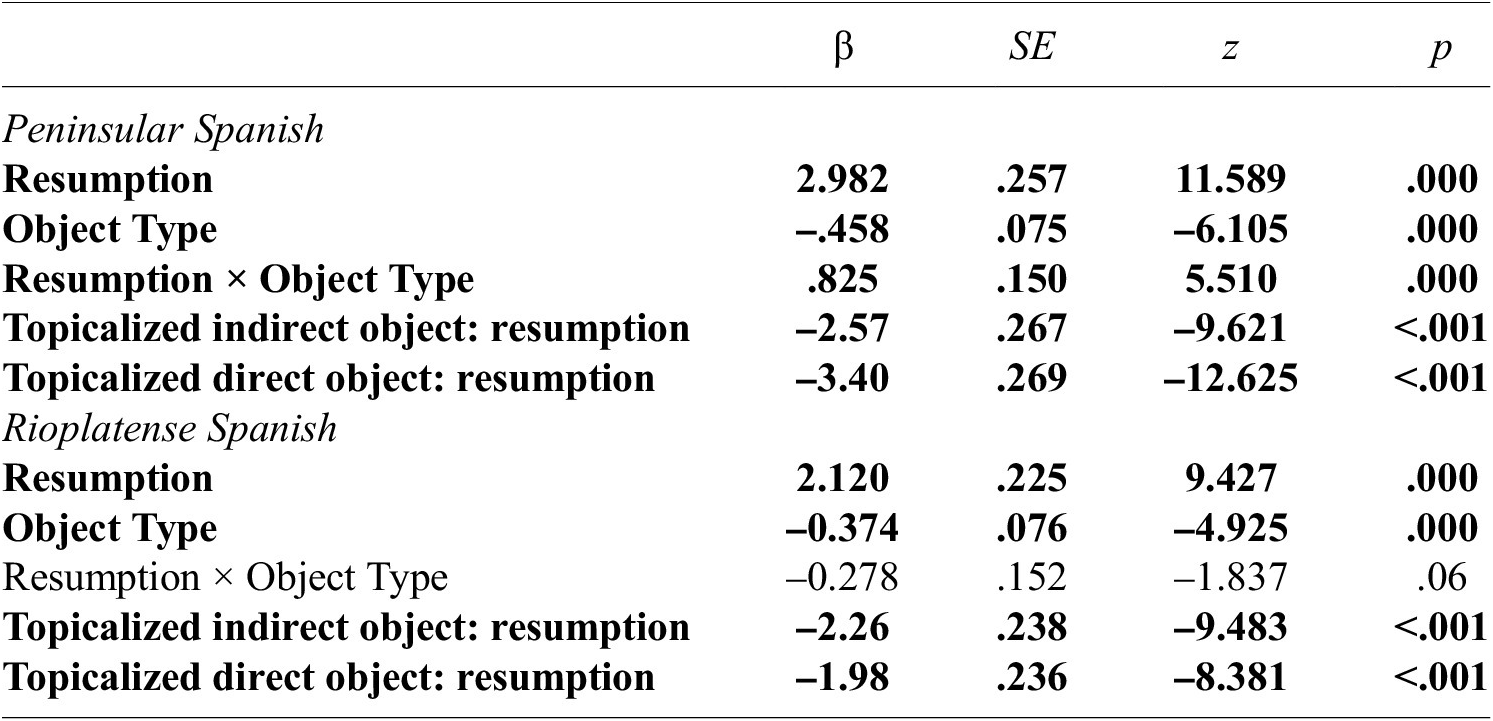
In the experimental items, similar qualitative patterns emerged for indirect and direct objects (Figure 1). For sentences with topicalized indirect objects, both groups showed a similar rating behavior: sentences with resumption received higher ratings than sentences without resumption. In both Peninsular and Rioplatense Spanish, the increase in ratings with resumption was comparable, suggesting a shared preference for doubling in this context. For sentences with topicalized direct objects, sentences with resumption also received higher ratings than sentences without it. However, in the Peninsular Spanish group, the magnitude of this preference was greater. Results of the pairwise comparisons show that the magnitude of the difference between sentences with and without resumption is greater for sentences with topicalized direct objects than for sentences with topicalized indirect objects (Topicalized indirect object: β = –2.57, SE = 0.267, z = –9.621, p <.0001; Topicalized direct object: β = –3.40, SE = 0.269, z = –12.625, p <.0001). This is confirmed by a significant interaction between Object Type and Resumption in the Peninsular variety, showing that the effect of resumption was stronger in the direct object condition than in the indirect object condition. The same effect is not found for Rioplatense speakers (Table 1). Table 1 shows that this difference between the two varieties is due to a lower magnitude of the difference between resumption and non-resumption with topicalized direct objects in Rioplatense as shown by the z-scores and coefficients in Table 1. Whereas in the Peninsular group, the mean acceptability of sentences with topicalized direct objects dropped from 5.27 to 3.3 in the absence of a clitic, the decrease was smaller in the Rioplatense group, from 5.03 to 3.71. These findings suggest cross-varietal differences in the degree to which clitic resumption is required in direct object topicalization.
Acceptability ratings of sentences with topicalized indirect and direct objects compared between speaker groups. Circles reflect by-condition averages across participants, and error bars show +/−1 standard deviations. Each point represents an individual participant. Peninsular and Rioplatense Spanish speakers reacted similarly to resumption of indirect objects. By contrast, the two groups differed in their responses to topicalized sentences with direct objects.

Model results for the between-group comparisons. Model estimates are expressed in log odds and significant effects at the α = .05 level are bolded. Pairwise comparisons showed that the dispreference towards non-resumption in topicalized sentences with direct object was significantly stronger in Peninsular than Rioplatense Spanish speakers (compare the values of the z-coefficients in the last row for each variety)

5. Discussion and Proposal
As indicated, the motivation of this study lies in the intersection of two issues. On the one hand, differences in CD are explained in terms of a different status of the clitics involved: the optionality of CD with indirect vs. the ungrammaticality of CD with direct object DPs in Peninsular Spanish has been accounted for in terms of the respective clitic being an agreement marker (dative clitic) vs. an argumental D (accusative clitic). In Rioplatense, the possibility of doubling direct object DPs reveals that the accusative clitic has further grammaticalized and is on its way to becoming an agreement marker, thus likening them to dative clitics. On the other hand, however, current analyses of CLLD do not address such differences. Because clitic resumption is compulsory in all varieties of Spanish and also obligatory in topicalization structures of languages that do not generally allow for clitic doubling (e.g. Italian), it is generally assumed that CLLD and CD are not derivationally related. It is either assumed that there is no movement of the XP (base generation in the left periphery) or it is assumed that clitics mark anaphoricity and contrast in CLLD, whereas they are closer to agreement markers in CD. Against this setup, we asked whether there is indeed no effect of the different status of the clitics in topicalization structures.
Our first research question (RQ1) concerned accusative vs. dative CLLD in Peninsular Spanish. We asked whether constructions with dislocated direct objects differ from constructions with dislocated indirect objects in this variety. As expected from previous research on CLLD (Leonetti Reference Leonetti2008), we found that in both accusative and dative CLLD, resumption receives significantly higher ratings when compared to no resumption. Interestingly, the effect between resumption and no resumption was significantly larger in the case of direct objects. This shows that the dispreference towards no resumption was significantly stronger in sentences with topicalization of direct objects than in sentences with topicalization of indirect objects – this was confirmed by a significant interaction between Object Type and Resumption in the Peninsular variety. Our findings suggest that the different status of dative vs. accusative clitics in Peninsular Spanish has some impact on CLLD structures: omitting the clitic in the dative conditions leads to a less severe violation than in the accusative condition, a tendency that is expected under an analysis in terms of agreement markers for dative clitics vs. argumental D-heads for accusative clitics (Uriagereka Reference Uriagereka1988, Sportiche Reference Sportiche, Rooryck and Zaring1996, Parodi Reference Parodi, Fabri, Ortmann and Parodi1998, Torrego Reference Torrego1998, Bleam Reference Bleam2000, Ormazábal & Romero Reference Ormazábal and Romero2002, Reference Ormazábal and Romero2013, Baker & Kramer Reference Baker and Kramer2018). Concretely, if dative clitics (and dative arguments in general) are non-argumental (Cuervo Reference Cuervo2010), their omission affects acceptability less than the absence of an argumental accusative pronoun. Adopting a view in which topicalized direct objects are base generated in the left periphery as proposed by, e.g. Suñer (Reference Suñer2006), the topic in such a configuration establishes a long-distance agreement link with the object in its lower position in the clausal spine. Intuitively, if a clitic is a D-head and is thus the object, then its omission should lead to a strong violation, since omitting the clitic basically means that the relevant (e.g. direct) object is omitted. The same holds true for movement accounts in which the accusative clitic is a determiner heading a big DP or a marker of anaphoricity/contrast. Under López’s (Reference López2009) account, for example, the CLLD structure could not be derived in the absence of the clitic because the features related to anaphoricity or contrast could not be checked.
However, the fact that we find differences between accusative and dative CLLD in Peninsular Spanish does not mean that CD equals CLLD in the dative condition. Our results also reveal that resumption in CLLD is not optional in Peninsular Spanish, which is in clear contrast with CD, which is optional in both varieties (Rinke et al. Reference Rinke, Lago and Gattei2023). In the accusative condition, in Peninsular Spanish, the presence of a direct object DP requires the absence of the clitic while accusative CLLD of an object DP requires the presence of the clitic. Hence, despite the difference between dative and accusative CLLD in Peninsular Spanish, our results indicate that CLLD is not derived from underlying CD (Zubizarreta Reference Zubizarreta1998, Fernández Soriano Reference Olga, Bosque and Demonte1999, Gabriel & Rinke Reference Gabriel, Rinke, Ferraresi and Lühr2010, Saab & Zdrojewski Reference Saab, Zdrojewski and Di Tullio2013).
Our second research question (RQ2) concerned accusative vs. dative CLLD in Rioplatense Spanish. We asked whether constructions with dislocated direct objects differ from constructions with dislocated indirect objects in this variety. As in the case of Peninsular Spanish, we found that in Rioplatense Spanish, resumption receives significantly higher ratings when compared to no resumption, both in accusative and dative CLLD. Interestingly, in the Rioplatense variety, the significant interaction between Object Type and Resumption found in the Peninsular variety disappears (see Table 1). Hence, the dispreference towards no resumption in topicalized sentences with direct objects was similar to the one found in sentences with indirect objects. This shows that, in this variety, differences between dative and accusative resumption are gradually leveling out. This finding provides an answer to our third question, i.e. whether Peninsular and Rioplatense Spanish differ with respect to the acceptability of CLLD structures with and without resumption (RQ3). Our results showed indeed a difference between the two varieties in that the effect of reduced acceptability, that was caused by the absence of resumption in accusative CLLD, varied across groups.
The central question to be answered is whether these findings can be related to the difference found between the two varieties with respect to CD. In our view, there are a couple of observations speaking against this view. First, resumption in accusative CLLD is necessary in both varieties, which is certainly not the case for CD: in Peninsular Spanish, CD with direct objects is considered to be ungrammatical, whereas in Rioplatense Spanish, accusative CD is optional (with specific, definite and DOM-marked direct objects). Rinke et al. (Reference Rinke, Lago and Gattei2023) argue that the dialectal differences in CD of direct objects reflect indeed qualitative differences in acceptability and point to a grammatical change which is related to an ongoing grammaticalization of the accusative clitic. However, in the present test, the differences between Rioplatense and Peninsular Spanish were only gradual, and the dislocated DPs included were inanimate and not animate and DOM-marked. This also makes it unlikely that the differences in accusative CLLD between the two varieties have the same source as in CD. Instead, we argue that the differences between Rioplatense and Peninsular Spanish regarding the acceptability of CLLD without resumption are related to another development in Rioplatense Spanish, namely, the emergence of definite and specific null objects as in (11) (see Masullo Reference Masullo2017, Rinke Reference Rinke, di Tullio and Kailuweit2011, Schwenter Reference Schwenter, Face and Klee2006).

In contrast to doubling clitics (and object agreement), null objects show a general tendency to occur with inanimate referents (Cyrino et al. Reference Cyrino, Duarte, Kato, Kato and Negrão2000, Rinke Reference Rinke, Barbosa and Flores2025). Following Raposo’s (Reference Raposo2004) and Kato and Raposo’s (Reference Kato, Raposo and Moura2005) analysis of null objects in Portuguese, the null object construction parallels a topicalization structure. Based on a base-generation approach, these authors assume that in CLLD structures such as (12), the determiner embeds and identifies the content of an empty pronominal element (pro) and is moved to preverbal position. The topic may be realized or implicit.

Kato and Raposo (Reference Kato, Raposo and Moura2005) attribute a parallel structure to null object constructions (14), where the main difference consists in the fact that the determiner is phonologically empty.Footnote 6

Based on the analysis of European Portuguese null object constructions proposed by Raposo (Reference Raposo2004) and Kato and Raposo (Reference Kato, Raposo and Moura2005), we assume that a null clitic as in (13) starts to be available in Rioplatense Spanish. Hence, the fact that the dispreference toward non-resumption in topicalized sentences with direct object was different from topicalized dative objects in Peninsular but not in Rioplatense Spanish, reflects a change in progress in Rioplatense Spanish where null objects start gradually to be licensed.
6. Conclusion
This paper addressed clitic resumption by undertaking a comparative study of two varieties of Spanish, namely, Peninsular and Rioplatense Spanish. Our aim was to investigate the extent to which clitic resumption in clitic left dislocation (CLLD) of accusative and dative objects is compulsory in these two varieties. The motivation of this study lied in the fact that clitic doubling with dative objects is optional but doubling of accusative objects is very marginal in Peninsular Spanish, and that doubling of accusatives is sometimes available in Rioplatense Spanish. We presented the findings of an acceptability judgment task comparing sentences with dislocated direct and indirect objects with and without resumption. We have shown that the differences between dative and accusative clitics in Peninsular Spanish are to some extent reflected in accusative vs. dative CLLD, namely, in a tendency to be more likely to accept CLLD of dative objects without resumption than accusative CLLD without resumption. We also found differences between Peninsular and Rioplatense Spanish. Concretely, Rioplatense Spanish speakers did not differ in their ratings between accusative and dative topicalization, being therefore less rigid concerning the rejection of accusative CLLD without resumption. We argued that these differences are not related to the differences between the two varieties regarding accusative clitic doubling. We proposed an analysis by which the differences between the varieties lie in whether they accept accusative null clitics as D-heads or not.
Competing Interests
The authors have no conflict of interest to declare.
Acknowledgments
We would like to thank Adam Ledgeway and three anonymous reviewers for helpful comments and guidance in the review process.



 Open access

