

INTRODUCTION
In the 2000 U.S. census, in what has been called “the greatest change in the measurement of race in the history of the United States” (Farley Reference Farley, Perlmann and C. Waters2002, 33), respondents were allowed, for the first time ever, to self-identify with more than one racial group. Today, multiple-race identifiers are one of the fastest-growing demographics (Pew 2015). The rise in this population, coupled with an increasing intermarriage rate and the election of President Obama, have catalyzed public discourse regarding the significance of multiracialism in 21st century U.S. politics.Footnote 1
The biracial children of White-Black unions in particular symbolize the intimate crossing of a strict racial periphery (Myrdal Reference Myrdal1944; Reuter Reference Reuter1918). For nearly a century, these individuals typically identified as Black, keeping in line with the “one-drop rule.”Footnote 2 But since 2000, the number of Americans identifying as White and Black has more than tripled, currently making it the largest multiple-race subgroup (Bureau of the Census Reference Bureau and FactFinder2015).
The widespread adoption of this new racial label reflects a discontinuity from the past and a rupture to racial norms. Whereas racial identification was often treated as an ascribed trait devoid of choice in U.S. politics, it has become more of a conscious decision than an automatic label (Nagel Reference Nagel1995), and there is a growing percentage of the population for whom race is not a mutually exclusive concept (Lee Reference Lee2008; Telles and Sue Reference Telles and Sue2009; Williams Reference Williams2006). The decision to identify oneself with multiple groups instead of more conventional, singular racial labels signals a break from tradition—and a declaration of racial affect that poses substantive political repercussions. Historically, Blacks of mixed-race have been integral in advancing the political agenda of the Black American community (Davis Reference Davis2001; Du Bois Reference Du Bois1903b; White Reference White1948). In choosing to assert a multiple-race label, White-Black identifiers are consciously differentiating themselves from Black Americans—and this shift in identification has raised serious questions about minority group solidarity and Black political cohesiveness (Shelby Reference Shelby2005; Williams Reference Williams2006).
Yet, what does it really mean, politically, to identify with multiple racial groups? Does a multiple-race label signify a weakening of minority identity and a desire to distance oneself politically from Blacks? Or is the embrace of multiple labels instead an affirmative identification that suggests a progressive approach to racial and social issues? Racial meanings have always been fundamental to the structuring of American politics, and disparities between Whites and Blacks have been an enduring element of race relations (Hutchings and Valentino Reference Hutchings and Valentino2004; Kinder and Sanders Reference Kinder and Sanders1996). But what do people of White-Black parentage look like, sociodemographically, and where do they reside in the political divide?
At present, we lack the answer to these questions, though some work has started to examine the political implications of multiracialism. Notably, Masuoka (Reference Masuoka2011) proposes two competing hypotheses regarding the political consequences of mixed-race identity: first, that it is an expression of positive self-regard that is not associated with a particular political perspective, and second, that a multiracial identity is related to a particular outlook that does shape an individual’s political perspective and attitudes. Moreover, in their study of the implications that multiracialism poses for the American racial order, Hochschild, Weaver, and Burch (Reference Hochschild, Weaver and Burch2012, 8) argue that, “the race or ethnicity with which a person identifies or is identified is becoming less and less predictive of his or her views, behaviors, and, eventually, life chances.”
But in putting forth such conjectures, these works have tended to neglect seminal social psychological theories including the marginal man hypothesis (Park Reference Park1928; Reference Park1931; Stonequist Reference Stonequist1935) and social identity theory (Tajfel Reference Tajfel1981; Tajfel and Turner Reference Tajfel, Turner, Worchell and Austin1986), as well as foundational research on the role of parental socialization in the development of political ideologies (e.g., Hess and Torney Reference Hess and Torney1967; Jennings and Niemi Reference Jennings and Niemi1968). As I argue below, engagement with these literatures is integral to a more comprehensive theory of multiracial political attitudes. Furthermore, prior political works have not brought forward the data necessary to test these hypotheses, due in part to the empirical challenges associated with studying the American mixed-race population.
Bringing to bear improved theory and data, this research enhances our understanding of the relationship between race and attitudes by providing new information on the views of biracial people. Bridging diverse and previously unconnected academic literatures, I argue that in considering the consequences of multiracialism, we must assess what it means—historically, politically, and culturally—to be of White and Black parentage in the United States. This entails grappling with the political connotations of crossing rigid racial boundaries, as well as the significance associated with subjective racial labels. I thus frame the political effects of race in terms of two mechanisms: parentage and racial self-identification. I distinguish between these mechanisms by isolating the effects of race that are due to self-identification (e.g., deciding to label oneself as “Black”) as well as parents’ race (i.e., having interracial parents, as opposed to monoracial parents).
To examine the political attitudes of biracial Americans, I analyze data from a national study of first-year college students. I first assess the sociodemographic backgrounds of the biracial population, and find that most respondents of White-Black parentage now select a multiracial label. I then turn to biracials’ political attitudes. Results show that on racial issues, biracials generally hold views akin to the group with which they identify—and that White-Black identifiers tend to share the racial views of Blacks. But the process of growing up both White and Black in a race-conscious society and choosing to embrace both racial labels is also associated with an especially progressive approach to social issues involving gender equality and civil rights. I supplement quantitative data with in-depth interviews to assess two explanations for these findings: the transmission of attitudes from interracial parents to biracial offspring, and the unique life experiences of biracials in the United States.
Defining “Biracial”
The very words “monoracial” and “biracial” erroneously imply that there are such things as pure, biological races. In reality, race is mutable and contextual (Harris and Sim Reference Harris and Sim2002; Hochschild, Weaver, and Burch Reference Hochschild, Weaver and Burch2012). The inherent subjectivity of self-identification raises the question, how should “biracial” be measured?
Given that most Black Americans are of mixed racial ancestry (Davis Reference Davis2001), I distinguish between individuals who have parents of different races and those who are racially mixed at the level of grandparents or prior generations (Spencer Reference Spencer2004). Here, I define as “biracial” those who identify one parent as White, non-Hispanic and the other parent as Black, non-Hispanic.Footnote 3 I believe that any potential limitations of classifying “biracial” in this manner are outweighed by the sharper interpretations enabled by this approach. In restricting analyses to this population, my aim is not to affirm a perception that the study of race be limited to the Black-White paradigm, or that “biracial” refers principally to people who are White and Black, as opposed to myriad other racial/ethnic combinations (e.g., White-American Indian, Black-Asian). Although this method implicitly presumes that Black parents are “unmixed,” it is mitigated to some degree because survey respondents can identify their parents with multiple races (and I exclude such respondents from these analyses).
PRIOR WORK ON MULTIRACIAL POLITICAL ATTITUDES
The relationship between mixed racial heritage and sociopolitical outlook has long been speculated upon. Many scholars have assumed that people of mixed race are in the center of the racial divide, caught in the middle of two opposing worlds.Footnote 4 In his pivotal work on the psychology of racial hybrids, Park (Reference Park1931, 538) wrote that White-Black biracials represent “a distinct racial category and a separate social class.” Considered “too Black” for Whites and “too White” for Blacks, this so-called “marginal man” was not wholly embraced by either race (Park Reference Park1928; Stonequist Reference Stonequist1935). This theory that biracials are mindful of their dual heritage and not fully incorporated into a single group continues to structure research on the behavior of mixed-race Americans (e.g., Fryer Jr., Kahn, Levitt, and Spenkuch Reference Fryer, Kahn, Levitt and Spenkuch2012; Cheng and Lively Reference Cheng and Lively2009).
Other work, in contrast, has argued that part-White biracials tend to share the political views of their minority group. For example, Masuoka (Reference Masuoka2008) finds that, rather than having attitudes similar to Whites or developing an exclusive mixed-race consciousness, biracials identify more with their marginalized minority racial background.Footnote 5
But due to myriad data barriers, the attitudes of biracial Americans are not well understood. Traditionally, multiracialism research has been limited by nonrepresentative convenience samples (Bowles Reference Bowles1993; Kerwin, Ponterotto, Jackson, and Harris Reference Kerwin, Ponterotto, Jackson and Harris1993) and issues of classification and measurement (Bracey, Bamaca, and Umana-Taylor Reference Bracey, Bamaca and Umana-Taylor2004; Hochschild and Weaver Reference Hochschild and Weaver2010; Jaret and Reitzes Reference Jaret and Reitzes1999).Footnote 6 Although most political surveys, including the General Social Survey and the American National Election Studies, now employ “mark all that apply” race questions, the sample sizes they yield are usually too small to generate a sufficient number of multiple-race identifiers; to cope with this limitation, researchers often employ methodological approaches that increase the statistical power of the regression analyses, at the expense of analytical clarity.Footnote 7 To compound these problems further, surveys typically do not ask the races of respondents’ parents, thus preventing researchers from pinpointing individuals who identify with a single race but are of mixed-race parentage.
In addition to these data limitations, almost nothing is known about multiracials’ nonracial attitudes, because research (e.g., Masuoka Reference Masuoka2011) tends to focus solely on the racial views of this group. This approach discounts the many nonracial topics on which Blacks and Whites have opposing attitudes, such as capital punishment or discrimination of gays (Kinder and Sanders Reference Kinder and Sanders1996). This may explain why researchers alternatively find that biracials are politically in between Whites and Blacks on certain dimensions, but akin to Blacks on others. Improving our understanding of the political ramifications of multiracialism thus requires better data as well as more nuanced theory and empirical analyses.
THEORY AND ARGUMENT
The product of an unconventional union, Americans of White-Black parentage constitute a distinct group. Traditionally, these individuals were viewed as a reflection of the intimate crossing of a strict racial periphery and a threat to the American racial order (Davis Reference Davis2001; Myrdal Reference Myrdal1944). Although the U.S. Supreme Court overturned anti-miscegenation laws in 1967, the rate of White-Black intermarriage is hundreds of times lower than chance would predict (Fryer Reference Fryer2007; Rosenfeld Reference Rosenfeld2007) and public support for these marriages is lower than for other types of interracial marriages (Wang Reference Wang2012). White-Black married couples are also more likely to divorce than endogamous White couples (Bratter and King Reference Bratter and King2008; Zhang and Van Hook Reference Zhang and Van Hook2009).
The implications of interracial parentage are noteworthy for the construction of biracials’ attitudes because families play an integral role in initiating children into politics (Greenstein Reference Greenstein1965; Hess and Torney Reference Hess and Torney1967). As they grow and develop, children are regularly exposed to cues that signal and push them towards their parents’ political orientations, even beyond other social influences such as local political climate (Jennings, Stoker, and Bowers Reference Jennings, Stoker and Bowers2009). While we understand little about the politics of interracial couples (and even less about the orientations of single parents who have biracial children),Footnote 8 the decision to enter into an interracial relationship in the first place reflects some degree of social progressivism (Banks Reference Banks2011). White-Black couples also grapple with unique cultural conflicts that heighten their awareness of prejudice (Dalmage Reference Dalmage2000; Root Reference Root2001), and these experiences may bolster a distinctly liberal political belief system that is directly transmitted to biracial children.
Aside from the impact of their parents’ ideology, it would seem that biracial individuals are shaped by their own experiences straddling the White-Black racial divide in American society. People of mixed-race ancestry often spend years grappling with their identities (Bailey Reference Bailey2008; DaCosta Reference DaCosta2007; Rockquemore and Brunsma Reference Rockquemore and Brunsma2008) and have the option of identifying in a number of ways, including now with multiple groups. Racial labels are a product of social and economic processes, as well as interpersonal interactions and encounters (Bratter Reference Bratter2007; Campbell Reference Campbell2007; Davenport Reference Davenport2016).
Biracials’ chosen racial group identifications should be a meaningful barometer of their political attachments because political solidarity develops from the construction of subjective group identities. Identification requires both awareness of one’s membership in the group, as well as a psychological attachment to the group (Tajfel Reference Tajfel1981; Tajfel and Turner Reference Tajfel, Turner, Worchell and Austin1986), and group identifiers pay closer attention to those issues most central to the group’s interests (Conover Reference Conover1984). The meanings associated with biracials’ chosen racial identification thus provide context for their political outlooks.Footnote 9
Biracials who identify as “White-Black” are simultaneously distinguishing themselves from each of their component backgrounds while also incorporating both into a single self-concept.Footnote 10 A White-Black identification connotes both an in-between racial status and all-encompassing one. Identification as part-Black reflects subjective membership in a minority group, while identification as part-White reflects the embracing of White heritage as part of oneself—a pointed declaration given decades of hypodescent. The label “White-Black” is a break from the status quo and intimates a perspective on race that is unconfined by traditions and expectations—and potentially a political outlook that is similarly open minded.
Whereas a multiple-race label is inclusive, singular racial labels such as “Black” and “White” are exclusive. For Black Americans, the legacy of slavery, discrimination, and inequality help explain the construction of political unity (Du Bois Reference Du Bois1903a; Shelby Reference Shelby2005). Blacks take a collective approach to politics, believing that what happens to the race has implications for the individual (Dawson Reference Dawson1994; Reference Dawson2001). In sharp contrast, race is not as salient for Whites as a group because they are much less likely to experience intolerance or injustice. By virtue of their majority status and social position, Whites are typically afforded the ability to not think of themselves in terms of race at all (Flagg Reference Flagg1993; Haney-Lopez Reference Haney-Lopez2006).
This brings me to some hypotheses regarding biracials’ political views:
First, on issues of race, singular-identifying biracials will express attitudes most akin to monoracials who share their racial label. In their decision to identify as Black, biracials express a linked fate with Black Americans and an increased recognition of racial disparities. Comparatively, biracials who label themselves as singularly White contradict racial norms of hypodescent (Davis Reference Davis2001; Haney-Lopez Reference Haney-Lopez2006) and reflect a closer connection with their majority race. White identification is hence illustrative of weak attachments to the Black American community. Identification as White-Black signifies both identification with a minority group and a socially progressive approach to race, suggesting that these biracials will express strong support for racial policies, at levels more comparable to Blacks.
Second, on nonracial social attitudes, biracials—regardless of identification—will evince greater support than their monoracial peers on issues involving equality and civil liberties. These left-leaning opinions will be shaped by the passage of liberal social views from their interracial parents, as well as their own individual encounters as members of a marginalized minority group. Biracials who choose to identify as White-Black will express particularly progressive views on these issues, as the rejection of norms encapsulated in this racial label reflects a distinct parting from sociopolitical conventions.
DATA AND METHODS
To assess the political attitudes of biracial Americans, I examine data from The Freshman Surveys, which are collected by the Cooperative Institutional Research Program (CIRP) at UCLA’s Higher Education Research Institute (HERI). Each year, the Freshman Surveys are completed by hundreds of thousands of first-year college students across the United States. The surveys are given during orientation or registration at hundreds of higher learning institutions, including two-year and four-year colleges; research universities; public, private, and religious schools; single-sex schools; and historically Black colleges and universities (Sax et al. Reference Sax, Lindholm, Astin, Korn and Mahoney2001; Reference Sax, Lindholm, Astin, Korn and Mahoney2002; Reference Sax, Astin, Lindholm, Korn, Saenz and Mahoney2003). Detailed information on the Freshman Survey methodology is provided in the Appendix.
These data enable us to overcome many limitations of prior work. Importantly, the inclusion of political questions set the Freshman Surveys apart from other large sample datasets often used to study mixed-race Americans.Footnote 11 Especially notable is the Freshman Survey’s large sample size; pooling data from the three years in which students were asked their parents’ races (2001–2003) produces a sample of several thousand respondents of White-Black parentage. I also append to these data three census sociodemographic measures that are omitted in other large surveys of mixed-race individuals: respondent median income, percent Black, and population density at the home zip-code level. At present, the Freshman Surveys are the only representative study that permits multiple-race identification, includes the race of respondents’ parents, asks political questions, and has a large sample of mixed-race respondents.Footnote 12
Broadly speaking, since the mixed-race population is relatively young, focusing on individuals in late adolescence and early adulthood helps generate a larger multiracial sample (Fryer Jr. et al. Reference Fryer, Kahn, Levitt and Spenkuch2012). There are, however, some limitations to concentrating on first-year college students. Notably, these data cannot speak to the attitudes of the nearly one in ten people who drop out of high school.Footnote 13 But because two-thirds of students who do graduate high school enroll in college following their senior year (National Center for Education Statistics 2014; Norris Reference Norris2014), examining those who have recently arrived to college should still capture a sizable fraction of this age group. The inclusion of community colleges in this study also makes for a more socioeconomically diverse set of respondents. Furthermore, unlike other multiracialism studies that utilize census data (e.g., Xie and Goyette Reference Xie and Goyette1997; Qian Reference Qian2004), the Freshman Surveys include biracial children whose parents are unmarried, which additionally helps ensure a heterogeneous set of samples, in light of the correlation between marital status and social class (McLeod and Kessler Reference McLeod and Kessler1990).
The two primary predictive variables of interest here are respondent parentage and racial identification. I consider respondents to be “monoracial” if they have either two singularly White parents or two singularly Black parents. Respondents are “biracial” if they report one parent as singularly White and the other parent as singularly Black. Among those who report biracial parentage, I disentangle self-identification with one of three racial groups: White, Black, and White-Black.Footnote 14 In total, five different groups are examined: Monoracial Whites (n = 853,773), Biracial Whites (n = 241), Biracial White-Blacks (n = 1,884), Biracial Blacks (n = 1,323), and Monoracial Blacks (n = 79,469).Footnote 15
Descriptive Statistics
I begin by breaking down the three parentage groups (Monoracial White, Monoracial Black, and Biracial) by their chosen identification with one of three racial categories (White, Black, and White-Black).
Table 1 shows that, unsurprisingly, almost all respondents of monoracial parentage—over 99 percent—identify as either singularly White or singularly Black. In contrast, respondents of mixed parentage exhibit much less constraint in their identification, with 55 percent identifying as White-Black.Footnote 16 That most individuals of White-Black parentage do not self-identify as singularly Black indicates that the one-drop rule no longer defines group belonging for young biracials. However, this lack of a singular Black label does not necessarily reflect a dissociation from minority ancestry, and the small percentage of biracials who opt to call themselves White demonstrates that the bounds of Whiteness essentially remain impenetrable for this group. Instead, most biracials are choosing to present themselves as belonging to multiple groups—both White and Black.
Racial Parentage as a Predictor of Biracials’ Identification
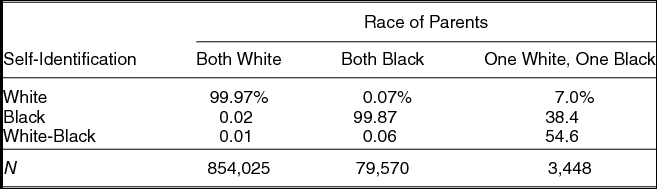
Table 2 displays group differences with respect to gender, region, parents’ marital status, religion, and neighborhood type.Footnote 17 Biracials, regardless of racial identification, are most likely to live in the Pacific West. While a plurality of Monoracial Blacks live in the South, White-Black identifiers are the least likely to live in that region, an unsurprising finding given the South’s history of strict adherence to the one-drop rule (Davis Reference Davis2001). The five racial groups also grow up in different neighborhoods. Relative to Monoracial Whites, Monoracial Blacks are much more likely to come from neighborhoods that are in the bottom median income quartile, and areas that are more densely populated and more Black. Biracials’ identifications correspond to their neighborhood context. Compared to Biracial Blacks, Biracial Whites grow up in neighborhoods that are much more affluent, less densely populated, and less Black—while Biracial White-Blacks grow up in areas that are only somewhat more affluent and densely populated, and about as Black.
Sample Demographic Characteristics: Gender, Region, Neighborhood Type, Parents’ Status, and Religion

Approximately half of biracials report having married parents, which is more comparable to that of Monoracial Blacks than Monoracial Whites. As a group, biracials are significantly less religious than their monoracial counterparts, and White-Black identifiers are particularly likely to be nonreligious. Among the three biracial groups, White identifiers are the most likely to follow Judaism, a predominantly White religion (Pew 2013), while Black identifiers are most likely to be Baptist, a religion with which Black Americans tend to affiliate (Kosmin and Keysar Reference Kosmin and Keysar2009).
Figure 1 presents an overview of socioeconomic characteristics across racial groups. The patterns of family income are illustrated in the first graph, which shows that the biggest disparity for family income exists between Monoracial Whites and Monoracial Blacks. Biracials are in the middle of these two groups, and their income is correlated with identification; Biracial Whites are most similar to Monoracial Whites, Biracial Blacks are most like Monoracial Blacks, and White-Blacks fall in between. Father’s and mother’s level of education follows roughly similar racial group patterns. These findings corroborate research showing that White-Black interracial couples are of higher socioeconomic status than endogamous Black couples (Wang Reference Wang2012).
Sample Demographic Characteristics: Parents’ Socioeconomic Background

Overall, these significant demographic differences across groups reinforce the importance of accounting for confounding factors in the analyses of political attitudes, particularly that of religion, which may structure opinions regarding whether government should have the capacity to regulate private behavior (Beck and Jennings Reference Beck and Jennings1991).
Regression Models
In evaluating biracials’ political attitudes, I run ordered logistic regressions in which the dependent variables of interest are views on explicitly racial issues (the degree to which one believes that racial discrimination continues to be a problem, the level of importance placed on promoting racial understanding, and support for affirmative action in college admissions); implicitly racial issues (support for criminals’ rights, the death penalty, and gun control); and nonracial social issues (abortion, whether the activities of married women should be limited to the home and family, and same-sex marriage).Footnote 18 Responses are coded from 0 to 1 such that higher values reflect more politically liberal views.
Regressions include covariates for gender, parents’ education, family income, parents’ marital status, religion, region, neighborhood (zip code median income, proportion Black non-Hispanic, and population density), and year surveyed. In order to assess whether there are differences in attitudes within racial identification groups by parentage, separate regressions are run for White identifiers, Black identifiers, and biracials (of any identification). For White identifiers and Black identifiers, I employ matching before each regression to better ensure comparability along demographic characteristics.Footnote 19 For ease of interpretation, I use the ordered logistic regression estimates to generate responses on the 0 to 1 scale and present the predicted differences in responses between the racial groups. Results shown are racial outcomes, though full tables of ordered logistic regressions, as well as all question wording and variable coding, are in the Appendix.Footnote 20
A Note on Interpretation
Since parents’ race naturally precedes children’s race, the effects of parentage can be interpreted as causally prior to both children’s self-identification and political attitudes. Thus any differences in political views between biracial and monoracial respondents that are found in a regression framework can be attributed to differences in parentage. More complex is the relationship between biracials’ self-identification and their political attitudes. These observational data do not enable me to make causal claims about the role of racial identification on attitudes. While the regression analyses presented designate self-identification as one predictor of political attitudes, results should not be taken to mean that identification leads to attitudes. Rather, self-identification and political views may constitute a cluster of intertwined social beliefs, because the labels that some biracials choose to adopt can be a consequence—rather than a cause—of holding a particular view. For example, negative affect towards a racialized policy like welfare (Gilens Reference Gilens1999) may engender feelings of resentment towards Blacks as a group, and push biracials away from a Black identification of any kind (though it does seem less likely that nonracial attitudes, such as feelings towards same-sex marriage or abortion, would shape racial labeling). Recognizing that identification is likely interconnected with political ideology, I thus interpret political attitudes as being associated with—and not necessarily the result of—biracials’ chosen identifications.
RESULTS
Explicitly Racial Attitudes
Table 3 displays opinion estimates on explicitly racial issues for each identification group. In line with prior research, Monoracial Whites express the least support for racial issues and are 30 percentage points less supportive than Monoracial Blacks of affirmative action and less likely to think it is important to promote racial understanding. As hypothesized, biracials’ subjective group identification is highly correlated with their racial policy attitudes; Biracial Whites are most akin to Monoracial Whites, while Biracial White-Blacks and Blacks appear no different from Monoracial Blacks.
Attitudes Towards Explicitly Racial Issues

Note: Percentages indicate disagreement that racism is no longer a major problem; that it is “very important” or “essential” to help promote racial understanding; and that affirmative action in college should be permitted.
Figure 2 presents the regression estimates of racial attitude differences. Panel (a) shows differences in attitudes between White identifiers, panel (b) shows differences between Black identifiers, and panel (c) compares the three biracial groups, by self-identification. As panel (a) illustrates, when other correlates are held constant, Biracial Whites are as likely as Monoracial Whites to believe that racism is a major problem. But on the other two racial measures, having a Black parent significantly shapes Biracial Whites’ opinions; relative to Monoracial Whites, Biracial Whites are 6 percent more likely to believe that it is important to help promote racial understanding and 7 percent more likely to support affirmative action in college admissions. Thus while their identification reflects the absence of a minority label, Biracial Whites do seem to be influenced by their minority parentage. In contrast to Whites, there is no substantive difference in racial attitudes among Black identifiers, as panel (b) illustrates.
Regression Estimates of Differences in Attitudes Towards Explicitly Racial Issues

Panel (c) shows that despite their identification as partly White, Biracial White-Blacks evince racial attitudes that are mostly comparable to those of Biracial Blacks, all else equal. At roughly similar rates, Biracial White-Blacks and Biracial Blacks agree that racial discrimination is a problem and believe it is important to promote racial understanding. However, biracials who identify as White are 10 to 15 percent less likely to subscribe to these views, suggesting that the choice to call oneself White is also correlated with less liberal racial attitudes.
In sum, on matters explicitly racial in nature, labeling oneself as at least partly Black is a key correlate of liberal attitudes and a greater commitment to racial progress. All told, these results generally indicate that biracials’ explicitly racial attitudes tend to mirror those held by the racial group with which they identify.Footnote 21
Implicitly Racial Attitudes
Table 4 shows attitudes on the implicitly racial issues of crime policy—criminals’ rights, the death penalty, and gun control. Across these issues, Monoracial Blacks are again the most liberal and Monoracial Whites the most conservative. However, the range in attitudes is not as wide, and often ten or fewer percentage points. Findings on implicitly racial issues parallel those on explicitly racial issues. That is, singular-identifying biracials exhibit views that are most similar to their Monoracial White and Black counterparts; Biracial Whites’ attitudes are most analogous to those held by Monoracial Whites, whereas Biracial Blacks are primarily akin to Monoracial Blacks. Biracial White-Blacks are again largely indistinguishable from Monoracial Blacks, suggesting that Biracial White-Blacks share a racial awareness with their minority-identified counterparts.
Attitudes Towards Implicitly Racial Issues

Note: Percentages indicate support for criminals’ rights, agreement that the death penalty should be abolished, and support for stronger federal gun control laws.
These findings hold up in the ordered logistic regression models in Figure 3. Once other sociodemographic factors are accounted for, singular-identified biracials are not much different from monoracials who share their identification, though results also suggest that the political effects of biracial parentage can endure even when individuals do not label themselves as such. This is evident in panel (a), which shows that—all else equal—Biracial Whites express greater opposition to the death penalty and greater support for gun control than Monoracial Whites. This finding is also visible in panel (b), which illustrates Biracial Blacks’ slightly lower support for gun control than Monoracial Blacks. Overall, though, biracials’ implicitly racial attitudes are again a function of their chosen identification—with White-Black identifiers looking a lot like Blacks.
Regression Estimates of Differences in Attitudes Towards Implicitly Racial Issues

Nonracial Attitudes
Table 5 presents opinions on nonracial social attitudes: abortion, support for married women working outside the home and family, and support for same-sex couples being afforded the right to legal marital status. Here, Biracial White-Blacks distinguish themselves as a uniquely progressive group, particularly on married women’s place in society and same-sex marriage. On abortion, biracials—regardless of identification—express the most liberal views. Monoracial Blacks, in contrast, are the most conservative group in every area; their support ranges from 12 to 20 points lower than that expressed by Biracial White-Blacks.
Attitudes Towards Nonracial Issues

Note: Percentages indicate agreement that abortion should be legal, disagreement that married women are “best confined to the home and family,” and agreement that same-sex couples should be allowed to legally marry.
Figure 4 reveals that these effects persist in the presence of statistical adjustments. As with racial issues, Biracial Whites’ views are again generally similar to those of Monoracial Whites. For White identifiers, differences in racial parentage do not necessarily lead to differences in social attitudes; for two of the three issues under examination (abortion and same-sex marriage), Biracial Whites share the views of Monoracial Whites.
Regression Estimates of Differences in Attitudes Towards Nonracial Issues

This is not the case for respondents identifying as Black. Among Black identifiers, net of all covariates, parentage is consistently and strongly predictive of opinion. Panel (b) shows that Biracial Blacks are significantly more liberal than Monoracial Blacks on all nonracial issues. The largest difference in opinion here has to do with same-sex marriage; Biracial Blacks are 10 percent more approving than their Monoracial Black peers, all else equal. Thus despite their congruous racial identification, Blacks of biracial parentage possess markedly less traditional social attitudes than Blacks of monoracial parentage, even when accounting for many other factors within a regression framework.
Panel (c) shows that on abortion, all three groups have similar levels of support, while on attitudes towards married women, biracial White-Blacks express the most progressive opinions. Biracial Blacks’ attitudes are statistically indistinguishable from those of Biracial White-Blacks on same-sex marriage. Biracials’ unique support for this issue should not be surprising, given the parallels between same-sex marriage and interracial marriage: both policies have been framed as civil rights issues involving the legal recognition of romantic unions considered to be socially transgressive (Eskridge Jr. Reference Eskridge1993; Haider-Markel and Joslyn Reference Haider-Markel and Joslyn2005).
Taken together, these results indicate that on nonracial social matters, individuals of biracial parentage who identify as racial minorities (i.e., as part-Black) express more liberal views than their monoracial counterparts.
Explaining Biracials’ Political Opinions
This article’s findings clarify where biracials of White-Black parentage fall on several political issues. Results indicate that by overlooking the role of racial identification and parentage, prior research on the political attitudes of mixed-race Americans has simplified a complex social phenomenon. But what accounts for White-Black identifiers’ liberal racial and social attitudes?
Here, I address the role of parental influences and personal experiences in greater depth. In doing so, I supplement the Freshman Survey findings with in-depth interviews of biracial college students to help disentangle the mechanisms at work.Footnote 22
Research on parental socialization has shown that children generally have value orientations that are similar to their parents (Hyman Reference Hyman1959; Thomas Reference Thomas1971; Troll, Neugarten, and Kraines Reference Troll, Neugarten and Kraines1969). Values including individualism and materialism are transmitted from parents to children due to the inheritance of socioeconomic status, the propensity of children to model their parents’ attributes, and parent-child relationship type (Bengtson, Biblarz, and Roberts Reference Bengtson, Biblarz and Roberts2002). Yet parents often do not transmit specific attitudes to their children (Connell Reference Connell1972; Jennings and Niemi Reference Jennings and Niemi1968; Niemi and Jennings Reference Niemi and Jennings1991). Adolescents tend to be more progressive and tolerant than their parents (Owen and Dennis Reference Owen and Dennis1987; Tedin Reference Tedin1980); relative to older generations, Millenials express more socially egalitarian views and more liberal opinions when it comes to race, gender, gay rights, and abortion (Stoker and Bass Reference Stoker, Bass, Shapiro and Jacobs2011).
Ideally, to assess the extent to which biracials are “inheriting” liberal social positions, I would use the Freshman Survey data to compare the views of biracial respondents to those of their interracial parents. Unfortunately, the absence of parental political questions from the surveys preclude me from doing so. But as Jennings (Reference Jennings and J.2007) notes, when direct measures of parental political traits are lacking, family influence can be evaluated with parental socioeconomic traits. Parents’ marital status can also matter for value inheritance; the intergenerational transmission of values deteriorates in divorced families because divorce weakens social connections between parents and children (Bengtson, Biblarz, and Roberts Reference Bengtson, Biblarz and Roberts2002). Examining the influence of parents’ income, education, marital status, region, and neighborhood characteristics, then, allows me to capture the impact of status inheritance and shared social milieu on respondent political attitudes (Dalton Reference Dalton1982; Jennings, Stoker, and Bowers Reference Jennings, Stoker and Bowers2009).
Disentangling the Roles of Parentage and Experience
In order to shed some light on the political influence that interracial parents have on their biracial children, I assess the effects of parental covariates from the ordered logistic regressions. Statistically significant results are denoted in Table 6.Footnote 23
Demographic Predictors of Attitudes for Biracial Respondents

Note: *= statistically significant at 95 percent level of confidence based on the ordered logistic regressions.
Several noteworthy findings emerge from this analysis. First, religion is a significant predictor of political views across the board. Given that religious identification is passed down from parents to offspring (Myers Reference Myers1996), this finding serves as evidence that parents are indirectly shaping their children’s political attitudes via the transmission of religious faith.
Beyond the effects of religion, other parental covariates are also influential—but primarily or solely on implicitly racial and nonracial matters. Notably, parents’ marital status is predictive of biracials’ opinions on four of these six issues; relative to comparable biracials whose parents are together, those whose parents are not currently together hold more liberal positions on criminals’ rights, gun control, abortion, and same-sex marriage. Thus, all else equal, having a single parent is predictive of more liberal attitudes on most of the implicitly racial and nonracial issues. However, parents’ marital status has no significant effect on explicitly racial issues, suggesting that opinions on these topics may be explained more by individual racial attachments and group identification than by parental attitude transmission. This implication is substantiated by the effects of several other factors—mother’s race, neighborhood population density, and percent Black—that are significant only on issues that are not explicitly racial. In addition, when it comes to the effect of parents’ education, findings suggest that maternal influence exceeds paternal influence; whereas the impact of father’s education is significant on only a single issue, mother’s education significantly predicts opinion on five issues.Footnote 24
Qualitative evidence also suggests that the general passage of political outlook from parents to offspring shapes biracials’ nonracial political outlooks. In particular, interview respondents took overall partisan cues from their parents. For example, one White-Black-identifying woman who called herself “a strong liberal” noted that she followed the same campaigns as her parents, stating, “Mostly my political views are based on what my parents have taught me and what I have experienced.” Another White-Black-identifying respondent similarly attributed her Democratic identification to “my family and living in such a liberal area” and posited that she would likely hold liberal beliefs even if she did not have a Black parent, because her (White) mother was liberal.
Consistent with the quantitative findings, one issue that is especially salient to biracials and indirectly tied to parental influences is same-sex marriage. Although race-based legal restrictions on marriage were outlawed decades ago, marriage equality is a topic that many biracial interviewees are especially sensitive to. As one White-Black-identifying woman put it, “I’m strongly for [same-sex marriage] because my parents wouldn’t have been able to get married back in the day. Who is to say who can marry who?” Another Black-identifying male said, “I can’t argue about [same-sex marriage]. I consider it a human right.”
Overall, quantitative and qualitative evidence imply that parental influences are more consequential for biracials’ views on implicitly and nonracial issues than on racial ones. This is consistent with my hypothesis that racial attitudes in particular are tied more to social group identification. These findings are also bolstered by prior research showing that parental transmission of outlook is only part of the political socialization story—also important are life cycle influences and other socializing agents (Jennings and Niemi Reference Jennings and Niemi1968). As Bengtson (Reference Bengtson1975, 369) writes of adolescent attitudes, “Global orientations may be more reflective of the individual’s unique personal biography, or of his or her response to sociohistorical events, than of effects attributable either to family or generational factors.”
Indeed, when asked about racial policies, biracial interviewees frequently cited their personal experiences as explanations for their views. Support for explicitly racial issues was largely due to individual encounters with discrimination, which were perceived to be pervasive by several respondents. Biracials’ mixed backgrounds and often ambiguous racial appearance leaves them susceptible to prejudice from multiple groups, which can make them acutely attuned to racial injustices. One Black-identifying male respondent felt that “biracial people face more racism from both ends of the spectrum,” while another echoed that he had been discriminated against by both Blacks and Whites because of his background: “I wouldn’t say it’s day-to-day life that I feel discriminated on, but I definitely feel that people will look at skin color and features and make a determination about who I am and how they would associate me, and how they would classify me in a group of people. [...] I’m always aware that it’s out there and it happens on a fairly regular basis.”
Such attention to racial prejudice contributed to a perception of shared adversities and political commonality with Black Americans. Both White-Black and Black identifiers expressed these feelings, and also indicated that they felt the social privileges afforded to Whites did not extend to them. As one White-Black-identifying woman put it, “I definitely feel a connection with the Black community as a whole, but not sure about the White community—it’s not that I don’t identify with the White community, it’s that they haven’t dealt with much hardships I guess.” Another Black-identifying male said that he would only feel political solidarity with Whites if “something negative were to happen, and there were to be a backlash” against Whites as a group. He also mentioned that as a mixed-race person, his support for “the advancement of minorities” extended beyond race to groups who were “underprivileged” and “fighting for more equality,” including the poor.
Relating Biracials’ Experiences to Existing Racial Identity Theory
Overall, the comments made by Biracial Blacks are consistent with W. E. B. Du Bois’s (Reference Du Bois1903a) influential argument in The Souls of Black Folk. Du Bois argued that a central element of Black solidarity is a collective Black identity, rooted in a common historical and cultural background, though not necessarily a shared biological lineage. Biracials who identify as Black—and to a lesser degree, those who identify as White-Black—embody this conception of a collective Black political identity, as their racial attitudes reflect an allegiance, sense of personal awareness, and shared interest with Black Americans.
In contrast, such solidarity with Blacks is not evident among biracial White identifiers. For example, on the issue of affirmative action, one biracial White interviewee argued that while she believed in the value of racial and ethnic diversity, she also felt that “coming from an affluent middle class background and having a White parent,” she had not faced many social or economic disadvantages that would make the policy particularly relevant for her.
To that end, these findings also extend Waters’s (Reference Waters1999) theory of strategic ethnic distancing, which was originally developed as a model explaining immigrant incorporation in the United States. As Waters argues, ethnic distancing is an identification approach employed by some native Black West Indians to separate themselves from Black Americans, whom they consider inferior and low status. In order to appear distinct from Black Americans, Black West Indians will present themselves as immigrants (for example, by playing up their Caribbean accents). The results shown here indicate that some biracials similarly separate themselves from Black Americans by identifying as White—a label that contradicts traditional racial norms. In light of how Whiteness has been characterized in U.S. law and society, a White identification among biracials reflects a distancing from their Black background. And for both West Indian immigrants and Biracial Whites, subjective identification as non-Black American corresponds with a weak sense of political and social solidarity with Black Americans.
Although Biracial White-Black identifiers are also presenting themselves in a way that does not align with conventional racial categories, they are not engaging in strategic distancing from Black Americans, nor are they falling in between their monoracial groups. As qualitative evidence illustrates, identification for these individuals reflects a personal acknowledgment of mixed-race parentage as well as an emotional political connection to Black Americans that is grounded in a perceived shared historical experience of slavery, Jim Crow, and discrimination.
In this sense, the attitudinal patterns of Biracial White-Blacks, as well as Biracial Blacks, are like those of second-generation Black West Indians in the U.S., who see themselves as part of the Black American community (Waters Reference Waters1999). The mechanisms of social and political attachments do differ between the groups. While second-generation West Indians incorporate a Black American identity primarily because they are ascribed this way by others,Footnote 25 Blackness is more escapable for biracials because their lighter skin tone and racially ambiguous phenotypes often make their race indeterminate to outsiders (Pauker, Weisbuch, Ambady, Sommers, Adams Jr., and Ivcevic Reference Pauker, Weisbuch, Ambady, Sommers, Adams and Ivcevic2009; Willadsen-Jensen and Ito Reference Willadsen-Jensen and Ito2006). Whereas biracials’ Blackness can go undetected externally, it typically remains a key component of their internal political identity. Biracials who identify as White-Black and Black do so in part because they perceive an affective attachment to Blacks in light of the Black American community’s struggles against racial oppression—a community to which biracials have always belonged (Davis Reference Davis2001).
DISCUSSION AND CONCLUSIONS
“Census 2000 will go down in history as the event that began to redefine race in American society.” —Kenneth Prewitt, former head of the U.S. Census BureauFootnote 26
The ability of Americans to self-identify with multiple racial groups has challenged longstanding assumptions about the meaning of race in the United States. Mixed-race individuals are no longer constrained to a single racial category, and their sociopolitical positions add nuance to our understanding of an entrenched racial divide.
High levels of White-Black identification illustrate a major shift in the shape of the U.S. color line, demonstrating that Americans of African heritage do not feel bound by the historical norm of hypodescent. This point is evidenced by Freshman Survey data showing that most biracials of White-Black parentage now opt to call themselves multiracial. It is further underscored by the fact that in the years since the Census race change, the White-Black-identifying population increased by 221 percent, to 2.5 million in 2014 (Bureau of the Census Reference Bureau and FactFinder2015).
But while the one-drop rule no longer strictly determines how biracials of White-Black parentage label themselves or are labeled by others, findings here show that the effects of this rule linger. Socially, Whiteness remains largely a non-option for biracials of White-Black parentage, as illustrated by the very small percentage of Freshman Survey respondents who self-identify as White. Research in social psychology (e.g., Ho, Sidanius, Levin, and Banaji Reference Ho, Sidanius, Levin and Banaji2011; Peery and Bodenhausen Reference Peery and Bodenhausen2008) showing that White-Black biracials tend to be ascribed as non-White further suggests that “White” is unlikely to become a popular biracial label anytime soon. In addition, more often than not, White-Black identifiers express racial attitudes that are not much different from Blacks. This intimates that, at present, multiple-race identification does not necessarily correspond to substantially weaker attachments to the Black American community. Although racial group boundaries have become fuzzier and identification is no longer viewed as mutually exclusive, group political attitudes have not changed accordingly.
Still, the increasing number of multiple-race identifiers raises important questions about the future of Black American political solidarity. Prior literature has demonstrated that residential segregation strengthens individual ties to Black history and culture (Tate Reference Tate1993), worshipping at Black churches shapes understanding of group interests (Calhoun-Brown Reference Calhoun-Brown1996; Harris-Lacewell Reference Harris-Lacewell2006; Taylor Reference Taylor2002), and the “shared experience of deprivation” is a fundamental facet of Black group consciousness (Gay Reference Gay2004). But this article has shown that, relative to Monoracial Blacks, biracials are more likely to live in racially diverse neighborhoods, are much less religious, and come from higher SES households. If these demographic and identification patterns persist and Black intermarriage rates continue to rise in the coming years,Footnote 27 the racial attitudes of White-Black identifiers may well diverge from those of Black identifiers down the road. This would intimate a more racially stratified society wherein racial identification, skin tone, social class, and political ideology are tightly linked. Thus the ability to identify with multiple races may ultimately stigmatize lower SES, darker-skinned, monoracial minorities by enabling people of mixed-race to distinguish themselves from these groups. But only time will tell whether this turns out to be the case.
More generally, the findings here demonstrate that by implicitly presuming that all respondents who identify with a particular racial group (e.g., “Black”) view the world through a single racial lens, researchers inadvertently mask the political influence of racial parentage. To the extent that we associate race with certain political meanings, and we structure our models of public opinion and racial attitudes around these meanings, such findings are noteworthy. Although the races with which biracials label themselves say much about their political solidarity, these labels sometimes conceal race’s impact on attitudes. For example, Biracial Whites are significantly more likely than Monoracial Whites to value racial tolerance and support affirmative action—indicating that while Biracial Whites present themselves as being part of the racial majority, their racial outlook is indicative of their minority background. For White-identified biracials, the decision to label with their majority race is not a “denial” or rejection of their Black heritage, but rather a reflection that race is a mostly inconsequential factor in their day-to-day lives.
This research has integrated and extended previously unconnected theories across political science, sociology, and social psychology, and findings also contribute to broader literatures on the political consequences of racial and ethnic identification (Chandra Reference Chandra2006; Dawson Reference Dawson1994). The results here inform our understanding of how self-identification corresponds with social group connections. Research on political attachments has consistently found that subjective group allegiances are more influential than objective group membership (Huddy Reference Huddy, Huddy and O.2003; Waters Reference Waters1990). Indeed, these findings show that not all biracials of White-Black parentage feel a strong sense of attachment to each of their component racial heritages. There are clear attitudinal differences among biracials that correspond with their chosen racial labels. At the same time, self-identification alone does not explain social attitudes; biracials are also influenced by their mixed-race background—even if they do not self-identify with multiple races.
Some limitations to the Freshman Surveys should be noted. First, these data do not allow for an examination of the influence of racial discrimination or physical appearance on opinion; it is plausible that biracials who are darker-skinned are more likely to support anti-discrimination legislation or other racial policies than biracials with lighter skin. However, my qualitative evidence suggests that skin tone and appearance play a relatively minor role in the construction of attitudes, which is consistent with prior research findings (Hochschild and Weaver Reference Hochschild and Weaver2007).Footnote 28
In addition, these data represent biracials’ self-identification and political attitudes in early adulthood, as reported on a survey. This measure is meaningful because it reflects individuals’ internal understanding of race and politics, but it does not enable me to speak to the durability of attitudes and identification across time and circumstance. Given their age, and that this is, for many, their first experience away from home, it would also be worthwhile to examine whether and to what extent biracials’ self-identification and attitudes evolve over college.
This work has centered on the political consequences of racial identification for White-Black biracial Americans, due to the size of this group, the high levels of social distance between Whites and Blacks, and the traditionally strict definition of what constitutes “Black” in American society. Yet it would be remiss to overlook other biracial subgroups, especially given the racial and ethnic disparities in intermarriage and the millions of multiple-race identifiers who do not label themselves as White-Black.Footnote 29 For biracials of Hispanic or Asian descent, national origin, foreign language fluency, and proximity to the immigrant experience all likely shape both identification choice and political outlook. But the general findings discussed here may have implications for these other subgroups. It is plausible that, in light of their experiences as racial minorities, the perception that racism is an important social problem is a widely held belief among multiple-race identifiers in general. Future projects must examine these other racial groups. Such research should also assess whether biracials have especially liberal attitudes towards economic issues, such as support for downwardly redistributive policies, and whether they express greater relative support for policies affecting socially marginalized groups such as the sick or disabled.
All told, these findings underscore that identification is more than a subjective expression of racial group belonging, or the “accurate” labeling of oneself with both constituent parental races. The social encounters associated with having multiple racial backgrounds also shape perceptions about racial policies and egalitarianism. Perhaps it should not be so surprising, then, that the attitudes of White-Black biracials are sometimes disparate from conventional monoracial groups, falling outside of the monoracial White and Black spectrum. Contrary to the conventional wisdom, on nonracial policy issues, Americans of White-Black parentage who opt to label themselves as racial minorities constitute not an intermediate group positioned between two more deeply rooted races, but a distinct group unto themselves.
SUPPLEMENTARY MATERIAL
To view supplementary material for this article, please visit http://dx.doi.org/10.1017/S0003055415000556




Comments
No Comments have been published for this article.