

Political scientists have come to appreciate the value of simulations for teaching a range of political processes in American and international politics (Brunazzo and Settembri Reference Brunazzo and Settembri2015; Cohen Reference Cohen2020). Simulations engage students and create memorable experiences (Hendrickson Reference Hendrickson2021; Kaunert Reference Kaunert2009). Students participating in simulation activities report feeling more motivated to learn and enthusiastic about the subject matter (Cohen, Alden, and Ring Reference Cohen, Alden and Ring2021). Compared to the traditional lecture format, simulations improve knowledge acquisition and retention (Forester, Jett, and Holtey Reference Forester, Jett and Holtey2024; Frederking Reference Frederking2005), as well as help develop real-world career skills (Kitchen Reference Kitchen2022). Instructors employing simulations have often found that they tend to boost their course enrollments (Glazier Reference Glazier2011; Shellman and Turan Reference Shellman and Turan2006).
Most of the simulations employed in legislative politics courses, however, are structured, short-form activities in which students are given specific pieces of legislation to consider in an abbreviated legislative process (e.g., Baranowski Reference Baranowski2006; Ciliotta-Rubery and Levy Reference Ciliotta-Rubery and Levy2000; Sands and Shelton Reference Sands and Shelton2010). We make the case for a more expansive multi-week, immersive experience that permits students the widest possible agency over the content and activities in the simulation. As scholars of Congress, we focus on legislative politics, but our approach is portable and could be used to simulate any political institution that involves free-flowing interactions between relatively equal actors (Kollars and Rosen Reference Kollars and Rosen2016).
The overall approach we advocate is to build a legislative simulation on the model of a “sandbox” in which participants are free to explore, create, and interact without a predefined set of objectives, such as passing a law or winning an election. Instructors who were twenty-first-century teenagers themselves, or parents of them, will likely know of popular sandbox video games such as Minecraft. In the context of software development or training, a “sandbox” refers to a controlled environment in which users can experiment without risk to the live environment or the underlying infrastructure.
As with a sandbox, we permit students to approach the simulation world in their own way, iterated over repeated play, with collaboration and competition in shared spaces and activities driving the learning experience. As one student reflected, “The simulation is innovative and very much challenge-by-choice.” Another commented, “The interactive and student-driven aspects of the course made it really special and enjoyable,” underscoring the transformative potential of this approach when paired with strong scaffolding and instructor guidance.
As with a sandbox, we permit students to approach the simulation world in their own way, iterated over repeated play, with collaboration and competition in shared spaces and activities driving the learning experience.
While this type of simulation necessarily involves play, the primary objective is not for the students to have fun (although they almost always do!). Instead, it is to engage them deeply in the subject matter and push them to understand and grapple with processes and concepts in ways that are not possible through listening to lectures alone. It also leads them to develop and practice critical skills, including public and interpersonal communication, that will serve them beyond the simulation. We believe this approach to learning is more meaningful and more practical for political science undergraduates and that it is emblematic of the innovative techniques that instructors must embrace to meet the challenges that higher education faces in the twenty-first century, including the negative effects of technology on student engagement (Huey and Giguere Reference Huey and Giguere2022).
LEARNING IN A SENATE SANDBOX
To present our approach, we draw on our experiences as instructors for a combined 11 sandbox-style simulation courses that enrolled hundreds of students between fall 2021 and spring 2025. These legislative simulations varied in their specific details, but all shared three essential features: (1) students themselves determine the policy issues considered in the simulated legislature and how to approach their own involvement, (2) immersive role-play extends across a month or longer, and (3) simulations are structured to create a high degree of equality among the students.
Beyond those essential features, the specific design and mechanics of a sandbox-style simulation can be tailored to fit different learning goals, course structures, and instructor preferences. We do not prescribe a single model for implementation, but all our simulations follow the same basic structure. Before the simulation begins, we provide students with a foundation for understanding the Senate through lectures, assigned readings, and supporting material. This foundation is tailored to the simulation and can include sample legislation, floor procedure guides, and expectations for participation. By scaffolding the simulation, we ensure that students understand the ground rules and can participate confidently and effectively. Once the simulation begins, most class meetings operate as the Senate floor in session. Other class meetings may be devoted to committee meetings or party caucuses. Some may be used for lectures and group discussions to ensure that students grasp key concepts and simulation developments. Class structure and how it contributes to student learning are discussed further in the rest of the article.
Student responses to our approach are consistently enthusiastic. One of us had taught legislative politics for more than two decades and was astonished by the positive response to the redesigned course. We find that our students describe the simulation as the most enjoyable and interesting aspect of our courses. When asked whether simulations should be longer or shorter, our students uniformly ask for more time devoted to simulation activities because they want to learn more. One student said, “I think having more simulation days would be really great for better understanding since the limited days meant we only got to do so many things.”
Our main goal in this article is to make the case for integrating a large-scale simulation of this kind into legislative politics courses by offering the rationale for our approach and discussing its advantages and potential concerns. We include quotations from anonymized student reviews that highlight key points and demonstrate students’ enthusiasm and appreciation for simulation learning.
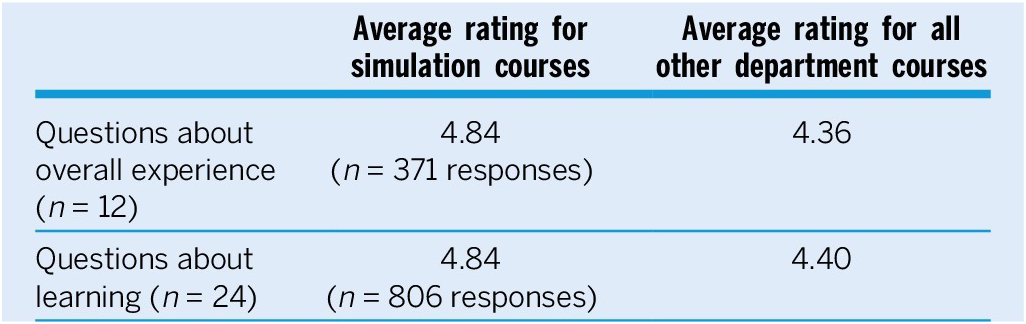
Positive evaluations of simulation learning are also evident in students’ reviews of our courses. The reviews for our 11 classes included 36 questions that were either about the students’ overall experience in the course (n = 12) or the quality of their learning (n = 24). The average responses to these questions for our courses were always more positive than the department average for the same questions. Table 1 summarizes the average ratings across the 11 courses. In the supplemental appendix, we report the average ratings for each specific question.
Table 1 Comparing Student Reviews of Simulation Courses and Other Department Courses for Questions about Overall Experience and Learning

Notes: Cells contain average ratings for the questions on end-of-semester student reviews on a 1–5 scale. Higher scores indicate more positive responses. Responses are aggregated across institutions and semesters. For both question types, the average difference between the ratings for simulation courses and the ratings for all other department courses was statistically significant at the p < .001 level.
We report the total number of student responses to the questions for the simulation courses only. We do not have the number of responses to the same questions for other department courses, although it is sure to be significantly higher given the large number of political science courses offered at our institutions.
At one of our institutions, instructors saw a dramatic improvement in student engagement in their legislative politics course after shifting from a traditional lecture format to a sandbox-style simulation. The classes were very similar in content focus, the instructional team, and the assigned readings, yet, the course’s overall rating improved from 0.30 to 0.40 points below the department average in the lecture format (on a 1–5 scale) to 0.30 to 0.45 points above the average in the sandbox-simulation format.
Of course, student reviews should not be taken at face value as evidence of learning. A long literature has documented the limitations of testimonials and student reviews (e.g., Stark and Freishtat Reference Stark and Freishtat2014). Most importantly, students are not well suited to evaluate effective pedagogy, and, in our case, simulations may bias student reviews upward precisely because they are enjoyable. However, engagement and attention, which students can reasonably evaluate, are necessary conditions for effective learning (deWinstanley and Bjork Reference deWinstanley and Bjork2002). Moreover, a growing body of research has touted the benefits of active learning, including simulations, especially when compared to traditional lecturing (e.g., Brown, Roediger, and McDaniel Reference Brown, Roediger and McDaniel2014; Deslauriers et al. Reference Deslauriers, McCarty, Miller and Kestin2019; Freeman et al. Reference Freeman, Eddy, McDonough and Wenderoth2014).
We also observed the course being transformative for at least some students’ career trajectories, likely because it gives them a more realistic and engaging political experience than a lecture-based course with similar content. Many of our students have gone on to work in legislative politics at the state and federal level. For example, one crisscrossed a major American state as a speechwriter for the state’s governor after his sophomore year. Others redirected their ambitions and interests toward a world of which they were previously unaware. One student who had studied philosophy and been primarily interested in the Chinese political system signed up for additional courses on the US policy-making process and sought an internship in American politics after the simulation.
Although this evidence is anecdotal, it suggests that students’ simulation experience causes them to do more than give the course a positive review. It leads them to consider new options for their lives and, in some cases, to seek out new experiences. The time students spend in a simulation may not only improve their college experience but also change how they engage with politics after they graduate.
If students are more actively engaged by simulation-based courses than by other courses, as our experiences indicate, learning is more likely to occur. Future research should use careful designs to examine more precisely whether and how student learning, as well as outcomes such as political interest and career trajectories, improve in sandbox-style simulations (e.g., Clark and Scherpereel Reference Clark and Scherpereel2024). Our purpose in this article is not to rigorously evaluate outcomes but rather to lay out our approach and discuss the positive results we have seen in our classrooms, as well as highlight challenges that instructors may face. In the next three subsections, we further explain the three key elements of our courses and their contributions to student learning.
Open Ended and Student Driven
In our simulations, we ask all students to assume the perspective of a senator representing a particular state and party. Students then develop their legislative persona over the course of the simulation. To do so, they need to research and reflect on how best to meet the needs of their state. As we discuss legislative organization, they decide whether they want to campaign for leadership positions or coveted committee slots. By introducing and trying to advance their own legislation, they not only learn the mechanics of the legislative process but also gain firsthand experience navigating the agenda-setting powers of leadership.
Our simulations allow students to introduce bills and amendments on any topics that interest them. There are no limits on the number of bills they can introduce or of amendments they can file. They are also free to craft their legislative personae in any way they choose, with the only expectation being that they can defend their decisions as advancing their reelection and other goals. Crafting their personae, students may also opt to make speeches, author op-eds, disseminate tweets, and write about their television appearances or town hall meetings. They collaborate with peers on various legislative strategies of their own design. Students elect their party leaders, and legislative parties meet in caucus to negotiate legislative priorities.
This student autonomy is reflected in the day-to-day classroom experience of the simulation. As discussed earlier, most classroom meetings operate as floor sessions of the Senate. These begin with the presiding officer, either an instructor or a student volunteer well versed in Senate rules, gaveling in and recognizing members for introductory remarks, legislative announcements, or other procedural business. The class then proceeds to the business of the day, as determined by the student-elected majority leader in consultation with colleagues. The presiding officer manages floor proceedings by recognizing speakers and overseeing votes, according to the rules and customs of the Senate. Students can then offer amendments, give floor speeches, and ultimately cast votes according to their own strategies and goals.
Student autonomy is reflected, first and foremost, in their ability to influence the legislative agenda, focusing on the policy priorities they believe are important for their reelection or other goals. Permitting wide agency for students when it comes to how they spend their time (and on what issues) frees up their creativity and allows them to take ownership of their own learning (Anderson and Winthrop Reference Anderson and Winthrop2025). We found that students exhibit more buy-in when they are pursuing individual interests or goals. Rather than having the instructors micromanage the simulation, students feel empowered to direct their own efforts and strategies. They build caucuses and coalitions with other students of their choosing. They tend to use this freedom not simply to pursue their preexisting policy preferences but also to find creative ways to have an impact on the simulation. Students frequently express appreciation for this autonomy. One remarked that the instructor “guided us when needed but allowed our imaginations and creativity to flourish through the entire process.”
Maximizing choice allows students to work in ways in which they feel best able to contribute. Whereas some students aspire to leadership positions, others are less comfortable with public speaking and prefer to work in the background. Some students may be partisan warriors; others care passionately about a particular policy issue. By providing students with varying opportunities for participation, from giving floor speeches to writing committee reports, our extroverted and introverted students have ample opportunities for participation.
The result is a dynamic, unpredictable simulation to which the instructors and other students are continually reacting. The potential for serendipity and surprise generates interest and excitement. Interacting with one another over time, students discover from personal experience how and why norms of reciprocity evolve in legislative settings. Students also quickly learn why legislators often rely on cue-taking from other members. In a fast-paced class meeting, students may cover a wide range of topics from banning junk fees to increasing agricultural subsidies, which often presents them with issues they have not yet had the time to research. When asked how they made voting decisions on such a wide range of issues, students will readily admit that they deferred to their party leadership or followed the example of respected classmates—just as real-world lawmakers often do. Further, although all our simulations operate under the institutional constraints of the Senate rules, students quickly learn the latitude afforded by those rules and even recognize their ability as autonomous political actors to operate outside the rules when they can achieve consensus. This offers not only a valuable learning opportunity concerning the malleability of political institutions but also an opportunity to develop their intersocial skills in a freewheeling environment that requires creativity, preparation, and collective effort to achieve results.
Even though students are expected to make many of the operational decisions in the simulation, instructors remain critical participants. As noted earlier, during the first few weeks of the course, instructors should lay the groundwork for the simulation through rigorous in-person or online lectures that provide the scaffolding for students to engage with and understand the simulation. This instructional role does not end once the simulation begins: instructors must regularly engage with the simulation to prod students toward the key learning outcomes the instructor wants to achieve. Lectures should continue during the simulation, either online or during class time, to provide an emotional break from the simulation; they should be aimed at building students toward proficiency for the final assignment, such as an exam or paper. Instructors can also pause the simulation from time to time for “learning moments” to ensure that students understand the rules and rhetoric of the Senate, reflect on key theory, and highlight interesting or revealing developments. These moments are often prompted by the students themselves, who often request pauses for clarification. These pauses help students build toward writing assignments that require them to reflect on experiences and draw broader implications. A side benefit of this approach is that such writing assignments are less vulnerable to plagiarism or reliance on AI, because they must address developments in the simulation.
Multi-week Structure
Although the balance of lectures to simulation days varies across our courses—from a course in which almost all class time is devoted to simulation activity to a 50/50 split—the commonality is that simulation activities comprise a substantial portion of each course, both in terms of class meetings and written assignments. Those of us devoting substantial class time to the simulation provide more traditional course content and background material via video lectures in a “flipped classroom” format. Others split the course, with the first half following a traditional lecture format and the second half primarily a simulation. All variations of the simulation still require consistent student engagement with key academic material, enforced through exams and integrative reflection assignments that compel students to apply theory to practice.
We observed several distinct advantages to this long-form simulation. First, the semester-long format better approximates the diversity of decisions involved in the legislative process (Blackstone and Oldmixon Reference Blackstone and Oldmixon2020). Just as members face competing demands on their time, our students must make decisions on dozens of bills across a wide range of topics. Likewise, legislative leaders must navigate difficult choices about agenda setting as they manage numerous competing demands from classmates. An extended simulation offers students more opportunities to place their issue priorities on the agenda and to discuss an issue about which they feel passionate. For example, a debate over childcare subsidies may engage only a few students, but nearly every one may have something to say about banning TikTok.
Second, the multi-week format provides more opportunities for experimentation and learning by doing. Deep learning is best developed through iterative cycles in which students face novel problems where they can apply their knowledge (Parker, Valencia, and Lo Reference Parker, Valencia and Lo2018). In our simulations, students can experiment with different strategies and, through trial and error, develop a greater understanding of course concepts (Hally Reference Hally, Harvey, Fielder and Gibb2022). For example, in one of our courses, the majority-party leadership began the floor day confident that they would be able to pass legislation without a unanimous consent agreement (UCA) to structure floor proceedings. Although the topic had been covered in lectures and readings, the students did not fully grasp the importance of UCAs until a bill with broad, bipartisan support consumed nearly an hour as students began offering amendments and giving speeches. In the next class meeting, the majority leader had the opportunity to try again and came prepared with a negotiated UCA, and the students saw how smoothly the legislative process could work.
Third, because our courses are built around the simulation, our students continuously engage with course material and receive immediate feedback on their performance. In addition to regular exams, our students demonstrate their knowledge by their ability to navigate the legislative process and achieve (or attempt to achieve) their goals, whether they be advancing a bill out of committee or obstructing the opposition. Students know their grades are based partly on steady and thoughtful participation in the simulation, which they then take seriously because grades are an important motivator for most students (Rust Reference Rust2002). Through regular engagement, students can assess their understanding in real time, both by seeing whether their legislative efforts are achieving results and by hearing their fellow students respond to those efforts. This real-time feedback encourages students to engage in consistent and sustained learning (Hernandez Reference Hernandez2012) and discourages procrastination (Kim and Seo Reference Kim and Seo2015).
In addition to their day-to-day engagement in the simulation, students further develop their understanding of course concepts through reflection papers, in which they connect their personal experiences in the simulation to topics covered in readings and lectures. Reflection is a crucial stage of experiential learning as concrete experience is translated into abstract conceptualization (Kolb Reference Kolb1984). Prompting students to assess their reelection chances based on their actions in the simulation, for example, pushes them to connect their experiences to the challenges of representation. Through reflection on the simulation, students frequently develop insights into representative politics that are not intuitive for Americans whose engagement with such matters is mostly through media consumption (Hersh Reference Hersh2020). One student “realized that creating bills to solve problems at the national level is a lot harder than I thought.” Indeed.
Through reflection on the simulation, students frequently develop insights into representative politics that are not intuitive for Americans whose engagement with such matters is mostly through media consumption.
Finally, we find that the semester-long simulation fosters deeper engagement from our students. Students are more likely to fully commit to a simulation when they recognize it as an integral component of the course (Hally Reference Hally, Harvey, Fielder and Gibb2022). During post-simulation discussions, we often hear our students express surprise at how “into it” they and their classmates became, creating a degree of positive peer pressure to participate actively. The social element of the simulation adds an additional layer of accountability for students in the form of peer recognition or reproval (Wedig Reference Wedig2010). Students push each other to come to class and to prepare for the day’s work. These repeated interactions reward students who invest in the class and penalize those who do not.
Relative Equality among Students
We found that one of the key elements of a successful simulation is maintaining a degree of equality among all students. When students feel powerless, they are more likely to disengage and gain less from the experience. Baranowski and Weir (Reference Baranowski and Weir2010) find that after a one-session Congress simulation, students in leadership positions or the majority party were more likely to say the activity gave them a better appreciation or understanding of the legislative process. Although equality can be difficult to maintain in political simulations, our experiences suggest that a few design elements are particularly helpful for ensuring that students have some degree of agency.
The unique rules of the Senate afford a wide range of tools for individual members to influence outcomes. Naturally, Senate simulations elevate certain students into leadership positions, and these leaders play a vital role in keeping the simulation running smoothly. Nevertheless, every member—even a rank-and-file senator from the minority party—still has the ability to influence legislative outcomes. We repeatedly observed students learning how to exercise these powers by objecting to UCAs, placing holds on bills, and filibustering legislation to extract concessions from the majority-party leadership. In one particularly memorable instance, a student came to class with a printout from Riddick’s Senate Procedure after doing his own research into how to block a bill.
This fundamental equality built into Senate rules is particularly apparent compared to the more hierarchical structure of the House of Representatives. In an early iteration of the course, one of us implemented a House simulation. The House’s more straightforward majority-rule procedures had the effect of stifling student creativity and engagement, particularly for those who were not in their party leadership. Rank-and-file members of both parties felt that they had little to no power, particularly after legislation reached the floor, and that their job was just to show up and vote however they were told by their leadership. Given these dynamics, it is unsurprising that one of the chief suggestions from the House simulation was that a greater portion of the class be devoted to committee meetings where they had more opportunities to influence legislation.
CONCERNS AND CHALLENGES
Although there are numerous benefits of extended, open-ended simulations, implementing them still requires a leap for many instructors to undertake. Opening the classroom to dynamic student decision making is a departure from how most instructors were trained. We identify four key concerns that may arise in an extended and open simulation. First, ceding control over the educational experience may limit the ability to achieve specific course goals. Second, instructors may struggle to evaluate students and assign grades. Third, the possibility of incivility and heated conflict may create discomfort. Finally, running an extended simulation may require additional resources and involve complicated logistics. Although these concerns are all valid, we provide tools, suggestions, and ways of thinking that alleviate them as much as possible.
Relinquishing Instructor Control
An open-ended simulation takes control away from the instructor by letting students shape what they learn. Although instructors can employ interventions and nudges along the way, they cannot focus attention on specific learning goals in the same way as in a traditional class setting. One risk is that students will draw the wrong lessons from a simulation. For example, free from real-world influences like the need to raise money and get reelected, students in a legislative simulation may operate somewhat differently from real-world lawmakers and develop a misleading view of Congress. Although we advocate for significant student control, instructors should actively participate, including by inserting themselves into the simulation to correct misperceptions and steer the class toward key learning objectives.
One way that instructors can do this is by playing additional nonplayer roles, including as political advisers, the president, the House of Representatives, special interest groups, and the media. By inserting these nonplayer influences into the legislative process—for example, by notifying the simulation Senate of legislation passed by the House, issuing presidential press releases or interest group statements, or disseminating news articles about simulation developments or simulated or real opinion polls—instructors can subtly influence the direction of the simulation and prompt learning opportunities. For instance, when students appear to ignore key interests in ways we considered unrealistic, we posted messages from the president or powerful interest groups suggesting an intention to punish errant lawmakers. We then used private conversations, lectures, and learning moments to help students understand how a real lawmaker would respond to such messages and why. Similarly, lectures can be used to remind students that even the institution they are studying may operate differently than it did during the simulation and ask students to consider why that is the case. The course does not operate on cruise control but instead requires the steady hand of the instructor, whether visible or invisible.
Assigning Grades
Open-ended simulations can also make it more difficult to evaluate students compared to a traditional class. Because students focus on different questions and play different roles, their experiences in the simulation will vary. For example, some students in a Congress simulation will focus on legislating, whereas others may concentrate on obstructing or messaging. In addition, in an open-ended simulation, there is no one way to play a role “correctly” or any single measure of success because “winning” in a legislature means different things to different members, depending on the political context and their own goals. Instructors can illuminate the broad array of experiences by requiring students to regularly step out of character and share their experiences in a group setting.
Although group learning is vital, we recommend grading students individually based on their demonstrated understanding of course concepts, their participation and engagement in the simulation, and their ability to reflect on it and tie their experiences to course material. Again, students should first be introduced to important themes and concepts through readings, lectures, or both; for example, Mayhew’s (Reference Mayhew1974) The Electoral Connection or Fenno’s (Reference Fenno1978) Homestyle. This will better enable them to engage with and understand their own decisions and the choices of their peers. Traditional assessments such as quizzes and exams can be used to assess individual students’ grasp of key material and ensure they have a working understanding of congressional procedure and strategy.
Participation and engagement can be assessed by tracking students’ activity over the course of the simulation. One option is to require them to turn in a portfolio of the materials they generated throughout the simulation, including a mandatory number of introduced bills and amendments and evidence of public engagement through press releases and shared communication spaces, to show they actively participated. Another is to use a point-based system in which students earn points for completing activities from a menu of possible options ranging from delivering a floor speech to writing a committee report. Regardless of the format, the goal is to ensure that students are evaluated on their individual contributions and not on any outcomes that occur in the simulation.
During the simulation, students should be asked to demonstrate their ability to connect theory to practice. Regular reflections require students to connect their experiences within the simulation directly to specific assigned readings and lectures and can include questions about concepts, such as collective action, institutional structure, polarization, and the malleability of institutional rules. Instructors provide feedback on these reflections to help students strengthen their understanding and potentially adjust their actions in the simulation. The final assignments, whether an exam or a paper, should also require students to make these crucial connections between simulation activities and course concepts.
By focusing grades on conceptual understanding, participation, and critical reflection, we separate each student’s grade from the efforts of other students, thereby evaluating their learning and not their ability to achieve a particular outcome in a simulation that is highly group dependent. In other words, individual grades serve as selective incentives for students to engage in the simulation because they will not be able to succeed by “freeriding” on their classmates’ efforts (Olson Reference Olson1971). This individual approach to grading helps promote student engagement beyond the strengths of student-directed learning that we noted earlier.
The Inevitability of Conflict
Given growing partisan animosity, many instructors are understandably reluctant to incorporate real-world politics into their classroom and create potential opportunities for students to introduce bias, misinformation, and inflammatory rhetoric. Intense conflict can undermine the learning environment or even threaten the credibility of the instructor, who must navigate disputes without taking sides. For this reason, many instructors adopt a purely theoretical approach. Although valuable in many ways, this approach misses the unique learning opportunities that occur when connecting theory to practice.
Even though a simulation necessarily injects conflict into the classroom, instructors can use this as an opportunity to improve the learning experience. Students regularly enter the classroom with biased understandings of opposing viewpoints. Several of us have taken steps to challenge these assumptions in our Senate simulations by randomizing students’ assignments to political parties and states. The students placed in the party to which they do not belong or a state with which they are unfamiliar frequently obtain a keen understanding of representation, as well as more empathy for and curiosity about those with opposing views (Clark and Scherpereel Reference Clark and Scherpereel2024). As one student put it, “It was eye-opening to play a Senator that doesn’t hold the same beliefs as me.”
Simulations can create heightened interpersonal conflicts between students. Students’ in-character experiences may also bleed into their out-of-character experiences. One student said, “It is easy to get caught up and feel as if it is real life at times.” Instructors can work to separate the simulation from real life by consistently stepping out of character. This act reminds students that individuals are playing roles and reinforces learning objectives for the full class. Some of us have adopted a “What Just Happened?” motion, in which students are free to pause the simulation to open discussion aimed at understanding both institutional rules and in-character motivations that students are obligated to share. Additionally, instructors can control the flow of outside influences by excluding real-world events from the simulation universe or introducing specific real-world (or made-up) events into the simulation universe. For example, an instructor may choose not to introduce a real-world mass shooting into the class simulation if they believe doing so would create problems for the learning experience.
Our students usually come to recognize that conflict is part of the simulation because conflict is inherent in politics. As one put it, “The worst feature in this course was that emotions do get involved. However, that is exactly how we learned how to play the game of politics.” Still, when instructors make efforts to direct the conflict toward productive ends, even a simulation with conflict can be an inclusive learning environment. One student reported, “I was amazed at my peers’ willingness to help me understand what was going on.… The ‘party’ separation didn’t prevent anyone from helping each other out.” Another said that the simulation “gave us a chance to bond and truly apply what we were learning.” It is not uncommon for the bonds and connections formed in the classroom to persist beyond the simulation. Students often forge friendships, highlighting how this type of learning environment can uniquely pair deep learning with healthy social development. As one student said, “I practiced collaborating with my peers and gained a great number of insights into the legislative process. I also made friends, which was very nice.”
Resource Sufficiency
Instructors interested in our approach to simulation learning might worry that it is only possible with extraordinary institutional resources. However, we have seen simulations work in a variety of settings: with small and large class sizes, with expert teaching assistants and no teaching assistants, and with heavy and light teaching loads. Our approach is flexible and allows instructors to tailor it to their needs and resources.
For example, those of us at universities that have breakout sessions or discussion sections have used them to hold committee meetings, giving students opportunities for more detailed policy deliberations than are possible in the main class. Breakout sessions, however, are not an option for all instructors. One of us adjusted for this by devoting several main class sessions to committee meetings. Although it is less structured and more difficult to monitor, this approach had some advantages over separate discussion sections: it fostered more student control and allowed different committees to meet simultaneously, requiring students to choose between their various priorities. Using the main classroom for committee meetings also allowed students to participate in multiple committees and encouraged broader student engagement with their classmates and policy topics.
We anticipate that simulation learning will become even easier to implement in the coming years as more resources to guide instructors become available via the internet and academic presses (e.g., Meyer-Gutbrod Reference Meyer-Gutbrod2025). There is also a growing community of scholars who are passionate about incorporating simulation learning into political science. As members of that community, we welcome and encourage outreach from anyone trying to figure out how to make sandbox-style simulation learning work in their classroom and who need advice on managing their specific constraints.
CONCLUSION
Today’s instructors are competing for students’ attention with an ever-growing number of distractions, and accordingly, the traditional lecture format is increasingly ill suited for effective learning. Our multi-week, open-ended simulation approach engages students through sandbox-style learning methods that are widely recognized as effective, even if they are seldom deployed in higher education. We have seen outstanding results from our sandbox approach with all types of students—in our class ratings, in student feedback, and in our interactions with them after the course ended As one student summarized, “Quite possibly the best course I have taken.… I felt like an elected representative and an agent of the political party I was assigned. Extremely unique in concept, execution, and lessons learned.”
Higher education must become more innovative if it is going to provide students with meaningful learning experiences that prepare them for life beyond campus in the twenty-first century. Perhaps counterintuitively, learning through play is one way to advance these important goals and reinvigorate political science education.
Higher education must become more innovative if it is going to provide students with meaningful learning experiences that prepare them for life beyond campus in the twenty-first century. Perhaps counterintuitively, learning through play is one way to advance these important goals and reinvigorate political science education.
SUPPLEMENTARY MATERIAL
To view supplementary material for this article, please visit http://doi.org/10.1017/S1049096525101637.
ACKNOWLEDGMENTS
First and foremost, the authors thank all our students who participated and engaged in our simulations over the years. We also thank Amanda Rosen, participants in the 2025 APSA Teaching & Learning Conference, and the anonymous reviewers for their helpful comments on this article. We appreciate support from colleagues who graciously shared their own simulation materials with us, including Charles Cameron, Eric R.A.N. Smith, and John Wilkerson, and from our institutions, including the McGraw Center for Teaching and Learning at Princeton University and the Center for Teaching Excellence and the Center for Integrative and Experiential Learning at the University of South Carolina.
CONFLICTS OF INTEREST
The authors declare no ethical issues or conflicts of interest in this research.